- Physics Lab Equipment
- Chemistry Lab Equipment
- Biology Lab Equipment
- Anatomical Lab Equipment
- Learning
- Educational Lab Equipment
- Magnets
- Agriculture
- Astronomy
- Earth Science
- Geography Lab Equipment
- Safety Lab Coat
- Laboratory
- Meteorological
- Electricity & Magnetism
- Heat
- School Lab Equipment
- Lab Glassware
- Science Lab Equipment
- Tvet Lab Equipment
- Robotics Kits Supplier and Manufacturer for Schools India
- Math Lab Equipment Manufacturers and Exporters in Ambala
- STEM Kits Manufacturers and Supplier India
- Engineering Lab Equipment
- Hospital Lab Equipment
- Water, Sanitation & Hygiene Supplies
- Cold Chain, Solar & Communication Equipment
- Nutrition
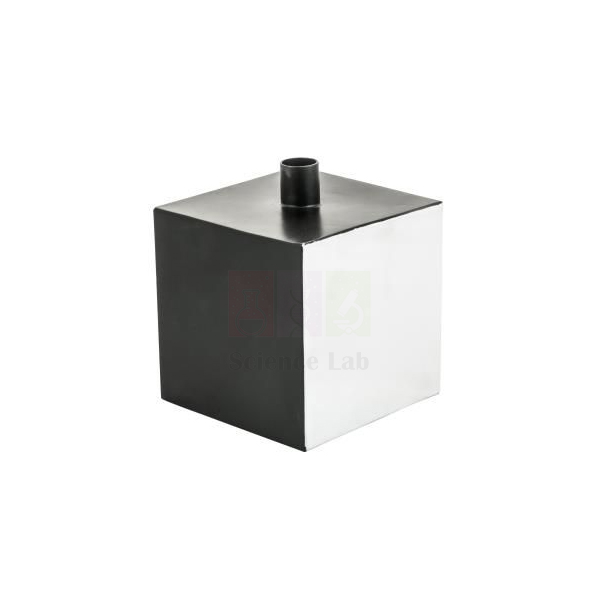
Leslie's Cube
Leslie’s Cube (Product Code: SLE/H/06) is a 4 x 4" hollow cube used to measure thermal radiation properties as a function of temperature, colour and surface texture. Filled with hot water, its differently finished faces sit at the same temperature yet radiate by different amounts, giving a direct, measurable demonstration that surface matters as much as heat. Physics teachers and college practical labs use it to introduce emissivity and black-body ideas, and it is made by Jain Scientific Equipments Pvt Ltd (ScienceLab), Ambala.
Specifications
| Parameter | Detail |
|---|---|
| Dimensions | 4 x 4" |
| Measures | Thermal radiation as a function of temperature, colour and surface texture |
| Needed, not included | Water, thermometer and light source |
Typical Use
Fill the cube with hot water and place a thermometer in it so the internal temperature is known. Point a radiation sensor or an infra-red thermometer at each face in turn from the same distance and record the readings: although every face is at the same temperature, the dark and dull faces register more radiation than the shiny ones. Repeat as the water cools, or refill with water at different temperatures, to show how emitted radiation rises steeply with temperature.
The experiment connects directly to everyday design choices — why radiators are often painted, why vacuum flasks are silvered and why solar collectors are dark. Have students predict the order of the faces before measuring, then compare predictions with data. Empty and dry the cube after use and avoid scratching or marking the faces, since their finish is what the lesson depends on. For institutions sourcing physics lab equipment in India, it pairs naturally with radiation cans for a complete radiation unit.
Manufacturer
Leslie’s Cube is part of the physics range offered by ScienceLab, the brand under which Jain Scientific Equipments Private Limited of Ambala, Haryana, trades. As a physics instruments supplier in India that also serves international markets, the company outlines its work on the company profile page.
Related Laboratory Equipment
Items that complete a Leslie’s cube practical:
- Immersion Thermometer — measures the water temperature inside the cube.
- Thermometer, Infra Red, Hand Held — a quick way to compare readings from each face.
- Hot Plate General Purpose — heats the water before filling.
- Radiation Can Set — follows on with absorption and cooling comparisons.
See the full Heat category for more thermal physics apparatus.
Frequently Asked Questions
What size is the cube?
It measures 4 x 4".
What else do I need?
Water, a thermometer and a light source are needed but not included. A radiation sensor or infra-red thermometer is also useful for comparing the faces.
What does the experiment demonstrate?
How thermal radiation depends on temperature, colour and surface texture — the basis of emissivity and good and poor emitters.
Can boiling water be used?
Hot water is the normal method. Please check with us about any upper temperature limit before pouring in boiling water.
How do I keep the faces in good condition?
Wipe gently with a soft dry cloth, avoid abrasive cleaners and never stack items on the cube.
What should our purchase office include in an enquiry?
Product code SLE/H/06, quantity, billing and delivery details, and any tender format you must follow; we reply with a formal quotation.
Request a Quote
For pricing, write to us through the contact page or add Leslie’s Cube to the enquiry cart.
Last updated: 24 September 2026
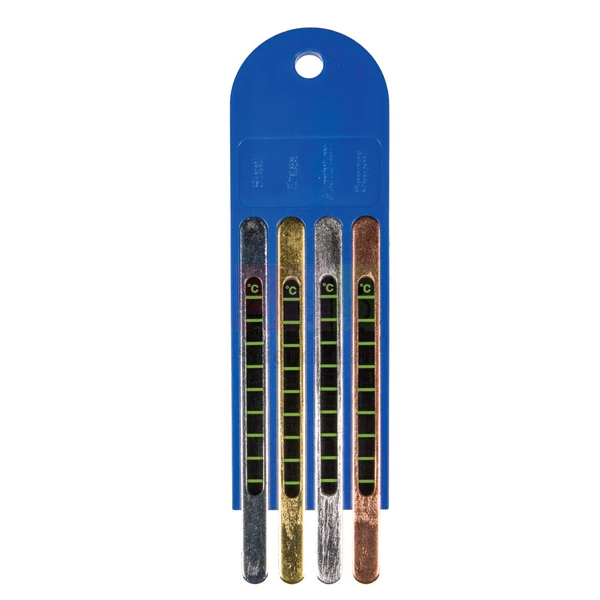
Thermal Conductivity Bars
Thermal Conductivity Bars (Product Code: SLE/H/07) test the conductivity of four metals at once: steel, brass, aluminium and copper strips are connected to a strip thermometer and mounted side by side on a plastic base. Dip the ends into a warm water bath and the strip thermometer shows which metal carries heat along its length fastest. Science teachers use it to make conduction visible to a whole class, and it forms part of the school physics lab equipment in India made by Jain Scientific Equipments Pvt Ltd (ScienceLab), Ambala.
Specifications
| Parameter | Detail |
|---|---|
| Metals | Steel, brass, aluminium and copper (4 strips) |
| Metal strip size | 5-1/4" L x 3/8" W x 3/8" D |
| Temperature indication | Strips connected to a strip thermometer |
| Base | Plastic, 7" L |
| Included | Instructions |
Typical Use
Prepare a shallow bath of warm water, hold the unit by its plastic base and dip the ends of all four strips in together so each metal starts under identical conditions. Watch the strip thermometer: the reading advances along the copper strip first, followed by aluminium, then brass, with steel lagging well behind. Because all four are tested at once, there is no need to repeat runs and compare them from memory, and the result is obvious even from the back of the room.
Follow-up questions work well here: why are cooking pans often made with copper or aluminium bases, why do steel spoon handles stay cooler, and how does conductivity relate to the metals’ structure? Let the bars return to room temperature before a second run, dry them after use and keep the strip thermometer away from direct flames or very hot surfaces. The unit makes a compact, hands-on addition to any school physics lab equipment set for heat.
Manufacturer
ScienceLab, the trading name of Jain Scientific Equipments Private Limited, produces these conductivity bars in Ambala, Haryana, alongside a wide range of heat and energy apparatus for customers in India and international markets. Details about the company are on the profile page.
Related Laboratory Equipment
Useful with, or as follow-ons to, the conductivity bars:
- Glass Beaker — a simple container for the warm water bath.
- Water Bath — holds the bath at a steady temperature for repeat runs.
- Heat Conducto meter — a paraffin-based comparison across five metals.
- Heat Transfer Kit — measures heat flow through a bar between two containers.
More conduction and convection apparatus is in the Heat category.
Frequently Asked Questions
Which metals are compared?
Steel, brass, aluminium and copper, all tested at the same time.
How big are the strips and base?
Each metal strip is 5-1/4" long, 3/8" wide and 3/8" deep, on a 7" long plastic base.
Do I need a separate thermometer?
No, the strips are connected to a strip thermometer that shows the heat moving along each metal. You only need a warm water bath.
How hot should the water be?
Warm water is enough to show the effect. Avoid boiling water or flames near the plastic base; the included instructions describe the method.
Is it suitable for students to use themselves?
Yes, with supervision around the water bath. It is small enough for group practical work as well as teacher demonstrations.
Can you quote for several units across schools?
Yes. Send the quantity of SLE/H/07, school names and delivery addresses through our contact page, for India or international delivery.
Request a Quote
Place your enquiry on the contact page, or add the Thermal Conductivity Bars to the enquiry cart with the rest of your heat apparatus list.
Last updated: 24 September 2026
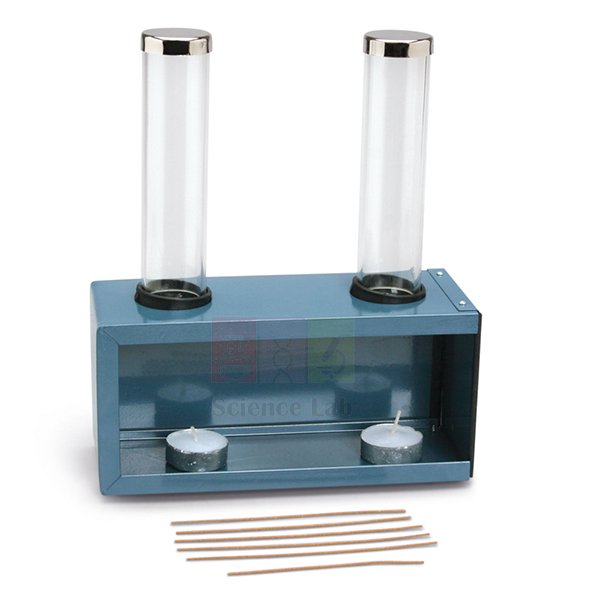
Convection of Gas Apparatus
Convection of Gas Apparatus (Product Code: SLE/H/08) is used to study convection currents in air. It consists of a metal box measuring 9" W × 4" D × 4" H with a removable glass front and 2 chimneys, supplied with touch paper and instructions. Smoke from the touch paper traces the moving air so students can actually watch warm air rise and cool air sink to replace it. A dependable piece of junior science lab equipment, it is made by Jain Scientific Equipments Pvt Ltd (ScienceLab), Ambala.
Specifications
| Parameter | Detail |
|---|---|
| Purpose | Studying convection currents in air |
| Body | Metal box, 9" W × 4" D × 4" H |
| Front | Removable glass front |
| Chimneys | 2 |
| Supplied with | Touch paper and instructions |
Typical Use
Slide out the glass front, stand a small lit candle (not listed among the contents) beneath one chimney and refit the glass. Light a piece of touch paper, blow it out so it smoulders, and hold it just above the second chimney. The smoke is drawn down that chimney, travels across the box and rises out through the chimney above the flame, drawing a visible loop of circulating air. The glass front lets the whole class follow the smoke path inside the box.
The demonstration explains everyday effects such as sea breezes, room ventilation, chimney draught and why heaters are placed low and air-conditioners high. Ask students to predict what will happen if the candle is moved under the other chimney, then test it. Carry out the activity in a well-ventilated room with a heat-resistant mat under the box, and let the metal cool before handling. It suits middle-school science lessons as well as introductory physics, and belongs in any educational laboratory equipment set in India covering the three modes of heat transfer.
Manufacturer
This apparatus is built by Jain Scientific Equipments Private Limited, which trades as ScienceLab from Ambala, Haryana. The company is a registered MSME (Udyam UDYAM-HR-01-0003714), and its export orders move under Importer-Exporter Code AAECJ8618A issued by DGFT, serving buyers in India and international markets. Learn more on the company profile.
Related Laboratory Equipment
Pair this with apparatus for the other modes of heat transfer:
- Apparatus Convection In Liquid — shows the same principle in water.
- Convection in Air Apparatus — an alternative design for air convection studies.
- Thermal Conductivity Bars — covers conduction in metals.
- Radiation Kit — completes the set with radiation and absorption.
Explore more in the Heat category.
Frequently Asked Questions
What is included?
The metal box with removable glass front and 2 chimneys, touch paper and instructions.
What heat source do I need?
A small candle placed under one chimney is the usual choice. It is not listed among the contents, so please arrange one locally.
How large is the box?
It measures 9" wide, 4" deep and 4" high.
Why is the front made of glass?
So students can see the smoke moving inside the box; it is removable for placing and lighting the candle.
Can I reorder touch paper?
Please ask us about refill touch paper when you order; we will confirm availability.
Can you supply it for export?
Yes, we ship to institutions and distributors in India and international markets; include SLE/H/08, quantity and destination in your enquiry.
Request a Quote
Ask for a quotation through our contact page, or add the Convection of Gas Apparatus to the enquiry cart.
Last updated: 24 September 2026
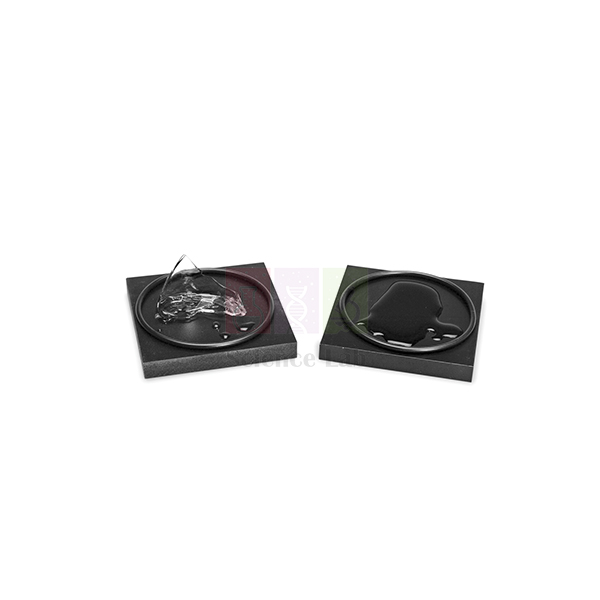
Ice Melting Kit
Ice Melting Kit (Product Code: SLE/H/09) is a surprising demonstration of thermal conductivity built around 2 identical-looking squares. Place a piece of ice on each: on one square the ice starts melting immediately, while on the other it remains unchanged. The puzzle grabs students’ attention and leads straight into a discussion of how heat moves through materials, making it a memorable hands-on science kit for primary and middle school. It is made by Jain Scientific Equipments Pvt Ltd (ScienceLab), Ambala.
Key Details
| Parameter | Detail |
|---|---|
| Type | Conductivity demonstration kit |
| Contents | 2 identical squares |
| Effect shown | Ice melts immediately on one square and remains unchanged on the other |
| Needed, not included | Ice |
| Suitable for | Classroom demonstrations and small-group enquiry on heat conduction |
Typical Use
Before adding ice, ask students to touch both squares and say which one feels colder. Most will pick one of them, even though both have been sitting in the same room at the same temperature. Then set an ice cube on each square at the same moment. The ice on the square that felt colder begins to melt at once, because that square conducts heat from the room into the ice quickly; on the other square, which conducts poorly, the ice hardly changes. The same idea explains why that square felt colder — it was drawing heat out of fingers faster.
Use the result to challenge the common idea that some materials are “naturally cold”, and link it to real examples like metal railings in winter or a tiled floor versus a carpet. For a stronger lesson, let groups record how long the ice takes to disappear on each square and write their own explanation before the teacher reveals it. Wipe the squares dry afterwards. It is an easy, low-mess addition for teachers building a science kit for students in India.
Manufacturer
ScienceLab is the trading identity of Jain Scientific Equipments Private Limited, an Ambala, Haryana maker of classroom demonstration kits and laboratory apparatus. Schools and distributors in India and international markets buy from its range; the company profile has the background.
Related Laboratory Equipment
Continue the conduction topic with these items:
- Thermometer, Infra Red, Hand Held — shows students that both squares start at the same temperature.
- Thermal Conductivity Bars — compares how well four metals conduct.
- Heat Conducto meter — ranks five metals by conduction using paraffin.
- Heat Transfer Kit — measures heat flowing from hot to cold water through a bar.
Browse the Heat category for more demonstrations.
Frequently Asked Questions
How does the kit work?
The two squares look identical but conduct heat very differently, so ice melts immediately on one and stays unchanged on the other.
What materials are the squares made of?
The listing does not state the materials. If you need them for lesson planning or a tender specification, please contact us.
Does it need power, heating or chemicals?
No. Only ice is needed; the squares work at room temperature.
Which age group is it for?
It works well from primary level upward because the effect is visible without measurement, and older students can add timing and explanation.
How do I care for the squares?
Dry them after each use and store them flat so the surfaces stay clean and undamaged.
Can we order one kit per group?
Yes. Tell us how many kits (SLE/H/09) you need and where to deliver, in India or overseas, and we will quote accordingly.
Request a Quote
Send your requirement through our contact page, or put the Ice Melting Kit in the enquiry cart with your other science kits.
Last updated: 24 September 2026
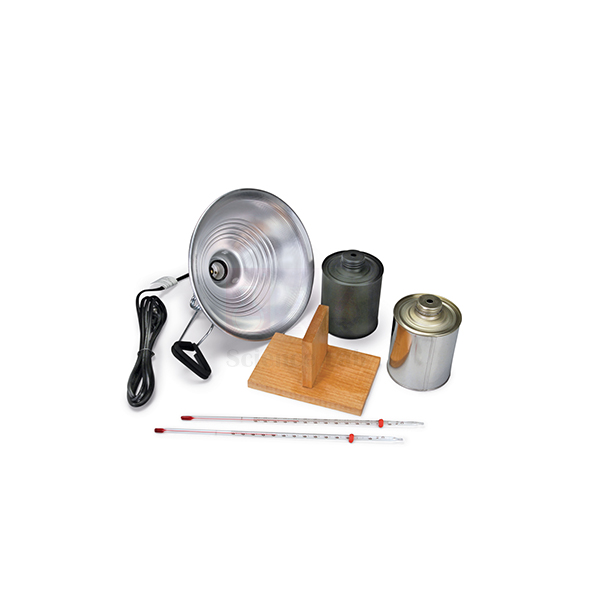
Radiation Kit
Radiation Kit (Product Code: SLE/H/10) is a complete set-up for examining how light and dark surfaces absorb heat from a lamp. It pairs a 6-oz black metal can with a 6-oz shiny metal can, adds two insulating lids and two thermometers, and includes a clamp lamp with reflector as the radiant source, plus instructions. Because nothing else has to be sourced, it is a straightforward radiation experiment kit in India for schools that want the lesson ready out of the box. It is made by Jain Scientific Equipments Pvt Ltd (ScienceLab), Ambala.
Specifications
| Parameter | Detail |
|---|---|
| Purpose | Examining heat absorption of light versus dark surfaces |
| Cans | 6-oz black metal can and 6-oz shiny metal can |
| Lids | 2 insulating lids |
| Thermometers | 2, range –20 to 50° C |
| Radiant source | 110-V AC clamp lamp with reflector |
| Documentation | Instructions included |
Typical Use
Fill both cans with the same volume of cool water, fit the insulating lids and push a thermometer through each so the bulb sits in the water. Clamp the lamp so its reflector points midway between the cans at equal distance, switch it on and read both thermometers at fixed intervals. The black can’s temperature climbs noticeably faster than the shiny can’s, giving a clear data set on absorption that students can graph and compare.
After the lamp is switched off, keep recording to see which can cools faster, which extends the lesson from absorption to emission. The thermometers read from –20 to 50° C, so start with water well below the top of that range and do not let the lamp run so long that readings go past 50° C. Let the lamp cool before unclamping it. The kit suits middle and secondary school practicals and makes a tidy addition to any science lab kit for heat and energy.
Manufacturer
Jain Scientific Equipments Private Limited assembles this kit under the ScienceLab brand at its Ambala, Haryana operation, which serves schools, colleges and distributors in India and international markets. Company details are available on the ScienceLab profile.
Related Laboratory Equipment
Apparatus that fits the same radiation unit:
- Radiation Can Set — a black and bright tin pair for cooling-curve work with your own thermometers.
- Leslie’s Cube — compares radiation emitted by different surface finishes.
- Stop Clock (Metal Case) — times the readings accurately.
- Heat Absorption & Radiation Comparator — another approach to dark versus shiny surfaces.
The Heat category lists further heat apparatus.
Frequently Asked Questions
What is in the kit?
A 6-oz black metal can, a 6-oz shiny metal can, 2 insulating lids, 2 thermometers, a clamp lamp with reflector and instructions.
What voltage is the lamp?
The clamp lamp listed is rated 110-V AC. If your mains supply differs from 110 V, as it does in India, discuss a suitable arrangement with us through the contact page before ordering.
What range do the thermometers cover?
Each thermometer reads from –20 to 50° C, which suits water-warming experiments under a lamp.
Can I use sunlight instead of the lamp?
Yes, direct sunlight works as a radiant source as long as both cans receive the same exposure.
Is calibration paperwork available for the thermometers?
Talk to us about any documentation your department needs; we confirm what can be supplied at quotation stage.
Do you supply complete kits in bulk?
Yes, for schools, colleges and distributors in India and abroad. Share quantity, product code SLE/H/10 and delivery details.
Request a Quote
Request a price on the contact page, or add the Radiation Kit to your enquiry cart for a combined quotation.
Last updated: 24 September 2026
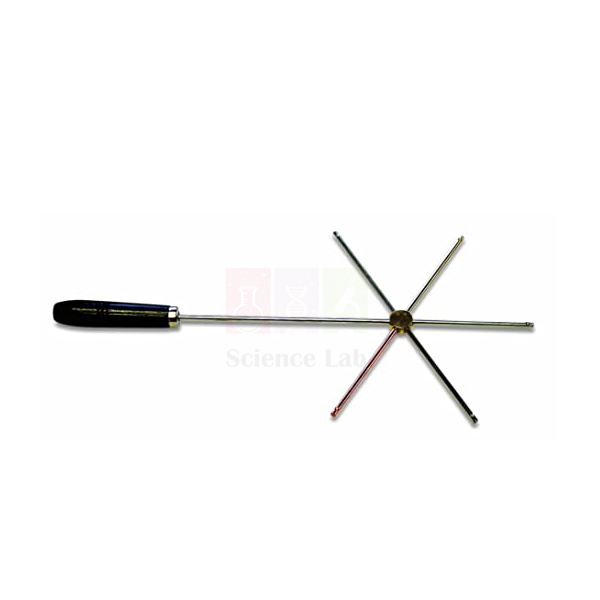
Heat Conducto meter
Heat Conducto meter (Product Code: SLE/H/11) demonstrates the rate of heat conduction in 5 different metals — aluminium, brass, copper, nickel and steel. The rods are equally spaced on a brass disk mounted on an insulated handle, and each has a cavity in its outer end to hold paraffin, so the order in which the wax melts reveals which metal conducts heat fastest. Teachers use it as a quick, visual comparison that needs no thermometers, and it comes from Jain Scientific Equipments Pvt Ltd (ScienceLab), a science apparatus manufacturer in India based in Ambala.
Specifications
| Parameter | Detail |
|---|---|
| Number of rods | 5, each of a different metal |
| Metals | Aluminium, brass, copper, nickel and steel |
| Rod size | 15 mm diameter, 95 mm long |
| Rod ends | Cavity in the outer end of each rod for holding paraffin |
| Mounting | Rods equally spaced on a brass disk |
| Handle | Insulated |
Typical Use
Press a small amount of paraffin wax into the cavity at the outer end of each rod. Holding the unit by its insulated handle, heat the brass disk evenly over a burner flame so that all five rods receive heat from the same source at the same time. As heat travels outward, the paraffin melts first at the end of the best conductor, and the class notes the order in which the remaining cavities follow. Because the rods are equally spaced and of identical 15 mm by 95 mm size, the comparison is fair and the ranking can be read straight off the apparatus.
Students can then relate the order they observed to tables of thermal conductivity and discuss why copper is used in heat exchangers and cookware while steel is chosen where slower heat flow is useful. Timing each melt with a stop clock adds a simple quantitative element to this physics experiment for school labs. Let the disk cool completely before cleaning out old wax, and store the unit so the rods are not bent.
Manufacturer
Made under the ScienceLab name, the Heat Conducto meter is one of many heat apparatus items from Jain Scientific Equipments Private Limited in Ambala, Haryana. The company supplies teaching laboratories throughout India and in international markets; see the company profile for more about its work.
Related Laboratory Equipment
Items you need or may want with the conducto meter:
- Paraffin — the wax placed in each rod’s cavity.
- Bunsen Burner — a flame source for heating the brass disk.
- Stop Clock (Metal Case) — times how long each cavity takes to melt.
- Thermal Conductivity Bars — a water-bath comparison using a strip thermometer.
Discover more apparatus in the Heat category.
Frequently Asked Questions
Which metals does it compare?
Five: aluminium, brass, copper, nickel and steel, one rod of each.
What size are the rods?
Each rod is 15 mm in diameter and 95 mm long, mounted equally spaced on a brass disk.
Is paraffin supplied?
Paraffin is not listed as part of the unit; it is available separately (see related items) or can be sourced locally.
How do I hold it while heating?
Use the insulated handle and keep hands clear of the brass disk and rods, which become hot. Place it on a heat-resistant mat to cool.
How is it different from Thermal Conductivity Bars?
This unit uses melting paraffin on 5 metals heated from a common disk, while the bars use a strip thermometer on 4 metals dipped in warm water.
What warranty and delivery terms apply?
These are confirmed on your quotation. Send SLE/H/11, quantity and destination, in India or abroad, through the contact page.
Request a Quote
For prices, contact us through the contact page or add the Heat Conducto meter to the enquiry cart.
Last updated: 24 September 2026
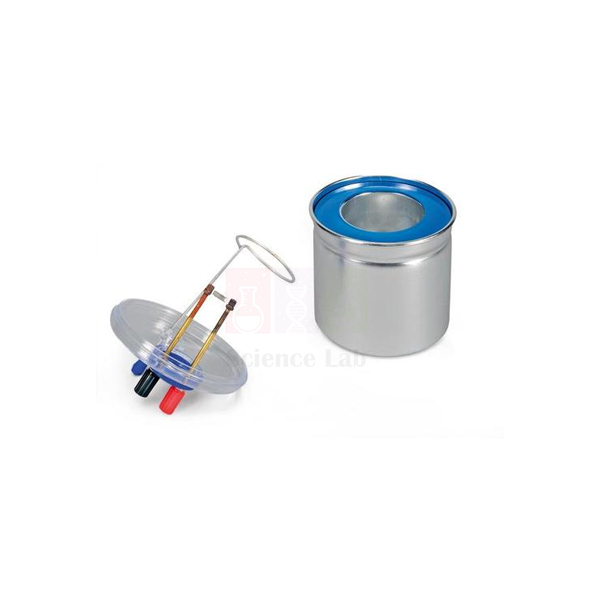
Calorimeter, Electric
Calorimeter, Electric (Product Code: SLE/H/12) is an electrically heated calorimeter for experiments in which a measured current warms a known quantity of water, so students can compare the electrical energy supplied with the heat the water gains. Its moulded cover carries a 1.5-ohm heating coil with standard binding posts, and the unit operates at 4 A from a 6-V lantern battery. Physics teachers in secondary schools, junior colleges and teacher-training labs use it for specific heat and electrical-energy practicals. It is made by Jain Scientific Equipments Pvt Ltd (ScienceLab), Ambala, as part of its calorimeter lab equipment for schools in India and international markets.
Specifications
| Parameter | Detail |
|---|---|
| Type | Electrically heated calorimeter with heating coil in the cover |
| Heating coil | 1.5-ohm coil mounted in a moulded cover |
| Operating current | 4 A |
| Power source | 6-V lantern battery (not included) |
| Electrical connections | Standard binding posts on the cover |
| Coil protection | Supporting posts and coil coated to prevent electrolysis |
| Supplied with | Insulated stirrer, single-hole rubber stopper and instructions |
Typical Use
In a standard practical, students pour a weighed amount of water into the calorimeter, fit the cover so the coil is immersed, and hold a thermometer in the single-hole rubber stopper. The binding posts are then wired to the 6-V lantern battery, the coil carries its 4 A working current, and the class stirs gently with the insulated stirrer while noting the temperature every half-minute or so. From the current, the coil resistance and the heating time they calculate the electrical energy delivered and set it against the heat absorbed by the water, which opens a discussion of heat losses and specific heat capacity.
The coating on the coil and its supporting posts prevents electrolysis while they sit in water, so the measured temperature rise comes from resistive heating rather than chemical side reactions. Practical tips: switch off between runs so the battery is not drained, keep stirring at an even pace for uniform water temperature, and dry the vessel and cover after the lesson. It is a compact addition to school physics lab equipment in India and elsewhere wherever heat and electricity are taught together.
Manufacturer
Calorimeter, Electric is produced by Jain Scientific Equipments Private Limited, the company behind the ScienceLab brand, from its base in Ambala, Haryana. For institutional buyers who need vendor registration details, the company's GSTIN is 06AAECJ8618A1ZT and its Legal Entity Identifier (LEI) is 3358004HRD1JIVXKYX49. More background on the business is in our company profile.
Related Laboratory Equipment
Items that complete an electrical-heating calorimetry practical:
- Ammeter Voltmeter — to monitor the current and voltage feeding the heating coil
- Digital Thermometer — for reading the water temperature as it rises
- Stop Clock — to time the heating interval used in the energy calculation
- Power Supply Variable — a bench DC source; check its output against the 6-V, 4 A requirement before using it instead of a battery
- Calorimeter Set, Copper, Joules — a copper calorimeter set for comparison heat experiments
More thermal apparatus is listed in our Heat equipment range.
Frequently Asked Questions
Is the 6-V lantern battery included?
No. The calorimeter needs a 6-V lantern battery, which is not included and is normally sourced locally.
What current does the heating coil draw?
The unit operates at 4 A through its 1.5-ohm coil, so use connecting leads and a source that can handle that current.
What comes with the calorimeter?
An insulated stirrer, a single-hole rubber stopper and instructions are supplied along with the calorimeter and its coil cover.
Why are the coil and posts coated?
The coating prevents electrolysis while the coil is immersed in water, keeping the experiment about heating and protecting the coil over repeated use.
Is a thermometer supplied?
A thermometer is not listed among the included items. A suitable one can be added to your order — contact us with your requirement.
Can a calibration certificate be provided?
This is a teaching calorimeter; if your institution needs any calibration documentation, please discuss it with us through the contact page before ordering.
What warranty applies?
Warranty terms are confirmed with each quotation — ask us for the current terms.
Do you supply schools in bulk or overseas?
Yes. We supply schools, colleges and distributors in India and international markets; share the quantity and delivery location when you enquire.
Request a Quote
To price Calorimeter, Electric for your laboratory, send your quantity through our contact page or add it to the enquiry cart.
Last updated: 24 September 2026
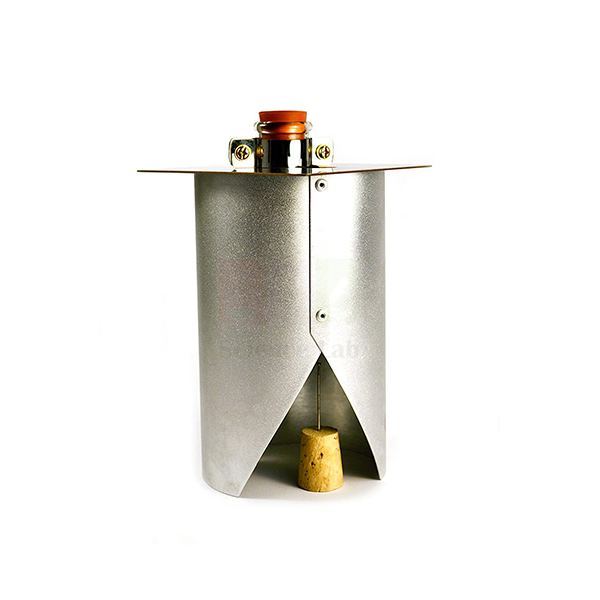
Food Calorimeter
Food Calorimeter (Product Code: SLE/H/13) is a classroom device for finding out how much energy solid foods release when they burn. A food sample is pinned on the stand beneath a flask of water, and the rise in the water's temperature as the sample burns shows how much heat it gave off. Biology, home-science and physics teachers use it in nutrition and energy lessons, and it is made by Jain Scientific Equipments Pvt Ltd (ScienceLab), Ambala, as part of its school biology lab equipment for India and international markets.
Key Details
| Parameter | Detail |
|---|---|
| Type | Food calorimeter for solid food samples |
| Purpose | Measuring the calories released when solid foods burn |
| Method | Food pinned on the stand under a flask of water; the water's temperature change is measured as the food burns |
| Result | Heat evolved per gram of food burned, compared with food labels or other burned samples |
| Lesson fit | Several samples can be tested within one class period |
| Supplied with | Instructions |
Typical Use
Students weigh a small piece of food such as a nut, a cracker or a piece of dried bread, pin it on the stand and light it, with a flask of water held above. They read the water temperature before ignition and again when the sample stops burning, then reweigh what is left. Using the mass of water, its temperature rise and the specific heat capacity of water, they work out the heat released and divide it by the mass of food burned to get a heat-per-gram value. Comparing that figure with the energy printed on the food label is the most memorable part of the lesson, because the class result is usually lower — which leads straight into a discussion of heat escaping to the air and incomplete burning.
Since the procedure is short, a class can test several foods in one period and compare fatty snacks with starchy ones. To build a complete calorimeter experiment kit, pair the device with a thermometer, a balance and a small flame source. Work on a heat-resistant surface in a ventilated room, keep safety goggles on while samples burn, and check for nut allergies in the group before using nuts as samples.
Manufacturer
ScienceLab is the brand name under which Jain Scientific Equipments Private Limited makes laboratory apparatus in Ambala, Haryana, and the Food Calorimeter is produced there for school and college laboratories. You can read about the company's background and product range in our company profile.
Related Laboratory Equipment
Useful additions for a food-energy practical:
- Triple Beam Balance — to weigh each food sample before and after burning for the per-gram figure
- Laboratory Thermometer — for reading the water temperature before and after each burn
- Glass Spirit Lamp — a steady flame for igniting the food sample
- Safety Goggles — eye protection for students while samples burn
- Calorimeter Food — another food calorimeter model listed in our biology range
Browse other thermal teaching apparatus in the Heat category.
Frequently Asked Questions
What kinds of food can be tested?
The device is designed for solid foods, which can be pinned on the stand and burned beneath the water.
How many samples can a class test in one lesson?
The procedure is simple enough for students to test multiple samples within one class period.
Is the water flask included?
The method uses a flask of water above the stand, but the flask is not listed as a separate item. Please contact us to confirm what is packed with your order.
Do I need a thermometer?
Yes — the experiment depends on measuring the water's temperature change, and a thermometer is not listed among the supplied items. See the Laboratory Thermometer above or ask us to quote one.
Why are class results lower than the values on food labels?
Some heat escapes to the surrounding air and some food may not burn completely, so classroom figures normally fall below label values. Comparing the two is part of the learning.
Are instructions provided?
Yes, instructions are included with the Food Calorimeter.
What should an institutional enquiry include?
Share the number of units, the delivery location in India or abroad, and any accessories you want quoted alongside through our contact form; warranty terms are confirmed in the quotation.
Request a Quote
For prices and delivery details on the Food Calorimeter, get in touch with us or place it in your enquiry cart.
Last updated: 24 September 2026