- Physics Lab Equipment
- Chemistry Lab Equipment
- Biology Lab Equipment
- Anatomical Lab Equipment
- Learning
- Educational Lab Equipment
- Magnets
- Agriculture
- Astronomy
- Earth Science
- Geography Lab Equipment
- Safety Lab Coat
- Laboratory
- Meteorological
- Electricity & Magnetism
- Heat
- School Lab Equipment
- Lab Glassware
- Science Lab Equipment
- Tvet Lab Equipment
- Robotics Kits Supplier and Manufacturer for Schools India
- Math Lab Equipment Manufacturers and Exporters in Ambala
- STEM Kits Manufacturers and Supplier India
- Engineering Lab Equipment
- Hospital Lab Equipment
- Water, Sanitation & Hygiene Supplies
- Cold Chain, Solar & Communication Equipment
- Nutrition
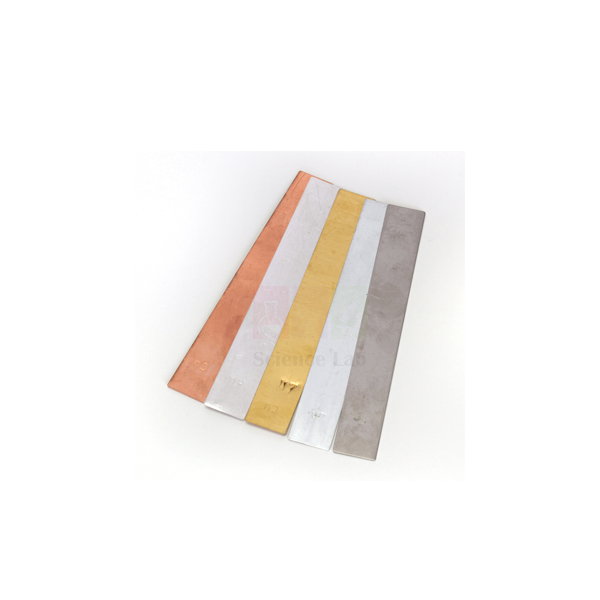
Metal Strips Set
Metal Strips Set (Product Code: SLE/EM/06) puts five different metals side by side in one matched set: one strip each of aluminium, brass, copper, steel and zinc, all cut to the same 3/4 x 5-1/4 inch size. Because every strip has identical dimensions, any difference students observe — in cell voltage, in reaction with an acid or in how quickly it tarnishes — comes from the metal itself rather than from its shape. Manufactured by Jain Scientific Equipments Pvt Ltd (ScienceLab), Ambala, it is a low-cost addition to school physics lab equipment in India and to chemistry benches studying metals and electrochemistry.
Specifications
| Parameter | Detail |
|---|---|
| Metals included | Aluminium, brass, copper, steel and zinc |
| Quantity | One strip of each metal |
| Strip size | 3/4 x 5-1/4 inches (each strip) |
| Form | Flat strips, usable as electrodes or test samples |
Typical Use
The most common use is building simple cells from two different strips dipped in an electrolyte such as salt water or dilute acid. Students swap pairs — zinc with copper, aluminium with copper, steel with zinc, and so on — read the voltage on a meter and rank the metals, arriving at their own version of the reactivity or electrochemical series. The same strips can be compared for their reaction with dilute acid, for their appearance after exposure to moist air, and as the two plates of a lamp-and-electrode conductivity test.
Clean the surface of each strip with fine abrasive paper before a voltage comparison, since oxide films change the readings. After contact with electrolytes, rinse the strips with water and dry them straight away; the steel strip in particular will rust if left damp. Used this way, the set becomes a flexible chemistry teaching kit for India’s secondary syllabus, where the same five metals return in several chapters.
Manufacturer
ScienceLab is the trading name of Jain Scientific Equipments Private Limited, an equipment maker based in Ambala, Haryana, that prepares sets like this one for school and college laboratories. Details of the company and its range are on our company profile.
Related Electricity Equipment
Useful companions for metal-strip cell and electrode experiments:
- Electrodes, Copper — a pack of 12 copper strips when every group needs its own copper electrode
- Student Voltaic Cell Set — a ready set for building simple voltaic cells
- Digital Multimeter — millivolt and volt DC ranges for comparing metal pairs
- Crocodile Clips & Leads — leads with a clip at each end that grip flat strips securely
- Glass Beaker — borosilicate beakers to hold the electrolyte
See the full Electricity Equipments range for more circuit and electrochemistry items.
Frequently Asked Questions
Which metals are in the Metal Strips Set?
One strip each of aluminium, brass, copper, steel and zinc.
Are all the strips the same size?
Yes. Every strip measures 3/4 x 5-1/4 inches, so comparisons between metals are fair. The thickness is not listed in our current documentation; contact us if you need it.
Does the set include an electrolyte, beaker or leads?
No. The set consists of the metal strips; electrolyte, container and connecting leads are ordered separately.
Can I order a single metal as a replacement?
Please ask through the contact page. Copper strips are also available on their own as Electrodes, Copper in packs of 12.
How should the strips be stored?
Clean and dry them after each use and keep them apart from damp items. Brass and copper will darken with time; a light rub with abrasive paper restores a bright surface.
What information do you need for a school or tender quotation?
The number of sets, delivery location, any related items (meters, leads, beakers) you want quoted together, and your institution’s tender format if one applies.
Do you export this set?
Yes. We supply institutions and distributors in India and international markets.
Request a Quote
Ask for a price on the Metal Strips Set through our contact page, or collect several items in the enquiry cart and send them to us in one request.
Last updated: 24 September 2026
444.jpg)
Jumper Wires (male to male)
Jumper Wires (male to male) (Product Code: SLE/EM/07) are 6-inch flexible hook-up leads with a connector pin at each end, sold in a pack of 40. They push straight into solderless breadboard holes and header sockets, so students can build, test and rearrange circuits without soldering, and they also top up the wiring in most circuit kits — for example when patching extra connections on a digital electronics trainer kit. The pack is supplied by Jain Scientific Equipments Pvt Ltd (ScienceLab), Ambala, to school, college and polytechnic electronics labs.
Specifications
| Parameter | Detail |
|---|---|
| Type | Male-to-male jumper wires |
| Length | 6 inches (each wire) |
| Pack quantity | 40 wires |
| Suitable for | Breadboarding and use with most circuit kits |
| Kit support | Provides additional materials for select kits |
Typical Use
On a breadboard, jumper wires carry signals and supply rails between components that are not in the same row: from a battery or bench supply to the power rails, from a switch to an LED and resistor, or from a sensor to a microcontroller pin. In a logic gates experiment kit or a transistor practical, a pack of 40 is enough to lay out a complete circuit and still have spares for the changes students make while troubleshooting. The 6-inch length reaches across a standard board without leaving loose loops that snag on components.
To keep them working, remove a wire by gripping the connector housing rather than pulling on the cable, and straighten bent pins before pushing them back into a board. Use them only in low-voltage circuits, never for mains wiring. Returning wires to their pack or a small box at the end of each lab session keeps the full count ready for the next group.
Supplier
These jumper wires are supplied by Jain Scientific Equipments Private Limited, trading as ScienceLab, of Ambala in Haryana. Alongside the equipment made at its own facility, the company sources everyday lab consumables so institutions can order a complete requirement from one vendor — see our company profile.
Related Electricity Equipment
Other items used when wiring and testing student circuits:
- Digital Multimeter — for checking voltages, currents and resistances on a breadboard circuit
- Crocodile Clips & Leads — clip-ended leads for terminals and component legs a pin cannot reach
- Banana/Alligator Cords — for apparatus and power supplies fitted with banana sockets
- Electrics Kit — a boxed set of motors, bulbs, buzzers and switches for circuit-building classes
Find more leads, meters and circuit apparatus in our Electricity Equipments range.
Frequently Asked Questions
How many jumper wires are in a pack?
Forty. Each pack contains 40 male-to-male wires.
How long is each wire?
Each wire is 6 inches long.
Will they fit my breadboard?
Male-to-male jumpers of this kind are made for solderless breadboards and header sockets. Pin dimensions are not listed in our current documentation, so contact us if you need confirmation for a particular board.
Which colours are included?
The colour mix is not specified in our listing; please ask when you request a quotation if colour coding matters for your lab.
Can they be used with mains-powered circuits?
No. They are intended for low-voltage breadboard and kit circuits only.
Can you supply several packs for a whole lab?
Yes. Multiple packs can be supplied to schools, colleges and distributors in India and international markets.
Request a Quote
Tell us how many packs you need through the contact page, or add the jumper wires to your enquiry cart with the rest of your electronics order.
Last updated: 24 September 2026

Ampere's Rule Apparatus
Ampere's Rule Apparatus (Product Code: SLE/EM/08) is a physics apparatus used to observe the magnetic field around a current-carrying wire in Grades 9–12 classrooms. Supplied with a manual, one 45-mm compass and six 16-mm compasses, it lets students apply the right-hand rule and see how the field varies with distance and with the plane studied. It is made by Jain Scientific Equipments Pvt Ltd (ScienceLab), an OEM manufacturer, at its own factory in Ambala, India.
Specifications
| Parameter | Detail |
|---|---|
| Demonstrates | Magnetic field around a current-carrying wire; right-hand rule; variation of the field with distance |
| Field planes studied | Perpendicular and parallel to the wire |
| Compasses included | One 45-mm compass and six 16-mm compasses |
| Documentation | Manual included |
| Size | 17.5 x 7.5 x 10 cm |
| Level | Grades 9–12 |
| Required, not included | Regulated DC power supply; banana/alligator cords |
| Product code | SLE/EM/08 |
| Manufacturer | Jain Scientific Equipments Pvt Ltd (ScienceLab) — OEM |
| Country of origin | India (made in Ambala, Haryana) |
What Is the Ampere's Rule Apparatus Used For?
Start with the 45-mm compass beside the wire and the current off, so the needle settles on north. Switch the supply on and the needle turns; reverse the leads and the swing reverses, so the class can predict each direction with the right-hand rule before switching. The six 16-mm compasses are then arranged around the wire in the perpendicular plane to trace the circular field, and moved outwards step by step to show the deflection falling off with distance.
Repeating the layout in the plane parallel to the wire shows how field direction relates to the current along its length. Switch the current on only while readings are being taken, keep magnets and steel items away from the bench, and line the wire up north–south for the clearest deflections. The apparatus works as a front-of-class demonstration and as a magnetism experiment kit for pairs of students at their own benches.
What to Specify When Ordering
- The number of Ampere's Rule Apparatus sets: one for teacher demonstration, or one per student pair for practical work.
- Whether a regulated DC power supply should be quoted, since none is included.
- Whether banana/alligator cords should be quoted with each set, as they are also not included.
- Any extra plotting compasses you want for mapping larger field patterns.
OEM Manufacturer
Jain Scientific Equipments Private Limited, trading as ScienceLab, is the OEM (original equipment manufacturer) of the Ampere's Rule Apparatus and makes it at its own licensed factory at Saha, Ambala, Haryana, India. Purchase departments that register vendors can use the company's GSTIN 06AAECJ8618A1ZT and Legal Entity Identifier 3358004HRD1JIVXKYX49.
Schools, dealers and importers buy the apparatus factory-direct, and replacement compasses or repeat orders can be requested from the manufacturer itself; ask us. The company profile gives further background.
Related Electricity Equipment
What you need to run this experiment, plus a companion demonstration:
- Banana/Alligator Cords — the connecting cords the apparatus requires, with a stacking banana plug and an alligator clip.
- Precision Variable Power Supply — a regulated DC supply with a panel meter and a maximum-voltage limiter.
- Digital Multimeter — DC current ranges for recording the current in each trial.
- Compass Plotting (Clear) — extra plotting compasses for larger field maps.
- Oersted's Law Apparatus — a magnetic needle inside a current frame for the classic Oersted observation.
More electromagnetism apparatus is available in our Electricity Equipments category.
Frequently Asked Questions
What comes with the Ampere's Rule Apparatus?
The Ampere's Rule Apparatus is supplied with a manual, one 45-mm compass and six 16-mm compasses, which together let students detect the field beside the wire and map its pattern around the conductor.
What else is needed to use the Ampere's Rule Apparatus?
The Ampere's Rule Apparatus requires a regulated DC power supply and banana/alligator cords, neither of which is included. Both can be quoted on the same order as the apparatus if your laboratory does not already have them.
What current setting should be used?
A recommended current is not stated in our current product details for the Ampere's Rule Apparatus. The supplied manual covers operation; for guidance before purchase, please contact us and the manufacturer will answer directly.
Which classes is the Ampere's Rule Apparatus designed for?
The Ampere's Rule Apparatus is designed for Grades 9–12, covering the magnetic effect of current, the right-hand rule and how magnetic fields change with distance from a current-carrying wire.
How much bench space does the Ampere's Rule Apparatus take?
The Ampere's Rule Apparatus measures 17.5 x 7.5 x 10 cm, so it fits easily on a student bench next to the power supply, leaving room to arrange the compasses around the wire.
Who manufactures the Ampere's Rule Apparatus?
Jain Scientific Equipments Pvt Ltd, trading as ScienceLab, is the OEM manufacturer of the Ampere's Rule Apparatus, producing it at its own licensed factory at Saha, Ambala, Haryana, India, and supplying schools and dealers factory-direct.
Is a calibration certificate available for the Ampere's Rule Apparatus?
The Ampere's Rule Apparatus is a demonstration apparatus rather than a measuring instrument. If your institution needs documentation, including a calibration certificate, discuss it with us through the contact page when requesting a quotation for India or international delivery.
Request a Quote
Request pricing for the Ampere's Rule Apparatus direct from the manufacturer via our contact page, or add it and its accessories to the enquiry cart.
Last updated: 24 September 2026
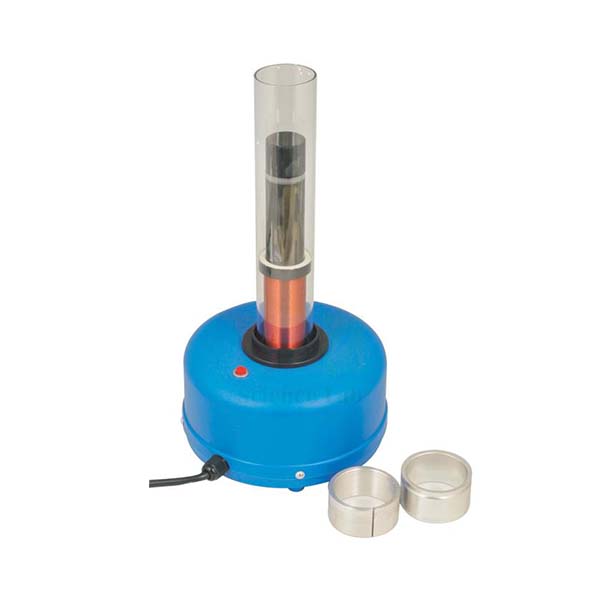
Ring Thrower
Ring Thrower (Product Code: SLE/EM/09) is a teacher-operated demonstration of electromagnetic induction that ends with an aluminium ring shooting up to 12 ft into the air. The ring rests over a coil of wire wound on an iron core. When the coil is energised with alternating current, its changing magnetic field induces an electromotive force (EMF) in the ring; the resulting current sets up an opposing magnetic field, and the repulsion propels the ring upward — Faraday’s law and Lenz’s law in a single, visible event. Manufactured by Jain Scientific Equipments Pvt Ltd (ScienceLab), Ambala, it is an electromagnetic induction kit that needs no assembly: it is ready to use as soon as it is plugged into a wall socket.
Specifications
| Parameter | Detail |
|---|---|
| Demonstrates | Electromagnetic induction, Faraday’s law, Lenz’s law and eddy-current repulsion |
| Construction | Coil of wire wound on an iron core; aluminium ring placed over the core |
| Ring flight height | Up to 12 ft |
| Operation | Coil energised with alternating current; ready to use after plugging into a wall socket |
| Listed power rating | 115-V AC, 60 Hz |
Typical Use
The ring thrower is usually introduced after students have met induction with a magnet and coil, because it turns an abstract rule into something they can watch and hear. With the ring on the core, a short burst of current launches it; the teacher can then ask why an aluminium ring, which is not attracted to a magnet, is pushed away so strongly. Holding the ring down on the core for a moment and then letting go shows that the induced current also warms the metal, a direct link to eddy-current heating. Discussing why a ring with a gap cut in it would not fly helps students see that a closed conducting loop is needed for the induced current to flow.
Keep faces and hands clear of the space above the core, check that nothing overhead is in the ring’s path, and energise the coil only in brief bursts so it does not overheat. The unit belongs with the physics lab equipment India’s senior secondary and undergraduate teachers use for electromagnetic induction, transformers and AC topics.
Manufacturer
The Ring Thrower is made under the ScienceLab brand by Jain Scientific Equipments Private Limited, an Ambala, Haryana manufacturer of physics and general science teaching apparatus. Learn more on our company profile page.
Related Electricity Equipment
Apparatus for the rest of an induction and transformer lesson:
- Primary-Secondary Coils — iron-cored coils with several secondary windings for measuring induction and turns ratio
- Primary and Secondary Coil Set — nested coils with binding posts and a soft iron core for mutual induction
- Demountable Transformer Kit — a laminated core with interchangeable coils for step-up and step-down work
- Apparatus for Studying the Production of Electricity by Induction — a follow-on set for student induction measurements
Explore the full Electricity Equipments range for more electromagnetism demonstrations.
Frequently Asked Questions
What power supply does the Ring Thrower need?
It plugs directly into a wall socket; no separate supply is required. The listed rating is 115-V AC, 60 Hz, so please contact us to confirm the version that matches your local mains before ordering.
How high does the ring go?
The aluminium ring can be propelled up to 12 ft, so use it in a room with adequate ceiling clearance.
Why is the ring made of aluminium?
Aluminium is a good electrical conductor and light in weight, so a strong induced current and a large repulsive force act on a small mass.
Does it work with direct current?
No. The effect depends on a changing magnetic field, which is why the coil is energised with alternating current.
Can students operate it?
It is best run by the teacher as a demonstration, with students observing from a safe distance.
Are spare rings available?
Please ask through the contact page and we will advise on replacement parts.
Do you supply institutions and export customers?
Yes. We supply schools, colleges and distributors in India and international markets.
Request a Quote
For a price on the Ring Thrower, write to us via the contact page or add it to the enquiry cart along with other induction apparatus.
Last updated: 24 September 2026
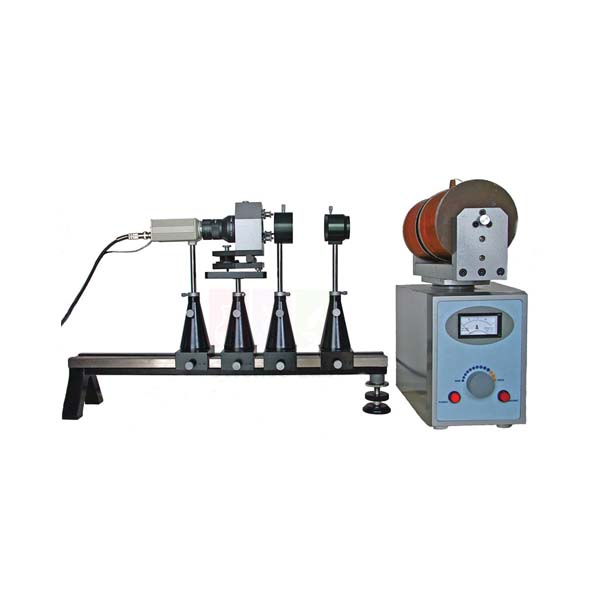
Complete Zeeman Effect Apparatus
Complete Zeeman Effect Apparatus (Product Code: SLE/EM/10) is an integrated bench system for observing the Zeeman effect — the splitting of an atomic spectral line when the emitting atoms are placed in a strong magnetic field. A slim mercury discharge lamp sits between the poles of a built-in, current-controlled electromagnet that reaches up to 1.3 T at the lamp position; the 546.1 nm emission line is isolated by an interference filter, collimated by a lens and resolved with a Fabry-Pérot etalon so that the splitting can be seen and measured. Manufactured by Jain Scientific Equipments Pvt Ltd (ScienceLab), Ambala, a physics instruments supplier in India, it is intended for university and college modern-physics and spectroscopy laboratories.
Specifications
| Parameter | Detail |
|---|---|
| Lamp | Mercury discharge lamp, slim design, AC, 1,500 Vp-p, 5 W |
| Observed emission line | 546.1 nm |
| Maximum magnetic field at lamp position | 1.3 T |
| Electromagnet | Built-in, current-controlled; magnet rotatable 90° for transverse or longitudinal viewing |
| Electromagnet power supply | 90-V DC, 0.5 to 1.4 A, with analog ammeter |
| Fabry-Pérot etalon | Aperture 40 mm; quartz plate separation 2.0 mm; central wavelength 589.3 nm; resolution ≥ 2 × 10⁵; high-reflection bandwidth 100 nm |
| Interference filter | Central wavelength 546.1 nm; transmission bandwidth ≤ 10 nm; peak transmission ≥ 50% |
| Collimating lens | Aperture 37 mm; focal length 110 mm |
| Operating limits | 0 to 40 °C (32 to 104 °F); humidity 35% to 80% |
| Power input | 110-V AC, 60 Hz, 190 W |
| Dimensions | 2 x 0.75 m |
| Weight | 36.4 kg (80 lb) |
Typical Use
With the field off, the etalon shows a set of sharp interference rings from the single mercury line. As the magnet current is raised, each ring splits into components whose separation grows with the field. Viewing across the field (transverse) and along it (longitudinal) — made possible by rotating the magnet through 90° — lets students compare the patterns seen in the two directions and relate them to angular-momentum selection rules. Measuring ring diameters at several magnet currents gives the energy splitting as a function of field, from which the Bohr magneton or the specific charge of the electron can be estimated.
Let the lamp stabilise before recording data, raise the magnet current gradually while noting the ammeter reading, and work in a darkened room for the clearest rings. Handle the etalon, filter and lens only by their mounts and keep their optical surfaces covered when not in use. Because it combines a precision etalon with collimating optics, the system also serves the interferometry side of optics lab equipment in India’s postgraduate departments.
Manufacturer
Jain Scientific Equipments Private Limited, which trades as ScienceLab, is based in Ambala, Haryana, and builds laboratory systems for higher-education physics as well as school science. Our company profile describes the company and its range.
Related Laboratory Equipment
Other apparatus for atomic physics and spectroscopy practicals:
- Complete Properties of Electrons Apparatus — a second route to the electron’s specific charge through beam deflection and focusing
- Spectrometer — a collimator-and-telescope spectrometer with vernier scale for line-spectrum measurements
- Sodium Spectral Lamp — a line source for companion spectrometer experiments
- Spectral Lamp Power Supply with Lamp Holder — a compact supply for running spectral lamps on the optical bench
See our Electricity Equipments range for further electromagnetism and electron-physics apparatus.
Frequently Asked Questions
Which spectral line is observed?
The 546.1 nm line of the mercury lamp, isolated by an interference filter centred on 546.1 nm with a transmission bandwidth of 10 nm or less.
How strong is the magnetic field?
Up to 1.3 T at the lamp position, set by the built-in current-controlled supply (90-V DC, 0.5 to 1.4 A) and read on its analog ammeter.
Can both transverse and longitudinal observations be made?
Yes. The magnet rotates through 90° so the line can be viewed across the field or along it.
What mains supply does it use?
The listed power input is 110-V AC, 60 Hz, 190 W. Please contact us to confirm the configuration for your local supply before placing an order.
How much space should we allow?
The system measures 2 x 0.75 m and weighs 36.4 kg, so plan for a sturdy, dedicated bench away from vibration.
What environment does it need?
Operation is specified from 0 to 40 °C at 35% to 80% humidity.
Are installation support, warranty or test documents provided?
These details are not in our current listing. Please discuss your installation, warranty and documentation requirements with us through the contact page.
Do you supply universities outside India?
Yes. We supply institutions in India and international markets; include your delivery location in the enquiry.
Request a Quote
For a formal quotation on the Complete Zeeman Effect Apparatus, send your requirement through our contact page or add the system to the enquiry cart.
Last updated: 24 September 2026
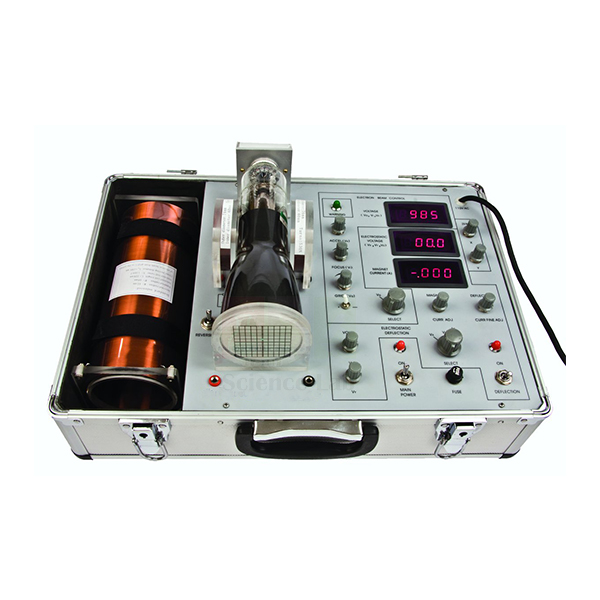
Complete Properties of Electrons Apparatus
Complete Properties of Electrons Apparatus (Product Code: SLE/EM/11) is a self-contained bench set for studying how a beam of free electrons behaves in electric and magnetic fields. It is built around a cathode-ray tube with a flat 75 mm screen, a pair of transverse field coils and an axial field solenoid, together with the supplies that drive them, and its instruction manual gives sample activities and sample data for six experiments ending with the determination of e/m. Manufactured by Jain Scientific Equipments Pvt Ltd (ScienceLab), Ambala, it serves colleges in India as a complete EM ratio apparatus and electron-optics trainer in one case.
Specifications
| Parameter | Detail |
|---|---|
| CRT overall length | 240 mm |
| CRT neck diameter | 51.4 mm |
| Flat screen diameter | 75 mm |
| Grid pitch | 10 mm |
| Electrostatic deflection | X-deflection ~±100 V; Y-deflection ~±100 V |
| Transverse field coils | Mean diameter 67 mm; 530 turns per coil |
| Axial field solenoid | Mean diameter 93 mm; length 228 mm; 1,300 turns |
| CRT cathode voltage | -750 to -1,400 V |
| Focus voltage | +200 to +400 V |
| Grid voltage | -4 to -80 V |
| Magnet supply | 0 to 9 V, 0.155 A (transverse); 0 to 7.7 V, 2.0 A (axial) |
| Power requirement | 110-V AC, 60 Hz |
| Case dimensions | 470 x 330 x 215 mm |
| Weight | ~10 kg (22 lb) |
Experiments covered by the instruction manual, with sample activities and sample data:
- Electron behaviour in an electric field
- Electron deflection in a transverse electric field
- Electron paths in an inhomogeneous longitudinal electric field
- Electron deflection in a transverse magnetic field
- Spiral electron path in a longitudinal magnetic field
- Determination of e/m
Typical Use
A practical session usually starts with the undeflected spot, then applies voltages to the X and Y plates to show that deflection is proportional to plate voltage and inversely related to beam energy. Switching to the transverse coils shows the beam bending in a magnetic field, and the axial solenoid turns the straight beam into a spiral that refocuses to a point — the basis of magnetic focusing and of the e/m measurement. Recording the cathode voltage and the solenoid current at which the spot refocuses gives the specific charge of the electron, making this a complete specific charge electron experiment with the manual’s sample data as a check on students’ results.
Allow the tube to warm up, begin with low settings and a dimmed room, and avoid leaving a bright, stationary spot on the screen for long periods. The CRT works at high voltage, so the case should be opened only by trained staff, and students should adjust the controls under supervision.
Manufacturer
Built by Jain Scientific Equipments Private Limited, the Ambala, Haryana company whose products carry the ScienceLab name, this apparatus is part of its range for undergraduate physics laboratories. More information is on the company profile page.
Related Laboratory Equipment
Alternative and companion apparatus for electron-physics practicals:
- Teltron Electron Deflection Tube D — a separate tube for the crossed-field method of finding e/m and electron velocity
- Teltron Helmholtz Pair of Coils D — coils giving a uniform magnetic field across D-series tubes
- Teltron Tube Holder D — stand for mounting D-series tubes and their coils
- Complete Zeeman Effect Apparatus — a spectroscopic route to the same electron properties
- Digital Multimeter — for independent checks of coil voltages and currents
Browse our Electricity Equipments range for more electricity and electromagnetism apparatus.
Frequently Asked Questions
Which experiments can be performed?
Six are covered in the manual: electron behaviour in an electric field, deflection in a transverse electric field, paths in an inhomogeneous longitudinal electric field, deflection in a transverse magnetic field, the spiral path in a longitudinal magnetic field, and determination of e/m.
Does it come with a manual?
Yes. The instruction manual contains sample activities and sample data for each of the six experiments.
Are the power supplies part of the apparatus?
The specification lists supplies for the CRT (cathode, focus, grid and deflection voltages) and for the transverse and axial coils. Please contact us if you need the exact scope of supply confirmed.
What mains supply is required?
The listed requirement is 110-V AC, 60 Hz. Confirm with us the configuration suited to your local mains before ordering.
How large and heavy is it?
The case measures 470 x 330 x 215 mm and the apparatus weighs about 10 kg (22 lb).
Is it safe for student use?
Yes, with supervision. The tube operates at high voltage inside the case, so students should use the external controls only.
What about warranty and calibration documents?
These terms are not in our current listing; please raise them with us through the contact page when requesting a quotation.
Can you ship to universities abroad?
Yes. We supply institutions and distributors in India and international markets.
Request a Quote
Send your enquiry for the Complete Properties of Electrons Apparatus through our contact page, or add it to the enquiry cart with any related tubes and coils.
Last updated: 24 September 2026
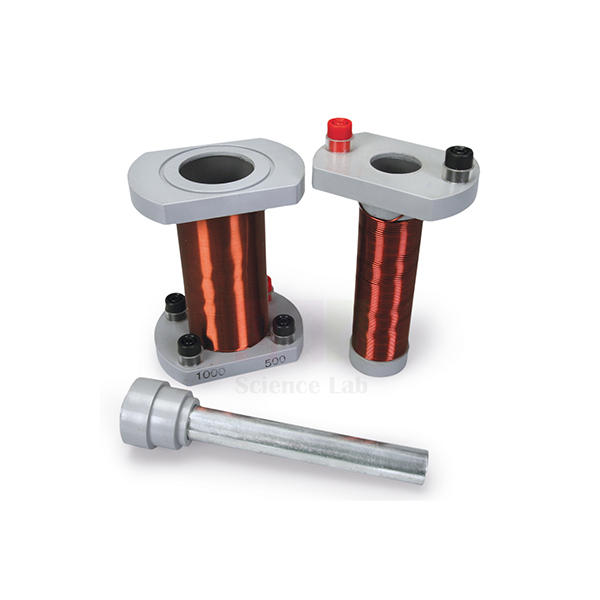
Primary-Secondary Coils
Primary-Secondary Coils (Product Code: SLE/EM/12) are a classic two-coil set for demonstrating electromagnetic induction and the working principle of a transformer. A primary coil of 175 turns of 18 AWG insulated copper wire and a secondary coil with three available windings — 500; 1,000; and 1,500 turns — are used on a plated iron core 165 mm long and 19 mm in diameter, so students can change the turns ratio and see the effect on the induced voltage directly. Manufactured by Jain Scientific Equipments Pvt Ltd (ScienceLab), Ambala, the set is a durable transformer experiment kit for school and college physics labs.
Specifications
| Parameter | Detail |
|---|---|
| Iron core | Plated iron, 165 mm long, 19 mm diameter |
| Primary coil | 175 turns of 18 AWG insulated copper wire |
| Secondary coil | Three available windings: 500; 1,000; and 1,500 turns, insulated copper wire |
| Coil formers | Moulded formers fitted with shielded banana jacks |
| Demonstrates | Electromagnetic induction and transformer principles |
Typical Use
For induction, the primary is connected to a low-voltage DC source through a switch and the secondary to a centre-zero galvanometer: the needle kicks one way when the switch is closed and the other way when it is opened, showing that only a changing current in the primary induces a current in the secondary. Sliding the iron core in and out shows how strongly the core links the two coils. For the transformer principle, the primary is fed from a low-voltage AC supply and the output is taken from each secondary winding in turn; moving from the 500-turn to the 1,500-turn winding raises the output, which students can compare with the turns ratio they calculate.
Because every connection is made through shielded banana jacks, students can rewire the circuit quickly and safely between trials. Always use a low-voltage laboratory supply rather than mains, and switch off before changing windings. The experiment appears in the electromagnetic induction chapter of CBSE and state-board syllabi, so the coils sit well in any list of physics practical equipment for CBSE schools as well as undergraduate labs.
Manufacturer
ScienceLab apparatus such as these coils is produced by Jain Scientific Equipments Private Limited (CIN U29309HR2020PTC087597), a private limited company based in Ambala, Haryana. Manufacturing is carried out at the company’s licensed factory at 449, HSIIDC Industrial Area, Saha, Ambala (Factory Licence AMB-ONLINE-CHD-J-414). Read more on our company profile.
Related Electricity Equipment
Items used with the coils in induction and transformer practicals:
- Galvanometer, Centre Zero Universal Meter — shows the size and direction of the induced current
- Power Supply Variable — a continuously variable AC or DC supply for driving the primary
- Banana/Alligator Cords — stacking banana plugs that fit the coils’ banana jacks
- Magnet Set — bar and horseshoe magnets for inducing current by moving a magnet through a coil
- Primary and Secondary Coil Set — a nested-spool alternative with binding posts
Browse all items in our Electricity Equipments range.
Frequently Asked Questions
How many turns do the coils have?
The primary has 175 turns of 18 AWG insulated copper wire. The secondary offers three windings of 500; 1,000; and 1,500 turns.
What size is the iron core?
It is a plated iron core 165 mm long and 19 mm in diameter.
How are connections made?
Each coil is wound on a moulded former fitted with shielded banana jacks, so standard banana-plug leads can be used.
Can the set show both step-up and step-down action?
Yes. Feeding the 175-turn coil and taking output from a secondary winding gives a step-up arrangement, and reversing the roles shows step-down. Maximum current ratings are not listed, so keep to low-voltage supplies and contact us if you need the ratings.
Is a power supply or meter included?
No. The coils and core are supplied without a power source or meter; see the related items above.
Is a calibration certificate available?
The coils are demonstration apparatus rather than a measuring instrument. If your tender asks for particular documents, discuss them with us before ordering.
What should be included in an institutional enquiry?
The number of sets, delivery address, any accessories to be quoted together, and vendor-registration details your institution needs. We supply across India and to international markets.
Request a Quote
To get a quotation for the Primary-Secondary Coils, use our contact page or add them to the enquiry cart with your other physics requirements.
Last updated: 24 September 2026
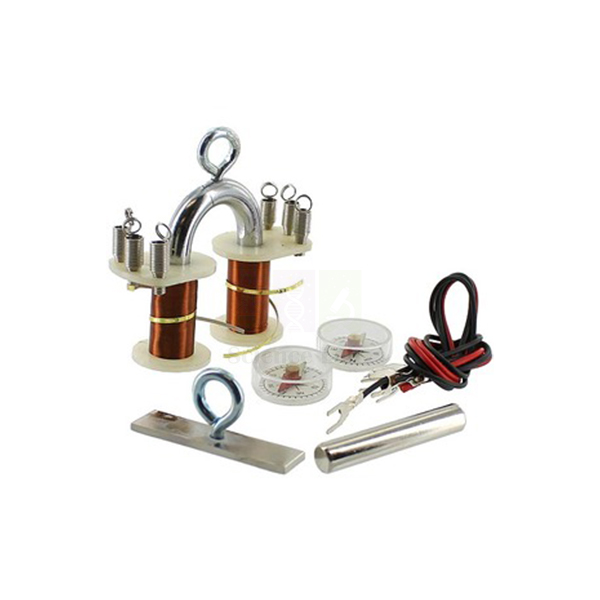
Electromagnet Kit
Electromagnet Kit (Product Code: SLE/EM/13) lets students make their own electromagnets from parts and then test what they have built. Coils on plastic spools slide onto iron cores to form either a bar electromagnet or a U-shaped electromagnet, and two magnetic compasses reveal the poles and the strength of the field. Designed for elementary through high school learners and manufactured by Jain Scientific Equipments Pvt Ltd (ScienceLab), Ambala, it is an electromagnetic kit for schools in India that packs away into its own plastic storage case with instructions.
Specifications
| Parameter | Detail |
|---|---|
| Coils | 2 coils on plastic spools |
| Cores | One U-shaped iron core and one straight iron core |
| Compasses | 2 magnetic compasses |
| Leads | A pair of wires |
| Storage | Plastic storage case |
| Documentation | Instructions included |
| Power | One 6-V battery or a DC power supply (not included) |
| Suitable for | Elementary through high school students |
Typical Use
Students usually start with one coil on the straight iron core to make a bar electromagnet. Bringing a compass to each end shows which end behaves as a north pole; swapping the battery connections reverses the poles, which is the key difference from a permanent magnet. They then fit both coils on the U-shaped core, connect them and compare how many small iron objects the U-shaped magnet holds against the bar version, investigating how core shape, number of coils and current affect the magnitude of the electromagnetic force. Older students can relate the pole they find to the direction of winding using the right-hand grip rule.
Connect the battery only while testing, so the coils stay cool and the cell lasts through the lesson, and keep the compasses away from the cores when storing them. Because every part returns to the fitted case, the kit works well as a take-out STEM science kit for Indian classrooms and science clubs where sets move between rooms.
Manufacturer
This kit is manufactured by Jain Scientific Equipments Private Limited under its ScienceLab brand in Ambala, Haryana, where the company produces practical kits for primary, secondary and senior classes. Visit our company profile to learn about the business.
Related Electricity Equipment
Items that extend electromagnet lessons:
- Iron-Clad Electromagnet — a heavy-lift electromagnet for a dramatic teacher demonstration
- Electromagnet with Keeper — a ready-wound U-shaped electromagnet with armature and hook
- Compass Plotting (Clear) — extra plotting compasses for mapping the field around the cores
- Magnet Set — permanent bar and horseshoe magnets, with iron filings, for side-by-side comparison
- Precision Variable Power Supply — a regulated DC source in place of a battery
For more magnetism and circuit apparatus see our Electricity Equipments range.
Frequently Asked Questions
What is in the Electromagnet Kit?
Two coils on plastic spools, a U-shaped iron core, a straight iron core, two magnetic compasses and a pair of wires, all in a plastic storage case with instructions.
Is a battery included?
No. The kit runs from one 6-V battery or a DC power supply, which you provide separately.
Which age groups is it suitable for?
It is designed for elementary through high school students; younger classes build and test, while older students can also study pole direction and force.
Can the magnetic poles be reversed?
Yes. Reversing the battery connections reverses the current and therefore the poles, which the compasses show immediately.
How much can the electromagnet lift?
A lifting figure is not given in our current listing, as it depends on the power source and core arrangement. Contact us if you need further detail.
Can lost parts be replaced?
Ask through the contact page and we will advise on individual replacement items.
Do you offer class quantities?
Yes. We supply multiple kits to schools and distributors in India and international markets.
Request a Quote
For kit pricing, contact us through the contact page or add the Electromagnet Kit to your enquiry cart.
Last updated: 24 September 2026