- Physics Lab Equipment
- Chemistry Lab Equipment
- Biology Lab Equipment
- Anatomical Lab Equipment
- Learning
- Educational Lab Equipment
- Magnets
- Agriculture
- Astronomy
- Earth Science
- Geography Lab Equipment
- Safety Lab Coat
- Laboratory
- Meteorological
- Electricity & Magnetism
- Heat
- School Lab Equipment
- Lab Glassware
- Science Lab Equipment
- Tvet Lab Equipment
- Robotics Kits Supplier and Manufacturer for Schools India
- Math Lab Equipment Manufacturers and Exporters in Ambala
- STEM Kits Manufacturers and Supplier India
- Engineering Lab Equipment
- Hospital Lab Equipment
- Water, Sanitation & Hygiene Supplies
- Cold Chain, Solar & Communication Equipment
- Nutrition
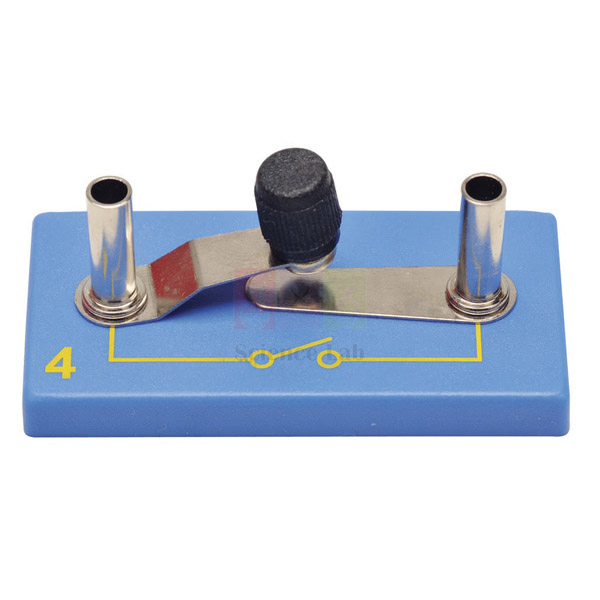
Push Switch Circuits Kit
Push Switch Circuits Kit (Product Code: SLE/PHY/64) is a spare push switch for the Circuits Kit, mounted on a sturdy panel and used to make or break a student circuit at the press of a button. Schools order it to replace a lost or worn switch or to extend existing kits, and the panel format is easy to use and store. It is made by Jain Scientific Equipments Pvt Ltd (ScienceLab), an OEM manufacturer, at its own factory in Ambala, India, for AC DC circuits experiment work.
Key Details
| Parameter | Detail |
|---|---|
| Item type | Spare component for the Circuits Kit |
| Component | Push switch |
| Mounting | Mounted on a sturdy panel for ease of use and storage |
| Product code | SLE/PHY/64 |
| Manufacturer | Jain Scientific Equipments Pvt Ltd (ScienceLab) — OEM |
| Country of origin | India (made in Ambala, Haryana) |
What Is the Circuits Kit Push Switch Used For?
A push switch gives students control that is easy to see and repeat: press the button and the circuit responds. Paired with a buzzer panel it becomes a model doorbell, and with a bulb holder it can flash signals in a simple code, turning a switching exercise into a communication activity that keeps younger learners engaged.
Because the switch comes on the same style of panel as the other Circuits Kit parts, it lines up neatly with cell holders, bulb holders and buzzers on the bench, and the whole set packs flat into storage afterwards. Check that panels are dry and connections tight before each lesson, and keep spares together so a missing switch never stops a practical.
OEM Manufacturer
Jain Scientific Equipments Private Limited trades as ScienceLab and is the OEM (original equipment manufacturer) of this spare switch panel, produced at its own licensed factory at Saha, Ambala, Haryana, India. Spares for the Circuits Kit are handled by the manufacturer itself, so schools can ask us for a single replacement or a batch for several kits. For tender and vendor forms, the company’s GSTIN is 06AAECJ8618A1ZT and its Legal Entity Identifier is 3358004HRD1JIVXKYX49. More details are on the ScienceLab profile.
Related Physics Lab Equipment
Other Circuits Kit parts used with the push switch:
- Electricity Circuits Kit — the complete circuit kit this spare switch is designed for.
- Circuits Kit Buzzer — sounds when the switch is pressed, as in a doorbell model.
- Circuits Kit Bulb Holder — lights a bulb under push-switch control.
- Circuits Kit Cell Holder — holds the cell that powers the circuit.
- Circuits Kit Rheostat — adds variable resistance to the same panel set.
The full range is in Physics Lab Equipment.
Frequently Asked Questions
Is the Push Switch Circuits Kit a complete circuit kit?
No. The Push Switch Circuits Kit is a spare push switch component for the Circuits Kit, mounted on a sturdy panel. The complete kit is listed separately as the Electricity Circuits Kit.
What is the Push Switch Circuits Kit used for?
The Push Switch Circuits Kit makes or breaks a student circuit when its button is pressed, for activities such as a doorbell model with a buzzer or a signalling circuit with a bulb holder.
Why is the Push Switch Circuits Kit mounted on a panel?
The Push Switch Circuits Kit is mounted on a sturdy panel for ease of use and storage, so it sits flat on the bench beside other Circuits Kit parts and packs away neatly after class.
Who manufactures the Push Switch Circuits Kit?
Jain Scientific Equipments Pvt Ltd (ScienceLab) manufactures the Push Switch Circuits Kit as the OEM at its own licensed factory at Saha, Ambala, Haryana, India, and supplies spares directly to schools and dealers.
Can I order several Push Switch Circuits Kit spares at once?
Yes. The Push Switch Circuits Kit can be ordered singly or in quantity to restock several kits; send the number required and delivery location through the contact page.
Request a Quote
Request spare push switches, or other Circuits Kit panels, through the ScienceLab contact page or add them to the enquiry cart. Quotations come direct from the manufacturer for buyers in India and international markets.
Last updated: 24 September 2026
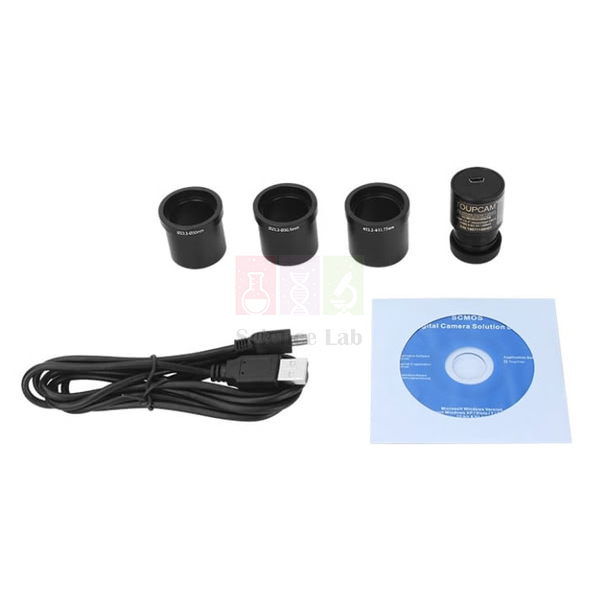
Microscope Digital Camera, 5MP
Microscope Digital Camera, 5MP (Product Code: SLE/M/09) is a USB eyepiece video camera used to capture still images and video from biological or stereo microscopes directly onto a PC in teaching and research labs. It draws its 5 V power from the computer's USB 2.0 port, so no separate adapter is needed, and it works with Windows, Mac OS X and Linux systems. The camera is supplied by Jain Scientific Equipments Pvt Ltd (ScienceLab), Ambala, India, a laboratory instruments supplier in India.
Specifications
| Parameter | Detail |
|---|---|
| Type | USB eyepiece video camera for biological or stereo microscopes |
| Resolution class | 5 MP (as named) |
| Recording | Still pictures and video |
| Spectral range | 380–650 nm (with IR filter) |
| White balance | Auto |
| Capture / control API | Native C/C++, DirectShow, Twain |
| Interface | USB 2.0 high-speed port |
| Power supply | DC 5 V over PC USB port |
| Cooling | Natural |
| Operating systems | Microsoft Windows XP / Vista / 7 / 8 (32 and 64 bit), Mac OS X, Linux |
| PC requirements | CPU equal to Intel Core2 2.8 GHz or higher; 2 GB memory or more; display 17 inch or larger |
| Operating conditions | -10 to 50 °C; 30–80% RH |
| Storage conditions | -20 to 60 °C; 10–60% RH |
| Supplied with | CD-ROM |
| Product code | SLE/M/09 |
| Supplied by | Jain Scientific Equipments Pvt Ltd (ScienceLab), Ambala, India |
What Is the 5MP Microscope Camera Used For?
A microscope camera turns a single-viewer instrument into a shared screen. Teachers project live images of cells, tissue sections or insects so a whole class sees the same field, students save images for practical records and project reports, and technicians record short videos of moving organisms such as protozoa. As part of smart lab equipment in Indian schools and colleges, it also lets lessons be archived and reused.
The camera goes into the eyepiece tube in place of one eyepiece and connects to a PC by USB. For clean images, focus the specimen through the eyepieces first, then insert the camera and fine-focus while watching the screen; auto white balance adjusts the colour for LED or halogen light. Developers can build their own capture tools using the native C/C++, DirectShow or Twain interfaces.
What to Specify When Ordering
- The make and model of your microscope, and the diameter of its eyepiece tube
- Your computer's operating system and version
- Whether you need this 5 MP camera or the lower-resolution 3 MP model
- The number of cameras required and the delivery location
Supplier
Jain Scientific Equipments Private Limited, trading as ScienceLab from Ambala, Haryana, supplies this 5 MP USB eyepiece camera as part of its microscope accessory range. Schools, colleges, research labs, dealers and importers in India and international markets can source cameras together with the microscopes they will be used on. See the ScienceLab company profile for more about the company.
Related Laboratory Equipment
Alternatives and microscopes to consider with this camera:
- Microscope Digital Camera, 3MP — a mid-resolution USB eyepiece camera for basic imaging
- 5mp Microscope Camera — another 5 MP option with its own feature set
- Wi-Fi Camera — wireless image sharing to several devices
- Binocular Microscope, 1000x Mag LED — a biological microscope for high-power imaging (confirm fit with us)
- Stereo Binocular Microscope — a stereo model for imaging whole specimens (confirm fit with us)
More cameras and accessories are in the Microscope category.
Frequently Asked Questions
How does the Microscope Digital Camera, 5MP connect to a computer?
The Microscope Digital Camera, 5MP connects through a USB 2.0 high-speed port and takes its DC 5 V power from the same USB connection. No external power adapter is needed, which keeps the setup simple on a lab bench.
Which microscopes can the Microscope Digital Camera, 5MP be used with?
The Microscope Digital Camera, 5MP is designed for biological or stereo microscopes and fits into an eyepiece tube. The tube diameter is not stated in its listing, so send us your microscope model to confirm the fit before ordering.
Which operating systems does the Microscope Digital Camera, 5MP support?
The Microscope Digital Camera, 5MP is listed for Microsoft Windows XP, Vista, 7 and 8 (32 and 64 bit), Mac OS X and Linux. For newer operating system versions, contact us to confirm software compatibility first.
What computer is needed for the Microscope Digital Camera, 5MP?
The Microscope Digital Camera, 5MP needs a PC with a processor equal to an Intel Core2 2.8 GHz or higher, at least 2 GB of memory, a USB 2.0 port and a display of 17 inches or larger.
Can the Microscope Digital Camera, 5MP record video?
Yes. The Microscope Digital Camera, 5MP records both still pictures and video. It also offers native C/C++, DirectShow and Twain interfaces, so it can be controlled from compatible imaging software or custom programs.
Who supplies the Microscope Digital Camera, 5MP?
Jain Scientific Equipments Pvt Ltd (ScienceLab), Ambala, Haryana, India supplies the Microscope Digital Camera, 5MP to schools, colleges, laboratories, dealers and importers in India and international markets, with or without matching microscopes.
Request a Quote
Send your requirement for the Microscope Digital Camera, 5MP, including your microscope model, through the contact page, or add it to the enquiry cart.
Last updated: 24 September 2026
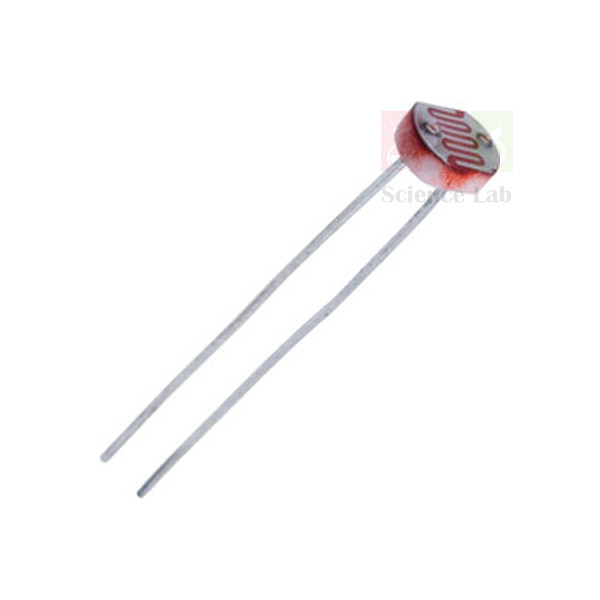
Miniature LDR
Miniature LDR (Product Code: SLE/PHY/65) is a 5 mm light dependent resistor used to sense light levels in physics and electronics experiments, from light-meter circuits to automatic night-lamp projects. Its resistance falls from about 1 MΩ in darkness to 2–4 kΩ at 100 lux, a change large enough to see clearly on a multimeter during physics practical work. It is supplied by Jain Scientific Equipments Pvt Ltd (ScienceLab), Ambala, India.
Specifications
| Parameter | Detail |
|---|---|
| Type | Light Dependent Resistor (LDR) housed in an epoxy package |
| Sensing material | Semiconductor whose conductance changes with luminance |
| Diameter | 5 mm |
| Dark resistance | 1 MΩ |
| Resistance at 10 lux | 10–20 kΩ |
| Resistance at 100 lux | 2–4 kΩ |
| Peak spectral response | 540 nm |
| Max. voltage | 150 V peak, AC or DC |
| Power dissipation | 100 mW |
| Lead pitch | 3 mm |
| Operating temperature | –30 °C to +70 °C |
| Product code | SLE/PHY/65 |
| Supplied by | Jain Scientific Equipments Pvt Ltd (ScienceLab), Ambala, India |
What Is a Miniature LDR Used For?
The simplest investigation connects the LDR to a multimeter on its resistance range and records readings as a lamp is moved closer or a hand shades the sensor; plotting resistance against light level shows how steeply the value falls. In an electronics context the LDR is placed in a potential divider with a fixed resistor, so the changing voltage can switch a transistor, LED or buzzer when it gets dark or bright.
Its peak spectral response at 540 nm lies in the green part of the spectrum, which makes it a good talking point about how sensors and the human eye respond to colour. Keep the power dissipated below 100 mW and the voltage within 150 V peak; in school circuits a series resistor keeps the current low. Solder the leads quickly, or mount the LDR in a component holder to avoid heat damage.
Supplier
Jain Scientific Equipments Private Limited, which trades as ScienceLab, supplies this miniature LDR from Ambala, Haryana, as a component for school and college electronics and physics practicals. It is a sourced semiconductor part rather than an item the company makes, and it can be quoted alongside the meters, holders and leads a sensor practical needs. Company details are on the ScienceLab profile page.
Related Physics Lab Equipment
Items used with the LDR in light-sensing experiments:
- Simple Circuit Module Light Dependent Resistor Board — an LDR already mounted on a board for plug-together circuits.
- LDR — another light dependent resistor listing to compare.
- Digital Multimeter — measures how the LDR’s resistance changes with light.
- Component Holder — holds small components such as the LDR without soldering.
- Crocodile Clips & Leads — clip onto the LDR’s leads for quick connections.
More sensors and meters are in Physics Lab Equipment.
Frequently Asked Questions
What is the resistance range of the Miniature LDR?
The Miniature LDR has a dark resistance of 1 MΩ, falling to 10–20 kΩ at 10 lux and 2–4 kΩ at 100 lux. Its resistance keeps reducing as more light falls on the device.
What are the size and lead spacing of the Miniature LDR?
The Miniature LDR is 5 mm in diameter, housed in an epoxy package, with a lead pitch of 3 mm, which keeps it compact enough for small student circuit layouts.
What are the electrical limits of the Miniature LDR?
The Miniature LDR is rated for a maximum of 150 V peak, AC or DC, and a power dissipation of 100 mW. It operates from –30 °C to +70 °C.
Which light colour does the Miniature LDR respond to most?
The Miniature LDR has its peak spectral response at 540 nm, in the green region of visible light, so it reacts most strongly to green and nearby wavelengths.
Who supplies the Miniature LDR?
Jain Scientific Equipments Pvt Ltd (ScienceLab), Ambala, India, supplies the Miniature LDR (SLE/PHY/65) to schools, colleges and dealers as a sourced electronic component, together with the meters and holders a practical needs.
How should I request a quotation for the Miniature LDR?
For the Miniature LDR, state the quantity, any related items such as multimeters or component holders, and the delivery location through the contact page to receive a single quotation.
Request a Quote
Send your Miniature LDR requirement through the ScienceLab contact page or add it to the enquiry cart. ScienceLab supplies buyers in India and international markets.
Last updated: 24 September 2026
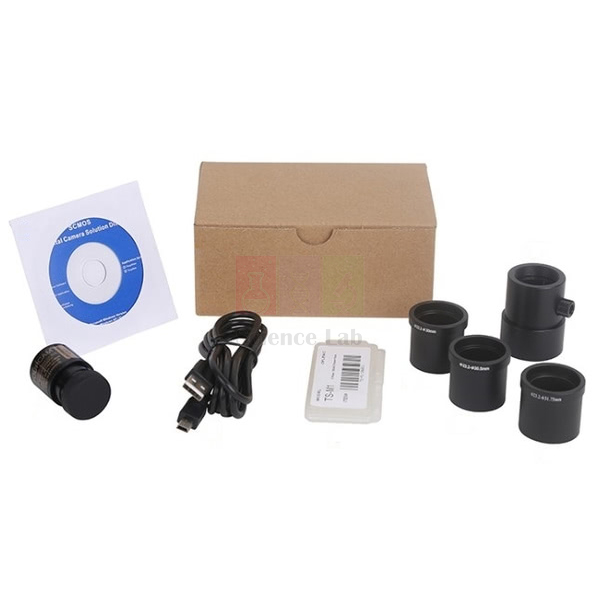
Microscope Digital Camera, 3MP
Microscope Digital Camera, 3MP (Product Code: SLE/M/10) is a mid-resolution USB eyepiece camera used to show and record live microscope images on a PC in school and college biology labs. It slides straight into the eyepiece tube in place of one eyepiece, with fittings for 23 mm, 30 mm and 30.5 mm tubes, and handles gain, exposure and white balance automatically. The camera is supplied by Jain Scientific Equipments Pvt Ltd (ScienceLab), Ambala, India, a biology lab equipment supplier in India.
Specifications
| Parameter | Detail |
|---|---|
| Type | USB eyepiece video camera for biological or stereo microscopes |
| Mounting | Directly into the eyepiece tube instead of one eyepiece; 23 mm, 30 mm and 30.5 mm diameters |
| C-mount / CS-mount | No / No |
| Sensor technology | CMOS |
| Full image size | 1600 x 1200 pixels (listed as 2 MP; please confirm resolution when ordering) |
| Image format | 4:3 |
| Frame rate | 5 fps (1600 x 1200) / 7.5 fps (1280 x 1024) / 22 fps (640 x 480) |
| Gain, back light, exposure, white balance | Auto |
| Signal output | USB 2.0 |
| Analog output / audio | No / No |
| External memory card | No |
| Camera power | From PC USB port |
| Product code | SLE/M/10 |
| Supplied by | Jain Scientific Equipments Pvt Ltd (ScienceLab), Ambala, India |
What Is the 3MP Microscope Camera Used For?
This camera suits everyday classroom imaging rather than publication work: a teacher displays a live onion-cell or blood-smear image on a monitor or projector, students capture pictures for their practical files, and a lab keeps a simple visual record of prepared slides. It is a simple way to add screen sharing to existing school biology lab equipment in India without replacing the microscopes.
Remove one eyepiece, insert the camera (using the fitting that matches your tube) and connect it to the PC. Choose 640 x 480 for smooth live viewing of moving organisms at 22 fps, and switch to the full 1600 x 1200 frame for still captures where detail matters more than speed. Because there is no memory card or audio channel, all images and video are saved on the computer.
What to Specify When Ordering
- Your microscope's eyepiece tube diameter (23 mm, 30 mm or 30.5 mm)
- The image resolution you need, so we can confirm this model suits it
- Your computer's operating system
- Number of cameras and the delivery location
Supplier
This USB eyepiece camera is supplied by ScienceLab, the trading name of Jain Scientific Equipments Private Limited, Ambala, Haryana. Schools, coaching institutes, colleges, dealers and importers in India and international markets add it to microscope orders when they want to share images with a whole class. More about the company is on the ScienceLab profile page.
Related Laboratory Equipment
Other imaging options and a microscope to pair it with:
- Microscope Digital Camera, 5MP — higher-resolution USB eyepiece camera with capture API support
- 2MP Digital USB-2 Colour Camera — an alternative USB colour camera
- Tablet Camera — a camera with its own screen for use without a PC
- Monocular Biological Microscope 400x, LED — a classroom microscope to display on screen (confirm fit with us)
See all cameras and microscopes in the Microscope category.
Frequently Asked Questions
What resolution does the Microscope Digital Camera, 3MP capture?
The Microscope Digital Camera, 3MP lists a full image size of 1600 x 1200 pixels, and its specification sheet states 2 MP. Please confirm the resolution you need when requesting a quotation, and we will verify it for the unit supplied.
Which eyepiece tubes does the Microscope Digital Camera, 3MP fit?
The Microscope Digital Camera, 3MP fits directly into eyepiece tubes of 23 mm, 30 mm and 30.5 mm diameter, replacing one eyepiece. It has no C-mount or CS-mount connection, so it is not intended for trinocular camera ports.
What frame rates does the Microscope Digital Camera, 3MP achieve?
The Microscope Digital Camera, 3MP runs at 5 fps at 1600 x 1200, 7.5 fps at 1280 x 1024 and 22 fps at 640 x 480. Use the lowest setting for smooth live viewing and the highest for still images.
Does the Microscope Digital Camera, 3MP need a separate power supply?
No. The Microscope Digital Camera, 3MP is powered from the PC's USB port and sends its signal over USB 2.0. Gain, back light, exposure and white balance are all automatic, so little manual adjustment is needed.
Can the Microscope Digital Camera, 3MP store images on a memory card?
No. The Microscope Digital Camera, 3MP has no external memory card slot, analog output or audio. Images and video are saved on the connected computer, which also makes them easy to share or print.
Who supplies the Microscope Digital Camera, 3MP?
Jain Scientific Equipments Pvt Ltd (ScienceLab), Ambala, Haryana, India supplies the Microscope Digital Camera, 3MP. It is shipped to schools, colleges, laboratories, dealers and importers in India and international markets, alone or with microscopes.
Request a Quote
For a quotation on the Microscope Digital Camera, 3MP, send the quantity, your eyepiece tube size and the resolution you need through the contact page, or add it to the enquiry cart.
Last updated: 24 September 2026
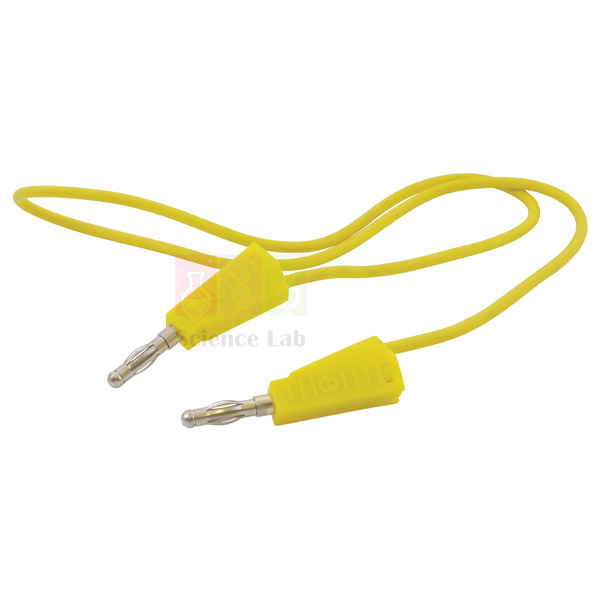
Stackable Leads Yellow
Stackable Leads Yellow (Product Code: SLE/PHY/66) is a yellow 4 mm stackable lead used to pick out a separate branch, meter connection or signal line in a laboratory circuit, so it is never confused with the red and black supply leads. It is 500 mm long and stacks with other 4 mm leads on a shared terminal, keeping physics lab instruments clearly wired. It is made by Jain Scientific Equipments Pvt Ltd (ScienceLab), an OEM manufacturer, at its own factory in Ambala, India.
Specifications
| Parameter | Detail |
|---|---|
| Colour | Yellow |
| Connector | 4 mm stackable lead |
| Length | 500 mm |
| Product code | SLE/PHY/66 |
| Manufacturer | Jain Scientific Equipments Pvt Ltd (ScienceLab) — OEM |
| Country of origin | India (made in Ambala, Haryana) |
What Are Yellow Stackable Leads Used For?
Once a circuit grows beyond a single loop, two colours are not enough. A yellow lead can mark the voltmeter connections across a component, the second branch of a parallel circuit, or the input signal to an oscilloscope or amplifier board, so a student tracing a fault always knows which wire belongs to which part of the diagram.
Teachers often agree a class rule — red to positive, black to negative, yellow for measurement or branch links — and write it into worksheets, which makes marking practical set-ups much quicker. As with any lead, inspect the plugs and insulation before use and coil leads loosely for storage rather than knotting them.
OEM Manufacturer
These yellow leads are made by Jain Scientific Equipments Private Limited (CIN U29309HR2020PTC087597), which trades as ScienceLab and is their OEM (original equipment manufacturer). Manufacturing is carried out at its own licensed factory at Saha, Ambala, Haryana, India — premises at 449, HSIIDC Industrial Area covered by Factory Licence AMB-ONLINE-CHD-J-414. Schools, colleges, dealers and importers order factory-direct; see the ScienceLab profile for more.
Related Physics Lab Equipment
Leads and meters that pair with yellow branch leads:
- Stackable Leads Red — positive-side leads for the supply connections.
- Stackable Leads — black leads for the negative or common return.
- Banana Plug Connectors Leads — an alternative set of plug-ended connecting leads.
- Standard Digital Multimeter — the meter a yellow measurement lead typically runs to.
- Ammeter Voltmeter — for reading current and voltage in branch circuits.
More apparatus is in Physics Lab Equipment.
Frequently Asked Questions
What are the Stackable Leads Yellow used for?
The Stackable Leads Yellow mark a connection that is neither supply positive nor negative, such as a meter link, a parallel branch or a signal line, keeping complex circuits easy to trace.
What length are the Stackable Leads Yellow?
The Stackable Leads Yellow are 500 mm long with a 4 mm stackable plug, the same length as the black and red stackable leads in the ScienceLab range.
Do the Stackable Leads Yellow work with red and black stackable leads?
Yes. The Stackable Leads Yellow share the 4 mm stackable format of the red and black versions, so all three colours can be plugged into each other on one terminal.
Who manufactures the Stackable Leads Yellow?
Jain Scientific Equipments Pvt Ltd (ScienceLab) manufactures the Stackable Leads Yellow as the OEM at its own licensed factory at Saha, Ambala, Haryana, India, and supplies them factory-direct.
Is an electrical rating listed for the Stackable Leads Yellow?
No current or voltage rating is stated for the Stackable Leads Yellow in this listing. Ask us through the contact page and we will confirm the rating for your intended use.
What should a quotation request for the Stackable Leads Yellow include?
For the Stackable Leads Yellow, give the quantity of yellow leads, any red or black leads needed and the delivery location; ScienceLab then quotes as the manufacturer for India and international markets.
Request a Quote
Request yellow leads, alone or with red and black sets, through the ScienceLab contact page or the enquiry cart. The quotation is issued directly by the manufacturer.
Last updated: 24 September 2026
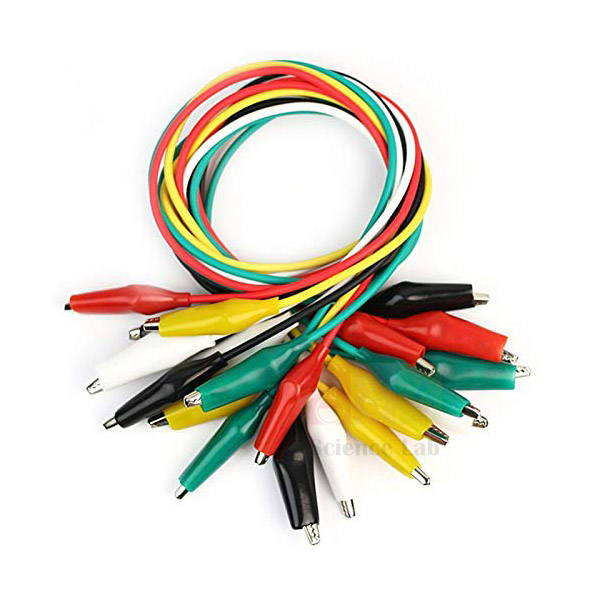
Crocodile Clips & Leads
Crocodile Clips & Leads (Product Code: SLE/PHY/67) are connecting leads with a crocodile clip at each end, used to make quick, temporary connections to component legs, bare wires, electrodes and terminals in school electricity experiments. They come as a pack of 20 leads, each 460 mm long — enough to equip several bench groups for an electricity experiment kit in school. They are made by Jain Scientific Equipments Pvt Ltd (ScienceLab), an OEM manufacturer, at its own factory in Ambala, India.
Specifications
| Parameter | Detail |
|---|---|
| Pack size | 20 leads |
| Lead length | 460 mm |
| Terminations | Crocodile clip at each end |
| Product code | SLE/PHY/67 |
| Manufacturer | Jain Scientific Equipments Pvt Ltd (ScienceLab) — OEM |
| Country of origin | India (made in Ambala, Haryana) |
What Are Crocodile Clip Leads Used For?
Crocodile leads connect things that have no socket. Students clip them onto the metal strips of an electrolysis cell, the legs of a resistor, the zinc and copper plates of a fruit cell or a test sample in a conductor-and-insulator experiment, then join the other end to a bulb holder, meter or cell. Because both ends are clips, the same lead works anywhere in the circuit.
For a firm contact, clip onto bare, clean metal rather than insulation, and avoid prising the jaws too wide. After the lesson, count the pack back in and store the leads loosely coiled so the cables and clip joints are not strained.
OEM Manufacturer
Jain Scientific Equipments Private Limited, the company behind the ScienceLab name, is the OEM (original equipment manufacturer) of these crocodile clip leads and makes them at its own licensed factory at Saha, Ambala, Haryana, India. Packs are supplied direct from the maker to schools, science kit assemblers, dealers and importers, with quotations prepared by the manufacturer rather than a trading middleman. Learn more on the ScienceLab profile page.
Related Physics Lab Equipment
Useful with crocodile leads:
- Crocodile Clip — individual clips for making up extra leads.
- Battery Snap with Crocodile Clip — links a snap-terminal battery into clip-lead circuits.
- Stackable Leads — 4 mm plug leads for connections to sockets.
- MES Bulb Holder — screw terminals that clip leads grip easily.
- Circuits Kit Electrode Holder — holds electrodes that crocodile leads connect to.
See more in Physics Lab Equipment.
Frequently Asked Questions
How many leads come in a pack of Crocodile Clips & Leads?
Crocodile Clips & Leads come as a pack of 20. Each lead is 460 mm long with a crocodile clip fitted at each end, ready for use in student circuits.
What are Crocodile Clips & Leads used for?
Crocodile Clips & Leads make quick temporary connections to items without sockets, such as component legs, electrodes, metal strips and bare wires, in electricity, electrolysis and conductivity experiments.
How long is each lead in the Crocodile Clips & Leads pack?
Each lead in the Crocodile Clips & Leads pack measures 460 mm, long enough to link components spread across a bench while keeping the circuit layout tidy.
Who manufactures the Crocodile Clips & Leads?
Jain Scientific Equipments Pvt Ltd (ScienceLab) manufactures the Crocodile Clips & Leads as the OEM at its own licensed factory at Saha, Ambala, Haryana, India, and supplies packs directly to buyers.
How should Crocodile Clips & Leads be looked after?
Store Crocodile Clips & Leads loosely coiled, clip only onto clean bare metal and avoid over-opening the jaws. Leads with damaged insulation should be taken out of use.
Can Crocodile Clips & Leads be ordered for many classrooms?
Yes. Crocodile Clips & Leads can be quoted in multiple packs of 20 for schools, dealers and importers in India and international markets; state the number of packs and delivery location.
Request a Quote
Ask for a price on packs of Crocodile Clips & Leads through the ScienceLab contact page or add them to the enquiry cart. The manufacturer quotes you directly.
Last updated: 24 September 2026

Knife Switch – Single Pole, Single Throw
Knife Switch – Single Pole, Single Throw (Product Code: SLE/PHY/68) is a knife switch on a plastic base used to open and close a single circuit in electricity practicals, with an exposed blade that shows at a glance whether the circuit is made or broken. Its poles and blade are brass to give good electrical connections, which makes it a dependable control in an Ohm law experiment kit. It is supplied by Jain Scientific Equipments Pvt Ltd (ScienceLab), Ambala, India.
Specifications
| Parameter | Detail |
|---|---|
| Switch type | Knife switch, single pole, single throw (SPST) |
| Base | Plastic |
| Poles and blade | Brass, to ensure good electrical connections |
| Application | Electricity circuits |
| Product code | SLE/PHY/68 |
| Supplied by | Jain Scientific Equipments Pvt Ltd (ScienceLab), Ambala, India |
What Is a Single Pole Knife Switch Used For?
A single-pole, single-throw switch has one job: connect or disconnect one line of a circuit. The knife pattern is popular in teaching because the moving blade is visible, so students see the physical gap that stops the current, which links the circuit symbol for a switch to the real object. It is the usual choice for switching the supply in resistance, Ohm’s law and heating-effect experiments.
Open the switch between readings so resistors and wires do not heat up and change the results. When closing, push the blade fully into the jaw so the brass parts meet firmly; a half-seated blade gives a poor contact and flickering meter readings. Operate the switch by its handle and keep fingers clear of the exposed metal when the circuit is live.
What to Specify When Ordering
- Switch pattern: this is single pole, single throw; double-pole knife switches are listed separately.
- Quantity per lab, typically one per circuit board or student pair.
- Any leads, meters or holders to be quoted with the switches.
Supplier
ScienceLab is the trade name of Jain Scientific Equipments Private Limited, which supplies this knife switch from Ambala, Haryana, India. The single-pole and double-pole knife switches in the range are sourced and quoted by the same company, so a lab can standardise on one style and order replacements from us directly. The ScienceLab profile has more about the company.
Related Physics Lab Equipment
Items used alongside the switch:
- Knife Switch Double Pole — for switching two lines at once.
- Contact Key (Push Switch) — a push-type key for taking brief readings.
- Crocodile Clips & Leads — connect the switch into the circuit.
- MES Bulb Holder — a simple load that shows when the switch is closed.
- Ammeter Voltmeter — takes readings in the switched circuit.
See all items in Physics Lab Equipment.
Frequently Asked Questions
What does single pole, single throw mean on this knife switch?
On the Knife Switch – Single Pole, Single Throw, one blade controls one circuit line and has one closed position, so the switch simply connects or disconnects that line.
What materials is the Knife Switch – Single Pole, Single Throw made of?
The Knife Switch – Single Pole, Single Throw is mounted on a plastic base, and its poles and blade are made of brass to ensure good electrical connections in student circuits.
Why use a knife switch instead of an enclosed switch in class?
The Knife Switch – Single Pole, Single Throw has a visible blade, so students can see the circuit open and close. This helps them connect the switch symbol in diagrams with how switching actually works.
Who supplies the Knife Switch – Single Pole, Single Throw?
Jain Scientific Equipments Pvt Ltd (ScienceLab), Ambala, Haryana, India, supplies the Knife Switch – Single Pole, Single Throw. The company sources the switch and quotes it to schools, colleges, dealers and importers in India and international markets.
Is a current rating given for the Knife Switch – Single Pole, Single Throw?
A current or voltage rating for the Knife Switch – Single Pole, Single Throw is not stated in this listing. Ask us through the contact page to confirm suitability for your circuit.
Can the Knife Switch – Single Pole, Single Throw be ordered in bulk?
Yes. ScienceLab quotes the Knife Switch – Single Pole, Single Throw in lab quantities directly as the supplier for schools, colleges, dealers and importers in India and international markets.
Request a Quote
Send the number of switches you need through the ScienceLab contact page or add the item to the enquiry cart. Quotes come directly from ScienceLab as the supplier.
Last updated: 24 September 2026
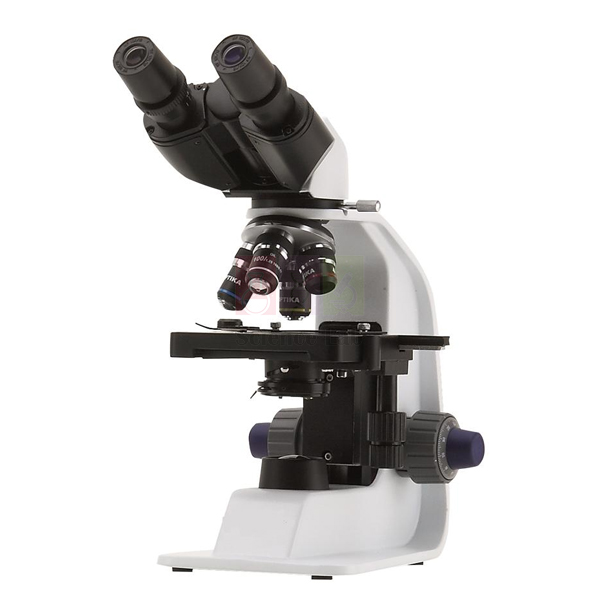
Binocular Biological Microscope, LED
Binocular Biological Microscope, LED (Product Code: SLE/M/11) is a compact two-eyepiece brightfield microscope used for cell, tissue and microorganism studies in school, college and routine teaching labs. At 4 kg and only 170 mm wide, it fits crowded student benches while still offering four achromatic objectives, a vernier mechanical stage and a 1 W white LED with brightness control. This compact binocular microscope for schools and colleges is supplied by Jain Scientific Equipments Pvt Ltd (ScienceLab), Ambala, India.
Specifications
| Parameter | Detail |
|---|---|
| Observation | Brightfield |
| Head | Binocular, inclined 30°, rotatable 360°; diopter adjustment on left eyepiece; interpupillary adjustment 48–75 mm |
| Eyepieces | Wide field WF10X/18, field number 18 mm |
| Nosepiece | Quadruple revolving, rotation on ball bearings |
| Objectives | Achromatic 4X, 10X, 40X, 100X; mechanical tube length 160 mm; anti-fungus treated |
| Condenser | Abbe, N.A. 1.2, precentered |
| Focusing | Coaxial coarse and fine (graduated 0.002 mm) with upper stop; adjustable tension of coarse knob |
| Stage | Double-layer mechanical sliding stage, 125 x 116 mm; X-Y movement range 76 x 30 mm |
| Stage scales | Vernier on both axes, accuracy 0.1 mm; specimen holder for one slide |
| Illumination | White LED, 1 W; intensity knob on left side of frame |
| Colour temperature / LED life | 6300 K / approx. 50 000 hours average |
| Power supply | External, 100/240 V AC, 50/60 Hz; output 5 V DC, 500 mA |
| Dimensions | Height 350 mm, width 170 mm, depth 210 mm |
| Weight | 4 kg |
| Product code | SLE/M/11 |
| Supplied by | Jain Scientific Equipments Pvt Ltd (ScienceLab), Ambala, India |
What Is the Compact Binocular LED Microscope Used For?
This model brings two-eyed viewing to classes that previously shared monocular instruments. Students use it to compare plant and animal cells, identify tissues in prepared sections, follow stages of cell division and observe stained microorganisms, while the vernier scales let them record exactly where an interesting field was found. It is a practical choice for a biology lab setup in schools where bench space and carrying weight matter.
Adjust the eyepiece spacing between 48 and 75 mm and set the left diopter ring before focusing, so each student sees one sharp, merged image. The upper focus stop keeps the high-power objectives from pressing into the slide, and the coarse-knob tension can be tightened if the stage drifts downward. Turn the LED down when viewing pale, unstained specimens to improve contrast.
Supplier
Jain Scientific Equipments Private Limited, which operates as ScienceLab from Ambala, Haryana, supplies this compact binocular LED microscope within its educational microscope range. Schools, colleges, teacher-training centres, dealers and importers in India and international markets can order it by the classroom set, together with slides and care items. Find company details on the ScienceLab profile.
Related Laboratory Equipment
Useful additions for a class set of these microscopes:
- Microfiber Lens Cloth — wipes dust and smudges from eyepieces between classes
- Microscope Slide Case — stores the class slide collection safely
- Prepared Microscope Slide Set – Circulatory System — ready slides of blood, vessels and muscle
- Binocular Microscope 1000x mag — an infinity-corrected model for more advanced labs
Compare other models in the Microscope category.
Frequently Asked Questions
How big and heavy is the Binocular Biological Microscope, LED?
The Binocular Biological Microscope, LED measures 350 mm high, 170 mm wide and 210 mm deep, and weighs 4 kg. Its compact footprint suits student benches where several microscopes must stand side by side.
Which objectives are fitted to the Binocular Biological Microscope, LED?
The Binocular Biological Microscope, LED has achromatic 4X, 10X, 40X and 100X objectives for a 160 mm mechanical tube, all anti-fungus treated, on a quadruple revolving nosepiece that rotates on ball bearings.
Is the 100X objective of the Binocular Biological Microscope, LED an oil-immersion lens?
The listing for the Binocular Biological Microscope, LED does not state whether its 100X objective is an oil-immersion type. Most 100X achromats are used with immersion oil, so please confirm with us when ordering.
What power supply does the Binocular Biological Microscope, LED need?
The Binocular Biological Microscope, LED runs from an external power supply rated 100/240 V AC, 50/60 Hz, with a 5 V DC, 500 mA output. It drives a 1 W white LED of 6300 K with an average life of about 50 000 hours.
Can the Binocular Biological Microscope, LED be adjusted for different students?
Yes. The Binocular Biological Microscope, LED has a head inclined 30° that rotates 360°, interpupillary adjustment from 48 to 75 mm and a diopter ring on the left eyepiece, so each user can set it to their own eyes.
Who supplies the Binocular Biological Microscope, LED?
The Binocular Biological Microscope, LED is supplied by Jain Scientific Equipments Pvt Ltd (ScienceLab), Ambala, Haryana, India, to schools, colleges, dealers and importers in India and international markets, individually or as classroom sets.
Request a Quote
Request a quotation for the Binocular Biological Microscope, LED through our contact page, or place it in the enquiry cart with the slides and accessories your lab needs.
Last updated: 24 September 2026