- Physics Lab Equipment
- Chemistry Lab Equipment
- Biology Lab Equipment
- Anatomical Lab Equipment
- Learning
- Educational Lab Equipment
- Magnets
- Agriculture
- Astronomy
- Earth Science
- Geography Lab Equipment
- Safety Lab Coat
- Laboratory
- Meteorological
- Electricity & Magnetism
- Heat
- School Lab Equipment
- Lab Glassware
- Science Lab Equipment
- Tvet Lab Equipment
- Robotics Kits Supplier and Manufacturer for Schools India
- Math Lab Equipment Manufacturers and Exporters in Ambala
- STEM Kits Manufacturers and Supplier India
- Engineering Lab Equipment
- Hospital Lab Equipment
- Water, Sanitation & Hygiene Supplies
- Cold Chain, Solar & Communication Equipment
- Nutrition

Planck's Constant Apparatus
Planck's Constant Apparatus (Product Code: SLE/PHY/47) is a ready-built circuit used to measure the photoelectric effect and determine Planck's constant in physics laboratories. Inside are a caesium antimony photocathode, a DC supply with a 10-turn potentiometer for the retarding voltage and a 0–19.99 V LED display, while six narrow-band filters vary the light frequency. It is supplied by Jain Scientific Equipments Pvt Ltd (ScienceLab), Ambala, India.
Specifications
| Parameter | Detail |
|---|---|
| Photocell | Caesium antimony cathode, spectral response range 185–650 nm |
| Stopping potential | DC, controlled by a 10-turn potentiometer |
| Voltage display | DC voltmeter with 0–19.99 V LED display |
| Filters | 6 narrow-band filters, FWHM bandwidth 4–15 nm |
| Filter wavelengths | 405 nm is among the listed wavelengths; ask us for the full set |
| Output socket | Female UHF socket for connection to a picoammeter |
| Lead included | 4 mm to UHF lead for connecting the picoammeter |
| Power source | 9 V PP3 battery |
| Dimensions | 205 x 150 x 115 mm (W x H x D) |
| Product code | SLE/PHY/47 |
| Supplied by | Jain Scientific Equipments Pvt Ltd (ScienceLab), Ambala, India |
What Is the Planck's Constant Apparatus Used For?
Light of a known frequency, selected with one of the six filters, falls on the caesium antimony cathode and releases photoelectrons. Students raise the retarding voltage with the 10-turn potentiometer until the picoammeter reading falls to zero and note this stopping potential on the digital display. Repeating with each filter gives a set of stopping potentials that, plotted against frequency, form a straight line whose gradient is h/e.
Because the circuit is ready-built and battery-powered, set-up time is short, which makes it a practical photoelectric effect kit for senior secondary and undergraduate courses in India. The photocurrent is tiny, so the apparatus is ideally used with a picoammeter, connected through the supplied 4 mm to UHF lead.
What to Specify When Ordering
- Whether you need a picoammeter, which the apparatus is designed to work with but which is not listed as included.
- Confirmation of the six filter wavelengths on your quotation.
- Spare 9 V PP3 batteries.
- Number of units needed for your practical groups.
Supplier
ScienceLab is the trading name of Jain Scientific Equipments Private Limited, which supplies the Planck's Constant Apparatus to schools, colleges and universities from Ambala, Haryana, India. The company sources the apparatus and can quote it with the other items needed for the photoelectric practical.
Institutional buyers completing vendor registration can use the company's GSTIN 06AAECJ8618A1ZT and its Legal Entity Identifier (LEI) 3358004HRD1JIVXKYX49. More about us is on the profile page.
Related Physics Lab Equipment
These items fit the same quantum physics teaching unit as the Planck's Constant Apparatus:
- Plancks Constant Determination Box — an LED-based method for estimating Planck's constant.
- Teltron Electron Diffraction Tube D — demonstrates the wave nature of electrons.
- Teltron Diode S — thermionic emission, for comparison with photoemission.
- Spectroscope, Direct Vision — for examining the spectral composition of light sources.
Browse all Physics Lab Equipment.
Frequently Asked Questions
What is included with the Planck's Constant Apparatus?
The Planck's Constant Apparatus includes the photocell circuit with a caesium antimony cathode, a DC retarding-voltage supply with 10-turn potentiometer, a 0–19.99 V LED display, six narrow-band filters and a 4 mm to UHF lead. A picoammeter is not listed as included.
Do I need a picoammeter with the Planck's Constant Apparatus?
Yes. The Planck's Constant Apparatus is ideally used in conjunction with a picoammeter, which reads the photocurrent through the female UHF socket. Please tell us if you need one, and we will advise on a suitable meter in our reply.
What light range does the Planck's Constant Apparatus respond to?
The caesium antimony photocell in the Planck's Constant Apparatus has a spectral response range of 185–650 nm. Six narrow-band filters, each with an FWHM bandwidth of 4–15 nm, select the light frequency; 405 nm is among the listed wavelengths.
How is the Planck's Constant Apparatus powered?
The Planck's Constant Apparatus runs on a 9 V PP3 battery, so no mains connection is needed at the bench. Keep a spare battery with the unit, and remove the battery if the apparatus will be stored for a long period.
How big is the Planck's Constant Apparatus?
The Planck's Constant Apparatus measures 205 x 150 x 115 mm (W x H x D). It is a compact bench unit that sits comfortably beside the light source and picoammeter on a normal laboratory table.
Who supplies the Planck's Constant Apparatus?
Jain Scientific Equipments Pvt Ltd (ScienceLab), Ambala, India, supplies the Planck's Constant Apparatus to schools, colleges and universities in India and international markets. Send your quantity and destination through our contact page for a quotation.
Request a Quote
Request a quotation for the Planck's Constant Apparatus on our contact page, or add it and any picoammeter requirement to the enquiry cart.
Last updated: 24 September 2026
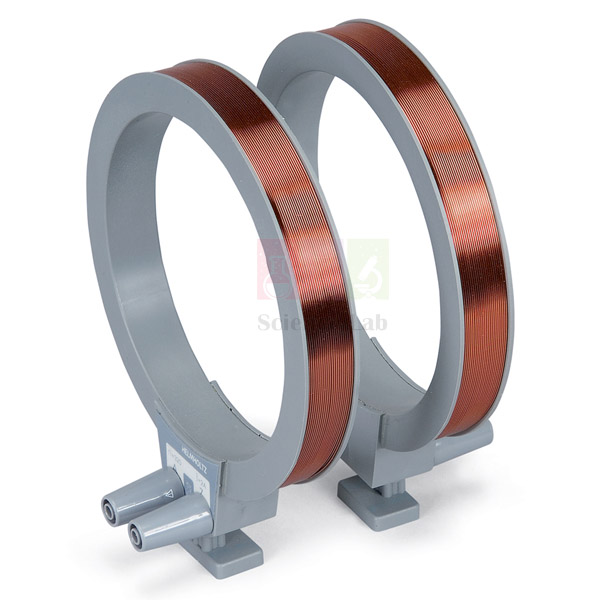
Teltron Helmholtz Pair of Coils S
Teltron Helmholtz Pair of Coils S (Product Code: SLE/PHY/48) is a pair of coils used to generate a uniform magnetic field perpendicular to the axis of a Teltron S-series electron tube in physics laboratories. Each coil has 320 turns on a 138 mm diameter and carries 1.0 A continuously, giving a maximum field of approx. 9 mT for bending electron beams in e/m experiments. It is supplied by Jain Scientific Equipments Pvt Ltd (ScienceLab), Ambala, India.
Specifications
| Parameter | Detail (each coil) |
|---|---|
| Number of turns | 320 |
| Coil diameter | 138 mm |
| Terminals | 4 mm safety sockets |
| Load rating | 1.0 A continuous operation; 1.5 A short-term operation |
| Effective impedance | Approx. 6.5 ohm |
| Max. field strength | Approx. 9 mT |
| Field direction | Perpendicular to the tube axis; vertical or coaxial arrangements possible with the Teltron Tube Holder S |
| Supplied as | Pair of coils, with instructions |
| Product code | SLE/PHY/48 |
| Supplied by | Jain Scientific Equipments Pvt Ltd (ScienceLab), Ambala, India |
What Are Helmholtz Coils Used For?
Mounted on the Teltron Tube Holder S, the two coils sit either side of the tube so that a current through them bends the electron beam into an arc or circle. From the coil current, number of turns and diameter, students calculate the field strength and combine it with the accelerating voltage and beam radius to find the specific charge of the electron — the heart of any EM ratio apparatus set-up in Indian physics laboratories.
The holder also lets the coils be set at variable distances, or arranged to give a vertical or coaxial field relative to the tube axis, so the same pair serves experiments that need a different field direction. Keep the current at or below 1.0 A for long runs and use the 1.5 A rating only briefly; an ammeter in series makes it easy to stay within these limits.
What to Specify When Ordering
- Whether you need the Teltron Tube Holder S on which the coils are configured.
- A DC supply and ammeter for the coil current, suited to 1.0 A continuous operation.
- Which S-series tubes you will use with the coils.
Supplier
Jain Scientific Equipments Private Limited, trading as ScienceLab, supplies the Teltron Helmholtz Pair of Coils S from Ambala, Haryana, India, as part of its electron-beam experiment range. Teltron is a third-party brand; the company sources the coils and can quote them with the holder, tubes and meters that complete the set-up. Visit our profile page to learn more.
Related Physics Lab Equipment
Use the Teltron Helmholtz Pair of Coils S with these items:
- Teltron Tube Holder S — sets the coil spacing and orientation around the tube.
- Digital Voltmeter/Ammeter With Shunts — meter for monitoring the coil current.
- Teltron Dual Beam Tube S — e/m from the diameter of a circular beam.
- Teltron Thomson Tube S — e/m by balancing electric and magnetic fields.
- Teltron Helmholtz Pair of Coils D — the equivalent coil pair for D-series tubes.
More items are listed under Physics Lab Equipment.
Frequently Asked Questions
What magnetic field do the Teltron Helmholtz Pair of Coils S produce?
Each coil of the Teltron Helmholtz Pair of Coils S has 320 turns and a 138 mm diameter, and the maximum field strength is approx. 9 mT. Set in Helmholtz geometry, the pair gives a uniform field across the tube.
What current can the Teltron Helmholtz Pair of Coils S carry?
The Teltron Helmholtz Pair of Coils S are rated at 1.0 A for continuous operation and 1.5 A for short-term operation, with an effective impedance of approx. 6.5 ohm per coil. A series ammeter helps keep the current within these limits.
How are the Teltron Helmholtz Pair of Coils S connected?
The Teltron Helmholtz Pair of Coils S connect through 4 mm safety sockets. Wire the two coils so the current flows the same way round in each; otherwise their fields oppose and the electron beam will not curve as expected.
Do the Teltron Helmholtz Pair of Coils S need the Tube Holder S?
Yes. The Teltron Tube Holder S lets the Teltron Helmholtz Pair of Coils S be configured in Helmholtz geometry or at variable distances, with the field vertical or coaxial to the tube axis. Order the holder too if your lab does not have one.
Who supplies the Teltron Helmholtz Pair of Coils S?
The Teltron Helmholtz Pair of Coils S are supplied by Jain Scientific Equipments Pvt Ltd (ScienceLab), Ambala, India. Teltron is a third-party brand, and the company sources the coils for institutions in India and international markets.
What should an enquiry for the Teltron Helmholtz Pair of Coils S include?
For the Teltron Helmholtz Pair of Coils S, give the number of pairs, the S-series tubes they will serve, and whether you need the Tube Holder S, a DC supply or a meter. Send it via our contact page or the enquiry cart.
Request a Quote
Ask for a quotation for the Teltron Helmholtz Pair of Coils S through the contact page, or collect the coils and matching S-series items in the enquiry cart.
Last updated: 24 September 2026
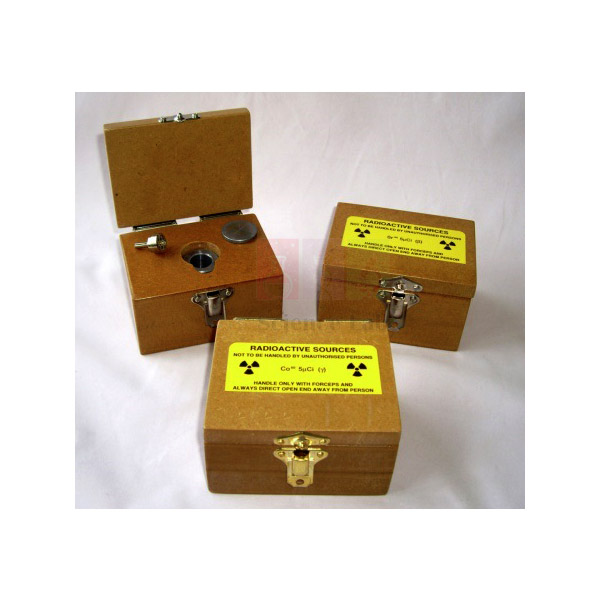
Sealed Radioactive Source, Americium
Sealed Radioactive Source, Americium (Product Code: SLE/PHY/49) is a 5 µCi (185 kBq) americium-241 sealed source used for alpha-particle experiments in school and college physics laboratories. Its active material sits in a silver-palladium disc that transmits a substantial proportion of the alpha particles plus a small amount of low-energy gamma emission, and the mount is colour-coded brown. It is supplied by Jain Scientific Equipments Pvt Ltd (ScienceLab), Ambala, India.
Specifications
| Parameter | Detail |
|---|---|
| Isotope | Americium-241 |
| Activity | 5 µCi (185 kBq) |
| Emissions | Alpha, plus a small amount of low-energy gamma |
| Active element | Silver-palladium disc; active material enclosed in metal foil |
| Mount | Cylindrical mount with a 4 mm diameter stem |
| Window protection | Wire gauze cap over the open window of the mount |
| Identification | Nature and strength engraved on the mount; colour code brown |
| Storage | Small lead castle inside a labelled MDF storage box, 100 x 75 x 65 mm high |
| Documentation | Data sheet enclosed with each source |
| Product code | SLE/PHY/49 |
| Supplied by | Jain Scientific Equipments Pvt Ltd (ScienceLab), Ambala, India |
What Is the Americium Source Used For?
The americium source is the usual alpha emitter for teaching radioactivity. With a GM tube and counter, students show that alpha particles have a short range in air and are stopped by a sheet of paper, then compare that with the greater penetration of beta and gamma radiation. The 4 mm stem lets the source be clamped at a fixed, repeatable distance from the detector, which makes it a reliable part of a radiation experiment kit for Indian schools and colleges.
Handle the source only with tongs or forceps, keep the window pointing away from the body, and return it to its lead castle and box as soon as readings are complete. Never touch or try to clean the foil; the wire gauze cap is there to protect it. Americium-241 is long-lived, so the count rate changes very little from one year to the next.
What to Specify When Ordering
- Which sources you need: this americium alpha source, and whether cobalt or strontium sources are needed too.
- Quantity of each source.
- Delivery destination and any radiation-source authorisation details your institution must provide.
Supplier
ScienceLab, the trading name of Jain Scientific Equipments Private Limited, supplies sealed radioactive sources for teaching laboratories from Ambala, Haryana, India. The company sources the americium source and can quote it together with the detector and counter needed to use it. Company details are on our profile page.
Related Physics Lab Equipment
Build a full alpha, beta and gamma practical around the Sealed Radioactive Source, Americium with these items:
- Sealed Radioactive Source, Cobalt — gamma source for penetration comparisons.
- Sealed Radioactive Source, Strontium — beta source for absorber experiments.
- Geiger Muller Tube Holder — mounts the GM tube that detects the radiation.
- Scaler Timer — counts the pulses over set intervals.
- Geiger Counter — survey meter for checking the source store and background.
See the complete Physics Lab Equipment range.
Frequently Asked Questions
What is the activity of the Sealed Radioactive Source, Americium?
The Sealed Radioactive Source, Americium contains 5 µCi (185 kBq) of americium-241. The nature and strength of the source are engraved on its mount, and a data sheet is enclosed with each source for your records.
What radiation does the Sealed Radioactive Source, Americium emit?
The Sealed Radioactive Source, Americium emits alpha particles and a small amount of low-energy gamma radiation. Its silver-palladium disc transmits a substantial proportion of the alpha particles, which suits alpha range and absorption practicals.
How is the Sealed Radioactive Source, Americium stored?
Each Sealed Radioactive Source, Americium comes in a small lead castle inside a labelled MDF storage box, 100 x 75 x 65 mm high. Keep it in a locked, labelled radioactive-source store and record every issue and return.
How can staff identify the Sealed Radioactive Source, Americium?
The Sealed Radioactive Source, Americium is colour-coded brown, and its nature and strength are engraved on the cylindrical mount. This lets staff tell it apart quickly from other sealed sources kept in the same store.
Is an authorisation needed to buy the Sealed Radioactive Source, Americium?
Radioactive sources are regulated in most countries, so check with your national radiation-safety authority what your institution needs before ordering the Sealed Radioactive Source, Americium. Share those requirements and the destination with us when you enquire.
Who supplies the Sealed Radioactive Source, Americium?
The Sealed Radioactive Source, Americium is supplied by Jain Scientific Equipments Pvt Ltd (ScienceLab), Ambala, India, to schools, colleges and institutions in India and international markets, subject to the destination's rules for radioactive materials.
Request a Quote
Send your source requirement and destination through our contact page, or list the sources and counting equipment in the enquiry cart for a quotation.
Last updated: 24 September 2026
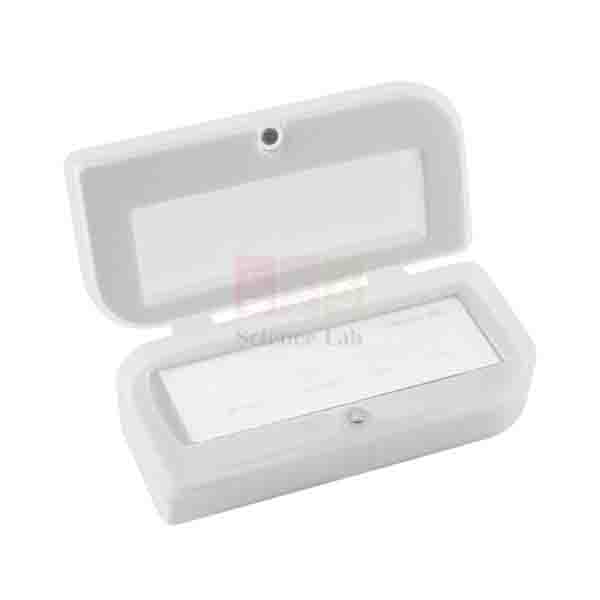
Micrometric Slide
Micrometric Slide (Product Code: SLE/PS/02) is a glass stage graticule slide used to calibrate a microscope’s eyepiece scale in biology and microscopy teaching laboratories. Its 1 mm scale, divided into 0.01 mm steps, lets students convert eyepiece divisions into real distances before they measure or count cells. It is supplied by Jain Scientific Equipments Pvt Ltd (ScienceLab), Ambala, India, as a companion to the micrometer eyepiece.
Specifications
| Parameter | Detail |
|---|---|
| Also known as | Stage graticule slide |
| Material | Glass |
| Slide size | 26 x 76 mm |
| Scale range | 1 mm |
| Divisions | 0.01 mm (10 µm) |
| Microscope type | Transmitted light microscopes |
| Used with | Micrometer eyepiece |
| Purpose | Manual microscope calibration for cell counting |
| Product code | SLE/PS/02 |
| Supplied by | Jain Scientific Equipments Pvt Ltd (ScienceLab), Ambala, India |
What Is a Micrometric Slide Used For?
The scale inside a micrometer eyepiece has no fixed real value: what one division covers changes with every objective. To find it, place the Micrometric Slide on the stage, focus on its scale, and rotate the eyepiece until both scales lie side by side. Note how many eyepiece divisions match a known number of 0.01 mm steps on the slide, then divide to get the value of one eyepiece division for that objective.
Repeat the procedure for each objective and keep the values in a table beside the microscope. Students can then measure cells, pollen grains or other specimens directly and apply the calibration in cell counting work. Handle the slide by its edges, clean it gently with lens tissue, and keep it in a slide box so the scale stays free of dust and scratches.
What to Specify When Ordering
- The number of slides, usually matched to the number of microscopes or student groups doing calibration.
- Whether you also need a micrometer eyepiece, since the slide is used together with one.
- That your microscopes use transmitted light, the type this slide is intended for.
Supplier
Jain Scientific Equipments Private Limited, which trades as ScienceLab from Ambala, Haryana, supplies the Micrometric Slide to schools, colleges, universities, training laboratories, dealers and importers in India and international markets. It can be ordered with microscopes, eyepieces and prepared slides so a microscopy room is equipped from a single source. Company details are on the ScienceLab profile.
Related Laboratory Equipment
Items used in the same calibration and measurement work:
- Eyepiece Micrometric — the eyepiece scale that this slide is used to calibrate.
- Monocular Biological Microscope 400x — a student microscope on which calibration can be practised.
- Student-Grade Microscope Slides — plain slides for mounting the specimens you measure after calibration.
- Glass Cover Slips — to cover specimen mounts before measurement.
- Slide Box — protective storage for the calibration slide between uses.
More slides and slide accessories are listed under Prepared Slides, and instruments under Microscope.
Frequently Asked Questions
What is a Micrometric Slide?
A Micrometric Slide, also called a stage graticule slide, is a glass slide carrying a 1 mm scale divided into 0.01 mm steps. It sits on the microscope stage as a known reference, so the eyepiece scale of a micrometer eyepiece can be calibrated against it.
What are the scale range and divisions of the Micrometric Slide?
The Micrometric Slide (SLE/PS/02) has a scale range of 1 mm with divisions of 0.01 mm, which is 10 micrometres per division. The glass slide itself measures 26 x 76 mm, so it fits the stage clips of a typical microscope.
Can the Micrometric Slide be used without a micrometer eyepiece?
No, the Micrometric Slide is meant to be used together with a micrometer eyepiece. The slide provides the known scale on the stage and the eyepiece scale is compared against it; without an eyepiece graticule there is nothing to calibrate.
Which microscopes is the Micrometric Slide suitable for?
The Micrometric Slide is suitable for transmitted light microscopes, where light passes up through the glass slide to the objective. Most student and laboratory biological microscopes work this way; please check with us before using it on any other type of instrument.
Does the Micrometric Slide come with a calibration certificate?
Calibration-certificate availability for the Micrometric Slide is not stated in the product details. If your laboratory needs a certificate or traceability documents, raise it through our contact page before ordering and we will tell you what can be provided.
How should the Micrometric Slide be stored?
Store the Micrometric Slide in a slide box or case away from dust, and handle it only by the edges. Clean the surface gently with lens tissue, because scratches or residue on the scale make it harder to line up the two scales accurately.
Who supplies the Micrometric Slide?
The Micrometric Slide (SLE/PS/02) is supplied by Jain Scientific Equipments Pvt Ltd (ScienceLab), Ambala, India. Schools, colleges, laboratories, dealers and importers in India and international markets can order it on its own or together with microscopes and eyepieces.
Request a Quote
For a quotation on the Micrometric Slide, place it in the enquiry cart or contact us through the contact page. State the quantity, whether micrometer eyepieces are also needed, and the delivery location.
Last updated: 24 September 2026
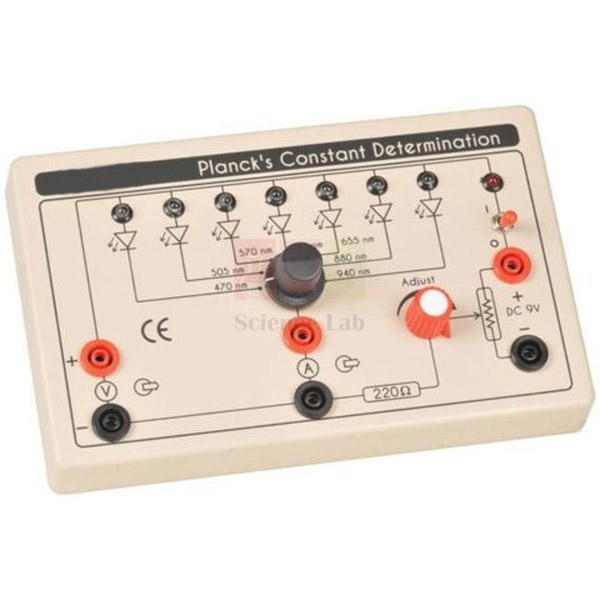
Plancks Constant Determination Box
Plancks Constant Determination Box (Product Code: SLE/PHY/50) is an LED-based apparatus used to find an approximate value of Planck's constant from the elbow voltage in LED characteristic curves in physics laboratories. Seven LEDs, from deep blue at 470 nm to near infrared at 940 nm, are mounted on the box with sockets for voltage and current measurements, making it a compact Planck constant experiment kit. It is supplied by Jain Scientific Equipments Pvt Ltd (ScienceLab), Ambala, India.
Specifications
| Parameter | Detail |
|---|---|
| Method | Elbow voltage in the characteristic curves of a number of LEDs |
| Number of LEDs | 7, mounted on the box |
| Wavelength range | 470 nm (deep blue) to 940 nm (near infrared) |
| Connections | Sockets for voltage and current measurements |
| Power | External 9 V power source or 9 V battery required |
| Leads | Connecting leads required |
| Product code | SLE/PHY/50 |
| Supplied by | Jain Scientific Equipments Pvt Ltd (ScienceLab), Ambala, India |
What Is the Planck's Constant Box Used For?
Students connect each LED in turn, raise the voltage slowly and note the value at which it just begins to emit light — the elbow of its current–voltage curve. That voltage multiplied by the electron charge gives the energy of the emitted photons; plotting energy against light frequency, worked out from each LED's wavelength, gives a straight line whose gradient approximates Planck's constant.
With seven LEDs spread from 470 nm to 940 nm, the graph has enough points for a clear straight-line fit, and the exercise doubles as an LED characteristics experiment kit for electronics topics. For the near-infrared LED the light cannot be seen, so read its turn-on point from the current meter instead of by eye.
What to Specify When Ordering
- Power: whether you will use an external 9 V source or a 9 V battery.
- Connecting leads and meters for the voltage and current sockets.
- Number of boxes, for example one per bench group or one for demonstration.
Supplier
Jain Scientific Equipments Private Limited, trading as ScienceLab, supplies the Plancks Constant Determination Box from Ambala, Haryana, India, to schools, colleges and dealers. The company sources the box and can add the meters, leads and power source needed for the practical to the same quotation.
Vendor details for purchase files: Jain Scientific Equipments Private Limited, CIN U29309HR2020PTC087597, GSTIN 06AAECJ8618A1ZT. More about the company is on our profile page.
Related Physics Lab Equipment
These items supply the power, connections and measurements the Plancks Constant Determination Box needs:
- Standard Digital Multimeter — measures the LED voltage and current.
- Digital Voltmeter — a dedicated bench voltmeter for the turn-on voltage.
- Crocodile Clips & Leads — connecting leads for the box and meters.
- Battery Clip, PP3 — connects a 9 V PP3 battery as the power source.
- Planck's Constant Apparatus — photoelectric method for a second, independent value.
Explore more Physics Lab Equipment.
Frequently Asked Questions
How does the Plancks Constant Determination Box find Planck's constant?
The Plancks Constant Determination Box uses the elbow voltage in the characteristic curve of each LED. Plotting the photon energy from that voltage against light frequency for all seven LEDs gives a line whose gradient is an approximate value of Planck's constant.
What LED wavelengths are on the Plancks Constant Determination Box?
The Plancks Constant Determination Box carries seven LEDs covering deep blue at 470 nm to near infrared at 940 nm. This spread gives a wide frequency range for the energy–frequency graph that students plot.
What else is needed to use the Plancks Constant Determination Box?
To use the Plancks Constant Determination Box you need an external 9 V power source or a 9 V battery, connecting leads, and meters for the voltage and current sockets on the box. These can be added to the same quotation on request.
How precise is the value from the Plancks Constant Determination Box?
The Plancks Constant Determination Box is designed to give an approximate value of Planck's constant, which suits teaching the link between photon energy and frequency. Students can compare their result with a second, independent method such as the photoelectric experiment.
Who supplies the Plancks Constant Determination Box?
The Plancks Constant Determination Box is supplied by Jain Scientific Equipments Pvt Ltd (ScienceLab), Ambala, India, to schools, colleges and dealers in India and international markets. Contact us with the quantity you need for a quotation.
What should a Plancks Constant Determination Box enquiry include?
For the Plancks Constant Determination Box, state the number of boxes, whether you need a 9 V battery or power source, and whether meters and leads should be quoted too. Use the contact page or the enquiry cart to send it.
Request a Quote
Price the Plancks Constant Determination Box by writing to us through the contact page, or add the box, meters and leads to the enquiry cart.
Last updated: 24 September 2026

Monocular Biological Microscope 400x
Monocular Biological Microscope 400x (Product Code: SLE/M/03) is a mirror-illuminated compound microscope used by younger students to view slides and live specimens at 40x, 100x and 400x without any electrical supply. A 38 mm mirror reflects daylight or lamp light through the specimen, and the light, handy build makes it easy to carry for field work. This compound microscope for schools in India and abroad is supplied by Jain Scientific Equipments Pvt Ltd (ScienceLab), Ambala, India.
Specifications
| Parameter | Detail |
|---|---|
| Head | Monocular tube, inclinable up to 90 degrees |
| Eyepiece | Wide field 10x |
| Objectives | Achromatic 4x, 10x, 40x SL |
| Magnification | 40x, 100x, 400x |
| Nosepiece | Triple revolving, with positive centering |
| Stage | 100 x 90 mm plain mechanical stage with paired clips |
| Condenser | Single lens with disc diaphragm |
| Focusing | Coarse and fine |
| Illumination | Natural light via 38 mm diameter mirror |
| Construction | Optical glass lenses and metal components |
| Product code | SLE/M/03 |
| Supplied by | Jain Scientific Equipments Pvt Ltd (ScienceLab), Ambala, India |
What Is the Mirror Microscope Used For?
This model is built for first lessons in microscopy where power is unreliable or absent: rural schools, open-air nature clubs, pond and garden surveys, and junior science lab equipment sets used by middle-school pupils. Students look at leaf sections, insect wings, algae from a water sample or prepared slides, moving from 4x to 40x on the triple nosepiece as they learn to focus with the coarse and fine knobs.
To light the specimen, tilt the mirror towards a bright window or a desk lamp until the field looks evenly white, then adjust the disc diaphragm for contrast. Never point the mirror at direct sunlight, which can harm the eye. Because the tube tilts up to 90 degrees, pupils can use it seated or standing at a bench.
Supplier
ScienceLab, the trading name of Jain Scientific Equipments Private Limited in Ambala, Haryana, supplies this mirror-lit microscope to schools and outreach programmes that need instruments independent of electricity. Education departments, NGOs running science camps, dealers and importers in India and international markets can combine it with slides and magnifiers in one order. Learn about the company on the ScienceLab profile page.
Related Laboratory Equipment
Useful companions for mirror-lit and field microscopy:
- Monocular Biological Microscope 400x, LED — LED-lit version for rooms with mains or battery power
- Concavity Slides — hold a drop of pond water for live organisms
- Pocket Magnifier — quick first look at specimens collected outdoors
- Microscope Case — padded hard case for carrying the microscope to field sites
- Basic Botany Slide Set — prepared plant slides for classroom study
More models are listed in the Microscope category.
Frequently Asked Questions
Does the Monocular Biological Microscope 400x need electricity?
No. The Monocular Biological Microscope 400x uses natural or room light reflected by a 38 mm diameter mirror, so it needs no mains supply or batteries. That makes it practical for classrooms without sockets and for outdoor field work.
What magnifications does the Monocular Biological Microscope 400x offer?
The Monocular Biological Microscope 400x offers 40x, 100x and 400x. A wide field 10x eyepiece works with achromatic 4x, 10x and 40x SL objectives mounted on a triple revolving nosepiece with positive centering.
How do I get even light with the Monocular Biological Microscope 400x?
Angle the mirror of the Monocular Biological Microscope 400x towards a window or lamp until the field is evenly bright, then set the disc diaphragm for contrast. Never aim the mirror at direct sunlight, as this can injure the eye.
Who is the Monocular Biological Microscope 400x designed for?
The Monocular Biological Microscope 400x is designed for younger students. It is simple to use yet keeps the main features of a compound microscope, including a 100 x 90 mm stage with paired clips and coarse and fine focusing.
Who supplies the Monocular Biological Microscope 400x?
Jain Scientific Equipments Pvt Ltd (ScienceLab), Ambala, Haryana, India supplies the Monocular Biological Microscope 400x to schools, colleges, education projects, dealers and importers in India and international markets, in single units or class quantities.
Are spare parts available for the Monocular Biological Microscope 400x?
For replacement parts for the Monocular Biological Microscope 400x, such as an eyepiece or mirror, contact us with the product code SLE/M/03 and the part needed, and we will confirm what can be supplied.
Request a Quote
Send your required quantity of the Monocular Biological Microscope 400x through our contact page, or add it to the enquiry cart together with slides and other biology items.
Last updated: 24 September 2026
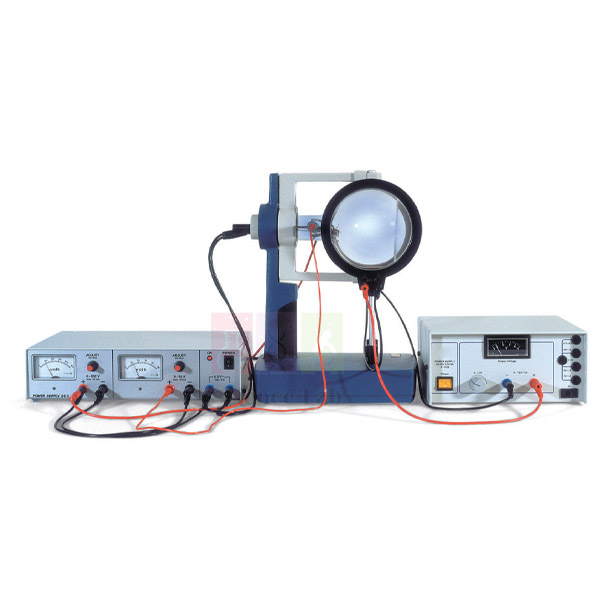
Teltron Dual Beam Tube D
Teltron Dual Beam Tube D (Product Code: SLE/PHY/51) is a semi-evacuated electron tube filled with low-pressure helium and fitted with both a tangential and an axial electron gun, used to study electron collisions and the electron charge-to-mass ratio in physics laboratories. Excited helium atoms make the beams glow as fine luminescent lines, so students see the electron path directly. It is supplied as the tube only by Jain Scientific Equipments Pvt Ltd (ScienceLab), Ambala, India.
Specifications
| Parameter | Detail |
|---|---|
| Tube type | Semi-evacuated, filled with low-pressure helium |
| Electron guns | Tangential and axial |
| Max. filament voltage | 7.5 V |
| Max. anode voltage | 300 V DC |
| Anode current | Approx. 30 mA at 200 V (anode) |
| Max. deflection voltage | 50 V DC |
| Scope of supply | Tube only; instructions included |
| Product code | SLE/PHY/51 |
| Supplied by | Jain Scientific Equipments Pvt Ltd (ScienceLab), Ambala, India |
What Is the Dual Beam Tube Used For?
Fire the axial gun with a magnetic field along the tube axis and the fine, luminous beam lets students study impact excitation and particle collisions — a visual link between electron physics and kinetic gas theory. Switch to the tangential gun with the field perpendicular, and the beam bends into a closed pattern whose diameter gives the fundamental electron charge-to-mass ratio, a classic specific charge electron experiment.
Because the Teltron Dual Beam Tube D is sold as the tube only, plan the full set-up before ordering: a D-series holder, a Helmholtz coil pair for the magnetic field, and a supply able to provide up to 300 V DC on the anode, 7.5 V on the filament and 50 V DC for deflection. Departments that already own Teltron D-series accessories can simply add the tube.
What to Specify When Ordering
- Whether you need the Teltron Tube Holder D and Teltron Helmholtz Pair of Coils D, since the product is the tube only.
- A power supply covering 300 V DC anode, 7.5 V filament and 50 V DC deflection.
- A meter for monitoring the coil current.
- Number of tubes required.
Supplier
ScienceLab is how Jain Scientific Equipments Private Limited trades, and the company supplies the Teltron Dual Beam Tube D from Ambala, Haryana, India. Teltron is a third-party brand; the company sources the tube and, because it ships as the tube only, can quote the holder, coils and supply alongside it. See our company profile.
Related Physics Lab Equipment
The Teltron Dual Beam Tube D is supplied as the tube only; these items complete the experiment:
- Teltron Tube Holder D — holder for the Teltron D-series tubes and coils.
- Teltron Helmholtz Pair of Coils D — provides the magnetic field that bends the beam.
- High Tension Power Supply — designed for thermionic experiments such as the Teltron double fine beam tube.
- Digital Voltmeter/Ammeter With Shunts — monitors the coil current.
- Teltron Dual Beam Tube S — the S-series version of this tube.
Visit the Physics Lab Equipment category for more.
Frequently Asked Questions
What is included with the Teltron Dual Beam Tube D?
The Teltron Dual Beam Tube D is supplied as the tube only, with instructions included. The holder, Helmholtz coils and power supply are separate items, and we can quote them together with the tube on request.
What gas is inside the Teltron Dual Beam Tube D?
The Teltron Dual Beam Tube D is semi-evacuated and filled with low-pressure helium. Electrons excite the helium atoms along their path, which makes the beams visible as fine luminescent lines during the experiment.
Why does the Teltron Dual Beam Tube D have two electron guns?
The Teltron Dual Beam Tube D uses its axial gun with a co-axial magnetic field to study impact excitation and particle collisions, and its tangential gun with a perpendicular field to find the electron charge-to-mass ratio from the beam pattern diameter.
What are the electrical ratings of the Teltron Dual Beam Tube D?
The Teltron Dual Beam Tube D has a maximum filament voltage of 7.5 V, a maximum anode voltage of 300 V DC and a maximum deflection voltage of 50 V DC. The anode current is approx. 30 mA at 200 V.
Who supplies the Teltron Dual Beam Tube D?
Jain Scientific Equipments Pvt Ltd (ScienceLab), Ambala, India, supplies the Teltron Dual Beam Tube D. Teltron is a third-party brand; the company sources the tube for colleges, universities and schools in India and international markets.
What should a Teltron Dual Beam Tube D enquiry include?
For the Teltron Dual Beam Tube D, list the number of tubes and say whether you already own a D-series holder, Helmholtz coils and a suitable supply, or need them quoted. Send the details through the contact page or the enquiry cart.
Request a Quote
Request pricing for the Teltron Dual Beam Tube D through our contact page, or add the tube and any missing accessories to the enquiry cart.
Last updated: 24 September 2026
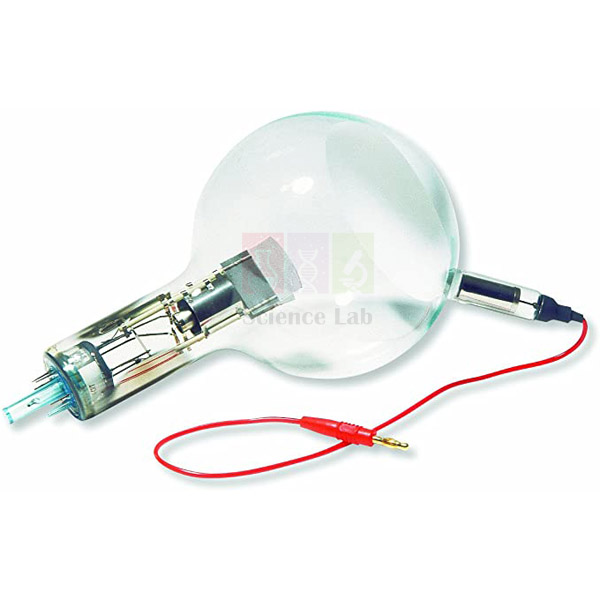
Teltron Perrin Tube S
Teltron Perrin Tube S (Product Code: SLE/PHY/52) is an evacuated electron tube from the Teltron S series used to repeat Jean Perrin's experiment, which shows that cathode rays carry negative charge, in college and senior school physics laboratories. It helps students connect a visible electron beam with the idea of the electron as a charged particle, a key step in any unit on the discovery of the electron. It is supplied by Jain Scientific Equipments Pvt Ltd (ScienceLab), Ambala, India.
Key Details
| Parameter | Detail |
|---|---|
| Product type | Evacuated electron tube for the Perrin experiment |
| Series | Teltron S series |
| Brand | Teltron (third-party brand) |
| Technical data | Ask us for the current specification sheet before ordering |
| Product code | SLE/PHY/52 |
| Supplied by | Jain Scientific Equipments Pvt Ltd (ScienceLab), Ambala, India |
What Is the Perrin Tube Used For?
In Perrin's classic experiment, an electron beam is steered by a magnetic field into a charge collector linked to an electroscope or meter; the collector gains negative charge, showing that cathode rays are negatively charged particles rather than a form of light. The Teltron Perrin Tube S brings this historic result into the teaching laboratory as a clear physics demonstration for students in India studying atomic structure.
Electron tubes of this kind run at high voltages, so the tube should be set up and switched on by a teacher or technician, mounted in a suitable holder and connected with shrouded leads. Confirm the operating voltages, holder and coil requirements with us before ordering; we will send the specification with your quotation.
Supplier
Jain Scientific Equipments Private Limited, which trades as ScienceLab, supplies the Teltron Perrin Tube S from Ambala, Haryana, India. Teltron is a third-party brand; the company sources the tube and will confirm its current specification and accessory needs in the quotation. Read more on our company profile.
Related Physics Lab Equipment
These items belong to the same S-series electron-beam teaching set as the Teltron Perrin Tube S:
- Teltron Tube Holder S — mounting point for the Teltron Student (S) series tubes.
- Teltron Helmholtz Pair of Coils S — magnetic field source for S-series tubes.
- Teltron Thomson Tube S — S-series tube for measuring e/m.
- Teltron Perrin Tube D — the D-series version of the Perrin tube.
- Electroscope, Gold Leaf — classic charge indicator for the electrostatics lessons that lead into electron-beam work.
Browse more in Physics Lab Equipment.
Frequently Asked Questions
What does the Teltron Perrin Tube S demonstrate?
The Teltron Perrin Tube S is used for Perrin's experiment, which shows that the electron beam, or cathode rays, carries negative charge. It is usually taught alongside other electron-beam experiments in a unit on the discovery of the electron.
What are the technical specifications of the Teltron Perrin Tube S?
Please ask us for the current specification sheet of the Teltron Perrin Tube S, including operating voltages and accessory requirements. We confirm these details with your quotation rather than list unverified figures on this page.
Which accessories does the Teltron Perrin Tube S need?
Teltron S-series tubes are mounted on the Teltron Tube Holder S, and electron-beam experiments generally need a high-voltage supply and often a pair of Helmholtz coils. Tell us what you already own and we will confirm what the Teltron Perrin Tube S set-up needs.
Can students operate the Teltron Perrin Tube S themselves?
The Teltron Perrin Tube S works at high voltages, so a teacher or lab technician should set it up and switch it on, with students observing and recording results. Always follow the operating instructions for the tube.
Who supplies the Teltron Perrin Tube S?
The Teltron Perrin Tube S is supplied by Jain Scientific Equipments Pvt Ltd (ScienceLab), Ambala, India. Teltron is a third-party brand; the company sources the tube for schools, colleges and institutions in India and international markets.
What should a Teltron Perrin Tube S enquiry include?
For the Teltron Perrin Tube S, state the quantity, the S-series holder, coils and power supply you already have, and your delivery destination. Send the details through the contact page or the enquiry cart and we will reply with a specification and quotation.
Request a Quote
Ask for the Teltron Perrin Tube S specification and price through our contact page, or add it to the enquiry cart with your other S-series items.
Last updated: 24 September 2026