- Physics Lab Equipment
- Chemistry Lab Equipment
- Biology Lab Equipment
- Anatomical Lab Equipment
- Learning
- Educational Lab Equipment
- Magnets
- Agriculture
- Astronomy
- Earth Science
- Geography Lab Equipment
- Safety Lab Coat
- Laboratory
- Meteorological
- Electricity & Magnetism
- Heat
- School Lab Equipment
- Lab Glassware
- Science Lab Equipment
- Tvet Lab Equipment
- Robotics Kits Supplier and Manufacturer for Schools India
- Math Lab Equipment Manufacturers and Exporters in Ambala
- STEM Kits Manufacturers and Supplier India
- Engineering Lab Equipment
- Hospital Lab Equipment
- Water, Sanitation & Hygiene Supplies
- Cold Chain, Solar & Communication Equipment
- Nutrition
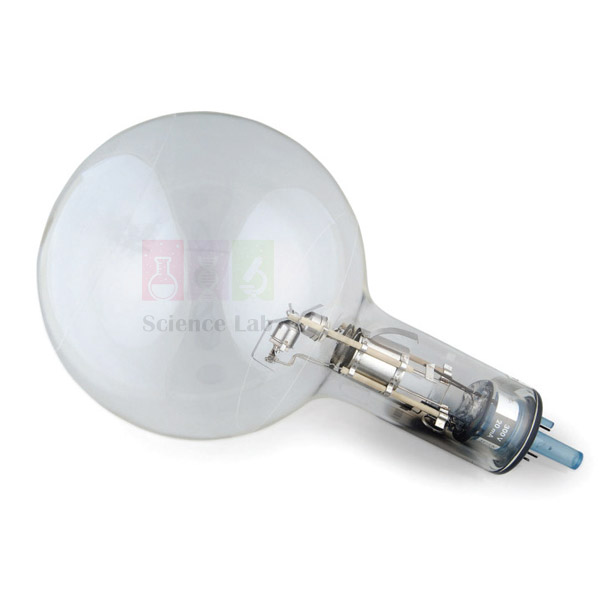
Teltron Dual Beam Tube S
Teltron Dual Beam Tube S (Product Code: SLE/PHY/53) is a Teltron S-series electron tube containing low-pressure helium and two electron guns, used to measure the electron charge-to-mass ratio from the diameter of a visible beam pattern in physics laboratories. Its anode runs at up to 300 V DC, with an anode current of approx. 30 mA at 200 V, and instructions are included. It is supplied by Jain Scientific Equipments Pvt Ltd (ScienceLab), Ambala, India.
Specifications
| Parameter | Detail |
|---|---|
| Series | Teltron S series |
| Tube type | Semi-evacuated, low-pressure helium filling |
| Electron guns | One tangential, one axial |
| Max. anode voltage | 300 V DC |
| Anode current | Approx. 30 mA at 200 V (anode) |
| Max. filament voltage | 7.5 V |
| Max. deflection voltage | 50 V DC |
| Documentation | Instructions included |
| Product code | SLE/PHY/53 |
| Supplied by | Jain Scientific Equipments Pvt Ltd (ScienceLab), Ambala, India |
What Is the Dual Beam Tube S Used For?
For the e/m experiment, the tube sits between Helmholtz coils so the magnetic field is perpendicular to the tangential beam. Students set an accelerating voltage, adjust the coil current until the glowing beam closes into a circle, and read its diameter; with the field worked out from the coil current, e/m follows from the standard relation. Repeating at several voltage and current settings gives a dependable average for this EM ratio apparatus exercise.
The axial gun adds a second investigation: with a co-axial magnetic field, the fine luminescent beams show impact excitation of helium atoms and particle collisions, linking electron physics to kinetic gas theory. Two investigations from one tube help physics departments in India get more from a single S-series set-up.
What to Specify When Ordering
- Whether your lab already has the Teltron Tube Holder S and Teltron Helmholtz Pair of Coils S.
- A power source able to give up to 300 V DC on the anode, 7.5 V on the filament and 50 V DC for deflection.
- An ammeter to set the Helmholtz coil current.
Supplier
Jain Scientific Equipments Private Limited, known by its trading name ScienceLab, supplies the Teltron Dual Beam Tube S from Ambala, Haryana, India. Teltron is a third-party brand; the company sources the tube for teaching laboratories and can bundle it with S-series holders and coils in a single quotation.
Buyers who need registration details can use GSTIN 06AAECJ8618A1ZT, and international orders are shipped under the company's Importer-Exporter Code AAECJ8618A issued by the DGFT. Visit our profile page for more.
Related Physics Lab Equipment
Complete an e/m practical with the Teltron Dual Beam Tube S using these items:
- Teltron Tube Holder S — stand for the S-series tube and its coils.
- Teltron Helmholtz Pair of Coils S — the perpendicular field that bends the beam into a circle.
- High Tension Power Supply — supply designed for thermionic experiments with Teltron fine beam tubes.
- Digital Voltmeter/Ammeter With Shunts — reads the coil current for the field calculation.
- Teltron Dual Beam Tube D — the D-series version of this tube.
More options are in Physics Lab Equipment.
Frequently Asked Questions
How is e/m found with the Teltron Dual Beam Tube S?
With the Teltron Dual Beam Tube S, the tangential beam is bent into a circle by a perpendicular magnetic field. Measuring the circle's diameter, the accelerating voltage and the field strength lets students calculate the electron charge-to-mass ratio.
Why is the beam visible in the Teltron Dual Beam Tube S?
The Teltron Dual Beam Tube S is semi-evacuated and filled with low-pressure helium. Electrons excite the helium atoms along their path, producing fine luminescent beams that make the trajectory visible to the whole group.
What voltages does the Teltron Dual Beam Tube S use?
The Teltron Dual Beam Tube S has a maximum anode voltage of 300 V DC, a maximum filament voltage of 7.5 V and a maximum deflection voltage of 50 V DC, with an anode current of approx. 30 mA at 200 V.
Are instructions provided with the Teltron Dual Beam Tube S?
Yes, instructions are included with the Teltron Dual Beam Tube S. Keep them with the tube, and check the voltage limits in them before connecting a new or different power supply.
Who supplies the Teltron Dual Beam Tube S?
The Teltron Dual Beam Tube S is supplied by Jain Scientific Equipments Pvt Ltd (ScienceLab), Ambala, India. Teltron is a third-party brand; the company sources the tube for schools, colleges and universities in India and international markets.
What should a Teltron Dual Beam Tube S quotation request include?
For the Teltron Dual Beam Tube S, give the number of tubes, say which S-series holder, coils and supply you already own, and name the delivery destination. Send the request through our contact page or the enquiry cart.
Request a Quote
Get a Teltron Dual Beam Tube S quotation by writing to us on the contact page, or add the tube and matching S-series items to the enquiry cart.
Last updated: 24 September 2026
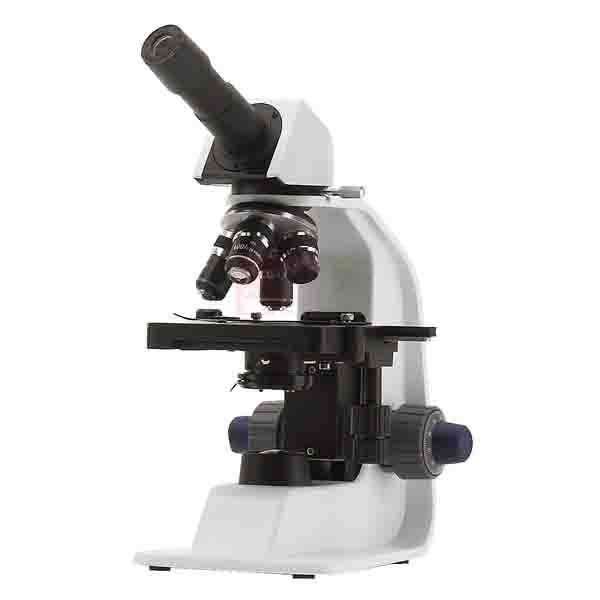
Monocular Microscope 1000x, LED light
Monocular Microscope 1000x, LED light (Product Code: SLE/M/04) is a single-eyepiece brightfield microscope used to study blood smears, bacteria and fine tissue detail at up to 1000x with a 100x oil-immersion objective in educational and routine laboratories. It combines a die-cast metal stand, anti-fungus glass optics and a double-layer mechanical stage with vernier scales for relocating a field. It is supplied by Jain Scientific Equipments Pvt Ltd (ScienceLab), Ambala, India, a biology lab instruments supplier to schools and colleges.
Specifications
| Parameter | Detail |
|---|---|
| Observation | Brightfield |
| Head | Monocular, inclined 30°, 360° rotatable |
| Eyepiece | Wide field WF10x/18 mm |
| Objectives | DIN achromatic 4x, 10x, 40x, 100x (oil) |
| Condenser | Abbe, N.A. 1.2, precentered, with diaphragm |
| Focusing | Coaxial coarse and fine (graduation 0.002 mm) with limit stop; adjustable tension of coarse focusing knob |
| Stage | Double-layer mechanical stage, 125 x 116 mm; X-Y movement range 76 x 30 mm |
| Stage scales | Vernier on both axes, accuracy 0.1 mm; specimen holder for one slide |
| Illuminator | 1 W LED with external power supply; intensity knob on left side of base |
| LED average lifetime | 50 000 hours |
| Construction | Die-cast metal; anti-fungus glass optics |
| Product code | SLE/M/04 |
| Supplied by | Jain Scientific Equipments Pvt Ltd (ScienceLab), Ambala, India |
What Is the 1000x Monocular Microscope Used For?
At 1000x a student can see the shape of bacterial cells in a Gram-stained smear, count white blood cell types in a blood film and study chromosome detail in root-tip squashes. The microscope suits senior-school, college and nursing labs as well as routine laboratory checks, and it is a sensible step up for microbiology lab equipment in India where a lower-power instrument no longer shows enough. The 4x, 10x and 40x objectives are used dry for locating and surveying the specimen before the oil objective is swung in.
For oil work, place one drop of immersion oil on the cover glass over the chosen area, rotate the 100x objective into the drop and focus only with the fine knob; the limit stop helps prevent the objective from being driven into the slide. Wipe the oil off the objective with lens tissue at the end of every session. The vernier readings let a teacher note the X-Y position of a good field so students can return to it.
Supplier
Jain Scientific Equipments Private Limited uses the trading name ScienceLab and supplies this oil-immersion monocular microscope from Ambala, Haryana. Schools, colleges, paramedical institutes, dealers and importers in India and international markets order it with immersion oil, slides and cleaning materials so that a microbiology bench is ready in a single consignment. The ScienceLab company profile has more background.
Related Laboratory Equipment
Consumables and alternatives for 1000x oil-immersion work:
- Immersion Oil, 25ml — required between the 100x objective and the cover glass
- Lens Tissue — removes oil from the objective after each session
- Bacteria slide Set of 12 — prepared bacterial slides for viewing at the highest power
- Microscope Slides Glass — plain slides for making smears and blood films
- Binocular Microscope, 1000x Mag LED — two-eyepiece alternative for longer viewing sessions
See all models in the Microscope category.
Frequently Asked Questions
What is the maximum magnification of the Monocular Microscope 1000x, LED light?
The Monocular Microscope 1000x, LED light reaches 1000x by combining its WF10x/18 mm eyepiece with a 100x oil-immersion objective. The DIN achromatic 4x, 10x and 40x objectives cover the lower powers used for locating the specimen.
Do I need immersion oil for the Monocular Microscope 1000x, LED light?
Yes, the 100x objective of the Monocular Microscope 1000x, LED light is an oil objective and needs a drop of immersion oil on the slide. Oil is not listed as included, so order it separately and clean the lens with lens tissue after use.
What kind of stage does the Monocular Microscope 1000x, LED light have?
The Monocular Microscope 1000x, LED light has a 125 x 116 mm double-layer mechanical stage with 76 x 30 mm X-Y travel, vernier scales on both axes reading to 0.1 mm, and a specimen holder for one slide.
How is the Monocular Microscope 1000x, LED light illuminated?
The Monocular Microscope 1000x, LED light uses a 1 W LED powered by an external power supply, with brightness set by a knob on the left of the base. The LED has an average lifetime of about 50 000 hours.
Who supplies the Monocular Microscope 1000x, LED light?
The Monocular Microscope 1000x, LED light is supplied by Jain Scientific Equipments Pvt Ltd (ScienceLab), Ambala, Haryana, India. The company ships it to schools, colleges, laboratories, dealers and importers in India and international markets.
Is a calibration certificate available for the Monocular Microscope 1000x, LED light?
Calibration documentation is not listed for the Monocular Microscope 1000x, LED light. If your institution needs any inspection or test document with the order, contact us before ordering so we can confirm what can be provided.
Request a Quote
Ask for a quotation on the Monocular Microscope 1000x, LED light through the contact page, or add it to the enquiry cart with immersion oil and slides for a complete microbiology bench.
Last updated: 24 September 2026
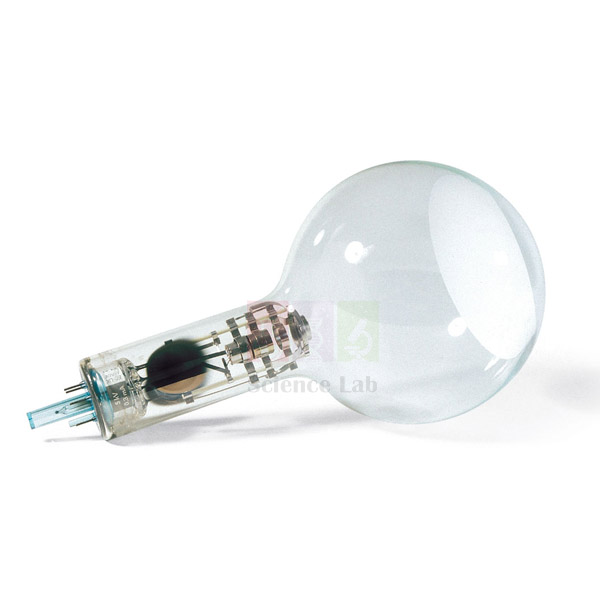
Teltron Electron Diffraction Tube S
Teltron Electron Diffraction Tube S (Product Code: SLE/PHY/54) is a highly evacuated Teltron S-series electron tube used to make electron interference visible as Debye–Scherrer rings on a fluorescent screen in physics laboratories. Students measure the rings produced by a polycrystalline graphite lattice and use the lattice spacing to find the electron wavelength at anode voltages up to 5 kV. It is supplied by Jain Scientific Equipments Pvt Ltd (ScienceLab), Ambala, India.
Specifications
| Parameter | Detail |
|---|---|
| Series | Teltron S series |
| Diffracting lattice | Polycrystalline graphite (Debye–Scherrer diffraction) |
| Lattice constant d10 | 0.213 nm |
| Lattice constant d11 | 0.123 nm |
| Max. anode voltage | 5 kV |
| Anode current | Approx. 0.1 mA at 4 kV |
| Max. filament voltage | 6.3 V AC |
| Documentation | Instructions included |
| Product code | SLE/PHY/54 |
| Supplied by | Jain Scientific Equipments Pvt Ltd (ScienceLab), Ambala, India |
What Is the Electron Diffraction Tube S Used For?
In the lab, the Teltron Electron Diffraction Tube S turns an abstract idea — electrons behaving as waves — into bright rings that students can measure. The inner and outer rings correspond to the two graphite lattice plane spacings, d10 = 0.213 nm and d11 = 0.123 nm, so each ring gives its own estimate of the electron wavelength.
A typical run records ring diameters at a series of anode voltages and then compares the measured wavelength with the de Broglie value calculated from each voltage. For departments buying from a physics instruments supplier in India, the tube slots into an existing S-series set-up and needs a filament supply of up to 6.3 V AC plus a high-voltage anode supply.
What to Specify When Ordering
- Whether you need the Teltron Tube Holder S to mount the tube.
- A power supply covering 6.3 V AC filament and up to 5 kV anode voltage.
- Number of tubes for demonstration or student groups.
Supplier
ScienceLab, the brand name of Jain Scientific Equipments Private Limited, supplies the Teltron Electron Diffraction Tube S to physics departments from Ambala, Haryana, India. Teltron is a third-party brand; the company sources the tube and can match it with the S-series holder and a high-voltage supply on one quotation. Find out more on our profile page.
Related Physics Lab Equipment
These items help you run the diffraction experiment with the Teltron Electron Diffraction Tube S:
- Teltron Tube Holder S — S-series stand with a fuse that protects tubes from excessive voltage.
- EHT Power Supply — adjustable 5 kV output with an auxiliary heater output.
- Teltron Dual Beam Tube S — S-series tube showing the electron's particle behaviour through e/m.
- Teltron Electron Diffraction Tube D — the D-series version of the same experiment.
Discover more in Physics Lab Equipment.
Frequently Asked Questions
How are the rings measured with the Teltron Electron Diffraction Tube S?
Students measure the diameters of the diffraction rings on the fluorescent screen of the Teltron Electron Diffraction Tube S, halve them to get the radii, and repeat at several anode voltages to see how the electron wavelength changes.
Which lattice spacings are used with the Teltron Electron Diffraction Tube S?
Calculations with the Teltron Electron Diffraction Tube S use the graphite lattice constants d10 = 0.213 nm and d11 = 0.123 nm, which correspond to the two diffraction rings seen on the screen.
What are the electrical limits of the Teltron Electron Diffraction Tube S?
The Teltron Electron Diffraction Tube S has a maximum filament voltage of 6.3 V AC and a maximum anode voltage of 5 kV, with an anode current of approx. 0.1 mA at 4 kV. Staying within these limits protects the tube.
Which holder is used with the Teltron Electron Diffraction Tube S?
Teltron S-series tubes are mounted on the Teltron Tube Holder S, which is listed as a separate product. Tell us whether your lab already has one when you request a quotation for the Teltron Electron Diffraction Tube S.
Who supplies the Teltron Electron Diffraction Tube S?
The Teltron Electron Diffraction Tube S is supplied by Jain Scientific Equipments Pvt Ltd (ScienceLab), Ambala, India. Teltron is a third-party brand, and the company sources the tube for teaching laboratories in India and international markets.
What should a Teltron Electron Diffraction Tube S enquiry include?
For the Teltron Electron Diffraction Tube S, state the quantity, whether you need the Tube Holder S and a high-voltage supply, and the delivery destination. Send the details through the contact page or add the items to the enquiry cart.
Request a Quote
For Teltron Electron Diffraction Tube S pricing, contact us through the contact page, or add the tube and S-series accessories to the enquiry cart.
Last updated: 24 September 2026
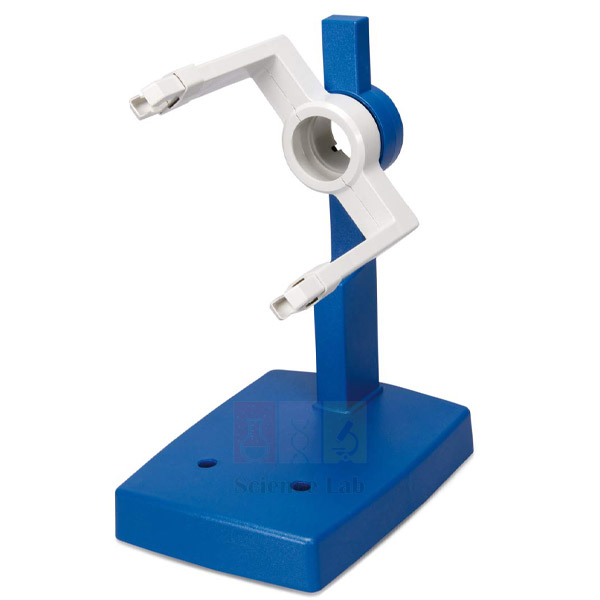
Teltron Tube Holder D
Teltron Tube Holder D (Product Code: SLE/PHY/55) is a support stand used to hold Teltron D-series electron tubes and their accessories securely during electron-beam experiments in physics laboratories. College and senior-school physics departments use it as the base of the whole D-series set-up, because its cast light alloy stand carries a 360° rotating clamp and two base holes for the Teltron D Helmholtz Coils. It is supplied by Jain Scientific Equipments Pvt Ltd (ScienceLab), Ambala, India, a physics instruments supplier to Indian and international buyers.
Specifications
| Parameter | Detail |
|---|---|
| Holds | The complete range of Teltron D-series tubes and accessories |
| Stand | Cast light alloy with a wishbone |
| Clamp | 360° rotating clamp made of heat-resistant plastic |
| Feet | Three rubber feet to prevent slipping and give stability |
| Coil mounting | Two holes in the base for affixing the Teltron D Helmholtz Coils |
| Earthing | 4 mm earthing socket in the pillar base |
| Dimensions | Approx. 230 x 175 x 320 mm |
| Weight | Approx. 1.5 kg |
| Documentation | Instructions included |
| Product code | SLE/PHY/55 |
| Supplied by | Jain Scientific Equipments Pvt Ltd (ScienceLab), Ambala, India |
What Is the Teltron Tube Holder D Used For?
The holder is the mechanical base of a Teltron D-series demonstration. The glass tube sits in the wishbone clamp, which turns through 360° so the tube screen can be angled towards the class, while a pair of Helmholtz coils fixes into the two base holes and stays lined up around the tube. This rigid arrangement is what makes electron-beam deflection, diffraction and specific charge (e/m) experiments with physics lab equipment repeatable from one lesson to the next.
Before switching on the tube supply, connect the 4 mm earthing socket in the pillar base as the included instructions describe. The three rubber feet keep the stand from sliding on a smooth bench, but it should still be placed away from the bench edge. Let a tube cool after use before loosening the clamp, and lift glass tubes by their bodies rather than by the connecting pins.
What to Specify When Ordering
- Tube series: this holder is for Teltron D-series tubes; laboratories using S-series tubes need the S version.
- Which D-series tubes you already have or are ordering with the holder.
- Whether the Teltron Helmholtz Pair of Coils D should be quoted together with the stand.
- Number of holders needed, usually one per demonstration station.
Supplier
Jain Scientific Equipments Private Limited trades as ScienceLab and supplies this Teltron-brand tube holder from Ambala, Haryana. Teltron is a separate brand, so the company sources the holder rather than producing it, and can quote it alongside the matching D-series tubes and coils so a department receives one consolidated offer. Company details are on the ScienceLab company profile.
Related Physics Lab Equipment
These items are used with the tube holder in electron-beam work:
- Teltron Helmholtz Pair of Coils D — fixes into the holder’s base holes to apply a uniform magnetic field across the tube.
- Teltron Electron Deflection Tube D — a D-series tube the clamp holds for beam-deflection experiments.
- Teltron Electron Diffraction Tube D — shows the wave nature of electrons using the same stand.
- Teltron Maltese Cross Tube D — another D-series tube for showing that electron beams travel in straight lines.
- Teltron Tube Holder S — the holder to choose if your laboratory works with S-series tubes.
See the full range in Physics Lab Equipment.
Frequently Asked Questions
What does the Teltron Tube Holder D hold?
The Teltron Tube Holder D holds the complete range of Teltron D-series tubes and their accessories. The tube sits in a 360° rotating clamp made of heat-resistant plastic, carried on a cast light alloy stand with a wishbone.
Can Helmholtz coils be mounted on the Teltron Tube Holder D?
Yes. The Teltron Tube Holder D has two holes in its base for affixing the Teltron D Helmholtz Coils, so the coils stay in position around the tube during magnetic-deflection experiments.
How big and heavy is the Teltron Tube Holder D?
The Teltron Tube Holder D measures approximately 230 x 175 x 320 mm and weighs about 1.5 kg. Three rubber feet under the base stop it from slipping on the laboratory bench.
Does the Teltron Tube Holder D have an earth connection?
Yes. The pillar base of the Teltron Tube Holder D includes a 4 mm earthing socket. Follow the instructions supplied with the holder and your tube when connecting it before an experiment.
Who supplies the Teltron Tube Holder D?
Jain Scientific Equipments Pvt Ltd (ScienceLab) of Ambala, India, supplies the Teltron Tube Holder D (SLE/PHY/55). Teltron is a separate brand; ScienceLab sources the holder and quotes it for schools, colleges and dealers.
What should a quotation request for the Teltron Tube Holder D include?
For the Teltron Tube Holder D, state the quantity, the D-series tubes you use, whether the D Helmholtz coils are needed and the delivery location. Send these details through the contact page.
Request a Quote
To order the Teltron Tube Holder D for your laboratory, send your requirement through the ScienceLab contact page or add the item to the enquiry cart. ScienceLab supplies institutions, dealers and importers in India and international markets.
Last updated: 24 September 2026
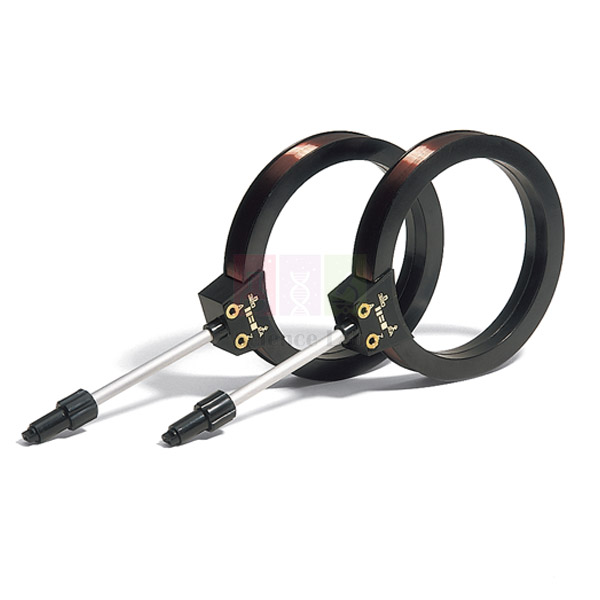
Teltron Helmholtz Pair of Coils D
Teltron Helmholtz Pair of Coils D (Product Code: SLE/PHY/56) is a pair of Helmholtz coils used to generate a uniform magnetic field perpendicular to the axis of Teltron D-series tubes in electron-beam experiments. University and senior-school physics laboratories use it with an EM ratio apparatus set-up; the coils have 320 turns and reach a maximum field of approximately 10 mT. It is supplied by Jain Scientific Equipments Pvt Ltd (ScienceLab), Ambala, India.
Specifications
| Parameter | Detail |
|---|---|
| Function | Uniform magnetic field perpendicular to the axis of Teltron D-series tubes |
| Configurations | Helmholtz geometry, or fields aligned vertically or coaxial with respect to the tube axis |
| Number of turns | 320 |
| Max. continuous current | 1.0 A |
| Max. momentary current | 1.5 A for 10 min; 2 A for 3 min |
| Effective impedance | 6 ohm |
| Max. field strength | Approx. 10 mT |
| Connectors | 4 mm sockets |
| Documentation | Instructions included |
| Product code | SLE/PHY/56 |
| Supplied by | Jain Scientific Equipments Pvt Ltd (ScienceLab), Ambala, India |
What Are Teltron Helmholtz Coils D Used For?
Two identical coils set up in Helmholtz geometry give a nearly uniform field in the space between them, which is where a D-series tube sits. When current flows, the electron beam inside the tube bends into a curve, and by recording the coil current and the tube’s accelerating voltage students can work through a specific charge electron experiment to estimate e/m. The same pair can also be arranged to give a vertical field or a field coaxial with the tube, so one set of coils covers several deflection studies.
Keep the coil current at or below 1.0 A for continuous running; 1.5 A is allowed for up to 10 minutes and 2 A for up to 3 minutes, after which the coils should rest. An ammeter in series makes it easy to stay within these limits. For scale, the approx. 10 mT maximum is about 300 times weaker than the roughly 3 T field of an MRI scanner.
What to Specify When Ordering
- Tube series: these coils suit Teltron D-series tubes; an S-series version is listed separately.
- Whether you also need the Teltron Tube Holder D, whose base has holes for fixing the coils.
- The DC supply and ammeter you will use to drive and monitor the coil current.
- Number of coil pairs, one per demonstration set-up.
Supplier
ScienceLab is the trading name of Jain Scientific Equipments Private Limited, which supplies this Teltron-brand coil pair from Ambala, Haryana. Because Teltron is an outside brand, the company sources the coils and quotes them together with the tube holder and D-series tubes when a department needs the complete arrangement. For vendor registration, the supplying company’s GSTIN is 06AAECJ8618A1ZT and its LEI is 3358004HRD1JIVXKYX49. More background is on the ScienceLab profile page.
Related Physics Lab Equipment
Items that complete a Helmholtz-coil experiment:
- Teltron Tube Holder D — stand whose two base holes take these coils and hold the tube between them.
- Teltron Electron Deflection Tube D — a D-series tube whose beam the coils deflect.
- Teltron Dual Beam Tube D — another D-series tube used inside the coil field.
- Power Supply Variable — a variable supply for setting the coil current; confirm its rating with us.
- Dual Range Ammeter — to monitor coil current against the 1.0 A continuous limit.
Browse more apparatus in Physics Lab Equipment.
Frequently Asked Questions
What field does the Teltron Helmholtz Pair of Coils D produce?
The Teltron Helmholtz Pair of Coils D produces a uniform magnetic field perpendicular to the axis of Teltron D-series tubes, with a maximum field strength of approximately 10 mT when set up in Helmholtz geometry.
How much current can the Teltron Helmholtz Pair of Coils D carry?
The Teltron Helmholtz Pair of Coils D is rated for 1.0 A continuous current. Higher currents are momentary only: 1.5 A for 10 minutes or 2 A for 3 minutes. The effective impedance is 6 ohm.
Can the Teltron Helmholtz Pair of Coils D be used in other arrangements?
Yes. Besides the Helmholtz geometry, the Teltron Helmholtz Pair of Coils D can be configured to produce magnetic fields aligned vertically, or coaxial, with respect to the tube axis, as described in the included instructions.
How are the Teltron Helmholtz Pair of Coils D connected?
The Teltron Helmholtz Pair of Coils D connects through 4 mm sockets, so standard 4 mm laboratory leads link it to a DC supply and a series ammeter. The coils have 320 turns.
Who supplies the Teltron Helmholtz Pair of Coils D?
Jain Scientific Equipments Pvt Ltd (ScienceLab), Ambala, India, supplies the Teltron Helmholtz Pair of Coils D (SLE/PHY/56). Teltron is a separate brand; ScienceLab sources the coils and quotes them for institutions and dealers.
What details speed up a quotation for the Teltron Helmholtz Pair of Coils D?
For the Teltron Helmholtz Pair of Coils D, give the quantity, the tubes and holder you use, any power supply or ammeter needed and the delivery location through the contact page.
Request a Quote
Ask for a price on the Teltron Helmholtz Pair of Coils D through the ScienceLab contact page, or add it to the enquiry cart with the matching holder and tubes. Supply covers India and international markets.
Last updated: 24 September 2026
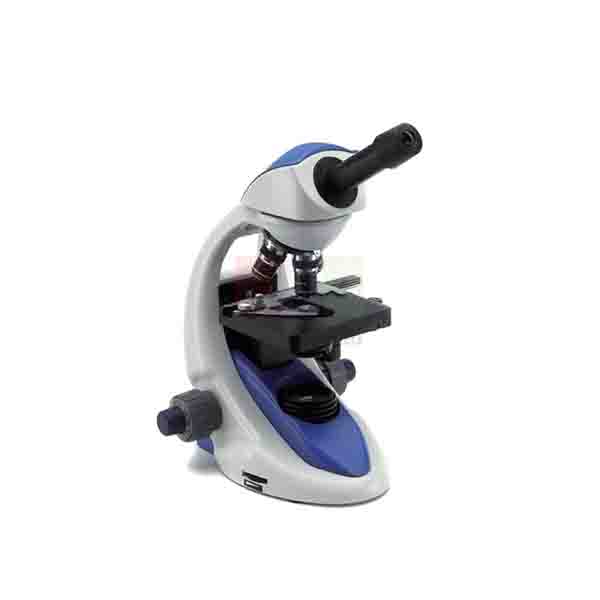
Binocular Microscope, 1000x Mag LED
Binocular Microscope, 1000x Mag LED (Product Code: SLE/M/05) is a two-eyepiece brightfield microscope used for A Level, undergraduate and other higher-education biology and microbiology practicals at 40x to 1000x. It carries four DIN achromatic objectives with published numerical apertures and working distances, a 3 W white LED and a universal 100/240 V external power supply. This binocular microscope is supplied by Jain Scientific Equipments Pvt Ltd (ScienceLab), Ambala, India, with an instruction manual and dust cover included.
Specifications
| Parameter | Detail |
|---|---|
| Observation | Brightfield |
| Head | Binocular, inclined 30°, rotatable 360°; diopter adjustment on left eyepiece; interpupillary adjustment 48–75 mm |
| Eyepieces | Wide field WF10x/18, field number 18 |
| Nosepiece | Quadruple revolving, rotation on ball bearings |
| Objective 4x | Achromatic DIN, N.A. 0.10, W.D. 18 mm |
| Objective 10x | Achromatic DIN, N.A. 0.25, W.D. 7 mm |
| Objective 40x | Achromatic DIN, N.A. 0.65, W.D. 0.53 mm |
| Objective 100x | Achromatic DIN, N.A. 1.25, W.D. 0.13 mm (oil immersion) |
| Objective notes | Mechanical tube length 160 mm; all objectives anti-fungus treated |
| Magnification | 40x, 100x, 400x, 1000x |
| Condenser | Abbe, N.A. 1.25, precentered |
| Focusing | Coaxial coarse and fine (graduated 0.002 mm) with upper stop to prevent objective-specimen contact; adjustable coarse tension |
| Stage | Double-layer mechanical sliding stage, 125 x 115 mm; vernier on both axes, accuracy 0.1 mm; specimen holder for one slide |
| Stage X-Y travel | 76 x 30 mm (a shorter summary lists 70 x 30 mm; please confirm when ordering) |
| Illumination | White LED, 3 W (comparable to a 30–35 W halogen bulb); intensity knob on left of frame |
| Colour temperature / LED life | 6300 K / approx. 50 000 hours average |
| Power supply | External, 100/240 V AC, 50/60 Hz; output 7.5 V; max. power required 7 W |
| Dimensions / weight | Height 370 mm, width 235 mm, depth 290 mm / 6.5 kg |
| Included | Instruction manual, dust cover |
| Product code | SLE/M/05 |
| Supplied by | Jain Scientific Equipments Pvt Ltd (ScienceLab), Ambala, India |
What Is the 1000x Binocular Microscope Used For?
Advanced students use it for cell biology, histology and microbiology work: identifying tissue types in prepared sections, studying mitotic stages, examining stained blood films and viewing bacteria under oil. Viewing with both eyes reduces fatigue during long practical sessions and exam preparation, and the published N.A. and working-distance values help lecturers explain resolution and why the 100x objective needs oil.
Before each class, set the interpupillary distance to the student's eyes and use the left-eyepiece diopter ring to balance focus between both eyes. Survey the slide at 4x and 10x, where the working distance is generous, then move to 40x and to the 100x oil objective; the upper stop protects slides from being crushed. Cover the instrument with the supplied dust cover after use.
What to Specify When Ordering
- Number of microscopes per lab, and whether any are for teacher demonstration
- Confirmation of the stage X-Y travel you require (listed as 76 x 30 mm)
- Immersion oil, slides or a camera to be quoted alongside
- Delivery country, so the power-supply plug type can be confirmed
Supplier
ScienceLab is the trading name under which Jain Scientific Equipments Private Limited, Ambala, Haryana, supplies this higher-education binocular microscope. Universities, colleges, senior schools, research-training centres, dealers and importers in India and international markets use one enquiry to source microscopes, slides and accessories together. Company information is on the ScienceLab profile.
Related Laboratory Equipment
Items that complete a higher-education microscopy bench:
- Immersion Oil, 25ml — needed for the 100x oil-immersion objective
- Human Histology Slide Set of 25 — tissue sections suited to 400x and 1000x study
- Microscope Cleaning Kit — brush, blower, lens fluid and tissue for routine care
- Eyepiece Micrometric — scale eyepiece for measuring cell sizes (confirm fit with us)
- Microscope Digital Camera, 5MP — captures images to a PC for reports (confirm fit with us)
Browse further options in the Microscope category.
Frequently Asked Questions
Which objectives come with the Binocular Microscope, 1000x Mag LED?
The Binocular Microscope, 1000x Mag LED has four DIN achromatic objectives for a 160 mm tube: 4x (N.A. 0.10), 10x (N.A. 0.25), 40x (N.A. 0.65) and 100x oil (N.A. 1.25). All objectives are anti-fungus treated.
What power supply does the Binocular Microscope, 1000x Mag LED use?
The Binocular Microscope, 1000x Mag LED uses an external power supply rated 100/240 V AC, 50/60 Hz, with a 7.5 V output and a maximum requirement of 7 W. This range covers mains supplies in most countries.
How is the binocular head of the Binocular Microscope, 1000x Mag LED adjusted?
The Binocular Microscope, 1000x Mag LED head is inclined 30° and rotates 360°. Interpupillary distance adjusts from 48 to 75 mm, and a diopter ring on the left eyepiece corrects focus differences between the user's eyes.
What is included with the Binocular Microscope, 1000x Mag LED?
The Binocular Microscope, 1000x Mag LED is listed with an instruction manual and a dust cover. Immersion oil, slides and cameras are not listed as included; add them to your enquiry if you need them with the microscope.
How large and heavy is the Binocular Microscope, 1000x Mag LED?
The Binocular Microscope, 1000x Mag LED measures 370 mm high, 235 mm wide and 290 mm deep and weighs 6.5 kg. Plan bench space accordingly, particularly when several units are installed in one teaching laboratory.
Who supplies the Binocular Microscope, 1000x Mag LED?
Jain Scientific Equipments Pvt Ltd (ScienceLab) of Ambala, Haryana, India supplies the Binocular Microscope, 1000x Mag LED. It is shipped to universities, colleges, schools, dealers and importers in India and international markets, singly or in lab sets.
Request a Quote
Request pricing for the Binocular Microscope, 1000x Mag LED via the contact page, or place it in the enquiry cart along with oil, slides and cleaning supplies.
Last updated: 24 September 2026
206.jpg)
Cylinders, Metal (Set of 6)
Cylinders, Metal (Set of 6) (Product Code: SLE/PHY/57) is a set of six precision metal cylinders used to measure and compare the density of different metals in physics practicals. Each cylinder has a 10 mm diameter and is made of a different metal — brass, lead, iron, copper, aluminium or zinc — and the set comes in a wooden block. It is made by Jain Scientific Equipments Pvt Ltd (ScienceLab), an OEM manufacturer, at its own factory in Ambala, India, as physics practical equipment for CBSE and other syllabi.
Specifications
| Parameter | Detail |
|---|---|
| Purpose | Precision cylinders for experiments on density |
| Pieces per set | 6 |
| Metals | Brass, lead, iron, copper, aluminium and zinc |
| Diameter | 10 mm |
| Storage | Supplied in a wooden block |
| Product code | SLE/PHY/57 |
| Manufacturer | Jain Scientific Equipments Pvt Ltd (ScienceLab) — OEM |
| Country of origin | India (made in Ambala, Haryana) |
What Are Metal Density Cylinders Used For?
The classic exercise is to find the density of each metal from its dimensions. Students measure the diameter and length of a cylinder with a vernier caliper, work out the volume as πr²h, weigh the cylinder on a balance and divide mass by volume. Repeating this for all six metals shows clearly why a lead cylinder feels so much heavier than an aluminium one of the same diameter.
The same cylinders can be lowered into a measuring cylinder of water to find volume by displacement, letting a class compare the geometric and displacement methods and discuss measurement error. Return each cylinder to its place in the wooden block after use to avoid dents, and have students wash their hands after handling the lead piece.
OEM Manufacturer
Jain Scientific Equipments Private Limited, trading as ScienceLab, is the OEM (original equipment manufacturer) of this cylinder set and produces it at its own licensed factory at Saha, Ambala, Haryana, India. Because the maker supplies schools, colleges, dealers and importers directly, a lost or damaged cylinder can be raised with the same team that made the set — ask us about a replacement. Read more on the ScienceLab company profile.
Related Physics Lab Equipment
Other apparatus needed for a density practical:
- Caliper Vernier (Metal) — measures cylinder diameter and length for the volume calculation.
- Triple-Beam Balance — weighs each cylinder to find its mass.
- Glass Measuring Cylinder — finds volume by water displacement as a cross-check.
- Metal Density Cubes (Set of 6) — the same density study with equal-sized cubes instead of cylinders.
More apparatus is listed under Physics Lab Equipment.
Frequently Asked Questions
Which metals are in the Cylinders, Metal (Set of 6)?
The Cylinders, Metal (Set of 6) contains one cylinder each of brass, lead, iron, copper, aluminium and zinc. All six have a 10 mm diameter and are supplied together in a wooden block.
What size are the metal cylinders in this set?
Each cylinder in the Cylinders, Metal (Set of 6) has a diameter of 10 mm. The length is not listed on this page; if you need it for worksheets, ask us through the contact page before ordering.
How do students find density with the Cylinders, Metal (Set of 6)?
With the Cylinders, Metal (Set of 6), students measure each cylinder’s diameter and length, calculate its volume, weigh it on a balance and divide mass by volume to compare the densities of the six metals.
Who manufactures the Cylinders, Metal (Set of 6)?
Jain Scientific Equipments Pvt Ltd (ScienceLab) manufactures the Cylinders, Metal (Set of 6) as the OEM at its own licensed factory at Saha, Ambala, Haryana, India, and supplies it directly to institutions and dealers.
How should the Cylinders, Metal (Set of 6) be stored and handled?
Keep the Cylinders, Metal (Set of 6) in its wooden block when not in use so pieces are not lost or dented. Students should wash their hands after handling the lead cylinder.
Can ScienceLab supply the Cylinders, Metal (Set of 6) in bulk?
Yes. ScienceLab supplies the Cylinders, Metal (Set of 6) in class quantities to schools, colleges, dealers and importers in India and international markets. Share the number of sets and delivery location for a quotation.
Request a Quote
Send your quantity through the ScienceLab contact page or add the set to the enquiry cart. Quotations come direct from the manufacturer in Ambala.
Last updated: 24 September 2026
388.jpg)
Metal Density Cubes (Set of 6)
Metal Density Cubes (Set of 6) (Product Code: SLE/PHY/58) is a set of six equal-sized metal cubes used to show how density differs from one metal to another in physics and general science lessons. Because every cube has a 20 mm side, students can compare brass, lead, zinc, copper, aluminium and iron simply by weighing them, a staple of school physics lab equipment in India. The set is made by Jain Scientific Equipments Pvt Ltd (ScienceLab), an OEM manufacturer, at its own factory in Ambala, India.
Specifications
| Parameter | Detail |
|---|---|
| Cubes per set | 6 |
| Side length | 20 mm (2 cm) |
| Volume of each cube | 8 cm³ (calculated from the 20 mm side) |
| Metals | Brass, lead, zinc, copper, aluminium and iron |
| Product code | SLE/PHY/58 |
| Manufacturer | Jain Scientific Equipments Pvt Ltd (ScienceLab) — OEM |
| Country of origin | India (made in Ambala, Haryana) |
What Are Metal Density Cubes Used For?
Equal volume is the whole point of this set. Since each cube measures 2 cm along every edge, its volume is 8 cm³, so dividing the mass in grams by 8 gives the density in g/cm³ directly. Before weighing, ask students to rank the cubes by feel and then check their predictions on a balance — the gap between aluminium and lead usually surprises them.
The cubes also support class 9 density and relative density lessons in a science lab kit, and older students can measure the edges with a vernier caliper to confirm the volume rather than assuming it. Keep the six cubes together in a labelled tray or box, and remind learners to wash their hands after handling lead.
What to Specify When Ordering
- Set size: this six-cube set includes zinc; the seven-cube Metal Density Cube Set adds steel and tin instead of zinc.
- Number of sets, for example one per student group.
- Whether a balance or vernier caliper should be quoted with the cubes.
OEM Manufacturer
These density cubes come from Jain Scientific Equipments Private Limited, which trades as ScienceLab and acts as their OEM (original equipment manufacturer). They are produced at the company’s own licensed factory at Saha, Ambala, Haryana, India, rather than bought in from a trader, so schools, dealers and importers deal with the maker for quotations and repeat orders. Company background is on the ScienceLab profile page.
Related Physics Lab Equipment
Useful companions for density work:
- Metal Density Cube Set — seven-cube alternative that includes steel and tin.
- Cylinders, Metal (Set of 6) — 10 mm cylinders for practising volume calculation with a curved shape.
- Caliper Vernier (Metal) — checks the cube edges before calculating volume.
- Balance Triple Beam — weighs each cube to find its mass.
Find more in Physics Lab Equipment.
Frequently Asked Questions
Which metals are included in the Metal Density Cubes (Set of 6)?
The Metal Density Cubes (Set of 6) includes one cube each of brass, lead, zinc, copper, aluminium and iron, giving a spread from light to heavy metals for density comparisons.
What size is each cube in the Metal Density Cubes (Set of 6)?
Each cube in the Metal Density Cubes (Set of 6) has a 20 mm side. That gives every cube a volume of 8 cm³, so mass in grams divided by 8 gives density in g/cm³.
How does the Set of 6 differ from the Metal Density Cube Set?
The Metal Density Cubes (Set of 6) contains six 20 mm cubes including zinc. The Metal Density Cube Set has seven 20 mm cubes and swaps zinc for steel and tin.
Who manufactures the Metal Density Cubes (Set of 6)?
Jain Scientific Equipments Pvt Ltd (ScienceLab) is the OEM manufacturer of the Metal Density Cubes (Set of 6), producing them at its own licensed factory at Saha, Ambala, Haryana, India.
Do students need a measuring cylinder to use the Metal Density Cubes (Set of 6)?
No. The Metal Density Cubes (Set of 6) are regular 20 mm cubes, so volume comes from the side length. A balance is needed for mass; a measuring cylinder is optional for a displacement cross-check.
How can I get a quotation for the Metal Density Cubes (Set of 6)?
Send the number of Metal Density Cubes (Set of 6) sets, any balances or calipers needed and your delivery location through the contact page; the quotation comes from the manufacturer.
Request a Quote
Order the Metal Density Cubes (Set of 6) through the ScienceLab contact page or the enquiry cart. Prices are quoted directly by the manufacturer for schools, colleges and dealers in India and international markets.
Last updated: 24 September 2026