- Physics Lab Equipment
- Chemistry Lab Equipment
- Biology Lab Equipment
- Anatomical Lab Equipment
- Learning
- Educational Lab Equipment
- Magnets
- Agriculture
- Astronomy
- Earth Science
- Geography Lab Equipment
- Safety Lab Coat
- Laboratory
- Meteorological
- Electricity & Magnetism
- Heat
- School Lab Equipment
- Lab Glassware
- Science Lab Equipment
- Tvet Lab Equipment
- Robotics Kits Supplier and Manufacturer for Schools India
- Math Lab Equipment Manufacturers and Exporters in Ambala
- STEM Kits Manufacturers and Supplier India
- Engineering Lab Equipment
- Hospital Lab Equipment
- Water, Sanitation & Hygiene Supplies
- Cold Chain, Solar & Communication Equipment
- Nutrition
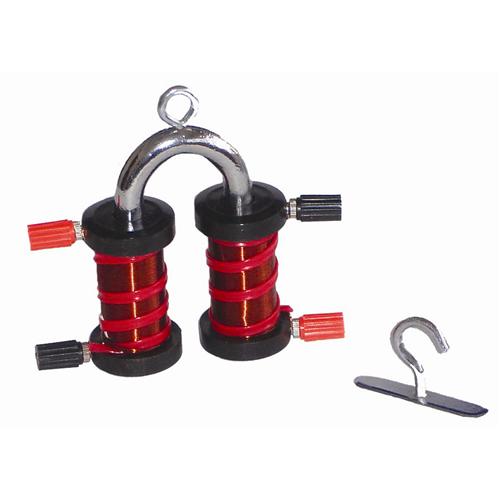
U-Shaped Electromagnet
U-Shaped Electromagnet (Product Code: SCL174/024) is a teaching electromagnet built from a U-shaped core and two coils of enamelled copper wire, each with 200 turns, that slide onto the core’s side arms. Powered from a 4–6 V DC source, it shows students how an electric current produces magnetism and how that magnetism can be switched on and off, strengthened or reversed. It is made by Jain Scientific Equipments Pvt Ltd (ScienceLab), Ambala, for use as part of an electromagnetic kit in school physics labs across India.
Specifications
| Parameter | Detail |
|---|---|
| Core | U-shaped, with two lateral arms |
| Coils | Two, each with 200 turns of enamelled copper wire |
| Coil mounting | Coils can be placed freely on the lateral arms of the core |
| Distance between core-arm axes | 5 cm |
| Power supply | 4–6 V DC source |
Typical Use
With both coils on the arms and connected to a DC supply, the core becomes a horseshoe-shaped magnet that can hold iron objects or attract a keeper plate. Students can switch the current off to show that the magnetism disappears, use one coil or both to compare the strength of the effect, and reverse the connections to swap the poles, checking each result with a compass needle. Adding an ammeter and a rheostat to the circuit turns the demonstration into a simple investigation of how current affects magnetic strength.
Because the coils are removable, the same apparatus also introduces transformer ideas: with one coil fed and the other connected to a meter, switching the current on or off induces a brief reading in the second coil. Keep the supply within the stated 4–6 V DC, switch off between runs so the coils do not warm up, and use proper leads rather than bare wire for the connections.
Manufacturer
Made by Jain Scientific Equipments Private Limited, the company behind the ScienceLab brand in Ambala, Haryana, which designs electricity and magnetism apparatus alongside its wider range of school laboratory equipment. The company profile explains more about the business.
Related Lab Equipment
These items complete the circuit or help students observe the electromagnet’s field:
- Power Source For Teacher — a bench power source to consider for energising the coils; match its output to the 4–6 V DC requirement.
- Analogue Ammeter — measures the coil current during strength comparisons.
- Rheostat — varies the current smoothly for investigations.
- Banana Plug Connectors Leads — tidy, secure connections between supply, meter and coils.
- Magnetic Compass Needle — identifies which arm is the north pole.
Browse the Lab Equipment category for further electromagnetism apparatus.
Frequently Asked Questions
What supply voltage does the electromagnet need?
It is designed for a 4–6 V DC source. Staying in that range keeps the demonstration effective without overheating the coils.
Is a power supply included?
A supply is not listed as part of the product. You can use a suitable school DC power supply or battery pack, or ask us to quote for one through the contact page.
How many turns are on each coil?
Each of the two coils has 200 turns of enamelled copper wire.
Can the coils be taken off the core?
Yes. They can be placed freely on the lateral arms, so you can use one coil, both coils, or rearrange them for induction demonstrations.
How do I set the polarity of the two arms?
The pole at each arm depends on the direction of current in its coil. Connect the coils, test each arm with a compass needle, and swap the leads on one coil if both arms show the same pole.
Is a keeper or armature supplied?
The product listing does not mention one. Please confirm the exact contents with us before ordering if your lesson plan needs a keeper.
Do you accept bulk and export orders?
Yes. We quote for institutional quantities and ship to India and international markets; give us the quantity and destination.
Request a Quote
To get pricing for the U-Shaped Electromagnet, contact our team or add it with the supply and meters you need to the enquiry cart.
Last updated: 24 September 2026
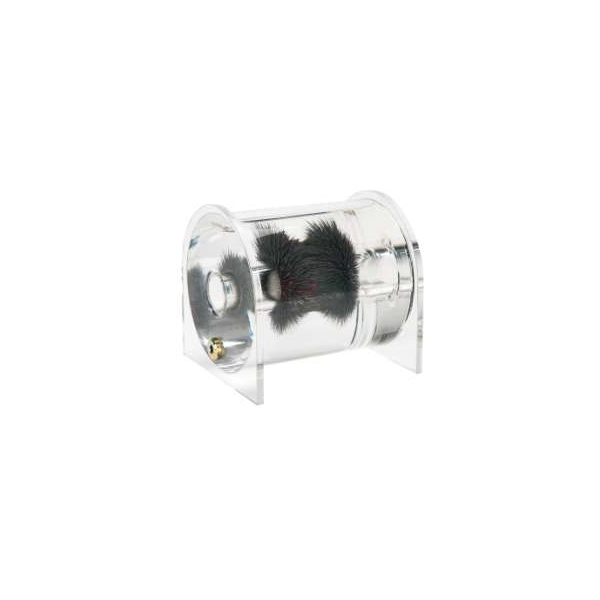
Device for Demonstrating Magnetic Field Lines
Device for Demonstrating Magnetic Field Lines (Product Code: SCL1577/025) makes the invisible field around a magnet visible without iron filings. It has six transparent plates arranged diametrically at equal spacing, each carrying many small ferromagnetic arrows that move easily and line up with the local field, so students see both the shape and the direction of the field lines. One plate is interchangeable, and an interchangeable plate with an arcuate notch lets the device sit on a U-shaped magnet model. It is made by Jain Scientific Equipments Pvt Ltd (ScienceLab), Ambala, as a clean, reusable demonstration model for the physics lab.
Specifications
| Parameter | Detail |
|---|---|
| Plates | Six transparent plates, diametrically and equally spaced |
| Interchangeable plate | One of the plates is interchangeable |
| Field indicators | Many easily moving ferromagnetic arrows on the plates |
| U-magnet fitting | An interchangeable plate with an arcuate notch for installation on a U-shaped magnet model |
Typical Use
Bring a bar magnet to the device and every arrow swings to point along the field at its own position. Because the plates are spaced evenly around the device, the arrows show the pattern in several planes at once, helping students understand that a magnetic field fills the space around a magnet rather than lying flat on a sheet of paper. The arrowheads also show direction, from the north pole round to the south pole, which iron filings cannot do.
Swapping in the notched plate and seating it on a U-shaped magnet model reveals the concentrated, nearly parallel field between the two poles, a useful comparison with the bar-magnet pattern. Teachers can also place the device near an energised electromagnet to show that a current-carrying coil produces the same kind of field. After use, keep strong magnets away from the device during storage and clean the plates with a soft dry cloth.
Manufacturer
ScienceLab is the trading name of Jain Scientific Equipments Private Limited, incorporated under CIN U29309HR2020PTC087597, with its base in Ambala, Haryana. The company manufactures at its licensed factory at 449, HSIIDC Industrial Area, Saha, Ambala (Factory Licence AMB-ONLINE-CHD-J-414); the company profile gives further background.
Related Lab Equipment
Magnets and detectors that work with this field-lines device in the same lesson:
- Horseshoe-Shaped Magnets — U-shaped magnets for the notched-plate demonstration.
- Bar Magnet (Plastic) — produces the classic bar-magnet field pattern.
- U-Shaped Electromagnet — shows that an electric current creates a comparable field.
- Compass — lets students check field direction point by point.
- Magnetic Field Demonstrator — another way to display field patterns for comparison.
See the Lab Equipment category for more magnetism apparatus.
Frequently Asked Questions
How many plates does the device have?
Six transparent plates, arranged diametrically and equally spaced, each carrying freely moving ferromagnetic arrows.
Are magnets included?
The listing describes the plates and arrows but does not include magnets. Order bar or horseshoe magnets separately, or ask us to confirm contents through the contact page.
What is the notched plate for?
Its arcuate notch lets the plate be installed on a U-shaped magnet model, so students can study the field between and around the two poles.
How is this better than iron filings?
There is no loose powder to spill or clean up, the display is ready again instantly, and the arrows show the direction of the field as well as its shape.
How should the device be maintained?
Wipe the plates with a soft dry cloth, avoid solvents that could cloud the transparent material, and store it away from strong magnets so the arrows are not left permanently magnetised in one direction.
Can you supply it for school tenders or overseas buyers?
Yes. Send the quantity, delivery location and any vendor documents you need; we quote for institutions in India and international markets.
Request a Quote
For a quotation on the Device for Demonstrating Magnetic Field Lines, get in touch or add it to the enquiry cart together with the magnets you plan to use.
Last updated: 24 September 2026
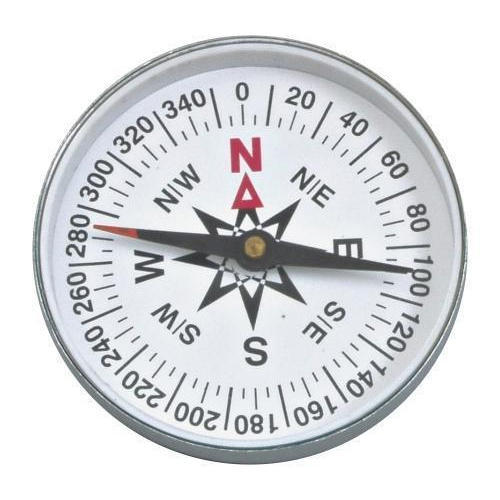
Compass
Compass (Product Code: SCL1379/026) is a compact student compass: a 40 mm magnetic needle on a conical bearing, enclosed in a cylindrical transparent plastic box 45 mm across. The needle is held on its median axis so that it does not drop off when the box is turned or tilted, which makes it practical to hand out to every pair of students. Its N and S ends are coloured blue and red. It is made by Jain Scientific Equipments Pvt Ltd (ScienceLab), Ambala, and suits bulk supply for school physics lab equipment in India.
Specifications
| Parameter | Detail |
|---|---|
| Needle length (longitudinal dimension) | 40 mm |
| Needle mounting | Support for the median axis with a conical bearing and pivot needle |
| Pole colours | N blue, S red |
| Case | Cylindrical transparent plastic box, 45 mm diameter |
| Retention | Needle stays on its axis and does not fall when the box is twisted |
Typical Use
The most common classroom task is plotting field lines: students place a bar magnet on paper, set the compass near one pole, mark where the needle points, move the compass to that mark and repeat, joining the dots into a field line. The transparent case lets them see the paper beneath, and because the needle is retained on its axis the compass can be picked up and repositioned again and again without the needle falling off.
It is equally useful for finding north before setting up experiments that need a fixed orientation, for showing that a current-carrying wire deflects a nearby needle, and for simple outdoor direction-finding activities. Remind students that the blue end marks N on this model, keep the compasses away from magnets when they are stored together, and wipe the plastic case clean with a dry cloth.
Manufacturer
The compass comes from Jain Scientific Equipments Private Limited, an Ambala, Haryana manufacturer that markets its classroom and laboratory products as ScienceLab. Learn about the company on the ScienceLab profile.
Related Lab Equipment
Magnetism practicals that use this compass usually need these items too:
- Bar Magnet (Plastic) — the magnet whose field students plot.
- Magnetic Compass Needle — a larger needle for the teacher’s front-of-class demonstration.
- Compass Plotting (Clear) — an alternative plotting compass for larger groups.
- Device for Demonstrating Magnetic Field Lines — shows the whole field pattern at once for comparison with plotted results.
More student apparatus is available in the Lab Equipment category.
Frequently Asked Questions
How big is the compass?
The needle is 40 mm long and sits in a transparent plastic box with a 45 mm diameter, small enough for field-line plotting on an exercise-book page.
Will the needle fall out if a student turns the compass over?
No. The needle pivots on its axis in a way that keeps it from falling when the box is twisted, which suits handling by students.
Which colour marks north?
On this compass the N pole is blue and the S pole is red, so it is worth pointing this out before a plotting exercise.
Why does the needle sometimes point the wrong way?
A compass stored touching a strong magnet can have its needle remagnetised in reverse. Store compasses apart from magnets and check them against a known north before class.
Can I order a full class set?
Yes. Tell us how many compasses you need and where they should be delivered; we quote for schools across India and buyers in international markets.
Is there a warranty?
Warranty terms are given with each quotation. Please ask through the contact page if you need them before placing an order.
Request a Quote
To order compasses for your class, send us the quantity or add the Compass to the enquiry cart and submit your list.
Last updated: 24 September 2026
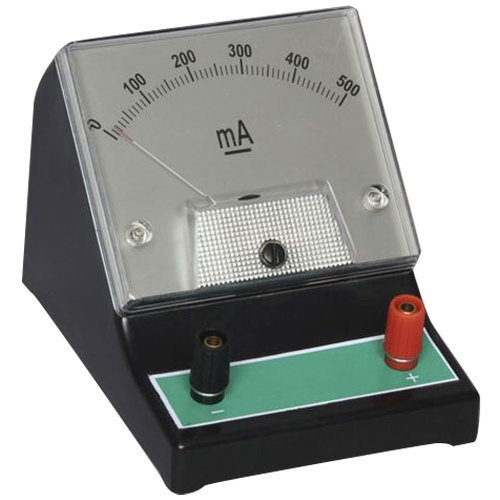
Analogue Ammeter
Analogue Ammeter (Product Code: SCL1285/027) is a stationary moving-pointer meter for direct current with three measuring ranges: 0–50 mA, 0–500 mA and 0–5 A. Each scale division equals 1/50 of the selected range’s maximum, the pointer rests at a left-hand zero, and a zero-adjustment lets the teacher correct the rest position before a reading. Schools and colleges use it as the current meter in DC circuit practicals, and it forms one half of the ammeter and voltmeter pair that every school physics lab in India needs. The meter is built by Jain Scientific Equipments Pvt Ltd (ScienceLab), Ambala, for bench use in teaching labs.
Specifications
| Parameter | Detail |
|---|---|
| Current type | DC |
| Measuring ranges | 0–50 mA / 500 mA / 5 A |
| Scale division | 1/50 of the maximum limit of the range in use |
| Zero position | Left zero indicator, with zero-position adjustment |
| Construction | Stationary (bench) instrument |
| Dimensions | 100 x 100 x 140 mm |
Typical Use
The ammeter is connected in series with the component under test, observing polarity, and the range is chosen to suit the expected current: the 50 mA scale for small currents through resistors and LEDs, the 500 mA scale for lamps and small motors, and the 5 A scale for heavier loads such as electromagnets. Together with a voltmeter, a rheostat and a DC supply, it makes up the core of an Ohm’s law experiment kit in India’s secondary and senior-secondary labs, where students plot current against voltage and calculate resistance.
Good practice is to start on the highest range when the current is unknown and step down until the pointer sits in the upper part of the scale, where the reading is most precise. Check that the pointer rests exactly on zero before switching on, using the zero adjustment if needed, and never connect the meter directly across a supply without a load in the circuit.
Manufacturer
Jain Scientific Equipments Private Limited produces this meter under its ScienceLab trade name at Ambala in Haryana, alongside a catalogue of electrical and physics teaching apparatus for institutions. For more on the company, see the company profile.
Related Lab Equipment
A DC current meter is only one part of the circuit; these items complete a typical practical:
- Analogue Voltmeter — the DC voltmeter listed alongside it, for Ohm’s law work.
- Power Source For Teacher — a bench power source for driving the circuit.
- Rheostat — varies the current in steps for a set of readings.
- Resistance Box — provides known resistances to test against.
- Banana Plug Connectors Leads — secure leads for connecting the meter in series.
Further measuring instruments are listed in the Lab Equipment category.
Frequently Asked Questions
What ranges does this ammeter have?
Three DC ranges: 0–50 mA, 0–500 mA and 0–5 A, with each division equal to 1/50 of the selected maximum.
Can it measure alternating current?
No, it is a DC instrument. For AC circuits choose the Analogue Ammeter AC instead.
How is the meter zeroed?
With no current flowing, turn the zero-position adjuster until the pointer sits exactly on the left-hand zero mark.
What are its dimensions?
The stationary case measures 100 x 100 x 140 mm, a size that stands steadily on a student bench.
Is a calibration certificate available?
The listing does not mention one. If your lab or tender requires calibration documentation, please discuss availability with us through the contact page before ordering.
What should I include in a quotation request for several lab tables?
Give the product code SCL1285/027, the number of meters, whether you also need voltmeters and power sources, and the delivery location. We supply institutions across India and international markets.
Request a Quote
To price the Analogue Ammeter, with or without matching voltmeters, send an enquiry or add it to the enquiry cart.
Last updated: 24 September 2026
Analogue Voltmeter
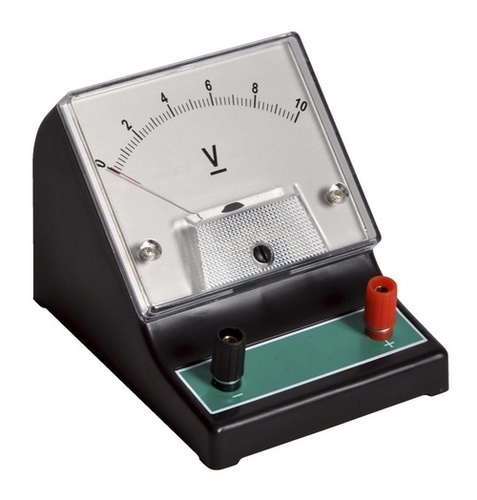
Analogue Voltmeter (Product Code: SCL1589/028) measures DC potential difference on a single 0–10 V range, read in 0.1 V divisions on a pointer scale that starts from a left-hand zero. A zero-position adjustment keeps the pointer true between lessons, and the stationary 100 x 100 x 140 mm case sits squarely on a student bench. It is the voltage half of the classic ammeter and voltmeter set used in school physics practicals across India, covering the low-voltage DC circuits built from cells and bench supplies. The voltmeter is manufactured in Ambala by Jain Scientific Equipments Pvt Ltd (ScienceLab) for student benches and teacher demonstrations.
Specifications
| Parameter | Detail |
|---|---|
| Current type | DC |
| Measuring range | 0–10 V |
| Scale division | 0.1 V |
| Zero position | Left zero indicator, with zero-position adjustment |
| Construction | Stationary (bench) instrument |
| Dimensions | 100 x 100 x 140 mm |
Typical Use
A voltmeter is always connected in parallel, across the component whose potential difference is being measured, with its positive terminal towards the positive side of the supply. On this meter the fine 0.1 V divisions let students record voltage across a resistor, a lamp or a cell to one decimal place, which is exactly what is needed to draw a smooth V–I graph, compare the terminal voltage of a cell with and without a load, or check how potential difference is shared between resistors in series.
Before each practical, confirm the pointer rests on zero and adjust it if necessary. Keep circuits within the 10 V full-scale value — if a supply could exceed it, switch the supply to a lower setting first. Pairing the voltmeter with the matching DC ammeter gives students a consistent set of instruments for AC DC circuits experiment kit activities and Ohm’s law investigations.
Manufacturer
This voltmeter is one of the electrical measuring instruments made by Jain Scientific Equipments Private Limited, which operates as ScienceLab from Ambala, Haryana. You can read about the company’s background and product range on its profile page.
Related Lab Equipment
Pair the voltmeter with these items for complete DC circuit practicals:
- Analogue Ammeter — the DC current meter listed alongside it.
- Power Source For Teacher — supplies the circuit being measured.
- Rheostat — changes the voltage across the test component in steps.
- Connecting Wire — for wiring the meter across components.
- Digital Voltmeter — a digital alternative for comparing analogue and digital readings.
More measuring instruments can be found in the Lab Equipment category.
Frequently Asked Questions
What is the measuring range?
A single DC range of 0–10 V, with 0.1 V per scale division.
Can it be used on AC circuits?
No, it is designed for DC. For alternating voltage, choose the Analogue Voltmeter AC instead.
How should it be connected?
In parallel with the component, observing the polarity marked on the terminals. Connecting it in series will give a misleading reading.
What if the pointer does not return to zero?
Disconnect the meter and use the zero-position adjustment to bring the pointer back to the left zero mark before measuring.
What warranty and after-sales support is offered?
Warranty terms are set out in each quotation. Contact us through the contact page for details or for help with a meter already in use.
Do you supply matched sets for a whole lab?
Yes. We quote voltmeters, ammeters and accessories together for schools and colleges in India and in international markets.
Request a Quote
For pricing on the Analogue Voltmeter, contact ScienceLab with your quantity, or add it to the enquiry cart together with the matching ammeter.
Last updated: 24 September 2026
Analogue Ammeter AC
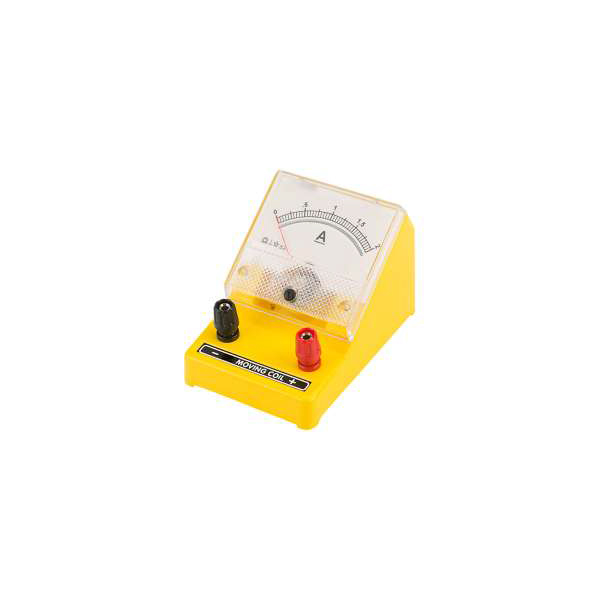
Analogue Ammeter AC (Product Code: SCL1296/029) is a bench meter for alternating current, reading from 0 to 2 A in 0.1 A divisions. Its pointer rests at a left-hand zero that can be trimmed with the zero-position adjustment, and it is housed in a stationary 100 x 100 x 140 mm case. Physics teachers use it where DC meters cannot be used — in transformer, AC motor and mains-derived low-voltage circuits — so students can measure current in AC circuits experiment kit activities with the same kind of analogue display they know from DC work. This AC meter comes from Jain Scientific Equipments Pvt Ltd (ScienceLab), Ambala, India.
Specifications
| Parameter | Detail |
|---|---|
| Current type | Alternating current (AC) |
| Measuring range | 0–2 A |
| Scale division | 0.1 A |
| Zero position | Left zero indicator, with zero-position adjustment |
| Construction | Stationary (bench) instrument |
| Dimensions | 100 x 100 x 140 mm |
Typical Use
In a transformer lesson the meter is placed in series with the primary or secondary winding so students can compare the currents on each side and relate them to the turns ratio. It also measures the current drawn by a lamp or a small AC motor running from a low-voltage AC supply, and, with an AC voltmeter across the same load, allows a simple estimate of apparent power. Because there is no polarity to observe on AC, connections are straightforward, but the meter must still be wired in series and never directly across the supply.
Keep circuit currents inside the 2 A full-scale value; if the load is unknown, begin with a high-resistance setting and increase the current gradually. Always use a low-voltage AC source from a proper school supply rather than mains directly. Check the zero before each session and store the meter flat in a dry cupboard. Schools equipping an electromagnetic kit for school labs in India often buy it together with the matching AC voltmeter.
Manufacturer
Behind the ScienceLab name is Jain Scientific Equipments Private Limited, an Ambala, Haryana company making teaching and laboratory apparatus; its details are on the company profile. It is registered as an MSME with Udyam number UDYAM-HR-01-0003714, and overseas orders are shipped under its DGFT Importer-Exporter Code, AAECJ8618A.
Related Lab Equipment
For complete AC practicals, these items are used alongside the meter:
- Analogue Voltmeter AC — the AC voltage meter listed alongside it.
- Demonstrative Transformer (for high school) — primary and secondary currents to compare.
- Demonstration Motor AC/DC — a load whose running current students can measure.
- Crocodile Clips & Leads — quick connections into series circuits.
More electrical apparatus appears in the Lab Equipment category.
Frequently Asked Questions
What current range does the AC ammeter cover?
It measures alternating current from 0 to 2 A, with 0.1 A per division.
Can I use it for DC measurements?
It is specified for alternating current. For DC circuits, use the Analogue Ammeter instead.
Is it safe to connect to mains?
Student circuits should always run from a low-voltage AC output of a school power supply or transformer, not directly from the mains socket.
How is the pointer zeroed?
With the circuit switched off, turn the zero-position adjustment until the pointer lines up with the left-hand zero mark.
Can a calibration certificate be provided?
One is not included in the product listing. If you need calibration paperwork, discuss availability with us through the contact page before placing the order.
What do you need from us to prepare an institutional quote?
The product code SCL1296/029, quantity, delivery address and any vendor registration documents your purchase office requires. We serve institutions in India and international markets.
Request a Quote
Ask for a price on the Analogue Ammeter AC through our contact page, or place it in the enquiry cart alongside the AC voltmeter and transformer.
Last updated: 24 September 2026
Analogue Voltmeter AC
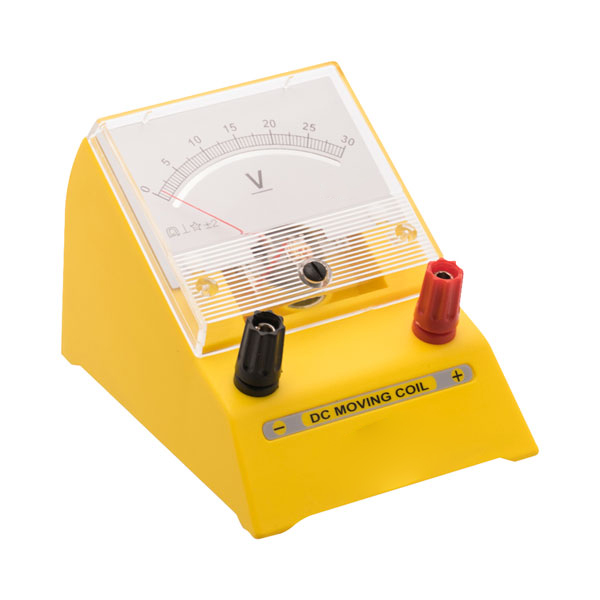
Analogue Voltmeter AC (Product Code: SCL1399/030) measures alternating voltage on three ranges — 0–3 V, 0–15 V and 0–30 V — with a 0.1 V division listed for its scale. The meter has a left-hand zero indicator, a zero-position adjustment and a stationary 100 x 100 x 140 mm bench case. Its multi-range design lets one instrument follow the low voltages of a transformer’s secondary coil as well as the higher outputs of a school AC supply, making it a practical addition to the physics lab instruments that schools in India use for AC work. Manufacturer: Jain Scientific Equipments Pvt Ltd (ScienceLab), based in Ambala, Haryana.
Specifications
| Parameter | Detail |
|---|---|
| Current type | Alternating current (AC) |
| Measuring ranges | 0–3 V / 15 V / 30 V |
| Scale division | 0.1 V (as listed) |
| Zero position | Left zero indicator, with zero-position adjustment |
| Construction | Stationary (bench) instrument |
| Dimensions | 100 x 100 x 140 mm |
Typical Use
The classic application is the transformer ratio experiment: students measure the primary voltage on one range, the secondary voltage on another, and compare the ratio with the number of turns on each coil. Step-up and step-down arrangements are easy to follow because switching between the 3 V, 15 V and 30 V ranges keeps the pointer in a readable part of the scale. The meter also checks the output of a low-voltage AC supply before a lesson and shows how voltage divides across lamps or resistors connected in series on AC.
Connect it in parallel across the component being tested. When the voltage is unknown, begin on the 30 V range and move down only once the reading is clearly within a lower range. Use it with low-voltage AC sources only — never on the mains directly — and zero the pointer before each session for consistent results.
Manufacturer
Jain Scientific Equipments Private Limited, known to customers as ScienceLab, builds electrical measuring instruments like this at Ambala in Haryana for schools, colleges and dealers. The company profile gives a fuller introduction.
Related Lab Equipment
These items are used with an AC voltmeter in transformer and AC circuit practicals:
- Analogue Ammeter AC — the AC current meter listed alongside it.
- Demonstrative Transformer (for high school) — for primary and secondary voltage measurements.
- Multimeter — a digital cross-check on the analogue reading.
- Stackable Leads — allow the meter to be connected across a component without disturbing the circuit.
Browse related instruments in the Lab Equipment category.
Frequently Asked Questions
Which voltage ranges are available?
Three AC ranges: 0–3 V, 0–15 V and 0–30 V.
What is the scale division on each range?
The product listing gives a 0.1 V division. If you need the division confirmed for each individual range, for example for a worksheet, please ask us through the contact page.
Can it measure DC voltage?
It is specified for alternating current. For DC circuits choose the Analogue Voltmeter instead.
Is it suitable for mains voltage?
No. Its highest range is 30 V, so it is intended for low-voltage AC from a school supply or transformer secondary.
How should the meter be looked after?
Store it flat in a dry place, avoid knocks that can bend the pointer, and never leave it connected to a voltage above the selected range.
Do you supply schools abroad as well as in India?
Yes. ScienceLab supplies institutions and distributors in India and international markets; share your quantity and destination for a quotation.
Request a Quote
To receive a quotation for the Analogue Voltmeter AC, message our sales team or add it to the enquiry cart with any meters and transformers you need.
Last updated: 24 September 2026
Wilmshurst Electrostatic Machine (for lyceum)
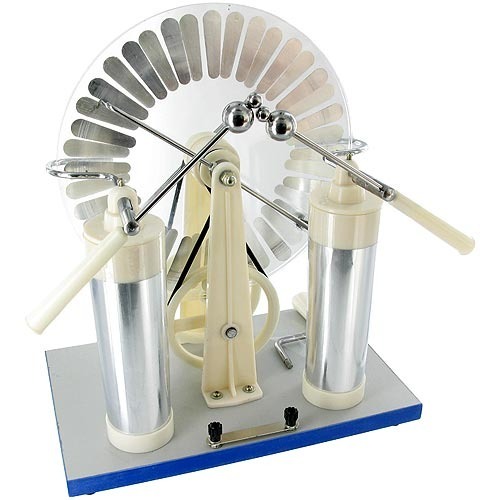
Wilmshurst Electrostatic Machine (for lyceum) (Product Code: SCL2301/031) is a high-voltage influence machine of the Wimshurst type for upper-secondary physics. Two plastic discs, 20 cm in diameter and carrying tinfoil sheets, rotate in opposite directions; brushes collect the separated charge and store it in two condensers (Leyden jars), whose electrodes connect to a pair of metal discharger rods with an insulated handle. Adjusting the gap between the rods produces bright sparks that make static electricity dramatic and memorable. It is made by Jain Scientific Equipments Pvt Ltd (ScienceLab), Ambala, as a centrepiece physics demonstration kit for electrostatics in India’s senior classes.
Specifications
| Parameter | Detail |
|---|---|
| Type | High-voltage electrostatic generator |
| Discs | Two plastic discs with deposited tinfoil sheets, rotating in opposite directions |
| Disc diameter | 20 cm |
| Charge collection | Two sets of brushes collect the charge and store it in two condensers |
| Condensers | Two Leyden (Leiden) jars |
| Discharger | Condenser electrodes connected to two metal rods with an insulated handle; the distance between the rods can be varied |
| Main parts | Two discs, two Leyden jars, collector combs (listed as crests), brushes, dischargers and support |
Typical Use
As the discs turn, charge builds up in the two Leyden jars until it jumps the gap between the discharger rods as a visible, audible spark. Teachers vary the rod separation to show that a larger gap needs more charge — and more turns of the discs — before a spark appears, which opens a discussion on potential difference and the breakdown of air. The machine also powers other electrostatics demonstrations: connected to an electrostatic plume it makes field lines stand out, it charges an electroscope from a distance, and it can illustrate lightning and point discharge in a simple, controlled way.
Electrostatic machines work best in dry conditions, so wipe the discs and jars with a clean dry cloth and keep the machine in a dry room before use. Always discharge the jars by bringing the discharger rods together, using the insulated handle, before touching any part of the machine, and keep students at a sensible distance during spark demonstrations; anyone with an implanted medical device should stay well clear.
Manufacturer
The machine is built by Jain Scientific Equipments Private Limited, the Ambala, Haryana firm that sells laboratory and demonstration apparatus as ScienceLab to institutions and dealers. Find out more about the company on its profile page.
Related Lab Equipment
These electrostatics items are commonly used with the machine or taught in the same unit:
- Electrostatic Sultan — its paper strips show the field when connected to the machine.
- Electroscope with Accessories — detects the charge the machine produces.
- Demonstrative Plan Condenser/ Capacitor — extends the lesson on how condensers store charge.
- Wimshurst Machine — an alternative machine from our electricity range.
- Electrostatic Investigation — further electrostatics apparatus for student work.
Explore the complete Lab Equipment category for related apparatus.
Frequently Asked Questions
What size are the discs?
Each of the two plastic discs is 20 cm in diameter and carries tinfoil sheets; the discs turn in opposite directions.
Is “Wilmshurst” the same as a Wimshurst machine?
Yes. The product name uses the spelling “Wilmshurst”, but the construction described — counter-rotating discs, collectors, brushes and Leyden jars — is that of the Wimshurst influence machine.
What does “for lyceum” mean?
Lyceum refers to upper-secondary level; the machine is intended for demonstrations in senior school and introductory college classes.
What spark length can it produce?
The product listing does not state a spark length or output voltage. It depends on conditions such as humidity; ask us through the contact page if you need further technical detail.
How do I make the machine safe after a demonstration?
Bring the discharger rods together with the insulated handle so the Leyden jars discharge fully, then wait a moment before touching the discs, jars or brushes.
Why does it not spark on a humid day?
Moisture on the discs and jars lets charge leak away. Dry and warm the machine gently, wipe all insulating parts clean and run it in the driest room available.
Can you supply it to colleges and export buyers?
Yes. We quote for schools, colleges and distributors across India and in international markets; include your quantity and destination.
Request a Quote
For a quotation on the Wilmshurst Electrostatic Machine, write to our team or add it to the enquiry cart along with the electrostatics apparatus you plan to use with it.
Last updated: 24 September 2026