- Physics Lab Equipment
- Chemistry Lab Equipment
- Biology Lab Equipment
- Anatomical Lab Equipment
- Learning
- Educational Lab Equipment
- Magnets
- Agriculture
- Astronomy
- Earth Science
- Geography Lab Equipment
- Safety Lab Coat
- Laboratory
- Meteorological
- Electricity & Magnetism
- Heat
- School Lab Equipment
- Lab Glassware
- Science Lab Equipment
- Tvet Lab Equipment
- Robotics Kits Supplier and Manufacturer for Schools India
- Math Lab Equipment Manufacturers and Exporters in Ambala
- STEM Kits Manufacturers and Supplier India
- Engineering Lab Equipment
- Hospital Lab Equipment
- Water, Sanitation & Hygiene Supplies
- Cold Chain, Solar & Communication Equipment
- Nutrition
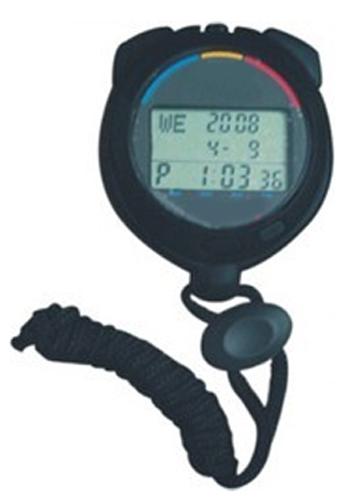
Digital Chronometer (Stopwatch)
Digital Chronometer (Stopwatch) (Product Code: SCL-059/01b) is a compact digital electronic stopwatch for timing motion, oscillation and reaction experiments in the school laboratory. Its 10 mm display figures are easy for a whole group to read, and its stated accuracy is 0.01 s. It is made by Jain Scientific Equipments Pvt Ltd (ScienceLab), Ambala, India, alongside its wider line of physics lab instruments in India.
Specifications
| Parameter | Detail |
|---|---|
| Type | Digital electronic stopwatch |
| Size | 30 x 50 x 15 mm, with a deviation of 10 mm on each side |
| Display figure height | 10 mm |
| Accuracy | 0.01 s |
| Power | Battery (provided) |
Typical Use
The stopwatch is the everyday timer for experiments where students start and stop the count by hand: the period of a pendulum, the time a block takes to slide down an inclined plane, or the oscillation of a mass on a spring. In simple pendulum apparatus India practicals, a good habit is to time 10 or 20 complete swings and divide, because this spreads the delay of pressing the button over many oscillations and gives a far more reliable period.
It is also handy for rate experiments in chemistry and biology, such as timing a colour change or counting pulse beats over a fixed interval. Ask students to repeat each reading at least three times and average the results, then discuss why reaction time, rather than the 0.01 s display, limits the accuracy of hand timing.
Manufacturer
This stopwatch is manufactured by Jain Scientific Equipments Private Limited, which trades as ScienceLab from Ambala in Haryana and prepares physics and general science apparatus for educational buyers. Details of the business are on our company profile.
Related Lab Equipment
Timing is only half of most motion experiments; these catalogue items complete the set-up:
- Inclined Plane With Accessories — time a block or bar sliding down the wooden plane.
- Set of Springs — time the oscillation of a hanging mass for spring-constant work.
- Stopwatch, Digital — an alternative handheld digital timer from our measuring range.
- Bench Stopwatch — a bench-top timer that a whole class can watch during demonstrations.
- Stop Clock — a classic stop clock option for physics practicals.
More timing and measuring apparatus is listed in the Lab Equipment category.
Frequently Asked Questions
How fine are the readings on this stopwatch?
The stated accuracy is 0.01 s. With hand timing, human reaction time is usually the larger source of error, so repeat and average readings.
Does it come with a battery?
Yes, it is provided with a battery, so it is ready to use on arrival.
How big is the stopwatch?
It measures 30 x 50 x 15 mm, with a stated deviation of 10 mm on each side, and the display figures are 10 mm high.
How should it be looked after?
Keep it dry and away from direct heat, wipe it with a dry cloth, and remove the battery if the stopwatch will be stored for a long break such as the summer vacation.
Is a calibration certificate available for timing accuracy?
Please raise this with us before ordering through the contact page so we can discuss what documentation is possible.
What warranty applies?
Warranty terms are confirmed in each quotation; ask our team through the contact page.
Can you supply class sets for several laboratories?
Yes. Quote the product code SCL-059/01b with the number of units and delivery location; we supply schools and distributors across India and international markets.
Request a Quote
For pricing on the Digital Chronometer (Stopwatch), write to us via the contact page or place it in the enquiry cart with the rest of your laboratory list.
Last updated: 24 September 2026
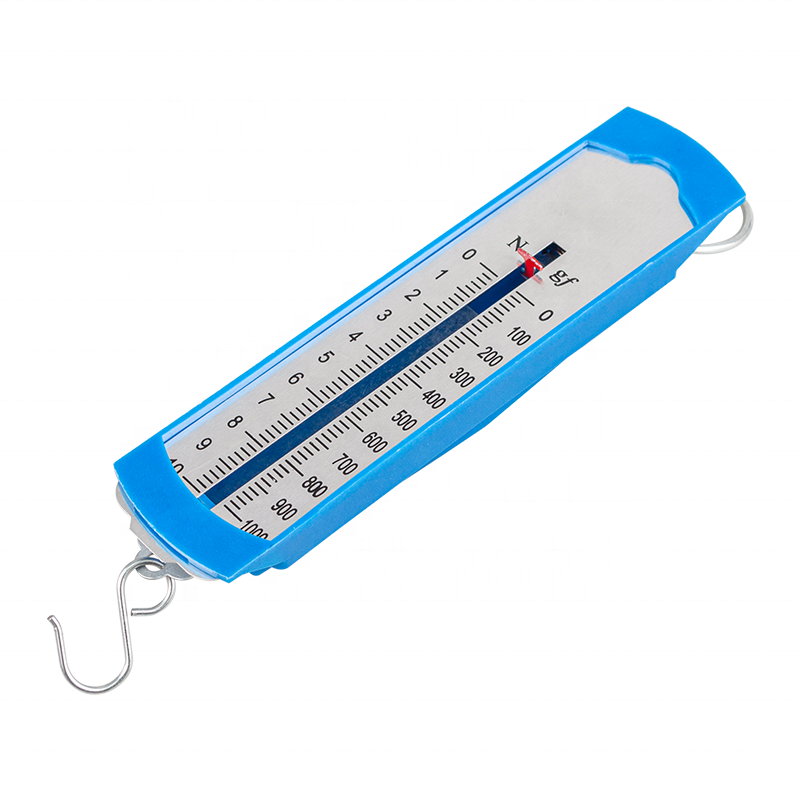
Dynamometer
Dynamometer (Product Code: SCL-583/01c) is a spring force meter that reads forces up to 5 N, with a scale marked both in newtons and in grams. Students hang a load from its hook, or pull an object with it, and read the force directly from the metal scale. This piece of physics lab equipment for school India classrooms is made by Jain Scientific Equipments Pvt Ltd (ScienceLab), Ambala, India.
Specifications
| Parameter | Detail |
|---|---|
| Type | Spring dynamometer with plastic support |
| Maximum force | 5 N |
| Newton scale divisions | 0.1 N |
| Gram scale divisions | 10 g |
| Scale | Metal scale with zero adjuster, reading in both grams and newtons |
| Body | Rectangular plastic body |
| Fittings | Suspension ring and load hook |
Typical Use
Hang the dynamometer from its suspension ring, set the pointer to zero with the adjuster, then attach a load to the hook: students read the weight in newtons and the equivalent in grams on the same scale, which makes the link between mass and weight very clear. Adding masses one at a time and recording each reading also gives a quick demonstration that the spring stretches in proportion to the force applied.
Held horizontally, it becomes the pulling gauge in a friction experiment kit India teachers set up with a wooden block on a board: drag the block at a steady speed, note the force, then change the surface or the load and compare. Always re-zero when changing between vertical and horizontal use, and never pull beyond 5 N, as overstretching can permanently alter the spring.
Manufacturer
Jain Scientific Equipments Private Limited, based in Ambala, Haryana, and known to customers as ScienceLab, manufactures the dynamometer for school and college physics laboratories. ScienceLab is the trading name of the company (CIN U29309HR2020PTC087597), which manufactures at its licensed factory at 449, HSIIDC Industrial Area, Saha, Ambala (Factory Licence AMB-ONLINE-CHD-J-414). Learn more on the company profile.
Related Lab Equipment
Force measurements usually call for loads, supports and something to pull; these items fit the same practical:
- Set Of Marked Masses — hooked 50 g masses to check readings against known loads.
- Stand — a steel rod stand to hang the dynamometer from during load tests.
- Inclined Plane With Accessories — its hooked wooden bar is pulled with the dynamometer in friction work.
- Set of Springs — compare springs of different stiffness under the same force.
- Force Meter/Spring Balance — an alternative spring balance from our measuring range.
Explore the Lab Equipment category for the rest of the mechanics apparatus.
Frequently Asked Questions
What range does the dynamometer cover?
It reads up to a maximum of 5 N, with 0.1 N divisions on the newton scale and 10 g divisions on the gram scale.
Why does the scale show both grams and newtons?
The dual scale lets students see the weight of a load in newtons alongside the mass it corresponds to, which is useful when teaching the difference between the two.
How do I correct a reading that does not start at zero?
Use the zero adjuster on the metal scale with nothing on the hook, in the same orientation you will measure in.
How can the spring be kept accurate over time?
Do not exceed 5 N, do not let a load snap back against the stop, and store the dynamometer unloaded in a dry cupboard.
Is a calibration certificate available?
Please discuss calibration-certificate requirements with us through the contact page before placing the order.
What details are needed for a tender or institutional quotation?
Share the product code SCL-583/01c, quantity, delivery location and any required specification sheet; we reply with a formal quotation.
Request a Quote
Ask for a price on the Dynamometer through our contact page, or add it to the enquiry cart to combine it with masses, springs and stands in one request.
Last updated: 24 September 2026
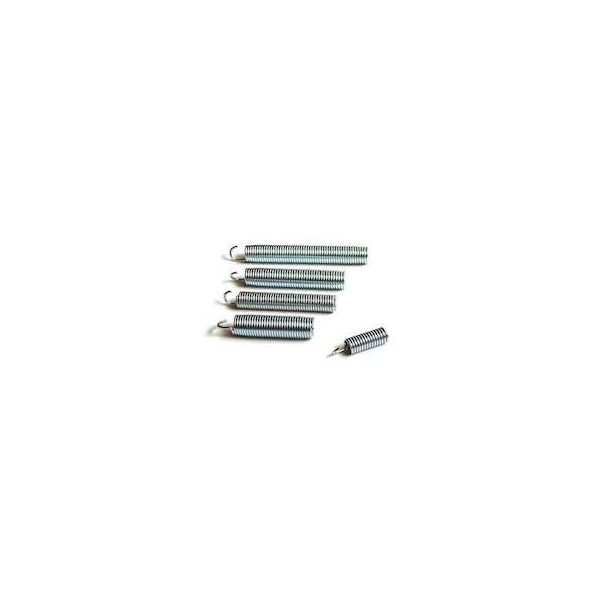
Set of Springs
Set of Springs (Product Code: SCL-485/01d) contains five rust-resistant steel spiral springs of different stiffness, each with a hook at one end, for investigating how springs stretch under load. Because the elastic constants span 20–80 N/m, students can compare soft and stiff springs in a single lesson. Made by Jain Scientific Equipments Pvt Ltd (ScienceLab), Ambala, India, it serves as a ready Hooke law spring kit India schools can use for class practicals.
Specifications
| Parameter | Detail |
|---|---|
| Contents | 5 steel spiral springs |
| Material | Steel, rust resistant |
| Diameter of spring spirals | 15–20 mm |
| Elastic constants | 20–80 N/m |
| End fitting | Hook at one end |
Typical Use
Hang a spring by its hook from a stand, fix a ruler beside it, and add known masses in equal steps. Plotting extension against force gives a straight line whose slope is the spring constant, and repeating the test with each of the five springs shows how stiffness varies across the set. Groups can then combine two springs in series or in parallel and predict the new constant before measuring it.
The same springs work as the core of an SHM experiment kit India teachers use for oscillation studies: pull a loaded spring down a little, release it, and time several oscillations to find the period, then compare how the period changes with mass and with stiffness. Keep loads modest so each spring returns to its original length when unloaded, which is the sign it has stayed within its elastic limit.
Manufacturer
The springs are manufactured by Jain Scientific Equipments Private Limited, an Ambala, Haryana company whose educational products carry the ScienceLab name and are sent to schools and colleges nationwide. Visit the company profile for background on the business.
Related Lab Equipment
A spring investigation also needs a support, loads, a scale and a timer; these catalogue items complete it:
- Stand — the steel rod and base from which the springs are suspended.
- Set Of Marked Masses — hooked masses for loading the springs in equal steps.
- Metal Ruler — for measuring each extension beside the hanging spring.
- Dynamometer — shows how a calibrated spring is used to read force directly.
- Digital Chronometer (Stopwatch) — times oscillations for period measurements.
Find more mechanics apparatus in the Lab Equipment category.
Frequently Asked Questions
How many springs are in the set and how stiff are they?
There are five steel spiral springs, with elastic constants in the range 20–80 N/m. For the constant of each individual spring, please ask us via the contact page.
Will the springs rust in a humid laboratory?
They are made of rust-resistant steel. Wiping off moisture after use and storing them dry will keep them in good condition for longer.
Do the springs have hooks at both ends?
Each spring has a hook at one end for hanging. Masses can be attached at the other end using a hooked mass or a small loop of thread.
Can I use the springs without a stand?
You need some rigid support to hang them from; a laboratory stand with a rod is the most convenient option and keeps the spring vertical beside a ruler.
How do I avoid damaging a spring?
Add load gradually and remove it if the spring no longer returns to its unloaded length. Store the springs unstretched and separately so the coils do not tangle.
Do you supply multiple sets for group practicals?
Yes. Mention the product code SCL-485/01d and the number of sets; we supply institutions across India and international markets.
Request a Quote
Send your requirement for the Set of Springs through the contact page, or add it to the enquiry cart with stands and masses for a combined quotation.
Last updated: 24 September 2026
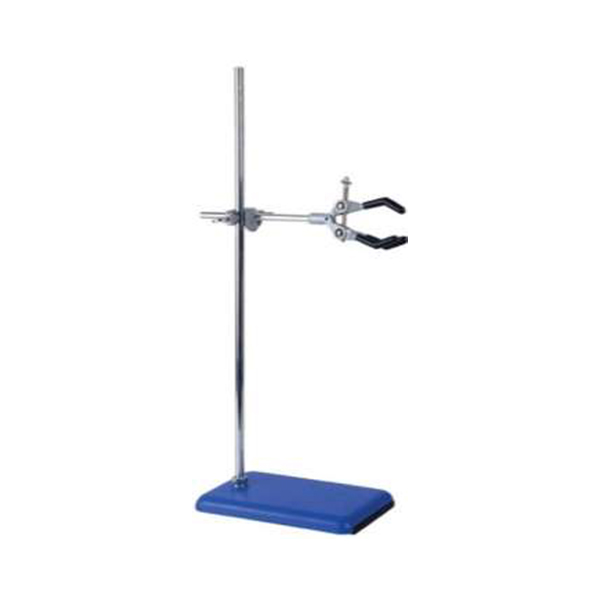
Stand
Stand (Product Code: SCL-987/01e) is a heavy laboratory support stand with a massive steel or cast-iron base and a 600 mm vertical steel rod, used to hold springs, dynamometers, pulleys, levers and other apparatus steady during experiments. It is a basic item in any school lab setup India institutions plan for physics and general science. The stand is made by Jain Scientific Equipments Pvt Ltd (ScienceLab), Ambala, India.
Specifications
| Parameter | Detail |
|---|---|
| Base | Massive steel or cast-iron base, minimum 120 x 200 x 5 mm |
| Rod | Vertical steel rod with anticorrosive coating |
| Rod length | 600 mm |
| Rod diameter | 12 mm |
| Rod fixing | Perpendicular thread on the base |
| Supplied with | Two sockets and pliers |
Typical Use
Screw the rod firmly into the threaded hole so it stands perpendicular to the base, then slide the sockets onto the rod at the heights you need and lock the pliers in them to grip the apparatus. A typical mechanics bench uses one stand to hang a spring or dynamometer, another to carry a pulley or a lever pivot, and sometimes a third to hold a ruler upright for reading extensions.
Teachers comparing lab stand clamp boss head India options should look at stability first: the heavy base resists tipping when a load hangs from the rod, but always position the load over the base rather than beyond its edge. For wider or heavier set-ups, clamp the base to the bench or add weight on it, and check the socket screws are tight before a class begins.
Manufacturer
Jain Scientific Equipments Private Limited manufactures this stand in Ambala, Haryana, and sells its laboratory apparatus under the ScienceLab brand to schools, colleges and dealers. The company profile gives more information about who we are.
Related Lab Equipment
A stand becomes useful once it carries apparatus; these items are commonly mounted on or ordered with it:
- Boss Head — spare connectors for fixing extra clamps or cross-rods to the stand.
- Universal Clamp — grips tubes, rulers and small apparatus of varying sizes.
- Set of Springs — hung from the stand for Hooke's law and oscillation work.
- Pulley — mounted on the rod for simple machine and tension experiments.
- Retort Stand — an alternative stand design from our chemistry range.
Browse the Lab Equipment category for further supports and accessories.
Frequently Asked Questions
What size are the base and rod?
The base is at least 120 x 200 x 5 mm in steel or cast iron, and the rod is 600 mm long with a 12 mm diameter.
What fittings come with the stand?
It is supplied with two sockets and pliers for holding apparatus on the rod. Extra boss heads and clamps can be ordered separately.
Will the rod rust?
The steel rod carries an anticorrosive coating. Wipe off spills promptly and avoid scratching the coating with tools to keep that protection intact.
Can the rod be removed for storage?
Yes, it is fixed by a thread in the base, so it can be unscrewed for compact storage or transport and screwed back in before use.
Is the stand suitable for chemistry work as well as physics?
It can hold light glassware with suitable clamps, but for heating set-ups choose clamps suited to hot glassware and keep the load centred over the base.
How do I order stands for a whole laboratory?
Send the product code SCL-987/01e, the quantity and your delivery address; we quote for institutions across India and international markets.
Request a Quote
For a quotation on the Stand, contact us through the contact page or add it to your enquiry cart together with the clamps and apparatus it will carry.
Last updated: 24 September 2026
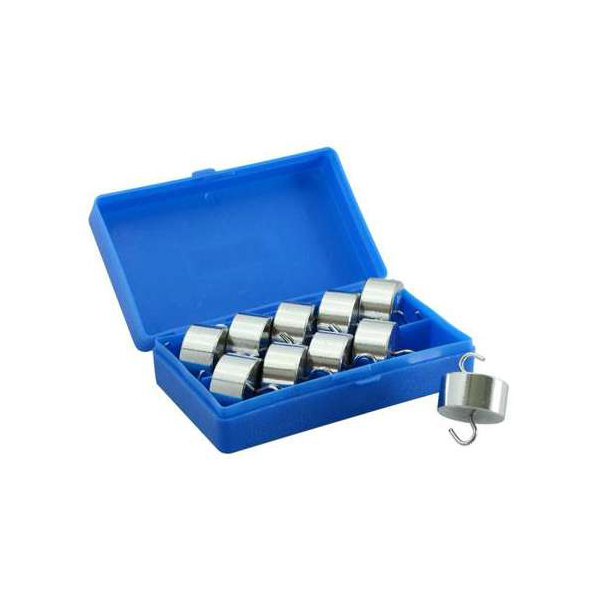
Set Of Marked Masses
Set Of Marked Masses (Product Code: SCL-059/01f) is a boxed set of four 50 g nickel-plated steel masses, each shaped as a cylinder with a central hole and fitted with two wire hooks. The hooks let students hang the masses quickly from springs, levers, pulleys and force meters, making the set a practical piece of laboratory equipment school India teachers reach for in almost every mechanics lesson. It is made by Jain Scientific Equipments Pvt Ltd (ScienceLab), Ambala, India.
Specifications
| Parameter | Detail |
|---|---|
| Pieces in set | 4 |
| Mass of each piece | 50 g |
| Material | Nickel-plated steel |
| Shape | Cylinder with a hole in the middle |
| Hooks | 2 wire hooks per piece |
| Storage | Storage box provided |
Typical Use
Equal 50 g steps make it simple to load a spring or dynamometer progressively and draw a force–extension graph, or to add a known mass to a balance tray when checking a reading. With a moment bar apparatus school students can hang one mass at a measured distance on one side of the pivot and find where two masses must sit on the other side to restore balance, a direct test of the principle of moments.
Over a pulley, the masses provide a steady pulling force for simple machine and friction studies. Encourage students to handle them by the hooks rather than dropping them into place, and to return every piece to the storage box at the end of the lesson so the set stays complete and the plating stays clean.
Manufacturer
ScienceLab is the trading name of Jain Scientific Equipments Private Limited, whose Ambala, Haryana operation manufactures this mass set among many other teaching aids for physics laboratories. More about the company is available on its company profile page.
Related Lab Equipment
Marked masses are the load in many set-ups; these items are the apparatus they are most often used with:
- Lever — a graduated wooden bar with holes for hanging masses at set distances.
- Set of Springs — load the springs in equal steps to find their stiffness.
- Balance — an equal-arm balance for weighing by comparison.
- Pulley — turns the weight of the masses into a horizontal or lifting force.
- Dynamometer — check that each 50 g piece reads as expected on a force scale.
For more mechanics apparatus, open the Lab Equipment category.
Frequently Asked Questions
How many masses are included, and what does each weigh?
The set has 4 pieces of 50 g each, supplied in a storage box.
Why does each mass have two wire hooks?
The hooks make the masses easy to hang from springs, levers and force meters, and to lift without touching the plated surface.
Can I use these masses on a pan balance?
Yes, they can be placed on a balance tray as known masses. For fine weighing, a dedicated weight box is more suitable.
How should the masses be cleaned?
Wipe them with a dry, lint-free cloth. Avoid abrasive cleaners, which can wear the nickel plating, and keep them in the box between lessons.
Can you confirm the accuracy of each mass with a certificate?
Please discuss calibration-certificate availability with us through the contact page before you order.
Are larger quantities available for a school or distributor?
Yes. Send the product code SCL-059/01f with the number of sets; we supply buyers across India and international markets.
Request a Quote
Request pricing for the Set Of Marked Masses via our contact page, or put it in the enquiry cart with the springs, lever or stand you plan to use it with.
Last updated: 24 September 2026
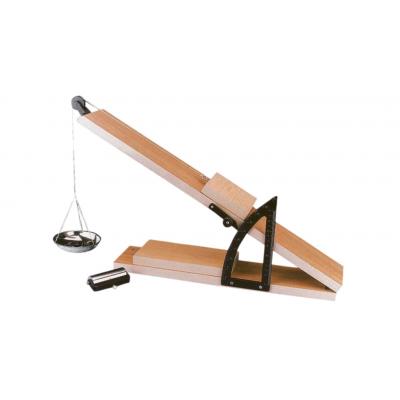
Inclined Plane With Accessories
Inclined Plane With Accessories (Product Code: SCL-871/01g) is a polished wooden tribometer board, 900 mm long, with a metal pulley at one end and a drilled wooden bar that slides along it. Students use it to study friction, forces on a slope and the mechanical advantage of an inclined plane. This inclined plane apparatus India schools use in mechanics practicals is made by Jain Scientific Equipments Pvt Ltd (ScienceLab), Ambala, India.
Specifications
| Parameter | Detail |
|---|---|
| Plane (tribometer) | Polished wood, coniferous species, without stubs (knots) |
| Plane dimensions | Length 900 mm, width 100 mm, thickness 25 mm |
| Mounting | Fixing element for attaching to a stand |
| Pulley | Metal pulley at one end, maximum diameter 40 mm, thickness 4 mm |
| Accessory bar | One wooden bar, minimum 30 x 40 x 120 mm |
| Bar holes | Three blind holes of 10 mm diameter, drilled to the middle of the body, symmetrically distributed on each of two adjacent sides |
| Bar hook | Hook in the middle of the small side |
Typical Use
Laid flat on the bench, the board acts as a friction track: hook a force meter to the wooden bar and pull it along at a steady speed to measure sliding friction, then turn the bar onto its other face to compare contact areas, or add masses to see how friction grows with the normal force. Because the bar has holes on two adjacent sides, students can load it evenly in more than one orientation.
Raised on a stand through its fixing element, the board becomes an inclined plane. Tie a thread from the bar's hook over the end pulley to a hanger of masses and you have a simple pulley system lab India teachers use to show the force needed to hold or raise a load up a slope. Gradually tilting the plane until the bar just starts to slide is also a neat way to estimate the coefficient of static friction from the angle.
Manufacturer
Jain Scientific Equipments Private Limited, which trades as ScienceLab in Ambala, Haryana, manufactures the inclined plane and its accessory bar for school physics departments. The company is a registered MSME enterprise (Udyam UDYAM-HR-01-0003714) and handles export shipments under Importer-Exporter Code AAECJ8618A issued by the DGFT. See the company profile for more.
Related Lab Equipment
To run full friction and slope experiments on this board, these catalogue items are the usual companions:
- Dynamometer — hook it to the bar to read the pulling force directly in newtons.
- Stand — supports the plane at an angle through its fixing element.
- Set Of Marked Masses — hang over the pulley or add to the bar to change the load.
- Digital Chronometer (Stopwatch) — time the bar sliding down the slope.
- Inclined Plane with Roller & Pan — an alternative inclined plane design with a roller and pan.
Further mechanics apparatus is listed in the Lab Equipment category.
Frequently Asked Questions
What is included with the inclined plane?
The polished wooden plane with its end pulley and fixing element, plus one wooden bar with blind holes and a hook. Force meters, masses and stands are ordered separately.
How long and wide is the plane?
It is 900 mm long, 100 mm wide and 25 mm thick, made from knot-free coniferous wood with a polished surface.
What are the holes in the wooden bar for?
The three 10 mm blind holes on each of two adjacent sides let you add small loads evenly and use the bar in different orientations when comparing friction.
Can I use it without a stand?
Yes, laid flat it works as a horizontal friction track. To use it as an inclined plane you need a stand or another support attached through the fixing element.
How do I keep the friction results consistent?
Keep the polished surface clean, dry and free of chalk or oil, and wipe both the board and bar before each set of readings.
Can you supply several units for a tender or export order?
Yes. Share the product code SCL-871/01g, quantity and destination; we supply institutions across India and international markets.
Request a Quote
To get a price for the Inclined Plane With Accessories, reach us through the contact page or add it to the enquiry cart along with a dynamometer and masses.
Last updated: 24 September 2026
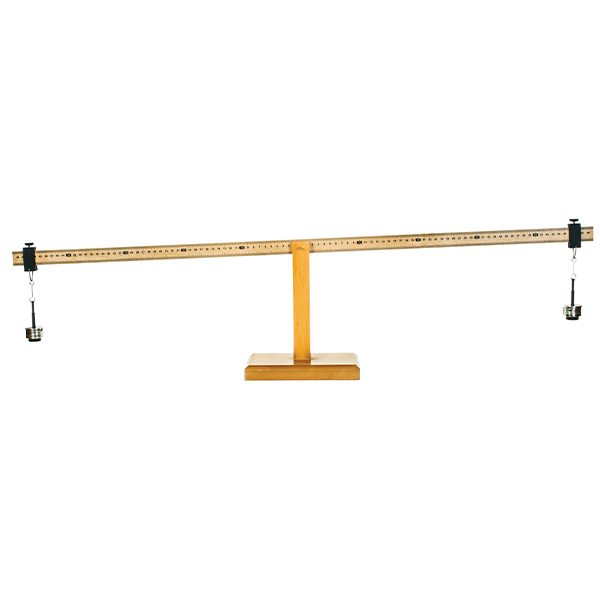
Lever
Lever (Product Code: SCL-121/01h) is a 400 mm graduated wooden bar that pivots on a central rotation axis, used to demonstrate the principle of moments and the conditions for equilibrium. A row of small holes along its centre line lets students hang loads at precise distances from the pivot, and adjusting nuts at each end let the empty bar be balanced first. It is made by Jain Scientific Equipments Pvt Ltd (ScienceLab), Ambala, India, for the physics lab equipment India schools and colleges need for mechanics.
Specifications
| Parameter | Detail |
|---|---|
| Material | Wooden bar |
| Length | 400 mm |
| Cross-section | Minimum 30 x 4 mm |
| Rotation axis | Median (central) axis, minimum diameter 4 mm |
| Holes | 2 mm diameter holes every 15 mm along the median line |
| Graduation | Every 5 mm |
| Balancing | Nuts at both ends for balancing the lever |
Typical Use
Mount the lever on its axis, then turn the end nuts until the unloaded bar rests horizontal; this removes the bar's own weight from the calculation. Hang a mass from a hole on one side, balance it with masses on the other, and read both distances from the 5 mm graduations. Students quickly find that load times distance on the left equals load times distance on the right, and can go on to test first-, second- and third-class lever arrangements.
Used as a simple center of gravity apparatus India teachers can set up in minutes, the bar also shows what happens when the balancing nuts are deliberately moved off-centre: the bar tilts until a compensating load is added. Replacing one set of masses with a force meter lets classes measure an unknown force from its moment.
Manufacturer
From its base in Ambala, Haryana, Jain Scientific Equipments Private Limited manufactures the lever and sells it under its ScienceLab trade name to schools and laboratory suppliers. The company profile explains more about the business.
Related Lab Equipment
These items are needed, or useful, when running moments experiments with the lever:
- Set Of Marked Masses — hooked masses to hang from the lever's holes.
- Stand — a rod stand to support the lever's axis at a convenient height.
- Dynamometer — measures an applied force for calculating unknown moments.
- Balance Demonstration Fulcrum/Lever — an alternative demonstration lever from our physics range.
- Apparatus for Demonstrating the Moment of Force — a dedicated moments demonstrator for the teacher's bench.
See the Lab Equipment category for other mechanics apparatus.
Frequently Asked Questions
How long is the lever and how is it marked?
The bar is 400 mm long and graduated every 5 mm, with 2 mm holes at 15 mm intervals along its centre line.
What are the nuts at the ends for?
They are balancing nuts: turn them to make the empty bar hang level before you add any loads.
Does the lever come with masses or a stand?
The listing covers the lever bar. Masses and a support stand are available separately; ask us if you would like them quoted together.
What loads can hang from the holes?
Use light hooked masses or thread loops through the 2 mm holes, and keep loads moderate so the wooden bar does not bend.
How should the wooden bar be stored?
Store it flat in a dry place, away from heat and damp, so the wood does not warp and the balance point stays true.
What information helps you prepare a quotation?
Please give the product code SCL-121/01h, quantity and delivery location. We serve schools and distributors across India and international markets.
Request a Quote
Ask for pricing on the Lever through the contact page, or add it to the enquiry cart with masses and a stand for a complete moments set-up.
Last updated: 24 September 2026
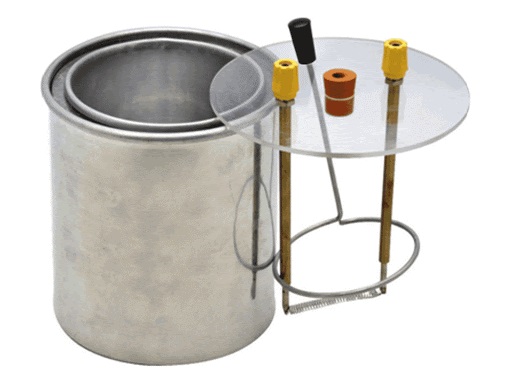
Calorimeter With Accessories
Calorimeter With Accessories (Product Code: SCL-054/02a) is an aluminium double-cup calorimeter with an insulated outer cup, a transparent plastic cap with a thermometer hole, two heating electrodes and a stirrer. It lets students measure heat transfer, specific heat capacity and the heating effect of an electric current with reduced heat loss to the surroundings. This calorimeter lab India schools and colleges use is made by Jain Scientific Equipments Pvt Ltd (ScienceLab), Ambala, India.
Specifications
| Parameter | Detail |
|---|---|
| Inner cup | Aluminium, minimum volume 150 ml |
| Outer cup | Aluminium, with thermal insulation |
| Cap | Transparent plastic, with hole for thermometer |
| Heating | Two heating resistant electrodes, tightened with nuts |
| Accessory | Stirrer |
Typical Use
For the method of mixtures, weigh the empty inner cup, add a known amount of cold water, then drop in a heated solid and stir while watching the thermometer through the cap. The insulated outer cup slows heat exchange with the room, so the final steady temperature is closer to the true value and the specific heat capacity of the solid can be calculated with confidence.
For electrical heating, connect the two electrodes to a suitable low-voltage supply through an ammeter and voltmeter, record current, voltage and time, and compare the electrical energy supplied with the heat gained by the water. The same set-up doubles as thermometry apparatus India teachers use for cooling-curve work: heat the water, switch off, and log the temperature at regular intervals while stirring gently.
Manufacturer
This calorimeter set is manufactured in Ambala, Haryana, by Jain Scientific Equipments Private Limited, a company that trades as ScienceLab and serves physics and chemistry laboratories. For institutional vendor registration, the company's GSTIN is 06AAECJ8618A1ZT and its Legal Entity Identifier is 3358004HRD1JIVXKYX49. More details are on the company profile.
Related Lab Equipment
A complete heat experiment also needs temperature, time, mass and electrical readings; these items cover them:
- Laboratory Thermometer — fits through the cap to follow the water temperature.
- Multimeter — measures the current and voltage fed to the heating electrodes.
- Power Source For Teacher — a bench power source for electrical heating; confirm the output you need with us.
- Digital Chronometer (Stopwatch) — times the heating or cooling period.
- Balance — weighs the cup, water and sample before and after mixing.
More heat and physics apparatus is available in the Lab Equipment category.
Frequently Asked Questions
What does the calorimeter set include?
An aluminium inner cup of at least 150 ml, an insulated aluminium outer cup, a transparent plastic cap with thermometer hole, two heating electrodes fixed with nuts, and a stirrer.
Is a thermometer supplied?
A thermometer is not listed in the set; the cap has a hole to take one. Our laboratory thermometers can be quoted alongside it.
What power supply should I use with the heating electrodes?
Use a low-voltage laboratory supply. Please confirm the recommended voltage and current with us through the contact page before connecting.
Can it be used without the electrical heating part?
Yes. For method-of-mixtures experiments you only need the cups, cap, stirrer and a thermometer; the electrodes simply stay unconnected.
How do I clean the aluminium cups?
Rinse with clean water after each use and dry thoroughly. Avoid strong alkaline cleaners, which attack aluminium.
Is a calibration certificate offered?
Please discuss any calibration-certificate requirement with us via the contact page.
Can you quote for a tender or bulk supply?
Yes. Quote the product code SCL-054/02a with quantity and destination; we supply across India and international markets.
Request a Quote
For prices on the Calorimeter With Accessories, write to us through the contact page or add it to the enquiry cart with thermometers and meters for one combined quotation.
Last updated: 24 September 2026