- Physics Lab Equipment
- Chemistry Lab Equipment
- Biology Lab Equipment
- Anatomical Lab Equipment
- Learning
- Educational Lab Equipment
- Magnets
- Agriculture
- Astronomy
- Earth Science
- Geography Lab Equipment
- Safety Lab Coat
- Laboratory
- Meteorological
- Electricity & Magnetism
- Heat
- School Lab Equipment
- Lab Glassware
- Science Lab Equipment
- Tvet Lab Equipment
- Robotics Kits Supplier and Manufacturer for Schools India
- Math Lab Equipment Manufacturers and Exporters in Ambala
- STEM Kits Manufacturers and Supplier India
- Engineering Lab Equipment
- Hospital Lab Equipment
- Water, Sanitation & Hygiene Supplies
- Cold Chain, Solar & Communication Equipment
- Nutrition
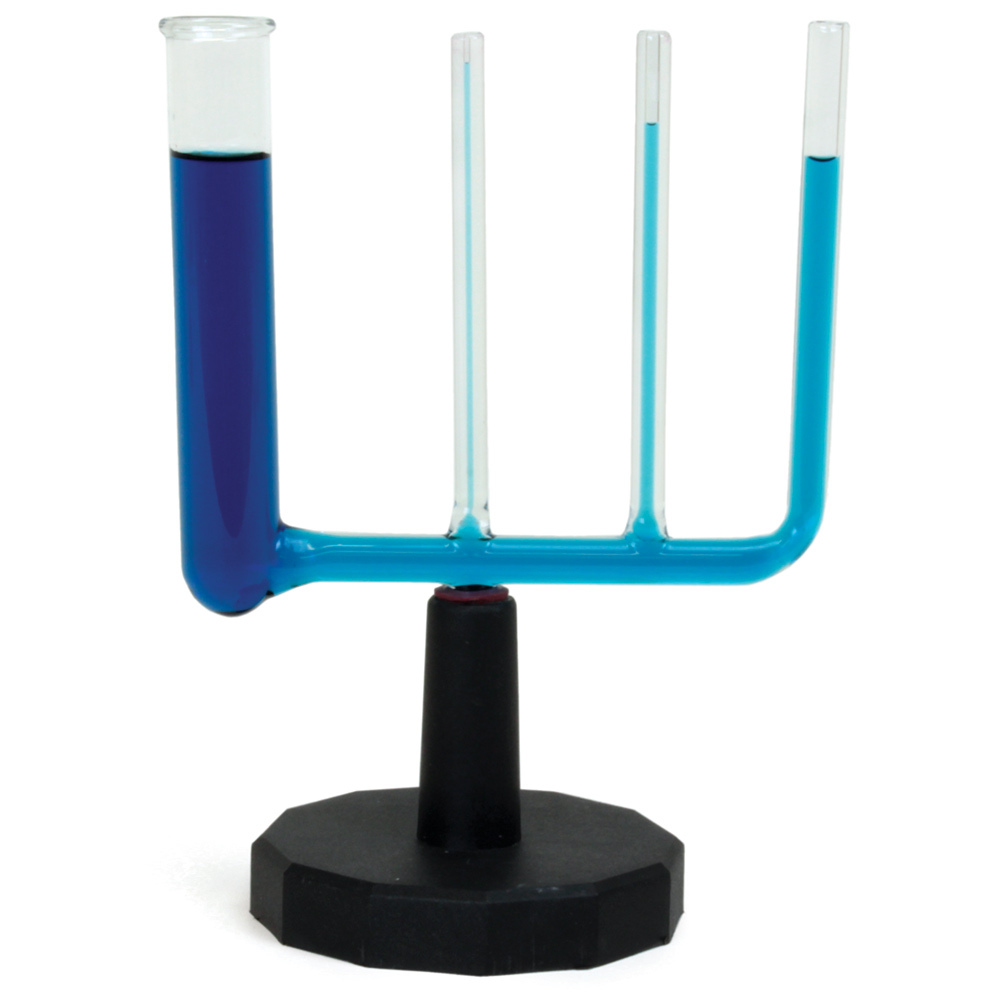
Set of Capillary Tubes
Set of Capillary Tubes (Product Code: SCL1240/016) is a device of three interconnected tubes, each 20 cm long, with different diameters of 1 mm, 1.5 mm and 2 mm, mounted on a plastic stand. When coloured water is poured in, the liquid settles at different heights in the three tubes – highest in the narrowest – so capillarity and surface tension become visible at a glance. The set is made by Jain Scientific Equipments Pvt Ltd (ScienceLab), Ambala, for any school running a capillary tube experiment in India.
Specifications
| Parameter | Detail |
|---|---|
| Type | Three interconnected capillary tubes |
| Tube length | 20 cm |
| Tube diameters | 1 mm, 1.5 mm and 2 mm |
| Mounting | Plastic stand |
Typical Use
Because the tubes are connected, students might expect the water to stand at one common level, as it does in ordinary communicating vessels. Instead, it climbs highest in the 1 mm tube, less in the 1.5 mm tube and least in the 2 mm tube. Measuring each height with a ruler lets the class show that the rise gets larger as the bore gets smaller, which introduces the balance between surface tension pulling the liquid up and the weight of the raised column pulling it down. The same effect explains water moving up through soil, paper towels, lamp wicks and the fine vessels of plants.
Clean tubes are essential: any trace of grease lowers the rise and makes the levels uneven, so rinse with clean water after use and let the set drain and dry upright on its stand. A drop of food colour makes the meniscus easy to see from the back of the room. Alongside other surface tension apparatus in India's school physics labs, the set gives a quick, reliable demonstration that needs no power or pump.
Manufacturer
Jain Scientific Equipments Private Limited produces this set under its ScienceLab trade name at Ambala in Haryana, where it develops properties-of-matter apparatus for secondary and senior secondary science. Learn more on the company profile.
Related Lab Equipment
Items that support a capillarity and fluids lesson:
- Metal Ruler — for measuring the height of the liquid in each tube.
- Glass Beaker — to hold and pour the coloured water.
- Capillary Tube Apparatus — an alternative apparatus for studying capillary rise.
- Pascal's Sphere — another liquid-properties demonstration for the same unit.
Other demonstration apparatus is available in our Lab Equipment category.
Frequently Asked Questions
What are the tube sizes?
Three tubes, each 20 cm long, with diameters of 1 mm, 1.5 mm and 2 mm, joined together and mounted on a plastic stand.
Why does water rise highest in the narrowest tube?
Surface tension lifts the liquid around the edge of the meniscus, and in a narrower tube that lift supports a taller column relative to its weight, so the rise is greater.
Which liquid works best?
Clean water with a little colouring is ideal for class use and makes the levels easy to compare.
How should the set be cleaned?
Rinse with clean water after each use, avoid oily or greasy substances, and let it drain upright on its stand. Do not push anything into the fine tubes.
What are the tubes made of?
The tube material is not listed in the current specification. Please ask through the contact page if your order needs it confirmed.
Can you supply sets for every lab group?
Yes. We quote class sets and bulk quantities for schools, colleges and distributors in India and international markets.
Request a Quote
For a price on the Set of Capillary Tubes, reach us through the contact page or add the item to your enquiry cart with other properties-of-matter apparatus.
Last updated: 24 September 2026
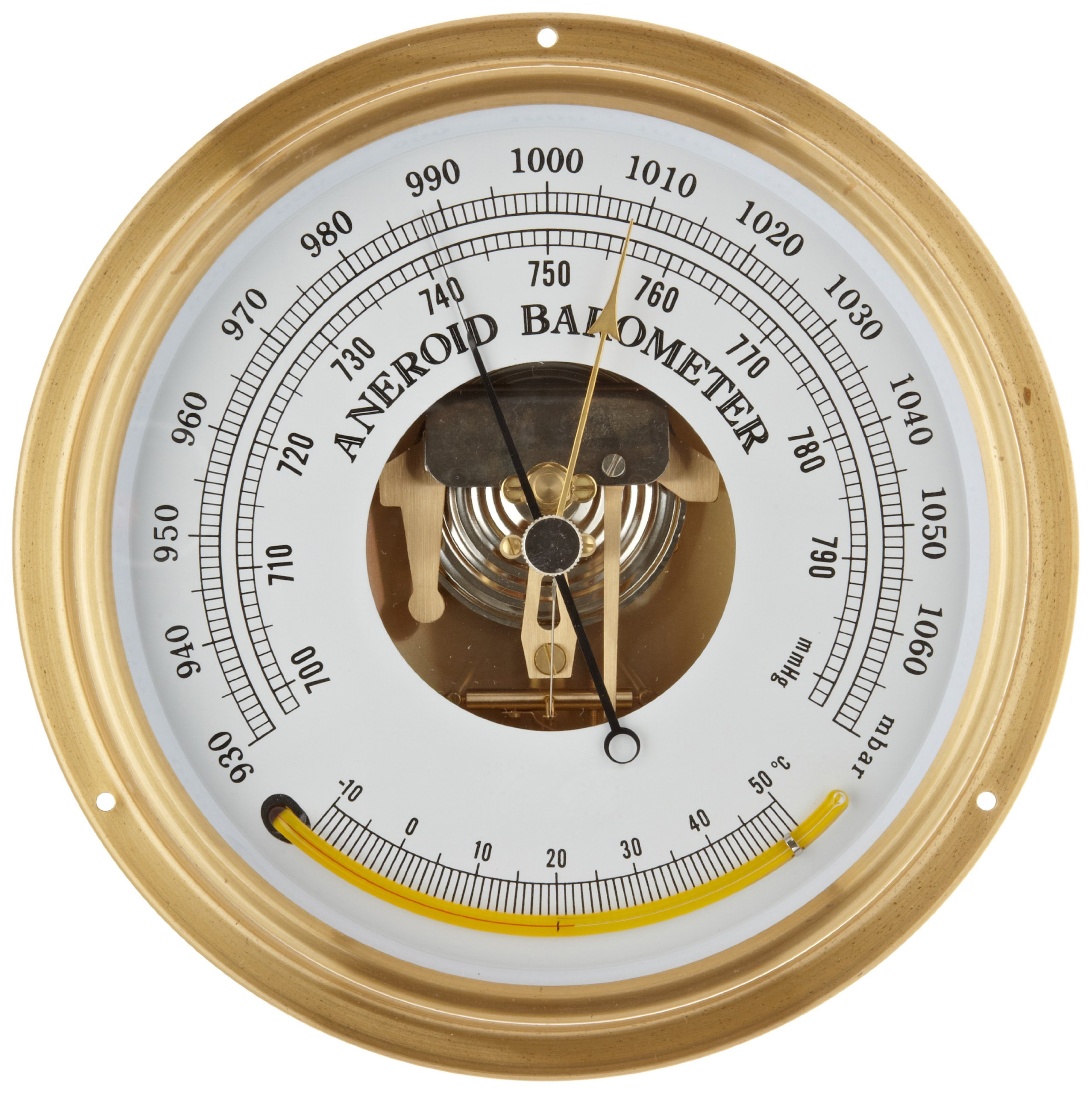
Aneroid Barometer
Aneroid Barometer (Product Code: SCL1544/017) measures atmospheric pressure without any liquid column: a sealed brass barometric box flexes as the air pressure rises or falls, and that movement drives an indicator across the scale of a plastic cylindrical body. Physics, geography and environmental-science teachers use it for weather lessons and to show students how pressure is read in both mm Hg and pascals. It is made by Jain Scientific Equipments Pvt Ltd (ScienceLab), Ambala, which builds physics lab instruments in India for schools, colleges and training institutes.
Specifications
| Parameter | Detail |
|---|---|
| Instrument type | Aneroid barometer with indicator |
| Body | Plastic, cylindrical |
| Pressure-sensing element | Brass barometric box |
| Longitudinal dimension | 150 mm (brass barometric box) |
| Measuring range | 700–800 mm Hg |
| Scale units | mm Hg, with an additional scale graduated in pascals |
Typical Use
In a classroom the barometer is usually placed where students can read it at the same time every day, building a pressure log they compare with the weather they observe; a reading that keeps falling over a day or two is a good starting point for discussing approaching rain or wind. Because the dial carries both mm Hg and pascals, every reading also becomes a unit-conversion exercise that links the traditional mercury-based unit with the SI unit used in textbooks.
Keep the instrument upright on a steady shelf, away from heaters, sunny windows and air-conditioning vents, because rapid temperature changes can disturb the reading, and give the case a light tap before reading so the indicator settles. Schools setting up physics lab equipment for school labs in India often keep an aneroid unit beside a mercury Fortin barometer, so learners can compare two different measuring principles side by side.
Manufacturer
Jain Scientific Equipments Private Limited, trading as ScienceLab, is based in Ambala, Haryana, and makes teaching apparatus for school, college and technical-institute laboratories; the company profile gives background on the business. The company is a registered MSME enterprise (Udyam UDYAM-HR-01-0003714), and its export consignments move under Importer-Exporter Code AAECJ8618A issued by the DGFT.
Related Lab Equipment
Pressure and weather lessons usually call for more than one instrument. These items from the same catalogue fit the same lab sessions:
- Fortin Barometer — a mercury-column reference for comparing against the aneroid reading.
- Metal Barometer — another barometer in the range, handy when several groups or stations need their own instrument.
- Digital Hygrometer - Thermometer — adds humidity and temperature to a daily weather log.
- Vacuum Pump with Pressure Gauge — for follow-up demonstrations of pressures below atmospheric.
Browse more apparatus in the Lab Equipment category.
Frequently Asked Questions
What pressure range does this aneroid barometer cover?
It reads from 700 to 800 mm Hg, with a second scale in pascals. If your school is at a high altitude where normal pressure may fall below that band, tell us your location through the contact page before ordering.
Does the instrument contain mercury?
No. An aneroid barometer works through a sealed metal box — brass in this model — so there is no liquid to spill, which makes it easier to handle in a classroom than a mercury barometer.
Can students record readings in SI units?
Yes. Besides mm Hg, the scale is graduated in pascals, so readings can be taken directly in the SI unit and cross-checked against the mm Hg value.
How should the barometer be cared for?
Wipe the plastic body with a soft dry cloth, keep it away from heat and strong sunlight, avoid dropping it, and do not open the case, since the brass barometric box and the indicator linkage are delicate.
Is a calibration certificate supplied?
The product listing does not include one. If your institution needs calibration documentation, raise it with us through the contact page so availability can be discussed before you order.
What details help us prepare an institutional quotation?
Quote product code SCL1544/017, the quantity, the delivery address and any paperwork your purchase department requires, such as vendor registration details or a delivery schedule.
Do you supply schools and distributors outside India?
Yes. ScienceLab supplies institutions and distributors across India and in international markets; share your destination and quantity for an export quotation.
Request a Quote
For pricing and delivery of the Aneroid Barometer, send us an enquiry or add it to the enquiry cart together with the other apparatus you need for pressure and weather lessons.
Last updated: 24 September 2026
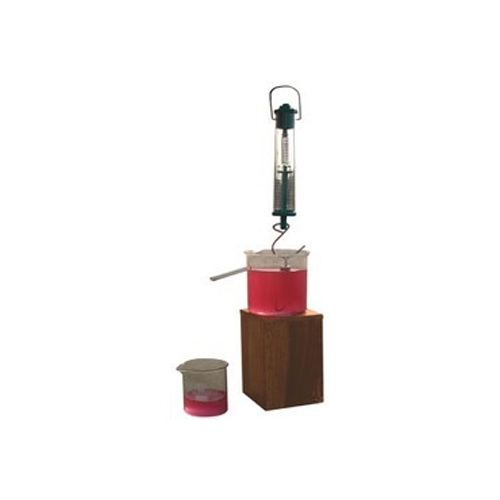
Set to Demonstrate Archimedes' Principle/Law
Set to Demonstrate Archimedes' Principle/Law (Product Code: SCL1247/018) is a buoyancy demonstration set used to prove that the upthrust on an immersed body equals the weight of the liquid it displaces, in secondary-school physics lessons. It combines a plastic bowl with a side drainage connection, a dynamometer graduated in newtons and two plastic cylinders, the full one fitting strictly into the empty one. It is manufactured by Jain Scientific Equipments Pvt Ltd (ScienceLab), an OEM manufacturer, at its own factory in Ambala, India, as a physics demonstration kit.
Specifications
| Parameter | Detail |
|---|---|
| Water vessel | Plastic bowl with a side water-drainage connection |
| Force meter | Dynamometer graduated in N (newtons) |
| Full cylinder | Plastic, full (solid), with handle |
| Empty cylinder | Plastic, empty, with handle and a hook at the bottom |
| Cylinder fit | The full cylinder fits strictly into the empty one |
| Product code | SCL1247/018 |
| Manufacturer | Jain Scientific Equipments Pvt Ltd (ScienceLab) — OEM |
| Country of origin | India (made in Ambala, Haryana) |
What Is the Archimedes' Principle Set Used For?
The classic procedure hangs the empty cylinder from the dynamometer, with the full cylinder suspended from the hook underneath, and notes the force reading in air. The full cylinder is then lowered into the water in the bowl: the reading drops because of the buoyant force, and the displaced water runs out through the side drainage connection. When students fill the empty cylinder with water, the dynamometer returns to its original reading, and because the full cylinder fits strictly into the empty one, the water added has exactly the volume of the immersed body.
Teachers can extend the lesson by collecting the drained water in a beaker and weighing it, or by repeating the test with salt water to discuss density. Hang the dynamometer from a firm stand so it reads vertically, zero it before each run, and fill the bowl up to the drain level before immersing the cylinder so that all the displaced water is captured. The set sits comfortably alongside other mechanics lab equipment in India's secondary-school physics rooms.
OEM Manufacturer
This Archimedes' principle set is made by Jain Scientific Equipments Private Limited, trading as ScienceLab, as the OEM (original equipment manufacturer) at its own licensed factory at Saha, Ambala, Haryana, India. Schools, colleges, distributors and importers buy it factory-direct, so quotations, class-set orders and questions about a replacement cylinder or dynamometer are answered by the maker itself — ask us. More about the company's background and range is on the ScienceLab company profile.
Related Lab Equipment
These items support the same buoyancy practical or the fluid lessons that follow it:
- Stand — a rigid support for hanging the dynamometer and cylinders above the bowl.
- Dynamometer — an extra force meter so several student groups can work at once.
- Balance — for weighing the water collected from the drainage connection as a cross-check.
- Pascal's Sphere — a natural next demonstration on how pressure acts in liquids.
See the full Lab Equipment category for more mechanics and fluids apparatus.
Frequently Asked Questions
What comes in the set?
The Set to Demonstrate Archimedes' Principle/Law contains a plastic bowl with a side water-drainage connection, a dynamometer graduated in newtons, a full plastic cylinder with handle, and an empty plastic cylinder with handle and a hook at the bottom.
Why must the full cylinder fit exactly inside the empty one?
In the Set to Demonstrate Archimedes' Principle/Law the full cylinder fits strictly into the empty one, so the empty cylinder holds exactly the volume of the immersed body. Filling it with water therefore restores the original dynamometer reading, proving the principle.
What is the range of the dynamometer?
The dynamometer in the Set to Demonstrate Archimedes' Principle/Law is graduated in newtons, but its full-scale value is not given in our listing. Ask us through the contact page if you need the range confirmed for worksheets or a tender.
Is a stand included?
A stand is not listed among the contents of the Set to Demonstrate Archimedes' Principle/Law. Any laboratory stand that lets the dynamometer hang freely above the bowl will work, or the Stand linked above can be added to your order.
Who manufactures the Set to Demonstrate Archimedes' Principle/Law?
The Set to Demonstrate Archimedes' Principle/Law is manufactured by Jain Scientific Equipments Pvt Ltd (ScienceLab), the OEM, at its own licensed factory at Saha, Ambala, Haryana, India, and quotations for single sets or class quantities come straight from the manufacturer.
How do I look after the set?
After each class, empty and dry the bowl and cylinders of the Set to Demonstrate Archimedes' Principle/Law, store the dynamometer unloaded, and never hang more on it than its marked capacity, so the spring keeps its accuracy.
Request a Quote
To receive a quotation direct from the manufacturer for the Set to Demonstrate Archimedes' Principle/Law, use our contact form or place the item in your enquiry cart and submit the list in one go.
Last updated: 24 September 2026
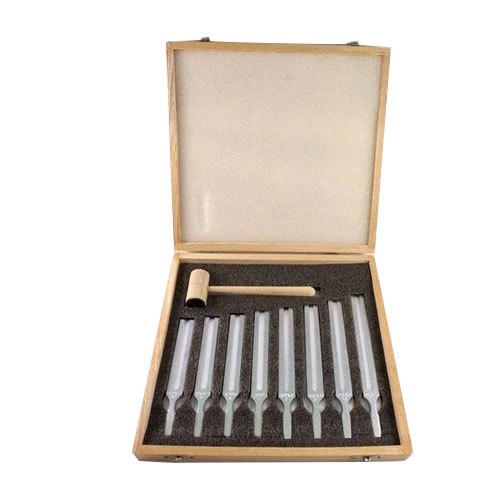
Tuning Fork
Tuning Fork (Product Code: SCL1531/019) is an adjustable sound source: a U-shaped vibrator fixed on a wooden resonator box, with two slidable bodies on the vibrator that change its oscillation frequency across the instrument’s range. It is calibrated to 7 frequencies, so one instrument can do much of the work that usually needs a tuning fork set in an Indian school physics room. Physics teachers use it to demonstrate pitch, resonance and the link between mass and frequency. It is made by Jain Scientific Equipments Pvt Ltd (ScienceLab), Ambala, and supplied with a rubber-tipped metal hammer.
Specifications
| Parameter | Detail |
|---|---|
| Vibrator | U-shaped, fixed on the resonator box |
| Resonator | Wooden box |
| Frequency adjustment | Two slidable bodies on the vibrator modify the oscillation frequency within its range |
| Calibration | 7 frequencies |
| Hammer | Metal, with handle and rubber-coated impact element |
Typical Use
Strike one prong with the rubber-coated hammer and the wooden box amplifies the note so a whole class can hear it. Moving the two sliding bodies along the U-shaped vibrator shifts the pitch, which lets students hear directly how adding mass towards the prong tips lowers the frequency of a vibrating body. Setting the fork to each of its calibrated positions in turn gives a series of known notes for listening tests, for comparing with a second fork, or for tuning a string on a sonometer by ear.
Placed near the open end of a resonance tube, the fork also serves as the source in speed-of-sound experiments, making it a useful companion to a resonance tube experiment kit. Hold the instrument by its box rather than the prongs, strike firmly but never against the bench or a hard object, and damp the sound by touching the prongs lightly when the demonstration ends.
Manufacturer
ScienceLab is the trading name of Jain Scientific Equipments Private Limited, an Ambala, Haryana manufacturer of acoustics, mechanics and electricity apparatus for teaching laboratories. Buyers who want to know more about the organisation behind the brand can read the company profile.
Related Lab Equipment
Sound and wave practicals often combine this fork with the apparatus below:
- Tuning Fork on Resonance Box — a second source for resonance and beat demonstrations.
- Tuning Fork Set, Steel — fixed-pitch forks for individual student practicals.
- Resonance Tube Apparatus — for measuring the speed of sound with the fork as the source.
- Sonometer, Simple Pattern — for matching a vibrating string to the fork’s note.
- Long Cylindrical Spring (Resort) — shows the wave motion that underlies sound.
More teaching apparatus is listed in the Lab Equipment category.
Frequently Asked Questions
How many frequencies can this tuning fork be set to?
It is calibrated to 7 frequencies. The individual frequency values are not given in the product listing, so ask us through the contact page if you need them for lesson planning.
How is the pitch changed?
By sliding the two bodies attached to the U-shaped vibrator. Their position changes the vibrating mass distribution and therefore the oscillation frequency.
Is a hammer included?
Yes. A metal hammer with a handle and a rubber-coated impact element comes with the instrument, so the prongs are struck without metal-on-metal contact.
Why is the fork mounted on a wooden box?
The box acts as a resonator: it vibrates with the fork and radiates the sound more strongly, so the note carries across a classroom.
Can it be used to demonstrate beats?
Yes, when paired with a second sound source of nearly the same pitch, such as another fork. Detuning one of them slightly with its sliding bodies produces audible beats.
How should the instrument be stored?
Keep it in a dry cupboard, away from damp walls, because moisture can affect the wooden box; store the hammer with it so it is not replaced by a hard striker.
Can you quote for several units or for export?
Yes. Share the quantity and destination; ScienceLab supplies schools and distributors in India and international markets.
Request a Quote
To price this Tuning Fork for your lab, write to us with the quantity, or collect it with other items in the enquiry cart and send a single request.
Last updated: 24 September 2026
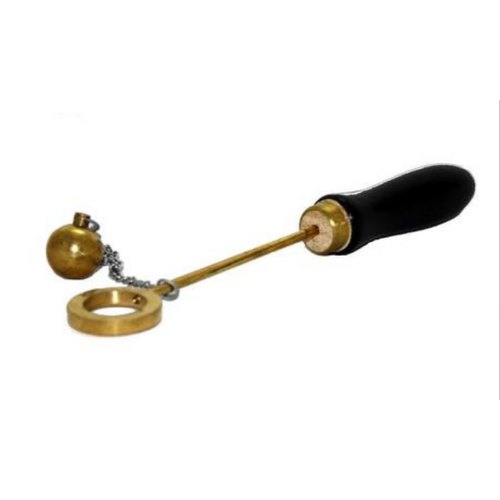
Gravesand Ring-Device to Demonstrate Thermal Expansion
Gravesand Ring-Device to Demonstrate Thermal Expansion (Product Code: SCL1255/020) is the traditional ’s Gravesande ring-and-ball apparatus: a ball and a ring matched so closely that the ball slips through the ring at room temperature but sticks once the ball has been heated. It gives students an instant, visible proof that solids expand when heated, and is used in middle- and secondary-school heat lessons as a simple demonstration model for the physics lab. This ring device is made by Jain Scientific Equipments Pvt Ltd (ScienceLab) at Ambala, Haryana.
Specifications
| Parameter | Detail |
|---|---|
| Type | Gravesande ring (ring-and-ball thermal expansion device) |
| Ball diameter | 15 mm |
| Fit | Ball passes through the ring at room temperature; does not pass when the ball is heated |
| Handles | Both the ball and the ring have handles |
Typical Use
Start by passing the cold ball through the ring to show the class that it fits. Then hold the ball by its handle in the flame of a spirit lamp or Bunsen burner for a short while and try again: the ball now rests on top of the ring instead of dropping through. Leave it there and, as it cools, it eventually falls through — a second observation that shows contraction on cooling. Heating the ring as well opens its hole a little, which makes a good discussion question on whether the hole in a heated plate grows or shrinks.
The demonstration links naturally to everyday examples such as gaps in railway lines, loosening a tight jar lid under hot water and the sag of power lines in summer. Always hold both parts by their handles, rest the hot ball on a heat-resistant mat, and let it cool in air before storage. As a small, reusable piece of heat apparatus it complements a heat energy science kit in the school lab.
Manufacturer
ScienceLab apparatus such as this ring device comes from Jain Scientific Equipments Private Limited in Ambala, Haryana, a company that produces demonstration and practical equipment for physics, chemistry and biology teaching. Visit the about-the-company page for details of who we are.
Related Lab Equipment
To run and extend a thermal-expansion lesson, teachers often order these alongside the ring device:
- Glass Spirit Lamp — a simple heat source for classrooms without a gas supply.
- Bunsen Burner — heats the ball faster in labs fitted with gas.
- Ball & Ring Apparatus — an alternative ring-and-ball design for additional student groups.
- Bar Compound Copper & Iron — shows that different metals expand by different amounts.
- Expansion Apparatus — moves the topic on to measuring linear expansion.
Other heat and mechanics items are grouped in the Lab Equipment category.
Frequently Asked Questions
How does the ring device show thermal expansion?
The 15 mm ball passes through the ring when both are at room temperature; after the ball is heated it expands and no longer passes, which students can see immediately.
Is a heat source included?
No burner or lamp is listed with the device. A spirit lamp or a Bunsen burner is suitable, and both are available from our catalogue.
Can students handle it safely?
Both the ball and the ring have handles so the metal parts need not be touched, but the ball stays hot for some time after heating. Under teacher supervision, set it down on a heat-resistant surface and allow it to cool naturally.
What metal are the ball and ring made of?
The product listing does not specify the material. If your syllabus or tender needs it stated, please ask us through the contact page.
Why is the name spelled “Gravesand”?
It refers to the Gravesande ring, named after the Dutch scientist Willem ’s Gravesande, who used this ring-and-ball arrangement to demonstrate expansion; the listing uses a shortened spelling.
What should I include when requesting a quotation?
Give the product code SCL1255/020, the number of units, your institution’s name and the delivery location. We quote for schools across India and for buyers in international markets.
Request a Quote
Ready to order the ring device? Contact ScienceLab for a quotation, or add it to the enquiry cart with the heat source and other apparatus you need.
Last updated: 24 September 2026
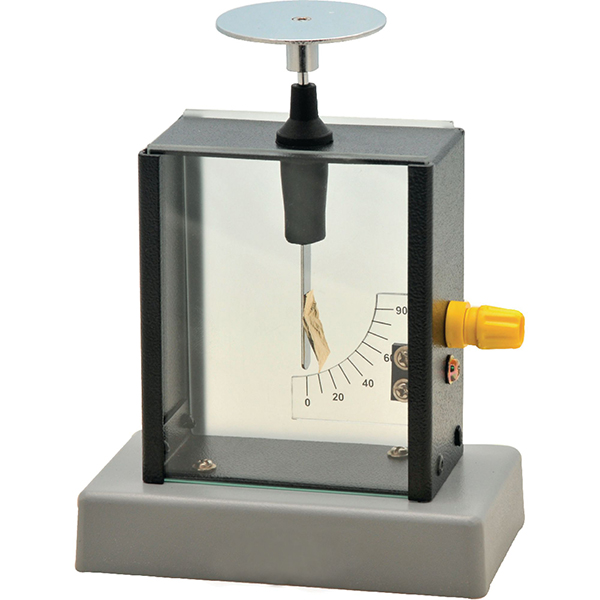
Electroscope with Accessories
Electroscope with Accessories (Product Code: SCL1357/021) detects electric charge: an electrode carrying one or two thin metallic sheets is fixed in a plastic support with two transparent glass sides, and when the electrode is touched with an electrified rod the sheet or sheets swing away from their rest position. It is a basic piece of electrostatics apparatus for school physics rooms, where it forms the core of many an electricity experiment kit for school classes. Jain Scientific Equipments Pvt Ltd (ScienceLab) makes this electroscope in Ambala for school and college laboratories.
Key Details
| Parameter | Detail |
|---|---|
| Type | Leaf-type electroscope |
| Sensing element | Electrode with one or two thin metallic sheets attached |
| Housing | Plastic support with two transparent glass sides |
| Operating principle | Touching the electrode with an electrified rod makes the sheet(s) deviate from the equilibrium position |
| Supplied as | Electroscope with accessories (confirm the accessory list with your quotation) |
| Suitable for | Electrostatics demonstrations and student practicals |
Typical Use
Rub a rod with a suitable cloth and touch it to the electrode: the metallic sheets take on the same charge, repel each other or the fixed electrode, and open out behind the glass windows. From there teachers can show charging by contact and by induction, compare how strongly different rods charge, and identify an unknown charge by watching whether the divergence grows or shrinks when a rod of known charge approaches. Touching the electrode with a finger earths it and lets the sheets fall back.
Electrostatics works best in dry air, so run the demonstration away from open windows on humid days and keep the glass sides and electrode free of dust and fingerprints. Among physics lab instruments in India this is one of the first that students meet when they study charge, and it pairs well with other electrostatic apparatus for later lessons.
Manufacturer
The electroscope is produced by Jain Scientific Equipments Private Limited, which trades as ScienceLab from Ambala, Haryana, and supplies teaching apparatus to schools, colleges and distributors; our company profile has more background. Purchase departments that need vendor registration details can use GSTIN 06AAECJ8618A1ZT and LEI 3358004HRD1JIVXKYX49.
Related Lab Equipment
These items are used with an electroscope in the same electrostatics lessons:
- Rods (wands) to Study Electrification — rods for charging the electrode by friction.
- Ebonite Rod — a classic rod for producing charge of a known sign.
- Electrostatic Sultan — makes the field around a charged conductor visible with paper strips.
- Wilmshurst Electrostatic Machine (for lyceum) — a stronger charge source for advanced demonstrations.
- Electroscope, Gold Leaf — an alternative design for comparison between groups.
Explore further electricity and magnetism apparatus in the Lab Equipment category.
Frequently Asked Questions
Which accessories are included?
The product listing does not itemise the accessories. Please confirm the exact contents with us through the contact page when you request a quotation, so you know whether charging rods need to be ordered separately.
Does it have one leaf or two?
The electrode carries one or two thin metallic sheets; state your preference when you enquire and we will confirm what will be supplied.
Why does the electroscope not respond on some days?
Humid air lets charge leak away quickly. Warm the rod and cloth slightly, work away from damp areas and wipe the housing dry before the lesson.
How do I discharge it between experiments?
Touch the electrode briefly with your finger; this earths it and the sheets return to their equilibrium position.
How should it be cleaned?
Use a soft, dry, lint-free cloth on the glass sides and plastic support. Avoid solvents and never pull on the thin sheets, which are easily bent or torn.
Do you supply larger quantities for schools or distributors?
Yes. We handle orders from single units to bulk institutional supply across India and international markets; send the quantity and destination for a quote.
Request a Quote
For a price on the Electroscope with Accessories, send your requirements or build a list in the enquiry cart and submit it to our sales team.
Last updated: 24 September 2026

Electrostatic Sultan
Electrostatic Sultan (Product Code: SCL1362/022) is a metallic rod on an insulated support with a plume of narrow paper strips at its upper end. When an electrified wand is brought near the rod, the strips lift and spread out, tracing the pattern of electric field lines around the charged conductor. Teachers use this plume-style indicator to turn an abstract idea into something a whole class can see. It is made by Jain Scientific Equipments Pvt Ltd (ScienceLab), Ambala, as one of its physics demonstration items for schools.
Specifications
| Parameter | Detail |
|---|---|
| Conductor | Metallic rod on an insulated support |
| Rod height | 200 mm |
| Indicator | Narrow paper strips at the upper end of the rod |
| Strip length | 100 mm |
| Number of strips | 20 |
| Function | Outlines electric field lines when an electrified wand approaches the rod |
Typical Use
Stand the sultan on a dry bench and bring a charged rod slowly towards the metal conductor. The 20 paper strips pick up like charge, repel one another and fan outwards in radial directions, much like the field-line diagrams in a textbook. Removing the rod lets them droop again, and connecting the sultan to an electrostatic machine keeps the plume standing for longer so students can walk round and study it from every side.
Two sultans charged with opposite signs and placed a short distance apart show the strips reaching towards each other, while like charges make them bend away — a memorable way to compare attraction and repulsion. Because paper absorbs moisture, store the device in a dry cupboard and let it sit in a warm, dry room before a lesson. For schools buying electrostatics apparatus as part of their physics lab equipment in India, it adds a strong, memorable visual to the topic.
Manufacturer
ScienceLab is a brand of Jain Scientific Equipments Private Limited, a private limited company in Ambala, Haryana, that makes physics apparatus for classroom demonstrations and student benches. The ScienceLab profile page introduces the company and its work.
Related Lab Equipment
These products provide the charge source or the next step in the same electrostatics sequence:
- Wilmshurst Electrostatic Machine (for lyceum) — keeps the strips charged for a sustained demonstration.
- Rods (wands) to Study Electrification — the electrified wands used to bring charge near the rod.
- Electroscope with Accessories — detects and compares the charge on the wands.
- Friction Rod, Brass/Ebonite — another rod option for charging by friction.
Find more demonstration apparatus in the Lab Equipment category.
Frequently Asked Questions
What are the main dimensions?
The rod is 200 mm high and carries 20 paper strips, each 100 mm long, at its upper end.
What do I need to operate it?
Only a source of charge, such as a rubbed rod or wand, or an electrostatic machine for a stronger effect. No power supply or batteries are involved.
Why is the support insulated?
An insulated support keeps the charge on the rod and strips instead of letting it drain to the bench, so the strips stay spread long enough to observe.
Can the paper strips be replaced if they tear?
Worn strips can be discussed with our team; tell us what you need through the contact page and we will advise.
What warranty applies?
Warranty terms are confirmed with each quotation rather than on this page. Please ask when you request pricing.
Can you ship it abroad?
Yes. ScienceLab supplies customers in India and international markets; include your country and quantity so we can quote with the right packing and shipping.
Request a Quote
Interested in the Electrostatic Sultan? Reach our sales desk through the contact page, or add the item to the enquiry cart to include it in a wider order.
Last updated: 24 September 2026
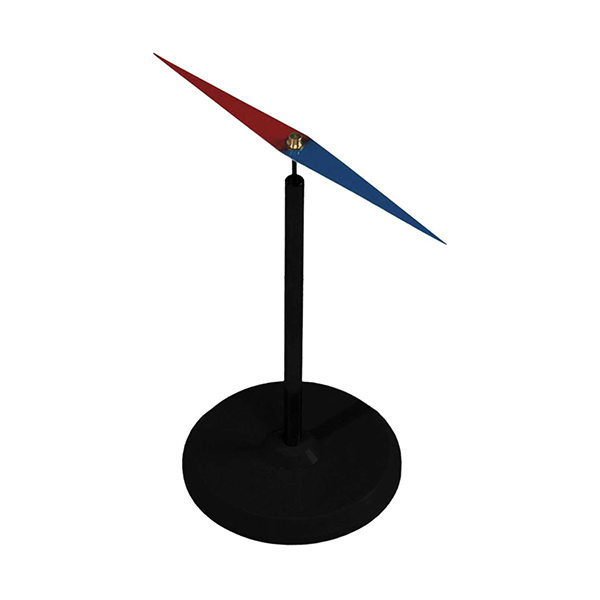
Magnetic Compass Needle
Magnetic Compass Needle (Product Code: SCL1465/023) is a large demonstration needle, 100 mm long, that turns freely on a conical bearing mounted on a centre-axis support. Its north and south poles are painted blue and red respectively, so the whole class can see which way the needle settles. Teachers use it to show the Earth’s magnetic field, the attraction and repulsion of poles and the magnetic effect of an electric current. It is made by Jain Scientific Equipments Pvt Ltd (ScienceLab), Ambala, and fits well into a magnetism experiment kit for Indian schools.
Specifications
| Parameter | Detail |
|---|---|
| Needle length (longitudinal dimension) | 100 mm |
| Mounting | Support for the centre axis, with a conical bearing and pivot needle |
| Pole marking | N pole painted blue, S pole painted red |
Typical Use
Set on the teacher’s bench away from steel objects, the needle swings and comes to rest along the north–south line, opening a lesson on the Earth as a magnet. Bringing one end of a bar magnet close to each painted pole shows that like poles repel and unlike poles attract, and because the needle is long, the movement is easy to follow from the back of the room.
The same needle is ideal for repeating Oersted’s observation: lay a straight wire over it along the north–south direction, switch on a current, and the needle turns across the wire; reversing the current reverses the deflection. It can also be moved around a magnet or an electromagnet to show how the field direction changes from point to point. Keep it away from strong magnets during storage, as prolonged contact can weaken or even reverse its magnetisation.
Manufacturer
Jain Scientific Equipments Private Limited manufactures this needle and the rest of the ScienceLab range from its base in Ambala, Haryana, serving laboratories in schools, colleges and vocational institutes. Background on the company is available on the profile page.
Related Lab Equipment
The following items are commonly used with a demonstration compass needle:
- Bar Magnet (Plastic) — for showing attraction and repulsion between poles.
- Steel Horseshoe Magnet — lets students probe the field between two close poles.
- Oersted’s Law Apparatus — a dedicated set-up for the magnetic effect of current.
- Compass — a small cased compass for individual student use.
- Magnetic Needle, Brass — an alternative needle design for additional stations.
More magnetism and electricity apparatus appears in the Lab Equipment category.
Frequently Asked Questions
How long is the needle?
Its longitudinal dimension is 100 mm, a size chosen for demonstration rather than for pocket use.
Which end points north?
The N pole is painted blue and the S pole red. Point this out to students, because many pocket compasses use a different colour convention.
How is the needle mounted?
It rests on a conical bearing on a pivot needle carried by a support for the centre axis, which keeps friction low so it can respond to weak fields.
Can it be used for Oersted’s experiment?
Yes. Place a current-carrying wire above or below the needle, parallel to it, and the needle deflects; a suitable DC supply and leads are needed and are ordered separately.
How should it be stored?
Store it away from strong magnets and iron tools, and handle it gently when moving it so the conical bearing and pivot are not knocked or bent.
What information should a tender or quotation request include?
List the product code SCL1465/023, quantity, delivery address and any documents your institution needs; we respond to buyers across India and international markets.
Request a Quote
To buy the Magnetic Compass Needle, request a quotation from our team or save it in the enquiry cart while you choose magnets and other apparatus.
Last updated: 24 September 2026