- Physics Lab Equipment
- Chemistry Lab Equipment
- Biology Lab Equipment
- Anatomical Lab Equipment
- Learning
- Educational Lab Equipment
- Magnets
- Agriculture
- Astronomy
- Earth Science
- Geography Lab Equipment
- Safety Lab Coat
- Laboratory
- Meteorological
- Electricity & Magnetism
- Heat
- School Lab Equipment
- Lab Glassware
- Science Lab Equipment
- Tvet Lab Equipment
- Robotics Kits Supplier and Manufacturer for Schools India
- Math Lab Equipment Manufacturers and Exporters in Ambala
- STEM Kits Manufacturers and Supplier India
- Engineering Lab Equipment
- Hospital Lab Equipment
- Water, Sanitation & Hygiene Supplies
- Cold Chain, Solar & Communication Equipment
- Nutrition
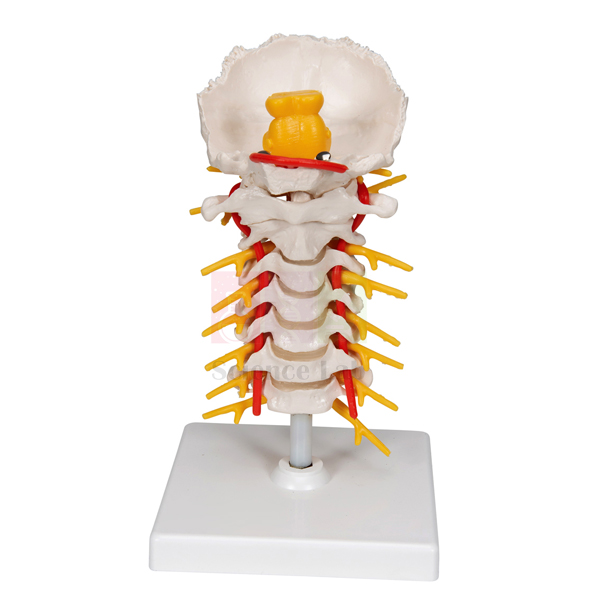
Human Cervical Spinal Column Model
Human Cervical Spinal Column Model (Product Code: SLE/BL/70) is a life-size model of the neck spine used to teach the cervical vertebrae, their discs and the spinal nerve branches in anatomy, physiotherapy and biology classes. It starts at the occipital bone of the skull and continues through all 7 cervical vertebrae, flexibly mounted on a removable stand, which makes it a compact addition to biology teaching aids for the skeleton. It is made by Jain Scientific Equipments Pvt Ltd (ScienceLab), an OEM manufacturer, at its own factory in Ambala, India.
Specifications
| Parameter | Detail |
|---|---|
| Skull portion | Occipital bone |
| Vertebrae | 7 cervical vertebrae with intervertebral discs |
| Neural structures | Segment of spinal cord with nerve branches |
| Height | 19 cm |
| Size | 12 × 12 × 14 cm |
| Scale | Life size |
| Mounting | Flexibly mounted on stand, removable |
| Product code | SLE/BL/70 |
| Manufacturer | Jain Scientific Equipments Pvt Ltd (ScienceLab) — OEM |
| Country of origin | India (made in Ambala, Haryana) |
What Is the Cervical Spinal Column Model Used For?
Starting at the occipital bone, a tutor can show how the skull rests on the top of the cervical spine and then work down the seven vertebrae, discussing the discs between them and the nerve branches that leave the spinal cord to supply the neck, shoulders and arms. The flexible mounting lets the column bend a little, which helps when explaining how a sudden forward-and-back movement in a whiplash injury strains the neck.
Physiotherapy and chiropractic clinicians use the model to show patients where a trapped nerve or worn disc is causing symptoms, while in schools it serves as high school biology lab equipment for lessons on the skeleton and nervous system. Lift it off the stand to pass it round, and support the whole column when doing so rather than holding it by the skull bone.
OEM Manufacturer
ScienceLab is the trading name of Jain Scientific Equipments Private Limited, the OEM (original equipment manufacturer) that produces the Human Cervical Spinal Column Model at its own licensed factory in Saha, Ambala, Haryana, India. Institutions, dealers and importers therefore deal with the maker itself, from the first quotation to any repeat order.
Purchase departments completing vendor registration can use the company’s GSTIN 06AAECJ8618A1ZT and LEI 3358004HRD1JIVXKYX49. The company profile has further background.
Related Bone Models
Pair the cervical column with these models:
- Human Skull with Cervical Spine Model — shows the complete skull seated on the neck vertebrae
- Human Thoracic Spinal Column Model — the next section down, where the ribs attach
- Human Lumbar Spinal Column Model — for comparing the small cervical vertebrae with the large lumbar ones
- Human Vertebral Column Model With Skull — places the neck within the whole spine
The Bone Model category lists all spine, joint and skeleton models.
Frequently Asked Questions
What does the Human Cervical Spinal Column Model include?
The Human Cervical Spinal Column Model includes the occipital bone of the skull, 7 cervical vertebrae with intervertebral discs, a segment of the spinal cord and its nerve branches, covering the neck region from the base of the skull downwards.
How large is the Human Cervical Spinal Column Model?
The Human Cervical Spinal Column Model is life size and 19 cm high, with a listed size of 12 × 12 × 14 cm, so it fits easily on a desk or can be passed around a small tutorial group.
Is the Human Cervical Spinal Column Model flexible?
Yes. The Human Cervical Spinal Column Model is flexibly mounted on its stand, so the column can be moved slightly to illustrate neck bending and the kind of strain involved in a whiplash injury.
Can the Human Cervical Spinal Column Model be taken off the stand?
Yes, the Human Cervical Spinal Column Model is removable from its stand. When passing it round a class, support the whole column with both hands rather than holding it by the occipital bone alone.
How should the Human Cervical Spinal Column Model be cleaned?
Clean the Human Cervical Spinal Column Model with a soft cloth, lightly dampened if necessary. Avoid chemical cleaners and never immerse the model in water, because the discs and nerve branches are small parts.
Who manufactures the Human Cervical Spinal Column Model?
Jain Scientific Equipments Pvt Ltd (ScienceLab) manufactures the Human Cervical Spinal Column Model as the OEM at its own factory at Saha, Ambala, Haryana, India, and quotes for it directly to schools, colleges, dealers and importers.
What should a tender or purchase request for the Human Cervical Spinal Column Model include?
A request for the Human Cervical Spinal Column Model should give the code SLE/BL/70, the quantity, the delivery address in India or abroad and your vendor forms. Our GSTIN and LEI appear in the manufacturer section above.
Request a Quote
Put the Human Cervical Spinal Column Model in the enquiry cart, or share your requirement through the contact page, and the manufacturer will prepare a quotation for you directly.
Last updated: 24 September 2026
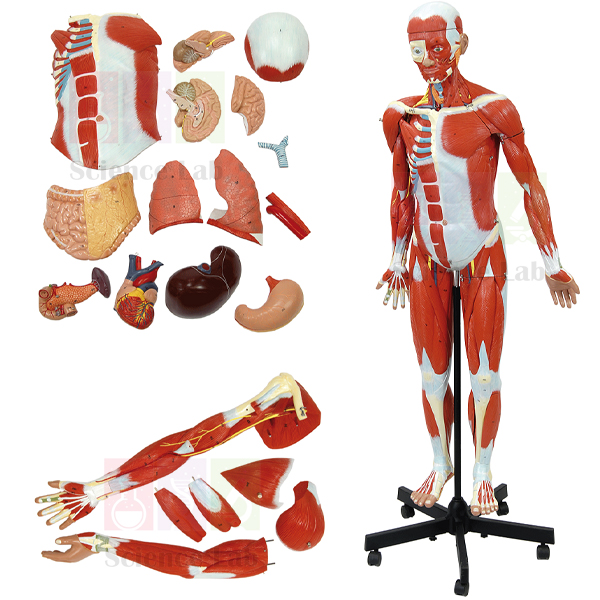
Human Muscular Figure Model
The Human Muscular Figure Model (Product Code: SLE/BL/71) is a 32-part, 140 cm tall figure that shows the musculature of the body together with removable internal organs. A 6-part muscular arm and an 8-part muscular leg detach for close study, the skullcap lifts off to reveal a bisected brain, and the heart, lungs and main abdominal organs can all be taken out. Every structure is numbered and referenced on the accompanying key card. Built by Jain Scientific Equipments Pvt Ltd (ScienceLab), one of the human anatomical models manufacturers in India based in Ambala, it is rod-mounted on a base with casters for use in medical, nursing, physiotherapy and sports science teaching.
Specifications
| Parameter | Detail |
|---|---|
| Type | Full muscular figure with removable organs |
| Total parts | 32 |
| Arm | Removable 6-part muscular arm |
| Leg | Removable 8-part muscular leg |
| Head and brain | Removable skullcap; brain bisected along the longitudinal fissure, showing internal structures and vasculature |
| Heart | Removable 2-part heart representing the atria, ventricles, valves and sections of the heart wall |
| Lungs | Bisected and removable, showing the bronchial tree and vascular system |
| Abdominal organs (removable) | Liver with gallbladder, 2-part stomach, duodenum with pancreas and spleen, large intestine |
| Identification | Structures numbered and referenced on the accompanying key card |
| Mounting | Rod-mounted on base with casters |
| Model height | 140 cm |
| Total size | 150 x 50 x 40 cm |
| Weight | Approximately 12 kg |
Typical Use
A figure of this size lets a whole class study the muscular system in its true proportions. Tutors usually begin with the surface muscles of the trunk and limbs, then detach the 6-part arm and the 8-part leg so students can examine the limb muscles piece by piece. With the chest and abdomen opened up, the removable heart, lungs, liver, stomach and intestine let the same model double as a lesson on the organs of the torso — the bisected brain and lungs show internal structure, not just outer surfaces.
Medical and nursing colleges use it for anatomy practicals, physiotherapy and sports science departments for muscle function and injury discussions, and fine-arts faculties for figure study. It suits institutions building a human biology model set in India around one central figure. The casters make it easy to wheel between lecture hall and lab; make sure the figure is standing steady before removing parts, return each piece to its matching position, and cover it when not in use.
Manufacturer
Jain Scientific Equipments Private Limited, known to customers as ScienceLab, manufactures this full-size muscular figure in Ambala, Haryana, alongside smaller anatomy models and laboratory apparatus. The company profile explains more about the organisation.
Related Laboratory Equipment
Items that complement a full muscular figure in anatomy teaching:
- Human Sexless Muscular Figure — an alternative muscular figure for comparison when equipping several rooms
- Miniature Human Muscular Figure — a desk-sized figure for individual student revision
- Human Muscular Arm Model — more detail on the muscles of the upper limb
- Human Muscular and Ligamentous Skeleton — shows how muscles and ligaments attach to the skeleton
- Skeletal Muscle Fiber Model — explains muscle structure at the level of the fibre
Browse more figures in the Human Models category.
Frequently Asked Questions
How many parts does the figure have?
32 parts in total, including a 6-part arm, an 8-part leg, a 2-part heart and a 2-part stomach.
How tall is it and how much space does it need?
The model is 140 cm tall; the total size is 150 x 50 x 40 cm and it weighs approximately 12 kg.
Which internal organs can be removed?
The 2-part heart, the bisected lungs, the liver with gallbladder, the 2-part stomach, the duodenum with pancreas and spleen, and the large intestine. The skullcap also lifts off to show the bisected brain.
Can it be moved between rooms?
Yes. It is rod-mounted on a base with casters, so it can be wheeled between the lecture hall and the lab.
How are the structures identified?
Anatomical structures are numbered on the model and referenced on the accompanying key card.
What are the packed dimensions for shipping?
Packed size and gross weight depend on the packing method chosen for the destination. Contact us and we will provide them with the quotation.
Do you export this figure?
Yes. We supply colleges, hospitals' teaching departments and distributors in India and international markets; warranty terms are set out on the quotation.
Request a Quote
Request a formal quotation for the Human Muscular Figure Model through our contact page, or add it to the enquiry cart with any supporting muscle and skeleton models.
Last updated: 24 September 2026
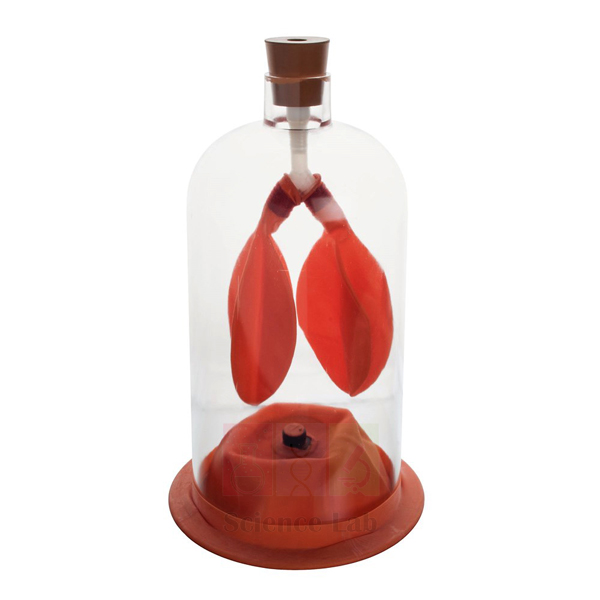
Human Lung Model in Bell Jar
The Human Lung Model in Bell Jar (Product Code: SLE/BL/72) is a simple working model of the breathing mechanism. Two balloons attached to a Y-tube act as the lungs, the bell jar with its open top represents the chest cavity, and a stout rubber sheet across the bottom acts as the diaphragm. Pull the rubber sheet down and the balloons inflate; let it go and they deflate. Made by Jain Scientific Equipments Pvt Ltd (ScienceLab), Ambala, it serves as a direct, hands-on biology experiment kit for students learning how breathing works, and is used from middle school through to nursing and physiology courses.
Specifications
| Parameter | Detail |
|---|---|
| Type | Bell jar breathing mechanism model |
| Lungs | Two balloons attached to a Y-tube |
| Chest cavity | Bell jar with open top |
| Diaphragm | Stout rubber sheet |
| Principle shown | Pulling the diaphragm down lowers the pressure inside the chamber, so the lungs expand and take in air; releasing it lets the lungs deflate |
| Teaching purpose | Shows how the lungs are filled and emptied by the contraction and relaxation of the diaphragm muscle |
Typical Use
This is a demonstration students can operate themselves. When the rubber diaphragm is pulled downward, the space inside the bell jar increases and the pressure there falls below atmospheric pressure, so air rushes in through the Y-tube and the balloon lungs expand — just as the lungs fill when the diaphragm contracts and flattens. When the sheet is released, it returns to its resting position and the balloons empty, modelling exhalation as the diaphragm relaxes. Asking students to describe the pressure change at each step links the biology lesson to basic gas laws from physics.
The model is a natural fit for health education programmes in schools in India that cover breathing, exercise and the effects of smoking, and for first-year nursing physiology. Pull the diaphragm gently and evenly rather than snapping it, check that the Y-tube and balloons are seated firmly so air does not leak, and store the model away from heat and sunlight so the rubber parts last longer.
Manufacturer
This breathing model is made in Ambala, Haryana, by Jain Scientific Equipments Private Limited, which trades as ScienceLab and supplies both simple demonstration apparatus and detailed anatomical models to education. Our company profile has more background.
Related Laboratory Equipment
Equipment for a complete breathing and respiration practical alongside the bell jar model:
- Lung Demonstration Model — another demonstration of lung function for comparison or a second bench
- Lung Capacity Gauge — lets students measure their own lung capacity after seeing the mechanism
- Lung Volume Bags — for collecting and comparing breath volumes in class
- Human Respiratory System Model, 2-parts — shows the real anatomy of the airway and lungs that the balloons represent
- Breathing Fitness Health Lab — activities connecting breathing with fitness and health
For anatomical models, visit our Human Models category.
Frequently Asked Questions
How does the bell jar lung model work?
Pulling the rubber diaphragm down lowers the pressure inside the jar, so the balloon lungs fill with air; releasing it lets them deflate.
What represents each part of the body?
The two balloons represent the lungs, the Y-tube the airways, the bell jar the chest cavity, and the rubber sheet the diaphragm.
Can students operate it themselves?
Yes. It is a simple hands-on model, and operating the diaphragm themselves helps students remember the sequence of inhalation and exhalation.
Is the bell jar made of glass or plastic?
The material of the jar is not specified in our current product details. Please contact us to confirm before ordering, especially for younger classes.
Can the balloons or rubber sheet be replaced?
Rubber parts naturally wear with repeated use. Ask us about replacement balloons and diaphragm sheets when you order.
Do you supply this model in quantity?
Yes. We quote for class sets, school chains and distributors in India and international markets, with warranty terms stated on the quotation.
Request a Quote
To price the Human Lung Model in Bell Jar for your school or college, use our contact page or add it to the enquiry cart together with other respiration equipment.
Last updated: 24 September 2026
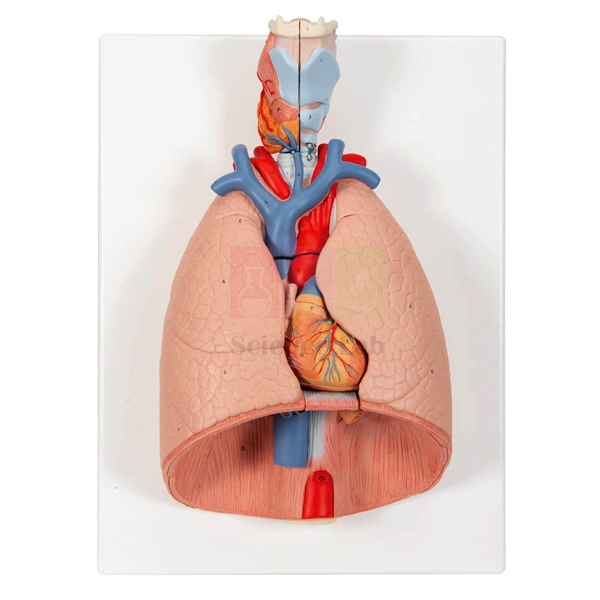
Human Lungs with Heart and Larynx Model
Human Lungs with Heart and Larynx Model (Product Code: SLE/BL/73) is a dissectible anatomy model used to teach the respiratory tract and heart–lung circulation in school, nursing and college classes. Schools assembling a human biology model set in India choose it because it combines a removable 2-part larynx, 2-part heart and 2-part lungs with the trachea, great vessels, diaphragm and oesophagus, numbered against a key card on a base. It is made by Jain Scientific Equipments Pvt Ltd (ScienceLab), an OEM manufacturer, at its own factory in Ambala, India.
Key Details
| Parameter | Detail |
|---|---|
| Type | Dissectible model of lungs, heart and larynx |
| Removable parts (as listed) | 2-part larynx, trachea with bronchial tree, vena cava, aorta, 2-part heart, subclavian artery and vein, pulmonary artery, 2-part lungs, diaphragm, oesophagus |
| Finish | Appropriately coloured |
| Identification | Numbered, with key card |
| Mounting | Mounted on a base |
| Product code | SLE/BL/73 |
| Manufacturer | Jain Scientific Equipments Pvt Ltd (ScienceLab) — OEM |
| Country of origin | India (made in Ambala, Haryana) |
What Is the Lungs, Heart and Larynx Model Used For?
A lesson on respiration can start at the larynx, where opening the two halves reveals the internal cavity, then move down the trachea into the branching bronchial tree and out into each lung. Lifting away the lung parts exposes the heart, and separating the heart halves lets the teacher show how deoxygenated blood returning through the vena cava is sent to the lungs along the pulmonary artery, while oxygenated blood leaves through the aorta. With the diaphragm at the base and the oesophagus running behind the airway, students also see why swallowing and breathing share the same space in the neck and chest.
Because it combines several organ systems, the model works well as the centrepiece of a human body model kit for India's secondary schools, nursing institutes and physiotherapy courses. Hand out the numbered key card and ask groups to reassemble the parts in order after each session; this reinforces anatomy and ensures nothing goes missing. Keep the removable parts together in a closed cabinet and wipe them with a soft, dry cloth only.
OEM Manufacturer
Jain Scientific Equipments Private Limited, which trades as ScienceLab, is the OEM (original equipment manufacturer) of this lungs, heart and larynx model. It is made and assembled at the company's own licensed factory at Saha, Ambala, Haryana, India, rather than bought in from a trader, and goes factory-direct to schools, colleges, nursing institutes, dealers and importers. If a removable part is lost or damaged, ask us about a replacement from the manufacturer. More background is on our company profile.
Related Human Models
Add these models to teach the chest organs in more depth:
- Human Thoracic Organs Model — a similar set of chest organs with removable front lung halves
- Human Segmented Lungs Model — shows the internal segments of the lungs
- Human Heart Model — a larger view of the heart chambers and valves
- Human Larynx, Trachea, and Bronchi Model — focuses on the upper and middle airway
- Pathology of the Human Lung Model — for comparing healthy lungs with common diseases
This model is listed in our Human Models category with other anatomy models.
Frequently Asked Questions
Which parts of the Human Lungs with Heart and Larynx Model can be removed?
The Human Lungs with Heart and Larynx Model lists its larynx, heart and lungs as 2-part sections, alongside the trachea with bronchial tree, vena cava, aorta, subclavian vessels, pulmonary artery, diaphragm and oesophagus, all numbered on the key card.
Why does the lungs, heart and larynx model include the oesophagus and diaphragm?
The lungs, heart and larynx model includes the oesophagus and diaphragm to show real relationships in the chest: the oesophagus runs behind the trachea, and the diaphragm forms the floor on which the lungs and heart rest during breathing.
Is a key card provided with the model?
Yes. Every structure on the Human Lungs with Heart and Larynx Model is appropriately coloured and numbered, and a key card identifies each number so students can name the parts during practicals and revision.
What are the size and material of the model?
The size and material of the Human Lungs with Heart and Larynx Model are not stated in its listing. Ask us through the contact page and we will confirm the dimensions and material in your quotation.
Who manufactures the Human Lungs with Heart and Larynx Model?
Jain Scientific Equipments Private Limited (ScienceLab) is the OEM that manufactures the Human Lungs with Heart and Larynx Model at its own factory at Saha, Ambala, Haryana, India, supplying schools, colleges, dealers and importers directly.
How does it compare with the Human Thoracic Organs Model?
Both the Human Lungs with Heart and Larynx Model and the Human Thoracic Organs Model show the heart, lungs and airway; the thoracic model is built around removable front lung halves. Tell us your syllabus focus and we will suggest the better fit.
Can colleges or distributors order several units?
Yes. The Human Lungs with Heart and Larynx Model can be quoted for colleges, schools and distributors in India and international markets; send product code SLE/BL/73, the quantity and the delivery location, and the quotation comes directly from the manufacturer.
Request a Quote
Quotations for the Human Lungs with Heart and Larynx Model come straight from the manufacturer. Send your requirement through our contact page, or add the model to the enquiry cart.
Last updated: 24 September 2026
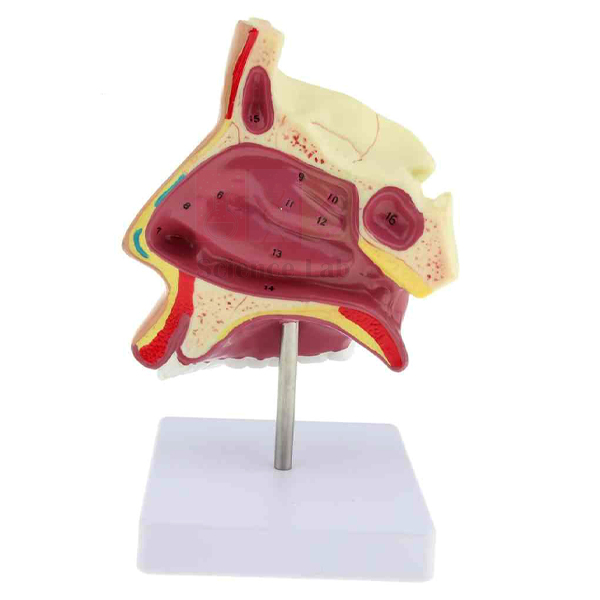
Human Nose Model on Stand
The Human Nose Model on Stand (Product Code: SLE/BL/74) is an enlarged, colour-finished model of the structure of the human nose, held on a stand and numbered with a key card. Presenting the nose on a stand makes it well suited to front-of-class demonstration, anatomy room displays and ENT teaching corners where the model is viewed as much as it is handled. It is manufactured by Jain Scientific Equipments Pvt Ltd (ScienceLab), Ambala, and is ordered by colleges and schools that need a school lab equipment supplier in India for sense organ and airway models.
Key Details
| Parameter | Detail |
|---|---|
| Type | Enlarged model of the human nose |
| Shows | Structure of the nose |
| Mounting | Mounted on a stand |
| Finish | Appropriately coloured |
| Identification | Numbered, with key card |
| Suitable for | ENT training, nursing anatomy, sense organ lessons and anatomy displays |
Typical Use
In ENT and nursing teaching, the nose is the entry point to the respiratory tract and the site of many everyday complaints, from blocked passages to nosebleeds. Tutors use this model to walk trainees through the structure of the nose in order, pointing to each numbered feature and checking recall with the key card. Because the stand presents the model upright, it can be positioned on the lecturer's desk and turned to face the class while the lesson moves from external shape to the passages that carry air inward.
In school classes it supports the chapter on the sense organs, where students learn how smell is detected and how the nose prepares air before it reaches the lungs. Between sessions it can stay on display in a glass-fronted cabinet; dust it regularly, keep the key card filed with it, and avoid placing it where the stand could be knocked from a shelf edge.
Manufacturer
ScienceLab models such as this one are manufactured by Jain Scientific Equipments Private Limited in Ambala, Haryana. For vendor registration, buyers can note the company's Corporate Identity Number U29309HR2020PTC087597 and its Factory Licence AMB-ONLINE-CHD-J-414, which covers the production premises at 449, HSIIDC Industrial Area, Saha, Ambala. More about the company is on our company profile.
Related Human Models
Models often chosen with the Human Nose Model on Stand for ENT and sense organ teaching:
- Human Nose Model on Base — the base-mounted version for close desk study by small groups
- Human Nasal Cavity Model — continues inward to the nasal cavity
- Anatomical Human Nasal Cavity Model — a further option for studying the internal nasal passages
- Human Tongue Model — pairs smell with taste in the chemical senses lesson
- Human Ear Model, 5 Parts — completes an ear, nose and throat teaching set
All our anatomy models are listed in the Human Models range.
Frequently Asked Questions
Why choose the stand-mounted version?
The stand presents the model upright, which suits demonstrations to a whole class and display in anatomy rooms. If the model will mainly be handled on a desk by small groups, the base-mounted version may suit better.
Is a key card included?
Yes. The model is numbered and comes with a key card for identifying its structures.
What scale is the model?
It is an enlarged model. The exact enlargement and dimensions are not in our current listing, so please contact us for them.
Is it suitable for ENT and nursing courses?
Yes. It is used to teach the structure of the nose as part of ENT, nursing and paramedical anatomy, as well as school sense organ lessons.
Can you provide registration details for our tender or vendor file?
Yes. Our CIN and factory licence number are given above; other registration details can be requested through the contact page.
Do you ship to institutions abroad?
Yes. ScienceLab supplies India and international markets. Warranty and delivery terms are confirmed on the quotation.
Request a Quote
Send your enquiry for the Human Nose Model on Stand through our contact page, or add it to the enquiry cart with other ENT models to receive one combined quotation.
Last updated: 24 September 2026
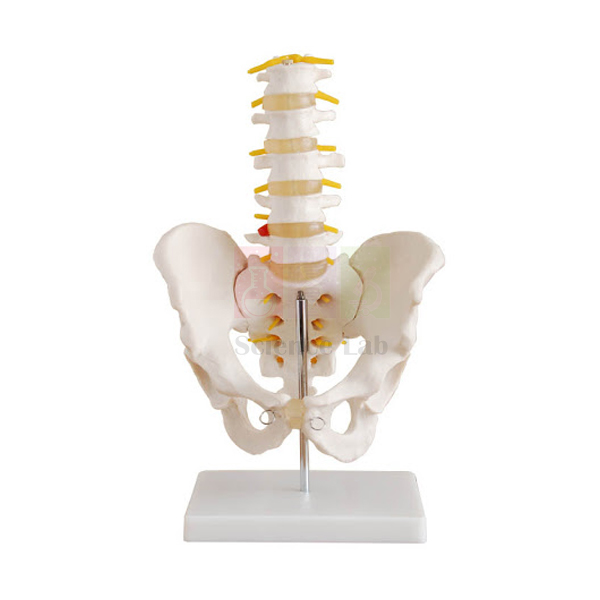
Human Pelvis Structural Model With 5 Pcs Lumbar Vertebrae
Human Pelvis Structural Model With 5 Pcs Lumbar Vertebrae (Product Code: SLE/BL/75) is an anatomical bone model of the lower spine joined to the pelvis, used to teach the lumbosacral region as one functional unit in anatomy, physiotherapy and sports science courses. Its five life-size lumbar vertebrae are shown with normal intervertebral discs and the spinal cord, sitting on the pelvis as they do in the body. It is made by Jain Scientific Equipments Pvt Ltd (ScienceLab), an OEM manufacturer, at its own factory in Ambala, India.
Specifications
| Parameter | Detail |
|---|---|
| Lumbar vertebrae | 5 pieces, life size |
| Intervertebral discs | Normal (healthy) discs shown |
| Neural structure | Spinal cord |
| Pelvis | Included, joined to the lumbar spine |
| Product code | SLE/BL/75 |
| Manufacturer | Jain Scientific Equipments Pvt Ltd (ScienceLab) — OEM |
| Country of origin | India (made in Ambala, Haryana) |
What Is the Pelvis and Lumbar Vertebrae Model Used For?
Many back and hip complaints involve the junction between the lumbar spine and the pelvis, and this model lets a tutor show that connection directly. Students can follow the curve of the lower back into the pelvis, see how the discs separate each vertebra, and understand why tilting the pelvis changes the posture of the whole lower spine. It is especially helpful when teaching core-stability exercises, lifting technique and ergonomic sitting.
Colleges setting up biology lab equipment in India for human anatomy often choose a combined model like this instead of separate spine and pelvis pieces, because it keeps the structures in their correct relationship. Handle it by the pelvis rather than the vertebrae, and store it upright on a stable surface.
OEM Manufacturer
The model is made by Jain Scientific Equipments Private Limited — the company behind the ScienceLab name — as OEM (original equipment manufacturer) at its own licensed factory at Saha, Ambala, Haryana, India. Anatomy departments, physiotherapy colleges, dealers and importers order it straight from the factory rather than through a trader.
Questions about the pelvis type, a stand or a matching spine model are answered by the manufacturer itself, and repeat orders for further labs come from the same source. See the company profile for more.
Related Bone Models
Models that build on the spine-and-pelvis lesson:
- Human Vertebral Model With Pelvis & Femur Heads — extends the view to include both hip joints
- Human Lumbar Spinal Column Model — a lumbar column model for studying the vertebrae in more detail
- Human Lumbar Set Model — lumbar vertebrae for close individual study
- Human Adult Female Pelvis Structural Model — a stand-alone female pelvis for comparing pelvic shape
- Human Adult Male Pelvis Structural Model — the male pelvis for the same comparison
Browse more spine and pelvis models in the Bone Model category.
Frequently Asked Questions
How many vertebrae does the Human Pelvis Structural Model With 5 Pcs Lumbar Vertebrae include?
The Human Pelvis Structural Model With 5 Pcs Lumbar Vertebrae includes five lumbar vertebrae at life size, separated by normal intervertebral discs and joined to the pelvis, so students can study the lower spine and hip girdle together.
Does the Human Pelvis Structural Model With 5 Pcs Lumbar Vertebrae show the spinal cord?
Yes. The Human Pelvis Structural Model With 5 Pcs Lumbar Vertebrae shows the spinal cord along with the five lumbar vertebrae, normal intervertebral discs and pelvis, which helps tutors relate the nervous system to the bones of the lower back.
Is the pelvis on this lumbar vertebrae model male or female?
The description of the Human Pelvis Structural Model With 5 Pcs Lumbar Vertebrae does not specify a male or female pelvis. If your course needs a particular pelvis type, ask through our contact page before ordering so the manufacturer can confirm.
Does the Human Pelvis Structural Model With 5 Pcs Lumbar Vertebrae include femur heads or a stand?
Neither femur heads nor a stand is listed for the Human Pelvis Structural Model With 5 Pcs Lumbar Vertebrae. For a version with femur heads, see the Human Vertebral Model With Pelvis & Femur Heads, or contact us to confirm the current configuration.
How should the Human Pelvis Structural Model With 5 Pcs Lumbar Vertebrae be cleaned?
Wipe the Human Pelvis Structural Model With 5 Pcs Lumbar Vertebrae gently with a soft, slightly damp cloth, paying attention to dust between the vertebrae, and let it dry fully. Handle it by the pelvis rather than the vertebrae when moving it.
Who manufactures the Human Pelvis Structural Model With 5 Pcs Lumbar Vertebrae?
The Human Pelvis Structural Model With 5 Pcs Lumbar Vertebrae is manufactured by Jain Scientific Equipments Pvt Ltd (ScienceLab), the OEM, at its own factory at Saha, Ambala, Haryana, India, and sold factory-direct to institutions, dealers and importers.
Can this pelvis and lumbar vertebrae model be ordered in quantity?
Yes. ScienceLab quotes the Human Pelvis Structural Model With 5 Pcs Lumbar Vertebrae for single pieces and bulk orders for colleges and distributors in India and international markets; include product code SLE/BL/75 and the quantity in your enquiry.
Request a Quote
Quotations come direct from the manufacturer: use the contact page or add this spine-and-pelvis model to the enquiry cart with any other models you require.
Last updated: 24 September 2026
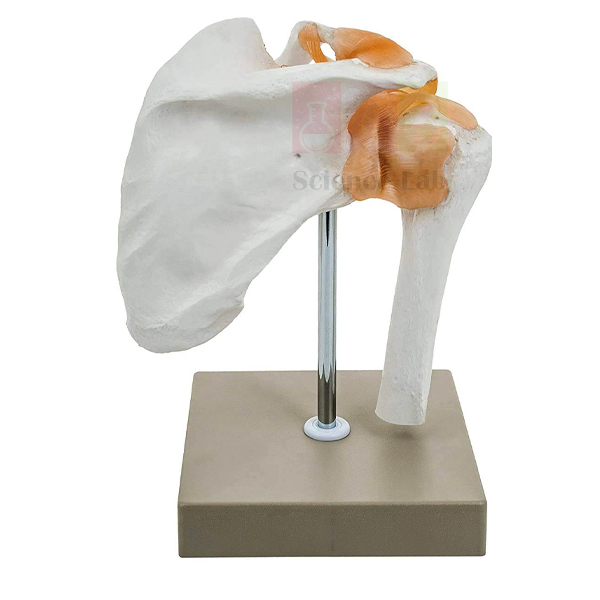
Human Shoulder Joint Model
Human Shoulder Joint Model (Product Code: SLE/BL/76) is a life-size, movable model of the shoulder used to demonstrate abduction, adduction, anteversion, retroversion and internal/external rotation in biology, nursing and physiotherapy teaching. A flexible artificial ligament holds the joint together as it moves, making it a practical biology teaching aid for motion lessons; it stands on a stand at 16 × 12.5 × 20 cm. It is made by Jain Scientific Equipments Pvt Ltd (ScienceLab), an OEM manufacturer, at its own factory in Ambala, India.
Specifications
| Parameter | Detail |
|---|---|
| Type | Movable shoulder joint model for demonstrating movement |
| Movements illustrated | Abduction, adduction, anteversion, retroversion, internal and external rotation |
| Scale | Life size |
| Size | 16 × 12.5 × 20 cm |
| Mounting | On stand |
| Included feature | Flexible artificial ligament |
| Product code | SLE/BL/76 |
| Manufacturer | Jain Scientific Equipments Pvt Ltd (ScienceLab) — OEM |
| Country of origin | India (made in Ambala, Haryana) |
What Is the Human Shoulder Joint Model Used For?
The model is built for movement lessons. A teacher can hold the stand steady, move the joint slowly into each position and ask students to name the movement and the plane in which it happens — lifting away from the body for abduction, back towards it for adduction, forwards for anteversion, backwards for retroversion, and turning inwards or outwards for rotation. Physiotherapy and nursing students use the same sequence to relate range-of-motion testing and patient positioning to what is happening at the joint itself.
Because the joint is held by a flexible ligament rather than a rigid pin, demonstrate each movement gently and return the joint to its resting position after use, so the ligament is not left under strain on the shelf. Schools building up their school biology lab equipment in India often pair this functional shoulder with a labelled joint model, so one explains structure and the other explains motion.
OEM Manufacturer
The Human Shoulder Joint Model is an original ScienceLab product: Jain Scientific Equipments Private Limited, the company behind the ScienceLab name, is its OEM (original equipment manufacturer) and builds it at its own licensed factory at Saha, Ambala, Haryana, India.
Physiotherapy and nursing colleges, dealers and importers therefore deal with the maker for quotations, and can ask us directly about spare parts if the ligament is ever damaged. Background on the company is on the company profile page.
Related Bone Models
Models often used alongside this one in upper-limb and joint lessons:
- Shoulder Joint Model — a numbered, key-labelled shoulder for naming the individual structures
- Shoulder Girdle with Musculature Model — adds the muscles that actually produce these shoulder movements
- Human Elbow Joint Model — continues the upper-limb lesson at the next joint down the arm
- Human Joint Models — joint replicas for comparing different joint types
- Human Skeleton, Rod-Supported — a full skeleton for locating the shoulder within the whole body
See the complete Bone Model range for further joint, spine, pelvis and skeleton models.
Frequently Asked Questions
Which movements can the Human Shoulder Joint Model demonstrate?
The Human Shoulder Joint Model is designed to illustrate abduction, adduction, anteversion, retroversion, and internal and external rotation, so the full set of listed shoulder movements can be shown on one life-size joint during a lesson.
How large is the Human Shoulder Joint Model?
The Human Shoulder Joint Model is life size and measures 16 × 12.5 × 20 cm on its stand, compact enough for a teacher's desk or for passing around a small group of students.
What does the flexible artificial ligament do on the Human Shoulder Joint Model?
On the Human Shoulder Joint Model, the flexible artificial ligament keeps the joint connected while it moves through its range. Move the joint gently and avoid forcing it past a natural position, which would stretch the ligament unnecessarily.
Does the Human Shoulder Joint Model come with a numbered key?
A key is not listed for the Human Shoulder Joint Model (SLE/BL/76). For numbered identification of bones and ligaments, see the labelled Shoulder Joint Model, or contact us to confirm what ships with this model.
How should the Human Shoulder Joint Model be cleaned?
Wipe the Human Shoulder Joint Model with a soft, slightly damp cloth and let it dry before storage. Avoid solvents and abrasive cleaners, and return the joint to its resting position so the ligament is not left under strain.
Who manufactures the Human Shoulder Joint Model?
The Human Shoulder Joint Model is manufactured by Jain Scientific Equipments Pvt Ltd (ScienceLab), the OEM, at its own factory at Saha, Ambala, Haryana, India, and is supplied factory-direct to schools, colleges, dealers and importers.
What should an institutional enquiry for the Human Shoulder Joint Model include?
An enquiry for the Human Shoulder Joint Model should state the product code SLE/BL/76, the number of models needed and whether delivery is within India or to international markets. The manufacturer replies with pricing and dispatch details.
Request a Quote
To price the Human Shoulder Joint Model for your department with a quotation straight from the manufacturer, contact us or add it to the enquiry cart with any other anatomy models you need.
Last updated: 24 September 2026
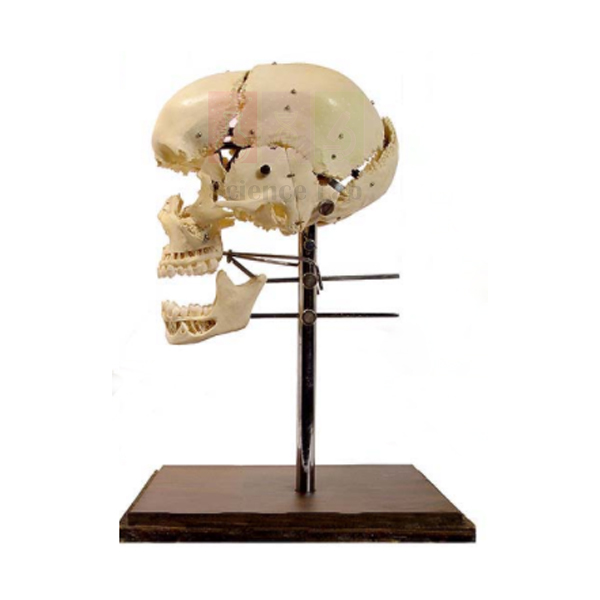
Human Skull Bones Model
Human Skull Bones Model (Product Code: SLE/BL/77) is a highly detailed anatomical skull, disarticulated into many sections, used to teach cranial bones, sinuses and skull structure in biology, anatomy and medical education. Its base is sectioned sagittally to display the sinuses, the calvarium is cut horizontally and the lower jaw is hinged, making it a thorough biology teaching aid for advanced classes. It is made by Jain Scientific Equipments Pvt Ltd (ScienceLab), an OEM manufacturer, at its own factory in Ambala, India.
Key Details
| Parameter | Detail |
|---|---|
| Model type | Human skull, disarticulated into many sections |
| Level of detail | Highly detailed |
| Skull base | Sectioned sagittally, displaying all 3 sinuses |
| Calvarium | Sectioned horizontally |
| Lower jaw | Hinged |
| Product code | SLE/BL/77 |
| Manufacturer | Jain Scientific Equipments Pvt Ltd (ScienceLab) — OEM |
| Country of origin | India (made in Ambala, Haryana) |
What Is a Disarticulated Skull Model Used For?
Teachers use the model to show how the skull is built from separate bones and how they fit together, then take it apart so students can study each section closely. The sagittal cut through the base exposes the sinuses, while the horizontal cut through the calvarium lets students look into the cranial cavity.
The hinged lower jaw demonstrates the opening and closing movement used in chewing and speech. As a human biology model for senior school, nursing, dental and medical classes, it should be handled over a padded tray, reassembled after each lesson and stored covered.
What to Specify When Ordering
- The number of models needed for your anatomy or biology classes.
- Whether a storage case should be quoted with the model.
- Whether a simpler three-part skull would suit junior classes alongside this detailed model.
OEM Manufacturer
ScienceLab is the trading name of Jain Scientific Equipments Private Limited, an anatomical models manufacturer and the OEM of this skull model. The model is made at the company's own licensed factory at Saha, Ambala, Haryana, India, and supplied factory-direct to medical and nursing colleges, universities, schools, dealers and importers. Replacement sections or repeat orders can be discussed directly with the maker — ask us. See the ScienceLab profile.
Related Skulls
Other skull models and anatomy items that support the same lessons.
- Human Skull Model, Plastic — an economical life-size skull that opens into 3 parts.
- Human Skull Model, Life Size Colored — a skull with bones painted in different colours.
- Human Skull Model, Fetal Child — to compare fetal and adult skull bones.
- Human Skull Storage Case, Black Plastic — a storage case for skull models; confirm the fit with us.
- Human Skeleton Model, Disarticulated — to place the skull in the context of the whole skeleton.
See all skull models in the Skulls category.
Frequently Asked Questions
What does the Human Skull Bones Model show?
The Human Skull Bones Model is a highly detailed skull disarticulated into many sections. Its base is sectioned sagittally, displaying all 3 sinuses, the calvarium is cut horizontally, and the lower jaw is hinged to demonstrate movement.
How is the skull model taken apart?
The Human Skull Bones Model separates into many sections: the calvarium comes away along its horizontal cut, the base is divided along a sagittal cut and the jaw is hinged. Lay the sections out on a tray in order so students can reassemble the skull easily.
Who is the Human Skull Bones Model suitable for?
The Human Skull Bones Model suits senior school biology, nursing, physiotherapy, dental and medical anatomy classes, where students need to study individual skull sections and the sinuses rather than only the outside of the skull.
Who manufactures the Human Skull Bones Model?
Jain Scientific Equipments Pvt Ltd (ScienceLab) manufactures the Human Skull Bones Model as the OEM at its own licensed factory in Saha, Ambala, Haryana, India. Colleges, schools, dealers and importers buy direct from the maker and can ask about replacement sections.
What material and size is the model?
The current listing for the Human Skull Bones Model does not state its material or dimensions. Please ask through the contact page before ordering, and we will confirm the details you need for your tender or purchase file.
Can I order several skull models for a college anatomy lab?
Yes. The Human Skull Bones Model can be ordered in the quantity your anatomy or biology lab needs, for delivery across India and to international markets. Send the number of models and the delivery location for a quotation direct from the manufacturer.
Request a Quote
To request a quotation for the Human Skull Bones Model, use the contact page or add it to the enquiry cart together with any other anatomy models. ScienceLab quotes directly as the manufacturer.
Last updated: 24 September 2026