- Physics Lab Equipment
- Chemistry Lab Equipment
- Biology Lab Equipment
- Anatomical Lab Equipment
- Learning
- Educational Lab Equipment
- Magnets
- Agriculture
- Astronomy
- Earth Science
- Geography Lab Equipment
- Safety Lab Coat
- Laboratory
- Meteorological
- Electricity & Magnetism
- Heat
- School Lab Equipment
- Lab Glassware
- Science Lab Equipment
- Tvet Lab Equipment
- Robotics Kits Supplier and Manufacturer for Schools India
- Math Lab Equipment Manufacturers and Exporters in Ambala
- STEM Kits Manufacturers and Supplier India
- Engineering Lab Equipment
- Hospital Lab Equipment
- Water, Sanitation & Hygiene Supplies
- Cold Chain, Solar & Communication Equipment
- Nutrition
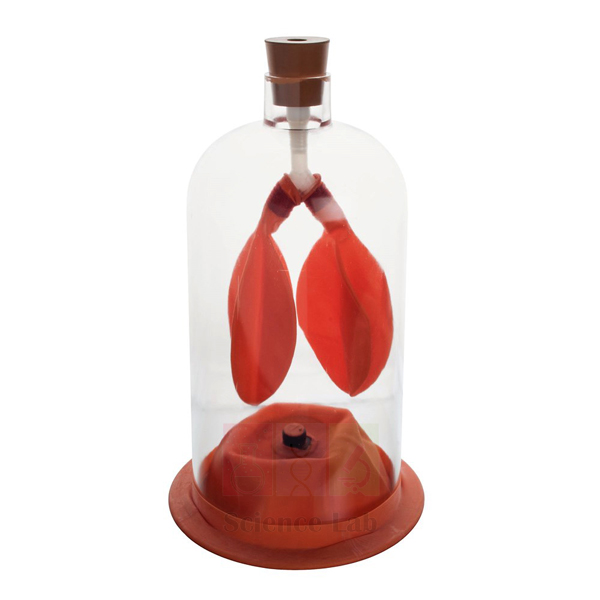
Human Lung Model in Bell Jar
The Human Lung Model in Bell Jar (Product Code: SLE/BL/72) is a simple working model of the breathing mechanism. Two balloons attached to a Y-tube act as the lungs, the bell jar with its open top represents the chest cavity, and a stout rubber sheet across the bottom acts as the diaphragm. Pull the rubber sheet down and the balloons inflate; let it go and they deflate. Made by Jain Scientific Equipments Pvt Ltd (ScienceLab), Ambala, it serves as a direct, hands-on biology experiment kit for students learning how breathing works, and is used from middle school through to nursing and physiology courses.
Specifications
| Parameter | Detail |
|---|---|
| Type | Bell jar breathing mechanism model |
| Lungs | Two balloons attached to a Y-tube |
| Chest cavity | Bell jar with open top |
| Diaphragm | Stout rubber sheet |
| Principle shown | Pulling the diaphragm down lowers the pressure inside the chamber, so the lungs expand and take in air; releasing it lets the lungs deflate |
| Teaching purpose | Shows how the lungs are filled and emptied by the contraction and relaxation of the diaphragm muscle |
Typical Use
This is a demonstration students can operate themselves. When the rubber diaphragm is pulled downward, the space inside the bell jar increases and the pressure there falls below atmospheric pressure, so air rushes in through the Y-tube and the balloon lungs expand — just as the lungs fill when the diaphragm contracts and flattens. When the sheet is released, it returns to its resting position and the balloons empty, modelling exhalation as the diaphragm relaxes. Asking students to describe the pressure change at each step links the biology lesson to basic gas laws from physics.
The model is a natural fit for health education programmes in schools in India that cover breathing, exercise and the effects of smoking, and for first-year nursing physiology. Pull the diaphragm gently and evenly rather than snapping it, check that the Y-tube and balloons are seated firmly so air does not leak, and store the model away from heat and sunlight so the rubber parts last longer.
Manufacturer
This breathing model is made in Ambala, Haryana, by Jain Scientific Equipments Private Limited, which trades as ScienceLab and supplies both simple demonstration apparatus and detailed anatomical models to education. Our company profile has more background.
Related Laboratory Equipment
Equipment for a complete breathing and respiration practical alongside the bell jar model:
- Lung Demonstration Model — another demonstration of lung function for comparison or a second bench
- Lung Capacity Gauge — lets students measure their own lung capacity after seeing the mechanism
- Lung Volume Bags — for collecting and comparing breath volumes in class
- Human Respiratory System Model, 2-parts — shows the real anatomy of the airway and lungs that the balloons represent
- Breathing Fitness Health Lab — activities connecting breathing with fitness and health
For anatomical models, visit our Human Models category.
Frequently Asked Questions
How does the bell jar lung model work?
Pulling the rubber diaphragm down lowers the pressure inside the jar, so the balloon lungs fill with air; releasing it lets them deflate.
What represents each part of the body?
The two balloons represent the lungs, the Y-tube the airways, the bell jar the chest cavity, and the rubber sheet the diaphragm.
Can students operate it themselves?
Yes. It is a simple hands-on model, and operating the diaphragm themselves helps students remember the sequence of inhalation and exhalation.
Is the bell jar made of glass or plastic?
The material of the jar is not specified in our current product details. Please contact us to confirm before ordering, especially for younger classes.
Can the balloons or rubber sheet be replaced?
Rubber parts naturally wear with repeated use. Ask us about replacement balloons and diaphragm sheets when you order.
Do you supply this model in quantity?
Yes. We quote for class sets, school chains and distributors in India and international markets, with warranty terms stated on the quotation.
Request a Quote
To price the Human Lung Model in Bell Jar for your school or college, use our contact page or add it to the enquiry cart together with other respiration equipment.
Last updated: 24 September 2026
