- Physics Lab Equipment
- Chemistry Lab Equipment
- Biology Lab Equipment
- Anatomical Lab Equipment
- Learning
- Educational Lab Equipment
- Magnets
- Agriculture
- Astronomy
- Earth Science
- Geography Lab Equipment
- Safety Lab Coat
- Laboratory
- Meteorological
- Electricity & Magnetism
- Heat
- School Lab Equipment
- Lab Glassware
- Science Lab Equipment
- Tvet Lab Equipment
- Robotics Kits Supplier and Manufacturer for Schools India
- Math Lab Equipment Manufacturers and Exporters in Ambala
- STEM Kits Manufacturers and Supplier India
- Engineering Lab Equipment
- Hospital Lab Equipment
- Water, Sanitation & Hygiene Supplies
- Cold Chain, Solar & Communication Equipment
- Nutrition
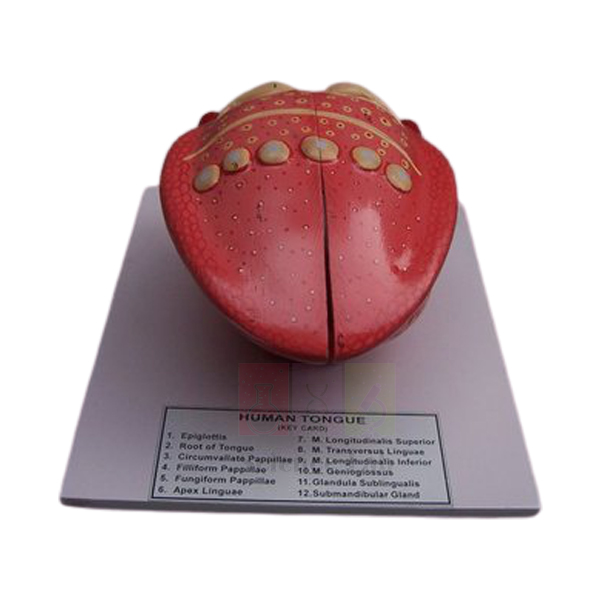
Human Tongue Model
Human Tongue Model (Product Code: SLE/BL/94) is a coloured, numbered teaching model of the human tongue that lets students trace its surface papillae, its muscle layers and the neighbouring salivary glands in a single view. It suits school and college biology classes, nursing and dental foundation courses, and any department assembling biology teaching aids in India for lessons on taste and digestion. The model is made by Jain Scientific Equipments Pvt Ltd (ScienceLab) in Ambala, India, and arrives mounted on a base with its key card.
Specifications
| Parameter | Detail |
|---|---|
| Model | Human tongue with associated muscles and glands |
| Mounting | Mounted on a base |
| Finish | Appropriately coloured and numbered |
| Key | Key card included |
| Surface structures shown | Epiglottis, root of tongue, circumvallate papillae, filiform papillae, fungiform papillae, apex linguae (tip of the tongue) |
| Muscles shown | M. longitudinalis superior, M. transversus linguae, M. longitudinalis inferior, M. genioglossus |
| Glands shown | Glandula sublingualis (sublingual gland), submandibular gland |
Typical Use
Teachers bring out the tongue model when covering the special senses and the mouth as the entry point of the digestive system. The three kinds of papillae on the upper surface lead naturally into a discussion of taste, while the longitudinal, transverse and genioglossus muscles show how the tongue changes shape during chewing, swallowing and speech. Because every structure carries a number, students can work through the key card in pairs, point to each part, and then quiz one another with the card covered.
The epiglottis and root of the tongue help explain why food passes into the oesophagus rather than the airway, and the sublingual and submandibular glands tie the lesson to saliva and the first stage of digestion. As part of school biology lab equipment in India, the model works well beside a prepared slide of tongue tissue so learners can compare the whole-organ view with what they see under the microscope. Store it covered and away from direct sunlight so the colouring stays clear.
Manufacturer
This tongue model is produced by Jain Scientific Equipments Private Limited, the company behind the ScienceLab name, which operates from Ambala, Haryana and makes anatomy models alongside a wider range of educational laboratory equipment. Schools and procurement offices that need vendor registration details can use its GSTIN 06AAECJ8618A1ZT and LEI 3358004HRD1JIVXKYX49. Background on the company is available on the ScienceLab company profile.
Related Human Models
These models and slides extend a lesson on the mouth, taste and the upper digestive and respiratory tracts:
- Microstructure of the Human Tongue Model — a magnified look at the tissue behind the papillae seen on this model.
- Prepared Microscope Slide Set – Digestion (Liver, Pancreas and Tongue) — real tongue sections for microscope work after the model demonstration.
- Larynx Human Model — continues the story below the epiglottis into the voice box.
- Human Nasal Cavity Model — covers smell, which works together with taste in flavour perception.
- Human Digestive System Model — places the tongue at the start of the complete digestive tract.
Browse every anatomy teaching model in the Human Models category.
Frequently Asked Questions
Which parts of the tongue can students identify on this model?
The epiglottis, root of the tongue, circumvallate, filiform and fungiform papillae, the apex, four named muscles (superior and inferior longitudinal, transverse and genioglossus) and the sublingual and submandibular glands. Each is numbered and listed on the key card.
Is the model supplied with a key and a base?
Yes. It comes mounted on a base, and a key card matching the numbered structures is included, so it is ready for classroom use on arrival.
What are the dimensions of the Human Tongue Model?
Overall dimensions are not listed on this page. Please ask through our contact page and we will confirm the size before you order.
How should the model be cleaned?
Wipe it with a soft cloth, lightly dampened if needed, and let it dry before storing. Avoid solvents or abrasive cleaners, which can dull the painted colours and numbers.
Does the model come with a warranty?
Warranty terms are not stated here. Ask us through the contact page and we will set them out in writing with your quotation.
Can you supply several units for a school network or an overseas buyer?
Yes. ScienceLab supplies schools, colleges and distributors across India and international markets; share the quantity and destination so we can quote packing and delivery.
Request a Quote
For a quotation on the Human Tongue Model, send the product code SLE/BL/94, the quantity and your delivery location through our contact page, or add it to the enquiry cart along with any other models you need.
Last updated: 24 September 2026
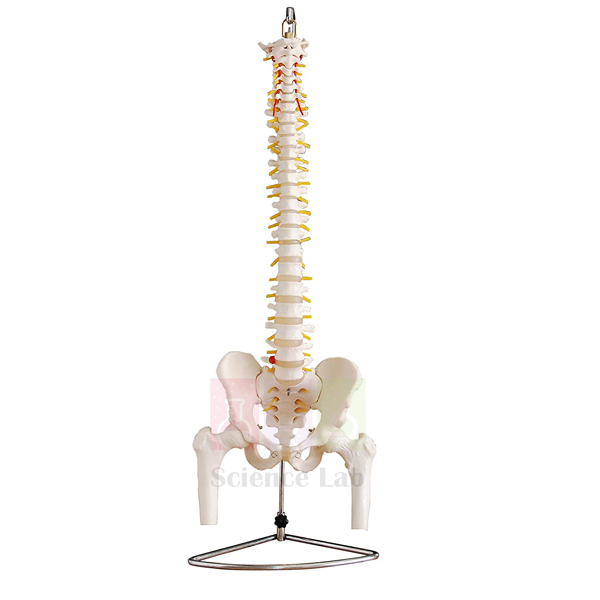
Human Vertebral Model With Pelvis & Femur Heads
Human Vertebral Model With Pelvis & Femur Heads (Product Code: SLE/BL/95) is a life-size, rigid 72 cm vertebral column with pelvis, sacrum, femur heads and occipital bone, used to teach spinal anatomy and disc pathology in medical, orthopaedic and physiotherapy classrooms. It shows the spinal cord, nerve roots, all nerve branches, the vertebral artery and a herniated lumbar disc on an 85 cm deluxe chrome stand. It is made by Jain Scientific Equipments Pvt Ltd (ScienceLab), an OEM anatomical models manufacturer, at its own factory in Ambala, India.
Specifications
| Parameter | Detail |
|---|---|
| Scale | Life size |
| Column height | 72 cm |
| Column type | Inflexible (rigid) vertebral column |
| Bones included | Vertebral column, pelvis, sacrum, femur heads, occipital bone |
| Soft structures shown | Spinal cord, nerve roots, all nerve branches, vertebral artery |
| Pathology shown | Herniated lumbar disc |
| Vertebral features | Significant features of each vertebra, including the vertebral notch |
| Stand | Deluxe chrome stand, 85 cm high |
| Intended users | Students, orthopaedic surgeons and other medical professionals |
| Product code | SLE/BL/95 |
| Manufacturer | Jain Scientific Equipments Pvt Ltd (ScienceLab) — OEM |
| Country of origin | India (made in Ambala, Haryana) |
What Is the Vertebral Column Model with Pelvis Used For?
Because the column runs from the occipital bone down through the sacrum to the pelvis and femur heads, one model supports a complete spine lesson: the regional differences between cervical, thoracic and lumbar vertebrae, the course of the vertebral artery in the neck, and the exit of nerve roots between neighbouring vertebrae. The herniated lumbar disc gives orthopaedic, physiotherapy and nursing students a concrete example of how a displaced disc can press on a nerve root — much easier to explain on a model than on a chart.
The column is rigid, so it is intended for showing structure and relationships rather than bending demonstrations. Its chrome stand raises it to a comfortable viewing height for a group, making it a practical centrepiece among the biology teaching aids in an anatomy room or a patient-education corner.
OEM Manufacturer
Jain Scientific Equipments Private Limited, better known by its trading name ScienceLab, is the OEM of this vertebral model and produces it at its own licensed factory at Saha, Ambala, Haryana, India. Medical colleges, teaching hospitals, dealers and importers therefore deal directly with the manufacturer, whether they are placing a first order, repeating one or asking about spare parts. The company profile gives more background.
Related Bone Models
Models that extend the same spine, pelvis and hip teaching:
- Human Lumbar Spinal Column Model — a closer look at the lumbar region where the disc herniation is shown
- Economy Human Flexible Vertebral Column, Color Coded — a flexible column for bending demonstrations, which this rigid model does not do
- Human Pelvis with Lower Lumbar and Femur Heads — concentrates on the pelvic end of the same anatomy
- Human Vertebral Column Model With Skull — adds a complete skull at the upper end of the column
- Human Hip Joint Model — for the joint formed where the femur head meets the pelvis
The full list of skeletal and joint models is in our Bone Model category.
Frequently Asked Questions
How tall is the Human Vertebral Model With Pelvis & Femur Heads?
The Human Vertebral Model With Pelvis & Femur Heads has a 72 cm tall vertebral column at life size, mounted on a deluxe chrome stand 85 cm high, which lifts the spine to a comfortable viewing level for a group.
Can the spine of the Human Vertebral Model With Pelvis & Femur Heads be bent?
No. The Human Vertebral Model With Pelvis & Femur Heads has an inflexible column, so it is meant for showing structure and relationships. For flexion demonstrations, choose a flexible vertebral column model from the same range.
Which nerves and vessels does the Human Vertebral Model With Pelvis & Femur Heads show?
The Human Vertebral Model With Pelvis & Femur Heads shows the spinal cord, nerve roots, all nerve branches and the vertebral artery, together with the significant features of each vertebra, including the vertebral notch.
What pathology is shown on the Human Vertebral Model With Pelvis & Femur Heads?
The Human Vertebral Model With Pelvis & Femur Heads includes a herniated lumbar disc. Teachers use it to explain how a displaced disc can press on a nerve root, a common topic in orthopaedic, physiotherapy and nursing courses.
Who manufactures the Human Vertebral Model With Pelvis & Femur Heads?
Jain Scientific Equipments Pvt Ltd (ScienceLab) is the OEM manufacturer of the Human Vertebral Model With Pelvis & Femur Heads, product code SLE/BL/95. It is made at the company’s own licensed factory in Saha, Ambala, Haryana, India.
How should the Human Vertebral Model With Pelvis & Femur Heads be cleaned?
Dust the column and nerve details of the Human Vertebral Model With Pelvis & Femur Heads with a soft brush, wipe the chrome stand with a dry cloth, and keep the model upright on its stand away from direct heat.
What should a quotation request for the Human Vertebral Model With Pelvis & Femur Heads include?
For the Human Vertebral Model With Pelvis & Femur Heads, send the product code SLE/BL/95, the quantity, the delivery city or country and any tender reference through the contact page; the quotation comes directly from the manufacturer.
Request a Quote
For price and availability, contact ScienceLab or add the model to your enquiry cart; your quotation is prepared by the manufacturer itself.
Last updated: 24 September 2026
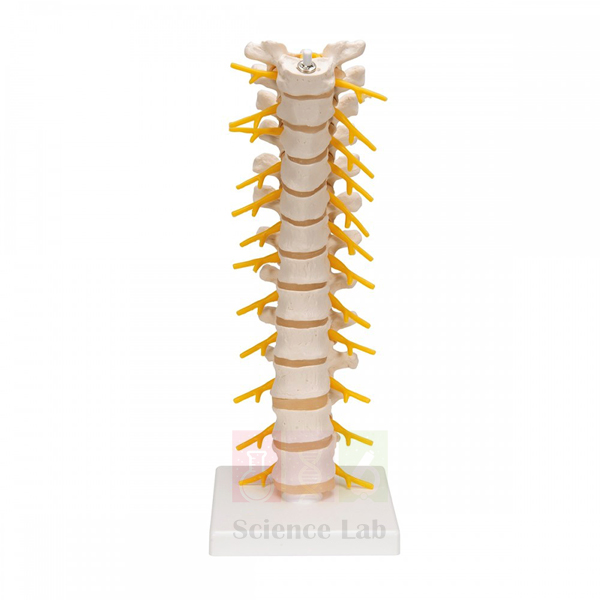
Human Thoracic Spinal Column Model
Human Thoracic Spinal Column Model (Product Code: SLE/BL/96) is a life-size model of the 12 thoracic vertebrae with intervertebral discs, spinal cord segment and nerve branches, used to teach mid-spine anatomy in biology, nursing and medical classrooms. At 32 cm tall, it is flexibly mounted on a stand and can be lifted off for handling. The model is made by Jain Scientific Equipments Pvt Ltd (ScienceLab), its OEM manufacturer, at the company’s own factory in Ambala, India.
Specifications
| Parameter | Detail |
|---|---|
| Region | Thoracic spine |
| Vertebrae | 12 thoracic vertebrae with intervertebral discs |
| Neural structures | Thoracic segment of the spinal cord and nerve branches |
| Scale | Life size |
| Height | 32 cm |
| Size | 12 × 12 × 32 cm |
| Mounting | Flexibly mounted on a stand; removable |
| Product code | SLE/BL/96 |
| Manufacturer | Jain Scientific Equipments Pvt Ltd (ScienceLab) — OEM |
| Country of origin | India (made in Ambala, Haryana) |
What Is the Thoracic Spine Model Used For?
The thoracic region is where the spine meets the ribs, so this section is used to point out what makes thoracic vertebrae different from those in the neck and lower back — the rib-bearing facets, the long downward-sloping spinous processes and the heart-shaped bodies. With the spinal cord segment and nerve branches in place, students can follow how each thoracic nerve leaves the canal between neighbouring vertebrae, which leads naturally into the intercostal nerves that run along the ribs.
The flexible mounting lets the column curve slightly in the hand, giving a sense of how the discs allow limited movement in this relatively stiff part of the back, and lifting it off the stand makes it easy to pass around a small group. Many institutions pair it with cervical and lumbar sections so the three regions form a complete human biology model set on one shelf.
OEM Manufacturer
This thoracic spine section is an original ScienceLab product. Jain Scientific Equipments Private Limited, which trades as ScienceLab, is its OEM and makes it at the company’s own licensed factory at Saha, Ambala, Haryana, India, rather than reselling a traded model. Schools, nursing colleges and medical departments buy it factory-direct, and dealers or importers receive quotations straight from the manufacturer. Visit the company profile for more.
Related Bone Models
Spine models that complete or extend a vertebral column lesson:
- Human Cervical Spinal Column Model — the neck section above the thoracic spine
- Human Lumbar Spinal Column Model — the lower-back section below it
- Economy Human Spine (vertebrae) and Thorax — shows how the thoracic vertebrae connect to the ribs and sternum
- Human Spinal Cord Section Model — an enlarged cross-section of the spinal cord and its nerves
Other vertebral, pelvic and skeletal models are listed in the Bone Model category.
Frequently Asked Questions
How many vertebrae does the Human Thoracic Spinal Column Model include?
The Human Thoracic Spinal Column Model includes all 12 thoracic vertebrae, each separated by an intervertebral disc, so the complete mid-back section of the spine can be studied as one life-size unit.
Does the Human Thoracic Spinal Column Model show the spinal cord?
Yes. The Human Thoracic Spinal Column Model includes the thoracic segment of the spinal cord together with its nerve branches, letting students follow how each thoracic nerve leaves the canal between neighbouring vertebrae.
What are the dimensions of the Human Thoracic Spinal Column Model?
The Human Thoracic Spinal Column Model is life size and 32 cm in height, with an overall size of 12 × 12 × 32 cm — compact enough to pass around a small group or keep on a shelf.
Can the Human Thoracic Spinal Column Model be removed from its stand?
Yes. The Human Thoracic Spinal Column Model is flexibly mounted on a stand and is removable, so it can be lifted off for close handling during a practical and then replaced for display.
Who manufactures the Human Thoracic Spinal Column Model?
Jain Scientific Equipments Pvt Ltd, trading as ScienceLab, is the OEM manufacturer of the Human Thoracic Spinal Column Model (SLE/BL/96). It is made at the company’s own factory at Saha, Ambala, Haryana, India, and supplied factory-direct.
How should the nerve branches of the Human Thoracic Spinal Column Model be handled?
Hold the Human Thoracic Spinal Column Model by the vertebral bodies rather than the nerves, and avoid bending the column sharply. This protects the fine nerve-branch details when the model is passed between students.
Is the Human Thoracic Spinal Column Model supplied outside India?
Yes. The Human Thoracic Spinal Column Model is supplied to institutions in India and international markets. Share the destination and quantity in your enquiry so freight can be included in the quotation from the manufacturer.
Request a Quote
Ask for pricing via our contact page, or add the thoracic spinal column model to your enquiry cart together with the cervical and lumbar sections; the manufacturer quotes you directly.
Last updated: 24 September 2026
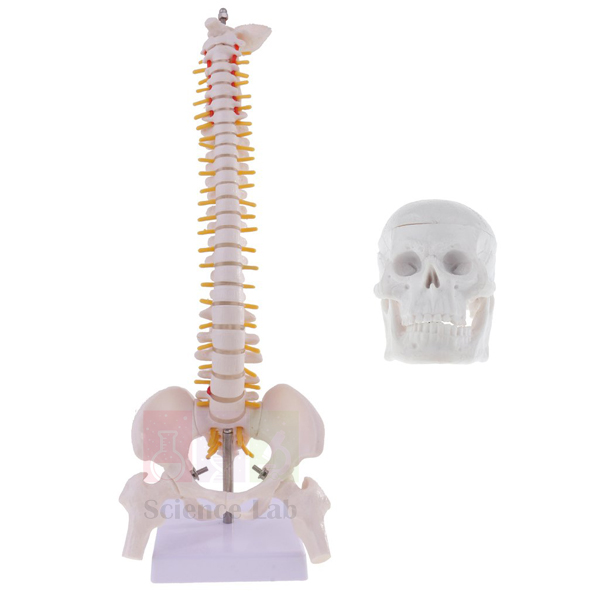
Human Vertebral Column Model With Skull
Human Vertebral Column Model With Skull (Product Code: SLE/BL/97) is an anatomical teaching model used to show the skull, spine and pelvis as one connected axial skeleton in biology, nursing and physiotherapy classrooms. It comes with an entire skull and pelvis on the vertebral column, and the skull has a calvaria cut and a spring-held lower jaw. It is made by Jain Scientific Equipments Pvt Ltd (ScienceLab), an OEM manufacturer, at its own factory in Ambala, India, as part of its human biology model set range.
Specifications
| Parameter | Detail |
|---|---|
| Model type | Vertebral column with an entire skull and pelvis |
| Skull | Calvaria cut, so the cranium can be opened |
| Lower jaw | Spring-held |
| Overall size | 44 × 18 × 12 cm |
| Product code | SLE/BL/97 |
| Manufacturer | Jain Scientific Equipments Pvt Ltd (ScienceLab) — OEM |
| Country of origin | India (made in Ambala, Haryana) |
What Is the Vertebral Column Model With Skull Used For?
Most spine models stop at the neck or the sacrum. This one keeps the whole chain together: the skull resting on the top of the column and the pelvis at its lower end, so a teacher can trace the load path from head to hips in a single demonstration. Students name the cervical, thoracic, lumbar, sacral and coccygeal regions in order, point out the natural curves, and see where the spine meets the pelvis at the sacroiliac joints.
The calvaria cut lets the class open the cranium during the same lesson, and the spring-held lower jaw shows how the mandible opens without coming loose. Physiotherapy and posture sessions use the model to explain why a change in one region of the spine affects the others. When moving it between rooms, support the column with both hands rather than lifting it by the skull. Schools planning biology teaching aids in India often choose it as a compact companion to a full skeleton.
OEM Manufacturer
Jain Scientific Equipments Private Limited trades as ScienceLab and is the OEM (original equipment manufacturer) of this spine-and-skull model. It is produced at the company's own licensed factory at Saha, Ambala, Haryana, India, so schools, medical and physiotherapy colleges, dealers and importers buy it from the maker itself rather than through a trading house.
If a jaw spring or another part needs replacing after years of classroom use, ask us: spares and repeat orders are handled by the manufacturer directly. Learn more about the company on the ScienceLab company profile.
Related Skulls
These models extend a spine and skeletal-system unit built around the vertebral column with skull:
- Human Skull with Cervical Spine Model — a closer look at the atlas, axis and neck region.
- Human Cervical Spinal Column Model — the neck vertebrae on their own for detailed identification.
- Human Vertebral Model With Pelvis & Femur Heads — carries the study on to the hip joints.
- Economy Human Flexible Vertebral Column, Color Coded — a flexible alternative for showing spinal movement.
- Human Adult Male Pelvis Structural Model — the pelvis as a separate model for closer study.
Browse the full Skulls category for more skull and cranium models.
Frequently Asked Questions
What does the Human Vertebral Column Model With Skull include?
The Human Vertebral Column Model With Skull comes with an entire skull and pelvis joined to the vertebral column, so the axial skeleton can be shown as one piece. The skull has a calvaria cut and a spring-held lower jaw for classroom demonstrations.
What size is the Human Vertebral Column Model With Skull?
The Human Vertebral Column Model With Skull measures 44 × 18 × 12 cm overall. If you need to confirm its scale or check cabinet space before ordering, send your question through our contact page and we will answer with your quotation.
Can the skull of the Human Vertebral Column Model With Skull be opened?
Yes. The skull on the Human Vertebral Column Model With Skull has a calvaria cut, so the top of the cranium can be opened to show the inside, and its spring-held lower jaw lets students open the mouth without the mandible falling away.
Which courses use the Human Vertebral Column Model With Skull?
The Human Vertebral Column Model With Skull is used in school biology, nursing, physiotherapy and anatomy teaching wherever the link between skull, spine and pelvis must be explained, including lessons on spinal regions, spinal curves and posture.
Who manufactures the Human Vertebral Column Model With Skull?
The Human Vertebral Column Model With Skull is manufactured by Jain Scientific Equipments Pvt Ltd (ScienceLab), the OEM, at its own factory at Saha, Ambala, Haryana, India. Quotations, repeat orders and spare-part questions are all handled by the manufacturer.
Can the Human Vertebral Column Model With Skull be ordered in bulk or for export?
Yes. The Human Vertebral Column Model With Skull is supplied in quantity to schools, colleges, dealers and importers in India and international markets. Share the number of units and the delivery location so we can prepare a quotation.
Request a Quote
To price the Human Vertebral Column Model With Skull, send the quantity and delivery location through our contact page or add it to the enquiry cart. Quotations come direct from the manufacturer, with no trader in between.
Last updated: 24 September 2026
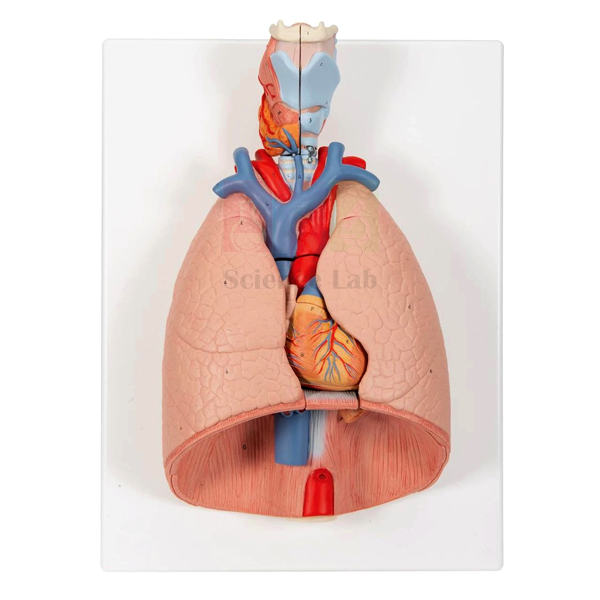
Human Thoracic Organs Model
Human Thoracic Organs Model (Product Code: SLE/BL/98) is an anatomy model used to teach the layout of the chest, with two removable front halves of the lungs that reveal the heart and great vessels in their natural position. It also shows a two-part larynx and heart, the trachea and bronchial tree, subclavian vessels, vena cava, aorta, pulmonary artery, oesophagus and diaphragm, numbered on a key card. It is made by Jain Scientific Equipments Pvt Ltd (ScienceLab), an OEM anatomical models manufacturer, at its own factory in Ambala, India.
Key Details
| Parameter | Detail |
|---|---|
| Type | Thoracic organs anatomy model |
| Removable parts | Two front halves of the lungs |
| Two-part organs | Larynx, heart |
| Airway and vessels | Trachea and bronchial tree, subclavian artery and vein, vena cava, aorta, pulmonary artery |
| Other structures | Oesophagus, diaphragm |
| Finish and key | Appropriately coloured, numbered with key card |
| Mounting | Mounted on a base |
| Custom builds | Custom-made anatomical models available for bulk quantity |
| Product code | SLE/BL/98 |
| Manufacturer | Jain Scientific Equipments Pvt Ltd (ScienceLab) — OEM |
| Country of origin | India (made in Ambala, Haryana) |
What Is the Human Thoracic Organs Model Used For?
With the front lung halves in position, the model shows what an anatomist first sees on opening the chest: the lungs filling most of the cavity and the diaphragm below. Removing them exposes the mediastinum, the central region where the heart, aorta, vena cava, pulmonary artery, trachea and oesophagus run close together. This makes it a clear way to explain relations between organs, such as why the oesophagus lies behind the heart, how the subclavian vessels arch towards the arms and how the pulmonary artery links the right side of the heart to the lungs.
As high school biology lab equipment it supports chapters on breathing and circulation, and in nursing and medical courses it serves as a revision aid before cadaver or imaging sessions. Ask students to predict which structure lies beneath each lung half before lifting it, then confirm with the numbered key card. Store the loose lung halves with the base and clean all surfaces with a soft, dry cloth.
What to Specify When Ordering
- Whether you need the standard model or a custom-made version, which is offered for bulk quantity
- The number of units for each lab, department or distributor order
- Any companion chest models, such as the Human Lungs with Heart and Larynx Model, to be quoted together
OEM Manufacturer
This thoracic model is manufactured by Jain Scientific Equipments Private Limited (CIN U29309HR2020PTC087597), the OEM (original equipment manufacturer) behind the ScienceLab brand. Production takes place at the company's own licensed factory at 449, HSIIDC Industrial Area, Saha, Ambala, Haryana (Factory Licence AMB-ONLINE-CHD-J-414), where custom-made anatomical models can also be discussed for bulk quantities. Colleges, schools, dealers and importers buy factory-direct, and replacement lung halves or repeat orders are handled by the manufacturer itself, so just ask us. Learn more on our profile page.
Related Human Models
Pair this model with the following for a complete chest and trunk lesson:
- Human Lungs with Heart and Larynx Model — a comparable set of organs with 2-part lungs
- Human Heart on Diaphragm Model — a closer look at the heart resting on the diaphragm
- Segmented Lung — shows the internal segments that the front lung halves cover
- Human Sexless Torso Model — places the thoracic organs within the whole trunk
- Human Skeleton with Internal Organs & Muscles — relates the organs to the rib cage and spine
The model is listed in our Human Models category.
Frequently Asked Questions
Which parts of the Human Thoracic Organs Model come off?
On the Human Thoracic Organs Model, the two front halves of the lungs are removable, and the larynx and heart are each made in two parts, so students can open the chest layer by layer during a lesson.
What is visible once the lung halves are removed?
Removing the lung halves of the Human Thoracic Organs Model exposes the heart, aorta, vena cava, pulmonary artery, subclavian artery and vein, trachea with bronchial tree and oesophagus, with the diaphragm forming the floor of the chest below.
Can a customised version of the thoracic organs model be made?
Custom-made anatomical models are listed as available for bulk quantity alongside the Human Thoracic Organs Model. Share your requirement and quantity through the contact page so we can discuss what is feasible before quoting.
How does it differ from the Human Lungs with Heart and Larynx Model?
The Human Thoracic Organs Model and the Human Lungs with Heart and Larynx Model cover the same organ group; the thoracic model is built around removable front lung halves that reveal the organs in their natural position. We can help you choose.
What size is the Human Thoracic Organs Model?
Dimensions and material of the Human Thoracic Organs Model are not stated in its listing. Ask us through the contact page and we will confirm them, along with packing details, in the quotation.
Who manufactures the Human Thoracic Organs Model?
Jain Scientific Equipments Private Limited (ScienceLab) is the OEM that manufactures the Human Thoracic Organs Model at its own licensed factory at Saha, Ambala, Haryana, India, and supplies it directly to schools, colleges, dealers and importers.
What should a tender or institutional enquiry include?
A tender or institutional enquiry for the Human Thoracic Organs Model should give product code SLE/BL/98, the quantity, the delivery location in India or abroad and any customisation needed; quotations come directly from the manufacturer.
Request a Quote
For pricing on the Human Thoracic Organs Model, contact the manufacturer through our contact page or add it to the enquiry cart.
Last updated: 24 September 2026
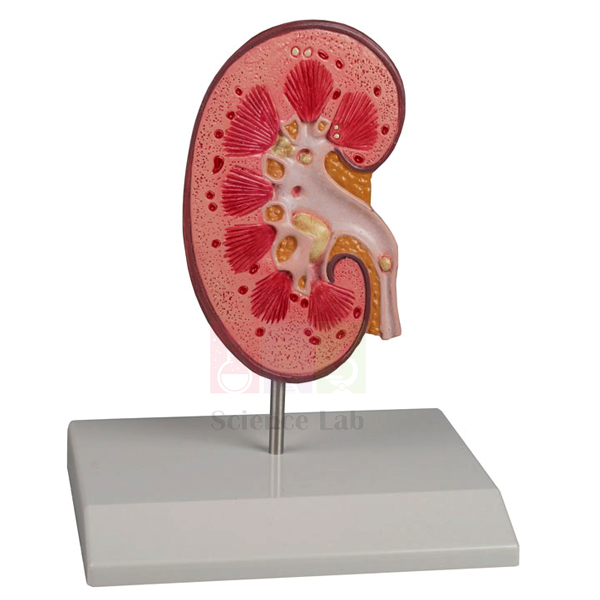
Kidney Stone Model
Kidney Stone Model (Product Code: SLE/BL/99) is a pathology teaching model used to explain kidney stones (nephrolithiasis) and stones in the urinary tract (urolithiasis) to students and patients. Its renal calices, renal pelvis and ureter are shown opened so stones can be located from the renal pyramids down to the ureter, which suits nursing institutes, urology clinics and pharmacy college lab equipment lists. It is made by Jain Scientific Equipments Pvt Ltd (ScienceLab), an OEM manufacturer, at its own factory in Ambala, India.
Key Details
| Parameter | Detail |
|---|---|
| Type | Pathology model of kidney and urinary stones |
| Conditions illustrated | Nephrolithiasis (kidney stones) and urolithiasis (urinary stones) |
| Opened structures | Renal calices, renal pelvis, ureter |
| Stone positions shown | Area of the renal pyramids; origin of the upper calix group; renal cortex; connecting tubules of the lower calix group, causing congestion of the minor calices (partially closed, partially opened); ureter |
| Finish and key | Appropriately coloured, numbered with key card |
| Mounting | Mounted on a base |
| Product code | SLE/BL/99 |
| Manufacturer | Jain Scientific Equipments Pvt Ltd (ScienceLab) — OEM |
| Country of origin | India (made in Ambala, Haryana) |
What Is the Kidney Stone Model Used For?
In the classroom, the opened collecting system lets students follow urine from the renal pyramids through the minor and major calices into the renal pelvis and down the ureter, and then see how a stone at each point changes the picture. The lower calix group, with its partly blocked minor calices, shows how an obstruction backs up urine inside the kidney, while the stone in the ureter explains the sudden, severe pain of ureteric colic. These comparisons support lectures on renal physiology, urinary tract pathology and the diet advice given for stone prevention.
Doctors and nurses also use the model in outpatient clinics to show patients where a stone sits and why a particular treatment is being discussed, and it adds a practical element to a health education kit for schools in India covering hydration and kidney health. Point to each numbered site while reading from the key card, and keep the model covered and dust-free between sessions.
OEM Manufacturer
ScienceLab is the trading name of Jain Scientific Equipments Private Limited, the OEM (original equipment manufacturer) of this kidney stone model. The company makes its anatomy and pathology models at its own licensed factory at Saha, Ambala, Haryana, India, and sells them factory-direct to medical and nursing colleges, hospitals, schools, dealers and importers in India and international markets. Repeat orders and quotations are handled by the manufacturer itself. Visit the company profile for background.
Related Human Models
For a complete lesson on the kidney and urinary tract, consider:
- Human Kidney Model — normal kidney anatomy to compare with the stone sites
- Human Kidney, Nephron, and Glomerulus Model Set — explains the tubules and filtration units involved
- Human Kidney, Nephron and Renal Corpuscle Model — enlarges the nephron and renal corpuscle for detailed study
- Human Kidney with Adrenal Gland Model — shows the kidney with its adrenal gland and vessels
- Gallstone Model — contrasts urinary stones with stones in the biliary system
This model is listed in our Human Models category.
Frequently Asked Questions
What conditions does the Kidney Stone Model explain?
The Kidney Stone Model explains kidney stones (nephrolithiasis) and stones elsewhere in the urinary tract (urolithiasis), showing where stones form or lodge in the opened calices, renal pelvis and ureter of a coloured, numbered kidney.
Where are the stones shown on the Kidney Stone Model?
On the Kidney Stone Model, stones are shown in the area of the renal pyramids, at the origin of the upper calix group, in the renal cortex, in the connecting tubules of the lower calix group and in the ureter.
Is the kidney stone model suitable for patient education?
Yes. The opened calices, renal pelvis and ureter of the Kidney Stone Model make it straightforward for doctors and nurses to show a patient where a stone sits and why it can cause pain or block the flow of urine.
Does the Kidney Stone Model come with a key?
Yes. The Kidney Stone Model is appropriately coloured and numbered, and the numbered features are identified on an accompanying key card, which makes it easy to use for self-study, practical examinations and counselling.
Is the Kidney Stone Model life size?
Scale, size and material of the Kidney Stone Model are not stated in its listing. Ask us through the contact page and we will confirm these details, together with packing information, in your quotation.
Who manufactures the Kidney Stone Model?
Jain Scientific Equipments Private Limited (ScienceLab) is the OEM that manufactures the Kidney Stone Model at its own factory at Saha, Ambala, Haryana, India, and supplies it directly to medical and nursing colleges, hospitals, dealers and importers.
Can hospitals or distributors order the model in quantity?
Yes. Hospitals, colleges and distributors in India and international markets can order the Kidney Stone Model in quantity; state product code SLE/BL/99 and the number of units, and the quotation comes straight from the manufacturer.
Request a Quote
Ask the manufacturer for a quotation on the Kidney Stone Model through our contact page, or add it to the enquiry cart with related kidney models.
Last updated: 24 September 2026
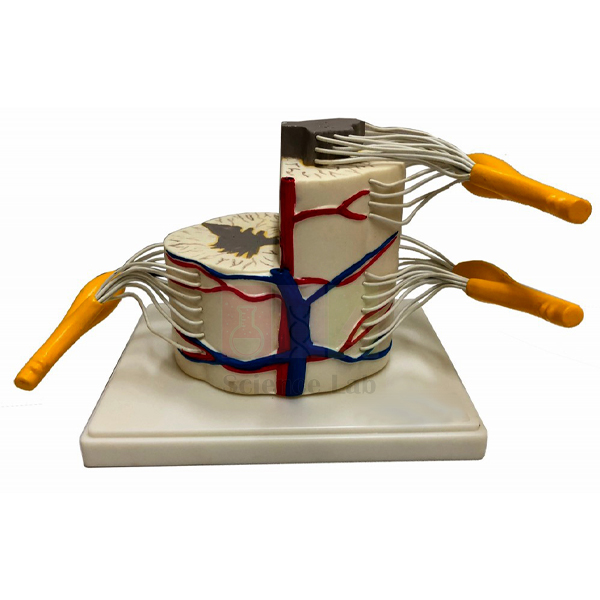
Human Vertebral And Partial Spinal Cord Model
Human Vertebral And Partial Spinal Cord Model (Product Code: SLE/BL/100) reproduces a segment of the upper thoracic spinal cord at six times life size, with the anterior and posterior nerve roots exposed and colour coded so the direction of nerve signals is easy to follow. Physiology teachers, nursing and physiotherapy tutors and senior school biology departments use it to explain how the cord connects to the body through spinal nerves. It is manufactured by Jain Scientific Equipments Pvt Ltd (ScienceLab), Ambala, and fits naturally into a human biology model set for the nervous system.
Specifications
| Parameter | Detail |
|---|---|
| Region represented | Segment of the upper thoracic spinal cord |
| Scale | Six times life size |
| Material | Vinyl plastic, chosen for durability |
| Nerve roots | Anterior and posterior roots exposed and colour coded |
| Size | 30 x 15 x 15 cm |
Typical Use
The enlargement makes the difference between the two root types visible from the back of a classroom. A tutor can trace the posterior (sensory) root into the cord and the anterior (motor) root out of it, then use the model to walk through a simple reflex arc or to explain why an injury at one level affects a particular band of the body. Because the roots are colour coded, students copying labelled diagrams into notebooks can match colours to function without constant prompting.
In high school biology lab equipment collections the model sits well between a whole nervous-system chart and prepared slides of spinal cord sections: it bridges the gross and microscopic views. Its vinyl construction tolerates repeated handling during practical sessions and viva preparation; keep it on a flat shelf and wipe it with a damp cloth after use.
Manufacturer
Jain Scientific Equipments Private Limited makes this spinal cord model under its trading name ScienceLab at Ambala in Haryana, a long-standing centre for scientific instrument making in India. The company designs and produces anatomy models for teaching institutions and dispatches them within India and abroad; you can read more on the company profile page.
Related Human Models
Pair this segment with models that show the whole spine or the wider nervous system:
- Human Spinal Cord Section Model — a sectional view for comparing grey and white matter.
- Human Thoracic Spinal Column Model — shows the thoracic vertebrae that surround this region of the cord.
- Human Reflex Pathway Model — follows the sensory and motor roots through a complete reflex arc.
- Human Nervous System Model — puts the spinal nerves in the context of the whole body.
All anatomy teaching models are listed in the Human Models category.
Frequently Asked Questions
Which part of the spinal cord does the model represent?
A segment from the upper thoracic region, enlarged six times so the nerve roots and their attachments are clear.
How large is the model?
It measures 30 x 15 x 15 cm, a comfortable size for bench demonstrations and small-group work.
Will it stand up to regular student handling?
It is moulded in vinyl plastic for durability. Normal classroom handling is fine; avoid dropping it or leaving it near heat sources.
Is a printed key supplied?
A key is not listed in the product details. If you need a labelled key or a structure list for your syllabus, ask us through the contact page before ordering.
What should an institutional enquiry include?
Give the product code SLE/BL/100, quantity, delivery address and any tender or purchase-order format you must follow, and we will prepare the quotation accordingly.
Do you ship outside India?
Yes. ScienceLab serves buyers in India and international markets; share the destination country and quantity for a packed and delivered quote.
Request a Quote
Ask for a price on the Human Vertebral And Partial Spinal Cord Model through our contact page, or place it in the enquiry cart with the other anatomy items on your list.
Last updated: 24 September 2026
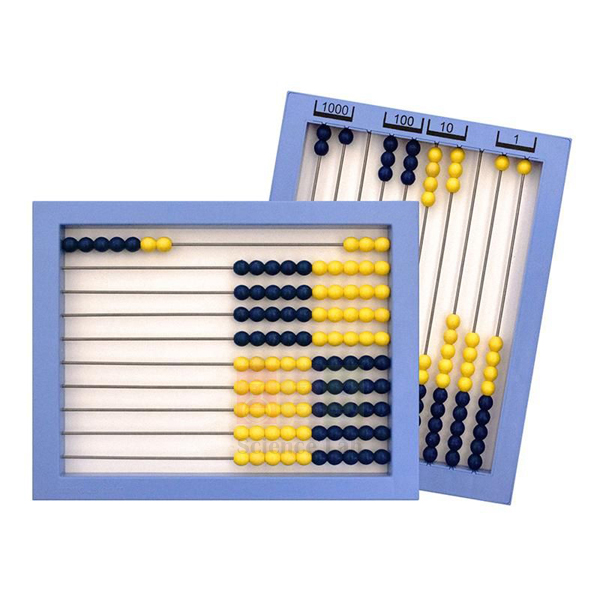
Abacus Desk/Table
Abacus Desk/Table (Product Code: SLE/MAT/01) is a bead-frame calculating instrument used to teach counting, place value and basic arithmetic at a pupil's desk or table in primary maths classrooms. Its beads slide along a series of wires or rods set in a frame, and the rods represent the decimal places, so children can see how units, tens and hundreds build up. It is made by Jain Scientific Equipments Pvt Ltd (ScienceLab), an OEM manufacturer, at its own factory in Ambala, India.
Key Details
| Parameter | Detail |
|---|---|
| Type | Calculating instrument (bead frame) |
| Working principle | Beads slide along a series of wires or rods set in a frame |
| Place value | Rods represent the decimal places |
| Format | Desk/table version for use on a work surface |
| Product code | SLE/MAT/01 |
| Manufacturer | Jain Scientific Equipments Pvt Ltd (ScienceLab) — OEM |
| Country of origin | India (made in Ambala, Haryana) |
What Is the Abacus Desk/Table Used For?
Placed flat in front of a pupil or a pair, the abacus turns abstract numbers into beads that can be counted and moved. Children show a number by sliding beads on each rod, add by moving more beads across, and discover exchange when a rod fills and ten beads become one bead on the next rod to the left. Subtraction with borrowing works the same way in reverse.
A simple routine helps: clear the frame by pushing all beads to one side before each sum, and always read from the units rod leftwards. Because every child can work on their own frame, the teacher can walk the room and check answers at a glance. For a maths lab, it sits naturally beside base ten blocks and place value mats as hands-on mathematics lab equipment.
OEM Manufacturer
This desk abacus comes from Jain Scientific Equipments Private Limited, the company behind the ScienceLab name, which makes it as the original equipment manufacturer at its own licensed factory in Saha, Ambala, Haryana, India. Schools ordering a class set, and dealers or importers stocking maths teaching aids, receive it direct from the maker rather than from a middleman, and repeat orders go back to the same production team. Read about the company on the ScienceLab profile.
Related Maths Lab Equipment
Teachers often combine the desk abacus with other place value resources.
- Abacus Upright — the upright version for demonstrating the same bead method to the class.
- Decimal Abacus — an alternative abacus for decimal place value work.
- Base Ten Blocks — shows units, tens and hundreds as solid pieces alongside bead work.
- Place Value Mat with Stacking Counters — a flat mat for recording numbers built on the abacus.
- Game of Place Value — a game to practise the same concept.
Explore the full Maths Lab Equipment range.
Frequently Asked Questions
What is the Abacus Desk/Table used for?
The Abacus Desk/Table is used at a pupil's desk to teach counting, place value, addition and subtraction. Sliding beads along rods lets children see each step of a calculation instead of only writing it down.
How does the Abacus Desk/Table show decimal places?
On the Abacus Desk/Table, beads slide along a series of wires or rods set in a frame, and each rod represents a decimal place. Moving beads on the right-hand rod counts units, and each rod to the left is worth ten times more.
How is the Abacus Desk/Table different from the Abacus Upright?
Both abacuses use beads sliding on rods to represent decimal places. The Abacus Desk/Table is the version for working on a desk or table, while the Abacus Upright is the upright format that suits showing the method to a group.
How many rods and beads does the Abacus Desk/Table have?
The listing for the Abacus Desk/Table does not state the number of rods or beads, the frame size or the material. Ask through the contact page and ScienceLab will confirm these details before you order.
Who manufactures the Abacus Desk/Table?
The Abacus Desk/Table is manufactured by Jain Scientific Equipments Pvt Ltd (ScienceLab), the OEM, at its own licensed factory in Saha, Ambala, Haryana, India, and is sold directly to schools, dealers and importers.
Can schools order the Abacus Desk/Table as a class set or for export?
Yes. Schools can order the Abacus Desk/Table in class quantities, and dealers can order for India and international markets. Send the number required and the delivery location through the contact page for a quotation.
Request a Quote
Tell us how many Abacus Desk/Table units you need through the contact page, or add the item to the enquiry cart. Your quotation comes directly from the manufacturer.
Last updated: 24 September 2026