- Physics Lab Equipment
- Chemistry Lab Equipment
- Biology Lab Equipment
- Anatomical Lab Equipment
- Learning
- Educational Lab Equipment
- Magnets
- Agriculture
- Astronomy
- Earth Science
- Geography Lab Equipment
- Safety Lab Coat
- Laboratory
- Meteorological
- Electricity & Magnetism
- Heat
- School Lab Equipment
- Lab Glassware
- Science Lab Equipment
- Tvet Lab Equipment
- Robotics Kits Supplier and Manufacturer for Schools India
- Math Lab Equipment Manufacturers and Exporters in Ambala
- STEM Kits Manufacturers and Supplier India
- Engineering Lab Equipment
- Hospital Lab Equipment
- Water, Sanitation & Hygiene Supplies
- Cold Chain, Solar & Communication Equipment
- Nutrition
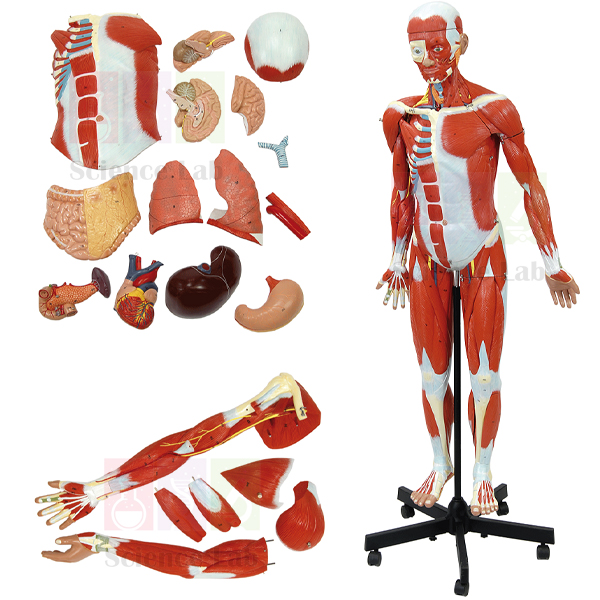
Human Muscular Figure Model
The Human Muscular Figure Model (Product Code: SLE/BL/71) is a 32-part, 140 cm tall figure that shows the musculature of the body together with removable internal organs. A 6-part muscular arm and an 8-part muscular leg detach for close study, the skullcap lifts off to reveal a bisected brain, and the heart, lungs and main abdominal organs can all be taken out. Every structure is numbered and referenced on the accompanying key card. Built by Jain Scientific Equipments Pvt Ltd (ScienceLab), one of the human anatomical models manufacturers in India based in Ambala, it is rod-mounted on a base with casters for use in medical, nursing, physiotherapy and sports science teaching.
Specifications
| Parameter | Detail |
|---|---|
| Type | Full muscular figure with removable organs |
| Total parts | 32 |
| Arm | Removable 6-part muscular arm |
| Leg | Removable 8-part muscular leg |
| Head and brain | Removable skullcap; brain bisected along the longitudinal fissure, showing internal structures and vasculature |
| Heart | Removable 2-part heart representing the atria, ventricles, valves and sections of the heart wall |
| Lungs | Bisected and removable, showing the bronchial tree and vascular system |
| Abdominal organs (removable) | Liver with gallbladder, 2-part stomach, duodenum with pancreas and spleen, large intestine |
| Identification | Structures numbered and referenced on the accompanying key card |
| Mounting | Rod-mounted on base with casters |
| Model height | 140 cm |
| Total size | 150 x 50 x 40 cm |
| Weight | Approximately 12 kg |
Typical Use
A figure of this size lets a whole class study the muscular system in its true proportions. Tutors usually begin with the surface muscles of the trunk and limbs, then detach the 6-part arm and the 8-part leg so students can examine the limb muscles piece by piece. With the chest and abdomen opened up, the removable heart, lungs, liver, stomach and intestine let the same model double as a lesson on the organs of the torso — the bisected brain and lungs show internal structure, not just outer surfaces.
Medical and nursing colleges use it for anatomy practicals, physiotherapy and sports science departments for muscle function and injury discussions, and fine-arts faculties for figure study. It suits institutions building a human biology model set in India around one central figure. The casters make it easy to wheel between lecture hall and lab; make sure the figure is standing steady before removing parts, return each piece to its matching position, and cover it when not in use.
Manufacturer
Jain Scientific Equipments Private Limited, known to customers as ScienceLab, manufactures this full-size muscular figure in Ambala, Haryana, alongside smaller anatomy models and laboratory apparatus. The company profile explains more about the organisation.
Related Laboratory Equipment
Items that complement a full muscular figure in anatomy teaching:
- Human Sexless Muscular Figure — an alternative muscular figure for comparison when equipping several rooms
- Miniature Human Muscular Figure — a desk-sized figure for individual student revision
- Human Muscular Arm Model — more detail on the muscles of the upper limb
- Human Muscular and Ligamentous Skeleton — shows how muscles and ligaments attach to the skeleton
- Skeletal Muscle Fiber Model — explains muscle structure at the level of the fibre
Browse more figures in the Human Models category.
Frequently Asked Questions
How many parts does the figure have?
32 parts in total, including a 6-part arm, an 8-part leg, a 2-part heart and a 2-part stomach.
How tall is it and how much space does it need?
The model is 140 cm tall; the total size is 150 x 50 x 40 cm and it weighs approximately 12 kg.
Which internal organs can be removed?
The 2-part heart, the bisected lungs, the liver with gallbladder, the 2-part stomach, the duodenum with pancreas and spleen, and the large intestine. The skullcap also lifts off to show the bisected brain.
Can it be moved between rooms?
Yes. It is rod-mounted on a base with casters, so it can be wheeled between the lecture hall and the lab.
How are the structures identified?
Anatomical structures are numbered on the model and referenced on the accompanying key card.
What are the packed dimensions for shipping?
Packed size and gross weight depend on the packing method chosen for the destination. Contact us and we will provide them with the quotation.
Do you export this figure?
Yes. We supply colleges, hospitals' teaching departments and distributors in India and international markets; warranty terms are set out on the quotation.
Request a Quote
Request a formal quotation for the Human Muscular Figure Model through our contact page, or add it to the enquiry cart with any supporting muscle and skeleton models.
Last updated: 24 September 2026