- Physics Lab Equipment
- Chemistry Lab Equipment
- Biology Lab Equipment
- Anatomical Lab Equipment
- Learning
- Educational Lab Equipment
- Magnets
- Agriculture
- Astronomy
- Earth Science
- Geography Lab Equipment
- Safety Lab Coat
- Laboratory
- Meteorological
- Electricity & Magnetism
- Heat
- School Lab Equipment
- Lab Glassware
- Science Lab Equipment
- Tvet Lab Equipment
- Robotics Kits Supplier and Manufacturer for Schools India
- Math Lab Equipment Manufacturers and Exporters in Ambala
- STEM Kits Manufacturers and Supplier India
- Engineering Lab Equipment
- Hospital Lab Equipment
- Water, Sanitation & Hygiene Supplies
- Cold Chain, Solar & Communication Equipment
- Nutrition
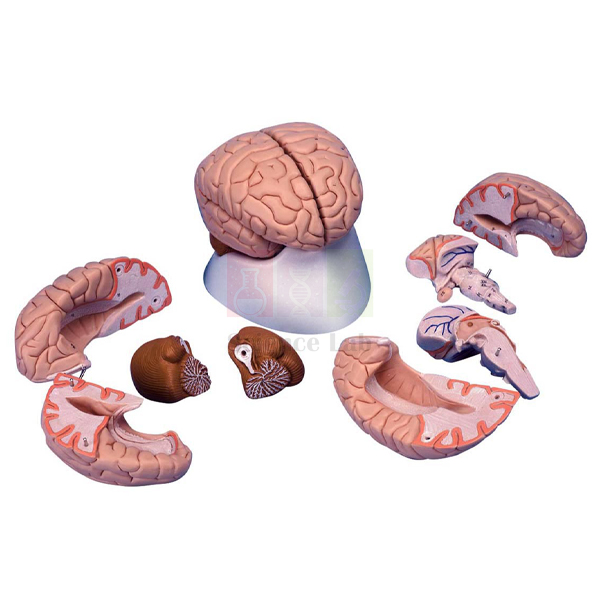
Human Brain Model, 8 Parts
Human Brain Model, 8 Parts (Product Code: SLE/BL/46) is a medially divided anatomical brain model used to teach the lobes, brain stem and cerebellum as biology lab equipment in Indian and overseas schools and colleges. Its parts show the frontal with parietal lobes, the temporal with occipital lobes, half of the brain stem and half of the cerebellum, coloured and numbered with a key card. It is made by Jain Scientific Equipments Pvt Ltd (ScienceLab), an OEM manufacturer, at its own factory in Ambala, India.
Specifications
| Parameter | Detail |
|---|---|
| Number of parts | 8 |
| Division | Medially divided |
| Regions shown | Frontal with parietal lobes; temporal with occipital lobes; half of brain stem; half of cerebellum |
| Finish | Appropriately coloured and numbered |
| Identification | Key card |
| Base | Removable base |
| Product code | SLE/BL/46 |
| Manufacturer | Jain Scientific Equipments Pvt Ltd (ScienceLab) — OEM |
| Country of origin | India (made in Ambala, Haryana) |
What Is the 8-Part Human Brain Model Used For?
The 8-part division is well matched to a full practical session. Groups begin with the assembled brain, identify the main lobes from the outside, then split the model along the midline to study the medial surface of each half. Removing the half brain stem and half cerebellum shows how these structures sit beneath the cerebrum and why damage at the back of the brain affects balance and coordination.
Lifting the model off its removable base lets students turn it over and look at the underside, which stays hidden on fixed models. Teachers set identification exercises using the numbered structures and key card, rotating the parts between benches so every student handles each region, which makes it a dependable core piece in a human biology model set in India. Count the parts back in at the end of a session and reassemble them on the base for the next class.
OEM Manufacturer
Jain Scientific Equipments Private Limited, which trades as ScienceLab, is the OEM (original equipment manufacturer) of the Human Brain Model, 8 Parts. The model is made and assembled at the company's own licensed factory at Saha, Ambala, Haryana, India, rather than bought in from a trader, and is supplied factory-direct to schools, colleges, dealers and importers.
For institutional and tender buyers who need vendor registration details, the company's GSTIN is 06AAECJ8618A1ZT and its Legal Entity Identifier is 3358004HRD1JIVXKYX49. If a part goes missing or you want a repeat order, ask us and the manufacturer will respond directly. Read our company profile for background on the business.
Related Brain Models
Models that pair well with this brain in a neuroanatomy unit:
- Human Brain Model, 4 Parts — a simpler life-size version for introductory classes
- Human Brain Model, 15 Parts — adds the ventricles and detailed internal anatomy
- Human Regional Brain Model — colour-codes functional areas of the cortex
- Human Skull Model, Life Size Colored — shows the skull that encloses and protects the brain
- Human Vertebral And Partial Spinal Cord Model — continues the central nervous system below the brain stem
See all options in the Brain Models category.
Frequently Asked Questions
Which regions does the Human Brain Model, 8 Parts show?
The Human Brain Model, 8 Parts is medially divided and shows the frontal with parietal lobes, the temporal with occipital lobes, half of the brain stem and half of the cerebellum, so students can study both the outer surface and the cut midline of the brain.
Why does the 8-part brain model have a removable base?
The removable base of the Human Brain Model, 8 Parts lets a teacher lift the brain away to pass it around the class or examine its underside, then return it to the base for display on a bench or shelf between lessons.
Is the Human Brain Model, 8 Parts life size?
The scale and dimensions of the Human Brain Model, 8 Parts are not stated in our product information, so we do not quote a size here. Please ask through our contact page and we will confirm the measurements before you order.
Does the 8-part brain model come with a key card?
Yes. The Human Brain Model, 8 Parts is appropriately coloured, its structures are numbered, and a key card is supplied so students can match each number to the name of the lobe or region during identification exercises.
Should we choose the 8-part or the 15-part brain model?
The Human Brain Model, 8 Parts covers the lobes, brain stem and cerebellum for school and early college work. The Human Brain Model, 15 Parts additionally shows the brain ventricles and detailed internal anatomy, so it suits advanced medical and neuroscience courses.
Who manufactures the Human Brain Model, 8 Parts?
The Human Brain Model, 8 Parts is manufactured by Jain Scientific Equipments Pvt Ltd (ScienceLab) as the OEM, at its own licensed factory at Saha, Ambala, Haryana, India. Schools, colleges, dealers and importers buy it directly from the manufacturer.
Can you handle a biology model kit bulk order that includes this brain?
Yes. ScienceLab quotes the Human Brain Model, 8 Parts for single schools, multi-school orders, distributors and importers in India and international markets. Share the quantity and delivery points and we will prepare one consolidated quotation.
Request a Quote
Request a price for the Human Brain Model, 8 Parts on our contact page, or add it to the enquiry cart together with your other laboratory needs. Quotations come straight from the manufacturer.
Last updated: 24 September 2026
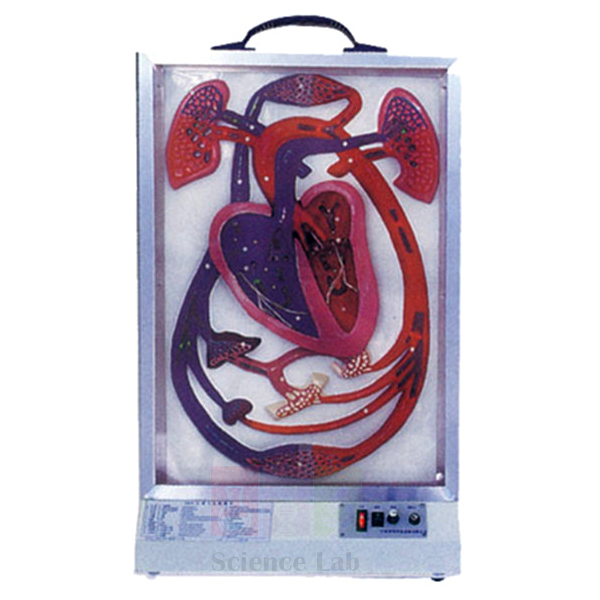
Human Cardiac Beat And Blood Circulation
The Human Cardiac Beat And Blood Circulation model (Product Code: SLE/BL/47) is a powered demonstration unit that pairs an enlarged, sectioned heart with a diagram of the body's blood circulation. Its flexible heart wall is moved mechanically from behind so the heart visibly beats, the valves open and close, and flashing lights trace the flow of blood — red for arteries and blue for veins. For institutions comparing heart model anatomy options in India, that movement is what separates it from static display models. It is manufactured by Jain Scientific Equipments Pvt Ltd (ScienceLab), Ambala, for schools, nursing colleges and medical teaching departments.
Specifications
| Parameter | Detail |
|---|---|
| Type | Working heart and blood circulation demonstration model |
| Size | 41 x 17 x 71 cm |
| Heart display | Enlarged heart shown in section, together with a blood circulation diagram |
| Heart wall | Flexible material, moved by a mechanism behind it to demonstrate the heartbeat |
| Valves | Shown opening and closing |
| Circulation display | Light flashes — red represents arteries, blue represents veins |
| Power | Requires a power supply |
Typical Use
Teachers switch the model on at the start of a cardiac cycle lesson and let the class watch several beats before explaining what is happening: the heart wall contracting and relaxing, the valves opening to let blood through and closing to stop it flowing backwards, and the lights showing oxygen-rich blood leaving through the arteries and returning through the veins. Having motion and colour at the same time helps students connect the pumping action of the heart with the route blood takes around the body.
As school biology lab equipment in India, it fits the circulation chapter in secondary classes and is equally useful for nursing and paramedical students revising cardiac physiology. The light flashes are easiest to follow in a dimmed room. Place the unit on a stable bench within reach of a socket, switch it off between lessons, and keep the flexible heart wall away from sharp objects and direct sunlight.
Manufacturer
Jain Scientific Equipments Private Limited produces this circulation model in Ambala, Haryana, and sells it under its trading name, ScienceLab, as part of a catalogue that spans anatomy models and general laboratory apparatus. Our company profile gives more detail about the business.
Related Laboratory Equipment
These items extend a heart and circulation lesson built around this model:
- Human Heart, Pumping Model — a hand-operated alternative in which a squeeze bulb drives simulated blood through clear chambers
- Human Heart Model — a static model for close study and labelling of heart anatomy after the demonstration
- Human Fetal Circulation Model — shows how circulation is arranged before birth, for comparison with the adult pattern
- Human Lungs with Heart and Larynx Model — links the heart to the lungs for the pulmonary part of the circuit
- Blood Pressure Monitor — lets students take real readings once they understand what drives blood pressure
More anatomy teaching models are listed in the Human Models category.
Frequently Asked Questions
Does the model need electricity?
Yes, it needs a power supply to run the heartbeat mechanism and the lights. For voltage and plug details, especially on export orders, please check with us through the contact page.
How much space does it take up?
The model measures 41 x 17 x 71 cm, so allow a bench or shelf position of at least that footprint and height.
How is the blood flow shown?
By flashing lights on the circulation diagram: red lights represent arteries and blue lights represent veins.
Can students actually see the valves working?
Yes. The valves open and close as the flexible heart wall moves, which makes the role of valves in one-way flow easy to explain.
Who should we contact if the mechanism or lights need attention?
Write to us with the product code SLE/BL/47 and a short description of the issue, and our team will advise on the next step. Warranty terms are stated on the quotation.
Can you supply several units or ship internationally?
Yes. We quote for single units, multiple-campus orders and distributor quantities for India and international markets.
Request a Quote
For pricing and delivery on the Human Cardiac Beat And Blood Circulation model, reach us via the contact page or place it in your enquiry cart with any related heart models you need.
Last updated: 24 September 2026
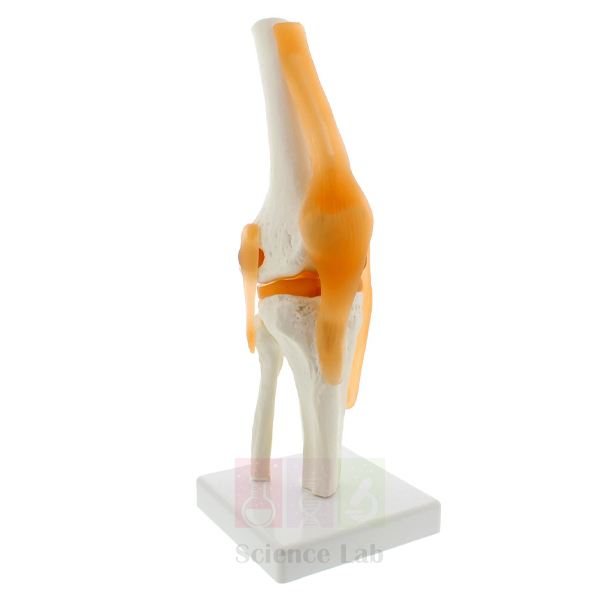
Human Knee Joint Model, Life Size
Human Knee Joint Model, Life Size (Product Code: SLE/BL/48) is a functional knee joint on a stand used to demonstrate flexion, extension and internal/external rotation in anatomy, physiotherapy and sports science teaching. Flexible artificial ligaments hold the joint together as it moves, and the model measures 12.5 × 12.5 × 32 cm. It is made by Jain Scientific Equipments Pvt Ltd (ScienceLab), an OEM manufacturer, at its own factory in Ambala, India, for college anatomy rooms and high school biology lab equipment lists.
Specifications
| Parameter | Detail |
|---|---|
| Joint represented | Human knee joint |
| Movements demonstrated | Flexion, extension, internal and external rotation |
| Ligaments | Flexible artificial ligaments included |
| Size | 12.5 × 12.5 × 32 cm |
| Scale | Life size |
| Mounting | On stand |
| Product code | SLE/BL/48 |
| Manufacturer | Jain Scientific Equipments Pvt Ltd (ScienceLab) — OEM |
| Country of origin | India (made in Ambala, Haryana) |
What Is the Knee Joint Model Used For?
Bend the model slowly from full extension into flexion and the class can watch how the ligaments tighten and slacken as the joint moves. With the knee partly bent, a gentle twist demonstrates the internal and external rotation that the knee allows only in flexion — a useful starting point for discussing twisting injuries in sport and why ligament tears are so common.
Clinics and physiotherapy departments use the same model at the bedside to explain a diagnosis or a rehabilitation exercise to a patient. In schools it supports the chapter on movement and locomotion, where students classify the knee as a hinge-type synovial joint. Move the joint within its natural range only; forcing it past its limits can overstretch the flexible ligaments.
OEM Manufacturer
Jain Scientific Equipments Private Limited, trading as ScienceLab, is the original equipment manufacturer (OEM) of this knee joint model and makes it at its own licensed factory at Saha, Ambala, Haryana, India. Physiotherapy colleges, schools, clinics, dealers and importers order it factory-direct, so the quotation comes from the maker rather than a reseller. If a ligament needs attention after years of demonstrations, ask us — spares enquiries are handled by the manufacturer itself. Visit the company profile to learn more.
Related Bone Models
Models that pair well with the knee for lower-limb teaching:
- Human Hip Joint Model — the joint above the knee, also with flexible ligaments, for a full lower-limb lesson
- Human Femur Bone Model — shows the thigh bone that forms the upper part of the knee
- 3D Printed Human Flexed Knee Joint — a detailed view of the knee held in flexion
- Human Joint Models — for comparing the knee with other joints of the body
See every joint, spine and skeleton model in the Bone Model category.
Frequently Asked Questions
Which movements can the Human Knee Joint Model, Life Size perform?
The Human Knee Joint Model, Life Size performs flexion, extension and internal/external rotation. Its flexible artificial ligaments hold the joint together through these movements, so a tutor can show how the knee bends, straightens and turns slightly when partly flexed.
How big is the knee joint model?
The Human Knee Joint Model, Life Size measures 12.5 × 12.5 × 32 cm and represents the knee at life size, mounted on a stand. That footprint fits on a teacher’s desk or a small demonstration table in a physiotherapy skills lab.
Can the knee be taken off the stand?
The description of the Human Knee Joint Model, Life Size says it is supplied on a stand but does not say whether it detaches. If a removable joint matters for your teaching, ask through our contact page and we will confirm before you order.
Are the knee model’s ligaments replaceable if they wear out?
For worn ligaments on the Human Knee Joint Model, Life Size, contact us with code SLE/BL/48. As the manufacturer, ScienceLab handles repair and spare-part enquiries itself and will advise what can be done for your model.
Who manufactures the Human Knee Joint Model, Life Size?
Jain Scientific Equipments Pvt Ltd, trading as ScienceLab, manufactures the Human Knee Joint Model, Life Size as the OEM at its own licensed factory at Saha, Ambala, Haryana, India. Institutions and dealers receive quotations directly from the manufacturer.
Is the knee model suitable for patient education in a clinic?
Yes. The Human Knee Joint Model, Life Size is life size and moves like a real knee, so clinicians can use it to explain ligament injuries, knee problems and rehabilitation exercises to patients as well as to students in a classroom.
Can you supply a set of joint models for a department?
Yes. The Human Knee Joint Model, Life Size can be quoted together with hip, shoulder, elbow and hand joint models for institutions in India and international markets. List the product codes and quantities, and ask about warranty terms in the same enquiry.
Request a Quote
Send your enquiry through the contact page, or collect this and other joint models in the enquiry cart and submit them together for a single quotation from the manufacturer.
Last updated: 24 September 2026
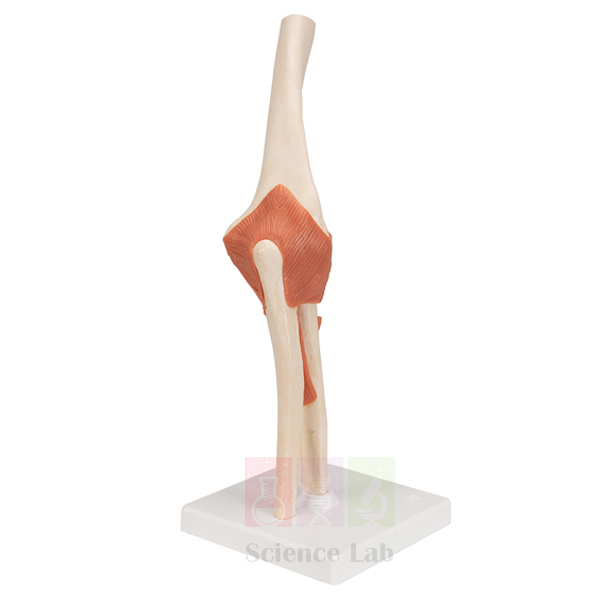
Human Elbow Joint Model
Human Elbow Joint Model (Product Code: SLE/BL/49) is an anatomical teaching model of the human elbow used to show how the humerus meets the radius and ulna in biology, nursing and physiotherapy classes. Teachers use it when covering the joints and movement of the upper limb, because a three-dimensional joint is far easier to follow than a flat textbook drawing. It is made by Jain Scientific Equipments Pvt Ltd (ScienceLab), an OEM manufacturer, at its own factory in Ambala, India.
Key Details
| Parameter | Detail |
|---|---|
| Type | Human anatomical joint model |
| Joint represented | Elbow joint of the human arm |
| Size, mounting and parts | Not stated in the current listing — please confirm with us before ordering |
| Product code | SLE/BL/49 |
| Manufacturer | Jain Scientific Equipments Pvt Ltd (ScienceLab) — OEM |
| Country of origin | India (made in Ambala, Haryana) |
What Is the Elbow Joint Model Used For?
The elbow is a synovial joint where three bones meet: the humerus of the upper arm and the radius and ulna of the forearm. The hinge between the humerus and ulna lets the arm bend and straighten, while the joint between the heads of the radius and ulna lets the forearm turn palm-up and palm-down. An elbow model helps students find each bone, link every movement to the bones that make it possible, and see why the elbow works mainly in one plane while the shoulder above it moves in many directions.
In physiotherapy, nursing and sports-science courses the model supports discussion of sprains, fractures around the joint and “tennis elbow”, and it helps a practitioner show a patient which part of the arm an exercise targets. As biology lab equipment in India for lessons on the skeleton, it can sit beside a full skeleton so learners place the elbow in context. Keep it covered, away from heat and direct sunlight, and clean it with a soft, slightly damp cloth.
OEM Manufacturer
ScienceLab, the trading name of Jain Scientific Equipments Private Limited, is the OEM behind this elbow model and makes it at its own licensed factory at Saha, Ambala, Haryana, India. Because the maker answers enquiries directly, schools, colleges, dealers and importers can confirm the current size, mounting and parts with the people who produce it before placing an order. See the company profile for more about the business.
Related Bone Models
Models that build a complete lesson on the upper limb:
- Human Elbow Cross-Section Model — shows the elbow region in section, linking surface anatomy to what lies beneath
- Human Shoulder Joint Model — the joint above the elbow, for contrasting a ball-and-socket joint with a hinge joint
- Human Hand Joint Model — continues the arm down to the joints of the hand
- Elbow Joint Model Human — another elbow model in the range, useful for extra student stations
More joint and skeleton models are listed in the Bone Model category.
Frequently Asked Questions
What does the Human Elbow Joint Model represent?
The Human Elbow Joint Model represents the human elbow, where the humerus of the upper arm meets the radius and ulna of the forearm. For an exact list of the parts and features on the current version, please ask us through the contact page before you order.
What size is the elbow model, and does it come on a stand?
The current listing for the Human Elbow Joint Model does not state its dimensions or mounting. Send us a request with code SLE/BL/49 and we will confirm the size, base and packed weight with your quotation, before you commit to an order.
Which movements happen at the elbow joint?
At the joint shown by the Human Elbow Joint Model, the arm bends and straightens at the humerus–ulna hinge, while the forearm turns palm-up and palm-down where the radius rotates against the ulna. Ask us whether the model itself moves before planning a demonstration.
Who manufactures the Human Elbow Joint Model?
Jain Scientific Equipments Pvt Ltd (ScienceLab) manufactures the Human Elbow Joint Model as the OEM at its own licensed factory at Saha, Ambala, Haryana, India. Quotations and specification questions are answered directly by the manufacturer, not by a trading intermediary.
How is the Human Elbow Joint Model different from the other elbow models you list?
The range also includes the Elbow Joint Model Human and the Human Elbow Cross-Section Model. Tell us your course level and teaching aim, and we will suggest whether the Human Elbow Joint Model or another option suits your lessons.
What should an institutional quotation request for the elbow model include?
A quotation request for the Human Elbow Joint Model should give code SLE/BL/49, the quantity, your delivery address in India or abroad and any tender or vendor-registration forms. Warranty terms and the confirmed specification can be included in the same reply.
Request a Quote
To order, add the Human Elbow Joint Model to the enquiry cart or send your requirement through our contact page. The manufacturer will reply with price, availability and the confirmed specification.
Last updated: 24 September 2026
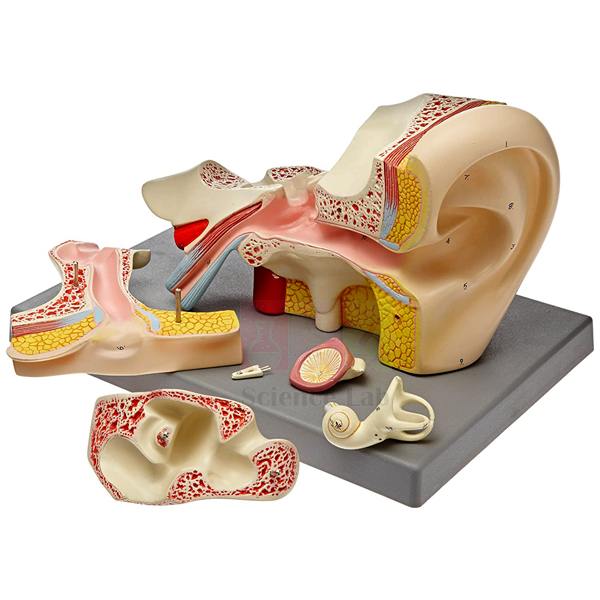
Human Ear Model, 5 Parts
The Human Ear Model, 5 Parts (Product Code: SLE/BL/50) is a dissectible model of the human ear, built 5–6 times larger than the natural ear so that small hearing structures can be pointed out clearly in front of a class. It separates into 5 parts, is coloured to distinguish the different structures, and is numbered with a key card. Schools, nursing colleges and audiology courses looking for an ear model for anatomy lab use in India choose it mainly for explaining how hearing works. It is manufactured by Jain Scientific Equipments Pvt Ltd (ScienceLab), Ambala, and supplied mounted on a base.
Specifications
| Parameter | Detail |
|---|---|
| Type | Dissectible human ear model |
| Number of parts | 5, dissectible |
| Enlargement | 5–6 times larger than the natural ear |
| Mounting | Mounted on a base |
| Finish | Appropriately coloured |
| Identification | Numbered, with key card |
| Teaching focus | Explaining the hearing mechanism |
Typical Use
The model is built for the lesson that asks, "How do we hear?" Teachers follow a sound wave from the outer ear, through the ear canal to the eardrum, across the tiny bones of the middle ear and into the inner ear, where vibrations are turned into nerve signals. Because the model is enlarged 5–6 times and comes apart into 5 pieces, students can see how the outer, middle and inner ear fit together and then examine each region in turn using the numbers and key card.
It works well in high school biology lab equipment sets for the sense organs chapter, and in nursing, speech therapy and audiology courses where ear anatomy underpins practical work. After each session, reassemble the 5 parts before storing so none go missing, keep the model covered to limit dust, and clean painted surfaces gently with a soft, slightly damp cloth.
Manufacturer
This ear model is made by Jain Scientific Equipments Private Limited, which operates in Ambala, Haryana, under the ScienceLab brand. The company is incorporated as a private limited company (CIN U29309HR2020PTC087597) and produces its range at a licensed factory at 449, HSIIDC Industrial Area, Saha, Ambala (Factory Licence AMB-ONLINE-CHD-J-414). You can read more on our company profile.
Related Laboratory Equipment
Items that pair with the Human Ear Model, 5 Parts in a hearing and balance lesson:
- Human Inner Ear Model, 18x — a far more magnified view of the inner ear alone for detailed study
- Human Inner Ear Model, 4x — a smaller inner-ear model suited to individual or small-group work
- Human Ear Model — an alternative ear model if you are equipping several benches
- Sight & Sound Health Lab — activity material on the senses of sight and hearing to follow the anatomy lesson
Browse our complete Human Models collection for other sense organ models.
Frequently Asked Questions
How many parts does the ear model separate into?
It is dissectible into 5 parts, which lets students look at individual regions of the ear and then put them back together.
How large is it compared with a real ear?
It is 5–6 times larger than the natural ear. Overall dimensions are not listed in our current details; contact us if you need them for cabinet planning.
How are the structures labelled?
Structures are numbered on the model and identified on the accompanying key card.
Is it suitable for explaining how hearing works?
Yes, that is its main purpose. The enlargement and removable parts make it straightforward to trace sound through the outer, middle and inner ear.
Can your company registration details be provided for vendor enrolment?
Yes. Our CIN and factory licence are listed above, and further registration details needed for tender or vendor forms can be requested through the contact page.
Do you supply ear models in quantity or for export?
Yes. We quote for classroom sets, college departments and distributors across India and international markets; warranty terms are confirmed on the quotation.
Request a Quote
Ask for pricing on the Human Ear Model, 5 Parts through our contact page, or add it to the enquiry cart together with the other sense organ models you need.
Last updated: 24 September 2026
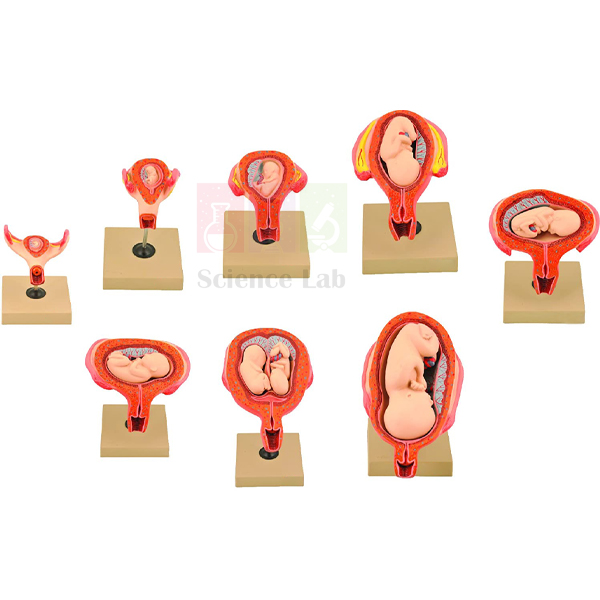
Human Embryo Development Set
The Human Embryo Development Set (Product Code: SLE/BL/51) is a series of models showing the fetus at different stages of the gestation period, from each of the first three months of pregnancy through to the fourth and fifth month, together with models of a breech presentation, a fetus lying on its back and twin five-month-old fetuses in the uterus. Each model is mounted on a base, coloured and numbered with a key card. It is produced by Jain Scientific Equipments Pvt Ltd (ScienceLab), an anatomical models manufacturer in Ambala, for biology departments, nursing and midwifery schools and medical colleges.
Specifications
| Parameter | Detail |
|---|---|
| Type | Set of fetal development models covering the gestation period |
| Models 1–3 | One model for each of the first three months of pregnancy |
| Model 4 | Fetus in the fourth to fifth month |
| Model 5 | Fetus in the breech position |
| Model 6 | Fetus lying on its back |
| Model 7 | Twin five-month-old fetuses in the uterus |
| Closer examination | Models 4–8 are described as allowing closer examination of the anatomical features that have developed |
| Mounting | Mounted on a base |
| Finish and identification | Appropriately coloured, numbered, with key card |
Typical Use
The set is laid out in order on the bench so students can walk along a timeline of pregnancy. The first three models show how quickly the embryo changes month by month early on; the fourth shows the more developed fetus of the fourth to fifth month. The remaining models move the discussion from growth to position: the breech model and the fetus on its back let tutors explain fetal presentation and why it matters as delivery approaches, while the twin model shows how two fetuses share the space of the uterus.
This makes the set especially useful in midwifery and obstetric nursing training, as well as in senior-school reproduction chapters. As part of a biology lab setup in schools in India, it is often shared between sections and kept in a closed cabinet; keep the key card with the set, dust the models with a soft brush and return each one to its place in the sequence after class.
Manufacturer
ScienceLab is the brand under which Jain Scientific Equipments Private Limited, based in Ambala, Haryana, makes and sells this development set and its other human anatomy teaching models. Visit the company profile to learn more about the company.
Related Laboratory Equipment
Models and aids that complete a pregnancy and birth lesson alongside this set:
- Human Embryo Set, PVC — a 10-part series showing the uterus and fetus for every month up to the ninth
- Embryo Model — the 4-week embryo, for the very start of the development timeline
- Human Placenta Model — explains how the fetus is supported through the placenta and umbilical cord
- Human Birth Demonstration Model — carries the lesson on from fetal position to the birth process
- Fetal Positions Before Birth — an additional teaching aid on presentations before delivery
Find further anatomy models in our Human Models category.
Frequently Asked Questions
Which stages of pregnancy does the set cover?
Models 1–3 each show one of the first three months, and model 4 shows the fetus in the fourth to fifth month. Further models show fetal positions and twins.
How many models are in the set?
Our product description details models 1 to 7 and also refers to models 4–8 for closer examination, so please confirm the exact piece count with us through the contact page before ordering.
Does the set show abnormal fetal positions?
Yes. Model 5 shows the breech position and model 6 shows the fetus lying on its back, alongside the standard developmental models.
Is a twin pregnancy included?
Yes. Model 7 shows twin five-month-old fetuses in the uterus.
How do students identify the structures?
The models are numbered and a key card is supplied, so students can check each numbered feature against its name.
What do you need to prepare a quotation?
Tell us the quantity of sets, the delivery address and your required timeline. We supply institutions and distributors in India and international markets, and warranty terms are confirmed in writing on the quotation.
Request a Quote
Request pricing for the Human Embryo Development Set on our contact page, or add it to the enquiry cart with any other development models you are considering.
Last updated: 24 September 2026
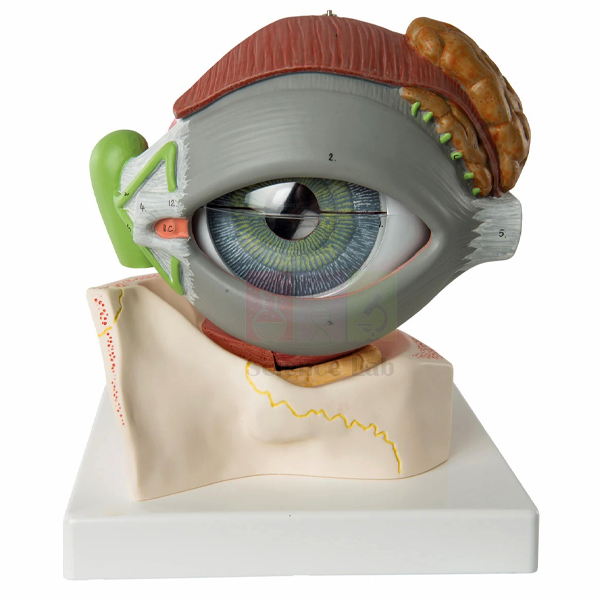
Human Eye Model with Eyelids
The Human Eye Model with Eyelids (Product Code: SLE/BL/52) is a 5x-enlarged model that shows the eyeball in its bony orbit together with the surrounding muscles, the eyelids, a tear duct and the lachrymal gland. The eyeball itself is horizontally sectioned, and the sclera with its clear cornea, as well as the muscles, can be removed. As an eye model for anatomy teaching in India, it goes a step beyond a plain eyeball by showing how the eye sits within and is served by the structures around it. It is manufactured by Jain Scientific Equipments Pvt Ltd (ScienceLab), Ambala, mounted on a base and numbered with a key card.
Specifications
| Parameter | Detail |
|---|---|
| Type | Eye-in-orbit model with eyelids |
| Enlargement | 5x |
| Structures included | Eyelids, bony orbit with muscles, tear duct, lachrymal gland |
| Eyeball | Horizontally sectioned |
| Removable parts | Sclera with clear cornea; muscles |
| Mounting and finish | Mounted on a base, appropriately coloured and nicely finished |
| Identification | Numbered, with key card |
Typical Use
The model is ideal for demonstrating the relationship between the eyeball and the musculature within the orbit. Tutors lift away the removable muscles to show where they attach and explain how they turn the eye in different directions, then remove the sclera and clear cornea to reveal the horizontally sectioned interior. The eyelids, lachrymal gland and tear duct add a second strand to the lesson: how the eye is protected and kept moist, and where tears are produced and drained.
Optometry, ophthalmic assistant and nursing students use it for these accessory structures, while senior school classes use it in the sense organs chapter. ScienceLab supplies it as part of the biology lab equipment range that institutions across India order for sense organ teaching. Handle the clear cornea by its edges to avoid scratches, clean it with a soft lint-free cloth, and keep the removable parts together on the base when the model is not in use.
Manufacturer
Jain Scientific Equipments Private Limited manufactures this eye model and markets it as ScienceLab from Ambala, Haryana, where the company designs and builds teaching models for biology and medical education. The company profile has the full background.
Related Human Models
Other eye models that suit the same vision and sense organ lessons:
- Human Eye in Orbit Model — another orbit-based design for comparing how the eye is held in the skull
- Human Eye Model — concentrates on the eyeball itself when the accessory structures are not needed
- Eye Microanatomy Model — takes the lesson down to the tissue-level structure of the eye
- Cataract Eye Model with 4 Forms of Cataract — links normal eye anatomy to a common clinical condition
The full Human Models range lists all our anatomy teaching models.
Frequently Asked Questions
How is this different from a standard eyeball model?
It includes the eyelids, bony orbit with muscles, tear duct and lachrymal gland, so it shows the eye in its surroundings rather than on its own.
How much is the eye enlarged?
The model is 5x enlarged. For overall dimensions, please contact us.
Which parts can be removed?
The sclera with clear cornea and the muscles are removable, and the eye itself is horizontally sectioned to show its interior.
Does it explain the tear system?
Yes. The lachrymal gland and tear duct are included, which lets tutors cover tear production and drainage in the same lesson.
Is a key to the numbered structures supplied?
Yes, the model is numbered and comes with a key card.
Can we order this for several labs or for export?
Yes. Quotations are prepared for single pieces, department sets and distributors in India and international markets, with warranty terms stated on the quotation.
Request a Quote
Send your requirement for the Human Eye Model with Eyelids through the contact page, or add it to the enquiry cart along with other eye models for a combined quotation.
Last updated: 24 September 2026
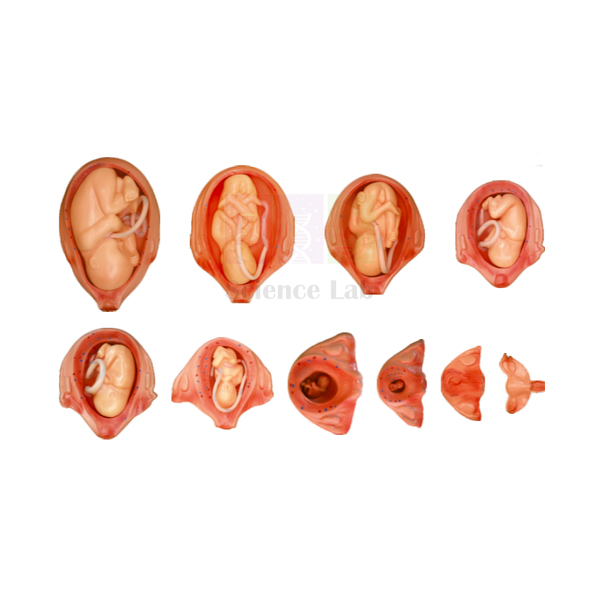
Human Embryo Set, PVC
The Human Embryo Set, PVC (Product Code: SLE/BL/53) is a 10-part model series that shows the relationship between the fetus and the uterus across the whole gestation period, beginning with a normal uterus and then covering each month of pregnancy up to the ninth. The parts are made of PVC and synthetic rubber. Made by Jain Scientific Equipments Pvt Ltd (ScienceLab) in Ambala, one of the human anatomical models manufacturers in India serving schools and colleges, the set is used in biology, nursing and midwifery teaching wherever a month-by-month picture of pregnancy is needed.
Specifications
| Parameter | Detail |
|---|---|
| Type | Embryo and fetus development series showing fetus and uterus |
| Number of parts | 10 |
| Material | PVC and synthetic rubber |
| Part 1 | Normal uterus, inner genitals |
| Part 2 (first month) | Placenta is shown |
| Part 3 (second month) | Embryo looks like a human |
| Part 4 (third month) | Fetus about 9 cm |
| Part 5 (fourth month) | Fetus about 16 cm |
| Part 6 (fifth month) | Fetus about 25 cm |
| Part 7 (sixth month) | Fetus about 30 cm |
| Part 8 (seventh month) | Fetus about 35 cm |
| Part 9 (eighth month) | Fetus about 40 cm |
| Part 10 (ninth month) | Fetus about 45 cm |
Typical Use
Because every month of pregnancy has its own part, the set is ideal for a growth-timeline activity. Students arrange the 10 parts in order, starting from the normal uterus, and note how the uterus changes as the fetus grows. The fetal heights listed for each stage — from about 9 cm in the third month to about 45 cm in the ninth — can be plotted on a simple graph, turning a descriptive topic into a data exercise. Tutors also use the second and third parts to discuss when the placenta appears and when the embryo takes on a recognisably human form.
In nursing and midwifery training the set supports antenatal teaching, where students must relate the month of pregnancy to what is happening inside the uterus. It also suits health education programmes in schools in India that cover pregnancy and prenatal care. Store the parts in order so the sequence is ready for the next class, and clean the PVC and rubber surfaces with a damp cloth only.
Manufacturer
The set is manufactured in Ambala, Haryana, by Jain Scientific Equipments Private Limited — the company behind the ScienceLab trading name — whose catalogue covers reproductive, developmental and other human anatomy models. See our company profile for more information.
Related Laboratory Equipment
These models round out a pregnancy and development module built around the 10-part set:
- Human Embryo Development Set — adds fetal positions such as breech and a twin pregnancy
- Embryo Model — a closer look at the 4-week embryo that precedes the later parts of this set
- Human Placenta Model — expands on the placenta introduced in part 2
- Human Birth Demonstration Model — continues the story after the ninth month
- Female Pelvis with Organs — places the uterus in the context of the surrounding pelvic organs
All our anatomy teaching models are grouped in the Human Models category.
Frequently Asked Questions
How many parts are in the Human Embryo Set?
There are 10 parts: a normal uterus followed by one part for each month of gestation from the first to the ninth.
What material is it made from?
The set is made of PVC and synthetic rubber, which can be wiped clean with a damp cloth.
Are fetal sizes given for each stage?
Yes. The reference heights run from about 9 cm (third month) to about 45 cm (ninth month). For the physical dimensions of the model parts themselves, please contact us.
At which stage is the placenta shown?
The placenta is shown in part 2, which represents the first month of gestation.
Is it suitable for midwifery and nursing courses?
Yes. Relating each month of pregnancy to the fetus and uterus is central to antenatal teaching, and the set is organised exactly that way.
Can we place a biology model kit bulk order that includes this set?
Yes. We quote combined orders for institutions and distributors in India and international markets. Include quantities, delivery address and any documentation required; warranty terms are confirmed on the quotation.
Request a Quote
Ask for a quotation on the Human Embryo Set, PVC through the contact page, or add it to the enquiry cart with the other development models on your list.
Last updated: 24 September 2026