- Physics Lab Equipment
- Chemistry Lab Equipment
- Biology Lab Equipment
- Anatomical Lab Equipment
- Learning
- Educational Lab Equipment
- Magnets
- Agriculture
- Astronomy
- Earth Science
- Geography Lab Equipment
- Safety Lab Coat
- Laboratory
- Meteorological
- Electricity & Magnetism
- Heat
- School Lab Equipment
- Lab Glassware
- Science Lab Equipment
- Tvet Lab Equipment
- Robotics Kits Supplier and Manufacturer for Schools India
- Math Lab Equipment Manufacturers and Exporters in Ambala
- STEM Kits Manufacturers and Supplier India
- Engineering Lab Equipment
- Hospital Lab Equipment
- Water, Sanitation & Hygiene Supplies
- Cold Chain, Solar & Communication Equipment
- Nutrition
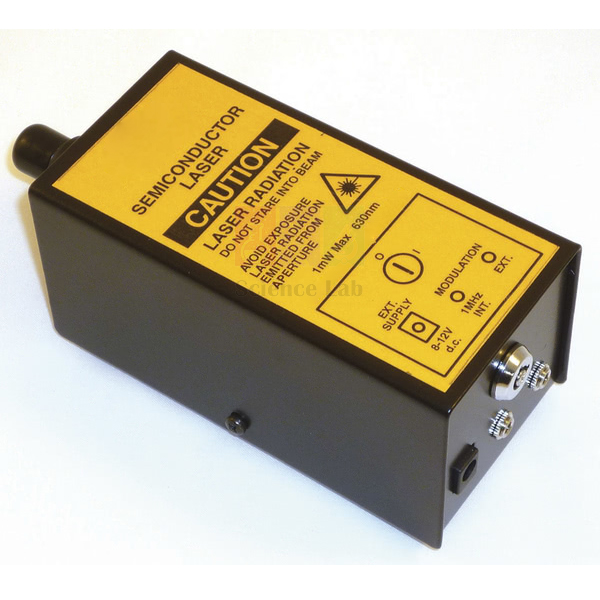
Semiconductor Laser
Semiconductor Laser (Product Code: SLE/PHY/291) is a red diode laser used for optics, speed of light and optical communication experiments in school and college physics laboratories. It emits an intense monochromatic beam at 630 - 640 nm and 0.9 mW (Class II operation), which can be modulated from an external waveform or by its own internal pulse generator. It is supplied by Jain Scientific Equipments Pvt Ltd (ScienceLab), Ambala, India, as a laser experiment kit component for institutions.
Specifications
| Parameter | Detail |
|---|---|
| Beam | Intense, monochromatic red beam |
| Wavelength | 630 - 640 nm |
| Output power | 0.9 mW (Class II operation) |
| Beam divergence | Typically about 1 milliradian |
| External modulation | Digital or analogue waveform applied to the 3.5mm jack socket on the rear panel |
| Internal modulation | Internal generator producing 0.1 µs pulses at approximately 1 MHz |
| Main application | Speed of light experiments; general optics work |
| Product code | SLE/PHY/291 |
| Supplied by | Jain Scientific Equipments Pvt Ltd (ScienceLab), Ambala, India |
What Is the Semiconductor Laser Used For?
The feature that sets this laser apart is modulation. Switched to its internal generator, it sends short 0.1 µs light pulses at about 1 MHz; students place a fast photodetector near the laser and another at the far end of a measured path, display both signals on a dual-trace oscilloscope, and read the delay to calculate the speed of light. Feeding an audio or digital signal into the 3.5mm rear jack instead turns the beam into a simple optical communication link.
Unmodulated, the narrow, low-divergence red beam is ideal for single-slit, double-slit and diffraction grating work, for tracing reflection and refraction through blocks and prisms, and for aligning optical benches. At Class II output the natural blink reflex normally protects the eye, but students should still never look into the beam, point it at people or let it bounce off shiny surfaces towards the class.
What to Specify When Ordering
- Number of Semiconductor Laser units required.
- Whether you plan speed of light work and need an oscilloscope and detectors quoted as well.
- Your modulation source for external signals, such as a signal generator.
- Mains supply voltage at the point of use, so we can confirm the right power arrangement.
Supplier
ScienceLab, the trading name of Jain Scientific Equipments Private Limited in Ambala, Haryana, India, supplies this semiconductor laser to schools, colleges, universities and dealers. We can build a complete optics or speed of light bench around it, with the oscilloscope, optical bench and mirrors listed on our site, and send one consolidated quotation. Read about the company on our profile page.
Related Physics Lab Equipment
Items commonly used with the Semiconductor Laser:
- Oscilloscope Dual Trace — displays sent and received pulses for the speed of light delay.
- Signal Generator and Amplifier — external waveform source for the modulation jack.
- Optical Bench Set — holds slits, lenses and screens in line with the beam.
- Mirror, Plane Glass — folds the beam to lengthen the path in a small room.
- Laser Pen, Red — simple pointer-type laser for basic ray work.
See the wider optics range in Physics Lab Equipment.
Frequently Asked Questions
What wavelength and power does the Semiconductor Laser have?
The Semiconductor Laser emits an intense monochromatic red beam of wavelength 630 - 640 nm at 0.9 mW, corresponding to Class II operation. Its typical beam divergence is about 1 milliradian, giving a narrow spot over long bench distances.
How is the Semiconductor Laser modulated?
The Semiconductor Laser can be modulated by an external digital or analogue waveform applied to the 3.5mm jack on its rear panel. Alternatively, its internal generator produces 0.1 µs pulses at approximately 1 MHz, which suits speed of light measurements.
Can the Semiconductor Laser measure the speed of light?
Yes, the Semiconductor Laser is designed to make speed of light experiments straightforward. Its short internal pulses travel a measured path to a detector, and the delay seen on a dual-trace oscilloscope gives the speed. The detector and oscilloscope are quoted separately.
Is the Semiconductor Laser safe for classroom use?
The Semiconductor Laser operates at Class II, a low power level normally protected by the eye’s blink reflex. Teachers should still prevent anyone from staring into the beam, avoid shiny reflecting surfaces in the beam path and supervise students throughout the practical.
What mains supply does the Semiconductor Laser need?
The supply voltage for the Semiconductor Laser is not listed here, so please tell us the mains voltage used in your laboratory through the contact page. We will confirm the correct power arrangement before quoting.
Who supplies the Semiconductor Laser?
The Semiconductor Laser is supplied by Jain Scientific Equipments Pvt Ltd (ScienceLab), based in Ambala, Haryana, India. We supply schools, colleges, universities and dealers in India and international markets, often as part of a complete optics bench.
Request a Quote
Get a quotation for the Semiconductor Laser by writing to us through the contact page, or add it and any matching items to the enquiry cart and submit a single enquiry.
Last updated: 24 September 2026
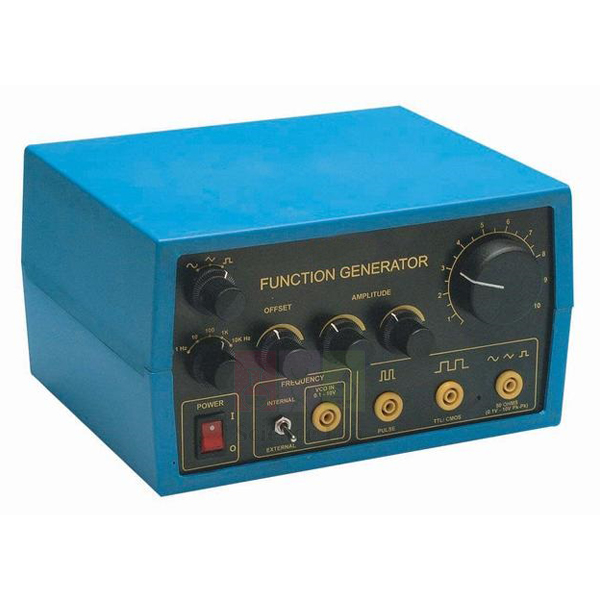
Signal Generator & Amplifier
Signal Generator & Amplifier (Product Code: SLE/PHY/292) is a bench function generator used to produce sine, square, triangular, pulse and TTL/CMOS signals for electronics and physics experiments in schools, colleges and training labs. It covers 1 Hz to 100 kHz in five ranges, and all of its outputs can be used at the same time. It is supplied by Jain Scientific Equipments Pvt Ltd (ScienceLab), Ambala, India, as a function generator for lab use in India and international markets.
Specifications
| Parameter | Detail |
|---|---|
| Waveforms | Sine, square, triangular, pulse and TTL/CMOS-compatible square wave |
| Frequency range | 1 Hz to 100 kHz, adjustable |
| Range steps | Five steps: 1 Hz, 10 Hz, 100 Hz, 1 kHz and 10 kHz, with a x10 multiplier |
| Amplitude control | Coarse and fine controls on the front panel |
| Simultaneous outputs | Pulse, TTL/CMOS and sine/square/triangular outputs all available at once on the front panel |
| Pulse and TTL/CMOS level | Fixed amplitude, compatible with TTL/CMOS logic |
| VCO input | Output frequency follows a DC voltage of 0.1 V to 10 V at the VCO IN socket, with the toggle switch set to external |
| Mains input | 120 V, 60 Hz or 240 V, 50/60 Hz (selectable) |
| Dimensions | 215 x 180 x 130 mm (W x D x H) |
| Weight | About 1.5 kg |
| Product code | SLE/PHY/292 |
| Supplied by | Jain Scientific Equipments Pvt Ltd (ScienceLab), Ambala, India |
What Is the Signal Generator Used For?
A function generator is the standard signal source for an electronics bench. Students feed its sine output into RC and LC circuits to plot frequency response and find resonance, use the square wave to watch capacitor charging on an oscilloscope, and drive counters, flip-flops and logic gates directly from the TTL/CMOS output. Because the pulse, TTL/CMOS and analogue outputs work simultaneously, one unit can clock a digital circuit while also supplying a test signal.
The VCO input adds a useful extra: a DC voltage between 0.1 V and 10 V sets the output frequency, so students can demonstrate frequency modulation or sweep a filter by hand with a potentiometer. In physics lessons the signal generator for electronics labs doubles as the test source for sound and interference demonstrations, and we can advise on driving a loudspeaker directly. Start with the amplitude low, choose the range step first and then fine-tune the frequency.
What to Specify When Ordering
- Number of Signal Generator & Amplifier units, typically one per bench.
- Mains voltage at your site: 120 V, 60 Hz or 240 V, 50/60 Hz.
- Any power output you need for loudspeakers or vibrators, so we can confirm suitability.
- Whether an oscilloscope and leads should be quoted with the generator.
Supplier
ScienceLab is the trading name of Jain Scientific Equipments Private Limited, Ambala, Haryana, which supplies this signal generator to schools, engineering colleges, polytechnics and dealers. For vendor registration, the supplying company is registered under GSTIN 06AAECJ8618A1ZT, and export consignments are shipped under Importer-Exporter Code AAECJ8618A issued by the DGFT. More company information is on our profile page.
Related Physics Lab Equipment
Complete an electronics or waves bench with the Signal Generator & Amplifier:
- Oscilloscope Dual Trace — displays the generator output and the circuit response together.
- Loudspeaker Unit — turns the sine output into sound for wave demonstrations.
- Semiconductor Laser — its modulation jack accepts the generator’s analogue or digital signal.
- Signal Generator And Amplifier (European Version) — model with a 4.5 W power output and digital frequency display.
Browse more instruments in Physics Lab Equipment.
Frequently Asked Questions
What frequency range does the Signal Generator & Amplifier cover?
The Signal Generator & Amplifier covers 1 Hz to 100 kHz. The range is selected in five steps of 1 Hz, 10 Hz, 100 Hz, 1 kHz and 10 kHz with a x10 multiplier, and the frequency is then adjusted within each step.
Which waveforms does the Signal Generator & Amplifier produce?
The Signal Generator & Amplifier produces sine, square and triangular waves plus pulse and TTL/CMOS-compatible square wave outputs. The pulse, TTL/CMOS and analogue outputs are available at the same time on the front panel and can be used together.
What does the VCO input on the Signal Generator & Amplifier do?
The VCO input on the Signal Generator & Amplifier lets a DC voltage of 0.1 V to 10 V control the output frequency. Set the toggle switch to external mode and apply the voltage to the VCO IN socket.
Does the Signal Generator & Amplifier work on 120 V and 240 V mains?
Yes, the Signal Generator & Amplifier has a selectable mains input for 120 V, 60 Hz or 240 V, 50/60 Hz. Set the selector to match your local supply before switching on for the first time.
What power output does the amplifier section provide?
Power output figures for the amplifier section of the Signal Generator & Amplifier are not listed in the product details. If you need to drive a loudspeaker, vibrator or other load, tell us the load through the contact page and we will confirm suitability.
Who supplies the Signal Generator & Amplifier?
The Signal Generator & Amplifier is supplied by Jain Scientific Equipments Pvt Ltd (ScienceLab) of Ambala, Haryana, India. We supply schools, colleges, polytechnics and dealers across India and international markets, and can quote it with oscilloscopes and leads.
Request a Quote
Ask for a quotation on the Signal Generator & Amplifier through our contact page, or place it in the enquiry cart along with the rest of your bench equipment and send one request.
Last updated: 24 September 2026
238.jpg)
Signal Generator And Amplifier (European Version)
Signal Generator And Amplifier (European Version) (Product Code: SLE/PHY/293) is a power signal generator used to drive loudspeakers, vibrators and other low-impedance loads in physics and electronics laboratories. It spans 0.1 Hz to 99.9 kHz on a digital display with 0.01% frequency accuracy and delivers up to 4.5 W across the whole range for every waveform. It is supplied by Jain Scientific Equipments Pvt Ltd (ScienceLab), Ambala, India, for laboratories on 220 - 240 V, 50 Hz mains.
Specifications
| Parameter | Detail |
|---|---|
| Frequency range | 0.1 Hz to 99.9 kHz in six decades, read on a digital display |
| Frequency accuracy | 0.01% (100 ppm) on all ranges |
| Waveforms | Sine, rectangular and triangular |
| Maximum power output | 4.5 W over the entire frequency range for all waveforms; maximum power transfer into a 4 ohm load |
| High impedance output | Up to 17 V peak to peak from an internal source impedance of 600 ohm |
| Low impedance output | 6 V RMS at 4 ohm (about 8.8 V peak for all waveforms) |
| Amplitude control | Zero to maximum in 256 increments, shown on a 10-segment bar graph |
| Attenuation | x1, x0.1, x0.01 (±1%), on the 600 ohm output only |
| Amplifier | Voltage gain 100; frequency response DC to 100 kHz (-3 dB), 4.5 W into a 4 ohm load |
| Settings memory | All control settings except amplitude are stored and updated on any change |
| Output protection | Withstands a prolonged short circuit on the output |
| Earthing | Earth terminal connected to physical earth through the power cord; signal output floating with respect to ground |
| Mains supply | 220 - 240 V, 50 Hz |
| Internal fuse | T315mA L |
| Dimensions | Approx. 210 x 155 x 118 mm (L x W x D) |
| Weight | Approx. 2.05 kg without power cord |
| Product code | SLE/PHY/293 |
| Supplied by | Jain Scientific Equipments Pvt Ltd (ScienceLab), Ambala, India |
What Is the Power Signal Generator Used For?
Its 4.5 W low-impedance output is what makes this generator useful in physics. It can drive a vibration generator for standing waves on strings, a loudspeaker for sound interference and resonance tube work, or the coil of a reed relay for capacitor charging experiments. The digital display and 0.01% accuracy mean students read the frequency straight from the panel, without a separate counter, which speeds up graph-based practicals such as frequency against tension or length.
For electronics, the 600 ohm high-impedance output with its x0.1 and x0.01 attenuators provides small, clean signals for amplifier and filter circuits. Because the signal output floats with respect to ground, decide which terminal connects to the oscilloscope earth before measuring. The unit tolerates an accidental short circuit on the output, but it should never be opened by users; refer any fault to us for advice.
What to Specify When Ordering
- Number of units required for your laboratories.
- Confirmation that your mains supply is 220 - 240 V, 50 Hz; if not, ask us about an alternative model.
- The loads you plan to drive, such as loudspeakers or vibration generators.
- Whether oscilloscopes, leads or vibrators should be added to the quotation.
Supplier
This power signal generator is supplied by ScienceLab, the trading name of Jain Scientific Equipments Private Limited of Ambala, Haryana, India. We supply it to universities, colleges, schools and dealers, and can match it with the vibrators, loudspeakers and oscilloscopes used in the same experiments so the bench arrives complete. Find out more on our company profile.
Related Physics Lab Equipment
Loads and instruments that work with the Signal Generator And Amplifier (European Version):
- Vibration Generator — driven by the power output for standing waves on strings.
- Loudspeaker Unit — converts the output to sound for interference and resonance work.
- Reed Relay — switched by a power signal generator to charge and discharge capacitors.
- Oscilloscope Dual Trace — shows the waveform and the circuit response side by side.
- Signal Generator & Amplifier — function generator with selectable 120 V or 240 V mains input.
View the complete Physics Lab Equipment range.
Frequently Asked Questions
What frequency range and accuracy does the Signal Generator And Amplifier (European Version) offer?
The Signal Generator And Amplifier (European Version) covers 0.1 Hz to 99.9 kHz in six decades, shown on a digital display. Frequency accuracy is 0.01% (100 ppm) on all ranges, so readings can be taken directly from the panel.
How much power can the Signal Generator And Amplifier (European Version) deliver?
The Signal Generator And Amplifier (European Version) delivers a maximum of 4.5 W over its entire frequency range for all waveforms. Maximum power transfer occurs into a 4 ohm load, where the low-impedance output gives 6 V RMS.
What is the difference between the two outputs on the Signal Generator And Amplifier (European Version)?
The Signal Generator And Amplifier (European Version) has a low-impedance power output for loads around 4 ohm, and a high-impedance output of up to 17 V peak to peak from 600 ohm. Only the 600 ohm output has the x1, x0.1 and x0.01 attenuator.
What mains supply does the Signal Generator And Amplifier (European Version) need?
The Signal Generator And Amplifier (European Version) runs on 220 - 240 V, 50 Hz mains and is protected by an internal T315mA L fuse. Its earth is connected through the power cord, while the signal output floats with respect to ground.
Is the Signal Generator And Amplifier (European Version) protected against short circuits?
Yes, the Signal Generator And Amplifier (European Version) is a robust instrument that withstands a prolonged short circuit on its output. Users should not open the case; if a fault appears, contact us through the contact page for advice.
Who supplies the Signal Generator And Amplifier (European Version)?
The Signal Generator And Amplifier (European Version) is supplied by Jain Scientific Equipments Pvt Ltd (ScienceLab), Ambala, Haryana, India. We supply laboratories and dealers in India and international markets and can quote matching vibrators, loudspeakers and oscilloscopes.
Request a Quote
Request a price for the Signal Generator And Amplifier (European Version) through the contact page, or add it to the enquiry cart together with the loads you plan to drive.
Last updated: 24 September 2026
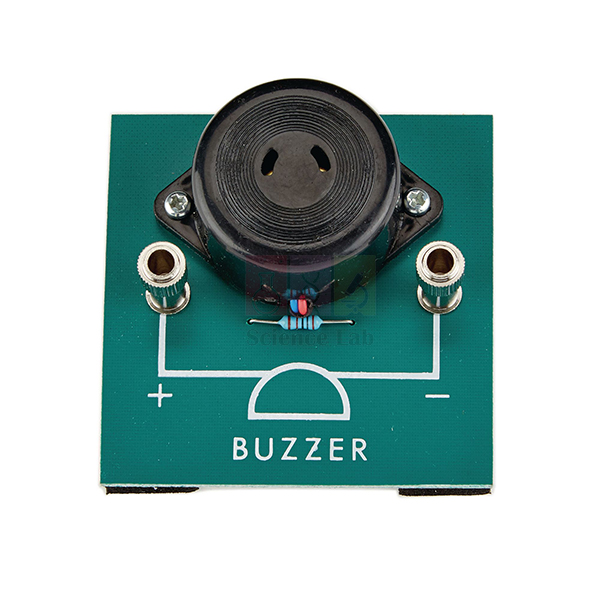
Simple Circuit Module Buzzer
Simple Circuit Module Buzzer (Product Code: SLE/EM/28) is a base-mounted buzzer from the Simple Circuit Modules series. Because it is a low-current buzzer of about 2mA capacity, it sounds even when only a very small current flows, so pupils can hear at once whether the circuit they have built is complete. Primary and secondary teachers use it in electricity experiment kit lessons on circuits, switches and simple alarms. It is made by Jain Scientific Equipments Pvt Ltd (ScienceLab), Ambala, India.
Specifications
| Parameter | Detail |
|---|---|
| Series | Simple Circuit Modules |
| Component | Low-current buzzer |
| Current capacity | 2mA approx. |
| Mounting | On base |
| Companion module in the same series | LED boards: large light-emitting diodes with a 220 ohm series resistor, for p.d.s of up to 6V |
Typical Use
Since it needs only around 2mA, the buzzer still sounds in circuits with fairly high resistance. That makes it handy for continuity checks, for testing whether materials such as pencil graphite or salt water conduct, and for alarm circuits in which a push switch, reed relay or sensor board sets it off. Younger pupils can build a cell-switch-buzzer loop in minutes and then add a second module to see how the circuit changes.
Pairing the buzzer with an LED board from the same series gives a circuit that signals with both sound and light, a popular combination for door-alarm and quiz-buzzer projects. If the module is marked with polarity, connect it the right way round, and run it from the low-voltage cells used in normal class work.
Manufacturer
The buzzer module is one of the Simple Circuit Modules produced by Jain Scientific Equipments Private Limited, which trades as ScienceLab from Ambala, Haryana. Learn more about the company on our profile page.
Related Laboratory Equipment
Modules and parts that combine with the buzzer:
- Simple Circuit Module Push Switch — sounds the buzzer on demand
- Simple Circuit Module LED Board Red — a visual indicator to use alongside the buzzer
- Simple Circuit Module Reed Relay — lets a magnet or a second circuit trigger the buzzer
- Simple Circuit Module Lamp Holder — a lamp module for comparing indicators
- Banana/Alligator Cords — leads for linking modules together
More items are listed in the Electricity Equipments category.
Frequently Asked Questions
How much current does the buzzer draw?
It is a low-current buzzer of approximately 2mA capacity.
What supply voltage should I use?
A voltage rating for the buzzer is not given in our current listing; contact us for it, and use low-voltage cells in the meantime.
Is the buzzer mounted?
Yes. The buzzer is mounted on a base, which keeps it steady on the bench during experiments.
Does it come with an LED board?
The LED boards are a companion module in the same series. Please confirm in your enquiry whether you need them, and we will include them in the quotation.
Which modules work well with it?
Push switches, LED boards, lamp holders and the reed relay from the Simple Circuit Modules series combine naturally with the buzzer.
Can I order module sets for a whole class?
Yes. We supply schools, distributors and tender buyers in India and international markets; list the modules and quantities you need.
Request a Quote
Price your buzzer modules through our contact page or add them to the enquiry cart.
Last updated: 24 September 2026
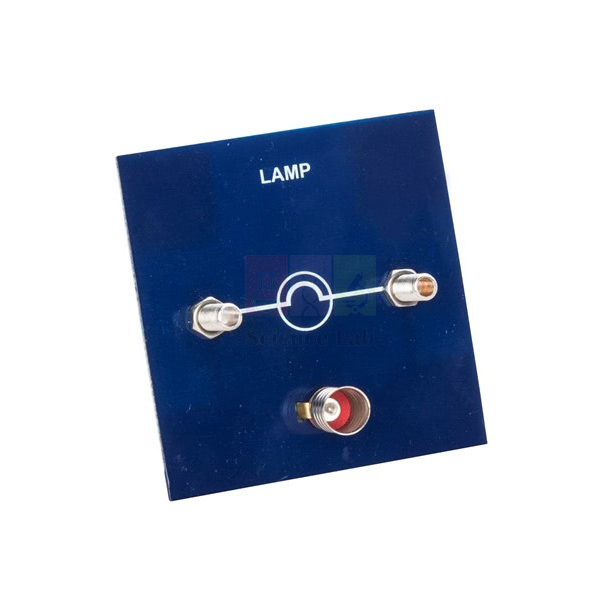
Simple Circuit Module Lamp Holder
Simple Circuit Module Lamp Holder (Product Code: SLE/EM/29) is the lamp unit of the Simple Circuit Modules series: a 4.5V / 0.3A bulb in a holder that lights to show when current is flowing and glows brighter or dimmer as the circuit changes. It is used in school physics lab equipment sets in India for series and parallel circuits, and as the classic non-ohmic example in Ohm’s law practicals. It is made by Jain Scientific Equipments Pvt Ltd (ScienceLab), Ambala, India.
Specifications
| Parameter | Detail |
|---|---|
| Series | Simple Circuit Modules |
| Bulb rating | 4.5V / 0.3A |
| Supplied as | Bulb in a holder |
| Companion module in the same series | LED boards: large light-emitting diodes with a 220 ohm series resistor, for p.d.s of up to 6V |
Typical Use
With two lamp modules, pupils see series and parallel behaviour directly: in series both lamps glow dimmer than one alone, while in parallel each keeps its full brightness and removing one leaves the other lit. In older classes, measuring current at several voltages up to the 4.5V rating and plotting current against voltage shows the curved graph typical of a filament lamp, a useful contrast with a fixed resistor in any Ohm’s law experiment kit.
Do not exceed the bulb’s 4.5V rating, or the filament may fail; set the supply before connecting and let a hot bulb cool before handling it. Where a lesson only needs an on/off indicator, the companion LED boards in the same series draw far less current than the 0.3A filament lamp.
Manufacturer
ScienceLab is the trading name of Jain Scientific Equipments Private Limited, the Ambala, Haryana maker of this lamp module and the rest of the Simple Circuit Modules. Our company profile explains more about the business.
Related Laboratory Equipment
Useful partners for lamp-circuit lessons:
- Simple Circuit Module LED Board Green — a low-current light indicator for comparison with the filament lamp
- Simple Circuit Module Push Switch — switches the lamp circuit
- Simple Circuit Module Buzzer — an audible indicator in the same series
- Digital Multimeter — for current and voltage readings on the lamp
- Lamp Holder (Economy Switch) — a separate plastic-base lamp holder with Fahnestock clips
Browse the Electricity Equipments category for more modules and accessories.
Frequently Asked Questions
What bulb is fitted?
A 4.5V / 0.3A bulb, supplied in its holder.
Can I use a higher supply voltage?
No. Keep the voltage across the lamp at or below its 4.5V rating to avoid blowing the filament.
Are replacement bulbs available?
Please contact us to confirm replacement bulb supply when you order.
Should I choose the lamp module or an LED board?
Choose the lamp to teach brightness, power and filament behaviour; choose an LED board (220 ohm series resistor, for p.d.s up to 6V) for a low-current on/off indicator. Many teachers use both.
Is a calibration or test report provided?
The lamp module is a teaching component rather than a measuring instrument; if you need documentation for a tender, discuss it with us.
Can you supply class quantities?
Yes, to schools, distributors and tender buyers across India and international markets. Send the module list and quantities for a quotation.
Request a Quote
Request pricing for the lamp module via our contact page or through the enquiry cart.
Last updated: 24 September 2026
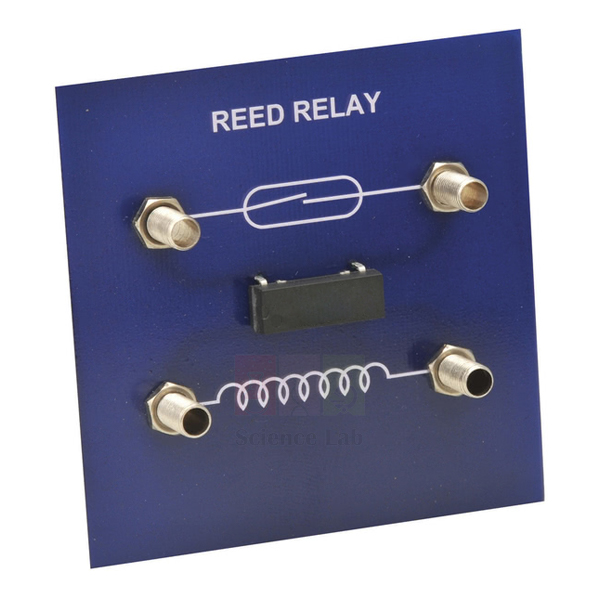
Simple Circuit Module Reed Relay
Simple Circuit Module Reed Relay (Product Code: SLE/EM/30) lets one circuit switch another. A current through the relay coil produces magnetism that makes the reed switch a second, separate circuit, and a series resistor protects the reed contacts from short-circuit damage. Teachers use it to show electromagnetic switching in action and to build simple control circuits, making it a practical part of any electromagnetic kit for schools and colleges. It is made by Jain Scientific Equipments Pvt Ltd (ScienceLab), Ambala, India.
Key Details
| Parameter | Detail |
|---|---|
| Type | Reed relay module, Simple Circuit Modules series |
| Operating principle | Current through the coil produces magnetism that causes the reed to switch another circuit |
| Contact protection | Series resistor protects the reed contacts from short-circuit damage |
| Purpose | Demonstrating electromagnetic switching and relay control circuits |
| Suitable for | School and college physics and basic electronics practicals |
Typical Use
A typical layout uses two circuits. In the first, a cell and a push switch drive the relay coil; in the second, the reed contacts sit in a loop containing a buzzer or LED board with its own supply. Pressing the switch energises the coil, the reed switches and the buzzer or LED responds — showing how a small control current can operate a separate load, the same idea used in door alarms and automatic lighting. Bringing a bar magnet close to the relay also operates the reed, a neat way to link the lesson back to magnetism.
Keep both circuits on low-voltage supplies and wire the control side and the switched side clearly apart so students can trace each loop. Thanks to the protective series resistor, an accidental short on the switched side is less likely to damage the reed contacts, which suits hands-on student work. The coil’s operating voltage is not stated in our listing, so check it with us before choosing a supply.
Manufacturer
Jain Scientific Equipments Private Limited, trading as ScienceLab, makes this reed relay module in Ambala, Haryana. For institutional vendor registration, the company’s GSTIN is 06AAECJ8618A1ZT and its Legal Entity Identifier (LEI) is 3358004HRD1JIVXKYX49. See our company profile for more.
Related Laboratory Equipment
Modules for building relay control circuits:
- Simple Circuit Module Push Switch — operates the relay coil in the control circuit
- Simple Circuit Module Buzzer — a low-current load for the relay to switch
- Simple Circuit Module LED Board Red — a visual indicator on the switched circuit
- Simple Circuit Module Light Dependent Resistor Board — a sensor module for light-controlled circuit projects
- Reed Relay — a separate reed relay in our physics range
The full Electricity Equipments category has more modules and accessories.
Frequently Asked Questions
How does the reed relay work?
Current in the coil produces magnetism, which operates the reed and switches a second, independent circuit.
What protects the contacts?
A series resistor protects the reed contacts from short-circuit damage.
What coil voltage and contact rating does it have?
These values are not given in our current listing; contact us for them before planning your circuits.
Can it switch mains-powered equipment?
No. It is a teaching module for low-voltage circuits and should not be connected to mains supplies.
Which modules does it work with?
It belongs to the same Simple Circuit Modules series as the buzzer, lamp holder and LED boards, so these make natural partners on the control and switched sides.
What details are needed for an institutional or tender quotation?
Send the module list, quantities and delivery location; our GSTIN and LEI above can be used for vendor registration.
Do you export these modules?
Yes, we supply schools and distributors in India and international markets.
Request a Quote
For pricing, contact us or add the reed relay module to your enquiry cart along with the other modules you need.
Last updated: 24 September 2026
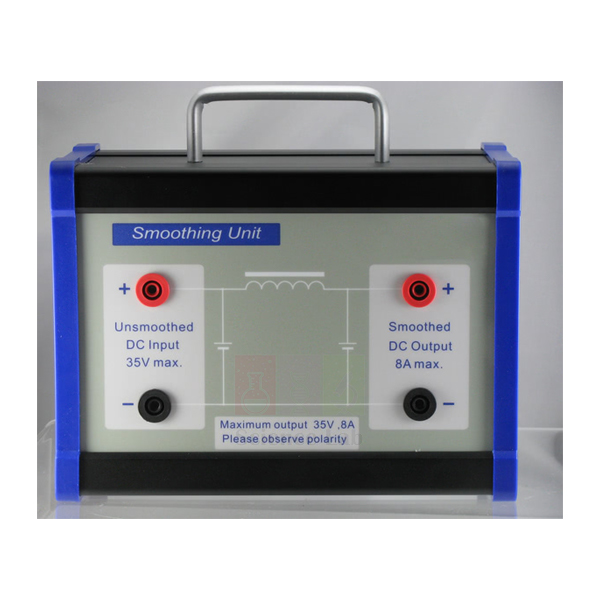
Smoothing Unit
Smoothing Unit (Product Code: SLE/PHY/294) is an LC filter unit used to reduce ripple from non-regulated low-voltage power supplies in school and college laboratories. A toroidal 0.1 H inductor works with a network of 2,200 µF capacitors and diodes to keep the output smooth at currents up to 8 A at 35 V. It is supplied by Jain Scientific Equipments Pvt Ltd (ScienceLab), Ambala, India, as an add-on for the power supply units in a lab.
Specifications
| Parameter | Detail |
|---|---|
| Function | Reduces ripple from non-regulated power supplies |
| Filter components | Toroidal 0.1 H inductor with a network of 2,200 µF capacitors and diodes |
| Input voltage | 0 to 35 V d.c.; absolute maximum 40 V d.c. (d.c. rectified from 28 V a.c.) |
| Current rating | 8 A maximum (up to 8 A at 35 V) |
| Typical ripple | About 1% with a 12 V supply at 3 A |
| Reverse polarity | Works without damage even with reversed polarity |
| Connections | Shrouded sockets accepting standard 4mm plugs and shrouded plugs |
| Dimensions | 208 x 155 x 115 mm (W x H x D); height including handle 187 mm |
| Product code | SLE/PHY/294 |
| Supplied by | Jain Scientific Equipments Pvt Ltd (ScienceLab), Ambala, India |
What Is the Smoothing Unit Used For?
Many school low-voltage supplies deliver rectified but unsmoothed DC, which rises and falls with every mains cycle. Connected between such a supply and the experiment, the Smoothing Unit turns that pulsing output into steady DC, even when the load draws several amperes. That matters for electrolysis, electromagnets, DC motors and any measurement where a fluctuating current would make meter readings jump.
It is also a teaching aid in its own right. Displaying the supply voltage on an oscilloscope before and after the unit shows students exactly what smoothing does, which links neatly with half wave and full wave rectifier kit experiments. Keep the input within 35 V (never above the 40 V absolute maximum), connect with shrouded 4mm leads, and note that an accidental reversal of polarity will not damage the unit.
What to Specify When Ordering
- Number of Smoothing Unit pieces, often one per low-voltage supply.
- The output voltage and current of the power supplies you will smooth, to confirm they are within 35 V and 8 A.
- Whether shrouded 4mm leads or an oscilloscope should be included in the quotation.
Supplier
Jain Scientific Equipments Private Limited, known by its trading name ScienceLab, supplies the Smoothing Unit from Ambala, Haryana, India. Schools, colleges and dealers can order it on its own or with the power supplies and leads it is used with, and we check voltage and current compatibility when preparing the quotation. Visit our profile page to learn more about the company.
Related Physics Lab Equipment
Items that work with the Smoothing Unit:
- Power Supply, Stepped — low-voltage source whose output can be smoothed.
- Power Supply Variable — adjustable supply for circuits that need steady DC.
- Oscilloscope Dual Trace — compares the rippled input with the smoothed output.
- Stackable Leads — 4mm leads for connecting supply, unit and load.
- Power Supply, Smoothed — an alternative when a single supply with smoothed output is preferred.
See more power and circuit items in Physics Lab Equipment.
Frequently Asked Questions
What does the Smoothing Unit do?
The Smoothing Unit reduces ripple from non-regulated power supplies. Its toroidal 0.1 H inductor and network of 2,200 µF capacitors and diodes turn pulsing rectified DC into a steady output, even when high currents are drawn.
What are the voltage and current limits of the Smoothing Unit?
The Smoothing Unit accepts 0 to 35 V d.c. at up to 8 A, with an absolute maximum of 40 V d.c., which corresponds to d.c. rectified from 28 V a.c. Stay within these limits to protect the capacitors and diodes.
How much ripple remains after the Smoothing Unit?
With a 12 V supply delivering 3 A, the Smoothing Unit typically leaves about 1% ripple. The actual figure depends on the supply and the load current, and an oscilloscope shows the result clearly.
Will the Smoothing Unit be damaged if connected the wrong way round?
No, the Smoothing Unit will work without suffering damage even at reverse polarity. This makes it well suited to student use, although correct polarity should still be checked before readings are taken.
What plugs fit the Smoothing Unit?
The Smoothing Unit has shrouded sockets that accept standard 4mm plugs as well as shrouded plugs. It measures 208 x 155 x 115 mm (W x H x D), and 187 mm high including its carrying handle.
Who supplies the Smoothing Unit?
The Smoothing Unit is supplied by Jain Scientific Equipments Pvt Ltd (ScienceLab) of Ambala, Haryana, India. We serve schools, colleges, institutions and dealers in India and international markets, and can quote the unit with suitable power supplies and leads.
Request a Quote
To receive a quotation for the Smoothing Unit, contact us through the contact page or add it to the enquiry cart with your power supplies and leads.
Last updated: 24 September 2026
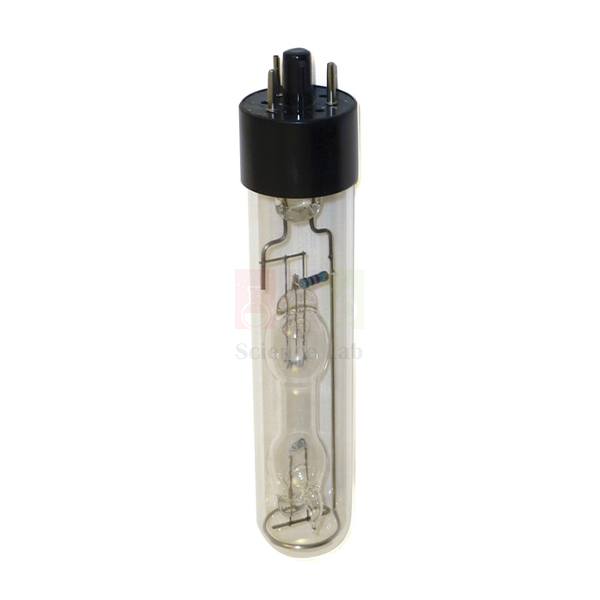
Sodium Spectral Lamp
Sodium Spectral Lamp (Product Code: SLE/PHY/295) is a discharge lamp used to produce the characteristic yellow sodium light for optics experiments in college and school physics laboratories. It fits a spectral lamp power supply through a 4 pin base and measures 30 mm in diameter and 140 mm in length. It is supplied by Jain Scientific Equipments Pvt Ltd (ScienceLab), Ambala, India, as part of its optics lab equipment range for India and international markets.
Specifications
| Parameter | Detail |
|---|---|
| Lamp type | Sodium spectral lamp |
| Base connection | 4 pin |
| Diameter | 30 mm |
| Length | 140 mm |
| Operation | For use with a spectral lamp power supply |
| Product code | SLE/PHY/295 |
| Supplied by | Jain Scientific Equipments Pvt Ltd (ScienceLab), Ambala, India |
What Is the Sodium Lamp Used For?
Sodium light is dominated by the closely spaced yellow D lines, which makes it the standard near-monochromatic source for undergraduate optics. With a spectrometer and a diffraction grating, students measure the grating element or the wavelength of the D lines; with a prism they find the refractive index at a known wavelength. The same lamp illuminates Newton’s rings, Fresnel biprism and air-wedge experiments, where a single dominant colour gives sharp, countable fringes.
A sodium discharge lamp needs a few minutes after switching on before it reaches full, steady brightness, so start it before the class begins. Let it cool completely before removing it from the holder, handle it by the base rather than the glass, and keep the envelope free of fingerprints. Store a spare lamp in its packing so an experiment is not held up when a lamp reaches the end of its life.
What to Specify When Ordering
- Number of Sodium Spectral Lamp units, including spares.
- The make or model of your spectral lamp power supply, so we can confirm it takes a 4 pin lamp of this size.
- Whether a new spectral lamp power supply with lamp holder is needed as well.
Supplier
ScienceLab, the trading name of Jain Scientific Equipments Private Limited in Ambala, Haryana, India, supplies the Sodium Spectral Lamp as a replacement and as part of complete spectroscopy set-ups. We supply colleges, universities, schools and dealers and can quote the lamp together with a power supply and spectrometer. Company details are available on our profile page.
Related Physics Lab Equipment
Use the Sodium Spectral Lamp with these optics items:
- Spectral Lamp Power Supply with Lamp Holder — powers and holds a spectral lamp; ask us to confirm the fit.
- Spectrometer — measures the angles of the sodium lines through a prism or grating.
- Apparatus Newton’s Ring — interference experiment that needs a monochromatic source.
- Prism, Borosilicate Glass — for refractive index measurements on the spectrometer.
- Sodium Lamp Kit — an alternative sodium light source set.
More optics apparatus is listed under Physics Lab Equipment.
Frequently Asked Questions
What are the dimensions of the Sodium Spectral Lamp?
The Sodium Spectral Lamp is 30 mm in diameter and 140 mm long, with a 4 pin base connection. Check that your lamp housing accepts a lamp of this size and base before ordering a replacement.
Which power supply does the Sodium Spectral Lamp need?
The Sodium Spectral Lamp is designed for use with a spectral lamp power supply and cannot run directly from the mains. Send us the details of your existing supply through the contact page, or order a matching power supply with the lamp.
What experiments use the Sodium Spectral Lamp?
The Sodium Spectral Lamp provides yellow, nearly monochromatic light for spectrometer work with prisms and diffraction gratings, and for interference experiments such as Newton’s rings, Fresnel biprism and air-wedge measurements in college and senior school optics.
How should the Sodium Spectral Lamp be handled?
Allow the Sodium Spectral Lamp to cool completely before removing it, hold it by the base instead of the glass, and keep the envelope clean. Give it a few minutes to warm up to steady brightness before taking measurements.
Who supplies the Sodium Spectral Lamp?
The Sodium Spectral Lamp is supplied by Jain Scientific Equipments Pvt Ltd (ScienceLab), Ambala, Haryana, India. We supply institutions and dealers in India and international markets, as a replacement lamp or with a power supply and spectrometer.
Request a Quote
Ask for a quotation on the Sodium Spectral Lamp through the contact page, or add it to the enquiry cart and mention the power supply you use so we can confirm compatibility.
Last updated: 24 September 2026