- Physics Lab Equipment
- Chemistry Lab Equipment
- Biology Lab Equipment
- Anatomical Lab Equipment
- Learning
- Educational Lab Equipment
- Magnets
- Agriculture
- Astronomy
- Earth Science
- Geography Lab Equipment
- Safety Lab Coat
- Laboratory
- Meteorological
- Electricity & Magnetism
- Heat
- School Lab Equipment
- Lab Glassware
- Science Lab Equipment
- Tvet Lab Equipment
- Robotics Kits Supplier and Manufacturer for Schools India
- Math Lab Equipment Manufacturers and Exporters in Ambala
- STEM Kits Manufacturers and Supplier India
- Engineering Lab Equipment
- Hospital Lab Equipment
- Water, Sanitation & Hygiene Supplies
- Cold Chain, Solar & Communication Equipment
- Nutrition
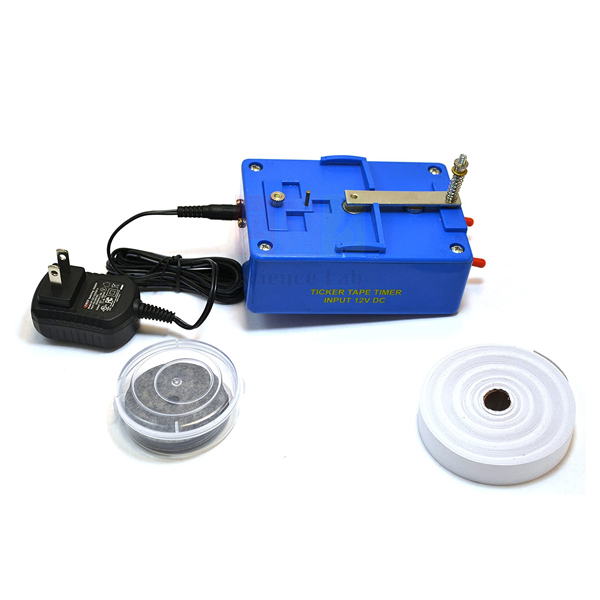
Ticker Tape Timer
Ticker Tape Timer (Product Code: SLE/PHY/312) is an electromagnetic timing device used to record the motion of a trolley or falling object as a trail of dots on paper tape, for measuring velocity, acceleration and general timing in school physics labs. An electromagnet drives a striker that marks the tape through a carbon disc at 50–60 Hz, following the local mains frequency, with connections through 4 mm terminal sockets. This mechanics lab equipment item is supplied by Jain Scientific Equipments Pvt Ltd (ScienceLab), Ambala, India.
Specifications
| Parameter | Detail |
|---|---|
| Mechanism | Electromagnet activating a striker |
| Marking method | Dots printed via a carbon disc on ticker tape |
| Dot rate | 50–60 Hz, depending on the mains frequency |
| Connections | 4 mm terminal sockets |
| Applications | Measurement of velocity, acceleration and general timing |
| Product code | SLE/PHY/312 |
| Supplied by | Jain Scientific Equipments Pvt Ltd (ScienceLab), Ambala, India |
What Is the Ticker Tape Timer Used For?
Fix one end of the paper tape to a trolley, thread it under the striker and carbon disc, switch on and release the trolley. Because the striker hits at the mains frequency, the gap between neighbouring dots always represents the same short time, one-fiftieth of a second on a 50 Hz supply. Evenly spaced dots mean steady speed, while gaps that grow along the tape show acceleration.
A popular technique is to cut the tape into strips of ten dot-spaces and stick them side by side to build a tape chart, which works like a speed-time graph. Students then find average velocity from the length of each strip and acceleration from the change between strips. Check whether your mains supply is 50 or 60 Hz before calculating, keep a spare carbon disc handy, and make connections through the 4 mm sockets with the supply switched off.
What to Specify When Ordering
- Your mains frequency (50 or 60 Hz), which sets the dot rate.
- The power supply and 4 mm leads you will connect the timer with.
- How many boxes of carbon discs to include.
- The number of timers, for example one per practical group.
Supplier
Jain Scientific Equipments Private Limited, trading as ScienceLab, supplies the Ticker Tape Timer from Ambala, Haryana, India to schools, colleges and dealers in India and international markets. The timer is sourced for our mechanics range, and we confirm its supply requirements in writing when we quote. Read about the company on our company profile.
Related Physics Lab Equipment
Consumables, trolleys and alternatives for motion experiments:
- Ticker Tape Carbon Disc — replacement discs that print the dots on the tape.
- Dynamics Trolley, Plastic — pulls the tape through the timer.
- Dynamics Trolley, Wooden — a wooden alternative for the same experiments.
- Stackable Leads — 4 mm leads for connecting the timer.
- Light Gates/Timing Gates — an electronic alternative for timing moving objects.
See the whole range in Physics Lab Equipment.
Frequently Asked Questions
How fast does the Ticker Tape Timer make dots?
The Ticker Tape Timer produces dots at 50 to 60 Hz, depending on the mains frequency. On a 50 Hz supply each gap between dots represents one-fiftieth of a second, which is the time base for speed and acceleration calculations.
How is the Ticker Tape Timer connected?
The Ticker Tape Timer connects through 4 mm terminal sockets. Its operating voltage is not listed on this page, so please ask us through the contact page and we will confirm the supply it needs before you order.
What consumables does the Ticker Tape Timer use?
The Ticker Tape Timer prints dots through a carbon disc onto ticker tape. Carbon discs wear with use, so schools usually keep spares; our Ticker Tape Carbon Disc listing covers replacement discs for this purpose.
Which experiments is the Ticker Tape Timer used for?
The Ticker Tape Timer is used to measure velocity, acceleration and general timing. Typical practicals include trolleys on runways, free fall of a mass pulling the tape, and building tape charts that act as speed-time graphs.
Who supplies the Ticker Tape Timer?
The Ticker Tape Timer is supplied by Jain Scientific Equipments Pvt Ltd (ScienceLab) of Ambala, Haryana, India, to schools, colleges and dealers in India and international markets. Quotations can include carbon discs, trolleys and leads.
Can the Ticker Tape Timer be ordered in bulk?
Yes. The Ticker Tape Timer can be quoted in quantities for several practical groups or schools. Send the number of timers, any accessories and the delivery location through our contact page for a quotation.
Request a Quote
Request a quotation for the Ticker Tape Timer through our contact page, or add it and its carbon discs to the enquiry cart.
Last updated: 24 September 2026
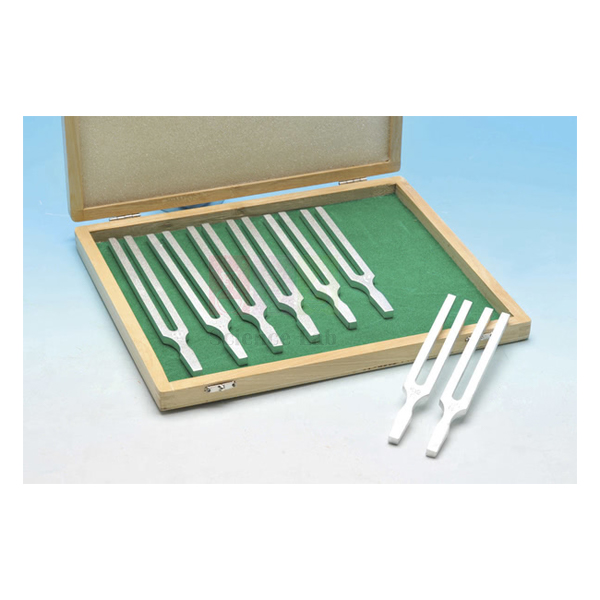
Tuning Fork Set, Aluminium
Tuning Fork Set, Aluminium (Product Code: SLE/PHY/313) is a boxed set of eight aluminium tuning forks used as known-frequency sound sources for resonance and sonometer experiments in school and college physics labs. The forks cover one octave, from C at 256 Hz to C at 512 Hz, and each has a plain shank with its frequency in hertz marked on it. This tuning fork set for school physics in India is made by Jain Scientific Equipments Pvt Ltd (ScienceLab), an OEM manufacturer, at its own factory in Ambala, India.
Specifications
| Parameter | Detail |
|---|---|
| Number of forks | 8 (one of each frequency) |
| Frequencies | C 256 Hz, D 288 Hz, E 320 Hz, F 341 Hz, G 384 Hz, A 426 Hz, B 480 Hz, C 512 Hz |
| Material | Aluminium |
| Shank | Plain |
| Marking | Frequency in hertz marked on each fork |
| Packing | Boxed set |
| Product code | SLE/PHY/313 |
| Manufacturer | Jain Scientific Equipments Pvt Ltd (ScienceLab) — OEM |
| Country of origin | India (made in Ambala, Haryana) |
What Is the Aluminium Tuning Fork Set Used For?
The classic use is the resonance tube experiment for the speed of sound. Strike a fork on a rubber pad, hold it over the open end of an air column and adjust the water level until the sound swells to its loudest. Repeating this with all eight forks gives a set of resonant lengths that students can plot against the reciprocal of frequency to find the speed of sound.
The set also makes the physics of music concrete. The two C forks, at 256 Hz and 512 Hz, show that an octave is a doubling of frequency, while the forks in between step through a musical scale. Always strike the forks on a rubber pad rather than the bench, hold them by the plain shank, and return them to the box so the marked frequencies stay easy to read.
What to Specify When Ordering
- The number of boxed sets, for example one per practical bench.
- Aluminium (this set) or the steel set, which has the same eight frequencies.
- Whether rubber pads, a resonance tube or a sonometer should be quoted with the forks.
OEM Manufacturer
The Tuning Fork Set, Aluminium is manufactured by Jain Scientific Equipments Private Limited, which sells under the ScienceLab name and is the OEM (original equipment manufacturer) for this set. The forks are made at the company's own licensed factory at Saha, Ambala, Haryana, India and dispatched factory-direct to schools, colleges, institutions, dealers and importers in India and international markets. ScienceLab is a registered MSME with manufacturing as its major activity (Udyam UDYAM-HR-01-0003714), and export shipments move under Importer-Exporter Code AAECJ8618A (DGFT). Our company profile has more details.
Related Physics Lab Equipment
Apparatus used with tuning forks in sound experiments:
- Tuning Fork Set, Steel — the same eight frequencies in steel forks.
- Rubber Pad — for striking forks without damaging them.
- Resonance Tube Apparatus — for measuring the speed of sound with each fork.
- Sonometer, Simple Pattern — for tuning a vibrating wire to a fork.
- Tuning Fork on Resonance Box — mounted forks for demonstrating major chords.
More sound apparatus is listed in Physics Lab Equipment.
Frequently Asked Questions
Which frequencies are in the Tuning Fork Set, Aluminium?
The Tuning Fork Set, Aluminium contains one fork each of C 256 Hz, D 288 Hz, E 320 Hz, F 341 Hz, G 384 Hz, A 426 Hz, B 480 Hz and C 512 Hz. Together they span one octave.
Is the frequency marked on each fork in the Tuning Fork Set, Aluminium?
Yes. Every fork in the Tuning Fork Set, Aluminium has its frequency in hertz marked on it, so students can identify each fork quickly and record the correct value in resonance or sonometer experiments.
What is the difference between the aluminium and steel tuning fork sets?
The Tuning Fork Set, Aluminium and the Tuning Fork Set, Steel contain the same eight frequencies from 256 Hz to 512 Hz; the difference is the fork material. Tell us which material your syllabus or lab prefers when requesting a quotation.
How should the forks in the Tuning Fork Set, Aluminium be struck?
Strike the forks of the Tuning Fork Set, Aluminium on a rubber pad and hold them by the plain shank. Striking them on a bench or metal surface can damage the prongs and may affect the sound they produce.
Who manufactures the Tuning Fork Set, Aluminium?
The Tuning Fork Set, Aluminium is manufactured by Jain Scientific Equipments Pvt Ltd (ScienceLab), the OEM, at its own licensed factory at Saha, Ambala, Haryana, India. Quotations and repeat orders are handled directly by the manufacturer.
Is a calibration certificate available for the Tuning Fork Set, Aluminium?
A calibration certificate is not listed for the Tuning Fork Set, Aluminium. If your institution needs frequency test documentation, please discuss it with us through the contact page before ordering so we can explain what is available.
Request a Quote
To order the Tuning Fork Set, Aluminium, send the number of sets and your delivery location through our contact page, or add it to the enquiry cart. Your quotation comes straight from the manufacturer.
Last updated: 24 September 2026
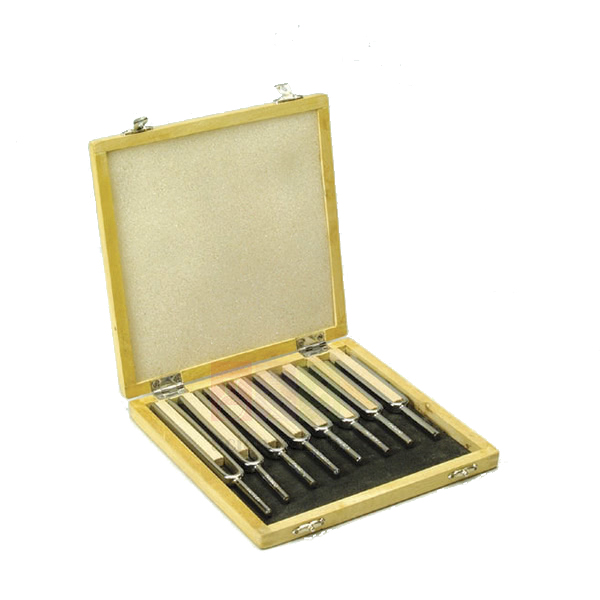
Tuning Fork Set, Steel
Tuning Fork Set, Steel (Product Code: SLE/PHY/314) is a boxed set of eight steel tuning forks used as reference sound sources for sonometer, resonance and pitch experiments in physics laboratories. The plain-shank forks run from C 256 Hz to C 512 Hz in eight steps, and every fork carries its frequency marking. Suited to sonometer work in Indian school and college labs, it is made by Jain Scientific Equipments Pvt Ltd (ScienceLab), an OEM manufacturer, at its own factory in Ambala, India.
Specifications
| Parameter | Detail |
|---|---|
| Material | Steel |
| Set size | Boxed set of 8 |
| Contents | One each of C (256 Hz), D (288 Hz), E (320 Hz), F (341 Hz), G (384 Hz), A (426 Hz), B (480 Hz), C (512 Hz) |
| Shank | Plain |
| Marking | Frequency marked on each fork |
| Product code | SLE/PHY/314 |
| Manufacturer | Jain Scientific Equipments Pvt Ltd (ScienceLab) — OEM |
| Country of origin | India (made in Ambala, Haryana) |
What Is the Steel Tuning Fork Set Used For?
On a sonometer, students place a vibrating fork stem on the sounding board and move the bridge until a small paper rider on the wire jumps off, showing that the wire length is in resonance with the fork. Doing this for each of the eight forks gives a table of frequency against resonant length. The results show that frequency is inversely proportional to length, which is the first law of vibrating strings.
The forks also let a class compare pitch across a full octave and relate each note to a number. Keep the forks in their box between lessons, strike them only on a rubber pad, and avoid dropping them, because a bent prong can change the note a fork gives.
What to Specify When Ordering
- How many boxed steel sets you need.
- Whether you prefer steel (this set) or the aluminium set with the same frequencies.
- Any sonometers, rubber pads or resonance apparatus to include in the same quotation.
OEM Manufacturer
Jain Scientific Equipments Private Limited, trading as ScienceLab, is the OEM (original equipment manufacturer) of the Tuning Fork Set, Steel. The set is produced at the company's own licensed factory at Saha, Ambala, Haryana, India, rather than bought in from a trader, and it reaches schools, colleges, institutions, dealers and importers in India and international markets factory-direct. For replacement forks or repeat sets, ask the manufacturer directly. Read our company profile to learn more.
Related Physics Lab Equipment
Apparatus that pairs with the steel forks:
- Sonometer, 3 Wire Pattern — for the laws of vibrating strings with each fork.
- Tuning Fork Set, Aluminium — the same frequencies in aluminium forks.
- Rubber Pad — the right surface for striking a fork.
- Tuning Forks Set of 2 — a smaller pair for introductory lessons on vibration and sound.
- Resonance Apparatus with Brass Tube — for resonance in an air column.
See more in Physics Lab Equipment.
Frequently Asked Questions
What notes and frequencies does the Tuning Fork Set, Steel include?
The Tuning Fork Set, Steel includes one fork each of C (256 Hz), D (288 Hz), E (320 Hz), F (341 Hz), G (384 Hz), A (426 Hz), B (480 Hz) and C (512 Hz), covering a full octave in eight steel forks.
Can the Tuning Fork Set, Steel be used with a sonometer?
Yes. The Tuning Fork Set, Steel is well suited to sonometer experiments, where each fork is used to find the resonant length of a wire. Using all eight frequencies lets students verify that frequency is inversely proportional to length.
How is the Tuning Fork Set, Steel packed?
The Tuning Fork Set, Steel comes as a boxed set of eight forks. Storing the forks in the box between lessons keeps the set together and protects the prongs from knocks that could alter their pitch.
Are the forks in the Tuning Fork Set, Steel marked?
Yes. Each fork in the Tuning Fork Set, Steel has its frequency marked on it and a plain shank for holding. Students can therefore read the value directly instead of relying on a separate list during the experiment.
Who manufactures the Tuning Fork Set, Steel?
The Tuning Fork Set, Steel is manufactured by Jain Scientific Equipments Pvt Ltd (ScienceLab), the OEM, at its own licensed factory at Saha, Ambala, Haryana, India. Requests for extra forks or repeat sets go directly to the manufacturer.
What information does a quotation for the Tuning Fork Set, Steel need?
A quotation for the Tuning Fork Set, Steel needs the number of sets, any accessories such as sonometers or rubber pads, and the delivery location in India or abroad. Send these through our contact page.
Request a Quote
To request a quotation for the Tuning Fork Set, Steel, use our contact page or add the set to the enquiry cart. Quotations are issued direct by the manufacturer in Ambala.
Last updated: 24 September 2026
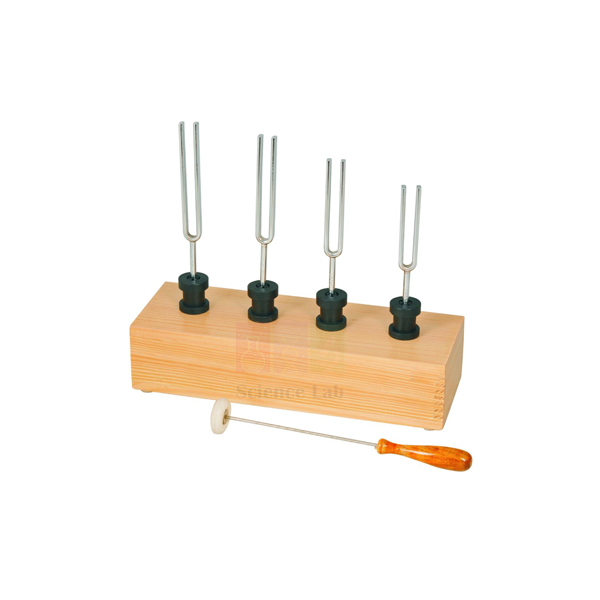
Tuning Fork on Resonance Box
Tuning Fork on Resonance Box (Product Code: SLE/PHY/315) is a set of four steel tuning forks mounted on a wooden resonance box, used to demonstrate how single notes build a basic major chord in school and college sound lessons. Teachers sound C (256Hz), E (320Hz), G (384Hz) and upper C (512Hz) one by one or together, making it a compact physics demonstration kit for a whole class. It is made by Jain Scientific Equipments Pvt Ltd (ScienceLab), an OEM manufacturer, at its own factory in Ambala, India.
Specifications
| Parameter | Detail |
|---|---|
| Fork material | Steel |
| Number of forks | Four, mounted on one wooden box |
| Frequencies | C (256Hz), E (320Hz), G (384Hz), C (512Hz) |
| Intended demonstration | Formation of basic major chords |
| Product code | SLE/PHY/315 |
| Manufacturer | Jain Scientific Equipments Pvt Ltd (ScienceLab) — OEM |
| Country of origin | India (made in Ambala, Haryana) |
What Is the Tuning Fork Resonance Box Used For?
The four forks are tuned to the notes of a C major chord plus its octave. Their frequencies stand in the simple ratio 4:5:6:8, so students can hear why notes whose frequencies form small whole-number ratios sound pleasant together, and why the top C at 512Hz, exactly double 256Hz, sounds like the same note one octave higher. The wooden box acts as a resonator, reinforcing the vibration so the notes carry across a classroom.
In a sound wave experiment, strike one fork at a time with a soft rubber striker, then add the others to build the chord step by step. Touch a prong lightly to stop a note before sounding the next. Never strike the steel forks on a bench or with metal, as this can damage the prongs and shift the pitch.
What to Specify When Ordering
- Confirm that the four-fork chord arrangement (256Hz, 320Hz, 384Hz and 512Hz) suits your lesson plan.
- Number of units needed — one for the demonstration bench, or several for group work.
- Whether a striker should be quoted separately, since the listing covers the forks and box only.
OEM Manufacturer
Jain Scientific Equipments Private Limited, which trades as ScienceLab, is the OEM (original equipment manufacturer) of the Tuning Fork on Resonance Box. The forks and resonance box are made and assembled at the company's own licensed factory at Saha, Ambala, Haryana, India, rather than bought in from a trader. Schools, colleges, dealers and importers therefore deal directly with the maker, and if a unit is ever damaged you can ask us about replacement parts. More about the company is on our company profile.
Related Physics Lab Equipment
These items extend a sound and resonance lesson built around the Tuning Fork on Resonance Box:
- Tuning Fork Set, Steel — loose forks for frequency and pitch experiments at student benches.
- Resonance Apparatus with Brass Tube — air-column resonance to find the speed of sound with a fork.
- Sonometer, Simple Pattern — matches a vibrating wire to a fork’s frequency.
- Tuning Forks Set of 2 — two aluminium forks for comparing frequency and wavelength.
- Forced Oscillation and Resonance Demo — shows resonance in a mechanical system.
See the full Physics Lab Equipment range for more sound, wave and mechanics apparatus.
Frequently Asked Questions
What frequencies are on the Tuning Fork on Resonance Box?
The Tuning Fork on Resonance Box carries four steel forks tuned to C (256Hz), E (320Hz), G (384Hz) and upper C (512Hz). Together they give a C major chord with its octave, which is why the set is used to show how basic major chords are formed.
Why are the forks mounted on a wooden box?
On the Tuning Fork on Resonance Box, the wooden box works as a resonator: the vibrating fork sets the box and the air inside it vibrating too, so the note is much louder than a hand-held fork and can be heard clearly by a whole class.
Is a striker included with the Tuning Fork on Resonance Box?
The listing for the Tuning Fork on Resonance Box covers the four steel forks on their wooden box and does not mention a striker. If you need a rubber striker, say so in your enquiry and we will confirm what can be quoted with the set.
How should the Tuning Fork on Resonance Box be looked after?
Strike the forks of the Tuning Fork on Resonance Box only with a soft rubber striker, never against a bench or metal object. Do not bend or file the prongs, wipe off fingerprints and moisture after use, and store the unit in a dry cupboard to protect the steel.
Who manufactures the Tuning Fork on Resonance Box?
The Tuning Fork on Resonance Box is manufactured by Jain Scientific Equipments Pvt Ltd (ScienceLab) as the OEM, at its own licensed factory at Saha, Ambala, Haryana, India. It is supplied factory-direct to schools, colleges, dealers and importers in India and international markets.
Can a calibration certificate be supplied with the Tuning Fork on Resonance Box?
The forks of the Tuning Fork on Resonance Box are listed at their nominal frequencies. If your institution needs a calibration certificate, please discuss it with us through the contact page before ordering so we can confirm what documentation is possible.
Request a Quote
To order the Tuning Fork on Resonance Box, send the quantity and delivery location through our contact page, or add it to the enquiry cart together with other physics apparatus. Quotations come direct from the manufacturer in Ambala, for single schools as well as bulk orders for India and international markets.
Last updated: 24 September 2026
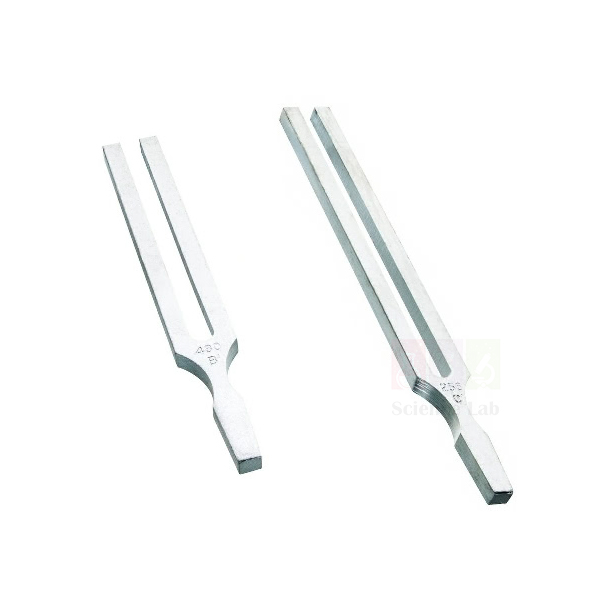
Tuning Forks Set of 2
Tuning Forks Set of 2 (Product Code: SLE/PHY/316) is a pair of aluminium tuning forks used to show students how vibrations produce sound and how frequency relates to wavelength in school science and physics practicals. One fork is tuned to C (256Hz) and the other to B (480Hz), so learners can hear and compare two clearly different pitches side by side. The set is made by Jain Scientific Equipments Pvt Ltd (ScienceLab), an OEM manufacturer, at its own factory in Ambala, India.
Specifications
| Parameter | Detail |
|---|---|
| Contents | Two tuning forks |
| Material | Aluminium |
| Fork 1 | C, 256Hz |
| Fork 2 | B, 480Hz |
| Demonstrates | Relationship between frequency and wavelength; how vibrations produce sound |
| Product code | SLE/PHY/316 |
| Manufacturer | Jain Scientific Equipments Pvt Ltd (ScienceLab) — OEM |
| Country of origin | India (made in Ambala, Haryana) |
What Are the Tuning Forks Set of 2 Used For?
A struck fork vibrates at one steady frequency, which makes it an ideal source for introducing sound. Dip the prongs of a sounding fork into a beaker of water and the splash shows that sound comes from vibration; touch it to a light hanging ball and the ball is pushed away. Sounding the 256Hz fork and then the 480Hz fork lets students hear that a higher frequency gives a higher pitch.
For the frequency and wavelength lesson, remind students that sound travels at the same speed in the same air, so the B fork, vibrating faster, must produce shorter waves than the C fork. This links neatly to wave-speed calculations in a physics lab equipment course for schools in India and elsewhere. Strike the forks only on a rubber pad or soft striker, and hold them by the stem so the prongs ring freely.
OEM Manufacturer
The Tuning Forks Set of 2 is produced by Jain Scientific Equipments Private Limited, known to customers by its trading name ScienceLab. As the original equipment manufacturer (OEM), the company makes these forks at its own licensed factory at Saha, Ambala, Haryana, India, and supplies them straight to schools, colleges, dealers and importers. Quotations and repeat orders are handled by the manufacturer itself, with no trader in between. Read more on our company profile.
Related Physics Lab Equipment
Pair the Tuning Forks Set of 2 with these items for a complete sound and waves practical:
- Tuning Fork Set, Aluminium — a wider range of aluminium forks when more frequencies are needed.
- Tuning Fork on Resonance Box — four box-mounted forks for chord and resonance demonstrations.
- Resonance Tube Apparatus — uses a fork to find the speed of sound from air-column resonance.
- Sonometer, 3 Wire Pattern — compares string vibration with a fork of known frequency.
- Ripple Tank — makes the link between frequency and wavelength visible on water.
Browse all Physics Lab Equipment for further sound and wave apparatus.
Frequently Asked Questions
What frequencies are the Tuning Forks Set of 2 tuned to?
The Tuning Forks Set of 2 contains one fork tuned to C at 256Hz and one tuned to B at 480Hz. Because the two frequencies are well apart, students can easily hear the difference in pitch and relate it to how fast each fork vibrates.
What material are the Tuning Forks Set of 2 made from?
Both forks in the Tuning Forks Set of 2 are made of aluminium. If your syllabus or teacher prefers steel forks, ask us about the separate steel tuning fork set listed in our physics range before you place the order.
Which experiments suit the Tuning Forks Set of 2?
The Tuning Forks Set of 2 suits introductory experiments showing that vibrations produce sound, comparing high and low pitch, and explaining why a higher frequency means a shorter wavelength. With a resonance tube or sonometer, the forks also serve as a known-frequency source.
How do I keep the Tuning Forks Set of 2 in tune?
Keep the Tuning Forks Set of 2 accurate by striking the forks only on a rubber pad or soft striker, never on hard surfaces. Do not drop or bend the prongs, and store both forks together in a dry place when they are not in use.
Who manufactures the Tuning Forks Set of 2?
Jain Scientific Equipments Pvt Ltd (ScienceLab) manufactures the Tuning Forks Set of 2 as the OEM, at its own licensed factory in Saha, Ambala, Haryana, India. Buyers order directly from the maker, whether for one school or for dealers and importers.
Can the Tuning Forks Set of 2 be ordered in bulk?
Yes, the Tuning Forks Set of 2 can be quoted for single schools or larger quantities for dealers, tenders and importers in India and international markets. Send the number of sets and delivery location through the contact page for a quotation.
Request a Quote
Request a quotation for the Tuning Forks Set of 2 through our contact page, or place it in the enquiry cart with the rest of your sound apparatus. You receive the quotation directly from the manufacturer in Ambala.
Last updated: 24 September 2026
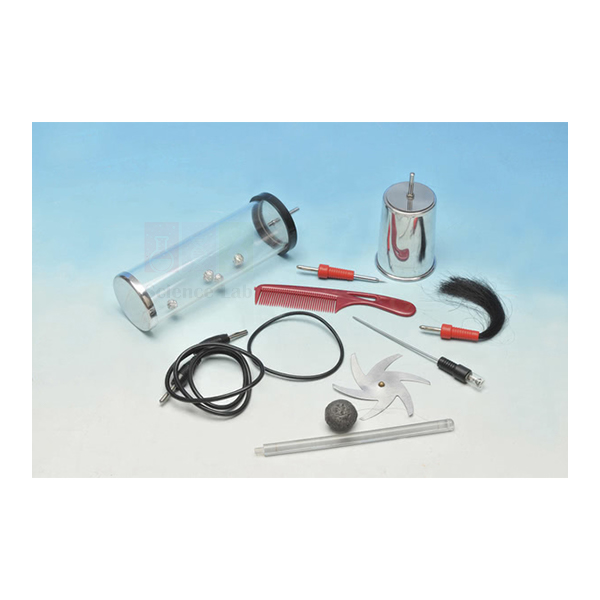
Van De Graaff Accessory Kit
Van De Graaff Accessory Kit (Product Code: SLE/PHY/317) is a set of eight electrostatics accessories used with a Van de Graaff generator to demonstrate charge, repulsion and discharge in school and college physics labs. It brings together a Faraday’s pail, electric whirl, pith-ball pillar, head of hair, neon bulb and more, so one generator can support a full sequence of static electricity experiments. The kit is made by Jain Scientific Equipments Pvt Ltd (ScienceLab), an OEM manufacturer, at its own factory in Ambala, India.
Key Details
| Parameter | Detail |
|---|---|
| Type | Accessory kit for Van de Graaff generator |
| Number of items | Eight (listed below) |
| Generator | Not part of this kit; ordered separately |
| Product code | SLE/PHY/317 |
| Manufacturer | Jain Scientific Equipments Pvt Ltd (ScienceLab) — OEM |
| Country of origin | India (made in Ambala, Haryana) |
Kit contents:
- Faraday’s pail
- Perspex cylinder
- Electric whirl
- Pillar with pith ball
- Comb
- Head of hair
- Point discharger
- Neon bulb
What Is the Van de Graaff Accessory Kit Used For?
Each piece turns the charged dome into a different lesson. The head of hair shows like charges repelling as the strands lift and spread, and the pith ball on its pillar is first attracted and then pushed away once it picks up charge. The electric whirl spins as charge leaks from its pointed tips, while the point discharger shows how sharp points release charge and helps bring the dome back to a safe state.
The neon bulb glows briefly when brought near the charged dome, a vivid sign of the high potential involved, and the Faraday’s pail is used with an electroscope to explore how charge sits on a conductor. Together they make the kit useful school physics lab equipment in India and abroad. Work in dry air, keep electronics away from the generator and discharge the dome before handling any accessory.
What to Specify When Ordering
- Whether you need the Van de Graaff generator as well, or only the accessory kit for an existing machine.
- The make of the generator already in your lab, so we can confirm the accessories suit it.
- Number of kits — usually one per generator.
OEM Manufacturer
This Van De Graaff Accessory Kit is an OEM product of Jain Scientific Equipments Private Limited, the company that trades as ScienceLab. The accessories are made and assembled at its own licensed factory at Saha, Ambala, Haryana, India, the same factory that produces its Van de Graaff generator, so both can be sourced from one manufacturer. For institutional vendor registration, the company’s GSTIN is 06AAECJ8618A1ZT and its LEI is 3358004HRD1JIVXKYX49. Company background is on our company profile.
Related Physics Lab Equipment
Complete your electrostatics bench with these items alongside the Van De Graaff Accessory Kit:
- Van de Graaff Generator — the charge source that every accessory in this kit is designed around.
- Electroscope, Gold Leaf — detects the charge collected in the Faraday’s pail.
- Electroscope, Needle — a sturdier charge indicator for student groups.
- Electrostatic Investigation — charging-by-friction experiments that lead into generator work.
More electrostatics and electricity apparatus is listed under Physics Lab Equipment.
Frequently Asked Questions
What is included in the Van De Graaff Accessory Kit?
The Van De Graaff Accessory Kit contains eight items: a Faraday’s pail, a Perspex cylinder, an electric whirl, a pillar with pith ball, a comb, a head of hair, a point discharger and a neon bulb, all intended for use with a Van de Graaff generator.
Does the Van De Graaff Accessory Kit include the generator?
No. The Van De Graaff Accessory Kit contains accessories only; the generator is listed separately as our Van de Graaff Generator. You can order both together, or order just the kit if your lab already has a working generator.
Which experiments can be shown with the Van De Graaff Accessory Kit?
With the Van De Graaff Accessory Kit a teacher can show repulsion of like charges with the head of hair and pith ball, charge leaking from points with the electric whirl and point discharger, glow from the neon bulb, and charge on conductors with the Faraday’s pail.
How should the Van De Graaff Accessory Kit be used safely?
Use the Van De Graaff Accessory Kit under teacher supervision, change accessories only after the generator dome has been discharged, and keep computers, phones and other electronics well away. Store the parts clean and dry, because dust and damp reduce the charge the generator can build.
Who manufactures the Van De Graaff Accessory Kit?
The Van De Graaff Accessory Kit is manufactured by Jain Scientific Equipments Pvt Ltd (ScienceLab) as the OEM, at its own licensed factory in Saha, Ambala, Haryana, India. The company also makes the matching Van de Graaff generator, so a school can buy both from one maker.
What should I include when asking for a Van De Graaff Accessory Kit quotation?
For a Van De Graaff Accessory Kit quotation, state the number of kits, whether the generator is also required, and your delivery location in India or abroad. Send these through the contact page and the manufacturer will reply directly.
Request a Quote
Send your requirement for the Van De Graaff Accessory Kit through our contact page, or add it and the generator to the enquiry cart. Quotations are prepared directly by the manufacturer in Ambala for schools, colleges, dealers and importers.
Last updated: 24 September 2026
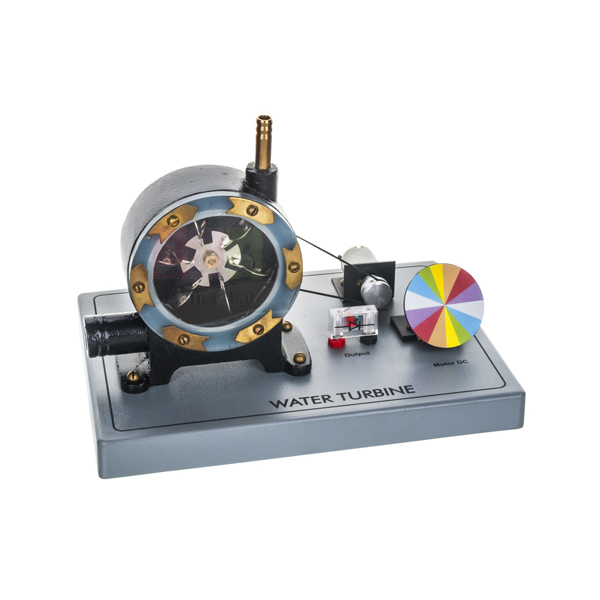
Water Turbine with Dynamo Model
Water Turbine with Dynamo Model (Product Code: SLE/PHY/318) is a working demonstration model used to show the conversion of mechanical energy into electrical energy in school physics and general science lessons. Flowing water turns a small turbine under a transparent cover, and the turbine drives a dynamo coupled directly to it, all fitted on a sturdy plastic base. The model is made by Jain Scientific Equipments Pvt Ltd (ScienceLab), an OEM manufacturer, at its own factory in Ambala, India.
Key Details
| Parameter | Detail |
|---|---|
| Turbine housing | Transparent cover, so the turning wheel is visible |
| Water connections | Inlet and outlet tubes |
| Generator | Dynamo directly connected to the turbine |
| Base | Sturdy plastic base |
| Demonstrates | Conversion of mechanical energy into electrical energy |
| Product code | SLE/PHY/318 |
| Manufacturer | Jain Scientific Equipments Pvt Ltd (ScienceLab) — OEM |
| Country of origin | India (made in Ambala, Haryana) |
What Is the Water Turbine Dynamo Model Used For?
The model is a small-scale picture of a hydroelectric station. Water enters through the inlet tube, strikes the turbine and leaves through the outlet, and the spinning shaft turns the dynamo, which generates a current. Because the cover is transparent, students can watch the wheel speed up as the flow increases and connect what they see to the energy chain from moving water to mechanical rotation to electricity.
For a class demonstration, run the inlet from a tap with a length of tubing and let the outlet drain into a sink or tray. Connect the dynamo terminals to a sensitive meter or a small lamp so the output can be seen, then vary the flow to show how more water gives more electrical output. This makes the model a useful demonstration model for the physics lab and energy topics. Drain and dry the model after use.
OEM Manufacturer
ScienceLab is the trading name of Jain Scientific Equipments Private Limited, the OEM that manufactures the Water Turbine with Dynamo Model. The turbine, cover and base are assembled with the dynamo at the company's own licensed factory at Saha, Ambala, Haryana, India, and the finished model goes factory-direct to schools, colleges, dealers and importers. Questions about spare parts or repeat orders are answered by the manufacturer itself, so just ask us. Read about the company on our company profile.
Related Physics Lab Equipment
Useful items to run and extend a lesson with the Water Turbine with Dynamo Model:
- Rubber Tubing — links a laboratory tap to the turbine inlet.
- Galvanometer, Centre Zero Universal Meter — shows the small current produced by the dynamo.
- Demonstration Dynamo Model — explains what happens inside the dynamo.
- Demonstration Pelton Turbine — a larger turbine for engineering fluid-mechanics labs.
Find more energy and electricity demonstrations in our Physics Lab Equipment range.
Frequently Asked Questions
How does the Water Turbine with Dynamo Model work?
In the Water Turbine with Dynamo Model, water enters the inlet tube and turns the turbine inside its transparent cover. The turbine is connected directly to a dynamo, so its rotation is converted into electrical energy that can be shown with a meter or small lamp.
What water supply does the Water Turbine with Dynamo Model need?
The Water Turbine with Dynamo Model has inlet and outlet tubes, so a laboratory tap with connecting tubing is the usual source, with the outlet draining into a sink or tray. Flow rate and pressure needs are not listed; please ask us through the contact page.
Is a meter or bulb supplied with the Water Turbine with Dynamo Model?
The listing for the Water Turbine with Dynamo Model describes the turbine, cover, tubes, dynamo and plastic base, and does not include a meter or lamp. Mention in your enquiry if you would like a galvanometer or lamp holder quoted alongside it.
Which topics does the Water Turbine with Dynamo Model support?
The Water Turbine with Dynamo Model supports lessons on energy conversion, hydroelectric power and renewable energy, and introduces how generators produce electricity. It suits middle and secondary school science as well as introductory college demonstrations.
Who manufactures the Water Turbine with Dynamo Model?
Jain Scientific Equipments Pvt Ltd (ScienceLab) manufactures the Water Turbine with Dynamo Model as the OEM, at its own licensed factory at Saha, Ambala, Haryana, India. It is supplied directly by the maker to institutions and trade buyers in India and international markets.
How should the Water Turbine with Dynamo Model be stored?
After each use, drain all water from the Water Turbine with Dynamo Model, wipe the transparent cover and base, and let it dry before storing. Keeping the dynamo and its terminals dry protects the electrical part of the model between lessons.
Request a Quote
For a quotation on the Water Turbine with Dynamo Model, write to us through the contact page or add it to the enquiry cart. The quote comes straight from the manufacturer, whether you need one model or a quantity for several schools.
Last updated: 24 September 2026
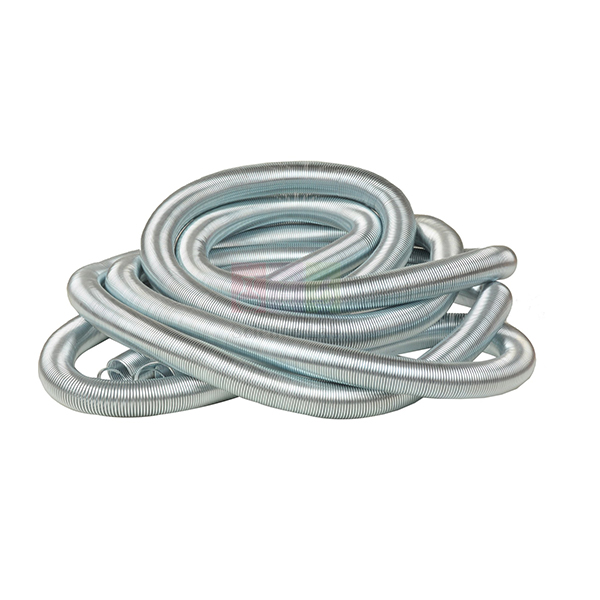
Wave Form, Helix
Wave Form, Helix (Product Code: SLE/PHY/319) is a long, close-wound steel wire spring used to demonstrate transverse and longitudinal waves across a classroom floor or bench in school and college physics. Its 20mm diameter coils close to about 3 metre and stretch to approximately 9 metre, giving pulses room to travel slowly enough for students to follow. It is made by Jain Scientific Equipments Pvt Ltd (ScienceLab), an OEM manufacturer, at its own factory in Ambala, India.
Specifications
| Parameter | Detail |
|---|---|
| Construction | Steel wire, close-wound helix |
| Coil diameter | 20mm |
| Ends | Looped |
| Closed length | 3 metre |
| Extended length | Approx. 9 metre |
| Product code | SLE/PHY/319 |
| Manufacturer | Jain Scientific Equipments Pvt Ltd (ScienceLab) — OEM |
| Country of origin | India (made in Ambala, Haryana) |
What Is the Wave Helix Used For?
Stretch the helix along the floor between two students, or hook one looped end to a fixed point. A quick sideways flick sends a transverse pulse along the coils, while a sharp push along the axis sends a longitudinal pulse of compressions and rarefactions, the same pattern as a sound wave. Students can then watch pulses reflect from a fixed end, see how two pulses pass through each other, and set up standing waves by shaking one end steadily.
As part of a wave motion kit for schools in India or abroad, the long 9 metre stretch is the key advantage: pulses travel far enough to time with a stopwatch, and changing the stretch shows how tension affects wave speed. Never let a stretched helix go suddenly, and keep the coils from tangling or kinking, as a kinked steel spring does not recover its shape.
OEM Manufacturer
Jain Scientific Equipments Private Limited, trading as ScienceLab, manufactures the Wave Form, Helix as the original equipment manufacturer. It is wound and finished at the company's own licensed factory at Saha, Ambala, Haryana, India, and sold directly by the maker to schools, colleges, dealers and importers instead of through a trading house. That means quotations, repeat orders and replacement requests all come back to the factory that made it. See our company profile for more.
Related Physics Lab Equipment
Other apparatus for teaching waves alongside the Wave Form, Helix:
- Metal Slinky, Helical Spring — a shorter spring for desk-top wave work in small groups.
- Slinky Spring — another compact option for longitudinal wave practice.
- Ripple Tank — shows reflection, refraction and interference of water waves.
- Apparatus for Demonstrating the Phenomenon of Wave Propagation and Reflection — a mounted demonstration of travelling and reflected waves.
Explore more wave and sound apparatus in Physics Lab Equipment.
Frequently Asked Questions
How long is the Wave Form, Helix?
The Wave Form, Helix has a closed length of 3 metre and extends to approximately 9 metre. Its coils are 20mm in diameter, and the long working length gives pulses enough distance to be followed by eye and timed across a classroom.
Can the Wave Form, Helix show both transverse and longitudinal waves?
Yes. Moving one end of the Wave Form, Helix from side to side sends a transverse wave along it, while pushing and pulling along its length sends a longitudinal wave of compressions and rarefactions, similar to how sound travels.
What are the looped ends of the Wave Form, Helix for?
The looped ends of the Wave Form, Helix let a student hold it securely or hook it over a fixed point such as a clamp or door handle. Fixing one end is useful for showing how a pulse reflects and inverts at a fixed boundary.
How should the Wave Form, Helix be stored?
Let the Wave Form, Helix close up gently rather than releasing it while stretched, keep the coils in line so they do not tangle, and store it dry to protect the steel wire. A kinked or overstretched helix loses its even spacing.
Who manufactures the Wave Form, Helix?
Jain Scientific Equipments Pvt Ltd (ScienceLab) manufactures the Wave Form, Helix as the OEM at its own licensed factory at Saha, Ambala, Haryana, India. Schools, colleges, dealers and importers buy it directly from the manufacturer for India and international markets.
Request a Quote
Tell us how many Wave Form, Helix springs you need through the contact page, or add the item to the enquiry cart with your other wave apparatus. The quotation is issued directly by the manufacturer in Ambala.
Last updated: 24 September 2026