- Physics Lab Equipment
- Chemistry Lab Equipment
- Biology Lab Equipment
- Anatomical Lab Equipment
- Learning
- Educational Lab Equipment
- Magnets
- Agriculture
- Astronomy
- Earth Science
- Geography Lab Equipment
- Safety Lab Coat
- Laboratory
- Meteorological
- Electricity & Magnetism
- Heat
- School Lab Equipment
- Lab Glassware
- Science Lab Equipment
- Tvet Lab Equipment
- Robotics Kits Supplier and Manufacturer for Schools India
- Math Lab Equipment Manufacturers and Exporters in Ambala
- STEM Kits Manufacturers and Supplier India
- Engineering Lab Equipment
- Hospital Lab Equipment
- Water, Sanitation & Hygiene Supplies
- Cold Chain, Solar & Communication Equipment
- Nutrition
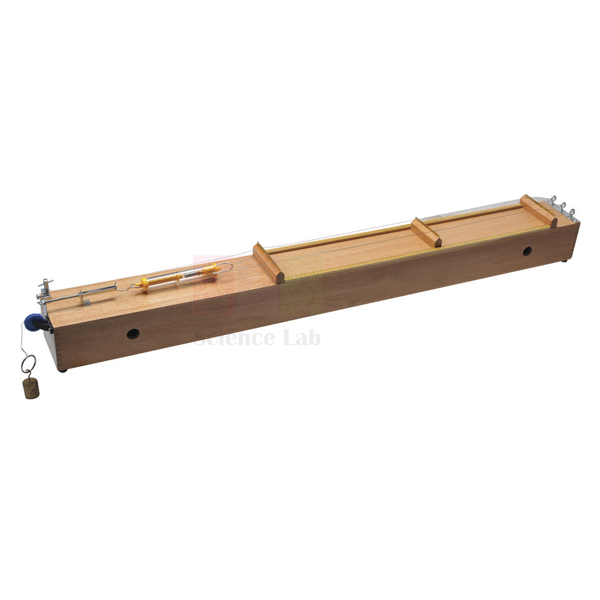
Sonometer, 3 Wire Pattern
Sonometer, 3 Wire Pattern (Product Code: SLE/PHY/296) is a stretched-string apparatus used to study the laws of vibrating strings and compare frequencies in school and college physics laboratories. Its hollow wooden resonance box, 1290 x 130 x 110 mm, carries millimetre scales, a pulley-loaded wire and a 100 N spring balance for measured tension. It is made by Jain Scientific Equipments Pvt Ltd (ScienceLab), an OEM manufacturer, at its own factory in Ambala, India.
Specifications
| Parameter | Detail |
|---|---|
| Resonance box | Hollow, wooden, 1290 x 130 x 110 mm |
| Scales | Divided in millimetres between the fixed bridges over which the wires are stretched |
| Loaded wire | One wire passes over a pulley and can be loaded as desired |
| Tension measurement | Spring balance reading 100 N x 5 N fitted to one end |
| Tension adjustment | Fine adjustment of the tension by a wing nut |
| Pattern | 3 wire |
| Product code | SLE/PHY/296 |
| Manufacturer | Jain Scientific Equipments Pvt Ltd (ScienceLab) — OEM |
| Country of origin | India (made in Ambala, Haryana) |
What Is the 3 Wire Sonometer Used For?
The sonometer lets students verify the three laws of transverse vibration: frequency varies inversely with vibrating length, with the square root of tension, and inversely with the square root of mass per unit length. On this pattern the spring balance sets a measured tension on one wire through the wing nut, while the pulley wire is tensioned by hanging masses, so two methods of applying tension can be compared on one box. A small paper rider on the wire jumps off at resonance when a sounding tuning fork is pressed against the box.
Typical practicals include finding the frequency of an unknown tuning fork, comparing two forks, and plotting vibrating length against 1/f. Move the bridges slowly and read lengths from the millimetre scale at the bridge edges. Release tension at the end of each session so the wires and the spring balance are not left under load, and keep the wooden box dry so its resonance stays consistent.
What to Specify When Ordering
- Number of Sonometer, 3 Wire Pattern sets for your laboratory.
- Tuning fork sets and slotted masses for loading the pulley wire, if needed.
- Spare wire requirements for restringing.
- Whether the order is for your own institution or for resale as a dealer or importer.
OEM Manufacturer
This sonometer is produced by Jain Scientific Equipments Private Limited, trading as ScienceLab, which is the OEM (original equipment manufacturer) rather than a reseller. The wooden resonance box is built, fitted with its scales, pulley, bridges and spring balance, and assembled at the company’s own licensed factory at Saha, Ambala, Haryana, India.
Schools, colleges, government institutions, dealers and importers buy direct from the factory, and quotations come straight from the people who make the apparatus. Ask us about replacement wires, bridges or balances and about repeat orders for additional laboratories. More about the company is on our profile page.
Related Physics Lab Equipment
Items used with the Sonometer, 3 Wire Pattern:
- Tuning Fork Set, Steel — known frequencies for resonance and frequency comparison.
- Slotted Mass Hanger, 1kg — loads the pulley wire in measured steps.
- Steel Wire — wire stock for restringing; confirm the gauge with us.
- Sonometer, Simple Pattern — two-wire model with twin 50 N spring balances.
See more sound and waves apparatus in Physics Lab Equipment.
Frequently Asked Questions
What size is the Sonometer, 3 Wire Pattern?
The Sonometer, 3 Wire Pattern is built on a hollow wooden resonance box measuring 1290 x 130 x 110 mm. Millimetre scales run between the fixed bridges, so vibrating lengths can be read directly without a separate rule.
How is tension applied on the Sonometer, 3 Wire Pattern?
On the Sonometer, 3 Wire Pattern, one end carries a spring balance reading 100 N x 5 N, with a wing nut for fine adjustment of tension. Another wire passes over a pulley and is tensioned by loading it with masses as desired.
Which experiments can be done with the Sonometer, 3 Wire Pattern?
The Sonometer, 3 Wire Pattern is used to verify the laws of vibrating strings, find the frequency of a tuning fork, compare frequencies and investigate how length and tension affect pitch, using a paper rider or ear to detect resonance.
Who manufactures the Sonometer, 3 Wire Pattern?
The Sonometer, 3 Wire Pattern is manufactured by Jain Scientific Equipments Pvt Ltd (ScienceLab), the OEM, at its own licensed factory at Saha, Ambala, Haryana, India. Buyers receive quotations, repeat supplies and replacement parts directly from the manufacturer.
Are tuning forks and masses included with the Sonometer, 3 Wire Pattern?
Tuning forks and slotted masses are listed separately from the Sonometer, 3 Wire Pattern on our site. Tell us which frequencies and loads your practicals need through the contact page, and we will add them to the quotation.
Can the Sonometer, 3 Wire Pattern be ordered in bulk or for export?
Yes, the Sonometer, 3 Wire Pattern is supplied factory-direct in quantity to schools, colleges, dealers and importers in India and international markets. Send the number of sets and the destination for a quotation from the manufacturer.
Request a Quote
Request a quotation for the Sonometer, 3 Wire Pattern through our contact page or the enquiry cart. As the manufacturer, we quote directly, with no trader in between.
Last updated: 24 September 2026
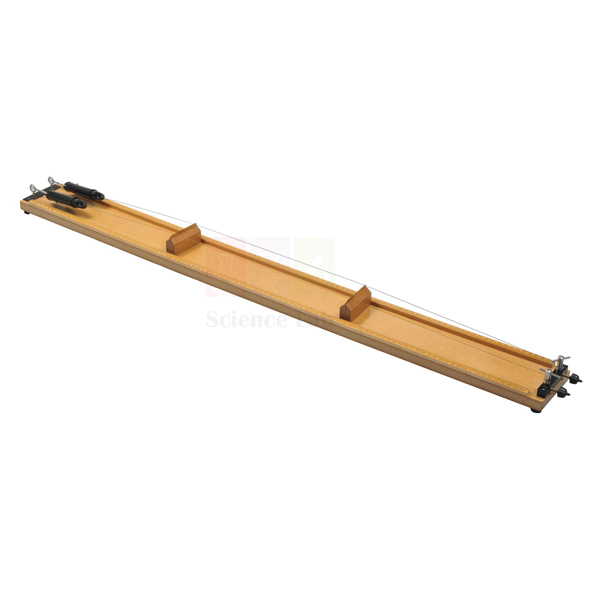
Sonometer, Simple Pattern
Sonometer, Simple Pattern (Product Code: SLE/PHY/297) is a two-wire sonometer used to investigate how length and tension set the pitch of a vibrating string in school and college physics laboratories. Each steel wire has its own 50 N spring balance and wrest pin on a 1140 mm wooden resonance box, so the two strings can be tensioned and compared side by side. It is made by Jain Scientific Equipments Pvt Ltd (ScienceLab), an OEM manufacturer, at its own factory in Ambala, India.
Specifications
| Parameter | Detail |
|---|---|
| Resonance box | Wooden; 1140 mm long, 125 mm wide, 100 mm high |
| Tension measurement | Two 50 N spring balances with hooks at one end of the base |
| Wire anchorage | Two corresponding wrest pins at the other end |
| Wires supplied | Two steel wires, 30 swg, 1 metre long |
| Bridges | Three: one large bridge to span both wires and two small bridges for the individual wires |
| Product code | SLE/PHY/297 |
| Manufacturer | Jain Scientific Equipments Pvt Ltd (ScienceLab) — OEM |
| Country of origin | India (made in Ambala, Haryana) |
What Is the Simple Sonometer Used For?
With two identical 30 swg wires, each on its own spring balance, this sonometer is well suited to comparison work. Students set one wire as a reference, then change the tension or the bridge spacing on the second until both sound in unison, which shows directly how frequency depends on tension and length. The large bridge spans both wires to give them the same vibrating length, while the two small bridges let each wire be adjusted independently.
It also covers the standard sonometer practicals: finding the frequency of a tuning fork by resonance with a paper rider, and plotting vibrating length against the reciprocal of frequency. Simple to set up and read, it is a practical choice of sonometer for Indian school and college labs running several groups at once. Tighten wires gradually with the wrest pins while watching the balance, stay within the 50 N scale, and slacken both wires before storage.
What to Specify When Ordering
- Number of Sonometer, Simple Pattern sets needed.
- Additional 30 swg steel wires as spares for restringing.
- Tuning fork sets to go with the sonometers.
- Delivery destination, whether within India or for export.
OEM Manufacturer
ScienceLab is the brand of Jain Scientific Equipments Private Limited, and the company is the original equipment manufacturer (OEM) of this sonometer. Its wooden resonance box is made, and the balances, wrest pins, bridges and wires are fitted and assembled, at the company’s own licensed factory at Saha, Ambala, Haryana, India, so buyers deal with the maker rather than a trading intermediary.
The factory at 449, HSIIDC Industrial Area, Saha, Ambala operates under Factory Licence AMB-ONLINE-CHD-J-414, and the company’s Corporate Identity Number is U29309HR2020PTC087597 for vendor records. Schools, colleges, institutions, dealers and importers are supplied factory-direct; ask us about spare wires, bridges and repeat orders. See the company profile for more.
Related Physics Lab Equipment
Complete a vibrating-strings practical with these items:
- Tuning Fork Set, Aluminium — reference frequencies for resonance with the wires.
- Tuning Fork on Resonance Box — louder reference note for comparing pitch by ear.
- Steel Wire — wire stock for replacements; confirm the gauge with us.
- Sonometer, 3 Wire Pattern — larger model with a pulley-loaded wire and 100 N balance.
Browse the full Physics Lab Equipment category.
Frequently Asked Questions
What comes with the Sonometer, Simple Pattern?
The Sonometer, Simple Pattern is supplied with two steel wires, 30 swg and 1 metre long, and three bridges: one large bridge to span both wires and two small bridges for the individual wires. Two 50 N spring balances and two wrest pins are fitted.
What are the dimensions of the Sonometer, Simple Pattern?
The Sonometer, Simple Pattern has a wooden resonance box 1140 mm long, 125 mm wide and 100 mm high. The spring balances sit at one end of the base and the wrest pins at the other.
How is wire tension measured on the Sonometer, Simple Pattern?
Each wire on the Sonometer, Simple Pattern is attached to its own 50 N spring balance with a hook, and tightened from the opposite end with a wrest pin. Students read the tension directly from the balance while adjusting the pin.
Who manufactures the Sonometer, Simple Pattern?
The Sonometer, Simple Pattern is manufactured by Jain Scientific Equipments Pvt Ltd (ScienceLab), the OEM, at its own licensed factory at Saha, Ambala, Haryana, India. Quotations, repeat orders and spare parts come directly from the manufacturer.
How does the Sonometer, Simple Pattern differ from the 3 wire pattern?
The Sonometer, Simple Pattern uses two wires, each with a 50 N spring balance and wrest pin, on a 1140 mm box. The 3 wire pattern has a larger box, a pulley-loaded wire and a single 100 N balance with wing-nut adjustment.
Can the Sonometer, Simple Pattern be supplied in quantity?
Yes, the Sonometer, Simple Pattern is supplied factory-direct in class quantities to schools, colleges, dealers and importers in India and international markets. Share the number of sets and destination through the contact page.
Request a Quote
Send your requirement for the Sonometer, Simple Pattern through the contact page or add it to the enquiry cart. The quotation comes direct from the manufacturer in Ambala.
Last updated: 24 September 2026
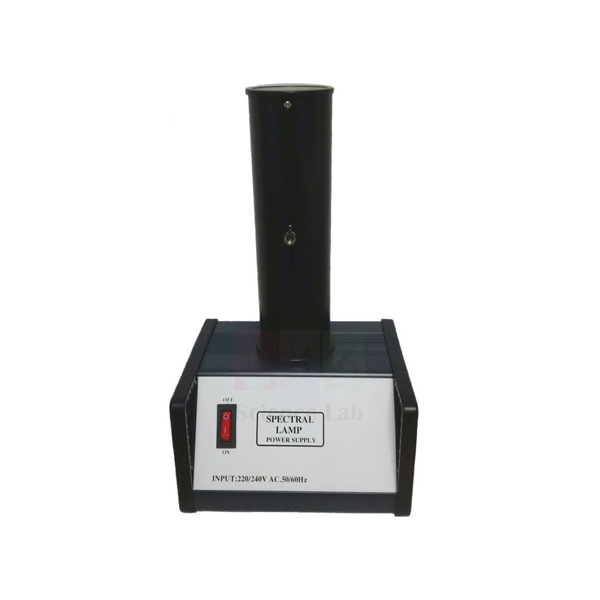
Spectral Lamp Power Supply with Lamp Holder
Spectral Lamp Power Supply with Lamp Holder (Product Code: SLE/PHY/298) is a compact spectral light source used to provide bright line-spectrum illumination for optics experiments and atomic absorption (AA) spectrometry in college and school laboratories. The lamp stands inside a black protective tube on top of the power unit, and turning the outer sleeve selects differently shaped apertures. It is supplied by Jain Scientific Equipments Pvt Ltd (ScienceLab), Ambala, India, for physics and chemistry teaching labs.
Key Details
| Parameter | Detail |
|---|---|
| Configuration | Compact spectral lamp combined with its power supply |
| Lamp mounting | Inside a black protective tube standing up from the top of the power unit |
| Apertures | Different shaped apertures selected by rotating the outer sleeve of the lamp cover |
| Light output | Bright, intense light, unlike the dull light available from spectrum tubes |
| Applications | Optical work and AA spectrometry |
| Product code | SLE/PHY/298 |
| Supplied by | Jain Scientific Equipments Pvt Ltd (ScienceLab), Ambala, India |
What Is the Spectral Lamp Power Supply Used For?
Spectrum tubes are easy to show but often too faint for accurate spectrometer readings. This unit solves that by pairing a spectral lamp with its own supply in one compact housing, giving an intense line source that can be placed right against the spectrometer slit. Students use it to measure spectral line positions with a prism or diffraction grating, to find wavelengths, and to provide the monochromatic light needed for interference experiments.
The rotating sleeve is a practical touch: choosing a suitable aperture shape cuts stray light and matches the beam to the slit or optical set-up, while the black tube keeps glare away from the observer. For chemistry and instrumentation courses, the same bright source demonstrates the principle of atomic absorption. Switch on a few minutes before readings so the output settles, and let the lamp cool before handling it.
What to Specify When Ordering
- Number of units required.
- Which spectral lamp element or elements you need, such as sodium.
- Mains voltage and frequency at your laboratory.
- Whether spare lamps or a spectrometer should be added to the quotation.
Supplier
Jain Scientific Equipments Private Limited, trading as ScienceLab, supplies the Spectral Lamp Power Supply with Lamp Holder from Ambala, Haryana, India. We work with colleges, universities, schools and dealers, and we match the lamp type and mains supply to each buyer’s needs before quoting. More information about the company is on our profile page.
Related Physics Lab Equipment
Items that complete a spectroscopy bench with this light source:
- Sodium Spectral Lamp — 4 pin sodium lamp for spectral lamp power supplies; ask us to confirm the fit.
- Spectrometer — measures the angular position of each spectral line.
- Prism, Clear Glass — disperses the light into its spectrum on the prism table.
- Spectrum Tube Power Supply — for gas spectrum tubes when a simple line display is enough.
- Sodium Lamp Kit — an alternative sodium light source arrangement.
Find more optics apparatus in Physics Lab Equipment.
Frequently Asked Questions
What is the Spectral Lamp Power Supply with Lamp Holder used for?
The Spectral Lamp Power Supply with Lamp Holder provides a bright, intense spectral light source for optical work such as spectrometer and grating measurements, and for AA spectrometry. It is far brighter than the dull light available from spectrum tubes.
How is the lamp mounted on the Spectral Lamp Power Supply with Lamp Holder?
On the Spectral Lamp Power Supply with Lamp Holder, the lamp sits inside a black protective tube standing up from the top of the power unit. This keeps the lamp shielded and directs light towards the experiment.
Can the aperture be changed on the Spectral Lamp Power Supply with Lamp Holder?
Yes, rotating the outer sleeve of the lamp cover on the Spectral Lamp Power Supply with Lamp Holder selects different shaped apertures. This helps match the emerging light to a spectrometer slit or other optical set-up and reduces stray light.
Which lamps and mains voltage suit the Spectral Lamp Power Supply with Lamp Holder?
Lamp element and mains rating for the Spectral Lamp Power Supply with Lamp Holder should be confirmed at the time of enquiry. Tell us the spectrum you need and your local supply through the contact page, and we will confirm the configuration.
Who supplies the Spectral Lamp Power Supply with Lamp Holder?
The Spectral Lamp Power Supply with Lamp Holder is supplied by Jain Scientific Equipments Pvt Ltd (ScienceLab), Ambala, Haryana, India. We supply institutions and dealers in India and international markets, often together with spectrometers, prisms and spare lamps.
Request a Quote
For a quotation on the Spectral Lamp Power Supply with Lamp Holder, use the contact page or add it to the enquiry cart, mentioning the lamp type and mains supply you need.
Last updated: 24 September 2026
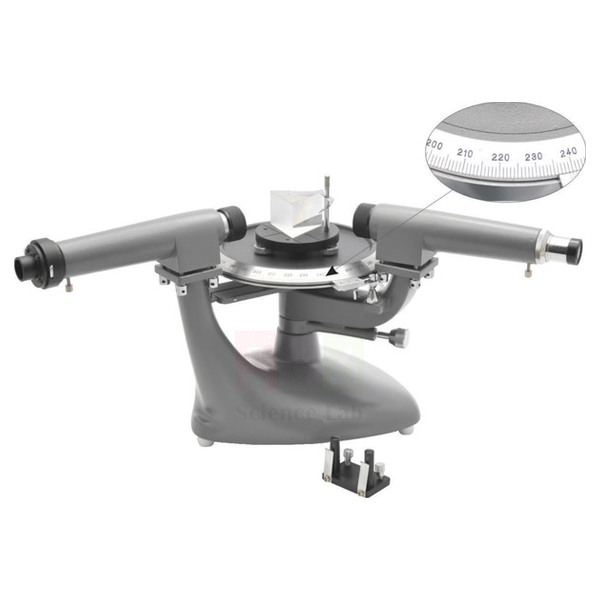
Spectrometer
Spectrometer (Product Code: SLE/PHY/299) is an optical instrument used to measure angles of refraction, dispersion and diffraction for quantitative spectroscopy in college and senior school physics laboratories. Its cast collimator and telescope bodies turn over a 170 mm scale, and a spring-loaded vernier gives readings to 0.1°. It is made by Jain Scientific Equipments Pvt Ltd (ScienceLab), an OEM manufacturer, at its own factory in Ambala, India, as core optics lab equipment for institutions.
Specifications
| Parameter | Detail |
|---|---|
| Construction | Main structural parts, including collimator and telescope bodies, are castings; metal parts well coated with protective finishes |
| Scale | 170 mm diameter, divided 0 to 360° x 1°; rotates independently, with locking screw |
| Vernier | Spring-loaded vernier on the telescope mount, reading to 0.1° |
| Telescope mounting | Movable pillar with locking-screw adjustment and axis adjustment |
| Telescope eyepiece | Ramsden eyepiece with cross wires and locking-ring focus adjustment |
| Telescope objective | 170 mm focal length, 21 mm aperture, in a spiral focusing system |
| Collimator mounting | Fixed pillar with axis adjustment |
| Collimator objective | 150 mm focal length, in a spiral focusing system |
| Slit | Unilaterally adjustable, 6 mm long |
| Prism table | Three levelling screws; lines marked to help place the prism |
| Standard accessories | 1 prism clamp for prisms up to 40 mm high; 1 diffraction grating holder, aperture 25 x 25 mm; 1 small screwdriver; 1 tommy bar for axis adjustment; full instructions |
| Product code | SLE/PHY/299 |
| Manufacturer | Jain Scientific Equipments Pvt Ltd (ScienceLab) — OEM |
| Country of origin | India (made in Ambala, Haryana) |
What Is the Spectrometer Used For?
As a prism spectrometer, it lets students find the angle of the prism and the angle of minimum deviation, and from these the refractive index and dispersive power of the glass. Fitted with a diffraction grating in the 25 x 25 mm holder, it becomes a grating spectrometer for measuring the wavelengths of spectral lines from a sodium or other spectral lamp. The 0.1° vernier reading supports genuinely quantitative results rather than simple demonstrations.
Good results start with adjustment. Focus the Ramsden eyepiece on the cross wires, set the telescope and collimator for parallel light using the spiral focusing, then level the prism table with its three screws. Keep the slit narrow but bright, lock the scale before taking a reading, and keep the instrument covered and away from dust after use. Only the tommy bar and screwdriver supplied should be used for axis adjustments.
What to Specify When Ordering
- Number of spectrometers for your optics laboratory.
- Prisms and diffraction gratings to go with the included clamp and grating holder.
- Light source: sodium spectral lamp and spectral lamp power supply, if needed.
- Whether the order is for institutional use or for resale as a dealer or importer.
OEM Manufacturer
Jain Scientific Equipments Private Limited, which trades as ScienceLab, is the original equipment manufacturer (OEM) of this spectrometer. The cast bodies are finished and assembled with their optics and scales at the company’s own licensed factory at Saha, Ambala, Haryana, India, rather than sourced from a trader, and the finished instruments go factory-direct to colleges, universities, schools, dealers and importers.
Because the manufacturer handles supply itself, requests for replacement eyepieces, prism clamps, grating holders or repeat orders can be raised with us directly. Learn more about the company on our profile page.
Related Physics Lab Equipment
Complete a spectroscopy practical with these items:
- Prism, Borosilicate Glass — for minimum deviation and refractive index work.
- Prism, Clear Glass — an alternative prism for dispersion experiments.
- Sodium Spectral Lamp — bright yellow line source for wavelength measurements.
- Spectral Lamp Power Supply with Lamp Holder — powers and shields the spectral lamp at the slit.
- Sodium Lamp Kit — an alternative sodium light source set.
More optics apparatus is in Physics Lab Equipment.
Frequently Asked Questions
How precise are readings on the Spectrometer?
The Spectrometer has a 170 mm diameter scale divided 0 to 360° in 1° steps, and a spring-loaded vernier on the telescope mount reads to 0.1°. The scale rotates independently and locks with a screw during readings.
What accessories come with the Spectrometer?
The Spectrometer comes with one prism clamp for prisms up to 40 mm high, one diffraction grating holder with a 25 x 25 mm aperture, one small screwdriver, one tommy bar for axis adjustment and full instructions.
What are the telescope and collimator optics of the Spectrometer?
The Spectrometer telescope has a 170 mm focal length objective with a 21 mm aperture and a Ramsden eyepiece with cross wires. The collimator objective has a 150 mm focal length, and both use spiral focusing, with a 6 mm unilaterally adjustable slit.
What is the collimator lens aperture of the Spectrometer?
The collimator focal length of the Spectrometer is 150 mm, but its lens aperture is not confirmed in our current product details. If the aperture matters for your specification, ask us through the contact page and we will confirm it before quoting.
Who manufactures the Spectrometer?
The Spectrometer is manufactured by Jain Scientific Equipments Pvt Ltd (ScienceLab), the OEM, at its own licensed factory at Saha, Ambala, Haryana, India. Quotations, spare parts and repeat orders come directly from the manufacturer rather than through a trader.
Is a calibration certificate available for the Spectrometer?
If your tender or purchase file needs a calibration or inspection document for the Spectrometer, please discuss the requirement with us through the contact page before ordering, and we will confirm what can be provided.
Request a Quote
Ask for a quotation on the Spectrometer through the contact page, or add it with prisms and a light source to the enquiry cart. Quotes come direct from the manufacturer.
Last updated: 24 September 2026
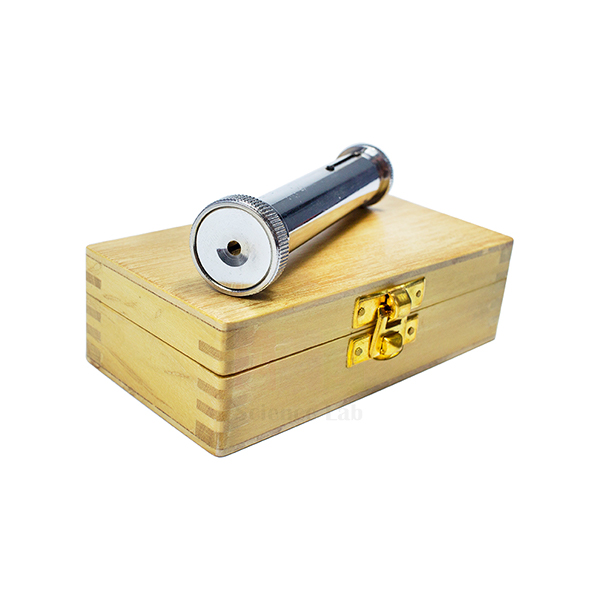
Spectroscope, Direct Vision
Spectroscope, Direct Vision (Product Code: SLE/PHY/300) is a straight-through optical instrument used to view the spectrum of a light source by looking directly at it, in school and college physics laboratories. Teachers and students use it for the rapid examination of the spectral composition of white light sources, and it gives a bright spectrum with a dispersion of approximately 11°. As practical optics lab equipment, it is made by Jain Scientific Equipments Pvt Ltd (ScienceLab), an OEM manufacturer, at its own factory in Ambala, India.
Specifications
| Parameter | Detail |
|---|---|
| Instrument type | Direct-vision spectroscope |
| Dispersion | Approx. 11° |
| Slit | Variable width, adjusted by rotating the end piece |
| Intended use | Rapid examination of the spectral composition of white light sources |
| Storage case | Wooden case |
| Product code | SLE/PHY/300 |
| Manufacturer | Jain Scientific Equipments Pvt Ltd (ScienceLab) — OEM |
| Country of origin | India (made in Ambala, Haryana) |
What Is the Direct Vision Spectroscope Used For?
A direct vision spectroscope lets a learner hold the instrument in line with a lamp and see its light spread into a band of colours, without setting up a prism table, collimator and telescope. In a lesson on light and colour, students can observe the continuous spectrum of a white source such as a filament lamp and discuss why white light contains every visible colour from red to violet.
Turn the end piece to narrow the slit when the source is bright and the colours look blurred, and open it a little for a dim source; the balance between brightness and sharpness is itself a useful teaching point. Never point the instrument at the Sun, and return it to its wooden case after the lesson so the optics stay clean. It suits school physics lab equipment lists in India where a quick, qualitative view of spectra is needed before students move on to measured work.
OEM Manufacturer
Jain Scientific Equipments Private Limited, which trades under the name ScienceLab, is the OEM (original equipment manufacturer) of the Spectroscope, Direct Vision. The instrument is produced at the company's own licensed factory at Saha, Ambala, Haryana, India, and is not bought from a trader and relabelled. Schools, colleges, institutions, dealers and importers in India and international markets buy it factory-direct, and questions about replacement parts or repeat orders go straight to the manufacturer. Read more on our company profile.
Related Physics Lab Equipment
These items support the same lessons on dispersion and spectra:
- Spectrometer — for measured angles and wavelengths once students have seen spectra qualitatively.
- Spectroscope (for high school) — a prism instrument with collimator and telescope for bench work.
- Prism, Clear Glass — shows dispersion of white light on the open bench.
- Prism – Acrylic, Set of 7 — several prism shapes for refraction and dispersion activities.
- Electromagnetic Spectrum Chart — places the visible band within the wider spectrum.
Browse the full range in Physics Lab Equipment.
Frequently Asked Questions
What does the Spectroscope, Direct Vision show?
The Spectroscope, Direct Vision shows the spectrum of a light source when you look straight through it at the source. It is intended for rapid examination of the spectral composition of white light sources and gives a bright spectrum with a dispersion of approximately 11°.
How is the slit width adjusted on the direct vision spectroscope?
The slit of the Spectroscope, Direct Vision has a variable width, set by rotating the end piece. A narrower slit gives sharper colour boundaries, while a wider slit admits more light when the source is faint.
How is the Spectroscope, Direct Vision stored?
The Spectroscope, Direct Vision comes in a wooden case, which protects the instrument during storage and when it is carried between classrooms. Keeping it in the case between lessons also keeps dust off the optics.
Can the direct vision spectroscope measure wavelengths?
No wavelength scale is listed for the Spectroscope, Direct Vision; it is described for quick visual examination of spectra. For measured angles or wavelengths a spectrometer is the usual choice, and we can advise which instrument suits your syllabus through the contact page.
Who manufactures the Spectroscope, Direct Vision?
The Spectroscope, Direct Vision is manufactured by Jain Scientific Equipments Pvt Ltd (ScienceLab), the OEM, at its own licensed factory at Saha, Ambala, Haryana, India. Quotations, repeat orders and spare-part questions are handled directly by the manufacturer.
Can schools order the Spectroscope, Direct Vision in bulk or for export?
Yes. The Spectroscope, Direct Vision can be quoted in class-set quantities for schools, colleges and dealers in India and international markets. Send the quantity and delivery location through our contact page and the manufacturer will prepare the quotation.
Request a Quote
To order the Spectroscope, Direct Vision, send your quantity and delivery details through our contact page or add it to the enquiry cart. Your quotation comes direct from the manufacturer in Ambala.
Last updated: 24 September 2026
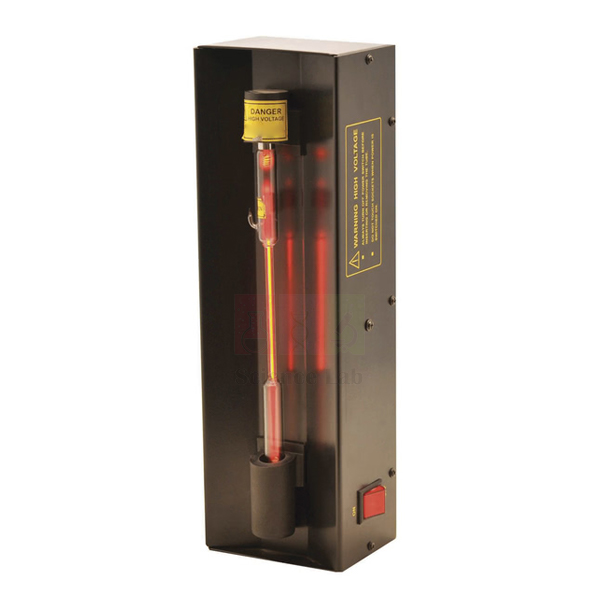
Spectrum Tube Power Supply
Spectrum Tube Power Supply (Product Code: SLE/PHY/301) is a mains-operated unit used to light gas-filled spectrum tubes so that their emission spectra can be studied in school and college physics laboratories. A common item of physics lab equipment in India for atomic-spectra lessons, it takes 26 cm tubes, and its enclosed box holds the tube firmly while stopping students from touching the electrodes. It is supplied by Jain Scientific Equipments Pvt Ltd (ScienceLab), Ambala, India.
Specifications
| Parameter | Detail |
|---|---|
| Suitable tube length | 26 cm |
| Power input | 220 V AC, 50 Hz |
| Tube mounting | Specially designed box holds the tube firmly |
| Student protection | Box prevents students from touching the electrodes |
| Background panel | Black panel behind the tube cuts out distracting ambient light and protects the tube from breakage |
| Product code | SLE/PHY/301 |
| Supplied by | Jain Scientific Equipments Pvt Ltd (ScienceLab), Ambala, India |
What Is the Spectrum Tube Power Supply Used For?
When a high voltage is applied across the low-pressure gas in a spectrum tube, the gas glows with a colour typical of that element. Viewed through a spectroscope or diffraction grating, the glow separates into distinct bright lines rather than a continuous band, which gives students direct evidence that atoms emit light only at particular wavelengths. The black panel behind the tube makes this faint glow stand out even when the room lights are on.
Spectrum tubes run at high voltage, so tubes should be changed only by a teacher or technician with the unit switched off and unplugged, and allowed to cool before handling. Check that your mains supply matches the listed 220 V AC at 50 Hz, and that the tubes you plan to use are 26 cm long.
What to Specify When Ordering
- Your mains supply, so we can confirm it matches the unit's 220 V AC, 50 Hz input.
- The length of any spectrum tubes you already hold (the unit is designed for 26 cm tubes).
- Whether you also need spectrum tubes, and which gases.
- The viewing instrument students will use, such as a spectroscope or spectrometer.
Supplier
Jain Scientific Equipments Private Limited, trading as ScienceLab, supplies the Spectrum Tube Power Supply from Ambala, Haryana, India to schools, colleges, dealers and institutional buyers in India and international markets. The unit is sourced for our physics range, and we confirm its output details and tube compatibility in writing with each quotation. Export shipments are handled under Importer-Exporter Code AAECJ8618A (DGFT), and the supplying company's GSTIN is 06AAECJ8618A1ZT for vendor registration. Read more on our company profile.
Related Physics Lab Equipment
Pair the power supply with these items for a complete emission-spectra practical:
- Spectroscope, Direct Vision — for a quick look at the light from a lit tube.
- Spectrometer — for measuring the positions of individual spectral lines.
- Hydrogen Spectrum Set — a separate set built around a hydrogen discharge tube.
- Spectral Lamp Power Supply with Lamp Holder — a brighter spectral lamp source for optical work.
- Electromagnetic Spectrum Chart — wall reference for visible and invisible radiation.
See more in Physics Lab Equipment.
Frequently Asked Questions
What length of tube does the Spectrum Tube Power Supply take?
The Spectrum Tube Power Supply is designed for 26 cm spectrum tubes. Its specially designed box holds the tube firmly in place, so check the length of any tubes you already own before ordering.
What mains supply does the Spectrum Tube Power Supply need?
The Spectrum Tube Power Supply operates on 220 V AC at 50 Hz. Buyers whose mains supply differs should tell us their voltage and frequency when requesting a quotation, so we can confirm suitability before supply.
Are spectrum tubes included with the Spectrum Tube Power Supply?
The listing for the Spectrum Tube Power Supply does not state that tubes are included. Tell us which gas tubes you need through the contact page, and we will confirm exactly what the quotation covers.
How does the Spectrum Tube Power Supply protect students?
The Spectrum Tube Power Supply holds the tube inside a specially designed box that prevents students from touching the electrodes, and a black panel behind the tube protects it from breakage. A teacher should still change tubes with the unit unplugged.
What is the output voltage of the Spectrum Tube Power Supply?
The output voltage of the Spectrum Tube Power Supply is not listed on this page. Please ask us through the contact page for the current specification sheet, which we confirm with your quotation rather than quoting unverified figures here.
Who supplies the Spectrum Tube Power Supply?
The Spectrum Tube Power Supply is supplied by Jain Scientific Equipments Pvt Ltd (ScienceLab) of Ambala, Haryana, India, to schools, colleges, dealers and institutional buyers in India and international markets. Vendor registration details are provided with the quotation.
Request a Quote
For a quotation on the Spectrum Tube Power Supply, send your quantity, mains supply and delivery location through our contact page, or add the item to the enquiry cart.
Last updated: 24 September 2026
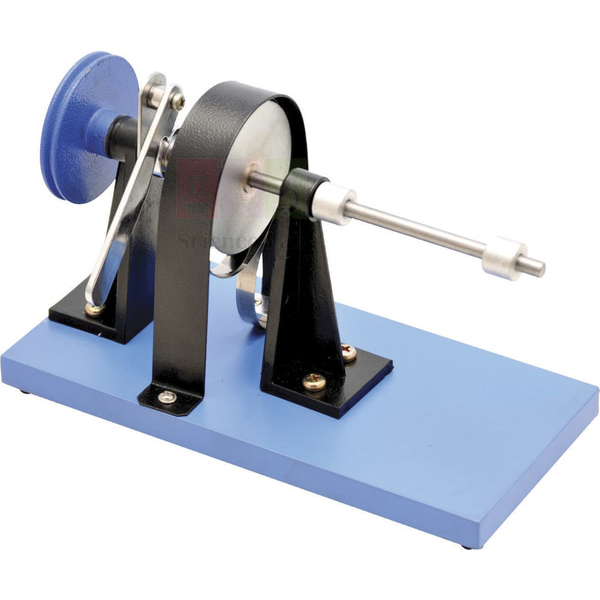
Spring Unit
Spring Unit (Product Code: SLE/PHY/302) is an energy-transfer module used to show how potential energy stored in a wound-up clock spring is converted into electrical energy in school physics lessons. Part of the Energy Transfer Kit, it has a clock spring, free-wheel, winding ratchet and 56 mm aluminium V pulley on a steel shaft, on a 165 x 100 mm base. This physics demonstration kit unit is made by Jain Scientific Equipments Pvt Ltd (ScienceLab), an OEM manufacturer, at its own factory in Ambala, India.
Specifications
| Parameter | Detail |
|---|---|
| Energy conversion shown | Potential energy in a wound-up spring to electrical energy |
| Spring | Clock spring carried on a steel shaft |
| Mechanism | Free-wheel device and winding ratchet |
| Pulley | Aluminium V pulley, 56 mm diameter |
| Base size | 165 x 100 mm (common to all Energy Transfer Kit units) |
| Kit connections | Energy Transfer Kit units have 4 mm socket terminals where appropriate |
| Included | Driving belt |
| Second use | Winding a weight on a cord to show potential-to-kinetic energy changes |
| Product code | SLE/PHY/302 |
| Manufacturer | Jain Scientific Equipments Pvt Ltd (ScienceLab) — OEM |
| Country of origin | India (made in Ambala, Haryana) |
What Is the Spring Unit Used For?
Students wind the clock spring with the ratchet, storing elastic potential energy, and then release it so the free-wheel lets the spring turn the shaft and pulley. With the driving belt linking the pulley to another unit of the Energy Transfer Kit, the stored energy ends up as electrical energy, and the class can trace each step of the chain from spring to belt to output. Because every unit shares the same 165 x 100 mm base, the modules sit neatly in a row on the bench.
The unit also works on its own: attach a cord to the pulley and let the spring wind a small weight upward. The raised weight gains potential energy, which turns into kinetic energy as it falls and can be stored again when it is wound back up. Wind the spring gradually rather than forcing it, and keep the belt at moderate tension so it does not slip or strain the shaft.
What to Specify When Ordering
- How many Spring Units you need per lab group.
- Which other Energy Transfer Kit units you want, since each is available separately.
- Whether you need extra driving belts; ask us about spares.
OEM Manufacturer
Jain Scientific Equipments Private Limited, the company behind the ScienceLab name, is the OEM (original equipment manufacturer) of the Spring Unit. The unit is made and assembled at the company's own licensed factory at Saha, Ambala, Haryana, India, so buyers deal with the maker rather than a trading intermediary. Schools, colleges, dealers and importers in India and international markets can ask the manufacturer directly about repeat orders, belts and other replacement parts. See our company profile for background.
Related Physics Lab Equipment
Other units and accessories that build out the same energy-transfer demonstrations:
- Handwheel Drive Unit — hand-driven input unit from the same Energy Transfer Kit.
- Line Shaft Unit — shaft-and-pulley module from the same kit for transmitting motion.
- Mounted Solar Cell — kit unit showing light energy converted to electrical energy.
- Newton Mass Set 1N Set — small masses for the weight-on-a-cord demonstration.
Explore the wider range in Physics Lab Equipment.
Frequently Asked Questions
What energy change does the Spring Unit demonstrate?
The Spring Unit demonstrates the conversion of potential energy stored in a wound-up clock spring into electrical energy, when its pulley is belted to another Energy Transfer Kit unit. It can also show potential energy changing to kinetic energy and back in a raised weight.
Is the Spring Unit compatible with other Energy Transfer Kit units?
Yes. The Spring Unit is one of the separately available units of the Energy Transfer Kit, and all units in the kit share the same 165 x 100 mm base size. Tell us which other units you plan to combine it with.
What is included with the Spring Unit?
The Spring Unit comes complete with a driving belt. The clock spring, free-wheel device, winding ratchet and 56 mm aluminium V pulley are mounted on its steel shaft; other kit units are ordered separately.
Can the Spring Unit be used without the rest of the kit?
Yes. On its own, the Spring Unit can wind a weight on a cord, so students see the raised weight gain potential energy and then convert it to kinetic energy as it falls. Linking to electrical output needs another kit unit.
Who manufactures the Spring Unit?
The Spring Unit is manufactured by Jain Scientific Equipments Pvt Ltd (ScienceLab), the OEM, at its licensed factory at Saha, Ambala, Haryana, India. Enquiries about belts, replacement parts and repeat orders go directly to the manufacturer.
What does a quotation for the Spring Unit need?
A quotation for the Spring Unit needs the number of units, any other Energy Transfer Kit units you want with it, and the delivery location in India or abroad. Send these through the contact page and we will reply with a manufacturer quotation.
Request a Quote
Request a quotation for the Spring Unit through our contact page, or add it and any companion units to the enquiry cart. Quotes are issued direct by the manufacturer.
Last updated: 24 September 2026
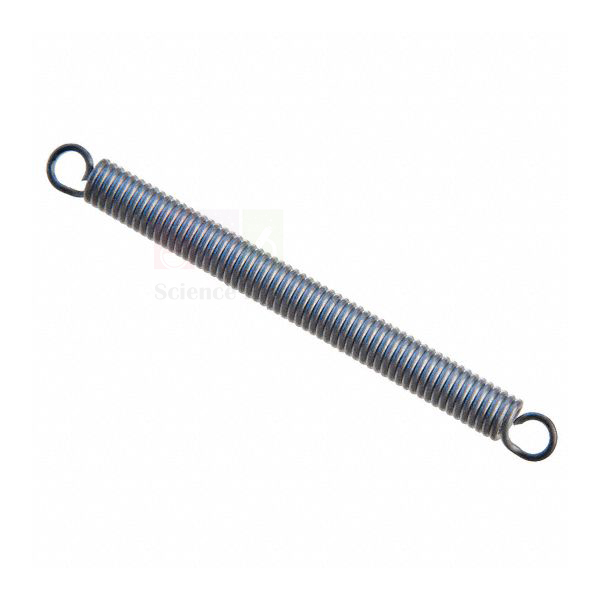
Extension Spring, Steel
Extension Spring, Steel (Product Code: SLE/PHY/303) is a closely wound steel coil spring with looped ends used to study motion, mass and potential energy in school and college physics practicals. Each spring is 225 mm long and 6 mm in diameter, stretches an average of 430 mm under a 200 g load, and is sold in packs of 200 for whole-class use. This mechanics lab equipment item is made by Jain Scientific Equipments Pvt Ltd (ScienceLab), an OEM manufacturer, at its own factory in Ambala, India.
Specifications
| Parameter | Detail |
|---|---|
| Material | Steel |
| Ends | Closely wound, looped |
| Length | 225 mm |
| Diameter | 6 mm |
| Wire | Approx. 19 swg |
| Average extension for 200 g load | 430 mm |
| Maximum deflection | 750 mm |
| Pack size | Pack of 200 |
| Product code | SLE/PHY/303 |
| Manufacturer | Jain Scientific Equipments Pvt Ltd (ScienceLab) — OEM |
| Country of origin | India (made in Ambala, Haryana) |
What Is the Steel Extension Spring Used For?
The most common use is a Hooke's law investigation: hang the spring from a clamp by one looped end, add masses to the other, and record the extension for each load. Plotting load against extension gives a straight line while the spring behaves elastically, and its gradient gives the spring constant. With an average stretch of 430 mm for 200 g, the extensions are large enough to read easily with a metre rule.
The same spring supports oscillation work. Pull a hanging mass down slightly, release it, and time several complete oscillations with a stop clock to study simple harmonic motion and how the period depends on mass. It also shows that a stretched spring stores elastic potential energy. Keep loads well within the 750 mm maximum deflection so the coils return to their original length after each run.
What to Specify When Ordering
- Number of packs required (the spring is listed as a pack of 200).
- The loads you plan to use, so they suit the 430 mm average extension at 200 g and the 750 mm maximum deflection.
- Any masses, hangers, clamp stands or timers you want quoted together.
OEM Manufacturer
ScienceLab is the trading name of Jain Scientific Equipments Private Limited, the OEM (original equipment manufacturer) of the Extension Spring, Steel. Production takes place at the company's own licensed factory at Saha, Ambala, Haryana, India, and packs go factory-direct to schools, colleges, institutions, dealers and importers in India and international markets. Because the maker handles your enquiry, repeat orders for further packs are quoted without a middleman. Learn more on our company profile.
Related Physics Lab Equipment
Items used alongside the spring in elasticity and oscillation practicals:
- Hooke’s Law Apparatus — a complete set-up for measuring load against extension.
- Newton Mass Set 1N Set — masses for loading the spring in steps.
- Retort Stand — a support to hang the spring from.
- Stop Clock (Metal Case) — for timing oscillations of a mass on the spring.
- Metal Slinky, Helical Spring — for wave demonstrations with a longer coil.
Find more in Physics Lab Equipment.
Frequently Asked Questions
How much does the Extension Spring, Steel stretch?
The Extension Spring, Steel has an average extension of 430 mm for a 200 g load and a maximum deflection of 750 mm. These large extensions make readings easy for students in Hooke's law and oscillation experiments.
How many springs are in a pack of the Extension Spring, Steel?
The Extension Spring, Steel is listed as a pack of 200, which suits schools equipping several classes or lab groups at once. Confirm the number of packs you need when you request a quotation.
What are the dimensions of the Extension Spring, Steel?
Each Extension Spring, Steel is 225 mm long and 6 mm in diameter, wound from steel wire of approximately 19 swg. The coils are closely wound and both ends are formed into loops for hanging.
Can the Extension Spring, Steel be used for simple harmonic motion?
Yes. A mass hung from the Extension Spring, Steel can be displaced and released so students time its oscillations and study simple harmonic motion. Keep the total stretch well within the 750 mm maximum deflection.
Who manufactures the Extension Spring, Steel?
The Extension Spring, Steel is manufactured by Jain Scientific Equipments Pvt Ltd (ScienceLab), which is the OEM, at its own licensed factory at Saha, Ambala, Haryana, India. Repeat orders and quotations are handled directly by the manufacturer.
Can the Extension Spring, Steel be supplied for export?
Yes. The Extension Spring, Steel is supplied to buyers in India and international markets. Send the number of packs and the delivery destination through our contact page and we will prepare a quotation.
Request a Quote
To order the Extension Spring, Steel, send the number of packs and your delivery location via our contact page, or place it in the enquiry cart. The quotation is prepared directly by the manufacturer.
Last updated: 24 September 2026