- Physics Lab Equipment
- Chemistry Lab Equipment
- Biology Lab Equipment
- Anatomical Lab Equipment
- Learning
- Educational Lab Equipment
- Magnets
- Agriculture
- Astronomy
- Earth Science
- Geography Lab Equipment
- Safety Lab Coat
- Laboratory
- Meteorological
- Electricity & Magnetism
- Heat
- School Lab Equipment
- Lab Glassware
- Science Lab Equipment
- Tvet Lab Equipment
- Robotics Kits Supplier and Manufacturer for Schools India
- Math Lab Equipment Manufacturers and Exporters in Ambala
- STEM Kits Manufacturers and Supplier India
- Engineering Lab Equipment
- Hospital Lab Equipment
- Water, Sanitation & Hygiene Supplies
- Cold Chain, Solar & Communication Equipment
- Nutrition
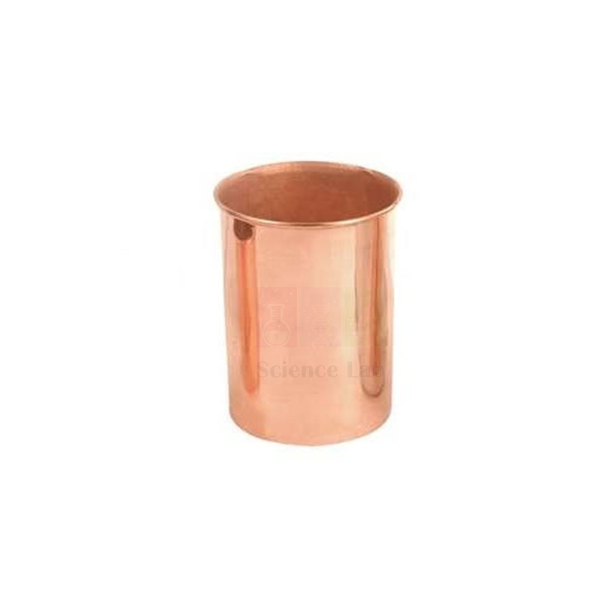
Calorimeter, Copper
Calorimeter, Copper (Product Code: SLE/PHY/144) is a plain copper calorimeter vessel used to contain water or other liquids in specific-heat, latent-heat and cooling experiments in school and college physics laboratories. At 100 mm long and 65 mm in diameter, with parallel sides and a rolled rim, it leaves room for a thermometer, a stirrer and a solid sample; no stirrer is included. It is made by Jain Scientific Equipments Pvt Ltd (ScienceLab), an OEM manufacturer, at its own factory in Ambala, India.
Specifications
| Parameter | Detail |
|---|---|
| Material | Copper |
| Shape | Parallel sides, rolled rim |
| Length | 100 mm |
| Diameter | 65 mm |
| Stirrer | Without stirrer |
| Product code | SLE/PHY/144 |
| Manufacturer | Jain Scientific Equipments Pvt Ltd (ScienceLab) — OEM |
| Country of origin | India (made in Ambala, Haryana) |
What Is a Copper Calorimeter Used For?
Copper conducts heat very well, so the vessel and its contents settle to the same temperature quickly, which keeps readings consistent. Common practicals include the specific heat capacity of a solid by the method of mixtures, the latent heat of vaporisation of water by condensing steam into the cup, and Newton's law of cooling, where the copper cup is filled with hot water and its temperature is logged as it cools.
It is a standard piece of thermometry apparatus in India's physics labs. Keep the outside surface clean and bright to limit heat lost by radiation, weigh the empty vessel before each experiment, and dry it straight after use to slow tarnishing. A separate stirrer is needed, since the cup is supplied bare.
What to Specify When Ordering
- The quantity of copper calorimeters per lab or per student pair.
- Stirrers and thermometers to go with them, as none are included.
- Any lagging or outer container for insulated work.
- Whether aluminium calorimeters are also needed for comparison.
OEM Manufacturer
This copper calorimeter is made by Jain Scientific Equipments Private Limited, the company behind the ScienceLab brand, which is the OEM and produces it at its own licensed factory at Saha, Ambala, Haryana, India. Institutions ordering class sets deal with the maker itself, so quotations, repeat orders and delivery questions are answered at source rather than by a trading intermediary. Dealers and importers in India and international markets are supplied on the same factory-direct basis. Visit the ScienceLab profile for more about the company.
Related Physics Lab Equipment
Apparatus used with a copper calorimeter in heat practicals:
- Calorimeter, Aluminium — a smaller aluminium cup for comparison work.
- Calorimeter Set, Copper, Joules — lagged copper set with its own heating coil for the electrical method.
- Apparatus for Newton's Cooling Law — dedicated set-up for cooling-rate experiments.
- Calorimeter Lagging — felt jacket and base mat to insulate the vessel.
- Digital Pocket Thermometer — quick temperature readings of the water in the cup.
Explore the full Physics Lab Equipment category for more heat apparatus.
Frequently Asked Questions
What size is the Calorimeter, Copper?
The Calorimeter, Copper is 100 mm long and 65 mm in diameter, with parallel sides and a rolled rim. This gives enough room for a thermometer, a stirrer and a solid sample to sit in the liquid at the same time.
Is a stirrer included with the Calorimeter, Copper?
No, the Calorimeter, Copper is supplied without a stirrer. Order a stirrer separately, or tell us in your enquiry and we will quote one with the calorimeters, together with thermometers if your lab needs them.
Which practicals use the Calorimeter, Copper?
The Calorimeter, Copper is used for specific heat capacity of solids by the method of mixtures, latent heat of vaporisation of water, and Newton's law of cooling. Its good thermal conductivity helps the vessel and its contents reach a common temperature quickly.
How should the Calorimeter, Copper be cleaned and stored?
Rinse the Calorimeter, Copper with clean water after each practical, dry it thoroughly and store it upright in a dry cupboard. Keeping the outside bright reduces heat loss by radiation, and prompt drying slows the dull tarnish that copper develops.
Who manufactures the Calorimeter, Copper?
The Calorimeter, Copper is manufactured by Jain Scientific Equipments Pvt Ltd (ScienceLab), the OEM, at its own licensed factory at Saha, Ambala, Haryana, India. Schools, colleges and importers buy it direct from the manufacturer.
What details does a Calorimeter, Copper quotation need?
For a Calorimeter, Copper quotation, send the product code SLE/PHY/144, the number of vessels, any stirrers, thermometers or lagging to include, and your delivery address. We quote for buyers in India and international markets.
Request a Quote
Price the Calorimeter, Copper by writing to us on the contact page or adding it to the enquiry cart. The manufacturer sends the quotation directly.
Last updated: 24 September 2026
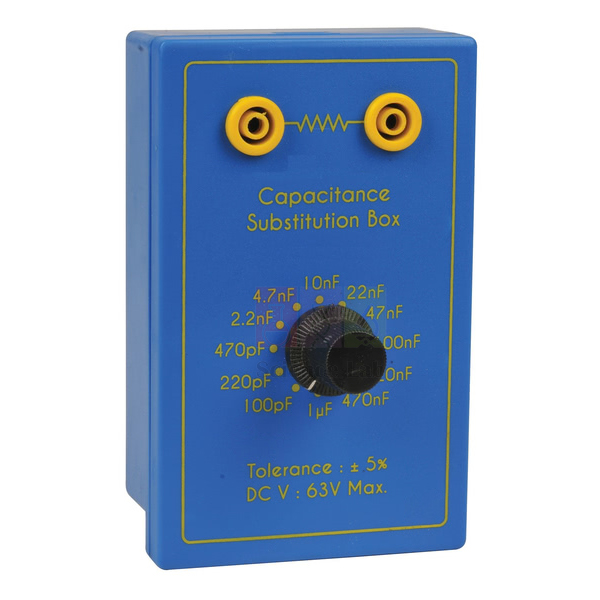
Capacitance Substitution Box
Capacitance Substitution Box (Product Code: SLE/PHY/145) is a switch-selected capacitor box used to insert a known capacitance into a circuit for RC timing, filter and AC reactance experiments in physics and electronics labs. A rotary selector switch chooses preferred values from 100 pF to 1 µF, each within ±5% and rated at 63 V, through two 4 mm safety sockets on a 75 x 100 x 40 mm ABS case. It is supplied by Jain Scientific Equipments Pvt Ltd (ScienceLab), Ambala, India.
Specifications
| Parameter | Detail |
|---|---|
| Case | Robust ABS, 75 x 100 x 40 mm |
| Selector | Rotary selector switch |
| Connections | Two 4 mm safety sockets |
| Capacitance values | 100 pF, 220 pF, 470 pF, 2.2 nF, 4.7 nF, 10 nF, 22 nF, 47 nF, 100 nF, 220 nF, 470 nF, 1 µF |
| Range | Preferred values from 100 pF to 1 µF |
| Accuracy | ±5% (all values) |
| Voltage rating | 63 V (all values) |
| Product code | SLE/PHY/145 |
| Supplied by | Jain Scientific Equipments Pvt Ltd (ScienceLab), Ambala, India |
What Is a Capacitance Substitution Box Used For?
Instead of soldering individual capacitors, students turn the selector to swap values and see at once how capacitance changes the time constant of an RC circuit, the cut-off point of a simple filter, or the reactance of a capacitor in an AC circuit driven by a signal generator and viewed on an oscilloscope. That flexibility makes it a useful part of any AC DC circuits experiment kit at college level.
Because the values run from picofarads to one microfarad, the box suits signal-frequency work; slow charge-and-discharge demonstrations read on a meter usually use larger capacitors. Keep the applied voltage below the 63 V rating, switch the supply off before changing value, and connect with shrouded 4 mm leads.
What to Specify When Ordering
- The number of capacitance substitution boxes needed.
- Whether a resistance substitution box should be quoted for RC work.
- Whether a signal generator and oscilloscope are also required.
- Connecting leads with 4 mm plugs for the safety sockets.
Supplier
ScienceLab is the trading name of Jain Scientific Equipments Private Limited, which supplies this capacitance substitution box from Ambala, Haryana, for physics and electronics laboratories. Institutional and tender buyers who need vendor registration details can use GSTIN 06AAECJ8618A1ZT and LEI 3358004HRD1JIVXKYX49. Background on the company is on the ScienceLab profile page.
Related Physics Lab Equipment
Instruments used with a capacitance box in circuit experiments:
- Resistance Substitution Box — switch-selected resistors to pair with the capacitors in RC circuits.
- Signal Generator and Amplifier — AC source for reactance and filter experiments.
- Oscilloscope Dual Trace — displays charging curves and phase differences.
- Advanced Digital Multimeter — measures circuit voltages and currents.
- Stackable Leads — 4 mm leads for the safety sockets.
Browse all Physics Lab Equipment for further electricity apparatus.
Frequently Asked Questions
What capacitance values does the Capacitance Substitution Box provide?
The Capacitance Substitution Box selects 100 pF, 220 pF, 470 pF, 2.2 nF, 4.7 nF, 10 nF, 22 nF, 47 nF, 100 nF, 220 nF, 470 nF and 1 µF, a set of preferred values chosen with its rotary switch.
What are the accuracy and voltage rating of the Capacitance Substitution Box?
Every value in the Capacitance Substitution Box has an accuracy of ±5% and a rating of 63 V. Keep circuit voltages below that rating, and allow for the ±5% tolerance when comparing measured time constants with calculated ones.
How is the Capacitance Substitution Box connected to a circuit?
The Capacitance Substitution Box connects through two 4 mm safety sockets on its ABS case, so standard 4 mm plug leads fit directly. The selected capacitor appears between the two sockets as soon as the rotary switch is turned.
Can the Capacitance Substitution Box be used for RC time-constant experiments?
Yes, the Capacitance Substitution Box can be combined with a resistor or resistance box for RC experiments. With its picofarad-to-microfarad values the time constants are short, so a signal generator and oscilloscope are the usual way to observe them.
Is a calibration certificate available for the Capacitance Substitution Box?
A calibration certificate is not listed for the Capacitance Substitution Box. If your tender or quality system asks for calibration documents, please raise it through the contact page before ordering so we can confirm what is possible.
Who supplies the Capacitance Substitution Box?
The Capacitance Substitution Box is supplied by Jain Scientific Equipments Pvt Ltd (ScienceLab), Ambala, Haryana, India. Schools, colleges, universities, dealers and importers can order it alongside resistance boxes, meters and signal sources.
What should a Capacitance Substitution Box quotation request include?
For a Capacitance Substitution Box quotation, give the product code SLE/PHY/145, the quantity, any companion instruments or leads you want quoted, and your delivery address in India or abroad.
Request a Quote
Ask for a price on the Capacitance Substitution Box through the contact page or add it to the enquiry cart with your other electricity items.
Last updated: 24 September 2026
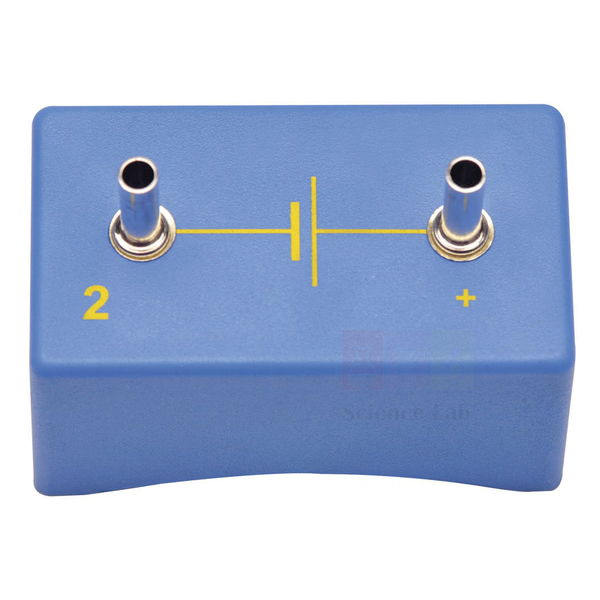
Circuits Kit Cell Holder
Circuits Kit Cell Holder (Product Code: SLE/PHY/146) is a panel-mounted battery holder used as the power source in a Circuits Kit for building simple series and parallel circuits in school science labs. It takes one D-size battery and, like the other Circuits Kit spares, sits on a sturdy panel that is easy to handle during lessons and to stack away afterwards. It is made by Jain Scientific Equipments Pvt Ltd (ScienceLab), an OEM manufacturer, at its own factory in Ambala, India.
Key Details
| Parameter | Detail |
|---|---|
| Type | Spare cell holder for the Circuits Kit |
| Battery | Uses 1 x D battery |
| Mounting | Sturdy panel, for ease of use and storage |
| Product code | SLE/PHY/146 |
| Manufacturer | Jain Scientific Equipments Pvt Ltd (ScienceLab) — OEM |
| Country of origin | India (made in Ambala, Haryana) |
What Is the Circuits Kit Cell Holder Used For?
The cell holder is where every Circuits Kit investigation starts: it supplies the voltage that drives current through lamps, buzzers, switches and rheostats. Adding a second or third holder in series lets students see a lamp glow brighter as the voltage rises, while holders side by side show how cells in parallel share the load, a core idea in any electricity experiment kit for school.
Extra holders are useful when a class splits into more groups than the original kit allows. Take the D cells out at the end of each lesson so they cannot leak, check the contacts for corrosion now and then, and store the panels flat with the other kit spares.
What to Specify When Ordering
- How many spare cell holders you need for your Circuits Kits.
- Whether D batteries should be quoted with the holders.
- Any other Circuits Kit spares required, such as bulb holders, push switches, buzzers or rheostats.
OEM Manufacturer
The Circuits Kit Cell Holder is one of the kit spares that Jain Scientific Equipments Private Limited, trading as ScienceLab, makes as the OEM at its own licensed factory at Saha, Ambala, Haryana, India. Because ScienceLab also makes the other Circuits Kit spares, schools can top up or extend their kits by ordering individual panels direct, without going through a trader. Dealers and importers in India and international markets are also supplied factory-direct. See the ScienceLab profile for company details.
Related Physics Lab Equipment
Other Circuits Kit panels and accessories:
- Circuits Kit Bulb Holder — lamp panel powered by the cell holder.
- Circuits Kit Push Switch — opens and closes the circuit.
- Circuits Kit Buzzer — an audible output component for circuit tests.
- Circuits Kit Rheostat — varies the current in the circuit.
- Electricity Circuits Kit — a panel-based kit for simple circuit investigations.
Find more circuit apparatus in Physics Lab Equipment.
Frequently Asked Questions
Which battery does the Circuits Kit Cell Holder take?
The Circuits Kit Cell Holder uses one D-size battery. The listing describes the holder panel only, so if you want D cells supplied with it, add them to your enquiry and they can be quoted together.
Is the Circuits Kit Cell Holder compatible with other kits?
The Circuits Kit Cell Holder is a spare for the Circuits Kit and matches its other panel-mounted components. If you want to use it with a kit from another source, send us details of that kit's connections through the contact page first.
Can several Circuits Kit Cell Holders be used together?
Yes, several Circuits Kit Cell Holders can be connected in series to increase the voltage, or in parallel so the cells share the load. Comparing lamp brightness for each arrangement is a common lesson.
Why is the Circuits Kit Cell Holder mounted on a panel?
The Circuits Kit Cell Holder is mounted on a sturdy panel for ease of use and storage. The panel gives students a stable base when building circuits on the bench and lets teachers stack components neatly between classes.
Who manufactures the Circuits Kit Cell Holder?
The Circuits Kit Cell Holder is manufactured by Jain Scientific Equipments Pvt Ltd (ScienceLab), the OEM, at its own licensed factory at Saha, Ambala, Haryana, India, alongside the other Circuits Kit spares.
What should a Circuits Kit Cell Holder quotation request include?
For a Circuits Kit Cell Holder quotation, give the product code SLE/PHY/146, the number of holders, whether D batteries or other kit spares should be included, and the delivery address for India or export.
Request a Quote
Request a price for the Circuits Kit Cell Holder via the contact page or the enquiry cart. Quotations are issued directly by the manufacturer.
Last updated: 24 September 2026
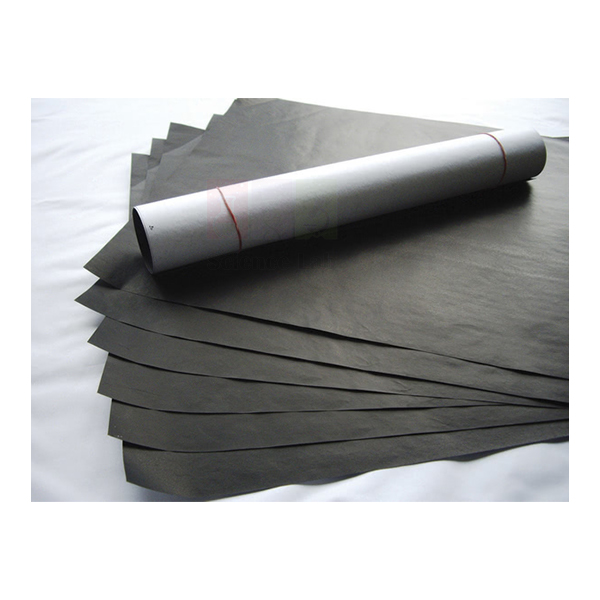
Conductive Paper
Conductive Paper (Product Code: SLE/PHY/147) is a resistive paper used to map electric fields by the equipotential points method in school and college physics labs. It comes as sheets of 38 cm x 53 cm, packed ten to a pack, and can also be cut into strips to make simple home-made resistors for electricity investigations. It is supplied by Jain Scientific Equipments Pvt Ltd (ScienceLab), Ambala, India.
Specifications
| Parameter | Detail |
|---|---|
| Material | Conductive paper sheet |
| Sheet size | 38 cm x 53 cm |
| Pack | Pack of 10 sheets |
| Main use | Plotting electric fields by the equipotential points method |
| Other use | Producing home-made strip resistors |
| Product code | SLE/PHY/147 |
| Supplied by | Jain Scientific Equipments Pvt Ltd (ScienceLab), Ambala, India |
What Is Conductive Paper Used For?
To plot a field, two electrodes are fixed on the sheet and connected to a low-voltage DC supply. A probe linked to a voltmeter or centre-zero galvanometer is moved across the paper to find points at the same potential; students mark them, join them into equipotential lines, and then sketch field lines at right angles. Changing the electrode shapes, such as two points, two parallel bars, or a point and a ring, shows how the field pattern follows the geometry.
Cut into strips, the same paper becomes a cheap resistor whose resistance rises with length and falls with width, which makes a neat investigation for physics lab equipment in India at secondary level. Store the sheets flat and dry, avoid folding or creasing them, and handle them by the edges to keep the surface even.
What to Specify When Ordering
- The number of packs (each pack holds 10 sheets of 38 cm x 53 cm).
- Whether a probe, galvanometer or voltmeter is needed for field plotting.
- Whether a low-voltage DC power supply should be quoted as well.
Supplier
Jain Scientific Equipments Private Limited, trading as ScienceLab, supplies conductive paper from Ambala, Haryana, as a consumable for electrostatics and electricity practicals. Schools, colleges, dealers and importers in India and international markets can order it together with the meters and supplies used in field-plotting work. Company information is on the ScienceLab profile page.
Related Physics Lab Equipment
Apparatus used with conductive paper:
- Galvanometer, Centre Zero Universal Meter — null indicator for locating equipotential points.
- Jockey with Insulated Handle (Single) — insulated probe for touching points on the sheet.
- Power Supply, Stepped — low-voltage source for the electrodes.
- Standard Digital Multimeter — reads potential at each point or the resistance of a strip.
- Conductive Putty — another shape-it-yourself conductor for resistance experiments.
See more in the Physics Lab Equipment category.
Frequently Asked Questions
What size is Conductive Paper and how many sheets are in a pack?
Conductive Paper comes in sheets of 38 cm x 53 cm, with 10 sheets in each pack. One sheet can be cut into smaller pieces so several student groups can plot fields or make strip resistors at the same time.
How is Conductive Paper used to plot electric fields?
On Conductive Paper, two electrodes are connected to a DC supply and a probe finds points of equal potential using a meter or galvanometer. Joining those points gives equipotential lines, and field lines are drawn at right angles to them.
Can Conductive Paper be used to make resistors?
Yes, Conductive Paper can be cut into strips to produce home-made resistors. Students can compare strips of different lengths and widths to see how resistance depends on the shape of a conductor, using a multimeter to take the readings.
What else is needed with Conductive Paper?
To use Conductive Paper for field plotting you need electrodes, a low-voltage DC power supply, connecting leads, a probe and a voltmeter or centre-zero galvanometer. These are ordered separately and can be quoted together with the paper.
How should Conductive Paper be stored?
Store Conductive Paper flat in a dry cupboard, away from damp and direct sunlight. Avoid folding or creasing the sheets and handle them by the edges, because a damaged surface can distort the equipotential pattern during an experiment.
Who supplies Conductive Paper?
Conductive Paper is supplied by Jain Scientific Equipments Pvt Ltd (ScienceLab), Ambala, Haryana, India. Schools, colleges, dealers and importers can order it in packs of 10 sheets alongside the meters and power supplies used with it.
What should a Conductive Paper quotation request include?
A Conductive Paper quotation request should give the product code SLE/PHY/147, the number of packs, any meters, probes or power supplies you want added, and the delivery address in India or abroad.
Request a Quote
For a price on Conductive Paper, get in touch through the contact page or add it to the enquiry cart with the rest of your electricity consumables.
Last updated: 24 September 2026
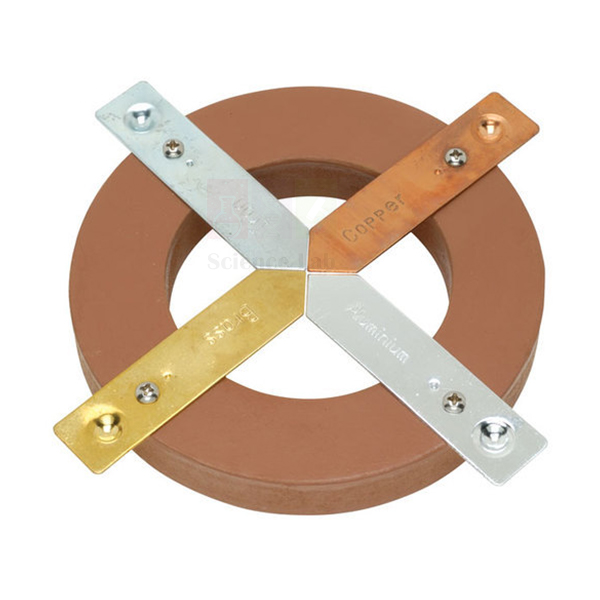
Conductivity of Metal Apparatus
Conductivity of Metal Apparatus (Product Code: SLE/H/28) turns a comparison of four metals into a timed race. Strips of copper, brass, steel and aluminium are mounted on a wooden ring and meet in the centre; when the centre is heated gently, wax placed in a hollow at the far end of each strip melts, and the difference in the time each cup of wax takes to melt shows how fast heat travels through each metal. It is a favourite for middle- and secondary-school heat lessons, and it is made by Jain Scientific Equipments Pvt Ltd (ScienceLab), Ambala, a school laboratory equipment manufacturer supplying India and international markets.
Key Details
| Parameter | Detail |
|---|---|
| Metal strips | Copper, brass, steel and aluminium |
| Mounting | Wooden ring, with the strips meeting in the centre |
| Heating point | Gentle heating at the centre, where the strips meet |
| Indicator | Wax placed in hollows at the end of each strip |
| What is compared | Time taken for each cup of wax to melt |
Typical Use
Students put a small, equal amount of wax into the hollow at the end of each strip, then place a gentle flame under the centre point and start timing. Because all four strips draw heat from the same shared centre, the only thing that differs is the metal. As each cup of wax melts, students log the time, and the finishing order gives a direct ranking of conduction rates. Asking the class to predict the order first, then explaining the result in terms of how readily each metal passes on heat, makes the lesson stick.
For fair results, use the same amount of wax in every hollow, keep the flame small and centred so it does not reach the wooden ring, and let the apparatus cool before resetting the wax. With a stop clock and a data table it becomes a neat, quantitative piece of physics lab equipment for school practicals, and its open layout lets a whole group watch the wax melt.
Manufacturer
ScienceLab products, including this conductivity ring, are manufactured by Jain Scientific Equipments Private Limited of Ambala, Haryana, for schools, colleges and distributors. Our company profile gives an overview of the business.
Related Laboratory Equipment
Everything else a timed conduction practical usually needs:
- Stop Clock — for timing how long each cup of wax takes to melt
- Wax — for filling the hollows at the end of each strip
- Micro Burner — a small, controllable flame for gentle heating at the centre
- Conductivity Apparatus — a six-metal rod version for a wider comparison
Find more thermal teaching aids in our Heat range.
Frequently Asked Questions
Which metals does the ring compare?
Copper, brass, steel and aluminium, each as a strip running to the centre.
How are the results measured?
By the difference in time taken for the wax in each strip's hollow to melt once the centre is heated.
Is wax supplied?
Wax is not listed among the included items; it can be ordered separately from our range.
What heat source should be used?
A small, gentle flame such as a micro burner or spirit lamp placed under the centre. A heat source is not listed as supplied.
How does this differ from the Conductivity Apparatus (SLE/H/19)?
This model uses four strips on a wooden ring and times melting wax cups; the SLE/H/19 apparatus holds six metal rods in a sheet-metal body.
Can you supply class sets or export orders?
Yes. We supply schools and distributors across India and international markets; state the quantity and destination, and warranty terms will be confirmed in the quotation.
Request a Quote
For a quotation on the Conductivity of Metal Apparatus, write to us or save it to the enquiry cart.
Last updated: 24 September 2026
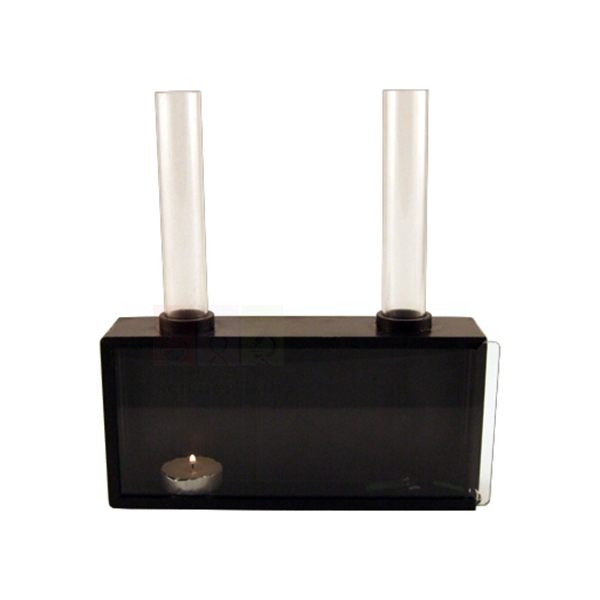
Convection in Air Apparatus
Convection in Air Apparatus (Product Code: SLE/PHY/148) is a two-chimney box used to make convection currents in air visible, with smoke drawn down one chimney and up the other over a candle, in school science labs. It is a metal box of 220 x 100 x 165 mm with a sliding glass front, two detachable glass chimneys and a candle holder fixed beneath the left chimney. It is made by Jain Scientific Equipments Pvt Ltd (ScienceLab), an OEM manufacturer, at its own factory in Ambala, India.
Specifications
| Parameter | Detail |
|---|---|
| Box | Metal, 220 x 100 x 165 mm |
| Front | Sliding glass front |
| Chimneys | Two detachable glass chimneys |
| Candle holder | Fixed to the base beneath the left chimney |
| Candles | Not included |
| Product code | SLE/PHY/148 |
| Manufacturer | Jain Scientific Equipments Pvt Ltd (ScienceLab) — OEM |
| Country of origin | India (made in Ambala, Haryana) |
What Is the Convection in Air Apparatus Used For?
A candle is lit in the holder under the left chimney and the glass front is slid shut. When smouldering paper or an incense stick is held over the right chimney, the smoke is pulled down into the box, drifts across to the flame and rises out through the left chimney. Students see that warm air rises and cooler air flows in to replace it, which is the basis of convection currents.
This simple demonstration model for the physics lab links directly to sea and land breezes, room ventilation and why chimneys draw. Use a short candle so the flame sits well below the chimney, keep the glass front closed during the demonstration, and let the chimneys cool before lifting them off to wipe away soot.
What to Specify When Ordering
- The number of Convection in Air Apparatus units needed.
- Candles, since none are included with the apparatus.
- Whether spare glass chimneys should be quoted with the order.
OEM Manufacturer
Jain Scientific Equipments Private Limited, trading as ScienceLab (CIN U29309HR2020PTC087597), is the OEM of the Convection in Air Apparatus. The apparatus is made at the company's own licensed factory at 449, HSIIDC Industrial Area, Saha, Ambala, which operates under Factory Licence AMB-ONLINE-CHD-J-414. Schools, institutions, dealers and importers receive it factory-direct, and replacement glass chimneys can be requested from the manufacturer, so ask us about availability. Learn more on the ScienceLab profile page.
Related Physics Lab Equipment
Apparatus covering the other ways heat travels:
- Apparatus Convection In Liquid — shows convection currents in water.
- Convection of Gas Apparatus — an alternative box-and-chimney air convection unit.
- Apparatus Heat/Thermal Conductivity — compares conduction in different metals.
- Heat Absorption & Radiation Comparator — compares absorption by black and shiny surfaces.
- Investigating Heat Poster — laminated chart summarising heat transfer.
Browse the full Physics Lab Equipment range for more heat apparatus.
Frequently Asked Questions
What are the dimensions of the Convection in Air Apparatus?
The Convection in Air Apparatus is a metal box measuring 220 x 100 x 165 mm, with a sliding glass front and two detachable glass chimneys on top. The candle holder is fixed to the base beneath the left chimney.
Are candles included with the Convection in Air Apparatus?
No, candles are not included with the Convection in Air Apparatus. Any short candle that fits the fixed holder can be used; add candles to your enquiry if you would like them quoted along with the apparatus.
How does the Convection in Air Apparatus show convection?
In the Convection in Air Apparatus, the candle heats the air under the left chimney so it rises out of the box. Cooler air is drawn in through the right chimney, and smoke held above it makes this current of air clearly visible.
Can the chimneys of the Convection in Air Apparatus be removed?
Yes, both glass chimneys of the Convection in Air Apparatus are detachable. They can be lifted off for cleaning soot or for compact storage, but always allow them to cool completely after a demonstration before handling.
Who manufactures the Convection in Air Apparatus?
The Convection in Air Apparatus is manufactured by Jain Scientific Equipments Pvt Ltd (ScienceLab), the OEM, at its own licensed factory at Saha, Ambala, Haryana, India. Buyers receive quotations and repeat supplies direct from the manufacturer.
What should a Convection in Air Apparatus quotation request include?
A Convection in Air Apparatus quotation request should give the product code SLE/PHY/148, the number of units, whether candles or spare chimneys are wanted, and the delivery address in India or overseas.
Request a Quote
Send your enquiry for the Convection in Air Apparatus through the contact page or add it to the enquiry cart. Quotations are prepared by the manufacturer itself.
Last updated: 24 September 2026
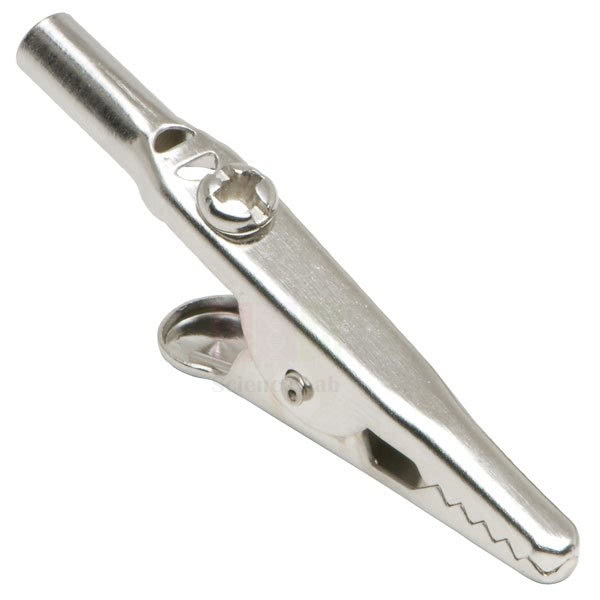
Crocodile Clip
Crocodile Clip (Product Code: SLE/PHY/149) is a standard-size spring clip used to make quick, temporary connections to wires, terminals and component legs in school and college electricity labs. Each nickel-plated steel clip is 50 mm long and rated at 10 A, with a 4 mm socket at the rear and a screw connection that can also be soldered; clips come in packs of 100. They are supplied by Jain Scientific Equipments Pvt Ltd (ScienceLab), Ambala, India.
Specifications
| Parameter | Detail |
|---|---|
| Size | Standard |
| Material | Nickel-plated steel |
| Length | 50 mm |
| Current rating | 10 A |
| Rear connection | 4 mm socket |
| Wire connection | Screw connection; can also be soldered |
| Pack | 100 clips |
| Product code | SLE/PHY/149 |
| Supplied by | Jain Scientific Equipments Pvt Ltd (ScienceLab), Ambala, India |
What Is a Crocodile Clip Used For?
Pushing a 4 mm plug lead into the rear socket turns any lead into a clip-on lead, so students can grip a resistor leg, an electrode, a lamp terminal or a bare wire without tools. Alternatively, a wire can be clamped under the screw or soldered on to make custom test leads, battery connectors or jumper wires for a class set.
A pack of 100 is sized for school lab equipment bulk supply, equipping several benches or replacing clips lost over a term. The 10 A rating comfortably covers low-voltage student circuits; keep the jaws clean for good contact, check that screws are tight, and never use these open clips on mains wiring.
Supplier
ScienceLab, the trading name of Jain Scientific Equipments Private Limited, supplies these crocodile clips from Ambala, Haryana, together with the leads and wire used to make up connections. Schools, colleges, dealers and importers in India and international markets can include them in a single order with other electricity accessories. Visit the ScienceLab profile page for company information.
Related Physics Lab Equipment
Leads and connectors that work with crocodile clips:
- Crocodile Clips & Leads — ready-made leads with a clip at each end.
- Stackable Leads — 4 mm plug leads that fit the clip's rear socket.
- Banana Plug Connectors Leads — 4 mm plug leads for meters and power supplies.
- Battery Snap with Crocodile Clip — battery connector with clips already attached.
- Connecting Wire — copper wire for making your own clip leads.
More connectors and circuit parts are in Physics Lab Equipment.
Frequently Asked Questions
How many clips are in a pack of Crocodile Clip (SLE/PHY/149)?
The Crocodile Clip (SLE/PHY/149) is sold in packs of 100 standard-size clips. That quantity lets a school equip several benches at once or keep spares in stock for clips that go missing during practicals.
What is the current rating of the Crocodile Clip?
Each Crocodile Clip is rated at 10 A. This is ample for the low-voltage circuits used in school and college electricity practicals, such as lamps, motors, resistors and electrolysis cells powered from a bench supply.
How is a wire or lead attached to the Crocodile Clip?
The Crocodile Clip has a 4 mm socket at the rear that accepts a standard 4 mm plug. A bare wire can also be fixed under its screw connection, or soldered to it for a permanent joint.
What is the Crocodile Clip made of and how long is it?
The Crocodile Clip is made of nickel-plated steel and is 50 mm long. The standard size gives a firm grip on terminals and component leads while staying small enough to work on crowded circuit boards.
Who supplies the Crocodile Clip?
The Crocodile Clip is supplied by Jain Scientific Equipments Pvt Ltd (ScienceLab), Ambala, Haryana, India. Schools, colleges, dealers and importers can order packs together with leads, wire and other electricity accessories.
What should a Crocodile Clip quotation request include?
A Crocodile Clip quotation request should give the product code SLE/PHY/149, the number of packs of 100, any leads or connecting wire you want added, and the delivery address in India or abroad.
Request a Quote
Request a price for the Crocodile Clip through the contact page or add packs to the enquiry cart with your other circuit accessories.
Last updated: 24 September 2026
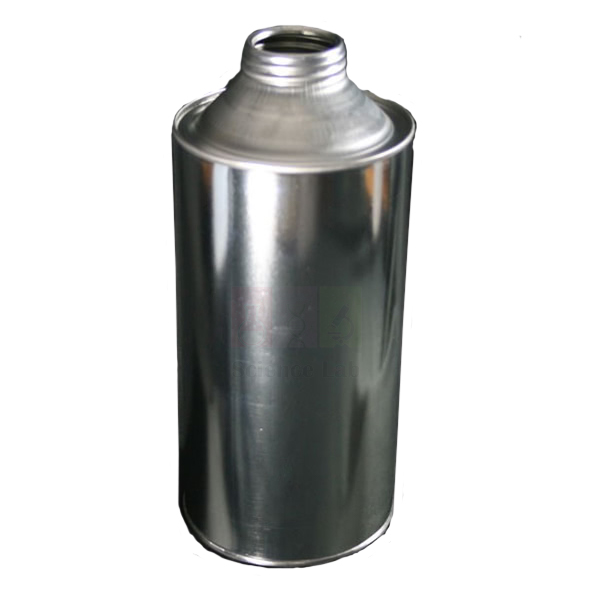
Crushing Can
Crushing Can (Product Code: SLE/PHY/150) is a light-walled tin plate can with an air-tight screw cap used to demonstrate the force exerted by atmospheric pressure in school and college physics laboratories. Teachers rely on it for a memorable class demonstration in which the 75 mm diameter can collapses once the air inside has been driven out by steam. It is made by Jain Scientific Equipments Pvt Ltd (ScienceLab), an OEM manufacturer, at its own factory in Ambala, India, as part of its physics lab equipment for schools.
Specifications
| Parameter | Detail |
|---|---|
| Construction | Light-walled tin plate can |
| Closure | Air-tight screw cap |
| Dimensions | 260 x 75 mm (75 mm diameter) |
| Demonstrates | Force exerted by atmospheric pressure |
| Product code | SLE/PHY/150 |
| Manufacturer | Jain Scientific Equipments Pvt Ltd (ScienceLab) — OEM |
| Country of origin | India (made in Ambala, Haryana) |
What Is the Crushing Can Used For?
The crushing can experiment shows students that the air around them presses on every surface with a surprisingly large force. A little water is heated in the open can until steam pushes most of the air out, the heat is removed and the cap is screwed on tight. As the steam cools and condenses, the pressure inside falls far below the pressure outside, and the atmosphere crumples the thin walls, often with an audible crack. Pouring cold water over the sealed can makes the collapse faster and more dramatic.
For safety, never heat the can with the cap in place, and handle the hot can with tongs or heat-resistant gloves. Only a shallow layer of water is needed, which keeps heating time short. The demonstration fits naturally into lessons on air pressure, gas laws and weather, and it is a practical addition to any physics lab equipment list for schools in India and abroad.
What to Specify When Ordering
- Number of cans — the light-walled can is designed to deform, so plan one per demonstration or group.
- Confirmation that the 260 x 75 mm size suits your burner and tripod set-up.
- Any heating accessories you also need, such as a burner, tripod or gauze.
- Delivery location, within India or overseas, so the quotation can include dispatch details.
OEM Manufacturer
Jain Scientific Equipments Private Limited trades as ScienceLab and is the OEM (original equipment manufacturer) of the Crushing Can. The can is produced at the company's own licensed factory at Saha, Ambala, Haryana, India, so schools, colleges, laboratory dealers and importers deal directly with the maker instead of a trading intermediary. Replacement cans for future terms can be ordered from the same source — ask us about current availability. You can read more about the company on our company profile.
Related Physics Lab Equipment
These items are used alongside the crushing can or extend the same atmospheric-pressure lesson:
- Bunsen Burner — heat source for boiling the small amount of water in the can.
- Tripod Cast Iron Varnished — stable support for the can over the flame.
- Gauze Wire — spreads the heat evenly under the base of the can.
- Magdeburg Hemisphere — a second classic demonstration of atmospheric pressure for the same topic.
Browse the full range of Physics Lab Equipment for other pressure, heat and mechanics apparatus.
Frequently Asked Questions
What size is the Crushing Can?
The Crushing Can measures 260 x 75 mm, with a 75 mm diameter body made from light-walled tin plate and closed by an air-tight screw cap. The thin walls are what allow atmospheric pressure to crush it visibly during a class demonstration.
How does the Crushing Can show atmospheric pressure?
The Crushing Can shows atmospheric pressure by replacing the air inside with steam. Once the cap is sealed and the steam condenses, the pressure inside drops sharply, so the unbalanced pressure of the outside air pushes the thin tin plate walls inward until the can collapses.
Can the Crushing Can be heated with the cap closed?
No. The Crushing Can must always be heated with the screw cap removed so that steam can escape freely. Fit the air-tight cap only after the heat source has been taken away, then let the can cool or pour cold water over it.
Can one Crushing Can be used for several demonstrations?
A Crushing Can is light-walled and meant to deform, so a collapsed can generally cannot be returned to its original shape. Most teachers treat it as a demonstration consumable and order enough cans for the number of classes or groups they plan to teach.
Who manufactures the Crushing Can?
The Crushing Can is manufactured by Jain Scientific Equipments Pvt Ltd (ScienceLab), the OEM, at its own factory at Saha, Ambala, Haryana, India. Buyers receive quotations and repeat supplies directly from the manufacturer rather than through a trader.
What does a quotation for the Crushing Can need?
A quotation for the Crushing Can needs the product code SLE/PHY/150, the number of cans, any related items such as burners or tripods, and the delivery location. Send these details through our contact page and we will reply with a quotation.
Do you supply the Crushing Can in bulk or for export?
Yes. ScienceLab supplies the Crushing Can in bulk to schools, colleges, dealers and institutional buyers across India and international markets. Share the quantity and destination on the contact page and we will confirm packing and dispatch in the quotation.
Request a Quote
To request a quotation for the Crushing Can (SLE/PHY/150), send your quantity and delivery details through our contact page or add the item to the enquiry cart. Quotations come straight from the manufacturer, with no intermediary between you and the factory.
Last updated: 24 September 2026