- Physics Lab Equipment
- Chemistry Lab Equipment
- Biology Lab Equipment
- Anatomical Lab Equipment
- Learning
- Educational Lab Equipment
- Magnets
- Agriculture
- Astronomy
- Earth Science
- Geography Lab Equipment
- Safety Lab Coat
- Laboratory
- Meteorological
- Electricity & Magnetism
- Heat
- School Lab Equipment
- Lab Glassware
- Science Lab Equipment
- Tvet Lab Equipment
- Robotics Kits Supplier and Manufacturer for Schools India
- Math Lab Equipment Manufacturers and Exporters in Ambala
- STEM Kits Manufacturers and Supplier India
- Engineering Lab Equipment
- Hospital Lab Equipment
- Water, Sanitation & Hygiene Supplies
- Cold Chain, Solar & Communication Equipment
- Nutrition

Ripple Tank – Premium Model
Ripple Tank – Premium Model (Product Code: SLE/PHY/127) is a projection-type ripple tank used to display wave propagation phenomena on a screen for whole-class demonstrations of the general properties of waves. Its frequency is set from 30 Hz to 100 Hz in 0.01 steps, and a 12V, 5A DC power supply is included, with everything housed in a lightweight aluminium case. It is supplied by Jain Scientific Equipments Pvt Ltd (ScienceLab), Ambala, India.
Specifications
| Parameter | Detail |
|---|---|
| Display method | Wave propagation phenomena projected onto a screen |
| Frequency | 30 Hz to 100 Hz in 0.01 steps |
| Power supply | 12V, 5A DC, included |
| Housing | Lightweight aluminium case |
| Documentation | Manual with teacher's notes and experiments |
| Product code | SLE/PHY/127 |
| Supplied by | Jain Scientific Equipments Pvt Ltd (ScienceLab), Ambala, India |
What Is the Premium Ripple Tank Used For?
Projecting the waves onto a screen means the whole class sees the same enlarged pattern at once, which is why this model suits lecture rooms and large demonstration benches. Teachers use it to show reflection, refraction, diffraction and interference in turn, following the experiments set out in the manual that accompanies the tank.
The fine frequency control, in 0.01 steps between 30 Hz and 100 Hz, lets you hold a pattern steady or change the wavelength gradually while students take notes. Darken the room for the sharpest projection and allow a moment after each frequency change for the pattern to settle. For a physics demonstration kit on waves, set-up stays simple because the power supply travels in the same case.
Supplier
ScienceLab is the brand of Jain Scientific Equipments Private Limited, which supplies this Premium Model ripple tank from Ambala, Haryana, India. The company sources the tank, together with its included power supply and manual, for schools, colleges, training institutes, dealers and importers, and quotes single units or additional tanks on request. Questions about the manual or about matching an earlier supply can be sent to us directly. See our company profile for background.
Related Physics Lab Equipment
Compare other wave tanks, or extend the lesson to electromagnetic waves:
- Ripple Tank — economy bench system with its own accessory set and hand stroboscope.
- Mini Ripple Tank — compact tank with built-in strobe for student group work.
- Microwave Transmitter/Receiver — carries reflection, refraction and interference over to microwaves.
- Electromagnetic Spectrum Chart — wall chart linking wave behaviour to the wider spectrum.
Visit the Physics Lab Equipment category for the full range.
Frequently Asked Questions
Is a power supply included with the Ripple Tank – Premium Model?
Yes. The Ripple Tank – Premium Model includes a 12V, 5A DC power supply, and everything is housed in a lightweight aluminium case, so no separate supply has to be sourced for demonstrations.
What frequency range does the Premium Model ripple tank offer?
The Ripple Tank – Premium Model runs from 30 Hz to 100 Hz, adjustable in 0.01 steps. That fine control helps a teacher hold a wave pattern steady or change the wavelength gradually during a demonstration.
How are the wave patterns displayed?
The Ripple Tank – Premium Model projects wave propagation phenomena onto a screen. A whole class can therefore watch reflection, refraction, diffraction and interference together instead of gathering around a small tank.
Does the Ripple Tank – Premium Model come with instructions?
Yes. The Ripple Tank – Premium Model is provided with a manual containing teacher's notes and experiments, giving a ready sequence of demonstrations on the general properties of waves for lesson planning.
Who supplies the Ripple Tank – Premium Model?
The Ripple Tank – Premium Model is supplied by Jain Scientific Equipments Pvt Ltd (ScienceLab), Ambala, Haryana, India. The company sources this projection ripple tank and answers quotation and after-sales questions for schools, colleges, dealers and importers in India and international markets.
How does the Premium Model differ from the economy Ripple Tank?
The Ripple Tank – Premium Model projects wave patterns onto a screen and carries its own 12V, 5A DC power supply in an aluminium case, while the economy Ripple Tank is a bench system with its own accessory set. Choose the Premium Model for whole-class demonstrations.
Request a Quote
Ask ScienceLab, the supplier, for a Ripple Tank – Premium Model quotation through our contact page, or list it in the enquiry cart with other wave apparatus.
Last updated: 24 September 2026
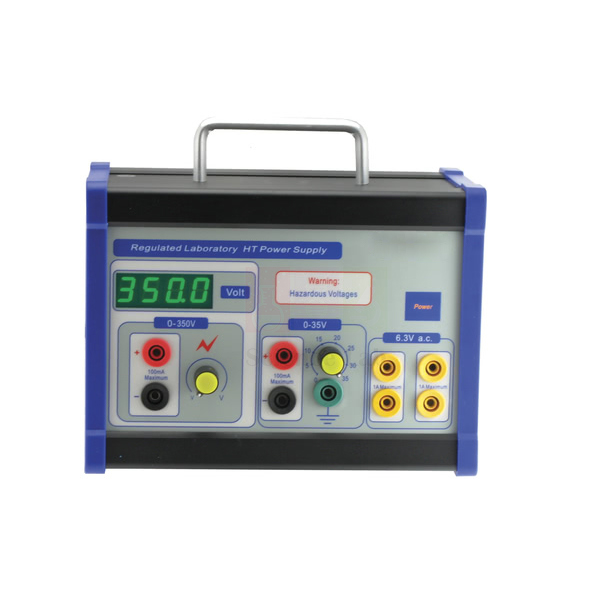
High Tension Power Supply
High Tension Power Supply (Product Code: SLE/PHY/128) is a regulated laboratory power supply used to provide the high-tension voltages needed for thermionic experiments, such as a double fine beam tube, in college and senior school physics laboratories. It gives two independent, continuously adjustable outputs of 0-35V and 0-350V at 100mA maximum, plus two 6.3V AC cathode heater outputs, all fully isolated from earth. It is supplied by Jain Scientific Equipments Pvt Ltd (ScienceLab), Ambala, India.
Specifications
| Parameter | Detail |
|---|---|
| HT outputs | Two independent outputs, 0-35V and 0-350V, continuously adjustable and fully regulated |
| Maximum current | 100mA |
| Heater outputs | Two auxiliary outputs, 6.3V a.c. 1A, for cathode heaters, protected by resettable fuse |
| Display | Bright 12.5 mm green LED display indicating HT output |
| Output sockets | Shrouded sockets suitable for standard 4 mm plugs or shrouded plugs |
| Isolation | All outputs fully isolated from earth; independent earth terminal provided |
| Input | 220V-240V, 50/60 Hz (mains supply stated as 230V ±5%, 50Hz) |
| Protection | Fuse 1A (L); primary protected by slow-blow fuse and thermal trips |
| Dimensions | 208 x 155 x 115 mm (W x H x D); height including handle 187 mm |
| Applications | Thermionic experiments such as the double fine beam tube; experiments needing a high tension supply, such as ionization current |
| Product code | SLE/PHY/128 |
| Supplied by | Jain Scientific Equipments Pvt Ltd (ScienceLab), Ambala, India |
What Is the High Tension Power Supply Used For?
Thermionic tubes need two things at once: a low heater voltage to warm the cathode so it emits electrons, and a high anode voltage to accelerate those electrons into a visible beam. The High Tension Power Supply provides both from one unit, with its 6.3V AC heater outputs and adjustable 0-350V HT output, which is why it suits fine beam tube work such as the specific charge of the electron experiment.
It also serves other experiments that need a high tension supply, including ionization current studies. Always switch off and turn the voltage controls to zero before changing connections, use shrouded 4 mm leads, and connect the independent earth terminal where the experiment requires it. The voltages involved are hazardous, so the unit should be used under a teacher's supervision.
What to Specify When Ordering
- Mains supply — the unit is specified for 220V-240V, 50/60 Hz input; tell us your local mains.
- Tube and holder — which thermionic tube and holder you will run from it, so we can check the combination.
- Leads — whether shrouded 4 mm leads should be included in the quotation.
Supplier
ScienceLab, the trading name of Jain Scientific Equipments Private Limited in Ambala, Haryana, supplies this High Tension Power Supply as a sourced instrument for electron-physics teaching. We can quote it together with the tubes, holders, coils and leads that make up a working thermionic set-up, which saves institutions from coordinating several vendors. Read about the company on our company profile.
Related Physics Lab Equipment
Items used alongside the High Tension Power Supply in electron-beam experiments:
- Teltron Dual Beam Tube D — electron tube for beam experiments; confirm its voltage needs with us.
- Teltron Helmholtz Pair of Coils D — coil pair giving a uniform magnetic field to bend the electron beam.
- Teltron Tube Holder D — stand for D-series tubes and their Helmholtz coils.
- EHT Power Supply — extra-high-tension supply for experiments beyond the 350V range.
- Stackable Leads — 4 mm leads for connecting the outputs.
See more power supplies and electron-physics apparatus in Physics Lab Equipment.
Frequently Asked Questions
What outputs does the High Tension Power Supply provide?
The High Tension Power Supply has two independent, continuously adjustable and fully regulated outputs of 0-35V and 0-350V with 100mA maximum current, plus two auxiliary 6.3V AC, 1A cathode heater outputs protected by a resettable fuse.
Which experiments is the High Tension Power Supply designed for?
The High Tension Power Supply is designed specifically for thermionic experiments such as the double fine beam tube. It can also be used for other experiments that require a high tension supply, for example ionization current measurements.
Are the outputs of the High Tension Power Supply isolated from earth?
Yes. All outputs of the High Tension Power Supply are fully isolated from earth, and an independent earth terminal is provided. The shrouded output sockets accept standard 4 mm plugs or shrouded plugs for safer connections.
What mains supply does the High Tension Power Supply need?
The High Tension Power Supply takes a 220V-240V, 50/60 Hz input, with the mains supply stated as 230V ±5%, 50Hz. It has a 1A (L) fuse, and its primary is protected by a slow-blow fuse and thermal trips.
Who supplies the High Tension Power Supply?
The High Tension Power Supply is supplied by Jain Scientific Equipments Pvt Ltd (ScienceLab), Ambala, Haryana, India. The company sources it for colleges, schools and institutions in India and international markets and can quote matching tubes and leads.
Is a calibration certificate available for the High Tension Power Supply?
A calibration document is not listed with the High Tension Power Supply. If your laboratory needs one, mention it through our contact page before ordering and we will confirm what paperwork can accompany the unit.
Request a Quote
Send us your High Tension Power Supply requirement, including the tubes and leads you plan to use, through the contact page, or add everything to the enquiry cart for one quotation.
Last updated: 24 September 2026
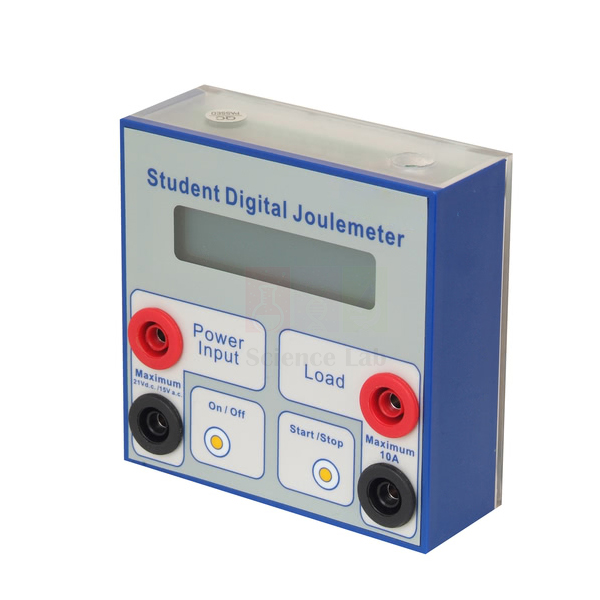
Joulemeter, Student Digital
Joulemeter, Student Digital (Product Code: SLE/PHY/129) is a digital energy meter used to measure the electrical energy delivered to a load in school and college heat and electricity practicals. Designed specifically for student use, it reads from 1 joule to 999,999 joules with 3% accuracy (1% typical) and has a built-in timer that starts and stops with the measurement. It is supplied by Jain Scientific Equipments Pvt Ltd (ScienceLab), Ambala, India.
Specifications
| Parameter | Detail |
|---|---|
| Energy range | 1 J to 999,999 J |
| Accuracy | 3%, with 1% typical |
| Input voltage | 0V to 15V AC, or 0V to 21V DC (maximum) |
| Maximum load current | 10A AC/DC |
| Circuitry | Microprocessor, combined with precision voltage multiplier |
| Start button | Starts the timer and joulemeter together and powers up the load |
| Stop button | Stops the timer and joulemeter and disconnects input power from the load |
| Display | 2 x 16 character LCD |
| Power | 9V DC mains adaptor, included |
| Dimensions | 90 x 90 x 33 mm |
| Product code | SLE/PHY/129 |
| Supplied by | Jain Scientific Equipments Pvt Ltd (ScienceLab), Ambala, India |
What Is the Student Digital Joulemeter Used For?
The Student Joulemeter sits between a low-voltage supply and the load, so students read the energy transferred directly instead of combining separate voltmeter, ammeter and stopwatch readings. It is most often used with an immersion heater in a metal block or calorimeter to find specific heat capacity, and for comparing the energy used by lamps, small motors and heaters.
Because one press of the start button powers the load and starts both the timer and the energy count, and the stop button cuts the power again, every group's readings begin and end at the same moment. Keep the input within 15V AC or 21V DC and the load current below 10A. That combination makes it a practical digital measuring instrument for calorimeter lab work.
Supplier
Jain Scientific Equipments Private Limited, trading as ScienceLab, supplies the Joulemeter, Student Digital from Ambala, Haryana to schools, colleges and institutions in India and international markets. It is a sourced electronic meter, and we can combine it in one order with heaters, calorimeters and power supplies from our physics list. For vendor registration and export documents, the supplying company's details are GSTIN 06AAECJ8618A1ZT and Importer-Exporter Code AAECJ8618A (DGFT). Visit our company profile for more.
Related Physics Lab Equipment
Build a specific heat capacity or energy-transfer practical with these items:
- Immersion Heater — sheathed miniature heater for metal-block calorimetry.
- Calorimeter Set, Copper, Joules — lagged calorimeter with a heating coil for electrical heating experiments.
- Power Supply, Stepped — low-voltage AC/DC source for powering the load through the meter.
- Joulemeter / Wattmeter, Digital — alternative meter that also reads power level.
Find more heat and electricity apparatus in Physics Lab Equipment.
Frequently Asked Questions
What range and accuracy does the Joulemeter, Student Digital have?
The Joulemeter, Student Digital measures energy from 1 joule to 999,999 joules. Its stated accuracy is 3%, with 1% accuracy typical, which is suitable for school and college energy-transfer practicals.
What input voltage and current can the Student Joulemeter handle?
The Joulemeter, Student Digital accepts 0V to 15V AC or 0V to 21V DC at most, with a maximum load current of 10A AC or DC. Stay within these limits when choosing the supply and load for an experiment.
How is the Joulemeter, Student Digital powered?
The Joulemeter, Student Digital runs from a 9V DC mains adaptor, which is included. Inside, a microprocessor combined with a precision voltage multiplier calculates the energy, and results appear on a 2 x 16 character LCD.
How does the built-in timer on the Student Joulemeter work?
On the Joulemeter, Student Digital, the start button starts the timer and joulemeter together and powers up the load. The stop button stops both and disconnects input power from the load, so energy and time are recorded over exactly the same period.
Who supplies the Joulemeter, Student Digital?
The Joulemeter, Student Digital is supplied by Jain Scientific Equipments Pvt Ltd (ScienceLab), Ambala, Haryana, India. The company sources this meter and ships it with other physics items to buyers in India and international markets.
Is a calibration certificate available for the Student Joulemeter?
Calibration documents are not listed for the Joulemeter, Student Digital. If your institution requires one, raise it through our contact page before ordering and we will confirm what can be supplied with the meter.
Request a Quote
For a quotation on a class set of Student Digital Joulemeters, write to us via the contact page or add them, with heaters and calorimeters, to the enquiry cart.
Last updated: 24 September 2026
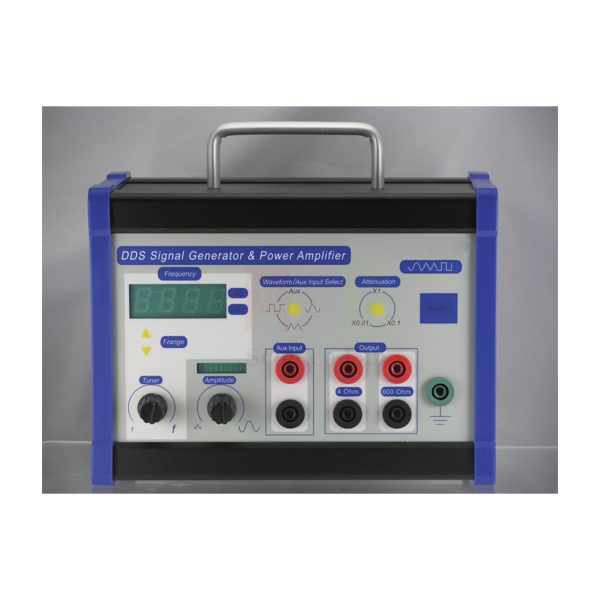
Signal Generator and Amplifier
Signal Generator and Amplifier (Product Code: SLE/PHY/130) is a combined function generator and power amplifier used to drive loudspeakers, vibrators and other wave apparatus in school and college physics and electronics laboratories. It produces sine, rectangular and triangular waves from 0.1 Hz to 99.9 kHz, shown on a digital display with 0.01% frequency accuracy, and delivers up to 4.5W into a 4 Ω load. It is supplied by Jain Scientific Equipments Pvt Ltd (ScienceLab), Ambala, India.
Specifications
| Parameter | Detail |
|---|---|
| Frequency range | 0.1 Hz to 99.9 kHz in six decades, read on digital display |
| Frequency accuracy | 0.01% (100 ppm) in all ranges |
| Output waveforms | Sine, rectangular and triangular |
| High impedance output | Maximum 17V peak to peak from an internal source impedance of 600 Ω |
| Low impedance output | 6V RMS at 4 Ω (about 8.8V peak for all waveforms) |
| Power output | Maximum 4.5W over the entire frequency range for all waveforms; maximum power transfer into a 4 Ω load: 6²/(4+4) = 4.5W |
| Frequency response | DC to 100 kHz, -3 dB, output power 4.5W into 4 Ω |
| Amplitude control | Zero to maximum in 256 increments, displayed on a 10-segment bar graph |
| Attenuation | x1, x0.1, x0.01, ±1%, on the 600 Ω output only |
| Amplifier voltage gain | 100 |
| Settings memory | All control settings except amplitude are stored and updated on any change |
| Output protection | Withstands prolonged short circuit; output floating with respect to ground; earth connected through the power cord |
| Electric supply | 220V~240V, 50Hz; detachable power lead; internal fuse T315mA L |
| Dimensions | Approx. 210 x 155 x 118 mm (L x W x D) |
| Weight | Approx. 2.05 kg without power cord |
| Product code | SLE/PHY/130 |
| Supplied by | Jain Scientific Equipments Pvt Ltd (ScienceLab), Ambala, India |
What Is the Signal Generator and Amplifier Used For?
One instrument covers two jobs. As a signal generator it supplies clean test waveforms for oscilloscope and circuit work, and as an amplifier it has enough power to drive a loudspeaker, vibration generator or resonance apparatus directly, which makes it a natural choice for standing waves on strings, air-column resonance, sound demonstrations and frequency-response measurements.
Use the 600 Ω output with its x1, x0.1 and x0.01 attenuator for low-level signals into electronic circuits, and the low-impedance output for loads around 4 Ω, where maximum power transfer occurs. The output withstands prolonged short circuits, which suits student benches, but it is still good practice to turn the amplitude to zero before connecting a new load. It works equally well as a signal generator for the electronics lab and as a driver for physics wave practicals.
Supplier
This Signal Generator and Amplifier is supplied by Jain Scientific Equipments Private Limited, which trades as ScienceLab and is based in Ambala, Haryana. It is a sourced electronic instrument, and we can quote it together with loudspeakers, vibration generators and oscilloscopes so a physics department can equip its wave and sound experiments through a single order. More about the company is on our company profile.
Related Physics Lab Equipment
Loads and instruments commonly connected to the Signal Generator and Amplifier:
- Vibration Generator — converts the amplified signal into vibrations for wave experiments.
- Loudspeaker Unit — mounted loudspeaker for sound and interference demonstrations.
- Oscilloscope Dual Trace — displays and compares the waveforms produced.
- Resonance Apparatus with Brass Tube — air-column resonance experiment that needs a steady sound source.
Browse the rest of our Physics Lab Equipment range.
Frequently Asked Questions
What waveforms and frequency range does the Signal Generator and Amplifier offer?
The Signal Generator and Amplifier produces sine, rectangular and triangular waves from 0.1 Hz to 99.9 kHz in six decades. The frequency is read on a digital display with 0.01% (100 ppm) accuracy on all ranges.
How much power can the Signal Generator and Amplifier deliver?
The Signal Generator and Amplifier delivers a maximum of 4.5W over its entire frequency range for all waveforms. Its low-impedance output gives 6V RMS at 4 Ω, and maximum power transfer occurs when the load is 4 Ω.
Is the Signal Generator and Amplifier protected against short circuits?
Yes. The Signal Generator and Amplifier is a robust instrument that can withstand a prolonged short circuit on its output. The output is floating with respect to ground, while the earth terminal connects to physical earth through the power cord.
What is the amplifier gain and attenuation of this unit?
The Signal Generator and Amplifier has an amplifier voltage gain of 100. Attenuation of x1, x0.1 and x0.01 (±1%) works on the 600 Ω output only, and amplitude is set in 256 increments shown on a 10-segment bar graph.
What mains supply does the Signal Generator and Amplifier use?
The Signal Generator and Amplifier runs on 220V~240V, 50Hz, with a detachable power lead for easy storage and an internal T315mA L fuse. It measures about 210 x 155 x 118 mm and weighs about 2.05 kg without the cord.
Who supplies the Signal Generator and Amplifier?
The Signal Generator and Amplifier is supplied by Jain Scientific Equipments Pvt Ltd (ScienceLab), Ambala, Haryana, India. The company sources it for schools, colleges and training institutes in India and international markets and can add loudspeakers or vibrators to the quotation.
Request a Quote
Tell us how many Signal Generator and Amplifier units you need, and which loudspeakers or vibrators should go with them, through our contact page or the enquiry cart.
Last updated: 24 September 2026
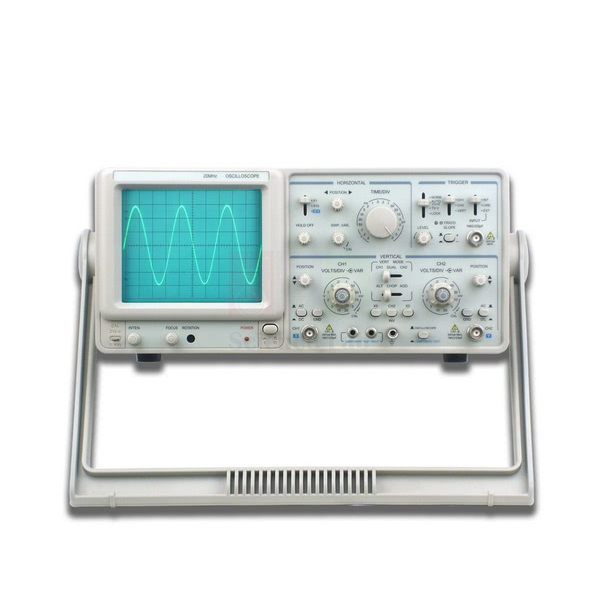
Oscilloscope Dual Trace
Oscilloscope Dual Trace (Product Code: SLE/PHY/131) is a 20MHz dual-channel cathode ray oscilloscope used to display and compare electrical waveforms in school, college and electronics laboratories. Both independent channels offer 5mV/div sensitivity, and a 6-inch rectangular CRT with red internal graticule, X-Y mode and algebraic addition and subtraction make it a versatile teaching CRO; a microphone is included for sound-wave work. It is supplied by Jain Scientific Equipments Pvt Ltd (ScienceLab), Ambala, India.
Specifications
| Parameter | Detail |
|---|---|
| Bandwidth and channels | 20MHz, dual channel, CH1 and CH2 independent |
| Vertical sensitivity | 5mV/div on both channels |
| Display | 6-inch rectangular cathode ray tube with red internal graticule |
| Time base | High-speed sweep; maximum sweep time 0.2 µs/div, 20 ns/div when magnified by 10 |
| Trigger | Alternate trigger function for observing two waveforms of different frequency |
| Operating modes | X-Y; algebraic addition and subtraction |
| Signal output | CH1 signal output |
| Accessory | Microphone included |
| Product code | SLE/PHY/131 |
| Supplied by | Jain Scientific Equipments Pvt Ltd (ScienceLab), Ambala, India |
What Is the Dual Trace Oscilloscope Used For?
In a physics or electronics laboratory the dual trace oscilloscope makes invisible signals visible. Students measure the amplitude and period of AC waveforms, compare the input and output of a circuit on the two channels, and use X-Y mode to form Lissajous figures for frequency and phase comparison. With the included microphone, sound from a tuning fork or loudspeaker appears as a trace they can measure.
The alternate trigger holds two signals of different frequency steady at the same time, and addition and subtraction of the channels demonstrate superposition. Set the trigger level first, begin on a less sensitive volts/div setting and increase it until the trace fills the screen. It fits wherever a CRO oscilloscope is part of the electronics or wave-physics syllabus.
Supplier
Jain Scientific Equipments Private Limited, which trades as ScienceLab from Ambala, Haryana, supplies the Oscilloscope Dual Trace as a sourced test instrument. We supply it to schools, colleges, polytechnics and training institutes in India and international markets, and can quote it alongside signal generators and other items for an electronics or physics laboratory. See the company profile for more about ScienceLab.
Related Physics Lab Equipment
Signal sources that pair naturally with the Oscilloscope Dual Trace:
- Signal Generator and Amplifier — waveform source with power output, for display and measurement on the scope.
- Signal Generator & Amplifier — function generator option with sine, square, triangular and pulse outputs.
- Loudspeaker Unit — sound source to pick up with the included microphone.
- Tuning Fork Set, Steel — steady tones for displaying and comparing sound waves on screen.
Explore more measuring instruments in Physics Lab Equipment.
Frequently Asked Questions
What is the bandwidth and sensitivity of the Oscilloscope Dual Trace?
The Oscilloscope Dual Trace is a 20MHz dual-channel instrument with 5mV/div sensitivity on both channels. CH1 and CH2 work independently, and a CH1 signal output is provided for passing the signal on to other equipment.
What sweep speeds does the Oscilloscope Dual Trace offer?
The Oscilloscope Dual Trace has a high-speed time base with a maximum sweep time of 0.2 µs/div. When magnified by 10, the sweep speed reaches 20 ns/div, which helps students examine fast-changing signals in detail.
Does the Oscilloscope Dual Trace have X-Y mode?
Yes. The Oscilloscope Dual Trace offers X-Y operation for Lissajous figures, algebraic addition and subtraction of the two channels, and an alternate trigger function that lets two waveforms of different frequency be observed together.
What accessories come with the Oscilloscope Dual Trace?
A microphone is included with the Oscilloscope Dual Trace for displaying sound waves. Other accessories such as probes are not listed, so please confirm the full accessory set through our contact page before ordering.
Who supplies the Oscilloscope Dual Trace?
The Oscilloscope Dual Trace is supplied by Jain Scientific Equipments Pvt Ltd (ScienceLab), Ambala, Haryana, India. The company sources this CRO for schools, colleges and training institutes in India and international markets.
Is a calibration certificate available for the Oscilloscope Dual Trace?
Calibration paperwork is not part of the Oscilloscope Dual Trace listing. If your laboratory needs it, ask through the contact page when you request a quotation, and we will confirm what documentation can be arranged.
Request a Quote
Request an Oscilloscope Dual Trace quotation for your laboratory through our contact page, or add it and a signal generator to the enquiry cart.
Last updated: 24 September 2026
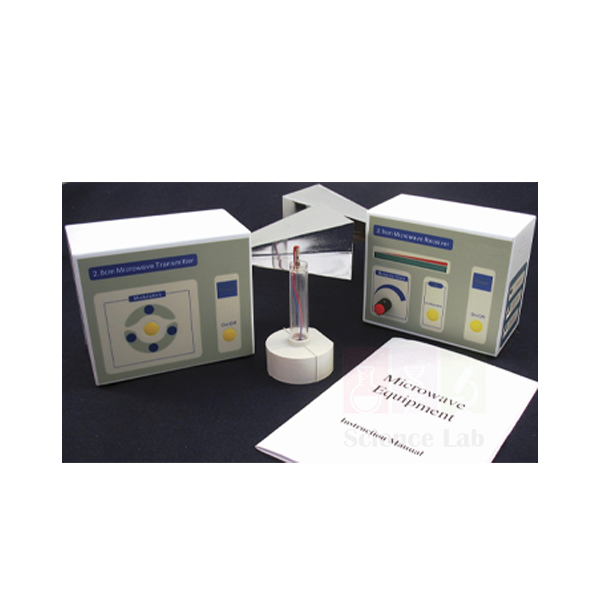
Microwave Transmitter/Receiver
Microwave Transmitter/Receiver (Product Code: SLE/PHY/132) is an apparatus for investigating transverse waves with microwaves, used to demonstrate reflection, refraction, polarisation and interference in school and college physics laboratories. The transmitter sends a plane polarised wave, modulated with a 1KHz tone, music or no modulation, while the receiver has gain control, a 30-bar signal-strength display and a built-in loudspeaker. It is supplied by Jain Scientific Equipments Pvt Ltd (ScienceLab), Ambala, India.
Specifications
| Parameter | Detail |
|---|---|
| Purpose | Investigation of transverse waves, at a convenient wavelength |
| Transmitter | Plane polarised wave, internally modulated with a 1KHz tone, or music, or no modulation |
| Auxiliary input | For external simple tones to transmit through microwaves |
| Receiver gain | Built-in gain control |
| Signal display | 30 bar graphs indicating signal strength |
| Receiver outputs | External outputs to data-loggers and external meters |
| Loudspeaker | Built into the receiver, with on/off control |
| Probe detector | For non-directional reception of the microwaves |
| Documentation | Detailed instruction booklet illustrating microwave experiments on reflection, refraction, polarisation, interference and more |
| Product code | SLE/PHY/132 |
| Supplied by | Jain Scientific Equipments Pvt Ltd (ScienceLab), Ambala, India |
What Is the Microwave Transmitter/Receiver Used For?
Microwaves behave like light but on a scale that fits comfortably on a laboratory bench, so wave effects that are hard to see with light become easy to measure. With this transmitter and receiver, students reflect the beam off metal plates, refract it through a prism, show polarisation by rotating the receiver or inserting a grille, and locate interference maxima and minima.
The receiver's loudspeaker turns signal strength into sound that a class can hear rising and falling as the receiver moves, and the probe detector maps standing waves regardless of direction. Outputs for data-loggers and external meters let older students record readings, and the auxiliary input shows how microwaves can carry an audio signal. The instruction booklet sets out each experiment for the teacher.
Supplier
The Microwave Transmitter/Receiver is supplied by Jain Scientific Equipments Private Limited, the Ambala, Haryana company that trades as ScienceLab. We source this apparatus and can quote it together with the plates, prism, lens and protractor accessories in our physics range, so a department can complete its microwave optics bench in one purchase. The company profile has more background.
Related Physics Lab Equipment
Accessories and alternatives for microwave wave experiments:
- Microwave Accessories Set of Plates — aluminium and perspex plates with a polarisation grille for reflection and polarisation work.
- Microwave Accessories Hollow Prism — perspex prism filled with paraffin for refraction experiments.
- Microwave Accessories Hollow Plano-convex Lens — oil-filled lens for focusing the microwave beam.
- Microwave Accessories Rotating Protractor — for measuring the directivity of the transmission.
- Apparatus Microwave — alternative kit for demonstrating the wave properties of microwaves.
More wave and optics apparatus is available in Physics Lab Equipment.
Frequently Asked Questions
What experiments can be done with the Microwave Transmitter/Receiver?
The Microwave Transmitter/Receiver is used to investigate transverse waves, including reflection, refraction, polarisation and interference. A detailed instruction booklet illustrating these and other microwave experiments is provided to guide teachers and students.
How is the microwave signal modulated?
The Microwave Transmitter/Receiver transmits a plane polarised wave that can be internally modulated with a 1KHz tone, with music, or left unmodulated. An auxiliary input also allows external simple tones to be transmitted through the microwaves.
How does the receiver show signal strength?
The receiver of the Microwave Transmitter/Receiver has built-in gain control and 30 bar graphs indicating signal strength. A built-in loudspeaker with on/off control makes changes audible, and external outputs connect to data-loggers and meters.
What is the probe detector for?
The probe detector of the Microwave Transmitter/Receiver gives non-directional reception of the microwaves. It is useful for mapping the field at different points, such as the nodes and antinodes of a standing wave, without depending on which way it faces.
What power supply does the Microwave Transmitter/Receiver need?
The power arrangement of the Microwave Transmitter/Receiver is not stated in our listing. Please ask through our contact page so we can confirm the supply it uses before you place an order.
Who supplies the Microwave Transmitter/Receiver?
The Microwave Transmitter/Receiver is supplied by Jain Scientific Equipments Pvt Ltd (ScienceLab), Ambala, Haryana, India. The company sources this apparatus for schools, colleges and institutions in India and international markets, along with its microwave accessories.
Request a Quote
For a Microwave Transmitter/Receiver quotation, with or without the plate, prism and lens accessories, contact us through the contact page or collect the items in the enquiry cart.
Last updated: 24 September 2026
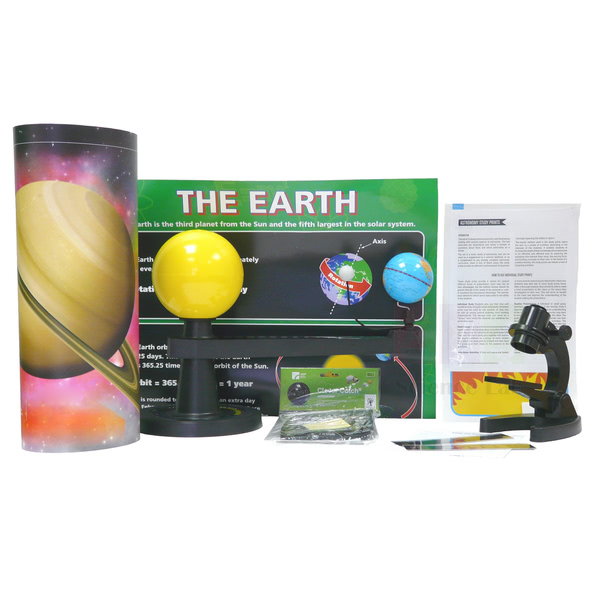
Astronomy Activity Kit
Astronomy Activity Kit (Product Code: SLE/PHY/133) is a classroom activity set used to teach the solar system, from the names and positions of the planets to eclipses, constellations and the seasons, in school science lessons. Its materials also introduce students to other bodies in the solar system, such as asteroids, meteors and comets, which keeps the topic hands-on and engaging. It is made by Jain Scientific Equipments Pvt Ltd (ScienceLab), an OEM manufacturer, at its own factory in Ambala, India.
Key Details
| Parameter | Detail |
|---|---|
| Type | Activity set for exploring the solar system |
| Topics covered | Names and positions of the planets; eclipses; constellations; seasons; the Earth, Sun and Moon |
| Other bodies introduced | Asteroids, meteors and comets |
| Contents | Not itemised in our listing — ask us for the current contents list |
| Product code | SLE/PHY/133 |
| Manufacturer | Jain Scientific Equipments Pvt Ltd (ScienceLab) — OEM |
| Country of origin | India (made in Ambala, Haryana) |
What Is the Astronomy Activity Kit Used For?
The kit follows the natural order of an astronomy unit. Students first become familiar with the names and positions of the planets, then move on to how eclipses happen, how constellations are recognised, and how the Earth, Sun and Moon together explain the seasons. Along the way the materials bring in asteroids, meteors and comets, so learners see that the solar system holds far more than the planets alone.
Teachers can run it as a guided whole-class lesson or split the materials between groups, each taking one topic and reporting back to the class. It pairs well with a solar system model or globe on the teacher's desk, and it suits earth science periods and science clubs as well as regular physics lessons.
What to Specify When Ordering
- Contents — ask for the current contents list so you can check it against your syllabus.
- Quantity — one kit per class, or one per student group.
- Companion models — whether a solar system model, planetarium set or globe should be quoted with it.
OEM Manufacturer
The Astronomy Activity Kit is produced by Jain Scientific Equipments Private Limited under its ScienceLab name, acting as the original equipment manufacturer. Kits are put together at the company's own licensed factory at Saha, Ambala, Haryana, and go straight to schools, education departments, distributors and importers. Buyers completing vendor forms can use the company's GSTIN 06AAECJ8618A1ZT and Legal Entity Identifier 3358004HRD1JIVXKYX49. Read more on our company profile.
Related Laboratory Equipment
Models and instruments that extend the Astronomy Activity Kit in the classroom:
- Solar System Model — mounted model of the planets for the teacher's desk.
- Project Planetarium Set — lets students plot eclipses, moon phases and planet positions.
- Mini Science Kit – Earth, Sun and Moon — activities on seasons, day and night and phases of the Moon.
- Celestial Star Globe — shows constellations and the apparent positions of stars.
- Astronomical Telescope — for moving from classroom activities to observing the night sky.
The kit is listed under Physics Lab Equipment, and more astronomy models appear in our Geography Lab Equipment range.
Frequently Asked Questions
What topics does the Astronomy Activity Kit cover?
The Astronomy Activity Kit takes students from the names and positions of the planets to eclipses, constellations, the seasons and the Earth, Sun and Moon. Its materials also introduce asteroids, meteors and comets as other members of the solar system.
What is included in the Astronomy Activity Kit?
Our listing does not itemise the contents of the Astronomy Activity Kit. Please ask through our contact page for the current contents list before ordering, so you can check it against your syllabus and class size.
Which students is the Astronomy Activity Kit suitable for?
The Astronomy Activity Kit is designed to help school students explore the mysteries of the solar system as an introductory unit. Tell us the class level you teach when you enquire, and we will help you judge whether it fits your curriculum.
Who manufactures the Astronomy Activity Kit?
The Astronomy Activity Kit is manufactured by Jain Scientific Equipments Pvt Ltd (ScienceLab) as the OEM, at its own licensed factory in Saha, Ambala, Haryana, India. Schools and resellers receive quotations directly from the manufacturer, without a trading intermediary.
Can the Astronomy Activity Kit be ordered in bulk?
Yes. The Astronomy Activity Kit can be quoted in class and school sets for education departments, dealers and importers in India and international markets. Share the number of kits and the delivery destination, and mention any companion models you need.
Request a Quote
To receive an Astronomy Activity Kit quotation direct from the manufacturer, message us through the contact page or add the kit and any companion models to the enquiry cart.
Last updated: 24 September 2026
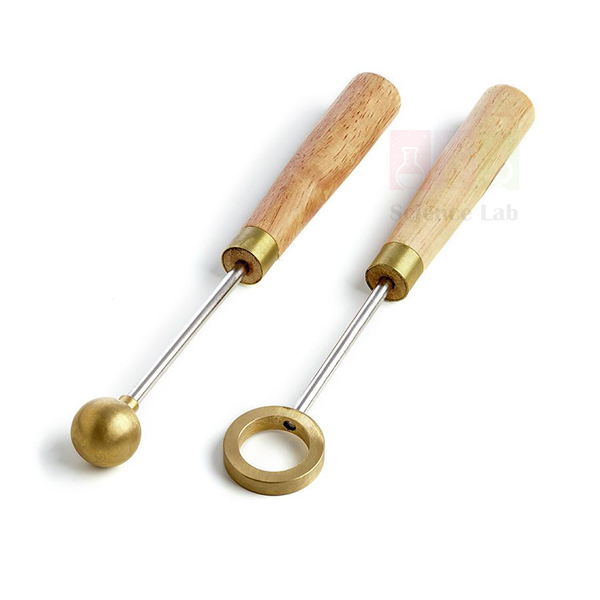
Ball & Ring Apparatus
Ball & Ring Apparatus (Product Code: SLE/PHY/134) is a two-piece thermal expansion demonstrator used to show that a heated metal ball will no longer pass through a ring it cleared when cold, in school and college physics laboratories. Its brass ball, 22 mm in diameter, and brass ring each sit on a brass rod with a wooden handle, so they can be held safely over a flame. It is made by Jain Scientific Equipments Pvt Ltd (ScienceLab), an OEM manufacturer, at its own factory in Ambala, India.
Specifications
| Parameter | Detail |
|---|---|
| Type | Two-piece apparatus for demonstrating thermal expansion |
| Ball | Brass, 22 mm diameter |
| Ring | Brass |
| Mounting | Ball and ring each individually mounted on a brass rod |
| Handles | Wooden, one on each rod |
| Product code | SLE/PHY/134 |
| Manufacturer | Jain Scientific Equipments Pvt Ltd (ScienceLab) — OEM |
| Country of origin | India (made in Ambala, Haryana) |
What Is the Ball and Ring Apparatus Used For?
The ball and ring apparatus gives a quick, visible proof that solids expand when heated. At room temperature the ball slips through the ring; the teacher then warms the ball in a Bunsen or spirit-lamp flame and tries again, and this time the ball rests on the ring instead of dropping through. As it cools, it falls through once more, which shows contraction on cooling as well.
A second run, heating the ring instead of the ball, lets students test their prediction of what happens to a hole when the metal around it expands. This makes it a staple of school physics lab equipment in India for the heat chapter. Hold the parts only by the wooden handles, rest the hot brass on a heat-proof mat, and let it cool in air rather than quenching it.
OEM Manufacturer
ScienceLab is the trading name of Jain Scientific Equipments Private Limited, the OEM (original equipment manufacturer) of this Ball & Ring Apparatus. It is made and assembled at the company's own licensed factory at Saha, Ambala, Haryana, India, rather than bought in from a trader, and goes factory-direct to schools, colleges, dealers and importers in India and international markets. Repeat orders and replacement parts are handled by the manufacturer itself, so ask us about availability. More background is on the ScienceLab company profile.
Related Physics Lab Equipment
These items are used alongside the ball and ring in heat and expansion lessons:
- Bar & Gauge Apparatus — shows the same effect with an iron bar tested against a brass gauge.
- Bimetallic Strip — shows that brass and steel expand by different amounts.
- Gravesand Ring-Device to Demonstrate Thermal Expansion — an alternative ring-type expansion demonstrator.
- Bunsen Burner — the usual heat source for warming the ball or the ring.
- Expansion Of Liquids Apparatus — extends the lesson from solids to liquids.
See the complete Physics Lab Equipment range for more heat apparatus.
Frequently Asked Questions
What does the Ball & Ring Apparatus include?
The Ball & Ring Apparatus is a two-piece set: a brass ball 22 mm in diameter and a brass ring, each mounted individually on its own brass rod with a wooden handle. A flame source such as a Bunsen burner is not part of the set and is ordered separately.
How does the Ball & Ring Apparatus demonstrate thermal expansion?
With the Ball & Ring Apparatus, students first pass the cold ball through the ring, then heat the ball in a flame and try again. The expanded ball no longer passes through, and once it cools it slips through again, showing both expansion and contraction of a solid.
Why do the Ball & Ring Apparatus parts have wooden handles?
The wooden handles on the Ball & Ring Apparatus keep hands away from the hot brass, because wood conducts heat far less than metal. Students can hold the ball and ring over a flame and bring them together without touching the heated parts.
Who manufactures the Ball & Ring Apparatus?
The Ball & Ring Apparatus is manufactured by Jain Scientific Equipments Pvt Ltd (ScienceLab) as the OEM, at its own licensed factory at Saha, Ambala, Haryana, India. Schools, colleges and dealers buy it factory-direct, with quotations and repeat orders handled by the manufacturer.
Is a calibration certificate available for the Ball & Ring Apparatus?
The Ball & Ring Apparatus is a qualitative demonstration piece rather than a measuring instrument, so it is not normally calibrated. If your tender asks for any test or inspection document, please discuss it with us through the contact page before ordering.
What should a quotation request for the Ball & Ring Apparatus include?
For a Ball & Ring Apparatus quotation, give the product code SLE/PHY/134, the number of sets, your delivery address and whether you also need burners or other expansion apparatus. The quotation then covers everything for your heat practicals in one reply.
Can the Ball & Ring Apparatus be supplied in bulk for export?
Yes, the Ball & Ring Apparatus can be supplied in quantity to school networks, dealers and importers in India and international markets. Share the quantity and destination through the enquiry cart or contact page, and packing and shipping details are confirmed in the quotation.
Request a Quote
To price the Ball & Ring Apparatus, send your quantity through the contact page or add it to the enquiry cart. Quotations come direct from the manufacturer in Ambala.
Last updated: 24 September 2026