- Physics Lab Equipment
- Chemistry Lab Equipment
- Biology Lab Equipment
- Anatomical Lab Equipment
- Learning
- Educational Lab Equipment
- Magnets
- Agriculture
- Astronomy
- Earth Science
- Geography Lab Equipment
- Safety Lab Coat
- Laboratory
- Meteorological
- Electricity & Magnetism
- Heat
- School Lab Equipment
- Lab Glassware
- Science Lab Equipment
- Tvet Lab Equipment
- Robotics Kits Supplier and Manufacturer for Schools India
- Math Lab Equipment Manufacturers and Exporters in Ambala
- STEM Kits Manufacturers and Supplier India
- Engineering Lab Equipment
- Hospital Lab Equipment
- Water, Sanitation & Hygiene Supplies
- Cold Chain, Solar & Communication Equipment
- Nutrition
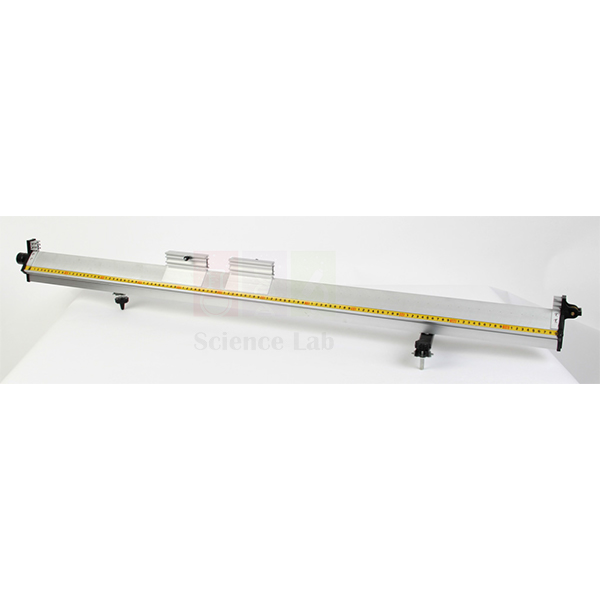
Linear Air Track
Linear Air Track (Product Code: SLE/PHY/120) is a compact (mini) air track used to study dynamics in a virtually friction-free environment in school and college mechanics laboratories. Gliders ride on a cushion of air along a high-strength 56 x 56 mm extruded aluminium track, which makes collisions and the conservation of momentum especially clear to students. It is made by Jain Scientific Equipments Pvt Ltd (ScienceLab), an OEM manufacturer, at its own factory in Ambala, India, as cost-effective mechanics lab equipment.
Specifications
| Parameter | Detail |
|---|---|
| Design | Mini linear air track for dynamics experiments in a virtually friction-free environment |
| Track profile | High-strength 56 x 56 mm extruded aluminium |
| Track length | 1.2 m in the technical specification; the description also quotes 1.5 m overall — please confirm when ordering |
| Gliders | Accept standard slotted masses for additional loads |
| Accessory pack | Vehicles with mass attachments, catapults and buffers |
| Air source | Required to operate the track; Laboratory Air Blower not included |
| Speed measurement | Requires standard light gates and timers; can also be used with light gates and a Wi-Fi module |
| Experiments covered | Velocity; force and acceleration; potential and kinetic energy; conservation of energy; SHM; motion on level and inclined planes |
| Product code | SLE/PHY/120 |
| Manufacturer | Jain Scientific Equipments Pvt Ltd (ScienceLab) — OEM |
| Country of origin | India (made in Ambala, Haryana) |
What Is the Linear Air Track Used For?
With the air supply running, the gliders float with almost no friction, so students can measure velocity, test force and acceleration, and follow the exchange between potential and kinetic energy without friction hiding the result. Launching one glider into another with the catapults and buffers turns momentum conservation from a formula into something they can watch and time.
The same set-up covers simple harmonic motion and motion on level and inclined planes, and the gliders take standard slotted masses when a heavier load is needed. For reliable timing, pair the track with light gates and a timer, level the track carefully before each run, and keep the air holes free of dust. It suits both teacher demonstrations and force and motion practicals run by student groups.
What to Specify When Ordering
- Track length — confirm the length on your quotation, as the listing quotes 1.2 m and 1.5 m overall.
- Air source — whether you also need the Linear Air Track Blower, since no blower is included.
- Timing — which light gates and timer you will use to measure glider speeds.
- Quantity — the number of tracks for your laboratory or student groups.
OEM Manufacturer
The Linear Air Track is an OEM product of Jain Scientific Equipments Private Limited, which trades as ScienceLab. The company makes and assembles its air tracks at its own licensed factory at Saha, Ambala, Haryana, so schools, colleges, dealers and importers buy directly from the maker rather than through a trader. When you need replacement gliders, buffers or other accessory-pack parts later, ask us and the request is handled by the manufacturer itself. See our company profile for more about ScienceLab.
Related Physics Lab Equipment
These items complete an air track set-up for timing and collision work:
- Linear Air Track Blower — supplies the air cushion the track needs, connected through a flexible hose.
- Light Gates/Timing Gates — pair of gates for measuring glider speeds with a timer.
- Millisecond Timer — timer with inputs for light gates, for velocity and acceleration readings.
- Apparatus Collision 2 Dimension — extends collision studies from one dimension to two.
More mechanics apparatus is listed under Physics Lab Equipment.
Frequently Asked Questions
What experiments can be done with the Linear Air Track?
The Linear Air Track covers velocity, force and acceleration, potential and kinetic energy, conservation of energy, SHM, and motion on level and inclined planes. It is particularly effective for collisions, where conservation of momentum is clearly demonstrated.
Is an air blower included with the Linear Air Track?
No. The Linear Air Track needs an air source to operate, and the Laboratory Air Blower is not included. You can add the Linear Air Track Blower to the same enquiry so that the track and its air supply are quoted together.
How long is the Linear Air Track?
The Linear Air Track's technical specification gives a length of 1.2 m, while its description quotes 1.5 m overall. Please confirm the exact length with us through the contact page before ordering so the quotation matches the track you expect.
What accessories come with the Linear Air Track?
The Linear Air Track is supplied with an accessory pack that includes vehicles with mass attachments, catapults and buffers. The gliders accept standard slotted masses for extra load, while the light gates and timers used to measure glider speeds are needed separately.
Who manufactures the Linear Air Track?
The Linear Air Track is manufactured by Jain Scientific Equipments Pvt Ltd (ScienceLab) as the OEM, at its own licensed factory in Saha, Ambala, Haryana, India. Quotations, repeat orders and spare-part requests are handled by the manufacturer directly.
Can the Linear Air Track be ordered in bulk or for export?
Yes. The Linear Air Track can be quoted in multiple units for schools, colleges, dealers and importers across India and international markets. Give the quantity and delivery destination in your enquiry so that we can prepare the quotation.
Request a Quote
Ask for a Linear Air Track quotation through our contact page or place it in the enquiry cart. The quote comes direct from the manufacturer, and the blower and timing gates can be added to the same request.
Last updated: 24 September 2026
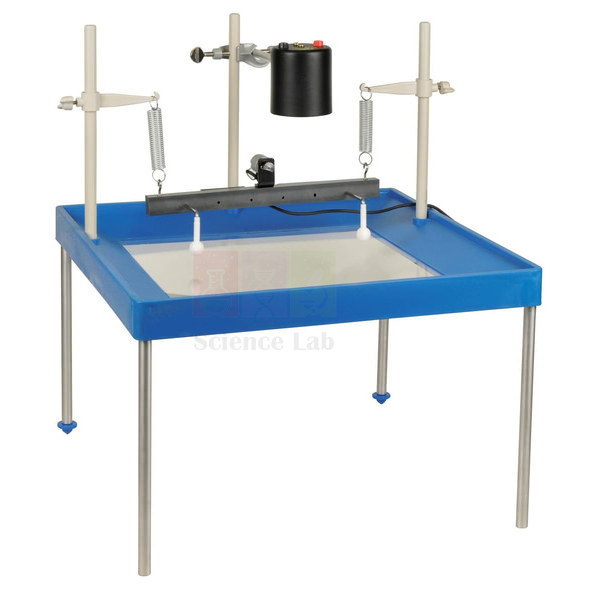
Ripple Tank
Ripple Tank (Product Code: SLE/PHY/121) is an economy ripple tank system used to show how water waves reflect, refract, diffract and interfere in school physics laboratories. Teachers choose it for its tough moulded frame, a 405 x 405 mm internal tank whose sloping sides minimise noise, and a 12V halogen lamp that lights the wave patterns clearly on the large transparent viewing surface. It is made by Jain Scientific Equipments Pvt Ltd (ScienceLab), an OEM manufacturer, at its own factory in Ambala, India.
Specifications
| Parameter | Detail |
|---|---|
| System type | Economy ripple tank system |
| Frame | Tough moulded frame with a large transparent viewing surface |
| Tank internal dimensions | 405 x 405 mm |
| Tank external dimensions | 420 x 420 mm |
| Tank sides | Sloping, to minimise noise |
| Light source | 12V halogen lamp on a lamp unit with adjustable arm |
| Wave generator | Ripple motor with eccentric cam mounted on the ripple bar |
| Power supply | Not included |
| Product code | SLE/PHY/121 |
| Manufacturer | Jain Scientific Equipments Pvt Ltd (ScienceLab) — OEM |
| Country of origin | India (made in Ambala, Haryana) |
The Ripple Tank system comes complete with:
- Ripple tank
- Ripple motor, eccentric cam mounted on ripple bar
- 4 push-fit legs
- 3 support pillars for supporting the light source and rippler bar
- 2 motor support springs
- Lamp unit with adjustable arm
- 2 rippler bar hanging hooks
- Curved reflector
- 2 barriers
- Roller bar
- Hand stroboscope
- Concave perspex plate
- Rectangular perspex plate
What Is the Ripple Tank Used For?
A ripple tank turns wave behaviour into something a class can see. With a shallow layer of water in the tank and the motor driving the ripple bar, straight wavefronts travel across the tank and their bright and dark bands appear on the viewing surface, while the hand stroboscope makes the moving pattern appear to stand still so students can measure the wavelength.
Each accessory maps onto a wave motion topic: the curved reflector shows reflection and focusing, the two barriers form a gap for diffraction, and the perspex plates placed under the water create a shallower region where waves slow down and refract. The roller bar is useful for sending single straight pulses by hand before switching to continuous waves from the motor.
What to Specify When Ordering
- Power supply — none is included, so say whether you want a supply for the 12V lamp and ripple motor quoted with the tank.
- Stroboscope — a hand stroboscope is supplied; state if you would also like an electronic stroboscope.
- Quantity — the number of tanks, for example one per demonstration bench.
OEM Manufacturer
Jain Scientific Equipments Private Limited, trading as ScienceLab, is the original equipment manufacturer of this Ripple Tank. Frames, tanks and accessory sets are produced and packed at the company's own licensed factory in Saha, Ambala, Haryana, and the finished system is dispatched factory-direct to schools, institutions and distributors. If a barrier, reflector or perspex plate is lost later, ask us for a replacement quote from the maker. Visit our company profile to learn more.
Related Physics Lab Equipment
Pair the Ripple Tank with a power source, or compare it with our other wave tanks:
- Power Supply, Stepped — low-voltage AC/DC bench supply to consider, since the tank ships without power.
- Xenon Stroboscope — electronic flash alternative to the hand stroboscope for freezing wave patterns.
- Mini Ripple Tank — compact tank with built-in strobe and frequency meter for student groups.
- Ripple Tank – Premium Model — projection model with its own power supply for whole-class demonstrations.
See the complete Physics Lab Equipment range for more wave and optics apparatus.
Frequently Asked Questions
What is included with the Ripple Tank?
The Ripple Tank comes with the tank, a ripple motor with eccentric cam on the ripple bar, 4 push-fit legs, 3 support pillars, 2 motor support springs, a lamp unit, 2 hanging hooks, a curved reflector, 2 barriers, a roller bar, a hand stroboscope and two perspex plates.
Is a power supply included with the Ripple Tank?
No, a power supply is not included with the Ripple Tank. You will need a suitable supply for its 12V halogen lamp and ripple motor; tell us what you already have, or ask us to quote one alongside the tank.
What size is the Ripple Tank?
The Ripple Tank measures 405 x 405 mm internally and 420 x 420 mm externally. Its sloping sides minimise noise in the wave pattern, and the large transparent viewing surface lets a group watch the same pattern together.
How should the Ripple Tank be looked after?
Empty and dry the Ripple Tank after each lesson, wipe the transparent surface with a soft cloth, and store the perspex plates flat so they are not scratched. Keep water away from the lamp unit and switch off the power before adjusting the ripple bar.
Who manufactures the Ripple Tank?
The Ripple Tank is manufactured by Jain Scientific Equipments Pvt Ltd (ScienceLab), the OEM, at its own licensed factory at Saha, Ambala, Haryana, India. Buyers deal directly with the maker for quotations, accessory replacements and repeat orders.
Can the Ripple Tank be supplied to several schools at once?
Yes. The Ripple Tank can be quoted in quantity for school groups, education departments, dealers and importers in India and international markets. Share the number of units, the delivery destination and any power supplies you want quoted.
Request a Quote
To receive a Ripple Tank quotation straight from the manufacturer, write to us through the contact page or add the tank to your enquiry cart together with any power supply you need.
Last updated: 24 September 2026
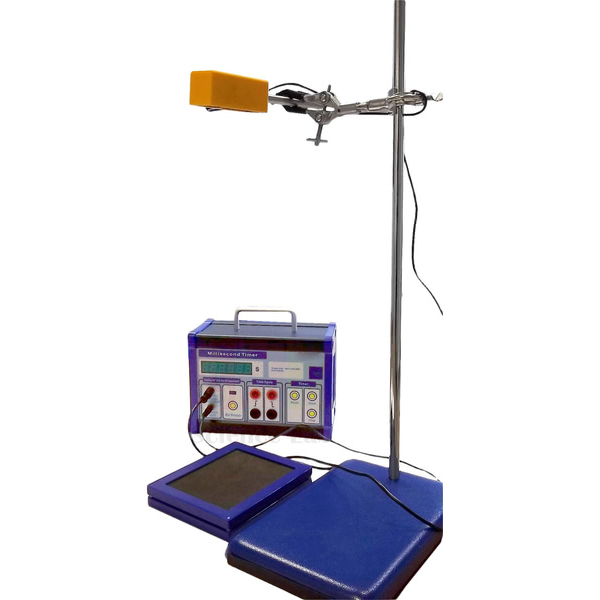
G By Freefall Apparatus and Timer
G By Freefall Apparatus and Timer (Product Code: SLE/PHY/122) is an electromagnetic release apparatus used to measure the acceleration due to gravity, g, by timing a falling steel ball in school and college physics laboratories. An electromagnet in a plastic moulded case holds a heavy steel sphere, and a platform unit containing a microswitch has terminals for an external timer, so the fall time is captured electrically. It is made by Jain Scientific Equipments Pvt Ltd (ScienceLab), an OEM manufacturer, at its own factory in Ambala, India.
Key Details
| Parameter | Detail |
|---|---|
| Release unit | Electromagnet housed in a plastic moulded case, with connections for an external timer |
| Falling mass | Heavy steel sphere, supplied |
| Landing unit | Platform unit containing a microswitch and terminals for the external timer |
| Timing start | Timer is triggered as soon as the ball release button is pressed |
| Priming | Electromagnet is primed when the stopping plate and solenoid are connected with the leads provided |
| Timer | External timer connected through the terminals — confirm with us whether a timer is part of your quotation |
| Product code | SLE/PHY/122 |
| Manufacturer | Jain Scientific Equipments Pvt Ltd (ScienceLab) — OEM |
| Country of origin | India (made in Ambala, Haryana) |
What Is the G By Freefall Apparatus Used For?
The G By Freefall Apparatus gives students a direct measurement of g. With the sphere held on the electromagnet, pressing the release button drops the ball and starts the timer at the same instant; the ball striking the platform operates the microswitch and ends the timing. Measuring the drop height and the fall time lets students apply h = ½gt² to calculate g.
Repeating the drop from several heights and plotting height against the square of the time gives a straight line whose gradient is half of g, a standard mechanics practical. Measure the height from the bottom of the sphere to the platform, take several readings at each height, and stand the platform on a firm, level surface so the microswitch responds cleanly.
What to Specify When Ordering
- Timer — the apparatus connects to an external timer; state whether you need a timer quoted with it.
- Leads — connecting leads are provided; ask if you want spares for several benches.
- Quantity — the number of sets needed for your laboratory or student groups.
OEM Manufacturer
ScienceLab is the trading name under which Jain Scientific Equipments Private Limited makes this freefall apparatus as the OEM. The electromagnet unit and landing platform are made and assembled at the company's own licensed factory at Saha, Ambala, Haryana, and orders from schools, colleges, dealers and importers are dispatched direct from there. For vendor registration, institutional buyers can note GSTIN 06AAECJ8618A1ZT and LEI 3358004HRD1JIVXKYX49. Company background is on our profile page.
Related Physics Lab Equipment
Complete the freefall practical with a timer, or extend it with related motion apparatus:
- Millisecond Timer — timer with a G by Free Fall facility for reading the fall time.
- Light Gates/Timing Gates — an alternative way to time moving objects with a suitable timer.
- Apparatus Falling Bodies (Projectile) — follow-up apparatus comparing vertical fall with projectile motion.
- Stackable Leads — spare connecting leads for wiring the apparatus to a timer.
The full Physics Lab Equipment range lists more mechanics and timing apparatus.
Frequently Asked Questions
Does the G By Freefall Apparatus and Timer include a timer?
The G By Freefall Apparatus and Timer is described with connections and terminals for an external timer. Please confirm through our contact page whether your quotation should include a timer, such as a millisecond timer, so the set is complete for your practical.
What is supplied with the G By Freefall Apparatus and Timer?
The G By Freefall Apparatus and Timer comes with an electromagnet unit in a plastic moulded case, a heavy steel sphere, a platform unit containing a microswitch with timer terminals, and the leads used to connect the stopping plate and solenoid.
How is the fall time started and stopped?
On the G By Freefall Apparatus and Timer, timing starts as soon as the ball release button is pressed. The sphere then lands on the platform unit, whose microswitch is wired to the external timer's terminals to end the measurement of the fall.
Who manufactures the G By Freefall Apparatus and Timer?
Jain Scientific Equipments Pvt Ltd (ScienceLab) manufactures the G By Freefall Apparatus and Timer as the OEM at its own licensed factory in Saha, Ambala, Haryana, India. Quotations and replacement parts, such as an extra steel sphere, are handled by the manufacturer directly.
Can the G By Freefall Apparatus and Timer be ordered for a whole class?
Yes. The G By Freefall Apparatus and Timer can be quoted in class sets for schools, colleges, dealers and importers across India and international markets. Tell us the number of sets and whether each needs its own timer.
Request a Quote
Request a G By Freefall Apparatus and Timer quotation direct from the manufacturer through our contact page, or save it in the enquiry cart alongside a timer and spare leads.
Last updated: 24 September 2026
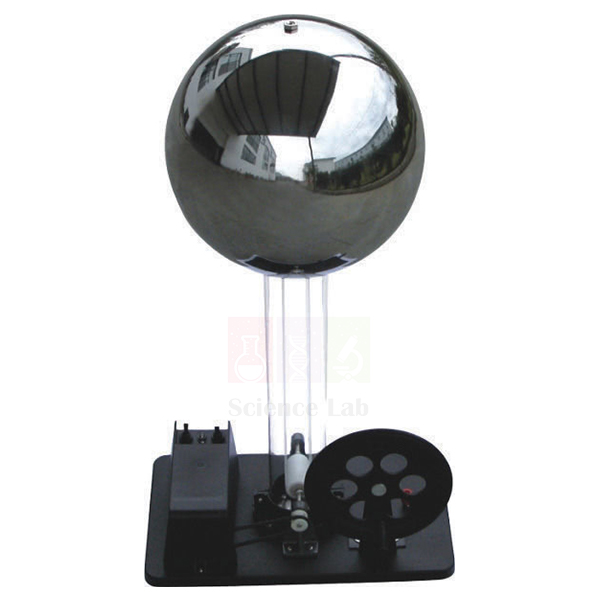
Van de Graaff Generator
Van de Graaff Generator (Product Code: SLE/PHY/123) is an electrostatic generator used to build up a large static charge on a metal dome for demonstrations of static electricity in schools and colleges. Students crank it by hand, so the charge depends on how hard and how long they turn, or run it from a laboratory DC supply up to 12V; the 23 cm dome is listed at 400kV. It is made by Jain Scientific Equipments Pvt Ltd (ScienceLab), an OEM manufacturer, at its own factory in Ambala, India.
Specifications
| Parameter | Detail |
|---|---|
| Operation | Hand crank (supplied), or DC source from a laboratory power supply up to 12V |
| DC operation | Gives the user control of belt speed and charge |
| Dome diameter | 23 cm |
| Voltage | 400kV |
| Dimensions | 63 x 25 x 25 cm |
| Weight | 5.68 kg |
| Product code | SLE/PHY/123 |
| Manufacturer | Jain Scientific Equipments Pvt Ltd (ScienceLab) — OEM |
| Country of origin | India (made in Ambala, Haryana) |
What Is the Van de Graaff Generator Used For?
The Van de Graaff Generator makes static electricity dramatic. As the belt runs, charge collects on the dome, and students can watch sparks jump to an earthed conductor, see strips of light paper or hair stand apart as like charges repel, and use an electroscope to show charge being transferred. Because the hand crank links effort directly to charge, it gives a true hands-on experience rather than a push-button demonstration.
For longer or steadier runs, drive it from a laboratory DC supply of up to 12V and set the belt speed to control how quickly charge builds. Work in dry air where possible, discharge the dome with an earthed conductor before anyone touches it, and keep the generator away from sensitive electronics. As a physics demonstration kit piece, it supports lessons on charge, electric fields and lightning.
What to Specify When Ordering
- Power mode — hand crank only, or also a laboratory DC power supply (up to 12V) for powered running.
- Companion items — electroscopes or other electrostatics apparatus to be quoted alongside.
- Quantity — one per demonstration room, or more for student groups.
OEM Manufacturer
This Van de Graaff Generator is manufactured by Jain Scientific Equipments Private Limited, the company behind the ScienceLab name, as an original equipment manufacturer. Each unit is built and assembled at its own licensed factory at Saha, Ambala, Haryana, and supplied factory-direct to schools, colleges, dealers and importers without a trading middleman. For belts, cranks or other replacement parts in future, ask us and the manufacturer will respond directly. Learn more on our company profile.
Related Physics Lab Equipment
Build a complete electrostatics lesson around the Van de Graaff Generator with these items:
- Electroscope, Gold Leaf — detects and compares charge transferred from the dome.
- Electroscope in Flask, Gold Leaf — simple glass-flask electroscope for student groups.
- Electrostatic Investigation — friction rods, fabrics and a pith ball for charging-by-rubbing experiments.
- Power Supply Variable — continuously variable bench supply to consider for running the generator from DC.
Explore the wider Physics Lab Equipment range for more electricity and magnetism apparatus.
Frequently Asked Questions
Can the Van de Graaff Generator be used without mains power?
Yes. The Van de Graaff Generator is cranked by hand with the supplied crank, so no power supply is needed for basic demonstrations. It can also be powered from a DC source by a laboratory power supply up to 12V when you want control of belt speed.
What are the dimensions and weight of the Van de Graaff Generator?
The Van de Graaff Generator measures 63 x 25 x 25 cm and weighs 5.68 kg, with a dome diameter of 23 cm. That size lets a teacher carry it between classrooms and stand it on an ordinary demonstration bench.
What voltage does the Van de Graaff Generator produce?
The Van de Graaff Generator is listed at 400kV. In practice the charge built up depends on how hard and how long the crank is turned, or on the belt speed set through the DC supply, and results also vary with conditions such as humidity.
How should the Van de Graaff Generator be used safely in class?
The Van de Graaff Generator should be operated by, or under the supervision of, a teacher. Discharge the dome with an earthed conductor before touching it, keep it away from electronic equipment, and do not let anyone with a heart pacemaker take part in demonstrations.
Who manufactures the Van de Graaff Generator?
The Van de Graaff Generator is manufactured by Jain Scientific Equipments Pvt Ltd (ScienceLab) as the OEM, at its own licensed factory in Saha, Ambala, Haryana, India. Schools and resellers receive quotations and after-sales help from the maker itself.
What should a Van de Graaff Generator quotation request include?
For a Van de Graaff Generator quotation, give the number of units, the delivery city or country, and whether you want a laboratory DC power supply or electroscopes included. Dealers and importers in India and international markets can request quantity quotations the same way.
Request a Quote
Contact the manufacturer for a Van de Graaff Generator quotation through our contact page, or collect it in the enquiry cart with the electroscopes and power supply you need.
Last updated: 24 September 2026
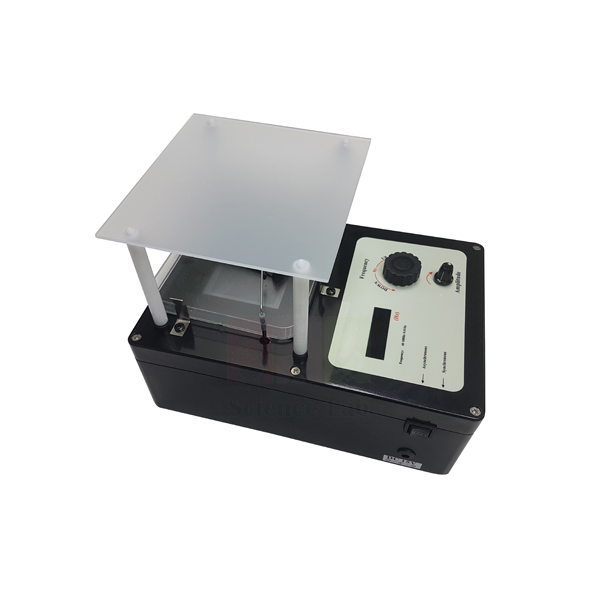
Mini Ripple Tank
Mini Ripple Tank (Product Code: SLE/PHY/124) is a compact ripple tank with a built-in strobe and frequency meter, used to show water-wave patterns to small groups in school physics laboratories. Its strong light source is synchronised with the wave generator across a 60 to 100 Hz working range, so students see a steady pattern; the unit measures 265 x 185 x 195 mm and weighs 2 kg. It is supplied by Jain Scientific Equipments Pvt Ltd (ScienceLab), Ambala, India.
Specifications
| Parameter | Detail |
|---|---|
| Type | Mini ripple tank with strobe and frequency meter |
| Working range | 60 to 100 Hz |
| Illumination | Strong light source synchronised with the wave generator |
| Overall size | 265 x 185 x 195 mm |
| Product weight | 2 kg |
| Product code | SLE/PHY/124 |
| Supplied by | Jain Scientific Equipments Pvt Ltd (ScienceLab), Ambala, India |
What Is the Mini Ripple Tank Used For?
The Mini Ripple Tank is built for student benches where a full-size tank would be too large. Because the light is synchronised with the wave generator, the ripples appear to stand still, so students can sketch wavefronts, compare wavelengths at different frequencies across the 60 to 100 Hz range and read each frequency directly from the meter.
Many teachers give one compact tank to each group, so every student can adjust the frequency and see how the pattern responds instead of crowding around a single demonstration. Fill it with a shallow layer of clean water, set it on a level bench, and empty and dry it after the lesson. It fits neatly into a wave motion kit for secondary school practicals.
Supplier
Jain Scientific Equipments Private Limited, which trades as ScienceLab, supplies the Mini Ripple Tank from Ambala, Haryana, India. The company sources this compact tank with its built-in strobe and frequency meter for school and college physics laboratories and quotes single units, class sets and repeat orders, so schools and resellers can add tanks as student numbers grow. Our company profile has more background.
Related Physics Lab Equipment
Other wave apparatus that complements the Mini Ripple Tank:
- Ripple Tank — economy full-size tank with barriers, reflector and perspex plates for demonstrations.
- Ripple Tank – Premium Model — projects wave patterns onto a screen for a whole class.
- Wave Form, Helix — steel helix for showing waves along a spring alongside water waves.
- Metal Slinky, Helical Spring — for transverse and longitudinal wave demonstrations on the bench.
Find more apparatus in our Physics Lab Equipment category.
Frequently Asked Questions
What frequency range does the Mini Ripple Tank cover?
The Mini Ripple Tank has a working range from 60 to 100 Hz. Its built-in frequency meter shows the setting, so students can record the frequency for each wave pattern they observe without needing a separate instrument.
How big is the Mini Ripple Tank?
The Mini Ripple Tank has an overall size of 265 x 185 x 195 mm and a product weight of 2 kg. That compact footprint suits individual student benches and makes the tank easy to store between lessons.
Does the Mini Ripple Tank need a separate stroboscope?
No separate stroboscope is needed for the Mini Ripple Tank, because a strobe is built in. The tank is lit by a strong light source synchronised with the wave generator, which helps students observe steady wave patterns.
How is the Mini Ripple Tank different from the full-size Ripple Tank?
The Mini Ripple Tank is a compact 2 kg unit with a built-in strobe and frequency meter, intended for group work on the bench. The full-size Ripple Tank is a larger demonstration system supplied with its own accessory set for reflection, refraction and diffraction.
Who supplies the Mini Ripple Tank?
The Mini Ripple Tank is supplied by Jain Scientific Equipments Pvt Ltd (ScienceLab), Ambala, Haryana, India. The company sources the tank and quotes single units or class sets directly to schools, colleges, dealers and importers in India and international markets.
What should I include in a Mini Ripple Tank enquiry?
For a Mini Ripple Tank quotation, give the number of tanks, the delivery city or country, and any questions about power input, which we will answer with the quote. Schools, dealers and importers in India and international markets can all order this way.
Request a Quote
Get a Mini Ripple Tank quotation directly from ScienceLab, the supplier, by writing through our contact page, or add a class set to the enquiry cart.
Last updated: 24 September 2026
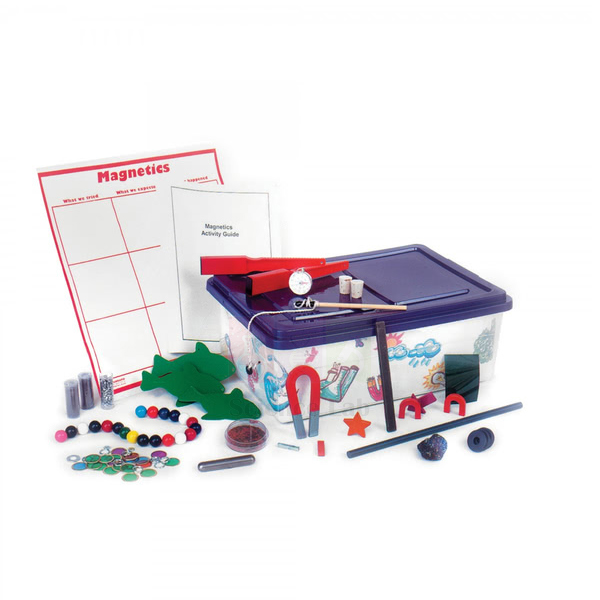
Magnets Kit
The Magnets Kit (Product Code: SLE/EAM/39) is a small-group magnetism experiment kit that helps students discover how magnetic force behaves through their own investigations. Working from the included Teacher's Guide, a group of up to five students sorts materials into magnetic and non-magnetic, finds out what attracts and what repels, tests whether magnetic force passes through solids, and watches how a compass responds to a magnetic field. Primary and middle school science teachers use it for inquiry-based lessons, and it is made by Jain Scientific Equipments Pvt Ltd (ScienceLab), Ambala.
Key Details
| Parameter | Detail |
|---|---|
| Type | Student magnetism experiment kit |
| Experiments covered | Classifying magnetic and non-magnetic materials; attraction and repulsion; magnetic force through solids; how compasses react to a magnetic field; and more |
| Supplied as | Teacher's Guide plus material for five students |
| Suitable for | School science lessons on magnetism, group work and demonstrations |
Typical Use
A typical lesson begins with prediction: students guess which everyday objects a magnet will pick up, then test them and record the results in two columns. They go on to bring magnet ends together to feel attraction and repulsion, and to place sheets of paper, card or thin wood between a magnet and a paper clip to see that magnetic force acts through many solids. Bringing a magnet near a compass and watching the needle swing links the idea of a magnetic field to navigation.
Because the material is sized for five students, one kit serves a single working group; teachers usually buy several so a whole class can rotate through the same investigation. As a science kit for students it encourages careful observation and fair testing. Keep magnets away from phones, cards and the compass when stored, and return them to their packing after each lesson so their strength is preserved.
Manufacturer
This kit is made under the ScienceLab name by Jain Scientific Equipments Private Limited of Ambala, Haryana, a company producing physics, electricity and magnetism apparatus for education. Its equipment reaches schools and colleges in India and international markets; see the company profile for more.
Related Electricity & Magnetism Equipment
Add these to extend the same magnetism lessons:
- Materials Collection for Magnetism Studies — twenty assorted materials for a wider sorting activity.
- Compass Plotting (Clear) — lets students map field lines around a magnet.
- Economy Alnico Bar Magnets — extra bar magnets for larger classes.
- Magnetic Field Tube — a demonstration that makes a three-dimensional field visible.
Explore the Electricity & Magnetism category for more apparatus.
Frequently Asked Questions
How many students can use one kit?
The kit contains material for five students together with a Teacher's Guide. For a full class, order one kit per group of five.
Which magnets and materials are included?
Our listing describes the experiments rather than an itemised parts list. Ask us through the contact page for the current contents before you order.
Is a teacher's guide provided?
Yes. A Teacher's Guide is included to help plan the investigations on classification, attraction and repulsion, force through solids and compass behaviour.
How should the magnets be stored?
Store them in their packing, away from electronic devices, bank cards and compasses, and avoid dropping them, as knocks can weaken or chip magnets.
Is there a warranty?
Warranty terms are given with each quotation; please ask us for the terms that apply to your order.
What should a school or institutional quotation include?
The product code SLE/EAM/39, the number of kits (usually one per group of five students), the delivery address and any other magnetism items required. We quote for customers in India and international markets.
Request a Quote
For pricing on the Magnets Kit, contact us via the contact page or place it in the enquiry cart with any compasses or bar magnets you need.
Last updated: 24 September 2026
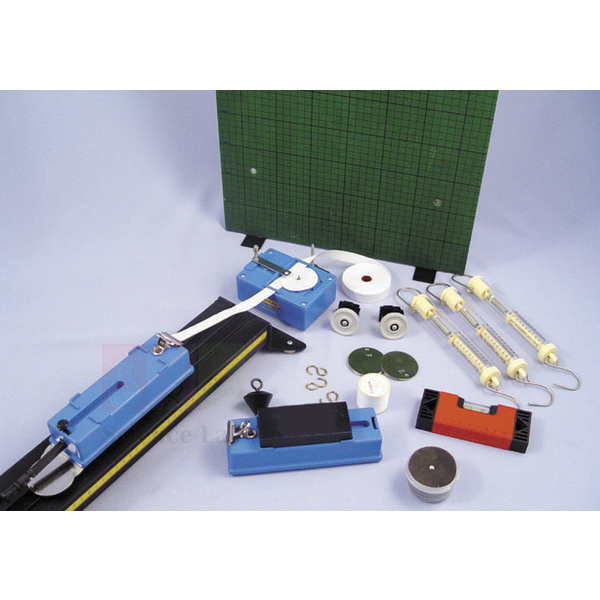
Force, Motion & Dynamics Kit
Force, Motion & Dynamics Kit (Product Code: SLE/PHY/125) is a trolley-and-bench system used to investigate forces, acceleration, collisions and kinetic energy in school physics laboratories. At its centre is a rigid 1.2 m aluminium profiled bench with a built-in scale, worked with two 740 g low-friction trolleys, a 6V AC ticker tape timer and a force board with pulleys and spring balances. It is made by Jain Scientific Equipments Pvt Ltd (ScienceLab), an OEM manufacturer, at its own factory in Ambala, India.
Specifications
| Parameter | Detail |
|---|---|
| Bench | Aluminium profiled bench, 1.2 m, rigid construction, with built-in scale |
| Trolleys | 1 spring-loaded trolley and 1 standard trolley, each 740 g, low friction |
| Added mass | Trolley weight (brick), 500 g; 10 x 10 g masses with securing hole |
| Timer | Ticker tape timer, 6V AC operation |
| Timer consumables | 100 carbon discs; 5 ticker tape rolls, 30 m length |
| Force board | With legs for bench mounting; 2 pulleys with integral clamp, reel of cotton, 3 hooks, pendulum bob |
| Spring balances | 3 x 10N/1kg, beige |
| Set-up aid | Line level for setting up the bench |
| Product code | SLE/PHY/125 |
| Manufacturer | Jain Scientific Equipments Pvt Ltd (ScienceLab) — OEM |
| Country of origin | India (made in Ambala, Haryana) |
Full contents of the kit:
- 1 x Aluminium Profiled Bench, 1.2 m rigid construction
- 1 x Spring Loaded Trolley, 740 g low friction trolley
- 1 x Standard Trolley, 740 g low friction trolley
- 1 x Trolley Weight (brick), 500 g for additional mass
- 10 x 10 g Masses, with securing hole
- 1 x Ticker Tape Timer, 6V AC operation
- 1 x Line Level, for setting up bench
- 1 x Force Board, with legs for bench mounting
- 2 x Pulleys, with integral clamp for force board
- 1 x Reel of Cotton, accessory for force board
- 3 x Hooks, accessory for force board
- 1 x Pendulum Bob, accessory for force board
- 3 x Spring Balances, 10N/1kg, beige
- 100 x Carbon discs, for ticker tape timer
- 5 x Ticker Tape Rolls, 30 m length
What Is the Force, Motion & Dynamics Kit Used For?
The kit is built around the core force and motion experiments: pulling a trolley with different accelerating forces, repeating the run with added masses, and colliding the spring-loaded trolley with the standard trolley to compare elastic and inelastic collisions. Tilting the bench turns it into an inclined plane for acceleration studies, and the ticker tape record lets students work out velocity and kinetic energy from the spacing of the dots.
The force board adds a second set of investigations with pulleys, hooks, cotton and spring balances, such as resolving forces and balancing loads, while the pendulum bob supports simple oscillation work. Level the bench with the line level before each run and keep the carbon discs and tape rolls together so the timer is always ready. As a force motion experiment kit, it gives a class a broad set of mechanics lab equipment in one purchase.
What to Specify When Ordering
- AC supply — the ticker tape timer runs on 6V AC, so confirm you have a suitable low-voltage supply or ask us to quote one.
- Consumables — extra carbon discs and 30 m ticker tape rolls for repeat practicals.
- Quantity — one kit per student group or per demonstration bench.
OEM Manufacturer
Jain Scientific Equipments Private Limited, known to schools as ScienceLab, is the OEM behind the Force, Motion & Dynamics Kit and puts each kit together at its own factory in Ambala instead of buying it in from a trader. The company is incorporated under CIN U29309HR2020PTC087597, and production runs at its licensed premises at 449, HSIIDC Industrial Area, Saha, Ambala (Factory Licence AMB-ONLINE-CHD-J-414). Schools, colleges, dealers and importers receive quotations from the manufacturer, and requests for replacement parts are answered by the same team. More details are on our company profile.
Related Physics Lab Equipment
Keep the kit running and extend it with these items:
- Ticker Tape Carbon Disc — replacement carbon discs for the kit's ticker tape timer.
- Ticker Tape Timer — an extra timer so two groups can record runs at the same time.
- Power Supply, Stepped — low-voltage AC/DC bench supply to consider for running the 6V AC timer.
- Dynamics Trolley, Plastic — additional low-friction trolley for multi-trolley collision experiments.
- Linear Air Track — friction-free alternative for momentum and collision studies.
Browse all mechanics apparatus under Physics Lab Equipment.
Frequently Asked Questions
What is included in the Force, Motion & Dynamics Kit?
The Force, Motion & Dynamics Kit includes a 1.2 m aluminium profiled bench, spring-loaded and standard 740 g trolleys, a 500 g trolley weight, 10 x 10 g masses, a 6V AC ticker tape timer, a force board with accessories, 3 spring balances, carbon discs and tape rolls.
Does the Force, Motion & Dynamics Kit need a power supply?
The ticker tape timer in the Force, Motion & Dynamics Kit operates on 6V AC. A power supply is not listed among the kit contents, so check that you have a low-voltage AC source or ask us to include one in your quotation.
How much ticker tape and how many carbon discs are supplied?
The Force, Motion & Dynamics Kit comes with 5 ticker tape rolls, each 30 m long, and 100 carbon discs for the ticker tape timer. Replacement consumables can be quoted separately when a class needs more for repeat practicals.
Which experiments can students carry out with the kit?
With the Force, Motion & Dynamics Kit, students investigate the effect of different accelerating forces on different masses, elastic and inelastic collisions between two trolleys, acceleration on an inclined plane and kinetic energy, plus force-board work with pulleys and spring balances.
Who manufactures the Force, Motion & Dynamics Kit?
Jain Scientific Equipments Pvt Ltd (ScienceLab) manufactures the Force, Motion & Dynamics Kit as the OEM at its own licensed factory in Saha, Ambala, Haryana, India. Quotations and spare-part requests are handled by the manufacturer rather than a reseller.
Can the kit be supplied in bulk for schools or export?
Yes. The Force, Motion & Dynamics Kit can be quoted in quantity for schools, education departments, dealers and importers in India and international markets. State the number of kits, the delivery destination and whether AC supplies or extra consumables are required.
Request a Quote
For a Force, Motion & Dynamics Kit quotation direct from the manufacturer, use our contact page or add the kit and any spare consumables to the enquiry cart.
Last updated: 24 September 2026
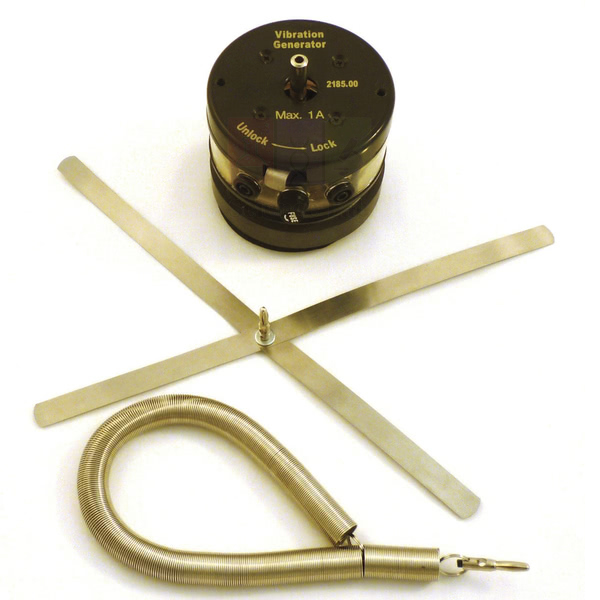
Vibration Generator
Vibration Generator (Product Code: SLE/PHY/126) is an electromechanical driver used to produce electronically controlled vibrations that set up waves on springs, strings and similar media in physics laboratories. Driven by a signal generator, it covers a frequency range of 30 to 10,000 Hz from an electrical input of 5W, 1A maximum, in a compact 120 x 120 x 120 mm body weighing 1.5 kg. It is supplied by Jain Scientific Equipments Pvt Ltd (ScienceLab), Ambala, India.
Specifications
| Parameter | Detail |
|---|---|
| Function | Provides electronically controlled vibrations to generate waves |
| Drive signal | Used in conjunction with a signal generator |
| Frequency range | 30 to 10,000 Hz |
| Electrical input | 5W, 1A max |
| Dimensions | 120 x 120 x 120 mm |
| Weight | 1.5 kg |
| Product code | SLE/PHY/126 |
| Supplied by | Jain Scientific Equipments Pvt Ltd (ScienceLab), Ambala, India |
What Is the Vibration Generator Used For?
Connected to a signal generator, the Vibration Generator turns an electrical signal into mechanical movement, so students can set up standing waves and change the frequency to find each resonant mode. With a wave spring attached, it illustrates mechanical wave properties such as frequency, wavelength and interference in a way the whole room can see.
Start at a low amplitude, raise the frequency slowly until a clear pattern of nodes and antinodes appears, and record the frequency for each pattern. Keep the drive within the 5W, 1A maximum input and clamp the unit firmly so it does not creep across the bench. Used this way, it becomes the core of a wave motion kit for school and college practicals.
What to Specify When Ordering
- Signal source — a signal generator is needed to drive it; say if you want one quoted.
- Wave medium — whether a spring or string set-up should be quoted alongside.
- Quantity — the number of units for demonstration and student benches.
Supplier
The Vibration Generator is supplied by Jain Scientific Equipments Private Limited, which trades as ScienceLab from Ambala, Haryana. We source this driver and can combine it with signal generators, springs and other wave apparatus from our physics list, so a school or college can order a complete wave set-up through one supplier. Details of the company are on our company profile.
Related Physics Lab Equipment
These items are used with the Vibration Generator in wave experiments:
- Signal Generator and Amplifier — combined signal source and power amplifier to drive the vibrator.
- Metal Slinky, Helical Spring — spring medium for showing waves and standing-wave patterns.
- Sonometer, Simple Pattern — string apparatus for related resonance and frequency work.
- Xenon Stroboscope — flash stroboscope that makes a vibrating string or spring appear to stand still.
More wave and sound apparatus is listed under Physics Lab Equipment.
Frequently Asked Questions
What do I need to drive the Vibration Generator?
The Vibration Generator should be used with a signal generator, which supplies the electrical signal it converts into vibration. Its electrical input is rated at 5W, 1A maximum, so choose a signal source and amplitude setting that stay within that rating.
What frequency range does the Vibration Generator cover?
The Vibration Generator works from 30 to 10,000 Hz. The low end suits slow, clearly visible standing waves on springs and strings, while higher settings let students explore how wavelength shortens as frequency rises.
How large and heavy is the Vibration Generator?
The Vibration Generator measures 120 x 120 x 120 mm and weighs 1.5 kg. It is small enough to clamp at the end of a bench or stand, leaving room for the spring or string it drives.
What can students demonstrate with the Vibration Generator?
Paired with a wave spring, the Vibration Generator illustrates mechanical wave properties such as frequency, wavelength and interference. Students can also find resonant modes by adjusting the signal frequency until stable standing-wave patterns form.
Who supplies the Vibration Generator?
The Vibration Generator is supplied by Jain Scientific Equipments Pvt Ltd (ScienceLab), Ambala, Haryana, India. The company sources it for schools, colleges and institutional buyers in India and international markets, and can quote it with a signal generator.
What should a Vibration Generator quotation request include?
For a Vibration Generator quotation, list the number of units, the delivery destination, and whether you also need a signal generator, spring or stroboscope. Tender and bulk requirements can be sent through the contact page in the same way.
Request a Quote
Place the Vibration Generator in the enquiry cart with any signal generator or spring you need, or send the details through our contact page for a quotation.
Last updated: 24 September 2026