- Physics Lab Equipment
- Chemistry Lab Equipment
- Biology Lab Equipment
- Anatomical Lab Equipment
- Learning
- Educational Lab Equipment
- Magnets
- Agriculture
- Astronomy
- Earth Science
- Geography Lab Equipment
- Safety Lab Coat
- Laboratory
- Meteorological
- Electricity & Magnetism
- Heat
- School Lab Equipment
- Lab Glassware
- Science Lab Equipment
- Tvet Lab Equipment
- Robotics Kits Supplier and Manufacturer for Schools India
- Math Lab Equipment Manufacturers and Exporters in Ambala
- STEM Kits Manufacturers and Supplier India
- Engineering Lab Equipment
- Hospital Lab Equipment
- Water, Sanitation & Hygiene Supplies
- Cold Chain, Solar & Communication Equipment
- Nutrition
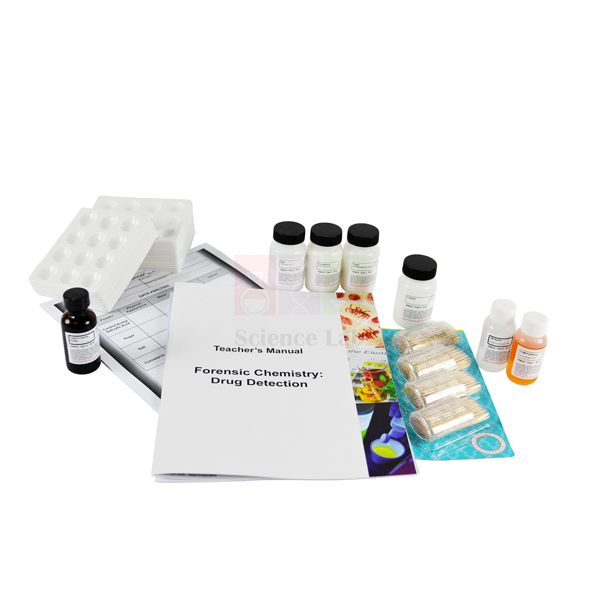
Forensic Chemistry of Drug Detection
Forensic Chemistry of Drug Detection (Product Code: SLE/CH/136) casts students as forensic toxicologists. Everyone who ate the school cafeteria’s chilli became ill, and aspirin appears to have been stolen from the nurse’s office – so could one of the cafeteria ingredients have been swapped for it? Groups answer the question with a series of chemical tests, including tests on control aspirin. With enough material for 15 groups, it is a science kit for students in India that teaches controls, evidence and careful reasoning, supplied by Jain Scientific Equipments Pvt Ltd (ScienceLab), Ambala, India.
Key Details
| Parameter | Detail |
|---|---|
| Type | Forensic toxicology activity |
| Scenario | Illness after the cafeteria chilli; aspirin missing from the nurse’s office |
| Method | Series of chemical tests on cafeteria ingredients, including tests on control aspirin |
| Group capacity | Enough material for 15 groups |
| Teaching material | Teacher’s manual, Student’s guide and Analysis copy-masters |
Typical Use
The investigation is built on the idea of a control. Students first run each test on the known aspirin sample to see what a positive result looks like, then repeat the same tests on every cafeteria ingredient. Any ingredient that responds like the control becomes a suspect substitution; any that does not can be cleared. Writing up the findings on the analysis sheets teaches students to separate observations from conclusions, just as a toxicologist’s report must.
Because the storyline involves food and a medicine, set a firm rule before starting: nothing on the bench is tasted, and every sample is handled with a clean spatula or dropper to prevent cross-contamination. Goggles should be worn throughout. Teachers can extend the lesson by explaining that real forensic laboratories follow quick screening tests with confirmatory instrumental analysis, which makes this a thought-provoking chemistry experiment kit for India’s senior secondary classes.
Supplier
This drug-detection activity is supplied by Jain Scientific Equipments Private Limited, which trades as ScienceLab and is based in Ambala, Haryana, India, supplying schools and colleges with kits and laboratory apparatus. Read more in our company profile.
Related Chemistry Lab Equipment
Items that deepen the aspirin chemistry or support the testing:
- Properties of Aspirin — explores the compound at the centre of the case
- Greener Synthesis Of Acetylsalicylic Acid — shows how aspirin itself is made
- Micro Test Plates — handy for running small-scale spot tests side by side
- Safety Goggles — eye protection during chemical testing
- Forensic Science Lab Investigation — a broader forensic investigation for the same unit
More kits are listed in Chemistry Lab Equipment.
Frequently Asked Questions
What is the case students have to solve?
Everyone who ate the cafeteria’s chilli became ill. Students must decide whether any ingredient could have been substituted with aspirin taken from the nurse’s office.
Why do students test control aspirin?
The control shows what a positive result looks like, giving a reliable reference against which every ingredient is judged.
How many groups does one kit serve?
There is enough material for 15 groups.
Is it appropriate for a school laboratory?
Yes, with standard precautions: goggles, supervision and a strict no-tasting rule, since the scenario involves food and a medicine.
Which chemicals and apparatus are included?
The component list is not detailed on this page. Request it through our contact page to see what your laboratory will need to provide.
What documentation comes with the kit?
A Teacher’s manual, a Student’s guide and Analysis copy-masters.
Do you ship to international schools?
Yes, we supply institutions in India and international markets. Quote code SLE/CH/136, the number of kits and the destination.
Request a Quote
Ask for a price on the drug-detection kit via our contact page, or place it in the enquiry cart with your other forensic chemistry kits.
Last updated: 24 September 2026