- Physics Lab Equipment
- Chemistry Lab Equipment
- Biology Lab Equipment
- Anatomical Lab Equipment
- Learning
- Educational Lab Equipment
- Magnets
- Agriculture
- Astronomy
- Earth Science
- Geography Lab Equipment
- Safety Lab Coat
- Laboratory
- Meteorological
- Electricity & Magnetism
- Heat
- School Lab Equipment
- Lab Glassware
- Science Lab Equipment
- Tvet Lab Equipment
- Robotics Kits Supplier and Manufacturer for Schools India
- Math Lab Equipment Manufacturers and Exporters in Ambala
- STEM Kits Manufacturers and Supplier India
- Engineering Lab Equipment
- Hospital Lab Equipment
- Water, Sanitation & Hygiene Supplies
- Cold Chain, Solar & Communication Equipment
- Nutrition

Apparatus Newton's Second Law
Apparatus Newton's Second Law (Product Code: SLE/PHY/16) is a clamp-mounted spring launcher used to help students visualize and grasp Newton's Second Law of Motion in school physics labs. The sturdy unit projects one ball horizontally while another drops vertically, and both land at the same time; its spring can propel a ball 48 inches from the starting point. It is made by Jain Scientific Equipments Pvt Ltd (ScienceLab), an OEM manufacturer, at its own factory in Ambala, India, for school physics lab equipment sets in India and abroad.
Specifications
| Parameter | Detail |
|---|---|
| Teaching aim | Visualizing Newton's Second Law of Motion |
| Demonstration | A horizontally projected ball and a vertically dropped ball land at the same time |
| Launcher | Spring device that can propel a ball 48 inches from its starting point |
| Mounting | Detachable rod for clamping to a table or stand |
| Size | 12 x 4-1/2 x 2 inches |
| Weight | 1.21 lb |
| Documentation | Instructions provided |
| Product code | SLE/PHY/16 |
| Manufacturer | Jain Scientific Equipments Pvt Ltd (ScienceLab) — OEM |
| Country of origin | India (made in Ambala, Haryana) |
What Is the Newton's Second Law Apparatus Used For?
Once released, each ball has only one force acting on it, its weight, which points straight down. By Newton's second law, the same force per unit mass gives both balls the same downward acceleration, so the one that is launched sideways and the one that simply drops reach the floor together. No horizontal force acts after launch, so the projected ball keeps a steady sideways speed as it falls. Students see and hear the second law at work.
Clamp the unit with its detachable rod to the edge of a bench or to a laboratory stand so it stays rigid when the spring fires. With the horizontal range of up to 48 inches marked on the floor and the launch height measured, older students can calculate the launch speed and fall time. Keep the landing area clear and let the class predict the result before each trial.
OEM Manufacturer
ScienceLab is the trading name of Jain Scientific Equipments Private Limited (CIN U29309HR2020PTC087597), the OEM behind the Apparatus Newton's Second Law. The company produces it at its licensed factory at 449, HSIIDC Industrial Area, Saha, Ambala (Factory Licence AMB-ONLINE-CHD-J-414), and sells it straight from the manufacturer to schools, colleges, dealers and importers. Requests for a replacement rod or spring mechanism, or for matching units on a repeat order, go to the same team — just ask. The company profile has more background.
Related Physics Lab Equipment
Useful companions for Newton's-law and projectile lessons include:
- Apparatus Falling Bodies (Projectile) — a free-standing wooden-block version of the drop-and-project demonstration.
- Retort Stand — a stand the detachable rod can be clamped to when no bench edge is free.
- Meter Stick, White — for measuring launch height and horizontal range.
- Dynamics Trolley, Wooden — for measuring force, mass and acceleration directly.
- Ticker Tape Timer — records motion so students can calculate acceleration.
Find more under Physics Lab Equipment.
Frequently Asked Questions
How does the Apparatus Newton's Second Law demonstrate the law?
The Apparatus Newton's Second Law launches one ball horizontally while another drops vertically. Both land at the same time because the only force on each is its weight, giving the same downward acceleration, which lets students connect force and acceleration as the second law describes.
How far can the Newton's second law apparatus launch a ball?
The spring device of the Apparatus Newton's Second Law can propel a ball 48 inches from its starting point. Plan a clear landing area of at least that distance in front of the bench or stand where the unit is clamped.
How is the Apparatus Newton's Second Law mounted?
The Apparatus Newton's Second Law has a detachable rod for clamping to a table or a laboratory stand. The unit itself measures 12 x 4-1/2 x 2 inches and weighs 1.21 lb, so it is easy to fix rigidly and to store after class.
Who manufactures the Apparatus Newton's Second Law?
Jain Scientific Equipments Pvt Ltd (ScienceLab) manufactures the Apparatus Newton's Second Law as the OEM at its own licensed factory in Saha, Ambala, Haryana, India. It is sold factory-direct, so buyers deal with the manufacturer for quotations and later parts.
What comes in the Apparatus Newton's Second Law pack?
The Apparatus Newton's Second Law comes as the spring launcher unit with its detachable clamping rod, and instructions are provided. To confirm the exact pack contents, including the balls, before ordering, ask ScienceLab through the contact page.
What do I need to send for a quotation on SLE/PHY/16?
For a quotation on the Apparatus Newton's Second Law, code SLE/PHY/16, send the number of units, delivery address or country, and any stands or measuring items to include. ScienceLab supplies schools and dealers in India and international markets directly.
Request a Quote
Use the contact page or the enquiry cart to request the Apparatus Newton's Second Law. The quote is issued by ScienceLab itself, the manufacturer of the unit.
Last updated: 24 September 2026

Apparatus Young Modulus Searle's
Apparatus Young Modulus Searle's (Product Code: SLE/PHY/17) is a twin-frame extension apparatus used to determine the Young's modulus of a wire by Searle's method in college and senior-secondary physics labs. Two hinged cast metal frames, a spirit level on a pivoted cross-bar and a micrometer head reading to 0.01 mm let students measure very small extensions; brass and steel wires are included. It is made by Jain Scientific Equipments Pvt Ltd (ScienceLab), an OEM manufacturer, at its own factory in Ambala, India.
Specifications
| Parameter | Detail |
|---|---|
| Measures | Young's modulus (modulus of elasticity) of a wire: for small strains, the ratio of the rate of change of stress with strain |
| Frames | Two cast metal rectangular frames, hinged together parallel to each other so that only vertical relative motion is possible |
| Reference indicator | Spirit level fixed on a cross-bar pivoted across the frames |
| Wire and load fittings | Self-centering chuck at the upper end of each frame for holding the wire; load hook at the lower end of each frame |
| Scale | Vertical scale 10 – 0 – 10 mm on one frame |
| Micrometer | Micrometer head along the scale, reading to 0.01 mm, for adjusting the spirit level |
| Also included | Ceiling bracket carrying a pair of chucks; counterpoise weight; set of two wires, one brass and one steel |
| Product code | SLE/PHY/17 |
| Manufacturer | Jain Scientific Equipments Pvt Ltd (ScienceLab) — OEM |
| Country of origin | India (made in Ambala, Haryana) |
What Is the Searle's Young Modulus Apparatus Used For?
Young's modulus tells us how stiff a material is, and Searle's method measures it on a long, thin wire. The two wires hang from the chucks of the ceiling bracket and pass into the self-centering chucks of the two frames. One frame carries the counterpoise weight to keep its wire taut as a reference, while load is added to the hook of the other. Because the frames are hinged to move only vertically, any stretch of the loaded wire tilts the spirit level on the cross-bar.
After each load change, the micrometer head is turned until the bubble is level again, and the change in reading gives the extension to 0.01 mm. Plotting load against extension, then using the wire's length and diameter, gives Young's modulus as stress divided by strain. The Searle's method Young's modulus experiment is a standard practical in India's senior-secondary (including CBSE class 11) and undergraduate physics courses. Add and remove load gently, and stay well within the elastic limit so the wire returns to its original length.
What to Specify When Ordering
- Number of complete apparatus sets required for the lab.
- Whether you need extra brass or steel wires beyond the set of two supplied.
- Loading weights and hanger, which are not listed in the kit contents.
- Mounting: the kit includes a ceiling bracket; mention it if a wall mounting suits your lab better.
OEM Manufacturer
The Apparatus Young Modulus Searle's is an OEM product of Jain Scientific Equipments Private Limited, the company that trades as ScienceLab. It is manufactured as a complete apparatus at the company's own licensed factory at Saha, Ambala, Haryana, India, and dispatched factory-direct to universities, colleges, schools, dealers and importers. Replacement wires or chucks and repeat orders can be requested from the manufacturer itself — just ask us. Visit the ScienceLab profile to learn more.
Related Physics Lab Equipment
A Searle's experiment also needs loading and measuring items such as:
- Hangers with Slotted Weights — to load the experimental wire in equal steps.
- Micrometer Screw Gauge, Lock Type — for measuring the wire diameter to find its cross-sectional area.
- Meter Stick, White — for measuring the original length of the wire.
- Wall Mount For Searle Apparatus — an alternative mounting where a ceiling fixing is impractical.
- Searle's Apparatus — another Searle's apparatus listing in the physics range.
More instruments are listed in Physics Lab Equipment.
Frequently Asked Questions
What is the Apparatus Young Modulus Searle's used to measure?
The Apparatus Young Modulus Searle's measures the Young's modulus of a wire, a measure of the stiffness of its material. The extension of a loaded wire is compared with a reference wire, and the micrometer reading after re-levelling the spirit level gives the extension.
How accurate is the micrometer on the Searle's apparatus?
The micrometer head on the Apparatus Young Modulus Searle's reads to 0.01 mm. It runs along a vertical scale of 10 – 0 – 10 mm on one frame and is used to bring the spirit level back to level after each change of load.
Which wires are supplied with the Apparatus Young Modulus Searle's?
The Apparatus Young Modulus Searle's includes a set of two wires, one of brass and one of steel, together with a ceiling bracket carrying a pair of chucks and a counterpoise weight. Each frame has a self-centering chuck to grip its wire.
Who manufactures the Apparatus Young Modulus Searle's?
Jain Scientific Equipments Pvt Ltd, trading as ScienceLab, manufactures the Apparatus Young Modulus Searle's as the OEM at its own factory in Saha, Ambala, Haryana, India. Colleges and dealers order it direct from the manufacturer, who also handles requests for spare wires.
Are slotted weights included with the Searle's apparatus?
Slotted weights are not listed among the contents of the Apparatus Young Modulus Searle's, which lists a counterpoise weight for the reference frame. Order a hanger with slotted weights separately, or ask ScienceLab to include suitable weights in the same quotation.
Can a calibration certificate be supplied for the micrometer?
Availability of any calibration document for the micrometer of the Apparatus Young Modulus Searle's should be discussed with ScienceLab before you order. State this requirement, the number of sets and your delivery location in your enquiry through the contact page.
Request a Quote
To receive a quotation for the Apparatus Young Modulus Searle's, write to us through the contact page or add it to the enquiry cart along with weights and measuring instruments. Quotes come straight from ScienceLab as the manufacturer.
Last updated: 24 September 2026
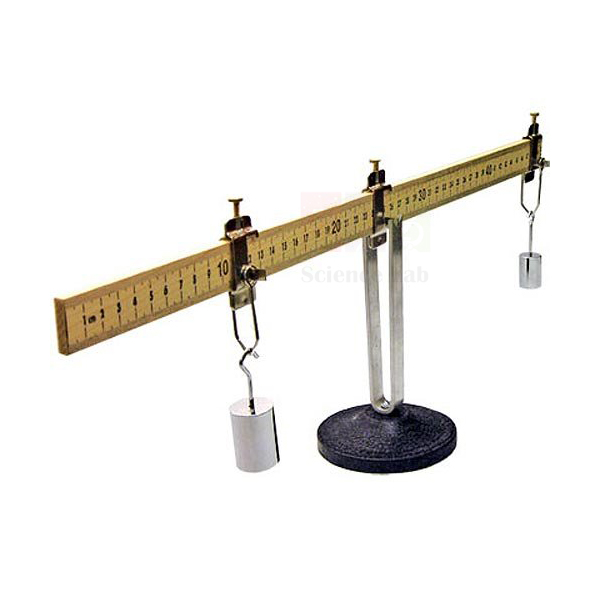
Balance Demonstration Fulcrum/Lever
Balance Demonstration Fulcrum/Lever (Product Code: SLE/PHY/18) is a meter-stick lever set used to teach the relationship between the length of a lever arm, the moment of a force and the amount of force, in school physics labs. With a meter stick, a stand, three knife-edge clamps and 50 gram and 100 gram hooked weights, students balance real loads and see the law of moments at work. It is made by Jain Scientific Equipments Pvt Ltd (ScienceLab), an OEM manufacturer, at its own factory in Ambala, India.
Specifications
| Parameter | Detail |
|---|---|
| Teaching aim | Relationship between length of lever arm, moment of force and amount of force; law of torque |
| Lever | Meter stick |
| Support | Stand |
| Clamps | Three knife-edge clamps |
| Weights | One 50 gram hooked weight; one 100 gram hooked weight |
| Product code | SLE/PHY/18 |
| Manufacturer | Jain Scientific Equipments Pvt Ltd (ScienceLab) — OEM |
| Country of origin | India (made in Ambala, Haryana) |
What Is the Lever and Fulcrum Balance Used For?
One knife-edge clamp on the meter stick rests on the stand as the fulcrum, and the other two clamps carry the 50 gram and 100 gram hooked weights. Students slide the weights along the stick until it balances, then read each distance from the fulcrum straight off the stick's scale. They soon find that the 50 gram weight must hang twice as far from the pivot as the 100 gram weight, because the moments on either side must be equal: force multiplied by distance on the left equals force multiplied by distance on the right.
Moving the fulcrum away from the centre brings the stick's own weight into play, which lets older students locate its centre of gravity or estimate its mass from the balance point. The set works well as a moment bar apparatus for school practicals and as a quick teacher demonstration of why a long spanner or crowbar makes work easier. Handle the knife edges carefully and keep them clean so the stick pivots freely.
OEM Manufacturer
ScienceLab is how Jain Scientific Equipments Private Limited trades, and the company is the OEM (original equipment manufacturer) of the Balance Demonstration Fulcrum/Lever. The set is manufactured at its licensed factory at Saha, Ambala, Haryana, India, then supplied factory-direct to schools, colleges, dealers and importers. Extra knife-edge clamps, replacement weights or repeat class sets are handled by the manufacturer itself, so just ask us. Read more on the company profile.
Related Physics Lab Equipment
For a wider unit on moments, levers and forces, consider:
- Moments Kit — further experiments on turning effects for older students.
- Disk for the Balance of Moments — shows balanced moments on a rotating disc instead of a straight lever.
- Hangers with Slotted Weights — adds more load values for extended balancing tasks.
- Balance Spring Tubular Plastic — measures the force needed to hold the lever in balance.
The complete range is in Physics Lab Equipment.
Frequently Asked Questions
What does the Balance Demonstration Fulcrum/Lever teach?
The Balance Demonstration Fulcrum/Lever teaches the relationship between the length of a lever arm, the moment of force and the amount of force. By adjusting weights on the meter stick until it balances, students observe the law of torque, also called the principle of moments.
What parts are in the fulcrum and lever balance set?
The Balance Demonstration Fulcrum/Lever consists of a meter stick, a stand, three knife-edge clamps, one 50 gram hooked weight and one 100 gram hooked weight. One clamp forms the fulcrum on the stand and the other two hold the weights on the stick.
How do students find the balance point with this lever set?
With the Balance Demonstration Fulcrum/Lever, students move the hooked weights along the meter stick until it rests level, then read each distance from the fulcrum. Multiplying each weight by its distance shows that the moments on both sides are equal at equilibrium.
Who manufactures the Balance Demonstration Fulcrum/Lever?
Jain Scientific Equipments Pvt Ltd, trading as ScienceLab, manufactures the Balance Demonstration Fulcrum/Lever as the OEM at its own factory in Saha, Ambala, Haryana, India. It is sold direct from the manufacturer to schools, colleges, dealers and importers.
Can more weights be used with the lever balance?
Yes. The Balance Demonstration Fulcrum/Lever is supplied with one 50 gram and one 100 gram hooked weight, and extra hooked or slotted weights can be hung from the knife-edge clamps for further balancing problems. Ask ScienceLab to add suitable weights to your quotation.
How can a school order the fulcrum/lever balance in quantity?
Schools can order the Balance Demonstration Fulcrum/Lever, code SLE/PHY/18, in class-set quantities by sending the number of sets and delivery location through the contact page. ScienceLab supplies schools, dealers and importers in India and international markets.
Request a Quote
For a quotation on the Balance Demonstration Fulcrum/Lever, add it to the enquiry cart or contact us via the contact page. You deal directly with the manufacturer from enquiry to dispatch.
Last updated: 24 September 2026
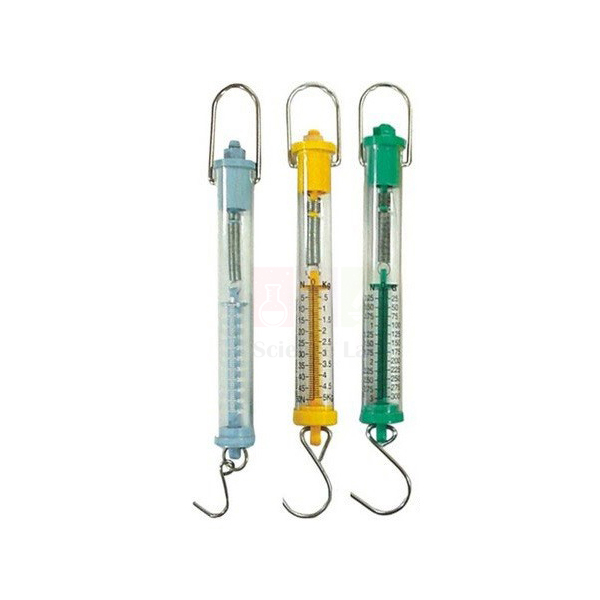
Balance Spring Tubular Plastic
Balance Spring Tubular Plastic (Product Code: SLE/PHY/19) is a tubular spring balance used to measure forces, such as the pull of gravity on a mass, in school physics and science labs. It is 250 mm long overall including its ring and hook, the spring mechanism is clearly visible through the plastic tube, and it carries a zero adjustment plus colour-coded ranges scaled in both grams and newtons. It is made by Jain Scientific Equipments Pvt Ltd (ScienceLab), an OEM manufacturer, at its own factory in Ambala, India.
Specifications
| Parameter | Detail |
|---|---|
| Measures | Force, such as the force of gravity exerted on a mass; can be calibrated for measuring mass |
| Body | Tubular plastic |
| Overall length | 250 mm, including ring and hook |
| Mechanism | Spring mechanism clearly visible |
| Zero setting | Zero adjustment incorporated |
| Scales | Graduated in both grams and newtons |
| Range identification | Each range is colour-coded |
| Product code | SLE/PHY/19 |
| Manufacturer | Jain Scientific Equipments Pvt Ltd (ScienceLab) — OEM |
| Country of origin | India (made in Ambala, Haryana) |
What Is the Tubular Spring Balance Used For?
A spring balance is often the first force-measuring instrument students handle. Hang the balance by its ring, set the pointer to zero with the zero adjustment, then attach the load to the hook and read the scale. Because the scale is marked in both grams and newtons, one reading lets the class connect mass and weight and see how a load in grams corresponds to a force in newtons. The visible spring shows how the extension grows with the load, a direct link to Hooke's law.
Beyond weighing, students use it to measure friction by dragging a block across the bench, the pull needed to raise a load with pulleys, or the effort on a lever. The colour coding makes it easy to hand the right range to each group and to collect them again after class. Hold it vertically when weighing, re-zero before each set of readings and never load it past the end of its scale. It is everyday physics lab equipment in India's schools and junior colleges.
What to Specify When Ordering
- The range or ranges you need; each range is colour-coded, so ask us which ranges are available.
- Quantity per range, for example one per student group.
- Whether you want a mixed set of ranges for one lab.
OEM Manufacturer
Jain Scientific Equipments Private Limited trades as ScienceLab and is the OEM for the Balance Spring Tubular Plastic. The balance is produced at the company's licensed factory at Saha, Ambala, Haryana, India, and supplied directly by the maker to schools, colleges, dealers and importers, which keeps repeat orders for the same range and colour code simple. For replacements or additional ranges, just ask us. The ScienceLab profile explains more about the company.
Related Physics Lab Equipment
Spring balances are used alongside masses and other force experiments such as:
- Mass Set — known masses for checking readings and weighing practice.
- Newton Mass Set 1N Set — masses matched to newton values for force work.
- Hooke's Law Apparatus — explores the spring extension that the balance relies on.
- Force Meter/Spring Balance — another force meter option in the measuring range.
- Balance Demonstration Fulcrum/Lever — a lever experiment where the balance can measure the effort.
Browse more in Physics Lab Equipment.
Frequently Asked Questions
What is the Balance Spring Tubular Plastic used to measure?
The Balance Spring Tubular Plastic measures force, such as the force of gravity exerted on a mass, and it can be calibrated for measuring mass. Its scales are marked in both grams and newtons, so students can relate mass and weight from a single reading.
How long is the tubular plastic spring balance?
The Balance Spring Tubular Plastic is 250 mm long overall, including its ring and hook. The compact tubular plastic body keeps the spring mechanism clearly visible, which helps students see the spring stretch as the load increases.
How is the tubular spring balance set to zero?
The Balance Spring Tubular Plastic has a built-in zero adjustment. Hang it vertically by its ring with nothing on the hook, adjust the pointer to zero, and then attach the load. Re-check the zero before each new set of readings for consistent results.
Why are the spring balance ranges colour-coded?
Each range of the Balance Spring Tubular Plastic is colour-coded so teachers and students can pick the correct range quickly and avoid overloading a lighter one. Tell ScienceLab which ranges and how many of each you need when you request a quote.
Who manufactures the Balance Spring Tubular Plastic?
Jain Scientific Equipments Pvt Ltd (ScienceLab) manufactures the Balance Spring Tubular Plastic as the OEM at its own factory in Saha, Ambala, Haryana, India. Schools, dealers and importers in India and international markets buy it directly from the manufacturer.
Can a calibration certificate be provided for the spring balance?
Whether a calibration document can be provided with the Balance Spring Tubular Plastic should be discussed with ScienceLab before ordering. Include this request, the ranges needed and your delivery location when you contact us through the contact page.
Request a Quote
List the ranges and quantities of the Balance Spring Tubular Plastic you need and send them through the contact page, or add the item to the enquiry cart. The quotation is prepared by ScienceLab as the manufacturer.
Last updated: 24 September 2026
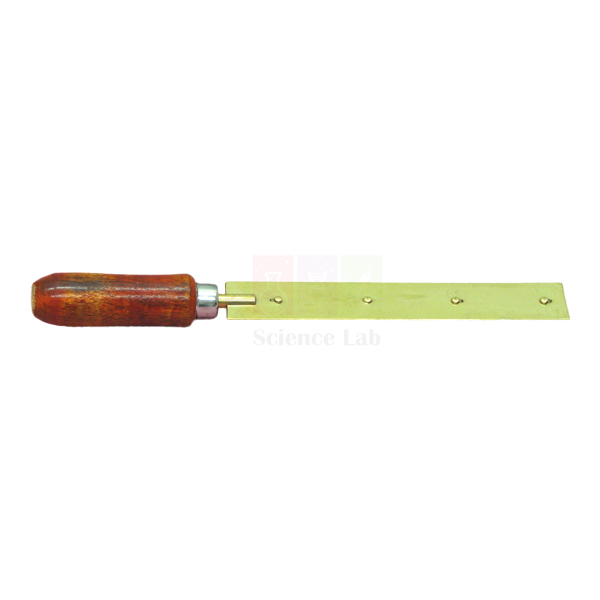
Bar Compound Copper & Iron
Bar Compound Copper & Iron (Product Code: SLE/PHY/20) is a bimetallic compound bar used to demonstrate the principle of the thermostat in school physics and general science labs. An iron strip and a copper-based strip are riveted together from end to end and mounted in a wooden handle, and when the bar is heated the unequal expansion of the two metals makes it bend. It is made by Jain Scientific Equipments Pvt Ltd (ScienceLab), an OEM manufacturer, at its own factory in Ambala, India.
Specifications
| Parameter | Detail |
|---|---|
| Demonstrates | Principle of the thermostat |
| Construction | Bimetal strip: one strip of each metal, riveted together from end to end |
| Metals | Iron and a copper-based strip. The product name lists copper; our earlier catalogue description lists brass. Please confirm the metal pair in your enquiry. |
| Handle | Wooden handle |
| Behaviour on heating | The bar bends because the two metals expand unequally |
| Product code | SLE/PHY/20 |
| Manufacturer | Jain Scientific Equipments Pvt Ltd (ScienceLab) — OEM |
| Country of origin | India (made in Ambala, Haryana) |
What Is the Compound Bar Used For?
As a piece of physics lab equipment for India's heat and expansion lessons, it takes only a flame to use. Hold the bar by its wooden handle and pass it slowly through the flame so both strips warm evenly. The copper-based strip expands more than the iron for the same rise in temperature, but the rivets stop the strips from sliding past each other, so the whole bar curls with the iron on the inside of the curve. As it cools, the bar straightens again, showing that the effect is reversible.
That bending movement is exactly what switches a thermostat: in an iron, a room heater or a fire alarm, a bimetal strip moves as it warms and opens or closes an electrical contact. Students can predict which way the bar will bend before heating, then check. Keep the heating gentle, rest the hot bar on a heat-proof mat afterwards, and never touch the metal until it has cooled.
What to Specify When Ordering
- Confirm the metal pair you need: the product name lists copper and iron, while the earlier catalogue text lists brass and iron.
- Number of compound bars, for example one per student group or one for teacher demonstration.
- Whether a heat source such as a Bunsen burner should be quoted with the bars.
OEM Manufacturer
ScienceLab is the trading name of Jain Scientific Equipments Private Limited, the OEM (original equipment manufacturer) of the Bar Compound Copper & Iron. The company manufactures it at its licensed factory in Saha, Ambala, Haryana, India, and sells factory-direct to schools, colleges, dealers and importers. Jain Scientific Equipments Private Limited is a registered MSME whose major activity is manufacturing (Udyam UDYAM-HR-01-0003714), and export consignments move under Importer-Exporter Code AAECJ8618A issued by the DGFT. See the company profile for more.
Related Physics Lab Equipment
For a full set of thermal expansion demonstrations, pair the compound bar with:
- Bimetallic Strip — another bimetal item for the same thermostat lesson.
- Ball & Ring Apparatus — shows expansion of a solid when heated in a single metal.
- Apparatus Bar & Gauge — demonstrates linear expansion of a heated bar.
- Bunsen Burner — a heat source for warming the bar evenly.
More apparatus is listed in Physics Lab Equipment.
Frequently Asked Questions
What does the Bar Compound Copper & Iron demonstrate?
The Bar Compound Copper & Iron demonstrates the principle of the thermostat. Its two riveted metal strips expand by different amounts when heated, so the bar bends, just as the bimetal strip inside a thermostat bends to open or close an electrical contact.
Which way does the compound bar bend when heated?
When the Bar Compound Copper & Iron is heated, it bends with the iron strip on the inside of the curve, because the copper-based strip expands more than iron. On cooling, the bar returns towards its original straight shape.
What metals is the compound bar made of?
The Bar Compound Copper & Iron joins an iron strip to a copper-based strip, riveted from end to end in a wooden handle. The product name lists copper, while our earlier catalogue text lists brass, so please confirm the metal pair with ScienceLab when you enquire.
Who manufactures the Bar Compound Copper & Iron?
Jain Scientific Equipments Pvt Ltd, trading as ScienceLab, manufactures the Bar Compound Copper & Iron as the OEM at its own factory in Saha, Ambala, Haryana, India. It is supplied factory-direct to schools, colleges, dealers and importers.
How should the compound bar be heated safely?
Hold the Bar Compound Copper & Iron only by its wooden handle and warm it gently and evenly in a flame. Place the hot bar on a heat-proof mat after the demonstration and do not touch the metal strips until they have cooled completely.
How do I request a quotation for SLE/PHY/20?
To request a quotation for the Bar Compound Copper & Iron, code SLE/PHY/20, send the quantity, the metal pair you require and your delivery location through the ScienceLab contact page. ScienceLab supplies buyers in India and international markets.
Request a Quote
Send your requirement for the Bar Compound Copper & Iron through the contact page or add it to the enquiry cart. As the manufacturer, ScienceLab quotes directly and can confirm the metal pair with you.
Last updated: 24 September 2026
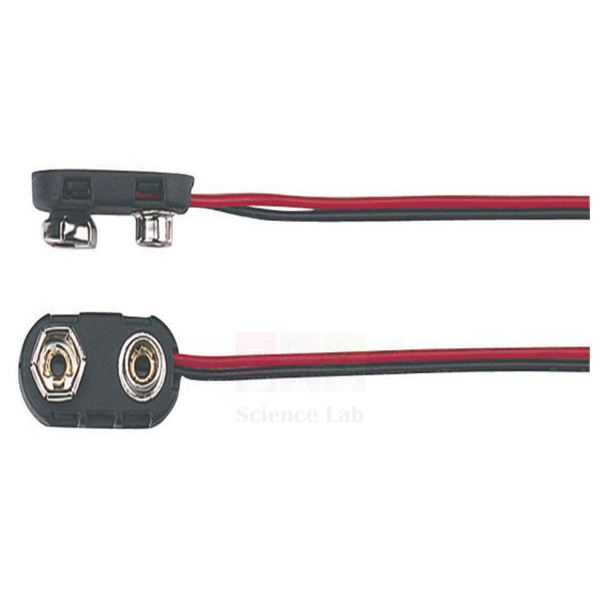
Battery Clip, PP3
Battery Clip, PP3 (Product Code: SLE/PHY/21) is a standard snap-on battery connector used to take power from a PP3 battery into simple circuits in school physics and electronics labs. It has 150 mm leads and fits both PP3 batteries and press-stud type battery holders, so one clip style serves both power options on the bench. It is supplied by Jain Scientific Equipments Pvt Ltd (ScienceLab), Ambala, India, as a basic part for any electricity experiment kit a school assembles.
Specifications
| Parameter | Detail |
|---|---|
| Type | Standard PP3 battery clip |
| Lead length | 150 mm |
| Fits | PP3 batteries; press-stud type battery holders |
| Product code | SLE/PHY/21 |
| Supplied by | Jain Scientific Equipments Pvt Ltd (ScienceLab), Ambala, India |
What Is the PP3 Battery Clip Used For?
A PP3 battery has two press-stud terminals of different sizes at one end, and the clip snaps onto them in only one orientation, so the battery cannot be connected the wrong way round at the clip. The 150 mm leads then carry the supply to the rest of the circuit, whether that is a bulb holder, a buzzer, a small motor or a breadboard. The same clip also snaps onto press-stud type battery holders, which lets a class switch between a PP3 battery and a holder of cells without rewiring.
Before wiring, note which lead goes to the positive terminal and keep that polarity throughout the circuit. Never let the two lead ends touch while a battery is attached, as that shorts the battery and heats the wires. Unclip the battery at the end of each lesson so it does not drain in storage, and bend the leads gently so the joints at the clip last longer.
Supplier
ScienceLab is the trading name of Jain Scientific Equipments Private Limited, which supplies the Battery Clip, PP3 from Ambala, Haryana, India. The company sources it as a standard component and ships it with other electricity and circuit items, so a school or dealer can place a single order for the whole circuit list. Ask us about quantities for class kits or for dealer stock. Company information is on the ScienceLab profile page.
Related Physics Lab Equipment
These items complete a simple battery circuit with the PP3 clip:
- Battery Snap with Crocodile Clip — a battery connector with crocodile clips already attached for clip-on wiring.
- Crocodile Clip — for making quick connections at the ends of the leads.
- MES Bulb Holder — a bulb holder for a first lamp circuit.
- Circuits Kit Push Switch — lets students switch the circuit on and off.
- Battery Holder, C — a holder for C cells when a different battery format is wanted.
More circuit and electricity items are in Physics Lab Equipment.
Frequently Asked Questions
What is the Battery Clip, PP3 used for?
The Battery Clip, PP3 connects a PP3 battery, or a press-stud type battery holder, to a circuit. It snaps onto the battery terminals and carries the supply through its 150 mm leads to bulbs, buzzers, motors or other components in school experiments.
How long are the leads on the PP3 battery clip?
The leads on the Battery Clip, PP3 are 150 mm long. That length reaches comfortably across a small circuit board or bench layout while keeping the wiring short and tidy for student circuits.
Does the PP3 battery clip fit battery holders?
Yes. The Battery Clip, PP3 can be used with PP3 batteries or with press-stud type battery holders, so the same clip works whether a class uses a single PP3 battery or a holder of cells with press-stud terminals.
How can short circuits be avoided with the PP3 clip?
With the Battery Clip, PP3 attached to a battery, keep the two lead ends apart and connect them only into a complete circuit. Unclip the battery after use so it does not drain, and check the leads for damaged insulation before each lesson.
Who supplies the Battery Clip, PP3?
The Battery Clip, PP3 is supplied by Jain Scientific Equipments Pvt Ltd (ScienceLab), Ambala, Haryana, India, to schools, colleges, dealers and importers in India and international markets, often together with other circuit components on the same order.
What should I include when asking for a quote on SLE/PHY/21?
When asking for a quote on the Battery Clip, PP3, code SLE/PHY/21, give the quantity required, the delivery location and any other circuit items you want on the same order. Send the request through the ScienceLab contact page or the enquiry cart.
Request a Quote
Add the Battery Clip, PP3 to the enquiry cart with the rest of your circuit components, or send quantities through the contact page for a quotation.
Last updated: 24 September 2026
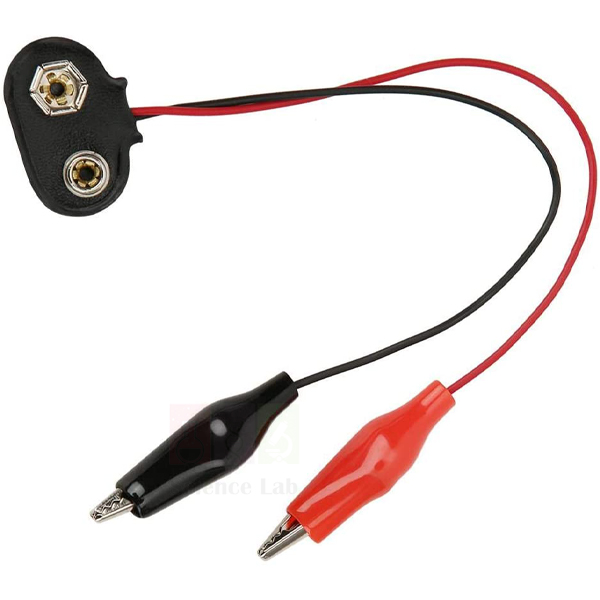
Battery Snap with Crocodile Clip
Battery Snap with Crocodile Clip (Product Code: SLE/PHY/22) is a battery connector with crocodile clips attached, used to link a battery quickly to circuit components in school science and physics lessons. Because the clips grip terminals, wires and component legs directly, students can build and change circuits on the desk without screwdrivers or soldering. It is supplied by Jain Scientific Equipments Pvt Ltd (ScienceLab), Ambala, India, and is a handy part of any hands-on science kit for primary school and middle-school classes.
Key Details
| Parameter | Detail |
|---|---|
| Type | Battery snap (battery connector) |
| Connection ends | Crocodile clips attached |
| Purpose | Easy connection of a battery to a circuit |
| Product code | SLE/PHY/22 |
| Supplied by | Jain Scientific Equipments Pvt Ltd (ScienceLab), Ambala, India |
What Is the Battery Snap with Crocodile Clip Used For?
Young students often struggle with small terminal screws, and loose connections are the most common reason a first circuit fails. With this connector the battery snaps on at one end and the crocodile clips at the other bite straight onto a bulb holder terminal, a switch, a buzzer lead or a bare wire. A circuit can be built, tested and rearranged in seconds, which keeps attention on the science rather than the wiring.
Teachers use it for series and parallel circuit activities, for testing which materials conduct electricity, and for quick demonstrations at the front of the class. Clip only onto metal parts, check that the jaws close firmly, and never let the two crocodile clips touch each other while the battery is connected. Disconnect the battery after the lesson so it stays fresh for the next class.
Supplier
Jain Scientific Equipments Private Limited, trading as ScienceLab, supplies the Battery Snap with Crocodile Clip from Ambala, Haryana, India. It is a sourced component that the company packs and dispatches alongside its wider range of physics and circuit items, so schools, colleges, dealers and importers can combine it with the rest of their order. For the battery type it fits, or for large class quantities, please ask us. Learn more on the company profile.
Related Physics Lab Equipment
To build complete circuits around this connector, schools usually add:
- Battery Clip, PP3 — a standard PP3 clip with 150 mm leads for boards and terminal blocks.
- Crocodile Clips & Leads — extra clip leads to extend the circuit to more components.
- MES Bulb Holder — holds a small bulb so students can see the circuit working.
- Knife Switch – Single Pole — an easy-to-see switch for opening and closing the circuit.
Find more under Physics Lab Equipment.
Frequently Asked Questions
What is the Battery Snap with Crocodile Clip used for?
The Battery Snap with Crocodile Clip connects a battery to circuit components through crocodile clips attached to the connector. Students clip it directly onto terminals, wires or component legs, making circuits quick to build and change without tools or soldering.
Why choose crocodile clips instead of plain leads?
Crocodile clips on the Battery Snap with Crocodile Clip grip a terminal or wire firmly with one squeeze, so connections are fast and secure even for young students. Plain leads need screw terminals or soldering, which take longer and are harder for beginners.
Which battery does the Battery Snap with Crocodile Clip fit?
The Battery Snap with Crocodile Clip is a snap-type battery connector. To confirm the battery type it fits for your planned experiments, ask ScienceLab through the contact page before ordering, and mention the batteries or holders your lab already uses.
How should students use the crocodile clip battery snap safely?
When using the Battery Snap with Crocodile Clip, attach the clips only to metal parts of the circuit, keep the two clips apart while a battery is connected, and remove the battery after the lesson. This prevents short circuits, warm wires and flat batteries.
Who supplies the Battery Snap with Crocodile Clip?
Jain Scientific Equipments Pvt Ltd (ScienceLab), Ambala, Haryana, India, supplies the Battery Snap with Crocodile Clip to schools, colleges, dealers and importers in India and international markets, together with other circuit parts on one order.
How do I get a quotation for SLE/PHY/22?
For a quotation on the Battery Snap with Crocodile Clip, code SLE/PHY/22, send the number required, your delivery location and any other circuit items you need through the ScienceLab contact page, or add everything to the enquiry cart.
Request a Quote
Place the Battery Snap with Crocodile Clip in the enquiry cart or ask for a quotation through the contact page, listing the quantity for your classes.
Last updated: 24 September 2026
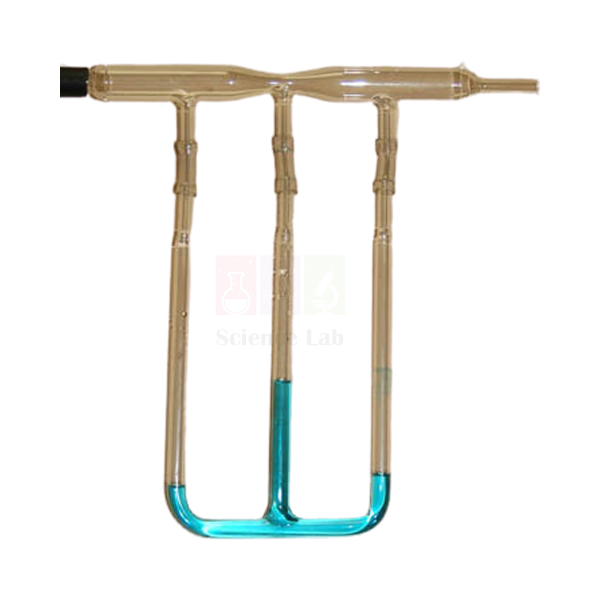
Bernoulli Tube Apparatus
Bernoulli Tube Apparatus (Product Code: SLE/PHY/23) is a glass flow-tube set used to explain Bernoulli's theorem by showing how the pressure and speed of a flowing liquid change with the bore of a tube, in physics labs. It pairs a Bernoulli tube with a central narrowed portion and a constant-bore gradient tube, each 500 x 13 mm with three side tubes for glass manometers. This physics demonstration kit is made by Jain Scientific Equipments Pvt Ltd (ScienceLab), an OEM manufacturer, at its own factory in Ambala, India.
Specifications
| Parameter | Detail |
|---|---|
| Flow tubes | Bernoulli tube with central narrowed portion; constant-bore gradient tube |
| Flow tube size | Each 500 x 13 mm (length x outer diameter) |
| Side tubes | Three sealed-in short side tubes on each flow tube, each 25 mm long, spaced about 150 mm apart |
| Constriction tapping | On the Bernoulli tube, the middle side tube comes out from the central narrowed portion |
| Manometer tubing | 6 lengths of glass tubing, connected to the side tubes for use as manometers |
| Outlets | 2 swan-necked outlet tubes |
| Connectors | 8 small pieces of rubber connecting tubing for joining the glass tubes as needed |
| Purpose | Observing the variation in pressure and speed of flow of an incompressible fluid with the bore or cross-section of the tube |
| Product code | SLE/PHY/23 |
| Manufacturer | Jain Scientific Equipments Pvt Ltd (ScienceLab) — OEM |
| Country of origin | India (made in Ambala, Haryana) |
What Is the Bernoulli Tube Used For?
Water from a steady supply is run through one flow tube at a time, with a length of glass tubing standing upright in each side tube as a manometer and a swan-necked outlet at the far end. In the constant-bore gradient tube, the water levels in the three manometers fall evenly along the tube, showing the pressure drop along a uniform pipe. In the Bernoulli tube, the middle manometer, which taps the narrowed portion, stands noticeably lower than its neighbours.
That dip is Bernoulli's theorem in action: to pass the same volume each second through the constriction, the water must speed up, and its pressure falls. Comparing the two tubes side by side separates this effect from the ordinary friction loss. Keep the flow steady, clamp the manometer tubes upright, and handle the glass with care when fitting the rubber connectors. It is a clear, low-cost piece of physics lab equipment in India's senior-secondary and college fluid-flow practicals.
What to Specify When Ordering
- Number of complete sets; each set includes both flow tubes, 6 glass tubing lengths, 2 swan-necked outlets and 8 rubber connectors.
- Any spare glass tubing lengths or rubber connectors you want quoted.
- Stands or clamps for holding the manometer tubes upright, if your lab needs them.
OEM Manufacturer
Jain Scientific Equipments Private Limited, known by its trading name ScienceLab, is the OEM of the Bernoulli Tube Apparatus. The set is manufactured at the company's licensed factory at Saha, Ambala, Haryana, India, and supplied factory-direct to schools, colleges, dealers and importers. Because glassware can break in use, replacement flow tubes, glass tubing or connectors are handled by the manufacturer itself — just ask us. More detail is on the ScienceLab profile page.
Related Physics Lab Equipment
These items support the experiment or take it further:
- Bernoulli's Theorem Demonstration module — a larger engineering-level unit for the same theorem.
- Rubber Tubing — for connecting the flow tube to the water supply.
- Borosilicate Glass Tubing — spare tubing for extra or replacement manometers.
- Retort Stand — holds the flow tube and manometer tubes steady.
See more apparatus in Physics Lab Equipment.
Frequently Asked Questions
What does the Bernoulli Tube Apparatus demonstrate?
The Bernoulli Tube Apparatus demonstrates Bernoulli's theorem: where a flowing incompressible liquid passes through a narrower section, its speed increases and its pressure falls. The manometer tapping at the narrowed portion of the Bernoulli tube shows this as a lower liquid level.
What is included in the Bernoulli Tube Apparatus?
The Bernoulli Tube Apparatus includes a Bernoulli tube with a central narrowed portion, a constant-bore gradient tube, 6 lengths of glass tubing, 2 swan-necked outlet tubes and 8 small pieces of rubber connecting tubing for joining the glass parts.
What size are the Bernoulli apparatus flow tubes?
Each flow tube of the Bernoulli Tube Apparatus measures 500 x 13 mm (length x outer diameter). Each has three sealed-in side tubes, 25 mm long and spaced about 150 mm apart, where glass tubing lengths are attached as manometers.
Why does the set include a constant-bore gradient tube?
The constant-bore gradient tube in the Bernoulli Tube Apparatus shows the steady pressure fall along a uniform tube. Comparing it with the Bernoulli tube lets students separate the pressure drop caused by the constriction from the ordinary loss along the length of the tube.
Who manufactures the Bernoulli Tube Apparatus?
Jain Scientific Equipments Pvt Ltd, trading as ScienceLab, manufactures the Bernoulli Tube Apparatus as the OEM at its own factory in Saha, Ambala, Haryana, India. It is supplied factory-direct, and replacement glass parts can be requested from the manufacturer.
What details should a quotation request for SLE/PHY/23 include?
A quotation request for the Bernoulli Tube Apparatus, code SLE/PHY/23, should state the number of sets, any spare tubing or connectors, and the delivery location in India or abroad. Send it through the ScienceLab contact page or enquiry cart.
Request a Quote
Request the Bernoulli Tube Apparatus through the contact page or add it to the enquiry cart with any spares you need. ScienceLab quotes directly as the manufacturer.
Last updated: 24 September 2026