- Physics Lab Equipment
- Chemistry Lab Equipment
- Biology Lab Equipment
- Anatomical Lab Equipment
- Learning
- Educational Lab Equipment
- Magnets
- Agriculture
- Astronomy
- Earth Science
- Geography Lab Equipment
- Safety Lab Coat
- Laboratory
- Meteorological
- Electricity & Magnetism
- Heat
- School Lab Equipment
- Lab Glassware
- Science Lab Equipment
- Tvet Lab Equipment
- Robotics Kits Supplier and Manufacturer for Schools India
- Math Lab Equipment Manufacturers and Exporters in Ambala
- STEM Kits Manufacturers and Supplier India
- Engineering Lab Equipment
- Hospital Lab Equipment
- Water, Sanitation & Hygiene Supplies
- Cold Chain, Solar & Communication Equipment
- Nutrition
Clinical Laboratory is an 89-item range of instruments and consumables for medical laboratory technology (DMLT and BMLT) institutes, nursing and paramedical colleges, hospital and health-centre laboratories, universities and research labs. Jain Scientific Equipments Pvt Ltd (ScienceLab), Ambala, makes the bench equipment, racks and glass items in it at its licensed Ambala factory and supplies the analysers, disposables and reagents, so a complete clinical laboratory equipment order can come from one source. The range is grouped by work area: sample collection, haematology, clinical chemistry and immunoassay, processing, pipetting, slide work and biosafety.
What Does the Clinical Laboratory Range Include?
| Topic | What it covers | Example products |
|---|---|---|
| Sample collection | Capillary and venous blood collection, swabs and sample containers | Safety Lancet Disposable 2.4 mm; EDTA Vacuum Tube; Tourniquet With Buckle; Sterile Swab Tube Cotton Tip |
| Haematology | ESR testing and manual cell counting | Tube ESR; ESR Rack; Manual Differential Cell Counter |
| Clinical chemistry and immunoassay | ELISA plate washing, bilirubin and glucose testing, and PCR plates | ELISA Washer 8 Channel; Bilirubin Meter; Microcuvette for Glucose; PCR Microplate |
| Sample processing | Mixing, heating, incubation and separation of samples | Vortex Test Tube; Orbital Shaker; Thermoblock; Water bath, 7 L; Manual Centrifuge |
| Pipetting | Fixed and variable volume pipettors, multichannel pipettes, tips and transfer pipettes | Pipettor, Variable Volume; Digital Pipette 8 Channels; Filter Pipette Tips; Transfer Pipette Sterile |
| Slides and dried blood spots | Staining, drying and storing slides, and dried blood spot sampling | Coplin Staining Jar; Slide Drying Rack; Dry Blood Spot Paper; Punch DBS 3.0mm |
| Biosafety and waste | Personal protection, sharps and biohazard disposal, and safe sample transport | Gloves W/o Powder Nitrile Disposable; Sharp Container Leak Proof Plastic; Biohazard Bag; Box Infectious Sample Transportation |
Featured Clinical Laboratory
| Product | Product Code | Typical Use |
|---|---|---|
| 18 parameter Haematology Analyser | SLE/CL/76 | Automated blood counts in haematology sections and training labs |
| Clinical Chemistry Analyzer | SLE/CL/77 | Biochemistry tests on serum and plasma samples |
| ELISA Reader 8 Channel | SLE/CL/73 | Reading ELISA microplates in immunoassay work |
| Haematocrit Centrifuge | SLE/CL/71 | Packed cell volume tests using capillary tubes |
| Centrifuge Complete w/accessories | SLE/CL/70 | Separating serum or plasma from blood samples |
| Counting Chamber Neubauer | SLE/CL/27 | Manual cell counts under the microscope, a core skill for haemocytometer practicals |
| Incubator 30L, up to 80C | SLE/CL/62 | Holding samples and cultures at a set temperature |
| Eye Wash Station | SLE/CL/50 | Emergency eye rinsing after a splash in the laboratory |
OEM Manufacturing & Supply
Clinical Laboratory is a mixed range, and each product page states whether its item is made or supplied. Bench equipment such as the centrifuges, water bath, thermoblock, thermomixer, vortex mixer, orbital shaker and blood specimen rotator, along with tube and slide racks, Coplin staining jars, slide storage boxes, the Neubauer counting chamber and ESR tubes, is made at ScienceLab's licensed factory at 449, HSIIDC Industrial Area, Saha, Ambala, Haryana. Disposable consumables (lancets, blood collection tubes, pipette tips, transfer pipettes, gloves, masks, biohazard bags and sharps containers), the blood grouping reagent, the analysers, the ELISA reader and washer, the bilirubin meter, the incubator and the eye wash station are supplied. Jain Scientific Equipments Private Limited quotes new laboratory set-ups, recurring consumable supplies, tender schedules and export consignments for buyers in India and international markets. For vendor registration, its company details are CIN U29309HR2020PTC087597 and GSTIN 06AAECJ8618A1ZT.
Related Ranges
- Laboratory — the parent hub of laboratory sub-ranges, from burners and balances to stands and clamps.
- Centrifuges — a wider choice of centrifuges, including the Clinical Centrifuge, if the models listed here do not match your sample volumes.
- Water Bath — serological and digital water baths beyond the single water bath in this range.
- Microscope — microscopes for cell counting and slide reading.
- Safety Lab Coat — gowns, coveralls and further lab coats for laboratory staff and students.
- Hospital Lab Equipment — hospital furniture, surgical instruments and ward and theatre equipment, whereas this page covers the diagnostic laboratory bench.
- Anatomical Lab Equipment — anatomical models for health-science institutes that teach anatomy alongside laboratory practice.
Frequently Asked Questions
What does the Clinical Laboratory range include?
The Clinical Laboratory range lists 89 instruments and consumables grouped by work area: blood sample collection, haematology, clinical chemistry and immunoassay, sample processing, pipetting, slide staining and dried blood spots, and biosafety and waste handling.
Who manufactures the Clinical Laboratory range?
The Clinical Laboratory range is partly manufactured and partly supplied by Jain Scientific Equipments Pvt Ltd (ScienceLab), Ambala. Centrifuges, mixers, the water bath, racks, staining jars and counting chambers are made at its Ambala factory, while analysers, ELISA equipment, disposables and reagents are supplied.
Can the Clinical Laboratory range equip a complete medical laboratory technology practical lab?
Yes. The Clinical Laboratory range covers collection, haematology, chemistry and immunoassay, processing, pipetting, slide work and biosafety for DMLT and BMLT practical labs; microscopes come from the separate Microscope range. Share the course and batch size and a list can be proposed.
Can Clinical Laboratory consumables be ordered in bulk?
Yes. Clinical Laboratory consumables such as blood collection tubes, lancets, pipette tips and gloves can be quoted in bulk for regular use; share the expected monthly or annual usage so that quantities can be planned.
Should centrifuges come from Clinical Laboratory or the Centrifuges range?
Clinical Laboratory lists centrifuges chosen for clinical work, namely manual, haematocrit and complete-with-accessories models. The separate Centrifuges range offers more options when a different capacity or type is needed.
What should a Clinical Laboratory quotation request include?
A Clinical Laboratory quotation request should give product names or codes, quantities, the delivery location, any tender schedule or export destination and, for electrical instruments, the mains voltage used at your site; company registration details are provided with the quotation.
Request a Quote or Catalogue
Send your equipment list or tender document through the contact page to receive a quotation or catalogue, or collect the items in the shopping cart and submit them as one enquiry.
Last updated: 24 September 2026
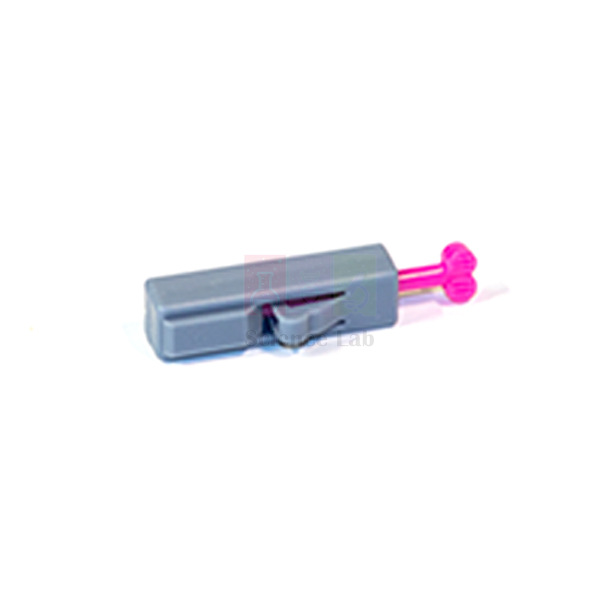
Lancet 2.4 mm Disposable
Lancet 2.4 mm Disposable (Product Code: SLE/CL/01) is a single-use safety lancet used to puncture the skin for capillary blood collection in clinical, diagnostic and teaching laboratories. Its instant trigger launches a spring-based blade to a depth of approximately 2.4mm, a built-in mechanism prevents reuse, and it is listed for laboratory services from basic laboratories to reference centres. It is supplied by Jain Scientific Equipments Pvt Ltd (ScienceLab), Ambala, India, as part of its disposable lab equipment range in India.
Specifications
| Parameter | Detail |
|---|---|
| Type | Safety lancet, single-use disposable |
| Blade depth | Approximately 2.4mm |
| Activation | Instant trigger launches a spring-based blade |
| Reuse protection | Mechanism prevents reuse |
| Application | Capillary blood collection |
| Service level | Basic laboratory to reference centre |
| Estimated shipping volume (as listed) | 0.004 m3 |
| Estimated shipping weight (as listed) | 0.7 kg |
| Product code | SLE/CL/01 |
| Supplied by | Jain Scientific Equipments Pvt Ltd (ScienceLab), Ambala, India |
What Is the 2.4 mm Disposable Lancet Used For?
Capillary sampling is used wherever only a few drops of blood are needed, for example point-of-care haemoglobin or glucose checks, blood grouping practicals, rapid tests and dried blood spot cards. The operator cleans and dries the fingertip, presses the lancet firmly against the side of the finger pad and triggers it; the blade fires and retracts in one movement. The first drop is usually wiped away and the following drops are collected into a capillary tube, microcuvette or onto a test card.
Wear gloves throughout, and drop each used lancet straight into a puncture-resistant sharps container rather than setting it down on the bench. Colleges buying lab equipment for college practicals in India, such as medical laboratory technology and nursing programmes, often keep lancets, capillary tubes and sharps bins together in one tray so students follow the full sampling routine.
Supplier
Jain Scientific Equipments Private Limited, an Ambala, Haryana company that trades as ScienceLab, supplies this single-use lancet to hospital laboratories, clinics, health programmes and training institutes as part of its clinical consumables range. Company details are on the ScienceLab profile.
Related Clinical Laboratory Items
Items used in the same capillary blood collection routine:
- Gloves W/o Powder Nitrile Disposable — hand protection while sampling
- Sharp Container Leak Proof Plastic — for immediate disposal of used lancets
- EDTA Capillary Tube — for collecting the capillary blood drop
- Microcuvette for Glucose — for glucose measurement from a finger-prick sample
- Adhesive Bandage — to cover the puncture site after collection
Explore the full Clinical Laboratory range for sampling and testing supplies.
Frequently Asked Questions
How deep does the Lancet 2.4 mm Disposable puncture?
The Lancet 2.4 mm Disposable has a blade depth of approximately 2.4mm, launched by an instant spring trigger. Always choose lancet depth according to your facility's sampling protocol for the patient and the puncture site.
Can the 2.4 mm disposable lancet be used more than once?
No. The 2.4 mm disposable lancet is a single-use device, and its built-in mechanism prevents reuse after it has fired. Discard each lancet straight into a puncture-resistant sharps container at the point of use.
How many lancets come in a pack?
The pack quantity of the Lancet 2.4 mm Disposable is not stated in our listing, which gives only an estimated shipping volume of 0.004 m3 and weight of 0.7 kg. Ask us through the contact page for the box count and carton details.
What expiry information is available for the 2.4 mm disposable lancet?
No expiry period is stated for the 2.4 mm disposable lancet on this page. Ask us for the lot number and expiry date of the batch you are quoted, together with the packaging details, before you place an order.
Who supplies the Lancet 2.4 mm Disposable?
The Lancet 2.4 mm Disposable is supplied by Jain Scientific Equipments Private Limited, trading as ScienceLab, from Ambala, Haryana, India. It is offered to hospitals, clinics, health programmes and training laboratories in India and international markets with other clinical consumables.
Can the 2.4 mm disposable lancet be ordered in bulk for programmes?
Yes. Bulk quantities of the 2.4 mm disposable lancet can be quoted for screening programmes, hospitals and distributors. Send product code SLE/CL/01, the number of lancets or boxes and the delivery location in India or abroad.
Request a Quote
To order the Lancet 2.4 mm Disposable, contact us through the contact page or add it to the enquiry cart with your other clinical consumables.
Last updated: 24 September 2026
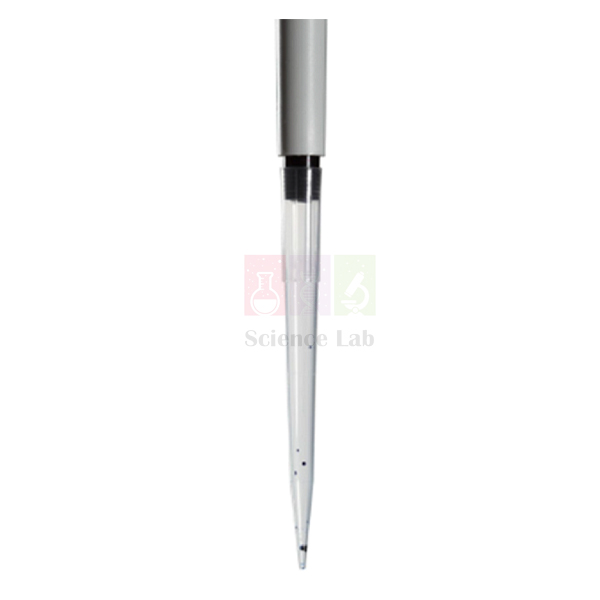
Pipette Tip White 2-20 ul
Pipette Tip White 2-20 ul (Product Code: SLE/CL/02) is a white polypropylene disposable tip for dispensing small liquid volumes from 2 to 20ul on standard automatic pipettes. Fitting a fresh tip for every sample keeps the pipette shaft clean and helps avoid carry-over contamination between specimens, reagents and controls. The tips are supplied as a rack of 960 for reference centres and laboratories running sophisticated techniques, and they reach buyers through Jain Scientific Equipments Pvt Ltd (ScienceLab), Ambala, a lab plastic ware supplier in India.
Specifications
| Parameter | Detail |
|---|---|
| Material | Polypropylene |
| Capacity | 2 to 20ul |
| Colour | White (standard colour) |
| Compatibility | Listed as compatible with all standard automatic pipettes |
| Packing | Rack of 960 pipette tips |
| Intended use | Avoiding contamination; sophisticated techniques in reference centres |
| Estimated volume (as listed) | 0.016 m3 |
| Estimated weight (as listed) | 1.1 kg |
Typical Use
The 2 to 20ul range covers the small additions made constantly in clinical and molecular work: adding sample to reaction wells, spotting controls, dispensing enzymes or primers and preparing serial dilutions at the low end of the scale. Set the pipette volume, press the shaft firmly into a tip in the rack so it seals evenly, pre-wet the tip once with the liquid for better accuracy, then aspirate slowly at a shallow depth and dispense against the vessel wall. Eject the tip directly into a waste container before moving to the next sample.
Keep racks closed until use and handle tips only with the pipette, not with fingers, to maintain cleanliness. Groups buying lab equipment for research in India often stock these general-purpose white tips for routine steps and keep filter tips for aerosol-sensitive work such as PCR set-up.
Supplier
ScienceLab is the trading name under which Jain Scientific Equipments Private Limited, Ambala, Haryana, supplies these pipette tips alongside the laboratory apparatus it produces. Institutions completing vendor registration can use GSTIN 06AAECJ8618A1ZT and LEI 3358004HRD1JIVXKYX49. Read the company profile for more background.
Related Clinical Laboratory Items
Pipettes and plasticware used with these tips in the same workflow:
- Pipettor, Variable Volume — an adjustable pipette for low-volume dispensing
- Single Channel Pipettors — single-channel pipettes for routine liquid handling
- Pipette Tip Barrier Ster 200ul — sterile filter tips for larger, contamination-sensitive volumes
- Micro Centrifuge Tube, 1.5ml — small tubes for the samples and mixes you pipette
- Reagent Reservoir 60ml — holds reagent for repeated aspiration
Visit the Clinical Laboratory category for the full range of consumables and instruments.
Frequently Asked Questions
What volume range do these tips cover?
They are designed for 2 to 20ul.
Will they fit my pipette?
They are listed as compatible with standard automatic pipettes. Fit can vary between brands, so share your pipette make and model through our contact page if you want us to confirm.
Are these tips sterile or filtered?
Our listing does not describe this item as sterile or filtered. For sterile tips with an aerosol barrier, see Pipette Tip Barrier Ster 200ul.
How many tips are supplied?
They come as a rack of 960 pipette tips.
Can the tips be autoclaved or reused?
Autoclaving is not specified in our listing, and the tips are intended as disposables to avoid contamination. Ask us if your protocol requires autoclavable tips.
Can you quote for a year's supply?
Yes. Tell us your expected annual quantity and delivery schedule for a quotation within India or to international markets.
Request a Quote
Request a price for Pipette Tip White 2-20 ul through the contact page or by adding it to the enquiry cart.
Last updated: 24 September 2026
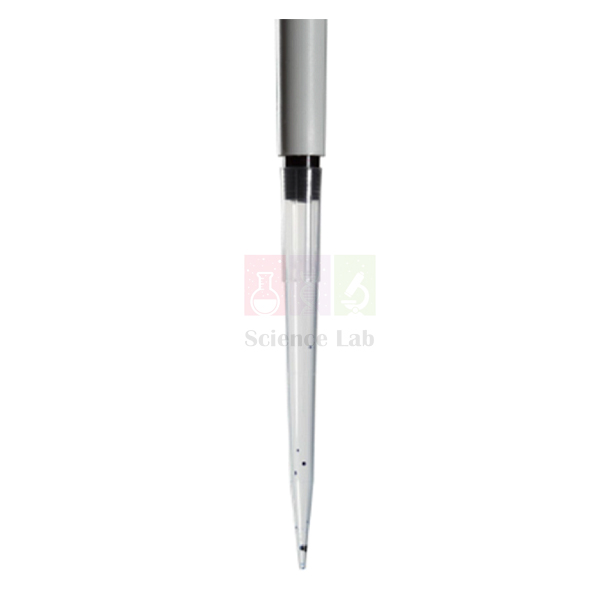
Pipette Tip Barrier Ster 200ul
Pipette Tip Barrier Ster 200ul (Product Code: SLE/CL/03) is a sterile filter tip for volumes up to 200ul, moulded in transparent polypropylene with a built-in aerosol barrier. The filter stops aerosols and splashes from reaching the pipette shaft, protecting both the sample and the instrument, which is why these tips are chosen for PCR techniques and other nucleic-acid work in reference centres. They are RNase and DNase free, packed as a rack of 960, and supplied by Jain Scientific Equipments Pvt Ltd (ScienceLab), Ambala, for laboratories equipping PCR workstations and PCR equipment in India and abroad.
Specifications
| Parameter | Detail |
|---|---|
| Material | Polypropylene, transparent |
| Capacity | Up to 200ul |
| Filter | Built-in aerosol barrier |
| Sterility | Sterile; RNase and DNase free |
| Compatibility | Listed as compatible with all standard automatic pipettes |
| Packing | Rack of 960 pipette tips |
| Intended use | Pipetting liquids in the laboratory; PCR techniques in reference centres |
| Estimated volume (as listed) | 0.016 m3 |
| Estimated weight (as listed) | 1.3 kg |
Typical Use
In PCR, a trace of amplified DNA carried on an aerosol into the pipette barrel can contaminate every reaction prepared afterwards. Barrier tips reduce that risk, so they are used for master-mix preparation, adding template DNA or RNA, pipetting extracted nucleic acids and handling potentially infectious liquids. The transparent body lets the operator see the liquid level and spot bubbles before dispensing, and a sterile, nuclease-free tip means the tip itself will not degrade sensitive RNA samples.
Open the rack only inside the clean area of the workflow, change gloves between pre- and post-amplification zones, and never let liquid touch the filter; if it does, discard the tip. Molecular labs assembling microbiology lab equipment in India usually keep separate tip racks and pipettes for each zone to avoid cross-contamination.
Supplier
These sterile barrier tips are supplied by ScienceLab, the brand of Jain Scientific Equipments Private Limited based in Ambala, Haryana. Besides producing laboratory apparatus, the company sources consumables so that molecular and clinical labs can order tips, tubes and plates together. Learn more on the ScienceLab company profile.
Related Clinical Laboratory Items
Consumables and instruments used alongside filter tips in PCR set-up:
- PCR Microplate — plates for setting up multiple reactions
- Pipettor, Variable Volume — an adjustable pipette to use with the tips
- Filter Pipette Tips — another filter tip option for contamination-sensitive work
- Pipette Tip White 2-20 ul — low-volume tips for routine additions
- Gloves W/o Powder Nitrile Disposable — powder-free gloves for clean-zone handling
The Clinical Laboratory category lists more molecular and diagnostic supplies.
Frequently Asked Questions
What is the purpose of the barrier filter?
It blocks aerosols and liquid from entering the pipette, protecting samples from cross-contamination and the pipette from contamination.
Are the tips sterile and nuclease free?
Yes. They are sterile and RNase and DNase free.
What is the maximum volume?
Up to 200ul. Stay within your pipette's range and avoid drawing liquid up to the filter.
Will they fit my pipette brand?
They are listed as compatible with standard automatic pipettes. Send us your pipette model via the contact page if you need confirmation.
Should the tips be autoclaved?
No need, as they are supplied sterile. Re-sterilising filter tips is not recommended because heat can affect the filter.
How are they packed, and can you supply regularly?
They come as a rack of 960 tips. We quote for scheduled or bulk supply within India and to international markets.
Request a Quote
To order Pipette Tip Barrier Ster 200ul, send your requirement via the contact page or add it to the enquiry cart.
Last updated: 24 September 2026
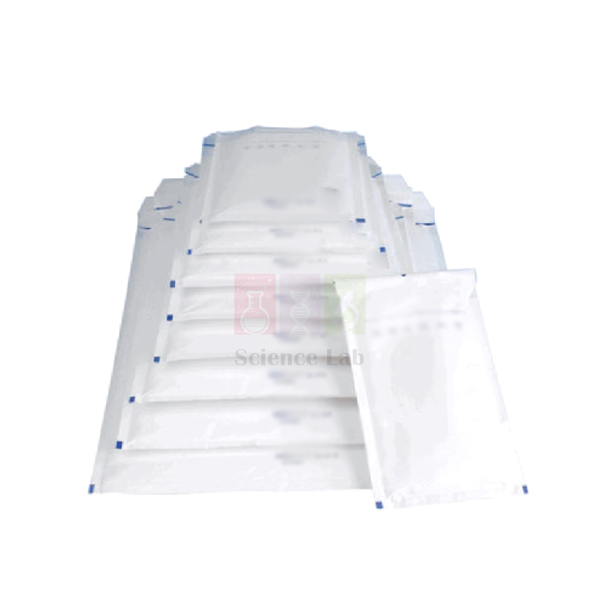
Envelope 27x36 cm
Envelope 27x36 cm (Product Code: SLE/CL/04) is a strong paper envelope of approximately 27x36cm with a water-resistant lining on the inside. The combination of a tough outer paper and a moisture-resistant inner layer helps protect paperwork, cards and bagged items from damp and handling while they are stored or sent between laboratory sections, clinics and referral sites. It is used across laboratory services from basic laboratories to reference centres and is supplied by Jain Scientific Equipments Pvt Ltd (ScienceLab), Ambala, a laboratory equipment supplier in India.
Specifications
| Parameter | Detail |
|---|---|
| Size | Approximately 27x36cm |
| Outer material | Strong paper |
| Inner lining | Water-resistant |
| Service level | Basic laboratory to reference centre |
| Disposal | Follow the manufacturer's recommended waste disposal |
| Estimated volume (as listed) | 0.084 m3 |
| Estimated weight (as listed) | 3 kg |
Typical Use
Laboratories handle a steady flow of paper: request forms, result sheets, logbooks, quality-control records and filter-paper cards that must travel with samples or be archived. An envelope of this size takes standard A4 paperwork without folding, and its water-resistant lining gives extra protection against spills, condensation from cold boxes and humid transport conditions. Many sites place dried sample cards in a sealed plastic bag first and then slip the bag into the envelope with the accompanying forms, so everything for one batch stays together.
Write the destination, sender and batch details on the outside with a permanent marker before filling, and seal the envelope fully. Note that a lined paper envelope is not a leak-proof container for liquid specimens; those need dedicated sample transport packaging. Buying envelopes from the same lab consumables supplier in India that provides your tubes, bags and cards makes restocking simpler.
Supplier
Jain Scientific Equipments Private Limited supplies this envelope under its ScienceLab name from Ambala, Haryana, as one of the stationery-type consumables it offers to clinical and teaching laboratories next to its own apparatus. You can read about the company on the ScienceLab profile.
Related Clinical Laboratory Items
Items commonly packed and sent together with lined envelopes:
- Dry Blood Spot Paper — filter-paper cards that are often dispatched in envelopes once dry
- Rack Drying DBS Cards — for drying cards completely before packing
- Bag Resealable Small Plastic — an inner sealed bag for cards or small items
- Box Infectious Sample Transportation — the right packaging when liquid or infectious samples must travel
See the complete Clinical Laboratory range for sample handling supplies.
Frequently Asked Questions
What size is the envelope?
Approximately 27x36cm, which holds A4 documents flat.
Is the envelope waterproof?
It has a water-resistant inner lining and a strong paper outer. It resists damp and minor spills, but it should not be treated as a sealed, waterproof container.
Can liquid specimens be sent in it?
No. Liquid or infectious specimens need leak-proof, purpose-made transport packaging; use the envelope for documents, cards and dry, bagged items.
How many envelopes are in a pack?
The pack quantity is not given in our listing. Please contact us to confirm pack and carton sizes.
How should used envelopes be disposed of?
Follow the manufacturer's recommended waste disposal and your laboratory's own waste rules, especially if the envelope may have contacted biological material.
Can you supply large quantities for a laboratory network?
Yes. Give us the quantity and delivery sites and we will quote for India or international markets.
Request a Quote
Ask for a quotation for Envelope 27x36 cm via our contact page or add it to the enquiry cart.
Last updated: 24 September 2026
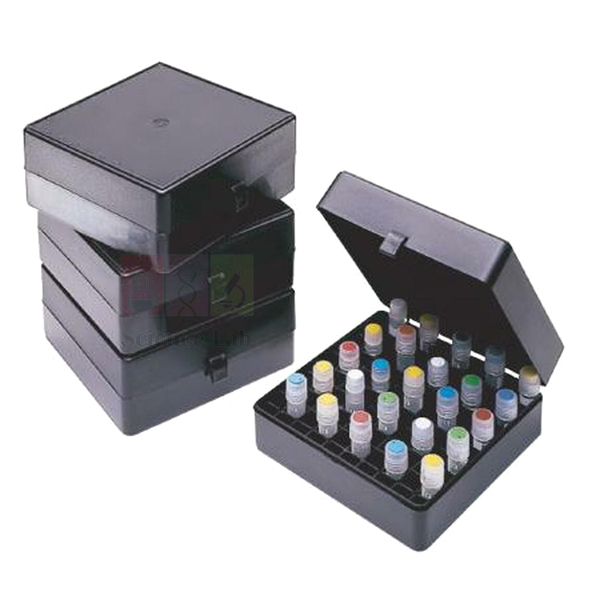
Box Storage tubes Set of 14
Box Storage tubes Set of 14 (Product Code: SLE/CL/05) is a set of plastic tube storage boxes for cryopreservation, each built as a rack with a matching lid that fits together to form a closed box with positions for 100 test tubes. The chemical-resistant plastic is made to withstand ultra-freezing, so samples can be organised on the bench and then transferred straight into cold storage. These boxes are used mainly at tertiary and reference facilities (laboratory network levels III-IV) and are made by Jain Scientific Equipments Pvt Ltd (ScienceLab), Ambala, a laboratory equipment manufacturer in India.
Specifications
| Parameter | Detail |
|---|---|
| Type | Storage box for test tubes of indicated volumes |
| Design | Rack with lid, fitting together to become a closed storage box |
| Material | Chemical-resistant plastic, withstanding ultra-freezing |
| Capacity | Positions for 100 test tubes |
| Supplied as | Set of 14 (as named) |
| Intended use | Cryopreservation of samples, mainly at tertiary and reference facilities (laboratory network levels III-IV) |
| Estimated volume (as listed) | 0.009 m3 |
| Estimated weight (as listed) | 0.5 kg |
Typical Use
Serum, plasma, isolates and extracted nucleic acids are often kept frozen for repeat testing, external quality assessment or research. Tubes are loaded into the open rack while aliquoting, the lid is fitted to close the box, and the whole unit goes into a laboratory deep freezer in India or abroad. Recording the row and column position of each tube in a sample register lets staff find a single tube quickly without holding the box out of the freezer for long.
Label every tube with a freezer-grade label before freezing, as ordinary labels can peel at very low temperatures. Allow frozen boxes to stand briefly before opening so frost does not fall into open tubes, and wipe racks with a suitable laboratory disinfectant between uses. Keeping each box to a single project or sample type makes inventory checks much easier.
Manufacturer
These storage boxes come from Jain Scientific Equipments Private Limited, whose laboratory and educational products are marketed under the ScienceLab name from Ambala, Haryana. Clinical and reference laboratories can source storage labware together with tubes, racks and instruments from the same company. The company profile has further details.
Related Clinical Laboratory Items
Items used with tube storage boxes in the sample storage workflow (check tube dimensions against the box before ordering):
- Label Self-Adhesive Freezer — labels intended for frozen sample tubes
- Screw Cap Tube 5.0 ml — screw-cap tubes for sample aliquots
- Micro Centrifuge Tube, 1.5ml — small tubes for storing extracts and aliquots
- Rack Tubes Set of 3 — bench racks for handling tubes before they go into storage
Browse the Clinical Laboratory category for more storage and sampling products.
Frequently Asked Questions
How many tubes does one box hold?
Each box provides positions for 100 test tubes.
Which tube sizes fit?
The box is made for test tubes of indicated volumes, but our listing does not state the tube size. Send us your tube volume and dimensions via the contact page so we can confirm fit.
Can it go into an ultra-low freezer?
Yes, the plastic is specified to withstand ultra-freezing. Use in liquid nitrogen is not stated, so please check with us for that application.
What does the set of 14 contain?
The product is named as a set of 14. Please confirm the exact set composition and carton details with us before placing a tender or order.
How should the boxes be cleaned?
Wipe with a laboratory disinfectant compatible with plastics and let them dry before reuse; the material is chemical resistant.
Do you supply reference laboratory networks?
Yes. Provide the quantity and delivery sites and we will quote for supply in India or international markets.
Request a Quote
Request pricing for Box Storage tubes Set of 14 through the contact page, or add it to your enquiry cart.
Last updated: 24 September 2026
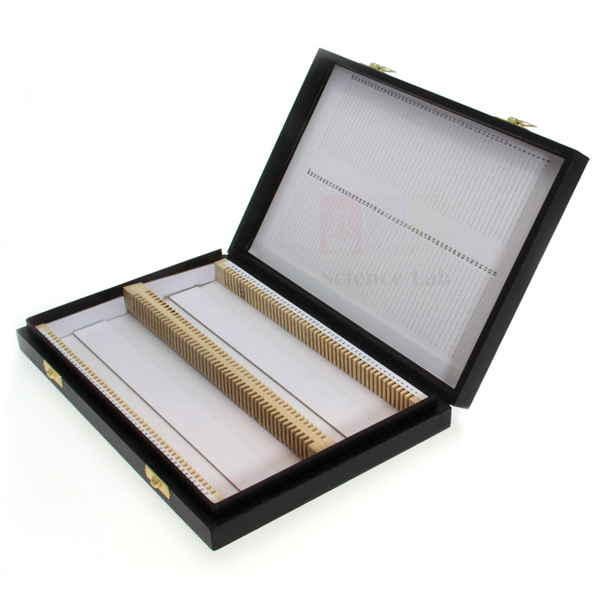
Box Storage 100 slides, Set of 10
Box Storage 100 slides, Set of 10 (Product Code: SLE/CL/06) is a set of ten microscope slide storage boxes, each suitable for 100 standard slides of 7.6 x 2.6 cm. The boxes are made of resistant thermoplastic ABS with a cork base, a lid with a sturdy lock and an index card holder in the flap cover, so stained smears, reference slides and teaching collections can be filed, labelled and kept secure. The set is manufactured by Jain Scientific Equipments Pvt Ltd (ScienceLab), Ambala, for clinical, pathology and teaching laboratories.
Specifications
| Parameter | Detail |
|---|---|
| Capacity | Suitable for 100 microscope slides per box |
| Slide size | Standard microscope slides, 7.6 x 2.6 cm |
| Box material | Resistant thermoplastic ABS |
| Base | Cork |
| Closure | Lid with a sturdy lock |
| Labelling | Index card holder on the flap cover |
| Supplied as | Set of 10 boxes |
| Estimated volume (as listed) | 90 dm3 |
| Estimated weight (as listed) | 12 kg |
Typical Use
Laboratories keep stained blood films, malaria smears, TB smears and histology sections for re-examination, quality control rechecking and teaching. Slides are dried completely, labelled, and placed in the box; the index card on the flap records the batch, date range or slide numbers so the right box can be located without opening several. With ten boxes in one set, a laboratory can dedicate separate boxes to different tests or months.
Colleges and schools that keep prepared microscope slides in India or elsewhere use the same boxes to protect teaching collections between practicals. Store the closed, locked boxes flat in a cool, dry cupboard away from direct sunlight so stains do not fade, and never box slides while mounting media or immersion oil is still wet.
Manufacturer
ScienceLab is the brand name used by Jain Scientific Equipments Private Limited, registered under CIN U29309HR2020PTC087597 in Ambala, Haryana. Its manufacturing is carried out at the company's licensed premises at 449, HSIIDC Industrial Area, Saha, Ambala, operating under Factory Licence AMB-ONLINE-CHD-J-414. More information is on the ScienceLab profile page.
Related Clinical Laboratory Items
Products used before and alongside slide storage:
- Microscope Slides Glass — plain glass slides for preparing smears and sections
- Slide Drying Rack — to dry stained slides fully before boxing them
- Diamond Marker — for permanently marking slide identification on glass
- Storage Box, 100 Slides — a related 100-slide storage box listing
Find more in the Clinical Laboratory category.
Frequently Asked Questions
How many boxes and slides does the set cover?
The set contains ten boxes, and each box is suitable for 100 microscope slides.
What slide size fits?
Standard microscope slides measuring 7.6 x 2.6 cm. For non-standard slides, please contact us to check fit.
Why does the box have a cork base?
Cork gives the slide edges a firm but cushioned seat, which helps reduce chipping when boxes are moved.
Can the boxes be locked?
Yes, each lid has a sturdy lock to keep the box closed during storage and handling.
Are the listed 90 dm3 and 12 kg figures per box?
They are the estimated volume and weight given in our listing and may apply to the packed set. Ask us for per-box and carton details when planning freight.
Can you supply several sets for a lab network or college?
Yes. Tell us the number of sets and delivery locations, and we will quote for India or international markets.
Request a Quote
To get pricing for Box Storage 100 slides, Set of 10, use the contact page or add it to the enquiry cart.
Last updated: 24 September 2026
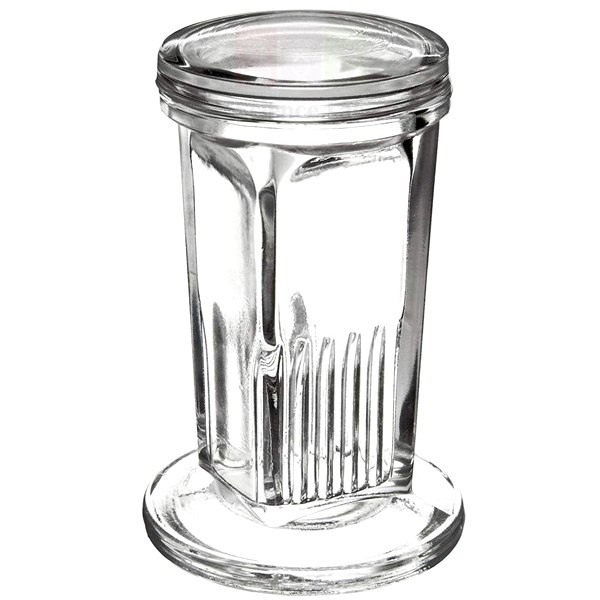
Coplin Jar Staining
Coplin Jar Staining (Product Code: SLE/CL/07) is a Coplin-type staining jar that holds 10 microscope slides of 26 x 76 mm upright in a bath of stain, fixative or rinse. The slides extend above the opening, so they can be lifted in and out by hand without forceps, and the jar has a glass cover that withstands stains and organic solvents. It is used for staining smears on microscope slides in clinical, microbiology and teaching laboratories, and is made by Jain Scientific Equipments Pvt Ltd (ScienceLab), Ambala, for laboratories putting together a staining kit for microbiology in India or abroad.
Specifications
| Parameter | Detail |
|---|---|
| Type | Jar, Coplin model, for staining |
| Capacity | 10 slides |
| Slide size | Fits slides of 26 x 76 mm |
| Handling | Slides extend above the opening, allowing manipulation without forceps |
| Cover | Glass, withstanding stain and organic solvents |
| Intended use | Staining of smears on microscope slides |
| Estimated volume (as listed) | 20 dm3 |
| Estimated weight (as listed) | 5 kg |
Typical Use
A row of Coplin jars, each filled with one reagent, turns slide staining into a simple sequence: fixative, stain, rinse, decolouriser, counterstain. Batches of up to 10 slides are moved from jar to jar by holding the exposed ends, timed at each step, then drained and dried. The method suits Giemsa and Wright staining of blood films, Ziehl-Neelsen and Gram procedures, and dehydration and clearing steps in histology, where the solvent-resistant glass cover limits evaporation and fumes between batches.
Label each jar with its reagent and filling date, keep the cover on whenever slides are not being moved, and filter or replace stains on a regular schedule to prevent precipitate forming on smears. For school practicals, a small set of jars works as a Gram stain kit for school in India or anywhere else when combined with slides, a timer and a drying rack.
Manufacturer
This staining jar is produced by Jain Scientific Equipments Private Limited, the Ambala, Haryana company behind the ScienceLab name, which makes apparatus for clinical, microbiology and teaching laboratories. Company background is available on the ScienceLab profile.
Related Clinical Laboratory Items
Equipment used in the same slide staining workflow:
- Microscope Slides Glass — glass slides for preparing the smears to be stained
- Rack Staining Slides Horizontal — an alternative for flooding stains over slides laid flat
- Mechanical Timer 60min — for timing each staining step
- Slide Drying Rack — to drain and air-dry slides after staining
- Box Storage 100 slides, Set of 10 — for storing stained slides once dry
Explore the Clinical Laboratory range for further staining and microscopy supplies.
Frequently Asked Questions
How many slides can be stained at once?
The jar holds 10 slides.
What slide size does it take?
It fits slides of 26 x 76 mm, the common standard microscope slide size.
Are forceps needed to handle the slides?
No. The slides stand higher than the jar opening, so they can be picked up by their exposed ends.
Can it hold xylene or alcohol?
The glass cover withstands stains and organic solvents. If you need the body material confirmed for a specific solvent, please contact us.
How should the jar be cleaned?
Empty the reagent according to your waste rules, rinse with water, remove stain deposits with a suitable laboratory cleaner and allow it to dry before refilling.
What do the listed 20 dm3 and 5 kg refer to?
They are the estimated volume and weight in our listing and may describe a packed quantity. Ask us for per-unit and carton details for your order.
Can you supply jars for a whole laboratory or college?
Yes. Share the quantity and delivery address and we will quote for India or international markets.
Request a Quote
Request a price for Coplin Jar Staining through our contact page or add it to the enquiry cart.
Last updated: 24 September 2026
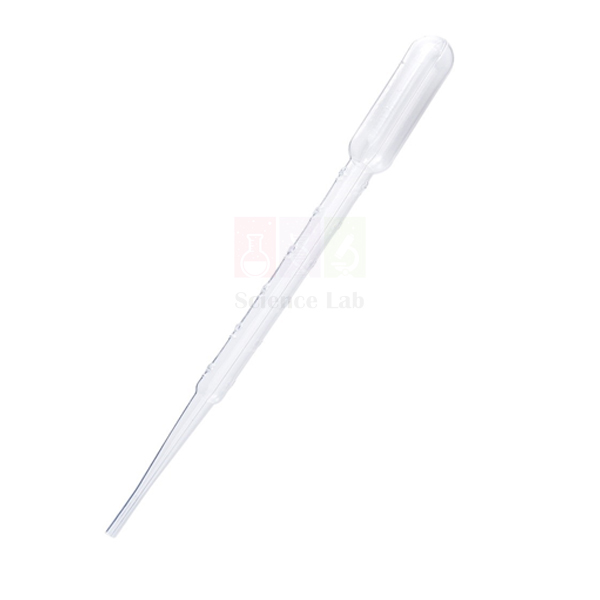
Transfer Pipette Sterile
Transfer Pipette Sterile (Product Code: SLE/CL/08) is a single-use plastic transfer pipette with an integrated flexible suction bulb and a fine tip, used to move liquids between tubes and vessels without a separate pipette filler. Every pipette is sterile and individually peel-packed, so each sample or reagent can be handled with a fresh, untouched device — the reason it is used in reference centres and for PCR and other sophisticated techniques. It is supplied by Jain Scientific Equipments Pvt Ltd (ScienceLab), Ambala, India, for laboratories that want a dependable lab consumables supplier in India for their clinical range.
Specifications
| Parameter | Detail |
|---|---|
| Type | Transfer pipette with integrated flexible suction bulb |
| Capacity | 5.8 ml |
| Graduation | Embossed, minimal graduation 0.25 ml |
| Tip | Fine tip, compatible with PCR applications |
| Sterility and packing | Sterile, individually peel-packed |
| Use | Single-use disposable |
| Intended use | PCR and sophisticated techniques; used in reference centres |
| Estimated weight / volume (as listed) | 1.5 kg / 0.02 m³ |
Typical Use
In a molecular or clinical laboratory this pipette handles the routine transfers that do not need a micropipette: moving a buffer into a tube, drawing off a supernatant, adding rinse liquid or carrying a sample from a collection container to a processing tube ahead of a PCR run. Squeeze the bulb before the fine tip enters the liquid, release it slowly to draw up the volume, check the level against the embossed 0.25 ml marks and then dispense gently against the wall of the receiving vessel to avoid splashing.
Open each peel pack only at the bench, hold the pipette by the bulb end and never let the tip touch gloves or bench surfaces. The embossed marks give approximate volumes, so keep a calibrated micropipette with barrier tips for exact microlitre steps and use this pipette for the larger transfers around them. Laboratories standardising their disposable lab equipment in India often order it together with tips, tube racks and waste bags so that one bench is stocked for the whole workflow.
Supplier
ScienceLab is the trading name of Jain Scientific Equipments Private Limited, a company based in Ambala, Haryana, that supplies sterile consumables such as this pipette alongside the laboratory apparatus it builds for clinical, school and college laboratories. You can read about the company's background and product range on our company profile.
Related Clinical Laboratory Products
Items used in the same sample-handling and PCR preparation workflow:
- Transfer Pipette, 1ml — a smaller transfer pipette for low-volume steps
- Transfer Pipette, 3ml — a mid-size option when the full capacity of this pipette is not needed
- Pipette Tip Barrier Ster 200ul — sterile barrier tips for precise micropipette dispensing during PCR set-up
- Rack Tubes Set of 3 — keeps microcentrifuge and storage tubes upright while you transfer liquid
- Biohazard Bag — for collecting used pipettes after potentially infectious work
See the complete Clinical Laboratory range for more consumables and equipment supplied to diagnostic, hospital and teaching laboratories in India and international markets.
Frequently Asked Questions
What volume does this transfer pipette hold?
Its capacity is 5.8 ml. The embossed scale has a minimal graduation of 0.25 ml, which is intended for approximate measurement rather than exact dosing.
Is every pipette sterile?
Yes. Each pipette is sterile and individually peel-packed, so sterility is kept until you open that one pack at the bench.
Can it be used in PCR work?
Yes — the fine tip is compatible with PCR applications and the product is intended for PCR and sophisticated techniques. For exact microlitre volumes, pair it with a calibrated micropipette and barrier tips.
Can the pipette be washed and reused?
No. It is a single-use disposable item; reusing it would remove the benefit of sterile packing and risk carry-over between samples.
How many pipettes come in one order unit?
The pack quantity per order unit is confirmed at quotation stage. Please ask through our contact page so we can quote the exact count.
Can you provide lot or sterility documentation?
Whether batch documentation can be provided for a particular order should be discussed with us before you place it — send the requirement via the contact page.
Do you supply larger quantities for hospitals and distributors?
Yes. Hospital laboratories, reference centres and distributors in India and international markets can request bulk supply; include your annual or per-order quantity and destination in the enquiry.
Request a Quote
For a quotation, send the product code SLE/CL/08, the quantity and your delivery location through our contact page, or add this pipette to the enquiry cart together with the other clinical consumables you need.
Last updated: 24 September 2026
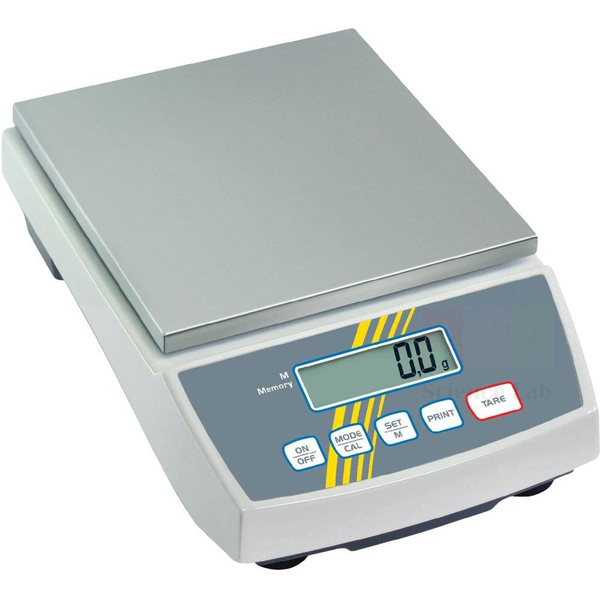
Precision Digital Scale
Precision Digital Scale (Product Code: SLE/CL/09) is an electronic laboratory scale with a 1500 g – 2000 g capacity and 0.1 g readability, intended for weighing reagents and chemicals in clinical, college and teaching laboratories. Along with a single tare key and a backlit LCD, it carries built-in programmes for net total, percentage weighing, counting and 18 weighing units, and it runs from an AC adapter or dry-cell batteries. The scale is manufactured by Jain Scientific Equipments Pvt Ltd (ScienceLab), Ambala, for buyers looking for a practical digital weighing balance in India for everyday reagent preparation.
Specifications
| Parameter | Detail |
|---|---|
| Type | Digital scale |
| Capacity | 1500 g – 2000 g |
| Readability | 100 mg (0.1 g) |
| Linearity | 0.1 g |
| Reproducibility | 0.1 g |
| Response time | Less than 1 second |
| Pan size (as listed) | 127 mm x 140 mm |
| Display | 7-segment LCD with backlight |
| Keys | One tare key; user data input via positive-action touch keys |
| Built-in programmes | Net total, weighing-in percentage, counting and 18 weighing units |
| Calibration | Calibrated at factory; automatic calibration using an external standard reference weight |
| Levelling | Levelling feet and level indicator |
| Protection | Overload (overweight) protection |
| Power | AC adapter (included) or 4 x "A" size dry-cell batteries |
| Intended use | Weighing of reagents and chemicals in the lab |
| Estimated weight / volume | 5.1 kg / 5.2 dm³ |
Typical Use
The scale is used wherever a lab weighs out salts, powders and liquids in gram quantities — making up buffers and staining solutions, preparing culture media, portioning chemicals for student practicals or checking the mass of a sample before processing. Set it on a firm bench, adjust the levelling feet until the level indicator is centred, place a weighing boat or paper on the pan, press tare and add material until the display reaches the target. The counting programme helps when the same small item has to be issued in fixed numbers, and percentage weighing is handy for checking a portion against a reference amount.
Because it reads to 0.1 g, it suits preparation work rather than milligram-level analysis; that makes it a sensible piece of lab equipment for college and hospital labs where many users weigh everyday reagents. Keep the pan clean and dry, avoid dropping loads onto it even though overload protection is built in, and recalibrate with the external reference weight whenever the scale is moved to a new bench. Battery operation lets it be used on a trolley or in a room without a nearby socket.
Manufacturer
This scale is made by Jain Scientific Equipments Private Limited, the Ambala, Haryana company that trades as ScienceLab and manufactures measuring and laboratory equipment for institutions in India and abroad. An overview of the company and its manufacturing background is available on our company profile.
Related Clinical Laboratory Products
Items that support weighing and reagent preparation at the same bench:
- Digital Scale 1500g/0.1g — another digital scale in the clinical range, useful for comparing options
- Plastic Weighing Boats — sit on the pan so chemicals never touch it directly
- Weighing Paper — for small powder portions that are tared out before adding the chemical
- Analytical Weight Box — boxed masses for routine reading checks (confirm with us which reference mass the calibration routine needs)
- Beaker Plastic — for dissolving weighed reagents once they leave the pan
Browse the full Clinical Laboratory range for more instruments and consumables used in diagnostic and teaching labs.
Frequently Asked Questions
What are the capacity and readability?
The capacity is 1500 g – 2000 g and the scale reads in 100 mg (0.1 g) steps, with linearity and reproducibility of 0.1 g. For milligram work an analytical balance is the better tool.
Does it have to be plugged in?
No. It runs from the included AC adapter or from 4 x "A" size dry-cell batteries, so it can also be used away from a socket.
How is the scale calibrated?
It is calibrated at the factory and offers automatic calibration using an external standard reference weight. Ask us through the contact page which reference mass value the routine expects.
Can it count items or show other units?
Yes — built-in programmes cover counting, net total, weighing-in percentage and 18 weighing units.
Is a calibration certificate supplied?
Calibration certificate availability should be discussed with us before ordering; please mention it in your enquiry so we can confirm what can be provided.
What warranty applies?
Warranty terms are stated with each quotation. Request them via our contact page along with your quantity.
What should an institutional quotation request include?
Quantity, delivery address, any tender or purchase reference, and documentation needs. This helps us return a complete quote for college, hospital or export orders in one step.
Request a Quote
Send your requirement for product code SLE/CL/09 through the contact page, or place the scale in the enquiry cart with weighing boats and other bench items to receive one combined quotation.
Last updated: 24 September 2026

Label Self-Adhesive Freezer
Label Self-Adhesive Freezer (Product Code: SLE/CL/10) is a roll of 280 small paper labels, each approximately 2.5 x 2.5 cm, made for marking samples and reagents that are going to be frozen. The labels are self-adhesive and can be written on with a pen or marker, so a technician can record a sample number, date or reagent name directly at the bench before the tube or vial goes into storage. They are used across laboratory services from hospital laboratories to reference centres and are supplied by Jain Scientific Equipments Pvt Ltd (ScienceLab), Ambala, as part of its role as a lab consumables supplier in India.
Specifications
| Parameter | Detail |
|---|---|
| Material | Paper |
| Adhesive | Self-adhesive |
| Writing | Writable with pen or marker |
| Label size | Approximately 2.5 x 2.5 cm |
| Supplied as | Roll of 280 labels |
| Intended use | Labelling samples or reagents to be frozen |
| Used in | Laboratory services from hospital laboratory to reference centre |
| Estimated weight / volume | 0.25 kg / 0.0003 m³ |
Typical Use
Clinical and research labs rely on labels like these to keep aliquots traceable once they disappear into a freezer rack: serum or plasma aliquots, reagent portions, extracted material and control samples all need a readable identifier that does not depend on memory or a separate sheet. The small square format fits the side of storage tubes, microcentrifuge tubes and small vials, and the paper surface takes handwriting from a pen or a fine marker.
For good adhesion, write on the label first, then apply it to a clean, dry and room-temperature tube and press it down firmly all round before the tube is cooled — labels applied to cold, frosted surfaces tend to lift. Wrap the label around the tube body rather than the cap so it stays with the sample, and keep one consistent format (sample ID, date, initials) across the team. Many buyers ordering from a laboratory equipment supplier in India add these labels to the same enquiry as tube racks and storage boxes.
Supplier
These freezer labels are supplied by Jain Scientific Equipments Private Limited, which operates under the ScienceLab name from Ambala, Haryana, and provides the everyday consumables that clinical and teaching laboratories need. For vendor registration, the company's GSTIN is 06AAECJ8618A1ZT, and its export consignments are handled under Importer-Exporter Code AAECJ8618A issued by the DGFT. Learn more on the company profile page.
Related Clinical Laboratory Products
Tubes and storage items that are commonly labelled with these freezer labels:
- Micro Centrifuge Tube, 1.5ml — small tubes for aliquots that need a compact label
- Screw Cap Tube 5.0 ml — screw-capped storage tubes for frozen samples and reagents
- Box Storage tubes Set of 14 — boxes for organising labelled tubes in storage
- Rack Tubes Set of 3 — holds tubes upright while you write and apply labels
Explore the wider Clinical Laboratory category for sample collection, storage and handling items.
Frequently Asked Questions
How many labels are on a roll, and what size are they?
Each roll carries 280 labels, and each label is approximately 2.5 x 2.5 cm.
What can I write on them with?
The paper labels are writable with a pen or a marker. A fine-tip marker gives the clearest result on such a small area.
What is the lowest freezer temperature they are suited to?
A specific temperature rating is not given in our current product details. If you plan to store samples at very low temperatures, please check with us through the contact page before ordering.
Will the labels fit narrow tubes?
The square format suits most small tubes and vials; on very narrow tubes the label wraps around the body. Measure your tube if you are unsure and we can advise.
How should unused rolls be stored?
Keep rolls in their packing in a clean, dry place away from direct heat so the adhesive stays usable until the roll is needed.
Can we order several rolls for a hospital or export shipment?
Yes. Multi-roll orders for hospitals, reference laboratories and distributors in India and international markets are quoted on request; include the number of rolls and destination.
Request a Quote
Mention product code SLE/CL/10 and the number of rolls on our contact page, or add the labels to the enquiry cart alongside the tubes and racks you are ordering.
Last updated: 24 September 2026
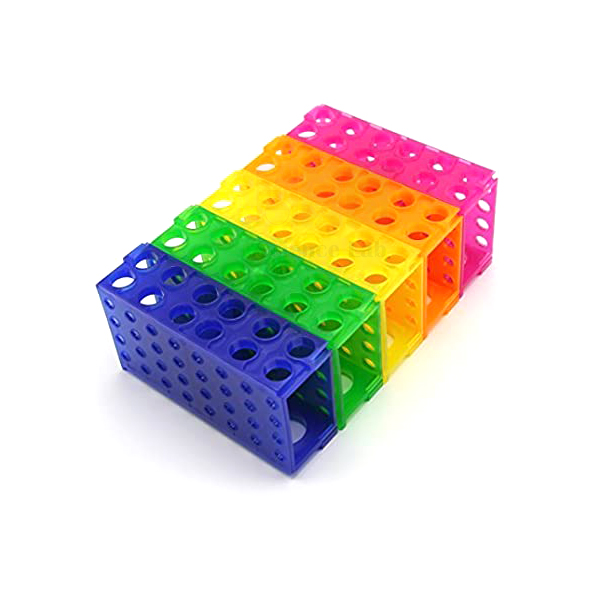
Rack Tubes Set of 3
Rack Tubes Set of 3 (Product Code: SLE/CL/11) is a set of chemical resistant plastic racks that hold laboratory tubes of various sizes in a stable, upright position, with positions for 240 tubes listed for the set. The racks are used in a wide range of assays to keep small microcentrifuge tubes and screw-capped storage tubes organised during pipetting, labelling and incubation, and they may be used at all facilities from laboratory network levels I to IV. The set is manufactured by Jain Scientific Equipments Pvt Ltd (ScienceLab), Ambala, and is a practical addition for labs sourcing from a lab plastic ware supplier in India.
Specifications
| Parameter | Detail |
|---|---|
| Supplied as | Set of 3 racks |
| Material | Chemical resistant plastic |
| Tube positions | Positions to hold 240 tubes (as listed) |
| Tubes held | Small microcentrifuge tubes and screw-capped storage tubes; various sized lab tubes |
| Function | Holds tubes in a stable upright position |
| Suitable for | All facilities, laboratory network levels I–IV |
| Estimated weight / volume | 1.0 kg / 2.43 dm³ |
Typical Use
Tube racks are the working surface of almost every assay: samples are opened, aliquoted and capped while standing in them, reagents are added in sequence across a row, and finished tubes wait in order for centrifugation, freezing or transport. With three racks in the set, a technician can keep incoming samples, working aliquots and completed tubes on separate racks, which cuts the chance of mixing up specimens in busy microbiology lab equipment set-ups and routine clinical benches alike.
Load tubes in a fixed pattern that matches your worksheet — for example sample 1 at the top-left position — and leave an empty position between groups when running several batches. The chemical resistant plastic can be wiped down with the laboratory's usual cleaning solution after spills; dry the racks before reuse so tubes do not stick. Keep heavy glass vessels off the racks and use them only for the tubes they are designed to hold.
Manufacturer
The rack set is produced by Jain Scientific Equipments Private Limited, a company in Ambala, Haryana, that markets its laboratory equipment under the ScienceLab brand to hospitals, colleges and schools. Visit our company profile to see how the business and its product lines are organised.
Related Clinical Laboratory Products
Tubes and equipment that are used together with these racks:
- Micro Centrifuge Tube, 1.5ml — small tubes of the kind the racks are designed to hold
- Screw Cap Tube 5.0 ml — screw-capped storage tubes for sample aliquots
- Micro Centrifuge — spins down the tubes that wait in the rack
- Label Self-Adhesive Freezer — for identifying each tube before it goes into storage
More racks, tubes and bench items are listed in the Clinical Laboratory category.
Frequently Asked Questions
How many racks are in the set?
Three racks are supplied in the set.
Is the 240-tube figure per rack or for the whole set?
Our listing states positions to hold 240 tubes. If you need the per-rack layout or hole diameters for a specific tube, please confirm with us through the contact page before ordering.
Which tubes fit?
The racks are intended for small microcentrifuge tubes and screw-capped storage tubes, and more generally for various sized lab tubes held upright.
How do I clean the racks?
Wipe them with a mild detergent or your lab's routine surface disinfectant, rinse and allow to dry. The plastic is chemical resistant, but check compatibility before soaking in strong solvents.
Can they go into an autoclave or freezer?
Temperature limits are not stated in our current product details, so please ask us before autoclaving the racks or using them in a freezer.
Do you supply multiple sets for laboratory networks?
Yes. Because the racks may be used at all facility levels, network and programme buyers can order several sets at once for delivery across India and international markets.
Request a Quote
Tell us how many sets of SLE/CL/11 you need via the contact page, or add the racks to the enquiry cart together with tubes and labels for one quotation.
Last updated: 24 September 2026
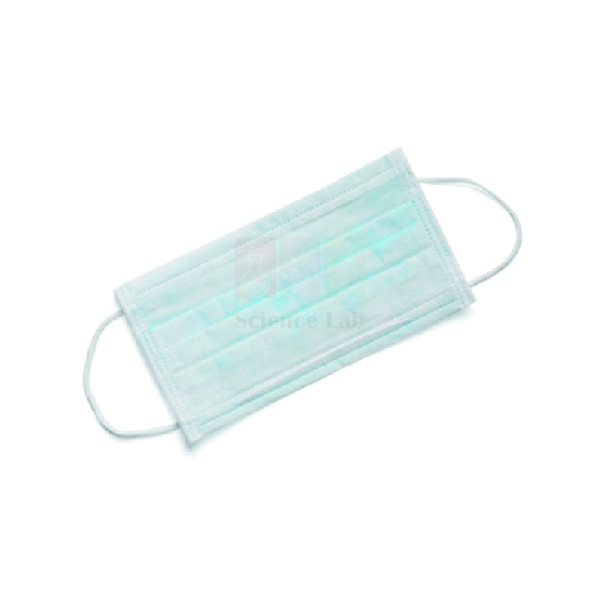
Mask Surgical Tie Strap Disposable
Mask Surgical Tie Strap Disposable (Product Code: SLE/CL/12) is a single-use type IIR surgical mask that fastens with tie straps rather than elastic, worn to protect the nose, mouth and chin wherever there is a risk of splash contamination. It is built from 3–4 non-woven layers with an impervious, liquid-splash-resistant outer layer and clearly identifiable inner and outer surfaces, and it comes in boxes of 50. The mask is supplied by Jain Scientific Equipments Pvt Ltd (ScienceLab), Ambala, to laboratories ranging from hospital labs to reference centres that are stocking disposable lab equipment in India.
Specifications
| Parameter | Detail |
|---|---|
| Type | Surgical mask, type IIR |
| Material | Non-woven, with an outer layer of impervious liquid-splash-resistant material |
| Construction | 3–4 non-woven layers; clearly identifiable inner and outer surfaces |
| Fastening | 2x2 tie straps allowing correct fixation, secured at the back of the head |
| Filtration | High bacterial filtration efficiency (as listed) |
| Size | Approx. 17 x 10 cm (l x w) |
| Use | Single-use disposable |
| Supplied as | Box of 50 masks |
| Estimated weight / volume | 0.3 kg / 0.0019 m³ |
Typical Use
In the laboratory this mask is worn for tasks where droplets or splashes can reach the face: opening sample tubes, decanting specimens, loading a centrifuge, handling cultures on an open bench or cleaning up a spill. Tie straps let the wearer adjust the fit to the head rather than relying on fixed ear loops, which many staff find more secure during long sessions and when the mask is worn with safety goggles.
To put it on, identify the outer (splash-resistant) surface, place the mask over nose, mouth and chin, tie the upper pair of straps at the crown and the lower pair at the nape, then shape the upper edge to the face. Replace the mask when it becomes damp or soiled, and remove it by the straps only, discarding it straight into a waste bag. Keep a box at each workstation along with gloves and lab coats — part of a sensible routine for any lab consumables supplier India order covering personal protection.
Supplier
Clinical and teaching laboratories receive this mask from Jain Scientific Equipments Private Limited, the company that trades as ScienceLab from its base in Ambala, Haryana, and supplies protective consumables together with the laboratory equipment it manufactures. Our company profile describes the business in more detail.
Related Clinical Laboratory Products
Protective items that are worn together with this mask:
- Gloves Exam Latex Without Powder — disposable latex gloves for clinical examinations and routine lab work
- Gloves W/o Powder Nitrile Disposable — a latex-free glove option for staff who need one
- Lab Coat Work — a cotton lab coat for body protection at the bench
- Safety Goggles — eye protection to pair with the mask for splash-prone tasks
- Disposable Isolation Gown — single-use body cover for higher-risk procedures
For more protective and sample-handling items, visit the Clinical Laboratory category.
Frequently Asked Questions
How many masks are in a box?
Each box contains 50 single-use masks.
Does the mask use ear loops or ties?
It fastens with 2x2 tie straps that are secured at the back of the head, allowing correct fixation for different head sizes.
How do I know which side faces outward?
The mask has clearly identifiable inner and outer surfaces; the outer layer is the impervious, liquid-splash-resistant material and should face away from the wearer.
Is it a respirator?
No. It is a type IIR surgical mask intended to protect the nose, mouth and chin against splash contamination. Tasks that call for respiratory protection need a respirator chosen under your lab's own safety rules.
What size is the mask?
It measures approximately 17 x 10 cm (length x width).
Can test reports be shared with our purchase team?
Please ask via the contact page what product documentation can be provided for your order before you raise a purchase order.
Do you ship cartons of masks to other countries?
Yes, carton quantities can be quoted for buyers in India and international markets; state the number of boxes and the destination.
Request a Quote
Request pricing for SLE/CL/12 by box or carton through our contact page, or add the masks to the enquiry cart with gloves and lab coats to cover your whole protective kit.
Last updated: 24 September 2026
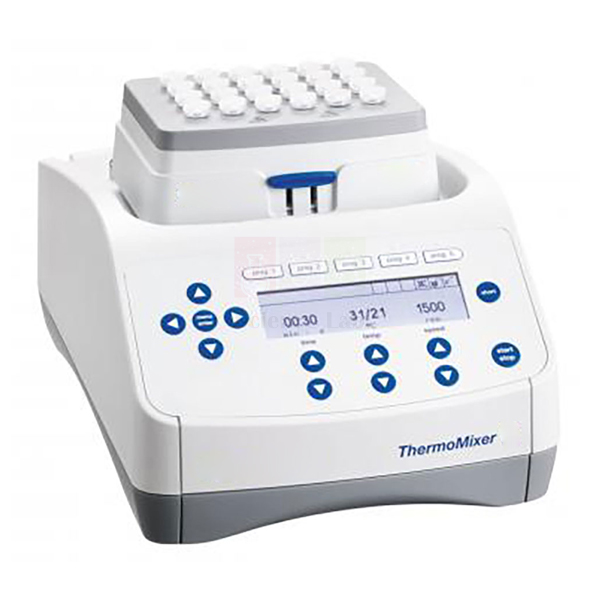
Thermomixer
Thermomixer (Product Code: SLE/CL/13) is a bench-top instrument that mixes samples while heating or cooling them, so incubation and agitation happen in one step instead of moving tubes between a shaker and a heating block. It mixes at 300–3,000 rpm on a 3 mm orbit, controls temperature up to 100 °C, and stores programmes for repeat protocols. Clinical, molecular biology and teaching labs use it for homogenous mixing of samples with controlled heating and cooling. It is manufactured by Jain Scientific Equipments Pvt Ltd (ScienceLab), Ambala, within our range of laboratory instruments in India.
Specifications
| Parameter | Detail |
|---|---|
| Type | Bench-top thermomixer |
| Speed range | 300–3,000 rpm |
| Mixing orbit | 3 mm |
| Mixing and vortexing radius | 1.5 mm |
| Temperature control range | Min: 15 °C ± 2 °C below RT; max: 100 °C |
| Temperature setting | Lowest 1 °C, highest 100 °C |
| Max heating rate | 7 °C / min |
| Max cooling rate | 2.5 °C / min between 100 °C and RT |
| Temperature homogeneity | Max. ± 0.5 °C at 20–45 °C |
| Timer | 15 sec to 99:30 h; continuous |
| Programming | More than 20 program slots; up to 4 program levels; 5 program keys (pre-defined, rewritable) |
| Anti-spill technology | Yes (as listed) |
| Power requirements | 100 V ~ 240 V, 50/60 Hz; power-stabilising function to protect the unit from accidental voltage surges; suiting plug provided |
| Intended use | Homogenous mixing of samples, heating and cooling |
| Estimated weight / volume | 6.3 kg / 0.0085 m³ |
Typical Use
A thermomixer earns its bench space in protocols that need a sample kept at a set temperature while it is agitated: enzyme digestions, lysis steps before nucleic-acid extraction, resuspending pellets, denaturing samples near 100 °C, or holding reactions at a controlled temperature during incubation. Because it can also bring samples below room temperature, the same unit can cool a reaction after heating without a separate ice bath. The programmable keys let a lab store its common protocols so students and new staff run them the same way every time — valuable in lab equipment for research in India where many users share one instrument.
For good results, load tubes symmetrically, close caps fully before high-speed mixing, and start at a lower speed when tubes are well filled, increasing once you see the liquid is contained. Let the unit reach set temperature before loading temperature-sensitive samples, and check that the plug and supply voltage match your site. Wipe the working surface after each session and clean up any spilled liquid promptly.
Manufacturer
ScienceLab is the brand used by Jain Scientific Equipments Private Limited of Ambala, Haryana, which manufactures this thermomixer as part of a wider line of heating, mixing and measuring instruments for laboratories. Read more about the organisation on the company profile page.
Related Clinical Laboratory Products
Accessories and equipment that belong in the same sample-preparation workflow:
- Thermoblock — a dry block for 5 ml tubes listed as suitable for the thermomixer
- Micro Centrifuge Tube, 1.5ml — small reaction tubes commonly mixed and incubated in such units
- Micro Centrifuge — spins down condensation and contents after heating and mixing
- Rack Tubes Set of 3 — keeps tubes in order before and after each run
See the Clinical Laboratory category for more instruments and consumables.
Frequently Asked Questions
What mixing speeds does it offer?
The speed range is 300–3,000 rpm on a 3 mm mixing orbit, with a 1.5 mm mixing and vortexing radius.
Can it cool samples as well as heat them?
Yes. The control range runs from 15 °C ± 2 °C below room temperature up to 100 °C. The maximum heating rate is 7 °C per minute and the maximum cooling rate is 2.5 °C per minute between 100 °C and room temperature.
How even is the temperature across the samples?
Temperature homogeneity is within a maximum of ± 0.5 °C at 20–45 °C.
Which tube formats can I run?
The Thermoblock for 5 ml tubes is listed as suitable for this thermomixer. If you need other tube or plate formats, please ask through our contact page so we can confirm what is available.
Can protocols be saved?
Yes — there are more than 20 program slots, programmes of up to 4 levels, and 5 program keys that are pre-defined but rewritable.
Will it run on our local mains supply?
It accepts 100 V ~ 240 V at 50/60 Hz, includes a power-stabilising function against accidental voltage surges, and is sent with a suiting plug.
Is a calibration certificate or warranty included?
Calibration certificate availability and warranty terms should be discussed with us; both are confirmed in writing with the quotation.
Request a Quote
Share product code SLE/CL/13, the number of units and your delivery country or city via our contact page, or place the thermomixer in the enquiry cart together with blocks and tubes.
Last updated: 24 September 2026
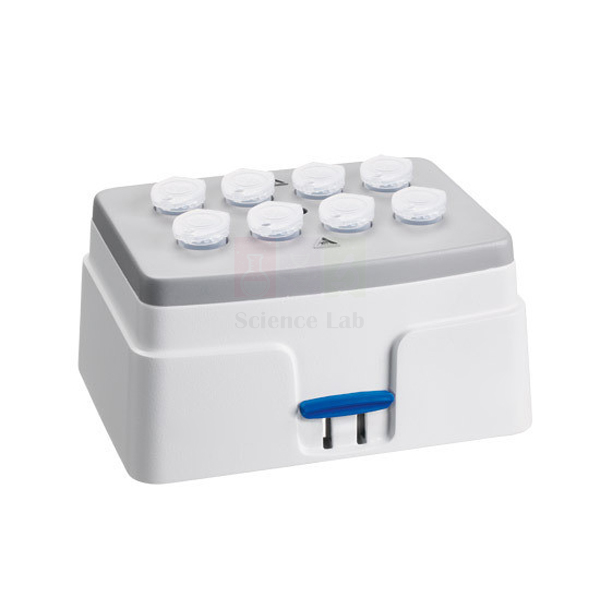
Thermoblock
Thermoblock (Product Code: SLE/CL/14) is a dry block for 5 ml tubes, listed as suitable for use with the thermomixer, that serves as an incubator for samples without the water, spills and evaporation that come with a water bath. It works on 100 V ~ 240 V mains, offers pre-programmed as well as user-defined programmes, and includes a power-stabilising function against accidental voltage surges. Hospital, microbiology and teaching laboratories use it when tubes need to be held at a controlled temperature on the bench. The Thermoblock is manufactured by Jain Scientific Equipments Pvt Ltd (ScienceLab), Ambala, as part of its microbiology lab equipment for India and export buyers.
Specifications
| Parameter | Detail |
|---|---|
| Type | Dry block for 5 ml tubes, suitable for thermomixer |
| Operation temperature (as listed) | 10 °C to 40 °C |
| Programmes | Pre-programmed and user-defined programmes |
| Power requirements | 100 V ~ 240 V, 50/60 Hz |
| Power protection | Function to stabilise power, preventing the unit from accidental voltage surges; suitable plug provided |
| Intended use | Used as an incubator for samples |
| Estimated weight / volume | 3 kg / 0.006 m³ |
Typical Use
Dry blocks are chosen when a lab wants tubes to sit in close metal contact with a temperature-controlled surface rather than in water. Typical jobs include holding sample tubes at a steady temperature during an incubation step, pre-warming reagents in 5 ml tubes before an assay, and keeping a batch of tubes at the same condition while a class works through a practical. Because there is no water, labels stay dry, tubes do not float, and there is no bath to drain, clean and refill — a point that matters in busy lab equipment for college practicals as much as in hospital labs.
Use tubes that match the 5 ml wells so they seat fully and heat evenly, and select a stored programme or set your own before loading. Allow the block to stabilise, then insert tubes and start timing. Keep the wells clean and dry, wipe away any spilled liquid at once, and switch the unit off before cleaning. When it is paired with the thermomixer, confirm the combination you need with us so that the block and base are ordered together.
Manufacturer
Our Ambala, Haryana company, Jain Scientific Equipments Private Limited, makes the Thermoblock and sells it under the ScienceLab brand, alongside the thermomixer and other bench instruments for clinical and teaching use. The company profile sets out the company's history and capabilities.
Related Clinical Laboratory Products
Instruments and tubes that are used with, or as alternatives to, this dry block:
- Thermomixer — the mixing and temperature-control unit this block is listed as suitable for
- Screw Cap Tube 5.0 ml — 5 ml screw-capped tubes for the block's tube size
- Water bath, 7 L — a water-based alternative when vessels do not fit a block
- Incubator 30L, upto 80C — a chamber incubator for plates, flasks and larger batches
Find more heating, incubation and sample-handling items in the Clinical Laboratory category.
Frequently Asked Questions
Which tubes does the Thermoblock take?
It is a dry block for 5 ml tubes. For other tube sizes, please ask us via the contact page.
What does the 10 °C to 40 °C figure refer to?
Our listing gives an operation temperature of 10 °C to 40 °C. If your protocol needs a particular block set-point, confirm it with us before ordering so we can check suitability.
Does it work with the thermomixer?
Yes — the block is described as suitable for the thermomixer. Tell us whether you need the block alone or together with the thermomixer so the quotation covers the right items.
Can I store my own programmes?
Yes. It provides pre-programmed routines and also user-defined programmes.
What power supply does it need?
100 V ~ 240 V at 50/60 Hz. A power-stabilising function helps protect it from accidental voltage surges, and a suitable plug is provided.
How should the block be cleaned?
Switch it off and let it return to room temperature, then wipe the wells and surfaces with a damp cloth and mild detergent. Do not pour liquid into the wells.
Can a calibration certificate be provided?
Calibration certificate availability should be discussed with us at the enquiry stage.
Request a Quote
For a quotation on SLE/CL/14, use our contact page or add the block to the enquiry cart; mention whether you also need the thermomixer and 5 ml tubes.
Last updated: 24 September 2026

Biohazard Bag
Biohazard Bag (Product Code: SLE/CL/15) is a plastic storage and transportation bag for potentially bio-hazardous waste, printed with the English word “biohazard” and the black tri-sickle logo so that everyone handling it recognises the contents. Each bag holds 6–10 L, closes with its own metal closure strip, and can be autoclaved before final disposal. Bags come in boxes of 10, in yellow or red with black print. The Biohazard Bag is supplied by Jain Scientific Equipments Pvt Ltd (ScienceLab), Ambala, for laboratories that need a straightforward waste disposal lab India solution from basic labs to reference centres.
Specifications
| Parameter | Detail |
|---|---|
| Type | Plastic storage and transportation bag for potential bio-hazardous waste |
| Marking | English text “biohazard” and black tri-sickle logo |
| Colour | Yellow or red with black print |
| Capacity | 6–10 L |
| Closure | Metal closure strip, one per bag |
| Autoclaving | Can be autoclaved prior to disposal |
| Storage | 15 to 25 °C |
| Supplied as | Box of 10 bags |
| Used in | Laboratory services from basic laboratory to reference centre; multiple purposes |
Typical Use
Place a bag in a rigid holder or bin at each bench where potentially infectious material is handled, and use it for used culture plates, swabs, disposable pipettes, gloves and other contaminated solid waste. The printed text and tri-sickle symbol warn cleaning staff and porters not to open or mix the bag with general waste, while the yellow or red colour lets a lab follow whichever colour code its waste policy uses. When the bag is about three-quarters full, seal it with the metal strip and move it to the decontamination area.
Because the bag can be autoclaved prior to disposal, many labs treat filled bags in an autoclave laboratory India set-up before handing them to the waste contractor. Leave the neck slightly open or follow your autoclave's instructions so steam can penetrate, stand the bag in a tray to catch leaks, and never put sharps directly into it — they belong in a puncture-resistant sharps container. Store unopened boxes between 15 and 25 °C.
Supplier
Biohazard Bags are supplied through ScienceLab, the trading name of Jain Scientific Equipments Private Limited in Ambala, Haryana, which provides safety consumables alongside its wider laboratory range. For vendor registration, the company is incorporated under CIN U29309HR2020PTC087597 and holds GSTIN 06AAECJ8618A1ZT. See the company profile for more background.
Related Clinical Laboratory Products
Items used in the same waste segregation and decontamination routine:
- Sharp Container Leak Proof Plastic — the puncture-resistant container for needles and lancets that must not go in bags
- Electric Autoclave — for decontaminating filled bags before disposal
- Autoclave Tape — indicator tape to mark loads that have been through a cycle
- Hazard Warning Tape: Biohazard — marks waste collection points and holding areas
- Gloves Exam Latex Without Powder — disposable gloves for handling filled bags
The Clinical Laboratory category lists more safety and sample-handling consumables.
Frequently Asked Questions
How many bags are in a box, and how much does each hold?
A box contains 10 bags, and each bag has a capacity of 6–10 L.
Can I choose the colour?
The bags are available in yellow or red with black print. State the colour your waste policy requires when you enquire.
Can the bags go into an autoclave?
Yes, they can be autoclaved prior to disposal. Follow your autoclave's loading instructions and use a tray under the bag.
How is the bag closed?
Each bag comes with one metal closure strip, which is twisted around the gathered neck once the bag is ready for removal.
Can needles or broken glass be put in these bags?
No. Sharps should always go into a leak-proof, puncture-resistant sharps container, not a plastic bag.
How should stock be stored?
Keep unopened boxes at 15 to 25 °C, away from direct sunlight and sharp objects.
Do you supply larger volumes for hospitals or export?
Yes. Multi-box orders for hospitals and distributors in India and international markets are quoted on request — include colour, number of boxes and destination.
Request a Quote
Send product code SLE/CL/15 with the colour and number of boxes through our contact page, or add the bags to the enquiry cart along with sharps containers and gloves.
Last updated: 24 September 2026
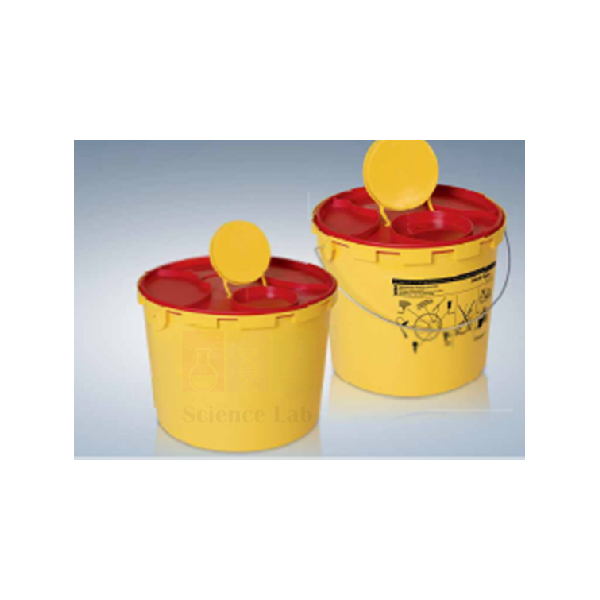
Sharp Container Leak Proof Plastic
Sharp Container Leak Proof Plastic (Product Code: SLE/CL/16) is a leak-proof, puncture-resistant container made of heavy-duty plastic for collecting and disposing of potentially infectious sharps such as lancets, needles and broken capillaries. It holds 4 to 6 L, stands upright and stable while in use, and closes with a tight-fitting lid so that sharps cannot come back out once it is sealed. The container is non-sterile and is intended to be disposed of as medical waste. It is supplied by Jain Scientific Equipments Pvt Ltd (ScienceLab), Ambala, to laboratory services from basic labs to reference centres that source through a lab consumables supplier in India.
Specifications
| Parameter | Detail |
|---|---|
| Type | Leak-proof, puncture-resistant sharps container |
| Material | Heavy-duty plastic |
| Capacity | 4 to 6 L |
| Closure | Tight-fitting lid; sharps cannot come out once closed |
| Stability | Upright and stable during use |
| Sterility | Non-sterile |
| Intended use | Collecting potentially infectious sharps |
| Recommended disposal | As medical waste |
Typical Use
Any bench where finger-prick sampling, venepuncture or capillary work takes place needs a sharps container within arm's reach, so that a used lancet or needle goes straight in without being carried across the room. Blood-collection points, haematology benches and teaching labs running blood-group practicals are typical locations. The heavy-duty plastic resists punctures from needle tips, and the stable base means the container does not tip when a sharp is dropped in with one hand.
Drop sharps in point-first and never push them down or try to recover anything from inside. Do not overfill: close the lid firmly when the container is about three-quarters full, then send the whole container for disposal as medical waste in line with your facility's rules. Pairing it with biohazard bags for soft waste and a supply of gloves keeps waste segregation simple for every user of disposable lab equipment in India.
Supplier
This sharps container reaches laboratories through Jain Scientific Equipments Private Limited, a company in Ambala, Haryana, better known by its ScienceLab brand, which sources safety consumables to complement the equipment it manufactures for clinical and educational users. Details are on the company profile.
Related Clinical Laboratory Products
Items used in the same blood sampling and sharps disposal routine:
- Lancet 2.4 mm Disposable — finger-prick lancets that go into the container after use
- Safety Lancet Disposable 2.4 mm — a safety-type lancet option for sampling points
- Biohazard Bag — for soft contaminated waste such as swabs and gloves
- Gloves Exam Latex Without Powder — hand protection while handling sharps
Explore other sampling and safety items in the Clinical Laboratory category.
Frequently Asked Questions
What capacity is the container?
It holds 4 to 6 L, which suits a single bench or sampling point.
Can it be opened again once it is closed?
It closes with a tight-fitting lid designed so that sharps cannot come out. Treat a closed container as final and do not reopen it.
Is the container sterile?
No, it is non-sterile. It is a collection container for used sharps, so sterility is not required.
How should a full container be disposed of?
The recommended disposal is as medical waste. Close the lid when about three-quarters full and hand it over through your facility's medical waste route.
Can it be emptied and reused?
No — the whole container goes for disposal with its contents; emptying it would expose staff to needle-stick injury.
What details should a bulk quotation request include?
Tell us the number of containers, how many sampling points you are equipping and your delivery location in India or abroad, and we will quote accordingly.
Request a Quote
Ask for a quotation on SLE/CL/16 via our contact page, or add the container to the enquiry cart together with lancets and biohazard bags.
Last updated: 24 September 2026
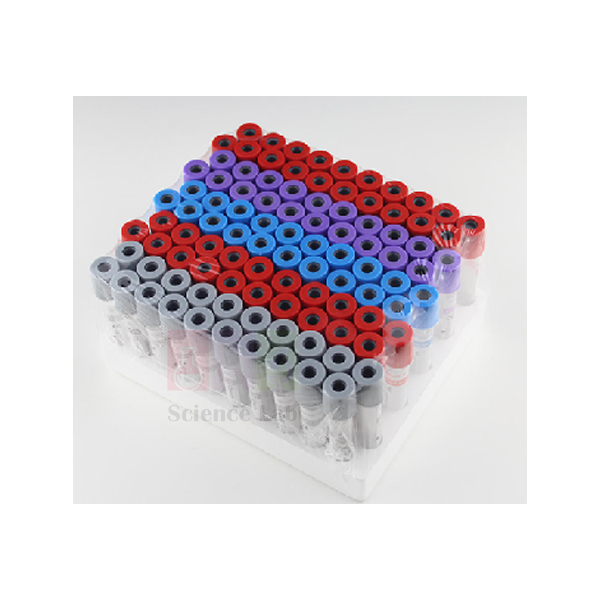
Tube Blood Coll w/capil
Tube Blood Coll w/capil (Product Code: SLE/CL/17) is a polypropylene capillary blood collection tube containing K2EDTA 1.3–2.2 mg, used to obtain and separate a whole blood or EDTA plasma sample from small-volume finger or heel pricks. It holds 0.25–0.5 ml, is capped with a microgard closure and has a clearly visible maximum-fill line. It is supplied by Jain Scientific Equipments Pvt Ltd (ScienceLab), Ambala, India, for clinical laboratories and health programmes looking for a laboratory equipment supplier in India.
Specifications
| Parameter | Detail |
|---|---|
| Type | Blood collection tube, with capillary |
| Material | Plastic (PP) |
| Additive | K2EDTA 1.3–2.2 mg |
| Capacity | 0.25–0.5 ml |
| Closure | Capped with microgard closure |
| Fill indicator | Clearly visible maximum-fill line |
| Intended use | Obtaining and separating a whole blood or EDTA plasma sample |
| Shelf life | Depends on the tube, its K2EDTA additive and storage conditions; ask us for the expiry date of the batch you are quoted |
| Product code | SLE/CL/17 |
| Supplied by | Jain Scientific Equipments Pvt Ltd (ScienceLab), Ambala, India |
What Is the Capillary Blood Collection Tube Used For?
Micro-collection tubes like this are used where only a few drops of blood can be taken: paediatric sampling, point-of-care screening, field surveys and student haematology practicals. After a finger or heel is pricked with a lancet, blood is guided into the tube through the capillary until it reaches the fill line; the EDTA stops the sample clotting, so it can be used as whole blood for counts and smears, or spun down to separate EDTA plasma.
Fill only to the marked line: under-filling changes the ratio of blood to K2EDTA, and over-filling makes the closure hard to seat. Close the cap straight after collection, invert the tube gently several times to mix blood with the anticoagulant, and label it before it leaves the patient's side. Stocking tubes, lancets and sharps containers together keeps a collection point running smoothly and simplifies reordering of disposable lab equipment in India.
Supplier
These collection tubes are supplied by ScienceLab, the brand of Jain Scientific Equipments Private Limited of Ambala, Haryana, which serves hospital laboratories, screening programmes and teaching institutions with sample-collection consumables for India and international markets. More about the company is on our company profile.
Related Clinical Laboratory Products
Items used in the same capillary blood collection workflow:
- Safety Lancet Disposable 2.4 mm — for the skin puncture that precedes collection
- EDTA Capillary Tube — an alternative EDTA format for very small volumes
- Blood Specimen Rotator — keeps EDTA samples gently mixed while they wait for analysis
- Micro Centrifuge — for spinning small tubes to separate plasma (confirm tube fit with us)
- Sharp Container Leak Proof Plastic — for safe disposal of used lancets
Visit the Clinical Laboratory category for other collection tubes and haematology items.
Frequently Asked Questions
How much blood does the Tube Blood Coll w/capil hold?
The Tube Blood Coll w/capil has a capacity of 0.25–0.5 ml and a clearly visible maximum-fill line. Filling to the line keeps the ratio of blood to K2EDTA as intended and lets the microgard closure seat properly.
Which anticoagulant does the capillary blood collection tube contain?
The capillary blood collection tube contains K2EDTA 1.3–2.2 mg as its additive. EDTA keeps the sample from clotting, so it can be used as whole blood or centrifuged to separate EDTA plasma.
Can the Tube Blood Coll w/capil be used for serum tests?
No. Because the Tube Blood Coll w/capil contains K2EDTA, it yields whole blood or EDTA plasma rather than serum. Use a plain tube or a serum gel tube when a test requires serum, and confirm tube choice against each assay's instructions.
What is the shelf life of the capillary blood collection tube?
Shelf life of the Tube Blood Coll w/capil depends on the tube, its K2EDTA additive and the storage conditions, so no fixed period is given here. Ask us for the expiry date of the batch you are quoted, along with the pack quantity.
Who supplies the Tube Blood Coll w/capil?
The Tube Blood Coll w/capil is supplied by Jain Scientific Equipments Private Limited, which trades as ScienceLab from Ambala, Haryana, India. It is offered to clinical laboratories, screening programmes and distributors in India and international markets with other sample-collection consumables.
What should a programme or distributor order include?
An order for the capillary blood collection tube should state product code SLE/CL/17, the quantity of tubes, the delivery points in India or abroad and any documentation required, so one quotation can cover tubes, lancets and sharps containers.
Request a Quote
Send product code SLE/CL/17 and your quantity via the contact page, or add these tubes to the enquiry cart with lancets and sharps containers for a single quotation.
Last updated: 24 September 2026
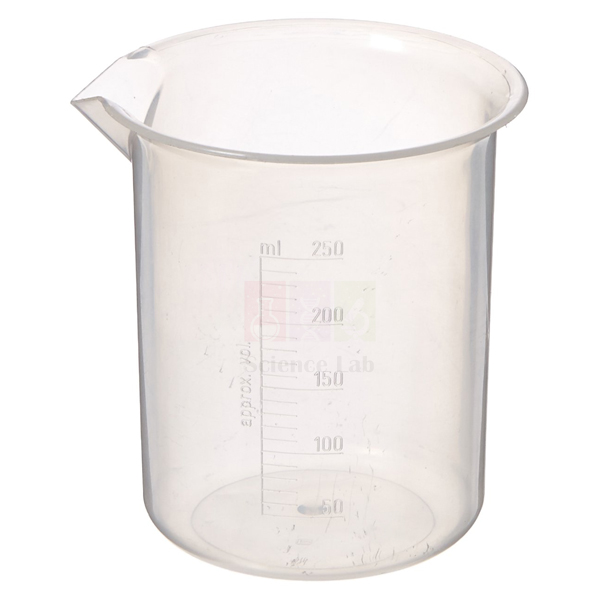
Beaker Plastic
Beaker Plastic (Product Code: SLE/CL/18) is a 250 ml beaker in polypropylene or an equivalent plastic, chosen for clinical laboratories that want a heat-resistant vessel which will not shatter when knocked over. The plastic is chemical and heat-resistant and autoclavable, resistant up to 121 °C, and the beaker has a pouring spout, embossed graduations beginning at 25 ml and a wide hexagonal base for stability. It is used for multiple techniques in clinical labs, from mixing reagents to collecting rinse liquids. The beaker is manufactured by Jain Scientific Equipments Pvt Ltd (ScienceLab), Ambala, and suits buyers comparing options from any lab plastic ware supplier in India.
Specifications
| Parameter | Detail |
|---|---|
| Capacity | 250 ml |
| Material | Polypropylene or equivalent |
| Resistance | Chemical and heat-resistant plastic |
| Autoclaving | Autoclavable, resistant up to 121 °C |
| Graduations | Embossed, beginning at 25 ml |
| Spout | Spout for easy pouring |
| Base | Wide hexagonal base |
| Intended use | Heat-resistant beaker for multiple techniques in clinical laboratories |
Typical Use
On a clinical bench the 250 ml beaker is a general-purpose vessel: dissolving weighed salts to make buffers and diluents, holding stain or wash solutions during slide work, collecting waste rinse liquid, or carrying water to top up equipment. Because the plastic is autoclavable to 121 °C, the beaker can be sterilised with other reusable ware, and because it does not shatter it is well suited to student benches where glass breakage is a concern — one reason it is popular as lab equipment for college practicals as well as hospital labs.
The embossed graduations starting at 25 ml give approximate volumes that stay readable after repeated washing; for accurate measurement transfer liquid to a measuring cylinder or volumetric ware. The hexagonal base resists rolling and tipping, and the spout gives a controlled pour. Wash with warm water and mild detergent, avoid abrasive pads that scratch the surface, and check compatibility before holding strong solvents for long periods.
Manufacturer
The Beaker Plastic is part of the ScienceLab range manufactured by Jain Scientific Equipments Private Limited, an Ambala, Haryana company that serves clinical, school and college laboratories. For vendor registration, the company's GSTIN is 06AAECJ8618A1ZT and its Legal Entity Identifier (LEI) is 3358004HRD1JIVXKYX49. Further details are on the company profile.
Related Clinical Laboratory Products
Labware used alongside this beaker when preparing and handling solutions:
- Cylinder Measuring Plastic — for measuring volumes more accurately before pouring into the beaker
- Plastic Beaker Set of 5 — a set of plastic beakers when several sizes are needed
- Glass Rod — for stirring reagents while they dissolve
- Drying Rack Glass & Plastic Ware — for draining and drying beakers after washing
The Clinical Laboratory category includes more plasticware and bench equipment.
Frequently Asked Questions
What is the beaker's capacity?
It holds 250 ml, with embossed graduations beginning at 25 ml.
Can it be autoclaved?
Yes. The plastic is autoclavable and resistant up to 121 °C, so it can be sterilised in a standard steam cycle.
Can I heat it directly on a flame or hot plate?
No. Its heat resistance is stated as up to 121 °C, so avoid direct flames and hot plate surfaces; use a borosilicate glass beaker for direct heating.
Are the graduations accurate enough for measuring?
They are intended as a guide. For accurate volumes use a measuring cylinder or volumetric flask and then transfer the liquid.
Why a hexagonal base?
The wide hexagonal base makes the beaker more stable on the bench and stops it rolling away if it is laid on its side.
Can we order beakers in quantity for several labs?
Yes. Quantities for hospital networks, colleges and distributors in India and international markets are quoted on request; include the number of units and delivery address.
Request a Quote
Use our contact page to request a quotation for SLE/CL/18, or add the beaker to the enquiry cart with measuring cylinders and other plasticware.
Last updated: 24 September 2026
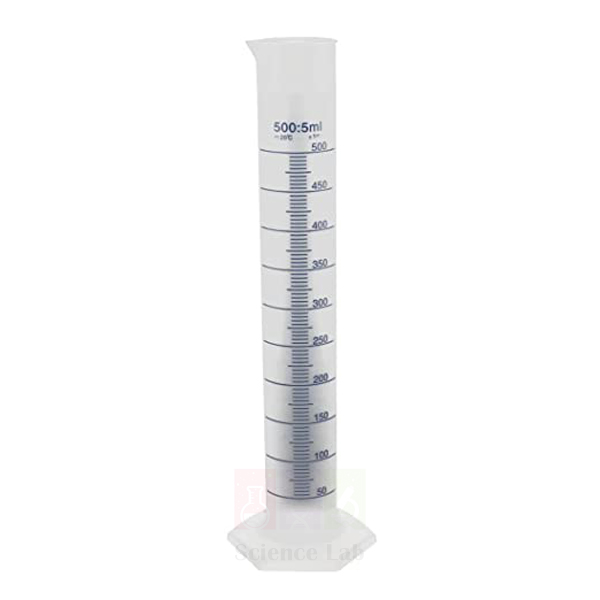
Cylinder Measuring Plastic
Cylinder Measuring Plastic (Product Code: SLE/CL/19) is a 500 ml measuring cylinder in polypropylene or an equivalent plastic, used for measuring liquid volumes in clinical and teaching laboratories where a break-resistant alternative to glass is preferred. It carries embossed graduations beginning at 50 ml, a spout for easy pouring and a wide hexagonal base, and the chemical and heat-resistant plastic is autoclavable, resistant up to 121 °C. The cylinder is produced by Jain Scientific Equipments Pvt Ltd (ScienceLab), Ambala, a scientific lab equipment manufacturer supplying labs across India and international markets.
Specifications
| Parameter | Detail |
|---|---|
| Capacity | 500 ml |
| Material | Polypropylene or equivalent |
| Resistance | Chemical and heat-resistant plastic |
| Autoclaving | Autoclavable, resistant up to 121 °C |
| Graduations | Embossed, beginning at 50 ml |
| Spout | Spout for easy pouring |
| Base | Wide hexagonal base |
| Intended use | Measuring of liquid volumes |
Typical Use
A 500 ml cylinder covers the mid-range measurements a clinical lab makes every day: measuring distilled water for reagent and buffer preparation, making up diluted disinfectant or wash solutions, and portioning larger volumes of stain or media before they are dispensed. In teaching labs the plastic construction lets students handle it confidently, and the hexagonal base keeps it upright on crowded benches — practical considerations for lab equipment for research in India and for routine diagnostic work alike.
For the best reading, stand the cylinder on a level surface, fill to just below the target, and add the last few millilitres with a wash bottle while viewing the liquid surface at eye level. Because graduations begin at 50 ml, smaller volumes are better measured in a smaller cylinder or pipette. After use, rinse and wash with mild detergent, drain upside down, and autoclave when the cylinder has contacted potentially infectious material — keeping within its stated limit of 121 °C.
Manufacturer
Jain Scientific Equipments Private Limited, the company behind the ScienceLab name, manufactures this cylinder in Ambala, Haryana, as part of its plasticware and measuring range for clinical and educational buyers. Our company profile explains more about the business.
Related Clinical Laboratory Products
Items that pair with this cylinder when preparing and measuring solutions:
- Beaker Plastic — a plastic beaker for mixing the liquid once it has been measured
- Measuring Cylinder, Polypropylene — other polypropylene cylinders when a different size is needed
- Glass Measuring Cylinder — a glass alternative where heating or solvent use rules out plastic
- Plastic Wash Bottle 250ml — for topping up precisely to the graduation mark
Browse further plasticware and bench items in the Clinical Laboratory category.
Frequently Asked Questions
What volume can the cylinder measure?
It has a 500 ml capacity with embossed graduations beginning at 50 ml.
What is the smallest graduation interval?
The interval between marks is not stated in our current product details. Please ask through the contact page if you need it for a method document.
Is it safe to autoclave?
Yes. It is made of autoclavable, heat-resistant plastic rated as resistant up to 121 °C.
Why choose plastic rather than glass?
Plastic does not shatter if the cylinder is dropped or knocked over, which reduces breakage and cut injuries on busy or student benches. Glass remains the choice for hot liquids or strong solvents.
How should I read the volume?
Place the cylinder on a level surface and read at eye level; with many aqueous solutions in polypropylene the liquid surface is nearly flat, which makes reading straightforward.
Is a calibration certificate available?
Calibration certificate availability should be discussed with us before ordering; mention the requirement in your enquiry.
Request a Quote
To receive a quotation for SLE/CL/19, contact us through the contact page or add the cylinder to the enquiry cart together with beakers and wash bottles.
Last updated: 24 September 2026
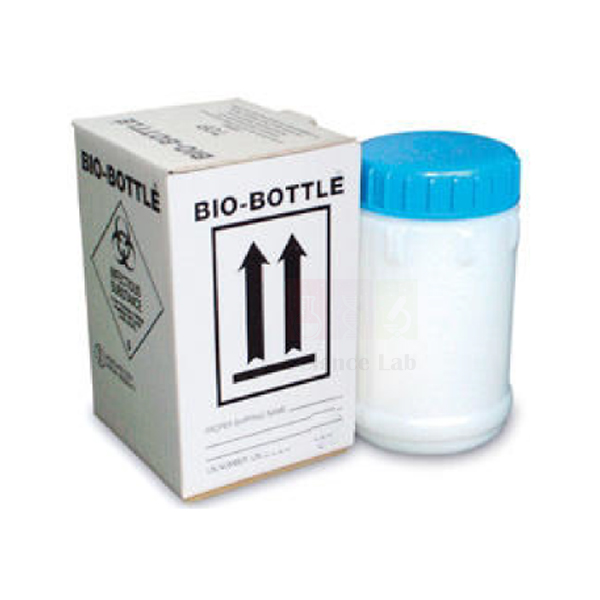
Box Infectious Sample Transportation
Box Infectious Sample Transportation (Product Code: SLE/CL/20) is a leak-proof, three-layer packaging system for moving potentially infectious specimens from a collection site to a testing laboratory. The primary packing holds 4 to 6 vacuum tubes of 5 to 7 ml, the secondary packing is a 40 x 150 mm plastic container fitted with absorbent material, and the outer cardboard box has inserts that act as barriers plus space for a cool-pack or dry ice. Health facilities, reference laboratories and surveillance programmes use it to send blood and other samples safely. It is supplied by Jain Scientific Equipments Pvt Ltd (ScienceLab), Ambala, as part of its work as a lab consumables supplier in India.
Specifications
| Parameter | Detail |
|---|---|
| Primary packing | Capacity 4 (four) to 6 (six) vacuum tubes, size 5 to 7 ml |
| Secondary packing | Plastic container, 40 x 150 mm (diameter x height), fitted with absorbent material |
| Tertiary packing | Very strong cardboard, described as sturdy enough to withstand being dropped from 3 metres high |
| Dimensions | Minimal outer dimensions to reduce air-freight cost |
| Cooling | Integrated space for a 0.3 L cool-pack (short-distance transport) or dry ice (long-distance transport) |
| Construction | Leak-proof box with inserts providing barriers |
Typical Use
Samples collected at a clinic, outbreak site or field survey often have to travel to a regional or reference laboratory. In this box the capped vacuum tubes form the primary layer; they are placed inside the plastic secondary container, where the absorbent material would soak up liquid if a tube leaked or broke; and the secondary container then sits in the cardboard outer box. The request forms should travel outside the secondary container so paperwork stays clean and readable.
For short journeys, place a conditioned 0.3 L cool-pack in the integrated space to keep samples cool; for long-distance transport the same space is used for dry ice. Close each layer fully, label the outer box as your carrier and local rules require, and record the dispatch time. Keeping a few boxes ready at each collection point avoids improvised packaging when an urgent referral comes up — and for programmes that source internationally, the compact outer dimensions help when planning lab equipment export from India by air.
Supplier
This transport box is supplied by ScienceLab, which is how Jain Scientific Equipments Private Limited of Ambala, Haryana, presents its laboratory equipment and consumables to hospitals, programmes and schools. Buyers completing vendor checks can verify the company through its Corporate Identification Number, U29309HR2020PTC087597, and its GSTIN, 06AAECJ8618A1ZT. More information is on the company profile.
Related Clinical Laboratory Products
Tubes and items that go into, or travel with, this transport box:
- EDTA Vacuum Tube — vacuum tubes for whole-blood samples that form the primary layer
- Vacuum Tube, Plain/Dry — plain vacuum tubes for serum samples being referred
- Container Sample 50 ml — sample containers for specimens collected outside vacuum tubes
- Label Self-Adhesive Freezer — labels for identifying tubes before they are packed
See the Clinical Laboratory category for more collection and storage items.
Frequently Asked Questions
How many tubes does one box carry?
The primary packing takes 4 to 6 vacuum tubes in the 5 to 7 ml size.
What happens if a tube leaks in transit?
The secondary plastic container is fitted with absorbent material to take up leaked liquid, and the box itself is leak-proof with inserts providing barriers.
Is a cool-pack included?
The box has integrated space for a 0.3 L cool-pack or for dry ice. Whether a cool-pack is included in your supply should be confirmed with us through the contact page.
Can we use it to send samples by air?
The outer box is kept to minimal dimensions to reduce air-freight cost. Transport rules for infectious specimens depend on how the sample is classified, the carrier and the route, so please discuss your shipment with us before ordering; classification, marking and documents remain the shipper's responsibility.
How strong is the outer box?
It is made of very strong cardboard, described as sturdy enough to withstand being dropped from 3 metres high.
Do you supply boxes for national programmes or distributors?
Yes. Programme, hospital-network and distributor quantities for India and international markets are quoted on request; tell us the number of boxes and the delivery points.
Request a Quote
Send product code SLE/CL/20 with your quantity and destination through the contact page, or add it to the enquiry cart together with vacuum tubes and labels.
Last updated: 24 September 2026
Gloves Exam Latex Without Powder
Gloves Exam Latex Without Powder (Product Code: SLE/CL/21) are non-sterile, single-use examination gloves made from natural latex for clinical examinations and routine clinical laboratory work. Each glove has five fingers, a palm and a sleeve, fits either hand, and is powder-free, so no residue is left on samples, slides or equipment. This listing is for size small (5 to 6.5), packed in boxes of 100. The gloves are supplied by Jain Scientific Equipments Pvt Ltd (ScienceLab), Ambala, to laboratories from basic labs to reference centres that rely on a lab consumables supplier in India for everyday protection.
Specifications
| Parameter | Detail |
|---|---|
| Material | Natural latex |
| Type | Glove for clinical examinations and routine clinical laboratory work |
| Powder | Without powder |
| Sterility | Non-sterile |
| Design | 5 fingers, palm and a sleeve; fits either hand |
| Size | Small (5 to 6.5) |
| Use | Single-use disposable |
| Supplied as | Box of 100 gloves |
| Storage | Dark, dry |
Typical Use
Examination gloves are worn for almost every hands-on task in a clinical lab: receiving and opening specimen containers, preparing smears, pipetting serum, loading analysers and cleaning work surfaces. Latex gives a close, flexible fit with good fingertip feel for handling small tubes and slides, and the powder-free finish avoids particles that can interfere with microscopy or contaminate samples. Because the gloves fit either hand, staff simply take two from the box without sorting lefts and rights.
Choose the right size — this listing is small (5 to 6.5) — so the gloves do not tear at the fingertips or bunch at the palm. Change gloves between patients or samples, whenever they are torn or visibly soiled, and before touching phones, door handles or keyboards; remove them inside-out and discard into a biohazard bag. Store boxes somewhere dark and dry, away from heat and sunlight. Labs that keep one box per workstation find that basic disposable lab equipment is used more consistently when it is within easy reach.
Supplier
From its base in Ambala, Haryana, Jain Scientific Equipments Private Limited supplies these latex gloves under the ScienceLab name, combining personal protective consumables with the laboratory equipment it manufactures so that institutions can source a complete bench from one company. Visit the company profile to learn more.
Related Clinical Laboratory Products
Protective and disposal items used together with these gloves:
- Gloves W/o Powder Nitrile Disposable — a latex-free alternative for staff with latex sensitivity
- Mask Surgical Tie Strap Disposable — face protection for splash-prone tasks
- Lab Coat Work — a white cotton coat to complete basic bench protection
- Biohazard Bag — for disposing of used gloves after potentially infectious work
Explore more protective consumables in the Clinical Laboratory category.
Frequently Asked Questions
What size and quantity does this listing cover?
Size small (5 to 6.5), supplied in boxes of 100 gloves. For other sizes, ask us through the contact page.
Are the gloves powdered?
No, they are made without powder, which keeps samples, slides and instrument surfaces free of glove powder.
Are they sterile?
No, they are non-sterile examination gloves for clinical examinations and routine lab work, not for sterile procedures.
What if a staff member is sensitive to latex?
These gloves are natural latex, so anyone with latex sensitivity should use a latex-free option such as our nitrile disposable gloves instead.
How should the boxes be stored?
Store them in a dark, dry place, away from direct sunlight, heat sources and ozone-producing equipment, and use older stock first.
Can you quote cartons for hospitals or export orders?
Yes. Carton and multi-box quantities are quoted for hospitals, laboratories and distributors in India and international markets; include sizes, box count and destination.
Request a Quote
Request a quotation for SLE/CL/21 through our contact page, or add the gloves to the enquiry cart with masks, lab coats and waste bags for one combined offer.
Last updated: 24 September 2026

Lab Coat Work
Lab Coat Work (Product Code: SLE/CL/22) is a standard white laboratory coat in non-shrink cotton, worn for personal protection during work in the laboratory. It has long sleeves, a notched lapel collar, front button closure, a left breast pocket and left and right lower side pockets, and it measures approximately 110 cm in length. This listing is for size small, supplied as a single plastic-wrapped coat. Staff in laboratory services from basic labs to reference centres wear it over their clothes at the bench. It is manufactured by Jain Scientific Equipments Pvt Ltd (ScienceLab), Ambala, for institutions looking for a reliable lab coat supplier in India.
Specifications
| Parameter | Detail |
|---|---|
| Material | Cotton, non-shrink (less than 5%) |
| Style | Standard laboratory coat, long sleeves, notched lapel collar |
| Closure | Front button closure |
| Pockets | Left breast pocket; left and right lower side pockets |
| Colour | White |
| Length | Approximately 110 cm |
| Size | Small |
| Supplied as | Pack of 1 plastic-wrapped coat |
| Intended use | Personal protection during work in the laboratory |
Typical Use
A cotton lab coat is the first layer of protection between everyday clothing and whatever happens on the bench — drips of stain, reagent splashes, blood specimens or dust from powders. The long sleeves cover the forearms while pipetting and handling tubes, and the length of about 110 cm protects clothing down to the knees when seated or standing. White fabric shows contamination quickly, which reminds the wearer to change and launder the coat before it spreads to other areas, a habit worth building in students using lab equipment for college practicals as well as in hospital staff.
Wear the coat fully buttoned, keep sleeves down, and take it off before leaving the lab for canteens, offices or libraries. Pens, markers and small notebooks fit the breast pocket, while the lower side pockets hold labels or tissues — but not sharps or open tubes. Because the cotton is non-shrink (less than 5%), the coat keeps its fit after regular laundering; wash coats separately from household clothes, and send any coat contaminated with infectious material for decontamination first.
Manufacturer
This work coat is made by Jain Scientific Equipments Private Limited, which trades as ScienceLab from Ambala, Haryana, and manufactures lab coats and other safety wear alongside laboratory apparatus for schools, colleges and hospitals. Read about the company on our company profile.
Related Clinical Laboratory Products
Other protective wear that completes the bench outfit:
- Lab Coat Premium — another lab coat option for buyers comparing styles
- Lab Coat - Light Weight Reusable — a lighter reusable coat for warmer rooms
- Gloves Exam Latex Without Powder — disposable gloves worn with the coat
- Mask Surgical Tie Strap Disposable — face protection for splash-risk tasks
More protective and sample-handling items are listed in the Clinical Laboratory category.
Frequently Asked Questions
What size is this coat?
This listing is size small, with a length of approximately 110 cm. For other sizes, please ask through our contact page.
Will it shrink when washed?
The cotton is non-shrink, with shrinkage of less than 5%, so the coat keeps its fit through regular laundering.
How many pockets does it have?
Three: a left breast pocket and left and right lower side pockets.
Is it suitable for work with strong acids?
It is a standard cotton coat for general personal protection. For work with corrosive chemicals, an acid-resistant apron or coat worn over it is the safer choice.
How is the coat packed?
Each coat is supplied individually, plastic wrapped, which keeps it clean in storage until issue.
Can you supply coats for a whole class or hospital department?
Yes. Institutional orders for India and international markets are quoted on request; list the quantity required in each size and the delivery address.
Request a Quote
Send product code SLE/CL/22 and your size-wise quantities via the contact page, or add the coat to the enquiry cart with gloves and masks for one quotation.
Last updated: 24 September 2026
Blood Grouping Anti-D, IgM
Blood Grouping Anti-D, IgM (Product Code: SLE/CL/23) is a blood grouping reagent used to detect the RhD antigen on red blood cells, so that a sample can be reported as RhD positive or negative, in blood transfusion services and diagnostic laboratories. It contains a monoclonal murine IgM antibody in a 10ml dropper vial that is stored and transported between 2 and 8 °C. It is supplied by Jain Scientific Equipments Pvt Ltd (ScienceLab), Ambala, India, a laboratory chemicals supplier in India for clinical and teaching laboratories.
Specifications
| Parameter | Detail |
|---|---|
| Reagent type | Anti-D blood grouping reagent |
| Antibody | Monoclonal murine IgM antibody |
| Presentation | Dropper bottle |
| Volume | Vial of 10ml |
| Storage and transportation | Between 2 and 8 °C |
| Application | Blood transfusion services |
| Suitable for | A wide range of laboratory services, from basic laboratories to reference centres |
| Shelf life | Depends on the reagent, its lot and storage conditions; ask us for the expiry date of the batch you are quoted |
| Product code | SLE/CL/23 |
| Supplied by | Jain Scientific Equipments Pvt Ltd (ScienceLab), Ambala, India |
What Is the Anti-D IgM Blood Grouping Reagent Used For?
RhD typing is one of the two results every blood group report carries, alongside the ABO group. In a routine test, the anti-D reagent is combined with a suspension of the patient's or donor's red cells; visible clumping (agglutination) shows that the RhD antigen is present, while a smooth, even suspension means it was not detected. Laboratories normally run anti-D next to anti-A and anti-B reagents, include known positive and negative controls, and follow the instructions for use that accompany the reagent lot for cell suspension strength, mixing time and reading.
Return the vial to the refrigerator after each session, keep the dropper tip clear of blood and slides so the reagent is not contaminated, and discard any vial that looks cloudy or has passed the expiry date printed on it. This is a clinical reagent for trained staff working with real blood samples; hospitals and colleges stocking an immunohaematology bench usually order it together with lancets, collection tubes and protective gloves.
Supplier
ScienceLab is the trading name of Jain Scientific Equipments Private Limited, a company based in Ambala, Haryana. For reagents such as this anti-D vial the company acts purely as a supplier, so blood banks, hospitals and colleges can combine the reagent with their glassware, consumables and bench equipment in one order. Read more on our company profile.
Related Clinical Laboratory Products
Items used in the same blood grouping workflow, from sample collection to safe disposal:
- Safety Lancet Disposable 2.4 mm — for obtaining a finger-prick sample when grouping from a drop of blood
- EDTA Vacuum Tube — for venous samples collected for grouping in the laboratory
- Gloves W/o Powder Nitrile Disposable — hand protection while handling blood samples and reagent
- Biohazard Bag — for used gloves, swabs and other contaminated waste after testing
- Blood Typing Kit, Simulated — a classroom alternative that teaches blood grouping without real blood
See the full Clinical Laboratory range for more diagnostic consumables and equipment.
Frequently Asked Questions
What is in each vial of Blood Grouping Anti-D, IgM?
Each dropper vial of Blood Grouping Anti-D, IgM holds 10ml of anti-D reagent containing a monoclonal murine IgM antibody. The number of tests a vial covers depends on the method and drop volume your laboratory uses.
How must the anti-D IgM reagent be stored and shipped?
The anti-D IgM reagent should be stored and transported between 2 and 8 °C. Plan receipt so the vials go into a refrigerator on arrival, and follow the instructions for use supplied with the lot for any further handling conditions.
Can the anti-D reagent be used for slide and tube methods?
The methods covered by the Blood Grouping Anti-D, IgM reagent are set out in the instructions for use of the lot we supply. Ask us through the contact page and we will confirm slide or tube suitability before you order.
Is the anti-D IgM reagent suitable for school biology classes?
No. The Blood Grouping Anti-D, IgM reagent is intended for trained laboratory staff testing real blood samples. For school demonstrations of blood grouping, a simulated blood typing kit avoids handling human blood altogether.
What is the shelf life of the Blood Grouping Anti-D, IgM?
Shelf life of the Blood Grouping Anti-D, IgM reagent depends on the reagent, its production lot and storage conditions, so no fixed period is given here. Ask us for the expiry date of the batch you are quoted, especially for large or export orders.
Who supplies the Blood Grouping Anti-D, IgM?
The Blood Grouping Anti-D, IgM reagent is supplied by Jain Scientific Equipments Private Limited, trading as ScienceLab, from Ambala, Haryana, India. It is offered to blood banks, hospitals, diagnostic laboratories and colleges in India and international markets.
What should an institutional enquiry for the anti-D reagent include?
An institutional enquiry for the anti-D IgM reagent should give product code SLE/CL/23, the number of 10ml vials, the delivery address, the required date and any lot documents your quality system needs, so we can confirm availability and shipping arrangements.
Request a Quote
For pricing and availability, send your requirement through our contact page or add this reagent to the enquiry cart together with other clinical laboratory items.
Last updated: 24 September 2026
Glass Rod
Glass Rod (Product Code: SLE/CL/24) is a plain colourless glass stirring rod, approximately 6mm thick and 200mm long, for mixing solutions, helping solids dissolve and guiding liquid while it is poured. It is a basic commodity on the benches of clinic and hospital laboratories, and teaching laboratories in schools and colleges use the same rod for everyday preparation work. It is made by Jain Scientific Equipments Pvt Ltd (ScienceLab), Ambala, India, and is part of the range the company offers as a laboratory glassware supplier in India.
Specifications
| Parameter | Detail |
|---|---|
| Material | Colourless glass |
| Diameter | Approximately 6mm |
| Length | Approximately 200mm |
| Intended use | Stirring |
| Suitable for | Laboratories in clinics and hospitals (basic commodity) |
Typical Use
In a clinical laboratory the rod is picked up many times a day: stirring a staining solution before it is filtered, dissolving salts while a buffer is being made up, or mixing a diluted disinfectant in a beaker. Holding the rod against the lip of a beaker while pouring lets the liquid run down the glass instead of splashing, a simple technique taught in every chemistry practical. The rod can also carry a single drop of solution to indicator paper when a quick check of acidity is needed.
Because it is inert and easy to see through, a glass rod does not colour or react with most routine solutions, which is why it remains standard chemistry lab glassware in India alongside beakers and cylinders. Stir with a gentle circular motion rather than tapping the base of the vessel, never use the rod to lever or crush hard solids, and avoid moving it quickly between very hot and cold liquids. Rinse it immediately after use so dried residue does not carry over into the next preparation.
Manufacturer
This rod comes from Jain Scientific Equipments Private Limited, the company behind the ScienceLab name, which produces laboratory glassware, instruments and teaching apparatus in Ambala, Haryana, for hospitals, colleges and schools. Buyers can combine simple items like this with larger clinical and science laboratory orders. Details of the company and its facilities are on the ScienceLab company profile.
Related Laboratory Equipment
These items are used with a glass rod when solutions are measured, mixed and cleaned up afterwards:
- Glass Beaker — the vessel most often stirred with a rod when solutions are prepared.
- Cylinder Measuring Plastic — for measuring the liquid volume before it is mixed.
- Hot Plate With Stirrer — hands-free magnetic stirring for longer or heated mixing jobs.
- Stirring Rod, Glass — an alternative glass stirring rod from the chemistry laboratory range.
- Drying Rack Glass & Plastic Ware — for air-drying rods and glassware after washing.
Browse the complete Clinical Laboratory category for more bench essentials.
Frequently Asked Questions
What are the dimensions of this glass rod?
It is approximately 6mm in diameter and approximately 200mm long, a length that reaches the bottom of common beakers while keeping your hand clear of the liquid.
Is it made of heat-resistant borosilicate glass?
The listing specifies colourless glass without naming the glass type. If your work involves heating or boiling liquids, ask us through the contact page to confirm the glass grade before ordering.
How should the rod be cleaned?
Rinse it straight after use, wash with laboratory detergent, rinse again with distilled water and let it dry on a rack. Check for chips or cracks before each use and replace a damaged rod.
Can I order a different length or thickness?
This page covers the approximately 200mm rod. If your course or procedure needs another size, tell us and we will let you know what can be offered.
Do you supply rods in bulk for schools and hospitals?
Yes. Institutional and bulk orders are quoted on request, for customers across India and international markets.
What should a quotation request include?
Mention the quantity, delivery location and any other glassware you need, so everything can be quoted and packed together.
Request a Quote
Send your requirement through the contact page, or add the Glass Rod to the enquiry cart along with the other items on your list.
Last updated: 24 September 2026
Petri Dish Glass With Lid
Petri Dish Glass With Lid (Product Code: SLE/CL/25) is a shallow, round culture dish in colourless glass, approximately 90mm in diameter, supplied together with its covering lid. It is intended for microbiological and medical examinations, where a clear, flat dish is needed to hold culture media, samples or specimens while they are incubated and inspected. Clinic and hospital laboratories keep it as a basic commodity, and microbiology departments in colleges use the same format for practical classes. It is made by Jain Scientific Equipments Pvt Ltd (ScienceLab), Ambala, for buyers looking for a glass petri dish in India that can be washed and used again.
Specifications
| Parameter | Detail |
|---|---|
| Material | Colourless glass |
| Lid | Included (dish supplied with lid) |
| Diameter | Approximately 90mm |
| Intended use | Microbiological and medical examinations |
| Suitable for | Specialised techniques; basic commodity for laboratories in clinics and hospitals |
Typical Use
The most common job for this dish is holding a layer of agar medium. Sterile medium is poured into the base, allowed to set with the lid in place, and then inoculated by streaking or spreading a sample across the surface. After incubation, the colonies can be counted and examined through the clear glass without opening the dish. Clinical laboratories also use glass petri dishes to hold tissue or swab specimens during examination, to soak slides, or to keep small items covered and clean on the bench.
For best results, sterilise dishes before media is poured, pour on a level surface so the agar sets evenly, and incubate plates upside down so condensation does not drip onto the culture. Write labels on the base rather than the lid, because lids get swapped. Used cultures must be decontaminated before the dishes are washed, rinsed and dried for the next run. Reusable glass dishes like these remain standard microbiology lab equipment in India where teaching and diagnostic labs want to limit single-use plastic.
Manufacturer
ScienceLab is the brand under which Jain Scientific Equipments Private Limited makes and sells laboratory glassware and equipment from Ambala, Haryana. The company equips clinical, college and school laboratories, so a petri dish order can be packed with the media preparation and incubation equipment it will be used with. Learn more on our profile page.
Related Laboratory Equipment
A culture workflow built around this dish usually also needs:
- Inoculation Loops — for streaking samples onto the medium in the dish.
- Inoculation Cell Spreader — for spreading a liquid sample evenly across the plate.
- Incubator 30L, upto 80C — to hold inoculated plates at a controlled temperature.
- Electric Autoclave — for sterilising media and decontaminating used plates before washing.
- Petri Dish Rack — keeps stacks of dishes organised on the bench or in storage.
Explore the Clinical Laboratory category for more diagnostic glassware and consumables.
Frequently Asked Questions
What size is the dish, and is the lid included?
The dish is approximately 90mm in diameter and is supplied with its lid. If you need the depth or wall thickness for your procedure, ask us and we will check it for you.
Can these dishes be sterilised with an autoclave or hot air oven?
Glass petri dishes are normally sterilised between uses, but the listing does not name the glass type. Confirm your intended sterilisation method with us through the contact page before ordering.
Why choose glass instead of disposable plastic dishes?
Glass dishes can be washed and reused, which suits teaching and diagnostic laboratories with steady daily use. Disposable plastic dishes avoid washing but create more waste.
How many dishes come in one pack?
The pack quantity is not listed on this page. Tell us how many dishes you need and we will quote accordingly.
How should used dishes be cleaned?
Decontaminate cultures first, then remove the medium, wash with laboratory detergent, rinse with distilled water and dry before sterilising again. Discard any dish with cracks or chipped rims.
Do you supply larger quantities for colleges or export?
Yes. Institutional and bulk orders are quoted on request for laboratories in India and international markets.
Request a Quote
Share your quantity and delivery details through the contact page or place the item in the enquiry cart to receive a quotation.
Last updated: 24 September 2026
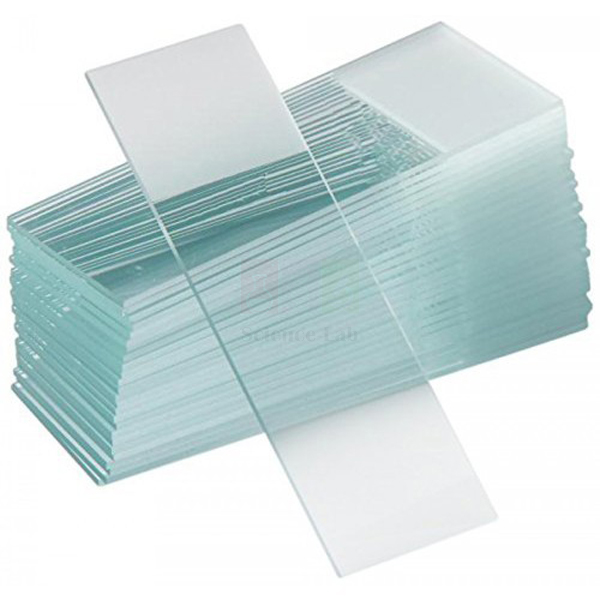
Cover Glass Slide
Cover Glass Slide (Product Code: SLE/CL/26) is a square microscopy slide cover in colourless glass, 22x22mm and 0.17mm thick, placed over a specimen on a microscope slide to flatten it and protect both the sample and the objective lens. The covers are clinical grade, washed and polished, free from nicks and scratches, and packed fibre-free in a box of 100. Pathology, haematology and microbiology benches in clinics and hospitals use them daily, as do biology practical classes. They are supplied by Jain Scientific Equipments Pvt Ltd (ScienceLab), Ambala, a lab consumables supplier India-wide for clinical and teaching laboratories.
Specifications
| Parameter | Detail |
|---|---|
| Material | Colourless glass |
| Type | Microscopy slide cover |
| Size | 22x22mm |
| Thickness | 0.17mm |
| Grade and finish | Clinical grade, non-corrosive, clean, washed and polished |
| Surface quality | Free from nicks and scratches |
| Packing | Packed fibre-free; box of 100 slide covers |
| Intended use | Cover for microscopy slides |
Typical Use
A cover glass turns a drop of liquid on a slide into a thin, even layer that the microscope can focus on. Technicians use it on wet mounts such as urine sediment, stool or skin scraping preparations, and on stained smears that are mounted in a medium for longer keeping. The 0.17mm thickness matters because high-power objectives are designed to look through a thin cover of this kind; a thicker or uneven cover makes fine detail harder to bring into focus.
To avoid air bubbles, touch one edge of the cover to the liquid and lower it slowly at an angle. Hold covers by their edges or with fine forceps so fingerprints do not end up in the field of view, and keep the box closed in a dry place so the glass stays clean and the covers do not stick together. Colleges that buy a compound microscope in India for their biology or pathology labs usually order cover glasses at the same time, because a class can use a box quickly.
Supplier
Jain Scientific Equipments Private Limited trades as ScienceLab from Ambala, Haryana, and supplies consumables like these cover glasses alongside the microscopes, slides and staining equipment it offers to clinical and educational laboratories. Ordering them together keeps a microscopy bench supplied from a single source. Visit the ScienceLab profile for more about the company.
Related Laboratory Equipment
These items complete a microscopy slide preparation bench:
- Plain Slides — the glass slides that the covers are placed on.
- Microscope Slide Cover Forceps — for picking up and lowering covers without fingerprints.
- Monocular Microscope 1000x, LED light — for examining covered preparations at high magnification.
- Slide Drying Rack — lets stained smears dry before they are mounted and covered.
- Storage Box, 100 Slides — for filing finished slides safely.
More diagnostic consumables are listed in the Clinical Laboratory category.
Frequently Asked Questions
What size and thickness are these cover glasses?
Each cover is 22x22mm and 0.17mm thick, made of colourless glass.
How many covers are in one box?
One box holds 100 slide covers, packed fibre-free so they arrive clean.
Can I use them with an oil immersion objective?
Yes, the thin 0.17mm cover suits high-power work; place the immersion oil on top of the cover glass, not beneath it, and wipe the objective after use.
Are cover glasses reusable?
They are treated as consumables. Thin glass breaks easily during cleaning, and covers used on clinical samples should be discarded as laboratory waste.
How should the boxes be stored?
Keep them closed in a dry, dust-free place. Humidity can make covers stick together or leave a haze on the glass.
Can you quote for large quantities?
Yes. Hospitals, colleges and distributors in India and international markets can request a bulk quotation through our contact page.
Request a Quote
Tell us how many boxes you need using the contact form, or add this item to the enquiry cart with your slides and microscopes.
Last updated: 24 September 2026
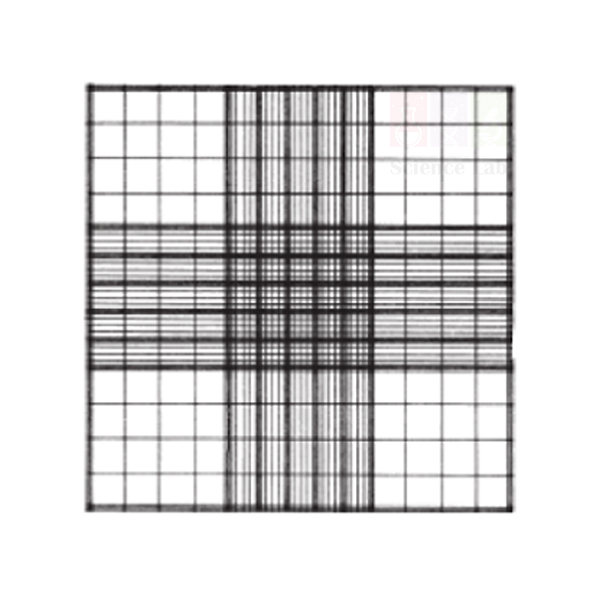
Counting Chamber Neubauer
Counting Chamber Neubauer (Product Code: SLE/CL/27) is a glass counting chamber with an improved Neubauer double grid and a chamber depth of 0.1mm, used to count cells in a known volume of diluted fluid under a microscope. Clinical laboratories with basic diagnostic activity use it for manual blood cell counts, and college laboratories use the same chamber to count yeast or cultured cells in practical work. It is made by Jain Scientific Equipments Pvt Ltd (ScienceLab), Ambala, as a dependable haemocytometer for Indian labs that still rely on manual counting or need a back-up to automated analysers.
Specifications
| Parameter | Detail |
|---|---|
| Material | Glass |
| Ruling | Double grid, improved Neubauer |
| Chamber depth | 0.1mm |
| Counting area | Approximately 9 mm² (ruled grid) |
| Intended use | Cell counting |
| Suitable for | Clinical laboratories with basic diagnostic activity |
Typical Use
The sample is first diluted in a suitable diluting fluid, a flat cover glass is placed across the raised supports, and the chamber is filled from the edge by capillary action. Once the cells settle, the technician counts them in defined squares of the grid under the microscope. Because the ruled area and the 0.1mm depth fix the volume above each square, the count can be converted into cells per unit volume by allowing for the squares counted and the dilution used. The double grid lets two separate fillings, or duplicate counts of one sample, be read on the same chamber.
Accurate counting depends on care: mix the diluted sample well before loading, avoid overfilling so liquid does not spill into the moats, and count cells touching the boundary lines on two sides only. Clean the chamber straight after use with distilled water and a soft lens tissue, and never use abrasive cleaners that could scratch the ruled surface. Laboratories in India choosing a cell counting hemocytometer for training benches often keep several chambers so students can practise in parallel.
Manufacturer
The chamber is produced by Jain Scientific Equipments Private Limited, which does business as ScienceLab from its base in Ambala, Haryana, and makes equipment for diagnostic, college and school laboratories. Buyers equipping a haematology bench can source the chamber together with microscopes, pipettors and counters. More information is available on the company profile.
Related Clinical Laboratory Products
These products are used with the counting chamber during a manual cell count:
- Binocular Biological Microscope — for viewing the grid and the cells during counting.
- Manual Differential Cell Counter — keeps a running tally as squares are counted.
- Pipettor, Variable Volume — for preparing accurate sample dilutions before loading.
- Blood Specimen Rotator — keeps blood samples evenly mixed before they are diluted.
- Transfer Pipette 3ml — a fine-tip disposable pipette for moving diluted samples.
See the full Clinical Laboratory range for more haematology equipment.
Frequently Asked Questions
What ruling and depth does this chamber have?
It carries an improved Neubauer double grid with a chamber depth of 0.1mm, made in glass.
What is the advantage of a double grid?
You can load two samples, or the same sample twice, and compare counts on one chamber. Close agreement between the two sides gives more confidence in the result.
Is a cover glass included?
The listing does not say. Counting chambers need a flat cover glass made for this purpose, as a very thin cover can bend and change the depth. Ask us via the contact page what is supplied with your order.
How is the cell concentration calculated?
Divide the number of cells counted by the volume of the squares counted (their area multiplied by the chamber depth), then multiply by the dilution factor. Your laboratory's procedure defines which squares to count for each cell type.
Can you provide a calibration certificate?
Please discuss certificate requirements with us before ordering, and we will confirm what documentation can be offered.
Do you supply chambers in quantity for colleges and hospitals?
Yes. Bulk and institutional orders are quoted for customers in India and international markets.
Request a Quote
Send your quantity and delivery location through the contact page, or add the chamber to the enquiry cart for a combined quotation.
Last updated: 24 September 2026
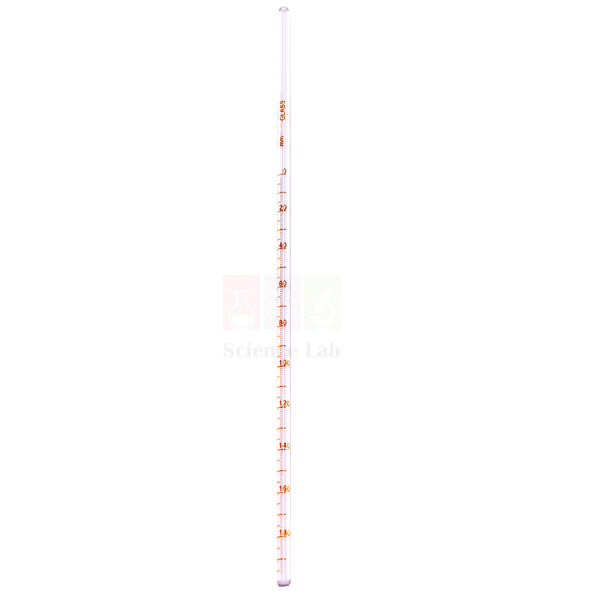
Tube ESR
Tube ESR (Product Code: SLE/CL/28) is a clear glass tube graduated from 0 to 200mm, with a diameter of approximately 2.6mm, used for measuring the sedimentation rate of red blood cells (erythrocytes). The ESR test is one of the simplest screening tests a laboratory runs, and this tube is a basic commodity in clinic and hospital laboratories as well as in medical laboratory technology training. It is made by Jain Scientific Equipments Pvt Ltd (ScienceLab), Ambala, India, which works as a lab glassware manufacturer in India for diagnostic and teaching customers.
Specifications
| Parameter | Detail |
|---|---|
| Material | Clear glass |
| Graduation | 0 – 200mm |
| Diameter | Approximately 2.6mm |
| Compatible rack | Suitable for Rack, ESR, 5 positions |
| Intended use | Measuring the sedimentation rate of red blood cells (erythrocytes) |
| Suitable for | Laboratories in clinics and hospitals (basic commodity) |
Typical Use
For an ESR test, a well-mixed anticoagulated blood sample is drawn up the tube to the zero mark, and the tube is set upright in an ESR rack. Red cells gradually settle, leaving a clear column of plasma above them. At the end of the period set by the laboratory's method, the technician reads the height of that clear column on the 0–200mm scale and reports it in millimetres. A raised result points to inflammation or other conditions that doctors then investigate further.
Results depend heavily on technique. Keep the tube exactly vertical, place the rack on a steady bench away from vibration, direct sunlight and heaters, and make sure no air bubbles are trapped in the blood column. Always fill the tube with a bulb or pipette filler rather than by mouth. After use, wash tubes thoroughly, rinse with distilled water and dry them completely, since traces of detergent or water can alter the next reading. Hospitals comparing laboratory instruments in India for a new haematology bench usually order tubes, racks and timers as one set.
Manufacturer
Jain Scientific Equipments Private Limited makes this tube under its ScienceLab trading name in Ambala, Haryana, where the company produces glassware, instruments and teaching equipment for laboratories. ESR tubes and the matching rack can be ordered from the same source. Read about the company on its profile page.
Related Clinical Laboratory Products
Complete your ESR setup with these items from the same range:
- ESR Rack — holds the tubes upright while the red cells settle.
- Mechanical Timer 60min — times the sedimentation period so every reading is taken on schedule.
- Bulb Type, Pipette Filler — for drawing blood up to the zero mark safely, without mouth pipetting.
- Blood Specimen Rotator — keeps samples evenly mixed before the tube is filled.
- Gloves W/o Powder Nitrile Disposable — protection while handling blood and cleaning used tubes.
More haematology items are listed in the Clinical Laboratory category.
Frequently Asked Questions
What scale and size does the tube have?
It is a clear glass tube graduated from 0 to 200mm, with a diameter of approximately 2.6mm.
Which rack does it fit?
The tube is suitable for an ESR rack with 5 positions. Mention the rack in your enquiry and we will confirm the pairing when quoting.
Does the tube contain an anticoagulant?
It is described as a graduated clear glass tube. Prepare the anticoagulated sample according to your laboratory's ESR method before filling.
Can the tubes be reused?
Glass tubes can be cleaned and reused provided they are washed, rinsed with distilled water and fully dried each time. Replace any tube with chipped ends or faded graduations.
How many tubes come in a pack?
Pack quantity is not listed on this page. Tell us the number you need through the contact page and we will quote accordingly.
Can you supply hospitals and colleges in bulk?
Yes. We quote institutional and bulk orders for laboratories in India and international markets.
Request a Quote
To receive pricing, use the contact page or add the ESR tube and rack to the enquiry cart.
Last updated: 24 September 2026
Coplin Staining Jar
Coplin Staining Jar (Product Code: SLE/CL/29) is an upright jar for staining techniques that holds 10 microscope slides of 26x76mm on edge, so a whole batch of smears can be dipped into one reagent at once. It is closed with a glass cover that withstands stains and organic solvents, and the slides stand taller than the opening so they can be lifted out by hand without forceps. Pathology, haematology and microbiology sections in clinics and hospitals rely on jars like this, and it is made by Jain Scientific Equipments Pvt Ltd (ScienceLab), Ambala, for laboratories planning a microbiology lab setup in India or refitting an existing staining bench.
Specifications
| Parameter | Detail |
|---|---|
| Type | Jar for staining techniques |
| Cover | Glass cover that withstands stains and organic solvents |
| Slide size | Fits slides of 26x76mm |
| Capacity | 10 slides |
| Design | Slides extend above the opening, allowing handling without forceps |
| Intended use | Staining of smears on microscope slides |
| Suitable for | Laboratories in clinics and hospitals (basic commodity) |
Typical Use
Most staining methods pass a slide through several liquids in a fixed order: a fixative, one or more stains, rinses, a differentiating step, and often alcohols and a clearing solvent before mounting. Laboratories set out a row of Coplin jars, one for each step, label them clearly, and move the slides from jar to jar with timed immersions. Because each jar takes up to 10 slides, a technician can stain a full batch of blood films, tissue sections or bacterial smears together instead of treating them one at a time.
Keep the glass cover on between runs to cut evaporation and fumes, especially for alcohol and solvent steps, and work in a well-ventilated area. Fill each jar high enough to cover the smear, filter or replace stains on a regular schedule so deposits do not settle on the slides, and lift slides by the end that projects above the rim. For school and college biology lab equipment in India, a small set of jars is also a simple way to teach students routine smear staining.
Manufacturer
ScienceLab is the working name of Jain Scientific Equipments Private Limited, a company in Ambala, Haryana, that makes and supplies apparatus for clinical and educational laboratories. Staining jars, slide racks and storage boxes from the same range can be ordered together for a complete slide workflow. See the about-us page for company details.
Related Clinical Laboratory Products
Pair the jar with these items used before and after staining:
- Coplin Jar Staining — another Coplin jar in the range for building a multi-step staining line.
- Rack Staining Slides Horizontal — for methods where stain is flooded onto flat slides instead of dipping.
- Plain Slides — slides for preparing the smears to be stained.
- Slide Drying Rack — lets stained slides drain and dry upright.
- Storage Box, 100 Slides — for storing finished slides after examination.
Find more in the Clinical Laboratory category.
Frequently Asked Questions
How many slides does the jar hold, and what size?
It takes 10 slides of 26x76mm, standing on edge.
Can alcohol or solvents be kept in it?
The glass cover withstands stains and organic solvents. Keep the jar covered when not in use and handle solvent steps in a ventilated area.
Do I need forceps to take slides out?
No. The slides extend above the opening, so you can lift them by hand. Wear gloves when handling stains.
How many jars do I need for one staining method?
Usually one jar per reagent step. Count the fixatives, stains, rinses and solvents in your protocol and order that number of jars.
How should the jar be cleaned?
Empty it, rinse with water, remove stain deposits with laboratory detergent or a suitable solvent, and let it dry fully before refilling.
Do you take bulk or export orders?
Yes. Hospitals, colleges and distributors in India and international markets can request a quotation via the contact page.
Request a Quote
Send your requirement through our contact page or add the staining jar to the enquiry cart with the rest of your staining bench items.
Last updated: 24 September 2026
Bag Resealable Small Plastic
Bag Resealable Small Plastic (Product Code: SLE/CL/30) is a multi-purpose storage and transportation bag made of black low density polyethylene (LDPE), approximately 10x15cm, that can be sealed and re-sealed with a pressure closure. A white opaque area in the centre of the bag gives space to write sample IDs, dates or contents. It is used across a wide range of laboratory services, from basic laboratories to reference centres, and is supplied by Jain Scientific Equipments Pvt Ltd (ScienceLab), Ambala, for customers who want a lab plastic ware supplier in India that also covers their instruments and glassware.
Specifications
| Parameter | Detail |
|---|---|
| Material | Low density polyethylene (LDPE) |
| Colour | Black |
| Type | Multi-purpose storage and transportation bag |
| Closure | Pressure seal; can be sealed and re-sealed |
| Labelling | White opaque writable area in the centre of the bag |
| Size | Approximately 10x15cm |
| Suitable for | A wide range of laboratory services, from basic laboratory to reference centre |
Typical Use
Small resealable bags keep the many loose items of a laboratory organised and identifiable. Typical contents include dried blood spot cards once they have dried, blank slides or cover glasses set aside for a particular test, spare tips and small tools for field kits, and paperwork that must travel with a batch of samples. The black film makes these bags easy to tell apart from clear bags used for other purposes, while the white panel keeps the written label readable.
Write on the white area with a permanent marker before filling the bag, then press the closure firmly along its full length so it seals completely. The bag can be opened and closed again for items that are checked often. It is a general storage bag, so infectious specimens should still go into dedicated leak-proof containers and transport boxes. Laboratories that order consumables from one laboratory equipment supplier in India often add a stock of these bags to routine orders.
Supplier
Jain Scientific Equipments Private Limited, known to customers as ScienceLab, operates from Ambala, Haryana, and supplies practical consumables like these bags alongside the equipment it produces for clinical and teaching laboratories. The company profile has more background.
Related Clinical Laboratory Products
Items commonly packed, labelled or shipped together with these bags:
- Dry Blood Spot Paper — completed and dried cards are often stored in small resealable bags.
- Rack Drying DBS Cards — holds cards while they dry before bagging.
- Label Self-Adhesive Freezer — for extra labelling of tubes and containers placed in the bag.
- Envelope 27x36 cm — a larger outer envelope for bags and accompanying paperwork.
- Box Infectious Sample Transportation — the proper choice when specimens themselves must be shipped.
Browse all items in the Clinical Laboratory category.
Frequently Asked Questions
What size and material is the bag?
It is approximately 10x15cm, made of black low density polyethylene (LDPE).
Can I write directly on the bag?
Yes. The centre of the bag has a white opaque writable area; a permanent marker gives the clearest result.
Can the bag be opened and closed more than once?
Yes, the pressure seal can be closed and re-sealed. Reuse bags only for clean items and discard any bag that has been in contact with biological material.
Is it suitable for shipping infectious samples?
It is a multi-purpose storage and transportation bag, not a specimen transport system. For infectious samples, follow the packaging rules that apply to you and use a dedicated transport box.
How many bags are in a pack?
The pack size is not stated here. Share the quantity you need through the contact page and we will quote.
Do you supply larger quantities?
Yes. Bulk and institutional orders are quoted for customers in India and international markets.
Request a Quote
Contact us through the enquiry page or add the bags to the enquiry cart together with your other consumables.
Last updated: 24 September 2026
Gloves W/o Powder Nitrile Disposable
Gloves W/o Powder Nitrile Disposable (Product Code: SLE/CL/31) are powder-free, single-use nitrile gloves for routine clinical laboratory work, in size medium (7 to 8). They are non-sterile, fit either hand, and form a simple barrier between the wearer and blood, body fluids, stains and reagents. Hospital laboratories, reference centres, college practical labs and research benches get through them in large numbers, and they are supplied by Jain Scientific Equipments Pvt Ltd (ScienceLab), Ambala, to buyers looking for lab gloves in nitrile across India alongside their other laboratory supplies.
Specifications
| Parameter | Detail |
|---|---|
| Material | Nitrile |
| Purpose | Gloves for routine clinical laboratory work |
| Powder | Powder free |
| Use | Single-use disposable |
| Sterility | Non-sterile |
| Fit | Fits either hand |
| Size | Medium (7 to 8) |
| Storage | Dark, dry place; protect from freezing and excessive heat |
| Suitable for | A wide range of laboratory services, from hospital laboratory to reference centre |
Typical Use
Gloves are worn for almost every task on a clinical bench: receiving and opening sample containers, separating serum, loading analysers, preparing and staining smears, and wiping down surfaces after a spill. Nitrile is a synthetic material, so it is a common choice where staff prefer to avoid natural rubber latex, and the powder-free finish means no powder residue ends up on slides, cuvettes or instrument parts. Because the gloves fit either hand, a box can be used without sorting left from right.
Change gloves between patients' samples and whenever they are torn or visibly contaminated, and never wash or reuse single-use gloves. Remove them by peeling each glove inside out, discard them into biohazard waste, and wash your hands afterwards. Keep boxes in a dark, dry store away from heat and freezing so the material stays supple. Hospitals that buy disposable lab equipment in India in bulk often order gloves on a regular schedule with other daily consumables.
Supplier
ScienceLab is the trade name of Jain Scientific Equipments Private Limited in Ambala, Haryana. Besides the laboratory equipment the company produces, it supplies everyday protective items like these gloves so clinical and teaching labs can place a single combined order. Find out more on the company profile.
Related Clinical Laboratory Products
Other protective and disposal items used with these gloves:
- Gloves Exam Latex Without Powder — a powder-free latex alternative for staff who prefer latex.
- Lab Coat Work — body and clothing protection on the bench.
- Mask Surgical Tie Strap Disposable — face protection during sample handling.
- Biohazard Bag — for disposing of used gloves and contaminated waste.
- Eye Wash Station — emergency eye rinsing close to the work area.
See the Clinical Laboratory category for the complete range.
Frequently Asked Questions
Which size are these gloves?
They are size medium (7 to 8). If your staff need other sizes, ask us through the contact page and we will tell you what is available.
Are the gloves sterile?
No, they are non-sterile gloves for routine laboratory work. Procedures that call for sterile gloves need a sterile product.
Why choose powder-free nitrile gloves?
Powder-free gloves leave no powder on samples, slides or instruments, and nitrile suits users who prefer to avoid natural rubber latex.
Do they fit left and right hands?
Yes. The gloves fit either hand, so there is no need to pair them.
How should stock be stored?
Store boxes in a dark, dry place and protect them from freezing and excessive heat.
How many gloves come in a box?
The box count is not listed on this page. Tell us your monthly usage and we will quote a suitable quantity.
Can you supply hospitals and colleges on a regular basis?
Yes. We quote bulk and repeat orders for laboratories in India and international markets.
Request a Quote
Request pricing through the contact page or add the gloves to the enquiry cart along with your other protective items.
Last updated: 24 September 2026
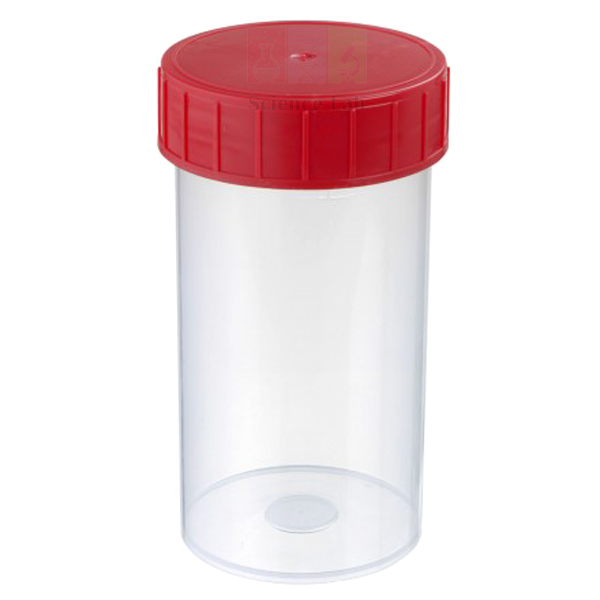
Container Sample 50 ml
Container Sample 50 ml (Product Code: SLE/CL/32) is a screw-capped specimen container in colourless plastic with a capacity of approximately 50 ml, suitable for a wide range of clinical specimens. It is non-sterile and intended as a single-use disposable, so each patient sample goes into a fresh container that is discarded after testing. Outpatient collection points, hospital laboratories and diagnostic centres use containers like this every day, and it is supplied by Jain Scientific Equipments Pvt Ltd (ScienceLab), Ambala, as part of its disposable lab equipment for India and overseas buyers.
Specifications
| Parameter | Detail |
|---|---|
| Material | Colourless plastic |
| Type | Sample container suitable for a wide range of clinical specimens |
| Closure | Screw cap |
| Sterility | Non-sterile |
| Use | Single-use disposable |
| Capacity | Approximately 50 ml |
Typical Use
A general specimen container of this size is handed to patients for routine urine examination, and is also used for sputum, other body fluids and small samples that are sent to the laboratory for non-culture testing. The clear plastic lets staff check the sample volume and appearance before the cap is removed, and the screw cap keeps the contents closed on the way from the collection room to the bench. Because the container is non-sterile, tests that require a sterile sample, such as microbiological culture, should use a sterile container instead.
Label the body of the container rather than the cap, since caps can be mixed up once removed. Tighten the cap fully, keep containers upright, and send them in a secondary bag or transport box. After testing, dispose of the container and any remaining sample as clinical waste. Many laboratories keep a steady stock of these containers, ordering them with gloves, labels and pipettes from one laboratory equipment supplier in India.
Supplier
Jain Scientific Equipments Private Limited runs the ScienceLab brand from Ambala, Haryana. Alongside the laboratory apparatus it manufactures, the company supplies collection consumables like this container for hospitals, diagnostic centres and colleges. Our profile page describes the company in more detail.
Related Clinical Laboratory Products
Items used when samples are collected, labelled and processed:
- Label Self-Adhesive Freezer — for clear patient identification on each container.
- Transfer Pipette 3ml — for taking an aliquot of a liquid specimen for testing.
- Screw Cap Conic Tube — a conical tube for spinning down part of the sample.
- Box Infectious Sample Transportation — for moving filled containers safely between sites.
- Gloves W/o Powder Nitrile Disposable — protection while handling patient specimens.
Explore the full Clinical Laboratory category.
Frequently Asked Questions
What is the capacity of the container?
It holds approximately 50 ml and has a screw cap.
Is the container sterile?
No, it is non-sterile. For samples that need a sterile container, such as culture specimens, ask us for a sterile alternative.
Can it be washed and reused?
No. It is a single-use disposable and should be discarded as clinical waste after use.
Which plastic is it made of, and is it leak-proof?
The listing describes it as colourless plastic with a screw cap and does not state the polymer or a leak-proof rating. If your transport procedure needs these details, contact us before ordering.
How are the containers packed?
The pack quantity is not listed here. Tell us your required quantity through the contact page and we will quote.
Do you supply in bulk for hospitals and export?
Yes. Bulk quotations are available for customers in India and international markets.
Request a Quote
For prices and pack options, write to us via the contact page or add the container to the enquiry cart.
Last updated: 24 September 2026
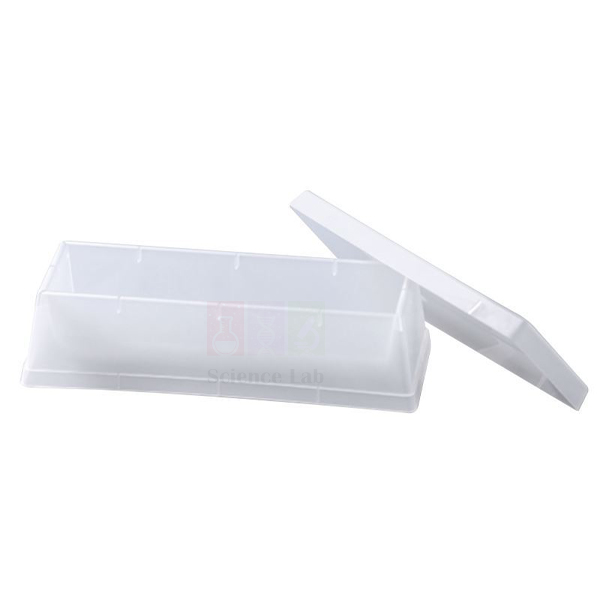
Reagent Reservoir 60ml
Reagent Reservoir 60ml (Product Code: SLE/CL/33) is a polypropylene trough that holds reagents and chemicals for a short time while they are drawn up by multichannel pipettes of 8 and 12 channels. Its trough profile keeps as much liquid as possible within reach of the tips even when only a small volume is being processed, and it has a pour-off spout, volume graduations every 5ml embossed on the inside and a wide, stable base. With a capacity of approximately 60ml, it is reusable and autoclavable. Immunology, molecular biology and research laboratories use it for plate work, and it is supplied by Jain Scientific Equipments Pvt Ltd (ScienceLab), Ambala, as practical lab equipment for research in India and for diagnostic benches.
Specifications
| Parameter | Detail |
|---|---|
| Material | Polypropylene |
| Type | Reservoir for short-time containment of reagents and chemicals |
| Profile | Trough profile maximises the liquid accessible, even with small volumes |
| Pipette compatibility | Multichannel pipettes with 8 and 12 channels |
| Spout | Pour-off spout |
| Graduation | Every 5ml, embossed on the inside |
| Base | Wide base for stability |
| Sterility | Non-sterile |
| Reuse | Reusable, autoclavable |
| Capacity | Approximately 60ml |
Typical Use
In plate-based assays such as ELISA, the same reagent has to go into every well quickly and evenly. The technician pours wash buffer, conjugate or substrate into the reservoir, dips all the tips of an 8 or 12 channel pipette into the trough together, and fills a whole column or row of the plate in one stroke. The embossed 5ml marks let you pour just the volume a run needs, and the trough shape means the last few millilitres can still be picked up rather than wasted. The wide base keeps the reservoir steady on the bench while tips go in and out.
Use a separate reservoir for each reagent and do not pour leftover liquid back into the stock bottle; empty it through the spout into waste instead. Rinse the reservoir after use, wash it, and autoclave it when the method requires sterile handling, since it is supplied non-sterile. Check chemical compatibility before holding strong solvents in polypropylene. Labs that source pipettes, tips and plates from one lab plastic ware supplier in India can add reservoirs to the same order.
Supplier
This reservoir is supplied by ScienceLab, the brand of Jain Scientific Equipments Private Limited in Ambala, Haryana, which produces and sources equipment for clinical, research and teaching laboratories. Buyers can combine plasticware like this with pipettors, plate instruments and autoclaves in a single enquiry. More about us on the ScienceLab profile.
Related Clinical Laboratory Products
Equipment that works alongside the reservoir in plate-based workflows:
- Digital Pipette 8 Channels — a multichannel pipette that draws from the trough in one stroke.
- Filter Pipette Tips — tips that help protect the pipette and samples from aerosol contamination.
- PCR Microplate — a plate filled column by column from the reservoir.
- ELISA Reader 8 Channel — reads the plate once reagents have been dispensed and developed.
- Electric Autoclave — for sterilising the reusable reservoir between runs.
Find more in the Clinical Laboratory category.
Frequently Asked Questions
How much does the reservoir hold, and how is it marked?
It holds approximately 60ml, with volume graduations every 5ml embossed on the inside.
Which pipettes can be used with it?
It accommodates multichannel pipettes with 8 and 12 channels, so a full column or row of a plate can be filled at once.
Is it disposable or reusable?
It is reusable and autoclavable, so it can be cleaned and sterilised between runs.
Is the reservoir supplied sterile?
No, it is supplied non-sterile. Autoclave it before use if your method requires sterile handling.
How do I empty leftover reagent?
Use the pour-off spout to empty it cleanly into waste. Avoid returning used reagent to the stock bottle, as this risks contaminating it.
Can you quote for larger quantities?
Yes. Laboratories, colleges and distributors in India and international markets can request a bulk quotation through the contact page.
Request a Quote
Send us your requirement on the contact page or add the reservoir to the enquiry cart with your pipettes and tips.
Last updated: 24 September 2026
Sterile Swab Tube Cotton Tip
Sterile Swab Tube Cotton Tip (Product Code: SLE/CL/34) is a sterile cotton-tipped swab on a plastic handle stick, individually packed in its own low density polyethylene (LDPE) tube, with an overall length of approximately 12cm. The swab is used to collect a sample from a patient or a surface and is then returned to the tube so the sample stays protected on its way to the laboratory. Hospital wards, clinical laboratories and microbiology teaching labs use swabs like this, and they are supplied by Jain Scientific Equipments Pvt Ltd (ScienceLab), Ambala, a lab consumables supplier India-wide for clinical and educational customers.
Specifications
| Parameter | Detail |
|---|---|
| Swab | Cotton-tipped swab |
| Handle | Plastic handle stick |
| Tube material | Low density polyethylene (LDPE) |
| Sterility | Sterile |
| Packing | Individually packed in tube |
| Length | Approximately 12cm |
Typical Use
Sterile swabs are the standard way to collect material from wounds, the throat or the nose for bacteriological examination, and to sample benches, equipment and hands during environmental monitoring in microbiology. After collection, the swab goes straight back into its tube, which keeps the sample from drying out quickly or being contaminated in transit. In the laboratory the swab is rolled over the first part of a culture plate, and the inoculum is then spread further with a loop to obtain separate colonies.
Before use, check that the tube is intact; open it only at the moment of sampling and do not let the cotton tip touch anything except the sampling site. Label the tube immediately with the patient or location details. The listing does not mention a transport medium, so follow your laboratory's rules on how quickly swabs must reach the bench. In teaching labs, swabbing surfaces and growing the results on plates is a simple, memorable practical for students.
Supplier
ScienceLab, the trading name of Jain Scientific Equipments Private Limited, is based in Ambala, Haryana. The company equips clinical and teaching laboratories and supplies sampling consumables like these swabs so that collection, culture and incubation items can be ordered together. Company details are on our profile page.
Related Clinical Laboratory Products
Products used in the same sampling and culture workflow:
- Petri Dish Glass With Lid — the plate the swab is rolled onto when the culture is started.
- Inoculation Loops — for streaking the inoculum out to obtain separate colonies.
- Label Self-Adhesive Freezer — for identifying each swab tube at the point of collection.
- Box Infectious Sample Transportation — for sending swabs from wards or field sites to the lab.
- Gloves W/o Powder Nitrile Disposable — hand protection while collecting and handling samples.
View all items in the Clinical Laboratory category.
Frequently Asked Questions
Is each swab sterile and separately packed?
Yes. Each cotton-tipped swab is sterile and individually packed in its own LDPE tube.
How long is the swab?
It is approximately 12cm long, with a plastic handle stick.
Does the tube contain a transport medium?
A transport medium is not mentioned in the listing. If your samples need one, tell us through the contact page before ordering.
Can a swab be used more than once?
No. Each swab is packed for one sample; once the tube is opened and used, it should be discarded as clinical waste after processing.
Is it suitable for student practicals?
Yes, for surface sampling and culture exercises under supervision, with used plates and swabs decontaminated before disposal.
Can you supply swabs in bulk?
Yes. Hospitals, colleges and distributors in India and international markets can request a bulk quotation.
Request a Quote
Ask for pricing through our contact page or add the swabs to the enquiry cart with your culture supplies.
Last updated: 24 September 2026
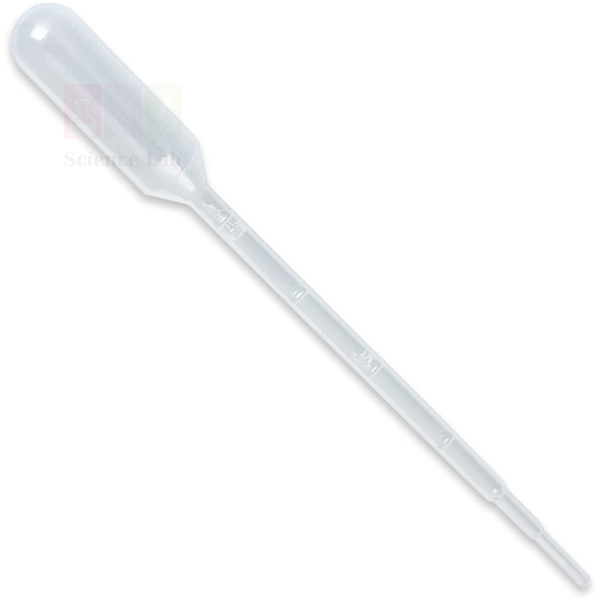
Transfer Pipette 3ml
Transfer Pipette 3ml (Product Code: SLE/CL/35) is a single-use, non-sterile transfer pipette with a capacity of 3.0ml, a fine tip and an integrated flexible suction bulb, so liquid can be drawn up and released with one hand and no separate filler. Embossed graduations, the smallest step being 0.5ml, give a quick visual guide to the volume held. Clinical laboratories use it to move serum, urine and reagents between containers, and teaching laboratories use it wherever students need a safe alternative to mouth pipetting. It is supplied by Jain Scientific Equipments Pvt Ltd (ScienceLab), Ambala, a lab consumables supplier India-wide for hospitals, colleges and schools.
Specifications
| Parameter | Detail |
|---|---|
| Type | Transfer pipette |
| Capacity | 3.0ml |
| Tip | Fine tip |
| Graduation | Embossed; minimal graduation 0.5ml |
| Bulb | Integrated flexible suction bulb |
| Sterility | Non-sterile |
| Use | Single-use disposable |
Typical Use
After a blood sample has been centrifuged, a transfer pipette is the quickest way to lift the serum or plasma off the cells and into a labelled tube. The fine tip also makes it easy to add reagents drop by drop, to top up a tube to a mark, or to move a portion of a urine sample into a centrifuge tube for sediment examination. Because a fresh pipette is used for each sample, there is no washing and no risk of carrying material from one patient to the next.
Squeeze the bulb before the tip enters the liquid, then release slowly to draw up the sample; keep the pipette tip-down so liquid does not run into the bulb. The embossed marks are meant as a guide, so use a calibrated pipettor when an exact volume is required. Colleges choosing lab equipment for college practicals in India often stock these pipettes in quantity because they suit large classes and remove the need for mouth pipetting.
Supplier
Jain Scientific Equipments Private Limited, which trades as ScienceLab from Ambala, Haryana, supplies disposable items such as this pipette together with the laboratory equipment it builds for clinical and educational users. That lets a laboratory source its routine plastics and its instruments from the same place. Read more on the company profile.
Related Clinical Laboratory Products
Choose from these alternatives and companion items:
- Transfer Pipette Sterile — the option to use when the transfer must be sterile.
- Transfer Pipette, 1ml — a smaller pipette for handling lower volumes.
- Screw Cap Tube 5.0 ml — a capped tube to receive separated serum or aliquots.
- Container Sample 50 ml — the specimen container liquid is often drawn from.
- Biohazard Bag — for disposing of used pipettes after contact with samples.
Browse the Clinical Laboratory category for more pipetting supplies.
Frequently Asked Questions
What volume does it hold, and how is it graduated?
It has a capacity of 3.0ml with embossed graduations; the smallest graduation is 0.5ml.
Is this pipette sterile?
No, it is non-sterile. For sterile transfers, choose the sterile transfer pipette in the same range.
Can I use it for accurate measurements?
The graduations are a guide for approximate volumes. For precise dispensing, use a calibrated pipettor.
Can the pipette be washed and used again?
No. It is a single-use disposable and should be discarded after each sample.
How many pipettes are in a pack?
The pack size is not given on this page. Share your quantity through the contact page and we will quote.
Do you supply schools, colleges and hospitals in bulk?
Yes. We quote bulk and repeat orders for customers in India and international markets.
Request a Quote
Use the contact page for pricing, or add the pipettes to the enquiry cart together with tubes and containers.
Last updated: 24 September 2026
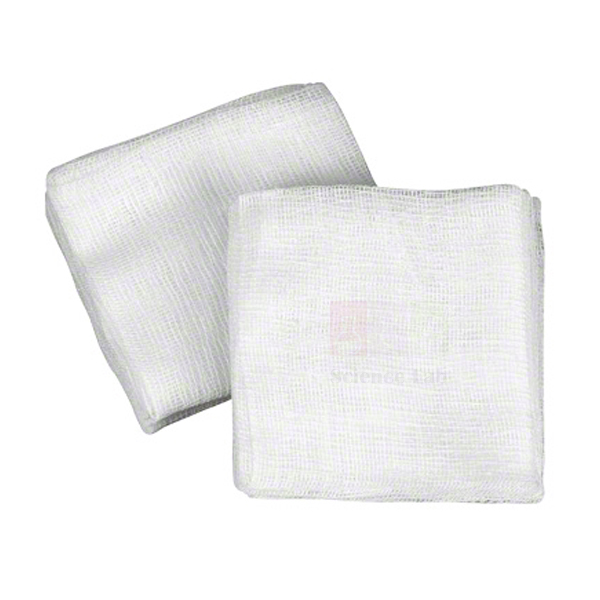
Gauze Compress
Gauze Compress (Product Code: SLE/CL/36) is a 12 ply gauze square of approximately 10x10cm, non-sterile and individually packed, for general absorbent and padding tasks in laboratories, clinics and first aid stations. The multi-layer build gives a thick, absorbent pad that holds together when pressed or folded. Sample collection rooms, school and college laboratories and workplace first aid points keep a stock of compresses, and they are supplied by Jain Scientific Equipments Pvt Ltd (ScienceLab), Ambala, for institutions stocking a first aid box for their lab in India or restocking a phlebotomy trolley.
Specifications
| Parameter | Detail |
|---|---|
| Product | Gauze compress |
| Layers | 12 ply |
| Size | Approximately 10x10cm |
| Sterility | Non-sterile |
| Packing | Individually packed |
Typical Use
In a blood collection room, a folded compress is pressed over the puncture site after the needle is withdrawn, then held in place until bleeding stops. Technicians also use gauze to wipe the outside of tubes and containers, to soak up small spills before disinfecting a surface, and to pad fragile glassware in a drawer or transport box. In first aid, non-sterile gauze is useful for cleaning around a minor injury and as an outer padding layer over a sterile dressing.
Because these compresses are non-sterile, use a sterile dressing for direct contact with open wounds. Open each individual pack only when needed so unused pieces stay clean and dry, and dispose of any gauze that has touched blood as clinical waste. Schools building a first aid training kit can include compresses so students practise applying pressure and padding correctly.
Supplier
ScienceLab is how Jain Scientific Equipments Private Limited, an Ambala, Haryana company, presents its laboratory range. Along with the equipment it produces, it supplies everyday clinical consumables like gauze so that labs and schools can restock safety and collection items in one order. Visit the company profile to learn more.
Related Clinical Laboratory Products
Items that sit alongside gauze on a collection trolley or in a first aid box:
- Adhesive Bandage — covers a puncture site once bleeding has stopped.
- Tourniquet With Buckle — used earlier in the same blood collection procedure.
- Sharp Container Leak Proof Plastic — for safe disposal of needles and lancets.
- Gloves W/o Powder Nitrile Disposable — protection for staff handling blood-stained gauze.
- First-Aid Box — a box for keeping compresses and other first aid items ready.
See more in the Clinical Laboratory category.
Frequently Asked Questions
What size and thickness is the compress?
Each compress is approximately 10x10cm and made of 12 ply gauze.
Is the gauze sterile?
No, it is non-sterile. Use a sterile dressing where gauze will be in direct contact with an open wound.
How are the compresses packed?
Each compress is individually packed. The number per outer box is not listed, so tell us your quantity when you enquire.
What is the gauze made of?
The fibre content is not stated in the listing. If your procurement specification needs it, ask us through the contact page.
Is it suitable for school first aid kits?
Yes, as a general-purpose absorbent pad for cleaning and padding, used alongside sterile dressings for open wounds.
Do you accept bulk orders?
Yes. Hospitals, schools and distributors in India and international markets can request a bulk quotation.
Request a Quote
Send your requirement through the contact page or add Gauze Compress to the enquiry cart with your other first aid and collection items.
Last updated: 24 September 2026
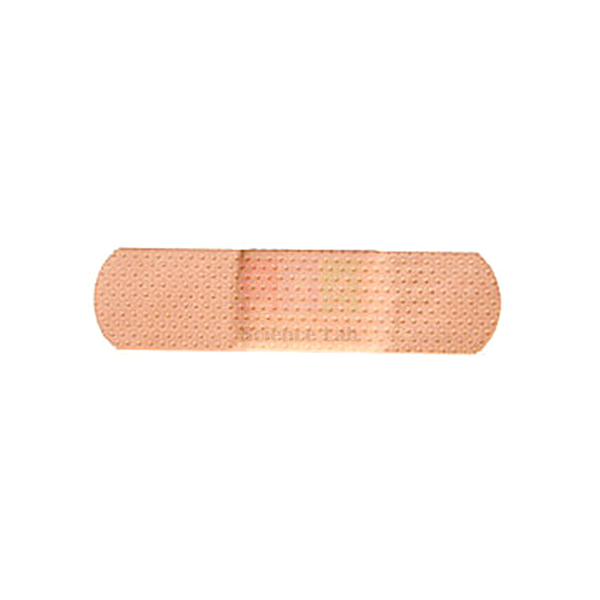
Adhesive Bandage
Adhesive Bandage (Product Code: SLE/CL/37) is a self-adhesive bandage with a central non-stick pad on a flexible, perforated non-woven tissue backing, approximately 30mm long. Its adhesive is hypoallergenic and water resistant, and every bandage is individually peel-packed, with 100 bandages to a box. Blood collection points use it to cover finger-prick and puncture sites, and schools, colleges and workplaces keep it for minor cuts. It is supplied by Jain Scientific Equipments Pvt Ltd (ScienceLab), Ambala, for buyers ordering disposable lab equipment in India alongside their clinical and safety supplies.
Specifications
| Parameter | Detail |
|---|---|
| Type | Self-adhesive bandage |
| Adhesive | Hypoallergenic and water resistant |
| Pad | Central non-stick pad |
| Backing | Flexible perforated non-woven tissue |
| Length | Approximately 30mm |
| Packing | Individually peel-packed; box of 100 bandages |
Typical Use
After a capillary sample is taken with a lancet, or once pressure has stopped bleeding at a venepuncture site, a small adhesive bandage keeps the spot covered and clean while the patient leaves. The non-stick pad sits over the puncture so it lifts away without pulling, the flexible backing moves with a finger or elbow, and the perforations let the skin breathe. The water-resistant adhesive helps the bandage stay in place through hand washing.
Apply it to clean, dry skin and avoid touching the pad when removing the peel-pack liners. Keeping each bandage in its own pack means a box can sit on a busy collection trolley without the rest being handled. Schools and colleges setting up a first aid box for the lab in India usually include a box of adhesive bandages for small cuts from broken glassware or dissection work.
Supplier
These bandages are supplied by ScienceLab, the trading name of Jain Scientific Equipments Private Limited of Ambala, Haryana. The company equips clinical and educational laboratories and adds practical first aid and collection consumables so customers can cover routine needs in one order. Company background is on the profile page.
Related Laboratory Equipment
Products commonly used together with adhesive bandages:
- Safety Lancet Disposable 2.4 mm — the finger-prick sites it makes are covered with a bandage afterwards.
- Gauze Compress — for applying pressure before the bandage goes on.
- Sharp Container Leak Proof Plastic — for disposing of used lancets and needles safely.
- Emergency First Aid Kit — a ready kit for laboratories and classrooms.
- Wall Mounting First Aid Kit — keeps bandages and dressings within reach on the lab wall.
See the complete Clinical Laboratory category for more collection supplies.
Frequently Asked Questions
How many bandages come in a box?
Each box contains 100 bandages, and every bandage is individually peel-packed.
What size are the bandages?
They are approximately 30mm long. The width is not listed, so ask us if you need it for your specification.
Will the bandage stay on when hands are washed?
The adhesive is water resistant, which helps it stay in place during normal hand washing. Replace it if it becomes loose or soaked.
Is it suitable for people with sensitive skin?
The adhesive is hypoallergenic. Anyone with a known reaction to adhesive dressings should still check before use.
Are the bandages sterile?
Sterility is not stated in the listing. If your procedure requires sterile dressings, contact us through the contact page before ordering.
Can you supply larger quantities?
Yes. Hospitals, schools and distributors in India and international markets can request a bulk quotation.
Request a Quote
Tell us how many boxes you need through the contact page, or add Adhesive Bandage to the enquiry cart with your first aid items.
Last updated: 24 September 2026
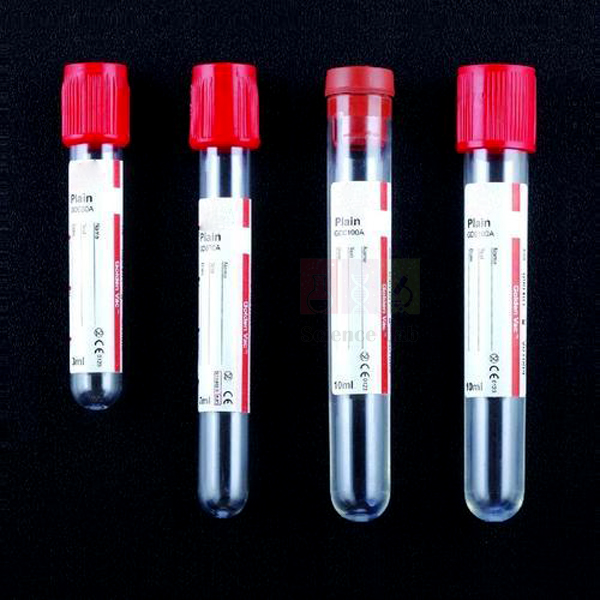
Vacuum Tube, Plain/Dry
Vacuum Tube, Plain/Dry (Product Code: SLE/CL/38) is a 6ml evacuated PET blood collection tube without anticoagulant, used to collect venous blood that is left to clot so serum can be separated for testing. Its vacuum-sealed cap draws blood once connected to a venipuncture needle, which makes it a routine item at phlebotomy counters, hospital laboratories and medical laboratory training rooms. It is supplied by Jain Scientific Equipments Pvt Ltd (ScienceLab), Ambala, India, as part of its disposable lab equipment range in India.
Specifications
| Parameter | Detail |
|---|---|
| Type | Vacuum blood collection tube, plain (dry) |
| Material | Plastic (PET) |
| Capacity | 6ml |
| Anticoagulant | None (tube without anticoagulant) |
| Closure | Capped with vacuum seal |
| Application | Blood collection |
| Storage | Between 2 °C and 30 °C |
| Product code | SLE/CL/38 |
| Supplied by | Jain Scientific Equipments Pvt Ltd (ScienceLab), Ambala, India |
What Is the Plain Vacuum Tube Used For?
A plain tube is chosen when the laboratory needs clotted blood, most often so that serum can be separated for biochemistry or serology work. After the draw, the tube is stood upright and left undisturbed until a firm clot forms; it is then centrifuged and the clear serum above the clot is transferred with a pipette for testing. Because nothing has been added to the tube, there is no additive to mix in, and in a multi-tube draw plain tubes are normally filled before additive tubes such as EDTA so that no anticoagulant is carried over.
Keep unopened stock between 2 °C and 30 °C, label each tube immediately after filling, and set aside any tube that does not draw blood, as its vacuum may have been lost. Training institutes that order from a lab consumables supplier in India often stock plain, serum gel and EDTA tubes together so students can practise the complete venous sampling sequence.
Supplier
This plain vacuum tube is supplied by Jain Scientific Equipments Private Limited, the Ambala, Haryana company that trades under the ScienceLab name and provides blood-collection consumables to clinical and teaching laboratories in India and international markets. Background on the company is given on the ScienceLab company profile.
Related Clinical Laboratory Items
Items that complete a venous blood draw and serum preparation:
- Tourniquet With Buckle — applied above the draw site to make the vein easier to locate
- Tube Vacuum Serum Gel — an alternative when a gel clot activator is preferred for serum collection
- EDTA Vacuum Tube — for anticoagulated whole-blood samples taken in the same draw
- Centrifuge Complete w/accessories — for spinning clotted tubes to separate the serum
- Sharp Container Leak Proof Plastic — for safe disposal of used needles after sampling
Browse the full Clinical Laboratory collection for other sampling tubes and bench equipment.
Frequently Asked Questions
Does the Vacuum Tube, Plain/Dry contain an anticoagulant?
No. The Vacuum Tube, Plain/Dry is a tube without anticoagulant, so blood collected in it clots naturally. No other additive is listed, which is why it is chosen when the laboratory needs clotted blood and serum.
What is the capacity of the plain vacuum tube?
The plain vacuum tube has a listed capacity of 6ml and is made of PET plastic with a vacuum-seal cap. If your protocol calls for a different draw volume, ask us through the contact page which other tubes can be offered.
How should unused plain vacuum tubes be stored?
Unused Vacuum Tube, Plain/Dry stock should be kept between 2 °C and 30 °C, as the listing states. No expiry period is given here; ask us for the expiry date of the batch you are quoted before dispatch.
Can the plain tube sample be used for serum tests?
Yes, serum testing is the usual purpose of the plain vacuum tube: once the blood has clotted and been centrifuged, serum is separated for testing. Each laboratory should still confirm that the tube suits its own assay methods.
Who supplies the Vacuum Tube, Plain/Dry?
The Vacuum Tube, Plain/Dry is supplied by Jain Scientific Equipments Private Limited, which trades as ScienceLab from Ambala, Haryana, India. Hospitals, diagnostic laboratories, health programmes and training institutes in India and international markets can order it with other blood-collection consumables.
How many plain vacuum tubes come in a pack?
The pack quantity of the plain vacuum tube is not stated in our listing. For hospital or programme orders, send product code SLE/CL/38, the number of tubes and the delivery location, and we will confirm pack and carton sizes in the quotation.
Request a Quote
Send your required quantity of Vacuum Tube, Plain/Dry through our contact page, or add it to the enquiry cart along with other clinical laboratory items for a combined quotation.
Last updated: 24 September 2026
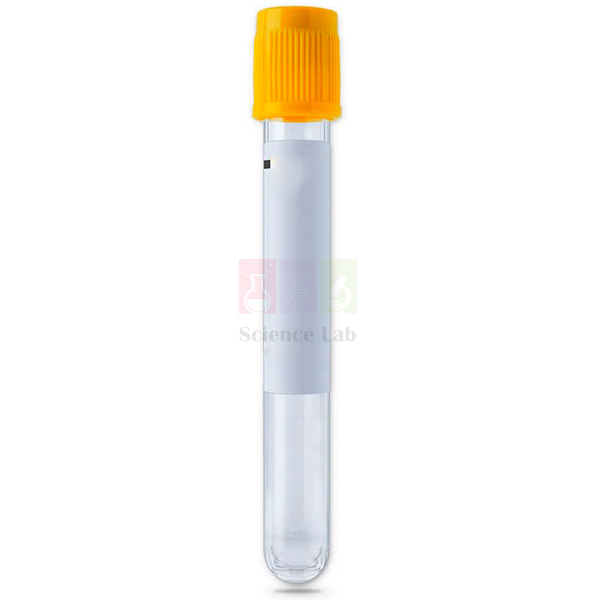
Tube Vacuum Serum Gel
Tube Vacuum Serum Gel (Product Code: SLE/CL/39) is a 4ml PET vacuum blood collection tube with a gel clot activator, used for serum collection in clinical chemistry and serology work. The vacuum seal draws the specimen during venipuncture, the activator helps the blood clot, and after centrifugation the gel keeps the serum apart from the clot; the listing covers services from basic laboratories to reference centres. It is supplied by Jain Scientific Equipments Pvt Ltd (ScienceLab), Ambala, India, a lab consumables supplier in India.
Specifications
| Parameter | Detail |
|---|---|
| Type | Vacuum blood collection tube, serum gel |
| Material | Plastic (PET) |
| Capacity | 4ml |
| Additive | Gel clot activator |
| Closure | Capped with vacuum seal |
| Application | Serum collection |
| Storage | Between 2 °C and 30 °C |
| Service level | Basic laboratory to reference centre |
| Shelf life | Depends on the tube, its gel and clot activator and storage conditions; ask us for the expiry date of the batch you are quoted |
| Product code | SLE/CL/39 |
| Supplied by | Jain Scientific Equipments Pvt Ltd (ScienceLab), Ambala, India |
What Is the Serum Gel Vacuum Tube Used For?
Serum gel tubes are the everyday choice for clinical chemistry panels such as liver and kidney function tests, lipid profiles and many serology assays. After filling, the tube is gently inverted a few times so the clot activator contacts the blood, then left upright until clotting is complete. When the tube is spun, the gel settles between the clot and the serum, so the serum can be pipetted off cleanly or, in many laboratories, loaded onto an analyser straight from the tube.
Use a centrifuge with a swing-out or suitable fixed rotor so the gel barrier forms evenly; a laboratory centrifuge in India set up for routine blood work will normally take tubes of this kind, but check the bucket or adaptor size before you order. Follow your own standard operating procedure for clotting time and spin settings, and keep stock between 2 °C and 30 °C until use.
Supplier
ScienceLab is the trading name of Jain Scientific Equipments Private Limited, based in Ambala, Haryana, which supplies this serum gel tube to hospital and diagnostic laboratories, health programmes and training institutes as part of its blood-collection consumables. More about the business is on the company profile page.
Related Clinical Laboratory Items
Products that fit into the same serum sampling and testing workflow:
- Tourniquet With Buckle — for vein location before the vacuum tube is attached
- Vacuum Tube, Plain/Dry — a plain tube without additive when a gel tube is not required
- Clinical Centrifuge — to spin the clotted sample so the gel barrier forms
- Transfer Pipette Sterile — for moving serum into secondary tubes or cuvettes
- Clinical Chemistry Analyzer — the analyser most serum samples are destined for
See the complete Clinical Laboratory range for collection tubes, racks and analysers.
Frequently Asked Questions
What sample does the Tube Vacuum Serum Gel produce?
The Tube Vacuum Serum Gel produces serum. Its gel clot activator helps the blood clot, and after centrifugation the serum sits above the gel, ready to be pipetted off or tested according to your laboratory's procedure.
How much blood does the serum gel tube take?
The serum gel tube has a listed capacity of 4ml in a PET tube capped with a vacuum seal. For other draw volumes, ask us through the contact page which serum tubes are currently available.
Why choose a serum gel tube over a plain tube?
A serum gel tube keeps serum and clot apart after spinning, which makes it easier to remove serum without disturbing cells. The Vacuum Tube, Plain/Dry is the alternative where no additive is wanted in the tube.
How soon can the serum gel tube be centrifuged?
The serum gel tube should be centrifuged only after clotting is complete. The exact waiting time, spin speed and rotor type should follow your laboratory's own standard operating procedure and the instructions supplied with the tubes.
What storage and shelf life apply to the Tube Vacuum Serum Gel?
Keep the Tube Vacuum Serum Gel between 2 °C and 30 °C before use. Shelf life depends on the tube, its gel and clot activator and the storage conditions, so ask us for the expiry date of the batch you are quoted.
Who supplies the Tube Vacuum Serum Gel?
The Tube Vacuum Serum Gel is supplied by Jain Scientific Equipments Private Limited, which trades as ScienceLab from Ambala, Haryana, India. It is offered to hospital and diagnostic laboratories, health programmes and training institutes in India and international markets.
What should an institutional enquiry include?
An institutional enquiry for the serum gel tube should give product code SLE/CL/39, the number of tubes, the delivery address and any tender reference or documents you need, so we can confirm pack sizes and prepare the quotation.
Request a Quote
For pricing and availability of the Tube Vacuum Serum Gel, write to us through the contact form or place it in the enquiry cart and submit your list.
Last updated: 24 September 2026
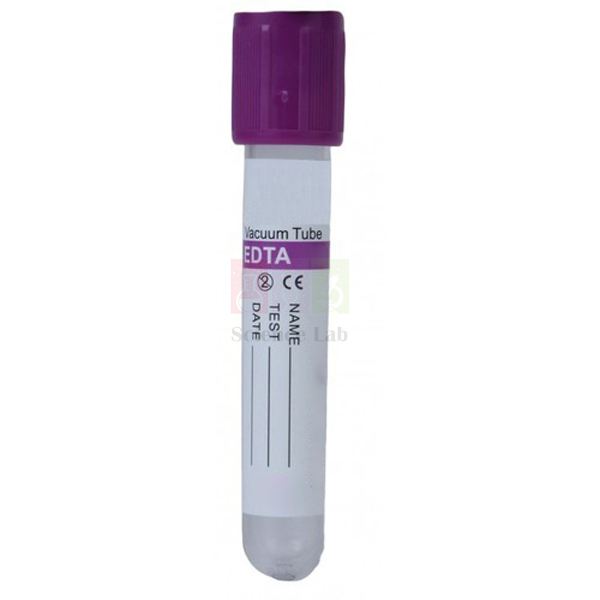
EDTA Vacuum Tube
EDTA Vacuum Tube (Product Code: SLE/CL/40) is a 6ml PET vacuum blood collection tube containing EDTA K3 anticoagulant, used to collect venous whole blood that stays unclotted for haematology testing. The vacuum-sealed cap draws blood during venipuncture, and the tube is listed for laboratory services from basic laboratories up to reference centres. It is supplied by Jain Scientific Equipments Pvt Ltd (ScienceLab), Ambala, India, to hospital, diagnostic and teaching laboratories buying disposable lab equipment in India and abroad.
Specifications
| Parameter | Detail |
|---|---|
| Type | Vacuum blood collection tube with anticoagulant |
| Material | Plastic (PET) |
| Anticoagulant | EDTA K3 |
| Capacity | 6ml |
| Closure | Capped with vacuum seal |
| Application | Blood collection |
| Storage | Between 2 °C and 30 °C |
| Service level | Basic laboratory to reference centre |
| Shelf life | Depends on the tube, its EDTA K3 additive and storage conditions; ask us for the expiry date of the batch you are quoted |
| Product code | SLE/CL/40 |
| Supplied by | Jain Scientific Equipments Pvt Ltd (ScienceLab), Ambala, India |
What Is the EDTA Vacuum Tube Used For?
EDTA blood is the standard specimen for a complete blood count on a haematology analyser, for preparing peripheral blood films and for many blood grouping procedures. Immediately after the tube fills, invert it gently several times so the anticoagulant mixes evenly with the blood; shaking hard can damage cells, and skipping the mixing step can leave small clots that upset cell counts. Letting the vacuum fill the tube to its intended level keeps the ratio of anticoagulant to blood correct.
In a multi-tube draw, EDTA tubes are filled after serum tubes so that potassium EDTA is not carried into samples meant for chemistry. Medical laboratory colleges sourcing lab equipment for college practicals in India often use these tubes to teach anticoagulant selection alongside plain and serum gel tubes.
Supplier
Jain Scientific Equipments Private Limited, which does business as ScienceLab from Ambala in Haryana, supplies this EDTA tube to hospital, diagnostic and educational buyers in India and international markets as part of its clinical laboratory consumables list. Read the ScienceLab profile for more about the company.
Related Clinical Laboratory Items
Equipment and consumables used with EDTA whole-blood samples:
- 18 parameter Haematology Analyser — runs the blood count on the anticoagulated sample
- Blood Specimen Rotator — keeps filled tubes gently mixed while they wait for analysis
- Counting Chamber Neubauer — for manual cell counts from the same specimen
- EDTA Capillary Tube — a capillary option when only a finger-prick sample is possible
- Test Tube Rack SS — holds filled tubes upright on the bench
The Clinical Laboratory category lists further haematology and sampling products.
Frequently Asked Questions
What does EDTA K3 mean on the EDTA Vacuum Tube?
EDTA K3 on the EDTA Vacuum Tube refers to tripotassium EDTA, the anticoagulant specified for this 6ml tube. It prevents clotting by binding calcium in the blood, so the cells stay in suspension for haematology work.
Which tests is the EDTA vacuum tube suitable for?
The EDTA Vacuum Tube is mainly used for haematology, such as blood counts and blood films. EDTA can interfere with some chemistry tests, including calcium and potassium, so your laboratory should confirm suitability for each assay.
Does the EDTA vacuum tube need mixing after collection?
Yes. The EDTA Vacuum Tube should be inverted gently several times straight after filling so the EDTA K3 is distributed through the sample; vigorous shaking can damage cells, and skipping the mixing step can leave small clots.
How should EDTA vacuum tubes be stored, and what is their shelf life?
Store the EDTA Vacuum Tube between 2 °C and 30 °C. Shelf life depends on the tube, its EDTA K3 additive and the storage conditions, so no fixed period is given here; ask us for the expiry date of the batch you are quoted.
Who supplies the EDTA Vacuum Tube?
The EDTA Vacuum Tube is supplied by Jain Scientific Equipments Private Limited, trading as ScienceLab, from Ambala, Haryana, India. Hospitals, diagnostic and educational laboratories and distributors in India and international markets can order it with plain and serum gel tubes.
Can EDTA vacuum tubes be supplied in bulk for export?
Yes. The 6ml EDTA Vacuum Tube can be quoted in bulk for hospitals, programmes and export buyers. Send product code SLE/CL/40, the number of tubes and the destination, and we will include packing details in the quotation.
Request a Quote
To receive a quotation for the EDTA Vacuum Tube, use the contact page or add the item to your enquiry cart with any other tubes you need.
Last updated: 24 September 2026
Screw Cap Conic Tube
Screw Cap Conic Tube (Product Code: SLE/CL/41) is a graduated, conical-bottom test tube made of polyethylene terephthalate (PET) with a screw cap and wide neck, designed for routine centrifugation. It is offered in 15ml and 50ml capacities and is used in hospital laboratories and reference centres for a variety of tests, from sediment preparation to sample aliquoting. The tube is supplied by Jain Scientific Equipments Pvt Ltd (ScienceLab), Ambala, a lab plastic ware supplier in India serving clinical and research buyers.
Specifications
| Parameter | Detail |
|---|---|
| Type | Test tube for routine centrifugation |
| Material | Polyethylene terephthalate (PET) |
| Bottom | Conical |
| Neck | Wide neck |
| Markings | Graduated |
| Closure | Screw cap |
| Capacity | 15ml and 50ml |
| Used in | Hospital laboratories and reference centres, for multiple tests |
Typical Use
The conical base gathers solids into a small, tight pellet during spinning, which is why these tubes are used for urine sediment work, washing cell suspensions, concentrating specimens and separating liquids before analysis. The wide neck makes it easy to pour or pipette samples in, the graduations give a quick visual check of volume, and the screw cap helps contain splashes and aerosols while the tube is handled or centrifuged.
Always load tubes in balanced pairs of the same size and fill level, and make sure your rotor or buckets accept conical tubes of the capacity you choose before ordering. Many buyers pair the 15ml size with a benchtop laboratory centrifuge in India for routine clinical work and use the 50ml size for larger preparation or transport volumes. After spinning, remove the supernatant carefully with a pipette so the pellet is not disturbed.
Supplier
The tube comes from Jain Scientific Equipments Private Limited, an Ambala, Haryana company trading as ScienceLab that supplies plasticware and consumables to laboratories. For vendor registration, the company's GSTIN is 06AAECJ8618A1ZT, and export orders are handled under Importer-Exporter Code AAECJ8618A issued by DGFT. See the company profile for details.
Related Clinical Laboratory Items
Items used alongside conical tubes when preparing and spinning samples:
- Laboratory Centrifuge — for spinning the tubes; confirm bucket size for your chosen capacity
- Vortex Test Tube — to mix or resuspend tube contents before and after centrifugation
- Transfer Pipette, 3ml — for drawing off supernatant above the pellet
- Screw Cap Tube 5.0 ml — a smaller screw-cap tube for storing separated aliquots
- Label Self-Adhesive Freezer — for marking sample identity on each tube
Visit the Clinical Laboratory category for more tubes, racks and centrifugation accessories.
Frequently Asked Questions
Which sizes are available?
The listing gives 15ml and 50ml capacities. Please state which size, or how many of each, when you enquire.
Are the tubes marked with volume graduations?
Yes, the tubes are graduated, which is useful for quick volume checks. For precise measurement, use a pipette or measuring cylinder.
What is the maximum centrifuge speed?
A speed rating is not given in our listing. Contact us with your centrifuge model and planned settings and we will advise.
Can the tubes be autoclaved?
Heat resistance is not stated. PET is generally not suited to autoclaving, so check with us before planning any heat sterilisation.
Are they supplied sterile?
Sterility is not mentioned in the listing. If your work needs sterile tubes, tell us so we can confirm what we can offer.
Can you quote for tenders or export orders?
Yes. Send the quantity per size, delivery location and any document requirements; we serve buyers in India and international markets.
Request a Quote
Ask for a price on Screw Cap Conic Tube through our contact page, or collect items in the enquiry cart and send one combined request.
Last updated: 24 September 2026
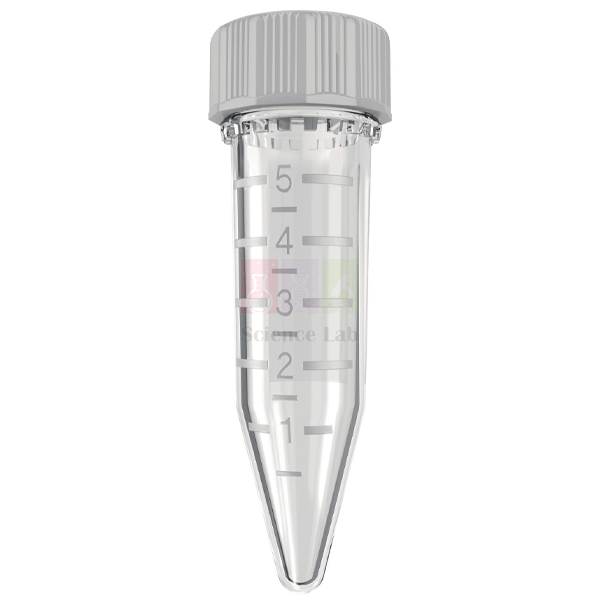
Screw Cap Tube 5.0 ml
Screw Cap Tube 5.0 ml (Product Code: SLE/CL/42) is a small polypropylene test tube with a screw cap and a capacity of 5.0ml, used in hospital laboratories and reference centres for multiple tests. Its size suits jobs where only a few millilitres need to be held securely, such as keeping separated serum or plasma, storing reagent portions or passing a specimen from one bench to another. This tube is one of the items of disposable lab equipment in India supplied by Jain Scientific Equipments Pvt Ltd (ScienceLab), Ambala.
Specifications
| Parameter | Detail |
|---|---|
| Type | Test tube with screw cap |
| Material | Polypropylene |
| Capacity | 5.0ml |
| Closure | Screw cap |
| Used in | Hospital laboratories and reference centres |
| Purpose | Multiple laboratory tests |
Typical Use
A common use is aliquoting: after a blood sample has been centrifuged, the serum or plasma is pipetted into one or more small screw-cap tubes so that different sections of the laboratory can work from their own portion, or so a portion can be kept back for repeat testing. The threaded cap closes more securely than a push-on stopper, which reduces the chance of leaks when tubes are carried in racks or boxes.
Polypropylene is a tough, slightly flexible plastic that resists many aqueous solutions and alcohols, making it practical for general bench work. Write the sample identity on a label before filling, tighten the cap fully and store tubes upright. Laboratories that source from a lab plastic ware supplier in India often keep this size next to larger conical tubes so both aliquoting and centrifugation needs are covered.
Supplier
Jain Scientific Equipments Private Limited supplies this 5.0ml tube under its ScienceLab trading name from Ambala, Haryana, serving hospital, college and research laboratories with small plasticware items. More background is on our profile page.
Related Clinical Laboratory Items
Useful companions when aliquoting and storing small sample volumes:
- Screw Cap Conic Tube — a larger conical tube for the centrifugation step before aliquoting
- Transfer Pipette, 1ml — for moving small volumes of serum or reagent into the tube
- Pipettor, Variable Volume — when aliquots must be dispensed to a set volume
- Label Self-Adhesive Freezer — to identify each tube clearly
- Rack Tubes Set of 3 — to keep tubes upright while filling and storing
More sampling and storage products are listed in the Clinical Laboratory section.
Frequently Asked Questions
What is the tube made of?
Polypropylene, with a screw cap. The cap material is not specified in our listing.
How much does the tube hold?
Its capacity is 5.0ml. Leave some headspace below the cap so it closes cleanly.
Is the tube graduated or conical?
Neither graduations nor bottom shape are given in the listing. If you need a graduated conical tube, see the Screw Cap Conic Tube, or ask us to confirm this tube's form.
Can it be autoclaved or frozen?
Polypropylene often tolerates both, but the listing does not state it for this tube or its cap. Please check with us before relying on heat sterilisation or freezer storage.
Is there a minimum order?
Minimum and pack quantities are not stated here. Share the number you need and we will quote accordingly.
Can you ship to laboratories outside India?
Yes. We quote for customers in India and international markets; include your destination and quantity in the enquiry.
Request a Quote
Get a quotation for Screw Cap Tube 5.0 ml via the contact page, or add it to the enquiry cart together with pipettes, labels and racks.
Last updated: 24 September 2026
EDTA Capillary Tube
EDTA Capillary Tube (Product Code: SLE/CL/43) is a 75 mm capillary tube with an internal EDTA coating, designed for the collection, transportation and processing of capillary blood from a finger or heel prick. The EDTA stops the small sample from clotting, so it can be carried to the bench and centrifuged or dispensed for testing. Tubes are packed in vials of 100 and are used by haematology benches, point-of-care testing sites and training laboratories. They are supplied by Jain Scientific Equipments Pvt Ltd (ScienceLab), Ambala, a lab consumables supplier in India for clinical sampling items.
Specifications
| Parameter | Detail |
|---|---|
| Type | Capillary tube, EDTA coated |
| EDTA coating | 1.65 mg/ml (listed as 1,65 mg/ml) |
| Diameter | 1.15 mm (listed as 1,15 mm) |
| Length | 75 mm |
| Packing | Vials of 100 tubes |
| Application | Collection, transportation and processing of capillary blood |
Typical Use
After the skin is punctured with a lancet and the first drop wiped away, the tip of the tube is touched to the next drop and blood rises by capillary action. Hold the tube level or angled slightly downward and stop before the end to avoid air gaps. For packed cell volume work, one end is closed with sealant, the tube is placed in a haematocrit centrifuge, and the ratio of packed cells to total column is read afterwards; tubes can also be used to move a measured drop onto slides or test devices.
Roll the filled tube gently between the fingers to spread the EDTA through the blood, and process the sample promptly. Nursing and medical laboratory technology programmes buying lab equipment for college teaching in India often use EDTA capillary tubes to show students how small-volume sampling differs from venous collection. Keep vials closed when not in use so the tubes stay clean.
Supplier
These capillary tubes are supplied by Jain Scientific Equipments Private Limited, a company in Ambala, Haryana, that trades as ScienceLab and keeps a range of capillary sampling consumables for laboratories and health programmes. For vendor registration, its GSTIN is 06AAECJ8618A1ZT and its Legal Entity Identifier (LEI) is 3358004HRD1JIVXKYX49. The company profile has further information.
Related Clinical Laboratory Items
Items needed for the rest of the capillary sampling routine:
- Safety Lancet Disposable 2.4 mm — makes the finger or heel puncture
- Capillary Tube Sealant — closes one end of the tube before spinning
- Haematocrit Centrifuge — spins sealed capillary tubes for packed cell volume readings
- Capillary Heparin Tube — the heparin-coated alternative when your method calls for heparin
- Sharp Container Leak Proof Plastic — for used lancets and any broken tubes
Explore the Clinical Laboratory category for more capillary and venous sampling supplies.
Frequently Asked Questions
How many tubes are in a vial?
Each vial holds 100 tubes, as listed. For carton sizes, please contact us.
What are the tube dimensions?
The tubes are 75 mm long with a diameter of 1.15 mm. The original listing writes these values with a decimal comma (1,15 mm).
How much EDTA is in the coating?
The listing states EDTA coated 1.65 mg/ml (written 1,65 mg/ml). Ask us if your method requires a specific EDTA salt.
Are the tubes glass or plastic?
The material is not stated in our listing. Please confirm with us before ordering if your protocol depends on it.
When should I choose EDTA rather than heparin capillary tubes?
EDTA is usual for haematology tests on capillary blood, while heparin is often used where the method specifies it. Follow the requirements of your test method.
Do you supply capillary tubes for screening programmes?
Yes. Send the number of vials and delivery location, and we will quote for supply in India or international markets.
Request a Quote
Request pricing for EDTA Capillary Tube through the contact form, or add the vials to your enquiry cart with lancets and sealant for one combined quotation.
Last updated: 24 September 2026
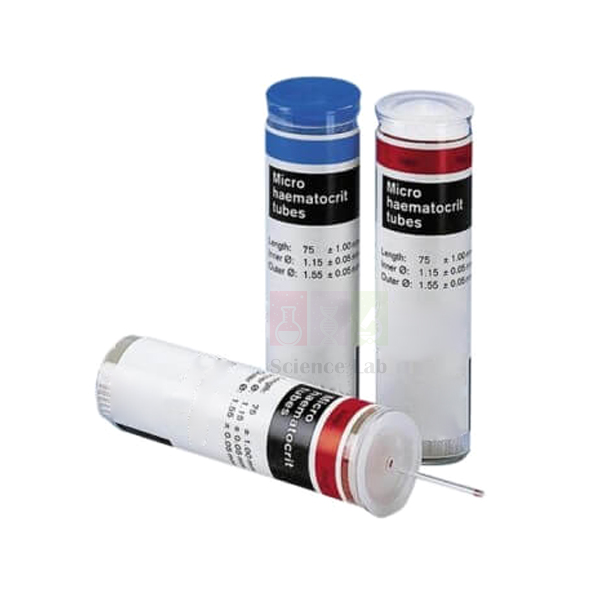
Capillary Heparin Tube
Capillary Heparin Tube (Product Code: SLE/CL/44) is a heparin-coated glass capillary tube, 75mm long with an inner diameter of 1.15mm, used to draw small volumes of blood for several laboratory tests. The heparin lining keeps the sample fluid after a skin puncture, and the glass bore gives a clear view of the blood column, which is useful for packed cell volume readings. The tubes come packed in glass boxes of 100 each and are supplied by Jain Scientific Equipments Pvt Ltd (ScienceLab), Ambala, a lab glassware supplier in India for hospital, clinic and teaching laboratories.
Specifications
| Parameter | Detail |
|---|---|
| Type | Capillary tube, heparin coated |
| Material | Glass |
| Inner diameter | 1.15mm (listed as 1,15mm) |
| Length | 75mm |
| Packing | Glass boxes of 100 tubes each |
| Application | Multiple tests on capillary blood |
Typical Use
The classic application is the micro-haematocrit test. Blood from a finger prick is allowed to run into the tube until it is roughly three-quarters full, the dry end is pushed into sealant, and the tube is placed in a haematocrit centrifuge with the sealed end facing outward. After spinning, the height of the red cell column is compared with the total column on a reading chart. Heparinised capillaries are also used to collect small samples for other methods that specify heparin.
Because the tubes are glass, wear gloves, press them into sealant with a gentle twisting motion rather than force, and discard any cracked tube. Put used or broken tubes straight into a sharps container. Any laboratory centrifuge in India intended for this test should have a capillary rotor, as standard tube buckets cannot hold these tubes.
Supplier
ScienceLab, the trading name of Jain Scientific Equipments Private Limited in Ambala, Haryana, supplies these heparin capillary tubes together with the sealants, lancets and centrifuges that go with them. To learn more about the company, visit the ScienceLab profile.
Related Clinical Laboratory Items
What you will typically need for a complete micro-haematocrit setup:
- Lancet 2.4 mm Disposable — for the skin puncture that supplies the blood drop
- Capillary Tube Sealant — seals the tube end so blood stays in during spinning
- Hematocrit Centrifuge — a centrifuge with a rotor made for capillary tubes
- EDTA Capillary Tube — an EDTA-coated option when your method specifies EDTA
- Gloves Exam Latex Without Powder — hand protection when handling blood and glass
The full Clinical Laboratory listing includes further capillary sampling products.
Frequently Asked Questions
What material are the tubes made from?
Glass, with a heparin coating on the inside.
What size are they?
Length 75mm and inner diameter 1.15mm. The source listing uses a decimal comma, so the diameter appears there as 1,15mm.
How are the tubes packed?
In glass boxes containing 100 tubes each. Ask us about carton quantities for larger orders.
Which heparin and what amount is used?
The heparin type and quantity are not stated in our listing. Please contact us if your test method specifies them.
Can these tubes be reused?
No. Once filled with blood and sealed or spun, they should be discarded as sharps waste.
What details help you prepare a quotation?
The number of boxes, the delivery address and whether you also need sealant, lancets or a centrifuge. We quote for India and international markets.
Request a Quote
For a price on Capillary Heparin Tube, reach us via the contact page or add it to the enquiry cart and submit your full list.
Last updated: 24 September 2026
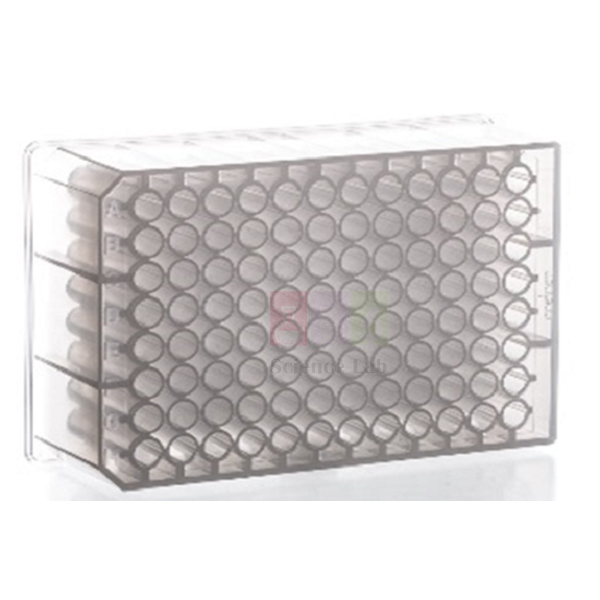
PCR Microplate
PCR Microplate (Product Code: SLE/CL/45) is a 96-well polypropylene plate for running PCR cycles, with slightly opaque white U-bottom wells that are alphanumerically identified. Its thin walls support efficient heat transfer between the thermal block and the reaction, and slightly raised well edges help the plate seal properly. Each plate is individually wrapped, sterile and RNase and DNase free, and is used in regional hospital laboratories, reference centres and molecular biology teaching labs. It forms part of the PCR equipment in India supplied by Jain Scientific Equipments Pvt Ltd (ScienceLab), Ambala.
Specifications
| Parameter | Detail |
|---|---|
| Type | Micro well plate for PCR cycles |
| Material | Polypropylene, autoclavable |
| Number of wells | 96, alphanumerically identified |
| Well colour | Slightly opaque white |
| Well shape | U-bottom |
| Well volume | Accommodates the content of 0.2ml PCR tubes |
| Wall design | Thin walls for optimal thermal transfer |
| Sealing | Slightly raised well edges facilitate plate sealing |
| Condition | Individually wrapped, sterile, RNase and DNase free |
| Compatibility | Stated to fit standard thermo-cyclers, real-time PCR systems and DNA sequencers |
Typical Use
The plate lets a laboratory run up to 96 reactions in one thermal cycler run, for example screening many patient samples, running controls and standards alongside unknowns, or comparing primer conditions. Reactions are usually set up with a multichannel pipette drawing master mix from a reservoir, filling one column at a time; the letter-and-number well labels (rows A to H, columns 1 to 12) make it easy to keep to a plate map. White wells are commonly chosen for real-time PCR because they reflect fluorescence back toward the detector.
Open the wrapper only at the clean bench, wear gloves and use filter tips to keep the plate free of contaminating nucleic acids. Seal the plate evenly across the raised rims before cycling so no well evaporates. Research groups and colleges building lab equipment for research in India often pair this plate with a multichannel pipette to cut set-up time for class practicals and diagnostic runs.
Supplier
This microplate is supplied by Jain Scientific Equipments Private Limited, which trades as ScienceLab from Ambala, Haryana, and supports molecular and clinical laboratories with plasticware as well as its own apparatus. Company background is available on the ScienceLab profile.
Related Laboratory Equipment
Instruments and consumables that complete a plate-based PCR workflow:
- Polymerase Chain Reaction (PCR) Machine — the thermal cycler that runs the plate
- Digital Pipette 8 Channels — fills a full column of wells in one stroke
- Reagent Reservoir 60ml — holds master mix for multichannel pipetting
- Filter Pipette Tips — barrier tips that help prevent carry-over contamination
- Punch DBS 3.0mm — for cutting dried blood spot discs to place into wells
More molecular and clinical items are in the Clinical Laboratory category.
Frequently Asked Questions
Will the plate fit my thermal cycler?
The listing states it fits standard thermo-cyclers, real-time PCR systems and DNA sequencers. To be sure, send us your instrument model and block type through our contact page.
What volume does each well take?
Each well accommodates the content of a 0.2ml PCR tube.
Is the plate sterile and free of nucleases?
Yes. Plates are individually wrapped, sterile, and RNase and DNase free, as listed.
Can the plate be autoclaved?
The polypropylene is autoclavable. Because the plate arrives sterile, autoclaving is normally only needed to decontaminate used plates before disposal.
Is the plate skirted or non-skirted?
The skirt style is not stated in our listing. Ask us to confirm it if your cycler or plate handler needs a particular format.
Can you supply plates in quantity for a testing programme?
Yes. Tell us the number of plates, delivery site and schedule, and we will quote for India or international markets.
Request a Quote
Send an enquiry for PCR Microplate through the contact page, or add it to the enquiry cart with pipettes and tips for a complete PCR set-up quotation.
Last updated: 24 September 2026
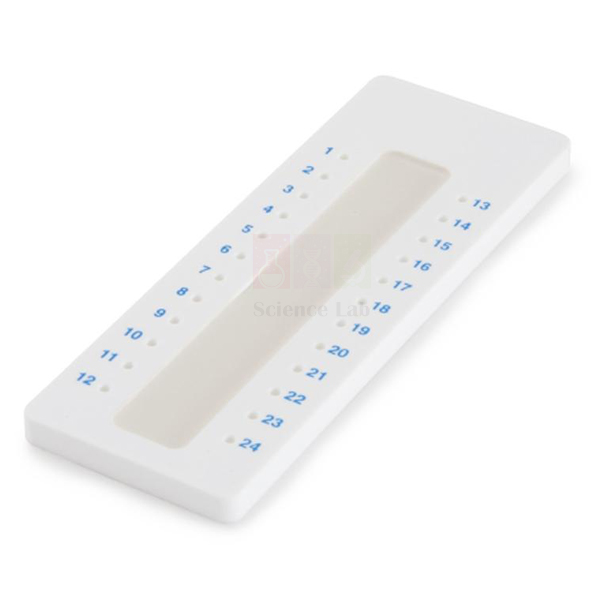
Capillary Tube Sealant
Capillary Tube Sealant (Product Code: SLE/CL/46) is a sealing compound for closing one end of blood-filled capillary tubes before they are centrifuged, supplied with a 24 slot tray that holds the tubes upright and in order. Sealing stops the blood from being thrown out of the tube during spinning, so it is a basic requirement for micro-haematocrit and similar capillary methods. It is used across laboratory services from district laboratories to reference centres, and is one of the lab equipment accessories in India supplied by Jain Scientific Equipments Pvt Ltd (ScienceLab), Ambala.
Specifications
| Parameter | Detail |
|---|---|
| Type | Sealant for capillary tubes |
| Supplied with | 24 slot tray for holding capillary tubes |
| Purpose | Sealing capillary tubes prior to centrifugation |
| Service level | District laboratory to reference centre |
Typical Use
Once a capillary tube has been filled, keep a finger over the clean end, hold the tube upright and press the dry end straight down into the sealant; a small twist as you lift it out leaves a neat plug in the bore. Stand the sealed tube in one of the tray slots so it stays upright and its position can be matched to the patient or student record. Working through the slots in order is a simple way to keep track of several samples before they are loaded into the centrifuge together.
Check each plug before spinning: it should fill the bore completely with no air gap between the plug and the blood. Use a fresh area of sealant for each tube, keep the tray covered between sessions so the surface stays clean, and wear gloves throughout. Teaching labs that run haematocrit practicals on a laboratory centrifuge in India usually keep a spare sealant tray on each bench so students do not have to share.
Supplier
Jain Scientific Equipments Private Limited, known to customers as ScienceLab, supplies this sealant from its base in Ambala, Haryana, as part of a capillary sampling range that also covers tubes, lancets and centrifuges. You can read about the company on its profile page.
Related Clinical Laboratory Items
Items that are used together with capillary tube sealant:
- Capillary Heparin Tube — heparinised glass tubes that are sealed before spinning
- EDTA Capillary Tube — EDTA-coated capillaries for haematology samples
- Haematocrit Centrifuge — spins the sealed tubes for packed cell volume
- Safety Lancet Disposable 2.4 mm — for the finger prick that provides the sample
- Gloves W/o Powder Nitrile Disposable — protection while handling blood-filled tubes
See the Clinical Laboratory range for more haematology consumables.
Frequently Asked Questions
What comes with the sealant?
It is supplied with a 24 slot tray for holding capillary tubes.
How many tubes can stand in the tray at once?
The tray has 24 slots, so up to 24 sealed tubes can be held and kept in sequence.
What is the sealant made of?
The sealant material is not stated in our listing. Please contact us if you need this for your records.
Will it suit the capillary tubes I already use?
It is made for sealing capillary tubes in general. If your tubes are an unusual diameter, tell us the size and we will confirm.
How many tubes can be sealed before the sealant runs out?
This is not stated in the listing and depends on how the sealant is used. Ask us about refill or replacement options when ordering.
Do you supply district and regional laboratories in quantity?
Yes. Send the number of units and delivery locations, and we will quote for India or international markets.
Request a Quote
Price and availability of Capillary Tube Sealant are available through our contact page; you can also add it to the enquiry cart along with capillary tubes.
Last updated: 24 September 2026
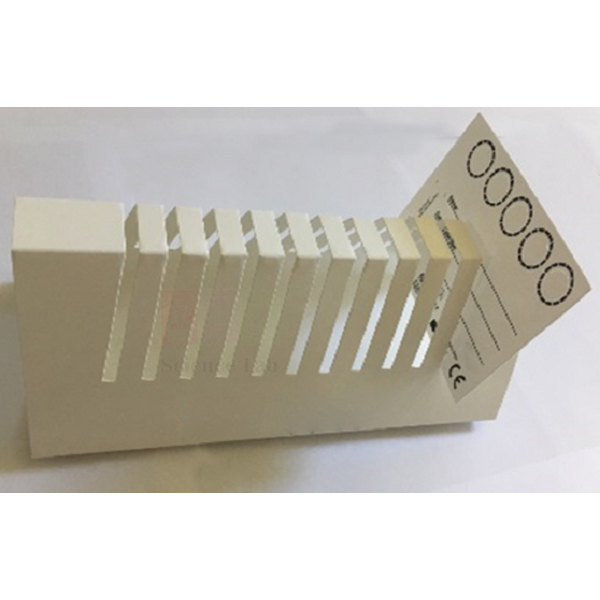
Rack Drying DBS Cards
Rack Drying DBS Cards (Product Code: SLE/CL/47) is a single-use, self-supporting vertical rack that holds 10 dry blood spot (DBS) filter cards in a horizontal position while the blood spots dry. Its sturdy base keeps the loaded rack stable on the bench, and the cards are held apart so the spots do not touch each other or any surface. The rack is used to dry blood samples collected for early infant diagnosis of HIV and suits clinics, sample collection points and laboratories. It is one of the items of disposable lab equipment in India supplied by Jain Scientific Equipments Pvt Ltd (ScienceLab), Ambala.
Specifications
| Parameter | Detail |
|---|---|
| Type | Self-supporting vertical drying rack for DBS filter cards |
| Material | Chemical resistant plastic or card board |
| Capacity | 10 cards, held in a horizontal position |
| Base | Sturdy base for optimal stability |
| Use | Single use |
| Application | Drying blood samples collected for HIV early infant diagnosis |
Typical Use
In early infant diagnosis, blood from a heel or finger prick is dropped onto the printed circles of a DBS card. The card must then dry completely before it is packed, because damp spots can degrade or grow mould in transit. Sliding each card into the rack keeps it flat with the spots facing up and clear of the bench, so air can reach both sides of the paper and blood cannot smear or pool at one edge.
Place the rack in a clean, shaded spot away from direct sunlight, dust and insects, and leave the cards to air-dry for the time set by your programme’s protocol without stacking or heating them. Once dry, the cards are packed for transport and the used rack is discarded with the clinic’s biohazard waste. Health programmes working with a laboratory equipment supplier in India usually order racks in the same quantities as DBS cards so every collection site has enough for each session.
Supplier
This drying rack is supplied by Jain Scientific Equipments Private Limited, the Ambala, Haryana business behind the ScienceLab brand, which provides DBS collection items to health programmes and laboratories. See the ScienceLab company profile for more.
Related Clinical Laboratory Items
Other supplies used in the dried blood spot collection chain:
- Dry Blood Spot Paper — the barcoded filter card that the rack is designed to hold
- Safety Lancet Disposable 2.4 mm — for the skin puncture that provides the blood drops
- Bag Resealable Small Plastic — for packing dried cards once they are ready
- Punch DBS 3.0mm — used in the receiving laboratory to cut discs from the spots
- Biohazard Bag — for disposing of the used single-use rack
The Clinical Laboratory category lists more sample collection and transport products.
Frequently Asked Questions
How many cards does one rack hold?
Ten cards, each held horizontally.
Is the rack plastic or card board?
The listing gives chemical resistant plastic or card board. Please ask us which material applies to your order if it matters for your programme.
Can the rack be reused?
No. It is intended for single use, which avoids carrying blood residue from one batch of cards to the next.
Why are the cards held horizontally?
A flat position lets each spot dry evenly without blood running toward one edge, and keeps the spots off the bench surface.
Does it need any stand or clamp?
No. It is self-supporting and has a sturdy base for stability.
Can you supply racks for a national or regional programme?
Yes. Share the total quantity, the number of delivery points and the schedule, and we will quote for India or international markets.
Request a Quote
Ask for a quotation on Rack Drying DBS Cards via the contact page, or add it to the enquiry cart together with DBS cards and lancets.
Last updated: 24 September 2026
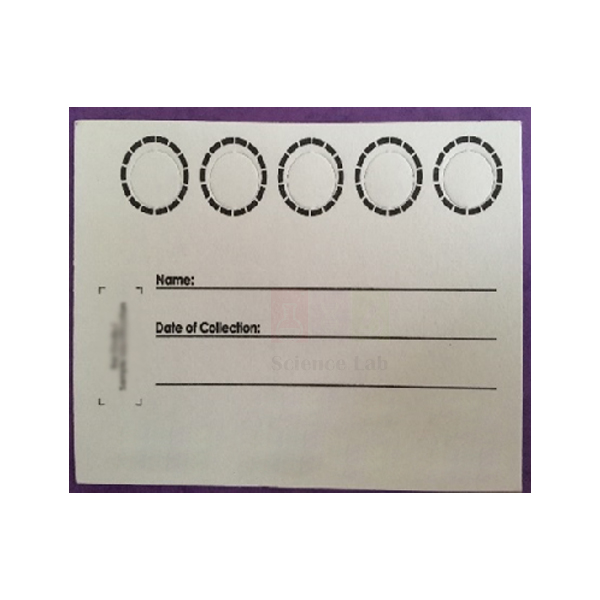
Dry Blood Spot Paper
Dry Blood Spot Paper (Product Code: SLE/CL/48) is a bar-coded dry blood spot (DBS) card with 5 distinct pre-marked spots, used to collect blood for early infant diagnosis of HIV. It collects blood and preserves it for later nucleic acid analysis, with stated DNA stability of at least 24 months. The spots are pre-perforated (pre-punched), which makes it quicker to release sample discs for PCR processing in the receiving laboratory. It is supplied by Jain Scientific Equipments Pvt Ltd (ScienceLab), Ambala, which serves health programmes as a lab consumables supplier in India.
Specifications
| Parameter | Detail |
|---|---|
| Type | Dry blood spot (DBS) card with bar coding |
| Spots | 5 distinct pre-marked spots |
| Spot format | Pre-perforated / pre-punched, for easier PCR processing |
| Function | Collects blood and preserves proteins for future nucleic acid analysis (as listed) |
| Stability | Minimum 24 months for DNA |
| Application | Blood collection for HIV infant early diagnosis |
Typical Use
At the collection point, the health worker records the patient details against the card’s barcode, punctures the infant’s heel or the side of a finger, and lets one large drop fall onto each pre-marked circle so it soaks through the paper. Drops should not be layered or pressed on, and the filter area should never be touched with fingers or gloves. The card is then dried flat, away from sunlight, before being packed for transport to the testing laboratory.
In the laboratory, the pre-perforated spots can be released and placed into extraction tubes or plate wells, reducing the time spent punching discs and the risk of carrying material between samples. Molecular labs that run PCR equipment in India for infant diagnosis rely on the barcode to link each result back to the right child and collection site.
Supplier
Jain Scientific Equipments Private Limited, trading as ScienceLab in Ambala, Haryana, supplies these DBS cards to diagnosis programmes and laboratories together with the lancets, racks and punches used alongside them. The ScienceLab profile describes the company in more detail.
Related Clinical Laboratory Items
Supplies for collecting, drying and processing DBS samples:
- Rack Drying DBS Cards — holds cards flat and apart while the spots dry
- Lancet 2.4 mm Disposable — for the heel or finger puncture
- Punch DBS 3.0mm — for laboratories that also punch discs from the spots
- PCR Microplate — a 96-well plate for running extracted samples in batches
- Gloves W/o Powder Nitrile Disposable — protects both the collector and the sample
Find more collection consumables in the Clinical Laboratory category.
Frequently Asked Questions
How many spots are on each card?
Five distinct pre-marked spots.
How long does the sample remain usable for DNA testing?
The listing states a minimum of 24 months for DNA. This assumes spots are dried and stored properly; stability for other analytes is not stated.
Is each card individually identified?
Yes, the cards carry bar coding so each sample can be traced to its patient record.
Do I still need a DBS punch?
The spots are pre-perforated to make processing easier. Some laboratories still use a punch as part of their method, so follow your own procedure.
Can the card be used for tests other than infant HIV diagnosis?
The listing names HIV infant early diagnosis. Any other use should be validated by the testing laboratory; contact us to discuss your application.
How should unused cards be stored?
Storage conditions for unused cards are not given in the listing. Ask us for handling guidance with your order.
Can you supply programme-scale quantities?
Yes. Tell us the card quantity, delivery points and timeline, and we will prepare a quotation for India or international markets.
Request a Quote
Enquire about Dry Blood Spot Paper through the contact page, or place it in the enquiry cart with drying racks and lancets to receive one quotation.
Last updated: 24 September 2026
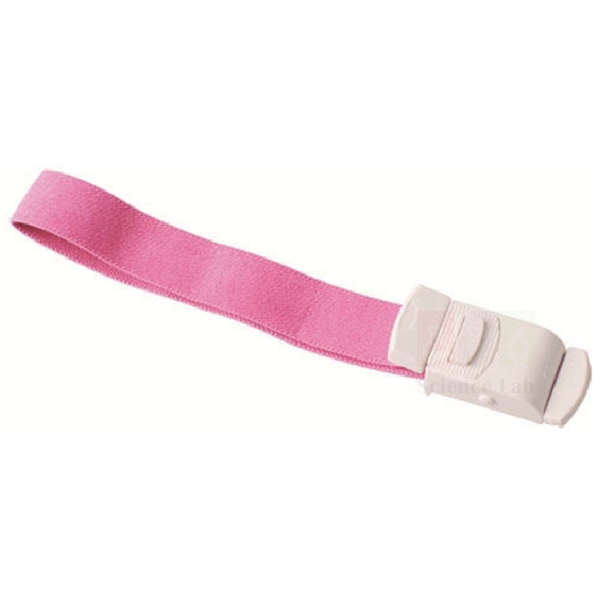
Tourniquet With Buckle
Tourniquet With Buckle (Product Code: SLE/CL/49) is a reusable, washable venipuncture tourniquet made of strong elastic tissue, approximately 2cm wide, with a snap-lock buckle of ABS or an equivalent polymer. Wrapped around the upper arm during blood sample collection, it briefly slows venous return so veins stand out and are easier to puncture; the buckle then lets the phlebotomist release pressure with one quick press. It is used at facilities of every level, from health posts to hospital laboratories and nursing training rooms, and is made by Jain Scientific Equipments Pvt Ltd (ScienceLab), a lab equipment manufacturer in India based in Ambala.
Specifications
| Parameter | Detail |
|---|---|
| Type | Venipuncture tourniquet with buckle |
| Strap material | Strong, elastic tissue |
| Buckle | Snap-lock, made of ABS or equivalent polymer |
| Width | Approximately 2cm |
| Length | 45cm to 75cm |
| Reuse | Reusable, washable |
| Application | Blood sample collection, at all facilities |
Typical Use
Place the strap around the arm roughly a hand’s width above the intended puncture site, pull it snug and click the buckle closed. Ask the patient to make a loose fist, locate the vein, insert the needle and connect the collection tube, then press the buckle to release the strap as soon as blood starts to flow. Leaving a tourniquet on for more than about a minute can alter some test results and cause discomfort, so it should be released before the needle is withdrawn.
Because the strap is washable, clean and disinfect it between patients in line with your facility’s infection-control policy, and remove it from service if the elastic becomes stretched or the buckle stops locking firmly. Nursing and paramedical institutes that buy lab equipment for college training in India find a buckle tourniquet easier for students to handle than a plain rubber strip.
Manufacturer
Jain Scientific Equipments Private Limited, which trades as ScienceLab, manufactures this buckle tourniquet in Ambala, Haryana, and also produces a broad range of laboratory and training apparatus for customers in India and abroad. The company profile gives more detail.
Related Clinical Laboratory Items
Items used in the same venous blood collection routine:
- Vacuum Tube, Plain/Dry — collects clotted blood for serum tests
- EDTA Vacuum Tube — collects anticoagulated blood for haematology
- Gauze Compress — for pressing on the site after the needle is removed
- Adhesive Bandage — to cover the puncture once bleeding stops
- Gloves Exam Latex Without Powder — hand protection for the phlebotomist
Browse the Clinical Laboratory range for more phlebotomy supplies.
Frequently Asked Questions
Is the tourniquet reusable?
Yes. It is reusable and washable, so it can be cleaned and used again rather than discarded after one patient.
What are its dimensions?
The strap is approximately 2cm wide, and the listed length is 45cm to 75cm. Contact us if you need to confirm how the length range applies to your order.
What is the buckle made of?
ABS or an equivalent polymer, with a snap-lock action for quick fastening and release.
Is the strap latex-free?
The listing describes the strap as strong, elastic tissue but does not state latex content. Ask us before ordering if you need a latex-free product.
Is a warranty offered?
Warranty terms are not stated in the listing. We can confirm them with your quotation.
Can you supply tourniquets for many facilities at once?
Yes. Share the quantity and delivery locations and we will quote for supply within India or to international markets.
Request a Quote
To order Tourniquet With Buckle, contact us through the contact page or add it to the enquiry cart alongside tubes and other phlebotomy items.
Last updated: 24 September 2026
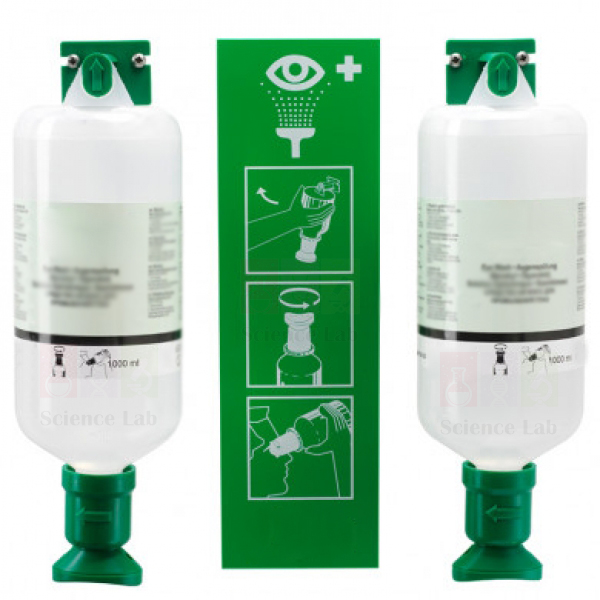
Eye Wash Station
Eye Wash Station (Product Code: SLE/CL/50) is a portable emergency eye-flush station used to rinse the eyes after chemical or blood contamination in clinical laboratories, sample collection rooms and school or college science labs. It holds 2 squeeze bottles of saline solution of approximately 1000 ml each and can stand on a bench top or be wall mounted, so no plumbing is needed. It is supplied by Jain Scientific Equipments Pvt Ltd (ScienceLab), Ambala, India, for institutions planning safety shower eyewash provisions in India.
Specifications
| Parameter | Detail |
|---|---|
| Type | Wash station for emergency eye flush |
| Contents | 2 squeeze bottles of saline solution |
| Bottle volume | Approximately 1000 ml each |
| Installation | Portable; bench top or wall mount |
| Application | Rinsing eyes after chemical or blood contamination, spills or splashes |
| Saline shelf life | Depends on the solution, its packaging and storage conditions; ask us for the expiry date of the batch you are quoted |
| Product code | SLE/CL/50 |
| Supplied by | Jain Scientific Equipments Pvt Ltd (ScienceLab), Ambala, India |
What Is the Eye Wash Station Used For?
Mount or place the station where it can be reached quickly from benches where acids, alkalis, stains or blood are handled, with a clear path and a visible sign. If a splash occurs, the affected person or a colleague takes a bottle, holds the eyelids open and directs the saline from the inner corner of the eye outward so contaminated liquid runs away from the other eye. Keep rinsing for as long as the chemical's safety data sheet or medical advice recommends, then seek medical attention.
Check the bottles during routine safety inspections, replace any bottle that has been opened, and make sure every student and staff member knows where the station is. Many labs keep it beside the first aid box so both are found in one place during an emergency. Squeeze bottles give an immediate first response; where large volumes of hazardous chemicals are handled, your safety officer may also require a plumbed eyewash.
What to Specify When Ordering
- Whether each station will stand on a bench top or be wall mounted, and whether you need us to confirm the mounting hardware
- The number of stations, based on the labs and rooms where chemicals or blood samples are handled
- Any replacement saline squeeze bottles you want quoted with the stations
- The delivery sites, in India or abroad
Supplier
ScienceLab, a trading name of Jain Scientific Equipments Private Limited of Ambala, Haryana, supplies this eye wash station as one of the safety items it offers to schools, colleges, hospitals and clinical labs in India and international markets. Learn more on the company profile.
Related Laboratory Equipment
Protective items that reduce the chance of needing the eye wash in the first place:
- Safety Goggles — eye protection when handling chemicals or blood samples
- Gloves W/o Powder Nitrile Disposable — keeps contaminated hands away from the face
- Lab Coat Work — body protection against splashes at the bench
- Laboratory Safety Chart — a wall reminder of safe practice and emergency steps
See the Clinical Laboratory category for more safety and sampling supplies.
Frequently Asked Questions
What does the Eye Wash Station include?
The Eye Wash Station includes 2 squeeze bottles of saline solution of approximately 1000 ml each, held in a portable station that can be used on a bench top or wall mounted where chemicals or blood samples are handled.
Can the Eye Wash Station be fixed to a wall?
Yes. Wall mounting is one of the listed options for the Eye Wash Station, alongside bench-top use. Mounting hardware is not specified in the listing, so ask us through the contact page what is included with your order.
What kind of incidents is the eye wash station meant for?
The Eye Wash Station is meant for emergency flushing of the eyes after chemical or blood contamination, such as a splash from a reagent bottle or sample tube. It gives an immediate first response while medical help is sought.
How long should the eye be rinsed?
With the Eye Wash Station, rinse for as long as the chemical's safety data sheet or medical advice recommends, keeping the eyelids open and flushing from the inner corner outward, then have the person examined by a doctor.
What is the shelf life of the saline in the Eye Wash Station?
Shelf life of the saline in the Eye Wash Station depends on the solution, its packaging and storage conditions, so no fixed period is stated here. Ask us for the expiry date of the batch you are quoted, and replace any bottle once opened.
Who supplies the Eye Wash Station?
The Eye Wash Station is supplied by Jain Scientific Equipments Private Limited, trading as ScienceLab, from Ambala, Haryana, India, to schools, colleges, hospitals and clinical laboratories in India and international markets along with other laboratory safety items.
Can schools and hospitals order several eye wash stations together?
Yes. Several Eye Wash Stations can be quoted together; send product code SLE/CL/50, the number of stations, any replacement saline bottles and the delivery sites so that we can prepare one quotation.
Request a Quote
For Eye Wash Station pricing, write to us via the contact page, or add it to your enquiry cart together with goggles, gloves and lab coats.
Last updated: 24 September 2026
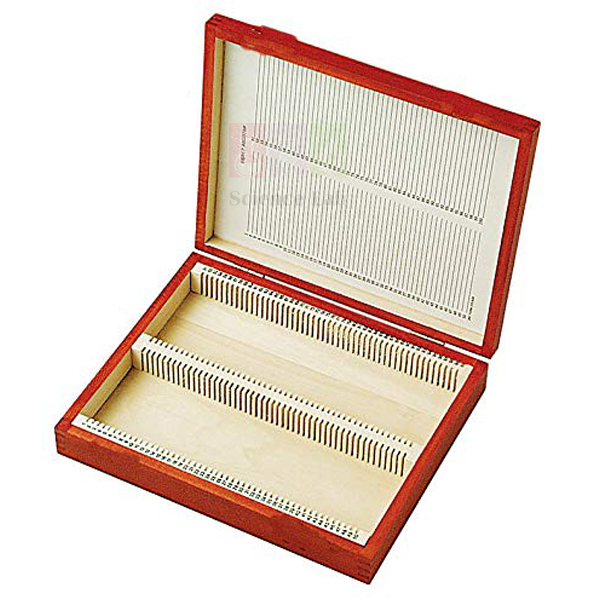
Storage Box, 100 Slides
Storage Box, 100 Slides (Product Code: SLE/CL/51) is a storage box for up to 100 standard microscope slides of 7.6 x 2.6 cm, made of resistant thermoplastic ABS with a cork base. A lid with a sturdy lock keeps the contents secure, and the flap cover carries an index card holder so users can note what each box contains. Pathology labs, blood-film archives, malaria microscopy units and biology departments use boxes like this to keep stained or prepared slides clean, organised and ready for review. It is made by Jain Scientific Equipments Pvt Ltd (ScienceLab), Ambala, a biology lab equipment manufacturer in India.
Specifications
| Parameter | Detail |
|---|---|
| Type | Storage box for microscope slides |
| Capacity | 100 microscope slides |
| Slide size | Standard 7.6 x 2.6 cm |
| Box material | Resistant thermoplastic ABS |
| Base | Cork |
| Closure | Lid with sturdy lock |
| Labelling | Index card holder on the flap cover |
Typical Use
Clinical laboratories often need to keep slides after reporting, for example blood films for review by a senior reader or malaria smears retained for quality-control rechecking. Storing them in a closed box protects the stained surface from dust, light and scratches, while the index card lets staff list slide numbers, dates or patient codes on the outside so a particular slide can be found without opening every box. The lock keeps the lid shut when boxes are carried between rooms or sent to a reference laboratory.
Make sure slides are completely dry and, where applicable, coverslipped before they go in, and keep the box in a cool, dry cupboard. College departments that build up permanent slides for biology teaching in India use the same boxes to keep class sets together from one year to the next. The ABS body can be wiped clean with a mild detergent; avoid strong solvents such as acetone, which can mark this plastic.
Manufacturer
Jain Scientific Equipments Private Limited, incorporated under CIN U29309HR2020PTC087597 and trading as ScienceLab, manufactures laboratory storage and handling items in Ambala, Haryana. Its production site is the licensed factory at 449, HSIIDC Industrial Area, Saha, Ambala, which holds Factory Licence AMB-ONLINE-CHD-J-414. Read more on the ScienceLab company profile.
Related Clinical Laboratory Items
Products that fit the slide preparation and archiving workflow:
- Box Storage 100 slides, Set of 10 — the same slide capacity ordered as a set of ten boxes
- Microscope Slides Glass — plain slides for preparing smears and films
- Rack Staining Slides Horizontal — holds slides flat during staining before storage
- Slide Drying Rack — lets stained slides dry fully before they are boxed
- Diamond Marker — for etching a permanent identifier on each slide
More microscopy and sample handling items are in the Clinical Laboratory category.
Frequently Asked Questions
Which slide size does the box take?
Standard microscope slides of 7.6 x 2.6 cm.
How many slides can be stored?
Up to 100 microscope slides per box.
How is the lid secured?
The box has a lid with a sturdy lock. Whether a key lock is provided is not stated, so ask us if you need one.
How do I record what is inside?
Slip a written index card into the holder on the flap cover and list the slide details there.
What is the purpose of the cork base?
It gives slide edges a softer surface to rest on than bare plastic, which helps reduce chipping when the box is moved.
Can I order a larger number of boxes?
Yes. Single boxes and the set of ten can both be quoted; share your quantity and delivery location for India or international markets.
Request a Quote
Ask for a price on Storage Box, 100 Slides through the contact page, or add it to the enquiry cart with slides and staining racks.
Last updated: 24 September 2026
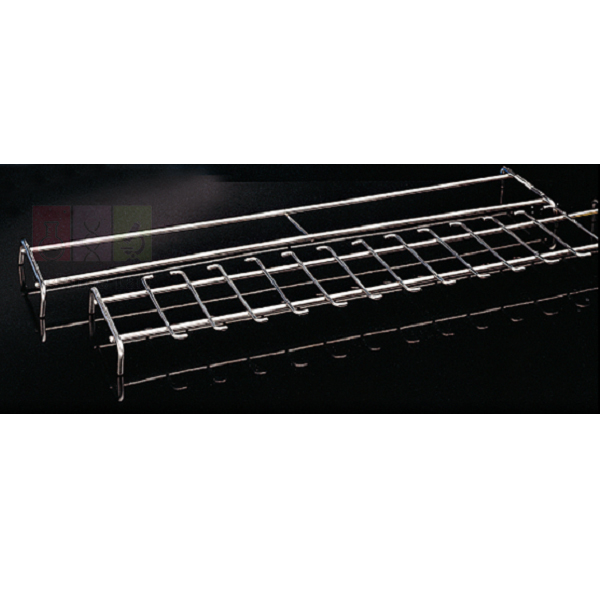
Rack Staining Slides Horizontal
Rack Staining Slides Horizontal (Product Code: SLE/CL/52) is a self-supporting stainless steel rack that holds 12 microscopy slides side by side in a horizontal position for staining. Placed across a sink or a container, it lets stain be flooded onto each slide while run-off drains away underneath, and its sturdy base keeps the rack steady during the process. Haematology, microbiology and parasitology benches, as well as teaching labs, use racks like this for routine smear staining. It is made by Jain Scientific Equipments Pvt Ltd (ScienceLab), Ambala, as part of its range of microbiology lab equipment in India.
Specifications
| Parameter | Detail |
|---|---|
| Type | Self-supporting rack for staining microscopy slides |
| Material | Stainless steel |
| Capacity | 12 microscopy slides |
| Slide position | Horizontal, side by side |
| Base | Sturdy base for optimal stability |
| Placement | Across a sink or container |
Typical Use
After smears have been prepared and fixed, lay them smear-side up across the rack and check that the rack sits level so stain does not run off one end. Each reagent is then dropped or flooded onto the slides in turn, left for the time given in the method, and rinsed away with a gentle stream of water, all without lifting the slides until staining is complete. This flat, flood-style approach suits Gram staining as well as Romanowsky-type blood stains such as Leishman or Giemsa.
Holding a full row of slides together keeps timing consistent across a batch, which is helpful when a Gram stain kit is being used by a class in a school or college lab in India. After each session, rinse the rack with water to remove stain deposits and let it dry before storage; stainless steel keeps its finish well when it is cleaned and dried regularly.
Manufacturer
This stainless steel staining rack is manufactured by Jain Scientific Equipments Private Limited under the ScienceLab name in Ambala, Haryana, where the company produces bench apparatus for clinical and teaching laboratories. Company information is available on our profile page.
Related Clinical Laboratory Items
Items that complete the slide staining routine:
- Coplin Staining Jar — for methods that immerse slides upright instead of flooding them
- Transfer Pipette 3ml — for dropping stain and buffer onto each slide
- Slide Drying Rack — stands stained slides up to drain and dry
- Microscope Slides Glass — plain slides for preparing the smears
- Storage Box, 100 Slides — keeps finished slides safe for later review
The Clinical Laboratory category has more microscopy and staining accessories.
Frequently Asked Questions
How many slides does the rack hold?
Twelve microscopy slides, laid horizontally side by side.
What is it made of?
Stainless steel.
Does it need a special staining tray?
No. The rack is self-supporting and is designed to be placed across a sink or any suitable container that catches the run-off.
Will it fit across my sink or tray?
The rack’s overall dimensions are not stated in our listing. Please contact us with the width of your sink or container so we can confirm.
Which staining methods can be used?
Any method where stain is flooded onto slides lying flat, such as Gram or Leishman staining. Follow the timing and rinsing steps of your chosen stain.
How should the rack be cleaned?
Rinse off stain residues with water after each use and dry it before storage. Avoid leaving it wet with stain overnight.
Do you supply racks to colleges and export customers?
Yes. Tell us the quantity and delivery location, and we will quote for India or international markets.
Request a Quote
Get a quotation for Rack Staining Slides Horizontal via the contact page, or add it to the enquiry cart together with slides, jars and drying racks.
Last updated: 24 September 2026
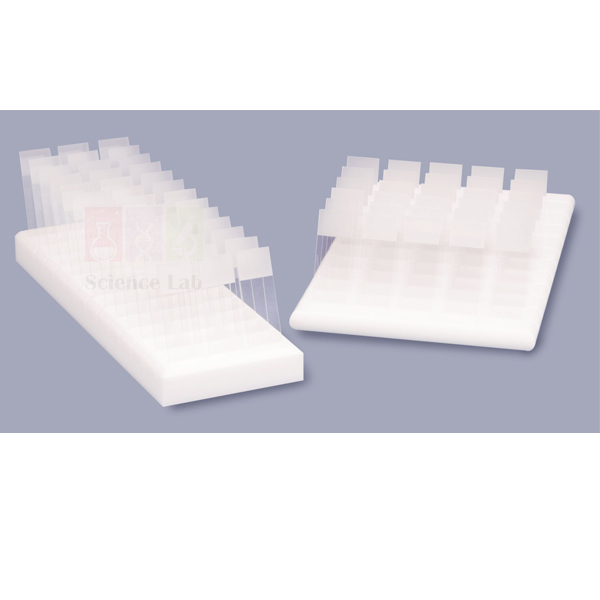
Slide Drying Rack
Slide Drying Rack (Product Code: SLE/CL/53) is a self-supporting stand that holds freshly stained microscopy slides upright while they air-dry, so smears are not smudged, stuck together or left lying in pooled stain before examination. Pathology benches, hospital laboratories and college microbiology practicals use it whenever smears are stained in batches, and it is made by Jain Scientific Equipments Pvt Ltd (ScienceLab), Ambala, India, as a practical part of any microbiology lab setup in India.
Specifications
| Parameter | Detail |
|---|---|
| Material | Heat-stable plastic (plexiglass) |
| Design | Self-supporting rack; sturdy base for optimal stability |
| Capacity | 12 microscopy slides held in a vertical position |
| Positions | 12 numbered positions |
| Drying surface | Slides stand vertically on replaceable blotting paper |
| Intended for | Drying coloured (stained) microscopy slides |
Typical Use
Once a Gram, Giemsa or Ziehl-Neelsen stain has been rinsed off, each slide is stood on its edge in one of the numbered slots with all smears facing the same way. Rinse water and residual stain run down onto the blotting paper at the base instead of drying as a film over the cells, and the upright position lets air reach both faces of the glass. Because every slot carries a number, the technician can note which patient or student sample sits in which position and then read the slides in that order under the microscope.
Change the blotting paper once it is coloured or saturated so that dye cannot wick back onto the slide edges, and wipe the plexiglass with a damp cloth and a mild detergent after each session. The rack is equally at home in a teaching lab and on a small diagnostic bench, making it useful microbiology lab equipment in India wherever slides are stained several at a time.
Manufacturer
This rack comes from Jain Scientific Equipments Private Limited, the Ambala, Haryana company that trades under the ScienceLab name and produces clinical, biology and general laboratory items for schools, colleges and diagnostic laboratories. You can learn more about the business on our company profile page.
Related Clinical Laboratory Equipment
These items are used alongside the slide drying rack in the same staining and microscopy workflow:
- Rack Staining Slides Horizontal — holds slides flat over a sink while stain is flooded on, before they move to the drying rack.
- Coplin Jar Staining — for dipping slides through stain, rinse and decolouriser baths.
- Microscope Slides Glass — plain glass slides for preparing new smears.
- Diamond Marker — etches an identification mark on each slide before it is stained.
- Storage Box, 100 Slides — keeps dried, examined slides organised for review or archiving.
Browse the complete Clinical Laboratory range for more diagnostic and teaching lab items.
Frequently Asked Questions
How many slides does the rack hold at one time?
It holds 12 microscopy slides, each in its own numbered position. For larger staining runs several racks can be used side by side; ask us for a multi-unit quotation.
What is the rack made of?
Heat-stable plastic (plexiglass) with a sturdy base. Clean it with a mild detergent solution and a soft cloth; abrasive pads can scratch the surface.
Why does it use blotting paper?
The slides stand vertically on a replaceable blotting paper strip that soaks up run-off from the stained slides. Please ask us whether replacement sheets can be included with your order.
Can unstained or freshly washed slides be dried in it?
Yes, as long as they fit the slots, although the rack is described specifically for drying coloured (stained) slides. Heat-fixing over a flame should be done before the slide goes into the rack, never in it.
Is a warranty or test report provided?
Warranty terms and any documents you need are confirmed at quotation stage. Please raise them through our contact page.
What details should a college or hospital include when requesting a quote?
Quote the product code SLE/CL/53, the quantity, the delivery address and whether tender paperwork is required. We supply institutions across India and international markets.
Request a Quote
To order the Slide Drying Rack or obtain a formal quotation, send your requirement through our contact page or add it to the enquiry cart along with the other staining items you need.
Last updated: 24 September 2026
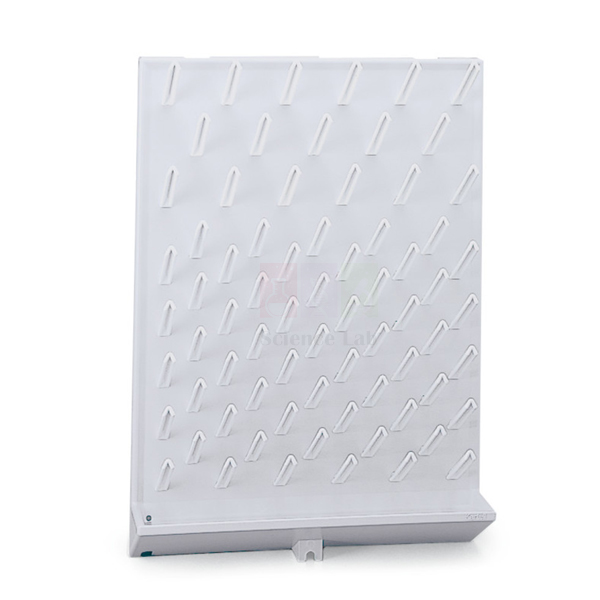
Drying Rack Glass & Plastic Ware
Drying Rack Glass & Plastic Ware (Product Code: SLE/CL/54) is an upright, plastic-coated wire rack on which freshly washed beakers, flasks, cylinders, bottles and plastic containers are inverted to drain and air-dry beside the sink. It suits wash-up areas in clinical, school and college laboratories, where it is often ordered together with new glassware from a single lab glassware supplier in India. The rack is made by Jain Scientific Equipments Pvt Ltd (ScienceLab), Ambala.
Specifications
| Parameter | Detail |
|---|---|
| Material | Plastic-coated wire |
| Mounting | Free-standing or wall mount |
| Dimensions (approx.) | 36 x 16 x 65 cm (w x d x h) |
| Intended for | Drying washed glass and plastic ware |
Typical Use
After washing and a final rinse, turn each vessel mouth-down on the rack so that water runs out rather than collecting inside, and hang narrow-necked items such as volumetric flasks and measuring cylinders so they cannot tip over. The plastic coating keeps bare metal away from the glass, which reduces knocks and scratches while wet items are being handled, and it is equally suitable for polypropylene beakers, bottles and sample containers.
Stand the rack on a draining board next to the sink, or fix it to the wall above the sink when bench space is short; water then drips straight into the basin. Keep heavier glassware on the lower part of the rack for stability. Schools and diagnostic labs that buy from a lab plastic ware supplier in India often pair this rack with a wash bottle of distilled water so that the final rinse leaves no mineral spots as the items dry.
Manufacturer
ScienceLab is the brand under which Jain Scientific Equipments Private Limited, based in Ambala, Haryana, makes wash-room, bench and teaching equipment for laboratories. Visit our company profile for background on the business and its product range.
Related Clinical Laboratory Equipment
Items that belong to the same wash-and-dry routine:
- Brush Test Tube — scrubs the inside of tubes and narrow vessels before they go on the rack.
- Wash Bottle LDPE with Narrow Mouth — directs a final rinse of distilled water over cleaned labware.
- Beaker Plastic — everyday plastic beakers that are dried on this rack between uses.
- Cylinder Measuring Plastic — tall measuring cylinders that drain fully when hung upside down.
- Slide Drying Rack — a separate rack for drying stained microscope slides.
See the full Clinical Laboratory category for more labware and bench accessories.
Frequently Asked Questions
What size is the rack?
Approximately 36 x 16 x 65 cm (width x depth x height). Measure the wall or draining area first if space is tight, and contact us if you need exact dimensions for a drawing.
Can it be fixed to a wall?
Yes. It can be used free-standing or wall mounted. Please check with us whether wall fixings are supplied or should be sourced locally for your wall type.
Why is the wire plastic-coated?
The coating separates the metal frame from the glass and plastic items, cushioning contact while wet labware is loaded and unloaded.
Is it suitable for plastic items as well as glass?
Yes. It is described for drying both glass and plastic ware, so beakers, bottles and containers of either material can share the same rack.
Can microscope slides be dried on it?
Slides are better handled in a dedicated slide rack that holds them upright on their edges; this rack is intended for vessels.
Do you ship multiple racks for several lab rooms or overseas?
Yes. We quote for single units, multi-room school orders across India and export consignments to international markets. Send the quantity and destination via our contact page.
Request a Quote
Add the Drying Rack Glass & Plastic Ware to the enquiry cart with your other wash-room items, or write to us on the contact page for a formal quotation.
Last updated: 24 September 2026
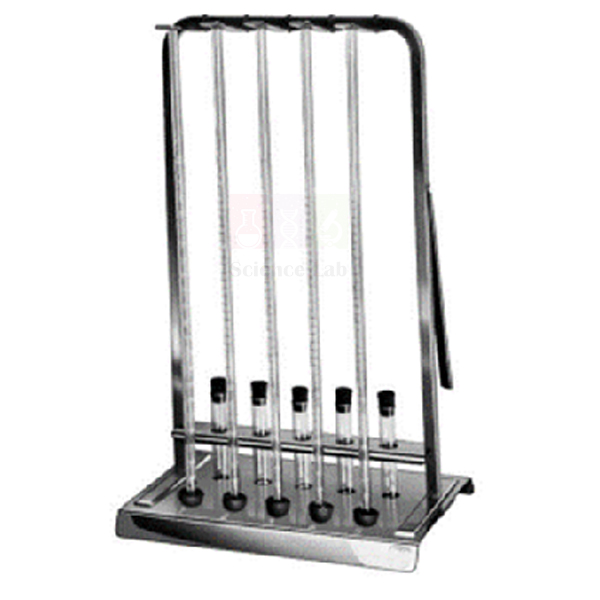
ESR Rack
ESR Rack (Product Code: SLE/CL/55) is a complete set-up for measuring erythrocyte sedimentation rate: a stand that holds five graduated tubes still and upright while red blood cells settle through the plasma column. Haematology benches in hospitals and pathology labs, as well as paramedical and MLT training institutes buying lab equipment for college practicals in India, use it for this routine screening test. The set-up is produced in Ambala by Jain Scientific Equipments Pvt Ltd (ScienceLab).
Specifications
| Parameter | Detail |
|---|---|
| Positions | Holds 5 test tubes |
| Tube graduation | 0 to 200 mm |
| Tube internal diameter | 2.6 mm |
| Pipette holding | Stand with valves to hold pipettes |
| Stand material | Stainless steel or plastic |
| Supplied as | Complete set-up to measure erythrocyte sedimentation rate |
| Use | Specific to the ESR technique; must be used with appropriate tubes |
Typical Use
Well-mixed anticoagulated blood is drawn into a graduated tube up to the zero mark, and the tube is seated in the stand where the valve holds it without leaking. After the reading interval set by the laboratory's own procedure, the technician reads the height of the clear plasma layer above the settled red cells directly from the millimetre scale, and records it as the ESR for that sample. With five positions, a small batch of patients or a group of students can be tested side by side.
Accurate readings depend on setup: place the rack on a level, vibration-free bench away from direct sunlight, fans and heat sources, and make sure each tube stands truly vertical, since even a slight tilt speeds up sedimentation. Rinse reusable tubes promptly after use. Like other manual laboratory instruments in India's pathology labs, the ESR rack gives consistent results only when these simple precautions are followed.
Manufacturer
Jain Scientific Equipments Private Limited makes this ESR set-up in Ambala, Haryana, and sells it under its trading name ScienceLab to hospitals, pathology laboratories and medical training colleges. Details about the company are on our company profile page.
Related Clinical Laboratory Equipment
Items used before, during and after an ESR test:
- Tube ESR — graduated sedimentation tubes; confirm they match this rack before ordering spares.
- EDTA Vacuum Tube — collects anticoagulated venous blood for haematology testing.
- Blood Specimen Rotator — keeps collected samples evenly mixed until the tube is filled.
- Mechanical Timer 60min — times the sedimentation interval with an audible alert.
- Biohazard Bag — for safe disposal of used disposable tubes and blood-contaminated waste.
More haematology and sample-handling items are listed in our Clinical Laboratory category.
Frequently Asked Questions
How many ESR tests can run at the same time?
Five. The rack provides positions for 5 tubes, each held by its own valve.
Are the tubes part of the set?
The rack is described as a complete set-up with tubes graduated 0 to 200 mm and an internal diameter of 2.6 mm. Please confirm the number of tubes and any spares you need when you ask for a quotation.
Can I use other tubes in this rack?
Only appropriate ESR tubes should be used. The scale length and bore of the tube affect the result, so mismatched tubes can give readings that are not comparable.
Is the stand made of stainless steel or plastic?
It is offered in either stainless steel or plastic. State your preference on the enquiry and we will confirm availability.
Can the rack be used for other blood tests?
No. It is a specific product for the ESR technique only.
Can you provide a calibration certificate for the tubes?
Please discuss any documentation you require with us before ordering through the contact page; we will tell you what can be provided.
Request a Quote
For an ESR Rack quotation, mention the stand material and quantity on our contact page, or place it in the enquiry cart with the tubes and collection items you need.
Last updated: 24 September 2026
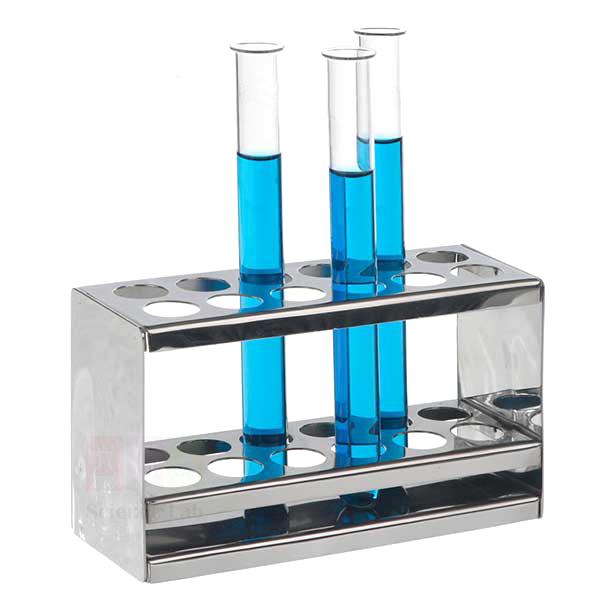
Test Tube Rack SS
Test Tube Rack SS (Product Code: SLE/CL/56) is a stainless steel rack with 24 openings sized for 18 mm test tubes, keeping specimen, reagent and reaction tubes upright and in a fixed order on the bench. It is used mainly in secondary, tertiary and reference clinical laboratories, and teaching labs that want a metal test tube rack for school practicals in India choose it too. Manufacturer: Jain Scientific Equipments Pvt Ltd (ScienceLab), Ambala, India.
Specifications
| Parameter | Detail |
|---|---|
| Capacity | 24 test tubes |
| Material | Stainless steel |
| Tube size | For test tubes of 18 mm diameter |
| Hole diameter | 19 mm |
| Typical setting | Secondary, tertiary and reference facilities |
Typical Use
In a busy biochemistry or serology section, a batch of patient samples is loaded row by row so that each tube's position matches the worksheet; reagents are then added across the rack in the same order, and the whole set can be carried to the centrifuge or reading station without tubes falling over. The 19 mm holes give an 18 mm tube a snug but easy fit, so tubes can be lifted out one-handed while the rest stay in place.
Stainless steel can be wiped with the disinfectants normally used on clinical benches; if a hypochlorite solution is used, rinse the rack with water afterwards and dry it to keep the surface bright. For school and college labs, a steel rack like this is sturdy laboratory equipment for school use in India, where racks are handled by many students every day.
Manufacturer
ScienceLab, the trading name of Jain Scientific Equipments Private Limited, fabricates racks, stands and bench accessories for clinical and educational laboratories from its base in Ambala, Haryana. Our company profile gives an overview of the organisation.
Related Clinical Laboratory Equipment
Equipment that works alongside this rack in routine tube handling:
- Vortex Test Tube — mixes the contents of a tube taken from the rack before it is returned.
- Test Tube Holder — grips a single tube when it has to be warmed or handled away from the rack.
- Brush Test Tube — cleans reusable glass tubes between runs.
- Water Bath Stainless Steel Test Tube Rack — for incubating tubes inside a water bath.
- Test Tube Rack, Polypropylene — a plastic alternative for general teaching benches.
Our Clinical Laboratory category lists more tubes, racks and sample-handling items.
Frequently Asked Questions
Which tube size fits this rack?
It is made for 18 mm test tubes, with holes of 19 mm. Narrower tubes will stand in it but may lean; for other tube sizes please ask us about a suitable rack.
How many tubes can it take?
Up to 24 tubes at once.
What is it made of?
Stainless steel, which suits the frequent wiping and disinfection that clinical benches need.
Can the rack be autoclaved?
Please confirm with us before autoclaving, and tell us the cycle you use, so that we can advise for the version supplied.
Where is this rack typically used?
It is used mainly at secondary, tertiary and reference facilities, and it is also suitable for college and school laboratories that handle 18 mm tubes.
What should a tender or purchase enquiry mention?
Give the product code SLE/CL/56, quantity, consignee address in India or abroad, and any vendor forms you need completed. We serve buyers in India and international markets.
Request a Quote
Request a quotation for the Test Tube Rack SS through our contact page, or collect it in the enquiry cart together with tubes and other bench items.
Last updated: 24 September 2026
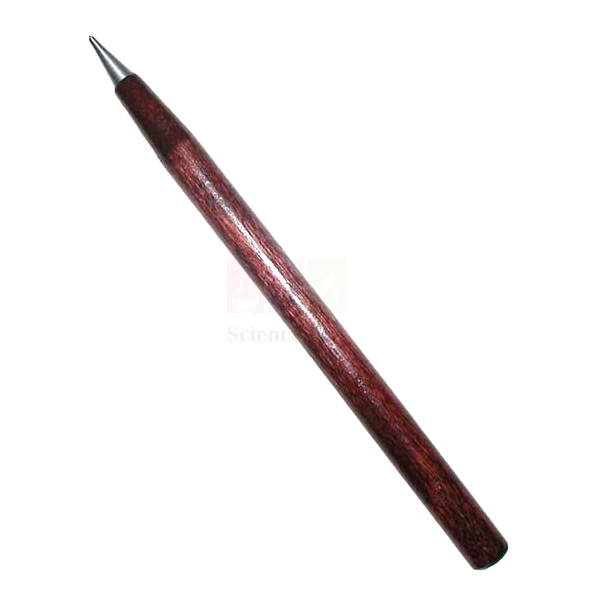
Diamond Marker
Diamond Marker (Product Code: SLE/CL/57) is a pencil-style glass-writing tool whose diamond tip scratches a permanent identification mark onto plain, non-frosted microscope slides. Laboratories at every level, from a basic health-centre lab to a reference centre, use it to number slides before staining, and it is standard lab equipment for college histology and microbiology practicals in India. Jain Scientific Equipments Pvt Ltd (ScienceLab) manufactures it in Ambala, India.
Specifications
| Parameter | Detail |
|---|---|
| Tip | Glass-writing diamond tip |
| Handle material | Wood, plastic or aluminium |
| Supplied as | 3 pencils of the same size |
| Marks on | Glass slides of the non-frosted type |
| Purpose | Identification marking of slides |
| Used in | Laboratory services from basic laboratories to reference centres |
Typical Use
Before a smear is spread, write the sample or patient number near one end of the slide with light, steady pressure, as you would with an ordinary pencil. Because the mark is cut into the glass rather than written in ink, it survives staining, alcohol fixation, xylene and immersion oil, and the slide can still be traced months later when it is pulled from storage for review or teaching.
Put the marker away after each session so the tip is not knocked against hard surfaces, and wipe away the fine glass dust after writing so it does not end up under the cover glass. It sits in the slide-preparation drawer alongside other small biology lab equipment in India, such as spreaders, forceps and cover glasses.
Manufacturer
Jain Scientific Equipments Private Limited, an Ambala, Haryana manufacturer trading as ScienceLab, makes this marker along with the slide-handling and staining items that clinical and teaching labs use every day. See our company profile for more about the company.
Related Clinical Laboratory Equipment
Items used with the marker in slide preparation and storage:
- Microscope Slides Glass — plain slides that take a clear diamond-etched mark.
- Cover Glass Slide — covers the specimen once the marked slide is prepared.
- Slide Drying Rack — holds numbered slides upright to dry after staining.
- Storage Box, 100 Slides — files marked slides in order for later reference.
- Label Self-Adhesive Freezer — an adhesive labelling option for tubes and containers.
Explore more in our Clinical Laboratory category.
Frequently Asked Questions
What comes in one order unit?
The marker is listed as 3 pencils of the same size. Handles may be wood, plastic or aluminium; tell us if you prefer one type and we will confirm what is available.
Will it write on frosted-end slides?
It is intended for non-frosted glass slides. Frosted ends are normally labelled with a lead pencil instead.
Does the mark wash off during staining?
No. The diamond tip scratches the glass surface, so the mark is not removed by stains, alcohol or clearing agents.
Can it be used to cut glass?
It is sold as a marking tool for slide identification, not as a glass cutter.
How should I look after the tip?
Avoid dropping the marker or pressing hard on the glass; store it in a case or drawer where the tip cannot strike other tools.
Can colleges order it in larger quantities?
Yes. We quote for class sets and laboratory stock across India and international markets; send the number of units needed through our contact page.
Request a Quote
Ask for a Diamond Marker quotation on our contact page, or place it in the enquiry cart with slides and staining supplies for a single combined quote.
Last updated: 24 September 2026
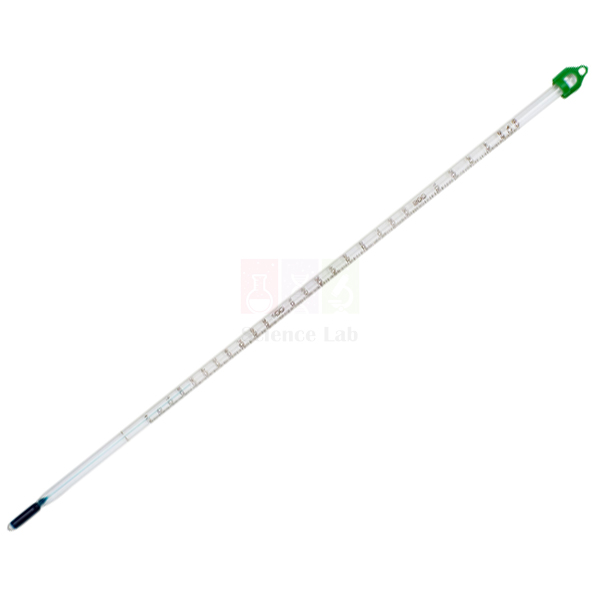
Glass Thermometer
Glass Thermometer (Product Code: SLE/CL/58) is a non-mercury liquid-in-glass thermometer reading from -10 °C to +110 °C on a large, easy-to-read scale. Clinical laboratories use it to measure process temperatures and to validate and control the temperature of equipment such as water baths, incubators and heating blocks, making it a simple piece of thermometry apparatus in India that every diagnostic bench needs. This thermometer is manufactured in Ambala by Jain Scientific Equipments Pvt Ltd (ScienceLab).
Specifications
| Parameter | Detail |
|---|---|
| Range | -10 °C to +110 °C |
| Minimum graduation | 1 °C |
| Filling | Non-mercury |
| Scale | Large, easy-to-read |
| Dimensions (approx.) | 8 x 250 mm (width x height) |
| Application | Measuring processes in the clinical laboratory; validating and controlling temperature in laboratory equipment |
Typical Use
To check a water bath, clamp or hang the thermometer so its bulb sits at the same depth as the samples, wait until the column stops moving, and read the scale at eye level to avoid parallax. In an incubator, standing the bulb in a small beaker of water damps out the swings caused by door openings and gives a truer picture of what the cultures experience. Comparing this reading with the instrument's own display shows whether the controller needs adjustment.
Daily thermometer checks, written into a temperature log for each instrument, are part of routine lab equipment maintenance in India's clinical and teaching laboratories. Store the thermometer flat or in a case, avoid moving it straight from a hot bath to a cold surface, and look for any break in the liquid column before each use.
Manufacturer
ScienceLab is the trading name of Jain Scientific Equipments Private Limited, an Ambala, Haryana company incorporated under CIN U29309HR2020PTC087597. Production takes place at the company's licensed factory at 449, HSIIDC Industrial Area, Saha, Ambala (Factory Licence AMB-ONLINE-CHD-J-414). Read more on our company profile.
Related Clinical Laboratory Equipment
Instruments and fittings this thermometer is commonly used with:
- Water bath, 7 L — the thermometer gives an independent check of bath temperature.
- Incubator 30L, upto 80C — verify chamber temperature against the controller display.
- Thermometer Clamp — holds the thermometer at a fixed depth in a bath or on a stand.
- Digital Pocket Thermometer — an electronic alternative for quick spot readings.
Find more clinical lab instruments in the Clinical Laboratory category.
Frequently Asked Questions
Does the thermometer contain mercury?
No. It is non-mercury filled, so a breakage does not create a mercury spill; broken glass should still be collected carefully.
What range and resolution does it offer?
It reads from -10 °C to +110 °C with a minimum graduation of 1 °C, which covers refrigerators, incubators and boiling water baths.
Will it fit my equipment?
It measures approximately 8 x 250 mm (width x height). Check the depth of the bath, port or rack you plan to use before ordering.
Is a calibration certificate supplied?
Please discuss calibration documentation with us before you order; we will confirm what is available for your requirement.
How should it be stored?
Keep it in a case or lying flat in a drawer, away from sudden heat or cold, and check the liquid column is continuous before each reading.
Can you quote for several thermometers for different instruments?
Yes. Give us the quantity and the list of equipment to be monitored through our contact page; we supply laboratories across India and international markets.
Request a Quote
Send your requirement for the Glass Thermometer via the contact page, or add it to the enquiry cart along with the baths and incubators it will monitor.
Last updated: 24 September 2026
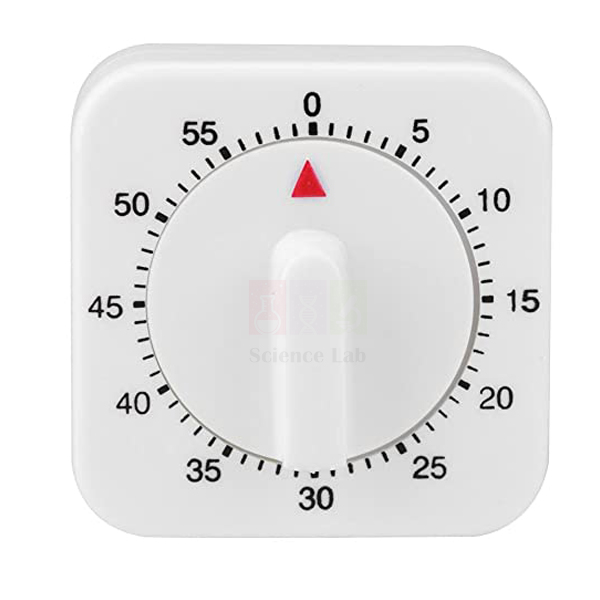
Mechanical Timer 60min
Mechanical Timer 60min (Product Code: SLE/CL/59) is a spring-driven countdown timer for professional use, graduated 0 to 60 minutes and fitted with a loud, long ring-alert when the set time runs out. Because it works mechanically, it needs no batteries or mains supply, so laboratory technicians, teachers and students can rely on it for timing staining steps, incubations and sedimentation readings. It is one of the practical lab equipment accessories in India made by Jain Scientific Equipments Pvt Ltd (ScienceLab), Ambala.
Specifications
| Parameter | Detail |
|---|---|
| Type | Mechanical, spring-driven countdown timer for professional use |
| Range | 0 to 60 minutes |
| Graduation | 5 minute and 1 minute intervals |
| Setting | By rotating the housing, hand ring or dial |
| Mechanism | Steel mechanics inside; housing, spring and gears shock resistant |
| Alarm | Loud, long ring-alert when the time has elapsed |
| Housing | Easy-to-clean, resistant plastic with smooth finish |
| Placement | Stands stable on a surface or clips onto clothes |
| Construction | Robust, light-weight and easy to transport |
Typical Use
Turn the dial to the required number of minutes and the countdown starts at once; the one-minute marks make short steps such as stain contact, decolourising or a clotting-time check easy to set, while the five-minute marks cover longer incubations. When the alarm rings, the technician can move straight to the next step without watching the clock, which keeps results consistent from batch to batch.
Clip the timer to a lab coat pocket when moving between the centrifuge, the microscope and the reception desk, or stand it on the bench beside the staining tray. For teaching laboratories buying from a laboratory instruments supplier in India, a set of these timers lets each student group time its own practical work independently.
Manufacturer
This timer is part of the bench-accessory line of Jain Scientific Equipments Private Limited, which trades as ScienceLab from Ambala in Haryana and serves hospitals, colleges and schools. More about the company is on our company profile.
Related Clinical Laboratory Equipment
Procedures and equipment where a countdown timer is routinely needed:
- ESR Rack — the sedimentation reading is taken after a fixed, timed interval.
- Coplin Staining Jar — timed immersion of slides in stain and rinse baths.
- Rack Staining Slides Horizontal — flood-staining steps timed on the bench.
- Manual Centrifuge — time each spin of the samples.
- Digital Timer — an electronic alternative with a numeric display.
Browse our Clinical Laboratory category for more everyday lab items.
Frequently Asked Questions
Does it need batteries?
No. It is a mechanical, spring-driven timer, so there are no batteries to replace.
What is the longest time it can be set for?
Up to 60 minutes, with graduations every 5 minutes and every 1 minute. For longer runs, a digital timer is more suitable.
Can it be heard in a busy laboratory?
It is fitted with a loud, long ring-alert that sounds when the time has elapsed.
Can I carry it with me?
Yes. It is light and can be clipped onto clothes, or stood on a flat surface.
How do I clean it?
Wipe the smooth plastic housing with a cloth dampened in a mild disinfectant; do not immerse the timer in liquid.
Is it available for class sets or export orders?
Yes. Tell us the number of timers required and the delivery location, in India or overseas, through our contact page.
Request a Quote
For a quotation on the Mechanical Timer 60min, write to us via the contact page or add it to your enquiry cart with the staining or ESR equipment it will be used with.
Last updated: 24 September 2026
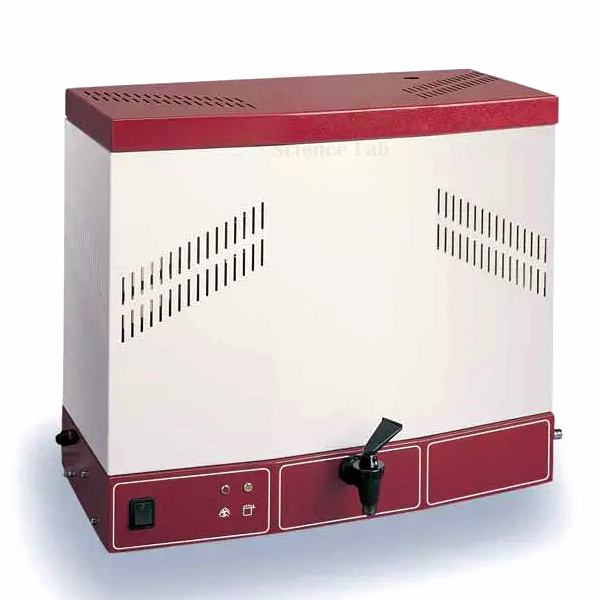
Distillation Unit With Tank
Distillation Unit With Tank (Product Code: SLE/CL/60) is an automatic water purification system that distils raw potable tap water and collects the distillate in an approximately 4 L tank, giving water with an output conductivity of about 2 µS/cm at 25 °C. Clinical, microbiology and teaching laboratories install it as their lab water still in India, supplying the purified water needed for reagents, stains, buffers and final glassware rinses. The unit is built by Jain Scientific Equipments Pvt Ltd (ScienceLab) of Ambala, Haryana.
Specifications
| Parameter | Detail |
|---|---|
| Output conductivity | Approximately 2 µS/cm at 25 °C |
| Tank capacity | Approximately 4 L |
| Operation | Automatic water purification system |
| Feed water | Raw potable water, 3 bar to 7 bar, 4 °C to 35 °C |
| Indicators | At least power on/off, standby and/or process, and tank level |
| Mounting | Free-standing or wall mount |
| Power requirements | 230 V / 50 Hz, with voltage surge protection |
| Protection | Thermostatic control and overheat protection; thermostatic low water cut-off protects the heating element |
Typical Use
The unit is connected to a potable water line within the stated pressure and temperature limits and then runs on its own: it heats the feed water, condenses the steam and fills the storage tank, while the indicators show whether it is powered, in standby or processing, and how full the tank is. Laboratory staff draw water from the tank to make up stains and reagent dilutions, prepare buffers, fill water baths and humidity trays, and give washed glassware a final rinse that dries without mineral spots.
In areas with hard tap water, periodic descaling of the boiling section keeps output steady; ask us for the cleaning routine suited to your unit. For laboratories that do not need a large water distillation plant in India, the wall-mount option lets this unit sit near the water point without taking up bench space. Use stored water promptly rather than keeping it for long periods.
Manufacturer
Jain Scientific Equipments Private Limited designs and builds water stills, baths and other laboratory utilities in Ambala, Haryana, and markets them under the ScienceLab trading name. Learn more on our company profile page.
Related Clinical Laboratory Equipment
Equipment that uses or dispenses the water this unit produces:
- Wash Bottle LDPE with Narrow Mouth — dispenses distilled water for rinsing and making up volumes.
- Reagent Bottle, Narrow Mouth — stores prepared solutions made with distilled water.
- Water bath, 7 L — filling the bath with distilled water limits scale build-up.
- Hot Plate With Stirrer — dissolves salts in distilled water when preparing buffers and reagents.
- Drying Rack Glass & Plastic Ware — air-dries glassware after its final distilled-water rinse.
Discover more in our Clinical Laboratory category.
Frequently Asked Questions
What quality of water does the unit produce?
The output conductivity is approximately 2 µS/cm at 25 °C. If your application needs a different grade, tell us so we can advise.
What feed water connection is required?
Raw potable water at 3 bar to 7 bar and between 4 °C and 35 °C. A plumber can connect it to a normal tap line within these limits.
What happens if the water supply stops?
A thermostatic low water cut-off protects the heating element, and the unit also has thermostatic control and overheat protection.
How much distilled water can it produce per hour?
The hourly output rate is not listed here. Please ask us through the contact page and we will confirm it for the model supplied.
What power supply does it need?
230 V / 50 Hz, with voltage surge protection built in. Contact us if your site runs on a different supply.
Can it be mounted on a wall?
Yes. It can be installed free-standing or wall mounted, whichever suits the space near your water point.
Are installation support and warranty terms available?
Installation guidance and warranty terms are confirmed with each quotation; share your site details with us when you enquire.
Request a Quote
To receive a quotation for the Distillation Unit With Tank, send your site details through the contact page or add it to the enquiry cart with the bottles and baths you plan to supply with distilled water.
Last updated: 24 September 2026
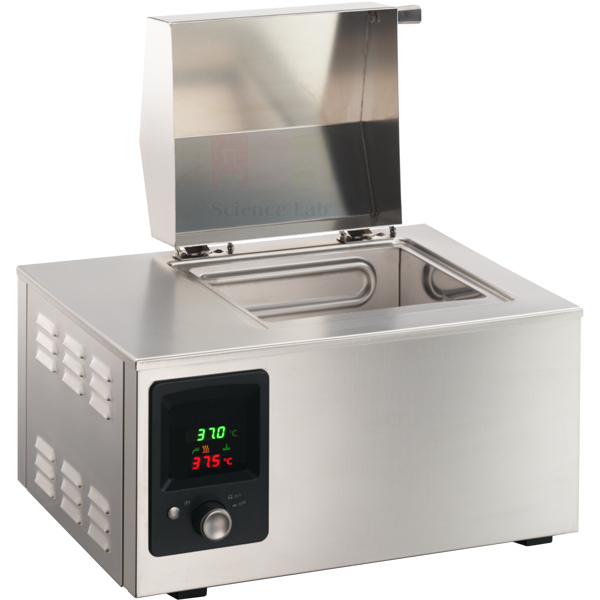
Water bath, 7 L
Water bath, 7 L (Product Code: SLE/CL/61) is a bench-top stainless steel water bath with a micro agitator that keeps the water at an even temperature, providing a controlled environment for incubating samples and tests from 3 °C above ambient up to 100 °C. Serology, biochemistry and blood bank sections in secondary, tertiary and reference facilities use it daily, and colleges needing a water bath for lab practicals in India choose it for the same reasons. Manufactured by Jain Scientific Equipments Pvt Ltd (ScienceLab), Ambala, for clinical and teaching labs.
Specifications
| Parameter | Detail |
|---|---|
| Capacity | 7 L (as per product name) |
| Temperature range | 3 °C above ambient to 100 °C |
| Variation within the bath | 0.1 °C |
| Circulation | Micro agitator homogenising the bath temperature |
| Construction | Stainless steel interior and exterior |
| Safety | Low water level warning; overheating protection |
| Power requirements | 230 V, 50/60 Hz, with voltage surge protection |
| Format | Bench-top, water-filled controlled temperature environment |
Typical Use
Typical jobs include incubating agglutination and coagulation tests at body temperature, inactivating serum, thawing frozen reagents and plasma, and warming culture media or solutions before use. Tubes are stood in a rack inside the bath so the water level sits above the liquid in each tube, and the micro agitator keeps every position at the same temperature so results do not depend on where a tube was placed.
Fill the bath with distilled water to reduce scale on the stainless steel, top it up before each session, and let the low water level warning act as a safety net rather than the routine reminder. Check the set temperature with an independent thermometer at regular intervals. As lab equipment for research in India as well as for routine diagnostics, the bath covers work from just above room temperature to boiling point.
Manufacturer
ScienceLab is how Jain Scientific Equipments Private Limited, an Ambala, Haryana manufacturer, brands the water baths, incubators and heating equipment it builds for laboratories. Background on the company is available on our company profile.
Related Clinical Laboratory Equipment
Items that complete a water bath workstation:
- Water Bath Stainless Steel Test Tube Rack — holds tubes submerged at the right depth; confirm it fits this bath.
- Glass Thermometer — an independent check on the bath temperature.
- Distillation Unit With Tank — supplies distilled water for filling and topping up.
- Test Tube Rack SS — stages tubes on the bench before and after incubation.
- Unstirred Thermostatic Water Bath, 14 Litre — a larger-volume alternative for bigger batches.
More incubation and sample-handling items are in our Clinical Laboratory category.
Frequently Asked Questions
What temperatures can the bath reach?
From 3 °C above ambient up to 100 °C. It has no cooling, so it cannot run below room temperature.
How even is the temperature?
Variation within the bath is 0.1 °C, helped by the micro agitator that homogenises the water.
What safety features are included?
A low water level warning and overheating protection, plus voltage surge protection on the 230 V, 50/60 Hz supply.
What are the internal dimensions?
The bath is a 7 L unit; for exact internal dimensions to plan rack sizes, please ask us via the contact page.
Which water should I use?
Distilled or deionised water is recommended to limit scale; empty, rinse and dry the bath if it will stand unused.
Is a calibration certificate or warranty included?
Documentation and warranty terms are agreed at quotation stage; please raise your requirements when you enquire.
Request a Quote
Ask for a quotation on the Water bath, 7 L through the contact page, or add it to the enquiry cart together with racks and a thermometer for a complete set-up.
Last updated: 24 September 2026
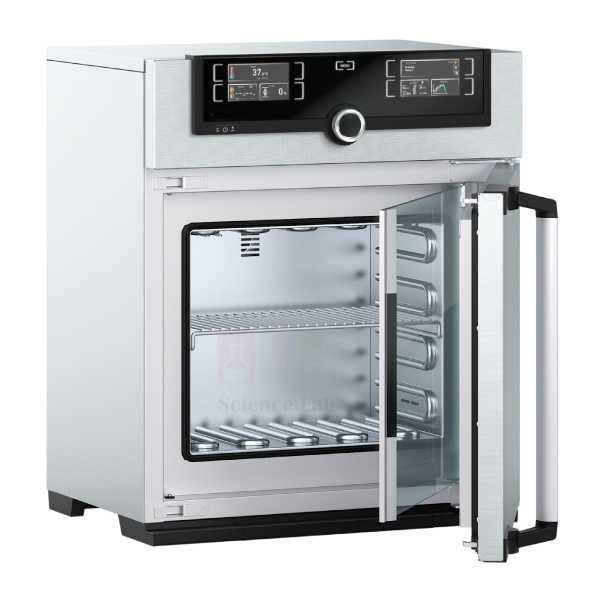
Incubator 30L, up to 80C
Incubator 30L, up to 80C (Product Code: SLE/CL/62) is a natural-convection laboratory incubator used to hold tests, samples and culture media at a set temperature, from 5 °C above ambient up to 80 °C, in clinical, microbiology and teaching laboratories. An adaptive PID microprocessor controller with a TFT colour display sets temperature and time, and the listing gives a maximum capacity of 32 litres with 3 height-adjustable shelves. It is supplied by Jain Scientific Equipments Pvt Ltd (ScienceLab), Ambala, India, for buyers of a bacteriological incubator in India.
Specifications
| Parameter | Detail |
|---|---|
| Maximum capacity | 32 litres, with natural convection |
| Temperature range | 5 °C above ambient up to 80 °C |
| Temperature setting | +20 °C to +80 °C |
| Adjustment precision | 0.1 K |
| Controller | Adaptive multifunctional digital PID microprocessor controller with high-definition TFT colour display (single display) |
| User settings | Temperature and time |
| Monitoring | Electronic temperature monitoring and control |
| Insulation | Double-wall construction |
| Doors | Double door: outer door metal, inner door tempered glass for viewing the contents |
| Inner chamber | Stainless steel |
| Outer cabinet | Easy-to-clean stainless steel; rear of zinc-plated steel |
| Shelves | 3 shelves, adjustable height |
| Power requirements | 100 V to 240 V, 50/60 Hz, with a power-stabilising function against accidental voltage surges |
| Safety | Electronic on-off control and safety device against overheating |
| Product code | SLE/CL/62 |
| Supplied by | Jain Scientific Equipments Pvt Ltd (ScienceLab), Ambala, India |
What Is the 30L Laboratory Incubator Used For?
Inoculated Petri dishes are placed lid-down on the shelves, the required temperature and incubation time are entered on the controller, and the double-wall cabinet and PID control keep conditions steady while colonies develop. Because the inner door is tempered glass, staff can open only the outer metal door to check growth without letting much warm air escape. Beyond routine bacteriology, the same unit handles biochemical tests, enrichment broths and other samples that must be held at a set temperature.
Leave space between stacks of plates so that natural convection can circulate air around them, and adjust the shelf heights before loading tall flasks. Place an independent thermometer inside to check the display periodically, and wipe the stainless steel chamber with a suitable disinfectant between runs. As microbiology lab equipment in India, it covers standard culture work and warm-temperature incubation up to 80 °C.
What to Specify When Ordering
- The working temperatures you need, within the +20 °C to +80 °C setting range and at least 5 °C above your room temperature
- The usable chamber volume you require (the listing gives 32 litres maximum)
- Your site power supply, which should fall within 100 V to 240 V, 50/60 Hz
- Whether you need shelves beyond the 3 height-adjustable shelves supplied
Supplier
ScienceLab, the trading name of Jain Scientific Equipments Private Limited in Ambala, Haryana, supplies this incubator to hospital, public health, college and research laboratories as part of its clinical laboratory range, for buyers in India and international markets. Company background is on our company profile.
Related Clinical Laboratory Equipment
Items used with the incubator in culture work:
- Petri Dish Glass With Lid — reusable culture plates for incubation
- Petri Dish Rack — stacks plates neatly on the incubator shelves
- Glass Thermometer — checks the chamber temperature independently of the controller
- Biohazard Bag — collects used cultures for autoclaving and disposal
- Laboratory Incubator With Visibility Door — an alternative incubator listing to compare
See all items in our Clinical Laboratory category.
Frequently Asked Questions
What is the chamber capacity of the Incubator 30L, up to 80C?
The Incubator 30L, up to 80C is named as a 30 L unit, while its description gives a maximum capacity of 32 litres with natural convection and 3 adjustable shelves. Confirm the usable volume you need when you enquire.
Can the 30L incubator hold temperatures close to or below room temperature?
No. The Incubator 30L, up to 80C works from 5 °C above ambient up to 80 °C, with a set-point range of +20 °C to +80 °C. For incubation at or below room temperature, ask us about alternatives.
How precisely can the incubator temperature be set?
The Incubator 30L, up to 80C has an adjustment precision of 0.1 K on its adaptive multifunctional digital PID microprocessor controller, which has a high-definition TFT colour display and lets the user set both temperature and time.
What power supply does the 30L incubator need?
The Incubator 30L, up to 80C accepts 100 V to 240 V at 50/60 Hz and includes a function that stabilises power against accidental voltage surges, plus electronic on-off control and a safety device against overheating.
Is a calibration certificate available for the incubator?
Calibration-certificate availability for the Incubator 30L, up to 80C should be discussed with us before ordering. Tell us through the contact page what verification your laboratory needs, and we will confirm what can be provided.
Who supplies the Incubator 30L, up to 80C?
The Incubator 30L, up to 80C is supplied by Jain Scientific Equipments Private Limited, which trades as ScienceLab from Ambala, Haryana, India, to hospital, public health, college and research laboratories in India and international markets.
What should a tender enquiry for the 30L incubator include?
A tender enquiry for the 30L laboratory incubator should give product code SLE/CL/62, the quantity, the delivery location, your site power supply and any documents your tender requires, so that we can prepare a complete quotation.
Request a Quote
Request a quotation for the Incubator 30L, up to 80C on our contact page, or add it to the enquiry cart with Petri dishes and other culture supplies.
Last updated: 24 September 2026
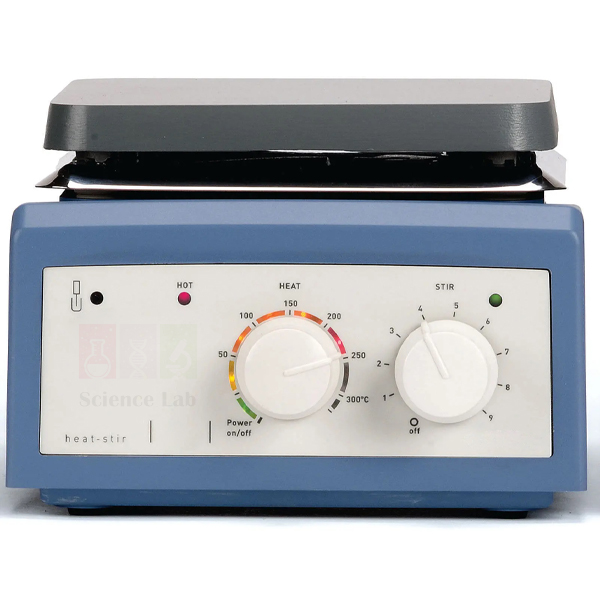
Hot Plate With Stirrer
Hot Plate With Stirrer (Product Code: SLE/CL/63) is a bench-top heater with a built-in magnetic stirrer, pairing a ceramic glass heating surface adjustable up to 450 °C with an electronically controlled motor of infinitely variable speed. Clinical and teaching laboratories use it for many techniques, above all to prepare buffers and other reagents, and it is a practical hot plate magnetic stirrer for India's diagnostic and college labs. Its manufacturer is Jain Scientific Equipments Pvt Ltd (ScienceLab) of Ambala, India.
Specifications
| Parameter | Detail |
|---|---|
| Type | Bench-top heater with magnetic stirrer; single stirring place |
| Temperature control | Adjustable up to 450 °C |
| Heating power | Approximately 500 W |
| Heating surface | Ceramic glass, on a synthetic lower base |
| Stirring motor | Electronically controlled, infinitely variable speed |
| Speed | Approximately 100 to 2000 rpm |
| Maximum stirring capacity | 15 L |
| Power requirements | 220 V / 50 Hz, with voltage surge protection |
| Supply versions listed | 120 V, 60 Hz or 230 V, 50 Hz |
Typical Use
To make a buffer, weigh the salts, add them to distilled water in a flat-bottomed glass beaker or flask, drop in a magnetic stirrer bar and set a moderate speed; gentle heat speeds up dissolving, and the solution is then cooled and brought to volume. The same set-up dissolves agar and media powders, keeps suspensions homogeneous during dispensing, and warms solutions for titrations or staining preparations.
Raise the stirring speed gradually so the bar does not lose coupling with the magnet and rattle, and keep the vessel centred on the single stirring place. The ceramic glass stays hot for some time after switching off, so let it cool before cleaning with a soft damp cloth. Laboratories comparing a laboratory magnetic stirrer in India will find that combining heating and stirring in one unit saves both bench space and a separate hot plate.
Manufacturer
Jain Scientific Equipments Private Limited produces this hot plate stirrer in Ambala, Haryana, where the company operates under the ScienceLab trading name. For vendor registration, ScienceLab's GSTIN is 06AAECJ8618A1ZT and its Legal Entity Identifier (LEI) is 3358004HRD1JIVXKYX49. See our company profile for more.
Related Clinical Laboratory Equipment
Items used in the same reagent-preparation workflow:
- Magnetic Stirrer Bar — the stirring element placed inside the vessel.
- Stirrer Bar Retriever — removes the bar from hot or finished solutions safely.
- Digital Scale 1500g/0.1g — weighs salts and powders before they are dissolved.
- Distillation Unit With Tank — provides distilled water for buffers and reagents.
- Cylinder Measuring Plastic — measures solvent volumes before and after mixing.
Our Clinical Laboratory category lists more preparation and analysis equipment.
Frequently Asked Questions
What is the maximum temperature?
The temperature control is adjustable up to 450 °C, with a heating power of approximately 500 W.
How much liquid can it stir?
The maximum stirring capacity is 15 L, at speeds of approximately 100 to 2000 rpm.
Is a stirrer bar included?
The contents supplied are not listed here, so please confirm with us; stirrer bars are also available separately.
Which mains supply does it need?
It is listed for 220 V / 50 Hz with voltage surge protection, and supply versions of 120 V, 60 Hz or 230 V, 50 Hz are also mentioned. State your local supply when ordering so we can confirm the correct version.
Which vessels should I use?
Use flat-bottomed, heat-resistant glassware on the ceramic surface; plastic containers should not be heated on it.
What registration details can you provide for vendor onboarding?
We can share our GSTIN, LEI and other company registration details with purchase departments; send your vendor form through our contact page.
Request a Quote
To request a quotation for the Hot Plate With Stirrer, contact us through the contact page or add it to the enquiry cart together with stirrer bars and glassware.
Last updated: 24 September 2026
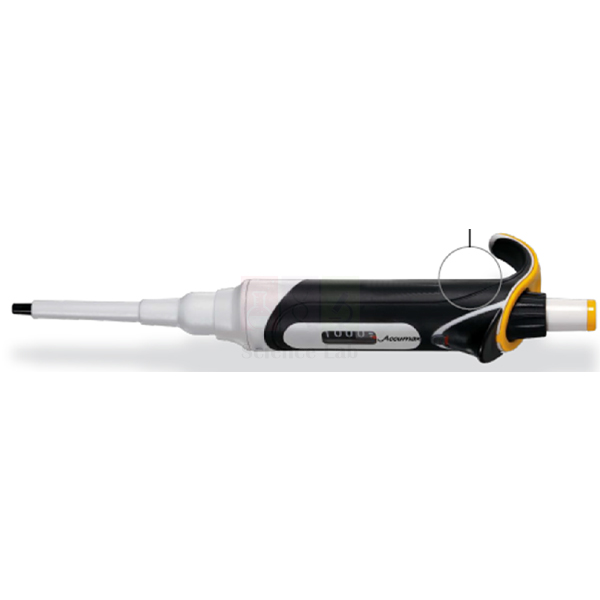
Digital Pipette 8 Channels
Digital Pipette 8 Channels (Product Code: SLE/CL/64) is an automatic air-displacement micropipette that delivers the same volume through eight detachable, disposable tips at once, across a 20–200 µl range, with the set volume shown on a digital read-out in the handle. Immunology, serology and molecular biology benches use it to fill and dilute microplates row by row, and research groups treat it as core lab equipment for research in India wherever many wells must be pipetted identically. The pipette is manufactured by Jain Scientific Equipments Pvt Ltd (ScienceLab) in Ambala.
Specifications
| Parameter | Detail |
|---|---|
| Channels | 8 |
| Volume range | 20–200 µl, using 8 detachable, disposable tips |
| Principle | Automatic air-displacement micropipette |
| Volume setting | Digital setting and read-out of delivered volume on the handle |
| Volume increments | Adjustable in increments of at least 0.5 µl |
| Volume lock | Locks to prevent accidental volume changes |
| Tip ejection | Push-button tip ejecting system |
| Material | Sturdy, chemical- and UV-resistant material |
| Sterilisation | Fully autoclavable (121 °C) |
Typical Use
Set the volume, lock it, and press the manifold evenly into a row of tips so that all eight seal at the same depth. Aspirate from a reagent reservoir with the pipette held vertical, then dispense into a row of microplate wells in one stroke; this is how ELISA plates are coated, washed by hand, loaded with samples and developed, and how serial dilutions are run across a plate far faster than with a single-channel pipette.
Check that every tip has drawn the same liquid height before dispensing, pre-wet tips for viscous or volatile liquids, and eject tips straight into a waste container with the push button so that contaminated tips are never handled. Autoclave the pipette when protocols require it, and keep it upright on a stand between uses. For institutions sourcing laboratory instruments in India for immunoassay work, an 8-channel pipette is usually paired with an 8-channel washer and reader.
Manufacturer
ScienceLab is the trade name used by Jain Scientific Equipments Private Limited of Ambala, Haryana, for its range of pipetting, sample-handling and clinical laboratory equipment. Visit our company profile to know more about us.
Related Clinical Laboratory Equipment
Accessories and instruments used in the same microplate workflow:
- Reagent Reservoir 60ml — a trough from which all eight channels aspirate at once.
- Pipette Tip Barrier Ster 200ul — sterile barrier tips; confirm the fit on the pipette nozzles.
- PCR Microplate — plates filled row by row with the multichannel pipette.
- ELISA Washer 8 Channel — washes the same eight-well rows between assay steps.
- ELISA Reader 8 Channel — reads the finished plate.
More pipetting and immunoassay equipment is listed in our Clinical Laboratory category.
Frequently Asked Questions
What volume range does it cover?
20–200 µl per channel, set digitally in increments of at least 0.5 µl.
Which tips does it take?
It accommodates 8 detachable, disposable tips in the 20–200 µl range. Tip fit varies between brands, so please confirm the tips you plan to use with us before ordering in quantity.
Can it be autoclaved?
Yes. It is fully autoclavable at 121 °C.
Can the set volume change during use?
The pipette locks to prevent accidental volume changes once the setting has been made.
Is a calibration certificate supplied with the pipette?
Please discuss calibration documentation with us before placing an order through the contact page; we will advise on what is available.
Can it be used inside a biosafety cabinet with UV?
It is made of chemical- and UV-resistant material, which suits work in cabinets where UV is used between sessions.
Request a Quote
Enquire about the Digital Pipette 8 Channels through the contact page, or add it to the enquiry cart together with tips, reservoirs and plates for a single quotation.
Last updated: 24 September 2026
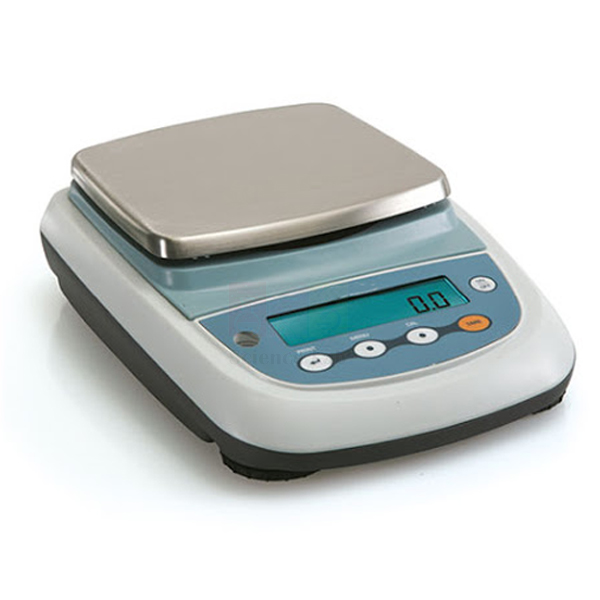
Digital Scale 1500g/0.1g
Digital Scale 1500g/0.1g (Product Code: SLE/CL/65) is a top-pan electronic scale with 0.1 g readability for weighing reagents, culture media powders, samples and small parts in clinical and teaching laboratories. A backlit LCD, built-in counting and percentage programmes and a choice of mains adapter or battery power make it a flexible digital weighing balance in India's labs, from the preparation room to a field station. Jain Scientific Equipments Pvt Ltd (ScienceLab), Ambala, is the manufacturer.
Specifications
| Parameter | Detail |
|---|---|
| Capacity / readability (per product name) | 1500 g / 0.1 g |
| Readability | 100 mg (0.1 g) |
| Reproducibility | 0.1 g |
| Linearity | 0.1 g |
| Response time | Less than 1 second |
| Display | 7-segment LCD with backlight |
| Pan size | 127 mm x 140 mm |
| Levelling | Levelling feet and level indicator |
| Keypad | Positive-action touch keys; one tare key |
| Calibration | Automatic calibration using an external standard reference weight; calibrated at factory |
| Built-in programmes | Net total, weighing-in percentage, counting and 18 weighing units |
| Protection | Overload (overweight) protection |
| Power | AC adapter (included) or 4 x "A" size dry-cell batteries |
Typical Use
Level the scale with its feet until the level indicator is centred, switch on and allow it to settle, then place a weighing boat or beaker on the pan and press tare so only the reagent is weighed. The 0.1 g readability suits weighing media powders, buffer salts and disinfectant concentrates, while the counting programme estimates the number of identical items from a sample count and the percentage mode helps when checking fill weights or formulations.
Keep the scale away from draughts, vibration and direct sun, and wipe spilled powder off the pan and keypad straight away. Run the automatic calibration with an external reference weight whenever the scale is moved or at the interval set by your quality plan. For schools and colleges choosing a digital weighing balance in India, the battery option also lets the same unit be used outdoors in ecology or field practicals.
Manufacturer
This scale comes from Jain Scientific Equipments Private Limited, which trades as ScienceLab from Ambala, Haryana, and manufactures measuring and laboratory equipment for education and diagnostics. See our company profile for more.
Related Clinical Laboratory Equipment
Items used with the scale in weighing and solution preparation:
- Plastic Weighing Boats — tared containers that keep powders off the pan.
- Weighing Paper — a disposable surface for small quantities of dry reagents.
- Beaker Plastic — for weighing liquids or larger portions directly.
- Hot Plate With Stirrer — dissolves the weighed salts into buffers and reagents.
- Precision Digital Scale — another digital scale in our clinical range for comparison.
Find more measuring equipment in our Clinical Laboratory category.
Frequently Asked Questions
What are the capacity and readability?
As the name states, it is a 1500 g scale reading to 0.1 g (100 mg), with reproducibility and linearity of 0.1 g.
Can it run without mains power?
Yes. It works from the included AC adapter or from 4 "A" size dry-cell batteries.
How is it calibrated?
It is calibrated at the factory and offers automatic calibration using an external standard reference weight. Please ask us whether a reference weight can be supplied with it; any calibration certificate requirement should also be discussed with us before ordering.
Which weighing units and functions are available?
There are 18 weighing units plus programmes for net total, weighing-in percentage and counting.
How large is the weighing pan?
The pan measures 127 mm x 140 mm.
What happens if it is overloaded?
The scale has overload (overweight) protection; still, avoid placing loads above its rated capacity.
Can schools order several scales for a lab?
Yes. Send the quantity and delivery location through our contact page; we supply institutions across India and international markets.
Request a Quote
For a quotation on the Digital Scale 1500g/0.1g, reach us through the contact page or add the scale to the enquiry cart with weighing boats and paper.
Last updated: 24 September 2026
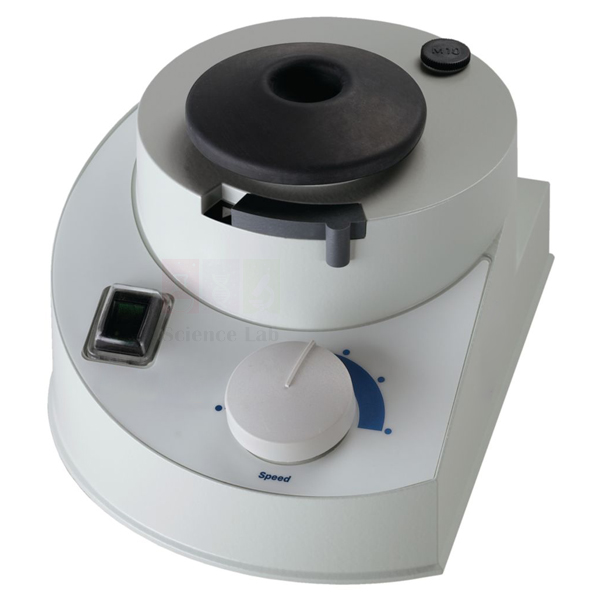
Vortex Test Tube
Vortex Test Tube (Product Code: SLE/CL/66) is a compact vortex mixer for one test tube at a time: pressing a tube into its rubber top sets the head moving in a small circular horizontal orbit that swirls samples and reagents into a vortex. Clinical, microbiology and molecular biology labs rely on this kind of vortex mixer in India for resuspending cells, mixing serum with reagents and preparing dilutions. This mixer is a product of Jain Scientific Equipments Pvt Ltd (ScienceLab), Ambala, Haryana.
Specifications
| Parameter | Detail |
|---|---|
| Type | Compact shaker/vibrator for a single test tube |
| Tube size | Rubber top cavity takes tubes up to 30 mm diameter |
| Operating modes | Touch mode (starts mixing when the rubber top is pressed down with a tube) and switch mode for continuous operation |
| Speed | Continuously adjustable, up to 3200 rpm |
| Orbit | Circular horizontal orbit of 5.6 mm |
| Stability | Non-skid feet prevent the shaker from sliding |
| Power requirements | 100 V to 240 V, 50/60 Hz, with voltage surge protection |
| Intended use | Mixing samples and reagents |
Typical Use
In touch mode the mixer waits until a tube is pressed onto the rubber cup, so a technician can work through a rack quickly: pick up a tube, hold it near the top, press for a few seconds, and return it. Switch mode keeps the head running continuously, which is handy for longer mixing such as dissolving a pellet or suspending beads while both hands prepare the next step.
Start at a lower speed and increase it until the liquid forms a vortex without climbing to the cap, and always close or cover tubes that contain infectious material. For whole blood, gentle inversion or a rotator is preferred over vigorous vortexing. It is a small but frequently used piece of lab equipment for research in India, from student DNA extraction practicals to routine serology.
Manufacturer
Jain Scientific Equipments Private Limited, known to customers as ScienceLab, makes mixers, shakers and other bench instruments at Ambala in Haryana for hospitals, colleges and research groups. Our company profile tells you more.
Related Clinical Laboratory Equipment
Tubes, racks and tools used with the vortex mixer:
- Test Tube Rack SS — keeps tubes upright and in order before and after mixing.
- Screw Cap Conic Tube — capped conical tubes that can be vortexed without spills.
- Screw Cap Tube 5.0 ml — small capped tubes for sample and reagent mixing.
- Transfer Pipette, 3ml — adds reagents to the tube before mixing.
- Blood Specimen Rotator — gentle mixing for blood collection tubes, where vortexing is unsuitable.
Browse the Clinical Laboratory category for more sample-preparation equipment.
Frequently Asked Questions
What tube sizes can it mix?
The rubber top cavity takes tubes up to 30 mm in diameter, one tube at a time.
What is the difference between touch and switch mode?
In touch mode it starts only when a tube is pressed onto the rubber top; in switch mode it runs continuously until switched off.
How fast does it run?
Speed is continuously adjustable up to 3200 rpm, with a circular horizontal orbit of 5.6 mm.
Will it work on my mains supply?
It accepts 100 V to 240 V at 50/60 Hz and includes voltage surge protection, so it suits most supplies in India and international markets.
Can it mix several tubes or microplates?
It is designed as a single-tube mixer. Ask us via the contact page if you need a multi-tube or plate shaker.
How do I clean it?
Unplug the unit, then wipe the rubber top and housing with a mild disinfectant; do not let liquid run into the base.
Request a Quote
For a Vortex Test Tube quotation, use our contact page or add it to the enquiry cart along with tubes and racks.
Last updated: 24 September 2026
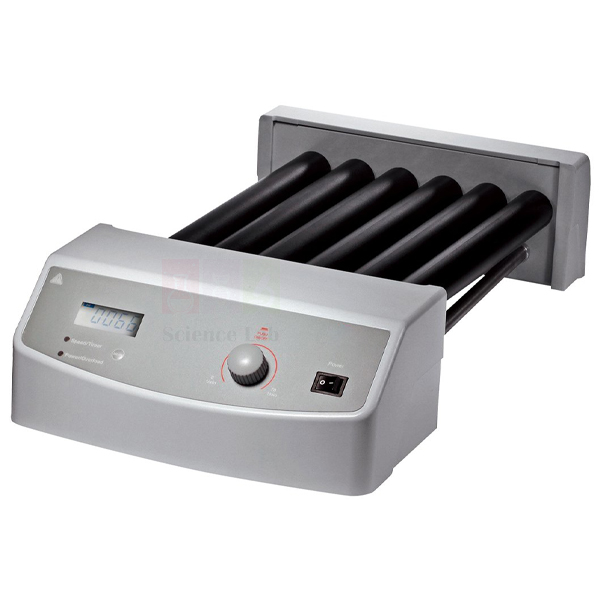
Blood Specimen Rotator
Blood Specimen Rotator (Product Code: SLE/CL/67) gently mixes up to 22 blood collection tubes by combining a rocking motion with rotation around a horizontal axis, keeping anticoagulated samples homogeneous and preventing clots from forming while they wait for analysis. Haematology sections, blood banks and sample collection centres across India rely on this kind of laboratory instrument before cell counts, ESR and other tests. The rotator is manufactured by Jain Scientific Equipments Pvt Ltd (ScienceLab), based in Ambala.
Specifications
| Parameter | Detail |
|---|---|
| Motion | Rocking motion with rotation around a horizontal axis |
| Capacity | 22 tubes |
| Tube size | 10–16 mm diameter (1.5 ml – 15 ml tubes) |
| Speed control range | 5–30 RPM |
| Timer | Built in |
| Power requirements | 100–240 V, 50/60 Hz, with voltage surge protection |
| Purpose | Thorough mixing of blood sample tubes to prevent clotting |
Typical Use
Freshly collected EDTA or citrate tubes are placed on the rotator as soon as they reach the laboratory, the speed and timer are set, and the combined rocking and rotating movement slowly turns each tube end over end so that cells and plasma stay evenly distributed. When the analyser or ESR stand is ready, the technician takes a tube straight from the rotator, confident that the sample has not settled or started to clot.
Use the lower end of the speed range for whole blood to avoid foaming or damaging cells, and spread tubes evenly across the rotator. Wipe the tube positions with a suitable disinfectant after any leak and at the end of each day. Hospitals and collection centres that buy from a laboratory instruments supplier in India often place one rotator beside each haematology analyser.
Manufacturer
Behind the ScienceLab brand is Jain Scientific Equipments Private Limited (CIN U29309HR2020PTC087597), a company based in Ambala, Haryana. It manufactures laboratory equipment at its licensed factory, 449, HSIIDC Industrial Area, Saha, Ambala, operating under Factory Licence AMB-ONLINE-CHD-J-414. Read the full company profile.
Related Clinical Laboratory Equipment
Items from the same blood collection and haematology workflow:
- EDTA Vacuum Tube — anticoagulant tubes that need regular mixing before testing.
- Tourniquet With Buckle — used during venous blood collection.
- ESR Rack — well-mixed samples go from the rotator into the ESR tubes.
- 18 parameter Haematology Analyser — performs cell counts on the mixed samples.
- Vortex Test Tube — for vigorous mixing of reagents rather than whole blood.
Our Clinical Laboratory category lists more haematology and sample-handling items.
Frequently Asked Questions
How many tubes does it hold?
22 tubes of 10–16 mm diameter, which covers collection tubes from 1.5 ml to 15 ml.
Can the speed be adjusted?
Yes. The speed control range is 5–30 RPM.
Does it have a timer?
Yes. It is fitted with a timer so mixing can run for a set period.
Can it take tubes wider than 16 mm or bottles?
It is specified for 10–16 mm tubes. For larger containers, please ask us through the contact page about a suitable mixer.
What power supply does it need?
100–240 V, 50/60 Hz, with voltage surge protection.
What details are needed for a hospital tender?
Quote the product code SLE/CL/67, quantity and consignee details; we can provide company registration information for vendor registration and supply across India and international markets.
Request a Quote
Get a quotation for the Blood Specimen Rotator via our contact page, or add it to the enquiry cart with collection tubes and haematology consumables.
Last updated: 24 September 2026
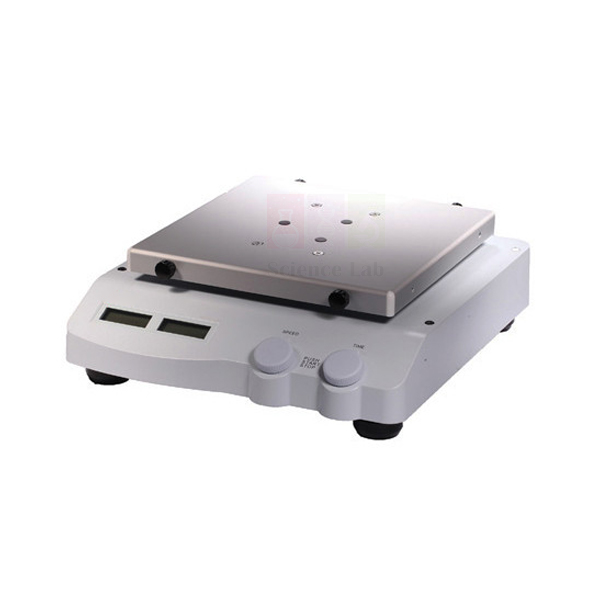
Orbital Shaker
Orbital Shaker (Product Code: SLE/CL/68) is a microprocessor-controlled bench shaker that moves its platform in a steady circular orbit to mix, dissolve and keep in suspension the liquids held in flasks, beakers, dishes and Petri dishes. It can run continuously or on a timer, and is used mainly in secondary and tertiary laboratories with a stable power supply, where it supports several techniques and, most often, the preparation of reagents for more complex tests. It is made by Jain Scientific Equipments Pvt Ltd (ScienceLab), Ambala, as part of its range of analytical lab instruments in India for clinical and teaching laboratories.
Specifications
| Parameter | Detail |
|---|---|
| Type | Microprocessor-controlled orbital shaker |
| Operation | Continuous or timed |
| Speed setting | 100 to 350 rpm |
| Amplitude | 4mm |
| Platform size | Approximately 24 x 24 cm |
| Suitable vessels | Flasks, beakers, dishes and Petri dishes |
| Load | Up to 2.5 kg |
| Display | LCD showing set and actual speed, plus set and elapsed time |
| End of run | Audible signal indicates automatic switch-off |
| Power requirements | 100V/240V, 50/60Hz, with voltage surge protection |
| Documentation | Instructions for use |
| Typical setting | Secondary and tertiary facilities with stable power supply |
Typical Use
In a clinical laboratory the shaker is usually loaded with flasks of buffer or reagent that must be brought fully into solution, culture dishes that need gentle and even agitation, or beakers of stain being mixed before filtration. The operator sets a speed between 100 and 350 rpm and either leaves the unit running continuously or enters a run time. The LCD shows the set and actual values side by side, and a beep confirms when a timed run has switched itself off, so staff can attend to other tasks instead of watching the clock.
Spread vessels evenly across the 24 x 24 cm platform, keep the total load within 2.5 kg, and start at a low speed before stepping up so that liquid does not climb over the rim; open beakers and Petri dishes generally need slower settings than stoppered flasks. Built-in surge protection helps where mains voltage fluctuates, but the instrument is still best placed on a stable, level bench. Laboratories assembling lab equipment for research in India often pair one shaker with a hot plate stirrer so that both gentle mixing and heated stirring are available.
Manufacturer
This orbital shaker is manufactured by Jain Scientific Equipments Private Limited, the Ambala, Haryana company that trades under the ScienceLab name and builds instruments for clinical, teaching and research laboratories. Background on the company, its facilities and its product lines is available on the ScienceLab company profile.
Related Clinical Laboratory Equipment
Items commonly used alongside the shaker when preparing and mixing reagents:
- Petri Dish Glass With Lid — culture dishes that sit flat on the platform for gentle agitation
- Beaker Plastic — open vessels for mixing reagent solutions at low speed
- Hot Plate With Stirrer — for solutions that must be heated while they are stirred
- Vortex Test Tube — rapid mixing of individual tubes too small for the platform
- Orbital Shaker, Digital — another digital orbital shaker listed in our Laboratory Instruments range
See the complete Clinical Laboratory range for further instruments and consumables.
Frequently Asked Questions
What speed range and orbit does the shaker offer?
Speed is set between 100 and 350 rpm with a 4mm amplitude, and the LCD displays both the set and the actual speed during the run.
How much can the platform carry?
Up to 2.5 kg, on a platform of approximately 24 x 24 cm that accommodates flasks, beakers, dishes and Petri dishes. Our listing does not describe clamps or a holding mat, so please contact us to confirm how your vessels will be secured.
Can it be left to run unattended?
Yes, in timed mode. It switches off automatically at the end of the set time and gives an audible signal; for longer jobs it can also run continuously.
What power supply does it need?
100V/240V at 50/60Hz, with voltage surge protection built in. It is intended for facilities that have a stable power supply.
Is a calibration certificate or warranty included?
Neither is stated in our listing. Please discuss calibration certificate availability and warranty terms with our team before ordering.
What should an institutional enquiry include?
The quantity, delivery location, local mains standard and any documents your purchase process requires. We quote for laboratories across India and international markets.
Request a Quote
Send your requirement for the Orbital Shaker through our contact page, or add it to the enquiry cart together with the glassware and consumables you need, and we will reply with a quotation.
Last updated: 24 September 2026
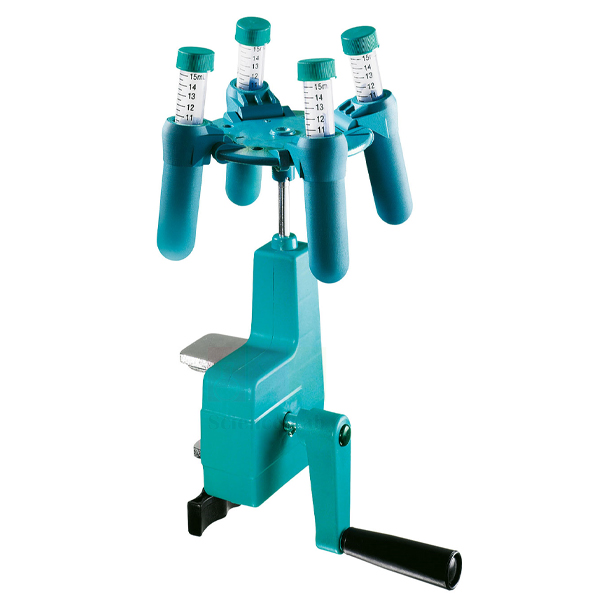
Manual Centrifuge
Manual Centrifuge (Product Code: SLE/CL/69) is a hand-operated centrifuge that spins four 15 ml conical tubes in a swing-out rotor without needing any electrical supply. Turning the handle drives a dismountable aluminium gear structure up to a maximum shaft speed of 3000 min^-1, enough for routine sedimentation work such as urine deposits or separating serum from clotted blood. Health posts, field laboratories, outreach programmes and teaching rooms use it where mains power is unreliable or absent. It is made by Jain Scientific Equipments Pvt Ltd (ScienceLab), Ambala.
Specifications
| Parameter | Detail |
|---|---|
| Type | Manual (hand-operated) centrifuge |
| Drive | Dismountable aluminium gear structure |
| Maximum shaft speed | 3000 min^-1 |
| Rotor | Swing-out rotor for 4 x 15 ml conical tubes (swings to 90°) |
| Buckets | 4 aluminium buckets for test tubes |
| Base | Aluminium |
| Mounting | Bench clamp with adaptable screw (0 to 40mm) |
| Power | None required – hand operated |
Typical Use
Fix the centrifuge to the edge of a sturdy table using the bench clamp, then load the buckets in opposite pairs with tubes filled to the same level so the rotor stays balanced. Crank the handle smoothly, building speed gradually, and hold it steady for the time your method specifies. When you stop turning, let the rotor coast to rest on its own rather than slowing it by hand, so the sediment is not stirred back up. The swing-out buckets lie horizontal during the spin, which gives a compact pellet at the tip of each conical tube.
For anyone comparing a laboratory centrifuge in India for off-grid clinics, school biology practicals or emergency field kits, the attraction of this model is its independence from power and generators. Because the gear structure can be dismounted, the unit also packs down for transport between sites. Wipe the buckets after every session and dry them fully before storage.
Manufacturer
Jain Scientific Equipments Private Limited, which trades as ScienceLab from Ambala in Haryana, manufactures this manual centrifuge as part of its clinical laboratory line for health and education customers. More about the company is set out on the ScienceLab profile page.
Related Clinical Laboratory Equipment
Useful companions for hand centrifugation of small samples:
- Screw Cap Conic Tube — conical tubes for the swing-out buckets; check the size against the 15 ml buckets
- Transfer Pipette Sterile — to draw off the supernatant after the spin
- Rack Tubes Set of 3 — keeps tubes upright before and after centrifuging
- Centrifuge Complete w/accessories — electric bench-top option for sites with steady power
- Hand Centrifuge — another hand-driven model from our Centrifuges range
More sampling and testing items are listed in our Clinical Laboratory category.
Frequently Asked Questions
Does the Manual Centrifuge need electricity?
No. It is entirely hand operated through its aluminium gear structure, so it can be used where there is no mains supply.
How many tubes does it hold, and what size?
Four 15 ml conical tubes, carried in four aluminium buckets on a swing-out rotor.
How fast does it spin?
The maximum shaft speed is 3000 min^-1 (3000 revolutions per minute). The speed actually reached depends on how steadily the handle is turned; our listing does not mention a speed indicator.
How is it fixed to the bench?
With a bench clamp whose adaptable screw covers 0 to 40mm, so it can be secured to a table edge within that thickness.
Can it be dismantled for transport or cleaning?
Yes, the gear structure is dismountable. Clean the buckets and base with a mild detergent solution and dry them thoroughly before reassembly.
Are spare buckets or a warranty available?
These are not stated in our listing. Please contact us to ask about spare parts and warranty terms.
Can you supply several units for a field programme?
Yes. Tell us the quantity and delivery point and we will quote for supply within India or to international markets.
Request a Quote
To order the Manual Centrifuge, write to us through the contact form or place it in the enquiry cart with any tubes and racks you need.
Last updated: 24 September 2026
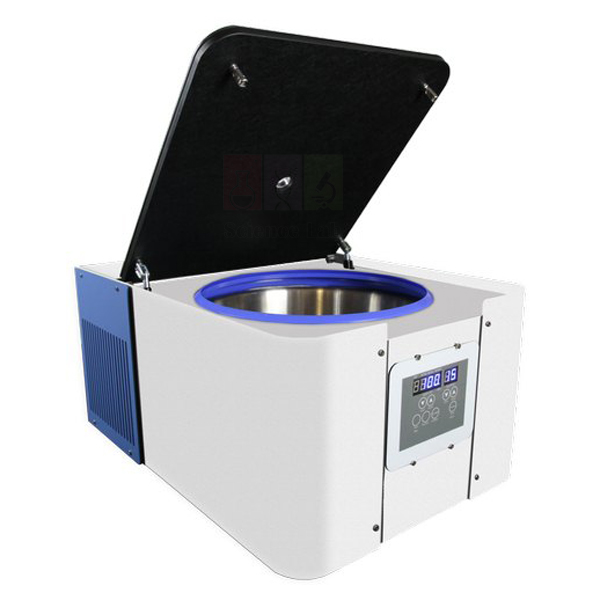
Centrifuge Complete w/accessories
Centrifuge Complete w/accessories (Product Code: SLE/CL/70) is an electrically driven bench-top centrifuge for processing blood, urine and other clinical samples in busy laboratories. Speed is adjustable up to 6000rpm and a 1-99 minute timer ends each run, while an automatic brake and a lid interlock keep the chamber closed until the rotor has stopped. It is intended mainly for secondary and tertiary facilities that handle a higher sample throughput and have a stable power supply. The unit is made by Jain Scientific Equipments Pvt Ltd (ScienceLab), Ambala, and joins its range of laboratory instruments in India for hospital and teaching laboratories.
Specifications
| Parameter | Detail |
|---|---|
| Type | Bench-top centrifuge |
| Speed | Adjustable, up to 6000rpm |
| Timer | 1-99 minutes |
| Safety features | Automatic brake and lid interlock |
| Construction | Stainless steel casting |
| Power requirements | 220V/110V, 50/60Hz, with voltage surge protection |
| Intended use | Sample processing |
| Typical setting | Secondary and tertiary facilities with higher sample throughput and stable power supply |
| Supplied as | Complete with accessories (itemised list on request) |
Typical Use
The most common job for this centrifuge is separating serum or plasma from collected blood before chemistry, serology or blood-bank testing, followed by spinning urine samples for sediment examination. After setting the speed and the run time, the operator closes the lid, starts the run and leaves the unit to finish on its own; the automatic brake slows the rotor at the end of the cycle, and the interlock prevents the lid being opened while it is still turning.
The original specification stresses that staff must be appropriately trained in its safe use, including how to balance the load and how to deal with spills. In practice that means placing tubes of equal volume in opposite positions, never overfilling tubes, and, if a tube breaks, waiting for aerosols to settle before opening the lid and disinfecting the chamber. Laboratories moving up from a hand-cranked unit usually find that a powered model with a timer frees technicians for other work during each spin.
Manufacturer
ScienceLab is the trading name of Jain Scientific Equipments Private Limited, a company based in Ambala, Haryana, which manufactures this bench-top centrifuge together with other clinical and educational laboratory apparatus. The company profile gives an overview of the business and its work.
Related Clinical Laboratory Equipment
Tubes, pipettes and racks used in the same sample-processing workflow:
- Tube Vacuum Serum Gel — gel tubes that form a barrier between serum and cells on spinning
- Vacuum Tube, Plain/Dry — plain tubes for clotted-blood serum separation
- Transfer Pipette, 3ml — to transfer separated serum or plasma into aliquot tubes
- Test Tube Rack SS — stainless steel rack for staging tubes before and after spinning
- Haematocrit Centrifuge — dedicated unit for capillary haematocrit tubes
The Clinical Laboratory section lists further collection, processing and testing products.
Frequently Asked Questions
Which accessories are included?
The unit is listed as complete with accessories, but our listing does not itemise them or state the rotor and tube capacity. Please contact us for the accessory list before ordering.
What speed and timer range does it offer?
Speed is adjustable up to 6000rpm, and the timer can be set from 1 to 99 minutes.
What safety features does it have?
An automatic brake and a lid interlock. Voltage surge protection is also built into the power section.
What power supply is required?
220V/110V at 50/60Hz. The centrifuge is intended for facilities with access to a stable power supply.
Do operators need training?
Yes. Staff should be trained in safe use, including balancing the rotor correctly and handling spills or broken tubes.
Can speed verification or a calibration certificate be provided?
This is not stated in our listing. Please discuss calibration certificate availability with us when you request a quotation.
Request a Quote
For pricing and delivery of the Centrifuge Complete w/accessories, use our contact page or add the item to the enquiry cart. Please mention the mains voltage at your site and the tube types you plan to spin.
Last updated: 24 September 2026
Haematocrit Centrifuge
Haematocrit Centrifuge (Product Code: SLE/CL/71) is a high-speed centrifuge designed for haematocrit capillary tubes, used to find the packed cell volume of a blood sample – the share of the sample occupied by red cells once they have been spun down. It runs at a fixed speed of approximately 13000rpm with a 1-99 minute timer, and an automatic brake and lid interlock make each run safer for the operator. Haematology benches, anaemia screening clinics, blood donation camps and medical laboratory technology courses rely on this simple test every day. It is made by Jain Scientific Equipments Pvt Ltd (ScienceLab), Ambala.
Specifications
| Parameter | Detail |
|---|---|
| Type | Haematocrit centrifuge |
| Tubes | Haematocrit capillary tubes |
| Speed | Fixed, approximately 13000rpm |
| Timer | 1-99 minutes |
| Safety features | Automatic brake and lid interlock |
| Construction | Stainless steel or coated steel casting |
| Power requirements | 220V/110V, 50/60Hz, with voltage surge protection |
Typical Use
A capillary tube is filled from a finger prick or from a well-mixed anticoagulated sample, one end is closed with sealant, and the tube is placed in the rotor with the sealed end facing outward. Tubes are loaded opposite one another to keep the rotor balanced, the timer is set to the time your procedure calls for, and the lid is closed. Because the speed is fixed, every run is spun at the same approximate 13000rpm, which helps keep results consistent between operators. Once the brake has stopped the rotor, the lengths of the packed red-cell column and the total column are read against a haematocrit reading scale.
Always record the tube position and patient identity before spinning, and discard any capillary that has leaked or cracked. Hospitals and training institutes looking for a laboratory equipment supplier in India often order this unit together with capillary tubes and sealant so the complete packed-cell-volume test is ready from the first day.
Manufacturer
This haematocrit centrifuge comes from Jain Scientific Equipments Private Limited in Ambala, Haryana, the company behind the ScienceLab brand of laboratory apparatus. ScienceLab is the trading name of this registered MSME enterprise, whose major activity is manufacturing (Udyam UDYAM-HR-01-0003714), and its export shipments are handled under Importer-Exporter Code AAECJ8618A issued by the DGFT. You can learn more on the ScienceLab company profile.
Related Clinical Laboratory Equipment
Consumables and equipment for the complete packed-cell-volume test:
- Capillary Heparin Tube — anticoagulated capillaries for direct finger-prick filling
- EDTA Capillary Tube — an alternative anticoagulant capillary for blood collection
- Capillary Tube Sealant — closes one end of each capillary before spinning
- Safety Lancet Disposable 2.4 mm — single-use lancet for the finger-prick sample
- Centrifuge Complete w/accessories — general bench-top centrifuge for larger sample tubes
Browse our Clinical Laboratory products for more haematology supplies.
Frequently Asked Questions
Which tubes does this centrifuge accept?
It is built for haematocrit capillary tubes. For ordinary sample tubes, a general bench-top centrifuge is the right choice.
Can the speed be adjusted?
No. The speed is fixed at approximately 13000rpm; you control the run with the 1-99 minute timer.
How many capillaries can be spun at once?
The rotor capacity is not stated in our listing. Please contact us to confirm the number of positions.
Is the casing stainless steel?
The listing gives stainless steel or coated steel casting. Ask us which finish applies to your order if this matters for your laboratory.
What protects the operator during a run?
An automatic brake and a lid interlock, together with voltage surge protection on the 220V/110V, 50/60Hz supply.
Can a calibration certificate or warranty be provided?
Neither is stated in our listing. Please discuss calibration certificate availability and warranty cover with us before you order.
Do you supply export and tender orders?
Yes. We quote for institutions in India and international markets; share the quantity, voltage and delivery location.
Request a Quote
Ask for a quotation for the Haematocrit Centrifuge through our contact page, or add it to your enquiry cart along with capillary tubes and sealant.
Last updated: 24 September 2026
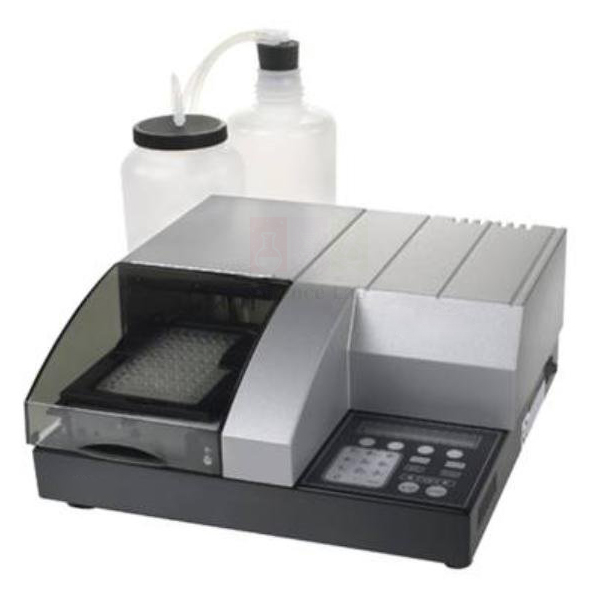
ELISA Washer 8 Channel
ELISA Washer 8 Channel (Product Code: SLE/CL/72) is an automatic bench-top washer that aspirates and dispenses wash solution across microplates or strips during ELISA (Enzyme-Linked Immunosorbent Assay) testing. Its 8-channel strip manifold works on eight wells per pass, a built-in vacuum and pressure pump drives the fluidics, and up to 75 wash protocols can be stored for different kits. Serology and immunology laboratories, blood banks, hospital diagnostic departments and research groups use it to replace tedious and variable hand washing. It is supplied by Jain Scientific Equipments Pvt Ltd (ScienceLab), Ambala, a laboratory analytical instruments supplier serving India and international markets.
Specifications
| Parameter | Detail |
|---|---|
| Type | Micro-plate or strip washer for ELISA |
| Platform | Bench-top, open and automatic system |
| Manifold | 8-channel strip manifold |
| Plate types | Flat, round, U or V-shaped bottom plates |
| Protocols | 75 user-definable protocols |
| Programmable parameters | 16-character assay name, number of cycles, wash volume, flow rate, variable soak times, aspiration and dispensing |
| Wash cycles | 1 to 10 |
| Dispensing volume | 25 to 3000ul |
| Fluid flow rate | 150 to 1000ul/well/second, to accommodate cellular assays |
| Soak time | 1-600 seconds |
| Aspiration | Crosswise/double aspiration of flat-bottom micro-plates for reduced residual liquid |
| Pump | Built-in vacuum and pressure pump assembly |
| Bottles | For waste, rinse and wash solutions |
| Protection | Spill-over protection; electronics isolated from fluidics |
| Operating conditions | Humidity up to 70%; operating temperature 15°C to 40°C |
| Power requirements | 220V/50Hz, with voltage surge protection |
| Included | Dust cover |
Typical Use
Every ELISA has several points where unbound sample, conjugate or substrate must be removed from the wells before the next reagent goes in, and incomplete washing is a leading cause of high background and false positives. With this washer, the user selects a stored protocol by its assay name, places the plate or strip holder on the carrier, and the instrument runs the programmed number of cycles, dispensing between 25 and 3000ul per well, soaking for the set time and aspirating again. For flat-bottom plates, crosswise or double aspiration pulls out more of the remaining liquid than a single central pass.
Gentler flow rates at the lower end of the 150 to 1000ul/well/second range help keep cell monolayers attached in cellular assays. Prime the lines with wash solution at the start of a session, run the rinse bottle through the manifold at the end of the day so salt does not crystallise in the pins, and empty the waste bottle as potentially infectious material. Keep the dust cover on when the washer is idle.
Supplier
The ELISA Washer 8 Channel is supplied by Jain Scientific Equipments Private Limited, the Ambala, Haryana company that trades as ScienceLab and equips diagnostic and teaching laboratories with instruments alongside its own apparatus. Visit the ScienceLab profile for more about the company.
Related Clinical Laboratory Equipment
Instruments and consumables that complete an ELISA workstation:
- ELISA Reader 8 Channel — reads the washed and developed plate
- Digital Pipette 8 Channels — adds samples and reagents to a full column of wells at once
- Reagent Reservoir 60ml — trough to feed the multichannel pipette
- Filter Pipette Tips — limit cross-contamination between patient samples
- Biohazard Bag — for disposal of used plates and tips
Our Clinical Laboratory category covers further immunoassay and sampling supplies.
Frequently Asked Questions
Which plate types can it wash?
Flat, round, U and V-shaped bottom plates, as whole micro-plates or as strips.
How many wash programmes can be stored?
75 user-definable protocols. Each can carry a 16-character assay name with its own cycles, wash volume, flow rate, soak time, aspiration and dispensing settings.
What volume, cycle and soak ranges are available?
Dispensing from 25 to 3000ul, 1 to 10 wash cycles, and soak times from 1 to 600 seconds.
Is it suitable for cell-based assays?
Yes. The fluid flow rate can be set from 150 to 1000ul/well/second so that gentle washing is possible for cellular assays.
What environment and power does it need?
It tolerates humidity up to 70% and operating temperatures from 15°C to 40°C, on a 220V/50Hz supply with voltage surge protection.
Are installation, calibration certificate and warranty provided?
These are not stated in our listing. Please contact us to discuss installation support, calibration certificate availability and warranty terms.
What should a tender or institutional enquiry include?
The number of units, delivery address, the ELISA kits you run and any documentation your procurement office needs. We quote for India and international markets.
Request a Quote
Request pricing for the ELISA Washer 8 Channel through our contact page, or add it to the enquiry cart with the matching reader and pipettes for a combined quotation.
Last updated: 24 September 2026
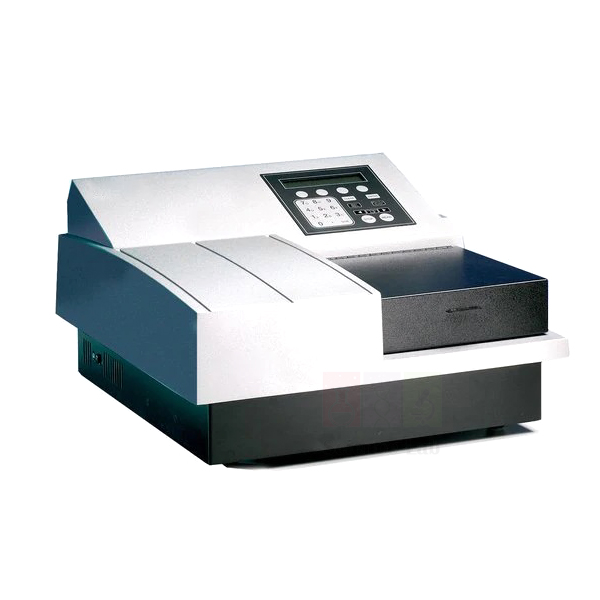
ELISA Reader 8 Channel
ELISA Reader 8 Channel (Product Code: SLE/CL/73) is a bench-top microplate photometer that measures the colour developed in ELISA (Enzyme-Linked Immunosorbent Assay) wells and turns those absorbance readings into qualitative or quantitative results with its on-board software. Eight measuring photo-detectors plus one reference detector read the plate, the optical range runs from 380 to 900nm, and built-in shaking mixes the wells before measurement. Hepatitis, HIV and other serology screening, hormone and antibody testing, and university immunology practicals all depend on this kind of reader. It is supplied by Jain Scientific Equipments Pvt Ltd (ScienceLab), Ambala.
Specifications
| Parameter | Detail |
|---|---|
| Type | Micro-plate reader for ELISA |
| Platform | Bench-top, open, automatic system |
| Detectors | Eight measuring plus one reference photo-detector |
| Wavelength range | Extended, 380-900nm |
| Absorbance range | 0.001-4.000 OD |
| Measuring modes | Single, dual and multi wavelength endpoint; endpoint and kinetic assay modes |
| Plates | All common 96-well microplates (flat, round, U or V-shaped bottom) |
| Shaking | Built-in; low, medium, high and variable speeds |
| Panel assays | Up to 8-panel assays in a single run |
| Formulas | Minimum 15 per assay (cut-off, transformation and validation) |
| Standards | Retained standards for assays spanning more than 1 micro-plate |
| Plate mapping | Automatic and manual |
| Result reporting | Plate matrix, table format, or both |
| Protocols | 50 user-definable assay protocols |
| Memory | Storage and recall of the last 10 micro-plate results |
| Sample identification | User-definable sample ID |
| Software | On-board qualitative and quantitative data reduction (English language) |
| Power requirements | 220V/50Hz, with voltage surge protection |
Typical Use
After the final wash and substrate step, the stopped plate is loaded into the reader, the matching protocol is called up, and the plate map tells the software which wells hold blanks, calibrators, controls and patient samples. The reader measures each well, applies the cut-off, transformation and validation formulas set for that assay, and reports results as a plate matrix, a table or both. Dual-wavelength reading, where a second reference wavelength is subtracted, helps cancel out scratches, fingerprints and plate imperfections. Kinetic mode, in which absorbance is followed over time, suits enzyme-rate work in research settings.
Panel assays let a laboratory read up to eight different tests on one plate in a single run, which saves plates when individual test volumes are small. Retained standards mean a large batch spread across more than one plate need not repeat the calibrators on every plate. Buyers comparing a laboratory instruments supplier in India for a full ELISA line often order the reader with the matching 8-channel washer so both instruments handle the same plate formats.
Supplier
Jain Scientific Equipments Private Limited supplies the ELISA Reader 8 Channel under its trading name ScienceLab, working from Ambala in Haryana to equip hospital, public-health and teaching laboratories. The company profile describes the business in more detail.
Related Clinical Laboratory Equipment
Equipment that works with the reader in a complete ELISA workflow:
- ELISA Washer 8 Channel — automated plate washing between assay steps
- Digital Pipette 8 Channels — fast reagent addition across a plate column
- Single Channel Pipettors — for pipetting individual samples and calibrators
- Incubator 30L, upto 80C — temperature-controlled plate incubation
- Pipette Tip Barrier Ster 200ul — sterile barrier tips for sample transfer
Find more diagnostic equipment in the Clinical Laboratory range.
Frequently Asked Questions
What wavelength and absorbance range does it cover?
380 to 900nm, with an absorbance range of 0.001 to 4.000 OD. The specific filter set supplied is not stated in our listing, so please tell us the wavelengths your kits require.
Can it perform kinetic as well as endpoint readings?
Yes. It offers endpoint and kinetic assay modes, and endpoint readings can be taken at a single, dual or multiple wavelengths.
How are results calculated?
On-board data reduction software (English language) applies at least 15 formulas per assay, covering cut-off, transformation and validation, and gives qualitative or quantitative results.
How much can it store?
50 user-definable assay protocols and the last 10 micro-plate results, each with user-definable sample IDs.
Does it connect to a printer or computer?
Printer and PC connections are not described in our listing. Please contact us to confirm output options before ordering.
Is a calibration certificate or warranty available?
Neither is stated in our listing. Discuss calibration certificate availability, installation and warranty terms with our team when requesting a quotation.
Request a Quote
For a quotation on the ELISA Reader 8 Channel, send your details through the contact page or add it to the enquiry cart. We supply laboratories in India and international markets.
Last updated: 24 September 2026
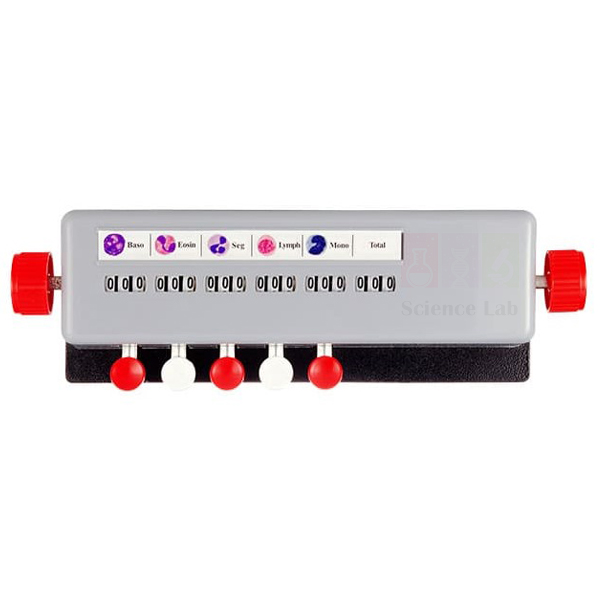
Manual Differential Cell Counter
Manual Differential Cell Counter (Product Code: SLE/CL/74) is a mechanical 5-unit tally counter with a totalizer, used to record each white blood cell by type while a stained blood smear is examined under the microscope. Its five keys cover the leucocyte classes – basophils, eosinophils, neutrophils, lymphocytes and monocytes – and the name and picture of each cell appear above its key, so the technician can keep an eye at the eyepiece and count by touch. Pathology laboratories, blood banks and medical laboratory technology colleges use it for the manual differential count. It is made by Jain Scientific Equipments Pvt Ltd (ScienceLab), Ambala.
Specifications
| Parameter | Detail |
|---|---|
| Type | Manual, mechanical 5-unit counter with totalizer |
| Application | Differential blood cell count |
| Keys | Five leucocyte keys: Baso, Eosin, Neutro, Lympho and Mono |
| Key labelling | Name and picture of the cell indicated above each key |
| Count capacity | Counts up to 100 cells |
| Readout | 3 digit |
| Signal | Audio signal when one hundred cells have been counted |
| Reset | Separate lever resets all figures to zero |
| Ergonomics | Soft key touch and convenient key placement to minimise fatigue |
Typical Use
With a well-spread, stained smear on the microscope stage, the examiner moves systematically across the thin area of the film and presses the matching key for every white cell seen. The totalizer keeps a running total, and when it reaches one hundred cells an audio signal sounds. Because the total is exactly one hundred, the figure on each key can be read directly as a percentage, ready to write onto the report. A single push on the separate reset lever returns every figure to zero for the next slide.
Soft-touch keys and a comfortable layout matter when a technician counts dozens of smears in a shift, and the cell pictures above each key are a helpful reminder for trainees still learning leucocyte morphology. Colleges setting up haematology practicals often list the counter among essential biology lab equipment in India, alongside staining racks and slide storage.
Manufacturer
ScienceLab counters are produced by Jain Scientific Equipments Private Limited, an Ambala, Haryana manufacturer of laboratory apparatus that trades under the ScienceLab name for clinical and educational customers. Read more on the ScienceLab profile page.
Related Clinical Laboratory Equipment
Items used to prepare, stain and store the smears you count:
- Rack Staining Slides Horizontal — holds smears level while stain is flooded on
- Coplin Staining Jar — for dip-staining several slides at once
- Slide Drying Rack — lets stained slides air-dry before examination
- Storage Box, 100 Slides — keeps counted slides for review or quality checks
- Counting Chamber Neubauer — for the total cell counts that accompany a differential
More haematology supplies are listed in the Clinical Laboratory category.
Frequently Asked Questions
Which cells can be counted?
The five leucocyte types: basophils, eosinophils, neutrophils, lymphocytes and monocytes, each on its own labelled key.
How does it tell me when the count is complete?
An audio signal sounds when one hundred cells have been counted. The totalizer has a 3-digit readout and counts up to 100 cells.
How are the figures cleared?
A separate lever resets all figures to zero in one movement.
Does it need batteries or mains power?
It is described as a manual, mechanical counter, and no power supply is listed. Please contact us if you need this confirmed for your order.
Can I record cell types beyond the five keys?
The keys are dedicated to the five leucocyte classes. Other findings, such as nucleated red cells, would need to be noted separately.
How should it be cleaned?
Wipe the keys and case with a lightly dampened cloth and keep liquids away from the mechanism.
Can colleges order several counters together?
Yes. Send the quantity and delivery location and we will quote for supply within India or to international markets.
Request a Quote
Order the Manual Differential Cell Counter by writing to us through the contact page or by adding it to the enquiry cart with your staining and slide supplies.
Last updated: 24 September 2026
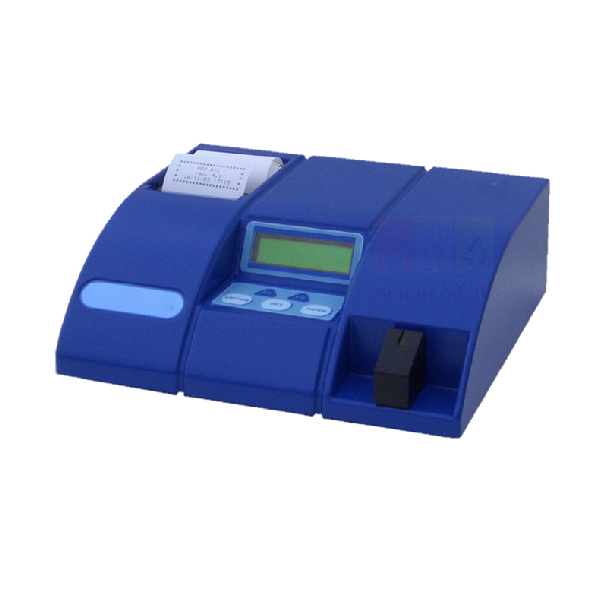
Bilirubin Meter
Bilirubin Meter (Product Code: SLE/CL/75) is a fully automatic bench-top analyser that measures bilirubin in just 10ul of whole blood and gives a result in 3 seconds, shown on a digital alphanumeric display and printed on its integrated printer. It is suited to intensive care, emergency departments and other low-volume settings in hospitals, and is widely used where newborns are monitored for jaundice. Auto-calibration, self-diagnosis and quality-control flags on abnormal results reduce routine upkeep. It is supplied by Jain Scientific Equipments Pvt Ltd (ScienceLab), Ambala, together with a starter set of accessories and consumables.
Specifications
| Parameter | Detail |
|---|---|
| Platform | Bench-top, open, fully automatic system |
| Sample type | Whole blood |
| Sample volume | 10ul |
| Analysis time | 3 seconds |
| Accuracy of measurement | Approximately 5% |
| Display and output | Digital alphanumeric display with integrated printer |
| Data management | Built-in software; data can be printed or sent to a PC |
| Quality control | Flags abnormal results; auto-calibration |
| Calibration | Automated calibration and self-diagnosis |
| Energy saving | Stand-by mode after 30 minutes |
| Operating conditions | Tolerates humidity up to 80%; operating temperature 15°C to 35°C |
| Power requirements | 220V/50Hz, with voltage surge protection |
| Suitable for | Intensive care, emergency departments or other low-volume hospital settings |
Standard accessories, consumables and parts supplied to operate the equipment:
- CD with user manual (English)
- 1 x thermal paper roll
- Fuse kit
- AC power cable
- Dust cover
- 100 x haematocrit micro capillary tubes
- 1 x plate of capillary sealing plasticine
Typical Use
A heel-prick or finger-prick drop, or a small venous sample, is drawn into one of the haematocrit micro capillary tubes, one end is closed with the sealing plasticine, and the sample is presented to the meter as described in the user manual. Three seconds later the bilirubin value appears on the display and can be printed straight onto thermal paper for the patient file, or passed to a PC through the built-in data management software. Because the meter calibrates itself, runs a self-diagnosis and flags abnormal results, nursing and laboratory staff can run it at the bedside area of a ward without a dedicated operator.
When hospitals ask a lab instruments supplier in India about a bilirubin meter, the usual questions concern sample volume, turnaround and running supplies. This unit needs only 10ul, reports in seconds, drops into stand-by after 30 minutes idle, and arrives with 100 capillaries and a paper roll so testing can start on the day of installation.
Supplier
Hospitals receive this meter from Jain Scientific Equipments Private Limited, which operates under the ScienceLab name from Ambala, Haryana and supplies clinical instruments alongside its laboratory apparatus. For institutional and tender buyers who need vendor registration details: GSTIN 06AAECJ8618A1ZT · LEI 3358004HRD1JIVXKYX49. More about the company is on the ScienceLab profile.
Related Clinical Laboratory Equipment
Items that support bilirubin sampling and testing:
- Safety Lancet Disposable 2.4 mm — single-use lancet for skin-puncture sampling
- Capillary Heparin Tube — additional capillaries for collection; confirm the type suits the meter
- Capillary Tube Sealant — for sealing capillaries once the supplied plasticine is used up
- Haematocrit Centrifuge — for units that also measure packed cell volume from capillary samples
- Gloves W/o Powder Nitrile Disposable — hand protection while handling blood
See our Clinical Laboratory range for more point-of-care and sampling items.
Frequently Asked Questions
How much blood does a test need?
10ul of whole blood per measurement.
How fast and how accurate is it?
Analysis takes 3 seconds, and the accuracy of measurement is approximately 5%.
What is included with the meter?
A CD with the English user manual, 1 thermal paper roll, a fuse kit, AC power cable, dust cover, 100 haematocrit micro capillary tubes and 1 plate of capillary sealing plasticine.
Can results be stored or transferred?
Yes. Built-in software handles data management, and results can be printed or sent to a PC.
Does it need manual calibration?
It performs automated calibration and self-diagnosis. If your laboratory needs a calibration certificate, please discuss its availability with us before ordering.
What conditions and power does it need?
It tolerates humidity up to 80% and operating temperatures from 15°C to 35°C, on a 220V/50Hz supply with voltage surge protection.
Can I reorder paper rolls and capillaries?
Please contact us with the quantities you need and we will confirm availability and warranty terms at the same time.
Request a Quote
To request a quotation for the Bilirubin Meter, use our contact page or add it to the enquiry cart. We supply hospitals and laboratories in India and international markets.
Last updated: 24 September 2026
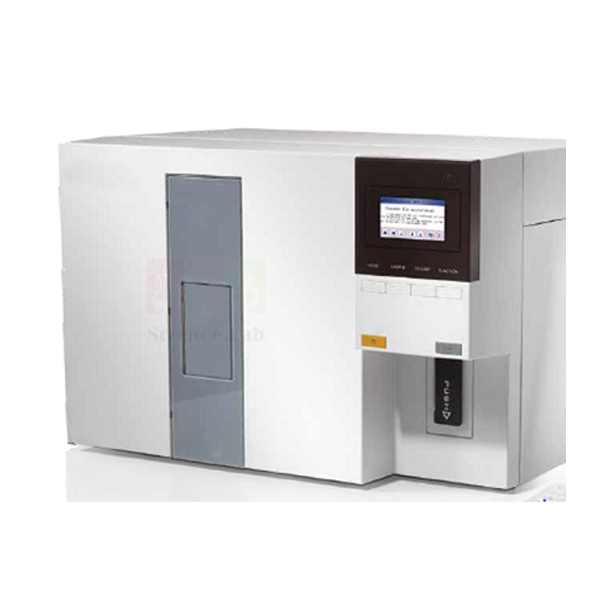
18 parameter Haematology Analyser
18 parameter Haematology Analyser (Product Code: SLE/CL/76) is an automated bench-top analyser for the complete blood count (CBC) with a 5-part white-cell differential, intended for routine haematology on whole blood. It combines flow-cytometry, colorimetry and electrical impedance to count and size red cells, white cells and platelets and to measure haemoglobin, processing 50 to 100 samples per hour. District and teaching hospitals, private diagnostic centres and larger clinics use this class of instrument as the core of their haematology bench. It is supplied by Jain Scientific Equipments Pvt Ltd (ScienceLab), Ambala.
Specifications
| Parameter | Detail |
|---|---|
| Method | Flow-cytometry, colorimetry, electrical impedance |
| Sample | Whole blood |
| Scope | Complete blood count (CBC) with 5-part differential, for routine haematology |
| Platform | Bench-top, open, automated system |
| Throughput | 50 to 100 samples per hour |
| Parameters listed | RBC, WBC, HGB, HCT, MCV, MCH, RDW-SD, RDW-CV, PLT, PDW-SD, PDW-CV, MPV and WBC differential (neutrophils, lymphocytes, monocytes, eosinophils, basophils) |
| Data management | Built in for analysis and reporting; stores at least 100 patient data, including quality control and calibrators |
| Reporting | Via external printer; printouts show sample ID, date and time, with graphs, histograms and scatter graphs |
| Quality control | Flags abnormal results; auto-calibration |
| Connectivity | External PC via USB; can interface to LIS (Laboratory Information System) |
| Casing | Corrosion-proof material |
| Environment | Tolerates harsh conditions such as high humidity; operating temperature 15°C to 35°C |
| Power requirements | 220V/50Hz, with voltage surge protection |
Typical Use
Venous blood collected into an anticoagulant tube is mixed gently, presented to the analyser and aspirated automatically. Within the run, impedance counting sizes red cells and platelets, colorimetry measures haemoglobin, and flow-cytometry separates the white cells into neutrophils, lymphocytes, monocytes, eosinophils and basophils. The printed report carries the sample ID, date and time together with histograms and scatter graphs, so a pathologist can see at a glance whether a sample needs a manual smear review. Abnormal results are flagged automatically, and quality-control and calibrator data are kept in the analyser's memory with the patient results.
With a USB link to a PC and the ability to interface with a Laboratory Information System, results can flow straight into hospital records instead of being re-typed. Institutions drafting a lab equipment tender in India should specify the power arrangements, the reagent supply they intend to use with this open system, and the printer and LIS details, so installation goes smoothly.
Supplier
This haematology analyser is offered by Jain Scientific Equipments Private Limited, the Ambala, Haryana business known to customers as ScienceLab, which supplies instruments for hospital and diagnostic laboratories in addition to its own laboratory apparatus. Company information is available on the ScienceLab profile page.
Related Clinical Laboratory Equipment
Collection and review items that sit alongside a haematology analyser:
- EDTA Vacuum Tube — anticoagulated tubes for CBC samples
- Blood Specimen Rotator — keeps samples gently mixed while they wait to be run
- Tourniquet With Buckle — for venous blood collection
- Manual Differential Cell Counter — for manual smear review of flagged samples
The full Clinical Laboratory catalogue lists more haematology and sampling products.
Frequently Asked Questions
Which parameters does it report?
Our listing names RBC, WBC, HGB, HCT, MCV, MCH, RDW-SD, RDW-CV, PLT, PDW-SD, PDW-CV, MPV and the 5-part WBC differential. Please contact us for the complete reportable parameter list of the model supplied.
What measuring principles does it use?
Flow-cytometry, colorimetry and electrical impedance, on whole blood samples.
How many samples can it process?
50 to 100 samples per hour.
Can it connect to our computer system?
Yes. It connects to an external PC via USB and can interface to an LIS. Results are printed through an external printer; whether a printer is included is not stated in our listing, so ask us to confirm.
Which reagents does it use?
It is described as an open system, but reagent types and consumption are not given in our listing. Please ask us for the reagent list before ordering.
What working conditions does it tolerate?
High humidity and operating temperatures from 15°C to 35°C. The casing is made of corrosion-proof material, and the 220V/50Hz supply has voltage surge protection.
Are installation, training, calibration certificate and warranty available?
These are not stated in our listing. Please discuss installation, user training, calibration certificate availability and warranty terms with us when you request a quotation.
Request a Quote
Send your requirement for the 18 parameter Haematology Analyser through our contact page, or add it to the enquiry cart. We quote for laboratories in India and international markets.
Last updated: 24 September 2026
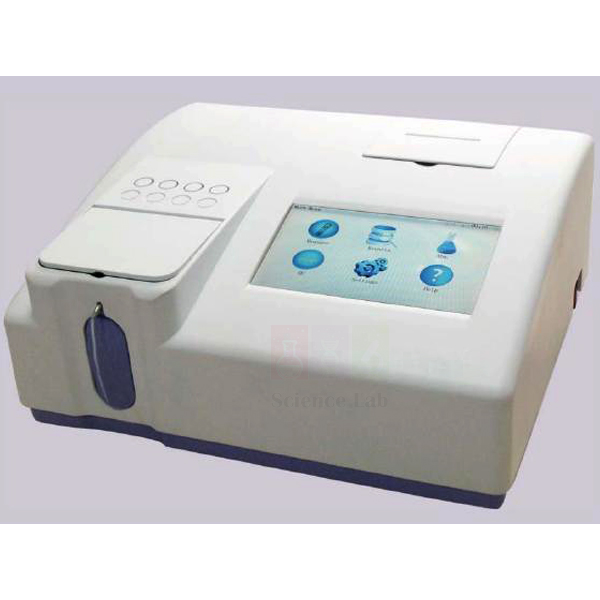
Clinical Chemistry Analyzer
Clinical Chemistry Analyzer (Product Code: SLE/CL/77) is a bench-top, open, automatic analyser for batch determination of routine biochemistry tests on serum, plasma and urine. It handles substrates such as glucose and urea, electrolytes, enzymes, lipids and immunoturbidimetric assays, running end point, differential, fixed time, kinetic, immunoturbidimetric and multi-standard methods at 60 to 100 tests per hour. Auto-sampling, auto-dilution and auto-calibration take much of the manual pipetting out of the day, which is why hospital, district and private laboratories treat it as one of the core analytical lab instruments in India's diagnostic services. It is supplied by Jain Scientific Equipments Pvt Ltd (ScienceLab), Ambala.
Specifications
| Parameter | Detail |
|---|---|
| Parameters | Routine chemistry analytes: substrates, electrolytes, enzymes, lipids, immunoturbidimetric |
| Methods | End point, differential, fixed time, kinetic, immunoturbidimetric, multi standard |
| Programming | Pre-programmed and user-programmable routines and profiles |
| Processing | Batch determination of routine clinical chemistry parameters |
| Platform | Bench-top, open, automatic system |
| Throughput | 60 to 100 tests per hour |
| Sample types | Serum, plasma, urine |
| Automation | Auto-sampling, auto-dilution, auto-calibration |
| Quality control | Flags abnormal results |
| Data management | Built in for analysis and reporting; stores at least 100 patient data, including quality control and calibrators |
| Reporting | Via external printer; printouts show sample ID, date and time |
| Connectivity | External PC via USB |
| Casing | Corrosion-proof material |
| Environment | Tolerates harsh conditions, including high humidity, some fungi and spikes; operating temperature 15°C to 40°C |
| Power requirements | 220V/50Hz, with voltage surge protection |
Typical Use
Blood is centrifuged to obtain serum or plasma, which is then loaded with any urine samples and the day's calibrators and controls. The operator selects individual tests or a stored profile – for example a liver, kidney or lipid panel – and the analyser samples, dilutes where necessary, reads each reaction by the method assigned to that test, and calculates the result. Kinetic and fixed-time methods suit enzyme and creatinine-type reactions, while end-point methods cover most substrate tests; immunoturbidimetric assays extend the menu to specific proteins. Results carrying the sample ID, date and time are printed through an external printer or sent to a PC over USB.
Because the platform is open, laboratories can programme their own routines for the reagent kits they prefer, subject to kit compatibility. Run controls at the start of every batch and review any flagged result before it is released. Keeping serum separation, pipetting and the analyser in one workflow shortens turnaround for outpatient clinics.
Supplier
Jain Scientific Equipments Private Limited, trading as ScienceLab and headquartered in Ambala, Haryana, supplies this chemistry analyser to hospital and diagnostic laboratories as part of its wider clinical range. The ScienceLab company profile has further details.
Related Clinical Laboratory Equipment
Equipment and consumables for the pre-analytical steps of chemistry testing:
- Tube Vacuum Serum Gel — collection tubes that give clean serum after spinning
- Centrifuge Complete w/accessories — bench-top centrifuge for serum and plasma separation
- Container Sample 50 ml — for collecting urine samples
- Single Channel Pipettors — for preparing calibrators, controls and manual dilutions
- Distillation Unit With Tank — distilled water for reagent preparation and rinsing
Visit the Clinical Laboratory section for the rest of our diagnostic range.
Frequently Asked Questions
What kinds of tests can it run?
Routine chemistry analytes: substrates, electrolytes, enzymes, lipids and immunoturbidimetric assays. The actual test menu depends on the reagent kits you use, so please share your list with us.
Which sample types are accepted?
Serum, plasma and urine.
How many tests per hour?
60 to 100 tests per hour, processed in batches.
Can we add our own test methods?
Yes. It offers pre-programmed as well as user-programmable routines and profiles on an open platform.
How are results stored and printed?
Built-in data management keeps at least 100 patient data, including quality control and calibrators. Results go to an external printer or to a PC via USB; whether a printer is included is not stated in our listing.
What environment can it work in?
It tolerates high humidity, some fungi and spikes, and operating temperatures from 15°C to 40°C. The casing is corrosion-proof and the 220V/50Hz supply has surge protection.
Are installation, calibration certificate and warranty provided?
These are not stated in our listing. Please contact us to discuss installation, calibration certificate availability, training and warranty.
Request a Quote
Ask for a quotation on the Clinical Chemistry Analyzer via our contact page or add it to the enquiry cart; include your expected daily test load and delivery location in India or abroad.
Last updated: 24 September 2026
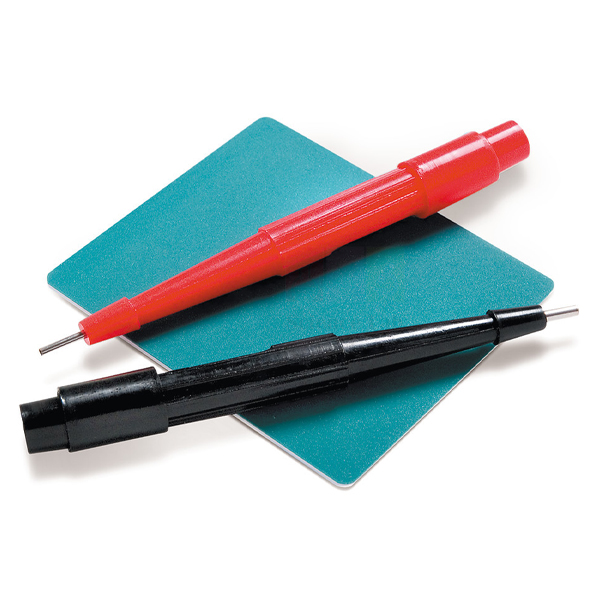
Punch DBS 3.0mm
Punch DBS 3.0mm (Product Code: SLE/CL/78) is a hand punch that cuts small discs, approximately 3.0mm in diameter, out of dried blood spot (DBS) filter-paper cards so that each disc can be dropped into a tube or plate well for elution and testing. Dried blood spots are widely used in newborn screening, early infant HIV diagnosis, surveillance studies and research, because the cards are easy to collect in the field and to post to a central laboratory. The punch is reusable, can be sterilised by autoclaving, and is replaced after a set number of punches. It is supplied by Jain Scientific Equipments Pvt Ltd (ScienceLab), Ambala, as part of its clinical range from a lab consumables supplier in India.
Specifications
| Parameter | Detail |
|---|---|
| Type | Punch for dried blood spot (DBS) filter papers |
| Punching diameter | Approximately 3.0mm |
| Sterilisation | Can be sterilised by autoclaving |
| Re-use | Reusable; intended to be disposed of after a set number of punches |
| Application | Punching samples from DBS filter-paper cards |
Typical Use
Once a DBS card has dried completely, lay it on a clean, firm surface and punch from the centre of a well-filled spot rather than its edge, where blood distribution is less even. Each 3.0mm disc is transferred into a labelled tube or the correct well of a plate, and the position is recorded against the card number. Many laboratories punch one or more discs from clean blank filter paper between patient samples, which helps limit carry-over of material from one card to the next.
At the end of a session, clean the punch and autoclave it so it is ready for the next batch. Track how many punches each tool has made, and replace it at the end of its service life so that cut edges stay clean and disc size stays consistent.
Supplier
The DBS punch is supplied by Jain Scientific Equipments Private Limited, which is based in Ambala, Haryana and trades under the ScienceLab name, providing sampling tools and consumables to screening programmes and diagnostic laboratories. More about the company can be found on the ScienceLab profile page.
Related Clinical Laboratory Items
Products used through the dried blood spot workflow, from collection to analysis:
- Dry Blood Spot Paper — filter-paper cards for collecting the blood spots
- Rack Drying DBS Cards — holds cards apart while they air-dry
- Bag Resealable Small Plastic — for storing and transporting dried cards
- PCR Microplate — plate wells to receive punched discs for molecular testing
- Safety Lancet Disposable 2.4 mm — single-use lancet for collecting the spot
Explore the Clinical Laboratory range for more sampling supplies.
Frequently Asked Questions
What size disc does it cut?
Approximately 3.0mm in diameter.
Can the punch be sterilised?
Yes. It can be sterilised by autoclaving between sessions.
How many punches can it make before replacement?
It is reusable but intended to be disposed of after a set number of punches. Our listing does not state that number, so please contact us for the recommended service life.
Which cards can it be used with?
It is designed for dried blood spot filter papers. If you use a particular card type, tell us so we can confirm suitability.
How can carry-over between samples be reduced?
Punching clean blank filter paper between patient cards and cleaning the punch regularly are common practices; follow the procedure set by your testing laboratory.
Can you supply punches for a screening programme?
Yes. Share the quantity required and the delivery location, and we will quote for India or international markets.
Request a Quote
To order the Punch DBS 3.0mm, reach us through the contact page or add it to the enquiry cart together with DBS cards and drying racks.
Last updated: 24 September 2026
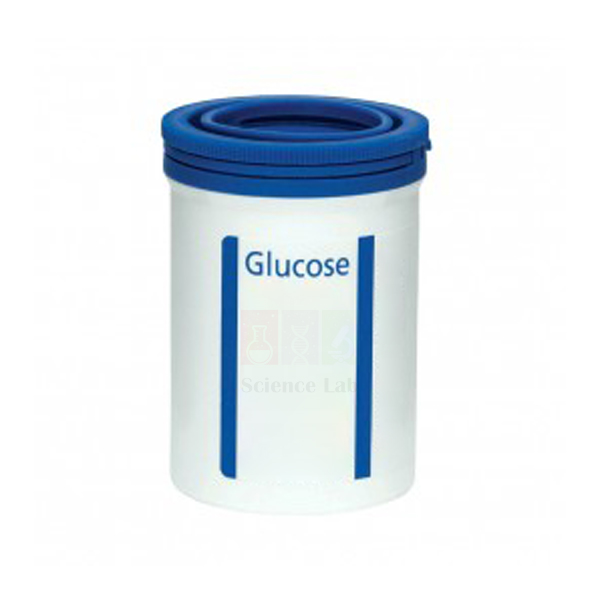
Microcuvette for Glucose
Microcuvette for Glucose (Product Code: SLE/CL/79) is a single-use sample collection and measuring microcuvette used to measure glucose in a direct-reading photometer (glucose 201+ set) at clinics, screening camps and laboratories. It draws 5 to 10uL of whole blood directly from the skin surface by capillarity, accepts capillary, venous or arterial whole blood, and comes as a box of 100 in a screw-cap plastic vial. It is supplied by Jain Scientific Equipments Pvt Ltd (ScienceLab), Ambala, India, a lab consumables supplier in India.
Specifications
| Parameter | Detail |
|---|---|
| Type | Single-use sample collection and measuring microcuvette |
| Analyte | Glucose |
| Sample volume | 5 to 10uL |
| Filling | Directly from the skin surface by capillarity |
| Sample types | Capillary, venous and arterial whole blood |
| For use with | Direct reading photometer, glucose 201+ set |
| Pack | Box of 100 microcuvettes in a plastic vial with screw cap |
| Documentation | Instruction manual in English |
| Shelf life | Depends on the product and storage conditions; ask us for the expiry date of the batch you are quoted |
| Product code | SLE/CL/79 |
| Supplied by | Jain Scientific Equipments Pvt Ltd (ScienceLab), Ambala, India |
What Is the Glucose Microcuvette Used For?
Clean and dry the fingertip, puncture it with a lancet and wipe away the first drops as your procedure directs. Hold the microcuvette tip into the next well-formed drop and let it fill in one continuous action; interrupted filling can leave air bubbles in the optical area. Wipe excess blood from the outside of the cuvette without touching the open end, check it visually and place it in the photometer holder at once. For venous or arterial samples, a drop from a well-mixed tube or syringe is applied in the same way.
Take out only the microcuvettes you need and close the screw cap firmly straight away, so the rest of the vial stays protected. Screening teams buying disposable lab equipment in India usually order microcuvettes, lancets and sharps containers together, so every finger-prick test in the field has a complete kit.
Supplier
ScienceLab is the trading name of Jain Scientific Equipments Private Limited, an Ambala, Haryana company that supplies these glucose microcuvettes to clinics, laboratories and screening programmes in India and international markets alongside its other sampling consumables. See the company profile for more information.
Related Clinical Laboratory Items
Consumables used with the microcuvettes during finger-prick glucose testing:
- Safety Lancet Disposable 2.4 mm — single-use lancet to obtain the blood drop
- Gloves W/o Powder Nitrile Disposable — operator protection during sampling
- Gauze Compress — for wiping the first drops and pressing the puncture site
- Sharp Container Leak Proof Plastic — for used lancets and contaminated items
- Glucose Test Strips — an alternative strip-based format for glucose checks
Browse the Clinical Laboratory category for more sampling consumables.
Frequently Asked Questions
How much blood does each Microcuvette for Glucose take?
Each Microcuvette for Glucose collects 5 to 10uL of whole blood, drawn in by capillarity directly from the skin surface. The single-use cuvette then serves as the measuring cell when it is inserted into the photometer.
Can venous or arterial blood be used in the glucose microcuvette?
Yes. Capillary, venous and arterial whole blood can all be used with the Microcuvette for Glucose; for venous or arterial samples, fill the cuvette from a drop taken from a well-mixed tube or syringe.
Which photometer is the Microcuvette for Glucose made for?
The Microcuvette for Glucose is inserted for direct reading in a glucose photometer (glucose 201+ set). Send us your photometer model through the contact page so we can confirm compatibility before you order.
Can a glucose microcuvette be reused?
No. The Microcuvette for Glucose is single-use: each cuvette collects and measures one sample and should then be discarded as clinical waste in line with your facility's biomedical waste rules.
How are the glucose microcuvettes packed, and what is their shelf life?
The Microcuvette for Glucose comes as a box of 100 in a plastic vial with a screw cap, with an English instruction manual. Shelf life depends on the product and storage conditions, so ask us for the expiry date of the batch you are quoted.
Who supplies the Microcuvette for Glucose?
The Microcuvette for Glucose is supplied by Jain Scientific Equipments Private Limited, which trades as ScienceLab from Ambala, Haryana, India. It is offered to clinics, laboratories, screening programmes and distributors in India and international markets.
Can glucose microcuvettes be ordered in bulk for screening programmes?
Yes. Bulk quantities of the Microcuvette for Glucose can be quoted for screening programmes; send product code SLE/CL/79, the number of boxes of 100, your photometer model and the delivery location in India or abroad.
Request a Quote
Request pricing for the Microcuvette for Glucose via our contact page, or add it to the enquiry cart along with lancets and other sampling consumables.
Last updated: 24 September 2026
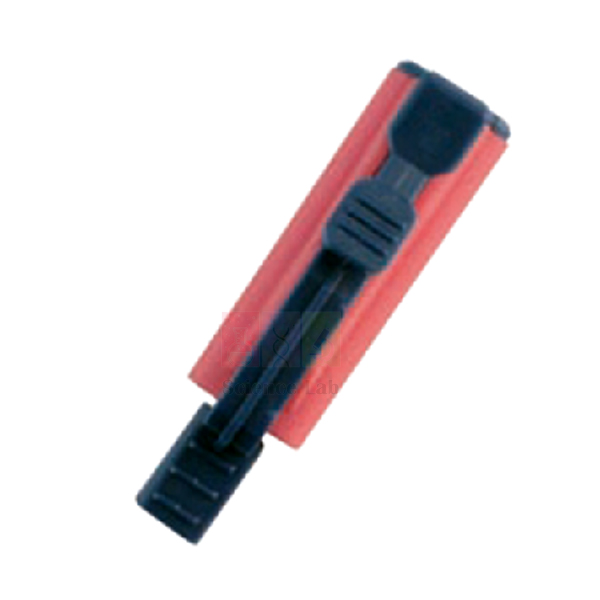
Safety Lancet Disposable 2.4 mm
Safety Lancet Disposable 2.4 mm (Product Code: SLE/CL/80) is a spring-loaded, single-use lancet used to make a finger-prick puncture for capillary blood collection before point-of-care and laboratory tests. Pressing its instant trigger fires a spring-based blade to a depth of approximately 2.4mm, after which a built-in mechanism prevents reuse. Nurses, phlebotomists, laboratory technicians and community health workers rely on it, and it is supplied by Jain Scientific Equipments Pvt Ltd (ScienceLab), Ambala, India, a lab consumables supplier in India.
Specifications
| Parameter | Detail |
|---|---|
| Product type | Safety lancet, single-use disposable |
| Blade depth | Approx. 2.4mm |
| Firing | Instant trigger launches a spring-based blade |
| Reuse protection | Mechanism preventing reuse |
| Intended use | Capillary blood collection |
| Product code | SLE/CL/80 |
| Supplied by | Jain Scientific Equipments Pvt Ltd (ScienceLab), Ambala, India |
What Is the 2.4 mm Safety Lancet Used For?
Before sampling, warm the patient's hand if it is cold, clean the chosen site with antiseptic and let it dry completely, since traces of alcohol can affect some results. Place the lancet firmly against the side of the fingertip and press the trigger; the spring-driven blade makes a single puncture. Let a drop form with light, steady pressure rather than hard squeezing, which can dilute the sample with tissue fluid, then collect it into a capillary tube, onto a filter-paper card or into a test device and press gauze on the site.
Because a fired lancet cannot be used again, discard it immediately into a sharps container at the point of use. Primary health centres and school health programmes that stock disposable lab equipment in India often keep these lancets in pre-counted packs within each sampling tray. Puncture depth should always follow your facility's protocol for the patient and the puncture site.
Supplier
ScienceLab, the name under which Jain Scientific Equipments Private Limited of Ambala, Haryana does business, supplies this safety lancet to hospitals, clinics and training institutions in India and international markets as part of its clinical consumables list. To learn more about the business, see the ScienceLab profile.
Related Clinical Laboratory Items
Collection products commonly used immediately after the finger prick:
- Capillary Heparin Tube — collects the drop for haematocrit and other capillary tests
- Tube Blood Coll w/capil — K2EDTA collection tube for small-volume samples
- Dry Blood Spot Paper — filter-paper cards for dried blood spot collection
- Sharp Container Leak Proof Plastic — for safe disposal of fired lancets
- Lancet 2.4 mm Disposable — a second 2.4mm single-use lancet listing to compare against your specification
Our Clinical Laboratory collection includes further sampling and safety supplies.
Frequently Asked Questions
What puncture depth does the Safety Lancet Disposable 2.4 mm give?
The Safety Lancet Disposable 2.4 mm has a blade depth of approximately 2.4mm. Select lancet depth according to your facility's protocol for the patient and the puncture site, and check that it matches the test you plan to run.
How does the safety feature of the 2.4 mm safety lancet work?
The 2.4 mm safety lancet has an instant trigger that releases a spring-based blade for a single puncture, and a built-in mechanism then prevents reuse, so a fired lancet cannot be armed and used on another person.
Which tests is the 2.4 mm safety lancet suited to?
The Safety Lancet Disposable 2.4 mm suits procedures that start with capillary blood collection, such as finger-prick haemoglobin or glucose checks, blood grouping practicals and dried blood spot sampling, provided your test protocol accepts capillary samples.
Are pack size and expiry details available?
Pack size and expiry are not stated in the listing for the 2.4 mm safety lancet. Ask us through the contact page for the pack quantity and for the lot and expiry date of the batch you are quoted.
How is it different from the Lancet 2.4 mm Disposable?
The Safety Lancet Disposable 2.4 mm and the Lancet 2.4 mm Disposable (SLE/CL/01) are both described as single-use, spring-triggered lancets of approximately 2.4mm depth with anti-reuse mechanisms. Ask us which listing matches your tender specification before ordering.
Who supplies the Safety Lancet Disposable 2.4 mm?
The Safety Lancet Disposable 2.4 mm is supplied by Jain Scientific Equipments Private Limited, which trades as ScienceLab from Ambala, Haryana, India. It reaches hospitals, clinics and training institutions in India and international markets with other clinical consumables.
What should a tender enquiry for the safety lancet include?
A tender enquiry for the 2.4 mm safety lancet should give product code SLE/CL/80, the number of lancets or packs, the delivery location, any documentation your procurement rules require and the target delivery date.
Request a Quote
For a quotation on the Safety Lancet Disposable 2.4 mm, write to us through the contact page or add it to your enquiry cart with other collection consumables.
Last updated: 24 September 2026
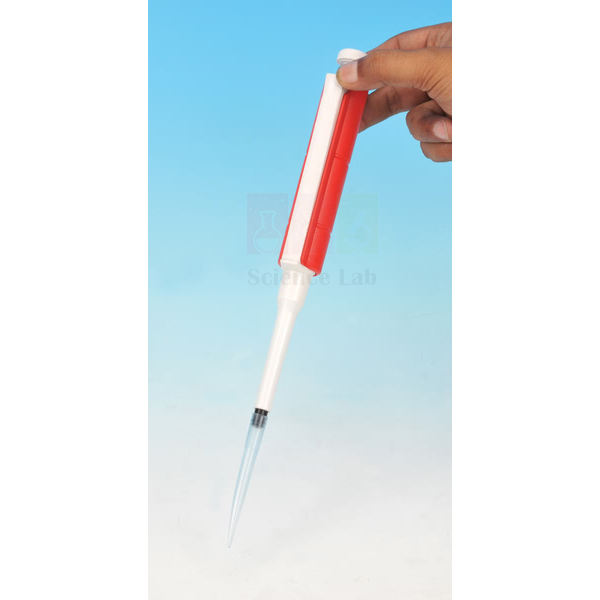
Pipettor, Fixed Volume
Pipettor, Fixed Volume (Product Code: SLE/CL/81) is a micropipettor set permanently to a single volume of 5ul, built for high accuracy wherever the same small volume has to be delivered again and again. With no volume dial to turn, there is no risk of a colleague leaving it at the wrong setting, which makes it well suited to clinical diagnostics, routine tests and control analysis. Biochemistry, serology and quality-control benches often keep one fixed-volume pipettor dedicated to each frequently run assay. It is made by Jain Scientific Equipments Pvt Ltd (ScienceLab), Ambala, a scientific instruments manufacturer in India.
Specifications
| Parameter | Detail |
|---|---|
| Type | Fixed volume micropipettor |
| Range | 5ul (fixed) |
| Accuracy | Designed for high accuracy at its fixed volume |
| Ideal for | Clinical diagnostics, routine tests and control analysis |
Typical Use
Small sample volumes of this size are common in colorimetric kits, where a few microlitres of serum, plasma or standard are added to a larger volume of reagent. Fit a fresh tip, press the plunger to the first stop, immerse the tip just below the surface of the sample, and release the plunger slowly and smoothly. Dispense against the inner wall of the tube or into the reagent, pressing through to expel the last of the liquid, then eject the tip. Holding the pipettor vertical while aspirating and pre-rinsing the tip once with the sample both help consistency at such a small volume.
Never lay the pipettor on its side or turn it upside down while liquid is in the tip, as this can draw fluid into the shaft. A laboratory that runs the same test daily will find a dedicated 5ul pipettor faster and less error-prone than resetting an adjustable one each time.
Manufacturer
Jain Scientific Equipments Private Limited produces this fixed-volume pipettor under its ScienceLab brand from Ambala, Haryana, as part of a clinical laboratory range that also includes adjustable and high-volume pipettors. The ScienceLab profile gives more background on the company.
Related Clinical Laboratory Equipment
Tips and pipettors that complete a liquid-handling set:
- Pipette Tip White 2-20 ul — tips covering the 5ul volume; confirm the fit on your pipettor
- Filter Pipette Tips — barrier tips that protect the shaft from aerosols
- Pipettor, Variable Volume — for assays that need volumes other than 5ul
- Pipettor, High Volume — for millilitre-range reagent dispensing
More liquid-handling products are available in our Clinical Laboratory range.
Frequently Asked Questions
Can the volume be changed?
No. The pipettor is fixed at 5ul. For other volumes, use an adjustable model such as our variable volume pipettor.
How accurate is it?
It is designed as a high-accuracy fixed volume micropipettor. Numerical accuracy and precision figures are not given in our listing, so please contact us for them.
Which tips does it take?
Tip compatibility is not stated in our listing. Tell us the tips you already stock, or ask us to recommend matching tips when you order.
Can it be autoclaved?
Our listing does not say whether the pipettor is autoclavable. Until confirmed, clean the outside with a mild disinfectant and keep liquids out of the shaft.
Is a calibration certificate available?
This is not stated in our listing. Please discuss calibration certificate availability with us before ordering.
Can laboratories order several units?
Yes. Share the quantity and delivery location and we will quote for supply within India or to international markets.
Request a Quote
To request a quotation for the Pipettor, Fixed Volume, use our contact page or add it to the enquiry cart together with the tips you need.
Last updated: 24 September 2026
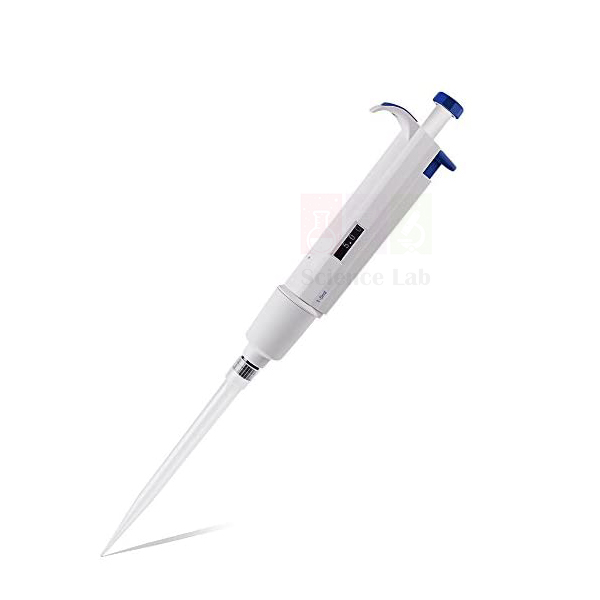
Pipettor, High Volume
Pipettor, High Volume (Product Code: SLE/CL/82) is an adjustable pipettor for the millilitre range, covering 1-5ml in increments of 0.1 ml. It is designed for safe day-to-day laboratory pipetting and dilution work, and aims to deliver accuracy that conventional glass pipetting cannot reach in reagent preparations, dilutions, colorimetric tests and cell cultures. Just as important, it removes the need for glass pipettes and for dangerous mouth pipetting, protecting staff and students from corrosive, toxic or infectious liquids. It is made by Jain Scientific Equipments Pvt Ltd (ScienceLab), Ambala.
Specifications
| Parameter | Detail |
|---|---|
| Type | High volume pipettor, adjustable |
| Range | 1-5ml |
| Increment | 0.1 ml |
| Designed for | Safe day-to-day laboratory pipetting and dilution work |
| Applications | Reagent preparations, dilutions, colorimetric tests and cell cultures |
| Safety benefit | Eradicates use of glass pipettes and mouth pipetting |
Typical Use
Set the required volume in 0.1 ml steps, fit a suitable tip, and aspirate slowly so that larger volumes of liquid do not foam or form bubbles; with viscous solutions, pause briefly before withdrawing the tip from the liquid. Dispense against the inner wall of the receiving tube or flask and press fully to empty the tip. In reagent preparation and serial dilution, the pipettor repeats the same volume far more consistently than a hand-read graduated glass pipette, and in colorimetric tests it adds reagent quickly to a whole rack of tubes.
For cell culture work, use sterile tips, work aseptically and never let medium reach the pipettor shaft. Teaching departments that are modernising their chemistry lab equipment in India use it to end mouth pipetting in student practicals, pairing it with a small-volume pipettor for microlitre work.
Manufacturer
Made in Ambala, Haryana by Jain Scientific Equipments Private Limited – the company that trades as ScienceLab – this pipettor belongs to a liquid-handling line designed for clinical, teaching and research laboratories. Company details are available on the ScienceLab company profile.
Related Clinical Laboratory Equipment
Items used with the pipettor for reagent preparation and dilutions:
- Reagent Reservoir 60ml — open trough to draw reagent from during repeated dispensing
- Screw Cap Tube 5.0 ml — tubes for dilutions and aliquots within the pipettor's range
- Cylinder Measuring Plastic — for measuring bulk diluent before pipetting
- Pipettor, Fixed Volume — for repeated microlitre sample additions
- Pipettor, Variable Volume — adjustable pipettor for smaller volumes
Browse the Clinical Laboratory category for more pipetting and sample-handling products.
Frequently Asked Questions
What volumes can it deliver?
Any volume from 1 to 5ml, set in increments of 0.1 ml.
Why choose it over glass pipettes?
It eradicates mouth pipetting and the handling of glass pipettes, and it is designed to give accuracy that conventional glass pipetting does not achieve in routine preparations and dilutions.
Which tips fit this pipettor?
Tip type and compatibility are not stated in our listing. Please contact us and we will confirm matching tips with your order.
Can it be used for cell culture?
Yes, cell cultures are among its listed applications. Use sterile tips and aseptic technique; whether the pipettor itself can be autoclaved is not stated in our listing, so check with us first.
Are accuracy figures or a calibration certificate available?
Numerical accuracy data are not given in our listing. Please discuss calibration certificate availability with us when you ask for a quotation.
Can colleges order class sets?
Yes. Send the number of units and delivery location, and we will quote for institutions in India and international markets.
Request a Quote
Order the Pipettor, High Volume through our contact page, or add it to the enquiry cart with reservoirs, tubes and other pipettors.
Last updated: 24 September 2026
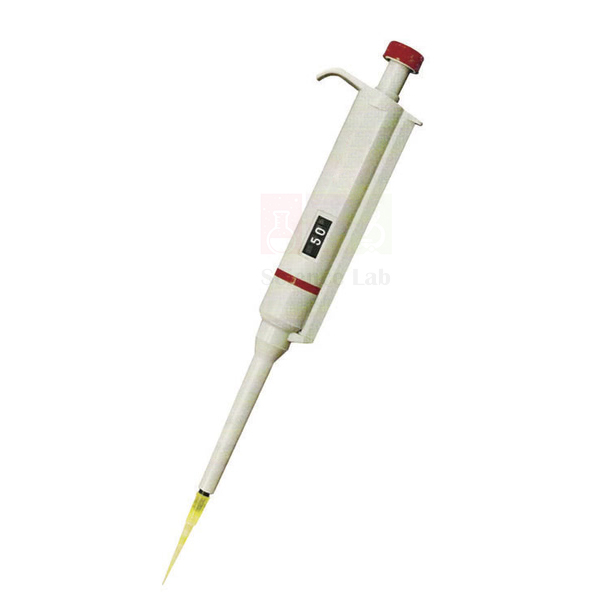
Pipettor, Variable Volume
Pipettor, Variable Volume (Product Code: SLE/CL/83) is an adjustable micropipette for measuring and delivering very small liquid volumes between 0.5 and 10 µl. The volume is set with a simple adjustment in 0.1 µl steps, and a 2-stop plunger separates the intake stroke from the dispensing stroke so that the set volume is released cleanly. Clinical, biotechnology and university teaching laboratories use it for sample, enzyme and reagent additions where a single microlitre matters, which makes it practical lab equipment for research in India and abroad. It is supplied by Jain Scientific Equipments Pvt Ltd (ScienceLab), Ambala.
Specifications
| Parameter | Detail |
|---|---|
| Type | Variable volume micropipette |
| Volume range | 0.5–10 µl |
| Volume increments | 0.1 µl |
| Plunger action | 2-stop mechanism for intake and dispensing |
| Volume setting | Simple volume adjustment |
| Tip removal | Mechanical tip ejector |
| Dimensions | 229 × 38 mm (approx.) |
| Design | Intended for accurate delivery with trouble-free operation and maintenance |
Typical Use
The 0.5–10 µl window covers the smallest additions in a working lab: adding template or primer to a reaction mix, loading DNA samples into gel wells, spiking enzyme into a digest, or preparing the first step of a dilution series. In molecular biology rooms it is usually kept next to PCR equipment in India's college and hospital labs, where the same few microlitres are dispensed many times a day. Because the increments are 0.1 µl, one pipettor can handle several nearby volumes without changing instruments.
For consistent results, set the volume by turning from a larger value down to the target, fit a fresh tip, press to the first stop, immerse the tip just below the liquid surface and release the plunger slowly. Dispense against the wall of the receiving vessel, press through to the second stop to expel the last droplet, then use the ejector so hands never touch a used tip. Never set the dial outside the 0.5–10 µl range, and store the pipettor upright when not in use.
Supplier
This pipettor is part of the laboratory range offered by ScienceLab, the trading name of Jain Scientific Equipments Private Limited in Ambala, Haryana, which supplies bench instruments and consumables to laboratories. For vendor registration, the supplying company is incorporated under CIN U29309HR2020PTC087597 and registered for GST under GSTIN 06AAECJ8618A1ZT. More background is on our company profile.
Related Clinical Laboratory Products
Buyers equipping a micro-volume pipetting station usually add these items:
- Filter Pipette Tips — filtered tips for the same low-volume band, useful for PCR and contamination-sensitive work.
- Pipette Tip White 2-20 ul — unfiltered tips for routine small additions; confirm tip fit with our team.
- Single Channel Pipettors — the next range up for larger reagent volumes.
- Pipettor, Fixed Volume — for repeating one set volume without adjusting the dial.
- Biohazard Bag — for collecting ejected tips after work with clinical samples.
More pipetting and diagnostic items are listed in our Clinical Laboratory category.
Frequently Asked Questions
What volumes can this pipettor dispense?
Any volume from 0.5 to 10 µl, adjustable in steps of 0.1 µl. For larger volumes, a higher-range pipettor is the better choice.
Why does it have two stops on the plunger?
The first stop measures the set volume during intake; the second stop pushes out the residual droplet during dispensing, so the full volume leaves the tip.
Are pipette tips included?
The listing does not state that tips are included. Please confirm with us when ordering and add compatible tips to the same enquiry so the pipettor can be used on arrival.
Can the pipettor be autoclaved?
The product data does not say whether the body is autoclavable, so please check with us before sterilising it. Wiping the outer surfaces with a mild disinfectant is a safe routine clean.
Is a calibration certificate available?
Please discuss calibration certificate availability with us through the contact page before placing the order, so we can tell you what documentation can accompany the supply.
What warranty applies?
Warranty terms are confirmed at quotation stage. Ask our team for the current terms when you send your enquiry.
Can you supply several pipettors for a college or export order?
Yes. We handle institutional and bulk orders for India and international markets; mention the quantity, product code SLE/CL/83 and delivery location in your enquiry.
Request a Quote
To price the Pipettor, Variable Volume for your lab, send the quantity and any tips you need through our contact page, or add the item to the enquiry cart along with other clinical laboratory products.
Last updated: 24 September 2026
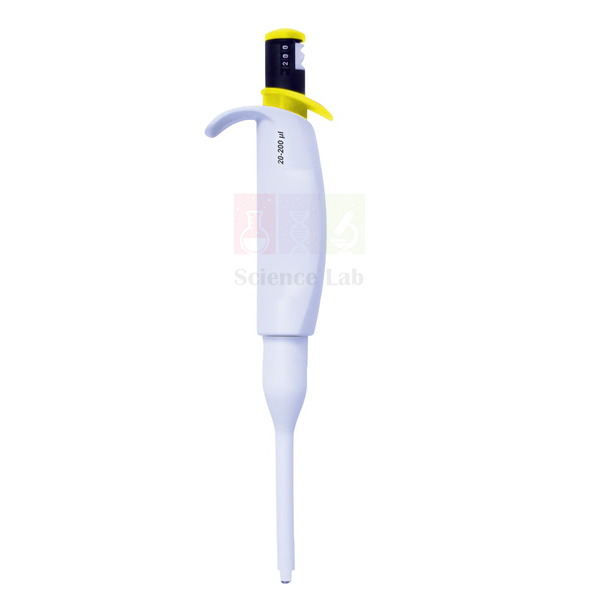
Single Channel Pipettors
Single Channel Pipettors (Product Code: SLE/CL/84) are hand-held liquid-handling instruments working in the 20–200 µl range, the band used most often for serum aliquots, buffer additions and ELISA well filling. The pipettor carries a yellow colour code so it can be picked out quickly on a crowded bench, and its listed inaccuracy and imprecision figures give lab managers a clear basis for comparing it with other instruments. Hospital labs, pathology units and college teaching rooms that stock microbiology lab equipment in India rely on this range for day-to-day dosing. It is supplied by Jain Scientific Equipments Pvt Ltd (ScienceLab), Ambala.
Specifications
| Parameter | Detail |
|---|---|
| Type | Single channel pipettor |
| Volume range | 20–200 µl |
| Colour code | Yellow |
| Inaccuracy (%) | 2.5 / 0.6 |
| Imprecision (%) | 0.7 / 0.2 |
Typical Use
In a clinical chemistry or serology section, a 20–200 µl pipettor transfers patient serum or plasma into reaction cuvettes, adds controls and calibrators, and dispenses sample and conjugate into microplate wells. Microbiology practicals use the same range for spreading an inoculum on agar plates and for serial dilutions in broth, while biochemistry classes use it to build standard curves for colorimetric assays. Because one instrument covers a tenfold span, it is often the first pipettor a new diagnostic or teaching lab buys.
Match the pipettor with tips sized for 200 µl work and keep the yellow-coded instruments and tip racks together to avoid mix-ups between ranges. For viscous liquids such as serum or glycerol, reverse pipetting (over-aspirating to the second stop and dispensing only to the first) gives more repeatable volumes. Always hold the pipettor vertically during aspiration, never lay it down with liquid in the tip, and have its performance checked at intervals set by your lab's quality procedure.
Supplier
Jain Scientific Equipments Private Limited, which trades as ScienceLab from Ambala in Haryana, sources and dispatches pipetting instruments like this one together with the teaching and laboratory apparatus it produces, so a clinical lab can order its bench set-up from a single vendor. Details of the company, its facilities and its range are on the ScienceLab profile page.
Related Clinical Laboratory Products
These items complete a routine pipetting workflow built around the 20–200 µl range:
- Pipette Tip Barrier Ster 200ul — sterile barrier tips sized for the top of this range.
- Pipettor, Variable Volume — covers micro-volumes below 20 µl.
- Pipettor, High Volume — for reagent volumes above 200 µl.
- Digital Pipette 8 Channels — fills a full microplate row at once when throughput grows.
Browse the complete Clinical Laboratory range for tips, racks and diagnostic consumables.
Frequently Asked Questions
What volume range does this pipettor cover?
It is listed for 20 to 200 µl. For volumes below or above this band, pair it with a lower- or higher-range pipettor.
What do the inaccuracy and imprecision figures mean?
They are listed as 2.5 / 0.6 % inaccuracy and 0.7 / 0.2 % imprecision, each pair quoted at different points of the range. Ask us for the test volumes behind each value if your quality system needs them.
Why is the pipettor colour coded yellow?
The colour marks its volume range, helping staff pick the right instrument and matching tip rack quickly, especially in labs that run several pipettors side by side.
Which tips should I order with it?
Use tips sized for up to 200 µl. The listing does not name a specific tip, so confirm the fit with our team when you place the order.
Can a calibration certificate be provided?
Calibration certificate availability should be discussed with us before ordering; write to us through the contact page with your requirement.
What should an institutional quotation request include?
Mention product code SLE/CL/84, the number of pipettors, any tips needed and the delivery address. We supply hospitals, colleges and distributors across India and international markets.
Request a Quote
For pricing on Single Channel Pipettors, message us via the contact page or place the item in the enquiry cart together with matching tips.
Last updated: 24 September 2026
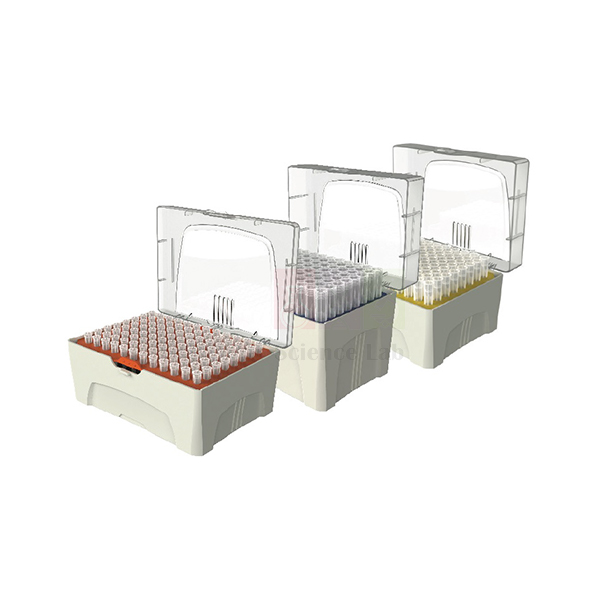
Filter Pipette Tips
Filter Pipette Tips (Product Code: SLE/CL/85) are 1–10 µL disposable tips with a built-in filter that stops aerosols and liquid from reaching the pipette shaft. They are free from DNase, RNase, human DNA, pyrogen and PCR inhibitors, which is why molecular biology, virology and diagnostic labs choose them for contamination-sensitive micro-volume work. The tips have a low-retention surface, can be autoclaved and are held in a hinged, colour-coded rack. They are supplied by Jain Scientific Equipments Pvt Ltd (ScienceLab), Ambala, a lab consumables supplier for India and international markets.
Specifications
| Parameter | Detail |
|---|---|
| Type | Filter pipette tips |
| Volume range | 1–10 µL |
| Sterilisation | Fully autoclavable |
| Surface | Low retention |
| Rack | Stackable; hinge rack allows single-hand operation |
| Identification | Colour-coded tray |
| Free from | DNase, RNase, human DNA, pyrogen and PCR inhibitor |
| Supplied as | Pack of 10 |
Typical Use
Filtered micro-volume tips are the standard choice when setting up PCR and real-time PCR reactions, handling extracted RNA, pipetting infectious specimens or loading samples from a gel electrophoresis kit in India's biotechnology teaching labs. The filter barrier keeps the inside of the pipettor clean, so a trace of one sample cannot be carried into the next, and the nuclease-free, inhibitor-free material protects sensitive enzymatic reactions. Low retention means less liquid clings to the tip wall, which matters when a few microlitres of enzyme or detergent-containing buffer are being dispensed.
In practice, open the hinged lid with one hand while holding the pipettor in the other, press the pipettor firmly onto a tip, and close the lid again straight away to keep the remaining tips clean. Change the tip for every sample and every reagent, and never reuse a filter tip once liquid has touched the filter. The colour-coded tray helps staff keep these small tips apart from larger racks, and the stackable design saves drawer space in busy PCR rooms.
Supplier
ScienceLab is the brand under which Jain Scientific Equipments Private Limited, an Ambala (Haryana) company, provides consumables such as these tips along with the laboratory and teaching equipment it makes. Ordering tips with your pipettors and other clinical items from one source simplifies purchasing for hospitals and colleges. Read about the company on our profile page.
Related Clinical Laboratory Products
Pair these tips with the following items used in the same micro-pipetting workflow:
- Pipettor, Variable Volume — a 0.5–10 µl pipettor for the same small-volume band.
- Pipette Tip White 2-20 ul — unfiltered tips for routine work where aerosol protection is not needed.
- Pipette Tip Barrier Ster 200ul — barrier tips for larger volumes in the same assay.
- Filtered Micropipette Tips — another filtered tip option from our measuring range.
- Biohazard Bag — for safe disposal of used tips after clinical or infectious work.
See all tips, pipettors and diagnostic consumables in the Clinical Laboratory category.
Frequently Asked Questions
What volume are these tips made for?
They are 1–10 µL filter tips, intended for micropipettes working in that range. Confirm the fit with your pipettor model when ordering.
Are the tips sterile when delivered?
The listing states that they are fully autoclavable and free from DNase, RNase, human DNA, pyrogen and PCR inhibitor; it does not state pre-sterilisation. Autoclave them before use if your protocol requires sterile tips, or ask us about sterile supply.
What is in a pack?
The tips are listed as available in a pack of 10. Ask our team how many tips each rack holds so you can plan your consumption.
Why use filter tips instead of ordinary tips?
The filter blocks aerosols from entering the pipettor, reducing cross-contamination between samples. They are recommended for PCR, RNA and infectious-sample work.
Can the racks be refilled or reused?
The tips themselves are single-use. Whether empty racks can be refilled should be checked with us via the contact page.
Do you supply tips in bulk for labs and distributors?
Yes, bulk and repeat orders are handled for India and international markets. Include the product code SLE/CL/85 and the number of packs in your enquiry.
Request a Quote
To receive a quotation for Filter Pipette Tips, contact us through the contact page or add them to the enquiry cart with any pipettors you need.
Last updated: 24 September 2026
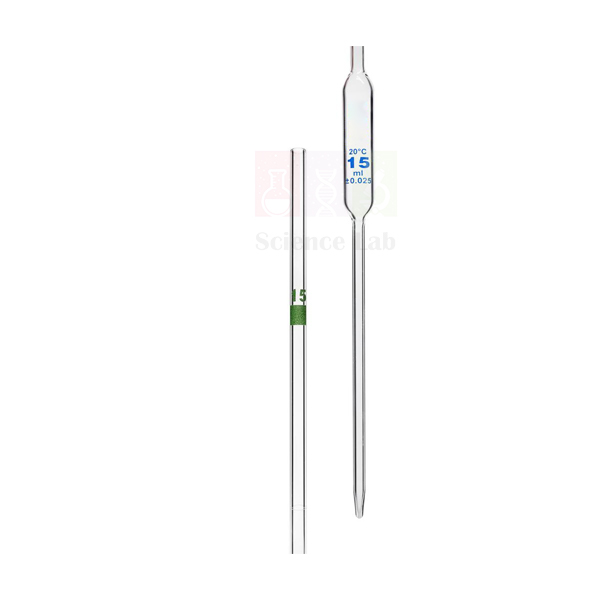
Pipette, 15ml
Pipette, 15ml (Product Code: SLE/CL/86) is a bulb-form glass pipette that delivers one fixed volume of 15 ml, marked by a single graduation line on its upper stem. Made from neutral glass that is heat and chemical resistant, and produced to Class B tolerance, it is intended for measured transfers in volumetric analysis, sample preparation and routine clinical or chemistry lab work. Schools, colleges and quality-control labs buying chemistry lab glassware in India use it wherever the same aliquot must be repeated. It is manufactured by Jain Scientific Equipments Pvt Ltd (ScienceLab), Ambala.
Specifications
| Parameter | Detail |
|---|---|
| Type | Bulb form pipette |
| Capacity | 15 ml |
| Graduation | Single graduation mark on the upper stem |
| Tolerance class | Class B |
| Material | Neutral glass |
| Resistance | Heat resistant and chemical resistant |
Typical Use
A one-mark bulb pipette is the tool for moving an exact aliquot of a solution from a volumetric flask into a conical flask before a titration, for dispensing a fixed volume of reagent into a series of test samples, or for preparing dilutions where every replicate must receive the same amount. Because it has only one mark, there is no scale to misread, which suits students learning volumetric analysis and technicians running repeated determinations. It is a common item in a school or college titration kit in India alongside burettes and flasks.
Always fill the pipette with a pipette filler rather than by mouth. Rinse it first with a little of the solution to be measured, draw the liquid above the mark, then let it fall until the bottom of the meniscus sits on the line at eye level. Allow the contents to drain freely with the tip touching the inside of the receiving vessel, and follow the delivery marking on the pipette regarding the final drop. Rinse with distilled water after use and store it in a pipette stand so the tip is protected.
Manufacturer
This pipette is produced under the ScienceLab name by Jain Scientific Equipments Private Limited of Ambala, Haryana, a registered MSME (Udyam UDYAM-HR-01-0003714) that manufactures laboratory glassware and teaching apparatus. Export consignments are shipped under Importer-Exporter Code AAECJ8618A issued by the DGFT. The company background is on our company profile.
Related Laboratory Equipment
Complete a volumetric transfer set-up with these items:
- Pipette Filler — draws liquid into the pipette safely without mouth suction.
- Pipette Stand, Vertical — holds washed pipettes upright to drain and protects the tips.
- Conical Flask — the usual receiving vessel for an aliquot before titration.
- Transfer Pipette, 3ml — a disposable option for rough transfers that do not need a fixed volume.
Further clinical and general lab items are in our Clinical Laboratory category.
Frequently Asked Questions
How much does this pipette deliver?
It delivers a single fixed volume of 15 ml, set by the one graduation mark on the upper stem. It is not graduated for intermediate volumes.
What does Class B mean?
Class B is a general-purpose tolerance class used for teaching and routine analysis; it allows a slightly wider tolerance than Class A glassware. Ask us if your method specifies a particular class.
Can the pipette be heated or oven-dried?
It is made of heat-resistant neutral glass, so hot-water washing is fine. As with all volumetric glassware, avoid strong heating, which can affect the delivered volume; air-dry or dry it gently.
Which chemicals can it be used with?
The glass is listed as chemical resistant and suits common aqueous acids, bases and salt solutions used in teaching labs. For unusual or aggressive reagents, check suitability with us first.
Is a calibration certificate available?
Please discuss calibration certificate availability with our team through the contact page before ordering.
Can you supply pipettes in quantity for schools or export?
Yes. We supply institutional and bulk orders across India and international markets; state product code SLE/CL/86, the quantity and the delivery destination.
Request a Quote
For a quotation on the Pipette, 15ml, write to us via the contact page or add it to the enquiry cart with fillers and stands.
Last updated: 24 September 2026
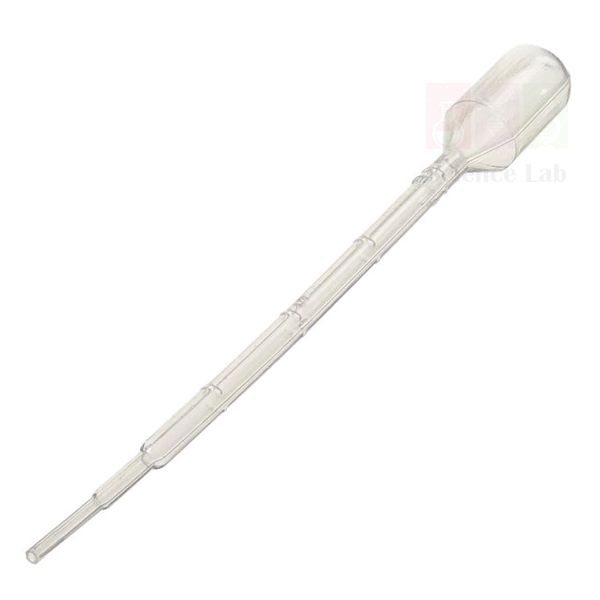
Transfer Pipette, 1ml
Transfer Pipette, 1ml (Product Code: SLE/CL/87) is a single-piece plastic dropper with a squeeze bulb and a stem graduated up to 1 ml, used for transferring and dispensing liquids in all types of laboratories. It is moulded from clear, non-toxic low density polyethylene with uniform wall thickness, so the liquid level is easy to see against the printed graduations. The fine 5 mm stem makes it well suited to adding reagents drop by drop or moving small sample volumes into tubes. As disposable lab equipment for India's clinical, school and research labs, it is supplied non-sterile in packs of 500 by Jain Scientific Equipments Pvt Ltd (ScienceLab), Ambala.
Specifications
| Parameter | Detail |
|---|---|
| Type | Graduated transfer pipette with bulb |
| Material | Low density polyethylene, non-toxic |
| Colour | Clear |
| Graduated up to | 1 ml |
| Capacity | 5 ml |
| Bulb draw | 3.5 ml |
| Length | 160 mm |
| Stem diameter | 5 mm |
| Chemical resistance | Chemical resistant |
| Sterility | Non-sterile |
| Pack size | Pack of 500 |
Typical Use
The 1 ml graduation is where this pipette earns its place: it lets a technician or student measure out a quick, approximate volume of reagent, add indicator or stain dropwise onto a slide, split a urine or serum specimen into labelled tubes, or lift a supernatant off a pellet after centrifugation. In practical classes, handing each student their own pipettes stops reagent bottles from being contaminated by shared droppers. Labs that buy from a lab plastic ware supplier in India often keep a pack of these at every bench.
Squeeze the bulb before dipping the stem into the liquid, then release slowly so the level rises without drawing air. Hold the pipette upright to read the volume against the graduations, and dispense by gentle pressure so drops fall one at a time. For exact volumetric work use a glass volumetric pipette instead. Treat each pipette as single-use and discard it according to your lab's waste procedure, especially after contact with clinical samples.
Supplier
ScienceLab, the trading name of Jain Scientific Equipments Private Limited of Ambala, Haryana, stocks plastic consumables like these pipettes so that laboratories can order disposables together with their instruments and glassware in one shipment. You can learn more about the company on the ScienceLab profile.
Related Clinical Laboratory Products
Items commonly ordered with 1 ml transfer pipettes:
- Transfer Pipette, 3ml — graduated to a larger volume with a wider stem for faster transfers.
- Transfer Pipette Sterile — for procedures where a non-sterile pipette is not acceptable.
- Rack Tubes Set of 3 — holds the tubes that samples are dispensed into.
- Biohazard Bag — for discarding used pipettes after contact with specimens.
For other disposables and diagnostic items, visit the Clinical Laboratory category.
Frequently Asked Questions
If it is a 1 ml pipette, why is the capacity 5 ml?
The stem is graduated up to 1 ml, while the whole pipette, including the bulb, holds 5 ml; the bulb draws 3.5 ml in one squeeze. Measure only within the graduated section.
Are these pipettes sterile?
No, they are supplied non-sterile. For sterile work, choose our Transfer Pipette Sterile instead.
How many pipettes are in one pack?
Each pack contains 500 pipettes.
Can they be washed and reused or autoclaved?
They are intended as disposable items and the listing does not state that they are autoclavable. Check with us through the contact page if your procedure needs heat sterilisation.
Which liquids can I handle with them?
The polyethylene is chemical resistant and suits aqueous reagents, stains, buffers and biological fluids. For organic solvents, confirm compatibility with our team before use.
Do you supply larger quantities for hospitals or export?
Yes, repeat and bulk orders are supplied across India and international markets. Quote product code SLE/CL/87 and the number of packs required.
Request a Quote
Ask for a quotation on the Transfer Pipette, 1ml through our contact page, or add it to the enquiry cart with your other clinical consumables.
Last updated: 24 September 2026
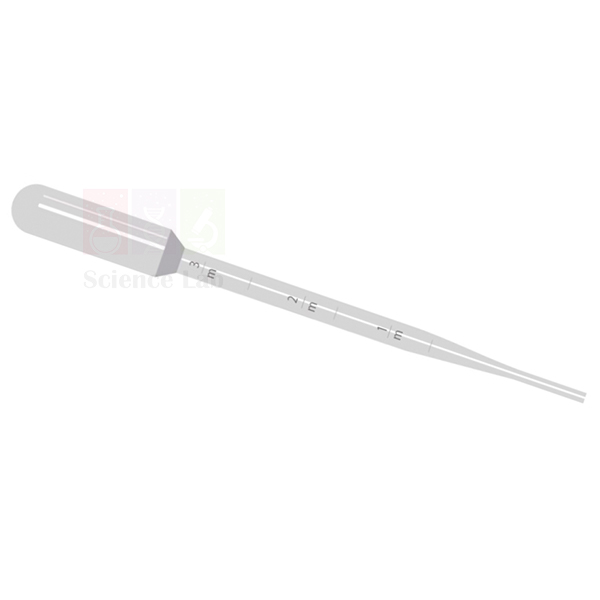
Transfer Pipette, 3ml
Transfer Pipette, 3ml (Product Code: SLE/CL/88) is a larger-format disposable dropper whose stem is graduated up to 3 ml, with a total capacity of 7 ml and a wide 7.8 mm stem for quicker filling and emptying. Like its smaller counterpart it is made of clear, non-toxic low density polyethylene with even wall thickness and readable graduations, and it resists common laboratory chemicals. Clinical labs, food and water testing rooms and college practical classes use it to move millilitre volumes without reaching for glassware, making it everyday lab equipment for college and hospital use in India. It is supplied non-sterile in packs of 500 by Jain Scientific Equipments Pvt Ltd (ScienceLab), Ambala.
Specifications
| Parameter | Detail |
|---|---|
| Type | Graduated transfer pipette with bulb |
| Graduated up to | 3 ml |
| Capacity | 7 ml |
| Bulb draw | 3.5 ml |
| Stem diameter | 7.8 mm |
| Length | 160 mm |
| Material | Low density polyethylene, non-toxic, clear |
| Chemical resistance | Chemical resistant |
| Sterility | Non-sterile |
| Pack size | Pack of 500 |
Typical Use
With a 3 ml graduated stem and a single squeeze drawing 3.5 ml, this pipette handles the jobs that are too large for a dropper yet too casual for a glass pipette: dispensing broth or diluent into test tubes, taking water samples from a bottle for testing, transferring homogenised samples in food microbiology lab equipment set-ups, and topping up buffer in electrophoresis tanks. The wider 7.8 mm bore lets suspensions and slightly viscous liquids flow without clogging, which saves time when many tubes must be filled in a row.
To fill, press the bulb, place the stem below the liquid surface and release gradually; tilt the pipette upright to check the level against the graduations before dispensing. Because the stem is wide, dispense with steady, light pressure to avoid splashing. Keep unopened packs away from heat and direct sunlight, and discard each pipette after use according to your laboratory's waste rules.
Supplier
These pipettes reach laboratories through ScienceLab, the name used by Jain Scientific Equipments Private Limited, an Ambala-based company in Haryana that combines its own apparatus production with a range of sourced plastic consumables. Visit the company profile for an overview of the business.
Related Clinical Laboratory Products
Useful companions when transferring millilitre volumes:
- Transfer Pipette, 1ml — finer graduations and a slimmer stem for dropwise additions.
- Transfer Pipette Sterile — when the procedure requires sterile transfer.
- Cylinder Measuring Plastic — for measuring larger volumes more exactly before transfer.
- Beaker Plastic — an unbreakable container to draw liquid from at the bench.
Explore more consumables in our Clinical Laboratory section.
Frequently Asked Questions
How much can I measure with this pipette?
Up to 3 ml on the graduated stem. The pipette holds 7 ml in total, and one squeeze of the bulb draws 3.5 ml.
How is it different from the 1 ml transfer pipette?
It is graduated to a larger volume and has a wider 7.8 mm stem, so it fills and empties faster and copes better with suspensions. The 1 ml version is better for dropwise work.
Is it sterile, and how is it packed?
It is non-sterile and comes in packs of 500 pieces.
Can it be used with solvents?
It is chemical resistant and suited to aqueous solutions, media and biological samples. For organic solvents, ask us via the contact page before use.
Is it accurate enough for quantitative analysis?
The graduations give a practical measured volume for routine transfers. Where a method specifies an exact volume, use calibrated volumetric glassware.
What details should a bulk quotation request include?
Give product code SLE/CL/88, the number of packs, your delivery location and whether you also need other consumables. We supply India and international markets.
Request a Quote
To order the Transfer Pipette, 3ml, send your requirement through the contact page or add it to the enquiry cart.
Last updated: 24 September 2026
Pneumatic Trough, Glass
Pneumatic Trough, Glass (Product Code: SLE/CL/89) is a wide, shallow water vessel for collecting gases over water, made from clear pressed soda-lime glass with a 25 cm diameter, a height of 12.5 cm and a capacity of 5000 ml. The transparent walls let students watch bubbles displace water from an inverted gas jar, which makes the classic gas-preparation experiments easy to follow. It is heat and chemical resistant and forms the centre of the gas collection apparatus used in school and college chemistry labs. It is manufactured by Jain Scientific Equipments Pvt Ltd (ScienceLab), Ambala.
Specifications
| Parameter | Detail |
|---|---|
| Material | Pressed soda-lime glass |
| Colour | Clear |
| Diameter | 25 cm |
| Height | 12.5 cm |
| Capacity | 5000 ml |
| Resistance | Heat resistant and chemical resistant |
Typical Use
The trough is filled with water and a gas jar, also full of water, is inverted into it and rested on a beehive shelf. A delivery tube from the gas generator is led under the shelf, and the gas bubbles up into the jar, pushing the water out. This downward displacement of water is how oxygen, hydrogen and other gases that are only slightly soluble in water are prepared and collected in practical classes, and it is a standard part of school chemistry lab equipment in India. Biology teachers also use the trough to hold water plants under an inverted funnel when demonstrating the oxygen given off in photosynthesis.
Set the trough on a flat, stable bench before filling it, as a full vessel is heavy. When heating a generator flask, always withdraw the delivery tube from the water before removing the flame to prevent water being sucked back into the hot flask. After the experiment, empty and rinse the trough with water, and dry it before storage; handle it with both hands and avoid knocks against hard surfaces.
Manufacturer
ScienceLab is the brand of Jain Scientific Equipments Private Limited, a company headquartered in Ambala, Haryana, that makes chemistry and general laboratory apparatus for teaching institutions and dispatches orders to schools, colleges and dealers. An overview of the company is on the about us page.
Related Laboratory Equipment
Assemble a complete gas-collection set-up with these items:
- Gas Jar, Glass — the jar inverted in the trough to receive the gas.
- Beehive Shelf, Porcelain — supports the gas jar and lets the delivery tube enter from below.
- Delivery Tube — carries gas from the generating flask to the jar.
- Gas Jar Cover — seals the filled jar before it is lifted out of the water.
- Pneumatic Trough — a plasticware alternative for junior classes.
This trough is listed in our Clinical Laboratory category along with other general lab items.
Frequently Asked Questions
What size is the trough?
It measures 25 cm in diameter and 12.5 cm in height, with a capacity of 5000 ml, which leaves room for a beehive shelf and gas jar.
Is a beehive shelf or gas jar included?
The listing covers the trough only. Order the shelf, gas jars, covers and delivery tube separately, or ask us to quote the complete set.
Can the trough be heated?
It is listed as heat resistant, so warm water is fine, but a pneumatic trough is not designed for direct flame heating. Avoid sudden temperature changes, as with any soda-lime glassware.
Why choose glass over a plastic trough?
Glass stays clear for longer, resists staining from chemicals and gives a better view of gas collection. A plastic trough is lighter and less fragile for younger students.
How should it be cleaned?
Rinse with water after each use and wash with a mild detergent if deposits form; the glass is chemical resistant, but avoid abrasive pads that scratch the surface.
Do you supply schools in quantity or overseas?
Yes. We handle institutional, tender and export orders for India and international markets; mention product code SLE/CL/89 and the quantity in your enquiry via the contact page.
Request a Quote
Request pricing for the Pneumatic Trough, Glass through our contact page, or add it to the enquiry cart along with gas jars and shelves.
Last updated: 24 September 2026