- Physics Lab Equipment
- Chemistry Lab Equipment
- Biology Lab Equipment
- Anatomical Lab Equipment
- Learning
- Educational Lab Equipment
- Magnets
- Agriculture
- Astronomy
- Earth Science
- Geography Lab Equipment
- Safety Lab Coat
- Laboratory
- Meteorological
- Electricity & Magnetism
- Heat
- School Lab Equipment
- Lab Glassware
- Science Lab Equipment
- Tvet Lab Equipment
- Robotics Kits Supplier and Manufacturer for Schools India
- Math Lab Equipment Manufacturers and Exporters in Ambala
- STEM Kits Manufacturers and Supplier India
- Engineering Lab Equipment
- Hospital Lab Equipment
- Water, Sanitation & Hygiene Supplies
- Cold Chain, Solar & Communication Equipment
- Nutrition
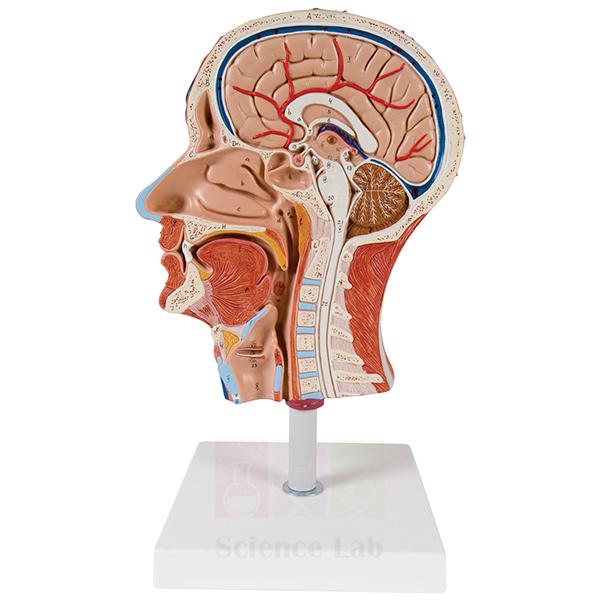
Head Section with Larynx Model
Head Section with Larynx Model (Product Code: SLE/A/43) is an about life-size dissection of the head used to teach the upper airway, the swallowing passage and the larynx in anatomy, ENT, speech-therapy and nursing courses. It shows the salivary glands, pharyngeal musculature and laryngeal structures, and divides to give a midsagittal view of the oronasal cavity, pharynx, larynx and trachea. It is made by Jain Scientific Equipments Pvt Ltd (ScienceLab), an OEM human anatomical models manufacturer in India, at its own factory in Ambala.
Specifications
| Parameter | Detail |
|---|---|
| Type | Dissectible head section model with larynx |
| Scale | About life size |
| Size (without base) | 27 x 14 x 16 cm |
| Structures shown | Salivary glands, pharyngeal musculature and laryngeal structures |
| Sectional view | Divides to show a midsagittal view of the oronasal cavity, pharynx, larynx and trachea |
| Base | Durable polymer base; the model can be removed from the base for examination |
| Supplied with | Identification key |
| Product code | SLE/A/43 |
| Manufacturer | Jain Scientific Equipments Pvt Ltd (ScienceLab) — OEM |
| Country of origin | India (made in Ambala, Haryana) |
What Is the Head Section with Larynx Model Used For?
In a lesson on swallowing and voice production, the teacher opens the model at its midsagittal division and traces the path of air from the nasal cavity through the pharynx into the larynx and trachea, then follows the route that food takes from the mouth into the pharynx. Because the pharyngeal muscles and the salivary glands appear on the same piece, students can connect chewing, saliva secretion and swallowing as one sequence instead of three separate topics.
Lifting the head off its base lets small groups pass it around during practicals and study the cut surface closely. For quick assessments, cover the identification key and ask learners to name the structures you point to. Institutions assembling biology teaching aids in India for ENT, speech-science or nursing introductions often pair it with a separate larynx model for extra detail of the voice box; senior school classes studying respiration and digestion can use it too.
OEM Manufacturer
Jain Scientific Equipments Private Limited, known by its brand ScienceLab, is the OEM (original equipment manufacturer) of the Head Section with Larynx Model. It is produced at the company's own licensed factory at Saha, Ambala, Haryana, India, and dispatched from there to medical colleges, speech-science departments, dealers and importers.
Ask us about replacement parts, repeat orders or matching sets for several labs — the manufacturer answers directly. More background is in the company profile.
Related Brain Models
Departments teaching the airway and head in more depth often order these models together with the head section:
- Larynx Human Model — an isolated voice box for closer study of the larynx seen here in context
- Human Larynx, Trachea, and Bronchi Model — continues the airway below the trachea into the bronchi
- Anatomical Human Nasal Cavity Model — adds detail at the upper end of the airway
- Human Head Section Model — a median-section relief that also covers the brain and cervical spine
See every head and brain model in the Brain Models category.
Frequently Asked Questions
What can students see when the Head Section with Larynx Model is opened?
When opened, the Head Section with Larynx Model gives a midsagittal view of the oronasal cavity, pharynx, larynx and trachea. The outer dissection also shows the salivary glands and the pharyngeal musculature, so airway and swallowing anatomy are studied together.
Is a key included with the Head Section with Larynx Model?
Yes. An identification key is supplied with the Head Section with Larynx Model, so teachers and students can check the name of each structure shown on the dissection and on the sectioned surface.
How large is the Head Section with Larynx Model?
The Head Section with Larynx Model is about life size and measures 27 x 14 x 16 cm without its base. For base or packed dimensions, please ask through our contact page before planning shipment or storage.
Can the head section be taken off its base?
Yes. The Head Section with Larynx Model lifts off its durable polymer base, so it can be handled and examined from all sides during practicals and then returned to the base for display.
How should the Head Section with Larynx Model be cleaned?
Wipe the Head Section with Larynx Model with a soft cloth lightly dampened with mild soapy water and let it dry. Avoid solvents and abrasive pads, which can dull the surface detail, and store it away from direct sunlight.
Who manufactures the Head Section with Larynx Model?
The Head Section with Larynx Model is manufactured by Jain Scientific Equipments Pvt Ltd (ScienceLab), the OEM, at its own licensed factory at Saha, Ambala, Haryana, India. Colleges and distributors order it directly from the manufacturer.
Do you supply several units to colleges or overseas buyers?
Yes. ScienceLab supplies the Head Section with Larynx Model to institutions across India and international markets. Share the quantity and delivery location, and the manufacturer will quote for the whole order in one reply.
Request a Quote
For pricing or a proforma invoice for the Head Section with Larynx Model (SLE/A/43), write to us via the contact page or add it to the enquiry cart along with other items on your list. Quotations come direct from the manufacturer.
Last updated: 24 September 2026
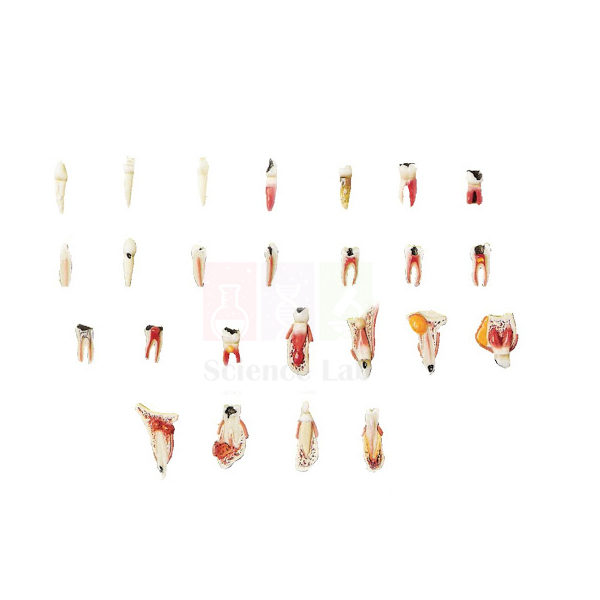
Odontopathies Model
Odontopathies Model (Product Code: SLE/A/44) is a life-size collection of 25 diseased teeth mounted on a green base under a removable transparent cover. Together they show periodontitis, necrosis and varying degrees of dental caries and dental pulp inflammation, so students can compare early and advanced disease side by side on real-size teeth. Dental hygiene schools, dental and nursing colleges and school health-education programmes use it, and it is manufactured by Jain Scientific Equipments Pvt Ltd (ScienceLab), Ambala, an anatomical models manufacturer.
Specifications
| Parameter | Detail |
|---|---|
| Type | Dental pathology display model |
| Scale | Life size |
| Size | 26 × 32 × 4 cm |
| Contents | 25 diseased teeth |
| Diseases depicted | Periodontitis, necrosis, and varying degrees of dental caries and dental pulp inflammation |
| Mounting | Green base with removable transparent cover |
Typical Use
Because the teeth are life size, learners see disease exactly as it appears in a patient’s mouth rather than on an enlarged model. A tutor can arrange a lesson around the progression of decay: from shallow caries through deeper lesions that reach the pulp and cause inflammation, on to necrosis, and then contrast these with periodontitis, where the supporting tissues rather than the tooth itself are affected. The transparent cover keeps the set dust-free on display and lifts off when students need a closer look.
Dental hygiene and assistant courses use the set for identification practice, asking trainees to classify each tooth by condition. In schools it fits oral health education, where showing real-size decayed teeth is often more persuasive than a chart. Replace the cover after every session so the small teeth stay clean and in position.
Manufacturer
This dental model comes from Jain Scientific Equipments Private Limited, an Ambala, Haryana manufacturer that sells under the ScienceLab name to dental, medical and general education buyers in India and international markets. To learn about the company, visit our company profile.
Related Human Models
Use these items with the Odontopathies Model for a complete oral-health unit:
- Dental Caries Model — focuses on the decay process in more detail.
- Human Teeth (Denture) — a healthy denture model for brushing demonstrations and comparison.
- Human Teeth — a wall chart to reinforce tooth names and structure.
- Human Skull — shows how teeth sit in the upper and lower jaws.
- Human Tongue Model — covers the other main structure of the oral cavity.
Browse all anatomy and pathology models in our anatomy models category.
Frequently Asked Questions
How many teeth are included?
The model has 25 diseased teeth mounted on one base.
Which dental diseases are shown?
Periodontitis, necrosis, and varying degrees of dental caries and dental pulp inflammation.
Are the teeth enlarged?
No, they are life size, which helps students recognise conditions as they appear clinically.
How is the model protected?
The teeth sit on a green base under a removable transparent cover. The whole unit measures 26 × 32 × 4 cm.
Can individual teeth be removed?
The teeth are described as mounted on the base; please confirm with us through the contact page if you need removable teeth for your course.
Do you supply several sets for a dental college?
Yes. Tell us how many sets you need and where they should be delivered, and we will send a combined quotation.
Request a Quote
Enquire about the Odontopathies Model through our contact page, or add it to the enquiry cart alongside other dental and oral-health teaching aids.
Last updated: 24 September 2026
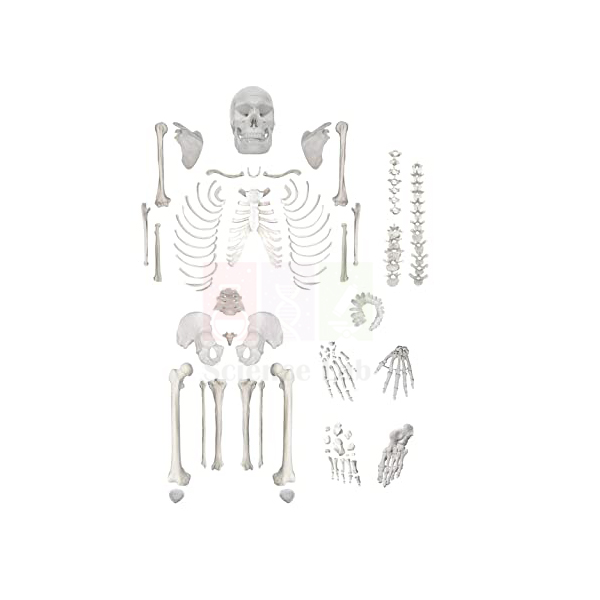
Disarticulated Human Skeleton
Disarticulated Human Skeleton (Product Code: SLE/A/45) is a life-size human skeleton model in 53 durable plastic pieces used for hands-on bone identification in anatomy, nursing and biology practicals. One hand and foot are wired, the other pair is loosely strung on nylon filament, and the vertebral column is strung on nylon filament, with a black plastic storage case included. It is made by Jain Scientific Equipments Pvt Ltd (ScienceLab), an OEM manufacturer, at its own factory in Ambala, India.
Specifications
| Parameter | Detail |
|---|---|
| Type | Disarticulated full human skeleton |
| Scale | Life-size |
| Number of pieces | 53 |
| Material | Durable plastic |
| Hands and feet | One hand and one foot articulated on wire; the other pair loosely articulated on nylon filament |
| Vertebral column | Strung on nylon filament |
| Storage | Black plastic storage case included |
| Product code | SLE/A/45 |
| Manufacturer | Jain Scientific Equipments Pvt Ltd (ScienceLab) — OEM |
| Country of origin | India (made in Ambala, Haryana) |
What Is the Disarticulated Human Skeleton Used For?
The mixed articulation is what sets this set apart in the lab. The wired hand and foot keep their natural shape, so they serve as a reference for how the small bones fit together, while the loosely strung pair can be spread out to examine the individual carpals, metatarsals and phalanges without losing any of them. The strung vertebral column can be laid out in order or curved to show the natural spinal curves, and the separate long bones, skull and girdles are handled one by one for side-identification and landmark exercises.
With a fixed count of 53 pieces to check in and out, a tutor can quickly confirm the set is complete at the end of a practical, and the storage case keeps everything together between classes or when the skeleton travels to another campus. For departments comparing a disarticulated human skeleton model with a fully loose set, this format trades some individual handling for much easier management.
OEM Manufacturer
Jain Scientific Equipments Private Limited, trading as ScienceLab, is the OEM (original equipment manufacturer) of the Disarticulated Human Skeleton and produces it at its own licensed factory at Saha, Ambala, Haryana, India. The company is a registered MSME manufacturer (Udyam UDYAM-HR-01-0003714) and ships export orders under Importer-Exporter Code AAECJ8618A issued by the DGFT.
Medical colleges, dealers and importers deal directly with the maker for quotations and for questions about spare pieces. Read more on our company profile.
Related Bone Models
Models used together with a disarticulated skeleton in osteology teaching:
- Human Skeleton Model, Disarticulated — an alternative disarticulated set for comparing formats
- Human Skeleton, Hang-Up — an assembled skeleton for placing each piece in context
- Human Muscular and Ligamentous Skeleton — shows the muscles and ligaments that attach to these bones
- Human Hand Joint Model — a closer view of the hand joints represented by the wired hand
The Bone Model category lists all our skeletons and joint models.
Frequently Asked Questions
How many pieces make up the Disarticulated Human Skeleton?
The Disarticulated Human Skeleton is made up of 53 durable plastic pieces that together form a life-size full human skeleton, with the smaller bones of the hands, feet and spine kept together on wire or nylon filament.
Why are the hands and feet of the Disarticulated Human Skeleton articulated differently?
On the Disarticulated Human Skeleton, one hand and foot are wired to show their assembled shape, while the other pair is loosely strung on nylon filament so the small bones can be examined individually without being lost.
Is the spine of the Disarticulated Human Skeleton made of separate bones?
The vertebral column of the Disarticulated Human Skeleton is strung on nylon filament, which keeps the vertebrae in order while still letting students study each one and lay the column out in sequence.
Does the Disarticulated Human Skeleton come with storage?
Yes. The Disarticulated Human Skeleton is supplied with a black plastic storage case, which keeps all 53 pieces together between practicals and when the set is carried to another room or campus.
How do I stop the nylon filament on the Disarticulated Human Skeleton from wearing?
Avoid pulling the vertebrae or finger bones of the Disarticulated Human Skeleton apart along the filament, and lay the strung sections flat in the storage case instead of coiling them tightly.
Who manufactures the Disarticulated Human Skeleton?
The Disarticulated Human Skeleton is manufactured by Jain Scientific Equipments Pvt Ltd (ScienceLab), the OEM, at its own factory at Saha, Ambala, Haryana, India. Quotations and any questions about replacement pieces are handled by the manufacturer directly.
Can a medical college order several Disarticulated Human Skeleton sets?
Yes. Tell us how many Disarticulated Human Skeleton sets you need and whether delivery is in India or to international markets, and the manufacturer will prepare a quotation for the full quantity.
Request a Quote
To price this disarticulated skeleton with a quotation straight from the manufacturer, contact us or add it to your enquiry cart.
Last updated: 24 September 2026
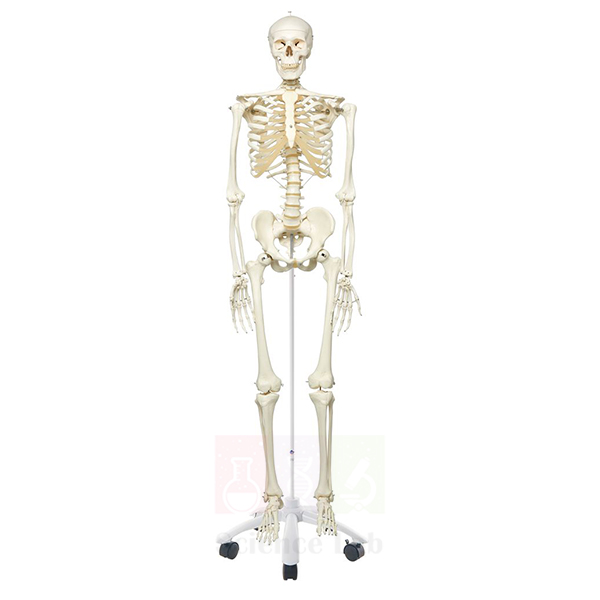
Human Skeleton, Rod-Supported
Human Skeleton, Rod-Supported (Product Code: SLE/A/46) is a life-size, articulated human skeleton in durable plastic used as a full-scale reference for naming bones and explaining joints in biology and anatomy teaching. Schools and colleges choosing a human skeleton model in India value its mobile metal rod stand with casters; the figure is 176.5 cm high and weighs 9.6 kg with the stand. It is made by Jain Scientific Equipments Pvt Ltd (ScienceLab), an OEM manufacturer, at its own factory in Ambala, India.
Specifications
| Parameter | Detail |
|---|---|
| Type | Life-size, articulated human skeleton |
| Material | Durable plastic |
| Support | Mounted on a metal rod with a stable metal stand |
| Mobility | Stand fitted with casters |
| Height including stand | 176.5 cm |
| Weight including stand | 9.6 kg |
| Product code | SLE/A/46 |
| Manufacturer | Jain Scientific Equipments Pvt Ltd (ScienceLab) — OEM |
| Country of origin | India (made in Ambala, Haryana) |
What Is the Rod-Supported Human Skeleton Used For?
Because the skeleton is articulated and held upright by its rod, a teacher can stand beside it and point out the skull, rib cage, vertebral column, pelvis and the long bones of the arms and legs in their natural positions. It suits lessons on the axial and appendicular skeleton, on the difference between ball-and-socket, hinge and pivot joints, and on how posture and proportion relate to the bones underneath. Students preparing for practical examinations can take turns identifying bones by sight and touch, which is more memorable than working from a chart alone.
The casters let one person wheel the model from a storeroom to the front of a classroom or between laboratories; move it by holding the stand and rod rather than pulling on a limb, and roll it slowly over thresholds. As one of the core biology teaching aids for secondary schools, colleges and allied-health institutes, a rod-supported skeleton is usually kept on permanent display in the biology or anatomy room.
OEM Manufacturer
The company that trades as ScienceLab, Jain Scientific Equipments Private Limited, is the OEM (original equipment manufacturer) of the Human Skeleton, Rod-Supported and produces it at its own licensed factory at Saha, Ambala, Haryana, India.
Because the skeleton, rod and castor stand all come from the maker, schools and dealers can ask us directly about spare parts or a matching second skeleton for another room. Background on the company is available on the ScienceLab company profile.
Related Bone Models
Departments that set up a skeleton station often add models for examining individual regions in more detail:
- Human Skeleton, Hang-Up — an alternative full skeleton that hangs from its stand
- Human Muscular and Ligamentous Skeleton — a life-size figure marked with muscle attachments for higher-level anatomy courses
- Human Skeleton Model, Disarticulated — loose bones that students can pick up and identify individually
- Human Knee Joint Model, Life Size — a close-up of one major weight-bearing joint
- Human Thoracic Spinal Column Model — detailed study of the vertebrae that support the rib cage
The full range of skeletons, joints and spinal models is listed in our Bone Model category.
Frequently Asked Questions
How tall and heavy is the Human Skeleton, Rod-Supported?
The Human Skeleton, Rod-Supported measures 176.5 cm in height and weighs 9.6 kg, both figures including its stand. Allow for this height when planning cupboard or display space in the laboratory.
Is the Human Skeleton, Rod-Supported life-size and articulated?
Yes. The Human Skeleton, Rod-Supported is a life-size skeleton made of durable plastic with articulated bones, so the limbs can be positioned to demonstrate joint movement during a lesson.
How is the Human Skeleton, Rod-Supported moved around?
The Human Skeleton, Rod-Supported is mounted on a metal rod fixed to a stable metal stand with casters, so it rolls across a level floor. Move it by the stand and rod, never by a limb, and lift the stand over steps.
How should the Human Skeleton, Rod-Supported be cleaned?
Wipe the Human Skeleton, Rod-Supported with a soft, dry or slightly damp cloth and let it air-dry. Avoid solvents and abrasive cleaners, and cover the model when the room is not in use.
Does the Human Skeleton, Rod-Supported include a dust cover or manual?
The listing for the Human Skeleton, Rod-Supported covers the skeleton, rod and castor stand only. If you need a cover or printed guide, please ask through our contact page before ordering.
Who manufactures the Human Skeleton, Rod-Supported?
The Human Skeleton, Rod-Supported is manufactured by Jain Scientific Equipments Pvt Ltd (ScienceLab) as the OEM at its own factory at Saha, Ambala, Haryana, India, and schools and dealers buy it direct from the maker.
What should a quotation request for the Human Skeleton, Rod-Supported include?
A request for the Human Skeleton, Rod-Supported should mention product code SLE/A/46, the number of skeletons, the delivery address in India or abroad and any vendor paperwork your purchase department needs.
Request a Quote
To order the Human Skeleton, Rod-Supported or ask about delivery, contact ScienceLab for a quotation direct from the manufacturer, or add it to your enquiry cart together with other laboratory items.
Last updated: 24 September 2026
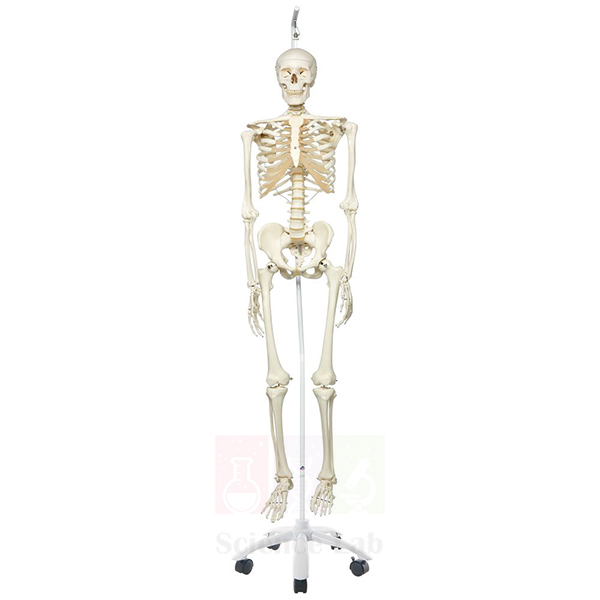
Human Skeleton, Hang-Up
Human Skeleton, Hang-Up (Product Code: SLE/A/47) is an articulated human skeleton that hangs from its own castor stand, used as the centrepiece of a biology lab setup for whole-body anatomy teaching in schools, colleges and medical teaching rooms. It features removable extremities and a 3-part detachable skull with 32 individually inserted teeth, and it arrives with a plastic dust cover and a Human Anatomy Manual. It is made by Jain Scientific Equipments Pvt Ltd (ScienceLab), an OEM manufacturer, at its own factory in Ambala, India.
Specifications
| Parameter | Detail |
|---|---|
| Type | Articulated human skeleton, hang-up mounting |
| Material | Durable, unbreakable synthetic material |
| Posture | Articulated to show normal posture |
| Extremities | Removable |
| Skull | 3-part, detachable, with cut calvarium and spring-held lower jaw |
| Teeth | 32, individually inserted |
| Stand | 2-part metal rod on a stable metal base with casters |
| Height including stand | 192.5 cm |
| Weight including stand | 8.8 kg |
| Supplied with | Plastic dust cover and Human Anatomy Manual |
| Product code | SLE/A/47 |
| Manufacturer | Jain Scientific Equipments Pvt Ltd (ScienceLab) — OEM |
| Country of origin | India (made in Ambala, Haryana) |
What Is the Hang-Up Human Skeleton Used For?
The removable arms and legs make this skeleton well suited to small-group work: one group can take a limb to the bench to trace the humerus, radius and ulna or the femur, tibia and fibula while the rest of the class studies the trunk on the stand. The opening skull supports lessons on the cranial vault and the inside of the braincase, the spring-held jaw shows how the mouth opens at the temporomandibular joint, and the full set of individually inserted teeth lets dental and nursing students practise naming incisors, canines, premolars and molars.
Teachers often combine it with the enclosed Human Anatomy Manual to set identification exercises, then use the model again for revision before practical exams. Because it forms part of a wider human biology model set in many departments, keep the plastic dust cover on between lessons and count the teeth and removable parts before the skeleton is put away. The castor base allows it to be wheeled between rooms; steady the hanging figure with one hand while moving it.
OEM Manufacturer
Jain Scientific Equipments Private Limited, trading as ScienceLab, is the OEM (original equipment manufacturer) of the Human Skeleton, Hang-Up and manufactures it at its own licensed factory at Saha, Ambala, Haryana, India.
The skeleton is supplied factory-direct to schools, universities, training centres, dealers and importers; if a tooth or another small part goes missing, ask us about a replacement. See the company profile for more about the business.
Related Bone Models
These items pair naturally with a hanging skeleton when building an anatomy teaching area:
- Human Skeleton, Rod-Supported — a rod-mounted alternative for rooms that prefer a rigidly supported figure
- Disarticulated Human Skeleton — separate bones for hands-on identification tests
- Human Skull Model, Plastic — an extra skull for bench work so the display skeleton stays assembled
- Human Shoulder Joint Model — a closer look at the joint where the upper limb meets the trunk
- Human Vertebral Model With Pelvis & Femur Heads — focused study of the spine and hip region
Browse all skeletons, joint models and spinal columns in the Bone Model category.
Frequently Asked Questions
What is included with the Human Skeleton, Hang-Up?
The Human Skeleton, Hang-Up comes with its stand, made up of a 2-part metal rod and a stable metal base with casters, plus a plastic dust cover and a Human Anatomy Manual for setting identification exercises.
What are the height and weight of the Human Skeleton, Hang-Up?
The Human Skeleton, Hang-Up stands 192.5 cm tall and weighs 8.8 kg, both measured including the stand, so check the height of any cupboard or alcove where it will be kept.
Can the skull of the Human Skeleton, Hang-Up be opened?
Yes. The skull of the Human Skeleton, Hang-Up is detachable and made in 3 parts, with a cut calvarium that lifts off and a spring-held lower jaw. The 32 teeth are individually inserted, so check them after use.
Are the arms and legs of the Human Skeleton, Hang-Up removable?
Yes, the extremities of the Human Skeleton, Hang-Up are removable for separate study at the bench. Reattach them carefully, aligning each limb before pushing it home, to avoid stressing the joints.
Should I choose the Human Skeleton, Hang-Up or the rod-supported skeleton?
Choose the Human Skeleton, Hang-Up if you want removable limbs, an opening skull and the included manual and dust cover; the rod-supported version holds the figure on a rod instead. Tell us how you teach and we will help you decide.
Who manufactures the Human Skeleton, Hang-Up?
Jain Scientific Equipments Pvt Ltd (ScienceLab) is the OEM of the Human Skeleton, Hang-Up and makes it at its own factory at Saha, Ambala, Haryana, India; quotations and repeat orders come directly from the manufacturer.
Do you handle bulk and export orders for the Human Skeleton, Hang-Up?
Yes. ScienceLab supplies the Human Skeleton, Hang-Up to schools and institutions in India and international markets. Share the product code SLE/A/47, quantity and delivery location to receive a quotation.
Request a Quote
For prices, availability or dispatch details on the Human Skeleton, Hang-Up, quoted by the manufacturer itself, please get in touch with ScienceLab, or place it in your enquiry cart along with other models you need.
Last updated: 24 September 2026
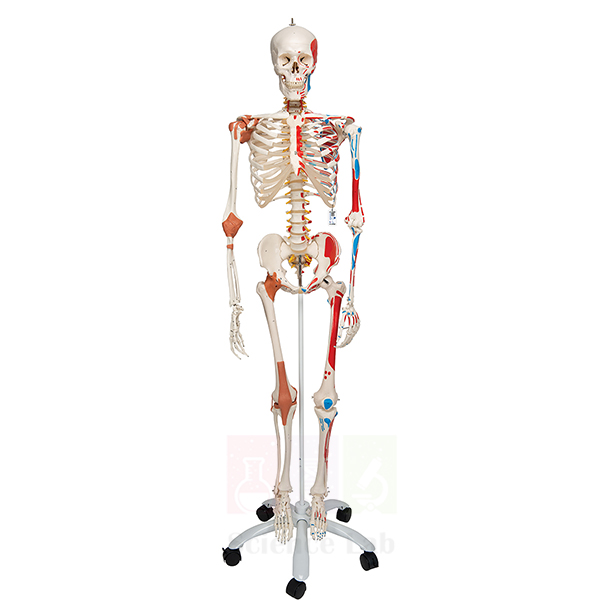
Human Muscular and Ligamentous Skeleton
Human Muscular and Ligamentous Skeleton (Product Code: SLE/A/48) is a life-size, articulated plastic skeleton used to teach where muscles attach and how ligaments hold the joints in physiotherapy, sports-science, nursing and medical courses. Its right side shows numbered muscle origins in red and insertions in blue, while the left side has fully flexible joints with ligaments and numbered bones. It is made by Jain Scientific Equipments Pvt Ltd (ScienceLab), an OEM manufacturer of anatomical models, at its own factory in Ambala, India.
Specifications
| Parameter | Detail |
|---|---|
| Type | Life-size, articulated plastic human skeleton |
| Right side | Numbered muscle origins (red) and insertions (blue) |
| Left side | Fully flexible joints with ligaments; numbered bones |
| Spine and head | Flexible spine and flexible head joints |
| Neurovascular detail | Protruding spinal nerves and vertebral arteries |
| Pathology shown | Lumbar slipped disc |
| Support | Metal rod with stable metal stand and casters |
| Height including stand | 176.5 cm |
| Weight including stand | 10 kg |
| Product code | SLE/A/48 |
| Manufacturer | Jain Scientific Equipments Pvt Ltd (ScienceLab) — OEM |
| Country of origin | India (made in Ambala, Haryana) |
What Is the Muscular and Ligamentous Skeleton Used For?
Knowing where a muscle starts and ends is the key to predicting what it does, and this skeleton makes that link visible. An instructor can point to a red origin near the shoulder and follow it to the matching blue insertion further down the arm, then move the joints on the ligament side through the same action to show the movement it produces. On that side, students see how the ligaments guide and limit movement at the major joints, which supports lessons on joint stability and common sprains.
The flexible spine, protruding spinal nerves and vertebral arteries help explain why vertebral alignment matters, and the lumbar slipped disc gives a concrete example for discussing back pain and nerve compression in clinical courses. Numbered bones and attachment points make it easy to set written identification tests, so this human skeleton model earns its place in college anatomy, kinesiology and physiotherapy rooms; wipe it gently so the coloured markings stay legible.
OEM Manufacturer
The Human Muscular and Ligamentous Skeleton is an OEM product of Jain Scientific Equipments Private Limited, which trades as ScienceLab and manufactures it at its own licensed factory at Saha, Ambala, Haryana, India.
Physiotherapy and medical colleges, dealers and importers buying from the manufacturer get quotations, repeat orders and spare-part enquiries handled by the same team. Find out more on the ScienceLab profile page.
Related Laboratory Equipment
For courses built around muscles, joints and the spine, these models extend what this skeleton teaches:
- Human Muscular Figure Model — shows the muscles themselves in position over the skeleton
- Human Muscular Arm Model — a close-up of the limb muscles whose attachments are marked here
- Human Lumbar Spinal Column Model — detailed study of the region where the slipped disc is shown
- Human Hand Joint Model with Ligaments — the small ligaments of the wrist and hand in more detail
- Human Skeleton, Rod-Supported — a plain skeleton for introductory classes
More skeletons and joint models are available in the Bone Model category.
Frequently Asked Questions
What do the red and blue markings on the Human Muscular and Ligamentous Skeleton show?
On the right side of the Human Muscular and Ligamentous Skeleton, red marks the numbered muscle origins and blue marks the numbered insertions, so each muscle can be traced from where it starts to where it ends.
What is shown on the left side of the Human Muscular and Ligamentous Skeleton?
The left side of the Human Muscular and Ligamentous Skeleton has fully flexible joints held together by ligaments, and each bone is numbered, which makes it useful for identification exercises and joint-stability lessons.
Is a numbered key included with the Human Muscular and Ligamentous Skeleton?
A printed key is not listed in the specification of the Human Muscular and Ligamentous Skeleton. Please ask through our contact page and the manufacturer will confirm what documentation accompanies the model.
What clinical features does the Human Muscular and Ligamentous Skeleton include?
The Human Muscular and Ligamentous Skeleton shows protruding spinal nerves, vertebral arteries and a lumbar slipped disc, together with a flexible spine and flexible head joints, for discussing back pain and nerve compression.
How tall and heavy is the Human Muscular and Ligamentous Skeleton?
Including its metal rod stand with casters, the Human Muscular and Ligamentous Skeleton is 176.5 cm tall and weighs 10 kg, so it can be wheeled between teaching rooms on a level floor.
Who manufactures the Human Muscular and Ligamentous Skeleton?
The Human Muscular and Ligamentous Skeleton is manufactured by Jain Scientific Equipments Pvt Ltd (ScienceLab), the OEM, at its own factory at Saha, Ambala, Haryana, India, and is supplied factory-direct to colleges, institutes and dealers.
Can institutions order several Human Muscular and Ligamentous Skeleton units or arrange export?
Yes. ScienceLab supplies the Human Muscular and Ligamentous Skeleton to colleges and training institutes in India and international markets. Send the code SLE/A/48, quantity and destination for a quotation from the manufacturer.
Request a Quote
To request a manufacturer's quotation for the Human Muscular and Ligamentous Skeleton, contact ScienceLab or add it to the enquiry cart and submit your full list in one step.
Last updated: 24 September 2026
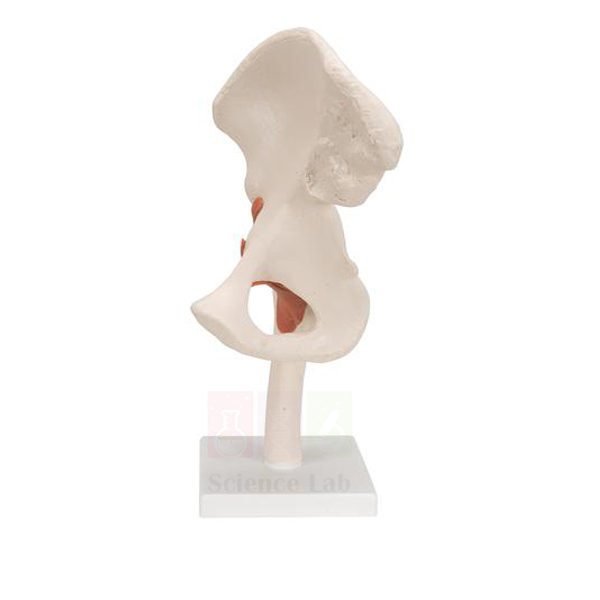
Hip Joint Model Human
Hip Joint Model Human (Product Code: SLE/A/49) is a life-sized, single-piece plastic model used to teach the anatomy of the right human hip joint and its ligaments in school, college and nursing classrooms. Anatomy, physiotherapy and medical students use it to see how the head of the femur sits in the pelvic socket and how ligaments bind the joint. It is made by Jain Scientific Equipments Pvt Ltd (ScienceLab), an OEM manufacturer of anatomical models, at its own factory in Ambala, India.
Key Details
| Parameter | Detail |
|---|---|
| Type | Human hip joint model with ligaments |
| Side represented | Right hip joint |
| Scale | Life-sized |
| Construction | Single piece |
| Material | Plastic |
| Product code | SLE/A/49 |
| Manufacturer | Jain Scientific Equipments Pvt Ltd (ScienceLab) — OEM |
| Country of origin | India (made in Ambala, Haryana) |
What Is the Hip Joint Model Used For?
The hip is the textbook example of a ball-and-socket joint, and a life-sized model shows its depth and strength far better than a diagram. Teachers use it to explain why the hip is more stable than the shoulder, to trace the ligaments that wrap the joint and resist over-extension, and to discuss where fractures of the femoral neck occur in elderly patients. Because it is a right hip, it also works well for orientation exercises in which students identify anterior, posterior, medial and lateral before naming structures.
As one of the more practical biology teaching aids for the skeletal system, the one-piece build means the model can be passed around a seminar group without parts going missing. It suits college tutorials, physiotherapy practicals and revision sessions before anatomy examinations.
OEM Manufacturer
Jain Scientific Equipments Private Limited, which trades as ScienceLab, is the OEM (original equipment manufacturer) of this hip joint model and produces it at its own licensed factory at Saha, Ambala, Haryana, India, rather than sourcing it from a trader. Medical and nursing colleges, schools, dealers and importers therefore deal directly with the maker for quotations and repeat orders. For vendor registration, the company’s GSTIN is 06AAECJ8618A1ZT and its Legal Entity Identifier (LEI) is 3358004HRD1JIVXKYX49. More about the business is on the ScienceLab company profile.
Related Bone Models
To teach the whole hip region, pair this model with bones and joints from the same part of the body:
- Human Femur Bone Model — the thigh bone whose head forms the ball of the hip joint.
- Human Adult Female Pelvis Structural Model — shows the pelvic bones that carry the hip socket.
- Human Adult Male Pelvis Structural Model — for comparing male and female pelvic shape.
- Human Hip Joint Model — an alternative hip model to compare before ordering.
- 3D Printed Human Flexed Knee Joint — continues the lower-limb lesson at the next major joint.
See every joint and skeleton model in the Bone Model category.
Frequently Asked Questions
Which side of the body does the Hip Joint Model Human show?
The Hip Joint Model Human (SLE/A/49) represents the right hip joint together with its ligaments, so students can practise anatomical orientation on a specific side rather than on a generic diagram of the joint.
Can the Hip Joint Model Human be taken apart?
No. The Hip Joint Model Human is a single-piece plastic model, so its bones and ligaments cannot be separated. The one-piece build keeps it sturdy for repeated handling and means no small parts go missing in class.
Does the Hip Joint Model Human show joint movement?
The Hip Joint Model Human is described as a single-piece model that illustrates the joint and its ligaments; movement is not listed as a feature. To demonstrate flexion or rotation, ask ScienceLab about suitable joint models.
What size and material is the Hip Joint Model Human?
The Hip Joint Model Human is life-sized and made of plastic. Exact dimensions and weight are not published on this page, so please contact ScienceLab if you need them for storage or display-cabinet planning.
Who manufactures the Hip Joint Model Human?
The Hip Joint Model Human is manufactured by Jain Scientific Equipments Pvt Ltd (ScienceLab) as the OEM, at the company’s own factory at Saha, Ambala, Haryana, India, and is supplied factory-direct to schools, colleges, dealers and importers.
How should the Hip Joint Model Human be cleaned and stored?
Wipe the Hip Joint Model Human with a soft, slightly damp cloth and dry it, avoiding solvent cleaners that could mark the plastic. Hold it by the bone rather than the ligaments when handing it round, and store it in a closed cupboard.
What should a quotation request for the Hip Joint Model Human include?
A quotation request for the Hip Joint Model Human should give product code SLE/A/49, the quantity and the delivery location, and say whether other bone models or vendor registration details are needed in the same quotation.
Is the Hip Joint Model Human available for bulk or export orders?
Yes. ScienceLab supplies the Hip Joint Model Human to institutions in India and international markets and can combine it with other anatomical models in one consignment; share quantities and destination through the contact page.
Request a Quote
Quotations for the Hip Joint Model Human come direct from the manufacturer. Contact ScienceLab with your quantity, or add the model to the enquiry cart with other bone models and send one request.
Last updated: 24 September 2026
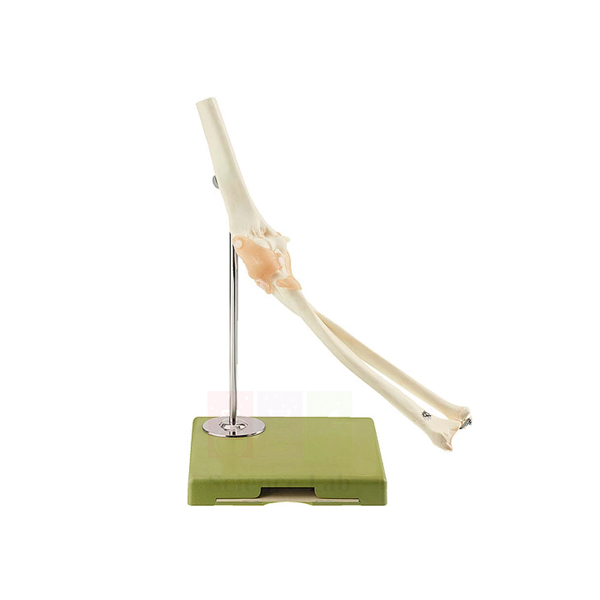
Functional Elbow Joint
Functional Elbow Joint (Product Code: SLE/A/50) is a life-size anatomical model of the human elbow used to demonstrate how the joint moves in anatomy, physiotherapy and sports science teaching. Its realistic bones and ligaments form one 1-part unit on a base that can be taken through all normal elbow movements, so students watch a working joint instead of a fixed pose. It is made by Jain Scientific Equipments Pvt Ltd (ScienceLab), an OEM manufacturer of human anatomical models, at its own factory in Ambala, India.
Specifications
| Parameter | Detail |
|---|---|
| Type | Functional model of the human elbow joint |
| Scale | Life-size |
| Construction | 1-part model with realistic bones and ligaments |
| Movement | Demonstrates all normal elbow joint movements |
| Size with base | 22 x 19 x 41 cm |
| Weight with base | 0.65 kg |
| Product code | SLE/A/50 |
| Manufacturer | Jain Scientific Equipments Pvt Ltd (ScienceLab) — OEM |
| Country of origin | India (made in Ambala, Haryana) |
What Is the Functional Elbow Joint Used For?
The elbow is where students first meet the idea that one joint can combine two kinds of motion: bending and straightening of the forearm, plus the turning of the palm up and down. With this functional model a teacher can move the forearm slowly while the class watches the joint surfaces glide and the ligaments on either side tighten and relax. Students then repeat the movement on their own arms and name what they saw. It is also a handy prop when explaining sprains, dislocation or overuse injuries around the elbow.
At 0.65 kg with its base, the model is light enough to pass around a tutorial group or carry between lecture rooms. Move it only within its natural range and never force the joint past its stop, as that strains the ligaments. In a human biology model set for anatomy practicals, a moving elbow sits well beside static bone models and sectioned joints.
OEM Manufacturer
ScienceLab is the trading name of Jain Scientific Equipments Private Limited, the OEM (original equipment manufacturer) of the Functional Elbow Joint. The model is produced at the company's own licensed factory at Saha, Ambala, Haryana, India, rather than sourced from a trader, and it goes out factory-direct to medical, nursing and physiotherapy colleges, schools, dealers and importers.
Because the maker handles every enquiry itself, questions about repeat orders or matching joint models are answered at source, so just ask us. More about the company is on the ScienceLab company profile.
Related Bone Models
These models help students move from the functional elbow to the rest of the upper limb and to other working joints:
- Elbow Joint Model Human — a life-size elbow on a base with labelled structures and a key, for naming parts after the movement demo.
- Human Elbow Joint Model — a second elbow model to compare with this functional version.
- Human Elbow Cross-Section Model — shows the muscles, ligaments and bones of the elbow region in section.
- Human Shoulder Joint Model — the next joint up the arm, for comparing ball-and-socket with hinge motion.
- Miniature Functional Knee Joint — a second moving joint for lower-limb lessons.
Explore more joint and skeleton models in the Bone Model category.
Frequently Asked Questions
What movements can the Functional Elbow Joint demonstrate?
The Functional Elbow Joint is built to show all normal movements of the human elbow. In class this usually means bending and straightening the forearm and turning the palm up and down, with the realistic ligaments showing how the joint is held together throughout.
What are the size and weight of the Functional Elbow Joint?
Including its base, the Functional Elbow Joint measures 22 x 19 x 41 cm and weighs 0.65 kg. That makes it light enough to pass around a tutorial group or carry between lecture rooms without a trolley.
Is the Functional Elbow Joint life-size, and can it be taken apart?
The Functional Elbow Joint is life-size and does not dismantle. It is a 1-part model in which the realistic bones and ligaments stay assembled, which suits frequent handling by students during practical sessions.
Who manufactures the Functional Elbow Joint?
The Functional Elbow Joint is manufactured by Jain Scientific Equipments Pvt Ltd (ScienceLab), the OEM, at its own factory at Saha, Ambala, Haryana, India. Colleges, schools and dealers deal directly with the manufacturer for quotations, repeat orders and product questions.
How should the Functional Elbow Joint be cared for?
Move the Functional Elbow Joint gently and only within its natural range, never forcing it past its stop. Keep it on its base when not in use, wipe it with a soft cloth and avoid solvents on the ligaments.
What should a quotation request for the Functional Elbow Joint include?
Give the product code SLE/A/50, the number of models and the delivery location through the ScienceLab contact page. The quotation for the Functional Elbow Joint then comes straight from the manufacturer.
Can the Functional Elbow Joint be supplied in quantity or for export?
Yes. ScienceLab supplies the Functional Elbow Joint singly or in quantity to schools, colleges, training institutes, dealers and importers in India and international markets, and several models can be packed together in one consignment.
Request a Quote
Ask for prices and delivery on the Functional Elbow Joint through our contact page, or add it to the enquiry cart with any other models you are considering. Quotations come direct from the manufacturer.
Last updated: 24 September 2026