- Physics Lab Equipment
- Chemistry Lab Equipment
- Biology Lab Equipment
- Anatomical Lab Equipment
- Learning
- Educational Lab Equipment
- Magnets
- Agriculture
- Astronomy
- Earth Science
- Geography Lab Equipment
- Safety Lab Coat
- Laboratory
- Meteorological
- Electricity & Magnetism
- Heat
- School Lab Equipment
- Lab Glassware
- Science Lab Equipment
- Tvet Lab Equipment
- Robotics Kits Supplier and Manufacturer for Schools India
- Math Lab Equipment Manufacturers and Exporters in Ambala
- STEM Kits Manufacturers and Supplier India
- Engineering Lab Equipment
- Hospital Lab Equipment
- Water, Sanitation & Hygiene Supplies
- Cold Chain, Solar & Communication Equipment
- Nutrition
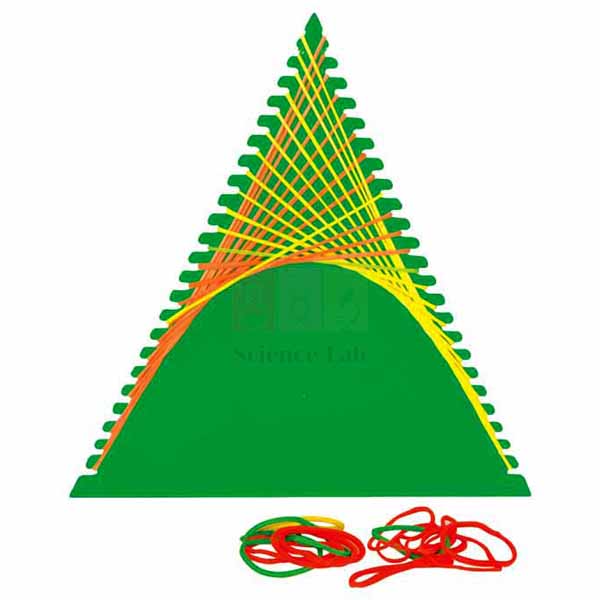
Construction of Parabola
Construction of Parabola (Product Code: SLE/MAT/79) is a plastic triangular plate used to construct a parabola from straight lines of rubber band in senior-secondary maths lessons on conic sections. Teachers and students use it because its equally marked slots — 24 on each side of a 19 cm x 20 cm plate — turn an abstract curve into a hands-on build. It is made by Jain Scientific Equipments Pvt Ltd (ScienceLab), an OEM manufacturer, at its own factory in Ambala, India.
Specifications
| Parameter | Detail |
|---|---|
| Material | Plastic |
| Form | Triangular plate |
| Slots | 24 equally marked slots on each side |
| Size | 19 cm x 20 cm |
| Construction method | Slots joined with rubber bands to form a parabola |
| Rubber bands | Inclusion not stated — ask us |
| Product code | SLE/MAT/79 |
| Manufacturer | Jain Scientific Equipments Pvt Ltd (ScienceLab) — OEM |
| Country of origin | India (made in Ambala, Haryana) |
What Is the Construction of Parabola Plate Used For?
The plate shows that a curve can be built entirely from straight lines. Pupils stretch a rubber band from the first slot on one side to the last slot on the other, then from the second slot to the second-last, and continue along the slots. Each band touches the curve as a tangent, and together the bands outline a smooth parabola — the method known as curve stitching, or the envelope of lines.
Students of conic sections can then compare the stitched curve with the focus-and-directrix definition of a parabola, identify its axis of symmetry and discuss why parabolic shapes appear in reflectors and arches. Because the plate is reusable, the construction can be repeated quickly for teacher demonstrations or small-group practicals in a school maths lab.
OEM Manufacturer
Construction of Parabola is made by ScienceLab (Jain Scientific Equipments Private Limited), which is the OEM (original equipment manufacturer) of this maths demonstration plate. It is produced at the company’s own licensed factory at Saha, Ambala, Haryana, India, so senior-secondary schools, colleges, dealers and importers buy from the maker itself. Extra plates and repeat orders are handled by the manufacturer — ask us. More is on the ScienceLab profile.
Related Maths Lab Equipment
Senior maths lessons on curves and geometry also draw on:
- Graph Board — for plotting a parabola from its equation and comparing it with the stitched curve.
- Trigonometry Board — another senior-secondary board for angle and ratio work.
- Advanced Geometry — for further geometry topics at senior level.
- Senior Maths Kit — a broader collection of aids for senior classes.
See more senior and junior aids in Maths Lab Equipment.
Frequently Asked Questions
How does the Construction of Parabola plate form a parabola?
The Construction of Parabola plate (SLE/MAT/79) has equally marked slots along its sides. Rubber bands joined between matching slots on two sides form straight lines that together outline a parabola, showing how a curve emerges as the envelope of straight lines.
What size is the Construction of Parabola plate, and how many slots does it have?
The Construction of Parabola plate measures 19 cm x 20 cm and has 24 equally marked slots on each side. It is a plastic triangular plate, compact enough for a desk while giving a clearly visible curve for group work.
Are rubber bands supplied with Construction of Parabola?
The product description of Construction of Parabola explains that rubber bands join the slots, but it does not say whether bands are packed with the plate. Ask us through the contact page and we will confirm exactly what the quotation includes.
Which classes use Construction of Parabola?
Construction of Parabola suits senior-secondary students studying conic sections and coordinate geometry, and it also makes an engaging enrichment activity for middle-school maths clubs. Teachers use it for demonstrations as well as hands-on group practicals.
Who manufactures Construction of Parabola?
Construction of Parabola is manufactured by Jain Scientific Equipments Pvt Ltd, trading as ScienceLab, the OEM for this teaching aid. It is produced at the company’s own factory at Saha, Ambala, Haryana, India, and schools receive quotations directly from the manufacturer.
What should a Construction of Parabola quotation request include?
For a Construction of Parabola quotation, tell us how many plates you need, whether rubber bands should be included, any other senior maths aids for the same order, and the delivery location in India or abroad. Use the contact page or the enquiry cart.
Is Construction of Parabola available in bulk and for export?
Yes. ScienceLab supplies Construction of Parabola plates for single schools, maths labs, colleges, distributors and importers across India and international markets. Share quantities on the contact page and the manufacturer will quote directly.
Request a Quote
To buy Construction of Parabola (SLE/MAT/79), send your requirement through the contact page or the enquiry cart. You will receive a quotation direct from the manufacturer.
Last updated: 24 September 2026
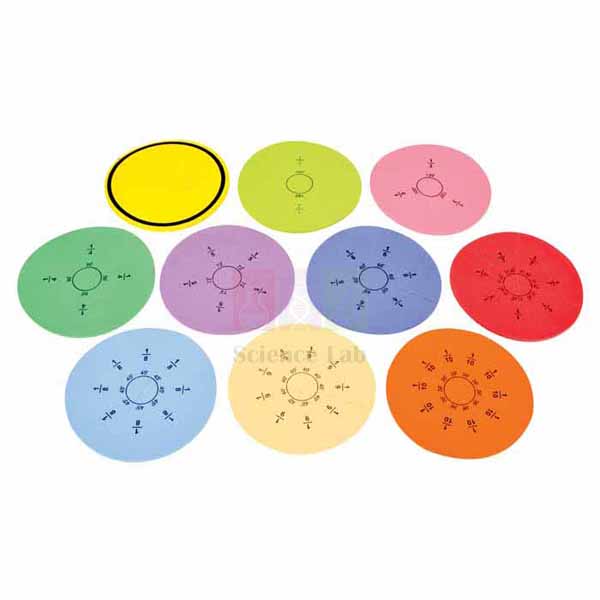
Non Magnetic Fraction Disc
Non Magnetic Fraction Disc (Product Code: SLE/MAT/80) is a set of soft foam fraction circles used to teach fractions and equivalent fractions through hands-on games and activities in primary maths. Teachers value its 55 colour-coded, easy-to-grip pieces, which show a whole and every family from halves to tenths so children can see, feel and compare the parts. It is made by Jain Scientific Equipments Pvt Ltd (ScienceLab), an OEM manufacturer, at its own factory in Ambala, India.
Specifications
| Parameter | Detail |
|---|---|
| Material | Soft foam |
| Magnetic | No (non-magnetic) |
| Number of pieces | 55 proportional pieces |
| Fractions shown | Whole, halves, thirds, fourths, fifths, sixths, sevenths, eighths, ninths and tenths |
| Piece design | Colourful, colour-coded, easy to grip |
| Teaching use | Fraction games and activities; seeing, feeling and comparing equivalent fractions |
| Product code | SLE/MAT/80 |
| Manufacturer | Jain Scientific Equipments Pvt Ltd (ScienceLab) — OEM |
| Country of origin | India (made in Ambala, Haryana) |
What Is the Non Magnetic Fraction Disc Used For?
Fraction circles let children see that two quarters cover exactly the same space as one half. With these foam pieces, a pupil lays one colour over another to find equivalent fractions, compares sizes side by side — one fifth against one sixth — and builds a whole from mixed pieces to discover that the parts add up to one. Colour coding lets children tell the halves from the thirds at a glance.
The soft, easy-to-grip foam suits younger hands and table or floor games, and because the set is non-magnetic it works on any surface without a board. Later, the same pieces support ordering fractions, adding fractions with like and unlike denominators, and introducing decimals through tenths — one reason fraction circles feature in most mathematics lab kits.
OEM Manufacturer
ScienceLab, the brand of Jain Scientific Equipments Private Limited, is the OEM (original equipment manufacturer) of the Non Magnetic Fraction Disc. The sets are made at the company’s own licensed factory at Saha, Ambala, Haryana, India, and dispatched factory-direct to schools, tutoring centres, dealers and importers. If a piece goes missing or you need repeat sets, ask us — the manufacturer deals with it directly. See the ScienceLab company profile.
Related Maths Lab Equipment
Fraction lessons with the discs pair well with:
- Designer Fraction — another fraction manipulative for comparing parts of a whole.
- Fraction Dice — roll-and-compare fraction games to play alongside the discs.
- Circle Kit — further work with circles and their parts.
- Maths Kit Junior — a broader set of aids for junior maths classes.
Browse more fraction and number aids under Maths Lab Equipment.
Frequently Asked Questions
What is included in the Non Magnetic Fraction Disc set?
The Non Magnetic Fraction Disc set (SLE/MAT/80) includes 55 proportional soft foam pieces representing a whole, halves, thirds, fourths, fifths, sixths, sevenths, eighths, ninths and tenths. The pieces are colour coded, so each fraction family is easy to identify.
Is the Non Magnetic Fraction Disc magnetic?
No. As its name states, the Non Magnetic Fraction Disc is a soft foam set without magnets, so the pieces are used on a desk, table or floor rather than on a magnetic whiteboard. If your lessons need board display, discuss it with us through the contact page.
How does the Non Magnetic Fraction Disc teach equivalent fractions?
With the Non Magnetic Fraction Disc, pupils lay smaller pieces over a larger one — for example two quarters on one half — to see that both cover the same area. Colour coding makes it easy to record which combinations are equivalent.
Which pupils is the Non Magnetic Fraction Disc suitable for?
The Non Magnetic Fraction Disc suits primary pupils meeting fractions for the first time and older pupils revising equivalence, ordering and addition of fractions. The soft, easy-to-grip foam is comfortable for young hands; supervise small children during use.
Who manufactures the Non Magnetic Fraction Disc?
The Non Magnetic Fraction Disc is manufactured by Jain Scientific Equipments Pvt Ltd, trading as ScienceLab, which is the OEM for this set. It is made at the company’s own factory at Saha, Ambala, Haryana, India, and quotations come straight from the manufacturer.
How should the Non Magnetic Fraction Disc be cleaned and stored?
Wipe Non Magnetic Fraction Disc pieces with a slightly damp cloth and let them dry flat, away from heat and sharp objects that could mark the soft foam. Store each set together so that all 55 pieces stay complete for the next lesson.
Can the Non Magnetic Fraction Disc be ordered in bulk or for export?
Yes. ScienceLab supplies the Non Magnetic Fraction Disc to classrooms, schools, education projects, distributors and importers across India and international markets. Send the number of sets and your delivery location through the contact page for a quotation from the manufacturer.
Request a Quote
Request a Non Magnetic Fraction Disc (SLE/MAT/80) quotation through the contact page, or list it in the enquiry cart with other maths items. Quotes come direct from the manufacturer.
Last updated: 24 September 2026
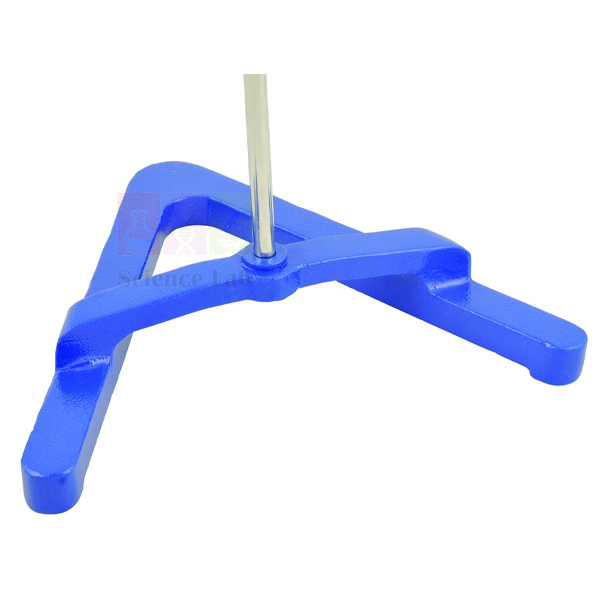
A-Shape Retort Stand Base
A-Shape Retort Stand Base (Product Code: SLE/CH/01) is a heavy cast iron base with an A-shaped footprint that forms the foundation of a retort stand, keeping clamps, rings and glassware steady on the bench. The base is finished in blue paint, sits on rubber feet and has a 10 x 1.5 mm tapped hole to receive the support rod. It is made by Jain Scientific Equipments Pvt Ltd (ScienceLab), Ambala, for school, college and research labs that need a dependable retort stand for lab work in India and abroad.
Specifications
| Parameter | Detail |
|---|---|
| Material | Cast iron |
| Finish | Blue paint |
| Rod fixing | Hole tapped 10 x 1.5 mm |
| Feet | Rubber feet |
| Version 1 (side length / rod) | 150 mm / 600 x 10 mm |
| Version 2 (side length / rod) | 150 mm / 700 x 10 mm |
Typical Use
The wide A-shaped footprint resists tipping when a flask, condenser or separating funnel is clamped away from the rod. Screw the rod firmly into the tapped hole, then add boss heads and clamps from the bottom up, keeping the heaviest load over the base rather than beyond its edge. The shorter rod suits routine filtration, burette work and heating over a burner; the longer rod gives headroom for distillation set-ups or when two clamps must be stacked.
The rubber feet protect bench tops and reduce sliding on smooth laminate. Wipe off chemical splashes promptly to protect the painted finish, and check that the rod remains tight in the thread before each practical session. Combined with a clamp and boss head, the base becomes the standard lab stand clamp boss head arrangement used in most chemistry and physics practicals.
Manufacturer
Jain Scientific Equipments Private Limited operates under the ScienceLab name from Ambala, Haryana, producing laboratory apparatus for education and research. The company is incorporated under CIN U29309HR2020PTC087597 and manufactures at its licensed factory at 449, HSIIDC Industrial Area, Saha, Ambala (Factory Licence AMB-ONLINE-CHD-J-414). More details are on the company profile.
Related Chemistry Lab Equipment
Parts that complete a working retort stand on this base:
- Retort Clamp Three Finger — grips flasks and condensers on the rod.
- Boss Head, With Detachable Attachment — fixes clamps to the rod at any height.
- Retort Rings — support funnels, wire gauze or evaporating dishes.
- Retort Stand — a complete stand option if you prefer to order one assembly.
- Stand With Base Plate H-Shape — an alternative base shape for comparison.
More stands and supports are listed under Chemistry Lab Equipment.
Frequently Asked Questions
What is the base made of?
Cast iron with a blue painted finish and rubber feet.
What thread does the rod hole have?
The hole is tapped 10 x 1.5 mm. The listed rods are 10 mm in diameter.
Which rod lengths are offered?
Two versions are listed, both with a 150 mm side length: one with a 600 x 10 mm rod and one with a 700 x 10 mm rod. Please state which version you need, and confirm with us whether the rod is included in your quotation.
Will it mark or slide on the bench?
The rubber feet help protect the work surface and improve grip on smooth benches.
How should it be cared for?
Wipe away chemical spills quickly, keep it dry, and check the rod thread is tight before use.
Can you supply bases in bulk for a new lab?
Yes. Share the quantity, rod version and any clamps or rings needed through our contact page; we supply institutions across India and international markets.
Request a Quote
Ask for a quotation on the A-Shape Retort Stand Base through our contact page, or add it with matching clamps to the enquiry cart.
Last updated: 24 September 2026

Acid Rain, Weathering & Erosion
Acid Rain, Weathering & Erosion (Product Code: SLE/CH/02) is a classroom activity kit in which student groups expose naturally occurring and construction materials to an acidic environment and compare them with the same materials kept in ‘normal’ rain, represented by tap water. It links chemistry with environmental studies by showing how acidity speeds up weathering and erosion. The kit is supplied by Jain Scientific Equipments Pvt Ltd (ScienceLab), Ambala, as an environmental science kit for schools that want a structured, group-based practical.
Key Details
| Parameter | Detail |
|---|---|
| Type | Student activity kit |
| Topic | Effect of acid rain on weathering and erosion of natural and man-made surfaces |
| Activity | Naturally occurring and construction materials exposed to an acidic environment |
| Comparison | Same materials exposed to ‘normal’ rain (tap water) |
| Teaching material | Teacher’s manual and student copy masters included |
| Class size | Sufficient materials for 15 groups |
Typical Use
Acid rain harms aquatic ecosystems and land areas, and it attacks both natural surfaces, such as the rock faces of mountainous regions, and man-made ones. Stones and metals used in buildings, statues and monuments can be affected, and the rate of weathering and erosion rises quickly as the rain becomes more acidic. This kit turns those ideas into an observation-based practical: each group sets up an acid sample and a tap-water control side by side, records the starting appearance of each material, and returns at intervals to note fizzing, dulling, pitting, colour change or loss of surface.
The student copy masters give a ready worksheet for recording observations, and the teacher’s manual supports planning and discussion. With materials for 15 groups, a full class can work in small teams at the same time, which makes it a practical chemistry experiment kit for middle and secondary classes studying environmental chemistry, rocks and corrosion. Follow the manual for handling the acid, have students wear eye protection and aprons, and keep the tap-water control untouched so the comparison stays fair.
Supplier
Jain Scientific Equipments Private Limited, which trades as ScienceLab, is based in Ambala, Haryana, and supplies teaching kits and laboratory apparatus to schools and colleges. Find out more on the company profile.
Related Chemistry Lab Equipment
Useful additions when running this acid rain activity:
- Paper, Universal, pH 1-14 — lets groups compare the acidity of the acid sample and the tap-water control.
- Digital Ph Meter(Pen Type) — for a numerical pH reading as an extension task.
- Glass Beaker Set of 5 — spare containers for extra samples or repeat trials.
- Acid Spill Clean Up Kit — keeps the room prepared for any spills during the practical.
- Acid Proof Aprons, Lab Coat, Pants, Shoe Covers and Sleeves — protective wear for students handling acid.
Explore more kits and apparatus in the Chemistry Lab Equipment category.
Frequently Asked Questions
How many students can use one kit?
The kit contains sufficient materials for 15 groups, so group size depends on how you divide your class.
Is teaching guidance included?
Yes. A teacher’s manual and student copy masters are included.
What does the experiment compare?
Students compare naturally occurring and construction materials placed in an acidic environment with the same materials exposed to tap water, which stands in for ‘normal’ rain.
Which exact materials and quantities are in the kit?
For a full contents list, please ask through our contact page and we will share it before you order.
Can the kit be reused?
The printed manual and copy masters can be kept for future classes; for repeat sessions, ask us about replacement materials for the consumable parts.
Do you supply kits for several schools at once?
Yes. Send the number of kits and delivery locations; we supply schools and institutions across India and international markets.
Request a Quote
To receive a quotation for the Acid Rain, Weathering & Erosion kit, write to us on the contact page or add it to your enquiry cart.
Last updated: 24 September 2026
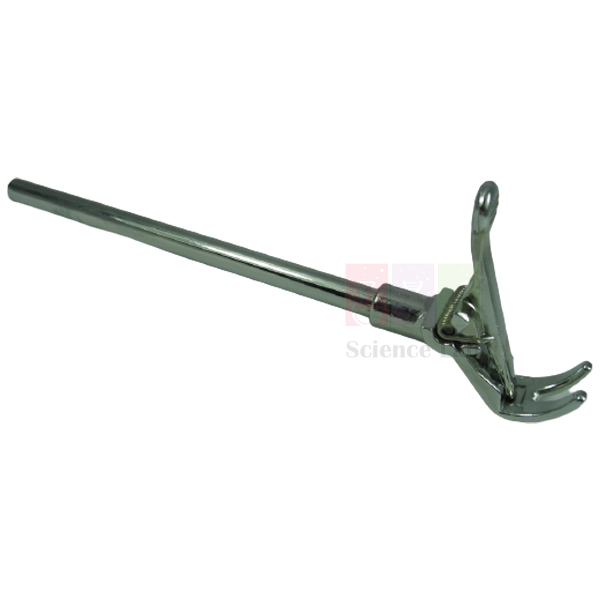
Alloy Test Tube and Thermometer Holder
Alloy Test Tube and Thermometer Holder (Product Code: SLE/CH/03) is a chrome plated alloy holder with spring-loaded jaws that close on test tubes or thermometers from the smallest sizes up to 25 mm. The spring action grips without the user having to keep squeezing, which helps students hold glassware steadily and keep their hands clear of heat and chemicals. Made by Jain Scientific Equipments Pvt Ltd (ScienceLab), Ambala, it is a practical piece of chemistry lab equipment for schools in India and for college teaching labs.
Specifications
| Parameter | Detail |
|---|---|
| Material | Alloy |
| Finish | Chrome plated |
| Jaws | Spring loaded |
| Tube size range | 0–25 mm |
| Holds | Test tubes and thermometers |
Typical Use
The most common job for this holder is gripping a test tube while its contents are warmed over a flame, for example when dissolving a salt, observing a decomposition or checking for a gas. Grip the tube near its mouth, tilt it slightly, point the open end away from everyone and move it gently through the flame so the liquid heats evenly. Because the jaws are sprung, the tube stays secure even when a student adjusts their hold. The same holder can steady a thermometer while a reading is taken from a beaker or tube, keeping the bulb off the glass wall.
The chrome plating resists everyday splashes, but it is still good practice to wipe the jaws after use and let the holder cool before storing it. Check that the spring closes firmly before each session; a weak grip on a hot tube is a hazard. For whole-class practicals, many schools issue one holder per bench along with a rack and brush so each group has a complete heating set.
Manufacturer
ScienceLab is the brand of Jain Scientific Equipments Private Limited, a laboratory apparatus company based in Ambala, Haryana, serving schools, colleges and laboratories. Visit the company profile to learn more.
Related Chemistry Lab Equipment
Items that complete a test-tube heating and measuring set:
- Test Tube — glass tubes for the holder to grip during reactions and heating.
- Bunsen Burner — heat source for warming tubes held in the jaws.
- Test Tube Stand (Wire Pattern) — somewhere safe to set tubes down after heating.
- Brush Test Tube — cleans residues from tubes after the practical.
- Laboratory Thermometer — a thermometer to use with the holder for temperature readings.
For more holders, clamps and racks, visit Chemistry Lab Equipment.
Frequently Asked Questions
What size of tube does it hold?
The spring-loaded jaws take tubes from 0 to 25 mm.
Can it hold a thermometer as well as a test tube?
Yes, it is designed as a test tube and thermometer holder.
What is it made of?
It is made of alloy with a chrome plated finish.
Can it be mounted on a retort stand?
The listing does not specify a stand mounting. If you need the holder fixed to a rod, ask us through the contact page and we will advise a suitable clamp.
How do I look after it?
Let it cool after heating work, wipe the jaws clean and store it dry. Check that the spring still closes firmly before each class.
Can I order it in class sets?
Yes. Tell us how many holders you need and the delivery location; we supply institutions in India and international markets.
Request a Quote
For a price on the Alloy Test Tube and Thermometer Holder, use our contact page or add it to the enquiry cart with your other bench items.
Last updated: 24 September 2026
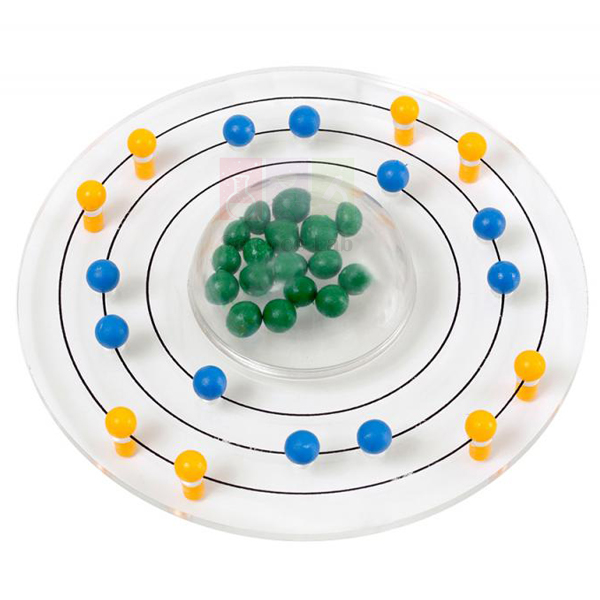
Atom Activity Model
Atom Activity Model (Product Code: SLE/CH/04) is a transparent, durable plastic model that lays out the structure of an atom — the nucleus, the protons, neutrons and electrons that make it up, and the electron layers around it — in a clear graphic form. Because it is transparent, teachers can place it on an overhead projector and show the whole class the same diagram while they build up an explanation. It is made by Jain Scientific Equipments Pvt Ltd (ScienceLab), Ambala, as an atom model kit for chemistry and physical science lessons in India and overseas.
Specifications
| Parameter | Detail |
|---|---|
| Type | Graphic model of atomic structure |
| Components shown | Nucleus; protons, neutrons and electrons; electron layers |
| Material | Durable plastic, transparent |
| Projection | Suitable for use with an overhead projector |
| Dimensions | 150 mm D x 25 mm H |
| Concepts supported | Atomic numbers, ionic and covalent bonding, electroneutrality, filling of electron layers, definition and calculation of ionic charge |
Typical Use
Teachers typically begin with the nucleus, pointing out protons and neutrons and using the proton count to explain how the atomic number identifies an element, and then move outward through the electron layers so students can see the order in which the layers fill. Comparing the number of electrons with the number of protons demonstrates electroneutrality; discussing what happens when an electron is lost or gained then shows how an ion forms and how its charge is worked out. The same layout supports a comparison of ionic bonding, where electrons are transferred, with covalent bonding, where they are shared.
On an overhead projector the transparent body lets the whole class follow each step, which works well for introducing the topic before students attempt worksheet problems. As a chemistry teaching kit item it also suits small-group revision, where students take turns using the model to explain atoms and ions to each other. Store it flat and clean the plastic with a soft, dry cloth to keep it clear for projection.
Manufacturer
The model comes from Jain Scientific Equipments Private Limited, known by its trading name ScienceLab, an Ambala, Haryana company that develops teaching aids and laboratory apparatus. Read our company profile for more.
Related Chemistry Lab Equipment
Teaching aids that extend lessons on atoms, elements and bonding:
- Modern Periodic Table Laminated — connects atomic number and electron layers to an element’s position.
- Chemical Bonding Chart — a wall reference for ionic and covalent bonding.
- NCERT Molecular Model Kit — moves students from single atoms to three-dimensional molecules.
- Atom Molecular Models Set — ball-and-link models for building molecules at the bench.
- Atom Models — an alternative atom model for comparison.
Find more models and apparatus in Chemistry Lab Equipment.
Frequently Asked Questions
Can it be used on an overhead projector?
Yes. The model is made of transparent plastic specifically so it can be used with an overhead projector.
What size is it?
It measures 150 mm D x 25 mm H.
Which topics does it help teach?
Atomic structure, atomic numbers, ionic and covalent bonding, electroneutrality, the filling of electron layers, and how ionic charge is defined and calculated.
What exactly is included in the supply?
A detailed contents list is not given here. Please ask through our contact page for the full contents before ordering.
Is it durable enough for student handling?
It is made of durable plastic. Wipe it with a soft, dry cloth and avoid solvents when cleaning.
Can schools order several units?
Yes. Share the quantity and delivery details; we supply schools and colleges across India and international markets.
Request a Quote
Request pricing for the Atom Activity Model on our contact page, or add it to the enquiry cart.
Last updated: 24 September 2026
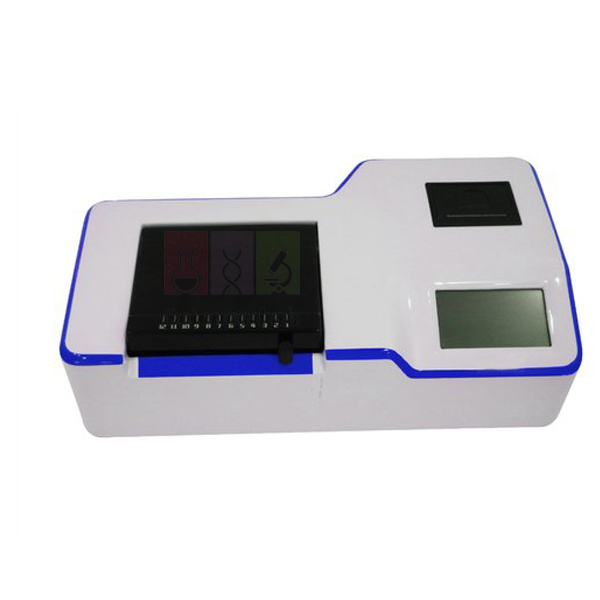
Aflatoxin meter
Aflatoxin meter (Product Code: SLE/CH/05) is a bench instrument that works on the solid-phase enzyme-linked immunosorbent assay (ELISA) principle to measure the aflatoxin B1 content of samples quantitatively. Used together with an aflatoxin B1 kit, it serves food, feed, edible oil, dairy, pharmaceutical, beverage and wine testing laboratories, as well as teaching labs that cover food safety. It is made by Jain Scientific Equipments Pvt Ltd (ScienceLab), Ambala, within its range of analytical lab instruments for India and international markets.
Specifications
| Parameter | Detail |
|---|---|
| Principle | Solid-phase ELISA (enzyme-linked immunosorbent assay) |
| System | Two parts: aflatoxin meter and B1 kit |
| Measures | Aflatoxin B1 content; other toxins can be measured with other matching kits |
| Minimum measure volume | 0.05 ng |
| Measuring range | 0.05–1 ng/ml (ppb) |
| Absorbance range | -0.041 to 1.999 A |
| Concentration range | 0.000–9999 |
| Wavelength | 450 ± 2 nm |
| Precision | ±0.1 ng/ml |
| Test speed | 20 pieces per hour |
| Light source | 36V / 20mA |
| Operating temperature | 5–35 °C |
| Power | 37 W |
| Working power supply | 220V ±10%, 50 Hz |
| Size | 350 x 270 x 210 mm |
| Weight | 9 kg |
| Applications | Food, feed, oils and fats, dairy products, pharmaceuticals, beverages, wine products |
Typical Use
Aflatoxins are toxic compounds produced by certain moulds on crops such as grains and oilseeds, and B1 is the one most often monitored. In an ELISA test, the prepared sample extract and kit reagents react in antibody-coated wells; after the washing and colour-development steps set out in the kit instructions, the meter reads the colour intensity at 450 nm and converts the absorbance into an aflatoxin B1 concentration. With a measuring range of 0.05–1 ng/ml (ppb), the instrument is aimed at trace-level screening, and a throughput of 20 pieces per hour suits routine batches in quality-control rooms.
For reliable results, follow the kit’s sample-preparation and timing steps closely, use calibrated pipettes, and run the instrument within its 5–35 °C operating temperature on a stable 220V supply. Because other kits can be used for other toxins, the same meter can grow with a lab’s testing programme. Food microbiology lab equipment set-ups in colleges and feed mills often place this meter alongside a balance, mixer and pipettes so that sample handling and reading happen at one bench.
Manufacturer
ScienceLab is the trading name of Jain Scientific Equipments Private Limited in Ambala, Haryana. The company is a registered MSME enterprise (Udyam UDYAM-HR-01-0003714), and its export orders are shipped under Importer-Exporter Code AAECJ8618A issued by the DGFT. See the company profile for background.
Related Chemistry Lab Equipment
Equipment used around the meter in an aflatoxin testing workflow:
- Micropipette — accurate dispensing of sample extract and kit reagents.
- Micropipette Tips — fresh tips for each sample to avoid carry-over.
- ELISA Washer 8 Channel — handles the plate washing steps of the assay.
- Electronic Compact Balance — weighs ground samples before extraction.
- Vortex Mixer — mixes sample extracts and reagents thoroughly.
More instruments are listed in Chemistry Lab Equipment.
Frequently Asked Questions
What does the meter measure?
It quantitatively measures aflatoxin B1 content in samples using the ELISA principle, with a measuring range of 0.05–1 ng/ml (ppb). Other toxins can be measured with other matching kits.
Is the B1 kit part of the supply?
The system is described as two parts, the meter and the B1 kit. Please confirm through our contact page which parts and how many kits your quotation should include.
What power supply does it need?
It runs on 220V ±10%, 50 Hz and has a power rating of 37 W.
How many tests can it handle?
The listed test speed is 20 pieces per hour.
Is a calibration certificate available?
Calibration documentation is not listed here. If your lab needs one, discuss it with us before ordering so we can confirm what can be arranged.
What warranty and after-sales support apply?
Warranty terms are not stated on this page; please ask for them with your quotation.
What should an institutional enquiry include?
Mention the sample types you test, the expected number of tests per day, kit requirements and delivery location. We supply institutions in India and international markets.
Request a Quote
For a quotation on the Aflatoxin meter, contact us through the contact page or add it to the enquiry cart together with pipettes and accessories.
Last updated: 24 September 2026
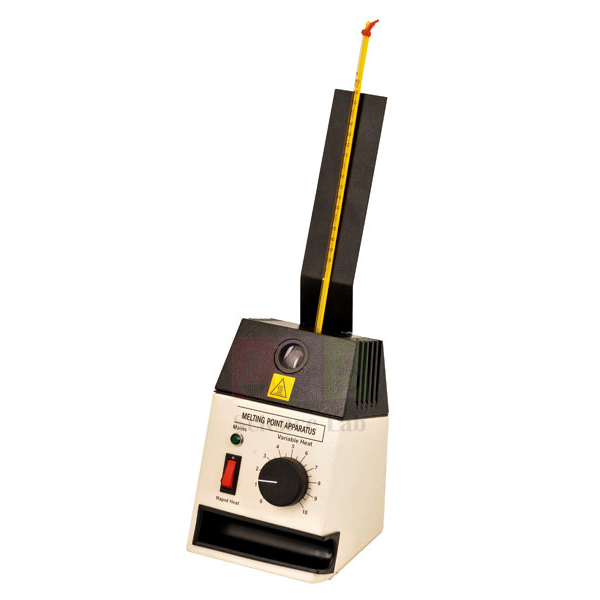
Apparatus Melting Point
Apparatus Melting Point (Product Code: SLE/CH/06) is an electrically heated instrument for finding the melting point of solid samples packed in capillary tubes, covering temperatures from ambient to 350 °C. Its ergonomic design puts safety and ease of operation first, which makes it well suited to school, college and university teaching labs where students check the purity and identity of organic compounds. It is made by Jain Scientific Equipments Pvt Ltd (ScienceLab), Ambala, and forms part of its chemistry lab instruments supplied across India and abroad.
Specifications
| Parameter | Detail |
|---|---|
| Temperature range | Ambient to 350 °C |
| Heating block | Aluminium, with ceramic insulation around it to minimise heat transfer to the casing |
| Controls | Single front-panel knob combining the main switch with an arbitrary 0 to 10 scale |
| Rapid heating | Rapid heat switch for reaching higher temperatures quickly |
| Sample viewing | Sample tubes illuminated from behind and magnified through a lens |
| Background | Rear selector for light or dark background |
| Electrical supply | 230V AC, 50/60Hz |
| Weight | 1.5 kg |
| Supplied with | Instructions |
| Optional accessories | Thermometer, capillary tubes, cooling plug |
Typical Use
A finely powdered sample is packed into the closed end of a capillary tube, which is placed in the heating block beside the thermometer. Students can use the rapid heat switch to approach the expected value quickly, then turn the control knob down to a lower setting so that the temperature climbs slowly through the melting range. Looking through the lens, with the tube lit from behind, they note the temperature at which the first droplet appears and the point at which the sample is completely liquid. A pure compound melts sharply over a narrow range, while an impure one melts lower and over a wider range, which is why the test is a standard step after recrystallisation.
The rear background selector helps with samples that are hard to see: a dark background suits white crystals and a light background suits coloured ones. Ceramic insulation keeps the outer casing cooler than the block, but the heating area should still be treated as hot until it has cooled, and a cooling plug (available as an accessory) can speed up turnaround between students. Keep the block clean of spilled powder and store the unit in a dry place when not in use.
Manufacturer
Jain Scientific Equipments Private Limited, trading as ScienceLab, is an Ambala, Haryana manufacturer of laboratory instruments and apparatus for education and research. Our company profile has further details.
Related Chemistry Lab Equipment
Consumables and alternatives for melting point work:
- Melting-Point Tubes — capillaries for packing the powdered sample.
- Capillary Tube Set — an alternative source of capillaries for class use.
- Glass Thermometer — the thermometer is an accessory, so order one if you do not already have it.
- Digital Melting Point Apparatus — a digital-readout option for comparison.
- Melting Point Apparatus Simple — a basic model for junior classes.
See all instruments in Chemistry Lab Equipment.
Frequently Asked Questions
What temperature range does it cover?
From ambient to 350 °C.
Is a thermometer included?
No. The thermometer, capillary tubes and cooling plug are available as accessories and should be ordered separately if needed.
How is the heating rate controlled?
A single front-panel knob with an arbitrary 0 to 10 scale sets the heat and also acts as the main switch; a separate rapid heat switch brings the block to higher temperatures quickly.
What power supply does it use?
230V AC, 50/60Hz. The unit weighs 1.5 kg.
Can a calibration certificate be provided?
This is not listed for the apparatus. If your lab needs one, please discuss it with us through the contact page before ordering.
What warranty applies?
Warranty terms are not given here; ask us and we will include them with your quotation.
Can you supply several units for a teaching lab?
Yes. Tell us the number of units and accessories required; we supply institutions across India and international markets.
Request a Quote
Get a quotation for the Apparatus Melting Point and its accessories via our contact page, or add them to the enquiry cart.
Last updated: 24 September 2026