- Physics Lab Equipment
- Chemistry Lab Equipment
- Biology Lab Equipment
- Anatomical Lab Equipment
- Learning
- Educational Lab Equipment
- Magnets
- Agriculture
- Astronomy
- Earth Science
- Geography Lab Equipment
- Safety Lab Coat
- Laboratory
- Meteorological
- Electricity & Magnetism
- Heat
- School Lab Equipment
- Lab Glassware
- Science Lab Equipment
- Tvet Lab Equipment
- Robotics Kits Supplier and Manufacturer for Schools India
- Math Lab Equipment Manufacturers and Exporters in Ambala
- STEM Kits Manufacturers and Supplier India
- Engineering Lab Equipment
- Hospital Lab Equipment
- Water, Sanitation & Hygiene Supplies
- Cold Chain, Solar & Communication Equipment
- Nutrition
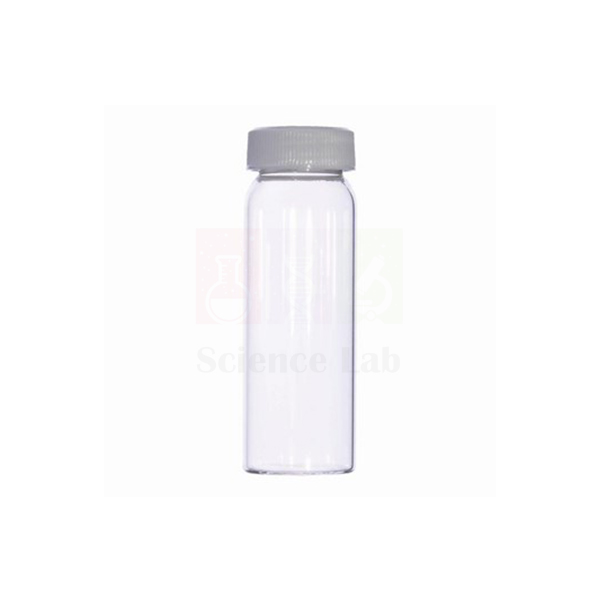
Universal Bottle PP Cap
Universal Bottle PP Cap (Product Code: SLE/P/30) is a 30 ml universal bottle closed with a polypropylene (PP) cap, used to collect, hold and label small samples in biology, chemistry and microbiology teaching laboratories. Its compact 30 ml volume suits individual student samples, reagent portions and specimens that need a screw closure. The bottle is made by Jain Scientific Equipments Pvt Ltd (ScienceLab), an OEM manufacturer, at its own factory in Ambala, India.
Specifications
| Parameter | Detail |
|---|---|
| Type | Universal bottle |
| Volume | 30 ml |
| Cap | PP (polypropylene) cap |
| Product code | SLE/P/30 |
| Manufacturer | Jain Scientific Equipments Pvt Ltd (ScienceLab) — OEM |
| Country of origin | India (made in Ambala, Haryana) |
What Is the Universal Bottle Used For?
“Universal” bottles earn their name because one small screw-capped bottle can do many jobs: holding a water sample from a pond survey, a portion of a stock solution for one practical group, a soil extract, or a specimen being passed from one bench to another. At 30 ml, it is large enough to label clearly yet small enough that a whole class set fits in one tray.
Write the contents, date and group name on each bottle before filling, leave a little headspace, and screw the PP cap down firmly before carrying it. Microbiology lab equipment in India often includes universal bottles for culture media and water testing practicals; ask us if you need to confirm the bottle body material for your procedure.
OEM Manufacturer
Jain Scientific Equipments Private Limited, trading as ScienceLab, is the OEM behind the Universal Bottle PP Cap. The bottles are produced at the company’s own licensed factory at Saha, Ambala, Haryana, and supplied factory-direct to schools, colleges, dealers and importers. Dealers restocking bottles for their own customers can place repeat orders straight with the manufacturer. For more about the company, see the ScienceLab company profile.
Related Scientific Lab Plasticware
Other containers used for sample and specimen work:
- Specimen Container, Universal 30ml — a universal specimen container listed separately.
- Container with sc cap — a larger wide-neck container for powders and samples.
- Specimen Container, PP — another polypropylene specimen option.
- Bottle McCARTNEY, BIJOU — small screw-capped bottles for culture work.
Browse the Scientific Lab Plasticware range for more.
Frequently Asked Questions
What is the volume of the Universal Bottle PP Cap?
The Universal Bottle PP Cap has a volume of 30 ml. This small size suits individual samples, class portions of solutions and specimens that need to be labelled and carried between benches.
What is the cap of the Universal Bottle PP Cap made of?
The Universal Bottle PP Cap is closed with a PP cap, meaning a cap made of polypropylene. The listing does not state the bottle body material, so ask us through the contact page if your procedure depends on it.
What is a universal bottle used for in the lab?
A universal bottle such as the Universal Bottle PP Cap is a general-purpose screw-capped bottle for collecting and storing small samples, for example water, soil extracts or portions of a solution, in teaching and routine laboratories.
Is the Universal Bottle PP Cap sterile?
Sterility is not stated for the Universal Bottle PP Cap. If your work needs sterile bottles, for example for microbiology, tell us your requirement through the contact page before ordering so we can confirm what can be supplied.
Who manufactures the Universal Bottle PP Cap?
ScienceLab (Jain Scientific Equipments Pvt Ltd) is the OEM of the Universal Bottle PP Cap and produces it at its own licensed factory in Saha, Ambala, India. Laboratories and dealers restocking bottles deal with the manufacturer directly.
What should I include in a quotation request for the Universal Bottle PP Cap?
For the Universal Bottle PP Cap, state the number of bottles, any requirement about body material or sterility, and the delivery location in India or abroad. Send it through the enquiry cart or the contact page.
Request a Quote
Ask for a quotation on the Universal Bottle PP Cap through the contact page or the enquiry cart. The manufacturer will respond with pricing for your quantity.
Last updated: 24 September 2026
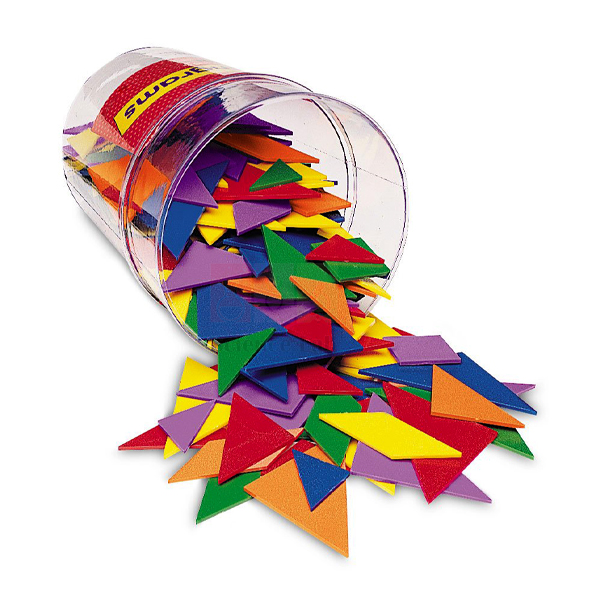
6-Color Tangrams
6-Color Tangrams (Product Code: SLE/MAT/37) is a class set of 30 tangrams used for whole-class problem-solving and shape puzzles in school maths. The tangrams come in six assorted colours (blue, red, green, yellow, orange and purple) and are stored in a sturdy plastic bucket. The set is made by Jain Scientific Equipments Pvt Ltd (ScienceLab), an OEM maker of mathematics lab kits, at its own factory in Ambala, India.
Key Details
| Parameter | Detail |
|---|---|
| Tangrams per set | 30 |
| Colours | Six assorted: blue, red, green, yellow, orange, purple |
| Storage | Sturdy plastic bucket |
| Main use | Whole-class problem-solving with tangram puzzles |
| Product code | SLE/MAT/37 |
| Manufacturer | Jain Scientific Equipments Pvt Ltd (ScienceLab) — OEM |
| Country of origin | India (made in Ambala, Haryana) |
What Are 6-Color Tangrams Used For?
A tangram is a square cut into seven pieces that can be rearranged into many outlines, from simple shapes to animals and people. With 30 tangrams in one bucket, each student in a class of up to 30 can solve the same challenge at once, compare strategies and explain how they matched the outline. The puzzles build problem-solving, spatial visualisation and the vocabulary of triangles, squares and parallelograms.
The six colours make classroom management easier: pieces can be sorted back into sets quickly, and pupils can record a finished design by colour on paper. Returning every tangram to the plastic bucket after the lesson keeps the class set complete for the next group.
OEM Manufacturer
This set of 6-Color Tangrams is manufactured by Jain Scientific Equipments Private Limited, the company behind the ScienceLab name, acting as the OEM (original equipment manufacturer). Production takes place at its own licensed factory at Saha, Ambala, Haryana, India, and sets go factory-direct to schools, colleges, dealers and importers. Buying from the manufacturer means your quotation, any repeat order and questions about replacement pieces are handled in one place, so ask us whenever you need them. The ScienceLab profile has more about the company.
Related Maths Lab Equipment
These puzzle and shape items build on the same problem-solving skills:
- Brights Tangrams Class Pack — a 210-piece class pack in vibrant colours
- Tangram — a tangram listed in the pre-primary range
- Rainbow Premier Pentominoes — for five-square shape puzzles
- 2D Shapes — for naming the flat shapes found in a tangram
Explore the rest of Maths Lab Equipment.
Frequently Asked Questions
How many tangrams are in the 6-Color Tangrams set?
The 6-Color Tangrams set contains 30 tangrams, enough for a whole class to work on the same puzzle at the same time. The tangrams are spread across six colours and packed together in a sturdy plastic bucket.
What colours are included in 6-Color Tangrams?
6-Color Tangrams come in six assorted colours: blue, red, green, yellow, orange and purple. The colours help teachers hand out and collect sets quickly and let pupils record their designs by colour after solving a puzzle.
How are 6-Color Tangrams stored?
6-Color Tangrams are packed in a sturdy plastic bucket that holds all 30 tangrams. Returning pieces to the bucket after each lesson keeps the class set complete and makes it easy to carry between classrooms.
Who manufactures 6-Color Tangrams?
6-Color Tangrams are manufactured by Jain Scientific Equipments Pvt Ltd (ScienceLab), the OEM, at its own licensed factory at Saha, Ambala, Haryana, India. Schools and dealers receive quotations and repeat-order support directly from the manufacturer.
What size are the pieces in 6-Color Tangrams?
The piece sizes and material of 6-Color Tangrams are not listed. If your lesson plan or tender specifies dimensions, please ask through the contact page and we will confirm the details with your quotation.
Can 6-Color Tangrams be ordered for several schools or for export?
Yes. 6-Color Tangrams can be quoted for several schools, dealers and importers in India and international markets. Send product code SLE/MAT/37, the number of bucket sets and the delivery locations to receive a combined quotation.
Request a Quote
To order 6-Color Tangrams, reach us through the contact page or add the set to the enquiry cart. The quotation is prepared by ScienceLab as the manufacturer, so you deal directly with the source.
Last updated: 24 September 2026
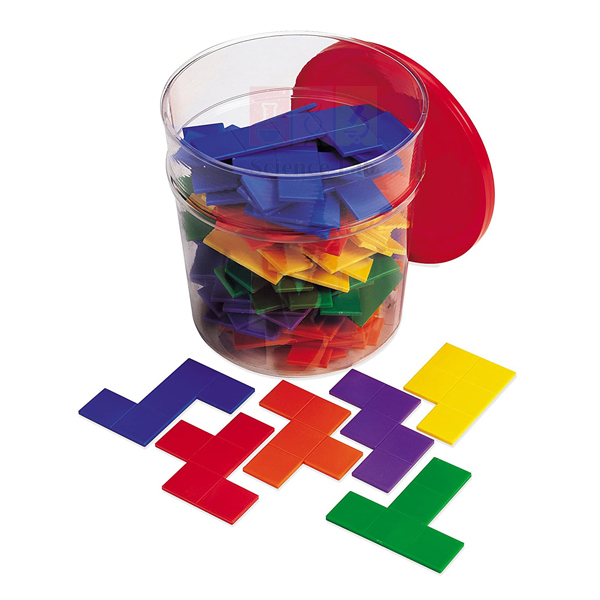
Rainbow Premier Pentominoes
Rainbow Premier Pentominoes (Product Code: SLE/MAT/38) is a 72-piece set of scored plastic pentominoes used to teach geometric concepts and problem-solving in school maths. It contains six pentomino sets of 12 pieces each, in yellow, red, green, blue, orange and purple, together with a clear plastic storage tub and an activity guide. The set is supplied by Jain Scientific Equipments Pvt Ltd (ScienceLab), Ambala, India.
Specifications
| Parameter | Detail |
|---|---|
| Pieces | 72 |
| Pentomino sets | Six scored pentomino sets, 12 pieces per set |
| Colours | Yellow, red, green, blue, orange, purple |
| Material | Scored plastic |
| Storage | Clear plastic tub |
| Activity guide | Included |
| Topics | Geometric concepts and problem-solving skills |
| Product code | SLE/MAT/38 |
| Supplied by | Jain Scientific Equipments Pvt Ltd (ScienceLab), Ambala, India |
What Are Rainbow Premier Pentominoes Used For?
Each pentomino is made of five equal squares joined edge to edge, and the score lines on these pieces show the individual squares clearly. Students use them to explore area (every piece covers five units), differences in perimeter between pieces of equal area, and transformations as they rotate and reflect pieces to fit a rectangle or outline. Fitting several pieces into a fixed frame is a classic problem-solving challenge that rewards planning and persistence.
Because the 72 pieces form six colour-coded sets, six groups can work at the same time, each with a full set of 12 shapes, and stray pieces are easy to return to the right group. The activity guide gives teachers ready-made challenges, and the clear tub shows at a glance whether every piece is back in place.
Supplier
ScienceLab is the trading name of Jain Scientific Equipments Private Limited, which supplies Rainbow Premier Pentominoes from Ambala, Haryana, India to schools, colleges, dealers and importers. The set is sourced as part of the company's maths lab range and can travel with other classroom items in one consignment. For vendor registration, export orders are handled under Importer-Exporter Code AAECJ8618A (DGFT), and the supplying company's GSTIN is 06AAECJ8618A1ZT. See the ScienceLab profile for company details.
Related Maths Lab Equipment
These items support the area, grid and puzzle work that pentominoes introduce:
- Colour Tile — for area work alongside pentomino puzzles
- Graph Board — for recording pentomino designs on a grid
- Interlocking Cubes — for building pentomino shapes from single cubes
- 6-Color Tangrams — a 30-tangram set for further shape puzzles
Find more in the Maths Lab Equipment category.
Frequently Asked Questions
What is included in Rainbow Premier Pentominoes?
Rainbow Premier Pentominoes include 72 scored plastic pieces arranged as six pentomino sets of 12 pieces each, in yellow, red, green, blue, orange and purple. A clear plastic tub for storage and an activity guide are also included.
What does scored mean on Rainbow Premier Pentominoes?
On Rainbow Premier Pentominoes, scored means each piece is marked with lines that divide it into its five unit squares. This helps students count area, compare shapes and see how pieces fit together on a grid.
How many students can use one set of Rainbow Premier Pentominoes?
One set of Rainbow Premier Pentominoes contains six colour-coded sets of 12 pieces, so up to six groups can each work with a complete set at once. Larger classes can order additional sets; state the class size when you ask for a quotation.
Who supplies Rainbow Premier Pentominoes?
Rainbow Premier Pentominoes are supplied by Jain Scientific Equipments Pvt Ltd (ScienceLab), Ambala, Haryana, India. The company sources the set for schools, dealers and importers, and vendor-registration details such as GSTIN are available for institutional buyers.
What should a quotation request for Rainbow Premier Pentominoes include?
A quotation request for Rainbow Premier Pentominoes should include product code SLE/MAT/38, the number of 72-piece sets, the delivery location in India or abroad, and any other maths items you want quoted together.
Request a Quote
Request pricing for Rainbow Premier Pentominoes through the contact page or add the set to the enquiry cart. The ScienceLab team will send a quotation with delivery details.
Last updated: 24 September 2026
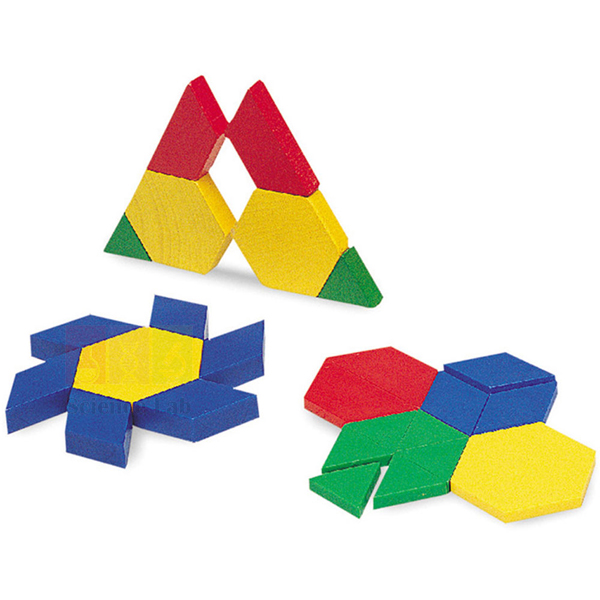
Plastic Pattern Blocks
Plastic Pattern Blocks (Product Code: SLE/MAT/39) is a set of 100 plastic pattern blocks used to analyse, compare and compose 2-D shapes in primary maths lessons. The blocks come in 6 shapes and 6 colours, and the largest shape measures 2 in wide. The set is made by Jain Scientific Equipments Pvt Ltd (ScienceLab), an OEM manufacturer of mathematics lab equipment, at its own factory in Ambala, India.
Specifications
| Parameter | Detail |
|---|---|
| Number of blocks | 100 |
| Shapes and colours | 6 shapes, 6 colours |
| Largest shape | 2 in wide |
| Material | Plastic |
| Topics | Symmetry, area measurement, analysing, comparing and composing 2-D shapes |
| Product code | SLE/MAT/39 |
| Manufacturer | Jain Scientific Equipments Pvt Ltd (ScienceLab) — OEM |
| Country of origin | India (made in Ambala, Haryana) |
What Are Plastic Pattern Blocks Used For?
Pupils place blocks edge to edge to copy and extend patterns, build designs with a line of symmetry, and find how many smaller blocks cover a larger one, which introduces area measurement without formulas. Comparing shapes by their sides and angles, then combining them into new figures, develops the reasoning behind analysing and composing 2-D shapes.
A set of 100 suits a small group or a teacher-led demonstration table, and schools running whole-class lessons can order several sets. Plastic blocks can be washed in mild soapy water and dried before storage, which helps when they are shared across classes. That makes them a practical piece of school laboratory equipment for primary maths rooms.
OEM Manufacturer
Jain Scientific Equipments Private Limited, known by its trading name ScienceLab, is the OEM (original equipment manufacturer) of these Plastic Pattern Blocks. They are made at the company's own licensed factory at Saha, Ambala, Haryana, India, and supplied factory-direct to schools, institutions, dealers and importers. Extra blocks and repeat orders are arranged with the manufacturer itself, so just ask us when your class needs more. Visit the ScienceLab company profile for more.
Related Maths Lab Equipment
These shape resources work well with pattern blocks in the same lessons:
- Brights Pattern Blocks — a larger 250-piece set in neon colours
- 10 Isometric Grid Pattern Geoboard — for outlining pattern block shapes on pins
- Attribute Blocks — for sorting and classifying shapes
- 2D Shapes — for naming and comparing flat shapes
Browse all Maths Lab Equipment.
Frequently Asked Questions
How many blocks are in the Plastic Pattern Blocks set?
The Plastic Pattern Blocks set contains 100 plastic blocks in 6 shapes and 6 colours. This quantity suits a small group or a demonstration table; for whole-class use, schools can order several sets and share them between tables.
How big are Plastic Pattern Blocks?
In the Plastic Pattern Blocks set, the largest shape measures 2 inches wide. Sizes of the smaller shapes and the block thickness are not listed, so please ask through the contact page if you need exact dimensions for a tender or worksheet.
What can students learn with Plastic Pattern Blocks?
Plastic Pattern Blocks help students explore symmetry and area measurement and learn to analyse, compare and compose 2-D shapes. Building patterns, covering larger shapes with smaller ones and describing their designs develops geometric vocabulary and reasoning.
Who manufactures Plastic Pattern Blocks?
Plastic Pattern Blocks are manufactured by Jain Scientific Equipments Pvt Ltd (ScienceLab), the OEM, at its own licensed factory in Saha, Ambala, Haryana, India. Buyers get quotations, additional blocks and repeat orders directly from the manufacturer on request.
How are Plastic Pattern Blocks different from Brights Pattern Blocks?
Plastic Pattern Blocks are a 100-block set in 6 shapes and colours, with the largest shape 2 inches wide. Brights Pattern Blocks are a separate, larger set in neon colours, so compare both listings and choose by class size and colour preference.
Can Plastic Pattern Blocks be supplied in bulk or for export?
Yes. Plastic Pattern Blocks can be quoted in multiple sets for schools, dealers and importers in India and international markets. Include product code SLE/MAT/39, the number of sets and the delivery location in your enquiry.
Request a Quote
Ask for a quotation on Plastic Pattern Blocks through the contact page, or add them to the enquiry cart with other items for your maths room. Prices come straight from the manufacturer in Ambala.
Last updated: 24 September 2026
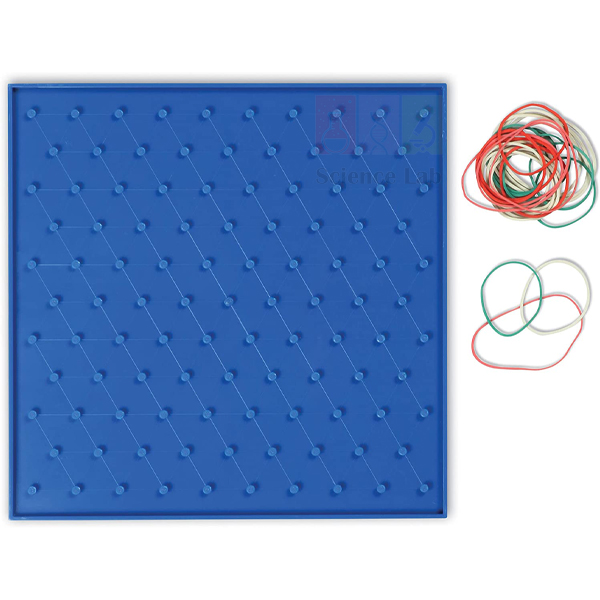
10 Isometric Grid Pattern Geoboard
10 Isometric Grid Pattern Geoboard (Product Code: SLE/MAT/40) is a two-sided geoboard used to outline pattern block shapes with bands and to explore triangles, hexagons and square-grid figures in school geometry. One face carries an isometric pin array that loops actual-size pattern block shapes, and the reverse is an 11 x 11 pin grid. It is made by Jain Scientific Equipments Pvt Ltd (ScienceLab), an OEM manufacturer, at its own factory in Ambala, India.
Key Details
| Parameter | Detail |
|---|---|
| Front face | Isometric pin array for looping actual-size pattern block shapes |
| Reverse face | 11 x 11 pin grid |
| Quantity | "10" appears in the product name; the number of boards is confirmed on your quotation |
| Used with | Rubber bands; pattern blocks for matching shapes |
| Product code | SLE/MAT/40 |
| Manufacturer | Jain Scientific Equipments Pvt Ltd (ScienceLab) — OEM |
| Country of origin | India (made in Ambala, Haryana) |
What Is the 10 Isometric Grid Pattern Geoboard Used For?
On the isometric side, pins sit at the corners of equilateral triangles, so students can stretch bands into triangles, rhombuses, trapezoids and hexagons that match real pattern blocks laid on top. This makes it easy to check a shape, show a hexagon split into fractions, or compare the angles of isometric shapes without a protractor.
Turning the board over gives an 11 x 11 square grid for rectangles, right-angled triangles, perimeter and area counting, and coordinate-style tasks. Having both grids on one board lets a class move between square and isometric geometry in the same lesson, which makes it a flexible addition to mathematics lab kits in India. Remove bands after use so the pins stay upright.
What to Specify When Ordering
- The number of boards required, since the "10" in the product name should be confirmed
- Whether rubber bands should be included with the boards
- Whether you also need pattern blocks to use on the isometric side
OEM Manufacturer
ScienceLab, the trading name of Jain Scientific Equipments Private Limited, is the OEM (original equipment manufacturer) of the 10 Isometric Grid Pattern Geoboard. The boards are made at the company's own licensed factory at Saha, Ambala, Haryana, India and go factory-direct to schools, colleges, dealers and importers. Because the maker quotes and supplies the boards itself, questions about quantities, repeat orders or replacement boards reach the right team straight away. More about the company is on the ScienceLab profile.
Related Maths Lab Equipment
These items complete an isometric and square-grid geometry station:
- Plastic Pattern Blocks — a 100-block set to lay on the isometric side
- Brights Pattern Blocks — a larger pattern block set in neon colours
- 5 Assorted Geoboards — double-sided boards with a 5 x 5 pin layout
- Rubber Bands (Good Quality) — for looping shapes over the pins
The full Maths Lab Equipment range lists more geoboards and shape sets.
Frequently Asked Questions
What grids does the 10 Isometric Grid Pattern Geoboard have?
The 10 Isometric Grid Pattern Geoboard has an isometric pin array on one side, designed to loop actual-size pattern block shapes, and an 11 x 11 pin grid on the reverse. Students switch between isometric and square-grid work by turning the board over.
Does the 10 Isometric Grid Pattern Geoboard match pattern blocks?
Yes. The isometric side of the 10 Isometric Grid Pattern Geoboard lets students loop actual-size pattern block shapes, so a real block can be placed on the pins to check a banded outline. This links hands-on blocks with banded and drawn shapes.
How many boards come with the 10 Isometric Grid Pattern Geoboard?
The product name of the 10 Isometric Grid Pattern Geoboard includes the number 10, but the listing does not state the pack quantity. Please confirm how many boards you need through the contact page, and the quotation will show the exact count.
Who manufactures the 10 Isometric Grid Pattern Geoboard?
The 10 Isometric Grid Pattern Geoboard is manufactured by Jain Scientific Equipments Pvt Ltd (ScienceLab), the OEM, at its own licensed factory in Saha, Ambala, Haryana, India. Quotations and repeat orders are handled directly by the manufacturer.
What is the 11 x 11 side of the 10 Isometric Grid Pattern Geoboard used for?
The 11 x 11 pin grid on the reverse of the 10 Isometric Grid Pattern Geoboard is used for square-grid geometry, such as rectangles, right-angled triangles, perimeter and area counting, and simple coordinate tasks with rubber bands.
Request a Quote
Send an enquiry for the 10 Isometric Grid Pattern Geoboard through the contact page or add it to the enquiry cart. The manufacturer will confirm the board quantity and quote directly.
Last updated: 24 September 2026
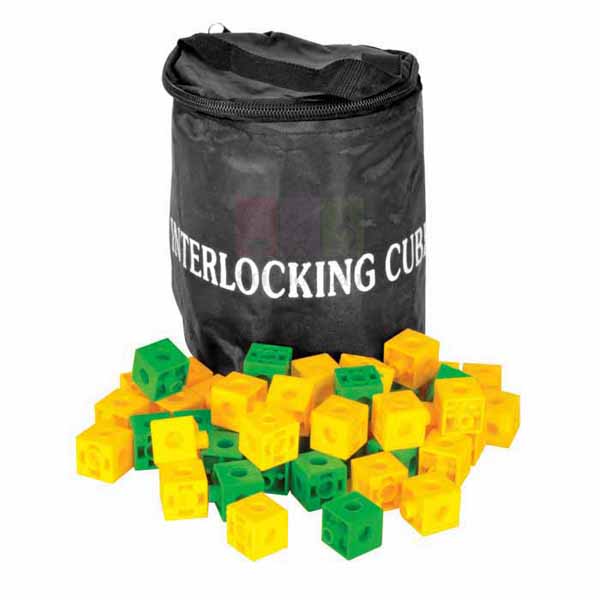
Interlocking Cubes
Interlocking Cubes (Product Code: SLE/MAT/41) are 2 cm linking cubes used to teach number, measurement, patterns and probability in primary maths. Their variety of colours lets teachers run colour-based probability experiments, while linking the cubes together builds hand-eye coordination. They are made by Jain Scientific Equipments Pvt Ltd (ScienceLab), an OEM school laboratory equipment manufacturer, at its own factory in Ambala, India.
Specifications
| Parameter | Detail |
|---|---|
| Cube size | 2 cm (L) x 2 cm (W) x 2 cm (H) |
| Colours | Variety of colours |
| Joining | Interlocking; cubes link together |
| Topics | Number, measurement, patterns, probability, abstraction |
| Other uses | Hand-eye coordination, sensory development and occupational-therapy activities |
| Product code | SLE/MAT/41 |
| Manufacturer | Jain Scientific Equipments Pvt Ltd (ScienceLab) — OEM |
| Country of origin | India (made in Ambala, Haryana) |
What Are Interlocking Cubes Used For?
Because every cube is the same 2 cm size, a train of linked cubes becomes a simple measuring unit: pupils measure objects in cubes, compare lengths and see why a common unit matters. Groups of ten linked cubes model place value, and snapping cubes on or off shows addition, subtraction and number bonds in a form children can hold, which helps them move from concrete objects to abstract numbers.
The range of colours supports pattern work, where students create, identify and extend a colour sequence, and simple probability experiments in which cubes are drawn from a bag and results are tallied. Beyond maths lessons, joining and separating the cubes is used in sensory-development and occupational-therapy activities because it exercises hand-eye coordination.
OEM Manufacturer
Interlocking Cubes are manufactured by Jain Scientific Equipments Private Limited, which trades as ScienceLab and is the OEM (original equipment manufacturer) for this item. The cubes are made at the company's own licensed factory at Saha, Ambala, Haryana, India, and supplied factory-direct to schools, early-learning and therapy centres, dealers and importers. When a growing class needs more cubes, the reorder goes straight to the maker, so ask us for a quotation. Read the ScienceLab company profile for background.
Related Maths Lab Equipment
These counting and number resources work alongside the cubes:
- Linking Cubes — another cube set for number and pattern work
- Base Ten Blocks — for moving from cube trains to place-value blocks
- Probability Kit — for extending colour-draw experiments
- Stacking Counters — for counting and sorting activities
See more number and measurement items in Maths Lab Equipment.
Frequently Asked Questions
What size are Interlocking Cubes?
Interlocking Cubes measure 2 cm in length, 2 cm in width and 2 cm in height. The uniform size lets pupils use a line of linked cubes as a measuring unit and compare lengths, areas and volumes by counting cubes.
What maths topics can Interlocking Cubes teach?
Interlocking Cubes teach number and measurement concepts, patterns and probability, and help students build abstraction by moving from physical cubes to written numbers. Pupils create, identify and extend patterns, and the colours make simple probability experiments possible.
How many cubes come in a pack of Interlocking Cubes?
The pack quantity and colour assortment of Interlocking Cubes are not stated in the listing. Tell us how many cubes or sets you need through the contact page, and the quotation will confirm the exact quantity and colours supplied.
Can Interlocking Cubes be used outside maths lessons?
Yes. Interlocking Cubes are also used in sensory-development and occupational-therapy activities, because linking and separating the cubes exercises hand-eye coordination. They remain primarily a maths resource for number, measurement and pattern work in school classrooms.
Who manufactures Interlocking Cubes?
Interlocking Cubes are manufactured by Jain Scientific Equipments Pvt Ltd (ScienceLab), the OEM, at its own licensed factory in Saha, Ambala, Haryana, India. Schools, dealers and importers in India and international markets buy directly from the manufacturer.
Request a Quote
For a quotation on Interlocking Cubes, use the contact page or add them to the enquiry cart. The quote comes directly from ScienceLab as the manufacturer and covers the quantity you specify.
Last updated: 24 September 2026
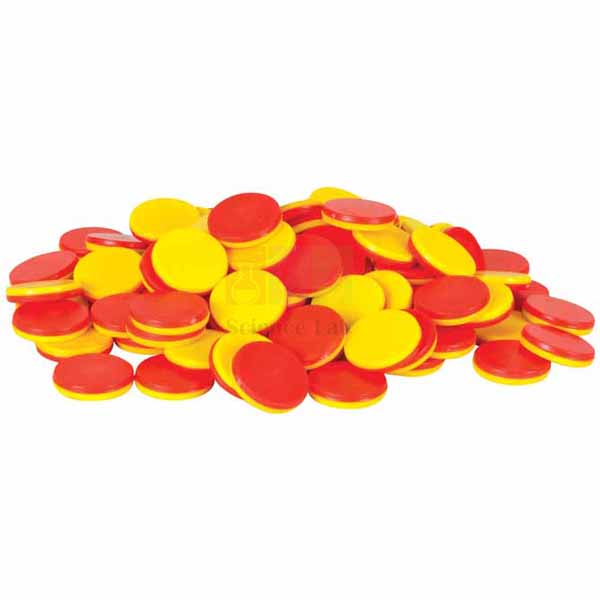
Integer Counters
Integer Counters (Product Code: SLE/MAT/42) is a set of two-colour plastic counters used to model positive and negative numbers in school maths lessons and maths labs. Each 30 mm counter is red on one face and yellow on the other, so pupils flip a chip to change its sign while they add, subtract, multiply and divide integers. The counters are made by Jain Scientific Equipments Pvt Ltd (ScienceLab), an OEM manufacturer of mathematics lab kits in India, at its own factory in Ambala.
Specifications
| Parameter | Detail |
|---|---|
| Type | Double-sided integer counters (two-colour chips) |
| Colours | Red on one side, yellow on the other side |
| Material | Plastic |
| Diameter | 30 mm |
| Operations covered | Addition, subtraction, multiplication and division of integers |
| Other use | Introducing basic ideas of probability |
| Product code | SLE/MAT/42 |
| Manufacturer | Jain Scientific Equipments Pvt Ltd (ScienceLab) — OEM |
| Country of origin | India (made in Ambala, Haryana) |
What Are Integer Counters Used For?
Integer counters turn the rules for signed numbers into something pupils can see and move. A common convention is to let one colour stand for +1 and the other for -1. A statement such as -2 + 3 is then modelled by laying out two chips of the negative colour and three of the positive colour, and removing each positive-negative pair as a “zero pair” until one positive counter remains.
Subtraction becomes taking counters away, adding zero pairs first when there are not enough of the colour needed, and multiplication can be shown as repeated groups of chips. Because every counter has two faces, a handful tossed onto a desk also gives a quick first experiment in chance: pupils tally how many land red side up and how many land yellow.
OEM Manufacturer
Integer Counters are produced by Jain Scientific Equipments Private Limited, which trades as ScienceLab, as the original equipment manufacturer (OEM). They are made at the company’s own licensed factory at 449, HSIIDC Industrial Area, Saha, Ambala, Haryana, so schools, maths resource centres, dealers and importers buy them factory-direct instead of through a trading middleman. For vendor registration, tender and institutional buyers can quote GSTIN 06AAECJ8618A1ZT and LEI 3358004HRD1JIVXKYX49. More about the company is on the ScienceLab company profile.
Related Maths Lab Equipment
These items from the same maths range carry integer work from counters into games, dice and algebra:
- Integer Board Game — practise the same addition and subtraction rules as a board game.
- Integer Dice — roll integer questions for pupils to model with the counters.
- Stacking Counters — for counting, sorting and grouping before signed numbers are introduced.
- Algebra Tiles — move on from number work to algebraic expressions.
Browse the full Maths Lab Equipment range for more manipulatives and teaching aids for number work.
Frequently Asked Questions
What colours are the Integer Counters?
Integer Counters are double-sided plastic chips, red on one side and yellow on the other. Teachers usually let one colour represent positive units and the other negative units, and a counter is flipped over to show the opposite sign.
What size are the Integer Counters?
Each Integer Counter has a diameter of 30 mm, which is large enough for small hands to pick up and flip, and for a teacher to arrange clear rows of positive and negative chips on a desk or tray.
Which topics can Integer Counters teach?
Integer Counters support addition, subtraction, multiplication and division of integers, including modelling statements such as -2 + 3 with two-colour chips. The same set can also introduce basic probability, for example by tossing counters and recording which colour lands face up.
How many counters come in one pack of Integer Counters?
The pack quantity of Integer Counters is not stated on this page. Please tell us how many counters you need per pupil or group through the contact page, and ScienceLab will confirm the quantity in its quotation.
Who manufactures the Integer Counters?
Integer Counters are manufactured by Jain Scientific Equipments Pvt Ltd (ScienceLab), the OEM, at its own licensed factory in Saha, Ambala, Haryana, India. New orders, repeat orders and requests for extra counters are all handled directly by the manufacturer.
Can schools order Integer Counters in bulk or for export?
Yes. Integer Counters can be quoted for a single classroom, for bulk orders covering several schools, or for dealers and importers in India and international markets. Send the quantity and delivery location so the manufacturer can prepare a quotation.
How should Integer Counters be cleaned and stored?
Integer Counters can be wiped with a damp cloth and mild soap, dried, and kept in a closed box or bag so none go missing between lessons. Counting them back after each class is a quick way to keep every set complete.
Request a Quote
To order Integer Counters, send your quantity and delivery details through the ScienceLab contact page or add them to the enquiry cart. Quotations come direct from the manufacturer, Jain Scientific Equipments Pvt Ltd (ScienceLab).
Last updated: 24 September 2026
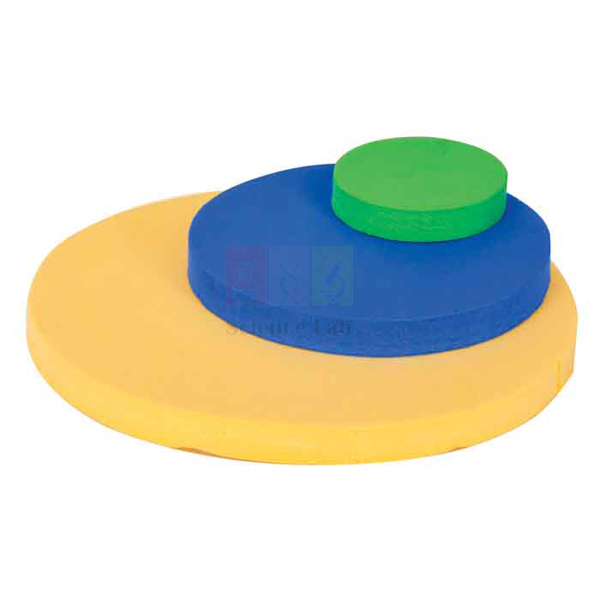
Circle Kit
Circle Kit (Product Code: SLE/MAT/43) is a set of three foam circular discs used to teach radius, diameter and circumference in school maths classrooms. The discs have diameters of 15 cm, 10 cm and 5 cm, so pupils can stack them as concentric circles and compare how the circumference grows with the diameter. It is made by Jain Scientific Equipments Pvt Ltd (ScienceLab), an OEM school lab equipment manufacturer, at its own factory in Ambala, India.
Specifications
| Parameter | Detail |
|---|---|
| Contents | Set of three circular discs of different radius |
| Disc diameters | 15 cm, 10 cm and 5 cm |
| Material | Foam |
| Concepts covered | Circles, concentric circles, radius, diameter, circumference and derivation of Pi |
| Product code | SLE/MAT/43 |
| Manufacturer | Jain Scientific Equipments Pvt Ltd (ScienceLab) — OEM |
| Country of origin | India (made in Ambala, Haryana) |
What Is the Circle Kit Used For?
The Circle Kit gives pupils real circles to handle instead of drawings. Stacking the three discs, largest at the bottom and centres lined up, shows concentric circles. Measuring straight across each disc through its centre gives the diameter, and halving it gives the radius, which clears up the common mix-up between the two terms.
For circumference, pupils wrap a string or paper strip once around the edge of each disc, straighten it and measure it. Dividing each circumference by its diameter gives nearly the same value for all three discs, and that constant is Pi. Because the discs are foam, they are light and durable enough for repeated group work, and easy for teachers to pass around the class.
OEM Manufacturer
The Circle Kit is an original ScienceLab product. Jain Scientific Equipments Private Limited, which trades as ScienceLab, is its OEM and makes the kit at its own licensed factory in Saha, Ambala, Haryana. Because the manufacturer deals with buyers directly, schools and distributors can ask the factory itself about repeat orders or replacement discs. Learn more on the ScienceLab company profile.
Related Maths Lab Equipment
Pair the Circle Kit with these items for drawing, measuring and graphing circles:
- Geometrical Instruments Set — for drawing and measuring circles on paper after handling the discs.
- Half Meter Scale — to measure the unwrapped string or strip for each circumference.
- Graph Board — to plot circumference against diameter for the three discs.
- Advanced Geometry — for further geometry topics once circle basics are secure.
More geometry and measurement aids are listed in the Maths Lab Equipment category.
Frequently Asked Questions
What sizes of discs are in the Circle Kit?
The Circle Kit contains three circular discs with diameters of 15 cm, 10 cm and 5 cm. Having three sizes lets pupils compare radius, diameter and circumference across circles instead of drawing conclusions from a single example.
What material is the Circle Kit made of?
The discs of the Circle Kit are made of foam. Foam discs are light, soft to handle and durable enough for repeated use, which makes them easy for teachers to hand around a class during circle lessons.
Can the Circle Kit be used to show the value of Pi?
Yes. With the Circle Kit, pupils measure the circumference of each disc using a string or strip and divide it by the diameter. All three discs give nearly the same ratio, which introduces Pi through measurement rather than memorisation.
Which lessons is the Circle Kit suitable for?
The Circle Kit suits lessons where circles, radius, diameter, circumference and concentric circles are introduced. Teachers can use it for demonstration at the front of the room or give one kit to each small group for hands-on measuring.
Who manufactures the Circle Kit?
The Circle Kit is manufactured by Jain Scientific Equipments Pvt Ltd (ScienceLab) as the OEM at its licensed factory in Saha, Ambala, Haryana, India, and quotations are issued directly by the manufacturer rather than by a reseller.
What should a quotation request for the Circle Kit include?
A quotation request for the Circle Kit should state the number of kits, the delivery city or country, and whether the order is for one school, a tender or resale. Send these details through the contact page so ScienceLab can prepare the quote.
Request a Quote
Ask for a quotation on the Circle Kit through the ScienceLab contact form, or place it in the enquiry cart together with other maths lab items. Your quote is prepared by the manufacturer itself.
Last updated: 24 September 2026