- Physics Lab Equipment
- Chemistry Lab Equipment
- Biology Lab Equipment
- Anatomical Lab Equipment
- Learning
- Educational Lab Equipment
- Magnets
- Agriculture
- Astronomy
- Earth Science
- Geography Lab Equipment
- Safety Lab Coat
- Laboratory
- Meteorological
- Electricity & Magnetism
- Heat
- School Lab Equipment
- Lab Glassware
- Science Lab Equipment
- Tvet Lab Equipment
- Robotics Kits Supplier and Manufacturer for Schools India
- Math Lab Equipment Manufacturers and Exporters in Ambala
- STEM Kits Manufacturers and Supplier India
- Engineering Lab Equipment
- Hospital Lab Equipment
- Water, Sanitation & Hygiene Supplies
- Cold Chain, Solar & Communication Equipment
- Nutrition
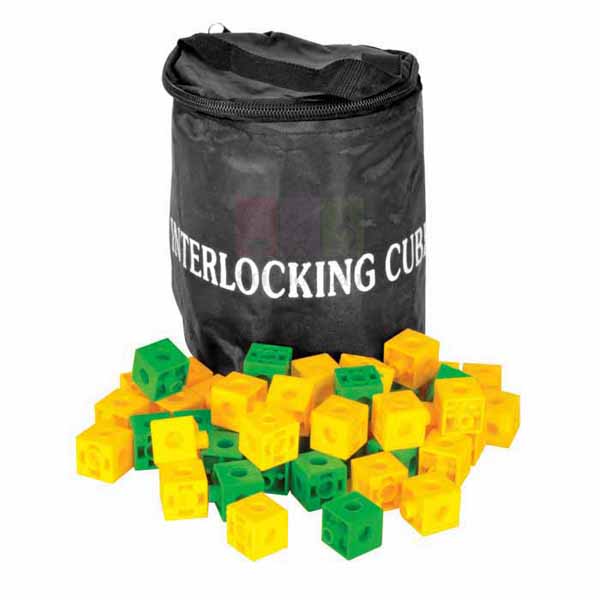
Interlocking Cubes
Interlocking Cubes (Product Code: SLE/MAT/41) are 2 cm linking cubes used to teach number, measurement, patterns and probability in primary maths. Their variety of colours lets teachers run colour-based probability experiments, while linking the cubes together builds hand-eye coordination. They are made by Jain Scientific Equipments Pvt Ltd (ScienceLab), an OEM school laboratory equipment manufacturer, at its own factory in Ambala, India.
Specifications
| Parameter | Detail |
|---|---|
| Cube size | 2 cm (L) x 2 cm (W) x 2 cm (H) |
| Colours | Variety of colours |
| Joining | Interlocking; cubes link together |
| Topics | Number, measurement, patterns, probability, abstraction |
| Other uses | Hand-eye coordination, sensory development and occupational-therapy activities |
| Product code | SLE/MAT/41 |
| Manufacturer | Jain Scientific Equipments Pvt Ltd (ScienceLab) — OEM |
| Country of origin | India (made in Ambala, Haryana) |
What Are Interlocking Cubes Used For?
Because every cube is the same 2 cm size, a train of linked cubes becomes a simple measuring unit: pupils measure objects in cubes, compare lengths and see why a common unit matters. Groups of ten linked cubes model place value, and snapping cubes on or off shows addition, subtraction and number bonds in a form children can hold, which helps them move from concrete objects to abstract numbers.
The range of colours supports pattern work, where students create, identify and extend a colour sequence, and simple probability experiments in which cubes are drawn from a bag and results are tallied. Beyond maths lessons, joining and separating the cubes is used in sensory-development and occupational-therapy activities because it exercises hand-eye coordination.
OEM Manufacturer
Interlocking Cubes are manufactured by Jain Scientific Equipments Private Limited, which trades as ScienceLab and is the OEM (original equipment manufacturer) for this item. The cubes are made at the company's own licensed factory at Saha, Ambala, Haryana, India, and supplied factory-direct to schools, early-learning and therapy centres, dealers and importers. When a growing class needs more cubes, the reorder goes straight to the maker, so ask us for a quotation. Read the ScienceLab company profile for background.
Related Maths Lab Equipment
These counting and number resources work alongside the cubes:
- Linking Cubes — another cube set for number and pattern work
- Base Ten Blocks — for moving from cube trains to place-value blocks
- Probability Kit — for extending colour-draw experiments
- Stacking Counters — for counting and sorting activities
See more number and measurement items in Maths Lab Equipment.
Frequently Asked Questions
What size are Interlocking Cubes?
Interlocking Cubes measure 2 cm in length, 2 cm in width and 2 cm in height. The uniform size lets pupils use a line of linked cubes as a measuring unit and compare lengths, areas and volumes by counting cubes.
What maths topics can Interlocking Cubes teach?
Interlocking Cubes teach number and measurement concepts, patterns and probability, and help students build abstraction by moving from physical cubes to written numbers. Pupils create, identify and extend patterns, and the colours make simple probability experiments possible.
How many cubes come in a pack of Interlocking Cubes?
The pack quantity and colour assortment of Interlocking Cubes are not stated in the listing. Tell us how many cubes or sets you need through the contact page, and the quotation will confirm the exact quantity and colours supplied.
Can Interlocking Cubes be used outside maths lessons?
Yes. Interlocking Cubes are also used in sensory-development and occupational-therapy activities, because linking and separating the cubes exercises hand-eye coordination. They remain primarily a maths resource for number, measurement and pattern work in school classrooms.
Who manufactures Interlocking Cubes?
Interlocking Cubes are manufactured by Jain Scientific Equipments Pvt Ltd (ScienceLab), the OEM, at its own licensed factory in Saha, Ambala, Haryana, India. Schools, dealers and importers in India and international markets buy directly from the manufacturer.
Request a Quote
For a quotation on Interlocking Cubes, use the contact page or add them to the enquiry cart. The quote comes directly from ScienceLab as the manufacturer and covers the quantity you specify.
Last updated: 24 September 2026