- Physics Lab Equipment
- Chemistry Lab Equipment
- Biology Lab Equipment
- Anatomical Lab Equipment
- Learning
- Educational Lab Equipment
- Magnets
- Agriculture
- Astronomy
- Earth Science
- Geography Lab Equipment
- Safety Lab Coat
- Laboratory
- Meteorological
- Electricity & Magnetism
- Heat
- School Lab Equipment
- Lab Glassware
- Science Lab Equipment
- Tvet Lab Equipment
- Robotics Kits Supplier and Manufacturer for Schools India
- Math Lab Equipment Manufacturers and Exporters in Ambala
- STEM Kits Manufacturers and Supplier India
- Engineering Lab Equipment
- Hospital Lab Equipment
- Water, Sanitation & Hygiene Supplies
- Cold Chain, Solar & Communication Equipment
- Nutrition
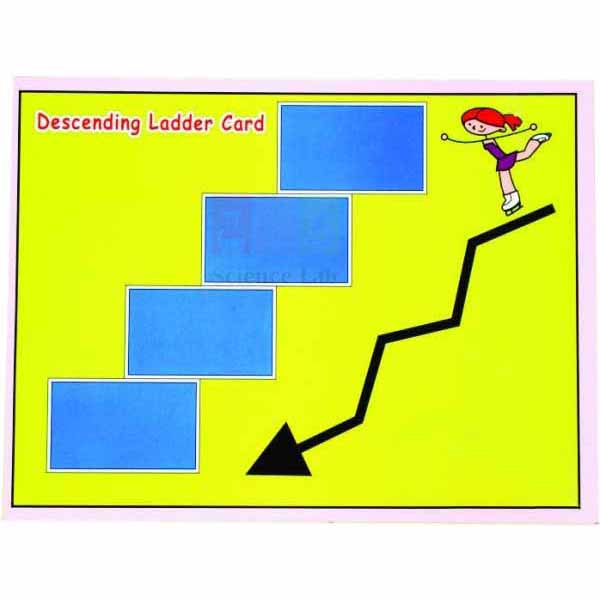
Descending Card Game
Descending Card Game (Product Code: SLE/MAT/24) is a printed card game used to teach arranging numbers in descending order, from largest to smallest, in primary mathematics. It measures 29 × 25 cm and has an interesting, easy-to-follow printed layout that students pick up quickly. It comes from Jain Scientific Equipments Pvt Ltd (ScienceLab), an OEM manufacturer with its own factory in Ambala, India.
Specifications
| Parameter | Detail |
|---|---|
| Size | 29 × 25 cm |
| Finish | Printed |
| Topic | Arranging numbers in descending order |
| Format | Card game with an easy-to-understand layout |
| Product code | SLE/MAT/24 |
| Manufacturer | Jain Scientific Equipments Pvt Ltd (ScienceLab) — OEM |
| Country of origin | India (made in Ambala, Haryana) |
What Is the Descending Card Game Used For?
Counting backwards and ordering from the largest number down is a separate skill from counting up, and the Descending Card Game gives it its own practice. Students arrange the cards from the biggest value to the smallest, learning the concept while they play rather than from a worksheet.
The 29 × 25 cm format fits comfortably on a pupil’s desk, so pairs or small groups can play side by side. Wipe the printed surface with a dry cloth and keep the game flat in storage. It sits well among mathematics lab kits in India for primary classes.
OEM Manufacturer
Jain Scientific Equipments Private Limited, which uses the brand ScienceLab, is the original equipment manufacturer of the Descending Card Game. It is manufactured at the company’s own licensed factory at Saha, Ambala, Haryana, and supplied directly to schools, dealers and importers.
Quotations and repeat orders are handled by the maker itself, so there is no trader in between. Read about the company on the company profile.
Related Maths Lab Equipment
These items round out number-ordering lessons:
- Ascending Card Game — the partner game for ordering from smallest to largest
- Empty Number Card (Set of 5) — blank cards for writing numbers with chalk
- Game of Place Value — for forming the greatest and smallest numbers from digits
- Integer Board Game — a dice game for later work with negative numbers
More number games are on the Maths Lab Equipment page.
Frequently Asked Questions
What size is the Descending Card Game?
The Descending Card Game measures 29 × 25 cm. This size fits on a student desk, so pairs or small groups can play at the same time without needing extra table space.
What does the Descending Card Game teach?
The Descending Card Game teaches students to arrange numbers in descending order, from largest to smallest. Its printed, easy-to-understand layout lets children learn the concept by playing rather than by copying from the board.
Should the Descending Card Game be used with the Ascending Card Game?
Teachers can use the Descending Card Game together with the Ascending Card Game so students practise ordering in both directions. Switching between the two also checks that children really compare values rather than memorising a sequence.
Who manufactures the Descending Card Game?
The Descending Card Game is an OEM product of Jain Scientific Equipments Pvt Ltd (ScienceLab), manufactured at the company’s own factory in Saha, Ambala, Haryana, India. Schools and distributors receive it directly from the manufacturer.
How should the Descending Card Game be cared for?
The Descending Card Game has a printed finish, so wipe it with a dry cloth rather than a wet one and store it flat in a dry place. Keeping all cards together after each lesson keeps the set complete.
Request a Quote
For a Descending Card Game quotation, use the contact page or add it to the enquiry cart. Quotes come straight from the manufacturer.
Last updated: 24 September 2026
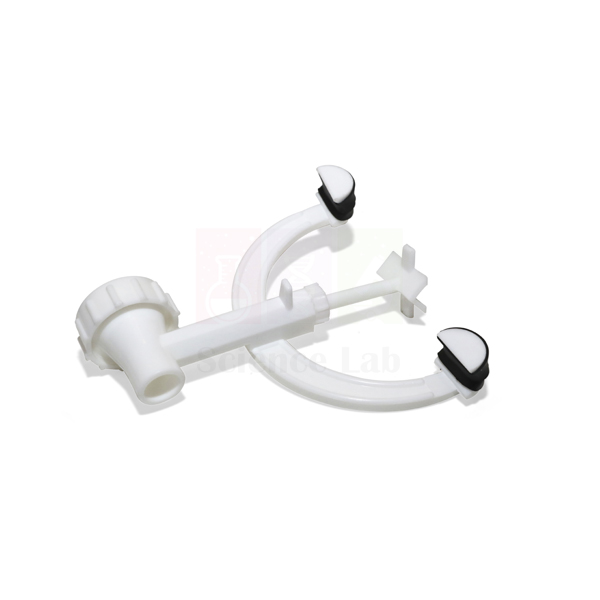
Burette Clamp - Single
Burette Clamp - Single (Product Code: SLE/P/27) is a polypropylene clamp used to fix a burette to a stand rod for titration experiments in school, college and university chemistry labs. Its polypropylene body suits benches where acid and alkali solutions are handled, it fits rods from 10 to 14 mm in diameter, and rubber grips hold the burette steady. Jain Scientific Equipments Pvt Ltd (ScienceLab) makes this burette clamp as an OEM manufacturer at its own factory in Ambala, India.
Specifications
| Parameter | Detail |
|---|---|
| Material | Polypropylene |
| Rod diameter | 10 to 14 mm |
| Grip | Rubber grips to prevent slipping |
| Version | Single (a double version is listed separately) |
| Product code | SLE/P/27 |
| Manufacturer | Jain Scientific Equipments Pvt Ltd (ScienceLab) — OEM |
| Country of origin | India (made in Ambala, Haryana) |
What Is the Single Burette Clamp Used For?
In an acid–base or redox titration the burette must stay perfectly still while the student opens the stopcock drop by drop and watches for the end point. The single clamp grips the burette on a retort stand rod so both hands are free, one for the stopcock and one to swirl the flask. Because the body is plastic, drips of acid or alkali from the burette tip will not rust it the way they can attack a plain steel clamp.
Fix the clamp at a height where the zero mark is close to eye level, check that the burette hangs vertical, and wipe any spills from the grips after the practical. For individual student stations the single type is the natural choice, with the double clamp kept for stands that two students share.
What to Specify When Ordering
- Stand rod diameter (the clamp is listed for 10 to 14 mm rods).
- Single or double version, and how many of each.
- Whether retort stands or burettes should be included in the same quotation.
OEM Manufacturer
Jain Scientific Equipments Private Limited trades as ScienceLab and is the OEM for the Burette Clamp - Single. It produces the clamp at its own licensed factory in Saha, Ambala, Haryana, alongside the double version, so a lab can source matching single and double clamps from the same maker in one order. Quotations are prepared by the manufacturer, not a reseller. Learn more about the company on the ScienceLab company profile.
Related Scientific Lab Plasticware
Other items used with a single burette clamp:
- Burette Clamp - Double — holds one or two burettes on a shared stand.
- Retort Stand — the rod and base the clamp fixes to.
- Burette — glass burette for measuring titrant volume.
- Automatic Titrating Burette — a self-filling option for repeated titrations.
View the whole Scientific Lab Plasticware range.
Frequently Asked Questions
What is the Burette Clamp - Single made of?
The Burette Clamp - Single is made of polypropylene and is fitted with rubber grips. A polypropylene body is light and does not rust when solutions drip onto it, which is useful on titration benches.
What rod size does the Burette Clamp - Single fit?
The Burette Clamp - Single is listed for rods with a diameter of 10 to 14 mm. Check the rods on your retort stands before ordering, and contact us if your stands use a different rod size.
Can the single clamp hold two burettes?
Our product note for the Burette Clamp - Single mentions holding one or two burettes, but its name indicates the single version. If you need two burettes side by side, compare it with the Burette Clamp - Double and confirm with us before ordering.
How do I stop the burette slipping in the Burette Clamp - Single?
The Burette Clamp - Single has rubber grips to prevent slipping. Tighten the clamp until the burette is held firmly and vertical, and keep the grips clean and dry so they continue to hold the glass well.
Who manufactures the Burette Clamp - Single?
Jain Scientific Equipments Pvt Ltd (ScienceLab) manufactures the Burette Clamp - Single as the OEM at its own licensed factory in Saha, Ambala, India. Schools, colleges, dealers and importers receive quotations directly from the manufacturer.
Can I get a calibration certificate or test report with the Burette Clamp - Single?
The Burette Clamp - Single is a holding clamp rather than a measuring instrument, so it is not calibrated. If your tender asks for any document with the clamps, raise it through the contact page and we will tell you what can be provided.
Request a Quote
Send your required quantity of the Burette Clamp - Single through the contact page or the enquiry cart. The manufacturer will reply with a quotation for India or export delivery.
Last updated: 24 September 2026
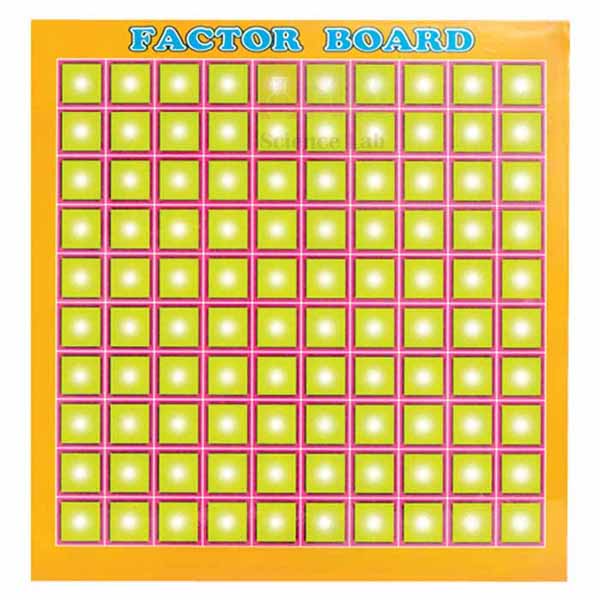
Factor Board
Factor Board (Product Code: SLE/MAT/25) is a maths board supplied with foam square tiles, used to explore factors and multiples in primary and middle school classes. Arranging the tiles into rectangular arrays shows every factor pair of a number, and the board allows innumerable combinations. The board is made by Jain Scientific Equipments Pvt Ltd (ScienceLab), an OEM manufacturer, at its own factory in Ambala, India.
Key Details
| Parameter | Detail |
|---|---|
| Supplied with | Foam square tiles |
| Topic | Factors and multiples — understanding their definitions |
| Combinations | Innumerable |
| Product code | SLE/MAT/25 |
| Manufacturer | Jain Scientific Equipments Pvt Ltd (ScienceLab) — OEM |
| Country of origin | India (made in Ambala, Haryana) |
What Is the Factor Board Used For?
On the Factor Board, students take a number of foam tiles and try to arrange all of them into rectangles. Each rectangle that works gives a factor pair, and a number that forms only a single row turns out to be prime. Seeing twelve tiles make several different rectangles explains the word “factor” better than a definition alone.
The same arrays read the other way show multiples, and comparing two numbers’ rectangles leads towards common factors. Because the combinations are innumerable, the board supports practice at several levels. It is a practical piece of school lab equipment for primary and middle classes.
OEM Manufacturer
The Factor Board is manufactured by ScienceLab, the brand of Jain Scientific Equipments Private Limited, acting as the OEM rather than a reseller. Boards and tiles go factory-direct to schools, dealers and importers.
Jain Scientific Equipments Private Limited (CIN U29309HR2020PTC087597) makes the board at its licensed factory at 449, HSIIDC Industrial Area, Saha, Ambala, which holds Factory Licence AMB-ONLINE-CHD-J-414. See our company profile for more.
Related Maths Lab Equipment
These items support the same number-theory lessons:
- Division Board — a foam-tile board for introducing division
- Place Value Board Multiplication — for multiplying whole numbers, the flip side of factors
- Colour Tile — multicoloured square tiles for area, perimeter and number operations
- Calculator Simple/Hand — a basic calculator for checking factor lists
The Maths Lab Equipment page lists more arithmetic aids.
Frequently Asked Questions
What comes with the Factor Board?
Foam square tiles come with the Factor Board so students can build arrays on it. How many tiles are included, and the board size, are not listed here, so please confirm them through our contact page before ordering.
How does the Factor Board teach factors and multiples?
The Factor Board teaches factors by having students arrange foam tiles into rectangles; the length and width of each rectangle form a factor pair. Reading the same arrays as repeated groups shows multiples and supports the definitions of both terms.
Can the Factor Board show prime numbers?
Yes, the Factor Board can show prime numbers. When a number of tiles can only be arranged as one single row, it has no other factor pair, so students discover primes and composites for themselves.
Who manufactures the Factor Board?
Jain Scientific Equipments Pvt Ltd (ScienceLab) is the OEM manufacturer of the Factor Board, making it at its own factory in Saha, Ambala, Haryana, India. Boards and tiles are sold directly by the manufacturer to schools and distributors.
Can the Factor Board be supplied in bulk or for export?
Yes, the Factor Board is available in bulk and can be ordered together with the Division Board and Place Value Board Multiplication. Dealers and importers in India and international markets can send the quantity and delivery location for a quotation.
Request a Quote
Ask for a Factor Board quotation using the contact page, or place the board in your enquiry cart. The manufacturer will respond with a quotation directly.
Last updated: 24 September 2026
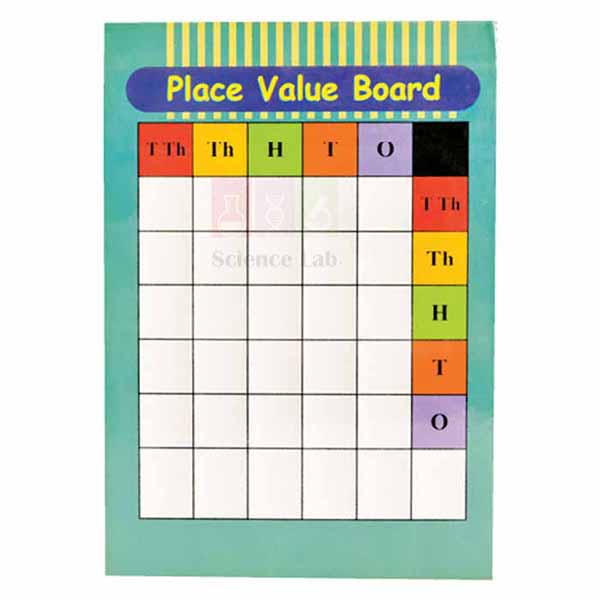
Place Value Board Multiplication
Place Value Board Multiplication (Product Code: SLE/MAT/26) is a maths board supplied with foam square tiles, used to explore multiplication of whole numbers through place value in primary classrooms. Teachers use it to give students a clear understanding of what happens in each place when a number is multiplied. The board is produced by Jain Scientific Equipments Pvt Ltd (ScienceLab), an OEM manufacturer, at its own factory in Ambala, India.
Key Details
| Parameter | Detail |
|---|---|
| Supplied with | Foam square tiles |
| Topic | Multiplication of whole numbers |
| Approach | Place-value board for hands-on multiplication |
| Product code | SLE/MAT/26 |
| Manufacturer | Jain Scientific Equipments Pvt Ltd (ScienceLab) — OEM |
| Country of origin | India (made in Ambala, Haryana) |
What Is the Place Value Board Multiplication Used For?
Written multiplication hides a lot of place-value thinking, and the Place Value Board Multiplication brings it into view. Students lay out foam tiles to build each partial product, then combine them, so they can see why digits shift and where a carried value comes from.
Children find multiplying whole numbers more fun when they can build it, and the board lets a teacher move from concrete tiles to the standard written method step by step. It is a useful addition to maths lab equipment for primary classes working on times tables and multi-digit multiplication.
OEM Manufacturer
Jain Scientific Equipments Private Limited, trading as ScienceLab, is the OEM of the Place Value Board Multiplication. The board is made at the company’s own licensed factory at Saha, Ambala, Haryana, and supplied factory-direct to schools, dealers and importers.
Extra tiles or repeat orders can be requested from the manufacturer itself — ask us. More about ScienceLab is on the company profile.
Related Maths Lab Equipment
These items work alongside the board in place-value and arithmetic lessons:
- Place Value Mat with Stacking Counters — a mat and counters for building numbers in expanded form
- Game of Place Value — a wire abacus for place value of larger numbers
- Division Board — a foam-tile board for the inverse operation
- Factor Board — foam-tile arrays for factors and multiples
Browse all Maths Lab Equipment for further number aids.
Frequently Asked Questions
What comes with the Place Value Board Multiplication?
The Place Value Board Multiplication comes with foam square tiles for building partial products. Tile quantity and board layout are not listed on this page — send a question through our contact page and the manufacturer will confirm them.
Which topic does the Place Value Board Multiplication cover?
The Place Value Board Multiplication covers multiplication of whole numbers. Students build partial products with foam tiles and see how place value explains carrying and the shifting of digits in the written method.
How is the Place Value Board Multiplication different from the Division Board?
The Place Value Board Multiplication focuses on multiplying whole numbers, while the Division Board introduces division through equal groups. Both are supplied with foam square tiles, so teachers can use them one after the other to link the two operations.
Who manufactures the Place Value Board Multiplication?
The Place Value Board Multiplication is an OEM product made by Jain Scientific Equipments Pvt Ltd (ScienceLab) at its own factory in Saha, Ambala, Haryana, India. Orders for the board and tiles are supplied directly by the manufacturer.
Can the Place Value Board Multiplication be ordered in bulk?
Yes, the Place Value Board Multiplication can be ordered in quantity for classrooms, school chains, dealers and importers in India and international markets. Mention how many boards you need and where they should be delivered.
Request a Quote
To order the Place Value Board Multiplication, contact us through the contact page or add it to the enquiry cart. You will receive a quotation direct from the manufacturer.
Last updated: 24 September 2026
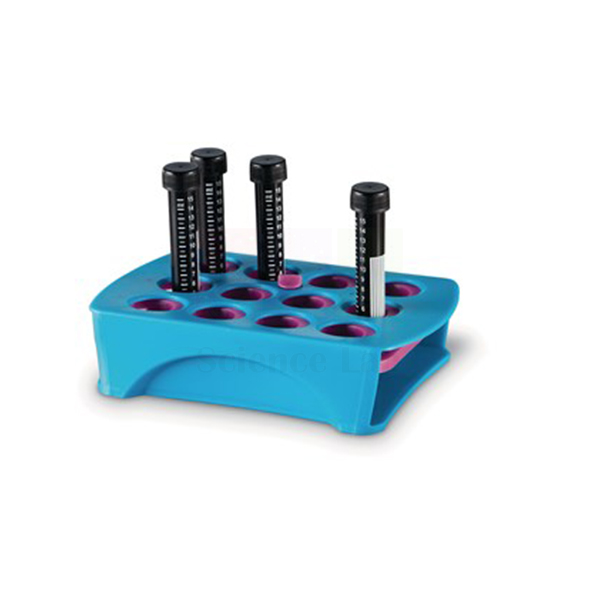
Universal Tube Rack
Universal Tube Rack (Product Code: SLE/P/28) is an adjustable polypropylene rack used to hold laboratory tubes of different sizes upright in biology, chemistry and clinical teaching labs. It holds up to 12 tubes of one size, anywhere from 16 to 30 mm in diameter, and each opening closes around the tube with an iris turned by a knob. The rack is made by Jain Scientific Equipments Pvt Ltd (ScienceLab), an OEM manufacturer, at its own factory in Ambala, India.
Specifications
| Parameter | Detail |
|---|---|
| Material | Polypropylene |
| Capacity | Up to 12 tubes of the same size |
| Tube diameter range | 16 to 30 mm |
| Tube volume range | 15 mL to 50 mL tubes |
| Tube holding | Iris openings: turn the knob to open, or insert a tube directly into the opening |
| Tubes | Not included |
| Product code | SLE/P/28 |
| Manufacturer | Jain Scientific Equipments Pvt Ltd (ScienceLab) — OEM |
| Country of origin | India (made in Ambala, Haryana) |
What Is the Universal Tube Rack Used For?
Most racks have fixed holes, so a lab needs a different rack for each tube size. This universal rack adapts instead: the iris in each opening closes around whatever tube is placed in it, from 15 mL up to 50 mL tubes. It suits labs that switch between culture tubes, sample tubes and centrifuge-style tubes during the week, and it saves bench space because one rack covers several sizes.
To load it, turn the knob to open the iris, drop the tube in and release, or simply push a tube straight into the opening. The listed capacity is up to 12 tubes when all are the same size. As a piece of school laboratory equipment it is also handy for teachers who prepare sample sets in different tube sizes for group work.
What to Specify When Ordering
- The diameter and volume of the tubes you will use (the rack takes 16 to 30 mm and 15 mL to 50 mL tubes).
- The number of racks needed per bench or per lab.
- Whether you also need tubes quoted, since tubes are not included with the rack.
OEM Manufacturer
The Universal Tube Rack comes from Jain Scientific Equipments Private Limited, known by its trading name ScienceLab, which is the original equipment manufacturer. Production takes place at the company’s own licensed factory at Saha, Ambala, Haryana, and racks are sent factory-direct to institutions, laboratories, dealers and importers. Because you deal with the maker, questions about the iris mechanism or repeat orders go straight to the people who produce it. Visit the company profile for background on ScienceLab.
Related Scientific Lab Plasticware
Other ways to hold, handle and clean tubes in the lab:
- Test Tube Rack — a fixed-hole rack for routine test tube work.
- Test Tube Rack, Polypropylene — a plastic rack for storing rows of tubes.
- Polyprop Test Tube Basket — for rinsing and carrying tubes to the sink.
- Test Tube Holder — for gripping a tube while heating or pouring.
- Brush Test Tube — cleans the inside of tubes after use.
Explore the Scientific Lab Plasticware category for more.
Frequently Asked Questions
What tube sizes fit the Universal Tube Rack?
The Universal Tube Rack accepts tubes from 16 to 30 mm in diameter and from 15 mL to 50 mL in volume. The iris in each opening adjusts to the tube, so one rack can serve several tube sizes.
How many tubes does the Universal Tube Rack hold?
The Universal Tube Rack holds up to 12 tubes of the same size. If you plan to mix tube sizes in one rack, ask us through the contact page how many will fit before you order.
Are test tubes included with the Universal Tube Rack?
No. Test tubes are not included with the Universal Tube Rack. Order tubes separately, or tell us the tube type you need through the contact page so it can be quoted alongside the racks.
How does the iris in the Universal Tube Rack work?
Each opening of the Universal Tube Rack has an iris that you open with a turn of the knob. Place the tube, then let the iris close around it, or push the tube directly into the opening without turning the knob.
Who manufactures the Universal Tube Rack?
The Universal Tube Rack is an OEM product of Jain Scientific Equipments Pvt Ltd (ScienceLab), made at the company’s own factory in Saha, Ambala, India. Questions about the iris openings, bulk supply or repeat orders go straight to the manufacturer.
What information is needed for a Universal Tube Rack quotation?
For a Universal Tube Rack quotation, send the number of racks, the tube sizes you plan to use and the delivery location in India or abroad. Add the item to the enquiry cart or write to us through the contact page.
Request a Quote
Request pricing for the Universal Tube Rack through the contact page or by adding it to the enquiry cart. Quotations are issued directly by the manufacturer.
Last updated: 24 September 2026
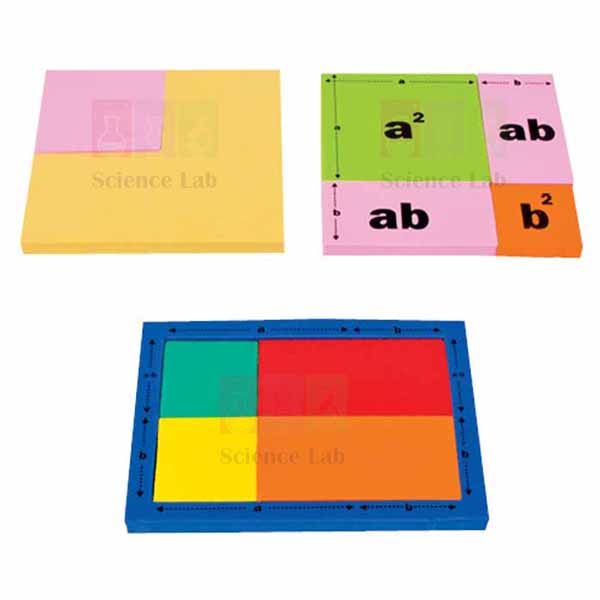
Student Identity Kit
Student Identity Kit (Product Code: SLE/MAT/27) is a hands-on algebra kit used to derive the identities (a+b)2, (a−b)2 and a2−b2 in school mathematics lessons. Designed for students, it lets learners generalise each formula on their own instead of memorising it. It is made by Jain Scientific Equipments Pvt Ltd (ScienceLab), an OEM manufacturer of mathematics lab kits in India, at its own factory in Ambala, India.
Key Details
| Parameter | Detail |
|---|---|
| Identities covered | (a+b)2, (a−b)2 and a2−b2 |
| Learning approach | Students generalise and derive each formula on their own |
| Designed for | School students learning algebraic identities |
| Product code | SLE/MAT/27 |
| Manufacturer | Jain Scientific Equipments Pvt Ltd (ScienceLab) — OEM |
| Country of origin | India (made in Ambala, Haryana) |
What Is the Student Identity Kit Used For?
The kit supports the algebra unit in which students meet the square of a sum, the square of a difference and the difference of two squares. Rather than being handed a2 + 2ab + b2 as a rule, learners work through the kit, spot the pattern and state the identity in their own words. This suits mathematics lab periods and activity-based lessons in secondary school.
A practical routine is to let small groups derive one identity each, check it with simple numbers such as a = 3 and b = 2, and then explain their reasoning to the class. As part of the lab equipment for a school mathematics room, the kit works best when its parts are kept together in one box after every lesson.
OEM Manufacturer
Jain Scientific Equipments Private Limited trades as ScienceLab and is the OEM (original equipment manufacturer) of the Student Identity Kit. The company designs and makes this kit at its own licensed factory at Saha, Ambala, Haryana, India, and supplies it factory-direct to schools, colleges, dealers and importers. Because you deal with the maker rather than a trader, questions about repeat orders or replacement parts are answered by the team that produces the kit. Learn more on the ScienceLab company profile.
Related Maths Lab Equipment
These items from the same maths lab range fit the algebra lessons in which this kit is used:
- Algebra Tiles — for modelling expressions and factorising with tiles
- Algebra Kit — for further hands-on work in the same algebra unit
- Graph Board — for plotting expressions and linking identities to graphs
- Senior Maths Kit — for equipping a secondary-level maths lab
Browse the full range of Maths Lab Equipment.
Frequently Asked Questions
What identities does the Student Identity Kit cover?
The Student Identity Kit covers three algebraic identities: (a+b)2, (a−b)2 and a2−b2. Students use it to generalise each identity and derive the formula themselves, so they understand where each expansion comes from instead of only memorising it.
What is included in the Student Identity Kit?
The current listing for the Student Identity Kit does not give a contents list or piece count. Please ask through the contact page and we will confirm exactly what the kit contains when we send your quotation.
Which students is the Student Identity Kit designed for?
The Student Identity Kit is designed for school students who are learning algebraic identities, usually when expanding brackets and the difference of squares are introduced. Teachers can demonstrate with one kit or give kits to small groups for self-directed practice in the maths lab.
Who manufactures the Student Identity Kit?
The Student Identity Kit is manufactured by Jain Scientific Equipments Pvt Ltd (ScienceLab), the OEM, at its own licensed factory in Saha, Ambala, Haryana, India. Buyers deal directly with the manufacturer for quotations, repeat orders and any questions about the kit.
Can the Student Identity Kit be ordered in bulk or for export?
Yes. The Student Identity Kit can be quoted in class-set quantities for schools, dealers and importers in India and international markets. Share the number of kits and the delivery location through the contact page so that a complete quotation can be prepared.
What should a quotation request for the Student Identity Kit include?
A quotation request for the Student Identity Kit should state the product code SLE/MAT/27, the number of kits, the delivery city or country, and any other maths lab items you need in the same shipment, so the manufacturer can quote everything together.
Request a Quote
To order the Student Identity Kit, send your requirement through the contact page or add the product to the enquiry cart. Quotations come direct from the manufacturer in Ambala, so pricing and delivery details reach you without a middleman.
Last updated: 24 September 2026
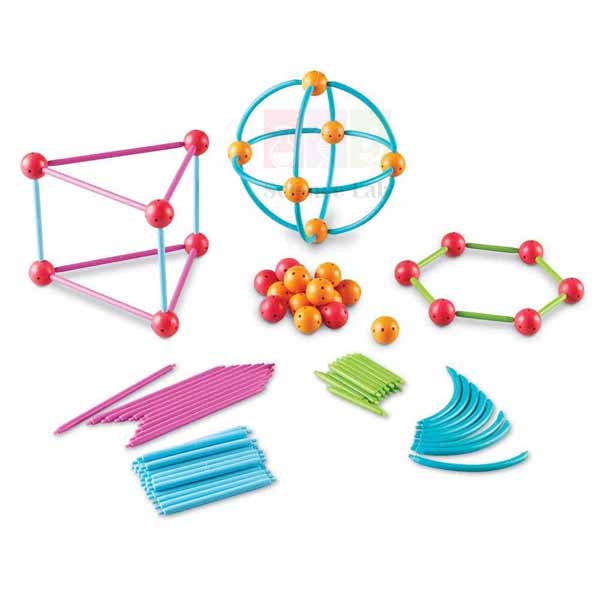
Geometric Shapes Building Set
Geometric Shapes Building Set (Product Code: SLE/MAT/28) is a construction set of sticks, curves and connectors used to build and explore 2-D and 3-D shapes in school maths classes. It contains 90 sticks in three lengths, 32 curves for circles and cylinders, and 48 connectors of two types. The set is made by Jain Scientific Equipments Pvt Ltd (ScienceLab), an OEM mathematics lab equipment manufacturer, at its own factory in Ambala, India.
Specifications
| Parameter | Detail |
|---|---|
| Sticks | 90, in 3 sizes: 2 1/4 in, 3 1/2 in and 5 1/4 in |
| Curves | 32, for making circles and cylinders |
| Connectors | 48, of 2 different types, approximately 1 in in diameter |
| Shapes possible | 2-D shapes, and 3-D shapes by combining pieces |
| Design | Child-friendly, durable sticks, curves and connectors |
| Product code | SLE/MAT/28 |
| Manufacturer | Jain Scientific Equipments Pvt Ltd (ScienceLab) — OEM |
| Country of origin | India (made in Ambala, Haryana) |
What Is the Geometric Shapes Building Set Used For?
Students join sticks with connectors to form triangles, squares, rectangles and other polygons, then add curves to close a circle or form the sides of a cylinder. Because every side is a physical stick, the class can count edges and vertices, compare side lengths across the three sizes, and see how a flat figure becomes a solid when more pieces are added. That makes the set useful for lessons on properties of shapes, perimeter and the difference between 2-D and 3-D figures.
For group work, give each table a share of the sticks and connectors and set a challenge, such as building every triangle possible from two stick sizes. Sorting the pieces back by type at the end of the lesson keeps the set complete. For a school laboratory setup in India that includes a maths corner, this open-ended building set pairs well with solid shape models.
OEM Manufacturer
The Geometric Shapes Building Set is produced by Jain Scientific Equipments Private Limited, which trades as ScienceLab and acts as the OEM (original equipment manufacturer) for its maths lab range. The set is made at the company's own licensed factory at Saha, Ambala, Haryana, India, and supplied factory-direct to schools, institutions, dealers and importers. ScienceLab is a registered MSME enterprise whose major activity is manufacturing (Udyam UDYAM-HR-01-0003714), and export shipments are handled under Importer-Exporter Code AAECJ8618A issued by DGFT. See the ScienceLab company profile for more background.
Related Maths Lab Equipment
Teachers who use this building set often pair it with these shape resources from the same range:
- Folding Geometric Shapes — for modelling solids with faces as well as edges
- Wooden Geometric Solids — for comparing skeleton models with solid shapes
- 2D Shapes — for naming and sorting flat shapes before building them
- Transparent 3D Solid Set — for follow-up work on three-dimensional solids
See all items in Maths Lab Equipment.
Frequently Asked Questions
What comes in the Geometric Shapes Building Set?
The Geometric Shapes Building Set contains 90 sticks in three sizes (2 1/4, 3 1/2 and 5 1/4 inches), 32 curves for making circles and cylinders, and 48 connectors of two different types, each approximately 1 inch in diameter.
Can the Geometric Shapes Building Set make 3-D shapes?
Yes. The Geometric Shapes Building Set is built around 2-D shapes first, and students can then combine sticks, curves and connectors into 3-D shapes such as cylinders and other skeleton solids, which helps them compare flat and solid figures.
Is the Geometric Shapes Building Set suitable for young children?
The Geometric Shapes Building Set is described as child-friendly, with durable sticks, curves and connectors intended for classroom handling. As with any set containing small parts, teachers should supervise younger pupils and count the pieces back in after each activity.
Who manufactures the Geometric Shapes Building Set?
The Geometric Shapes Building Set is manufactured by Jain Scientific Equipments Pvt Ltd (ScienceLab), the OEM, at its own licensed factory in Saha, Ambala, Haryana, India. Quotations, repeat orders and spare-piece enquiries are handled by the manufacturer itself, so just ask us.
How many Geometric Shapes Building Sets does a class need?
For the Geometric Shapes Building Set, the number depends on group size: one set can be shared by a small group, while larger classes usually order several sets. Tell us your class size through the contact page and we will quote the quantity you need.
Can the Geometric Shapes Building Set be exported?
Yes. The Geometric Shapes Building Set is supplied to buyers in India and international markets. Send the quantity, destination country and any other maths lab items through the contact page so that the export quotation can cover the full order.
Request a Quote
Request pricing for the Geometric Shapes Building Set through the contact page, or place it in the enquiry cart together with other maths lab items. Your quotation comes straight from the manufacturer at Ambala.
Last updated: 24 September 2026
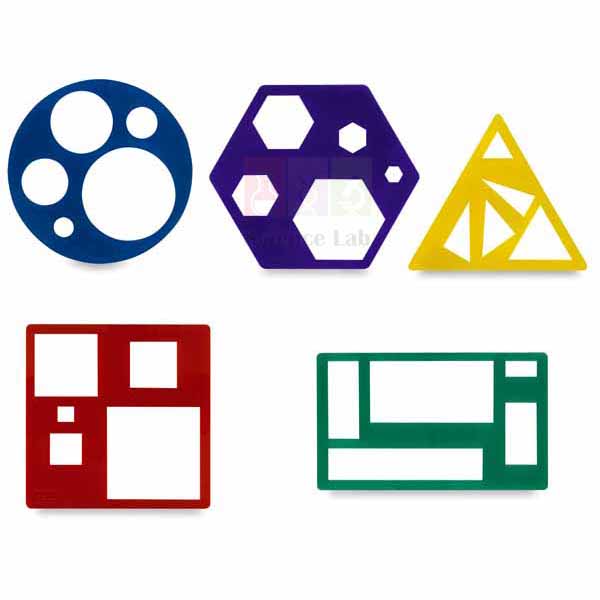
Primary Shapes Template Set
Primary Shapes Template Set (Product Code: SLE/MAT/29) is a set of transparent tracing templates used to draw and compare basic shapes in primary maths lessons. Its 5 durable, labelled templates (rectangle, triangle, circle, square and hexagon) each show one shape in several sizes and orientations. It is made by Jain Scientific Equipments Pvt Ltd (ScienceLab), an OEM manufacturer of educational laboratory equipment in India, at its own factory in Ambala, India.
Specifications
| Parameter | Detail |
|---|---|
| Templates | 5 durable, labelled templates |
| Shapes | Rectangle, triangle, circle, square and hexagon |
| Rectangle template size | 7.5 in (L) x 4.5 in (H) |
| Transparency | Transparent, so tracing lines stay visible after repositioning |
| Design | Relational shapes in varying sizes and orientations; tracing around the entire template gives the largest version |
| Product code | SLE/MAT/29 |
| Manufacturer | Jain Scientific Equipments Pvt Ltd (ScienceLab) — OEM |
| Country of origin | India (made in Ambala, Haryana) |
What Is the Primary Shapes Template Set Used For?
Each template nests several versions of one shape, so a child who traces an inner outline and then the whole template sees that a small square and a large square share the same properties. These relational examples help pupils make mental connections between size, orientation and shape name, which matters when a triangle is turned on its point and suddenly looks unfamiliar.
Because each template is transparent, pupils can slide it over lines they have already drawn and line up the next tracing precisely. Teachers use the set for shape recognition, drawing patterns and simple symmetry activities, and the printed labels reinforce shape vocabulary during independent work at the maths table.
OEM Manufacturer
ScienceLab is the trading name of Jain Scientific Equipments Private Limited, the OEM (original equipment manufacturer) of the Primary Shapes Template Set. The templates are produced at the company's own licensed factory at Saha, Ambala, Haryana, India, rather than bought in from a trader, and are sent factory-direct to schools, teacher-training institutes, dealers and importers. Replacement templates and repeat orders are handled by the manufacturer, so simply ask us when you need them. Visit the ScienceLab profile to learn about the company.
Related Maths Lab Equipment
These shape resources from the same range extend the tracing activities into sorting, building and area work:
- 2D Shapes — for handling flat shapes alongside tracing them
- Attribute Blocks — for sorting shapes by their attributes
- Geometric Shapes Building Set — for constructing the same shapes from sticks and connectors
- Upper Primary Maths Kit — for the next stage of a primary maths lab
Explore the complete Maths Lab Equipment category.
Frequently Asked Questions
Which shapes are in the Primary Shapes Template Set?
The Primary Shapes Template Set includes five durable, labelled templates: a rectangle, a triangle, a circle, a square and a hexagon. Each template shows its shape in varying sizes and orientations, and tracing around the whole template produces the largest version.
How big are the templates in the Primary Shapes Template Set?
In the Primary Shapes Template Set, the rectangle template measures 7.5 inches long by 4.5 inches high. Sizes of the other four templates are not listed, so please ask through the contact page if you need them before ordering.
Why are the Primary Shapes Template Set templates transparent?
The Primary Shapes Template Set uses transparent templates so that pupils can still see the lines they have already traced after moving the template. This makes it easier to line up new drawings, build patterns and compare the sizes of the nested shapes.
Who manufactures the Primary Shapes Template Set?
Jain Scientific Equipments Pvt Ltd (ScienceLab) manufactures the Primary Shapes Template Set as the OEM at its own licensed factory at Saha, Ambala, Haryana, India. Schools, dealers and importers receive quotations directly from the manufacturer rather than through an intermediary.
What should a quote request for the Primary Shapes Template Set include?
A quote request for the Primary Shapes Template Set should include the product code SLE/MAT/29, the number of sets, the delivery address and whether the order covers one classroom or several schools. Bulk orders for India and international markets can be quoted.
Request a Quote
Send an enquiry for the Primary Shapes Template Set through the contact page or add it to the enquiry cart. Because ScienceLab makes the set, the quotation you receive comes direct from the manufacturer.
Last updated: 24 September 2026