- Physics Lab Equipment
- Chemistry Lab Equipment
- Biology Lab Equipment
- Anatomical Lab Equipment
- Learning
- Educational Lab Equipment
- Magnets
- Agriculture
- Astronomy
- Earth Science
- Geography Lab Equipment
- Safety Lab Coat
- Laboratory
- Meteorological
- Electricity & Magnetism
- Heat
- School Lab Equipment
- Lab Glassware
- Science Lab Equipment
- Tvet Lab Equipment
- Robotics Kits Supplier and Manufacturer for Schools India
- Math Lab Equipment Manufacturers and Exporters in Ambala
- STEM Kits Manufacturers and Supplier India
- Engineering Lab Equipment
- Hospital Lab Equipment
- Water, Sanitation & Hygiene Supplies
- Cold Chain, Solar & Communication Equipment
- Nutrition
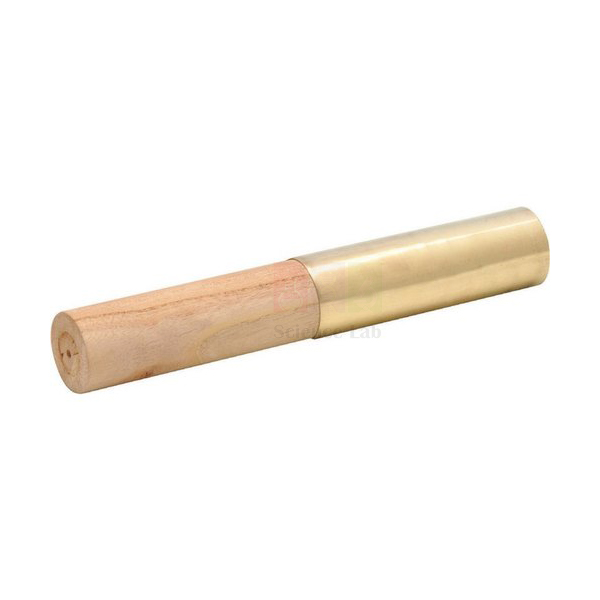
Wood & Metal Cylinder
Wood & Metal Cylinder (Product Code: SLE/PHY/320) is a 200 x 30mm cylindrical rod, half metal and half wood, used to demonstrate the difference between good and poor conductors of heat in school physics and general science labs. Paper wrapped round the rod and held briefly over a Bunsen flame scorches over the wood but stays uncharred over the metal, a result students remember. It is made by Jain Scientific Equipments Pvt Ltd (ScienceLab), an OEM manufacturer, at its own factory in Ambala, India.
Specifications
| Parameter | Detail |
|---|---|
| Form | Cylindrical rod made of two halves |
| Materials | One end metal, the other end wood |
| Dimensions | 200 x 30mm (dia.) |
| Heat source needed | Bunsen flame (not included) |
| Product code | SLE/PHY/320 |
| Manufacturer | Jain Scientific Equipments Pvt Ltd (ScienceLab) — OEM |
| Country of origin | India (made in Ambala, Haryana) |
What Is the Wood and Metal Cylinder Used For?
Wrap a single sheet of paper tightly round the join so that half the paper lies on wood and half on metal, then hold the rod briefly above a Bunsen flame. The metal conducts heat away from the paper so quickly that the paper over it stays below the temperature at which it chars. Wood is a poor conductor, so the paper over the wooden half heats up and scorches almost at once.
The side-by-side result makes this a memorable heat energy science kit piece for lessons on conduction, insulators and everyday examples such as wooden handles on metal pans. Keep the exposure short, hold the rod at the end away from the flame, and have students allow the metal half to cool before touching it or rewrapping.
OEM Manufacturer
The Wood & Metal Cylinder comes from Jain Scientific Equipments Private Limited, which trades as ScienceLab and acts as the OEM for this apparatus. The rods are made and assembled at the company's own licensed factory at Saha, Ambala, Haryana, India, and supplied direct from the factory to schools, colleges, dealers and importers. Ask us for repeat orders or class quantities and the manufacturer will quote directly. Our company profile has more background.
Related Physics Lab Equipment
Items that pair well with the Wood & Metal Cylinder in a conduction lesson:
- Bunsen Burner — the flame source needed for the scorching test.
- Apparatus Heat/Thermal Conductivity — compares how well different materials conduct heat.
- Thermal Conductivity Bars — rods of different metals for ranking conductors.
- Conductivity of Metal Apparatus — a follow-up experiment on conduction in metals.
Browse the Physics Lab Equipment range for more heat apparatus.
Frequently Asked Questions
What does the Wood & Metal Cylinder demonstrate?
The Wood & Metal Cylinder demonstrates that metals conduct heat much better than wood. Paper wrapped round the rod and held over a Bunsen flame chars quickly where it touches the wood, but stays uncharred where it touches the metal, because the metal carries the heat away.
What size is the Wood & Metal Cylinder?
The Wood & Metal Cylinder measures 200 x 30mm (dia.), with one half made of metal and the other of wood. The rod is long enough to hold safely by one end while the join is held over the flame.
What else is needed to use the Wood & Metal Cylinder?
To use the Wood & Metal Cylinder you need a Bunsen burner and a strip of plain paper to wrap tightly round the rod. The burner is not part of this item and can be quoted separately if your lab needs one.
Is the Wood & Metal Cylinder safe for students?
The Wood & Metal Cylinder is safe for supervised use when the rod is held over the flame only briefly. Hold it by the end away from the heat, keep loose paper away from the burner and let the metal half cool before it is handled again.
Who manufactures the Wood & Metal Cylinder?
Jain Scientific Equipments Pvt Ltd (ScienceLab) manufactures the Wood & Metal Cylinder as the OEM at its own licensed factory in Saha, Ambala, Haryana, India. It is supplied factory-direct to schools, colleges and trade buyers in India and international markets.
How can I get a quotation for the Wood & Metal Cylinder?
Send the number of Wood & Metal Cylinder rods you need and your delivery location through the contact page. Mention any companion items, such as Bunsen burners, so the manufacturer can quote everything in one reply.
Request a Quote
Request your quotation for the Wood & Metal Cylinder on the contact page, or add it to the enquiry cart along with other heat apparatus. Quotes come directly from the manufacturer in Ambala.
Last updated: 24 September 2026
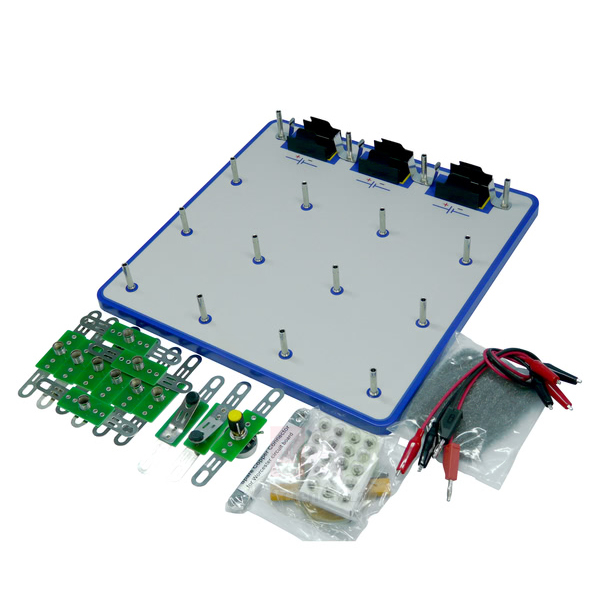
Worcester Circuit Board Kit
Worcester Circuit Board Kit (Product Code: SLE/PHY/321) is a circuit-building kit based on the Worcester circuit board pattern, used to assemble and test simple electric circuits in school science and physics lessons. Teachers choose Worcester-style boards because pupils can lay out a circuit on a baseboard and see every connection clearly, which suits first lessons on current electricity. The kit is made by Jain Scientific Equipments Pvt Ltd (ScienceLab), an OEM manufacturer, at its own factory in Ambala, India.
Key Details
| Parameter | Detail |
|---|---|
| Type | Circuit-building kit, Worcester circuit board pattern |
| Kit contents | Please ask us for the current contents list with your quotation |
| Product code | SLE/PHY/321 |
| Manufacturer | Jain Scientific Equipments Pvt Ltd (ScienceLab) — OEM |
| Country of origin | India (made in Ambala, Haryana) |
What Is the Worcester Circuit Board Kit Used For?
Worcester circuit boards let students build real circuits without soldering. Components are placed on a baseboard and linked together, so a class can move from a single cell and lamp to series and parallel arrangements, add switches, and compare how brightly lamps glow as the circuit changes. Because the layout on the board matches the circuit diagram, students learn to read and draw diagrams at the same time.
As an electricity experiment kit for school labs, the boards also support measurements with an ammeter and voltmeter, tests of conductors and insulators, and simple fault-finding tasks. Keep cells out of the kit when it is stored, check connections are clean before each lesson, and count components back in at the end of the period.
What to Specify When Ordering
- Ask for the current contents list and confirm it covers the experiments in your syllabus.
- Number of kits — for example one per student pair or group.
- Any meters or extra boards you want quoted alongside the kits.
OEM Manufacturer
Jain Scientific Equipments Private Limited, the company behind the ScienceLab brand, is the OEM for the Worcester Circuit Board Kit and its related Worcester circuit boards. The kits are made at the company's own licensed factory at 449, HSIIDC Industrial Area, Saha, Ambala, which operates under Factory Licence AMB-ONLINE-CHD-J-414, and the company is incorporated under CIN U29309HR2020PTC087597. Schools, colleges, dealers and importers buy directly from the factory, and spare boards can be requested from us. Visit our company profile to learn more.
Related Physics Lab Equipment
Items that work with or extend the Worcester Circuit Board Kit:
- Worcester Circuit Board — an individual Worcester board for adding circuit positions.
- Circuit Board Worcester — a board-and-components set in the same pattern.
- Circuits Kit Bulb Holder — extra lamp positions for series and parallel work.
- Ammeter Voltmeter — measures current and voltage in the circuits students build.
See more electricity apparatus in Physics Lab Equipment.
Frequently Asked Questions
What is a Worcester Circuit Board Kit?
A Worcester Circuit Board Kit is a set for building simple electric circuits on Worcester-pattern boards, where components are laid out on a baseboard and connected without soldering. It lets students assemble, test and change circuits quickly during school physics practicals.
What is included in the Worcester Circuit Board Kit?
The contents of the Worcester Circuit Board Kit are not itemised on this page. Please ask for the current contents list through the contact page before ordering, so you can check it against the experiments your syllabus requires.
Which experiments can students do with the Worcester Circuit Board Kit?
With the Worcester Circuit Board Kit, students can build series and parallel circuits, add switches and lamps, test which materials conduct, and practise matching real circuits to circuit diagrams. Adding meters extends the kit to simple current and voltage measurements.
Who manufactures the Worcester Circuit Board Kit?
The Worcester Circuit Board Kit is manufactured by Jain Scientific Equipments Pvt Ltd (ScienceLab) as the OEM, at its own licensed factory at Saha, Ambala, Haryana, India. It is supplied factory-direct to schools, colleges, dealers and importers in India and international markets.
Can extra boards be ordered for the Worcester Circuit Board Kit later?
Yes, you can ask us about extra or replacement boards for the Worcester Circuit Board Kit at any time. Because the kit comes directly from the manufacturer, add-on requests are handled by the same factory; availability is confirmed when you enquire.
What does a quotation for the Worcester Circuit Board Kit need?
A quotation for the Worcester Circuit Board Kit needs the number of kits, any meters or extra boards to include, and the delivery location in India or abroad. Send these details through the contact page for a direct reply.
Request a Quote
Enquire about the Worcester Circuit Board Kit on our contact page or add it to the enquiry cart with the rest of your electricity apparatus. Quotations and contents lists come direct from the manufacturer in Ambala.
Last updated: 24 September 2026
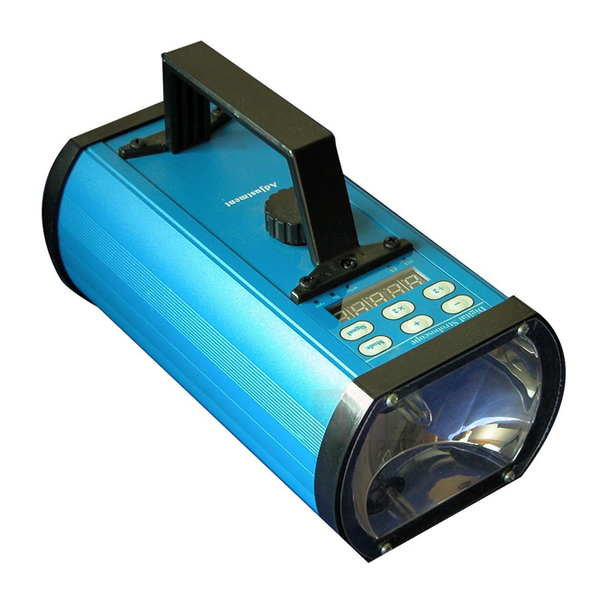
Xenon Stroboscope
Xenon Stroboscope (Product Code: SLE/PHY/322) is a stroboscopic lamp, also called a revolution calibration meter, used to freeze fast rotating or vibrating motion and calculate its speed in physics labs, engineering workshops and industrial settings. Its xenon flash is triggered from 0.2 to 300 Hz, internally or externally, and a 7-segment LED display shows the flashing frequency in real time, making it a practical test and measuring instrument. It is supplied by Jain Scientific Equipments Pvt Ltd (ScienceLab), Ambala, India.
Specifications
| Parameter | Detail |
|---|---|
| Light source | Xenon flash tube, instantaneous intense flash |
| Flash tube intensity | Approximately 10000 lux |
| Triggering frequency range | 0.2–300 Hz (internal and external) |
| Recommended triggering frequency | 0.2–180 Hz |
| External trigger signal | 5–12V pulse signal |
| Frequency adjustment | Rotating encoder for rapid frequency changes |
| Processing and display | Microcontroller processing unit; display chip driving a 7-segment LED showing real-time flash frequency |
| Power supply | AC220V ± 5%, 1.2A |
| Power consumption | Less than 8W maximum |
| Dimensions (L × W × H) | 215mm × 140mm × 150mm |
| Net weight | 2 kg |
| Documentation | Complete operating instructions supplied |
| Product code | SLE/PHY/322 |
| Supplied by | Jain Scientific Equipments Pvt Ltd (ScienceLab), Ambala, India |
What Is the Xenon Stroboscope Used For?
When the flash rate matches the speed of a rotating or vibrating object, the object is lit in the same position each time and appears to stand still; set the rate slightly off and it seems to move slowly forwards or backwards. Turning the encoder until a fan blade, motor shaft or vibrating string appears frozen lets students read the frequency from the display and work out the rotational speed of an object whose speed was unknown.
In physics lessons the stroboscope freezes ripple-tank waves, standing waves on strings and falling water drops, and the frozen motion can be photographed with a standard digital camera. Workshops use it the same way to check machine speeds without touching moving parts. Warn the group before use, since flashing light can affect people who are sensitive to it, and never judge a machine safe to touch because it looks stationary.
What to Specify When Ordering
- Your mains supply, as the listed input is AC220V ± 5%.
- Whether you will trigger it externally, and that your source gives a 5–12V pulse signal.
- Number of units, and any rotating or vibrating apparatus to be quoted with it.
Supplier
Jain Scientific Equipments Private Limited, trading as ScienceLab, supplies the Xenon Stroboscope from Ambala, Haryana, India to schools, colleges, technical institutes, dealers and importers. We source the instrument and ship it with its operating instructions to buyers in India and international markets; tell us your mains and triggering needs when you enquire. To find out more about the company, see our company profile.
Related Physics Lab Equipment
Apparatus often used with the Xenon Stroboscope:
- Ripple Tank — its wave patterns can be frozen under the strobe for study.
- Vibration Generator — drives strings and springs into standing waves to observe.
- Demonstration, Electric Motor — a rotating target for speed measurements.
- Newton’s Colour Disc — a spinning disc that shows strobe effects clearly.
More measuring and demonstration apparatus is listed under Physics Lab Equipment.
Frequently Asked Questions
What frequency range does the Xenon Stroboscope cover?
The Xenon Stroboscope triggers from 0.2 to 300 Hz, using either its internal control or an external signal, with 0.2 to 180 Hz recommended for regular use. The current flash frequency is shown in real time on its 7-segment LED display.
How does the Xenon Stroboscope measure speed?
The Xenon Stroboscope measures speed by matching its flash rate to a moving object. When the object appears stationary, the displayed flash frequency equals its rate of rotation or vibration, so the speed of an object with unknown movement can be calculated.
Can the Xenon Stroboscope be triggered externally?
Yes. The Xenon Stroboscope accepts an external 5 to 12V pulse signal for triggering across the same 0.2 to 300 Hz range. Check that your sensor or signal source can deliver a pulse in that range before connecting it.
What power supply does the Xenon Stroboscope need?
The Xenon Stroboscope is listed for AC220V ± 5% at 1.2A, with maximum power consumption of less than 8W. If your mains supply differs, tell us when you enquire so we can confirm what arrangement is possible before quoting.
Who supplies the Xenon Stroboscope?
The Xenon Stroboscope is supplied by Jain Scientific Equipments Pvt Ltd (ScienceLab), Ambala, Haryana, India, to schools, colleges, technical institutes and trade buyers. We supply it with complete operating instructions to customers in India and international markets.
Is a calibration certificate available for the Xenon Stroboscope?
Calibration documentation for the Xenon Stroboscope is not part of the listing. If your laboratory needs a calibration certificate, please raise it through the contact page before ordering so we can tell you what can be arranged.
Request a Quote
To request a quotation for the Xenon Stroboscope, send the quantity, your mains voltage and delivery location through the contact page, or add it to the enquiry cart with any companion apparatus.
Last updated: 24 September 2026
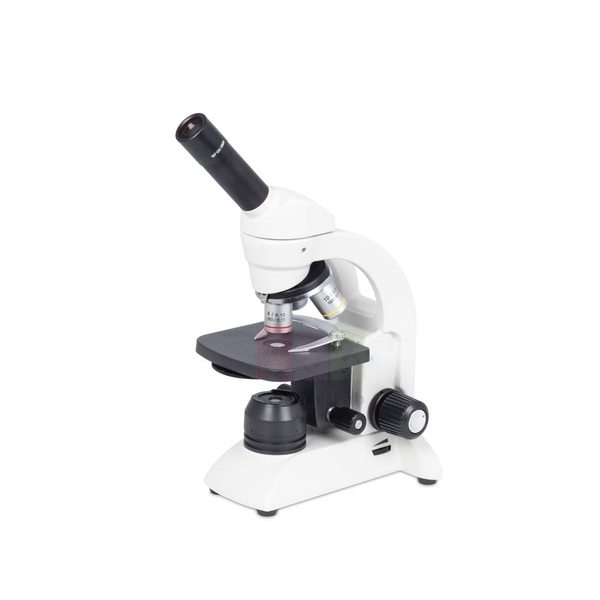
Monocular Microscope, 400x, LED
Monocular Microscope, 400x, LED (Product Code: SLE/M/97) is a cordless compound microscope used to study cells, tissues and micro-organisms up to 400x in junior and middle-school science classes. It is built with brass gears and mechanical parts for long classroom service, and pairs a gliding stage with LED lighting that runs from the mains or rechargeable batteries. This monocular microscope for schools in India and overseas is supplied by Jain Scientific Equipments Pvt Ltd (ScienceLab), Ambala, India.
Specifications
| Parameter | Detail |
|---|---|
| Viewing head | Monocular, 45° inclined, 360° rotation |
| Eyepiece | WF10X/18 mm with pointer |
| Nosepiece | Triple |
| Objectives | Achromatic, DIN: 4X, 10X and 40X (marked S) |
| Condenser | Built-in condenser lens, N.A. 0.65 |
| Filter | Built-in frosted glass |
| Stage | Gliding stage, 110 x 105 mm, with sample clips |
| Diaphragm | Disc diaphragm |
| Focusing | Separate coarse and fine adjustment; focus precision 2 µm; focusing stroke 8 mm |
| Illumination | LED with intensity control |
| Power | 110–220 V mains or rechargeable batteries |
| Mechanism | Brass gears and mechanical parts |
| Optics | Glass optics |
| Accessories included | Dust cover, charger, batteries, calibration slide |
| Product code | SLE/M/97 |
| Supplied by | Jain Scientific Equipments Pvt Ltd (ScienceLab), Ambala, India |
What Is the 400x LED Monocular Microscope Used For?
Teachers use it for the core practicals of junior biology: onion epidermis, cheek cells, stomata, pollen and pond-water organisms. Begin with the 4X objective, centre the specimen on the gliding stage, then turn the triple nosepiece to 10X and 40X and finish with the fine control. The frosted glass filter spreads the LED light evenly, and the intensity control lets pupils dim it for pale, unstained mounts.
A gliding stage lets pupils move the slide smoothly by hand, which is quicker for younger students than working a mechanical stage. Because the lighting also runs on rechargeable batteries, the microscope can be taken to a window bench, an outdoor lesson or a room without sockets, then recharged with the supplied charger after class. The included calibration slide helps students relate what they see to real size.
What to Specify When Ordering
- The number of microscopes needed per class or practical group
- Your mains voltage (the microscope is listed for 110–220 V and also runs on rechargeable batteries)
- Any extra slides, cover glasses or cleaning materials to be quoted in the same order
Supplier
Jain Scientific Equipments Private Limited, known to customers as ScienceLab, supplies this 400x LED monocular microscope from Ambala, Haryana. It is sourced for schools, coaching centres, colleges, dealers and importers in India and international markets that want a sturdy, battery-capable model for junior classes. Slides, cover glasses and cleaning materials can be added to the same quotation. Company background is on the ScienceLab profile page.
Related Laboratory Equipment
Consumables and alternatives commonly ordered with a 400x classroom microscope:
- Microscope Slides Glass — plain slides for pupils' own wet mounts
- Cover Glasses — to cover specimens before viewing with the 40X objective
- Basic Botany Slide Set — prepared plant sections for guided lessons
- Lens Tissue — for wiping the eyepiece and objectives without scratching
- Monocular Mirror Microscope, 400x — mirror-lit option for rooms without electricity
Compare other student models in the Microscope category.
Frequently Asked Questions
What accessories come with the Monocular Microscope, 400x, LED?
The Monocular Microscope, 400x, LED comes with a dust cover, a charger, batteries and a calibration slide. It can therefore be used on mains or on its rechargeable batteries straight away, and covered between lessons to keep dust off the optics.
Can the 400x LED monocular microscope work without mains power?
Yes. The Monocular Microscope, 400x, LED runs from 110–220 V mains or from rechargeable batteries, so it can be used in rooms without sockets or during power cuts. Recharge the batteries with the supplied charger after lessons so the microscope is ready next time.
What objectives are fitted to the Monocular Microscope, 400x, LED?
The Monocular Microscope, 400x, LED has achromatic DIN objectives of 4X, 10X and 40X on a triple nosepiece. Used with the WF10X/18 mm eyepiece, which has a pointer, they cover everything from low-power scanning to 400x detail of cells.
How fine is the focusing on this monocular microscope?
The Monocular Microscope, 400x, LED has separate coarse and fine adjustment, with a focus precision of 2 µm and an 8 mm focusing stroke. The fine control makes it easier for students to sharpen detail with the 40X objective without touching the slide.
Why does the microscope use brass gears?
Brass gears and mechanical parts are used in the Monocular Microscope, 400x, LED so that it lasts for many years in a school environment, where microscopes are handled daily by many students. Keeping the focusing controls clean and covered helps them turn smoothly.
Is a calibration certificate available for the Monocular Microscope, 400x, LED?
A calibration slide is included with the Monocular Microscope, 400x, LED, but a calibration certificate is not listed. If your institution needs any documentation with the order, please discuss it with us through the contact page before we prepare the quotation.
Who supplies the Monocular Microscope, 400x, LED?
Jain Scientific Equipments Pvt Ltd (ScienceLab), Ambala, Haryana, India, supplies the Monocular Microscope, 400x, LED (SLE/M/97) to schools, colleges, dealers and importers in India and international markets, with slides and other microscopy consumables available in the same order.
Request a Quote
For a quotation on the Monocular Microscope, 400x, LED, send the quantity and delivery location through our contact page, or place it in the enquiry cart together with slides and other lab items. We reply with a consolidated quotation.
Last updated: 24 September 2026
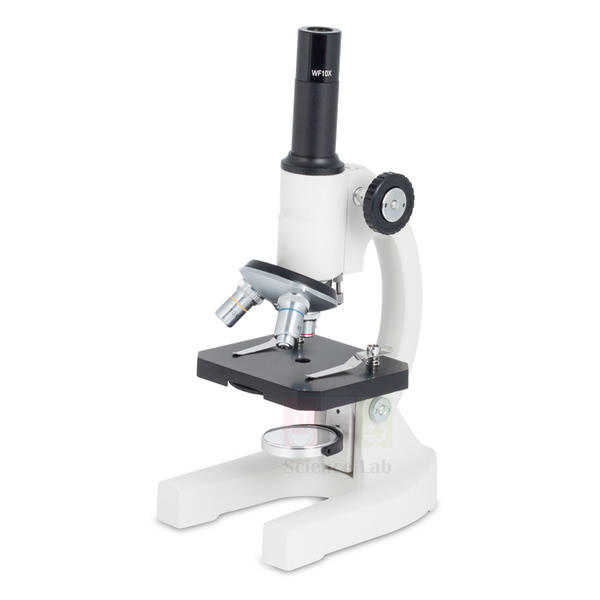
Monocular Mirror Microscope, 400x
Monocular Mirror Microscope, 400x (Product Code: SLE/M/98) is a mirror-lit compound microscope used to introduce elementary pupils and hobby users to microscopy, up to 400x, in classrooms and outdoors. It needs no electricity: a removable plano-concave mirror directs daylight or lamp light through the specimen, and a large gripping area makes it easy for small hands to carry. This compound microscope for primary schools in India and abroad is supplied by Jain Scientific Equipments Pvt Ltd (ScienceLab), Ambala, India.
Specifications
| Parameter | Detail |
|---|---|
| Head | Vertical monocular head, can be tilted to 45° |
| Eyepiece | Widefield WF10X/14 mm with built-in pointer |
| Nosepiece | Revolving triple nosepiece with positive click stops |
| Objectives | 4X/0.10, 10X/0.25, 40X/0.65; parcentric and parfocal |
| Focusing | Spring coarse focusing adjustment |
| Stage | 88 x 82 mm with stage clips |
| Diaphragm | Rotating disc diaphragm |
| Illumination | Removable plano-concave mirror (no power needed) |
| Handling | Large gripping area for carrying in class and outdoors |
| Intended users | Elementary school and hobby users |
| Product code | SLE/M/98 |
| Supplied by | Jain Scientific Equipments Pvt Ltd (ScienceLab), Ambala, India |
What Is the Mirror Microscope Used For?
This is a first microscope for children who have never used one. Tilt the head to a comfortable angle, turn the mirror towards a window or desk lamp until the field is evenly bright, and focus with the 4X objective before clicking round to 10X and 40X. Because the objectives are parfocal and parcentric, the specimen stays close to focus and near the centre when the nosepiece is turned, so young users lose their place less often.
The plano-concave mirror gives a choice of surfaces: the flat side for strong light such as a bright window, the concave side to gather more light from a weak or nearby source. With no cable or batteries, the microscope suits rural schools, field trips and rooms without power, while the rotating disc diaphragm helps control contrast on thin plant and pond specimens.
Supplier
ScienceLab, the trading name of Jain Scientific Equipments Private Limited in Ambala, Haryana, supplies this mirror microscope for primary schools, science clubs, NGOs, dealers and importers across India and international markets. Its simple, power-free design makes it a practical choice where electricity is unreliable, and it can be quoted with slides and cover glasses in one order. See the company profile for more about ScienceLab.
Related Laboratory Equipment
Items that help young learners get the most from a mirror microscope:
- Microscope Slides Depression — cavity slides that hold a drop of pond water
- Microscope Slide Cover Forceps — for lowering cover slips without trapping air
- Plant Cell Study Kit — a plant-cell activity to pair with first microscope lessons
- Microscope Case — for storing and carrying a microscope between lessons
- Monocular Microscope, 400x, LED — LED-lit alternative with rechargeable batteries
See all student and research models in the Microscope category.
Frequently Asked Questions
Does the Monocular Mirror Microscope, 400x need electricity?
No. The Monocular Mirror Microscope, 400x is lit by a removable plano-concave mirror that reflects daylight or lamp light up through the specimen. It needs no cable or batteries, which suits rooms without sockets, outdoor lessons and schools with unreliable power.
What objectives does the mirror microscope have?
The Monocular Mirror Microscope, 400x has 4X/0.10, 10X/0.25 and 40X/0.65 objectives on a revolving triple nosepiece with positive click stops, used with a WF10X/14 mm eyepiece. The highest combination reaches 400x, enough to see plant cells and many pond organisms.
Why are parfocal and parcentric objectives useful for children?
Parfocal and parcentric objectives on the Monocular Mirror Microscope, 400x keep the specimen close to focus and near the centre of the field when the nosepiece is turned. Young users therefore spend less time searching for the specimen after changing magnification.
How big is the stage on the Monocular Mirror Microscope, 400x?
The Monocular Mirror Microscope, 400x has an 88 mm x 82 mm stage with stage clips to hold the slide. Pupils move the slide by hand, and a rotating disc diaphragm below the stage adjusts how much light reaches the specimen.
Is the mirror microscope suitable for outdoor use?
Yes. The Monocular Mirror Microscope, 400x was designed with a large gripping area so it is easy to carry around the classroom and outdoors. Because it uses a mirror instead of a lamp, it works wherever there is enough daylight.
Who supplies the Monocular Mirror Microscope, 400x?
Jain Scientific Equipments Pvt Ltd, trading as ScienceLab from Ambala, Haryana, India, supplies the Monocular Mirror Microscope, 400x (SLE/M/98) to primary schools, science clubs, dealers and importers in India and international markets. Send your quantity through the contact page for a quotation.
Request a Quote
To receive a quotation for the Monocular Mirror Microscope, 400x, write to us through the contact page with your quantity and delivery address, or add it to the enquiry cart. Slides, cover glasses and cases can be included in the same enquiry.
Last updated: 24 September 2026
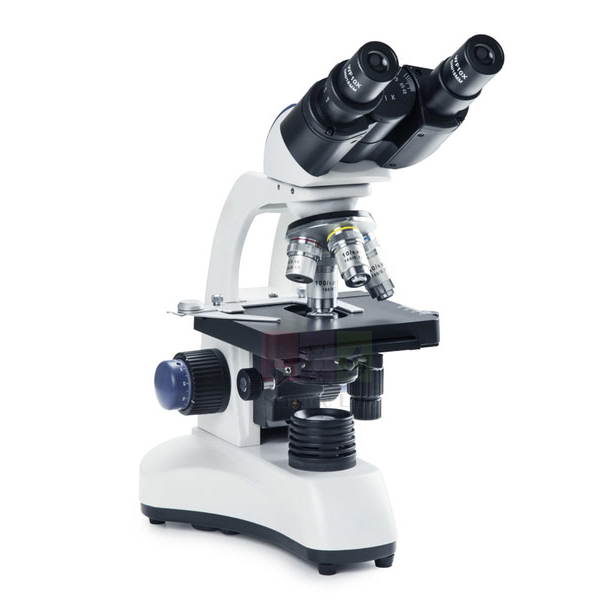
Binocular Microscope, 1000x
Binocular Microscope, 1000x (Product Code: SLE/M/99) is a cordless compound microscope used to examine stained slides, smears and bacteria at up to 1000x in school, college and training laboratories. It pairs achromatic 4/10/S40/S100x oil objectives with 1 W illumination that runs on rechargeable batteries, so it keeps working away from a mains socket. This binocular compound microscope for classrooms in India and abroad is supplied by Jain Scientific Equipments Pvt Ltd (ScienceLab), Ambala, India.
Specifications
| Parameter | Detail |
|---|---|
| Head | Binocular, rotatable 360° |
| Eyepieces | Wide field WF10x/18 mm, without pointer |
| Tubes | 30° inclined |
| Interpupillary distance | Adjustable, 48–75 mm |
| Diopter adjustment | ±5 diopter on left tube |
| Objectives | Achromatic 4x, 10x, S40x and S100x oil; S40x and S100x spring loaded |
| Nosepiece | Revolving, for four objectives, on ball bearings |
| Focusing | Coaxial coarse and fine; 200 graduations; 12.5 µm per graduation; 2.5 mm per rotation; total travel approx. 15 mm; adjustable rack stop |
| Stage | Plain mechanical stage, 123 x 119 mm; X-Y travel range 70 x 27 mm; two non-removable object clamps |
| Condenser | Abbe, N.A. 1.25, with iris diaphragm and filter holder; helicoidal height adjustment |
| Illumination | 1 W, cordless |
| Power | Rechargeable batteries; external 100–240 V AC mains/charger adapter |
| Optics | Anti-fungus treated and anti-reflection coated |
| Stand | Ergonomic |
| Product code | SLE/M/99 |
| Supplied by | Jain Scientific Equipments Pvt Ltd (ScienceLab), Ambala, India |
What Is the 1000x Cordless Binocular Microscope Used For?
At the highest magnification students can resolve bacteria, blood cells and fine detail in stained preparations, while the 4x and 10x objectives are used to scan onion epidermis, cheek cells, pond water or prepared tissue slides. Because the illumination runs from rechargeable batteries, the microscope can be used in rooms without bench sockets, during a power cut or at an outreach session, then recharged through the external adapter.
Set the interpupillary distance first, then correct the left eyepiece with the diopter ring so both eyes see one sharp image. The adjustable rack stop limits how far the stage rises, which helps keep the spring-loaded S40x and S100x objectives off the coverslip. Place a drop of immersion oil on the slide before swinging in the S100x, wipe the lens clean afterwards, and close the iris diaphragm a little to add contrast to pale specimens.
Supplier
Jain Scientific Equipments Private Limited, which trades as ScienceLab, supplies the cordless Binocular Microscope, 1000x from Ambala, Haryana, to schools, colleges, nursing and paramedical training institutes, dealers and importers in India and international markets. Battery-powered binocular models suit institutions where bench power is limited or where microscopes move between rooms. Background on the company is on our company profile page.
Related Laboratory Equipment
Consumables and alternatives that support oil-immersion work with this microscope:
- Immersion Oil, 25ml — required with the S100x oil objective
- Microscope Slides Glass — blank slides for smears and wet mounts
- Cover Glasses — to cover mounts before high-power viewing
- Lens Tissue — for removing oil from the objective after use
- Binocular Microscope, 1000x, LED Illumination — alternative with plan objectives and phase contrast
Compare other models in the Microscope category.
Frequently Asked Questions
Is the Binocular Microscope, 1000x cordless?
Yes. The Binocular Microscope, 1000x (SLE/M/99) has 1 W cordless illumination powered by rechargeable batteries, with an external 100–240 V AC mains/charger adapter. That makes it practical where bench sockets are few or where the microscope is carried between rooms.
Which objectives are fitted to the Binocular Microscope, 1000x?
The Binocular Microscope, 1000x carries four achromatic objectives, 4x, 10x, S40x and S100x oil, on a revolving nosepiece with ball bearings. Used with the WF10x/18 mm eyepieces, the S100x oil objective gives the 1000x maximum, and the S40x and S100x are spring loaded.
How fine is the focusing on this binocular microscope?
Focusing on the Binocular Microscope, 1000x is coaxial coarse and fine, with 200 graduations of 12.5 µm each, 2.5 mm per rotation and roughly 15 mm of total travel. An adjustable rack stop limits stage travel to help protect slides and objectives.
What stage does the Binocular Microscope, 1000x have?
The Binocular Microscope, 1000x has a plain mechanical stage of 123 x 119 mm with an X-Y travel range of 70 x 27 mm and two non-removable object clamps. Clamps that cannot be removed cannot be mislaid, which suits shared classroom microscopes.
How is the Binocular Microscope, 1000x adjusted for each user?
Each user of the Binocular Microscope, 1000x sets the interpupillary distance between 48 and 75 mm and uses the ±5 diopter adjustment on the left tube. The head rotates through 360°, so it can be turned towards a student or demonstrator across the bench.
Who supplies the Binocular Microscope, 1000x?
Jain Scientific Equipments Pvt Ltd, trading as ScienceLab in Ambala, Haryana, India, supplies the Binocular Microscope, 1000x (SLE/M/99) to schools, colleges, training institutes, dealers and importers in India and international markets. Quotations are prepared on request through the contact page.
What should a quotation request for this microscope include?
A quotation request for the Binocular Microscope, 1000x should state product code SLE/M/99, the number of microscopes, the delivery destination and whether immersion oil, blank slides or cover glasses should be quoted with it, so the whole bench set can be quoted in one reply.
Request a Quote
Send your quantity and delivery details for the Binocular Microscope, 1000x through our contact page, or place it in the enquiry cart together with oil, slides and cleaning supplies for one combined quotation.
Last updated: 24 September 2026
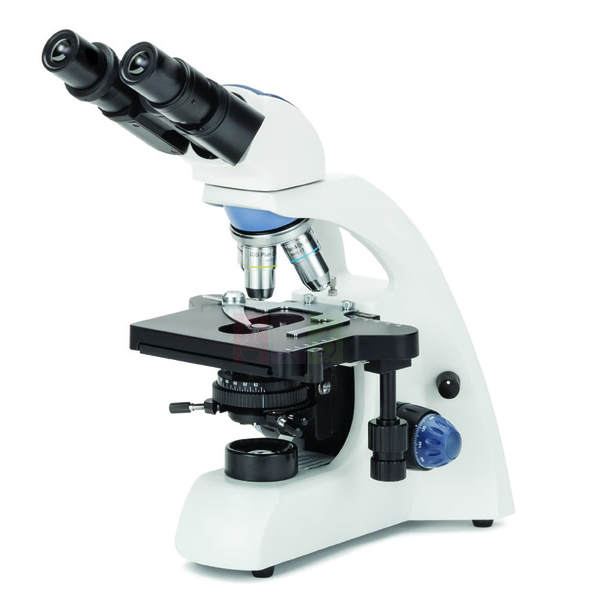
Binocular Microscope, 1000x, LED Illumination
Binocular Microscope, 1000x, LED Illumination (Product Code: SLE/M/100) is an advanced teaching microscope used for brightfield and phase contrast observation of live cells, bacteria and tissues up to 1000x in college and research-training laboratories. It carries plan objectives, a large 150 x 140 mm rackless stage and a Zernike phase contrast kit with a four-annulus rotating disc. This phase contrast microscope for labs in India and abroad is supplied by Jain Scientific Equipments Pvt Ltd (ScienceLab), Ambala, India.
Specifications
| Parameter | Detail |
|---|---|
| Objectives | Plan IOS 4x, 10x, S40x and S100x oil; S40x and S100x spring loaded |
| Nosepiece | Reversed quadruple, on ball bearings |
| Eyepieces | WF10x/20 mm |
| Tubes | Binocular, 30° inclined, Ø 30 mm |
| Head | 360° rotatable, secured with a screw |
| Interpupillary distance | 48–75 mm |
| Diopter adjustment | ±5 on left tube |
| Stage | 150 x 140 mm with integrated rackless X-Y mechanical stage, 75 x 30 mm travel |
| Focusing | Coaxial coarse and fine; 200 graduations; 1.5 µm per graduation; 0.3 mm per rotation; total travel approx. 28 mm; friction control on coarse adjustment |
| Rack stop | Adjustable rack stop supplied |
| Condenser | Abbe, N.A. 1.25, with iris diaphragm and filter holder; height adjustable |
| Phase contrast | Zernike kit with IOS objectives, rotating phase contrast disc with four annuli, centering telescope and green filter |
| Illumination | Adjustable 3 W LED illumination system |
| Optics | Anti-fungus treated and anti-reflection coated |
| Handling | Ergonomic carrying grip |
| Product code | SLE/M/100 |
| Supplied by | Jain Scientific Equipments Pvt Ltd (ScienceLab), Ambala, India |
What Is the 1000x Binocular LED Microscope Used For?
Phase contrast turns transparent, unstained specimens such as living protozoa, cheek cells, yeast or cultured cells into visible light-and-dark images without staining them. To set it up, bring the annulus that matches the objective in use under the condenser, check the ring alignment through the centering telescope, and add the green filter for a crisper image. For stained slides, work in ordinary brightfield and control contrast with the iris diaphragm.
Fine focus at 1.5 µm per graduation matters at 1000x, where the depth of field is very shallow, and the friction control lets each user set how firmly the coarse knob turns. The wide stage with 75 x 30 mm of travel makes it easy to scan a whole smear. Put a drop of immersion oil on the slide before rotating in the spring-loaded S100x plan objective, and wipe the lens clean afterwards.
Supplier
Jain Scientific Equipments Private Limited, trading as ScienceLab, supplies this phase contrast binocular microscope from Ambala, Haryana, for universities, life-science colleges, research-training labs, dealers and importers in India and international markets. Because it combines plan optics, brightfield and phase contrast in one instrument, it is often quoted for departments that need a single versatile teaching microscope. See our company profile for background on ScienceLab.
Related Laboratory Equipment
Consumables and accessories that support high-power and phase contrast work:
- Immersion Oil, 25ml — needed with the S100x plan objective
- Mitosis & Meiosis Set, Microscope Slides — prepared slides for high-power brightfield study
- Microscope Slide Warming Table — dries freshly made smears before examination
- Microscope Slide Case — organised storage for the department's slide collection
- Binocular Microscope, 1000x — cordless alternative with achromatic objectives
Browse the full Microscope category for other research and student models.
Frequently Asked Questions
Does the Binocular Microscope, 1000x, LED Illumination include phase contrast?
Yes. The Binocular Microscope, 1000x, LED Illumination is listed with a Zernike phase contrast kit: IOS objectives, a rotating phase contrast disc with four annuli, a centering telescope and a green filter. It lets users study unstained living specimens as well as stained slides.
What objectives does this binocular microscope use?
The Binocular Microscope, 1000x, LED Illumination uses plan IOS objectives of 4x, 10x, S40x and S100x oil on a reversed quadruple nosepiece with ball bearings. Plan objectives keep the image flat to the edge of the field, which helps when drawing or photographing specimens.
How precise is the focusing on the Binocular Microscope, 1000x, LED Illumination?
Focusing on the Binocular Microscope, 1000x, LED Illumination is coaxial, with 200 graduations, 1.5 µm per graduation and 0.3 mm per rotation over roughly 28 mm of travel. The coarse control has friction adjustment, and an adjustable rack stop is supplied to help protect slides.
How large is the stage on this microscope?
The Binocular Microscope, 1000x, LED Illumination has a 150 x 140 mm stage with an integrated rackless X-Y mechanical stage giving 75 x 30 mm of travel. A rackless design has no protruding rack, so it is less likely to catch on sleeves or get knocked.
What illumination does the Binocular Microscope, 1000x, LED Illumination have?
The Binocular Microscope, 1000x, LED Illumination has an adjustable 3 W illumination system. Users set the brightness for each objective, and the Abbe condenser (N.A. 1.25) with iris diaphragm and filter holder is height adjustable for fine control of the light.
What should a quotation request for this microscope include?
When requesting a quote for the Binocular Microscope, 1000x, LED Illumination, mention product code SLE/M/100, the quantity, your mains voltage, the delivery destination and whether you also need immersion oil, slides or lens-cleaning supplies. This lets us quote everything in one reply.
Who supplies the Binocular Microscope, 1000x, LED Illumination?
Jain Scientific Equipments Pvt Ltd, trading as ScienceLab in Ambala, Haryana, India, supplies the Binocular Microscope, 1000x, LED Illumination (SLE/M/100) to colleges, universities, research-training labs, dealers and importers in India and international markets. Quotations are prepared on request through the contact page.
Request a Quote
Ask for a quotation on the Binocular Microscope, 1000x, LED Illumination through our contact page, giving the number of instruments and delivery details, or add it to the enquiry cart alongside oil, slides and other laboratory items.
Last updated: 24 September 2026
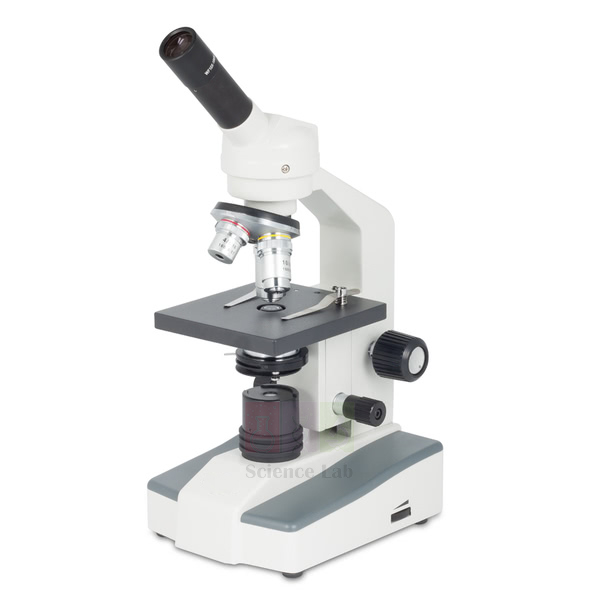
Monocular Microscope, 400x
Monocular Microscope, 400x (Product Code: SLE/M/101) is a mains-powered student microscope used to examine prepared and fresh slides up to 400x in secondary-school and college biology practicals. Its focusable Abbe condenser (N.A. 1.25) and LED lighting with intensity control give students more control over illumination than a fixed-condenser model. This school microscope for India and export markets is supplied by Jain Scientific Equipments Pvt Ltd (ScienceLab), Ambala, India.
Specifications
| Parameter | Detail |
|---|---|
| Head | Monocular, 45° inclined, 360° rotation |
| Eyepiece | WF10X/18 mm with pointer |
| Nosepiece | Triple |
| Objectives | Achromatic, DIN: 4X, 10X/0.25, 40X/0.65/S |
| Condenser | Focusable Abbe condenser, N.A. 1.25 |
| Filter | Built-in frosted glass |
| Stage | 110 x 110 mm plane stage with sample clips |
| Diaphragm | Disc diaphragm |
| Focusing | Separate coarse and fine adjustment; focus precision 2 µm; focusing stroke 7 mm |
| Illumination | LED with intensity control |
| Power | 100–220 V mains |
| Included | Dust cover |
| Product code | SLE/M/101 |
| Supplied by | Jain Scientific Equipments Pvt Ltd (ScienceLab), Ambala, India |
What Is the 400x Monocular Microscope Used For?
Secondary-school syllabuses call for slides of plant and animal cells, root-tip mitosis, stomata and simple micro-organisms, and this microscope covers all of them at up to 400x. Place the slide under the sample clips on the 110 x 110 mm plane stage, focus with the 4X objective using the coarse control, then move to 10X and 40X and finish with the fine control, which works to a precision of 2 µm.
Raise or lower the focusable Abbe condenser and turn the disc diaphragm to balance brightness and contrast: stained sections usually need more light, while thin unstained mounts show better with the condenser lowered and a smaller aperture. The 40X/0.65/S objective is spring-loaded, so it gives way if it touches a slide by mistake. Cover the microscope with the supplied dust cover after class.
What to Specify When Ordering
- The number of microscopes for the class or lab
- Your mains voltage (listed as 100–220 V; this model has no battery option)
- Slides, cover slips and prepared slide sets to be quoted with the microscopes
Supplier
ScienceLab is the trading name of Jain Scientific Equipments Private Limited, which supplies this 400x monocular microscope from Ambala, Haryana, to secondary schools, junior colleges, training institutes, dealers and importers in India and international markets. Schools equipping a biology room for the first time often combine it with prepared slide sets and slide storage in the same order. Company information is on the ScienceLab profile.
Related Laboratory Equipment
Slides, storage and an alternative model to consider with this microscope:
- Prepared Microscope Slide Set – Key Stage 4 Biology — prepared slides for secondary biology topics
- Microscope Glass Slides — for students' own temporary mounts
- Glass Cover Slips, No. 1 — thin covers for wet mounts viewed at 40X
- Slide Box — keeps prepared and student slides organised
- Monocular Microscope, 400x, LED Illumination — cordless alternative on rechargeable batteries
More student microscopes are listed in the Microscope category.
Frequently Asked Questions
Does the Monocular Microscope, 400x run on batteries?
No. The Monocular Microscope, 400x is listed for 100–220 V mains power only, with LED illumination and intensity control. For rooms without reliable sockets, a cordless model with rechargeable batteries from the same range may suit better, so ask us to compare the options.
What condenser does the Monocular Microscope, 400x have?
The Monocular Microscope, 400x has a focusable Abbe condenser with N.A. 1.25 and a disc diaphragm under the stage. Moving the condenser up or down lets students adjust brightness and contrast for stained and unstained specimens alike.
How precise is the focusing on the Monocular Microscope, 400x?
The Monocular Microscope, 400x uses separate coarse and fine focusing controls, with a focus precision of 2 µm and a focusing stroke of 7 mm. Students use the fine control for final sharpening when working with the 40X objective.
What is included with the Monocular Microscope, 400x?
The Monocular Microscope, 400x is supplied with a dust cover. Slides, cover slips and prepared slide sets are not part of the listing, but they can be quoted in the same order so the microscope is ready to use on arrival.
Does the eyepiece of the Monocular Microscope, 400x have a pointer?
Yes. The Monocular Microscope, 400x has a WF10X/18 mm eyepiece with a pointer. A teacher can place the pointer on a nucleus or cell wall and ask each student to identify it, which makes group teaching quicker.
Who supplies the Monocular Microscope, 400x?
Jain Scientific Equipments Pvt Ltd (ScienceLab), based in Ambala, Haryana, India, supplies the Monocular Microscope, 400x (SLE/M/101) to schools, colleges, dealers and importers in India and international markets. Share your quantity and delivery location through the contact page for a quotation.
Request a Quote
Request a quotation for the Monocular Microscope, 400x on our contact page with the number of units and your delivery location, or collect it with slides and other items in the enquiry cart and send one combined enquiry.
Last updated: 24 September 2026