- Physics Lab Equipment
- Chemistry Lab Equipment
- Biology Lab Equipment
- Anatomical Lab Equipment
- Learning
- Educational Lab Equipment
- Magnets
- Agriculture
- Astronomy
- Earth Science
- Geography Lab Equipment
- Safety Lab Coat
- Laboratory
- Meteorological
- Electricity & Magnetism
- Heat
- School Lab Equipment
- Lab Glassware
- Science Lab Equipment
- Tvet Lab Equipment
- Robotics Kits Supplier and Manufacturer for Schools India
- Math Lab Equipment Manufacturers and Exporters in Ambala
- STEM Kits Manufacturers and Supplier India
- Engineering Lab Equipment
- Hospital Lab Equipment
- Water, Sanitation & Hygiene Supplies
- Cold Chain, Solar & Communication Equipment
- Nutrition
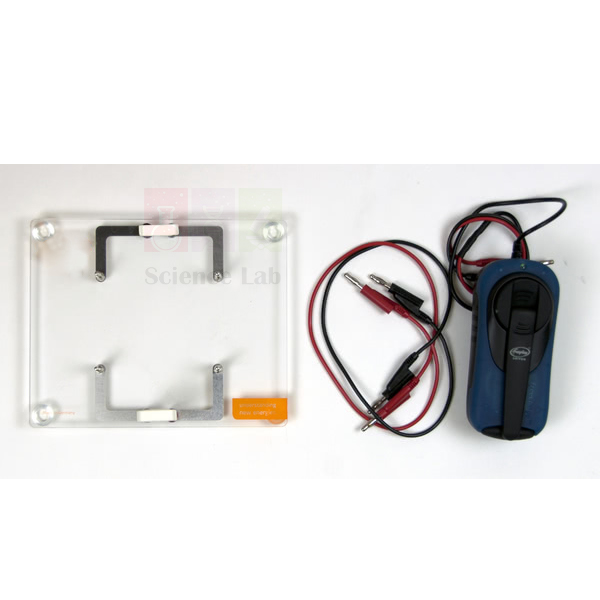
Solar Minikit Basic
Solar Minikit Basic (Product Code: SLE/PHY/214) is a primary school base kit used to run mainly qualitative renewable-energy experiments with the Basics add-on sets. Its hand crank generator lets children produce the electricity for each experiment themselves, so no mains connection or separate voltage source is needed in the room. This hands-on science kit for primary school is supplied by Jain Scientific Equipments Pvt Ltd (ScienceLab), Ambala, India.
Specifications
| Parameter | Detail |
|---|---|
| Kit type | Base kit for the Basic series, elementary (primary) school level |
| Experiment type | Mainly qualitative experiments with the Basics add-on sets |
| Energy source | Hand crank generator; no extra electrical connection or voltage source needed |
| Base | Base unit small |
| Connections | 2 x short-circuit plug for linking modules; test leads 50 cm, one black and one red |
| Packing | Carton with Minikit Basic insert |
| Documentation | Layout diagram Minikit Basic; info sheet for initial startup |
| Product code | SLE/PHY/214 |
| Supplied by | Jain Scientific Equipments Pvt Ltd (ScienceLab), Ambala, India |
Components in the Solar Minikit Basic:
- 1 x Hand generator
- 1 x Base unit small
- 2 x Short-circuit plug
- 1 x Test lead black 50 cm
- 1 x Test lead red 50 cm
- 1 x Insert Minikit Basic
- 1 x Carton
- 1 x Layout diagram Minikit Basic
- 1 x Info sheet for initial startup
What Is the Solar Minikit Basic Used For?
The Solar Minikit Basic is used to give young learners their first experience of making and using electricity. Children place the modules of an add-on set on the small base unit, bridge them with the short-circuit plugs or leads, and then turn the hand generator to make something light up, move or sound. Turning faster or slower gives an immediate, visible link between effort and electrical energy.
Because the kit needs no socket or battery pack, teachers can run lessons in any classroom, hall or outdoor space. Keeping the plugs, leads and generator in the insert, as shown on the layout diagram, makes it quick to check that every group has returned a complete set at the end of the period.
What to Specify When Ordering
- School level: this kit is for primary classes; junior high groups use the Solar Kit Basic
- Which Basics add-on sets you plan to combine with it
- Number of Minikits, typically one per group of pupils
- Delivery location in India or abroad
Supplier
Jain Scientific Equipments Private Limited trades as ScienceLab and supplies teaching equipment from Ambala, Haryana. The Solar Minikit Basic is part of a sourced renewable-energy range that the company offers to primary schools, education departments and dealers, so a complete set of base kits and add-ons can arrive in one shipment.
Company details are on the ScienceLab profile.
Related Physics Lab Equipment
Items often chosen with a primary school base kit:
- Solar Photovoltaic Basic — first solar cell experiments that pair with this base kit
- Solar Hydropower Basic — water wheel experiments for the same age group
- Solar Wind Basic — playful wind rotor experiments
- Solar Kit Basic — the junior high base kit for quantitative work
- Solar New Energy MiniKit — all-in-one primary kit covering several energy topics
More classroom apparatus is available in Physics Lab Equipment.
Frequently Asked Questions
Why does the Solar Minikit Basic include a hand generator?
The Solar Minikit Basic includes a hand crank generator so that pupils produce the electrical energy for their experiments themselves. This removes the need for a mains connection or separate voltage source and makes the link between effort and electricity easy to feel.
Which age group is the Solar Minikit Basic intended for?
The Solar Minikit Basic is intended for elementary or primary school pupils and mainly qualitative experiments. Older junior high students who need measured values normally use the Solar Kit Basic, which adds a power module and an AV module.
What is in the Solar Minikit Basic carton?
The Solar Minikit Basic carton contains a hand generator, a small base unit, two short-circuit plugs, one black and one red test lead of 50 cm, the Minikit Basic insert, a layout diagram and an info sheet for initial startup.
Does the Solar Minikit Basic work without an add-on set?
The Solar Minikit Basic provides the energy source, base and connections, while the experiment modules come from the Basics add-on sets. Order at least one add-on set with it, such as a solar, water or wind topic set, so pupils have modules to connect.
Who supplies the Solar Minikit Basic?
The Solar Minikit Basic is supplied by Jain Scientific Equipments Pvt Ltd (ScienceLab), Ambala, Haryana, India. ScienceLab sources the kit and supplies it with matching add-on sets to schools, dealers and institutional buyers in India and international markets.
What does ScienceLab need to quote the Solar Minikit Basic?
To quote the Solar Minikit Basic, ScienceLab needs product code SLE/PHY/214, the number of kits, the add-on sets you want and the delivery location. Orders for many schools can be combined in one written quotation.
Request a Quote
For a Solar Minikit Basic (SLE/PHY/214) quotation, write to us through the contact page or add the kit and its add-on sets to the enquiry cart.
Last updated: 24 September 2026
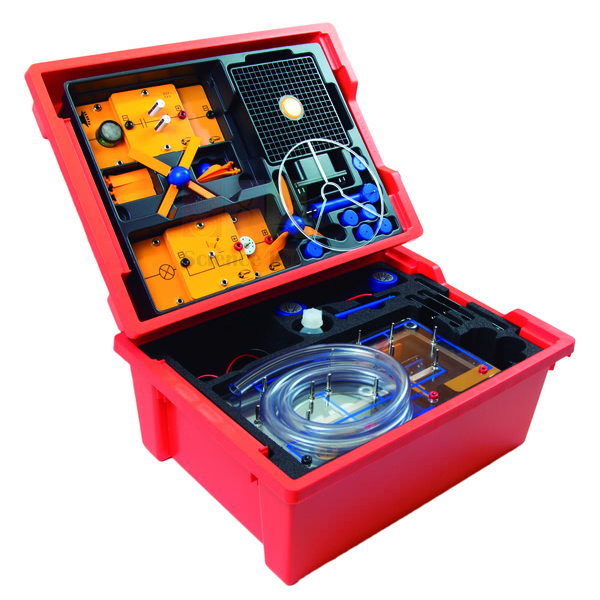
Solar New Energy Kit
Solar New Energy Kit (Product Code: SLE/PHY/215) is a multi-topic renewable-energy experiment kit used to teach photovoltaics, wind power, hydropower, electric mobility and fuel cells to junior high school students. It mixes qualitative and quantitative experiments and already contains its power module, AV measuring module and cables, along with three solar modules, a wind machine and a reversible fuel cell. This environmental science kit for schools is supplied by Jain Scientific Equipments Pvt Ltd (ScienceLab), Ambala, India.
Specifications
| Parameter | Detail |
|---|---|
| Kit type | Renewable-energy experiment kit for junior high school, packed in a box |
| Topics | Photovoltaics, wind power, hydropower, electric mobility and fuel cells |
| Solar modules | 0.5 V, 840 mA; 1.5 V, 280 mA; 2.5 V, 420 mA; plus solar cell cover set (4 pieces) and lighting module |
| Wind energy parts | Wind machine, wind turbine module, Solar-Wind rotor set, wind rotor set (assembled), padding universal wind |
| Hydropower parts | Water wheel module; silicone tube 12 mm |
| Storage and fuel cell | Capacitor module 5.0 F / 5.4 V; reversible fuel cell; distilled water (100 ml) |
| Electric mobility | Electric model car |
| Loads | Buzzer module, light bulb module, LED module 2 mA (red), motor module without gear with color discs set 1 |
| Power and measurement | Power module, AV module, potentiometer module; Smart Control measuring and control components |
| Base and cables | Solar-Base unit Large; test leads black and red in 25 cm and 50 cm |
| Packing | Box with NewEnergy Kit insert and 2 lids for tray |
| Documentation | Layout diagram New Energy Kit; info sheet for initial startup; instruction for use of finger protector |
| Product code | SLE/PHY/215 |
| Supplied by | Jain Scientific Equipments Pvt Ltd (ScienceLab), Ambala, India |
What Is the Solar New Energy Kit Used For?
The Solar New Energy Kit is used to cover the main renewable-energy topics of a junior high syllabus with one set of modules. Groups can start with qualitative observations, such as a solar module running the motor or the wind machine turning the rotor, and then switch to quantitative work using the power module, potentiometer and AV module to measure voltage and current.
Storage and mobility lessons build on the same parts: the capacitor module and reversible fuel cell show how energy can be held and released, and the electric model car turns the stored energy into motion. Before running the wind machine, go through the instruction for use of the finger protector with the class, and pack every module back into the insert using the layout diagram.
What to Specify When Ordering
- Number of kits, usually one per student group
- Whether younger classes also need the Solar New Energy MiniKit
- Any spare modules or replacement distilled water to quote (ask us about availability)
- Delivery location in India or abroad
Supplier
ScienceLab is the trading name of Jain Scientific Equipments Private Limited, an Ambala-based supplier that sources the Solar New Energy Kit for schools, colleges and education projects. Keeping this kit alongside other physics apparatus on one order simplifies purchasing for science departments.
Institutional buyers completing vendor registration can use the supplying company's GSTIN 06AAECJ8618A1ZT and Legal Entity Identifier (LEI) 3358004HRD1JIVXKYX49. See the ScienceLab company profile for more.
Related Physics Lab Equipment
Related kits for extending or adapting renewable-energy lessons:
- Solar New Energy MiniKit — elementary school version with a hand generator
- Solar New Energy Ready-To-Go — case version for primary and junior high use in any location
- Solar Wind Large — more detailed wind turbine experiments
- Solar H2 Ready-To-Go — dedicated hydrogen and fuel cell experiments
- Solar EMobility Ready-To-Go — battery technologies and the electric car in more depth
Explore further energy and electricity apparatus under Physics Lab Equipment.
Frequently Asked Questions
Which topics does the Solar New Energy Kit cover?
The Solar New Energy Kit covers photovoltaics, wind power, hydropower, electric mobility and fuel cells. Junior high school students work through both qualitative and quantitative experiments on each topic using the same base unit, loads and measuring modules.
Does the Solar New Energy Kit include a power supply and meters?
Yes, the Solar New Energy Kit includes the power module, the AV module for voltage and current measurement, a potentiometer module and test leads. All necessary accessories for its experiments, including cables and measuring devices, are packed in the kit.
Which solar modules are in the Solar New Energy Kit?
The Solar New Energy Kit contains three solar modules rated 0.5 V, 840 mA; 1.5 V, 280 mA; and 2.5 V, 420 mA. A solar cell cover set of four pieces and a lighting module support experiments on shading and indoor illumination.
What are the reversible fuel cell and distilled water for in the Solar New Energy Kit?
In the Solar New Energy Kit, the reversible fuel cell can split the supplied distilled water (100 ml) into hydrogen and oxygen and then turn those gases back into electricity. This lets students study energy storage and power the electric model car.
Who supplies the Solar New Energy Kit?
The Solar New Energy Kit is supplied by Jain Scientific Equipments Pvt Ltd (ScienceLab), Ambala, Haryana, India. ScienceLab sources the kit and delivers it to schools, colleges, dealers and project buyers in India and international markets.
What information does a Solar New Energy Kit quotation need?
A Solar New Energy Kit quotation needs product code SLE/PHY/215, the number of kits, any spare modules you want and the delivery location. Send the details through the contact page or enquiry cart for a written quotation.
Request a Quote
Request a quotation for the Solar New Energy Kit (SLE/PHY/215) through the ScienceLab contact page, or add it to the enquiry cart with any related kits.
Last updated: 24 September 2026
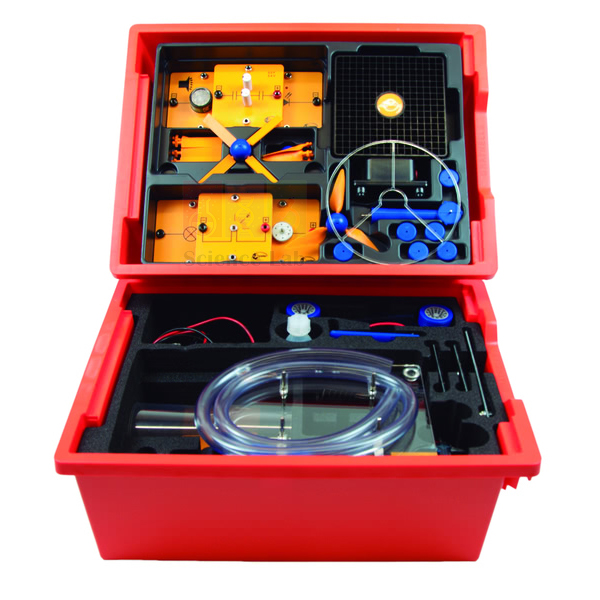
Solar New Energy MiniKit
Solar New Energy MiniKit (Product Code: SLE/PHY/216) is a beginner renewable-energy kit used to introduce elementary school children to solar, wind and water power, electric mobility and fuel cells through playful experiments. In place of a power module it relies on a hand generator and a small base unit, and it adds a model electric car, a wind machine and a reversible fuel cell. This STEM science kit for young learners is supplied by Jain Scientific Equipments Pvt Ltd (ScienceLab), Ambala, India.
Specifications
| Parameter | Detail |
|---|---|
| Kit type | Beginner renewable-energy kit for elementary school, packed in a box |
| Topics | Photovoltaics, wind power, hydropower, electric mobility and fuel cells |
| Hand-powered source | Hand generator |
| Solar modules | 0.5 V, 840 mA; 1.5 V, 280 mA; 2.5 V, 420 mA; plus solar cell cover set (4 pieces) and lighting module |
| Wind energy parts | Wind machine, wind turbine module, Solar-Wind rotor set, wind rotor set (assembled), padding universal wind |
| Hydropower parts | Water wheel module; silicone tube 12 mm |
| Storage and fuel cell | Capacitor module 5.0 F / 5.4 V; reversible fuel cell; distilled water (100 ml) |
| Electric mobility | Electric model car |
| Loads | Buzzer module, light bulb module, LED module 2 mA (red), motor module without gear with color discs set 1 |
| Base and connections | Base unit small; 2 x short-circuit plug; test leads 50 cm, one black and one red |
| Packing | Box with NewEnergy Kit insert and 2 lids for tray |
| Documentation | Layout diagram New Energy Minikit; info sheet for initial startup; instruction for use of finger protector |
| Product code | SLE/PHY/216 |
| Supplied by | Jain Scientific Equipments Pvt Ltd (ScienceLab), Ambala, India |
What Is the Solar New Energy MiniKit Used For?
The Solar New Energy MiniKit is used as a first, play-based tour of renewable energy for younger pupils. Children turn the hand generator to make the buzzer sound or the LED glow, hold a solar module under the lighting module to run the motor, let the wind machine spin the rotor, and pour water over the water wheel to see another way of making electricity.
Later lessons introduce storage: the capacitor module keeps energy for a short time, and the reversible fuel cell works with the included distilled water to show how hydrogen can carry energy to the model car. Short-circuit plugs keep wiring simple on the small base unit. Show the class how the finger protector is used before the wind machine is switched on.
What to Specify When Ordering
- Number of MiniKits needed, usually one per group of pupils
- Whether older classes also need the Solar New Energy Kit with power and measuring modules
- Any spare modules or replacement distilled water to quote (ask us)
- Delivery location in India or abroad
Supplier
Jain Scientific Equipments Private Limited, which trades as ScienceLab, supplies the Solar New Energy MiniKit from Ambala, Haryana, as part of a sourced range of energy education kits. Primary schools, education programmes and dealers can order it in class quantities together with other science teaching aids.
More about the company is on the ScienceLab profile page.
Related Physics Lab Equipment
Kits that suit the same age group or the next stage:
- Solar New Energy Kit — junior high version with power module and AV measuring module
- Solar New Energy Ready-To-Go — case version covering primary and junior high experiments
- Solar Minikit Basic — primary base kit for single-topic Basics add-on sets
- Solar Sunstick — solar learning toy for children from 6 years
- Light Energy Kit — activities on light sources, reflection and colour
Other primary and secondary apparatus is listed in Physics Lab Equipment.
Frequently Asked Questions
Which age group is the Solar New Energy MiniKit designed for?
The Solar New Energy MiniKit is designed for young students in elementary school. Its experiments are playful and mainly qualitative, giving children a first understanding of photovoltaics, wind power, hydropower, electric mobility and fuel cells before they move on to measured experiments.
How is the Solar New Energy MiniKit powered without a power module?
The Solar New Energy MiniKit is powered by the energy sources it teaches: a hand generator, three solar modules with a lighting module, a wind machine with rotor sets, a water wheel and a reversible fuel cell. No separate power module is part of the kit.
What is the difference between the Solar New Energy MiniKit and the Solar New Energy Kit?
The Solar New Energy MiniKit targets elementary school and uses a hand generator, small base unit and short-circuit plugs. The Solar New Energy Kit targets junior high school and adds a power module, AV module and potentiometer for quantitative measurements.
Does the Solar New Energy MiniKit include safety guidance for the wind machine?
Yes, the Solar New Energy MiniKit includes an instruction for use of the finger protector, alongside the info sheet for initial startup and a layout diagram. Teachers should go through the finger protector instruction with pupils before the wind machine is used.
Who supplies the Solar New Energy MiniKit?
The Solar New Energy MiniKit is supplied by Jain Scientific Equipments Pvt Ltd (ScienceLab), Ambala, Haryana, India. ScienceLab sources the kit and supplies it to primary schools, education projects and dealers in India and international markets.
How do I request a quotation for the Solar New Energy MiniKit?
To request a quotation for the Solar New Energy MiniKit, send product code SLE/PHY/216, the number of kits, any spares wanted and the delivery location through the contact page or enquiry cart. Class sets and bulk orders can be quoted together.
Request a Quote
Ask for a Solar New Energy MiniKit (SLE/PHY/216) quotation on the contact page, or place it in the enquiry cart with other classroom items.
Last updated: 24 September 2026
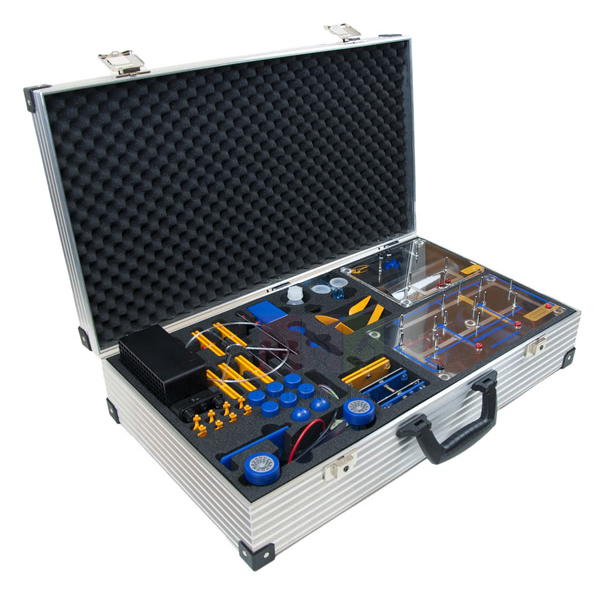
Solar New Energy Ready-To-Go
Solar New Energy Ready-To-Go (Product Code: SLE/PHY/217) is a renewable-energy experiment system in a carry case, used to teach photovoltaics, wind power, hydropower, electric mobility and fuel cells at both primary and junior high school level. It needs no additional equipment, because the power module, hand generator, AV measuring module, cables and both base units travel together, ready for use in any location. This portable science kit for students is supplied by Jain Scientific Equipments Pvt Ltd (ScienceLab), Ambala, India.
Specifications
| Parameter | Detail |
|---|---|
| Kit type | Ready-to-go renewable-energy system in a case; no additional equipment required |
| School levels | Primary and junior high school; qualitative and quantitative experiments |
| Topics | Photovoltaics, wind power, hydropower, electric mobility and fuel cells |
| Energy sources | Hand generator; solar modules 0.5 V, 840 mA, 1.5 V, 280 mA and 2.5 V, 420 mA; wind machine with wind turbine module; water wheel module; reversible fuel cell |
| Storage | Capacitor module 5.0 F / 5.4 V; distilled water (100 ml) for the reversible fuel cell |
| Loads | Buzzer module, light bulb module, LED module 2 mA (red), motor module without gear with color discs set 1, electric model car |
| Power and measurement | Power module, AV module, potentiometer module; Smart Control measuring and control components |
| Bases and connections | Solar-Base unit Large and Solar-Base unit small; 2 x short-circuit plug; test leads: 1 black and 1 red 25 cm, 2 black and 1 red 50 cm |
| Other parts | Lighting module; solar cell cover set (4 pieces); Solar-Wind rotor set; wind rotor set (assembled); silicone tube 12 mm |
| Case and packing | Case New Energy with insert and studded lid foam |
| Documentation | Layout diagram Solar-New Energy; info sheet for initial startup; instruction for use of finger protector |
| Primary-level experiments | From muscular strength to current, then to light, motion and noise; solar cell and solar module driving a motor, buzzer and LED; wind turbine powering a buzzer and an LED; influence of wind direction, rotor blade shape and wind speed; the larger the solar cell, the ...?; from solar cell to solar module; shading of solar modules; water wheel powering a buzzer; influence of water falling height; storage of solar and wind energy; what is an electrolyzer, how can water be split, what is a fuel cell; fuel cell driving the motor and buzzer; energy demand of several consumers; light bulb versus LED; storage and output of energy for e-mobility |
| Secondary-level experiments | Forms of energy and consumers; rotation discs, colour qualities, mixing colours, colour deception with the Benham disk and relief disk; characteristic curves of the electrolyzer and fuel cell; solar cell power versus area, angle of incidence (qualitative and quantitative), illumination intensity and load; I-V characteristics and fill factor, and their dependence on illuminance; changing wind speeds, start-up wind speed, turbine voltage with several consumers and characteristic curves of a wind turbine; number of rotor blades, wind direction, rotor blade pitch and blade shape (qualitative and quantitative); water falling height and water as an energy source (qualitative and quantitative); what an electrolyzer and a fuel cell do; running the electric car on the reversible fuel cell |
| Product code | SLE/PHY/217 |
| Supplied by | Jain Scientific Equipments Pvt Ltd (ScienceLab), Ambala, India |
What Is the Solar New Energy Ready-To-Go Used For?
The Solar New Energy Ready-To-Go is used when one kit has to serve several age groups and several rooms. Primary pupils start with the hand generator, feeling how muscular strength becomes light, motion and sound, then move on to solar modules, the wind machine and the water wheel. Older students use the same case for measured work, plotting I-V characteristics, fill factor and wind turbine curves with the AV module and potentiometer.
The motor module and color discs also support short lessons on colour mixing and the Benham disk, which makes the kit useful beyond energy topics. Since everything sits in one case, teachers can carry it between classrooms or to outreach events; check the insert against the layout diagram after each lesson so the next class finds a complete set.
What to Specify When Ordering
- Number of cases for your school or programme
- Whether the kit will serve primary, junior high or both, so we can suggest matching add-ons
- Any spare modules or replacement distilled water to quote (ask us about availability)
- Delivery location in India or abroad
Supplier
ScienceLab, the trading name of Jain Scientific Equipments Private Limited of Ambala, Haryana, supplies the Solar New Energy Ready-To-Go as a sourced teaching system. Schools, teacher-training centres and outreach programmes can order it on its own or with other physics apparatus, and our team can help match it to the grades you teach.
Read about the company on the ScienceLab profile page.
Related Physics Lab Equipment
Kits that complement or scale this system:
- Solar New Energy Kit — boxed junior high version for classes that stay in one lab
- Solar New Energy MiniKit — elementary version built around a hand generator
- Solar Smart Grid Ready-To-Go — next step into smart grids and energy management
- Solar H2 Ready-To-Go — dedicated electrolyzer and fuel cell experiments
- Solar Photovoltaic Ready-To-Go — deeper photovoltaic experiments in a carry case
See all items in Physics Lab Equipment.
Frequently Asked Questions
Does the Solar New Energy Ready-To-Go need any additional equipment?
No, the Solar New Energy Ready-To-Go is designed for use in any location without additional equipment. Its case already holds the power module, hand generator, AV module, cables, base units, energy sources and loads needed for the listed experiments.
Which school levels can use the Solar New Energy Ready-To-Go?
The Solar New Energy Ready-To-Go serves primary and junior high school. Its experiment list is split into a primary level, with playful qualitative experiments, and a secondary level with quantitative work such as I-V characteristics, fill factor and wind turbine characteristic curves.
Why does the Solar New Energy Ready-To-Go include both a hand generator and a power module?
The Solar New Energy Ready-To-Go includes a hand generator for primary experiments that turn muscular strength into light, motion and noise, and a power module for measured experiments with the AV module. One case therefore covers both hands-on and quantitative lessons.
How does the Solar New Energy Ready-To-Go differ from the Solar New Energy Kit?
The Solar New Energy Ready-To-Go comes in a carry case and covers primary and junior high levels, adding a hand generator, small base unit and short-circuit plugs. The Solar New Energy Kit is a boxed set aimed at junior high school only.
Who supplies the Solar New Energy Ready-To-Go?
The Solar New Energy Ready-To-Go is supplied by Jain Scientific Equipments Pvt Ltd (ScienceLab), Ambala, Haryana, India. ScienceLab sources the system and delivers it to schools, training centres, dealers and education projects in India and international markets.
What should a Solar New Energy Ready-To-Go enquiry include?
A Solar New Energy Ready-To-Go enquiry should include product code SLE/PHY/217, the number of cases, the grades you teach, any spares required and the delivery location. ScienceLab then sends a written quotation covering availability, packing and shipping.
Request a Quote
Get a quotation for the Solar New Energy Ready-To-Go (SLE/PHY/217) through the contact page, or add it to the enquiry cart with other kits.
Last updated: 24 September 2026
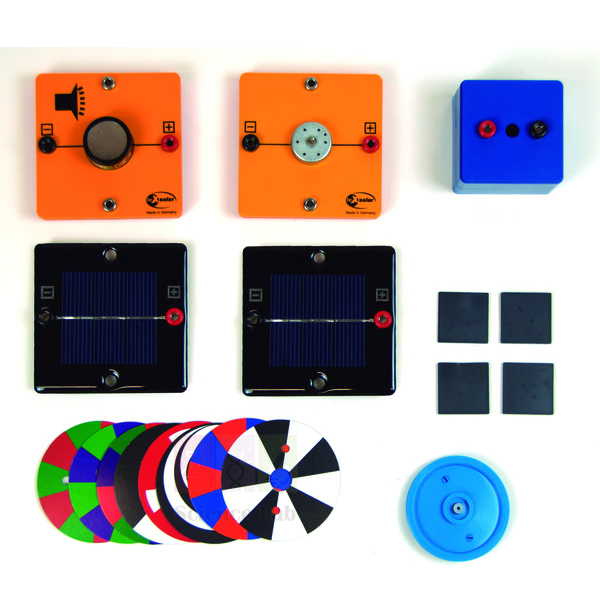
Solar Photovoltaic Basic
Solar Photovoltaic Basic (Product Code: SLE/PHY/218) is a photovoltaics add-on set used to answer first questions about solar cells: what a solar cell and a solar panel are, what they can power, and how a cell should be aligned to the sun. Its qualitative experiments suit elementary and junior high students and run on the Solar Minikit Basic or Solar Kit Basic. As an entry-level solar energy science kit, it is supplied by Jain Scientific Equipments Pvt Ltd (ScienceLab), Ambala, India.
Specifications
| Parameter | Detail |
|---|---|
| Kit type | Photovoltaics add-on set for the Basic series |
| School level | Elementary and junior high school; all experiments are qualitative |
| Solar modules | 0.5 V, 840 mA and 1.5 V, 280 mA |
| Light and shading | Lighting module; solar cell cover set (4 pieces) |
| Loads | Buzzer module; motor module without gear with color discs set 1 |
| Required base kit (not included) | Solar Minikit Basic in primary school, or Solar Kit Basic in junior high school; each contains all necessary accessories |
| Packing | Carton with PV Basic insert |
| Documentation | Layout diagram PV Basic; info sheet for initial startup |
| Product code | SLE/PHY/218 |
| Supplied by | Jain Scientific Equipments Pvt Ltd (ScienceLab), Ambala, India |
What Is the Solar Photovoltaic Basic Used For?
The Solar Photovoltaic Basic is used for a pupil-friendly introduction to photovoltaics. Students connect a solar module to the motor or buzzer, then tilt it towards the sun or the lighting module and watch the motor speed up or the sound change. Comparing the 0.5 V and 1.5 V modules shows the difference between a single solar cell and a small solar panel.
The four-piece cover set lets pupils shade part of a module and see how the output drops, while the color discs on the motor make changes in speed easy to spot. All of this is qualitative, so younger classes can reach sound conclusions without meters; junior high groups using the Solar Kit Basic can extend the same lessons with readings.
What to Specify When Ordering
- School level, so the matching base kit (Solar Minikit Basic or Solar Kit Basic) is included in the quotation
- Whether your school already has the base kit
- Number of PV Basic sets per class
- Delivery location in India or abroad
Supplier
Jain Scientific Equipments Private Limited, known by its trading name ScienceLab, supplies the Solar Photovoltaic Basic from Ambala, Haryana. The company sources this add-on together with the base kits and other topic sets, so schools and dealers can assemble a complete renewable-energy corner from one supplier.
Company information is available on the ScienceLab profile.
Related Physics Lab Equipment
Base kits and next steps for solar cell lessons:
- Solar Minikit Basic — primary base kit that this set needs
- Solar Kit Basic — junior high base kit that this set needs
- Solar Photovoltaic Large — larger photovoltaic system for school physics
- Mounted Solar Cell — single mounted cell for energy-conversion demonstrations
- Solar Energy Kit — separate cell kit for series and parallel connection work
More solar and electricity apparatus is available in Physics Lab Equipment.
Frequently Asked Questions
What questions does the Solar Photovoltaic Basic help students answer?
The Solar Photovoltaic Basic helps students answer what a solar cell is, what a solar panel is, what can be powered with a solar cell and how a solar cell should be aligned to the sun, along with many related questions explored through simple experiments.
Can the Solar Photovoltaic Basic be used on its own?
No, the Solar Photovoltaic Basic is an add-on set. It needs the Solar Minikit Basic in primary school or the Solar Kit Basic in junior high school, each of which contains all necessary accessories such as the base unit and cables.
Are the Solar Photovoltaic Basic experiments qualitative or quantitative?
All Solar Photovoltaic Basic experiments are designed to be qualitative. They are adapted for young students in elementary school and junior high school, who observe effects such as motor speed or buzzer sound rather than recording measured values.
What is supplied in the Solar Photovoltaic Basic carton?
The Solar Photovoltaic Basic carton contains a 0.5 V, 840 mA solar module, a 1.5 V, 280 mA solar module, a lighting module, a solar cell cover set of four pieces, a buzzer module, a motor module with color discs, the PV Basic insert and printed guidance sheets.
Who supplies the Solar Photovoltaic Basic?
The Solar Photovoltaic Basic is supplied by Jain Scientific Equipments Pvt Ltd (ScienceLab), Ambala, Haryana, India. ScienceLab sources the set and supplies it, with or without base kits, to schools, dealers and institutions in India and international markets.
How do I order the Solar Photovoltaic Basic?
To order the Solar Photovoltaic Basic, send product code SLE/PHY/218, the quantity, the base kit you need and your delivery location through the contact page or enquiry cart. ScienceLab replies with a written quotation for single or bulk orders.
Request a Quote
Request the Solar Photovoltaic Basic (SLE/PHY/218) on the contact page, or add it and its base kit to the enquiry cart.
Last updated: 24 September 2026
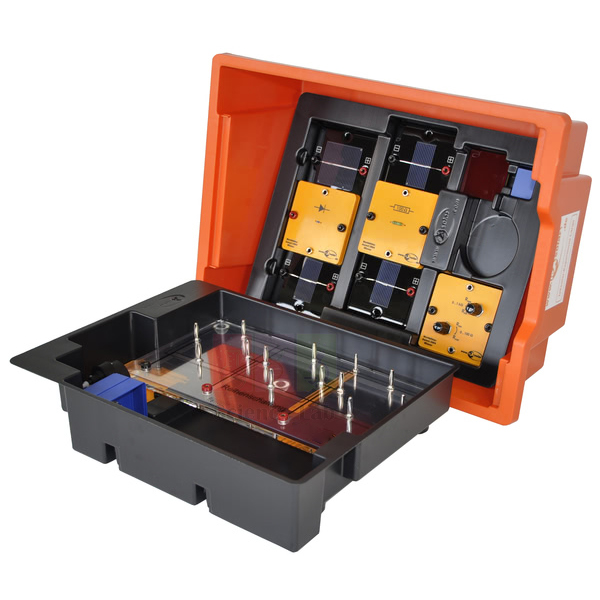
Solar Photovoltaic Large
Solar Photovoltaic Large (Product Code: SLE/PHY/219) is a photovoltaic experiment system used to connect school physics lessons with the practical use of solar cells. Five solar modules, together with diode, capacitor, resistor and potentiometer modules, let students build and test real PV circuits, and most experiments work in normal room lighting without an external power supply. This physics experiment kit for school labs is supplied by Jain Scientific Equipments Pvt Ltd (ScienceLab), Ambala, India.
Specifications
| Parameter | Detail |
|---|---|
| Kit type | Photovoltaic experiment system, packed in a box with lid |
| Solar modules | 3 x 0.5 V, 420 mA; 1 x 0.5 V, 840 mA; 1 x 1.5 V, 280 mA |
| Circuit modules | Diode module, resistor module, potentiometer module, capacitor module 220 mF, 2.5 V |
| Loads | Motor module without gear with color discs set 1; gear motor module; buzzer module |
| Light and filters | Lighting module (needed only for a few experiments and operated with a student power supply); color filters; solar cell cover set (4 pieces) |
| Lighting conditions | Most experiments can be carried out in normal room lighting without an external power supply |
| Base | Solar-Base unit Large |
| Packing | Box with black vacuum padding (1 top piece, 2 lower pieces) and lid for tray |
| Documentation | Layout diagram PV Large; info sheet for initial startup |
| Extras needed (not included) | 1 x AV module, 1 x power module, 2 x test lead black 25 cm, 2 x test lead red 25 cm, 1 x laboratory thermometer |
| Product code | SLE/PHY/219 |
| Supplied by | Jain Scientific Equipments Pvt Ltd (ScienceLab), Ambala, India |
What Is the Solar Photovoltaic Large Used For?
The Solar Photovoltaic Large is used to turn textbook photovoltaic theory into circuits students can build on the bench. With three identical 0.5 V, 420 mA modules, classes can compare series and parallel connections, then set them against the 0.5 V, 840 mA and 1.5 V, 280 mA modules. The diode, resistor, potentiometer and capacitor modules bring in the components found in real solar installations.
Because most experiments run in ordinary room light, lessons do not depend on the weather or on a darkened lab; the lighting module is only needed for a few experiments. The color filters and cover set show how light colour and shading affect output. Plan for the extras list, an AV module, power module, test leads and a laboratory thermometer, before the first practical.
What to Specify When Ordering
- Whether the extras (AV module, power module, 25 cm test leads, laboratory thermometer) should be quoted with the kit
- Number of systems for your student groups
- Whether a student power supply is available in your lab for the lighting module experiments
- Delivery location in India or abroad
Supplier
ScienceLab is the trading name under which Jain Scientific Equipments Private Limited supplies the Solar Photovoltaic Large from Ambala, Haryana. The company sources this system and can quote the extras it needs in the same order, so a school receives everything required for its first photovoltaic practical.
For vendor registration, the supplying company is Jain Scientific Equipments Private Limited (CIN U29309HR2020PTC087597, GSTIN 06AAECJ8618A1ZT). See the ScienceLab profile for company details.
Related Physics Lab Equipment
Items that complete or extend a photovoltaic practical:
- Solar Kit Basic — includes an AV module, power module and test leads
- Digital Thermometer — a laboratory thermometer for the extras list
- Solar Photovoltaic Basic — qualitative introduction for younger classes
- Solar Photovoltaic Professional — system-level PV training with regulators, MPP tracker and inverter
- Solar Photovoltaic Ready-To-Go — fully equipped PV kit in a carry case
Browse the Physics Lab Equipment category for further apparatus.
Frequently Asked Questions
What extra equipment does the Solar Photovoltaic Large need?
The Solar Photovoltaic Large needs one AV module, one power module, two black and two red test leads of 25 cm, and a laboratory thermometer. These extras are not in the box, so ask us to include them in your quotation if your lab does not already have them.
Can Solar Photovoltaic Large experiments run in normal room light?
Yes, most Solar Photovoltaic Large experiments can be conducted in normal room lighting, and no external power supply is needed for them. The included lighting module is required only for a few experiments and can be operated with a student power supply.
Which solar modules come with the Solar Photovoltaic Large?
The Solar Photovoltaic Large comes with five solar modules: three rated 0.5 V, 420 mA, one rated 0.5 V, 840 mA and one rated 1.5 V, 280 mA. The matching trio makes series and parallel connection experiments straightforward.
Which circuit components are included in the Solar Photovoltaic Large?
The Solar Photovoltaic Large includes a diode module, resistor module, potentiometer module and a capacitor module of 220 mF, 2.5 V, plus a gear motor module, a motor module with color discs and a buzzer module as loads.
Who supplies the Solar Photovoltaic Large?
The Solar Photovoltaic Large is supplied by Jain Scientific Equipments Pvt Ltd (ScienceLab), Ambala, Haryana, India. ScienceLab sources the system and delivers it, with its extras if required, to schools, colleges and dealers in India and international markets.
What should a Solar Photovoltaic Large quotation request include?
A Solar Photovoltaic Large quotation request should include product code SLE/PHY/219, the number of systems, whether the extras list should be added and the delivery location. Send it through the contact page or enquiry cart.
Request a Quote
Send your Solar Photovoltaic Large (SLE/PHY/219) enquiry, with or without its extras, through the contact page or the enquiry cart.
Last updated: 24 September 2026
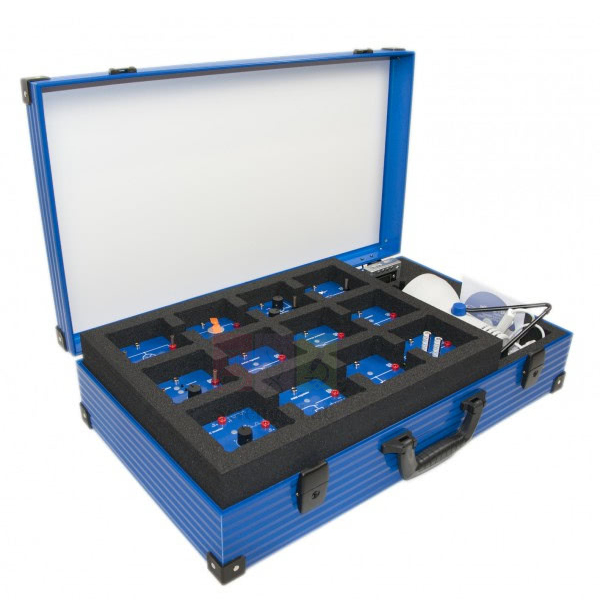
Solar Photovoltaic Professional
Solar Photovoltaic Professional (Product Code: SLE/PHY/220) is a modular photovoltaic training system used to teach PV fundamentals, component analysis and the design of complete off-grid PV systems on a laboratory scale. Built for vocational courses, apprentices, technicians, PV installers, sales training and engineering students, it works as a full solar cell characteristic kit and adds an MPP tracker, PWM, series and shunt regulators and a DC/AC inverter. It is supplied by Jain Scientific Equipments Pvt Ltd (ScienceLab), Ambala, India.
Specifications
| Parameter | Detail |
|---|---|
| System type | Modular photovoltaic training system in an aluminium case |
| Intended users | Studies and courses in renewable energies: training of sales representatives, apprenticeship, in-service training of technicians and PV installers, basic education of engineers |
| Solar modules | 1 x 5.33 V, 370 mA; 3 x 0.5 V, 420 mA; 3 x 0.5 V, 840 mA; base for solar panel; solar cell cover set (4 pieces) |
| Light source | Lamp housing with 80 W illuminant; 3 x lighting module (with safety sockets) |
| PV system modules | MPP-Tracker Pro with manual mode, PWM regulator Pro, series regulator module Pro, shunt regulator module Pro, deep discharge protection module Pro, DC/AC-Inverter Pro, capacitor module Pro, diode module Pro |
| Consumers | LED module (high brightness) Pro, light bulb module Pro, motor module Pro with propeller, radio module Pro |
| Resistors | Potentiometer module Pro; 2 x resistor module (triple) Pro; resistor plug elements: 1 x 33 ohm, 3 x 100 ohm, 2 x 10 ohm |
| Measurement and power | 2 x AV module; 1 x power module |
| Base and connections | Solar-base unit Professional; safety test leads: 4 red and 3 black 25 cm, 2 red and 1 black 50 cm; 3 x safety short-circuit plug with mid socket |
| Case | Aluminium case PV Professional with insert |
| Documentation | Layout diagram 1118 PV Professional; info sheet for initial startup |
| Electrical engineering experiments | Measurement of voltage, current and power; Ohm's law; parallel connection of resistors (current divider); series connection of resistors (voltage divider) |
| Photovoltaic basic experiments | Characteristic curve of solar modules; dark characteristic curve of solar cells; I-V characteristics versus illumination and temperature; series and parallel connection of solar cells; power versus surface area, angle of incidence, illumination and illumination under load; internal resistance versus illumination; shading effect; I-V characteristics, MPP and fill factor; I-V characteristics of partly shaded modules; temperature coefficient of solar cells |
| Photovoltaic system experiments | Components and possible operating conditions of an off-grid system; PWM versus series regulator; load characteristic of PWM regulators; characteristics and working principle of an MPP tracker; working principle of shunt and series regulators; deep discharge protection; working principle of an inverter; output voltage progression at an inverter |
| Product code | SLE/PHY/220 |
| Supplied by | Jain Scientific Equipments Pvt Ltd (ScienceLab), Ambala, India |
What Is the Solar Photovoltaic Professional Used For?
The Solar Photovoltaic Professional is used for practical courses where learners must understand a PV system component by component. Sessions can start with electrical basics, such as Ohm's law and voltage and current dividers, so the system also doubles as an Ohm law experiment kit for technical institutes in India and elsewhere. Trainees then move to solar module curves, fill factor and temperature coefficient before wiring regulators, protection and inverter into a working off-grid system.
Because the setup is modular, instructors can isolate details such as the switching threshold of a series or shunt regulator. The manual mode of the MPP tracker makes maximum power point tracking visible step by step, the PWM regulator shows pulse width modulated charging, and the inverter demonstrates alternating current produced from solar module current. The radio module and the comparison of the high-brightness LED with the light bulb keep learners engaged while they study efficiency.
What to Specify When Ordering
- Number of training systems or work stations
- The course level (apprentice, technician, installer or engineering), so we can confirm the system suits your syllabus
- Whether additional AV modules or safety test leads should be quoted
- Delivery location in India or abroad
Supplier
Jain Scientific Equipments Private Limited, trading as ScienceLab from Ambala, Haryana, supplies the Solar Photovoltaic Professional to technical institutes, colleges, training providers and dealers. The system is sourced by the company and can be combined with other energy trainers and measuring instruments in one institutional order.
Background on the company is on the ScienceLab company profile.
Related Physics Lab Equipment
Related trainers and instruments for PV and energy courses:
- Solar Smart Grid Professional — grid stability and storage training for the same course level
- Solar Photovoltaic Large — school-level PV system for earlier stages
- Solar Photovoltaic Ready-To-Go — portable PV kit for workshops and demonstrations
- Advanced Digital Multimeter — extra handheld meter for cross-checking readings
Other training apparatus is listed in Physics Lab Equipment.
Frequently Asked Questions
Who is the Solar Photovoltaic Professional designed for?
The Solar Photovoltaic Professional is designed for studies and courses in renewable energies, including training of sales representatives, apprenticeships, in-service training of technicians and PV installers, and basic education of engineers. Its main focus is laboratory experiments on photovoltaic systems.
Which PV system components can be studied with the Solar Photovoltaic Professional?
With the Solar Photovoltaic Professional, learners study an MPP tracker, a PWM regulator, series and shunt regulators, deep discharge protection and a DC/AC inverter, along with solar modules, a capacitor, a diode and several consumers, all as separate modules on the professional base unit.
How does the MPP tracker manual mode help in the Solar Photovoltaic Professional?
The MPP tracker in the Solar Photovoltaic Professional has an integrated manual mode, so learners can move the operating point themselves and see why tracking the maximum power point matters. This gives a descriptive understanding before automatic tracking is observed.
What light source is included with the Solar Photovoltaic Professional?
The Solar Photovoltaic Professional includes a lamp housing with an 80 W illuminant and three lighting modules with safety sockets, so illumination-dependent experiments can be carried out indoors under controlled conditions rather than relying on sunlight.
Can calibration documents be supplied with the Solar Photovoltaic Professional meters?
Calibration documents for the AV modules of the Solar Photovoltaic Professional should be discussed with us before ordering. Share your requirement through the contact page and we will confirm what documentation can accompany the system.
Who supplies the Solar Photovoltaic Professional?
The Solar Photovoltaic Professional is supplied by Jain Scientific Equipments Pvt Ltd (ScienceLab), Ambala, Haryana, India. ScienceLab sources the system and supplies it to technical institutes, colleges, training centres and dealers in India and international markets.
What details should a Solar Photovoltaic Professional enquiry include?
A Solar Photovoltaic Professional enquiry should include product code SLE/PHY/220, the number of systems, the course level, any extra modules or leads required and the delivery location. ScienceLab replies with a written quotation for single or multiple work stations.
Request a Quote
Request a quotation for the Solar Photovoltaic Professional (SLE/PHY/220) through the ScienceLab contact page, or add it to the enquiry cart with other trainers.
Last updated: 24 September 2026
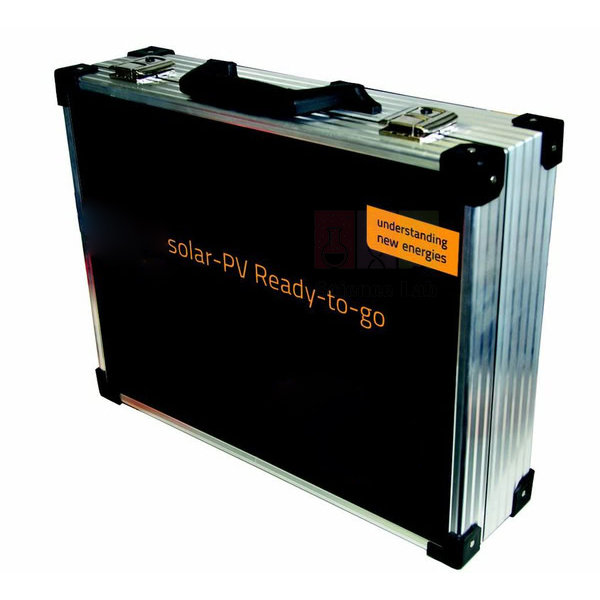
Solar Photovoltaic Ready-To-Go
Solar Photovoltaic Ready-To-Go (Product Code: SLE/PHY/221) is a fully equipped photovoltaic experiment system in an aluminium carry case, used to demonstrate solar energy from simple first trials up to I-V characteristics and the temperature dependence of solar cells. Since the measuring equipment and all ancillary parts are included, it works wherever you are without further components, in teaching labs, company workshops and sales demonstrations alike. This physics demonstration kit is supplied by Jain Scientific Equipments Pvt Ltd (ScienceLab), Ambala, India.
Key Details
| Parameter | Detail |
|---|---|
| System type | Fully equipped photovoltaic experiment system from the Ready-to-go series |
| Further components needed | None; all necessary ancillary equipment, including measuring equipment, is included |
| Experiment range | From simple trials on the basic characteristics of solar energy to more challenging experiments on I-V characteristics and temperature dependency of solar cells |
| Suitable for | Photovoltaics teaching, internal workshops in companies, and use as a demonstration kit for sales representatives |
| Case | Aluminium carry case with heavy-duty foam inserts |
| Product code | SLE/PHY/221 |
| Supplied by | Jain Scientific Equipments Pvt Ltd (ScienceLab), Ambala, India |
What Is the Solar Photovoltaic Ready-To-Go Used For?
The Solar Photovoltaic Ready-To-Go is used when photovoltaics has to be taught or demonstrated away from a fixed lab bench. A lesson can open with simple trials that show how a solar cell responds to light, then progress to recording I-V characteristics and examining how cell temperature changes the output, all with the measuring equipment packed in the same case.
Its wide range of experiments makes it equally useful for in-house training at companies and for sales representatives who need to show customers how solar cells behave. For reliable results, give the cells time to settle under steady light before taking readings, and return each part to its foam cut-out so the case travels safely to the next session.
Supplier
ScienceLab is the trading name of Jain Scientific Equipments Private Limited, an Ambala, Haryana supplier of teaching and laboratory equipment. The company sources the Solar Photovoltaic Ready-To-Go for schools, colleges, training departments and dealers who need a portable PV system rather than a bench-bound trainer.
You can read about the company on the ScienceLab profile page.
Related Physics Lab Equipment
Other photovoltaic and energy systems in the same range:
- Solar Photovoltaic Professional — modular trainer covering regulators, MPP tracking and inverters
- Solar Photovoltaic Large — boxed PV system for school physics labs
- Solar Smart Grid Ready-To-Go — portable smart grid system in the same case format
- Solar New Energy Ready-To-Go — portable overview of several renewable-energy topics
Find more apparatus in Physics Lab Equipment.
Frequently Asked Questions
Does the Solar Photovoltaic Ready-To-Go need any additional components?
No, the Solar Photovoltaic Ready-To-Go is a fully equipped experiment system that can be used wherever you are without further components. All necessary ancillary equipment, including the measuring equipment, is already included in its case.
Which experiments can be done with the Solar Photovoltaic Ready-To-Go?
The Solar Photovoltaic Ready-To-Go covers simple trials that demonstrate the basic characteristics of solar energy as well as more challenging experiments such as I-V characteristics and the temperature dependency of solar cells.
Is the Solar Photovoltaic Ready-To-Go only for schools?
No, the Solar Photovoltaic Ready-To-Go suits teaching labs and is also appropriate for internal workshops in companies and as a demonstration kit for sales representatives, thanks to its large range of potential experiments and portable case.
Where can I see the full component list of the Solar Photovoltaic Ready-To-Go?
The detailed component list of the Solar Photovoltaic Ready-To-Go is not published on this page. Ask us through the contact page and we will share the current packing list with your quotation, so you can check it against your syllabus.
How is the Solar Photovoltaic Ready-To-Go protected during transport?
The Solar Photovoltaic Ready-To-Go is enclosed in an aluminium carry case with heavy-duty foam inserts. Returning every part to its foam position after use keeps the modules and measuring equipment protected when the kit is carried between rooms or sites.
Who supplies the Solar Photovoltaic Ready-To-Go?
The Solar Photovoltaic Ready-To-Go is supplied by Jain Scientific Equipments Pvt Ltd (ScienceLab), Ambala, Haryana, India. ScienceLab sources the kit and supplies it to schools, colleges, companies and dealers in India and international markets.
What does ScienceLab need to quote the Solar Photovoltaic Ready-To-Go?
To quote the Solar Photovoltaic Ready-To-Go, ScienceLab needs product code SLE/PHY/221, the number of kits and the delivery location in India or abroad. Send these details through the contact page or add the kit to the enquiry cart.
Request a Quote
For a Solar Photovoltaic Ready-To-Go (SLE/PHY/221) quotation, contact us through the contact page or add it to the enquiry cart.
Last updated: 24 September 2026