- Physics Lab Equipment
- Chemistry Lab Equipment
- Biology Lab Equipment
- Anatomical Lab Equipment
- Learning
- Educational Lab Equipment
- Magnets
- Agriculture
- Astronomy
- Earth Science
- Geography Lab Equipment
- Safety Lab Coat
- Laboratory
- Meteorological
- Electricity & Magnetism
- Heat
- School Lab Equipment
- Lab Glassware
- Science Lab Equipment
- Tvet Lab Equipment
- Robotics Kits Supplier and Manufacturer for Schools India
- Math Lab Equipment Manufacturers and Exporters in Ambala
- STEM Kits Manufacturers and Supplier India
- Engineering Lab Equipment
- Hospital Lab Equipment
- Water, Sanitation & Hygiene Supplies
- Cold Chain, Solar & Communication Equipment
- Nutrition
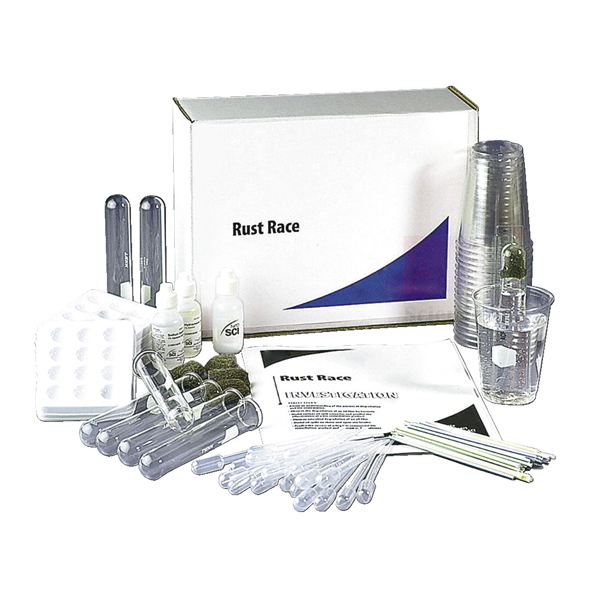
Rust Race Lab Investigation
Rust Race Lab Investigation (Product Code: SLE/CH/173) introduces oxidation-reduction reactions through a problem every student has seen: iron and other metals slowly corroding. Working in teams, the class performs redox reactions, measures how much oxygen is used up as metal corrodes, tests which metals corrode, and compares how well different rust inhibitors protect a surface. Planned for a class size of 40 students, it is a chemistry experiment kit for India’s secondary and junior college classrooms, supplied by Jain Scientific Equipments Pvt Ltd (ScienceLab), Ambala.
Specifications
| Parameter | Detail |
|---|---|
| Type | Lab investigation on oxidation-reduction and metal corrosion |
| Concept introduced | Oxidation-reduction reactions |
| Activities | Perform oxidation-reduction reactions; measure oxygen consumption during metal corrosion; test metals for corrosion; compare the effectiveness of rust inhibitors |
| Class size | 40 students |
Typical Use
The investigation works well as a short sequence rather than a single lesson. Students begin with simple redox reactions to see electrons being transferred between a metal and a solution, then set up corrosion samples that are left for a period and checked at intervals. Measuring oxygen consumption turns rusting from a vague idea into a quantity: as iron corrodes in a closed space, the loss of oxygen can be observed and recorded, which reinforces why air and moisture are both needed for rust to form.
The “race” element comes from comparing samples side by side. Teams test different metals and different protective treatments, predict which will corrode fastest, and then judge the rust inhibitors on their own evidence. This leads naturally into discussion of painting, oiling, galvanising and sacrificial protection in bridges, vehicles and pipelines. Label every sample clearly, keep a dated observation log and wear eye protection when handling any solutions.
Supplier
Jain Scientific Equipments Private Limited, known to schools as ScienceLab, supplies this investigation from Ambala, Haryana, as part of a wider catalogue of chemistry kits, glassware and apparatus for teaching laboratories. Our company profile gives an overview of the business.
Related Chemistry Lab Equipment
These items build on the redox and corrosion ideas covered in the Rust Race:
- Daniell Cell — shows redox reactions producing a measurable electric current.
- Simple Cell Kit — a zinc and copper cell that links metal reactivity to electrochemistry.
- Environmental Chemistry: Acid Rain, Weathering & Erosion — extends the study of how the environment attacks materials.
- Safety Goggles — eye protection for the whole class during practical work.
Explore more kits in our Chemistry Lab Equipment category.
Frequently Asked Questions
How many students is the Rust Race Lab Investigation designed for?
It is planned for a class size of 40 students, usually working in small teams.
What will students actually do?
Perform oxidation-reduction reactions, measure oxygen consumption during metal corrosion, test metals for corrosion and compare the effectiveness of rust inhibitors.
What components are in the kit?
A full component list is not included in our product details. Please request it through our contact page so you can check what your laboratory needs to add.
How long does the corrosion part take?
Rusting is a slow process, so plan for samples to be set up in one lesson and checked over following sessions; the exact timing depends on the conditions you use.
Is it suitable for introducing redox to beginners?
Yes. The investigation is intended as an introduction to oxidation-reduction reactions, using corrosion as a familiar starting point.
Can you supply kits for several sections or schools?
Yes. We handle institutional orders across India and international markets; send the number of kits and delivery details for a quotation.
Request a Quote
To order the Rust Race Lab Investigation, share your quantity through our contact page or add it to the enquiry cart with related electrochemistry items.
Last updated: 24 September 2026