- Physics Lab Equipment
- Chemistry Lab Equipment
- Biology Lab Equipment
- Anatomical Lab Equipment
- Learning
- Educational Lab Equipment
- Magnets
- Agriculture
- Astronomy
- Earth Science
- Geography Lab Equipment
- Safety Lab Coat
- Laboratory
- Meteorological
- Electricity & Magnetism
- Heat
- School Lab Equipment
- Lab Glassware
- Science Lab Equipment
- Tvet Lab Equipment
- Robotics Kits Supplier and Manufacturer for Schools India
- Math Lab Equipment Manufacturers and Exporters in Ambala
- STEM Kits Manufacturers and Supplier India
- Engineering Lab Equipment
- Hospital Lab Equipment
- Water, Sanitation & Hygiene Supplies
- Cold Chain, Solar & Communication Equipment
- Nutrition
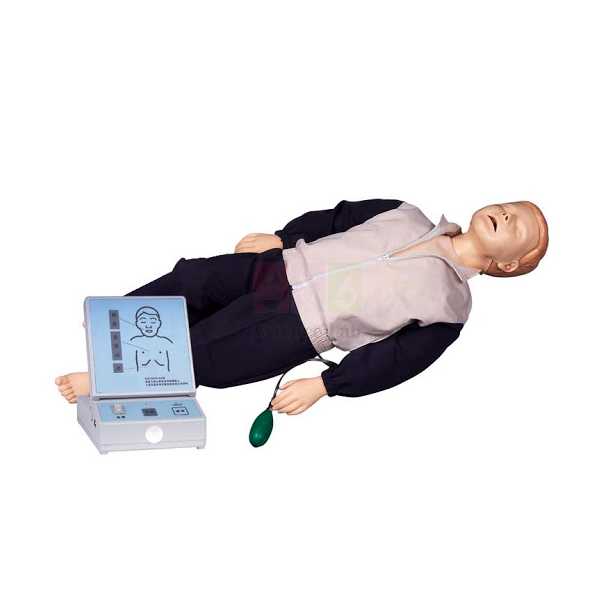
Advanced Child CPR Training Manikin
Advanced Child CPR Training Manikin (Product Code: SLE/BL/03) is a child-sized simulation model for practising paediatric resuscitation — chest compressions (heart pressure) and mouth-to-mouth respiration — with light indicators that show at once whether each step is done correctly. Designed according to the International CPR standard, it lets paediatric nurses, school health staff, paramedics and first aid instructors rehearse the adjustments needed when the patient is a child rather than an adult. It suits institutions assembling a health education kit school India programmes use for life-saving skills. It is made by Jain Scientific Equipments Pvt Ltd (ScienceLab), Ambala.
Key Details
| Parameter | Detail |
|---|---|
| Type | Child CPR simulation model |
| Design basis | Designed according to the International CPR standard |
| Skills practised | Patient revival through heart pressure and mouth-to-mouth respiration |
| Respiration indicator | Light indicator display for correct and incorrect artificial respiration (mouth-to-mouth) |
| Compression indicators | Correct compression position display and wrong compression position display |
| Suitable for | Paediatric CPR and first aid training |
Typical Use
Child CPR differs from adult technique in hand use, force and breath size, and trainees who have only practised on an adult model tend to over-press or over-inflate. On this manikin the instructor can let each trainee try, watch the compression-position lights, then correct placement straight away; the respiration lights do the same for rescue breaths, showing whether the airway was opened and the breath delivered properly. Short, repeated rounds work better than a single long attempt, so plan the class in rotations.
Schools, colleges and hospitals that source from a school lab equipment supplier India wide often pair this model with the adult and infant versions so that one course covers every age group. Between trainees, wipe the face and mouth area according to your hygiene procedure, and keep the manikin in a dry cupboard away from heat so the indicator components stay in good order.
Manufacturer
ScienceLab is the brand of Jain Scientific Equipments Private Limited, a company based in Ambala, Haryana that makes training models for medical and science education. It is registered as an MSME manufacturer under Udyam UDYAM-HR-01-0003714, and its international consignments move under IEC AAECJ8618A from the Directorate General of Foreign Trade. See our company profile for more.
Related Human Models
For a complete paediatric and general life support course, consider:
- Advanced Adult CPR Training Manikin — adds audio prompting and grade printing for adult technique.
- Advanced Infant CPR Training Manikin — for the youngest age group, where technique changes again.
- Human Respiratory System Model, 2-parts — to explain the airway that rescue breaths must reach.
- Human Heart Model — shows why chest compressions keep blood moving.
Browse our Human Models category for more.
Frequently Asked Questions
What does the child manikin indicate?
It has light displays for correct and incorrect mouth-to-mouth respiration, plus separate displays for correct and wrong compression position.
Does it include audio prompts or a printout like the adult model?
The features listed for this model are its light indicator displays. For audio or printing functions, please check the current specification with us through the contact page.
Which standard is it designed to?
It is designed according to the International CPR standard. Confirm with us if your training body requires a specific guideline edition.
Who typically buys the child version?
Nursing and medical colleges, paediatric wards, school health programmes and first aid trainers who need to teach child resuscitation specifically.
How do I keep it clean and working?
Disinfect the face and mouth area after each trainee as your protocol requires, avoid soaking the model, and ask us about any replacement parts you may need later.
Can you quote for a set of adult, child and infant manikins?
Yes. Tell us the quantity of each, your delivery location in India or abroad and your billing details; warranty terms are included in the quotation.
Request a Quote
Request pricing for the Advanced Child CPR Training Manikin through the contact page, or add it to your enquiry cart with the other manikins you need.
Last updated: 24 September 2026
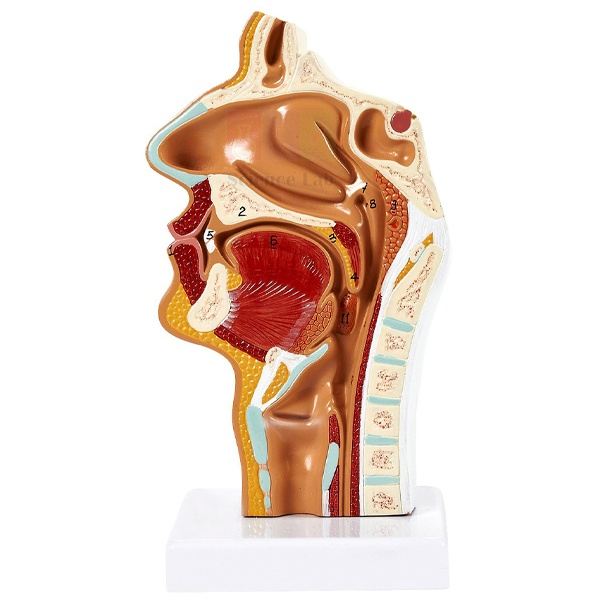
Anatomical Human Nasal Cavity Model
Anatomical Human Nasal Cavity Model (Product Code: SLE/BL/04) helps students understand the internal structure of the nose in three areas: the lateral nasal wall with its superior, middle and inferior nasal conchae, a section through the nasal bones and cartilages of the external nose, and the frontal, sphenoid and maxillary paranasal sinuses. Anatomy departments, ENT and physiology teachers, nursing schools and senior secondary biology classes use it to connect the nose with breathing, smell and sinus problems. As part of a wider range of biology lab equipment India schools and colleges order, it is made by Jain Scientific Equipments Pvt Ltd (ScienceLab), Ambala.
Key Details
| Parameter | Detail |
|---|---|
| Type | Anatomical model of the human nasal cavity |
| Nasal cavity | Lateral nasal wall showing the superior, middle and inferior nasal conchae projecting medially into the nasal cavity |
| External nose | Section of the nasal bones and cartilages |
| Paranasal sinuses | Frontal, sphenoid and maxillary sinuses |
| Suitable for | Anatomy, ENT, nursing and biology teaching |
Typical Use
Start with the external nose section to show how bone gives way to cartilage along the bridge, then move to the lateral wall, where the three conchae curl inward and create the narrow passages that warm, moisten and filter incoming air. Pointing out the frontal, sphenoid and maxillary sinuses around the cavity helps explain why a blocked nose often goes with sinus pressure, and why infections can spread between these spaces.
The model sits well within a human biology model set India classrooms use for the respiratory system and sense organs, and it is a handy prop for nursing students learning nasal procedures. Keep it covered when not in use, handle it by its base or edges rather than the fine structures, and clean it with a slightly damp cloth.
Manufacturer
Jain Scientific Equipments Private Limited makes human anatomy models for teaching at its operations in Ambala, Haryana, and sells them under the name ScienceLab. The company profile gives more information.
Related Human Models
Useful companions for teaching the nose, airway and senses:
- Human Nasal Cavity Model — an alternative nasal cavity model to compare.
- Human Nose Model on Base — another view of nasal anatomy for the same lesson.
- Human Respiratory System Model, 2-parts — follows the airway from the nose down to the lungs.
- Human Ear Model, 5 Parts — completes an ear, nose and throat teaching set.
Find more in our Human Models category.
Frequently Asked Questions
Which structures does the model show?
The nasal conchae on the lateral nasal wall, a section of the nasal bones and cartilages of the external nose, and the frontal, sphenoid and maxillary sinuses.
Is it suitable for school biology as well as medical teaching?
Yes. School classes use it for the respiratory system and sense of smell, while nursing and medical students use the same structures in more detail.
Does the model come apart?
The description does not list removable parts. Please ask us through the contact page for the current construction, size and base details.
Is a key to the structures included?
Please confirm with us whether a numbered key or guide is supplied with the model you order.
How should the model be cleaned?
Dust it regularly with a soft brush and wipe gently with a damp cloth. Avoid alcohol or solvent cleaners that could affect painted details.
Can you supply models for a new anatomy lab?
Yes, we supply institutions in India and international markets. Send the full list of models, quantities and delivery address, and our quotation will state warranty terms.
Request a Quote
To order the Anatomical Human Nasal Cavity Model, contact us through the contact page or add it to your enquiry cart.
Last updated: 24 September 2026
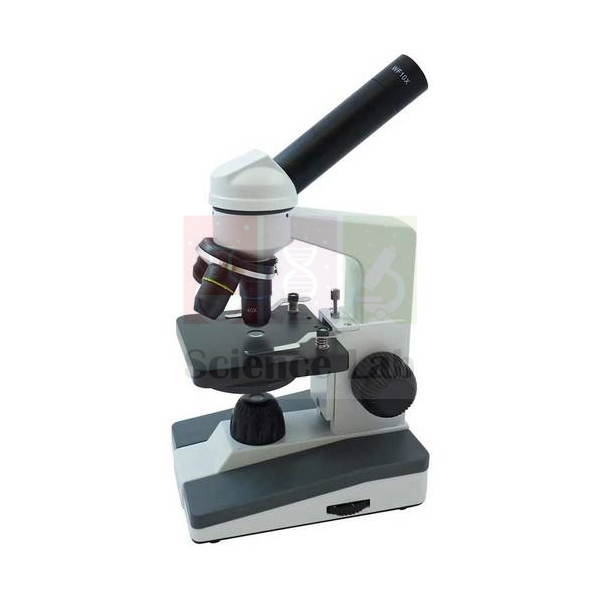
Cordless Microscope
Cordless Microscope (Product Code: SLE/M/50) is a compound microscope used to examine prepared and temporary slides at 40x, 100x and 400x in school and college biology labs. A 10x/14 mm widefield eyepiece with a pointer sits on a 360° rotatable head inclined at 45°, above parfocal 4x, 10x and 40xR objectives on an all-metal stand. This compound microscope for schools in India is supplied by Jain Scientific Equipments Pvt Ltd (ScienceLab), Ambala, India.
Specifications
| Parameter | Detail |
|---|---|
| Eyepiece | 10x/14 mm widefield, locked-in, with rotatable pointer |
| Head | 360° rotatable, inclined at 45° for viewing while seated |
| Objectives | 4x, 10x and 40xR; corrected, parcentric and parfocal |
| Total magnification | 40x, 100x and 400x |
| Focusing | Rack-and-pinion coarse and fine adjustment with slip clutch to protect the focusing mechanism |
| Travel stops | Upper and lower stops to prevent damage to slide or objective |
| Stage | Moveable stage with locked-on stage clips |
| Stand | Sturdy all-metal stand with stain-resistant, baked-on finish |
| Size | 11-1/2 in H x 4-1/2 in W x 6-1/2 in D (approx. 29.2 x 11.4 x 16.5 cm) |
| Weight | About 3-1/2 lb (approx. 1.6 kg) |
| Product code | SLE/M/50 |
| Supplied by | Jain Scientific Equipments Pvt Ltd (ScienceLab), Ambala, India |
What Is the Cordless Microscope Used For?
This microscope covers the core slide work of secondary biology: onion peel and cheek cells, leaf stomata, pond-water organisms and prepared microscope slides of plant and animal tissues. Scan at 40x, locate the area of interest at 100x, then move to 400x for cell detail. Because the objectives are parfocal, the image stays close to focus when the nosepiece is turned, so students spend less time refocusing.
Several features suit busy classrooms. The locked-in eyepiece and locked-on stage clips cannot easily go missing, the slip clutch protects the focusing gears when a knob is forced, and the upper and lower travel stops keep the objective from cracking a slide. A teacher can set the rotatable pointer on a structure so each student finds the same feature, and the cordless design keeps mains cables off the bench.
Supplier
ScienceLab is the business name of Jain Scientific Equipments Private Limited, which supplies the Cordless Microscope from Ambala, Haryana. Schools setting up class sets, colleges, dealers and importers in India and international markets can order it with slides, cover glasses and storage boxes on one quotation. Visit the ScienceLab profile to learn about the company.
Related Laboratory Equipment
Consumables and alternatives used with a student compound microscope:
- Student-Grade Microscope Slides — prepared slides for routine practicals
- Microscope Slides Glass — plain slides for students’ own mounts
- Cover Glasses — to cover wet mounts before viewing
- Blue Box, for storing Microscope Slides — keeps prepared slides organised
- Compound Microscope Cordless — another cordless model to compare
Compare other models in the Microscope category.
Frequently Asked Questions
What magnifications does the Cordless Microscope provide?
The Cordless Microscope provides 40x, 100x and 400x. Its 10x/14 mm widefield eyepiece combines with corrected, parcentric and parfocal 4x, 10x and 40xR objectives, covering everything from scanning a whole slide to viewing individual cells.
How does the Cordless Microscope protect slides and objectives?
The Cordless Microscope has upper and lower travel stops that prevent the objective from striking the slide, and a slip clutch on the rack-and-pinion focus that protects the mechanism if a knob is over-turned. Both features reduce breakages in student labs.
How is the Cordless Microscope lit and powered?
The Cordless Microscope is described as cordless, but its listing does not detail the light source or battery arrangement. Ask us on the contact page and we will confirm the illumination and charging details for the units we quote.
Does the Cordless Microscope have an eyepiece pointer?
Yes. The Cordless Microscope’s 10x/14 mm widefield eyepiece has a locked-in, rotatable pointer. A teacher can aim it at a cell or structure so that every student who looks through the eyepiece sees the same feature.
How large is the Cordless Microscope?
The Cordless Microscope measures 11-1/2 in H x 4-1/2 in W x 6-1/2 in D (about 29.2 x 11.4 x 16.5 cm) and weighs about 3-1/2 lb (about 1.6 kg). Its compact all-metal stand fits easily on a student bench.
Who supplies the Cordless Microscope?
The Cordless Microscope is supplied by Jain Scientific Equipments Pvt Ltd (ScienceLab), Ambala, Haryana, India. The company quotes single units and class sets for schools, colleges, dealers and importers in India and international markets.
What should a Cordless Microscope quotation request include?
A Cordless Microscope quotation request should give the number of microscopes, the delivery location and any slides, cover glasses or slide boxes you need. Mention if you want the illumination and charging details confirmed in writing with the quotation.
Request a Quote
Request a Cordless Microscope quotation through the contact page, or add it to the enquiry cart with the slides and consumables for your practicals.
Last updated: 24 September 2026
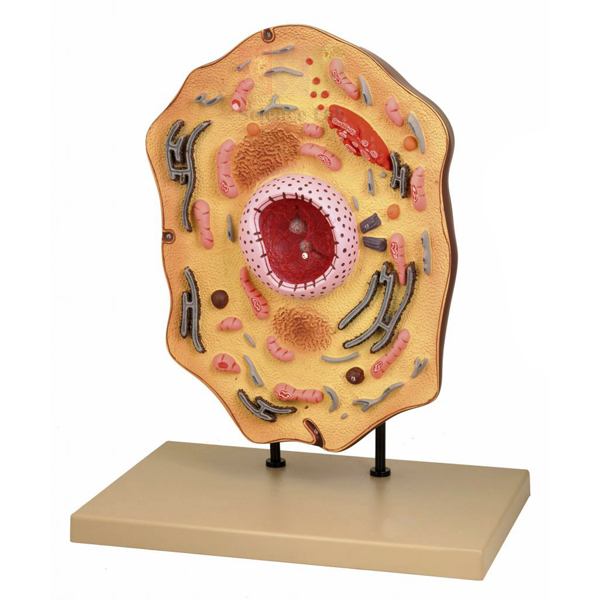
Animal Cell Model
Animal Cell Model (Product Code: SLE/BL/05) is a detailed teaching model of a typical animal cell, enlarged 20,000 times, used to show organelles that a school microscope cannot resolve in biology classrooms. Secondary schools and first-year life-science courses use it to point out the nucleus, mitochondria, Golgi apparatus, lysosomes and other structures to a whole class. It is made by Jain Scientific Equipments Pvt Ltd (ScienceLab), the OEM manufacturer, at its own factory in Ambala, India.
Specifications
| Parameter | Detail |
|---|---|
| Magnification | Enlarged 20,000 times |
| Structures shown | Nucleus, endoplasmic reticulum, mitochondria, ribosomes, Golgi apparatus, centrioles, lysosomes, fat vacuoles |
| Dimensions | 380 x 240 x 460 mm approx. |
| Weight | 2350 g approx. |
| Product code | SLE/BL/05 |
| Manufacturer | Jain Scientific Equipments Pvt Ltd (ScienceLab) — OEM |
| Country of origin | India (made in Ambala, Haryana) |
What Is the Animal Cell Model Used For?
The model is most useful when a lesson moves from what students see under a light microscope to what an electron micrograph reveals. After looking at stained cheek cells and finding little more than a nucleus and cytoplasm, the class can turn to the model to see where protein is made (ribosomes and endoplasmic reticulum), how it is packaged (Golgi apparatus), where energy is released (mitochondria) and which structures take part in cell division (centrioles). Asking students to trace a molecule's route from the nucleus to the cell surface turns a list of organelles into a working system.
At roughly 460 mm tall it can be seen from the back of a classroom, yet at about 2350 g one person can carry it between rooms. Placed beside a plant cell model it supports the familiar exam task of listing differences between plant and animal cells, which is why an animal cell model is a core piece of cell biology equipment in Indian school and college labs.
OEM Manufacturer
Jain Scientific Equipments Private Limited, which trades as ScienceLab, is the OEM (original equipment manufacturer) of this animal cell model and produces it at its own licensed factory at Saha, Ambala, Haryana, India. Schools, colleges, dealers and importers buy it factory-direct rather than through a trader, so quotations, repeat orders and questions about replacement parts are answered by the maker itself — just ask us. Read more on the company profile.
Related Animal Models
Items that complete a cell biology lesson around this model:
- Plant Cell Model — shown at the same 20,000 times enlargement, ideal for side-by-side comparison.
- Animal Mitosis Models — follow an animal cell through the stages of division.
- Microslide Ultra Structure of Animal Cells — micrograph images of organelles such as the Golgi body and mitochondrion to match against the model.
- Monocular Biological Microscope 400x, LED — for observing real animal cells before introducing the enlarged view.
Browse more zoology teaching models in our Animal Model category.
Frequently Asked Questions
Which organelles does the Animal Cell Model show?
The Animal Cell Model shows the nucleus, endoplasmic reticulum, mitochondria, ribosomes, Golgi apparatus, centrioles, lysosomes and fat vacuoles. Together these cover the organelles usually named in school and first-year college chapters on animal cell structure.
How large is the Animal Cell Model?
The Animal Cell Model measures about 380 x 240 x 460 mm and weighs about 2350 g. That makes it big enough to see from the back of a classroom, yet light enough for one teacher to carry between rooms.
How much is the cell enlarged in the Animal Cell Model?
The Animal Cell Model represents a typical animal cell enlarged 20,000 times. At that scale, structures such as ribosomes and lysosomes, which cannot be seen under a school light microscope, can be pointed out and compared during a lesson.
Who manufactures the Animal Cell Model?
The Animal Cell Model is manufactured by Jain Scientific Equipments Pvt Ltd (ScienceLab), acting as the OEM, at its own licensed factory at Saha, Ambala, Haryana, India. Orders and quotations come straight from the manufacturer rather than through a trading intermediary.
Is an identification key supplied with the Animal Cell Model?
A key is not listed in the Animal Cell Model's product details. Please ask through the contact page what labelling or key material comes with current production before you order, especially if students will work from numbered labels.
How should the Animal Cell Model be cleaned?
Wipe the Animal Cell Model with a soft, slightly damp cloth and let it dry. Avoid solvents and abrasive cleaners that could damage the surface detail, and store it away from direct sunlight so the organelles stay easy to distinguish.
Can schools order several Animal Cell Models at once?
Yes. Schools and dealers can order several Animal Cell Models on one enquiry; send the number of units and your delivery address, and the manufacturer will quote for supply within India or to international markets.
Request a Quote
For a quotation on the Animal Cell Model direct from the manufacturer, contact us via the contact page or place it in the enquiry cart with the rest of your biology list.
Last updated: 24 September 2026
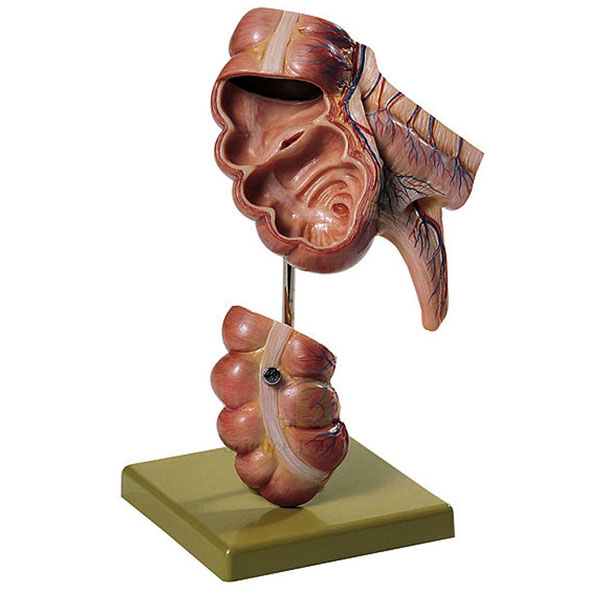
Appendix and Caecum Model
Appendix and Caecum Model (Product Code: SLE/BL/06) is a natural size PVC model of the junction between the small and large intestine, showing the wall of the caecum and the appendix and marking 17 positions for study. It separates into 2 parts and is mounted on a stand, so it can be taken apart during a lesson and reassembled afterwards. Medical and nursing colleges, surgical trainees and senior biology classes use it when teaching digestion and conditions such as appendicitis. Institutions looking for a biology lab equipment supplier India can order it from Jain Scientific Equipments Pvt Ltd (ScienceLab), Ambala, which makes it.
Specifications
| Parameter | Detail |
|---|---|
| Material | Advanced PVC |
| Size | Natural size |
| Structures shown | Wall of the caecum and appendix |
| Positions shown | 17 |
| Parts | Separates into 2 parts |
| Mounting | Mounted on a stand |
Typical Use
Because it is natural size, the model gives students a realistic sense of how small the appendix is compared with the caecum it hangs from — something diagrams rarely convey. In a lesson on the digestive tract, the teacher can show the model assembled first, then separate the two parts to look more closely at the caecum wall and the appendix. Medical and nursing students use the same model when learning about appendicitis, why the site of pain can vary, and what a surgeon looks for during an appendectomy.
For school biology lab equipment in India classrooms, it pairs well with a full digestive system model so learners can locate the caecum within the whole tract before looking at it in detail. Keep the stand on a flat surface, rejoin the two parts carefully after each lesson, and wipe the PVC with a mild soap solution when it needs cleaning.
Manufacturer
Jain Scientific Equipments Private Limited, trading as ScienceLab, produces anatomy teaching models in Ambala, Haryana for schools, colleges and hospitals. Tender and procurement teams needing vendor details can use GSTIN 06AAECJ8618A1ZT and Legal Entity Identifier 3358004HRD1JIVXKYX49. More about us is on the company profile.
Related Human Models
To teach the digestive system in context, buyers also choose:
- Human Digestive System Model — places the caecum and appendix within the whole digestive tract.
- Deluxe Human Male and Female Torso Model — shows abdominal organs in their body positions.
- Human Micro Sexless Torso Model — a compact torso for desk-level revision of organ layout.
See more in our Human Models category.
Frequently Asked Questions
Is the model life size?
Yes, it is natural size, which makes it realistic for demonstrating the proportions of the appendix and caecum.
What material is it made from?
It is made of advanced PVC, which can be wiped clean and handled regularly in class.
How many parts does it have?
It separates into 2 parts and is mounted on a stand.
What do the 17 positions refer to?
The model shows 17 positions. Please ask us through the contact page for the key that describes each one on the current model.
Which courses is it suitable for?
Senior secondary biology, nursing, medical and paramedical courses that cover the digestive system and abdominal conditions.
What do you need for an institutional quotation?
Quantity, delivery address, billing name and any tender or GST format required. We supply India and international markets, and warranty terms are included in the quotation.
Request a Quote
For a price on the Appendix and Caecum Model, write to us through the contact page or add it to your enquiry cart.
Last updated: 24 September 2026
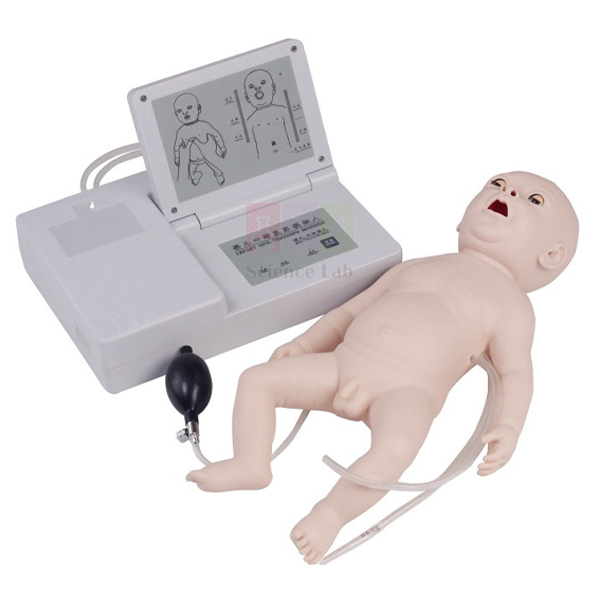
Advanced Infant CPR Training Manikin
Advanced Infant CPR Training Manikin (Product Code: SLE/BL/07) is an infant simulation model for learning how to revive a baby through heart pressure (chest compression) and mouth-to-mouth respiration. Designed according to the international CPR standard, it has light indicator displays that separate correct from wrong compression position and correct from incorrect artificial respiration, so learners see their mistakes as they make them. Neonatal and paediatric nurses, midwifery students, childcare workers and new-parent classes practise on it, and it fits well into the educational lab equipment India nursing schools keep for skills training. It is made by Jain Scientific Equipments Pvt Ltd (ScienceLab), Ambala.
Key Details
| Parameter | Detail |
|---|---|
| Type | Infant CPR simulation model |
| Design basis | Designed according to the international CPR standard |
| Skills practised | Heart pressure and mouth-to-mouth respiration for infant revival |
| Compression indicator | Light indicator display for correct and wrong compression position |
| Respiration indicator | Light indicator display for correct and incorrect artificial respiration (mouth-to-mouth) |
| Suitable for | Infant CPR and first aid courses |
Typical Use
Infant resuscitation calls for a very different touch: compressions are given with fingers rather than the heel of the hand, and rescue breaths are much smaller. Practising on an infant-sized model is the only realistic way to build that feel. Instructors usually demonstrate once, then let each learner try while the compression-position light confirms finger placement on the chest and the respiration light shows whether each breath was delivered correctly.
Hospitals running neonatal resuscitation refreshers, colleges teaching paediatric nursing and community programmes putting together a first aid training kit school staff and parents can use all find it useful. Clean the face and mouth after each learner, keep the manikin in a closed box when not in use, and check the indicator lights before each class so no session time is lost.
Manufacturer
Made in Ambala, Haryana, this manikin is part of the medical training range of Jain Scientific Equipments Private Limited, which does business under the ScienceLab name. Read about the company on our company profile.
Related Human Models
Items often purchased with the infant manikin for life support and physiology teaching:
- Advanced Adult CPR Training Manikin — for adult technique, with audio prompting and grade printing.
- Advanced Child CPR Training Manikin — bridges infant and adult technique for older children.
- Human Heart, Pumping Model — helps learners see what compressions are doing for circulation.
- Human Circulatory System Model — for background teaching on blood flow around the body.
More models are in our Human Models category.
Frequently Asked Questions
What skills can be practised on this manikin?
Infant chest compressions (heart pressure) and mouth-to-mouth respiration, with lights confirming correct or wrong compression position and correct or incorrect breaths.
Why buy an infant model when we already have an adult one?
Infant CPR uses different hand technique and much gentler breaths, which cannot be practised realistically on an adult-sized manikin.
Is it designed to a recognised CPR standard?
It is designed according to the international CPR standard. Please tell us if your programme follows a particular guideline version so we can advise.
How is the manikin powered?
Please check the power requirements for the indicator lights of the current model with us through the contact page.
How should it be cleaned between learners?
Wipe the face and mouth area with a suitable disinfectant wipe after each learner and let it dry. Ask us about replacement parts if your course has high usage.
Do you provide warranty and bulk pricing?
Warranty terms and pricing for multiple units are given in our quotation. We deliver to India and international markets.
Request a Quote
Ask for a quotation on the Advanced Infant CPR Training Manikin via the contact page, or place it in your enquiry cart.
Last updated: 24 September 2026
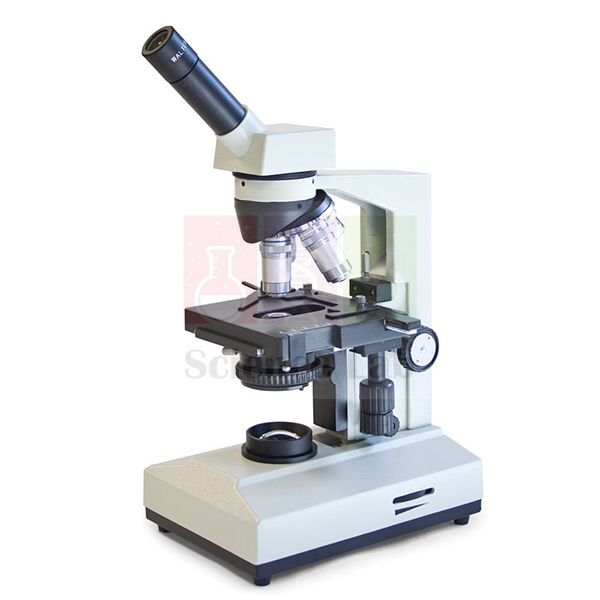
Compound Microscope
Compound Microscope (Product Code: SLE/M/51) is a rechargeable LED compound microscope used to study stained slides, cells and micro-organisms in school, college and training laboratories. It combines achromatic parfocal objectives, a built-in mechanical stage and a rack-and-pinion 1.25 N.A. Abbe condenser with iris diaphragm, and runs on its included NiMH batteries or the AC charger/adapter. It is supplied by Jain Scientific Equipments Pvt Ltd (ScienceLab), Ambala, India.
Specifications
| Parameter | Detail |
|---|---|
| Head | 360° rotating, inclined at 45° for easier viewing |
| Eyepiece | Locked-on 10x widefield, with calibrated pointer |
| Objectives | Achromatic, parcentered and parfocal |
| Stage | Built-in mechanical stage for easier slide scanning |
| Focusing | Separate coarse and fine rack-and-pinion focus, with positive stops at both ends of stage travel |
| Condenser | Rack-and-pinion adjustable 1.25 N.A. Abbe condenser with iris diaphragm |
| Illumination | Built into the base with on/off switch; bright, cool LED with light intensity control |
| LED bulb life | 10,000 hours |
| Power | Rechargeable NiMH batteries and AC charger/adapter included |
| Size | 11-1/2 in H x 6 in W x 9-1/2 in D (approx. 29.2 x 15.2 x 24.1 cm) |
| Weight | 10 lb (approx. 4.5 kg) |
| Product code | SLE/M/51 |
| Supplied by | Jain Scientific Equipments Pvt Ltd (ScienceLab), Ambala, India |
What Is the Compound Microscope Used For?
The adjustable Abbe condenser and iris diaphragm make this microscope suitable for both stained and unstained material, which is the heart of cell biology practicals: stained tissue sections, onion and cheek cells, and protists in pond water. Close the iris to add contrast to pale, transparent cells, and open it for well-stained slides. The mechanical stage moves the slide in controlled strokes, so students can scan a smear systematically instead of nudging the glass by hand.
With the NiMH batteries charged, the microscope can be used at benches or in rooms without sockets, then returned to its AC charger/adapter. The cool LED does not heat wet mounts or live specimens, and the positive stops at both ends of stage travel help protect delicate slides and optics. Teachers can use the calibrated pointer in the eyepiece to indicate exactly which structure to look at.
Supplier
As a biology lab instruments supplier, Jain Scientific Equipments Private Limited, trading as ScienceLab, provides the Compound Microscope from Ambala, Haryana. Schools, colleges, nursing and paramedical training institutes, dealers and importers in India and international markets can combine it with slides and accessories in one order. More about the company is on the ScienceLab profile.
Related Laboratory Equipment
Slides and accessories used with a compound microscope:
- Mitosis & Meiosis Set, Microscope Slides — prepared slides for cell-division practicals
- Microscope Slides Depression — cavity slides for living specimens in a drop of water
- Microscope Slide Cover Forceps — for handling cover glasses cleanly
- Lens Tissue — for cleaning the eyepiece and objectives after use
See more compound and stereo models in the Microscope category.
Frequently Asked Questions
What illumination does the Compound Microscope have?
The Compound Microscope has a bright, cool LED built into the base, with an on/off switch and light intensity control. The LED bulb life is listed as 10,000 hours, so lamp changes are rarely needed in routine teaching use.
How is the Compound Microscope powered?
The Compound Microscope runs on rechargeable NiMH batteries, and an AC charger/adapter is included. This lets it work at benches without a power point and be recharged between lessons from a standard outlet.
What condenser is fitted to the Compound Microscope?
The Compound Microscope has a rack-and-pinion adjustable 1.25 N.A. Abbe condenser with an iris diaphragm. Raising, lowering and stopping down the condenser gives more control over light and image contrast for different specimens.
Which objectives come with the Compound Microscope?
The Compound Microscope uses achromatic objectives that are parcentered and parfocal, so a centred, focused specimen stays in view when you change power. The listing does not state the individual objective magnifications; ask us on the contact page for the set we quote.
How big and heavy is the Compound Microscope?
The Compound Microscope measures 11-1/2 in H x 6 in W x 9-1/2 in D (about 29.2 x 15.2 x 24.1 cm) and weighs 10 lb (about 4.5 kg). The 360° rotating head is inclined at 45° for comfortable seated viewing.
Who supplies the Compound Microscope?
The Compound Microscope is supplied by Jain Scientific Equipments Pvt Ltd (ScienceLab), Ambala, Haryana, India. The company quotes schools, colleges, training institutes, dealers and importers in India and international markets, from single instruments to full class sets.
What should a Compound Microscope quotation request include?
A Compound Microscope quotation request should state the number of microscopes, the delivery location and the slides or accessories you want with them. If you need a specific objective set, include it so we can confirm availability in the quotation.
Request a Quote
Send your Compound Microscope enquiry through the contact page, or add it to the enquiry cart together with prepared slides and cleaning supplies.
Last updated: 24 September 2026
Apparatus Phototropic
Apparatus Phototropic (Product Code: SLE/BL/08) is a three-chambered wooden case used to study phototropism in seedlings in school and college plant physiology practicals. Teachers use it as a plant growth experiment kit that shows how excluding parts of the light spectrum changes the way seedlings grow, with three glass containers, opaque and slot shutters and an orange & blue filter. It is made by Jain Scientific Equipments Pvt Ltd (ScienceLab), an OEM manufacturer, at its own factory in Ambala, India.
Specifications
| Parameter | Detail |
|---|---|
| Purpose | Phototropism experiments with seedlings; shows the effect of excluding various parts of the light spectrum on growth |
| Case | Three-chambered wood case that accepts a variety of shutters |
| Window | One chamber has a window at the top and back |
| Seedling containers | Three glass containers |
| Shutters supplied | Opaque shutter and slot shutter |
| Filter supplied | One orange & blue filter |
| Overall size | 180 x 530 x 180 mm |
| Product code | SLE/BL/08 |
| Manufacturer | Jain Scientific Equipments Pvt Ltd (ScienceLab) — OEM |
| Country of origin | India (made in Ambala, Haryana) |
What Is the Phototropism Apparatus Used For?
Seedlings are raised in the three glass containers and one container is placed in each chamber. By fitting different shutters, the class sets up contrasting conditions side by side: the opaque shutter keeps a chamber dark, the slot shutter lets in a narrow beam of light from one direction, and the filter allows only part of the spectrum through. Over the following days students record the height and direction of growth in each chamber, and seedlings exposed to one-sided light bend towards it.
The filter comparison is the most instructive part, because phototropic bending responds far more strongly to blue light than to orange or red — an easy way into light-sensitive pigments and the plant hormone auxin. For reliable results, sow seeds of one variety, water all containers equally and keep the apparatus away from stray light from other sides. As plant biology lab equipment it can be reused year after year; wipe the wooden case dry and store the shutters and filter flat.
What to Specify When Ordering
- The number of sets — each set is one three-chambered case with three glass containers for seedlings.
- Whether you need shutters or filters beyond the opaque shutter, slot shutter and orange & blue filter supplied, since the case accepts a variety of shutters.
- Bench or shelf space for each set at 180 x 530 x 180 mm overall.
OEM Manufacturer
Jain Scientific Equipments Private Limited, which trades as ScienceLab, is the OEM (original equipment manufacturer) of the Apparatus Phototropic and makes it at its own licensed factory at Saha, Ambala, Haryana, India. Because the wooden case, shutters and filter come from the maker itself, schools and dealers can ask us directly about additional shutters, replacement glass containers or repeat sets for more benches. Institutions, distributors and importers all receive factory-direct quotations. Read more on our company profile.
Related Biology Lab Equipment
Apparatus for the wider plant physiology practical series:
- Clinostat (Electric) — a companion tropism experiment that cancels a one-sided stimulus
- Petri Dish — for germinating seeds before moving seedlings into the containers
- Photosynthesis Apparatus — another light-dependent plant experiment
- Kit for Demonstrating Seed Respiration in Germination — continues the germination topic
See the complete Biology Lab Equipment range for more plant and animal physiology apparatus.
Frequently Asked Questions
What comes with the Apparatus Phototropic?
The Apparatus Phototropic comes as a three-chambered wood case with three glass containers for seedlings, an opaque shutter, a slot shutter and one orange & blue filter. One chamber has a window at the top and back, and the case accepts a variety of shutters.
What is the overall size of the Apparatus Phototropic?
The Apparatus Phototropic measures 180 x 530 x 180 mm overall. That footprint lets the three chambers sit side by side on a laboratory bench or shelf away from stray light, where students can compare the seedlings in each chamber over several days.
Are seeds included with the Apparatus Phototropic?
Seeds are not listed as part of the Apparatus Phototropic. Quick-germinating seeds of a single variety, such as those your syllabus recommends, can be sown in the three glass containers a few days before the experiment begins.
Does the Apparatus Phototropic need a power supply?
No electrical parts are listed for the Apparatus Phototropic. The experiment relies on light reaching the seedlings through the window, the slot shutter and the orange & blue filter, so place the case where daylight or a lamp falls on it evenly.
Can extra shutters or filters be ordered for the Apparatus Phototropic?
The Apparatus Phototropic case accepts a variety of shutters and is supplied with an opaque shutter, a slot shutter and one orange & blue filter. For additional shutters or filters, contact us and we will confirm what can be quoted with your sets.
Who manufactures the Apparatus Phototropic?
Jain Scientific Equipments Pvt Ltd (ScienceLab) is the OEM manufacturer of the Apparatus Phototropic (SLE/BL/08). It is made at the company's own licensed factory at Saha, Ambala, Haryana, India, and supplied factory-direct to schools, colleges, dealers and importers.
Is the Apparatus Phototropic available for school tenders and export?
Yes. ScienceLab quotes the Apparatus Phototropic for school tenders, colleges and distributors in India and international markets. Send the number of sets and the delivery location, and the quotation will come directly from the manufacturer.
Request a Quote
For a quotation on the Apparatus Phototropic, contact us or add it to the enquiry cart with the rest of your plant physiology equipment. Quotes come directly from the manufacturer.
Last updated: 24 September 2026