- Physics Lab Equipment
- Chemistry Lab Equipment
- Biology Lab Equipment
- Anatomical Lab Equipment
- Learning
- Educational Lab Equipment
- Magnets
- Agriculture
- Astronomy
- Earth Science
- Geography Lab Equipment
- Safety Lab Coat
- Laboratory
- Meteorological
- Electricity & Magnetism
- Heat
- School Lab Equipment
- Lab Glassware
- Science Lab Equipment
- Tvet Lab Equipment
- Robotics Kits Supplier and Manufacturer for Schools India
- Math Lab Equipment Manufacturers and Exporters in Ambala
- STEM Kits Manufacturers and Supplier India
- Engineering Lab Equipment
- Hospital Lab Equipment
- Water, Sanitation & Hygiene Supplies
- Cold Chain, Solar & Communication Equipment
- Nutrition
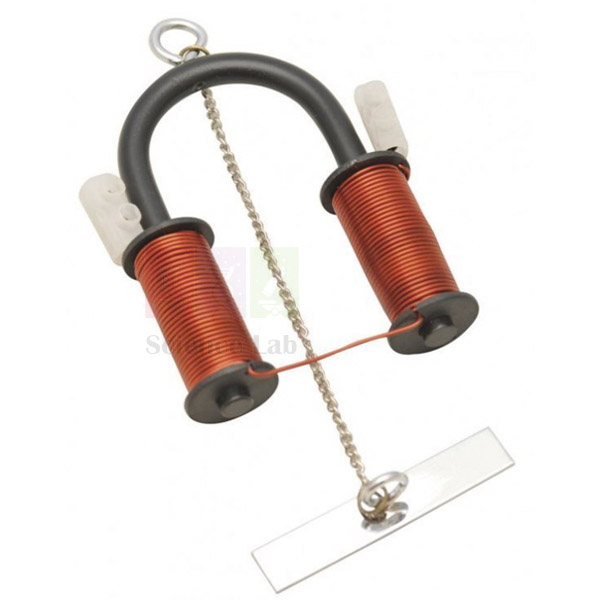
Electromagnet with Keeper
Electromagnet with Keeper (Product Code: SLE/PHY/95) is a U-shaped electromagnet used to demonstrate the magnetic effect of an electric current in school and college physics labs. Its circular-section core is wound with insulated copper wire, carries an armature with a hook for hanging loads and runs from 4-6 volts DC, so students can switch a magnetic pull on and off at will. It is manufactured by Jain Scientific Equipments Pvt Ltd (ScienceLab), an OEM manufacturer, at its own factory in Ambala, India.
Specifications
| Parameter | Detail |
|---|---|
| Core | U-shaped, circular section |
| Winding | Insulated copper wire |
| Connections | Barrel connections |
| Operating supply | 4-6 volts DC |
| Size (as listed) | 110 x 9 mm (diameter) |
| Fittings | Armature with carrying hook |
| Supplied with | Keeper |
| Product code | SLE/PHY/95 |
| Manufacturer | Jain Scientific Equipments Pvt Ltd (ScienceLab) — OEM |
| Country of origin | India (made in Ambala, Haryana) |
What Is the Electromagnet with Keeper Used For?
With the supply connected, the armature is pulled firmly onto the pole faces, and loads hung from the carrying hook show how strong the magnetic force is; switch off and the armature drops away. Students can compare the lifting effect at different voltages within the 4-6 V DC range, or reverse the current and use a plotting compass to see the poles swap. It is a classic electromagnetic kit item for school practicals on the magnetic effects of current.
Store the electromagnet with its keeper across the poles and away from loose steel items. Do not exceed the stated DC supply, and switch off between readings so the winding does not get warm.
What to Specify When Ordering
- Number of electromagnets needed for your class or demonstration bench.
- A DC supply that can provide 4-6 volts, if your lab does not already have one.
- Masses or hangers for load tests, which should be requested separately.
- Delivery location for packing and freight.
OEM Manufacturer
Jain Scientific Equipments Private Limited, trading as ScienceLab, manufactures this electromagnet as the OEM at its own licensed factory at Saha, Ambala, Haryana. Buying from the factory gives physics departments, dealers and importers a direct line to the maker for quotations and repeat orders, and you can ask us about a replacement keeper at any time. The company holds Udyam registration UDYAM-HR-01-0003714 as an MSME, and its Importer-Exporter Code AAECJ8618A (DGFT) covers shipments outside India. Visit the company profile for more.
Related Physics Lab Equipment
Other electromagnetism apparatus and accessories for these practicals:
- U-Shaped Electromagnet — a U-core electromagnet with two enamelled copper coils that slide onto the core arms.
- Electromagnet for Demo — a two-coil U-shaped electromagnet for teacher demonstrations.
- Electromagnet Kit — a student kit for building an electromagnet from coils and a U-shaped core.
- Power Supply, Stepped — an AC/DC bench supply for powering the electromagnet.
- Compass Plotting (Clear) — a plotting compass for identifying the electromagnet's poles.
Find more in Physics Lab Equipment and Magnets.
Frequently Asked Questions
What voltage does the Electromagnet with Keeper need?
The Electromagnet with Keeper is designed for use with 4-6 volts DC. A low-voltage DC bench supply or suitable cells can power it; stay within this range so the insulated copper winding does not overheat.
What size is the Electromagnet with Keeper?
The Electromagnet with Keeper is listed as 110 x 9 mm (diameter), with a U-shaped core of circular section. If you need full overall dimensions for a particular set-up, ask us through the contact page before ordering.
What is included with the Electromagnet with Keeper?
The Electromagnet with Keeper comes complete with its keeper, and the U-shaped wound core is fitted with an armature and carrying hook. Barrel connections are provided on the electromagnet for attaching the supply leads.
How is the electromagnet connected to a supply?
Connect the Electromagnet with Keeper to a 4-6 volts DC supply through its barrel connections. Switching the supply on energises the copper winding and pulls the armature onto the core; switching off releases it again.
Who manufactures the Electromagnet with Keeper?
The Electromagnet with Keeper is manufactured by Jain Scientific Equipments Pvt Ltd (ScienceLab) as the OEM at its own factory in Ambala, Haryana, India, and is supplied direct to schools, colleges, dealers and importers.
Can the electromagnet be ordered in quantity for export?
Yes. The Electromagnet with Keeper can be quoted for a single laboratory or for institutional and export orders across India and international markets. Include the quantity, any power supplies required and the destination in your enquiry.
Request a Quote
Send the number of Electromagnets with Keeper you need, together with any supply or accessory items, through the contact page, or add them to the enquiry cart. Quotations are prepared by the manufacturer itself.
Last updated: 24 September 2026

Lenz's Law – Open & closed loop
Lenz's Law – Open & closed loop (Product Code: SLE/PHY/96) is an electromagnetic induction demonstration used to show Faraday's law of induction and Lenz's law in school and college physics lessons. Passing a magnet through the complete loop makes the device move, while the split loop does not move at all, so students see that an induced current, not magnetism alone, causes the effect. It is manufactured by Jain Scientific Equipments Pvt Ltd (ScienceLab), an OEM manufacturer, at its own factory in Ambala, India.
Key Details
| Parameter | Detail |
|---|---|
| Demonstrates | Faraday's law of induction and Lenz's law |
| Loops | One complete (closed) loop and one split (open) loop |
| Closed loop | Device moves when a magnet is passed through the loop |
| Split loop | No movement at all |
| Magnet | Needed for the demonstration; confirm whether to include one when ordering |
| Product code | SLE/PHY/96 |
| Manufacturer | Jain Scientific Equipments Pvt Ltd (ScienceLab) — OEM |
| Country of origin | India (made in Ambala, Haryana) |
What Is the Lenz's Law Loop Apparatus Used For?
Moving a magnet into the closed loop induces a current in it, and by Lenz's law that current sets up a magnetic field opposing the change, so the loop is pushed away from, or drawn after, the moving magnet. Repeating the action with the split loop produces no movement, because the break stops any current from circulating. This side-by-side comparison makes the apparatus an effective electromagnetic induction kit for explaining why induced currents always oppose the change that creates them.
Move the magnet smoothly, then try faster and slower passes so students can relate the size of the response to the rate of change of magnetic flux. A strong magnet gives the clearest result; keep magnets away from meters and electronic devices while the demonstration is being set up.
What to Specify When Ordering
- Number of units, for a single teacher demonstration or for group work.
- Whether a suitable strong magnet should be quoted with the apparatus.
- Delivery location for the quotation.
OEM Manufacturer
ScienceLab is the name under which Jain Scientific Equipments Private Limited trades, and the company manufactures this Lenz's law apparatus as the OEM at its own factory at Saha, Ambala, Haryana. Induction demonstrations like this go factory-direct to schools, colleges, dealers and importers, so any question about the loops or spare parts reaches the maker straight away. The ScienceLab profile tells you more about the company.
Related Physics Lab Equipment
Magnets and induction apparatus that extend this demonstration:
- Device to Verify The Lenz's Law (for high school) — aluminium rings on a pivoted rocker arm, one ring slotted, for a comparable test.
- Eddy Current Unit — a copper tube in which a falling magnet is slowed by induced currents.
- Neodymium Magnets — strong rare-earth magnets that give clear induction effects.
- Neodymium Wand — neodymium button magnets on acrylic wands for safer handling.
- Demountable Transformer Accessory Set No. 2 — a Lenz's law accessory with pendulums with and without slits.
More electromagnetism apparatus is listed under Physics Lab Equipment.
Frequently Asked Questions
What does the Lenz's Law – Open & closed loop demonstrate?
The Lenz's Law – Open & closed loop apparatus demonstrates Faraday's law of induction and Lenz's law. A magnet passed through the complete loop makes the device move, showing that an induced current creates a field opposing the change in flux.
Why does the split loop not move?
No movement at all occurs with the split loop of the Lenz's Law – Open & closed loop because the gap prevents a current from circulating. With no induced current there is no opposing magnetic field, and so no force acts on the loop.
Is a magnet included with the Lenz's law apparatus?
The Lenz's Law – Open & closed loop listing describes passing a magnet through the loops but does not confirm that a magnet is supplied. Ask us through the contact page and a suitable magnet can be added to your quotation.
Which students is the open and closed loop demonstration suited to?
The Lenz's Law – Open & closed loop suits secondary, senior secondary and undergraduate physics wherever electromagnetic induction is taught. Younger classes see a striking effect, while older students can link it to Faraday's and Lenz's laws in mathematical form.
Who manufactures the Lenz's Law – Open & closed loop?
The Lenz's Law – Open & closed loop is manufactured by Jain Scientific Equipments Pvt Ltd (ScienceLab) as the OEM at its own factory in Ambala, Haryana, India, and is supplied direct to institutions, dealers and importers.
Can the apparatus be ordered in quantity or for export?
Yes. The Lenz's Law – Open & closed loop can be quoted individually or in quantity for schools, colleges and distributors in India and international markets. Share the quantity, any magnets needed and the destination for a complete quotation.
Request a Quote
To receive a price for the Lenz's Law – Open & closed loop, write to us through the contact page or add it to the enquiry cart. Your quotation comes directly from the manufacturer.
Last updated: 24 September 2026
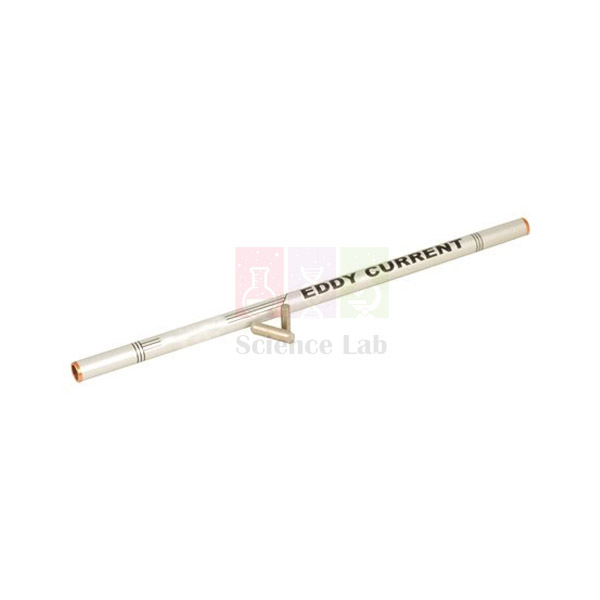
Eddy Current Unit
Eddy Current Unit (Product Code: SLE/PHY/97) is a copper-tube demonstration used to introduce eddy currents and electromagnetic braking in school and college physics. Two test masses, one of steel and one a neodymium magnet, are dropped down a 33 cm copper tube, and students see the magnet fall more slowly than the steel mass. It is manufactured by Jain Scientific Equipments Pvt Ltd (ScienceLab), an OEM manufacturer, at its own factory in Ambala, India.
Specifications
| Parameter | Detail |
|---|---|
| Tube | Copper, 33 cm |
| Test masses | Two, included: one steel, one neodymium magnet |
| Observation | The magnetic mass falls more slowly than the steel mass |
| Principle | Eddy currents induced in the tube oppose the falling magnet's motion |
| Product code | SLE/PHY/97 |
| Manufacturer | Jain Scientific Equipments Pvt Ltd (ScienceLab) — OEM |
| Country of origin | India (made in Ambala, Haryana) |
What Is the Eddy Current Unit Used For?
As the neodymium magnet falls, its moving field induces circulating eddy currents in the copper walls, and these currents produce their own field that opposes the downward motion. The steel mass is not a magnet, so it induces no such currents and simply falls freely, which turns the two drops into a fair test with a striking difference. Teachers use the result to connect Lenz's law with real applications such as magnetic braking, making this one of the simplest physics demonstration kits for showing induction without meters.
Hold the tube upright over a soft surface or catch the masses at the bottom, and time each drop with a stopwatch if students are to compare results in numbers. Keep the neodymium magnet away from the steel mass, electronic devices and fingers, because strong magnets can snap together sharply.
What to Specify When Ordering
- Number of units, for a teacher demonstration or for several student groups.
- Whether spare test masses (steel or neodymium magnet) are needed.
- Delivery location for packing and freight.
OEM Manufacturer
Jain Scientific Equipments Private Limited, which trades as ScienceLab, is the OEM of this eddy current apparatus and makes it at its own factory at Saha, Ambala, Haryana. Physics departments, dealers and importers can order it directly from the manufacturer, and if a test mass goes missing a replacement can be requested from the same source. Company background is on the profile page.
Related Physics Lab Equipment
Further induction and magnetism apparatus for the same topic:
- Eddy Current Unit 120 mm — an aluminium-disc eddy current demonstration driven by a hand-wheel unit.
- Lenz's Law – Open & closed loop — closed and split loops showing induced current opposing a moving magnet.
- Neodymium Magnets — strong magnets for further induction experiments.
- Adjustable Magnet — a magnet unit supplied with an eddy current pendulum demonstration.
- Search Coil — a hand-held coil for investigating changing magnetic fields with a meter or oscilloscope.
Explore more apparatus in Physics Lab Equipment.
Frequently Asked Questions
How does the Eddy Current Unit work?
In the Eddy Current Unit, a neodymium magnet falling through a copper tube induces eddy currents in the tube walls. Those currents create a magnetic field that opposes the magnet's downward motion, so it falls more slowly than the steel test mass.
What is included with the Eddy Current Unit?
The Eddy Current Unit includes a 33 cm copper tube and its test masses: one steel mass and one neodymium magnet. Together they let students compare an ordinary fall with a magnetically braked fall through the same tube.
Why does the Eddy Current Unit include a steel mass?
The steel mass in the Eddy Current Unit acts as the control. Because it is not a magnet, it induces no eddy currents and falls freely, so the slower fall of the neodymium magnet can be attributed to induced currents.
How should the neodymium magnet be handled?
The neodymium magnet in the Eddy Current Unit is strong, so handle it with care: keep it away from electronic devices and other magnets, and avoid trapping fingers. Younger pupils should use the unit under teacher supervision.
Who manufactures the Eddy Current Unit?
The Eddy Current Unit is manufactured by Jain Scientific Equipments Pvt Ltd (ScienceLab) as the OEM at its own factory in Ambala, Haryana, India, and is supplied direct to schools, colleges, dealers and importers.
What does a quotation for the Eddy Current Unit need?
A quotation for the Eddy Current Unit needs the quantity, whether spare test masses are required and the delivery destination. Orders are accepted from institutions and distributors in India and international markets through the contact page.
Request a Quote
Request a price for the Eddy Current Unit through the contact page, or place it in the enquiry cart with any magnets or other apparatus you need. The manufacturer sends the quotation directly.
Last updated: 24 September 2026
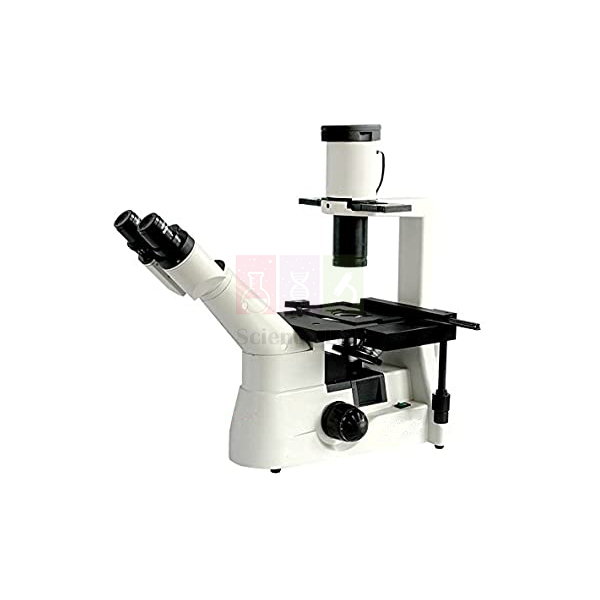
Inverted Tissue Culture Microscope
Inverted Tissue Culture Microscope (Product Code: SLE/M/34) is an inverted trinocular microscope used to observe living cells growing in flasks, bottles and dishes in cell culture, biotechnology and microbiology laboratories. Its objectives sit below a 180 x 150 mm stage, with extension plates for large bottles and micro-filter work. It is supplied by Jain Scientific Equipments Pvt Ltd (ScienceLab), Ambala, India, for institutions buying cell biology equipment in India and abroad.
Specifications
| Parameter | Detail |
|---|---|
| Viewing body | Siedentopf trinocular head inclined at 30°; interpupillary distance 55–75 mm; diopter adjustment ring on ocular |
| Eyepieces | PWF 10x, paired, field of view 20 mm |
| Centering telescope | 5x |
| Objective listed | LWD plan achromatic 4x/0.1, W.D. 18 mm |
| Nosepiece | Quadruple |
| Focusing | Two large low-positioned knobs; backlash-free rack and pinion, approx. 18 mm range; sensitive fine focusing knob; co-axial coarse and fine controls with rubber grips |
| Focus controls | Pre-focusing lever and tension adjustment ring |
| Illumination | 6 V, 20 W halogen lamp with spherical collector lens; continuous intensity regulation; field diaphragm; pull-out filter socket |
| Stage | Hard-coated fixed square plain stage, approx. 180 x 150 mm, with two extension plates and two stage clips in drilled holes |
| Base | Large, sturdy base with built-in solid-state transformer for the illuminator |
| Optional accessories | Micro-photographic camera; digital or CCD camera to photograph specimens and show them on a TV or laptop screen |
| Product code | SLE/M/34 |
| Supplied by | Jain Scientific Equipments Pvt Ltd (ScienceLab), Ambala, India |
What Is the Inverted Tissue Culture Microscope Used For?
Cells in culture settle and grow on the bottom of their vessel, under a layer of medium. An upright microscope cannot get close to them, so the inverted design turns the optics around: light comes from above and the objective looks up through the base of the flask or dish. Technicians use it to check confluence, cell shape and contamination before passaging, without opening the culture.
The long working distance of the listed 4x/0.1 objective (18 mm) suits thick-bottomed vessels. The two extension plates widen the stage for large bottles or micro-filter work, and the low-set focus knobs let the user rest their hands on the bench during long observation sessions. Attach one of the optional cameras to the trinocular port to record growth over several days.
What to Specify When Ordering
- The objectives you need for the quadruple nosepiece (only the 4x LWD objective is listed; ask us for the others)
- Camera option: micro-photographic, digital or CCD camera, if required
- Typical vessel sizes you will place on the stage
- Mains voltage and quantity
Supplier
This microscope is supplied by Jain Scientific Equipments Private Limited, which trades as ScienceLab, from Ambala, Haryana. Biotechnology departments, research laboratories, dealers and importers in India and international markets can order it with culture vessels and counting chambers in a single enquiry. Company details are on the ScienceLab profile page.
Related Laboratory Equipment
Equipment used in the same cell culture workflow:
- Carbon Dioxide (C02) Incubator — where cultures grow between inspections
- Petri Dish, Triple Vent — culture dishes viewed on the inverted stage
- Haemocytometer — for counting cells before seeding
- Microscope Digital Camera, 5MP — for recording cultures; confirm the fit with us
More microscopes and accessories are in the Microscope category.
Frequently Asked Questions
Why is a tissue culture microscope inverted?
The Inverted Tissue Culture Microscope places its objectives below the stage and its light source above, so it looks up through the base of a flask, bottle or dish. Cells growing on the vessel floor can be examined under their medium without opening or disturbing the culture.
Which objectives and eyepieces does the Inverted Tissue Culture Microscope have?
The Inverted Tissue Culture Microscope has paired PWF 10x eyepieces with a 20 mm field of view and a quadruple nosepiece. The listed objective is an LWD plan achromatic 4x/0.1 with 18 mm working distance; ask us which further objectives are offered for the remaining positions.
How large is the stage of the Inverted Tissue Culture Microscope?
The Inverted Tissue Culture Microscope has a hard-coated square plain stage of approximately 180 x 150 mm. Two extension plates enlarge it for large bottles and micro-filter work, and two stage clips fit into drilled holes to hold the specimen.
What illumination does the Inverted Tissue Culture Microscope use?
The Inverted Tissue Culture Microscope uses a 6 V, 20 W halogen lamp with a spherical collector lens, continuously adjustable brightness, a field diaphragm and a pull-out filter socket. A solid-state transformer built into the sturdy base powers the illuminator.
Can cultures be photographed through this microscope?
Yes. The Inverted Tissue Culture Microscope has a trinocular head, and optional accessories include a micro-photographic camera and a digital or CCD camera that let you photograph specimens and display them on a TV or laptop screen for teaching or records.
Who supplies the Inverted Tissue Culture Microscope?
The Inverted Tissue Culture Microscope is supplied by Jain Scientific Equipments Pvt Ltd, trading as ScienceLab, from Ambala, Haryana, India, to research institutes, biotechnology colleges, dealers and importers in India and international markets.
Request a Quote
Tell us the objectives, camera option and quantity you need for the Inverted Tissue Culture Microscope through our contact page, or add it to the enquiry cart with culture dishes and counting chambers.
Last updated: 24 September 2026
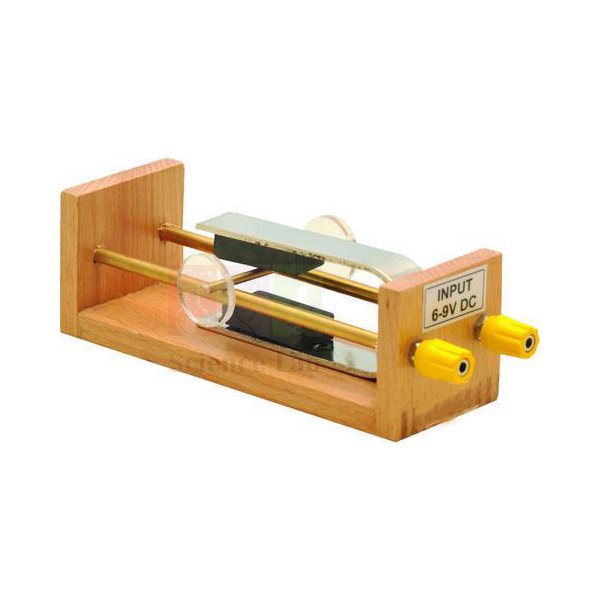
Force on a Conductor Apparatus
Force on a Conductor Apparatus (Product Code: SLE/PHY/98) is a rolling-axle demonstration used to show the force on a current-carrying conductor in a magnetic field, the motor effect behind Fleming's left-hand rule, in physics lessons. A brass axle resting on a pair of brass rails between the poles of a strong U-shaped magnet rolls away from the centre of the field as soon as a power supply is connected. It is manufactured by Jain Scientific Equipments Pvt Ltd (ScienceLab), an OEM manufacturer, at its own factory in Ambala, India.
Specifications
| Parameter | Detail |
|---|---|
| Magnet | Strong U-shaped magnet |
| Rails | Pair of brass rails with 4 mm socket terminals |
| Conductor | Brass axle with plastic discs, free to roll along the rails |
| Electrical contact | The axle completes the circuit between the two rails |
| Observed effect | Axle is repelled and rolls away from the centre of the magnetic field |
| Power | External power supply unit, connected at the rail terminals |
| Product code | SLE/PHY/98 |
| Manufacturer | Jain Scientific Equipments Pvt Ltd (ScienceLab) — OEM |
| Country of origin | India (made in Ambala, Haryana) |
What Is the Force on a Conductor Apparatus Used For?
Current flows along one rail, through the brass axle and back along the other, so the axle itself becomes the conductor lying across the magnetic field. The resulting force pushes it along the rails, and reversing either the current or the magnet reverses the direction it rolls, letting students check Fleming's left-hand rule for themselves. It is a staple piece of physics practical equipment for showing the principle behind every electric motor.
Connect a low-voltage supply to the 4 mm socket terminals and switch on only briefly, since the path through the axle has very little resistance. Keep the rails and axle clean so the contact stays good, and store the U-shaped magnet carefully to preserve its strength.
What to Specify When Ordering
- Number of sets, for a teacher demonstration or for group practicals.
- Whether a suitable low-voltage, high-current supply should be quoted as well.
- 4 mm leads for connecting the rails to the supply.
- Delivery location for packing and freight.
OEM Manufacturer
ScienceLab is the trading name of Jain Scientific Equipments Private Limited, which manufactures this force-on-a-conductor apparatus as the OEM at its own factory at Saha, Ambala, Haryana. Schools, universities, dealers and importers buy it direct from the maker, and questions about a spare axle or magnet are answered at source. For vendor registration, institutional and tender buyers can use GSTIN 06AAECJ8618A1ZT and LEI 3358004HRD1JIVXKYX49. The company profile gives more information.
Related Physics Lab Equipment
Supplies, magnets and alternatives for motor-effect practicals:
- Apparatus Force of Conductor — a Fleming's law version with a brass axle rolling on rails.
- Electromagnetic Power Supply — a low-voltage, high-current supply intended for Fleming's apparatus.
- Power Supply, Stepped — an AC/DC bench supply for general electricity practicals.
- Steel Horseshoe Magnet — horseshoe magnets with keepers for further magnetic field work.
- Stackable Leads — 4 mm leads for connecting the rails to the supply.
See more electromagnetism apparatus in Physics Lab Equipment.
Frequently Asked Questions
What does the Force on a Conductor Apparatus demonstrate?
The Force on a Conductor Apparatus demonstrates that a current-carrying conductor in a magnetic field experiences a force. When a supply is connected, the brass axle between the magnet's poles is repelled and rolls along the rails away from the centre of the field.
What parts make up the Force on a Conductor Apparatus?
The Force on a Conductor Apparatus comprises a strong U-shaped magnet, a pair of brass rails with 4 mm socket terminals, and a brass axle with plastic discs that rolls freely along the rails and completes the electrical contact between them.
What power supply does the apparatus need?
The Force on a Conductor Apparatus needs an external power supply unit connected to its 4 mm socket terminals, and the listing does not name a specific one. A low-voltage, high-current type such as the Electromagnetic Power Supply is worth discussing with us.
How does the apparatus relate to Fleming's left-hand rule?
The Force on a Conductor Apparatus lets students test Fleming's left-hand rule directly: field, current and motion are at right angles, and reversing either the current or the magnet makes the brass axle roll the opposite way along the rails.
Who manufactures the Force on a Conductor Apparatus?
Jain Scientific Equipments Pvt Ltd (ScienceLab) manufactures the Force on a Conductor Apparatus as the OEM at its own factory in Saha, Ambala, Haryana, India, and supplies it direct to schools, colleges, dealers and importers.
Can the Force on a Conductor Apparatus be ordered for export?
Yes. The Force on a Conductor Apparatus can be quoted for single laboratories or larger orders from institutions and distributors in India and international markets. Include the quantity, any power supplies or leads, and the destination when you contact us.
Request a Quote
For a quotation on the Force on a Conductor Apparatus, write to us through the contact page or add it to the enquiry cart along with any supply you need. Prices come straight from the manufacturer.
Last updated: 24 September 2026
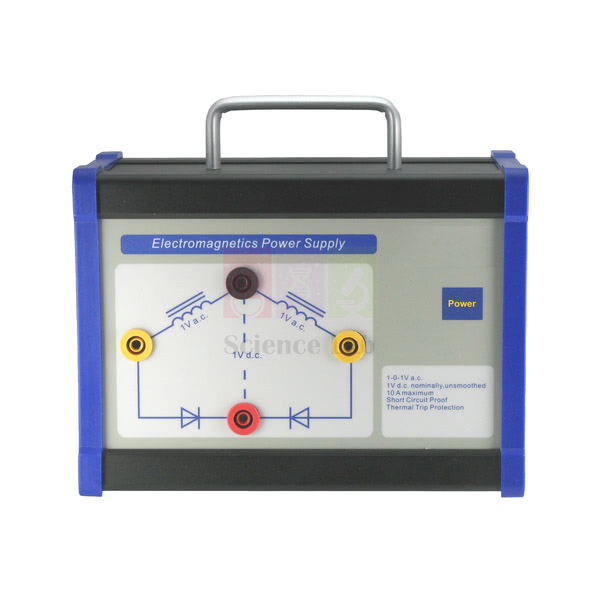
Electromagnetic Power Supply
Electromagnetic Power Supply (Product Code: SLE/PHY/99) is a low-voltage, high-current bench supply used to power electromagnetism kits and Fleming's apparatus in school and college physics labs. It gives students access to 1 V a.c. from a 1-0-1 V a.c. output or 2 V d.c. (unsmoothed), tolerates short circuits and has a short-circuit current of 10 A. It is supplied by Jain Scientific Equipments Pvt Ltd (ScienceLab), Ambala, India.
Specifications
| Parameter | Detail |
|---|---|
| Input voltage | 230 V ±10%, 50 Hz |
| Outputs | 1-0-1 V a.c. nominal; 2 V d.c. nominal |
| Student access | 1 V a.c. or 2 V d.c. |
| D.C. output | Rectified from 2 V a.c., unsmoothed |
| Short circuit | Tolerated; short-circuit current 10 A |
| Rectifier | 40 A Schottky barrier diode |
| Protection | Transformer protected by thermal fuses and a slow-blow fuse |
| Dimensions (W x H x D) | 208 x 155 x 115 mm |
| Height including handle | 187 mm |
| Product code | SLE/PHY/99 |
| Supplied by | Jain Scientific Equipments Pvt Ltd (ScienceLab), Ambala, India |
What Is the Electromagnetic Power Supply Used For?
Electromagnetism practicals such as the force on a conductor need a large current at a very low voltage, which general-purpose school supplies are not built to give. This unit fills that gap: its 1 V a.c. and 2 V d.c. outputs let a low-resistance conductor carry a heavy current, so the forces and fields involved are strong enough to see. It is a specialised power supply unit for the physics lab, and because the d.c. output is unsmoothed it is meant for these demonstrations rather than for sensitive electronics.
The supply tolerates short circuits, and its transformer is guarded by thermal fuses and a slow-blow fuse, which suits student benches where leads are often shorted by mistake. Use leads suited to heavy current and switch off between experiments. At 208 x 155 x 115 mm with a carrying handle, it moves easily from bench to bench.
What to Specify When Ordering
- Number of units required per laboratory.
- The apparatus it will power, such as Fleming's apparatus or an electromagnetism kit, so suitability can be checked.
- Your mains supply, since the unit's input is 230 V ±10%, 50 Hz.
- Any heavy-current leads you want quoted with it.
Supplier
Jain Scientific Equipments Private Limited, which trades as ScienceLab, supplies this electromagnetic power supply to schools, colleges, dealers and importers as part of its physics laboratory range. Quoting it together with the force-on-a-conductor apparatus or other electromagnetism kits it serves lets a department equip a complete practical in one order. Learn more about the company on the profile page.
Related Physics Lab Equipment
Apparatus powered by this supply, and alternative supplies for other work:
- Force on a Conductor Apparatus — a rolling-axle motor-effect demonstration that needs a heavy-current supply.
- Apparatus Force of Conductor — a Fleming's law apparatus with a brass axle on rails.
- Power Supply, Stepped — a stepped AC/DC supply for general electricity practicals.
- Power Supply, Smoothed — a smoothed supply for electronics work where ripple matters.
- Stackable Leads — 4 mm leads for connecting apparatus to the supply.
Browse more supplies and apparatus in Physics Lab Equipment.
Frequently Asked Questions
What outputs does the Electromagnetic Power Supply provide?
The Electromagnetic Power Supply provides a 1-0-1 V a.c. nominal output, giving students access to 1 V a.c., and a 2 V d.c. nominal output produced by rectifying 2 V a.c. The d.c. output is unsmoothed.
Is the Electromagnetic Power Supply protected against short circuits?
Yes. The Electromagnetic Power Supply tolerates short circuits, with a short-circuit current of 10 A. Its transformer is protected by thermal fuses and a slow-blow fuse, and a 40 A Schottky barrier diode handles the rectification.
What mains input does the Electromagnetic Power Supply need?
The Electromagnetic Power Supply runs from a 230 V ±10%, 50 Hz mains input. Buyers in regions with a different mains voltage or frequency should mention this in their enquiry so suitability can be checked before quoting.
How big is the Electromagnetic Power Supply?
The Electromagnetic Power Supply measures 208 x 155 x 115 mm (W x H x D), and its height including the handle is 187 mm, so it sits comfortably on a standard laboratory bench.
Can the Electromagnetic Power Supply be used for electronics circuits?
The Electromagnetic Power Supply is designed for low-voltage, high-current electromagnetism work, and its 2 V d.c. output is unsmoothed. For electronics circuits that need a steady d.c. supply, a smoothed bench power supply is the better choice.
Is a test or calibration certificate available for this power supply?
Documentation for the Electromagnetic Power Supply, such as a test or calibration certificate, should be discussed with us before ordering. Please state what your institution or tender requires through the contact page so we can confirm what can be provided.
Who supplies the Electromagnetic Power Supply?
The Electromagnetic Power Supply is supplied by Jain Scientific Equipments Pvt Ltd (ScienceLab), Ambala, India, to schools, colleges, dealers and importers in India and international markets. Contact us with quantities and the apparatus it will power for a quotation.
Request a Quote
To request a price for the Electromagnetic Power Supply, send the quantity and the apparatus you plan to use it with through the contact page, or add it to the enquiry cart. ScienceLab will reply with a quotation.
Last updated: 24 September 2026
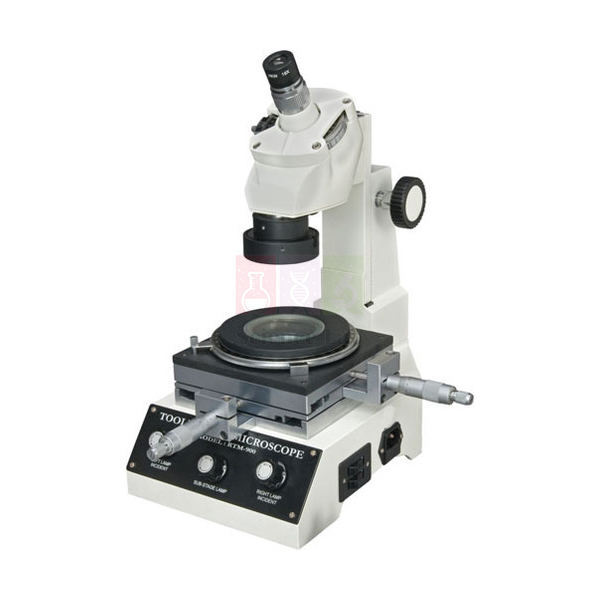
Toolmaker Microscope
Toolmaker Microscope (Product Code: SLE/M/35) is an optical measuring microscope used to measure angles, thickness, radius, diameter and similar dimensions of small components in engineering metrology and workshop laboratories. It combines 30x viewing with a 150 x 150 mm X-Y measuring stage read by micrometers to 0.01 mm or 0.005 mm. It is supplied by Jain Scientific Equipments Pvt Ltd (ScienceLab), Ambala, India, among its test and measurement instruments in India.
Specifications
| Parameter | Detail |
|---|---|
| Measurements | Angles, thickness, radius, diameter and similar dimensions |
| Magnification | 30x (2x objective with 15x eyepiece) |
| Field of view | 12 mm |
| Working distance | About 100 mm |
| Microscope tube | Inclined at 45° |
| Measuring stage | 150 x 150 mm, with travel in X and Y directions |
| Travel range | 50 x 50 mm |
| Micrometers | 25 mm each, least count 0.01 mm or 0.005 mm |
| Rotary stage | Graduated 0–360°, vernier reading 6 minutes |
| Illumination | Inclined transmitted light with separate intensity control |
| Product code | SLE/M/35 |
| Supplied by | Jain Scientific Equipments Pvt Ltd (ScienceLab), Ambala, India |
What Is the Toolmaker Microscope Used For?
In a metrology lab, the toolmaker microscope measures features that are too small or too delicate for callipers: the pitch and flank angle of a screw thread, the radius on a form tool, the diameter of a small drilled hole, the thickness of a shim or the profile of a gear tooth. Students align one edge of the feature with the eyepiece reference, note the micrometer reading, move the stage to the opposite edge and take the difference.
Transmitted light from below turns the part into a sharp silhouette, which makes edges easy to pick up at 30x, and the inclined illumination helps with helical features such as threads. For angles, the rotary stage is turned until a line in the field matches the second edge and read to 6 minutes on the vernier. It is a standard item of engineering lab equipment in India for polytechnic, ITI and mechanical engineering courses.
What to Specify When Ordering
- Micrometer least count: 0.01 mm or 0.005 mm
- Number of instruments for the metrology laboratory
- Mains voltage for the illumination
- Any documentation you need, such as a calibration record, so we can check availability
Supplier
Jain Scientific Equipments Private Limited, known by its trading name ScienceLab, supplies the Toolmaker Microscope from Ambala, Haryana, to engineering colleges, polytechnics, training institutes, dealers and importers in India and international markets. It can be quoted together with other measuring instruments for a complete metrology bench. Learn more on the ScienceLab profile.
Related Laboratory Equipment
Other measuring instruments used in the same metrology practicals:
- Vernier Travelling Microscope — for linear measurements with a vernier scale
- Crack Measuring Microscope — a portable measuring microscope for surface features
- Micrometer Screw Gauge, Lock Type — to cross-check outside dimensions
- Vernier Calliper — for larger dimensions before optical measurement
See our Microscope category for further optical instruments.
Frequently Asked Questions
What can be measured with the Toolmaker Microscope?
The Toolmaker Microscope is designed for measuring angles, thickness, radius, diameter and similar dimensions of small parts. Typical laboratory tasks include checking thread angles, tool radii, hole diameters and component profiles that are difficult to measure with contact instruments.
What magnification and working distance does the Toolmaker Microscope offer?
The Toolmaker Microscope gives 30x magnification from a 2x objective and a 15x eyepiece, with a 12 mm field of view and a working distance of about 100 mm. The microscope tube is inclined at 45° for comfortable viewing.
How fine are the linear readings on the Toolmaker Microscope?
The Toolmaker Microscope's 150 x 150 mm stage travels 50 x 50 mm in X and Y, driven by two 25 mm micrometers. The micrometers are listed with a least count of 0.01 mm or 0.005 mm, so state the version you need when ordering.
How are angles measured on the Toolmaker Microscope?
Angles are measured on the Toolmaker Microscope with its rotary stage, which is graduated from 0 to 360° and fitted with a vernier reading to 6 minutes. The part is rotated until each edge lines up with the reference in the field, and the difference is read off.
Is a calibration certificate available for the Toolmaker Microscope?
Calibration-certificate availability for the Toolmaker Microscope should be discussed with us before you order. Include the requirement in your enquiry through the contact page, and we will confirm what documentation can be supplied with the instrument.
Who supplies the Toolmaker Microscope?
The Toolmaker Microscope is supplied by Jain Scientific Equipments Pvt Ltd, trading as ScienceLab, Ambala, Haryana, India. The company serves engineering colleges, polytechnics, training institutes, dealers and importers in India and international markets.
Request a Quote
Send the micrometer least count you prefer and the quantity for the Toolmaker Microscope through our contact page, or add it to the enquiry cart with other metrology instruments for one combined quotation.
Last updated: 24 September 2026
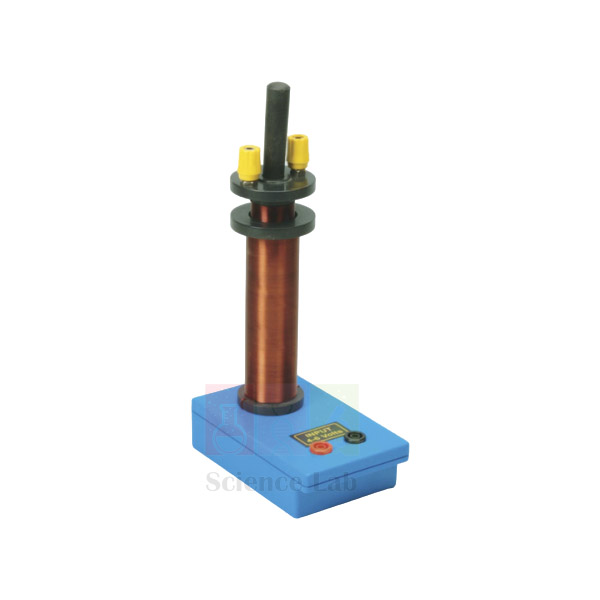
Induced Current Apparatus
Induced Current Apparatus (Product Code: SLE/PHY/100) is a two-coil demonstration set used to show how a changing magnetic field produces an electric current in school and college physics laboratories. Teachers use it for electromagnetic induction and mutual induction lessons, and its soft iron core fits the primary cylinder to strengthen the effect. It is made by Jain Scientific Equipments Pvt Ltd (ScienceLab), an OEM manufacturer, at its own factory in Ambala, India, as a practical electromagnetic induction kit for Indian classrooms.
Key Details
| Parameter | Detail |
|---|---|
| Primary coil | Insulated copper wire wound upon a cylinder, fitted with terminals |
| Secondary coil | Wound upon a cylinder into which the primary coil fits |
| Core | Soft iron core that fits the cylinder of the primary |
| Connections | Supplied complete with terminals |
| Product code | SLE/PHY/100 |
| Manufacturer | Jain Scientific Equipments Pvt Ltd (ScienceLab) — OEM |
| Country of origin | India (made in Ambala, Haryana) |
What Is the Induced Current Apparatus Used For?
The apparatus lets students see Faraday's law at work. Connect the secondary coil to a centre-zero galvanometer and the primary coil to a cell through a tap key: each time the primary circuit is made or broken, the needle kicks briefly, first one way and then the other. Pushing the energised primary into the secondary, or pulling it out, gives the same result and shows that only a change in magnetic flux induces a current.
Adding the soft iron core to the primary cylinder makes the deflections noticeably larger, a simple way to discuss how iron concentrates magnetic flux in transformers and induction coils. For clear readings, reverse the galvanometer connections to show that the direction of the induced current depends on the change, and switch the primary off between trials so the coil does not warm up. It is a dependable piece of physics lab equipment for schools in India preparing electromagnetism practicals.
OEM Manufacturer
The Induced Current Apparatus is made and assembled by ScienceLab, the trading name of Jain Scientific Equipments Private Limited, at its own licensed factory at Saha, Ambala, Haryana, India. As the original equipment manufacturer, the company produces this coil set at its factory rather than sourcing it from a trader, so schools, colleges, dealers and importers buy it factory-direct. Questions about a replacement coil or a spare soft iron core go straight to the manufacturer — just ask us. Learn more about the company on our company profile.
Related Physics Lab Equipment
These items complete an induction practical built around this apparatus:
- Galvanometer, Centre Zero Universal Meter — shows the direction and size of the induced current.
- One Way Key — makes and breaks the primary circuit cleanly.
- Connecting Wire — links the coils to the meter and the cell.
- Primary and Secondary Coil Set — an alternative coil pair for mutual induction work.
- Eddy Current Unit — extends the lesson to induced currents in solid conductors.
See the complete Physics Lab Equipment range.
Frequently Asked Questions
What is included with the Induced Current Apparatus?
The Induced Current Apparatus includes a primary coil of insulated copper wire wound on a cylinder with terminals, a secondary coil on a cylinder that receives the primary, and a soft iron core that fits the primary cylinder. A galvanometer, cell and leads are not part of the listing.
What else do I need to demonstrate electromagnetic induction?
To demonstrate induction with the Induced Current Apparatus you also need a sensitive centre-zero galvanometer for the secondary coil, a low-voltage DC source such as a cell for the primary, a tap key and connecting leads. We can quote these accessories together with the coils.
Why does the apparatus come with a soft iron core?
The soft iron core of the Induced Current Apparatus concentrates the magnetic field of the primary coil, so the change in flux through the secondary is larger. Students therefore see a bigger galvanometer deflection with the core in place than when the coils are used with air alone.
Who manufactures the Induced Current Apparatus?
The Induced Current Apparatus is manufactured by Jain Scientific Equipments Pvt Ltd, trading as ScienceLab, which is the OEM. It is made at the company's own factory at Saha, Ambala, Haryana, India, and supplied direct to schools, colleges, dealers and importers.
What should I include in a quotation request?
When requesting a quote for the Induced Current Apparatus (SLE/PHY/100), state the number of sets, whether you also need galvanometers, keys and leads, and the delivery address. Send these details through our contact page and the manufacturer will reply with a quotation.
Do you supply schools in bulk and handle export orders?
Yes. The Induced Current Apparatus is supplied in bulk for school and college laboratories and to dealers across India and international markets. Tell us the quantity and destination through the contact page, and we will confirm packing and dispatch details with the quotation.
Request a Quote
To get a quotation for the Induced Current Apparatus, contact ScienceLab or add it to the enquiry cart. Quotations come straight from the manufacturer, with no trading intermediary.
Last updated: 24 September 2026
