- Physics Lab Equipment
- Chemistry Lab Equipment
- Biology Lab Equipment
- Anatomical Lab Equipment
- Learning
- Educational Lab Equipment
- Magnets
- Agriculture
- Astronomy
- Earth Science
- Geography Lab Equipment
- Safety Lab Coat
- Laboratory
- Meteorological
- Electricity & Magnetism
- Heat
- School Lab Equipment
- Lab Glassware
- Science Lab Equipment
- Tvet Lab Equipment
- Robotics Kits Supplier and Manufacturer for Schools India
- Math Lab Equipment Manufacturers and Exporters in Ambala
- STEM Kits Manufacturers and Supplier India
- Engineering Lab Equipment
- Hospital Lab Equipment
- Water, Sanitation & Hygiene Supplies
- Cold Chain, Solar & Communication Equipment
- Nutrition
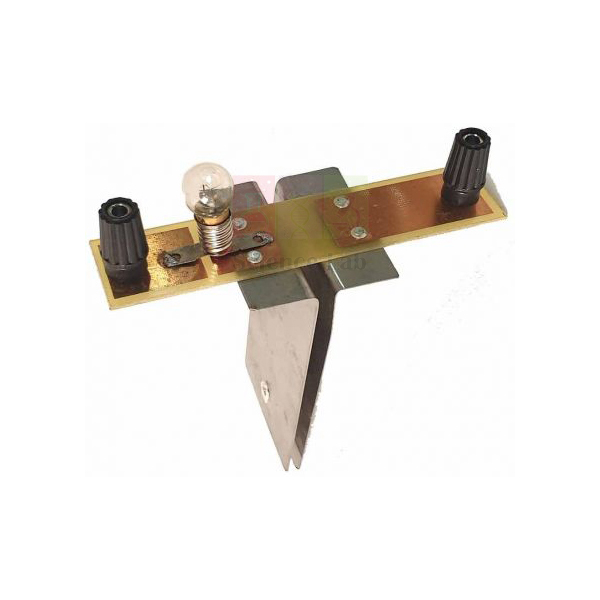
Conductivity Demonstrator
Conductivity Demonstrator (Product Code: SLE/CH/99) is a simple classroom apparatus that shows at a glance whether a liquid conducts electricity. Two platinum electrodes are mounted on a non-conductive support together with a light globe and terminals; connected to a power source and dipped into a solution, the globe glows when the liquid carries a current and stays dark when it does not. Science and chemistry teachers in middle and secondary schools use it to separate electrolytes from non-electrolytes in front of the whole class. It is made by Jain Scientific Equipments Pvt Ltd (ScienceLab), Ambala, a school laboratory equipment supplier in India.
Specifications
| Parameter | Detail |
|---|---|
| Electrodes | Two platinum electrodes |
| Mounting | Non-conductive support |
| Indicator | Light globe |
| Connections | Terminals for attaching the power supply |
| Power source | Battery pack or 6V power supply |
Typical Use
Connect the terminals to a battery pack or 6V power supply, then lower the electrodes into a beaker of the test liquid. Salt solution or dilute acid lights the globe, while distilled water or sugar solution leaves it dark, which gives students a clear, visual contrast between ionic and molecular substances. Comparing the brightness across several solutions also opens a discussion of strong and weak electrolytes.
Rinse the electrodes in distilled water and blot them dry between samples so one solution does not contaminate the next, and disconnect the power before changing beakers. Platinum is chosen for the electrodes because it resists attack by the acids and salt solutions being tested. A chemistry lab instruments supplier can quote the demonstrator together with beakers and leads so the activity is ready to run.
Manufacturer
The Conductivity Demonstrator comes from Jain Scientific Equipments Private Limited, which operates under the ScienceLab name in Ambala, Haryana, India, producing science teaching apparatus. See our company profile for more about the business.
Related Laboratory Equipment
Items used alongside the demonstrator in a conductivity lesson:
- Glass Beaker — holds each test solution for the electrodes to dip into
- Crocodile Clips & Leads — for wiring the terminals to the power source
- Battery Holder, C — for making up a battery pack when mains power is not available
- Power Supply Variable — a bench supply option; confirm with us that it can deliver the 6V required
- Conductivity of Solutions Apparatus — an alternative apparatus for the same topic
Find further teaching apparatus in the Chemistry Lab Equipment category.
Frequently Asked Questions
What does the Conductivity Demonstrator show?
Whether a solution conducts electricity: the light globe glows for conducting liquids and stays off for non-conducting ones.
What power source does it need?
A battery pack or a 6V power supply connected to its terminals. If you want a supply quoted with it, mention this in your enquiry.
Why are the electrodes platinum?
Platinum is highly resistant to corrosion, so the electrodes stay clean and consistent when dipped into acids, bases and salt solutions.
Does it give a numerical conductivity reading?
No. It is a qualitative demonstrator; quantitative work needs a conductivity meter.
How should the electrodes be cleaned?
Rinse them in distilled water after each solution and dry gently. Do not scrape the platinum surfaces.
Is a replacement globe available?
Spare-part availability is not listed here; please ask through our contact page.
Can you quote for several schools at once?
Yes. Share the quantity for each delivery point and we will prepare a consolidated quotation for India or international delivery.
Request a Quote
Add this demonstrator to the enquiry cart or contact us to receive a quotation.
Last updated: 24 September 2026
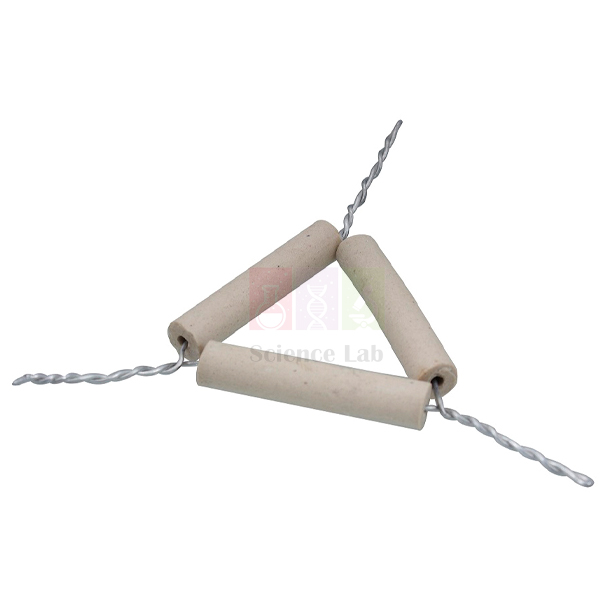
Pipeclay Triangle
Pipeclay Triangle (Product Code: SLE/CH/100) is a heating support used in laboratories when a substance must be heated directly over a Bunsen burner. The substance, usually held in a crucible or small dish, is placed in the triangle framework, which rests across a tripod or retort ring so the flame can reach the base of the vessel. It is a routine item in school and college chemistry practicals such as heating salts, igniting precipitates and burning metals in air. It is made by Jain Scientific Equipments Pvt Ltd (ScienceLab), Ambala, as part of its school chemistry lab equipment for India and international buyers.
Key Details
| Parameter | Detail |
|---|---|
| Type | Pipeclay triangle |
| Purpose | Holding a substance in its framework while it is heated |
| Heat source | Bunsen burner |
| Suitable for | Laboratory heating work in schools, colleges and teaching labs |
| Supplied as | Individual triangle; ask us about available sizes |
Typical Use
Set the triangle on a tripod or retort ring, seat the crucible so it sits securely in the framework with part of its body below the triangle, and light the Bunsen burner beneath. Classic practicals include heating hydrated copper sulphate to drive off water of crystallisation, heating magnesium ribbon in a lidded crucible to find the formula of its oxide, and igniting a filtered precipitate to constant mass in gravimetric analysis.
Choose a triangle that matches the crucible size so the vessel neither falls through nor perches on top. Lift hot crucibles with tongs, let the triangle cool in air on a heat-resistant surface, and never plunge it into water, as sudden cooling can crack it. Flat-bottomed glassware such as beakers belongs on a wire gauze instead. Schools buying chemistry lab equipment in India usually order triangles, tripods and crucibles together as a heating set.
Manufacturer
Jain Scientific Equipments Private Limited carries out business as ScienceLab from Ambala, Haryana, India, manufacturing apparatus for school, college and technical laboratories. More information is available in our company profile.
Related Chemistry Lab Equipment
The rest of a standard crucible-heating set-up:
- Crucible with lid — the vessel most often heated in a pipeclay triangle
- Tripod, Stainless Steel — supports the triangle over the burner
- Crucible Retort Ring — an alternative support when working on a retort stand
- Bunsen Burner — the heat source for the set-up
- Crucible Tong — for lifting hot crucibles in and out of the triangle
View all heating and bench apparatus in our Chemistry Lab Equipment category.
Frequently Asked Questions
What is a Pipeclay Triangle used for?
It holds a substance, normally in a crucible, steady in its framework while it is heated by a Bunsen burner.
What sizes are available?
Sizes are not listed on this page. Tell us the crucible sizes you use through our contact page and we will suggest a match.
Do I need a tripod as well?
Yes. The triangle rests across a tripod or a retort ring; it does not stand on its own.
Can I heat a beaker on it?
No. It is meant for crucibles and similar small vessels. Use a wire gauze under beakers and flasks.
How do I make it last longer?
Let it cool naturally after heating, avoid knocking it against hard surfaces, and replace it if it shows cracks.
Do you supply triangles in bulk for schools?
Yes. We supply institutions and distributors in India and international markets; include quantities and delivery details in your enquiry.
Request a Quote
Add the Pipeclay Triangle to our enquiry cart or send a message via the contact page for a quotation.
Last updated: 24 September 2026
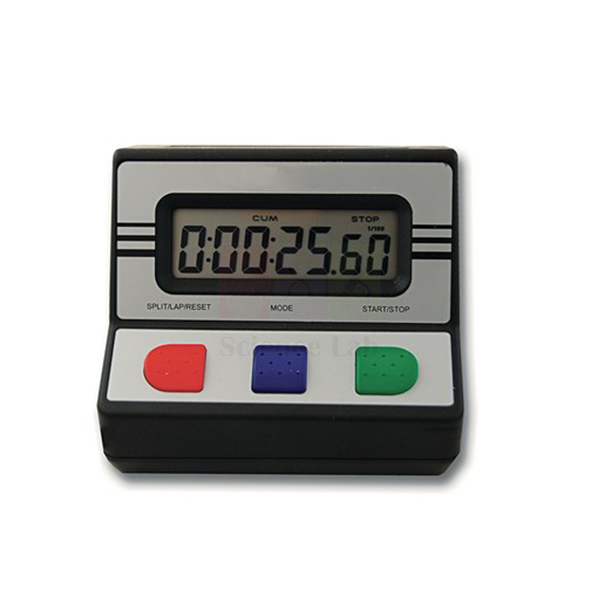
Bench Timer
Bench Timer (Product Code: SLE/ME/39) is a bench-top digital timer used to time practical work, reactions and demonstrations in school science laboratories. It counts up to 9 hours, 59 minutes and 59 seconds with lap and split timing, and its colour-coded buttons and clear LCD display sit in a robust ABS casing that stands up to everyday student use. It is supplied by Jain Scientific Equipments Pvt Ltd (ScienceLab), Ambala, India, complete with operating instructions and batteries.
Specifications
| Parameter | Detail |
|---|---|
| Type | Bench-top count-up timer, particularly suited to schools |
| Timing period | Up to 9 hours, 59 minutes and 59 seconds |
| Timing functions | Count up, lap timing and split timing |
| Display | Clear LCD |
| LCD dimensions | 63.7 x 19.7 mm |
| Controls | Colour-coded buttons |
| Casing | Robust ABS |
| Overall dimensions | 100 x 90 x 70.5 mm |
| Supplied with | Full operating instructions and batteries |
| Product code | SLE/ME/39 |
| Supplied by | Jain Scientific Equipments Pvt Ltd (ScienceLab), Ambala, India |
What Is a Bench Timer Used For?
A bench timer stands where the whole group can see it, which makes it practical for any experiment that runs for a set time or needs elapsed time recorded: rate-of-reaction work such as the disappearing-cross test, cooling curves, dissolving and diffusion practicals, and timed observations of yeast or germinating seeds. Lap timing records successive intervals without stopping the count, while split timing holds an intermediate reading on screen as the timer keeps running.
The long timing period also covers extended runs such as drying, evaporation or crystal-growth checks spread across a school day. Colour-coded buttons help younger students start, stop and reset without confusion, and keeping spare batteries in the prep room avoids a timing being lost halfway through a lesson. It sits as comfortably among physics lab equipment for schools in India as it does on chemistry and biology benches.
Supplier
Jain Scientific Equipments Private Limited, trading as ScienceLab from Ambala, Haryana, supplies this Bench Timer to schools, colleges, training institutes and dealers in India and international markets. The timer can be quoted on its own or together with stopwatches and other measuring instruments to equip every bench in a practical room. Company details are on the ScienceLab profile page.
Related Measuring Equipment
Other timing instruments to compare with, or order alongside, the Bench Timer:
- Bench Stopwatch — another bench-standing timer that also works as a clock with alarm.
- Digital Stopclock — a digital stopclock alternative for timing class experiments.
- Stopwatch, Digital — a handheld timer for individual students and field work.
- Reaction Timer — for measuring human reaction times in biology practicals.
Browse the full Measuring category for more instruments.
Frequently Asked Questions
How long can the Bench Timer time?
The Bench Timer has a timing period of up to 9 hours, 59 minutes and 59 seconds. It counts up from zero, so it suits both short rate-of-reaction experiments and longer practical sessions that run for most of a school day.
Does the Bench Timer have lap and split timing?
Yes. The Bench Timer counts up and offers lap and split timing, so students can record several intervals or intermediate readings during a single run, such as successive stages of a reaction, without restarting the timer.
Are batteries included with the Bench Timer?
Yes. The Bench Timer is supplied complete with batteries and full operating instructions, so it can go into use on the bench as soon as it arrives. Ask us if you need the battery type confirmed before ordering.
What size are the Bench Timer and its display?
The Bench Timer measures 100 x 90 x 70.5 mm overall, and its clear LCD display is 63.7 x 19.7 mm. The compact ABS body takes little bench space while keeping the readout visible to a small group of students.
Who supplies the Bench Timer?
The Bench Timer is supplied by Jain Scientific Equipments Pvt Ltd (ScienceLab), Ambala, Haryana, India. Schools, colleges and dealers in India and international markets can request quotations for single timers or for a set covering every bench.
Can the Bench Timer be ordered in class sets?
Yes. The Bench Timer can be quoted in class sets, for example one per bench group, for schools, tenders and dealers. Give the quantity and delivery location through the contact page to receive a quotation.
Request a Quote
Request a quotation for the Bench Timer through the contact page, or add it to the enquiry cart together with stopwatches, thermometers and other measuring items for your laboratory.
Last updated: 24 September 2026
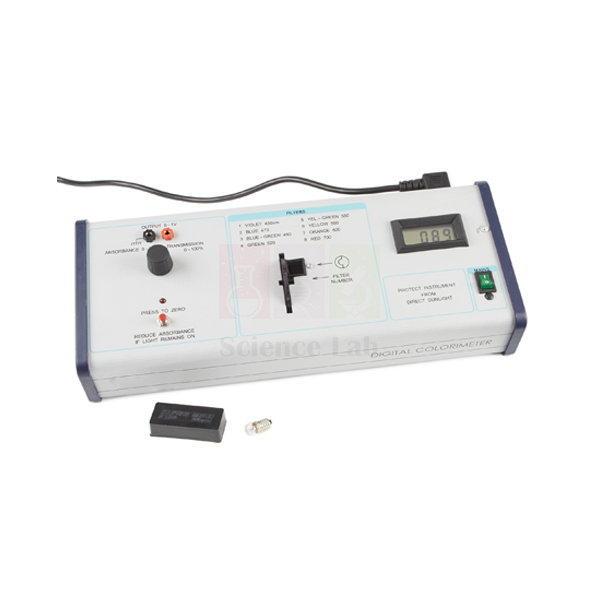
S-Range Digital Colorimeter - 240V
S-Range Digital Colorimeter - 240V (Product Code: SLE/ME/40) is a single-cuvette digital colorimeter used to measure the absorbance and transmission of coloured solutions in school, college and teaching laboratories. Chemistry and biology teachers use it for concentration and reaction-rate work, and its eight colour filters span 430–700 nm with push-button automatic zeroing. It is supplied by Jain Scientific Equipments Pvt Ltd (ScienceLab), Ambala, India, a laboratory analytical instruments supplier.
Specifications
| Parameter | Detail |
|---|---|
| Absorbance ranges | 0–1 (linear) and 0–2 |
| Transmission range | 0–100% (linear) |
| Max. initial absorbance of reference solution | 0.8A, 1.0A, 10% (as listed for the ranges) |
| Zero adjustment | Automatic, push-button zeroing with LED indicator (automatic gain control) |
| Light source | 6V, 0.15A MES lamp |
| Filters | 8 colour filters, 430–700 nm (violet to red), in a rotatable filter holder |
| Detector | Silicon photodiode |
| Output | 0–1V sockets, fitted as standard, for dataloggers or computers |
| Cuvette holder | Single holder for 10 mm path length cuvettes |
| Ambient light | Insensitive to normal ambient lighting |
| Mains version | 240V |
| Dimensions | 380 × 160 × 80 mm |
| Mass | 1.5 kg |
| Supplied with | 2 m detachable mains cable, filter disc, spare lamp, dust cover for the filter disk and cuvette socket |
| Product code | SLE/ME/40 |
| Supplied by | Jain Scientific Equipments Pvt Ltd (ScienceLab), Ambala, India |
What Is the S-Range Digital Colorimeter Used For?
Colorimetry lets students turn the intensity of a colour into a number. With the S-Range Digital Colorimeter, a class can prepare standard solutions, plot absorbance against concentration to demonstrate the Beer–Lambert relationship, and then read an unknown sample from the calibration line. The same instrument follows colour changes over time in reaction-rate and enzyme experiments, which makes it a versatile colorimeter for India's school and college labs.
Choose the filter whose colour is complementary to the solution (for example, a red or orange filter for a blue solution), zero the instrument on a blank with one press of the switch, then insert each sample cuvette in turn. Because the colorimeter is insensitive to normal room lighting, the lab does not need to be darkened, and the 0–1V output can feed a datalogger or computer for continuous recording.
What to Specify When Ordering
- Confirm that your mains supply suits the 240V version.
- Number of cuvettes needed — the single holder takes 10 mm path length cuvettes.
- Whether a Spare Colour Filter Wheel should be quoted with the instrument.
- Whether you will connect the 0–1V output to a datalogger or computer, so we can advise on the connection you need.
Supplier
ScienceLab, the trading name of Jain Scientific Equipments Private Limited in Ambala, Haryana, sources and supplies the S-Range Digital Colorimeter - 240V to schools, colleges, teaching laboratories and dealers. The matching spare filter wheel is listed separately, so replacement parts can be requested on the same enquiry as the instrument. Company details are on the ScienceLab company profile.
Related Measuring Equipment
Items that complete a colorimetry practical with this instrument:
- Spare Colour Filter Wheel for S-Range Digital Colorimeter — a replacement eight-filter wheel for this colorimeter.
- Plastic Cuvettes — sample cells; check that the path length suits the 10 mm holder.
- Research Pipettors — for measuring standard and sample volumes accurately into cuvettes.
- Colourwave Colorimeter — a compact alternative with RS232 digital output.
Explore more instruments in the Measuring category.
Frequently Asked Questions
What wavelengths does the S-Range Digital Colorimeter - 240V cover?
The S-Range Digital Colorimeter - 240V has eight colour filters covering 430–700 nm, from violet to red. They are held in a rotatable filter holder, so the user can quickly select the filter that suits the colour of the test solution.
Which cuvettes fit the S-Range Digital Colorimeter - 240V?
The S-Range Digital Colorimeter - 240V has a single cuvette holder that takes cuvettes with a 10 mm path length. Tell us how many cuvettes each class needs and suitable ones can be included in the same quotation.
Can the S-Range Digital Colorimeter - 240V connect to a datalogger or computer?
Yes. The S-Range Digital Colorimeter - 240V has 0–1V output sockets fitted as standard for dataloggers or computers. The interface or cable for your particular logging system is not listed here, so please ask us before ordering.
What comes with the S-Range Digital Colorimeter - 240V?
The S-Range Digital Colorimeter - 240V is supplied with a 2 m detachable mains cable, a filter disc, a spare lamp, and a dust cover for the filter disk and cuvette socket, so it is ready for laboratory use on arrival.
Does room lighting affect the S-Range Digital Colorimeter - 240V?
No. The S-Range Digital Colorimeter - 240V is insensitive to normal ambient lighting, and its automatic gain control zeros the instrument when you press a switch, with an LED indicator showing the adjustment, so the lab need not be darkened.
Who supplies the S-Range Digital Colorimeter - 240V?
The S-Range Digital Colorimeter - 240V is supplied by Jain Scientific Equipments Pvt Ltd (ScienceLab), Ambala, Haryana, India, to schools, colleges, laboratories and dealers in India and international markets. Quotations are prepared on request through the contact page.
Is a calibration certificate available for the S-Range Digital Colorimeter - 240V?
Calibration-certificate availability for the S-Range Digital Colorimeter - 240V should be discussed with us before ordering. Mention the requirement on the contact page and we will confirm what documentation can be provided.
Request a Quote
For a quotation on the S-Range Digital Colorimeter - 240V (SLE/ME/40), send the quantity, cuvette needs and delivery location through our contact page, or add it to the enquiry cart with the spare filter wheel.
Last updated: 24 September 2026
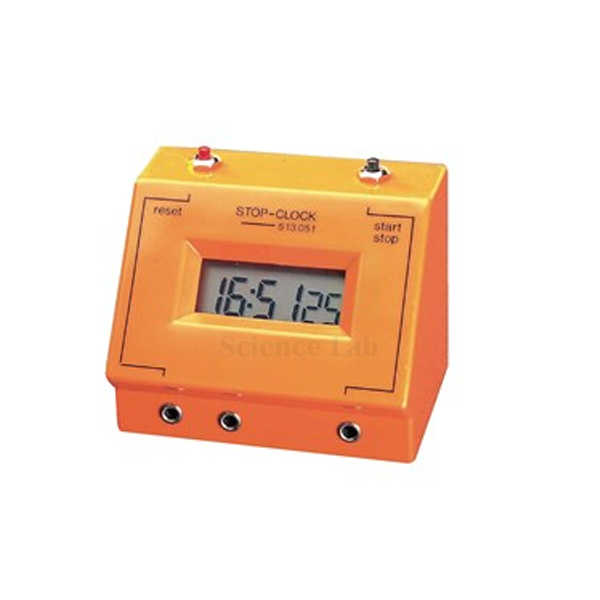
Digital Stopclock
Digital Stopclock (Product Code: SLE/ME/41) is a battery-powered digital timer used to time physics and general science experiments to 1/100 second in school and college laboratories. Its large 12 mm high display and front-panel 4 mm sockets, which let start/stop and reset be triggered externally as well as from the top-mounted push switches, set it apart from a handheld stopwatch. It is supplied by Jain Scientific Equipments Pvt Ltd (ScienceLab), Ambala, India, among its physics lab instruments.
Specifications
| Parameter | Detail |
|---|---|
| Timing range | Up to 1 hour |
| Resolution | 1/100 second |
| Timing functions | Start/stop, reset, split (lap) timing when required |
| Display | Large, 12 mm high |
| Controls | Top-mounted push switches, or front-panel 4 mm sockets |
| Power | Two AA/R6 or HP7 cells, giving many months of use |
| Light-gate work | A separate Centisecond Timer Module provides extra facilities when light gates are used |
| Product code | SLE/ME/41 |
| Supplied by | Jain Scientific Equipments Pvt Ltd (ScienceLab), Ambala, India |
What Is the Digital Stopclock Used For?
A stopclock with a display the whole bench can read is ideal for timing pendulum swings, trolley runs down a ramp, falling objects, cooling curves and the rate of simple chemical reactions. The split (lap) function records an intermediate time without stopping the count, so students can note, for example, the time for ten oscillations and then twenty in a single run.
The 4 mm sockets make it possible to wire the stopclock to external switches or contacts, so the clock starts and stops at the exact moment an event happens rather than when a student reacts. This reduces human reaction-time error and is a good way to introduce the idea of systematic error in physics lab instruments work in India's schools and colleges.
What to Specify When Ordering
- Number of stopclocks needed per laboratory or group.
- Whether AA/R6 or HP7 cells should be included with your order.
- Whether you plan external switching through the 4 mm sockets, or light-gate timing, so we can advise on suitable accessories.
Supplier
ScienceLab is the trading name of Jain Scientific Equipments Private Limited, Ambala, Haryana, and supplies the Digital Stopclock to schools, colleges and laboratory dealers alongside its wider range of timers and measuring instruments. Buyers can request timers, stopwatches and experiment apparatus on one enquiry. See the ScienceLab company profile for more about the company.
Related Measuring Equipment
Timing instruments and apparatus that pair well with the Digital Stopclock:
- Bench Stopwatch — a desk stopclock with calendar and alarm for longer sessions.
- Stopwatch, Digital — a handheld option for fieldwork and outdoor timing.
- Millisecond Timer — for experiments that need finer time resolution.
- Mathematical Pendulum Demonstration Apparatus — a classic experiment timed with a stopclock.
Find more timers and instruments in the Measuring category.
Frequently Asked Questions
How precise is the Digital Stopclock?
The Digital Stopclock times in steps of 1/100 second for periods of up to 1 hour. It also offers split (lap) timing, so intermediate times can be recorded during the same run without stopping the main count.
Can the Digital Stopclock be started by an external switch?
Yes. The Digital Stopclock has front-panel 4 mm sockets through which start/stop and reset can be operated, as an alternative to its top-mounted push switches, so an experiment can be timed from switches or contacts rather than by hand.
What batteries does the Digital Stopclock use?
The Digital Stopclock is powered by two AA/R6 or HP7 cells, which give many months of use in normal school timing. Please ask us whether cells should be included when we prepare your quotation.
Can the Digital Stopclock be used with light gates?
For light-gate work, a separate Centisecond Timer Module provides extra facilities beyond the Digital Stopclock itself. Please contact us to check which light-gate timing option we can quote for your experiment before you place an order.
Who supplies the Digital Stopclock?
The Digital Stopclock is supplied by Jain Scientific Equipments Pvt Ltd (ScienceLab), Ambala, Haryana, India. Schools, colleges, training institutes and dealers in India and international markets can request a quotation through the enquiry cart or the contact page.
What should a quotation request for the Digital Stopclock include?
When requesting the Digital Stopclock (SLE/ME/41), state the quantity, whether cells are needed, whether you plan external switching or light-gate work, and your delivery location. This lets us send an accurate quotation in one reply.
Request a Quote
To get a quotation for the Digital Stopclock (SLE/ME/41), send your requirements through the contact page or add the stopclock to the enquiry cart along with other timing apparatus.
Last updated: 24 September 2026
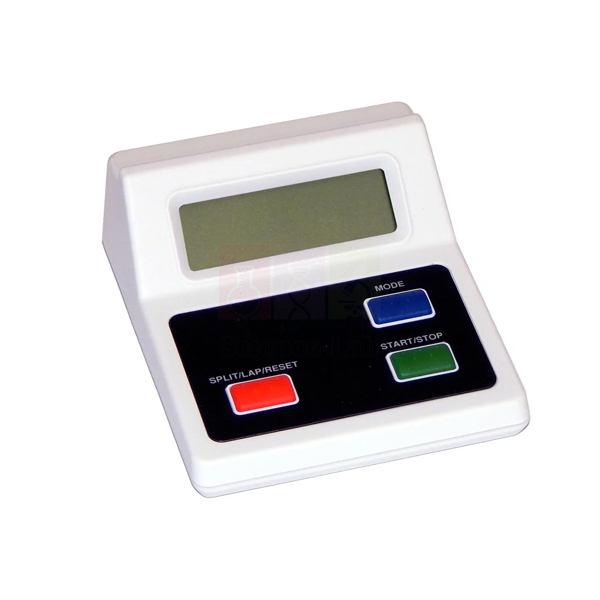
Bench Stopwatch
Bench Stopwatch (Product Code: SLE/ME/42) is a simple 1/100 second stopclock used to time experiments, practical sessions and classroom activities on school and college laboratory benches. As well as counting up to 24 hours, it works as a clock with calendar and alarm, all operated with just three buttons in a white case. It is supplied by Jain Scientific Equipments Pvt Ltd (ScienceLab), Ambala, India, with an R6 battery included, as part of its educational lab equipment for India and overseas buyers.
Specifications
| Parameter | Detail |
|---|---|
| Resolution | 1/100 second |
| Counting range | Up to 24 hours |
| Timing function | Lap facility |
| Other functions | Clock with calendar, and alarm |
| Buttons | Three: mode; split/lap/reset; start/stop |
| Case | White |
| Battery | R6, included |
| Size | L120 × W100 × H45 mm |
| Product code | SLE/ME/42 |
| Supplied by | Jain Scientific Equipments Pvt Ltd (ScienceLab), Ambala, India |
What Is the Bench Stopwatch Used For?
The Bench Stopwatch suits any practical where a group needs to share one clearly placed timer: timing a reaction until a solution turns cloudy, recording how long a candle burns under a jar, or noting the interval between readings in osmosis and rate-of-cooling experiments. Its 24-hour count also covers overnight or all-day investigations without restarting the timer.
Between experiments, the clock-and-calendar mode keeps the bench useful as a lab clock, and the alarm can remind students when the next reading is due. Keep it away from water baths and sinks, and replace the R6 battery when the display begins to fade.
Supplier
Jain Scientific Equipments Private Limited, which trades as ScienceLab from Ambala, Haryana, supplies the Bench Stopwatch to schools, colleges, coaching institutes and dealers. It is usually requested together with other timing and measuring instruments, and all of these can be included on the same quotation. Company background is available on the ScienceLab company profile.
Related Measuring Equipment
Other timers buyers compare with, or order alongside, the Bench Stopwatch:
- Bench Timer — a bench-top count-up timer with colour-coded buttons.
- Digital Stopclock — adds 4 mm sockets for starting and stopping from external switches.
- Digital Chronometer (Stopwatch) — a handheld stopwatch for individual students.
- Reaction Timer — for human reaction-time investigations in biology.
View all timers, balances and thermometers in the Measuring category.
Frequently Asked Questions
How long can the Bench Stopwatch count?
The Bench Stopwatch counts up to 24 hours in steps of 1/100 second, with a lap facility for recording intermediate times. This makes it suitable for both short reaction timings and long investigations that run through a full school day.
What extra functions does the Bench Stopwatch have?
Besides stopwatch timing, the Bench Stopwatch works as a clock with calendar and has an alarm. The alarm can be used to remind students when the next reading in a long experiment is due, keeping measurements evenly spaced.
How is the Bench Stopwatch operated?
The Bench Stopwatch uses three buttons: mode, split/lap/reset, and start/stop. This simple layout lets younger students learn to use it quickly, while the split and lap function still supports more careful timing in senior practicals.
Is a battery included with the Bench Stopwatch?
Yes, an R6 battery is included with the Bench Stopwatch, so it can be used as soon as it is unpacked. Ask us if you would like replacement R6 batteries quoted together with your order.
What is the size of the Bench Stopwatch?
The Bench Stopwatch measures L120 × W100 × H45 mm and comes in a white case. It stands on a laboratory bench where a whole group can see it, without taking up much working space.
Who supplies the Bench Stopwatch?
The Bench Stopwatch is supplied by Jain Scientific Equipments Pvt Ltd (ScienceLab), Ambala, Haryana, India. Schools, colleges and dealers in India and international markets can send quantities through the contact page to receive a quotation.
Request a Quote
Request a quotation for the Bench Stopwatch (SLE/ME/42) through the contact page, or place it in the enquiry cart with the other items on your laboratory list.
Last updated: 24 September 2026
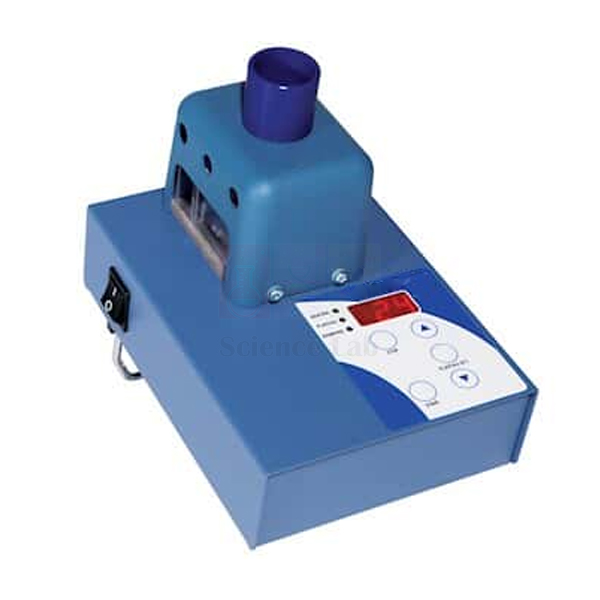
Digital Melting Point Apparatus
Digital Melting Point Apparatus (Product Code: SLE/ME/43) is a bench instrument used to determine the melting point of solid samples in chemistry, pharmacy and teaching laboratories. It heats two samples at once from ambient to 300 °C, climbing at 20 °C per minute to a chosen plateau and then at 2 °C per minute through the melt, with a PT100 sensor and a large three-digit LED readout. It is supplied by Jain Scientific Equipments Pvt Ltd (ScienceLab), Ambala, India.
Specifications
| Parameter | Detail |
|---|---|
| Number of samples | 2 |
| Temperature range | Ambient to 300 °C |
| Temperature resolution | 1 °C |
| Temperature accuracy | ±1% of displayed temperature |
| Display | Large three-digit LED |
| Sample status | Three LEDs show the state of the sample |
| Sensor | PT100 |
| Ramp rates | 20 °C per minute to plateau; 2 °C per minute to melt |
| Heating block | Behind a protective screen; heats quickly and holds the selected plateau temperature until the test is started |
| Viewing cover | Easily removed for access to the bulb and for cleaning |
| Feet | Extendable, to view samples at an optimum angle |
| Overall size | W160 x D220 x H170 mm |
| Mass | 1.8 kg |
| Product code | SLE/ME/43 |
| Supplied by | Jain Scientific Equipments Pvt Ltd (ScienceLab), Ambala, India |
What Is a Digital Melting Point Apparatus Used For?
Melting point is one of the quickest checks on the identity and purity of a crystalline solid: a pure compound melts sharply near its literature value, while impurities lower and widen the melting range. Students use this apparatus to confirm products they have synthesised or recrystallised, to compare an unknown with reference compounds, and to see how a mixed melting point shows whether two samples are the same substance. With two sample positions, an unknown and a reference can be run side by side.
In practice the block is first taken quickly to a plateau a little below the expected melting point, where it waits until the operator is ready; the slower 2 °C per minute ramp then gives time to watch the crystals collapse and note the temperature. Load finely ground, dry sample to a short, even depth in each tube, and set the extendable feet so the view through the cover is comfortable. The three status LEDs help students follow each stage of the test.
Supplier
ScienceLab is the trading name of Jain Scientific Equipments Private Limited, which supplies this Digital Melting Point Apparatus from Ambala, Haryana, India. Working as a chemistry lab instruments supplier, the company quotes it for colleges, pharmacy institutes, testing laboratories and dealers in India and international markets, together with melting-point tubes and small lab items if required. Read more on the company profile.
Related Measuring Equipment
Items used to prepare and run melting point tests, plus alternative models:
- Melting-Point Tubes — the tubes that carry samples into the heating block.
- Porcelain Mortar with Crusher — grinds crystals to a fine powder before loading.
- Spatula, Chattaway — handles small quantities of solid sample.
- Analogue Melting Point — a knob-controlled alternative with a magnifying eyepiece.
- Melting Point Apparatus, Digital — a digital model that tests three samples at once.
See more instruments in the Measuring category.
Frequently Asked Questions
How many samples can the Digital Melting Point Apparatus test at once?
The Digital Melting Point Apparatus takes 2 samples at a time. Running an unknown beside a reference compound, or two recrystallised fractions side by side, makes comparisons quicker and helps students judge purity from the melting behaviour.
What temperature range and accuracy does the Digital Melting Point Apparatus offer?
The Digital Melting Point Apparatus works from ambient temperature to 300 °C, with 1 °C resolution and an accuracy of ±1% of the displayed temperature. Readings come from a PT100 sensor and appear on a large three-digit LED display.
How does heating work on the Digital Melting Point Apparatus?
The Digital Melting Point Apparatus heats at 20 °C per minute to a selected plateau and holds there until you start the test. It then ramps at 2 °C per minute to the melt, giving time to observe each sample closely.
How is the Digital Melting Point Apparatus cleaned?
The viewing cover of the Digital Melting Point Apparatus is easily removed, giving access to the bulb and allowing cleaning. Take out used tubes once the block has cooled, and wipe away any spilled sample so it does not affect later readings.
What mains supply does the Digital Melting Point Apparatus need?
The mains supply for the Digital Melting Point Apparatus is not stated in our current listing. Tell us your laboratory voltage and frequency through the contact page, and we will confirm suitability before the quotation is issued.
Who supplies the Digital Melting Point Apparatus?
The Digital Melting Point Apparatus is supplied by Jain Scientific Equipments Pvt Ltd (ScienceLab), Ambala, Haryana, India, to colleges, pharmacy institutes, laboratories and dealers in India and international markets, with quotations prepared on request.
Is a calibration certificate available for the Digital Melting Point Apparatus?
Calibration-certificate availability for the Digital Melting Point Apparatus should be discussed with us before you order. Mention the document you need when you enquire, and we will confirm what can accompany the instrument.
Request a Quote
For a quotation on the Digital Melting Point Apparatus, write to us through the contact page or add it to the enquiry cart with melting-point tubes and any other items for your chemistry laboratory.
Last updated: 24 September 2026
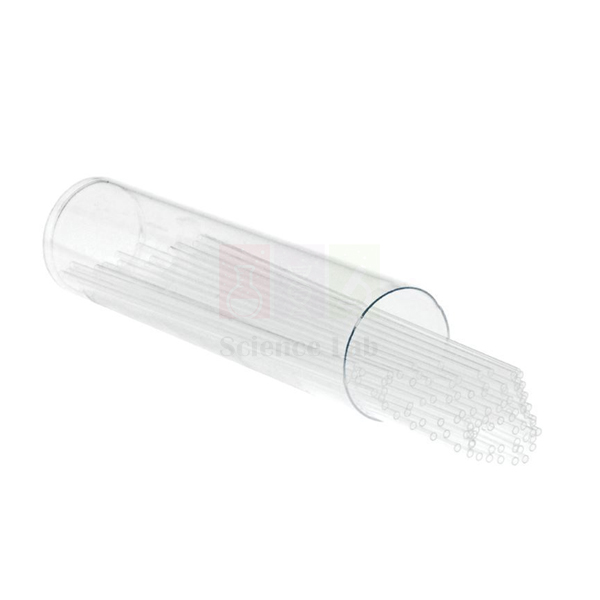
Melting-Point Tubes
Melting-Point Tubes (Product Code: SLE/ME/44) are thin-walled capillary tubes used to hold small powdered samples during melting point determination in chemistry, pharmacy and teaching laboratories. Each tube is 100 mm long and 1 mm in diameter, so it needs only a tiny amount of sample and lets heat pass quickly from the heating block to the solid. They are supplied by Jain Scientific Equipments Pvt Ltd (ScienceLab), Ambala, India, a lab consumables supplier for India and international markets.
Specifications
| Parameter | Detail |
|---|---|
| Type | Thin-walled capillary tubes |
| Length | 100 mm |
| Diameter | 1 mm |
| Typical use | Holding samples for capillary melting point determination |
| Product code | SLE/ME/44 |
| Supplied by | Jain Scientific Equipments Pvt Ltd (ScienceLab), Ambala, India |
What Are Melting-Point Tubes Used For?
In the capillary method, a finely ground solid is packed into the closed end of a melting-point tube, the tube is placed in a melting point apparatus, and the temperature at which the solid starts and finishes melting is recorded. A pure compound melts over a narrow range, while impurities lower and broaden it, so these tubes are central to identifying organic compounds and checking the purity of products such as recrystallised samples in school and college chemistry lab equipment sets.
To fill a tube, press the open end into a small heap of dry, powdered sample, then tap or drop the tube, closed end down, so the solid settles into a short, tightly packed column. Use a fresh tube for every determination and wipe the outside clean before inserting it into the heating block.
What to Specify When Ordering
- Number of tubes required — the pack size is not listed here, so tell us your total quantity.
- Which melting point apparatus you use, so we can check the 1 mm diameter suits its sample holes.
- Whether one end should already be sealed, or whether you seal the tubes yourself.
Supplier
ScienceLab, the trading name of Jain Scientific Equipments Private Limited in Ambala, Haryana, supplies Melting-Point Tubes as a consumable for chemistry and pharmacy practicals. Because the tubes are used once and discarded, schools and colleges usually re-order them each term alongside their melting point apparatus and other consumables. Learn more on the ScienceLab company profile.
Related Measuring Equipment
Apparatus and tools used with melting-point tubes:
- Digital Melting Point Apparatus — a two-sample instrument with an LED temperature display.
- Analogue Melting Point — a knob-controlled unit with a magnifying eyepiece.
- Apparatus Melting Point — another block-heated option for teaching laboratories.
- Pestle And Mortar — for grinding samples to the fine powder the tubes need.
See the complete Measuring category for more laboratory instruments.
Frequently Asked Questions
What size are the Melting-Point Tubes?
The Melting-Point Tubes are thin-walled capillary tubes, 100 mm long and 1 mm in diameter. The narrow bore holds only a small amount of sample, which helps the solid heat evenly and makes the start and end of melting easier to see.
Are the Melting-Point Tubes sealed at one end?
This listing does not state whether the Melting-Point Tubes are supplied with one end sealed. Please confirm with us before ordering; tubes open at both ends are normally sealed at one end in a small flame before filling.
Which apparatus can the Melting-Point Tubes be used with?
The Melting-Point Tubes are intended for capillary melting point apparatus, such as the digital and analogue melting point units in our Measuring range. Check that the 1 mm tube diameter suits the sample holes of your apparatus before ordering.
Can the Melting-Point Tubes be reused?
No, the Melting-Point Tubes are normally used once, because the melted and re-solidified sample cannot easily be cleaned out of such a narrow bore. Dispose of used tubes safely in a sharps container.
How many Melting-Point Tubes come in a pack?
The pack size of the Melting-Point Tubes is not listed on this page. Tell us the total number of tubes you need through the contact page, and we will confirm the pack quantities we can supply in the quotation.
Who supplies the Melting-Point Tubes?
The Melting-Point Tubes are supplied by Jain Scientific Equipments Pvt Ltd (ScienceLab), Ambala, Haryana, India, to schools, colleges, pharmacy institutes and dealers in India and international markets, with quotations sent on request.
Request a Quote
To order Melting-Point Tubes (SLE/ME/44), send the quantity and the apparatus you use through our contact page, or add them to the enquiry cart with your melting point apparatus.
Last updated: 24 September 2026