- Physics Lab Equipment
- Chemistry Lab Equipment
- Biology Lab Equipment
- Anatomical Lab Equipment
- Learning
- Educational Lab Equipment
- Magnets
- Agriculture
- Astronomy
- Earth Science
- Geography Lab Equipment
- Safety Lab Coat
- Laboratory
- Meteorological
- Electricity & Magnetism
- Heat
- School Lab Equipment
- Lab Glassware
- Science Lab Equipment
- Tvet Lab Equipment
- Robotics Kits Supplier and Manufacturer for Schools India
- Math Lab Equipment Manufacturers and Exporters in Ambala
- STEM Kits Manufacturers and Supplier India
- Engineering Lab Equipment
- Hospital Lab Equipment
- Water, Sanitation & Hygiene Supplies
- Cold Chain, Solar & Communication Equipment
- Nutrition
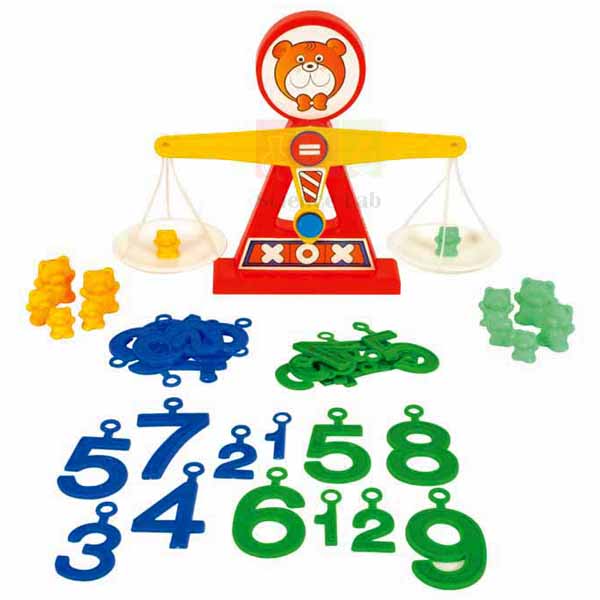
Dish Balance with Weight Number
Dish Balance with Weight Number (Product Code: SLE/MAT/63) is a durable plastic two-pan balance used by children to measure and compare weights in primary maths and early science lessons. It comes with a set of bear family weights and weighted numbers 1 to 9 in 2 colours, so pupils can see what they are measuring and relate what they observe to the measured result. Jain Scientific Equipments Pvt Ltd (ScienceLab), an OEM manufacturer, makes it at its own factory in Ambala, India.
Specifications
| Parameter | Detail |
|---|---|
| Material | Durable plastic |
| Pans | 2 pans with hanger |
| Bear family weights | Set provided, listed as 3 g – 6 pcs; 6 g, 9 g and 12 g – 2 pcs each |
| Weighted numbers | 1, 2, 3, 4, 5, 6 – 4 pcs each; 7, 8, 9 – 2 pcs each; in 2 colours |
| Learning objective | Measuring and comparing weights; relating visual and measured observation |
| Product code | SLE/MAT/63 |
| Manufacturer | Jain Scientific Equipments Pvt Ltd (ScienceLab) — OEM |
| Country of origin | India (made in Ambala, Haryana) |
What Is the Dish Balance with Weight Number Used For?
Children start by predicting which side will go down, then test it: a bear on one pan, two smaller bears on the other, and the class describes the result as heavier, lighter or equal. Because the dishes are open, every child can see what is being compared, which makes the step from "looks bigger" to "weighs more" much clearer.
The weighted numbers take the balance into early number work. Teachers typically ask pupils to place 3 and 4 on one pan and 7 on the other and test whether the sides balance, which turns addition and missing-number problems into something physical. Check that the balance sits level with empty pans before each activity. It makes a practical addition to mathematics lab kits in India for primary classes.
OEM Manufacturer
ScienceLab is the brand under which Jain Scientific Equipments Private Limited makes the Dish Balance with Weight Number as its OEM (original equipment manufacturer). The balance and its accessories are produced at the company's own licensed factory at Saha, Ambala, Haryana, India, and reach schools, dealers and importers without a trading intermediary. If a weight or number piece goes missing, ask the manufacturer directly about a replacement. More on our company profile.
Related Maths Lab Equipment
These balances and aids suit the same measuring and number lessons:
- Number Balance — a dedicated balance for exploring equality with numbers.
- Balance Mathematical — another maths balance for equation and equality work.
- Balance Simple Beam — a simple beam balance for comparing classroom objects.
- Hanging Pan Balance — for older pupils moving on to measured weighing.
The full range is in our Maths Lab Equipment category.
Frequently Asked Questions
What comes with the Dish Balance with Weight Number?
The Dish Balance with Weight Number comes with 2 pans with hanger, a set of bear family weights listed as 3 g (6 pcs) and 6 g, 9 g and 12 g (2 pcs each), and weighted numbers 1 to 9 in 2 colours.
How many weighted numbers are included?
The Dish Balance with Weight Number includes weighted numbers 1, 2, 3, 4, 5 and 6 with 4 pieces of each, and 7, 8 and 9 with 2 pieces of each, provided in 2 colours so that teams or pairs can work side by side.
What is the Dish Balance with Weight Number made of?
The Dish Balance with Weight Number is made of durable plastic. Its open dishes let children see exactly what they are weighing, so they can relate what they observe to the measured result during each comparison.
Which classes is the Dish Balance with Weight Number meant for?
The Dish Balance with Weight Number is aimed at children learning to measure and compare weights, usually in pre-primary and primary classes, and its weighted numbers extend the same balance into early addition and equality activities.
Who manufactures the Dish Balance with Weight Number?
The Dish Balance with Weight Number is manufactured by Jain Scientific Equipments Pvt Ltd (ScienceLab), the OEM, at its own licensed factory at Saha, Ambala, Haryana, India. Quotations and replacement-piece questions go directly to the manufacturer.
How do I get a quotation for the Dish Balance with Weight Number?
To get a quotation for the Dish Balance with Weight Number, send the product code SLE/MAT/63, the number of sets and the delivery location through our contact page. We quote schools, dealers and importers in India and international markets.
Request a Quote
Ask for a Dish Balance with Weight Number quotation via the contact page, or add it to the enquiry cart with other maths items. Prices come direct from the manufacturer.
Last updated: 24 September 2026
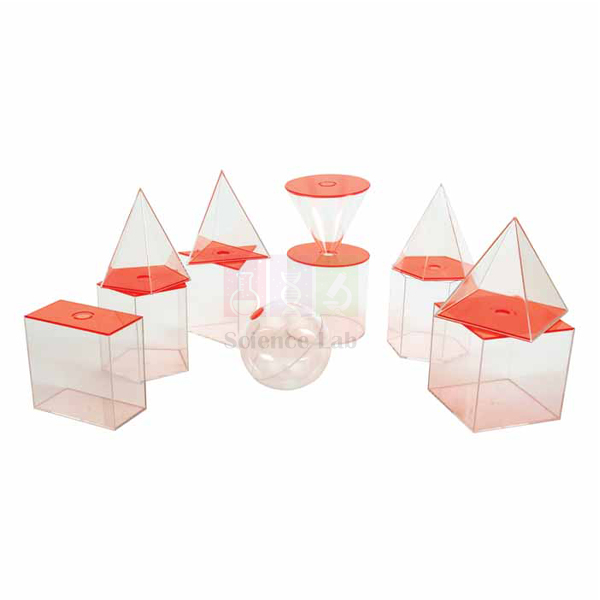
Transparent 3D Solid Set
Transparent 3D Solid Set (Product Code: SLE/MAT/64) is a set of large, see-through plastic solids used to introduce solid geometry and to show the relationships between area, volume, shape and size in school maths labs. Its shapes include a cone, cylinder, cube, cuboid, sphere, rectangular prism and square base pyramid, so students can investigate faces, vertices, edges, curves and angles. Jain Scientific Equipments Pvt Ltd (ScienceLab), an OEM manufacturer, makes it at its own factory in Ambala, India.
Key Details
| Parameter | Detail |
|---|---|
| Material | Transparent plastic solids |
| Shapes included | Cone, cylinder, cube, cuboid, sphere, rectangular prism, square base pyramid and others |
| Size | Large solids for tactile classroom use |
| Features to investigate | Shapes, faces, vertices, edges, curves and angles |
| Concepts illustrated | Relationships between area, volume, shape and size |
| Product code | SLE/MAT/64 |
| Manufacturer | Jain Scientific Equipments Pvt Ltd (ScienceLab) — OEM |
| Country of origin | India (made in Ambala, Haryana) |
What Is the Transparent 3D Solid Set Used For?
Because the solids are see-through, students can count every edge and vertex at once, including the ones at the back that are hidden on an opaque model. That makes it easier to tabulate faces, edges and vertices for each shape and to spot patterns such as Euler's relationship for polyhedra, while the cone, cylinder and sphere open up a discussion of curved surfaces.
A good exercise is to stand a solid on paper and view it from the top, front and side, then sketch its plan and elevations. Handling the large pieces adds a tactile element that helps students connect the shape and size of a solid with its surface area and volume. The set suits a complete maths lab setup for schools in India, from middle school to senior secondary.
OEM Manufacturer
Jain Scientific Equipments Private Limited, whose trading name is ScienceLab, manufactures the Transparent 3D Solid Set as the OEM (original equipment manufacturer). The solids are made at the company's own licensed factory at Saha, Ambala, Haryana, India, and shipped factory-direct to schools, colleges, institutions, dealers and importers. Because you deal with the maker, questions about a replacement piece or a repeat order are answered by the same team — just ask. See our company profile.
Related Maths Lab Equipment
Extend solid-geometry lessons with these items:
- 3D Colour Solid Set — colourful solids for linking 3D shapes to their 2D outlines.
- Volume Relation Between Cone and Cylinder — shows how cone and cylinder volumes compare.
- Relational GeoSolids — hollow shapes that can be filled to compare volumes.
- Folding Geometric Shapes — for exploring the nets that fold into each solid.
Browse the rest of our Maths Lab Equipment range.
Frequently Asked Questions
Which shapes are in the Transparent 3D Solid Set?
The Transparent 3D Solid Set includes shapes such as a cone, cylinder, cube, cuboid, sphere, rectangular prism and square base pyramid, among others. For the complete piece list of the current set, please ask us through our contact page.
Why use transparent solids instead of solid-colour ones?
The Transparent 3D Solid Set lets students see every edge and vertex at the same time, including those at the back of the shape, which makes counting features and picturing the inside of a solid much easier than with opaque models.
What can students investigate with the Transparent 3D Solid Set?
With the Transparent 3D Solid Set, students investigate shapes, faces, vertices, edges, curves and angles, and explore how area, volume, shape and size relate to one another across the different solids in the set.
How large are the solids in the Transparent 3D Solid Set?
The Transparent 3D Solid Set is described as a set of large solids for tactile classroom use, but exact dimensions are not stated in our catalogue. Contact us for the measurements of each shape before placing an order.
Who manufactures the Transparent 3D Solid Set?
The Transparent 3D Solid Set is manufactured by Jain Scientific Equipments Pvt Ltd (ScienceLab), the OEM, at its own licensed factory at Saha, Ambala, Haryana, India, and is quoted and dispatched directly by the manufacturer.
Can the Transparent 3D Solid Set be supplied to several schools at once?
Yes, the Transparent 3D Solid Set can be quoted in bulk for school groups, institutions and dealers in India and international markets. Share the quantity and delivery locations and we will prepare a combined quotation.
Request a Quote
For a Transparent 3D Solid Set quotation, write to us through the contact page or add it to the enquiry cart. You receive the price directly from the manufacturer.
Last updated: 24 September 2026
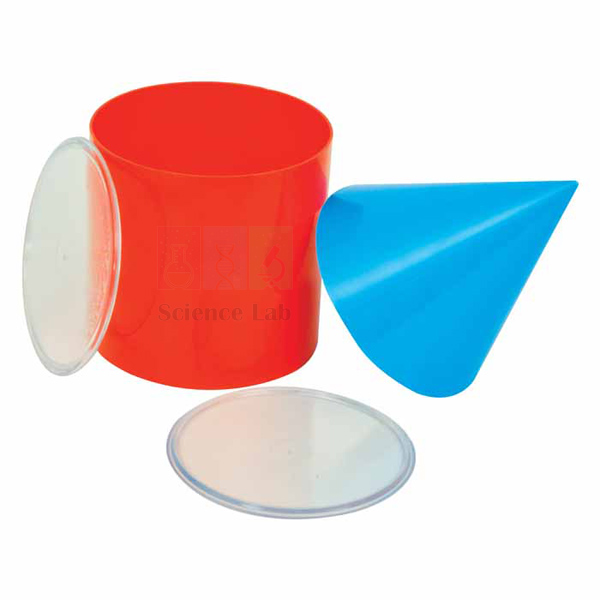
Volume Relation Between Cone and Cylinder
Volume Relation Between Cone and Cylinder (Product Code: SLE/MAT/65) is a two-piece demonstration set used to show how the volume of a cone compares with that of a cylinder of the same base and the same height in school maths labs. The set of 2 pieces comes with a lid and is listed at 10 cm x 10 cm. Jain Scientific Equipments Pvt Ltd (ScienceLab), an OEM school lab equipment manufacturer, makes it at its own factory in Ambala, India.
Specifications
| Parameter | Detail |
|---|---|
| Set contents | 2 pieces (cone and cylinder) with lid |
| Size | 10 cm x 10 cm |
| Geometry | Cone and cylinder of the same base and the same height |
| Purpose | Demonstrating the volume relationship between a cone and a cylinder |
| Product code | SLE/MAT/65 |
| Manufacturer | Jain Scientific Equipments Pvt Ltd (ScienceLab) — OEM |
| Country of origin | India (made in Ambala, Haryana) |
What Is the Cone and Cylinder Volume Set Used For?
The set answers a question students often ask: where does the one-third in the cone formula come from? A student fills the cone level to the rim with sand or rice and empties it into the cylinder, repeating until the cylinder is full. Because both pieces share the same base and height, the count of cone-fulls shows directly that the cone holds one third of the cylinder's volume.
Ask students to predict the number of pours before they start, and to level each cone-full with a ruler so the result is clean. Dry fillers pour neatly and are easy to collect afterwards. The activity links naturally to the formulae for the volume of a cylinder and a cone, and fits mensuration units in middle and secondary school.
OEM Manufacturer
ScienceLab, the trading name of Jain Scientific Equipments Private Limited, is the OEM (original equipment manufacturer) of the Volume Relation Between Cone and Cylinder set. The cone, cylinder and lid are produced at the company's own licensed factory at Saha, Ambala, Haryana, India, and sold factory-direct to schools, institutions, dealers and importers. For tender and vendor registration, the company's GSTIN is 06AAECJ8618A1ZT and its LEI is 3358004HRD1JIVXKYX49. More details are on our company profile.
Related Maths Lab Equipment
Useful companions for volume and mensuration lessons:
- Relational GeoSolids — fillable hollow shapes for comparing more volume relationships.
- Transparent 3D Solid Set — see-through solids for studying faces, edges and vertices.
- Measuring Cylinder, Polypropylene — for measuring the volume poured in each step.
- Volume Measuring Set — for general capacity and volume practice.
Explore more in our Maths Lab Equipment category.
Frequently Asked Questions
What does the Volume Relation Between Cone and Cylinder set demonstrate?
The Volume Relation Between Cone and Cylinder set demonstrates the volume relationship between a cone and a cylinder of the same base and the same height. Students fill the cone and pour it into the cylinder to find that the cylinder holds three cone-fulls.
What is included in the Volume Relation Between Cone and Cylinder set?
The Volume Relation Between Cone and Cylinder set is a set of 2 pieces, a cone and a cylinder, supplied with a lid. Its listed size is 10 cm x 10 cm, and both pieces share the same base and height.
What should I fill the cone and cylinder with?
Dry materials such as sand or rice work well with the Volume Relation Between Cone and Cylinder set because they pour cleanly and are easy to level. Ask us through our contact page before using water or other liquids.
Which classes use the Volume Relation Between Cone and Cylinder set?
The Volume Relation Between Cone and Cylinder set is used when classes study mensuration of solids, usually in middle and secondary school, to show where the one-third in the cone volume formula comes from before students apply it.
Who manufactures the Volume Relation Between Cone and Cylinder set?
The Volume Relation Between Cone and Cylinder set is manufactured by Jain Scientific Equipments Pvt Ltd (ScienceLab), the OEM, at its own licensed factory at Saha, Ambala, Haryana, India. Quotations and repeat orders come directly from the manufacturer.
Can the set be ordered in bulk for schools or export?
Yes, the Volume Relation Between Cone and Cylinder set can be quoted in bulk for schools, institutions and dealers in India and international markets. Send the quantity and delivery location to receive a quotation.
Request a Quote
Request a price for the Volume Relation Between Cone and Cylinder set through our contact page, or add it to the enquiry cart. Quotations are issued directly by the manufacturer.
Last updated: 24 September 2026
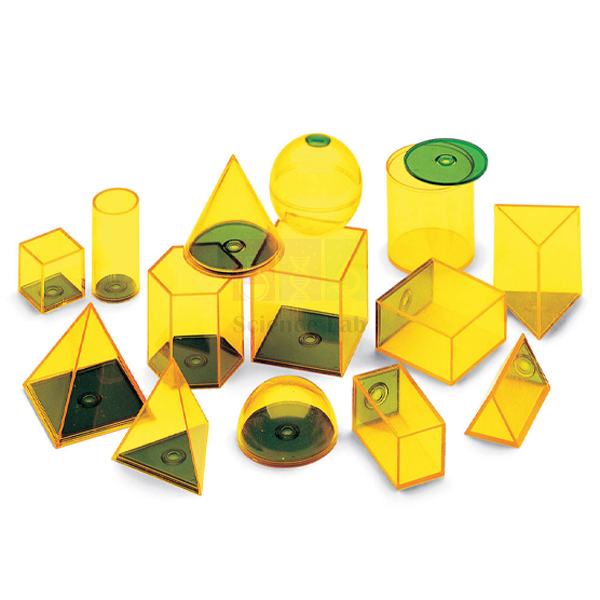
Relational GeoSolids
Relational GeoSolids (Product Code: SLE/MAT/66) is a set of 14 clear plastic, hollow geometric shapes used to demonstrate the relationship between shape, size and volume in school maths classrooms. Each shape has a removable stopper, so students can fill it with rice or sand and compare capacities directly, and a teaching guide is included. The set is supplied by Jain Scientific Equipments Pvt Ltd (ScienceLab), Ambala, a school lab equipment supplier in India.
Specifications
| Parameter | Detail |
|---|---|
| Set size | 14 clear plastic geometric shapes |
| Construction | Hollow shapes with removable stoppers |
| Shapes | Cylinders, cubes, size-related spheres, cones, rectangular shapes, pyramids and polyhedra |
| Fill material | Rice or sand |
| Included | Teaching guide |
| Product code | SLE/MAT/66 |
| Supplied by | Jain Scientific Equipments Pvt Ltd (ScienceLab), Ambala, India |
What Are Relational GeoSolids Used For?
Relational GeoSolids let students test volume ideas by pouring rather than by formula alone. A typical lesson starts with two related shapes — say a cone and a cylinder — and a prediction of which holds more; one shape is filled with rice or sand through its stopper opening and emptied into the other, and the class records how many fills it takes.
Working over a tray keeps spills contained, and replacing each stopper before shapes are stacked away keeps the filler inside. Because the shapes are clear, everyone can watch the level rise. The set is flexible laboratory equipment for schools in India, supporting early capacity work as well as later mensuration and the teaching guide's suggested activities.
Supplier
Jain Scientific Equipments Private Limited, which trades as ScienceLab, supplies the Relational GeoSolids set from Ambala, Haryana, India. The company sources the set and handles quotations, order coordination and dispatch for schools, colleges, institutions and dealers in India and international markets. For background on the company, visit our company profile.
Related Maths Lab Equipment
These items complement Relational GeoSolids in volume and capacity lessons:
- Volume Relation Between Cone and Cylinder — a focused two-piece set for the cone and cylinder result.
- Transparent 3D Solid Set — see-through solids for counting faces, edges and vertices.
- Volume Measuring Set — for measuring and comparing capacities in standard units.
- Measuring Cylinder, Polypropylene — for reading off the volume of filler poured.
Browse further aids in our Maths Lab Equipment category.
Frequently Asked Questions
What is in the Relational GeoSolids set?
The Relational GeoSolids set contains 14 clear plastic geometric shapes — hollow cylinders, cubes, size-related spheres, cones, rectangular shapes, pyramids and polyhedra — each with a removable stopper, together with a teaching guide for classroom activities.
What are Relational GeoSolids filled with?
Relational GeoSolids are filled with rice or sand through their removable stoppers. Students fill one shape and pour it into another to compare volumes, which shows how shape and size affect how much each solid holds.
Do Relational GeoSolids come with teaching material?
Yes, the Relational GeoSolids set includes a teaching guide, which helps teachers plan activities on the relationship between shape, size and volume and makes the set easier to introduce in lessons.
What size are the Relational GeoSolids shapes?
The individual dimensions of the Relational GeoSolids shapes are not stated in our catalogue description. Please ask through our contact page and we will confirm the sizes of the current set before you order.
Who supplies the Relational GeoSolids set?
The Relational GeoSolids set is supplied by Jain Scientific Equipments Pvt Ltd (ScienceLab), Ambala, Haryana, India, which quotes and dispatches it to schools, institutions and dealers in India and international markets.
What information do you need to quote Relational GeoSolids?
To quote Relational GeoSolids we need the product code SLE/MAT/66, the number of sets required and the delivery location. Send these through the contact page or add the set to the enquiry cart to start your request.
Request a Quote
For a price on Relational GeoSolids, contact us through the contact page or add the set to the enquiry cart with your quantity and delivery location.
Last updated: 24 September 2026
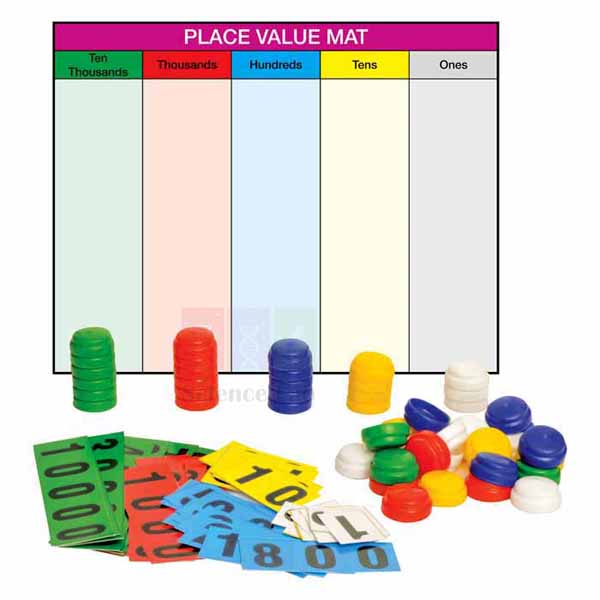
Place Value Mat with Stacking Counters
Place Value Mat with Stacking Counters (Product Code: SLE/MAT/67) is a place value kit used to help children visualise place value as they build numbers from 1 to 99,999 in primary maths lessons. It combines a place value mat, 45 place value cards and 125 colour-coded stacking counters in 5 colours that snap together vertically. Jain Scientific Equipments Pvt Ltd (ScienceLab), an OEM manufacturer, makes it at its own factory in Ambala, India, as part of its mathematics lab kits range.
Specifications
| Parameter | Detail |
|---|---|
| Number range | 1 to 99,999 |
| Stacking counters | 125 counters in 5 colours, colour coded; snap together vertically |
| Place value cards | Set of 45 cards |
| Mat | Place value mat included |
| Size | 30 cm x 27 cm |
| Learning objectives | Numeric, written and expanded forms of a number; number operations |
| Product code | SLE/MAT/67 |
| Manufacturer | Jain Scientific Equipments Pvt Ltd (ScienceLab) — OEM |
| Country of origin | India (made in Ambala, Haryana) |
What Is the Place Value Mat with Stacking Counters Used For?
A child draws a place value card, reads the number and builds it on the mat by stacking the right number of counters in each place. The colour coding keeps each place visually separate, so the difference between the tens stack and the thousands stack is obvious at a glance. The largest number, 99,999, is simply nine counters in every place.
From there, pupils say the number aloud, write it in words and record its expanded form, covering all three representations in one activity. The counters also model operations: when a place reaches ten counters in an addition, they are exchanged for one counter in the next place to the left, which makes regrouping concrete. The kit works well in a junior lab kit collection for the primary school maths room.
What to Specify When Ordering
- Number of kits — for example one per pupil pair or small group, based on class size.
- Contents check — each kit is listed with a place value mat, 45 cards and 125 counters in 5 colours.
- Extra counters — the separate Stacking Counters item can be quoted alongside if you need more.
- Desk space — the listed size is 30 cm x 27 cm.
OEM Manufacturer
Jain Scientific Equipments Private Limited, trading as ScienceLab, is the OEM (original equipment manufacturer) of the Place Value Mat with Stacking Counters. The kit is produced and packed as a set at the company's own licensed factory at Saha, Ambala, Haryana, India, and supplied factory-direct to schools, institutions, distributors and importers. Buyers get their quotation from the maker itself, and lost counters or cards can be discussed with the same team. Read more on our company profile.
Related Maths Lab Equipment
These place value resources extend the same lessons:
- Stacking Counters — additional counters for larger groups or bigger numbers.
- Game of Place Value — a game format for practising place value after building numbers.
- Base Ten Blocks — a proportional model showing the size of ones, tens and hundreds.
- Decimal Abacus — carries place value ideas on to decimals.
See all number and place value aids in Maths Lab Equipment.
Frequently Asked Questions
What is included in the Place Value Mat with Stacking Counters?
The Place Value Mat with Stacking Counters includes a place value mat, a set of 45 place value cards and 125 stacking counters in 5 colours. The listed size of the kit is 30 cm x 27 cm.
What number range does the Place Value Mat with Stacking Counters cover?
The Place Value Mat with Stacking Counters lets children build numbers from 1 to 99,999, so it covers place values from ones up to ten thousands and suits the number work taught across the primary years.
How do the stacking counters work?
The counters in the Place Value Mat with Stacking Counters snap together vertically and are stacked in the appropriate place on the mat. They are colour coded in 5 colours, which helps children keep each place value separate while they build numbers.
Which concepts does the Place Value Mat with Stacking Counters teach?
The Place Value Mat with Stacking Counters supports learning the numeric, written and expanded forms of a number, as well as number operations such as addition with regrouping, all through hands-on building on the mat.
Who manufactures the Place Value Mat with Stacking Counters?
The Place Value Mat with Stacking Counters is manufactured by Jain Scientific Equipments Pvt Ltd (ScienceLab), the OEM, at its own licensed factory at Saha, Ambala, Haryana, India, and is quoted directly by the manufacturer.
Can schools order the Place Value Mat with Stacking Counters in bulk?
Yes, the Place Value Mat with Stacking Counters can be quoted in class quantities for schools, institutions and dealers in India and international markets. Send the number of kits and the delivery location through our contact page.
Request a Quote
To order the Place Value Mat with Stacking Counters, send your requirement via our contact page or add it to the enquiry cart. Quotations come direct from the manufacturer.
Last updated: 24 September 2026
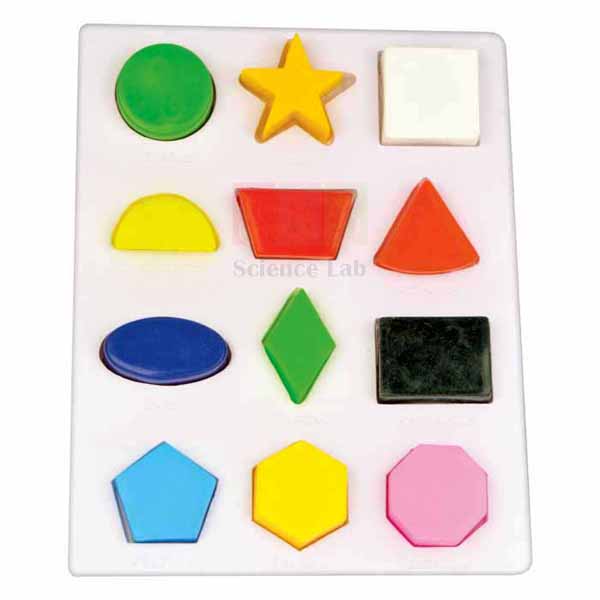
Plastic Moulds
Plastic Moulds (Product Code: SLE/MAT/68) is a set of 12 hollow plastic shape moulds used with clay so that children can make various geometrical figures in pre-primary and primary maths lessons. Provided with clay and listed at 20 cm length and 25 cm width, the set turns shape learning into a hands-on, enjoyable activity and fits neatly into a preschool kit or early maths corner. Jain Scientific Equipments Pvt Ltd (ScienceLab), an OEM manufacturer, makes it at its own factory in Ambala, India.
Specifications
| Parameter | Detail |
|---|---|
| Set contents | 12 hollow shapes with clay |
| Material | Plastic moulds |
| Length | 20 cm |
| Width | 25 cm |
| Purpose | Making various geometrical figures while learning through play |
| Product code | SLE/MAT/68 |
| Manufacturer | Jain Scientific Equipments Pvt Ltd (ScienceLab) — OEM |
| Country of origin | India (made in Ambala, Haryana) |
What Are Plastic Moulds Used For?
Children press clay into each hollow mould, ease it out and hold a finished geometrical figure they have made themselves. The teacher then asks them to name the shape, count its sides and corners, and compare it with the shapes their neighbours have made, so vocabulary and observation grow together.
Once several shapes are ready, pupils can arrange them into pictures, patterns or size orders on the desk. Press the clay in firmly and remove it gently so edges stay sharp, and keep the clay covered between lessons so it stays workable. The moulds suit any school lab setup in India that includes an early-years maths or activity corner.
OEM Manufacturer
Plastic Moulds are made by Jain Scientific Equipments Private Limited, operating as ScienceLab, which is the OEM (original equipment manufacturer) for this set. Manufacturing is carried out at the company's own licensed factory at Saha, Ambala, Haryana, India, and schools, colleges, dealers and importers buy direct from the factory rather than through traders. Repeat orders and replacement moulds can be discussed with the manufacturer — just ask. Find out more on our company profile.
Related Maths Lab Equipment
Shape resources that pair well with Plastic Moulds:
- Plastic Pattern Blocks — ready-made shapes for building and copying patterns.
- 2D Shapes — flat shapes for naming and comparing with the clay figures.
- Primary Shapes Template Set — templates for tracing the same shapes on paper.
- Geometric Shapes Building Set — for constructing shapes from parts.
Find more early maths aids in Maths Lab Equipment.
Frequently Asked Questions
What is included in the Plastic Moulds set?
The Plastic Moulds set includes 12 hollow shapes provided with clay, so children can start making figures straight away. The set is listed with a length of 20 cm and a width of 25 cm.
How do children use Plastic Moulds?
Children use Plastic Moulds by pressing clay into each hollow shape and easing it out to make a geometrical figure, then naming it, counting its sides and corners and comparing it with other shapes made in the class.
Which shapes are in the Plastic Moulds set?
The individual shapes in the Plastic Moulds set are not itemised in our catalogue description. Please ask through our contact page for the current list of the 12 shapes before placing your order.
Which age group are Plastic Moulds suitable for?
Plastic Moulds suit pre-primary and early primary children who are learning to recognise and name geometrical figures, because shaping clay by hand keeps young learners engaged while they build shape vocabulary.
Who manufactures Plastic Moulds?
Plastic Moulds are manufactured by Jain Scientific Equipments Pvt Ltd (ScienceLab), the OEM, at its own licensed factory at Saha, Ambala, Haryana, India. Quotations and repeat supplies are handled directly by the manufacturer.
Can Plastic Moulds be ordered for several classrooms?
Yes, Plastic Moulds can be quoted for school lab equipment bulk supply to schools, institutions and dealers in India and international markets. Tell us the number of sets and the delivery location to receive a quotation.
Request a Quote
Ask for a Plastic Moulds quotation through our contact page or add the set to the enquiry cart. The price is quoted directly by the manufacturer.
Last updated: 24 September 2026
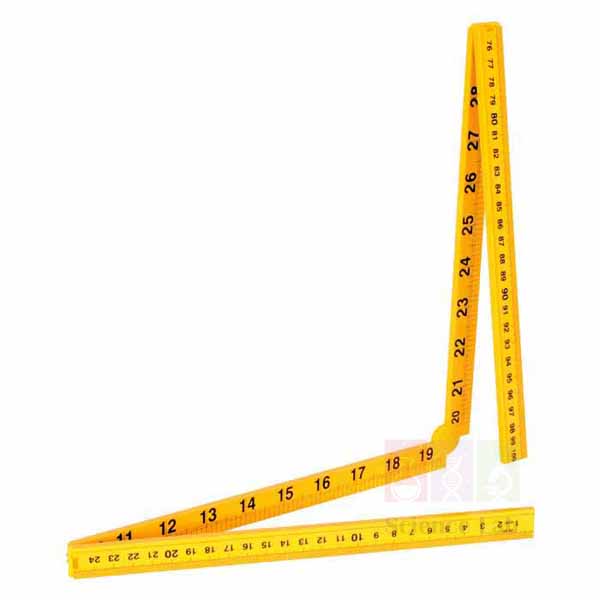
Folding Meter Stick
Folding Meter Stick (Product Code: SLE/MAT/69) is a folding metric measuring stick used to measure the length of objects in school maths and science labs. It folds into fourths on three hinges for easy storage and is calibrated only in centimetres and millimetres, with no inch scale. Jain Scientific Equipments Pvt Ltd (ScienceLab), an OEM and scientific lab equipment manufacturer in Ambala, makes it at its own factory in India.
Specifications
| Parameter | Detail |
|---|---|
| Folding | Folds into fourths on three hinges |
| Graduation | Metric units — centimetres and millimetres |
| Inch scale | Not included (customary units are not marked) |
| Storage | Folds for easy storage |
| Purpose | Measuring the length of objects |
| Product code | SLE/MAT/69 |
| Manufacturer | Jain Scientific Equipments Pvt Ltd (ScienceLab) — OEM |
| Country of origin | India (made in Ambala, Haryana) |
What Is the Folding Meter Stick Used For?
Pupils use the stick to measure desks, doorways, their own height or the length of a jump, first estimating and then checking. Because it reads only in centimetres and millimetres, it keeps the whole lesson in metric units and makes conversions between millimetres, centimetres and metres a natural next step.
Before reading, open all three hinges fully so the sections lie straight, start from the zero end and read at eye level to avoid parallax. For distances longer than the stick, mark the end point and move it along. It also doubles as physics lab equipment in schools in India, for example when setting a pendulum length.
What to Specify When Ordering
- Quantity — how many sticks you need per class, group or lab.
- Scale — this stick is metric only (centimetres and millimetres), with no inch markings.
- Format — whether a folding stick suits your storage, or a rigid stick such as the Meter Stick, White is preferred.
OEM Manufacturer
Jain Scientific Equipments Private Limited (CIN U29309HR2020PTC087597) trades as ScienceLab and is the OEM (original equipment manufacturer) of the Folding Meter Stick. The stick is produced at the company's licensed factory at 449, HSIIDC Industrial Area, Saha, Ambala, Haryana, India, which holds Factory Licence AMB-ONLINE-CHD-J-414. Schools, institutions, dealers and importers buy direct from this factory, and quotations come from the manufacturer itself. See our company profile for more.
Related Maths Lab Equipment
Other measuring tools often ordered with the Folding Meter Stick:
- Half Meter Scale — a shorter scale for desk-top measuring.
- Meter Stick, White — a rigid alternative for board work and demonstrations.
- Windup Meter Tapes — for measuring longer distances outdoors or across the room.
More measuring and geometry tools are in Maths Lab Equipment.
Frequently Asked Questions
How does the Folding Meter Stick fold?
The Folding Meter Stick folds into fourths on three hinges, so it packs down into four sections for easy storage in a cupboard or kit box and opens out again to its full length for measuring.
Which units are marked on the Folding Meter Stick?
The Folding Meter Stick is calibrated in metric units, centimetres and millimetres only. Inches, which belong to the customary system, are not included on this stick, so it suits lessons taught entirely in metric measurement.
What material is the Folding Meter Stick made of?
The material of the Folding Meter Stick is not stated in our catalogue description. Please ask through our contact page and we will confirm the material and finish of the current model before you order.
Is a calibration certificate available for the Folding Meter Stick?
Calibration-certificate requirements for the Folding Meter Stick should be discussed with us before ordering. Tell us through the contact page what documentation your lab or tender needs, and we will advise what can be provided with your order.
Who manufactures the Folding Meter Stick?
The Folding Meter Stick is manufactured by Jain Scientific Equipments Pvt Ltd (ScienceLab), the OEM, at its own licensed factory at Saha, Ambala, Haryana, India. Orders and quotations are handled directly by the manufacturer.
Can the Folding Meter Stick be ordered in bulk for schools?
Yes, the Folding Meter Stick can be quoted in bulk for schools, institutions and dealers in India and international markets. Share the quantity and delivery location, and we will prepare a quotation.
Request a Quote
For a Folding Meter Stick quotation, use our contact page or add it to the enquiry cart. Prices are provided directly by the manufacturer.
Last updated: 24 September 2026
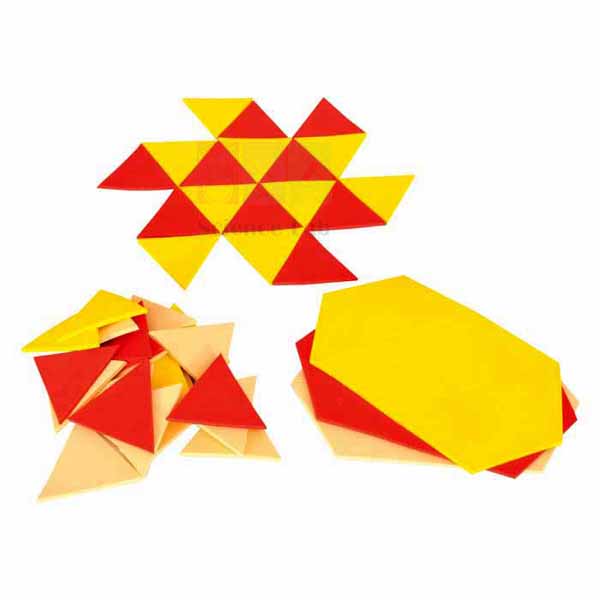
Designer Fraction
Designer Fraction (Product Code: SLE/MAT/70) is a set of 72 equilateral triangles in 3 colours used to help children understand fractions by building patterns and imaginative shapes in primary maths lessons. Because every piece is the same equilateral triangle, the colours in a finished design can be read directly as fractions of the whole. Jain Scientific Equipments Pvt Ltd (ScienceLab), an OEM among educational lab equipment manufacturers in India, makes it at its own factory in Ambala.
Specifications
| Parameter | Detail |
|---|---|
| Pieces | 72 equilateral triangles |
| Colours | 3 different colours |
| Purpose | Developing and designing different types of fractions and patterns |
| Type | Visual, hands-on fraction manipulative |
| Product code | SLE/MAT/70 |
| Manufacturer | Jain Scientific Equipments Pvt Ltd (ScienceLab) — OEM |
| Country of origin | India (made in Ambala, Haryana) |
What Is the Designer Fraction Set Used For?
Six triangles fit together into a hexagon, so each triangle becomes one sixth of that shape. If two of the six are one colour, children can see that the coloured part is two sixths — and, by regrouping, one third — which makes equivalent fractions something they discover rather than memorise. Larger designs extend the same idea to other fractions of a whole.
Set challenges such as "build a shape that is half one colour" or "make a design where a third of the pieces match", then ask pupils to explain their fraction. Recording finished designs on triangular dot paper keeps a lasting record. As hands-on educational lab equipment in India, the set also supports pattern and symmetry work beyond fractions.
OEM Manufacturer
The Designer Fraction set is manufactured by Jain Scientific Equipments Private Limited, known commercially as ScienceLab, in its role as OEM (original equipment manufacturer). The triangles are produced at the company's own licensed factory at Saha, Ambala, Haryana, India, and reach schools, colleges, dealers and importers straight from the factory. Because the maker handles your order, top-up pieces and repeat sets can be discussed directly — ask us. Learn more on our company profile.
Related Maths Lab Equipment
Fraction and pattern resources that work alongside Designer Fraction:
- Fraction Dice — adds a game element to fraction practice.
- Non Magnetic Fraction Disc — shows fractions as parts of a circle for comparison.
- Fraction Kit — a broader kit for building and comparing fractions.
- Plastic Pattern Blocks — mixed shapes for pattern and symmetry work.
Browse more in our Maths Lab Equipment category.
Frequently Asked Questions
How many pieces are in the Designer Fraction set?
The Designer Fraction set contains 72 equilateral triangles in 3 different colours, giving a small group enough identical pieces to build several patterns and compare the fractions each colour represents.
How does the Designer Fraction set teach fractions?
The Designer Fraction set teaches fractions by letting children construct shapes from identical triangles; the number of triangles of one colour, compared with the total in the shape, shows the fraction directly and makes equivalent fractions easy to see.
What size are the triangles in the Designer Fraction set?
The triangle size of the Designer Fraction set is not stated in our catalogue description. Please ask through our contact page for the dimensions and colours of the current set before placing an order.
Which classes is the Designer Fraction set suitable for?
The Designer Fraction set suits primary classes being introduced to fractions and patterns, and it remains useful in later years for equivalent fractions, symmetry and tessellation activities built from equilateral triangles.
Who manufactures the Designer Fraction set?
The Designer Fraction set is manufactured by Jain Scientific Equipments Pvt Ltd (ScienceLab), the OEM, at its own licensed factory at Saha, Ambala, Haryana, India. Quotations and repeat orders come straight from the manufacturer.
Can the Designer Fraction set be ordered for several classes?
Yes, the Designer Fraction set can be quoted in multiple sets for schools, institutions and dealers in India and international markets. Send the number of sets and delivery location, and we will prepare a quotation.
Request a Quote
Request a Designer Fraction quotation through our contact page or add it to the enquiry cart. Your price comes direct from the manufacturer.
Last updated: 24 September 2026