- Physics Lab Equipment
- Chemistry Lab Equipment
- Biology Lab Equipment
- Anatomical Lab Equipment
- Learning
- Educational Lab Equipment
- Magnets
- Agriculture
- Astronomy
- Earth Science
- Geography Lab Equipment
- Safety Lab Coat
- Laboratory
- Meteorological
- Electricity & Magnetism
- Heat
- School Lab Equipment
- Lab Glassware
- Science Lab Equipment
- Tvet Lab Equipment
- Robotics Kits Supplier and Manufacturer for Schools India
- Math Lab Equipment Manufacturers and Exporters in Ambala
- STEM Kits Manufacturers and Supplier India
- Engineering Lab Equipment
- Hospital Lab Equipment
- Water, Sanitation & Hygiene Supplies
- Cold Chain, Solar & Communication Equipment
- Nutrition

Beads – Bobbles & Laces
Beads – Bobbles & Laces (Product Code: SLE/MAT/12) is a bead-threading manipulative used to build early number and pattern skills in pre-primary and primary maths classrooms. Children thread tough plastic beads onto colourful strings, training fine motor control while they group, order and count. The set is made by Jain Scientific Equipments Pvt Ltd (ScienceLab), an OEM manufacturer of mathematics lab kits in India, at its own factory in Ambala.
Key Details
| Parameter | Detail |
|---|---|
| Bead material | Tough plastic |
| Stringing | Beads threaded on colourful strings (laces) |
| Skills developed | Fine motor skills, grouping, ordering, number association and identifying patterns |
| Product code | SLE/MAT/12 |
| Manufacturer | Jain Scientific Equipments Pvt Ltd (ScienceLab) — OEM |
| Country of origin | India (made in Ambala, Haryana) |
What Is the Beads and Laces Set Used For?
Threading a bead is a small, deliberate hand movement, so every string a child completes is also fine-motor practice. Teachers attach a number idea to the action: thread four beads and say “four”, or copy a short sequence started by the teacher and then continue it. Comparing two finished strings — which has more, which is longer — introduces ordering without any written work.
Before threading, children can sort the loose beads into groups and count each group, which links grouping with number association. The set fits naturally into a junior lab kit for primary school maths corners. Work at a table in small groups, and keep each lace separate in storage so strings do not knot between lessons.
OEM Manufacturer
Jain Scientific Equipments Private Limited, which trades as ScienceLab, is the original equipment manufacturer (OEM) of Beads – Bobbles & Laces. The sets are produced at the company’s own licensed factory at Saha, Ambala, Haryana, so schools and distributors buy straight from the maker instead of through a trading house.
If a class set loses beads or laces over time, ask us about replacements — your enquiry reaches the manufacturer directly. More about the company is on our company profile.
Related Maths Lab Equipment
These items extend bead work into sorting, counting and early place value:
- Stringing Beads — a pre-primary stringing set supplied with an activity write-up
- Beads, Wood — a wooden alternative for classrooms that prefer wooden beads and laces
- Sorting Ring — foldable plastic rings for grouping beads into sets
- Stacking Counters — colour counters for the next step in counting and ordering
- Abacus Upright — beads on rods for moving from counting towards place value
See the complete Maths Lab Equipment range for more early-years manipulatives.
Frequently Asked Questions
What is included with Beads – Bobbles & Laces?
Beads – Bobbles & Laces consists of tough plastic beads with colourful strings for threading. The number of beads and laces in each set is not listed on this page, so please confirm the pack contents through our contact page before ordering class sets.
Which skills does Beads – Bobbles & Laces help children develop?
Beads – Bobbles & Laces develops fine motor skills through threading and introduces grouping, ordering, number association and pattern recognition. Teachers use it for early counting, copying and extending sequences, and comparing the lengths of finished strings.
How should Beads – Bobbles & Laces be cleaned and stored?
Beads – Bobbles & Laces can be wiped with a damp cloth and dried fully before storage, since the beads are tough plastic. Keep beads and laces in a closed box so pieces are not lost and the strings do not tangle between lessons.
Who manufactures Beads – Bobbles & Laces?
Beads – Bobbles & Laces is manufactured by Jain Scientific Equipments Pvt Ltd (ScienceLab), the OEM, at its own factory in Saha, Ambala, Haryana, India. Schools, dealers and importers receive the set directly from the manufacturer rather than from a reseller.
Can schools order Beads – Bobbles & Laces in bulk?
Yes, Beads – Bobbles & Laces can be quoted in class-set or bulk quantities for schools, dealers and importers in India and international markets. Send the quantity and delivery location with your enquiry and the quotation comes straight from the manufacturer.
Request a Quote
To order Beads – Bobbles & Laces, send your quantity and delivery address through the contact page or add the item to the enquiry cart. Quotations are prepared directly by the manufacturer in Ambala.
Last updated: 24 September 2026
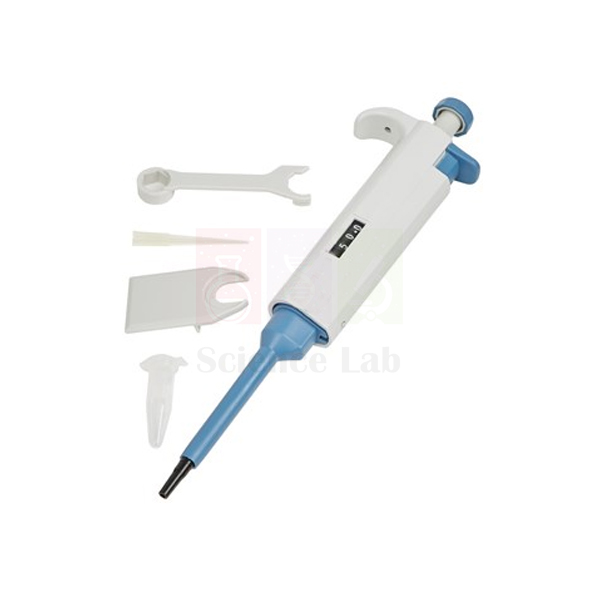
Micropipette
Micropipette (Product Code: SLE/P/24) is a variable-volume hand pipette used to measure and transfer small liquid volumes from 5 to 50 µl in biology, biotechnology, microbiology and chemistry laboratories. It is lightweight, takes standard micropipette tips, has a tip ejector, and comes with a tool and instructions for self-calibration. It is supplied by Jain Scientific Equipments Pvt Ltd (ScienceLab), Ambala, India, as part of its range of lab equipment for research and teaching.
Specifications
| Parameter | Detail |
|---|---|
| Type | Variable-volume micropipette |
| Volume range | 5–50 µl |
| Tips | Standard micropipette tips |
| Tip removal | Tip ejector |
| Design | Lightweight; easy to use |
| Calibration | Tool and instructions included for self-calibration |
| Product code | SLE/P/24 |
| Supplied by | Jain Scientific Equipments Pvt Ltd (ScienceLab), Ambala, India |
What Is a Micropipette Used For?
Micropipettes measure volumes far too small for glass pipettes or burettes. With a 5–50 µl range, this model suits loading samples into electrophoresis gel wells, preparing serial dilutions, adding enzymes or reagents to small reaction tubes and dispensing small aliquots in microbiology and biochemistry practicals.
Set the volume, press a fresh tip firmly onto the shaft, depress the plunger to the first stop, immerse the tip just below the liquid surface and release slowly. Dispense against the wall of the receiving vessel, then use the ejector to discard the tip without touching it. Keep the micropipette upright on a stand when not in use, never lay it down with liquid in the tip, and check its setting periodically with the supplied calibration tool and instructions.
What to Specify When Ordering
- Volume range: this model covers 5–50 µl; tell us if your work needs a different range.
- Tips: the quantity of standard micropipette tips to send with it.
- Number of micropipettes per bench or student group.
- Whether calibration documentation is needed, to be discussed with us before ordering.
Supplier
Jain Scientific Equipments Private Limited, trading as ScienceLab, supplies this micropipette from Ambala, Haryana, India. It is a sourced precision instrument, provided to schools, colleges, universities, research laboratories, dealers and importers together with tips and other consumables. See the ScienceLab profile for company information.
Related Laboratory Equipment
Micropipette users normally order these consumables and holders as well:
- Micropipette Tips — replacement tips for day-to-day pipetting.
- Filtered Micropipette Tips — filter tips for work where carry-over into the pipette matters.
- Micro Centrifuge Tube, 1.5ml — small tubes for the volumes a micropipette handles.
- Universal Tube Rack — holds tubes upright while samples are pipetted.
See the Scientific Lab Plasticware category for more liquid-handling items.
Frequently Asked Questions
What volume range does the ScienceLab Micropipette cover?
The Micropipette (SLE/P/24) is a variable-volume model covering 5 to 50 µl. The volume can be set within that range, making it suitable for small aliquots, dilutions and gel loading in teaching and research labs.
Which tips fit the Micropipette SLE/P/24?
The Micropipette SLE/P/24 is designed for standard micropipette tips. ScienceLab also supplies micropipette tips and filtered tips; tell us the quantity you need when requesting a quote so the pipette and tips can be sent together.
How is the Micropipette calibrated?
A tool and instructions for self-calibration are included with the Micropipette (SLE/P/24), so users can adjust it in the lab when routine checks show a deviation. For formal calibration documentation, please discuss your requirement with ScienceLab through the contact page.
What accuracy does the Micropipette have?
No numerical accuracy or precision figures are published for the Micropipette (SLE/P/24) on this page. If your work needs specific accuracy values, ask ScienceLab through the contact page before ordering so the details can be confirmed for you.
Who supplies the Micropipette SLE/P/24?
Jain Scientific Equipments Pvt Ltd, trading as ScienceLab, supplies the Micropipette (SLE/P/24) from Ambala, Haryana, India to schools, colleges, universities, research laboratories, dealers and importers in India and international markets.
How do I order micropipettes for a class or lab?
To order the Micropipette (SLE/P/24) for a class or lab, send the number of pipettes, the quantity of tips and the delivery location through the enquiry cart or contact page. ScienceLab will reply with a combined quotation.
Request a Quote
Add the Micropipette to the enquiry cart together with tips, or send your requirement via the contact page, and ScienceLab will send a quotation.
Last updated: 24 September 2026
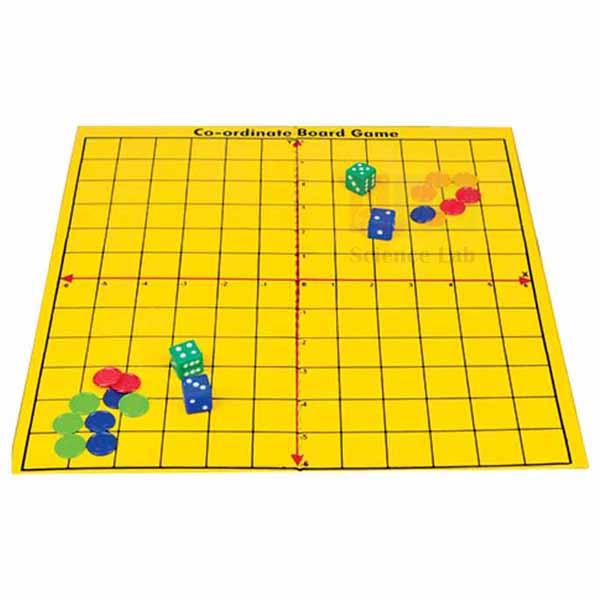
Coordinate Board
Coordinate Board (Product Code: SLE/MAT/13) is a board game used to teach plotting and naming points on a four-quadrant graph in school mathematics classes. Played in groups with colour counters and dice, it turns a routine coordinate-geometry exercise into an engaging team activity. It is made by Jain Scientific Equipments Pvt Ltd (ScienceLab), an OEM school lab equipment manufacturer, at its own factory in Ambala, India.
Key Details
| Parameter | Detail |
|---|---|
| Graph type | Four-quadrant coordinate graph |
| Supplied with | Colour counters and dice |
| Topic | Plotting coordinates and naming their points |
| Format | Group board game |
| Product code | SLE/MAT/13 |
| Manufacturer | Jain Scientific Equipments Pvt Ltd (ScienceLab) — OEM |
| Country of origin | India (made in Ambala, Haryana) |
What Is the Coordinate Board Used For?
Plotting and naming points on a four-quadrant graph is one of the most common tasks in a maths class, and the Coordinate Board makes it a game. Teachers can use the dice to generate ordered pairs; each player locates the point, marks it with a colour counter and names it aloud, while the group checks that the horizontal value was read first.
Because all four quadrants are on the board, students meet negative coordinates and the sign pattern of each quadrant early, not as an afterthought. It works well as a warm-up before written graph exercises and as a revision game within mathematics lab kits in India for middle classes.
OEM Manufacturer
ScienceLab is the trading name of Jain Scientific Equipments Private Limited, the OEM that makes the Coordinate Board at its own licensed factory at Saha, Ambala, Haryana. Institutions, dealers and importers order it factory-direct, and repeat orders or extra counters are handled by the manufacturer itself — just ask us.
Institutions registering us as a vendor can use GSTIN 06AAECJ8618A1ZT and LEI 3358004HRD1JIVXKYX49. Read the company profile for more background.
Related Maths Lab Equipment
Pair the Coordinate Board with these items for graph and number work:
- Graph Board — an enlarged write-and-wipe graph for whole-class plotting practice
- Integer Board Game — another dice-and-counter game, for adding and subtracting signed numbers
- Plastic Dice — extra dice when several groups play at once
- Trigonometry Board — a later step from coordinates into sine, cosine and tangent
Browse all Maths Lab Equipment for further geometry and algebra aids.
Frequently Asked Questions
What comes with the Coordinate Board?
The Coordinate Board is supplied with colour counters and dice for group play on a four-quadrant graph. The number of counters and dice per set is not stated on this page, so confirm the contents through our contact page before ordering several sets.
Which topic does the Coordinate Board teach?
The Coordinate Board teaches plotting points on a four-quadrant graph and naming them by their coordinates. Because all four quadrants are shown, students practise positive and negative x and y values and learn how the sign of each coordinate places a point.
Is the Coordinate Board meant for small groups or the whole class?
The Coordinate Board is designed as a group activity, so it is most practical with a small team around one desk. For whole-class plotting on a large surface, many teachers use it alongside the write-and-wipe Graph Board.
Who manufactures the Coordinate Board?
Jain Scientific Equipments Pvt Ltd (ScienceLab) manufactures the Coordinate Board as the OEM, producing the game at its own factory in Saha, Ambala, Haryana, India. Orders and quotations come directly from the manufacturer, not from a trader.
Can the Coordinate Board be supplied for several schools or for export?
Yes, the Coordinate Board can be quoted in bulk for schools, education departments, dealers and importers in India and international markets. Share the number of sets and the delivery location, and the manufacturer will prepare the quotation.
Request a Quote
For a quotation on the Coordinate Board, write to us through the contact page or add it to your enquiry cart. The quotation and terms come straight from the manufacturer.
Last updated: 24 September 2026
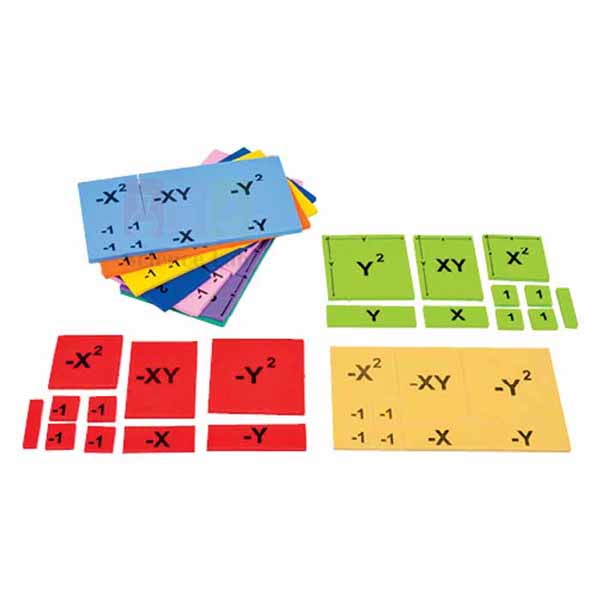
Algebra Kit
Algebra Kit (Product Code: SLE/MAT/14) is a set of labelled algebra tiles used to investigate polynomials in two variables in secondary school mathematics. It suits students moving to higher classes, where expressions with two or more variables replace simple one-variable work. The kit is made by Jain Scientific Equipments Pvt Ltd (ScienceLab), an OEM manufacturer, at its own factory in Ambala, India.
Key Details
| Parameter | Detail |
|---|---|
| Contents | Labelled algebra tiles |
| Topic | Polynomials in two variables |
| Level | Higher classes working with polynomials of two or more variables |
| Product code | SLE/MAT/14 |
| Manufacturer | Jain Scientific Equipments Pvt Ltd (ScienceLab) — OEM |
| Country of origin | India (made in Ambala, Haryana) |
What Is the Algebra Kit Used For?
The Algebra Kit lets students investigate two-variable polynomials by building them. Because every tile carries a label, a learner can name each term while laying it down, then combine like terms by grouping matching tiles. Arranging tiles into a rectangle gives a visual area model of multiplying two expressions, and reversing the process shows what factorising means.
Teachers find that working with physical tiles first makes symbolic manipulation less abstract. As part of a mathematics lab kit for Indian secondary classes, it works well in pairs: one student builds, the other writes the matching expression, then they swap roles.
OEM Manufacturer
Jain Scientific Equipments Private Limited trades as ScienceLab and is the OEM behind the Algebra Kit. The kit is produced at the company’s own licensed factory in Saha, Ambala, Haryana, and supplied factory-direct to schools, colleges, dealers and importers.
Because the maker handles the order itself, questions about tile labels or repeat orders get a direct answer — ask us. Our company profile has more about ScienceLab.
Related Maths Lab Equipment
These items support the same algebra lessons:
- Algebra Tiles — positive and negative tiles for operations, factorising and linear equations
- Algebra — a bingo-style class activity for testing algebra skills
- Senior Maths Kit — a teacher kit that includes plastic algebra cubes
- Graph Board — a write-and-wipe graph for plotting the expressions students build
The full Maths Lab Equipment page lists more algebra and geometry aids.
Frequently Asked Questions
What does the Algebra Kit contain?
The Algebra Kit contains labelled algebra tiles for exploring polynomials in two variables. The number of tiles and the exact labels are not listed on this page; please ask through our contact page for the current contents before ordering.
Which classes is the Algebra Kit suitable for?
The Algebra Kit is intended for students in higher classes who have moved on to polynomials with two or more variables. It helps them see how terms combine and how expressions multiply and factorise before they rely on symbols alone.
How is the Algebra Kit different from Algebra Tiles?
The Algebra Kit focuses on labelled tiles for polynomials in two variables. The separate Algebra Tiles product covers operations on polynomials, factorising, linear equations and integers with positive and negative tiles. Schools can keep both for different stages of the syllabus.
Who manufactures the Algebra Kit?
The Algebra Kit is an OEM product of Jain Scientific Equipments Pvt Ltd (ScienceLab), made at the company’s own factory in Saha, Ambala, Haryana, India. Institutions, dealers and importers are supplied by the manufacturer without a trading intermediary.
What information is needed for an Algebra Kit quotation?
For an Algebra Kit quotation, send the number of kits, the delivery address and whether you need other maths lab items in the same order. Quotes for India and international markets are prepared directly by the manufacturer.
Request a Quote
Request an Algebra Kit quotation through the contact page, or add the kit to the enquiry cart with other items. You will hear back from the manufacturer directly.
Last updated: 24 September 2026
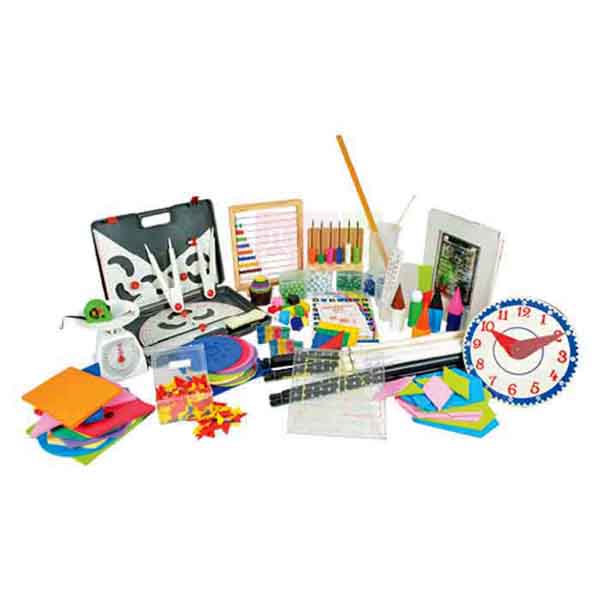
Maths Kit Junior
Maths Kit Junior (Product Code: SLE/MAT/15) is a teacher’s kit of 24 types of manipulatives used to lay the foundations of number, measurement and geometry in junior school mathematics. Each item correlates easily with the curriculum and is sized for teaching a group. The kit is made by Jain Scientific Equipments Pvt Ltd (ScienceLab), an OEM manufacturer of mathematics lab kits in India, at its own factory in Ambala.
Specifications
| Parameter | Detail |
|---|---|
| Manipulative types | 24 |
| Designed for | Teachers laying the foundation of mathematics; items correlate with the curriculum |
| Group teaching | Manipulatives sized for teaching a group |
| Product code | SLE/MAT/15 |
| Manufacturer | Jain Scientific Equipments Pvt Ltd (ScienceLab) — OEM |
| Country of origin | India (made in Ambala, Haryana) |
Kit contents:
- Solid figure set
- Geometrical instrument box
- Measuring tape
- Jug and beaker set
- Wall thermometer
- Chemical thermometer
- Kitchen balance
- Geoboard
- Skip counting board
- Designer fraction
- Abacus
- Fibre dummy clock
- Pattern of triangle
- Game of place value
- Magnetic fraction disk
- Half metre scale
- Plastic moulds
- Set of cups
- Junior Pythagoras theorem
- Geometrical stencils
- Set of pearl marbles
- Transparencies (set of 10)
- Arithmetic charts (set of 7)
- PVC charts (set of 3)
What Is the Maths Kit Junior Used For?
The Maths Kit Junior gives a teacher one box that covers most foundation topics. The abacus, game of place value and skip counting board support place value and times tables; the designer fraction and magnetic fraction disk show parts of a whole; the fibre dummy clock teaches time. The geoboard, geometrical stencils and solid figure set introduce shapes, and the junior Pythagoras theorem gives a first look at right triangles.
Measurement lessons draw on the kitchen balance, jug and beaker set, measuring tape, half metre scale and the wall and chemical thermometers, so students weigh, pour, measure and read temperatures themselves. As a junior lab kit for primary school use, it works well when the teacher demonstrates first and then passes items round the group.
What to Specify When Ordering
- How many kits you need — typically one per teacher or per classroom
- Whether this junior kit or the Senior Maths Kit suits the classes you teach
- Any single items from the list you want as extra spares (ask us)
- Delivery location, in India or abroad
OEM Manufacturer
ScienceLab, the trading name of Jain Scientific Equipments Private Limited, is the OEM that assembles the Maths Kit Junior at its own licensed factory at Saha, Ambala, Haryana. Buying from the maker means the whole kit — all 24 items — is packed and quoted by one company instead of being gathered from several traders.
Schools and distributors that need a replacement for one kit item later can ask the manufacturer directly. See our company profile for more about ScienceLab.
Related Maths Lab Equipment
These items sit alongside the junior kit or take students a step further:
- Senior Maths Kit — the follow-on kit for advanced concepts in higher classes
- Upper Primary Maths Kit — an alternative kit for upper primary classes
- Junior Pythagoras Theorem — the right-triangle aid from the kit, available on its own
- Game of Place Value — the U-shaped wire abacus for place value, sold separately
- Designer Fraction — extra triangle pieces for fraction and pattern work
Explore the wider Maths Lab Equipment range for individual manipulatives.
Frequently Asked Questions
How many items are in the Maths Kit Junior?
The Maths Kit Junior contains 24 types of manipulatives, from an abacus, geoboard and fibre dummy clock to a kitchen balance, jug and beaker set, thermometers, fraction aids, charts and transparencies. The full list is given on this page.
Does the Maths Kit Junior include measuring equipment?
Yes, the Maths Kit Junior includes a kitchen balance, jug and beaker set, measuring tape, half metre scale, wall thermometer and chemical thermometer. Together they let students measure mass, capacity, length and temperature during hands-on maths lessons.
Is the Maths Kit Junior meant for teachers or for students?
The Maths Kit Junior is designed as a teaching aid for teachers laying the foundation of mathematics. Its manipulatives are sized so a teacher can demonstrate to a group, after which students handle the items in turn.
Who manufactures the Maths Kit Junior?
Jain Scientific Equipments Pvt Ltd (ScienceLab) is the OEM manufacturer of the Maths Kit Junior and puts the complete kit together at its own factory in Saha, Ambala, Haryana, India. All 24 item types are packed and supplied by the manufacturer itself.
Can individual items of the Maths Kit Junior be ordered separately?
Some items in the Maths Kit Junior, such as the Junior Pythagoras Theorem and Game of Place Value, also have their own product pages. For any other single item or replacement part, ask us through the contact page.
Can the Maths Kit Junior be ordered in bulk for many schools?
Yes, the Maths Kit Junior can be quoted in bulk for school groups, education departments, dealers and importers in India and international markets. State the number of kits and the delivery location in your enquiry.
Request a Quote
To get a quotation for the Maths Kit Junior, contact us through the contact page or add it to the enquiry cart. Every quotation is issued by the manufacturer itself.
Last updated: 24 September 2026
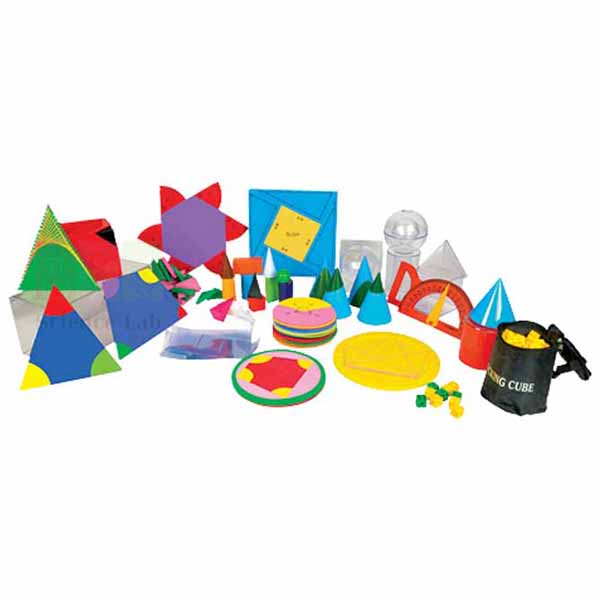
Senior Maths Kit
Senior Maths Kit (Product Code: SLE/MAT/16) is a teacher’s kit of 20 types of manipulatives used to teach advanced mathematics concepts such as mensuration, the Pythagoras theorem, heights and distances and commercial arithmetic in senior school classes. Sextant and theodolite models link classroom trigonometry with field measurement. The kit is made by Jain Scientific Equipments Pvt Ltd (ScienceLab), an OEM manufacturer, at its own factory in Ambala, India.
Specifications
| Parameter | Detail |
|---|---|
| Manipulative types | 20 |
| Purpose | Teaching advanced concepts; items correlate with the curriculum |
| Group teaching | Manipulatives sized for teaching a group |
| Product code | SLE/MAT/16 |
| Manufacturer | Jain Scientific Equipments Pvt Ltd (ScienceLab) — OEM |
| Country of origin | India (made in Ambala, Haryana) |
Items named in the kit description:
- Geoboard
- Magnetic fraction disk
- Set of marbles
- Pythagoras theorem (magnetic)
- Dummy cheque book and pay-in slip
- Mensuration kit
- Derivation of pi (magnetic)
- Optical square
- Cross vertical staff
- Vernier calliper
- Standard time indicator
- Survey measuring tape
- Rain gauge
- Magic circle
- Mathematics charts (set of 15)
- Algebra cubes (plastic)
- Sextant model
- Theodolite model
The description names 18 items; ask us through the contact page for the complete packing list of all 20 types.
What Is the Senior Maths Kit Used For?
The Senior Maths Kit is built for topics that are hard to teach from a textbook alone. The magnetic Pythagoras theorem and derivation-of-pi aids let a teacher demonstrate results on the board, the mensuration kit and vernier calliper support area and volume work, and the plastic algebra cubes make algebraic identities visible. The dummy cheque book and pay-in slip bring banking into commercial arithmetic lessons.
For heights and distances, students take the optical square, cross vertical staff, survey measuring tape, sextant model and theodolite model outdoors and measure real angles and lengths. The rain gauge adds a data-handling project. This is school lab equipment in India that suits a senior mathematics lab shared by several sections.
What to Specify When Ordering
- Number of kits required for your senior classes
- Confirmation of the full list of 20 item types (ask us)
- Whether you also need items such as the Theodolite Model as separate pieces
- Delivery location, in India or abroad
OEM Manufacturer
Jain Scientific Equipments Private Limited, trading as ScienceLab, is the OEM of the Senior Maths Kit. The kit is manufactured at the company’s own licensed factory at Saha, Ambala, Haryana, and supplied directly to schools, colleges, dealers and importers without a middleman.
Because the manufacturer assembles the whole set, one enquiry covers every item, and requests for a replacement piece can be raised with us later. More about the company is on the company profile page.
Related Maths Lab Equipment
These items complement the senior kit or can be bought on their own:
- Theodolite Model — the angle-measuring model from the kit, available separately
- Trigonometry Board — for sine, cosine and tangent before outdoor heights-and-distances work
- Volume Relation Between Cone and Cylinder — a mensuration demonstration of cone and cylinder volumes
- Maths Kit Junior — the foundation-level kit for junior classes
See all Maths Lab Equipment for more senior mathematics aids.
Frequently Asked Questions
What is included in the Senior Maths Kit?
The Senior Maths Kit is described as 20 types of manipulatives; 18 are named on this page, including a geoboard, vernier calliper, mensuration kit, sextant model and theodolite model. Ask through our contact page for the complete packing list.
Which surveying items come in the Senior Maths Kit?
The Senior Maths Kit includes an optical square, cross vertical staff, survey measuring tape, sextant model and theodolite model. Students use them to measure angles and distances outdoors and then solve heights-and-distances problems with trigonometry.
How is the Senior Maths Kit different from the Maths Kit Junior?
The Senior Maths Kit is aimed at advanced concepts such as mensuration, trigonometric measurement and commercial arithmetic. The Maths Kit Junior is aimed at foundation topics like counting, place value, fractions and simple measurement in lower classes.
Is a calibration certificate available for the vernier calliper in the Senior Maths Kit?
The vernier calliper in the Senior Maths Kit is supplied as a teaching aid, and no calibration certificate is listed on this page. If your school needs one, discuss it with us through the contact page before ordering.
Who manufactures the Senior Maths Kit?
The Senior Maths Kit comes from Jain Scientific Equipments Pvt Ltd (ScienceLab), which manufactures the kit as the OEM at its own factory in Saha, Ambala, Haryana, India. Schools, dealers and importers are supplied factory-direct.
Can the Senior Maths Kit be quoted for export or tenders?
Yes, the Senior Maths Kit can be quoted for school tenders, dealers and importers in India and international markets. Send the quantity, delivery location and any tender item description so the manufacturer can prepare the quotation.
Request a Quote
For a Senior Maths Kit quotation, reach us via the contact page or place it in the enquiry cart. Quotes come direct from the manufacturer in Ambala.
Last updated: 24 September 2026
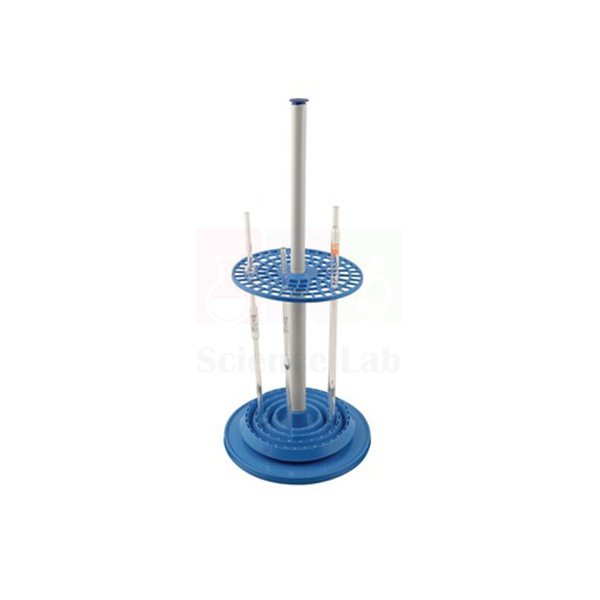
Pipette Stand Rotary
Pipette Stand Rotary (Product Code: SLE/P/23) is a revolving polypropylene stand used to hold pipettes upright for storage and drip-drying in chemistry, biology and microbiology laboratories. It holds up to 94 pipettes, turns on a vertical axis so any pipette can be reached from one spot, and has a lower disc with four tapered, open-bottomed troughs that cradle the tips. It is made by Jain Scientific Equipments Pvt Ltd (ScienceLab), an OEM manufacturer of chemistry lab instruments, at its own factory in Ambala, India.
Specifications
| Parameter | Detail |
|---|---|
| Type | Rotary pipette stand |
| Material | Polypropylene |
| Capacity | Up to 94 pipettes |
| Rotation | Rotates on a vertical axis |
| Lower disc | Four concentric troughs with tapered sides and open bottoms; cradle pipette tips and let water drops run off |
| Assembly | Easily assembled and disassembled |
| Product code | SLE/P/23 |
| Manufacturer | Jain Scientific Equipments Pvt Ltd (ScienceLab) — OEM |
| Country of origin | India (made in Ambala, Haryana) |
What Is a Rotary Pipette Stand Used For?
After washing, pipettes need to stand tip-down so water can drain out and they can dry without dust settling inside. The rotary stand does this for a whole lab's stock at once, holding up to 94 pipettes, and a gentle turn brings the required size round to the user instead of reaching across the bench. The tapered troughs in the lower disc protect delicate tips, while the open bottoms let drips escape rather than pooling around them.
Sort pipettes by volume into different troughs or sectors so students can find the right one quickly. Place a tray or paper towel beneath the stand to catch drips, and take the stand apart for cleaning when residue builds up. Keeping pipettes organised like this is a simple step in any new school lab setup in India.
OEM Manufacturer
Jain Scientific Equipments Private Limited, trading as ScienceLab, is the OEM (original equipment manufacturer) of this rotary pipette stand and makes it at its own licensed factory at Saha, Ambala, Haryana, India. Stands are supplied factory-direct to schools, colleges, universities, dealers and importers, and repeat orders or replacement parts are handled by the manufacturer — ask us.
The company is incorporated as Jain Scientific Equipments Private Limited (CIN U29309HR2020PTC087597) and operates its licensed factory at 449, HSIIDC Industrial Area, Saha, Ambala under Factory Licence AMB-ONLINE-CHD-J-414. Read more on the ScienceLab profile.
Related Scientific Lab Plasticware
Labs setting up a pipetting area often order these items with the rotary stand:
- Pipette Stand, Polypropylene — another polypropylene pipette stand in the same range.
- Pipette Stand, Vertical — a vertical stand option for smaller benches.
- Pipette Stand, Horizontal — keeps pipettes lying horizontal for storage.
- Pipette Filler — for filling pipettes without mouth suction before they return to the stand.
- Bulb Type, Pipette Filler — for pipetting harmful or unpleasant liquids.
Find more pipetting and storage items in the Scientific Lab Plasticware category.
Frequently Asked Questions
How many pipettes does the Pipette Stand Rotary hold?
The Pipette Stand Rotary (SLE/P/23) holds a maximum of 94 pipettes. Because the stand rotates on a vertical axis, any pipette in it can be brought within reach simply by turning the stand, which keeps the bench tidy.
How does the rotary pipette stand help pipettes drain?
The lower rotating disc of the Pipette Stand Rotary has four concentric troughs with tapered sides and open bottoms. These cradle the pipette tips protectively and let water drops run off, so washed pipettes can drain and dry standing upright.
What material is the Pipette Stand Rotary made from?
The Pipette Stand Rotary is made of polypropylene, a light, water-resistant plastic that suits wet pipettes and routine cleaning. Avoid placing hot glassware straight from a drying oven onto it; let the pipettes cool first.
Can the Pipette Stand Rotary be taken apart?
Yes. The Pipette Stand Rotary (SLE/P/23) can be easily assembled and disassembled, which makes cleaning simpler and helps when the stand has to be moved between laboratories or put away between terms.
Who manufactures the Pipette Stand Rotary?
Jain Scientific Equipments Pvt Ltd, trading as ScienceLab, manufactures the Pipette Stand Rotary (SLE/P/23) as the OEM at its own licensed factory in Saha, Ambala, Haryana, India, and supplies it directly to schools, colleges, dealers and importers.
What details are needed for a pipette stand quotation?
For a quotation on the Pipette Stand Rotary (SLE/P/23), send the number of stands, the delivery location and any pipettes or fillers to include. Use the enquiry cart or the contact page, and the manufacturer will reply directly.
Request a Quote
Price the Pipette Stand Rotary by adding it to the enquiry cart or by writing to us through the contact page. Quotations are issued directly by ScienceLab as the manufacturer.
Last updated: 24 September 2026
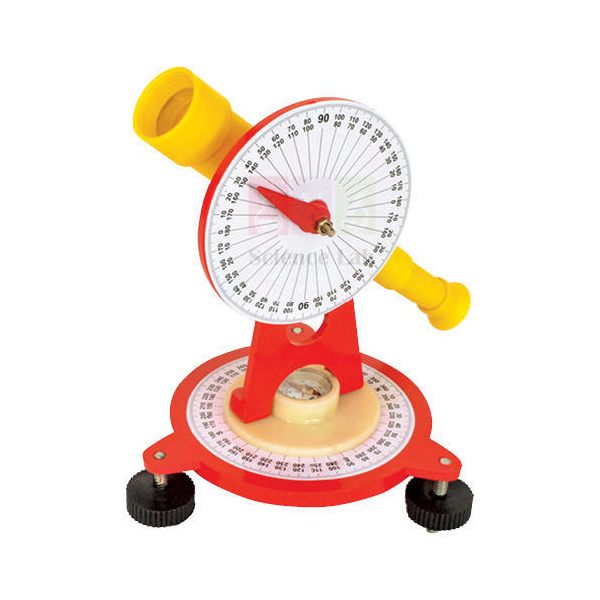
Theodolite Model
Theodolite Model (Product Code: SLE/MAT/17) is a teaching model of a theodolite used to show how horizontal and vertical angles are measured in school mathematics lessons on heights and distances. Its rotating telescope is mounted on horizontal and vertical axes, each fitted with a graduated circle. The model is made by Jain Scientific Equipments Pvt Ltd (ScienceLab), an OEM manufacturer, at its own factory in Ambala, India.
Key Details
| Parameter | Detail |
|---|---|
| Telescope | Movable, rotating telescope |
| Axes | Horizontal and vertical |
| Angle scales | Graduated circles on both axes |
| Demonstrates | Measurement of horizontal and vertical angles |
| Applications explained | Triangulation, prolonging lines, and elevation and depression of distant and near objects |
| Type | Teaching model for understanding how a theodolite works |
| Product code | SLE/MAT/17 |
| Manufacturer | Jain Scientific Equipments Pvt Ltd (ScienceLab) — OEM |
| Country of origin | India (made in Ambala, Haryana) |
What Is the Theodolite Model Used For?
A real theodolite is a surveying instrument, and this model lets students see its mechanics before they meet one in the field. They sight an object through the telescope, read the vertical circle for the angle of elevation or depression, and turn the instrument to read horizontal angles between two landmarks. The readings then feed straight into trigonometry problems on heights and distances.
Place the model on a steady, level table, turn the telescope slowly and read both circles before recording results in a table. Letting groups take their own readings builds a spirit of experimenting, which makes the model a useful part of mathematics lab kits in India for senior classes.
OEM Manufacturer
ScienceLab — the brand of Jain Scientific Equipments Private Limited — is the original equipment manufacturer of this Theodolite Model. It is made at the company’s own licensed factory at Saha, Ambala, Haryana, and supplied factory-direct to schools, colleges, dealers and importers.
Questions about the scale markings or a replacement part go straight to the people who make it — ask us. Our company profile explains more about ScienceLab.
Related Maths Lab Equipment
Use these with the Theodolite Model in angle and measurement lessons:
- Senior Maths Kit — a teacher kit that pairs the theodolite model with a sextant model and optical square
- Trigonometry Board — to build the sine, cosine and tangent ideas used with the readings
- Professional Protractor — a clear open-centre protractor for checking angles on paper
- Folding Meter Stick — for measuring the baseline distance to the object
More geometry and measurement aids are on the Maths Lab Equipment page.
Frequently Asked Questions
Can the Theodolite Model be used for real land surveying?
The Theodolite Model is a teaching model that explains how a theodolite measures horizontal and vertical angles; it is not described as a survey-grade instrument. If you need equipment for field surveying, discuss your requirement through our contact page.
Which parts of a theodolite does the Theodolite Model show?
The Theodolite Model shows a movable telescope mounted on horizontal and vertical axes, with a graduated circle on each axis. Students can see how turning the telescope about each axis changes the horizontal or vertical angle reading.
Which lessons use the Theodolite Model?
The Theodolite Model supports lessons on heights and distances, angles of elevation and depression, and the idea of triangulation. It helps students connect the trigonometric ratios they learn in class with how angles are actually measured.
What is the graduation interval of the Theodolite Model circles?
The graduation interval of the circles on the Theodolite Model is not stated on this page. Please ask through the contact page for the scale details of the current model before you finalise your order.
Who manufactures the Theodolite Model?
Jain Scientific Equipments Pvt Ltd (ScienceLab) is the OEM that makes the Theodolite Model, at its own factory in Saha, Ambala, Haryana, India. Schools, colleges, dealers and importers buy the model straight from its manufacturer.
Can the Theodolite Model be ordered in quantity?
Yes, the Theodolite Model can be quoted in quantity for schools, colleges, dealers and importers in India and international markets. Include the number of models and the delivery location in your enquiry.
Request a Quote
Ask for a Theodolite Model quotation on the contact page or add it to the enquiry cart. The quotation is sent directly by the manufacturer.
Last updated: 24 September 2026