- Physics Lab Equipment
- Chemistry Lab Equipment
- Biology Lab Equipment
- Anatomical Lab Equipment
- Learning
- Educational Lab Equipment
- Magnets
- Agriculture
- Astronomy
- Earth Science
- Geography Lab Equipment
- Safety Lab Coat
- Laboratory
- Meteorological
- Electricity & Magnetism
- Heat
- School Lab Equipment
- Lab Glassware
- Science Lab Equipment
- Tvet Lab Equipment
- Robotics Kits Supplier and Manufacturer for Schools India
- Math Lab Equipment Manufacturers and Exporters in Ambala
- STEM Kits Manufacturers and Supplier India
- Engineering Lab Equipment
- Hospital Lab Equipment
- Water, Sanitation & Hygiene Supplies
- Cold Chain, Solar & Communication Equipment
- Nutrition
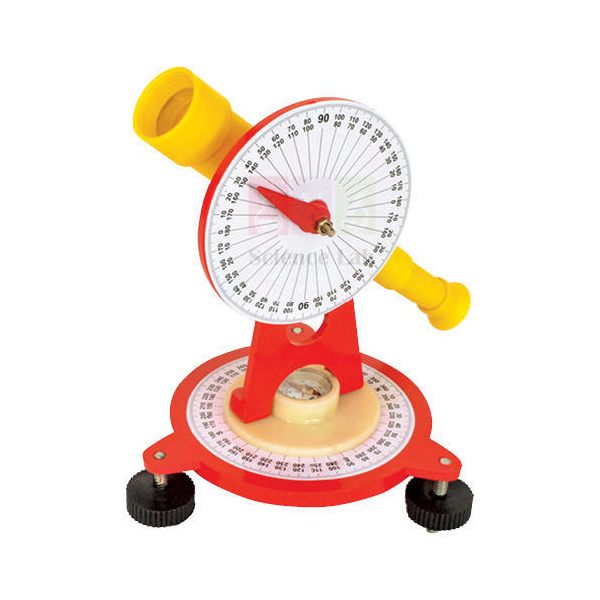
Theodolite Model
Theodolite Model (Product Code: SLE/MAT/17) is a teaching model of a theodolite used to show how horizontal and vertical angles are measured in school mathematics lessons on heights and distances. Its rotating telescope is mounted on horizontal and vertical axes, each fitted with a graduated circle. The model is made by Jain Scientific Equipments Pvt Ltd (ScienceLab), an OEM manufacturer, at its own factory in Ambala, India.
Key Details
| Parameter | Detail |
|---|---|
| Telescope | Movable, rotating telescope |
| Axes | Horizontal and vertical |
| Angle scales | Graduated circles on both axes |
| Demonstrates | Measurement of horizontal and vertical angles |
| Applications explained | Triangulation, prolonging lines, and elevation and depression of distant and near objects |
| Type | Teaching model for understanding how a theodolite works |
| Product code | SLE/MAT/17 |
| Manufacturer | Jain Scientific Equipments Pvt Ltd (ScienceLab) — OEM |
| Country of origin | India (made in Ambala, Haryana) |
What Is the Theodolite Model Used For?
A real theodolite is a surveying instrument, and this model lets students see its mechanics before they meet one in the field. They sight an object through the telescope, read the vertical circle for the angle of elevation or depression, and turn the instrument to read horizontal angles between two landmarks. The readings then feed straight into trigonometry problems on heights and distances.
Place the model on a steady, level table, turn the telescope slowly and read both circles before recording results in a table. Letting groups take their own readings builds a spirit of experimenting, which makes the model a useful part of mathematics lab kits in India for senior classes.
OEM Manufacturer
ScienceLab — the brand of Jain Scientific Equipments Private Limited — is the original equipment manufacturer of this Theodolite Model. It is made at the company’s own licensed factory at Saha, Ambala, Haryana, and supplied factory-direct to schools, colleges, dealers and importers.
Questions about the scale markings or a replacement part go straight to the people who make it — ask us. Our company profile explains more about ScienceLab.
Related Maths Lab Equipment
Use these with the Theodolite Model in angle and measurement lessons:
- Senior Maths Kit — a teacher kit that pairs the theodolite model with a sextant model and optical square
- Trigonometry Board — to build the sine, cosine and tangent ideas used with the readings
- Professional Protractor — a clear open-centre protractor for checking angles on paper
- Folding Meter Stick — for measuring the baseline distance to the object
More geometry and measurement aids are on the Maths Lab Equipment page.
Frequently Asked Questions
Can the Theodolite Model be used for real land surveying?
The Theodolite Model is a teaching model that explains how a theodolite measures horizontal and vertical angles; it is not described as a survey-grade instrument. If you need equipment for field surveying, discuss your requirement through our contact page.
Which parts of a theodolite does the Theodolite Model show?
The Theodolite Model shows a movable telescope mounted on horizontal and vertical axes, with a graduated circle on each axis. Students can see how turning the telescope about each axis changes the horizontal or vertical angle reading.
Which lessons use the Theodolite Model?
The Theodolite Model supports lessons on heights and distances, angles of elevation and depression, and the idea of triangulation. It helps students connect the trigonometric ratios they learn in class with how angles are actually measured.
What is the graduation interval of the Theodolite Model circles?
The graduation interval of the circles on the Theodolite Model is not stated on this page. Please ask through the contact page for the scale details of the current model before you finalise your order.
Who manufactures the Theodolite Model?
Jain Scientific Equipments Pvt Ltd (ScienceLab) is the OEM that makes the Theodolite Model, at its own factory in Saha, Ambala, Haryana, India. Schools, colleges, dealers and importers buy the model straight from its manufacturer.
Can the Theodolite Model be ordered in quantity?
Yes, the Theodolite Model can be quoted in quantity for schools, colleges, dealers and importers in India and international markets. Include the number of models and the delivery location in your enquiry.
Request a Quote
Ask for a Theodolite Model quotation on the contact page or add it to the enquiry cart. The quotation is sent directly by the manufacturer.
Last updated: 24 September 2026