- Physics Lab Equipment
- Chemistry Lab Equipment
- Biology Lab Equipment
- Anatomical Lab Equipment
- Learning
- Educational Lab Equipment
- Magnets
- Agriculture
- Astronomy
- Earth Science
- Geography Lab Equipment
- Safety Lab Coat
- Laboratory
- Meteorological
- Electricity & Magnetism
- Heat
- School Lab Equipment
- Lab Glassware
- Science Lab Equipment
- Tvet Lab Equipment
- Robotics Kits Supplier and Manufacturer for Schools India
- Math Lab Equipment Manufacturers and Exporters in Ambala
- STEM Kits Manufacturers and Supplier India
- Engineering Lab Equipment
- Hospital Lab Equipment
- Water, Sanitation & Hygiene Supplies
- Cold Chain, Solar & Communication Equipment
- Nutrition
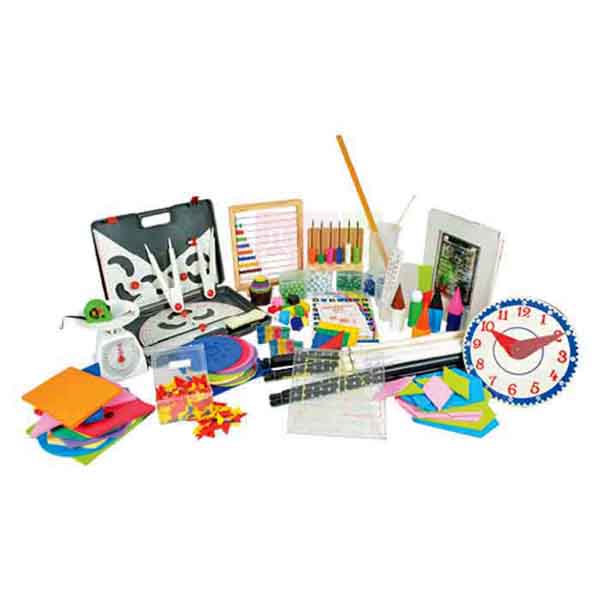
Maths Kit Junior
Maths Kit Junior (Product Code: SLE/MAT/15) is a teacher’s kit of 24 types of manipulatives used to lay the foundations of number, measurement and geometry in junior school mathematics. Each item correlates easily with the curriculum and is sized for teaching a group. The kit is made by Jain Scientific Equipments Pvt Ltd (ScienceLab), an OEM manufacturer of mathematics lab kits in India, at its own factory in Ambala.
Specifications
| Parameter | Detail |
|---|---|
| Manipulative types | 24 |
| Designed for | Teachers laying the foundation of mathematics; items correlate with the curriculum |
| Group teaching | Manipulatives sized for teaching a group |
| Product code | SLE/MAT/15 |
| Manufacturer | Jain Scientific Equipments Pvt Ltd (ScienceLab) — OEM |
| Country of origin | India (made in Ambala, Haryana) |
Kit contents:
- Solid figure set
- Geometrical instrument box
- Measuring tape
- Jug and beaker set
- Wall thermometer
- Chemical thermometer
- Kitchen balance
- Geoboard
- Skip counting board
- Designer fraction
- Abacus
- Fibre dummy clock
- Pattern of triangle
- Game of place value
- Magnetic fraction disk
- Half metre scale
- Plastic moulds
- Set of cups
- Junior Pythagoras theorem
- Geometrical stencils
- Set of pearl marbles
- Transparencies (set of 10)
- Arithmetic charts (set of 7)
- PVC charts (set of 3)
What Is the Maths Kit Junior Used For?
The Maths Kit Junior gives a teacher one box that covers most foundation topics. The abacus, game of place value and skip counting board support place value and times tables; the designer fraction and magnetic fraction disk show parts of a whole; the fibre dummy clock teaches time. The geoboard, geometrical stencils and solid figure set introduce shapes, and the junior Pythagoras theorem gives a first look at right triangles.
Measurement lessons draw on the kitchen balance, jug and beaker set, measuring tape, half metre scale and the wall and chemical thermometers, so students weigh, pour, measure and read temperatures themselves. As a junior lab kit for primary school use, it works well when the teacher demonstrates first and then passes items round the group.
What to Specify When Ordering
- How many kits you need — typically one per teacher or per classroom
- Whether this junior kit or the Senior Maths Kit suits the classes you teach
- Any single items from the list you want as extra spares (ask us)
- Delivery location, in India or abroad
OEM Manufacturer
ScienceLab, the trading name of Jain Scientific Equipments Private Limited, is the OEM that assembles the Maths Kit Junior at its own licensed factory at Saha, Ambala, Haryana. Buying from the maker means the whole kit — all 24 items — is packed and quoted by one company instead of being gathered from several traders.
Schools and distributors that need a replacement for one kit item later can ask the manufacturer directly. See our company profile for more about ScienceLab.
Related Maths Lab Equipment
These items sit alongside the junior kit or take students a step further:
- Senior Maths Kit — the follow-on kit for advanced concepts in higher classes
- Upper Primary Maths Kit — an alternative kit for upper primary classes
- Junior Pythagoras Theorem — the right-triangle aid from the kit, available on its own
- Game of Place Value — the U-shaped wire abacus for place value, sold separately
- Designer Fraction — extra triangle pieces for fraction and pattern work
Explore the wider Maths Lab Equipment range for individual manipulatives.
Frequently Asked Questions
How many items are in the Maths Kit Junior?
The Maths Kit Junior contains 24 types of manipulatives, from an abacus, geoboard and fibre dummy clock to a kitchen balance, jug and beaker set, thermometers, fraction aids, charts and transparencies. The full list is given on this page.
Does the Maths Kit Junior include measuring equipment?
Yes, the Maths Kit Junior includes a kitchen balance, jug and beaker set, measuring tape, half metre scale, wall thermometer and chemical thermometer. Together they let students measure mass, capacity, length and temperature during hands-on maths lessons.
Is the Maths Kit Junior meant for teachers or for students?
The Maths Kit Junior is designed as a teaching aid for teachers laying the foundation of mathematics. Its manipulatives are sized so a teacher can demonstrate to a group, after which students handle the items in turn.
Who manufactures the Maths Kit Junior?
Jain Scientific Equipments Pvt Ltd (ScienceLab) is the OEM manufacturer of the Maths Kit Junior and puts the complete kit together at its own factory in Saha, Ambala, Haryana, India. All 24 item types are packed and supplied by the manufacturer itself.
Can individual items of the Maths Kit Junior be ordered separately?
Some items in the Maths Kit Junior, such as the Junior Pythagoras Theorem and Game of Place Value, also have their own product pages. For any other single item or replacement part, ask us through the contact page.
Can the Maths Kit Junior be ordered in bulk for many schools?
Yes, the Maths Kit Junior can be quoted in bulk for school groups, education departments, dealers and importers in India and international markets. State the number of kits and the delivery location in your enquiry.
Request a Quote
To get a quotation for the Maths Kit Junior, contact us through the contact page or add it to the enquiry cart. Every quotation is issued by the manufacturer itself.
Last updated: 24 September 2026