- Physics Lab Equipment
- Chemistry Lab Equipment
- Biology Lab Equipment
- Anatomical Lab Equipment
- Learning
- Educational Lab Equipment
- Magnets
- Agriculture
- Astronomy
- Earth Science
- Geography Lab Equipment
- Safety Lab Coat
- Laboratory
- Meteorological
- Electricity & Magnetism
- Heat
- School Lab Equipment
- Lab Glassware
- Science Lab Equipment
- Tvet Lab Equipment
- Robotics Kits Supplier and Manufacturer for Schools India
- Math Lab Equipment Manufacturers and Exporters in Ambala
- STEM Kits Manufacturers and Supplier India
- Engineering Lab Equipment
- Hospital Lab Equipment
- Water, Sanitation & Hygiene Supplies
- Cold Chain, Solar & Communication Equipment
- Nutrition
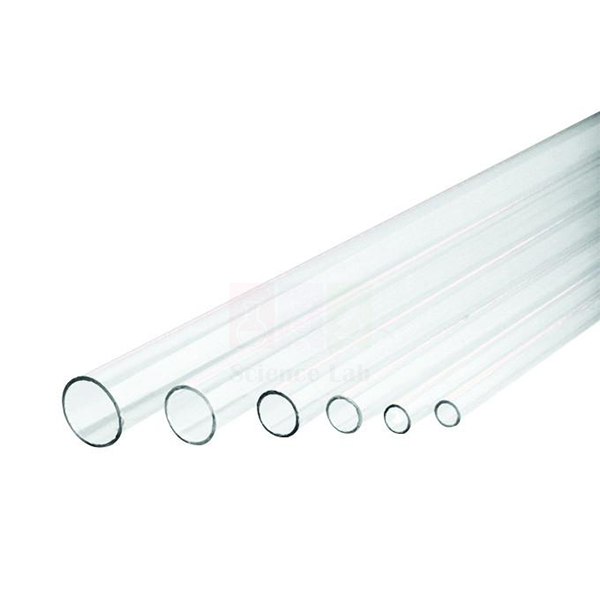
Soda Glass Tubing 6mm
Soda Glass Tubing 6mm (Product Code: SLE/MC/05) is clear soda glass tube used to make delivery tubes, bends, jets and connectors for gas and liquid apparatus in school chemistry labs. It comes in 500mm lengths and is listed as heat and chemical resistant for general laboratory use. It is supplied by Jain Scientific Equipments Pvt Ltd (ScienceLab), Ambala, India, a lab glassware supplier in India for schools and colleges.
Specifications
| Parameter | Detail |
|---|---|
| Material | Soda glass |
| Colour | Clear |
| Size (as named) | 6mm |
| Length | 500mm |
| Properties | Heat resistant and chemical resistant |
| Product code | SLE/MC/05 |
| Supplied by | Jain Scientific Equipments Pvt Ltd (ScienceLab), Ambala, India |
What Is Soda Glass Tubing Used For?
Soda glass tubing is the raw material for the glass parts of many school experiments: right-angle bends and delivery tubes for gas preparation, short connectors pushed through a rubber stopper, fine jets for fountain and wash-bottle set-ups, and simple manometers. Soda glass softens at a lower temperature than borosilicate, so students can bend and draw it in an ordinary Bunsen or spirit-lamp flame, which is why it is the usual choice for glass-working practicals.
Cut the tube by scoring it once with a glass tubing cutter and snapping it away from you with the hands protected by a cloth. Fire-polish every cut end, let hot glass cool on a heat-proof mat, and wet the tube with water or glycerol before easing it into a rubber stopper, a common cause of hand injuries if forced. For apparatus that will be heated strongly, use borosilicate tubing instead.
What to Specify When Ordering
- The outside diameter and bore you need — this listing is named 6mm, so please confirm the dimensions with us before ordering.
- The number of 500mm lengths required.
- Accessories such as a tubing cutter and rubber stoppers.
Supplier
Jain Scientific Equipments Private Limited, which trades as ScienceLab, supplies Soda Glass Tubing 6mm from Ambala, Haryana, as a consumable for chemistry practicals and apparatus building. The company sources the tubing for schools, colleges, laboratory technicians, dealers and importers, and can quote it with the stoppers, burners and other glassware it is used with. More information is on the company profile.
Related Laboratory Equipment
These tools and materials are used with Soda Glass Tubing 6mm when building apparatus:
- Glass Tubing Cutter — scores the tube for a clean, square break.
- Borosilicate Glass Tubing — the alternative for apparatus that will be heated strongly.
- Rubber Cork — holds the finished glass tube in flasks and test tubes.
- Rubber Tubing — joins lengths of glass tubing into a flexible gas line.
- Bunsen Burner — the flame used to bend, draw and fire-polish soda glass.
See related items in the Measuring Cylinders category.
Frequently Asked Questions
What length is the Soda Glass Tubing 6mm?
The Soda Glass Tubing 6mm is supplied in 500mm lengths. Students cut each length into shorter pieces for delivery tubes, bends and connectors, so one length usually provides glass for several pieces of apparatus.
Can Soda Glass Tubing 6mm be bent in a Bunsen flame?
Yes. Soda Glass Tubing 6mm softens at a lower temperature than borosilicate glass, so it can be bent and drawn into jets in an ordinary Bunsen burner flame. Rotate the tube evenly while heating and bend it slowly once it softens.
How do I confirm the exact diameter of the Soda Glass Tubing 6mm?
The Soda Glass Tubing 6mm is named for a 6mm size. Because tubing is specified by both outside diameter and bore, please confirm the dimensions you need through our contact page before ordering, so that it fits your stoppers and connectors.
Is Soda Glass Tubing 6mm suitable for strong heating?
Soda Glass Tubing 6mm is listed as heat and chemical resistant for general laboratory use, but soda glass expands more on heating than borosilicate. For apparatus that will be heated strongly or repeatedly, choose borosilicate glass tubing instead.
Who supplies the Soda Glass Tubing 6mm?
Soda Glass Tubing 6mm is supplied by Jain Scientific Equipments Pvt Ltd, trading as ScienceLab, from Ambala, Haryana, India. The company supplies tubing and related glassware to schools, colleges, dealers and importers in India and international markets.
What should a quotation request for Soda Glass Tubing 6mm include?
A quotation request for Soda Glass Tubing 6mm should give the number of 500mm lengths, the diameter and bore you need, any cutters or stoppers to add, and the delivery destination. Glass tubing needs careful packing, so the destination helps us plan it.
Request a Quote
To order Soda Glass Tubing 6mm (SLE/MC/05), add it to the enquiry cart or send your requirement through the contact page, including the dimensions and number of lengths you need.
Last updated: 24 September 2026
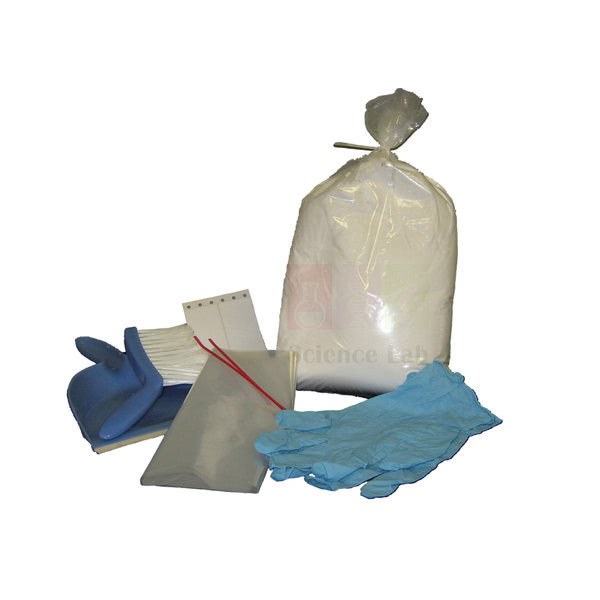
Solvent Spill Clean Up Kit
Solvent Spill Clean Up Kit (Product Code: SLE/CH/220) brings together what a lab needs to absorb, collect and bag a small solvent spill in one pack. The core of the kit is 1100g of diatomaceous earth, a fine mineral absorbent, packed in a polybag, backed up by vinyl exam gloves, a dust pan and brush, empty polybags, twist ties, blank shipping tags and an instruction sheet/MSDS. It is intended for chemistry teaching labs, preparation rooms, research labs and stores where organic solvents are handled, and it is supplied by Jain Scientific Equipments Pvt Ltd (ScienceLab), Ambala, India, as part of its range of lab consumables.
Specifications
| Parameter | Detail |
|---|---|
| Absorbent | 1100g diatomaceous earth in a 225 x 400mm polybag |
| Collection bags | 2 empty polybags, 225 x 400mm |
| Hand protection | 2 vinyl exam gloves |
| Collection tools | 1 dust pan and brush |
| Closures and labels | 2 twist ties, 2 blank shipping tags |
| Documentation | Instruction sheet/MSDS |
| Supplied as | Spill response consumable kit |
Typical Use
When a bottle of ethanol, acetone or another laboratory solvent is knocked over, the priority is to warn others, put out nearby flames, switch off heat sources and ventilate the room. The responder then puts on the vinyl gloves and pours diatomaceous earth around the edge of the spill first and then over the centre, so the liquid is contained while it soaks in. Once it has been absorbed, the dust pan and brush sweep the material into one of the empty polybags, which is closed with a twist tie and labelled on a blank shipping tag with the solvent name and date.
Keep the kit stored close to where solvents are dispensed, read the instruction sheet/MSDS during staff induction rather than for the first time during an incident, and hand the sealed bags over for lab waste disposal in line with your institution's rules. After use, check what has been consumed and restock before the next practical session.
Supplier
Jain Scientific Equipments Private Limited, which operates as ScienceLab from Ambala in Haryana, supplies this kit so laboratories can source safety consumables along with the teaching apparatus the company builds. Details of the company are on the ScienceLab profile.
Related Chemistry Lab Equipment
Complete your lab's spill response and hazard-marking set with:
- Acid Spill Clean Up Kit — the matching kit for acid spills.
- Caustic Spill Clean Up Kit — for alkali and caustic solution spills.
- Spill Pack — a multi-container absorbent pack with soda ash for general spill cover.
- Safety Goggles — eye protection, which the kit itself does not include.
- Hazard Warning Tape: Flammable — marks solvent storage areas and cordons off a spill zone.
See more safety and bench items in Chemistry Lab Equipment.
Frequently Asked Questions
What exactly is in the kit?
Instruction sheet/MSDS, 2 twist ties, 2 blank shipping tags, 2 vinyl exam gloves, 2 empty 225 x 400mm polybags, 1 dust pan and brush, and 1100g diatomaceous earth in a 225 x 400mm polybag.
How large a spill can one kit handle?
A rated spill volume is not stated for this kit. The absorbent supplied is 1100g of diatomaceous earth; for help sizing kits to your storage volumes, please contact us.
Should I use it for acid or caustic spills?
It is made up for solvent spills. For acids or caustic solutions, the dedicated acid and caustic kits listed above are the better match.
Is eye protection included?
No. The kit includes vinyl exam gloves only, so keep safety goggles beside it.
Can I buy refill components separately?
Refill availability is not listed here. Ask through the contact page and we will advise.
What should a school or tender enquiry include?
Quote the product code SLE/CH/220, the number of kits and the delivery location. We supply institutions in India and international markets.
Request a Quote
To equip your labs with the Solvent Spill Clean Up Kit, contact us through the contact page or add it to the enquiry cart with the acid and caustic kits for a complete set.
Last updated: 24 September 2026
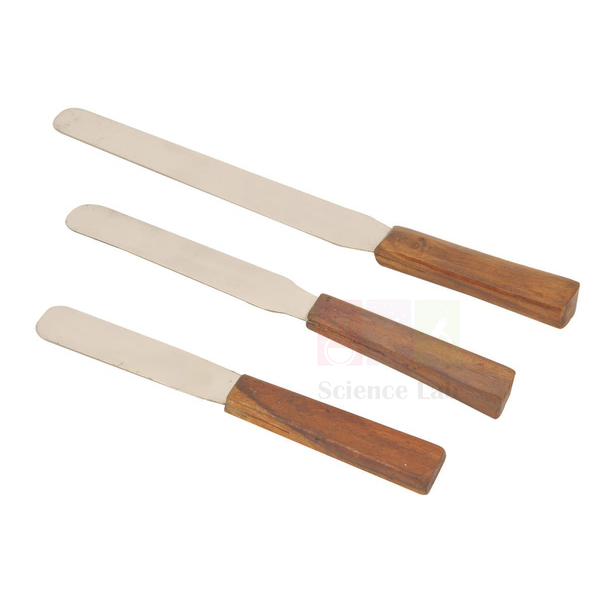
Spatula Palette Knife
Spatula Palette Knife (Product Code: SLE/CH/221) is a palette-knife style spatula with a flexible blade and parallel sides, set in a wooden handle. The flexible blade bends slightly under pressure, so it can spread, fold and scrape material across a flat surface in a way a rigid scoop spatula cannot. It is used for working pastes and ointments, lifting crystals or precipitate from filter paper and mixing small quantities of powder on a tile. As part of lab equipment for colleges and schools, it is manufactured by Jain Scientific Equipments Pvt Ltd (ScienceLab), Ambala, India.
Key Details
| Parameter | Detail |
|---|---|
| Type | Palette knife spatula |
| Blade | Flexible, with parallel sides |
| Handle | Wooden |
| Purpose | Spreading, mixing, scraping and lifting pastes, powders and crystals |
| Suitable for | Chemistry, pharmacy and biology teaching labs |
Typical Use
In pharmaceutics practicals, students use a palette knife to work an ointment base and powder together on a slab until the mixture is smooth, the classic technique of spatulation taught in pharmacy lab equipment sets. Chemistry students use it to lift crystals off a filter paper after recrystallisation, to scrape a dried precipitate together, or to fold two powders together on a tile before heating. Its thin, flexible edge also clears material from the curved inside of a mortar.
Hold the knife at a low angle and use the flat of the blade rather than the tip, so pressure is spread evenly and the blade keeps its shape. Wipe it clean straight after use and dry it fully. Since the handle is wood, avoid soaking the knife or leaving it in hot water, and do not use the blade to prise open lids, which can bend a flexible blade permanently.
Manufacturer
ScienceLab is the brand used by Jain Scientific Equipments Private Limited, which produces hand tools and apparatus for teaching laboratories at its base in Ambala, Haryana. Our company profile explains more about how we work.
Related Chemistry Lab Equipment
Tools and materials often used alongside a palette knife:
- Spatula, Chattaway — a rigid stainless option for measuring out small portions of solid.
- Spatula, Polypropylene — a non-metal choice for materials that should not touch metal.
- Pestle & Mortor, Unglazed — the knife helps recover powder from the bowl after grinding.
- Filter Paper — crystals and precipitates collected on it are lifted off with the flexible blade.
For the complete range, open Chemistry Lab Equipment.
Frequently Asked Questions
How is a palette knife different from an ordinary lab spatula?
Its blade is flexible with parallel sides, so it spreads and scrapes across flat surfaces; ordinary spatulas are stiffer and mainly used to scoop and transfer solids.
What is the blade made of?
The blade material is not listed on this page. Please ask through the contact page if you need it confirmed, for example for use with reactive chemicals.
What length is the blade?
Dimensions are not listed here; we can confirm them with your quotation.
Can it be autoclaved or left to soak?
Not recommended, because the handle is wooden. Wipe the blade clean and dry it after each use.
Is it suitable for pharmacy practicals?
Yes. The flexible blade is well suited to mixing ointments and pastes on a slab.
Can you supply sets for a whole class or for export?
Yes. We supply institutions and distributors in India and international markets; include the product code SLE/CH/221 and your quantity when you enquire.
Request a Quote
Ask for a price on the Spatula Palette Knife through our contact page, or add it to the enquiry cart together with other spatulas for your practical kits.
Last updated: 24 September 2026
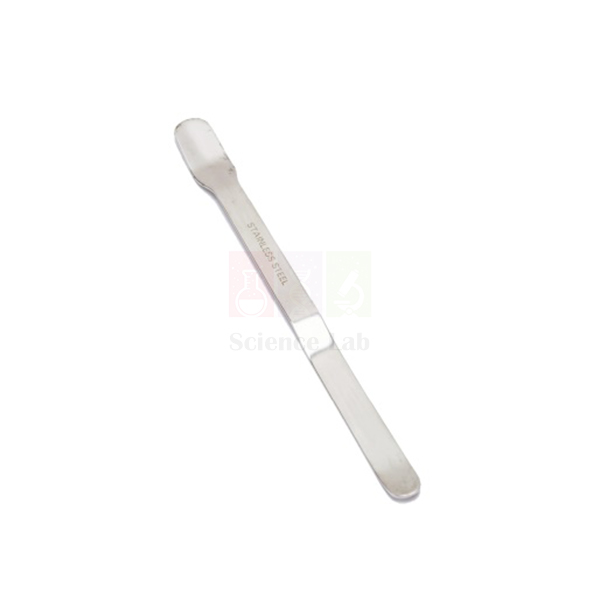
Spatula, 140mm
Spatula, 140mm (Product Code: SLE/CH/222) is a 140mm stainless steel laboratory spatula with a round bent end at one side and a scoop end at the other. The scoop end carries a small portion of powder or crystals from a reagent bottle, while the bent end is handy for scraping, stirring or breaking up caked solids. Its silver stainless steel finish is easy to wipe clean, making it an everyday tool at the chemical balance or digital weighing balance in school, college and industrial labs. It is manufactured by Jain Scientific Equipments Pvt Ltd (ScienceLab), Ambala, India.
Specifications
| Parameter | Detail |
|---|---|
| Material | Stainless steel |
| Colour | Silver |
| Length | 140mm |
| End 1 | Round bent end |
| End 2 | Scoop end |
Typical Use
A typical task is weighing out a salt to make up a standard solution: the student tares a weighing boat, uses the scoop end to add solid a little at a time, and taps the spatula gently to add the last few crystals until the target mass is reached. The round bent end is useful for loosening a reagent that has caked inside its bottle, for stirring a small quantity of mixture in a beaker, or for scraping residue from the sides of an evaporating basin.
To avoid cross-contamination, wipe and dry the spatula each time you change chemicals, or keep a dedicated spatula for each frequently used reagent. Never return unused solid to the stock bottle from the spatula; place it in a labelled container instead. Wash with detergent and water after the session and store dry.
Manufacturer
This spatula is made by Jain Scientific Equipments Private Limited, the company behind the ScienceLab name in Ambala, Haryana. The company is incorporated under CIN U29309HR2020PTC087597 and manufactures at its licensed factory at 449, HSIIDC Industrial Area, Saha, Ambala (Factory Licence AMB-ONLINE-CHD-J-414). Company details are on the profile page.
Related Chemistry Lab Equipment
Items used with this spatula when weighing and transferring solids:
- Plastic Weighing Boats — receive the solid on the balance pan.
- Balance Double Beam — for weighing the portions the spatula delivers.
- Bottle Reagent, W.M. Glass — wide-mouth bottles that the spatula can reach into easily.
- Spatula, Spoon End — a longer spoon-form alternative sold in packs for class sets.
- Spatula, Trulla — for moving larger quantities of material.
More options are available under Chemistry Lab Equipment.
Frequently Asked Questions
How long is this spatula?
It is 140mm long.
What shape are the two ends?
One end is round and bent; the other is a scoop end for carrying powders and crystals.
What material is it made from?
Stainless steel with a silver finish.
Is it sold singly or in packs?
Pack quantity is not listed on this page. Tell us how many you need through the contact page and we will quote accordingly.
How do I stop contamination between chemicals?
Clean and dry the spatula every time you switch reagents, or assign one spatula to each commonly used chemical.
What do you need for an institutional or export quotation?
The product code SLE/CH/222, quantity, delivery address and any vendor documents your purchase team requires. We supply buyers in India and international markets.
Request a Quote
For pricing on the Spatula, 140mm, reach us through the contact page, or add it to the enquiry cart with your weighing accessories.
Last updated: 24 September 2026
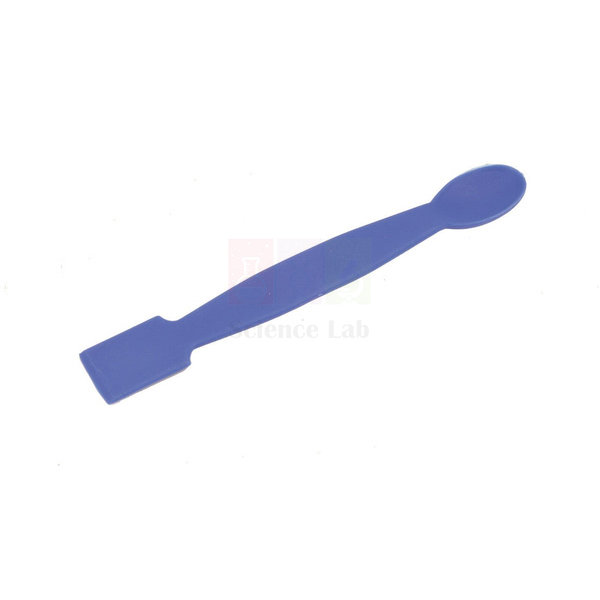
Spatula, Polypropylene
Spatula, Polypropylene (Product Code: SLE/P/44) is a blue, 150 mm double-ended plastic tool used to scoop, transfer and level solid chemicals and powders in school and college laboratories. One end is a spoon and the other a flat, knife-edged face, and the spatulas come in packs of 20 for whole-class use. This basic item of chemistry lab equipment for schools is made by Jain Scientific Equipments Pvt Ltd (ScienceLab), an OEM manufacturer, at its own factory in Ambala, India.
Specifications
| Parameter | Detail |
|---|---|
| Material | Polypropylene |
| Colour | Blue |
| Design | Spoon at one end; flat, knife-edged face at the other |
| Length | 150 mm |
| Chemical resistance | Chemical resistant |
| Pack size | 20 spatulas |
| Product code | SLE/P/44 |
| Manufacturer | Jain Scientific Equipments Pvt Ltd (ScienceLab) — OEM |
| Country of origin | India (made in Ambala, Haryana) |
What Is a Polypropylene Spatula Used For?
Students use the spoon end to take powders or crystals from a reagent bottle and the flat blade to scrape, level or divide solids on a weighing boat or watch glass. A plastic spatula is handy where a metal blade could react with the sample or scratch a container.
Use a clean, dry spatula for each chemical to avoid cross-contamination, wipe it after use and wash it before it goes back in the drawer. As practical-class lab plastic ware, a pack of 20 lets several benches keep their own spatula. Avoid very hot solids, which can soften plastic.
What to Specify When Ordering
- The number of packs (20 spatulas per pack).
- Other weighing items to include, such as weighing boats or weighing paper.
- The delivery location in India or abroad.
OEM Manufacturer
ScienceLab, the brand of Jain Scientific Equipments Private Limited, is the OEM manufacturer of this polypropylene spatula and makes it at the company's own licensed factory at Saha, Ambala, Haryana, India. Schools and distributors buy direct from the factory rather than from a trading intermediary, and repeat packs for a new academic year can be arranged with the same team — ask us. See the company profile.
Related Scientific Lab Plasticware
Items used with the spatula when weighing and dissolving solids.
- Plastic Weighing Boats — to hold powders scooped out with the spatula during weighing.
- Weighing Paper — an alternative surface for weighing small amounts of solid.
- Stirring Rod, Polypropylene — to dissolve the weighed solid in a solvent.
- Beaker, Polypropylene, Set of 4 — for dissolving and mixing the weighed chemicals.
The complete Scientific Lab Plasticware range lists more polypropylene tools for the chemistry bench.
Frequently Asked Questions
How many spatulas are in a pack of Spatula, Polypropylene?
One pack of Spatula, Polypropylene contains 20 blue spatulas, each 150 mm long, with a spoon at one end and a flat, knife-edged face at the other. A single pack can equip several benches at once.
Is the polypropylene spatula chemical resistant?
Yes. The Spatula, Polypropylene is made of chemical-resistant polypropylene, which suits common school reagents such as salts and many dilute acids and bases. Clean it between chemicals, and avoid very hot solids or strong solvents that attack plastics.
What is each end of the spatula used for?
On the Spatula, Polypropylene, the spoon end scoops powders and crystals from reagent bottles, while the flat, knife-edged face levels, scrapes and divides solids on a weighing boat or watch glass, helping students measure out small amounts carefully.
Who manufactures the Spatula, Polypropylene?
Jain Scientific Equipments Pvt Ltd (ScienceLab) manufactures the Spatula, Polypropylene as the OEM at its own licensed factory in Saha, Ambala, Haryana, India. Orders and quotations are handled directly by the manufacturer for schools, colleges, dealers and importers.
Can I order the spatulas along with other plasticware?
Yes. The Spatula, Polypropylene can be quoted together with weighing boats, beakers, stirring rods and other items from the ScienceLab plasticware range. List every item and quantity through the contact page or enquiry cart to receive one combined quotation.
Do you supply the spatulas in bulk for export?
Yes. ScienceLab supplies the Spatula, Polypropylene in packs of 20 to schools, colleges and distributors across India and international markets. Share the number of packs and the destination to receive a quotation.
Request a Quote
Ask for a quotation on the Spatula, Polypropylene through the contact page or by adding the packs to the enquiry cart. The reply comes straight from the manufacturer.
Last updated: 24 September 2026
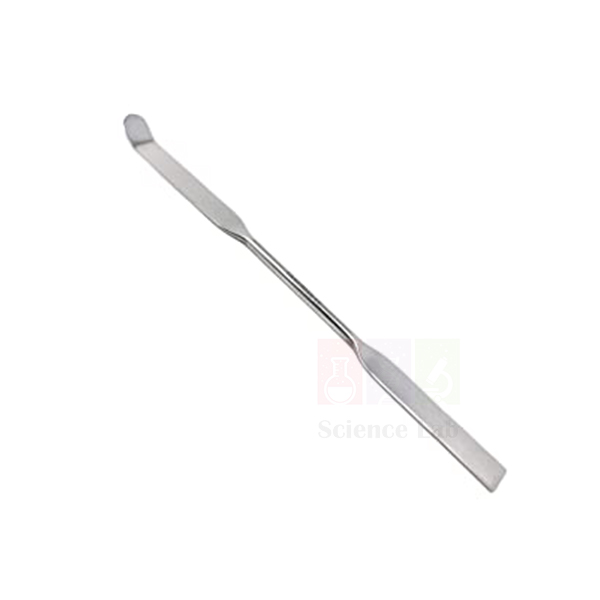
Spatula, Chattaway
Spatula, Chattaway (Product Code: SLE/CH/223) is a Chattaway-type stainless steel spatula with one flat end and the other end canted up. At 14.5cm long, 1.2 cm wide and weighing 15gms, it is slim and light enough to reach into test tubes and small bottles, and the upturned end holds a small heap of powder securely while it is carried. The polished finish sheds residue easily, which suits precise work with small amounts of solid, such as the pinch of salt used in qualitative salt analysis. It is manufactured by Jain Scientific Equipments Pvt Ltd (ScienceLab), Ambala, India, for school, college and research labs.
Specifications
| Parameter | Detail |
|---|---|
| Type | Chattaway |
| Material | Stainless steel |
| Ends | One end flat, the other end canted up |
| Finish | Polished |
| Length | 14.5cm |
| Width | 1.2 cm |
| Weight | 15gms |
Typical Use
In a salt analysis practical, the canted end picks up just enough of the unknown salt to drop into a dry test tube for a heating test, or into a small beaker to prepare the original solution. The narrow blade also transfers solid into a crucible for ignition, loads a little sample onto weighing paper on an analytical balance, and pushes material into the neck of a small flask. Because it is so light, students get a better feel for small quantities, which helps them avoid overloading tubes.
Use the flat end to level off a heap or scrape residue from a watch glass, and the canted end to carry. Clean the spatula immediately after each use, since traces of one salt can give false results in the next test, and dry it before it goes back in the drawer. Its polished stainless steel surface makes this quick.
Manufacturer
Jain Scientific Equipments Private Limited produces this Chattaway spatula and markets it under its ScienceLab brand from Ambala, Haryana, alongside a wide catalogue of chemistry lab equipment. Find out more on the company profile page.
Related Chemistry Lab Equipment
Useful companions for small-quantity solid handling:
- Test Tube Holder — holds the tube while a salt sample is heated.
- Crucible with lid — receives small solid portions for ignition.
- Weighing Paper — a surface for weighing the portions the spatula delivers.
- Spatula, 140mm — a scoop-end spatula for slightly larger portions.
- Spatula Palette Knife — a flexible blade for spreading and scraping.
Browse the rest of our Chemistry Lab Equipment.
Frequently Asked Questions
What are the dimensions?
It is 14.5cm long and 1.2 cm wide, and it weighs 15gms.
What makes a Chattaway spatula different?
It has one flat end and one end canted up, and its narrow blade is designed for taking small quantities from bottles and into test tubes.
Is the finish suitable for analytical work?
Yes. It is polished stainless steel, which is easy to clean between samples.
How many come in a pack?
Pack quantity is not stated on this page. Let us know your requirement through the contact page and we will confirm the packing.
Is there a warranty?
Warranty terms are provided with each quotation; ask us if you need them documented for your purchase file.
Can you supply class quantities or export orders?
Yes, ScienceLab supplies institutions in India and international markets. Include the product code SLE/CH/223 with the quantity you need.
Request a Quote
Request a quotation for the Spatula, Chattaway through the contact page, or add it to the enquiry cart with the rest of your salt analysis apparatus.
Last updated: 24 September 2026
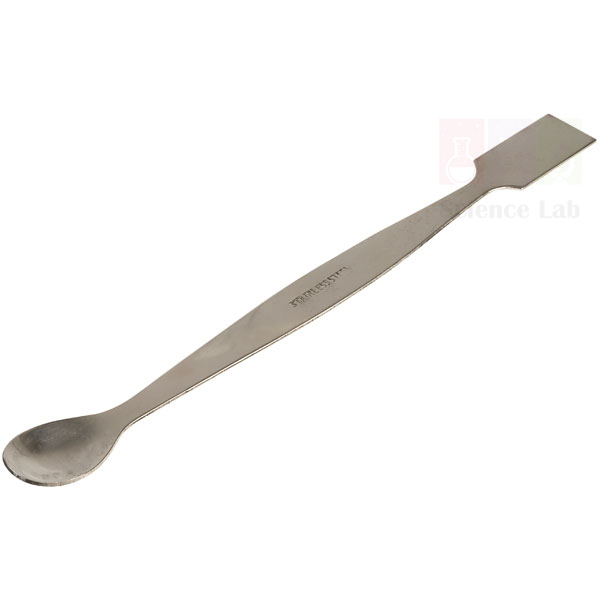
Spatula, Spoon End
Spatula, Spoon End (Product Code: SLE/CH/224) is a well-finished, polished stainless steel spatula, 150mm long, with a flat blade at one end and a small spoon at the other. The spoon holds a rounded portion of powder or crystals without spilling, while the flat end scrapes and levels. Supplied in packs of 10, it is convenient for equipping every group at a practical bench, especially for solubility experiments and crystallisation practicals in schools and colleges. It is manufactured by Jain Scientific Equipments Pvt Ltd (ScienceLab), Ambala, India.
Specifications
| Parameter | Detail |
|---|---|
| Type | Spoon end |
| Material | Stainless steel |
| Colour | Silver |
| Ends | One end flat, the other end spoon form |
| Finish | Well finished and polished |
| Length | 150mm |
| Pack | Pack of 10 |
Typical Use
In a solubility investigation, students add solute to water one spoonful at a time, stirring after each addition until no more dissolves, then compare how many spoonfuls different salts needed. The same spoon end is used to add copper sulphate or alum to hot water when growing crystals, to transfer powdered samples into a boiling tube, and to measure out reactants for simple displacement or neutralisation reactions. The flat end is handy for scraping crystals from the side of a beaker.
For quantitative work, treat the spoon as a transfer tool rather than a measure and weigh the solid on a balance. Issue one spatula per reagent to each group, which a pack of 10 makes easy, and ask students to wipe and dry the spoon before it is used in a different container. Wash in warm soapy water at the end of the session and store dry.
Manufacturer
ScienceLab spatulas are made by Jain Scientific Equipments Private Limited, a manufacturer of teaching-lab apparatus located in Ambala, Haryana, which supplies class-size packs like this one to schools and colleges. See our profile for company information.
Related Chemistry Lab Equipment
Other items that belong in the same weighing and transfer workflow:
- Plastic Weighing Boats — hold the spooned solid on the balance.
- Balance Triple Beam — turns a spoonful into a measured mass.
- Powder Funnel — guides the powder into narrow-necked flasks.
- Spatula, Trulla — double trowel scoops for bulkier transfers.
- Spoon Spatula — another spoon-type spatula to compare.
View all items in Chemistry Lab Equipment.
Frequently Asked Questions
How many spatulas are in a pack?
Each pack contains 10 spatulas.
How long is each spatula?
Each one is 150mm long.
Can the spoon be used as a fixed measure?
Only as a rough guide. The spoon volume is not specified, so weigh the solid whenever an accurate quantity is needed.
What is the material and finish?
Stainless steel, well finished and polished, silver in colour.
How should the spatulas be cleaned?
Wash in warm soapy water, rinse and dry thoroughly; wipe between reagents during a practical to prevent cross-contamination.
We are equipping several labs. What should our enquiry include?
The product code SLE/CH/224, the number of packs, delivery addresses for each site and your billing details. We supply institutions in India and international markets through the contact page.
Request a Quote
Send your requirement for the Spatula, Spoon End via the contact page, or add packs to the enquiry cart with the balances and weighing boats for your practical rooms.
Last updated: 24 September 2026
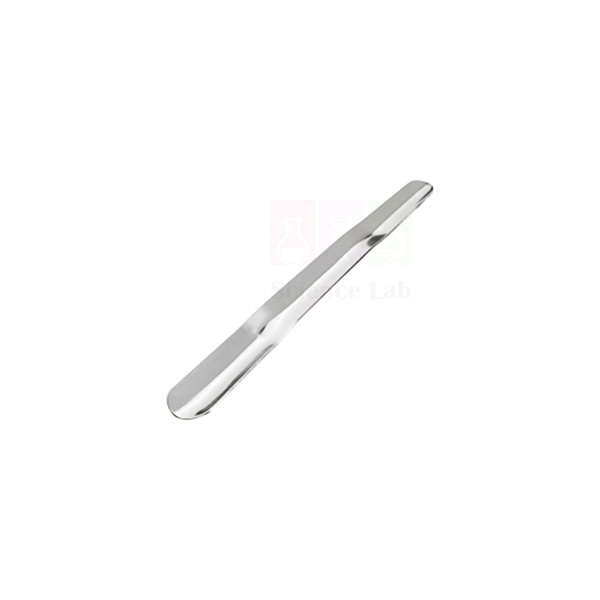
Spatula, Trulla
Spatula, Trulla (Product Code: SLE/CH/225) is a double-ended stainless steel spatula with a trowel-shaped scoop at each end, designed for handling large quantities of material. It measures 175mm in length with 15mm wide scoops, and its silver stainless steel finish cleans easily between uses. Where a narrow spatula would need many trips, the trowel scoops move granular solids, soil or powders from a stock container in a few passes, which makes it a practical addition to any educational lab equipment list for preparation rooms and practical benches. It is sold in packs of 10 and manufactured by Jain Scientific Equipments Pvt Ltd (ScienceLab), Ambala, India.
Specifications
| Parameter | Detail |
|---|---|
| Type | Trulla, double ended |
| Material | Stainless steel |
| Colour | Silver |
| Scoops | Trowel-shaped, at both ends |
| Length | 175mm |
| Width | 15mm |
| Pack | Pack of 10 |
Typical Use
Lab assistants reach for a trulla when refilling student reagent jars from a bulk container, portioning out sand, marble chips or soil for a class, or loading a larger mass of solid onto a balance for a stock solution. In environmental and agriculture practicals, it serves as a small trowel for moving soil samples into sieves, beakers or sample bags, and in pharmacy and food labs it handles granules and bulk powders. When planning a new school lab setup, a pack for the preparation room saves time every week.
Use one end for dry solids and keep the other for a second material if you need to switch quickly, then clean both ends before the next job. Pour from the side of the trowel into a funnel for narrow-necked containers. Wash, rinse and dry the spatulas after use, especially after salts that can mark stainless steel if left on the surface.
Manufacturer
Jain Scientific Equipments Private Limited manufactures laboratory apparatus in Ambala, Haryana under the ScienceLab name. It is a registered MSME enterprise (Udyam UDYAM-HR-01-0003714), and export consignments are shipped under Importer-Exporter Code AAECJ8618A issued by the DGFT. Read more on the ScienceLab company profile.
Related Chemistry Lab Equipment
Items that pair with a trulla when handling bulk solids:
- Powder Funnel — channels scooped material into bottles and flasks.
- Chemical Balance — for weighing out larger portions.
- Bottle Reagent, W.M. Glass Amber Colour — wide-mouth storage the trowel scoop fits into.
- Spatula, Spoon End — a smaller spoon form for student portions.
- Spatula, 140mm — a compact scoop spatula for the balance bench.
Discover more in Chemistry Lab Equipment.
Frequently Asked Questions
What is a trulla spatula used for?
Moving larger quantities of solid material. Both ends carry trowel-shaped scoops, so it transfers more per pass than a narrow spatula.
What are the length and scoop width?
It is 175mm long, and the scoops are 15mm wide.
How many are in a pack?
Ten spatulas per pack.
Is it suitable for soil and granular samples?
Yes. The trowel shape suits soil, sand, granules and coarse powders as well as fine chemicals.
How do I look after stainless steel spatulas?
Clean off chemicals soon after use, wash in soapy water, rinse and dry fully before storage.
Can you supply against a purchase order or for export?
Yes. Send the product code SLE/CH/225, number of packs and delivery details through the contact page; we supply buyers in India and international markets.
Request a Quote
Get a price for the Spatula, Trulla through our contact page, or add packs to the enquiry cart with funnels and storage bottles for your preparation room.
Last updated: 24 September 2026