- Physics Lab Equipment
- Chemistry Lab Equipment
- Biology Lab Equipment
- Anatomical Lab Equipment
- Learning
- Educational Lab Equipment
- Magnets
- Agriculture
- Astronomy
- Earth Science
- Geography Lab Equipment
- Safety Lab Coat
- Laboratory
- Meteorological
- Electricity & Magnetism
- Heat
- School Lab Equipment
- Lab Glassware
- Science Lab Equipment
- Tvet Lab Equipment
- Robotics Kits Supplier and Manufacturer for Schools India
- Math Lab Equipment Manufacturers and Exporters in Ambala
- STEM Kits Manufacturers and Supplier India
- Engineering Lab Equipment
- Hospital Lab Equipment
- Water, Sanitation & Hygiene Supplies
- Cold Chain, Solar & Communication Equipment
- Nutrition

Heating Mantle 250ml
Heating Mantle 250ml (Product Code: SLE/LHM/07) is a compact, controlled heating mantle for flasks of 250 ml, built around a woven glass fibre mat with a nichrome wire element inside a coated steel case. It gives students and technicians a flame-free way to warm, boil or reflux small volumes on an ordinary bench, which makes it a practical piece of school chemistry lab equipment in India for practical classes and small preparative work. The unit is manufactured by Jain Scientific Equipments Pvt Ltd (ScienceLab), Ambala.
Specifications
| Parameter | Detail |
|---|---|
| Flask capacity | 250 ml |
| Type | Controlled heating mantle |
| Case construction | Steel, with chemical resistant coating |
| Mantle | Woven glass fibre mat |
| Heating element | Nichrome wire |
| Insulation | Moulded silica powder |
| Element temperature | Up to 450 °C (max.) |
| Power supply | 220 V AC, 80 W |
Typical Use
A 250 ml mantle is the size most student groups need for short experiments: preparing a small ester under reflux, distilling a few tens of millilitres of a mixture, determining a boiling point range or dissolving a solid in hot solvent before recrystallisation. The glass fibre mat wraps heat around the lower part of the flask, so small volumes heat evenly and there is less risk of a hot spot cracking the glass than with a gauze and burner. Its modest 80 W rating also means several units can run side by side on one bench.
Seat the flask fully in the mantle, support the neck with a clamp, and bring the control up gradually while watching for steady boiling. The coated case resists occasional splashes, but spills should be wiped off promptly once the unit is switched off and cool; never pour liquid directly into the mantle. As a laboratory equipment supplier in India, we can advise on matching glassware so every student station is complete.
Manufacturer
ScienceLab is the trading name of Jain Scientific Equipments Private Limited, whose manufacturing and dispatch operations are based in Ambala, Haryana. We make and supply laboratory heating equipment for schools, colleges and research laboratories, and we welcome questions on sizes, controls and quantities before you order. Learn about our background on the company profile page.
Related Laboratory Equipment
Pair the 250 ml mantle with these items for a complete small-scale heating or distillation station:
- Round Bottom Flask 250 ml — the matching flask size for this mantle.
- Straight Coolant (Condenser) — for reflux or simple distillation above the flask.
- Thermometer Clamp — holds a thermometer at the still head when recording boiling temperatures.
- Digital Heating Mantles — an alternative with digital control for more repeatable settings.
- Heating Mantle 1000ml — the larger model for litre-scale batches.
See all models in the Heating Mantle category.
Frequently Asked Questions
What is the heating element made of?
The element is nichrome wire set in a woven glass fibre mat, insulated with moulded silica powder and housed in a steel case with a chemical resistant coating.
What temperature can the element reach?
The element temperature goes up to 450 °C maximum. The liquid in the flask will be cooler than the element, depending on the control setting and the volume being heated.
How much power does it use?
It is rated at 80 W on a 220 V AC supply, low enough to run several units on a shared bench circuit. For other supply voltages, please ask us before ordering.
Can I use a smaller or larger flask in it?
It is sized for 250 ml flasks. Using a flask that does not match the well leaves gaps or overloads the mat, so pick the mantle that matches your flask size.
How should I clean it?
Switch off, unplug and let it cool, then wipe the coated case with a damp cloth. Keep liquids out of the glass fibre mat; if a flask breaks inside, stop using the mantle and contact us for advice.
Is a calibration certificate available?
Calibration certificate availability should be discussed with our team when you send your enquiry.
Do you supply sets for a whole class or for export?
Yes, we quote for multiple units for institutions across India and international markets; tell us the number of student stations and any glassware you want included.
Request a Quote
For prices and delivery on the Heating Mantle 250ml, write to us via the contact page or add it to our enquiry cart with any matching flasks and condensers.
Last updated: 24 September 2026
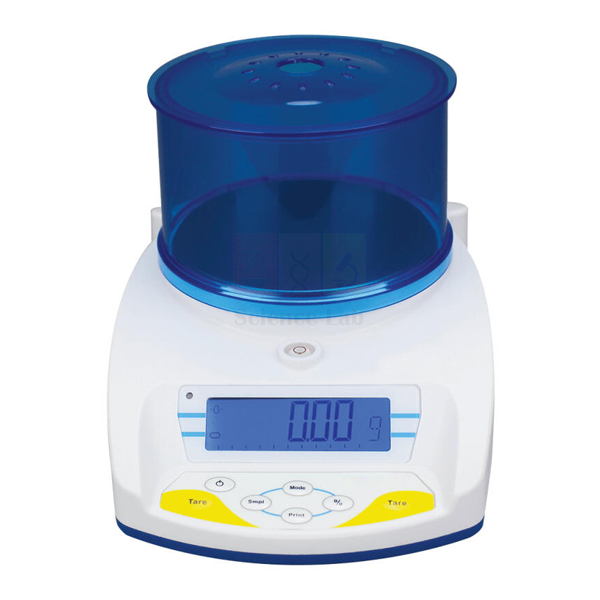
Portable Precision Balance
The Portable Precision Balance weighs up to 1000 g with a readability of 0.01 g, on mains power or on an internal battery rated for 24 hours. It calibrates internally without external weights, sends results over USB or RS-232 and has a hook for below-balance weighing, so it works at a field station as well as on a lab bench.
Portable precision balance specifications
| Parameter | Detail |
|---|---|
| Capacity and readability | 1000 g x 0.01 g |
| Repeatability / linearity | 0.01 g / 0.02 g |
| Calibration | Internal manual calibration or external calibration |
| Pan | 120 mm diameter, grade 304 stainless steel |
| Weighing units | g, lb, oz, N, GN, ct, dr, dwt, mm, ozt, T, tl.H, tl.S, tl.T |
| Display | Backlit LCD, 18 mm display height, programmable backlight, built-in capacity tracker |
| Interfaces | RS-232 and USB |
| Power | 12V DC 50/60Hz 800mA adapter or internal rechargeable battery, both included; battery life 24 hours |
| Housing | ABS plastic, 174 x 252 x 80 mm (W x D x H), 2 kg net; operating temperature 0° to 40°C |
| Product code | SLE/LB/24 |
| Minimum order | 10 units |
| Dispatch | Usually within 7 to 10 working days |
| Supplied by | ScienceLab (Jain Scientific Equipments Pvt Ltd), Ambala, India |
Field and bench work with the portable balance
Volume of a stone by displacement. Stand a glass beaker of water on the pan and tare it. Hang a stone on cotton thread from a retort stand and lower it until it is fully under water without touching the glass. The rise in grams equals the stone's volume in cubic centimetres, and its mass in air divided by that volume gives its density.
Suspended solids in pond water. Weigh a dry filter paper before the trip. At the pond, filter a measured volume of water through it in a glass funnel and carry the paper back in a labelled petri dish. Dry the paper, weigh it again on the same balance, and the gain is the mass of solids in that volume.
Mass and weight on one display. Weigh an object in grams, then switch the display unit to newtons and note the value. Hang the same object from a force meter, compare the two readings, and discuss why the balance can show newtons only by assuming a value for the pull of gravity.
Weighing functions and fittings
Software functions include parts counting with preset sample sizes, memory accumulation, selectable digital filtering, zero tracking, an audible overload alarm and a programmable auto power-off.
On the hardware side there are dual tare keys for left or right hand, colour-coded keys, three-point shock protection against overload, a level indicator with adjustable feet and an included hook for below-balance weighing. Balances with the 120 mm pan stack for storage, and a slot takes an optional Kensington-type lock and cable.
Frequently Asked Questions About the Portable Precision Balance
Can the balance be calibrated at a field station without carrying weights?
Yes. Its internal manual calibration is started by the user and needs no external weights, so none have to travel. Run it whenever a check reading looks wrong. External calibration is also listed, for labs that want to adjust the balance against their own weights back at base.
How can readings be kept steady outdoors?
Set the balance on a firm surface and turn the adjustable feet until the level indicator is centred. Shield the pan from wind with a cardboard box open on one side, and raise the digital filter setting so the display ignores small movements. Readings then take a little longer to settle.
Why should samples be placed in the middle of the 120 mm pan?
Position can change the reading. A load near the edge may read slightly differently from the same load at the centre, an effect called off-centre loading error. Place samples and containers in the middle of the pan, and keep the same position when readings are compared.
Why does the reading rise when a hanging object is lowered into a beaker of water on the pan?
The water pushes up on the object, and the object pushes down on the water with an equal force. The balance feels that extra push through the beaker. The rise equals the mass of water the object displaces, which is why a tared beaker can measure an object's volume.
Does the newton unit turn the balance into a force meter?
Not quite. The balance is set up to read mass, and in newton mode it multiplies that mass by a standard value of the pull of gravity. A spring force meter responds to the actual pull, so the two readings can differ slightly.
How should the rechargeable battery be looked after?
Charge it fully from the included adapter before a field day, since the 24 hour rating assumes a full charge. Turn on the programmable auto power-off to save charge between weighings. If the battery stops holding charge as long as it did, run the balance from the adapter and have the battery checked.
Electronic balances and accessories for field and bench weighing
- Precision Balance
- Precision Balance, 220g
- Balance, Portable
- Compact Balance 2000g
- Apparatus for Measuring the Density of Solids
- Plastic Weighing Boats
To request a quotation, send the product name, code and quantity through our contact page or add the item to your enquiry cart.
Last updated: 15 November 2026
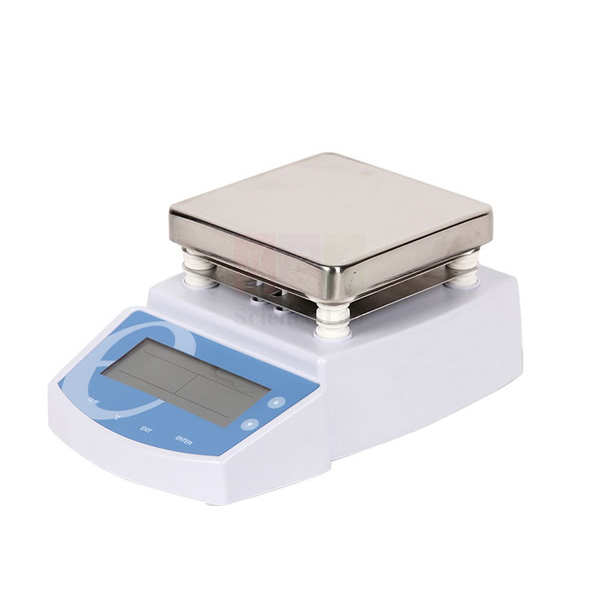
Hotplate & Stirrer, Digital
Hotplate & Stirrer, Digital (Product Code: SLE/LS/07) is a digital hotplate magnetic stirrer with a temperature probe, used to heat solutions to a set temperature while stirring them for a timed period in teaching and research laboratories. Its large LCD shows timer, temperature and running status; it heats to 300 °C, stirs 0–2000 mL at up to 1250 rpm, and its timer runs to 999 minutes. It is supplied by Jain Scientific Equipments Pvt Ltd (ScienceLab), Ambala, India, as a laboratory magnetic stirrer in India.
Specifications
| Parameter | Detail |
|---|---|
| Hotplate temperature | Maximum 300 °C |
| Heater | 380 W |
| Temperature control | Automatic constant temperature through a temperature probe; 1-point offset calibration |
| Stirring volume | 0 to 2000 mL |
| Stirring speed | 0 to 1250 rpm, push-button speed control |
| Timer range | 0 to 999 minutes (adjustable stirring time) |
| Display | LCD, 95 × 35 mm, showing timer, temperature and running status |
| Top plate size | 135 (L) × 135 (W) mm |
| Material | Stainless steel |
| Power | AC 220 V / 50 Hz |
| Ambient temperature | Below 50 °C |
| Dimensions | 230 (L) × 180 (W) × 120 (H) mm |
| Weight | 2.2 kg |
| Included | Temperature probe and 30 mm stirrer bar |
| Product code | SLE/LS/07 |
| Supplied by | Jain Scientific Equipments Pvt Ltd (ScienceLab), Ambala, India |
What Is a Digital Hotplate Stirrer Used For?
With its probe in the liquid, this unit controls the temperature of the solution itself rather than just the plate, which matters for solubility and enzyme experiments, making media or buffers at a fixed temperature, and timed reactions. The adjustable stirring time lets every run last the same period, so student groups record results under consistent conditions. It fits naturally among biology lab equipment in India's colleges, where enzyme practicals depend on steady temperatures.
Position the probe in the liquid clear of the vessel wall and the stirrer bar. Use the 1-point offset calibration against a reference thermometer to correct the displayed temperature, stay within the 2000 mL stirring volume, and keep the room below the 50 °C ambient limit.
What to Specify When Ordering
- Confirmation that your site uses AC 220 V / 50 Hz power
- The number of units required
- Extra stirrer bars beyond the 30 mm bar supplied
Supplier
This digital hotplate stirrer is supplied by Jain Scientific Equipments Private Limited, which trades as ScienceLab from Ambala, Haryana. We source it for colleges, research institutes and testing laboratories and can bundle it with glassware and spare stirrer bars in a single quotation. Company details are on our profile page.
Related Laboratory Stirrer
Items that support heated, timed stirring:
- Hotplate & Magnetic Stirrer Pro — alternative heated stirrer in the range.
- Magnetic Stirrer Bar — spare bars for everyday use.
- Glass Beaker — vessel for heating and stirring on the plate.
- Immersion Thermometer — independent reference when setting the probe offset.
- Beaker Tongs — for lifting hot beakers safely.
Find more models in the Laboratory Stirrer category.
Frequently Asked Questions
What temperature can the Hotplate & Stirrer, Digital reach?
The Hotplate & Stirrer, Digital (SLE/LS/07) heats to a maximum hotplate temperature of 300 °C with a 380 W heater. A temperature probe provides automatic constant temperature control of the liquid being heated.
What is included with the digital hotplate stirrer?
The Hotplate & Stirrer, Digital is supplied with a temperature probe and a 30 mm stirrer bar. The probe gives automatic constant temperature control, and more stirrer bars can be added to your order.
How does the timer work?
The Hotplate & Stirrer, Digital has an adjustable stirring time with a timer range of 0 to 999 minutes. The large LCD display shows the timer, temperature and running status, so progress can be checked at a glance.
What does 1-point offset calibration mean?
The 1-point offset calibration on the Hotplate & Stirrer, Digital lets the user correct the probe reading against a reference thermometer at one temperature, improving the accuracy of temperature control. It is a user adjustment, not a calibration certificate.
What are the speed and volume ranges?
The Hotplate & Stirrer, Digital stirs from 0 to 1250 rpm with push-button speed control and handles stirring volumes from 0 to 2000 mL on its 135 × 135 mm top plate.
Who supplies the Hotplate & Stirrer, Digital?
Jain Scientific Equipments Pvt Ltd (ScienceLab), Ambala, Haryana, India supplies the Hotplate & Stirrer, Digital SLE/LS/07 to colleges, research laboratories and dealers, for delivery in India and to international markets.
What does a quotation request need?
For a Hotplate & Stirrer, Digital quotation, send the number of units, confirm that your site uses AC 220 V / 50 Hz power, list any extra stirrer bars or glassware, and give the delivery location via our contact page.
Request a Quote
Send your enquiry for the Hotplate & Stirrer, Digital through our contact page, or add it to the enquiry cart with any glassware you need.
Last updated: 24 September 2026
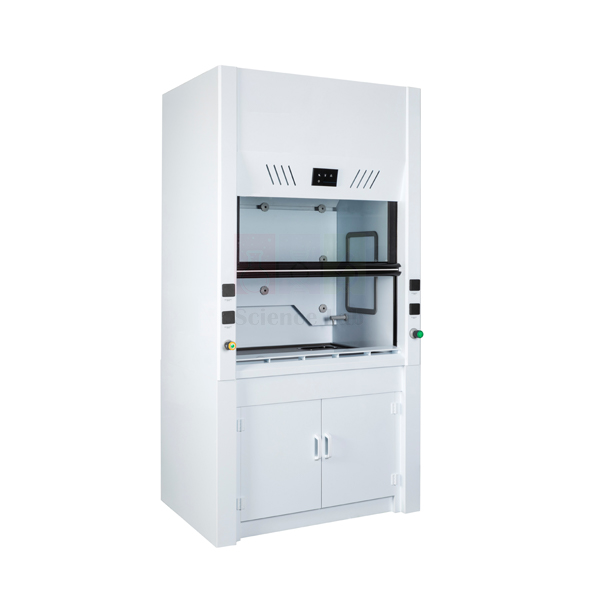
Polypropylene Ducted Fume Cupboard
Polypropylene Ducted Fume Cupboard (Product Code: SLE/LI/18) is a 1200 mm fume cupboard with services, used to extract chemical fumes to the outside through a duct in school, college and industrial laboratories. Its polypropylene work surface and polypropylene base cabinet with doors stand up to chemical attack, and LED illumination lights a 1000 x 630 x 1170 mm workspace. This fume hood for chemistry labs is supplied by Jain Scientific Equipments Pvt Ltd (ScienceLab), Ambala, India.
Specifications
| Parameter | Detail |
|---|---|
| Type | Ducted fume cupboard, with services |
| Size | 1200 mm |
| External dimensions (W x D x H) | 1200 x 805 x 2320 mm |
| Workspace dimensions (W x D x H) | 1000 x 630 x 1170 mm |
| Illumination | LED |
| Work surface | Polypropylene (PP) |
| Base cabinet | Polypropylene, with doors |
| Product code | SLE/LI/18 |
| Supplied by | Jain Scientific Equipments Pvt Ltd (ScienceLab), Ambala, India |
What Is the Ducted Polypropylene Fume Cupboard Used For?
A ducted fume cupboard removes fumes from the room altogether by exhausting them through ductwork, which makes it the usual choice for chemistry laboratories that work with acids, solvents and reactions producing corrosive or toxic vapours on a regular basis. Polypropylene suits acid work, and the base cabinet with doors gives storage directly beneath the work surface. As a piece of laboratory furniture, it becomes a fixed fume-handling station for the room.
Plan the installation before ordering: the room needs space for a 1200 x 805 x 2320 mm unit, a route for the exhaust duct to the outside and an extract arrangement suited to the duct run. Keep the sash lowered when nobody is working at the cupboard, avoid cluttering the 1000 mm-wide workspace, and store only compatible chemicals in the base cabinet.
What to Specify When Ordering
- The services you need at the cupboard, as this model is listed "with services".
- Ceiling height and door access, given the 2320 mm overall height.
- The duct route to the outside, and whether ducting and extraction should be discussed in the quotation.
- Quantity and delivery location.
Supplier
Jain Scientific Equipments Private Limited supplies this ducted cupboard under its ScienceLab trading name from Ambala, Haryana, to schools, colleges, industrial laboratories, dealers and importers. Ducting, room layout and services vary from building to building, so the scope of supply is agreed with each buyer before a quotation is issued. Company details are on our company profile.
Related Laboratory Instruments
Other fume-control options and items for acid work:
- Fume Cupboard, Ductless, Polypropylene — for rooms where ducting cannot be installed.
- Polypropylene Inverted Mobile Fume Cabinet — a mobile option with its own sink and taps.
- Thermo-Anemometer — for checking air velocity at the sash after installation.
- Acid Proof Aprons, Lab Coat, Pants, Shoe Covers and Sleeves — protective clothing for acid work at the cupboard.
The full Laboratory Instruments category lists more items.
Frequently Asked Questions
What size is the Polypropylene Ducted Fume Cupboard?
The Polypropylene Ducted Fume Cupboard is a 1200 mm model measuring 1200 x 805 x 2320 mm externally (W x D x H), with a 1000 x 630 x 1170 mm workspace. Check ceiling height and doorways before ordering.
What does "with services" mean for this fume cupboard?
The Polypropylene Ducted Fume Cupboard is listed as 1200 mm with services, which refers to service outlets at the cupboard. The exact services and fittings included should be confirmed with us when you request a quotation, based on what your experiments need.
Is ducting included with the ducted fume cupboard?
Ducting and exhaust arrangements for the Polypropylene Ducted Fume Cupboard depend on your building. Tell us the duct route and distance to the outside through our contact page, and we will confirm what the quotation covers before you order.
What materials is the fume cupboard made from?
The Polypropylene Ducted Fume Cupboard has a polypropylene (PP) work surface and a PP base cabinet with doors, with LED illumination inside the workspace. Polypropylene is widely used in laboratories where acids and corrosive chemicals are handled.
Who supplies the Polypropylene Ducted Fume Cupboard?
The Polypropylene Ducted Fume Cupboard is supplied by Jain Scientific Equipments Pvt Ltd (ScienceLab), Ambala, Haryana, India, to schools, colleges, industrial laboratories, dealers and importers in India and international markets.
What information is needed for a quotation?
A quotation for the Polypropylene Ducted Fume Cupboard needs the quantity, required services, room dimensions, ceiling height, duct route and delivery location. Photographs or a layout drawing of the laboratory help us understand the site before quoting.
Request a Quote
Send your room details and requirements for the Polypropylene Ducted Fume Cupboard through our contact page, or add it to the enquiry cart along with other laboratory items.
Last updated: 24 September 2026
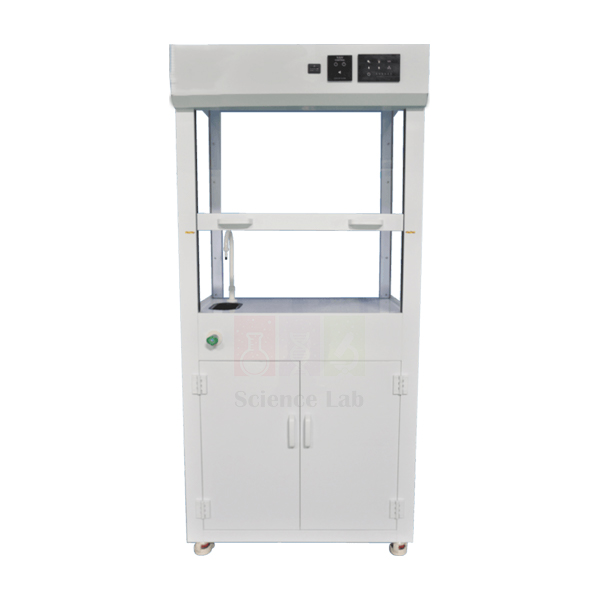
Polypropylene Inverted Mobile Fume Cabinet
Polypropylene Inverted Mobile Fume Cabinet (Product Code: SLE/LI/19) is a ductless fume cabinet on four lockable castors, used to give staff and students a protected space for working with a wide range of chemicals, and it is especially suited to schools. Built from welded virgin polypropylene, it combines a 5-inch colour touch-screen with a low-airflow alarm, a large oval PP sink, a swan-neck water tap and gas taps. It is supplied by Jain Scientific Equipments Pvt Ltd (ScienceLab), Ambala, a laboratory equipment supplier in India.
Specifications
| Parameter | Detail |
|---|---|
| Type | Ductless mobile fume cabinet |
| External dimensions | 1000 x 720 x 1900 mm (listed as H x D x W; confirm the order with your quotation) |
| Workspace dimensions | 985 x 500 x 860 mm (listed as H x D x W) |
| Front sash maximum opening | 625 x 865 mm (H x W) |
| Weight | 120 kg (excluding filters) |
| Cabinet and work surface | Welded white virgin polypropylene, for chemical and corrosion resistance, lighter weight and lower noise |
| Control system | 5-inch full-colour capacitive touch-screen, wipe-clean, with digital airflow velocity display, audible and visual low-airflow alarm and filter change indicators |
| Face airflow velocity | 0.5 ± 0.1 m/s (100 ± 20 fpm) |
| Filters | Range of carbon or HEPA filters available |
| Standard fittings | 1 gas tap, 1 swan-neck water tap, large oval PP sink, 1 power socket |
| Tap controls | Surface-mounted gas taps and water tap with remote controls outside the workspace |
| Base cabinet | Lower cabinet with 2 hinged doors, 100% polypropylene including hinges and handles |
| Mobility | 4 lockable castors |
| Sash and visibility | Sliding sash with full-height entry for easy cleaning; 360° visibility |
| Illumination | LED lights |
| Power supply | 240 V or 110 V, supplied with a plug of your choice; plugs into a standard 13A socket; internal mains socket with universal fitting |
| Product code | SLE/LI/19 |
| Supplied by | Jain Scientific Equipments Pvt Ltd (ScienceLab), Ambala, India |
What Is the Mobile Fume Cabinet Used For?
This mobile unit brings fume protection to any room with a standard socket: it can be wheeled between laboratories, locked in place on its castors and used for practical chemistry that releases vapours, with carbon or HEPA filters chosen to suit the work. The sink and taps let students rinse apparatus inside the cabinet, and 360° visibility makes it practical for teacher demonstrations to a whole class. As a fume hood with storage, its polypropylene base cabinet keeps related materials beneath the work surface.
Watch the digital airflow display during work — face velocity is listed at 0.5 ± 0.1 m/s — and stop if the low-airflow alarm sounds. Change filters when the indicator shows, use the full-height sash entry when cleaning inside, and wipe the touch-screen panel with a damp cloth. Lock all four castors before starting an experiment.
What to Specify When Ordering
- Power supply (240 V or 110 V) and the plug type you need.
- Carbon or HEPA filters, according to the chemicals or particles handled.
- The water, drain and gas connections available where the cabinet will be used.
- Door and lift access for a 120 kg cabinet listed at 1000 x 720 x 1900 mm.
- Quantity and delivery location.
Supplier
ScienceLab is the trading name of Jain Scientific Equipments Private Limited, which supplies this mobile fume cabinet from Ambala, Haryana, to schools, colleges, laboratories, dealers and importers. When filters need replacing later, ask the same supplier for a quotation on carbon or HEPA filters to suit the cabinet. Learn more on our company profile.
Related Laboratory Instruments
Filters, test equipment and alternative fume-control options:
- Acid Filter for Inverted Mobile Fume Hood — a replacement acid filter listed for the inverted mobile hood; confirm fit.
- Thermo-Anemometer — an independent check of face airflow.
- Polypropylene Ducted Fume Cupboard — a fixed, ducted alternative.
- Fume Cupboard, Ductless — a benchtop ductless option with an airflow alarm.
- Premium Safety Spectacles — eye protection for students working at the cabinet.
Explore the Laboratory Instruments category.
Frequently Asked Questions
Is the Polypropylene Inverted Mobile Fume Cabinet ductless?
Yes. The Polypropylene Inverted Mobile Fume Cabinet is a ductless mobile unit that uses carbon or HEPA filters, chosen from a range, instead of an exhaust duct. It plugs into a standard 13A mains socket and moves on four lockable castors.
What controls and alarms does the mobile fume cabinet have?
The Polypropylene Inverted Mobile Fume Cabinet uses a 5-inch full-colour capacitive touch-screen with a digital airflow velocity display, an audible and visual low-airflow alarm and filter change indicators. The wipe-clean panel is used instead of membrane switches.
What services are built into the fume cabinet?
The Polypropylene Inverted Mobile Fume Cabinet comes with one gas tap, one swan-neck water tap, a large oval polypropylene sink and one power socket as standard. The gas and water taps have remote controls outside the workspace.
What power supply options are available?
The Polypropylene Inverted Mobile Fume Cabinet is offered for a 240 V or 110 V supply and is supplied with a plug of your choice. State your mains voltage and preferred plug type when you request a quotation.
What are the size and weight of the mobile fume cabinet?
The Polypropylene Inverted Mobile Fume Cabinet is listed at 1000 x 720 x 1900 mm externally, with a 985 x 500 x 860 mm workspace and a 625 x 865 mm maximum sash opening. It weighs 120 kg without filters; confirm the dimension order with your quotation.
Who supplies the Polypropylene Inverted Mobile Fume Cabinet?
The Polypropylene Inverted Mobile Fume Cabinet is supplied by Jain Scientific Equipments Pvt Ltd (ScienceLab), Ambala, Haryana, India, to schools, colleges, laboratories, dealers and importers in India and international markets.
What should a quotation request for the fume cabinet include?
A quotation request for the Polypropylene Inverted Mobile Fume Cabinet should state the quantity, power supply and plug type, carbon or HEPA filter choice, the chemicals to be handled and the delivery location. Send it through our contact page.
Request a Quote
Request pricing for the Polypropylene Inverted Mobile Fume Cabinet through our contact page, or add it to the enquiry cart together with filters and safety wear.
Last updated: 24 September 2026
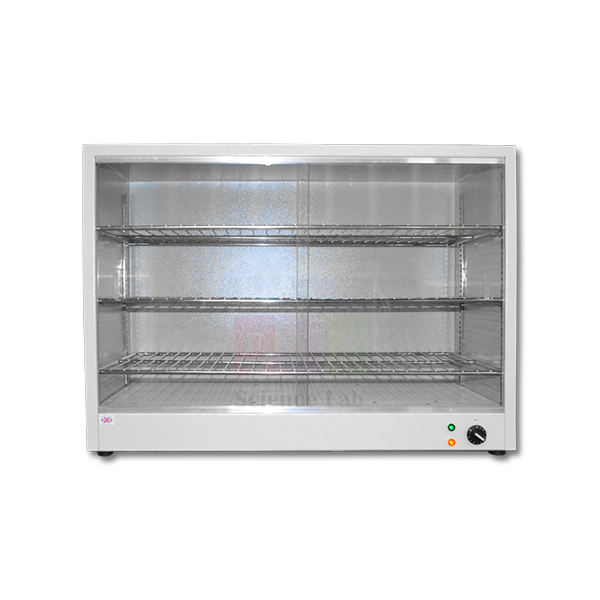
Laboratory Drying/Warming Cabinet
Laboratory Drying/Warming Cabinet (Product Code: SLE/LI/20) is a heated steel cabinet used to dry washed glassware and gently warm materials at up to about 50 °C in school, college and research laboratories. It offers 113 litres of space on two adjustable wire shelves, inside a single-skin sheet steel body finished in easy-clean grey stove paint. It is made by Jain Scientific Equipments Pvt Ltd (ScienceLab), an OEM manufacturer, at its own factory in Ambala, India.
Specifications
| Parameter | Detail |
|---|---|
| Capacity | 113 L |
| Temperature control | Adjustable, up to approx. 50 °C |
| External dimensions | 545 x 730 x 360 mm |
| Internal dimensions | 460 x 728 x 341 mm |
| Shelves | 2 wire shelves, adjustable |
| Construction | Single-skin sheet steel, easy-clean grey stove paint finish |
| Power | 240 V, 500 W |
| Product code | SLE/LI/20 |
| Manufacturer | Jain Scientific Equipments Pvt Ltd (ScienceLab) — OEM |
| Country of origin | India (made in Ambala, Haryana) |
What Is the Drying/Warming Cabinet Used For?
After washing, beakers, flasks and measuring cylinders need to dry before the next practical, and a warm, enclosed cabinet does this faster and more cleanly than an open rack. Because the temperature stays at or below about 50 °C, the cabinet can also warm items gently — for example drying papers or samples that should not meet the higher heat of a lab drying oven.
Set the wire shelves to suit tall cylinders or small vessels, stand glassware mouth-down or on its side so water drains, and leave gaps between items for warm air to circulate. Do not put flammable solvents or solvent-wet items inside. Wipe the painted interior from time to time to keep it clean.
What to Specify When Ordering
- Your mains supply — the listed cabinet is rated 240 V, 500 W.
- Whether 113 litres and two shelves suit your glassware load, or extra shelves should be discussed.
- The number of cabinets and the delivery location.
OEM Manufacturer
ScienceLab is the trading name of Jain Scientific Equipments Private Limited, the OEM (original equipment manufacturer) of this drying/warming cabinet. It is fabricated and assembled at the company's own factory at 449, HSIIDC Industrial Area, Saha, Ambala, Haryana, and dispatched factory-direct to schools, colleges, institutions, dealers and importers.
The company is incorporated under CIN U29309HR2020PTC087597, and production takes place in licensed factory premises under Factory Licence AMB-ONLINE-CHD-J-414. Replacement shelves and repeat orders are handled by the manufacturer itself — just ask us — and company details are on our company profile.
Related Laboratory Instruments
Items for washing, drying and temperature checks:
- Drying Rack — for draining glassware before it goes into the cabinet.
- Test Tube Rack With Drying Pegs — holds test tubes upside down while they drain.
- Oven, 43 litre — a compact laboratory oven to compare for other heating tasks.
- Digital Thermometer — for checking the temperature inside the cabinet.
Browse the Laboratory Instruments category for more.
Frequently Asked Questions
What temperature does the Laboratory Drying/Warming Cabinet reach?
The Laboratory Drying/Warming Cabinet has adjustable temperature control up to approximately 50 °C. That gentle range suits drying washed glassware and warming items that should not be exposed to the higher temperatures of a laboratory oven.
What is the capacity of the drying cabinet?
The Laboratory Drying/Warming Cabinet has a capacity of 113 litres, with internal dimensions of 460 x 728 x 341 mm and two adjustable wire shelves. Its external dimensions are 545 x 730 x 360 mm.
Who manufactures the Laboratory Drying/Warming Cabinet?
The Laboratory Drying/Warming Cabinet is manufactured by Jain Scientific Equipments Pvt Ltd (ScienceLab), an OEM manufacturer, at its own licensed factory at Saha, Ambala, Haryana, India. Quotations, repeat orders and spare-part requests are handled directly by the manufacturer.
What power supply does the drying cabinet need?
The Laboratory Drying/Warming Cabinet is listed for a 240 V supply with a 500 W rating. If your laboratory runs on a different mains voltage, mention it when requesting a quotation so the supply can be confirmed.
Can the shelves be adjusted for tall glassware?
Yes. The wire shelves in the Laboratory Drying/Warming Cabinet are adjustable, so the two shelves can be spaced to accommodate glassware and other items of different sizes, from small beakers to taller measuring cylinders.
How can schools order the drying cabinet in bulk?
Schools and colleges can order the Laboratory Drying/Warming Cabinet in bulk directly from the manufacturer. Send the number of units, your mains supply and the delivery address through our contact page to receive a quotation.
Request a Quote
Quotations for the Laboratory Drying/Warming Cabinet come direct from the manufacturer. Use our contact page, or add the cabinet to the enquiry cart with drying racks and other laboratory items.
Last updated: 24 September 2026
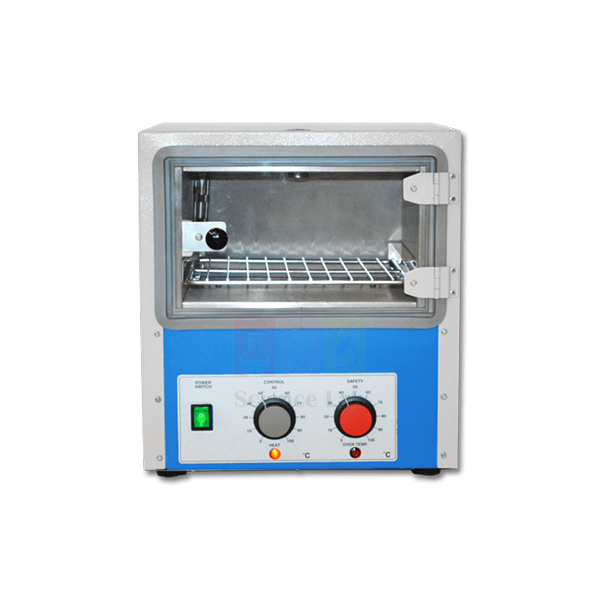
Laboratory Incubator With Visibility Door
Laboratory Incubator With Visibility Door (Product Code: SLE/LI/21) is a 100-litre general-purpose incubator used for incubation, drying, heating and other temperature-controlled work up to 100 °C in school, college and research laboratories. Biology and microbiology departments rely on it for routine culture work, and its PID digital controller shows set and actual values together with programmable ramp and dwell. It is made by Jain Scientific Equipments Pvt Ltd (ScienceLab), an OEM manufacturer, at its own factory in Ambala, India.
Specifications
| Parameter | Detail |
|---|---|
| Capacity | 100 litres |
| Maximum temperature | 100 °C |
| Fluctuation | 0.75 °C |
| Controller | PID digital controller with dual display (set and actual) and programmable ramp and dwell |
| Safety | Direct-reading thermostats for control and overheat safety protection |
| Indicator lamps | Power, heating and safety protection |
| Chamber | Aluminium-clad steel |
| Exterior | Sheet steel with powder-coat paint, durable and easy to clean |
| Shelves | Plated steel, adjustable on fixed shelf runners; listed as 4 shelves and 3 shelf positions |
| Maximum load height | 360 mm |
| Access port | Top vent/access port for thermometers and monitoring probes |
| External dimensions (H x W x D) | 735 x 590 x 567 mm |
| Internal dimensions (H x W x D) | 445 x 490 x 460 mm |
| Power | 750 W |
| Product code | SLE/LI/21 |
| Manufacturer | Jain Scientific Equipments Pvt Ltd (ScienceLab) — OEM |
| Country of origin | India (made in Ambala, Haryana) |
What Is the Laboratory Incubator Used For?
In teaching and research labs, this unit is most often used as a bacteriological incubator for growing cultures on agar plates and in broth tubes at a steady set temperature, but it also serves for drying and warming samples, glassware and media up to 100 °C. The visibility door lets staff check on plates and tubes without opening the chamber, and the listed 0.75 °C fluctuation keeps conditions stable over long incubations.
Use the programmable ramp and dwell functions to bring the chamber up to temperature gradually and hold it for a set period, and insert a thermometer or monitoring probe through the top vent/access port for an independent reading. Keep loads below the 360 mm maximum load height, spread plates across the adjustable shelves, and investigate at once if the safety protection lamp lights.
What to Specify When Ordering
- The mains voltage at your site — the listed unit is rated at 750 W.
- The shelf arrangement you need, as 4 shelves and 3 shelf positions are listed.
- Whether thermometers or monitoring probes for the top access port should be quoted.
- The number of incubators and the delivery location.
OEM Manufacturer
Jain Scientific Equipments Private Limited, which trades as ScienceLab, is the OEM (original equipment manufacturer) of this incubator and lists it among its own general-purpose laboratory incubators. The unit is built at the company's own licensed factory at Saha, Ambala, Haryana, rather than bought in from a trader.
Incubators are supplied factory-direct to schools, colleges, institutions, dealers and importers, and requests for spare parts such as shelves or indicator lamps go straight to the manufacturer — ask us. Read more on our company profile.
Related Laboratory Instruments
Items used before, during and after incubation:
- Petri Dish, Triple Vent — culture plates for incubation.
- Petri Dish Rack — keeps stacks of plates organised on the shelves.
- Digital Thermometer — for independent temperature checks.
- Digital Colony Counter — for counting colonies after incubation.
- Biosafety Cabinet Class 2 — for preparing cultures before they go into the incubator.
See the whole Laboratory Instruments range.
Frequently Asked Questions
What is the capacity of the Laboratory Incubator With Visibility Door?
The Laboratory Incubator With Visibility Door has a 100-litre aluminium-clad steel chamber with internal dimensions of 445 x 490 x 460 mm (H x W x D) and a maximum load height of 360 mm. External dimensions are 735 x 590 x 567 mm.
What temperature range does the incubator offer?
The Laboratory Incubator With Visibility Door reaches a maximum of 100 °C with a listed fluctuation of 0.75 °C. Its PID digital controller shows set and actual temperatures together and supports programmable ramp and dwell settings.
What safety features does the laboratory incubator have?
The Laboratory Incubator With Visibility Door has thermostats for both temperature control and overheat safety protection, plus indicator lamps for power, heating and safety protection. These let staff see at a glance whether the unit is heating normally.
Who manufactures the Laboratory Incubator With Visibility Door?
The Laboratory Incubator With Visibility Door is manufactured by Jain Scientific Equipments Pvt Ltd (ScienceLab), an OEM manufacturer, at its own licensed factory at Saha, Ambala, Haryana, India, and is supplied factory-direct to institutions, dealers and importers.
How many shelves does the incubator have?
The Laboratory Incubator With Visibility Door is listed with 4 plated steel shelves and 3 shelf positions on fixed runners. Please confirm the shelf arrangement you need when requesting a quotation, as the two figures should be checked together.
Is a calibration certificate available for the incubator?
Calibration-certificate availability for the Laboratory Incubator With Visibility Door should be discussed with us before ordering. The top vent/access port lets a reference thermometer or probe be inserted for your own checks; ask through our contact page.
Request a Quote
Quotations for the Laboratory Incubator With Visibility Door come direct from the manufacturer. Send your requirements through our contact page, or add the incubator to the enquiry cart with plates and racks.
Last updated: 24 September 2026
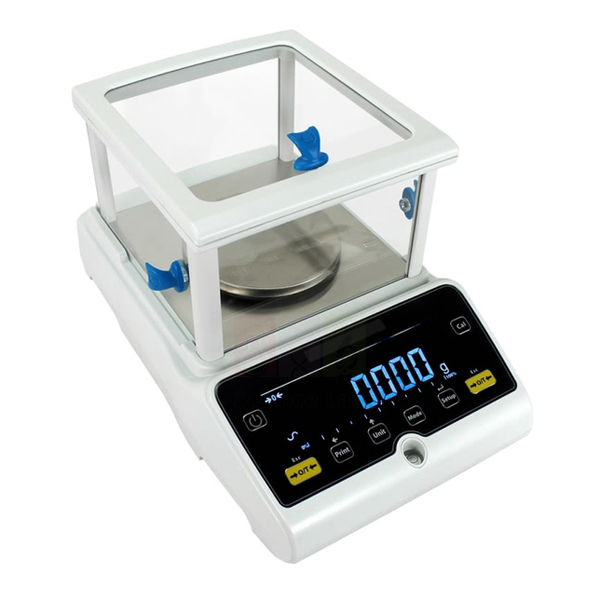
Precision Balance, 220g
The Precision Balance, 220g reads to 0.001g across its 220g capacity, with a repeatability of 0.002g and a linearity of 0.003g. It prints results with the date and time over USB or RS-232, has a sealed keypad and 24mm backlit digits, and is calibrated externally with weights.
220 g milligram balance specifications
| Parameter | Detail |
|---|---|
| Capacity | 220g |
| Readability / repeatability / linearity | 0.001g / 0.002g / 0.003g |
| Weighing pan | Grade 304 stainless steel, 120mm diameter |
| Display | Backlit LCD, 24mm white digits on a black background |
| Weighing units | mg, g, ct, GN, dr, ozt, dwt, mm, tl.T, tl.H, tl.S, T, custom unit |
| Calibration | External, with weights |
| Interfaces | USB and RS-232 |
| Power supply | 18V DC 50/60Hz 830mA adapter; AC adapter included |
| Housing and conditions | ABS plastic; 224 x 374 x 219mm (w x d x h); 4.1kg net; operating temperature 15° to 35°C |
| Product code | SLE/LB/25 |
| Minimum order | 10 units |
| Dispatch | Usually within 7 to 10 working days |
| Supplied by | ScienceLab (Jain Scientific Equipments Pvt Ltd), Ambala, India |
Milligram practicals on the 220 g balance
Thickness of aluminium foil. Cut a square of kitchen foil, measure its sides with a metal ruler, fold it into a small pad and weigh it. Divide the mass by the density of aluminium and by the area of the square. The answer is the foil thickness, a small fraction of a millimetre.
Yield of copper sulfate crystals. Warm copper oxide with dilute sulfuric acid, filter off the excess and evaporate the blue solution in a porcelain dish until crystals start to form. Dry the crystals on filter paper, weigh them and compare the mass with the yield expected from the acid used, since the copper oxide was in excess.
Growth of mealworms. Tare a plastic weighing boat, add a counted group of larvae and select the dynamic weighing filter so their movement does not upset the reading. Use the hold function to keep the value on the display, return the larvae to their tub, and repeat each week to plot mean mass against time.
Keypad, printing and weighing modes
Colour-coded keys cover the most used functions, and the sealed keypad resists dirt and spills. A level indicator with adjustable feet helps set the balance up on the bench, and a security slot takes an optional Kensington-type lock and cable.
The hold function freezes the displayed weight. Printouts carry the date and time for records kept in line with Good Laboratory Practice guidelines. Selectable digital filtering covers animal and dynamic weighing, and the balance also offers parts counting with preset sample sizes, multilingual text and display, and auto power-off.
Frequently Asked Questions About the Precision Balance, 220g
How do results get printed with the date and time?
Set the balance clock as the supplied operating instructions describe, then connect a printer or computer through USB or RS-232. Each printout then carries the date and time, which helps when practical or quality records must follow Good Laboratory Practice guidelines.
What does the hold function do with a sample that will not keep still?
Hold freezes the weight shown on the display. With the digital filter set for animal or dynamic weighing, the balance first smooths out the movement; press hold once the reading settles and note the value after the sample has been taken off.
What room temperature suits the balance?
Its listed operating range is 15° to 35°C. Within that range a steady temperature matters most, so keep the balance out of direct sun and away from heaters and air-conditioning outlets. A sample warmer than the room sets up air currents that make the last digit drift.
How is foil thickness worked out from its mass?
Volume equals mass divided by density, and for a flat sheet the volume is also length times width times thickness. So thickness equals mass divided by the density of aluminium and the area of the sheet. With grams, grams per cubic centimetre and square centimetres the answer is in centimetres; multiply by ten for millimetres.
Why fold the foil before weighing it?
A flat sheet overhangs the 120mm pan and catches the slightest draught, which makes the third decimal wander. Folded into a small pad, the same foil sits fully on the pan and settles quickly, while its mass stays the same.
What is the custom unit for?
It lets the user set up a unit of their own, as the supplied operating instructions describe. The display then shows the result in that unit, which helps when a method reports in a unit that is not on the standard list.
Milligram weighing accessories and balances
- Precision Balance
- High Precision Balance
- Balance, Analytical
- Balance Anti-Vibration Table
- Weighing Paper
- Plastic Weighing Boats
To request a quotation, send the product name, code and quantity through our contact page or add the item to your enquiry cart.
Last updated: 15 November 2026