- Physics Lab Equipment
- Chemistry Lab Equipment
- Biology Lab Equipment
- Anatomical Lab Equipment
- Learning
- Educational Lab Equipment
- Magnets
- Agriculture
- Astronomy
- Earth Science
- Geography Lab Equipment
- Safety Lab Coat
- Laboratory
- Meteorological
- Electricity & Magnetism
- Heat
- School Lab Equipment
- Lab Glassware
- Science Lab Equipment
- Tvet Lab Equipment
- Robotics Kits Supplier and Manufacturer for Schools India
- Math Lab Equipment Manufacturers and Exporters in Ambala
- STEM Kits Manufacturers and Supplier India
- Engineering Lab Equipment
- Hospital Lab Equipment
- Water, Sanitation & Hygiene Supplies
- Cold Chain, Solar & Communication Equipment
- Nutrition
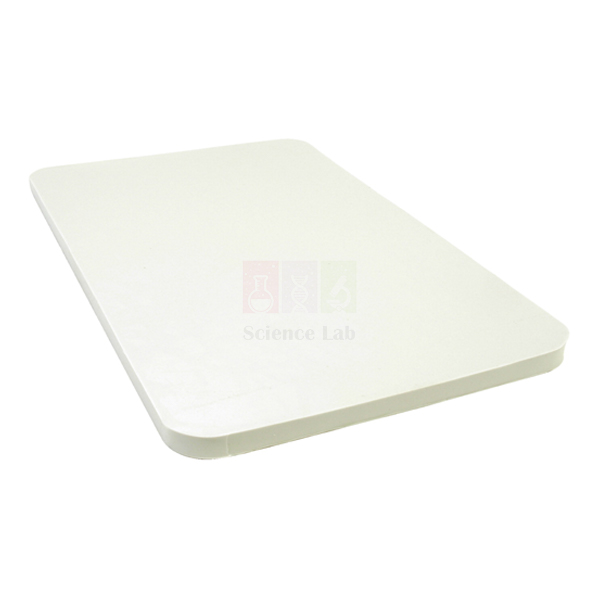
Dissection Replacement Pad, White
The Dissection Replacement Pad, White (Product Code: SLE/EDE/24) is a white, 10mm thick pad of flexible synthetic material, measuring 25 x 14cm, made as a replacement for the dissection pan and pad set. A light-coloured working surface makes dark tissue, fine vessels and small parts stand out clearly, which helps students see and record detail. Like the standard pad, it replaces dissection wax and removes the need to remelt old wax. It is manufactured by Jain Scientific Equipments Pvt Ltd (ScienceLab), Ambala, as one of its biology teaching aids for India and export customers.
Specifications
| Parameter | Detail |
|---|---|
| Type | Replacement dissection pad |
| For use with | Dissection pan and pad set |
| Colour | White |
| Material | Flexible synthetic material |
| Dimensions | 25 x 14cm |
| Thickness | 10mm |
| Wax | Not required — replaces dissection wax |
Typical Use
The white surface is chosen when contrast matters: tracing thin blood vessels, locating small glands, or photographing a finished dissection for a practical record or display. It also shows clearly when the pad needs cleaning, which encourages good hygiene habits among students. The 10mm depth accepts dissecting pins pushed in at an angle, so specimens stay spread open while observations are made.
A school laboratory equipment supplier in India will usually recommend keeping one or two spare pads per pan set, so that a pad can be changed during a busy practical week. Wash the pad with mild detergent and cold water after each class, since hot water tends to set stains on pale surfaces, then dry it flat. Swap it out once pinning no longer feels firm.
Manufacturer
This white pad is made by Jain Scientific Equipments Private Limited, the Ambala, Haryana company that sells its laboratory products under the ScienceLab name. To learn about our operations, please see the company profile.
Related Dissection Equipment
The pan set this pad is meant for, plus useful companions:
- Dissection Pan, Pad & Cover — the aluminium pan, pad and clear cover system
- Dissection Replacement Pad — the standard replacement pad, listed at 25 x 16cm
- Dissecting T-Pins — for fixing specimens into the pad
- Magnifying Glass — for examining fine structures against the white background
Explore the full Dissection Equipment range for pans, trays and instruments.
Frequently Asked Questions
What size is the white replacement pad?
It is 25 x 14cm and 10mm thick.
Why choose a white pad?
A white surface gives strong contrast against most tissue, which makes small structures easier to see, draw and photograph.
Is it the same as the standard Dissection Replacement Pad?
Both are 10mm thick flexible synthetic pads for the dissection pan and pad set, but the white pad is listed at 25 x 14cm and the standard pad at 25 x 16cm. Ask us which suits your pan.
Will stains show on the white surface?
Pale surfaces show marks more readily. Rinse promptly with cold water and mild detergent after each practical to keep the pad looking clean.
Do I need wax with this pad?
No. The pad replaces dissection wax and eliminates remelting.
How do I order white pads for several pan sets?
Send code SLE/EDE/24 with the number of pads and your delivery address, within India or abroad, and we will return a quotation.
Request a Quote
Request pricing for the Dissection Replacement Pad, White through our contact page, or place it in the enquiry cart with any other dissection supplies.
Last updated: 24 September 2026
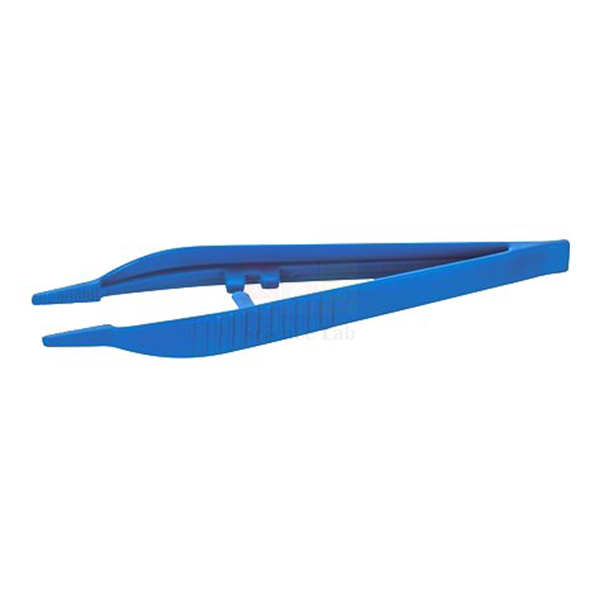
Forceps, Nylon
The Forceps, Nylon (Product Code: SLE/EDE/25) are straight forceps made of glass-filled nylon, with a blunt tip. Being non-metallic and blunt, they let students pick up and move delicate material — soft specimens, seeds, small invertebrates, filter paper or cover slips — with less risk of piercing or scratching it. They are a sensible, student-friendly choice within biology lab equipment for school labs in India, manufactured by Jain Scientific Equipments Pvt Ltd (ScienceLab), Ambala.
Specifications
| Parameter | Detail |
|---|---|
| Type | Forceps |
| Material | Nylon, glass filled |
| Shape | Straight |
| Tip | Blunt |
Typical Use
Nylon forceps come into their own wherever metal tips would do harm. In the biology lab they are used to lift leaves, petals and seeds for observation, to transfer preserved specimens between dishes, and to place or remove cover slips without chipping the glass. Glass filling makes the nylon stiffer than an unfilled plastic, so the arms spring back and grip evenly, while the blunt tip keeps younger students from puncturing soft tissue.
They also work well in field and classroom collections — for example as part of an insect collection kit for school, where small, fragile specimens must be handled gently. Rinse the forceps in water after use, wipe dry, and keep them away from open flames and hot plates, since heat can soften or distort nylon.
Manufacturer
Jain Scientific Equipments Private Limited, which trades as ScienceLab, manufactures laboratory teaching equipment in Ambala, Haryana. The company is incorporated under CIN U29309HR2020PTC087597, and production takes place at its licensed factory at 449, HSIIDC Industrial Area, Saha, Ambala (Factory Licence AMB-ONLINE-CHD-J-414). More about the business is on our company profile.
Related Dissection Equipment
Other handling tools and the containers they are typically used with:
- Forceps (Tweezers) — metal forceps for firmer gripping during dissection
- Forceps (Tweezers) Bent — a bent-tip version for reaching into specimens
- Petri Dish Glass With Lid — for holding specimens being moved or examined
- Specimen Container, PP — for storing collected material
- Hand Lens — to examine small specimens held in the forceps
For metal forceps, scalpels and full sets, browse Dissection Equipment.
Frequently Asked Questions
What are these forceps made of?
Glass-filled nylon, with straight arms and a blunt tip.
Why choose nylon forceps over stainless steel?
Nylon is non-metallic and, with a blunt tip, handles fragile items such as cover slips, seeds and soft specimens with less risk of scratching or piercing. Steel forceps remain the better choice for firm gripping during dissection.
How long are the forceps?
The length is not stated in the product listing. Please contact us and we will confirm the dimensions.
Can they be flamed or autoclaved?
Do not flame them, as nylon softens with heat. If your lab needs to sterilise plastic tools by another method, ask us before ordering so we can advise on suitability.
Are they resistant to laboratory chemicals?
Chemical compatibility is not specified in the listing. Tell us which solutions you plan to use and we will check before you order.
Do you supply them in bulk?
Yes, nylon forceps can be quoted in class quantities for schools, colleges and distributors in India and international markets; reference code SLE/EDE/25.
Request a Quote
For a quotation on Forceps, Nylon, reach us through the contact page or add them to the enquiry cart along with the rest of your lab list.
Last updated: 24 September 2026
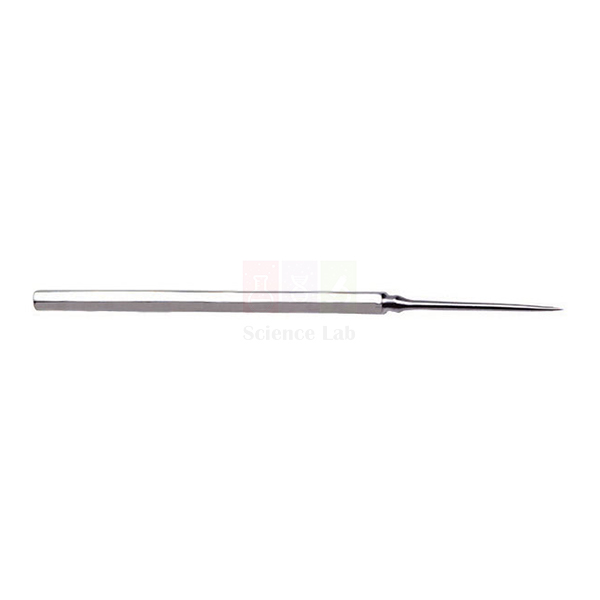
Needle, Stainless Steel
The Needle, Stainless Steel (Product Code: SLE/EDE/26) is a straight dissecting needle in stainless steel with a total length of 95mm, sold as a pack of 5. Packing five together makes it easy to equip a practical group, or to keep spares on hand when a point bends or goes missing. The needles are a staple item when a dissection kit for school use in India is being stocked, and they are manufactured by Jain Scientific Equipments Pvt Ltd (ScienceLab), Ambala.
Specifications
| Parameter | Detail |
|---|---|
| Type | Dissecting needle, straight |
| Material | Stainless steel |
| Total length | 95mm |
| Pack size | 5 needles |
Typical Use
Straight needles are the everyday tool for separating tissue layers, picking out small structures, and holding material steady while forceps or a scalpel do the main work. In plant practicals they help pull apart root tips or tease out anthers; in animal work they lift fine membranes and separate muscle bundles. Stainless steel resists corrosion from the water, stains and preservatives that needles are constantly exposed to.
A good approach for a class is to give each pair of students one needle from the pack and keep the rest in reserve, so practicals are not held up by a lost or damaged point. As a biology lab equipment supplier in India, ScienceLab recommends rinsing needles after every session, drying them fully and storing them points-down in a holder or with a protective cap, which protects both the tips and the people reaching for them.
Manufacturer
These needles are made by Jain Scientific Equipments Private Limited, whose products carry the ScienceLab brand. The firm works from Ambala, Haryana, and supplies schools, colleges and distributors in India and in international markets. Visit the company profile to learn more.
Related Dissection Equipment
Other fine-work instruments often ordered with these needles:
- Dissecting Needle Plastic Handle — a needle with a 100mm plastic handle for a fuller grip
- Seekers — blunt-ended stainless steel tools for tracing without piercing
- Dissecting Needle — another needle option from the same range
- Dissecting Set, Student — a student set when a full instrument kit is needed
- Petri Dish — to hold material in liquid while it is teased apart
Our complete Dissection Equipment listing covers needles, probes, forceps and sets.
Frequently Asked Questions
How many needles are in a pack?
Each pack contains 5 straight stainless steel dissecting needles.
What is the length of each needle?
The total length is 95mm.
Are these needles straight or bent?
They are straight dissecting needles.
How do I keep the points in good condition?
Avoid pressing the tip against the tray base, dry the needles after cleaning, and store them so the points are not touching other metal instruments.
Can I order single needles instead of packs?
The item is listed as a pack of 5. If you have a different quantity in mind, let us know and we will advise.
What warranty is offered?
Terms are given with each quotation; please ask through our contact page if you need them first.
Can you ship packs to institutions abroad?
Yes. We serve customers in India and international markets; include code SLE/EDE/26, the number of packs and your destination.
Request a Quote
Order packs of the Needle, Stainless Steel by sending a message from our contact page or adding them to the enquiry cart with your other dissection tools.
Last updated: 24 September 2026
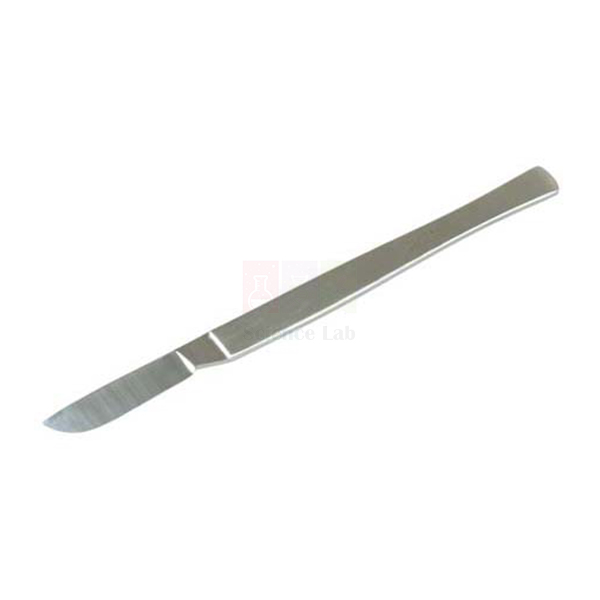
Scalpel, Stainless Steel
The Scalpel, Stainless Steel (Product Code: SLE/EDE/27) is a steel scalpel with a 130mm handle and a 45mm blade, made entirely in stainless steel. It is the cutting instrument of the dissection bench, used to make the first incision and to open body walls, stems or fruits cleanly so that other tools can follow. Suited to college practicals and senior school classes, it belongs in any dissection set for biology in India and is manufactured by Jain Scientific Equipments Pvt Ltd (ScienceLab), Ambala.
Specifications
| Parameter | Detail |
|---|---|
| Type | Scalpel |
| Material | Stainless steel |
| Handle length | 130mm |
| Blade length | 45mm |
Typical Use
With a 130mm handle the scalpel sits comfortably in the hand for longer cuts, and the 45mm blade gives enough edge to open a specimen in one controlled stroke. Students are taught to lift the skin or body wall with forceps and cut shallowly just beneath it, so that the organs underneath are not damaged. In botany, the same scalpel is used for longitudinal and transverse sections of flowers, fruits and stems.
Among zoology lab equipment in India, a scalpel calls for clear safety rules: carry it point-down, never pass it hand to hand, and always cut away from the body onto a firm board or tray. After use, clean the blade carefully by wiping from the back edge towards the tip, dry it immediately, and store the scalpel in a case or rack where the edge cannot be knocked against other instruments.
Manufacturer
ScienceLab scalpels come from Jain Scientific Equipments Private Limited in Ambala, Haryana — a company that manufactures dissection instruments along with a wide range of school and college laboratory apparatus. Company background is available on our profile page.
Related Dissection Equipment
Items used together with a scalpel in a typical practical:
- Scalpel Handle no.3 — a 125mm BP handle for labs that prefer replaceable surgical blades
- Forceps — to lift tissue ahead of the blade
- Wooden Dissecting Board — a softwood surface to cut and pin on
- Dissecting Tray with Wax — an aluminium tray with wax for pinned dissections
- Gloves W/o Powder Nitrile Disposable — hand protection during cutting
View more scalpels, sets and accessories in Dissection Equipment.
Frequently Asked Questions
What are the handle and blade lengths?
The handle is 130mm long and the blade is 45mm long.
What material is the scalpel made from?
Stainless steel.
Is the blade fixed or replaceable?
The listing gives the handle and blade lengths but does not specify the blade fitting. If you specifically need replaceable blades, see the Scalpel Handle no.3, or contact us to confirm this scalpel’s design.
How should the edge be looked after?
Cut only onto wood, wax or a pad — never glass or metal — clean and dry the blade straight after use, and store it so the edge does not touch other tools.
Is this scalpel suitable for younger students?
It is a sharp cutting instrument, so it is best used under close teacher supervision; many schools let younger classes use probes and blunt tools while the teacher makes the incisions.
How do we request an institutional quotation?
Share code SLE/EDE/27, the number of scalpels and the delivery address, whether in India or overseas, and our team will prepare a quote.
Request a Quote
Get a price for the Scalpel, Stainless Steel by contacting us through the contact page, or build your order list in the enquiry cart and send it in one go.
Last updated: 24 September 2026
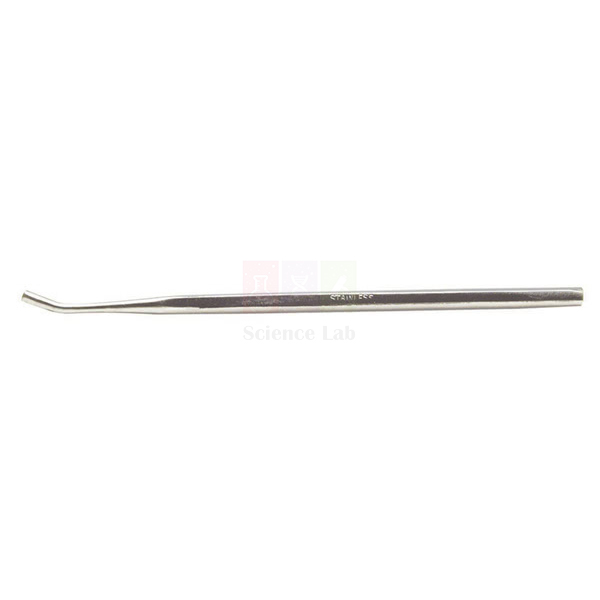
Seekers
Seekers (Product Code: SLE/EDE/28) are compact, plain-pattern stainless steel dissecting tools with a 35mm blunt-ended needle and a total length of 70mm including the handle. Where a sharp needle would pierce, a seeker slides along vessels, nerves and ducts to follow their path and separate them from surrounding tissue. They are a small but important part of zoology lab equipment in India and are manufactured by Jain Scientific Equipments Pvt Ltd (ScienceLab), Ambala.
Specifications
| Parameter | Detail |
|---|---|
| Pattern | Plain |
| Material | Stainless steel |
| Needle | 35mm, blunt end |
| Total length | 70mm including handle |
Typical Use
The blunt end is the whole point of a seeker. Once a specimen has been opened, students run the seeker gently under a blood vessel or nerve and lift it slightly, which shows where it branches and what it connects to without cutting or tearing it. The short 70mm overall length gives close control for small specimens and fine work, including work under a hand lens or dissecting microscope.
Teachers often introduce the seeker before the scalpel, because it lets students explore anatomy safely and builds careful technique. Within a school biology lab equipment set, seekers are typically issued alongside forceps and pins. Clean them after each use, dry them straight away, and store them with other fine instruments rather than loose in a drawer where the short needle can be bent.
Manufacturer
Seekers in the ScienceLab range are made by Jain Scientific Equipments Private Limited at Ambala, Haryana, India. The company builds apparatus for biology, chemistry and physics teaching and supplies institutions in India and international markets. Our company profile has the full story.
Related Dissection Equipment
Tools that work alongside seekers when tracing anatomy:
- Probe & Hook — a 6-inch chrome plated probe with a hook for holding tissue aside
- Probe, Chrome — a longer probe for larger specimens
- Needle, Stainless Steel — sharp straight needles for when piercing or teasing is needed
- Forceps (Tweezers) — to hold structures while the seeker separates them
- Dissecting Microscope — for fine tracing work on small specimens
Browse needles, probes and other fine instruments in Dissection Equipment.
Frequently Asked Questions
What is the difference between a seeker and a dissecting needle?
A seeker has a blunt end for tracing and lifting structures without piercing them, whereas a dissecting needle has a sharp point for teasing and picking.
How long is the seeker?
The needle is 35mm and the total length, including the handle, is 70mm.
What material is used?
Stainless steel, in a plain pattern.
Are seekers sold singly or in packs?
The pack quantity is not stated in the listing; contact us with the number you need and we will confirm how they are supplied.
How should seekers be stored?
Dry them after cleaning and keep them in a case or tray with other fine instruments so the short needle is not bent.
Can I get a combined quote with other dissection tools?
Yes. List code SLE/EDE/28 with any other items and quantities, plus your delivery location in India or abroad, and we will send one quotation.
Request a Quote
To buy Seekers for your lab, get in touch through the contact page or add them to the enquiry cart; we will reply with pricing and availability.
Last updated: 24 September 2026
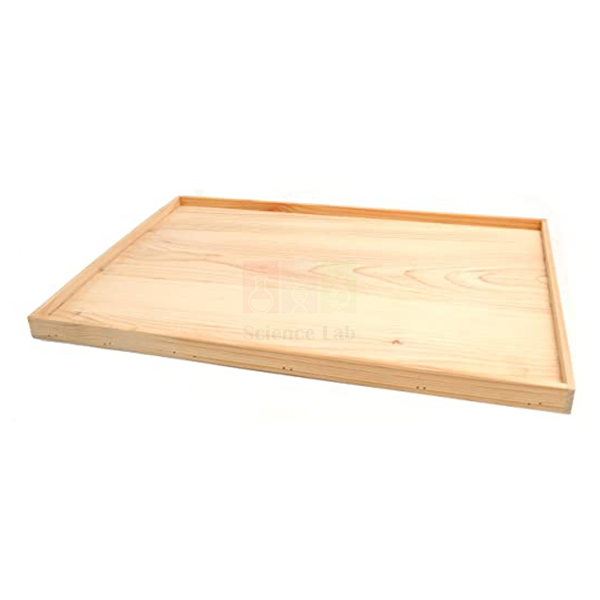
Wooden Dissecting Board
The Wooden Dissecting Board (Product Code: SLE/EDE/29) is a large 550 x 380mm board made of softwood, chosen so that dissecting pins press in easily and scalpel blades are not blunted on a hard surface. Its generous working area suits teacher demonstrations, larger preserved specimens and plant material spread out for study, and it fits naturally into a biology lab setup for schools in India as well as college practical labs. It is manufactured by Jain Scientific Equipments Pvt Ltd (ScienceLab), Ambala.
Specifications
| Parameter | Detail |
|---|---|
| Material | Softwood |
| Dimensions | 550 x 380mm |
| Designed for | Easy use with dissecting pins and scalpel blades |
Typical Use
At 550 x 380mm the board gives enough room for a specimen, pinned-back tissue and a row of instruments laid out beside it, which is why many teachers use it for front-of-class demonstrations where students gather round. Softwood takes pins with hand pressure alone and holds them firmly, and it is forgiving to scalpel edges that would dull quickly on glass, ceramic or metal.
It is equally useful as botany lab equipment in India — for cutting sections of stems, roots and fruits, or pinning out whole plants and flowers for drawing. Because wood is porous, place a plastic sheet or tray over it for very wet or preserved specimens, wipe it down with a damp cloth after use rather than soaking it, and let it dry flat and away from direct heat to prevent warping.
Manufacturer
ScienceLab is the trading name of Jain Scientific Equipments Private Limited, a registered MSME manufacturer (Udyam UDYAM-HR-01-0003714) based in Ambala, Haryana; export shipments are handled under Importer-Exporter Code AAECJ8618A (DGFT). The company supplies laboratory equipment to institutions in India and international markets — see our company profile.
Related Dissection Equipment
Pins, instruments and alternative surfaces for the same practical:
- Dissecting T-Pins — T-headed pins for fixing specimens to the board
- Scalpel, Stainless Steel — a stainless steel scalpel for cutting on the board
- Dissecting Instruments Set — 14 stainless steel instruments in a canvas case
- Dissecting Board — a softwood board with raised edges
- Dissection Pan, Pad & Cover — a covered aluminium pan for wet specimens kept between lessons
See every board, tray and tool in our Dissection Equipment category.
Frequently Asked Questions
What size is the board?
It measures 550 x 380mm.
Why is it made of softwood?
Softwood lets dissecting pins go in easily and is kind to scalpel blades, so edges stay sharp for longer.
How thick is the board?
Thickness is not given in the product listing. Please contact us if you need it for a specification.
Can it be used with wet or preserved specimens?
Yes, but wood absorbs liquid, so we suggest laying a plastic sheet or tray on the board for very wet work and wiping it clean afterwards.
How do I clean and store it?
Remove all pins, wipe with a damp cloth and mild detergent, and dry the board flat at room temperature; avoid soaking or placing it near heaters.
What details are needed for an institutional or export order?
Provide code SLE/EDE/29, the quantity and the delivery destination; we can also share the company registration details your purchase department requires.
Request a Quote
For a quotation on the Wooden Dissecting Board, write to us via the contact page or add it to the enquiry cart with pins and instruments for a complete set-up.
Last updated: 24 September 2026
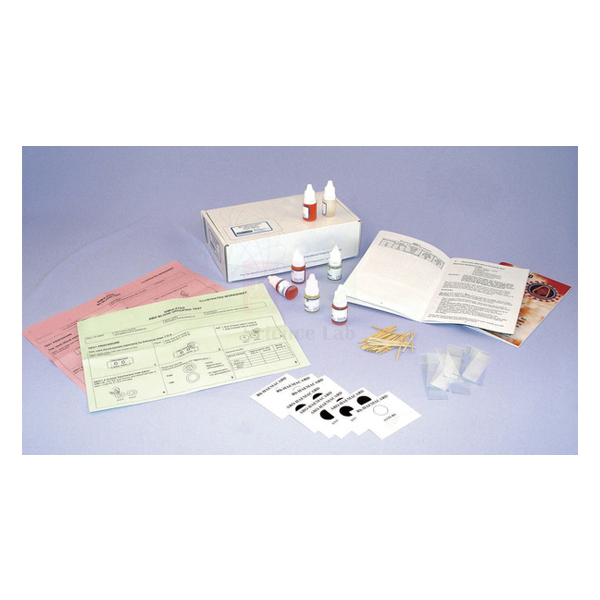
Blood Typing Kit, Simulated
Blood Typing Kit, Simulated (Product Code: SLE/EB/11) is an ABO-Rh blood typing kit used to teach blood grouping with artificial blood and sera in school and college biology classes. Students identify A, B, AB and O types and the Rh factor, find possible blood donors and settle a paternity question, and no real blood is ever used. It is supplied by Jain Scientific Equipments Pvt Ltd (ScienceLab), Ambala, India, as a genetics inheritance kit for practical lessons.
Specifications
| Parameter | Detail |
|---|---|
| Test type | ABO-Rh blood typing, simulated |
| Blood types covered | A, B, O and AB, plus Rh factor determination |
| Materials | Artificial blood and sera — real blood is not used |
| Learning outcomes | Simulated blood typing; identifying possible blood donors; genetic considerations to settle a paternity question |
| Group size | Designed for individual use or small groups |
| Construction | Durable, washable materials; component design based on equipment used in modern laboratory techniques |
| Comboplates | Dishwasher safe |
| Student material | Worksheets written for students and suited to the curriculum; workbooks and guides must be ordered separately |
| Curriculum links | Worksheets can be linked to AQA, IB, OCR, Edexcel, WJEC, SEB, IEB and CIE schemes |
| Shelf life | Shelf life depends on the chemical, its grade and storage conditions; ask us for the expiry date of the batch you are quoted |
| Product code | SLE/EB/11 |
| Supplied by | Jain Scientific Equipments Pvt Ltd (ScienceLab), Ambala, India |
What Is the Simulated Blood Typing Kit Used For?
The kit is used to run a realistic blood-grouping practical without any biological sample. Students place drops of simulated blood into the wells of a comboplate, add the simulated typing sera and watch for the clumping reaction that shows which antigens are present. Reading the pattern across the wells gives each sample's ABO group and Rh status, and the class then builds a donor-compatibility table from its results.
A follow-up task uses the same results to settle a paternity question, showing how blood groups are inherited and why some combinations of parents and child are impossible. Because the materials are artificial, this biology experiment kit for students can be repeated with different unknowns without biosafety concerns, and the comboplates go straight into the dishwasher ready for the next group.
What to Specify When Ordering
- The number of kits, depending on whether students will work individually or in small groups.
- Whether you need workbooks and guides, which must be ordered separately from the kit.
- The exam scheme your worksheets should link to (AQA, IB, OCR, Edexcel, WJEC, SEB, IEB or CIE).
- Your delivery address and any related items, such as blood-cell models, to include in the same quotation.
Supplier
ScienceLab is the trading name used by Jain Scientific Equipments Private Limited, a laboratory education supplier based in Ambala, Haryana, India. The company supplies this simulated typing kit, together with any separately ordered workbooks and guides, to schools, colleges and distributors. Our profile explains who we are and how we work with institutions.
Related Laboratory Equipment
Teachers often combine the kit with these resources:
- Human Blood Cell Types Model — illustrates the blood cells whose surface markers decide a person's blood group.
- Forensics Using Simulated Blood — another artificial-blood practical that extends the topic into forensic science.
- Forensic Chemistry of Blood Types — applies blood-group evidence to a forensic investigation.
- Genes & Probability Lab — broadens the inheritance work to monohybrid and dihybrid crosses.
Browse the complete Biology Kits range for other hands-on investigations.
Frequently Asked Questions
Does the Blood Typing Kit, Simulated use real blood?
No. The Blood Typing Kit, Simulated uses artificial blood and sera that simulate actual blood typing, so students carry out the full grouping procedure without any contact with human blood samples.
Which blood groups can students identify with the Blood Typing Kit, Simulated?
With the Blood Typing Kit, Simulated, students identify the A, B, AB and O groups and determine the Rh factor, then use the results to work out possible blood donors and answer a paternity question.
Are workbooks and teacher guides included with the Blood Typing Kit, Simulated?
No. Workbooks and guides for the Blood Typing Kit, Simulated must be ordered separately. Tell us how many you need when you enquire and we will add them to the same quotation as the kits.
How are the components of the Blood Typing Kit, Simulated cleaned?
The Blood Typing Kit, Simulated is made of durable, washable materials, and its comboplates are dishwasher safe, so the plates can be cleaned quickly and reused with the next class or group.
Will the Blood Typing Kit, Simulated worksheets fit our syllabus?
The worksheets of the Blood Typing Kit, Simulated are written for students and can be linked to AQA, IB, OCR, Edexcel, WJEC, SEB, IEB and CIE schemes. For other boards, compare the ABO-Rh and inheritance topics with your syllabus or ask us.
How long do the artificial blood and sera last?
No fixed period is stated for the artificial blood and sera in the Blood Typing Kit, Simulated, because shelf life depends on the chemical, its grade and storage conditions. Ask us for the expiry date of the batch you are quoted.
Who supplies the Blood Typing Kit, Simulated?
Jain Scientific Equipments Pvt Ltd, trading as ScienceLab from Ambala, Haryana, India, supplies the Blood Typing Kit, Simulated to schools, colleges and distributors in India and international markets, and handles bulk and export enquiries directly.
Request a Quote
For a quotation on Blood Typing Kit, Simulated and any workbooks, contact us or collect items in the enquiry cart.
Last updated: 24 September 2026
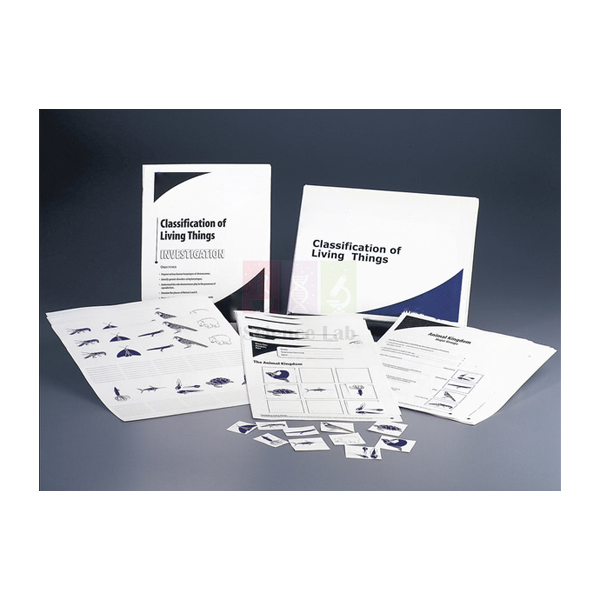
Classification of Living Things Lab Investigation
Classification of Living Things Lab Investigation (Product Code: SLE/EB/12) is a classroom biodiversity activity used to teach the Five Kingdoms by classifying illustrated life forms with a simple dichotomous key in school biology lessons. Sized for a class of 40, it takes students to the kingdom and phylum of each organism while they note what it “does for a living”. It is supplied by Jain Scientific Equipments Pvt Ltd (ScienceLab), Ambala, India, as a low-equipment biology teaching aid.
Key Details
| Parameter | Detail |
|---|---|
| Type | Classification lab investigation |
| Topic | Biodiversity; the Five Kingdoms |
| Method | Students view illustrations of various life forms and use a simple dichotomous key |
| Outcome | Kingdom and phylum determined for each life form; summary of what each life form “does for a living” |
| Class size | 40 students |
| Product code | SLE/EB/12 |
| Supplied by | Jain Scientific Equipments Pvt Ltd (ScienceLab), Ambala, India |
What Is the Classification of Living Things Investigation Used For?
The investigation is used at the start of a diversity-of-life unit. Students work through the key one couplet at a time, choosing between two descriptions at each step, until they reach a kingdom and then a phylum for each illustrated organism. Comparing answers between groups quickly shows where a key depends on careful observation, and disagreements become a starting point for discussing cell type, nutrition and body plan.
Since students work from illustrations rather than live or preserved specimens, the activity needs no microscopes or specimen storage and can run in an ordinary classroom. It pairs well with a classification chart for biology on the classroom wall, suits schools still building up their biology lab equipment, and leads naturally into field work with real organisms.
Supplier
The investigation is supplied by Jain Scientific Equipments Private Limited, known to customers as ScienceLab, from Ambala, Haryana, India. Schools, colleges and distributors can order it together with posters and other classification resources in a single quotation. See the company profile for more about our background and range.
Related Biology Kits
These resources extend the lesson before and after the key work:
- Classification of Living Things Poster — a wall reference for the kingdoms and major groups students meet in the key.
- Concepts Of Classification Kit — a warm-up that teaches trait-based sorting with simple numbered figures.
- Microbe Scavenger Hunt — lets students apply keys to real microorganisms from their surroundings.
- Hand Lens — for taking the lesson outdoors to examine real plants and small animals.
Our Biology Kits category lists further classroom investigations.
Frequently Asked Questions
What class size is the Classification of Living Things Lab Investigation designed for?
The Classification of Living Things Lab Investigation is designed for a class size of 40 students. For larger year groups, order one set for every 40 students, or ask us for a combined quotation.
Does the Classification of Living Things Lab Investigation need microscopes or specimens?
No. In the Classification of Living Things Lab Investigation students classify illustrations of life forms, so the lesson can run in any ordinary classroom without microscopes, preserved specimens or specimen storage.
Which classification levels does the investigation cover?
The Classification of Living Things Lab Investigation takes students to kingdom and phylum level within the Five Kingdom system, using a simple dichotomous key to place each illustrated life form.
What is a dichotomous key?
A dichotomous key, as used in the Classification of Living Things Lab Investigation, is a step-by-step identification tool: every step offers two contrasting descriptions, and choosing the one that fits leads to the next step and finally to a group.
Does the investigation cover how organisms live, or only their names?
Both. While working through the Classification of Living Things Lab Investigation, students also record what each life form “does for a living”, which links classification to ecology and to the diversity of the living world.
Who supplies the Classification of Living Things Lab Investigation?
Jain Scientific Equipments Pvt Ltd, trading as ScienceLab from Ambala, Haryana, India, supplies the Classification of Living Things Lab Investigation to schools, colleges and distributors in India and international markets, with quotations sent directly by the company.
What information helps prepare a quotation?
For a Classification of Living Things Lab Investigation quotation, send the number of classes or students, the delivery address and any related items such as classification posters through our contact page.
Request a Quote
To request Classification of Living Things Lab Investigation sets for your school, reach our team here or add them to the enquiry cart.
Last updated: 24 September 2026