- Physics Lab Equipment
- Chemistry Lab Equipment
- Biology Lab Equipment
- Anatomical Lab Equipment
- Learning
- Educational Lab Equipment
- Magnets
- Agriculture
- Astronomy
- Earth Science
- Geography Lab Equipment
- Safety Lab Coat
- Laboratory
- Meteorological
- Electricity & Magnetism
- Heat
- School Lab Equipment
- Lab Glassware
- Science Lab Equipment
- Tvet Lab Equipment
- Robotics Kits Supplier and Manufacturer for Schools India
- Math Lab Equipment Manufacturers and Exporters in Ambala
- STEM Kits Manufacturers and Supplier India
- Engineering Lab Equipment
- Hospital Lab Equipment
- Water, Sanitation & Hygiene Supplies
- Cold Chain, Solar & Communication Equipment
- Nutrition
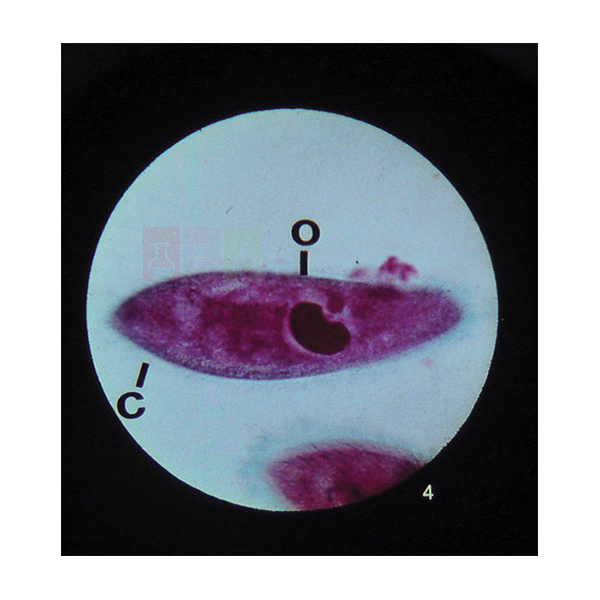
Microslide Five Kingdoms of Life
Microslide Five Kingdoms of Life (Product Code: SLE/PS/90) is a Microslide of 8 related 35mm images, photographed through a microscope, used to teach the five-kingdom classification of living things in school biology. It shows examples from Monera, Protista, Fungi, Plants and Animals, from nitrogen-fixing bacteria at 2000x and Gloeocapsa to Paramecium, Spirogyra, a mushroom, onion and Elodea, opening with Euglena as a classification puzzle. It is supplied by Jain Scientific Equipments Pvt Ltd (ScienceLab), Ambala, India.
Specifications
| Parameter | Detail |
|---|---|
| Format | 8 related 35mm images for a Microslide Viewer |
| Opening image | Euglena – a classification puzzle (400x) |
| Kingdom Monera | Nitrogen-fixing bacteria (2000x); Gloeocapsa (1000x) |
| Kingdom Protista | Paramecium (100x); Spirogyra (150x) |
| Fungus Kingdom | The mushroom (1/2x and 400x) |
| Plant Kingdom | Onion and Elodea (150x) |
| Animal Kingdom | Animal Kingdom image (750x) |
| Labelling | Arrows and callouts on each image |
| Folder | Detailed text folder with questions; pocket keeps the Microslide |
| Product code | SLE/PS/90 |
| Supplied by | Jain Scientific Equipments Pvt Ltd (ScienceLab), Ambala, India |
What Is the Microslide Five Kingdoms of Life Used For?
Classification lessons stick better when students see real organisms instead of names on a chart. The set opens with Euglena, which has chloroplasts like a plant yet swims like an animal, so the class has to argue where it belongs. From there it moves kingdom by kingdom, from the simplest cells in Monera to the Animal Kingdom.
The mushroom appears at both 1/2x and 400x, helping students connect a familiar fruiting body with its microscopic structure. Use the Microslide alongside a classification chart for biology class, asking groups to list the features that place each organism in its kingdom.
Supplier
ScienceLab, the trading name of Jain Scientific Equipments Private Limited in Ambala, Haryana, supplies Microslide Five Kingdoms of Life to schools that teach classification through images, models and posters. Biology departments, teacher-training colleges and dealers in India and international markets can order it with the rest of their classification resources. Details about the company are on the profile page.
Related Prepared Slides
Resources that support the same classification lessons:
- Microslide Viewer — for viewing the kingdom images.
- Classification of Living Things Poster — a wall summary of the groups shown in the set.
- Concepts Of Classification Kit — a hands-on sorting activity to follow the images.
- Classification of Living Things Lab Investigation — a structured investigation for older students.
- Euglena Model — an enlarged model of the organism that opens the set.
More titles are in Prepared Slides.
Frequently Asked Questions
Which organisms are shown in the Microslide Five Kingdoms of Life?
The Microslide Five Kingdoms of Life shows Euglena, nitrogen-fixing bacteria and Gloeocapsa (Monera), Paramecium and Spirogyra (Protista), a mushroom (Fungi), onion and Elodea (Plants) and an Animal Kingdom image.
Why is Euglena called a classification puzzle in the Microslide Five Kingdoms of Life?
Euglena opens the Microslide Five Kingdoms of Life as a classification puzzle because it makes food with chloroplasts like a plant but moves freely like an animal. Students debate its placement, which shows why classification systems change.
What magnifications are used in the Microslide Five Kingdoms of Life?
Magnifications in the Microslide Five Kingdoms of Life range from 100x for Paramecium to 2000x for nitrogen-fixing bacteria. The mushroom is shown at 1/2x and 400x, and the Animal Kingdom image at 750x.
How is the Microslide Five Kingdoms of Life used in class?
Students view the Microslide Five Kingdoms of Life through a Microslide Viewer and use the arrows and callouts with the text folder questions to identify each organism and the features that place it in its kingdom.
Who supplies the Microslide Five Kingdoms of Life?
The Microslide Five Kingdoms of Life is supplied by Jain Scientific Equipments Pvt Ltd (ScienceLab), Ambala, Haryana, India, to schools, colleges and dealers in India and international markets.
What should be included in a quotation request for the Microslide Five Kingdoms of Life?
For the Microslide Five Kingdoms of Life, state the number of sets, how many viewers you need and the delivery location, and add any classification kits or posters. Send it through the contact page.
Request a Quote
Ask for a quotation on the Microslide Five Kingdoms of Life through the contact page, or add it to the enquiry cart with viewers and classification resources.
Last updated: 24 September 2026
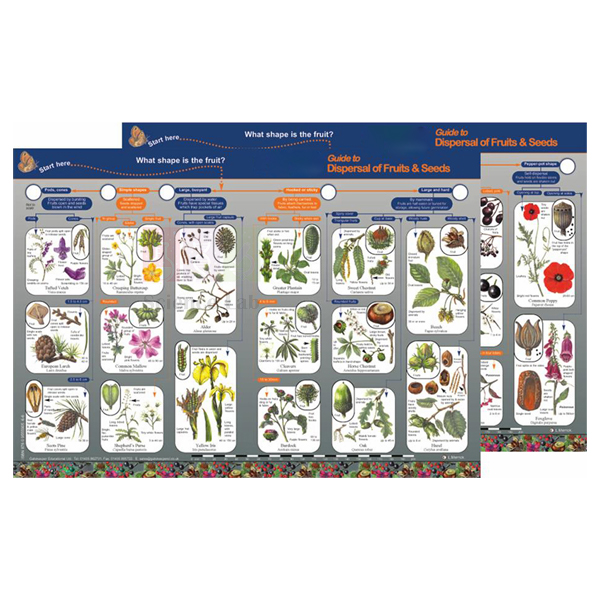
Key to Identifying Dispersal of Fruits & Seeds
Key to Identifying Dispersal of Fruits & Seeds (Product Code: SLE/EBT/15) is a fold-out identification guide used to work out how a fruit or seed is spread, in classroom botany and outdoor field study. Part of the Key Identification Guides K1 - 5 series, it is a wipe-clean A3 laminated sheet printed on both sides, with easy key questions and full colour illustrations for a school biology chart set. It is supplied by Jain Scientific Equipments Pvt Ltd (ScienceLab), Ambala, India.
Specifications
| Parameter | Detail |
|---|---|
| Series | Key Identification Guides K1 - 5 |
| Format | A3, laminated and folded |
| Printing | Printed on both sides |
| Surface | Wipe-clean |
| Illustrations | Clear, original full colour illustrations |
| Identification method | Key questions that are easy to follow |
| Suitable for | Schools and nature lovers of all ages |
| Product code | SLE/EBT/15 |
| Supplied by | Jain Scientific Equipments Pvt Ltd (ScienceLab), Ambala, India |
What Is the Fruit and Seed Dispersal Key Used For?
Plants cannot move, so they rely on their fruits and seeds to reach new ground. Some are carried by wind on wings or parachutes, some float on water, some hook onto animal fur or are eaten and passed on, and others are flung out when a pod bursts. A common lesson begins with a collecting walk around the school grounds; back in class, students take each fruit or seed through the key question by question until they reach its dispersal method, then record and compare their findings. Because the key relies on observable features, it also trains the step-by-step reasoning used in all biological identification.
The guide is a natural starting point for ecology fieldwork and simple investigations, such as timing how long different winged fruits take to fall or testing which seeds float. Robust and easy to handle, it can be wiped with a damp cloth after outdoor use, and the folded format fits in a clipboard folder or bag. Keep several copies so each group has its own during practical sessions.
Supplier
ScienceLab is the trading name of Jain Scientific Equipments Private Limited, which supplies this laminated key and other field-study resources from Ambala, Haryana, to schools, eco-clubs and nature groups in India and international markets. For vendor registration and export paperwork, the supplying company's details are Importer-Exporter Code AAECJ8618A (DGFT) and GSTIN 06AAECJ8618A1ZT. See the company profile for more.
Related Botany Equipment
Items that support seed and field identification activities:
- Seed Identification Kit — for closer study of the seeds students collect.
- Leaf & Seed Games — activity-based practice of identification skills for younger learners.
- Key to Identifying Water Invertebrates — a companion key from the same guide series for pond work.
- Plastic Container with a Magnifying Glass Lid — for collecting and inspecting small fruits and seeds in the field.
- Stopwatch, Digital — for timing the fall of winged fruits in follow-up investigations.
Visit the Botany category for more plant identification resources.
Frequently Asked Questions
What size and format is the guide?
The Key to Identifying Dispersal of Fruits & Seeds is an A3 sheet, laminated, printed on both sides and folded, so it can be opened on a desk for group work or carried in a bag or clipboard folder on field trips.
Can the guide be taken outdoors?
Yes. The Key to Identifying Dispersal of Fruits & Seeds is wipe-clean, robust and easy to handle, so mud or rain can simply be wiped from the laminate with a damp cloth after a collecting walk.
How does an identification key work?
The Key to Identifying Dispersal of Fruits & Seeds works through easy-to-follow questions about features users can see; each answer leads to the next question until the answer is reached, so no prior botanical knowledge is needed.
Which fruits and seeds are illustrated?
The full list of fruits and seeds illustrated in the Key to Identifying Dispersal of Fruits & Seeds is not given in the current listing. Ask through our contact page and ScienceLab will share details before you order.
Who supplies the Key to Identifying Dispersal of Fruits & Seeds?
The Key to Identifying Dispersal of Fruits & Seeds is supplied by Jain Scientific Equipments Pvt Ltd (ScienceLab), Ambala, Haryana, India, to schools, eco-clubs and field-study groups in India and international markets, singly or as class sets.
Are other guides in the series available?
The Key to Identifying Dispersal of Fruits & Seeds belongs to the Key Identification Guides K1 - 5 series. The Key to Identifying Water Invertebrates is also listed on our site; contact us to ask about the other titles.
Request a Quote
For a quotation on single copies or class sets, reach us through the contact page or add this key to the enquiry cart alongside other field study items.
Last updated: 24 September 2026
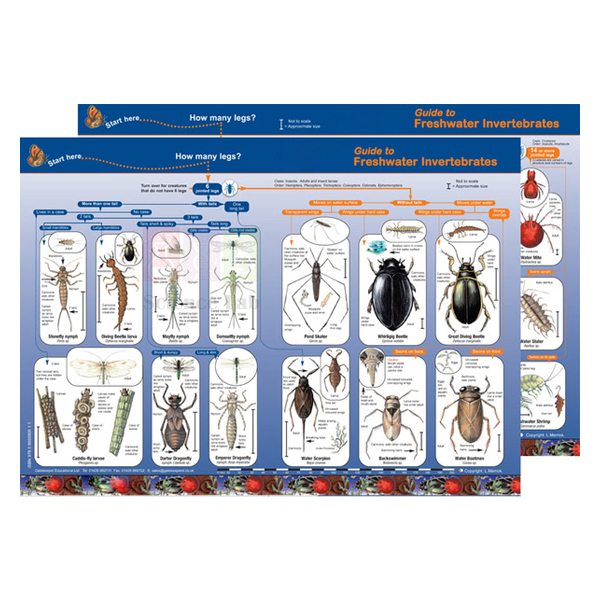
Key to Identifying Water Invertebrates
Key to Identifying Water Invertebrates (Product Code: SLE/EBT/16) is a folded, laminated identification chart used to name the small freshwater animals caught during pond dipping in school biology and field-study lessons. Part of the Key Identification Guides K1 - 5 series, it is an A3 sheet printed on both sides, with easy-to-follow key questions and clear, original full colour illustrations. It is supplied by Jain Scientific Equipments Pvt Ltd (ScienceLab), Ambala, India, as part of its zoology lab equipment for schools in India and abroad.
Specifications
| Parameter | Detail |
|---|---|
| Guide series | Key Identification Guides K1 - 5 |
| Sheet size | A3 |
| Finish | Laminated, wipe-clean |
| Layout | Folded; printed on both sides |
| Identification method | Key questions that are easy to follow |
| Artwork | Clear, original full colour illustrations |
| Handling | Robust and easy to handle |
| Intended users | Schools and nature lovers of all ages |
| Product code | SLE/EBT/16 |
| Supplied by | Jain Scientific Equipments Pvt Ltd (ScienceLab), Ambala, India |
What Is the Water Invertebrates Key Used For?
A pond-dipping session usually starts with a net swept gently through water plants and along the bottom, after which the catch is emptied into a shallow white tray of pond water. Students pick out individual animals, such as snails, worms, beetles or insect nymphs, and work through the key questions for each one, noting how many of every type they find. Because some freshwater invertebrates tolerate pollution while others need clean, well-oxygenated water, the list of animals found gives a simple picture of the habitat's health, which makes the chart a useful companion to an ecology or environmental science kit in school.
The laminated sheet copes with wet hands on the bank and can be wiped dry afterwards. Teachers often clip it to a board beside the sorting trays so it stays flat and visible to the whole group. Supervise students closely near open water, have them wash their hands after the session, and return all animals to the pond once they have been recorded.
Supplier
Jain Scientific Equipments Private Limited, which trades as ScienceLab, supplies this identification key from Ambala, Haryana, India. Schools, colleges, field-study groups and distributors can source the chart together with the nets, trays and lenses a pond-dipping day needs, in single copies or class quantities, for delivery across India and to international markets. Background on the company is on the company profile page.
Related Zoology Equipment
Everything else a class needs for a freshwater invertebrate survey:
- Net, Basic Fish Dip — for sweeping through water plants to collect invertebrates.
- Invertebrate Sampling Tray — a shallow tray for holding the catch while it is identified.
- Sorting Tray — for separating animals into groups before counting.
- Magnifying Glass — for checking the small features the key questions ask about.
- Key to Identifying Dispersal of Fruits & Seeds — a companion guide from the same Key Identification Guides series for plant fieldwork.
The Zoology category lists more nets, trays, specimens and animal-study resources.
Frequently Asked Questions
Can the Key to Identifying Water Invertebrates get wet during pond dipping?
Yes, splashes are not a problem. The Key to Identifying Water Invertebrates is laminated and wipe-clean, so it can be used with wet hands on the bank or beside the sorting trays. Wipe it dry before folding it away to keep the sheet in good order.
What size is the Key to Identifying Water Invertebrates?
The Key to Identifying Water Invertebrates opens to an A3 sheet printed on both sides, carrying the key questions and full colour illustrations. It then folds down so it can travel in a field bag or be clipped to a board at the pond edge.
Does the water invertebrates key come with a net or tray?
No. The Key to Identifying Water Invertebrates is the identification guide only. Dip nets, sampling trays and sorting trays are listed separately in the Zoology range and can be added to the same enquiry so a class has a complete pond-dipping set.
Which animals are covered by the Key to Identifying Water Invertebrates?
The current listing does not publish the full list of animals covered by the Key to Identifying Water Invertebrates. Please ask through our contact page and we will share the details before you place an order.
Can the water invertebrates key be used for water quality surveys?
Identifying which invertebrates are present is the first step in a simple water quality survey, and the Key to Identifying Water Invertebrates supports that step. The listing does not say whether a scoring index is included, so ask us if your survey needs one.
Is the Key to Identifying Water Invertebrates suitable for young children?
Yes. The Key to Identifying Water Invertebrates is intended for schools and nature lovers of all ages, and its illustrated key questions are easy to follow, so younger pupils can use it successfully with an adult guiding the pond-dipping session.
Who supplies the Key to Identifying Water Invertebrates?
The Key to Identifying Water Invertebrates is supplied by Jain Scientific Equipments Pvt Ltd (ScienceLab) of Ambala, Haryana, India. The company quotes single copies and class sets to schools, colleges and distributors in India and international markets through its contact page.
Request a Quote
To order the Key to Identifying Water Invertebrates, alone or with nets and trays, send the number of copies and your delivery location via our contact page, or build a list in the enquiry cart.
Last updated: 24 September 2026
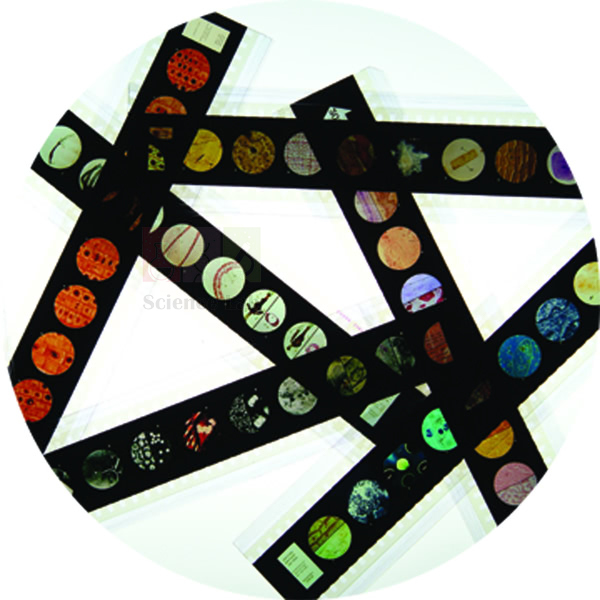
Microslide Harmful Bacteria
Microslide Harmful Bacteria (Product Code: SLE/PS/91) is a Microslide of 8 related 35mm images, photographed through a microscope, used to show bacteria that cause disease in people and crops in school biology and health education lessons. The listed subjects include the bacteria of diphtheria, typhoid fever, pneumonia, tuberculosis and food poisoning at 2000x, together with potato ring-rot and apple fire-blight bacteria. It is supplied by Jain Scientific Equipments Pvt Ltd (ScienceLab), Ambala, India.
Specifications
| Parameter | Detail |
|---|---|
| Format | Microslide – 8 related 35mm images photographed through a microscope |
| Viewing | Microslide Viewer |
| Human disease subjects | Diphtheria (2000x), typhoid fever bacteria (2000x), pneumonia bacteria (2000x), bacteria of tuberculosis (2000x), bacteria of food poisoning (2000x) |
| Plant disease subjects | Bacteria of potato ring-rot; bacteria of apple fire-blight (2000x) |
| Labelling | Arrows and callouts show the features to look for |
| Folder | Detailed text folder with questions; pocket holds the Microslide |
| Product code | SLE/PS/91 |
| Supplied by | Jain Scientific Equipments Pvt Ltd (ScienceLab), Ambala, India |
What Is the Microslide Harmful Bacteria Used For?
Typhoid, tuberculosis and food poisoning appear in most school health syllabuses, but the bacteria behind them should never be grown in a school lab. This Microslide lets students see those organisms as photographed images, with arrows and callouts pointing out their shape and arrangement, without anyone handling a culture.
Potato ring-rot and apple fire-blight widen the discussion to farming, showing that bacteria also damage crops and food supplies. Used with the text folder questions, the set supports lessons on hygiene, clean water and safe food handling, and it fits well into a health education kit for schools alongside Microslide Helpful Bacteria.
Supplier
Jain Scientific Equipments Private Limited supplies Microslide Harmful Bacteria through its ScienceLab brand, working from Ambala, Haryana. Schools and colleges usually request it together with the viewer and the other microbe and disease titles, and the company arranges supply for institutions and dealers in India and international markets. The ScienceLab profile has more about the company.
Related Prepared Slides
Items that support the same lessons on microbes and disease:
- Microslide Viewer — required to view the images.
- Microslide Helpful Bacteria — the useful side of bacteria, for a balanced lesson.
- Microslide Human Diseases — places bacterial disease beside viral, genetic and environmental illness.
- Microslide Body Defences Against Infection — how the body responds to the organisms shown here.
- Three Types of Bacteria, Stained — a stained preparation of three types of bacteria for comparison.
See all titles under Prepared Slides.
Frequently Asked Questions
Which bacteria are shown in the Microslide Harmful Bacteria?
The product details for the Microslide Harmful Bacteria list diphtheria, typhoid fever, pneumonia, tuberculosis and food poisoning bacteria, plus the bacteria of potato ring-rot and apple fire-blight. Ask us through the contact page if you need the full image list for all eight frames.
Is the Microslide Harmful Bacteria safe to use in a classroom?
Yes. The Microslide Harmful Bacteria contains photographic images only, taken through a microscope and viewed through a Microslide Viewer. There are no live bacteria or cultures, so nothing needs to be grown, handled or sterilised.
What magnification is used in the Microslide Harmful Bacteria?
Six of the listed subjects in the Microslide Harmful Bacteria are marked 2000x: the diphtheria, typhoid, pneumonia, tuberculosis, food-poisoning and apple fire-blight images. No magnification is stated for the potato ring-rot image.
Does the Microslide Harmful Bacteria cover plant diseases?
Yes. Besides human disease bacteria, the Microslide Harmful Bacteria includes the bacteria of potato ring-rot and apple fire-blight, which helps agriculture and environmental science students see how bacteria affect crops.
Who supplies the Microslide Harmful Bacteria?
The Microslide Harmful Bacteria is supplied by Jain Scientific Equipments Pvt Ltd (ScienceLab), Ambala, Haryana, India, to schools, colleges and dealers in India and international markets.
What is needed for a Microslide Harmful Bacteria quotation?
For a Microslide Harmful Bacteria quotation, tell us the number of sets, how many viewers you need and where the order is to be delivered. Send the details through the contact page.
Request a Quote
Ask for a quotation on the Microslide Harmful Bacteria through the contact page, or add it to the enquiry cart with viewers and related disease titles.
Last updated: 24 September 2026
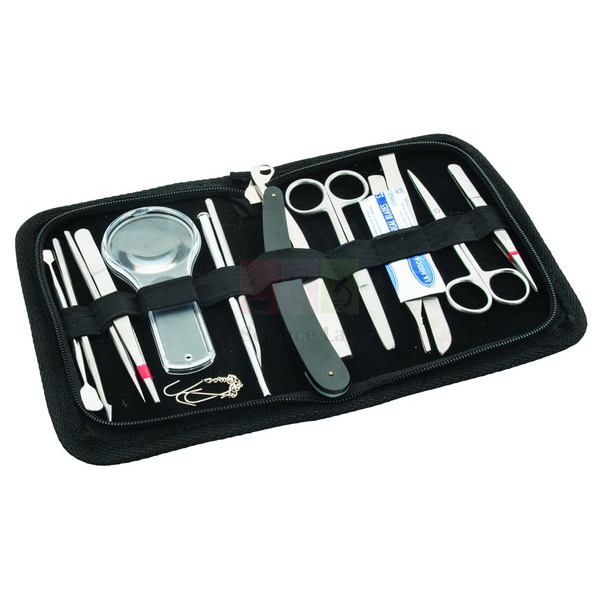
Dissecting Instruments Set
The Dissecting Instruments Set (Product Code: SLE/EDE/20) brings together 14 stainless steel dissecting instruments in a canvas case, so a student or teacher has a complete, organised toolkit for practical work instead of loose items gathered from a drawer. It suits institutions looking for a dissection kit for school use in India as well as college zoology and botany departments, and it is manufactured by Jain Scientific Equipments Pvt Ltd (ScienceLab), Ambala.
Specifications
| Parameter | Detail |
|---|---|
| Number of instruments | 14 |
| Instrument material | Stainless steel |
| Case | Canvas |
| Suitable for | Student and teacher dissection practicals |
Typical Use
A cased set works best when it is issued as a unit: one set per student or per pair, signed out at the start of the practical and checked back in at the end. Counting the instruments back into the case against the stated total of 14 makes a missing tool easy to spot, and students learn to lay out, use and return instruments in an orderly way — a habit that matters when sharp tools are involved. The same set moves easily between the dissection bench and field or herbarium work.
For a biology lab setup in a school in India, departments often keep a class quantity of identical sets so that every group works with the same tools and the teacher can demonstrate each step once. After use, wash and dry every instrument fully before it goes back into the canvas case, because moisture trapped in fabric can mark steel over time; store the closed case in a dry cupboard.
Manufacturer
The set comes from Jain Scientific Equipments Private Limited, a company based in Ambala, Haryana, that trades as ScienceLab and makes dissection, biology and general laboratory equipment for education. You can read about our background and facilities on the company profile page.
Related Dissection Equipment
Other sets for comparison, plus the working surface and pins a dissection needs:
- Dissecting Set, Student — an alternative set aimed at individual student use
- Dissecting Set, Large — a larger set option for comparison
- Dissecting Kit (Economy) — a budget kit for large classes
- Dissection Pan, Pad & Cover — an aluminium pan with pin-holding pad to work on
- Dissecting T-Pins — for fixing specimens to the pad or board
Compare every kit and single instrument in the Dissection Equipment category.
Frequently Asked Questions
How many instruments are in the set?
There are 14 stainless steel dissecting instruments, supplied together in a canvas case.
Which instruments does it include?
The piece-by-piece list is not published on this page. Please contact us for the current contents list before you order, especially if you need it for a tender specification.
Can individual instruments be replaced if one is lost?
Tell us which item is missing and we will advise whether a matching single instrument can be supplied.
How should the set be stored?
Clean and dry each instrument before returning it to the canvas case, then keep the case closed in a dry cupboard away from chemical fumes.
Is this set suitable for a whole class?
Yes, it is commonly ordered in class quantities so that each student or pair has an identical set. Let us know the number of students and we will quote accordingly.
What warranty applies?
Warranty coverage is stated in our quotation for each order; ask through the contact page if you need it in advance.
Can the sets be exported?
Yes. We supply schools, universities and distributors in India and international markets — quote code SLE/EDE/20 and the destination country in your enquiry.
Request a Quote
To receive a quotation for the Dissecting Instruments Set, message us on the contact page or add the set to your enquiry cart along with pans, pins and other dissection items.
Last updated: 24 September 2026
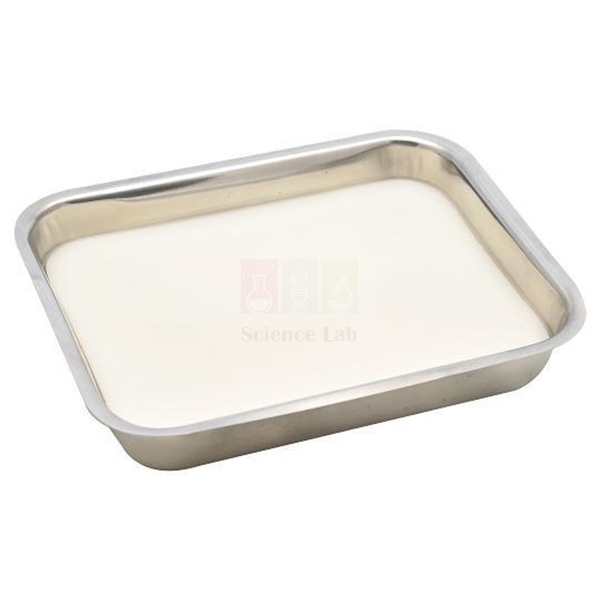
Dissecting Tray with Wax
The Dissecting Tray with Wax (Product Code: SLE/EDE/21) is an aluminium tray measuring 300 x 200 x 45mm, supplied with wax. The wax gives students a soft base into which dissecting pins can be pushed to hold a specimen open, while the raised sides contain fluids and loose tissue. It is a practical dissection tray for school labs in India and for college practical classes, manufactured by Jain Scientific Equipments Pvt Ltd (ScienceLab), Ambala.
Specifications
| Parameter | Detail |
|---|---|
| Tray material | Aluminium |
| Size | 300 x 200 x 45mm |
| Supplied with | Wax |
| Purpose | Pinning and dissecting specimens |
Typical Use
The specimen is laid on the wax, opened with a scalpel and pinned back with T-pins angled outward so the pins stay clear of the working area. Because the tray has walls 45mm high, the prepared specimen can be covered with water: many soft internal structures float apart under water and become far easier to see and trace than on a dry surface. The tray is equally useful for pinning out flowers or plant sections for drawing.
As a piece of school biology lab equipment in India, a wax tray is long-lived if it is looked after. Remove every pin at the end of the class, rinse the tray and wax surface, and let it dry before stacking. Over many sessions the wax becomes pitted from repeated pinning; teachers commonly renew the surface by carefully warming and levelling the wax so that it grips pins firmly again.
Manufacturer
This tray is made by Jain Scientific Equipments Private Limited, which operates as ScienceLab from Ambala, Haryana, and manufactures teaching laboratory equipment for education buyers in India and abroad. Institutions completing vendor registration can quote the company’s GSTIN 06AAECJ8618A1ZT and Legal Entity Identifier 3358004HRD1JIVXKYX49. Further details are on our company profile.
Related Dissection Equipment
Tools and alternatives used with a wax dissecting tray:
- Dissecting T-Pins — for fixing the specimen into the wax
- Scalpel, Stainless Steel — for the opening incisions
- Forceps (Tweezers) — to hold and lift tissue while cutting
- Dissection Pan, Pad & Cover — a wax-free alternative using a synthetic pad and clear cover
- Dissecting Dishes — for smaller specimens and separated parts
Trays, boards and instruments are all listed in the Dissection Equipment category.
Frequently Asked Questions
What are the tray dimensions?
The aluminium tray measures 300 x 200 x 45mm.
Is the wax included?
Yes, the tray is supplied with wax. The depth of the wax layer is not stated in the listing; ask us if you need that detail.
Why dissect under water in this tray?
The 45mm-deep tray can hold enough water to cover a pinned specimen, which lets delicate organs and tubes float apart so they can be traced without tearing.
How do I restore a wax surface full of pin holes?
Gently warm the wax until the surface softens and levels, then let it set before use. Keep heat low and supervised, and never leave the tray unattended on a heat source.
Should I choose wax or a synthetic pad?
Wax is simple and familiar; a synthetic pad such as our Dissection Pan, Pad & Cover avoids remelting altogether. Many labs keep both types in use.
What should a school include in its quotation request?
Mention code SLE/EDE/21, the number of trays, and your delivery address in India or abroad; add pins or instruments to the same request for a combined quote.
Request a Quote
Send your requirement for the Dissecting Tray with Wax through the contact page, or add it to the enquiry cart and submit the full list of dissection items you need.
Last updated: 24 September 2026
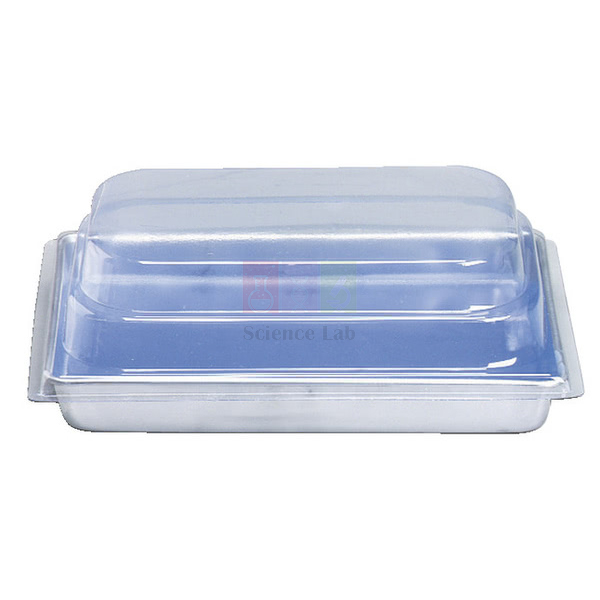
Dissection Pan, Pad & Cover
The Dissection Pan, Pad & Cover (Product Code: SLE/EDE/22) is a complete dissection system: an aluminium pan and a flexible synthetic pad measuring 29 x 19cm (11.5 x 7.5 in), plus a clear plastic cover. The pad replaces dissection wax, so there is no old wax to remelt, and the cover lets a specimen be kept between lessons. It is designed for biology lab equipment in India where the same specimen is studied over several periods, and it is manufactured by Jain Scientific Equipments Pvt Ltd (ScienceLab), Ambala.
Specifications
| Parameter | Detail |
|---|---|
| Pan and pad dimensions | 29 x 19cm (11.5 x 7.5 in) |
| Pan material | Aluminium, to prevent rusting |
| Pad | Flexible synthetic material; holds pins securely; smooth, long-lasting surface |
| Cover | Clear plastic; accommodates specimens up to 9cm (3.5 in) high |
| Cover function | Prevents excessive moisture loss; allows pans to be stacked for storage |
| Wax required | No — the pad replaces dissection wax and eliminates remelting |
Typical Use
This set is at its best in multi-lesson work. A specimen is pinned out on the pad, partly dissected, and then covered: the clear lid limits drying so tissue stays workable for the next session, and the covered pans stack neatly on a shelf instead of taking up bench space. Because the lid is transparent, students can still observe and sketch the specimen without lifting it, and the 9cm clearance leaves room for pins standing upright.
For teachers assembling biology teaching aids in India, the pad-and-pan design removes the most tedious part of wax trays — melting, pouring and levelling. After use, pull all pins, wash pad, pan and cover in mild detergent, rinse, and air-dry before reassembly. When the pad eventually wears from repeated pinning, it can be swapped for a replacement pad rather than replacing the whole set.
Manufacturer
Jain Scientific Equipments Private Limited, known to customers by its trade name ScienceLab, produces this dissection system in Ambala, Haryana, and supplies laboratories in India and international markets. See the company profile for more about who we are.
Related Dissection Equipment
Spares and tools that go with this pan system:
- Dissection Replacement Pad — a replacement synthetic pad for the dissection pan and pad set
- Dissection Replacement Pad, White — a white replacement pad for the same set
- Dissecting T-Pins — to hold specimens on the pad
- Dissecting Instruments Set — 14 stainless steel instruments in a canvas case
- Dissecting Tray with Wax — the traditional wax-based alternative
Find more trays, pans and instruments in Dissection Equipment.
Frequently Asked Questions
What size are the pan and pad?
Both measure 29 x 19cm (11.5 x 7.5 in).
How tall a specimen fits under the cover?
The clear plastic cover accommodates specimens up to 9cm (3.5 in) high.
Do I still need dissection wax?
No. The flexible synthetic pad replaces wax and holds pins securely, so there is no remelting of old wax.
Why is the pan made of aluminium?
Aluminium is used to prevent rusting, which matters for a pan that is washed after every practical.
Can the pad be replaced when it wears out?
Yes, replacement pads for the dissection pan and pad set are listed separately. Please confirm the size you need with us, as the replacement pads are listed with their own dimensions.
Is there a warranty on the set?
Warranty details are provided with our quotation; contact us if you need them before ordering.
Do you supply this set for whole labs or export?
Yes, we quote class and department quantities for customers in India and international markets. Include code SLE/EDE/22, the number of sets and whether spare pads are wanted.
Request a Quote
Ask for a price on the Dissection Pan, Pad & Cover via our contact page, or add the set and any spare pads to the enquiry cart for a single combined quotation.
Last updated: 24 September 2026
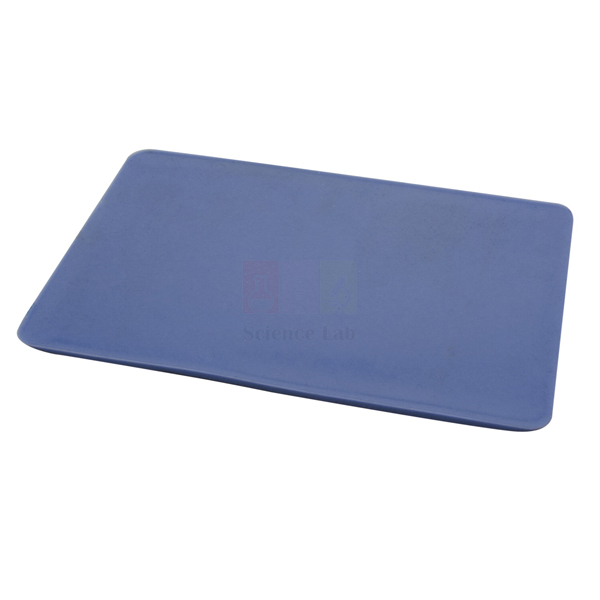
Dissection Replacement Pad
The Dissection Replacement Pad (Product Code: SLE/EDE/23) is a spare pad for the dissection pan and pad set, measuring 25 x 16cm and 10mm thick. Made of flexible synthetic material, it holds pins securely and offers a smooth, long-lasting working surface, so a worn pad can be renewed without buying a whole new pan. Labs that keep a school biology lab setup in India running term after term use it to refresh heavily pinned pads. It is manufactured by Jain Scientific Equipments Pvt Ltd (ScienceLab), Ambala.
Specifications
| Parameter | Detail |
|---|---|
| Type | Replacement dissection pad |
| For use with | Dissection pan and pad set |
| Material | Flexible synthetic material |
| Dimensions | 25 x 16cm |
| Thickness | 10mm |
| Surface | Smooth and long-lasting; holds pins securely |
| Wax | Not needed — replaces dissection wax and eliminates remelting |
Typical Use
Every pin pushed into a pad leaves a small channel, and after many classes the most-used central area no longer grips as firmly as the edges. That is the moment to lift out the old pad and drop in a new one. The 10mm thickness gives dissecting pins enough depth to seat firmly when they are angled outward, which keeps skin flaps and membranes open while students draw and label what they see.
Because no wax is involved, there is no heating, pouring or waiting for a surface to set before the next practical. Many departments keep a few spare pads in the store so a pan is never out of action when lab specimens are being prepared for a biological practical. Clean the pad with mild detergent and water after each use, remove every pin, and store it flat and dry so it keeps its shape.
Manufacturer
ScienceLab replacement parts are produced by Jain Scientific Equipments Private Limited, an Ambala, Haryana manufacturer of laboratory teaching equipment serving customers in India and international markets. The company profile gives an overview of the organisation.
Related Dissection Equipment
The pan set this pad belongs to, and the items used with it:
- Dissection Pan, Pad & Cover — the aluminium pan system with synthetic pad and clear cover
- Dissection Replacement Pad, White — a white replacement pad, listed at 25 x 14cm
- Dissecting T-Pins — pins to fix specimens into the pad
- Dissection Pan — a separate dissection pan in the same range
All pans, pads and dissection tools are in the Dissection Equipment category.
Frequently Asked Questions
What are the dimensions of this pad?
It measures 25 x 16cm and is 10mm thick.
Will it fit the pan I already have?
It is listed as a replacement for the dissection pan and pad set. Before ordering, compare the 25 x 16cm pad size with the inside of your pan, or send us your pan details and we will confirm the fit.
How is it different from the white replacement pad?
The white pad is listed at 25 x 14cm, while this pad is 25 x 16cm; both are 10mm thick and made of flexible synthetic material.
Does it hold pins as well as wax?
The pad is made to hold pins securely and gives a smooth, long-lasting surface, without the remelting that wax needs.
How long will a pad last?
Life depends on how often and how heavily it is pinned, so no fixed figure is given. Rotating pinning positions and removing pins promptly after class both help.
Can spare pads be ordered in bulk?
Yes. Give us code SLE/EDE/23, the quantity and your delivery location in India or overseas, and we will send a quotation.
Request a Quote
Stock up on Dissection Replacement Pads by writing to us from the contact page or adding them to the enquiry cart together with pans or pins.
Last updated: 24 September 2026