- Physics Lab Equipment
- Chemistry Lab Equipment
- Biology Lab Equipment
- Anatomical Lab Equipment
- Learning
- Educational Lab Equipment
- Magnets
- Agriculture
- Astronomy
- Earth Science
- Geography Lab Equipment
- Safety Lab Coat
- Laboratory
- Meteorological
- Electricity & Magnetism
- Heat
- School Lab Equipment
- Lab Glassware
- Science Lab Equipment
- Tvet Lab Equipment
- Robotics Kits Supplier and Manufacturer for Schools India
- Math Lab Equipment Manufacturers and Exporters in Ambala
- STEM Kits Manufacturers and Supplier India
- Engineering Lab Equipment
- Hospital Lab Equipment
- Water, Sanitation & Hygiene Supplies
- Cold Chain, Solar & Communication Equipment
- Nutrition
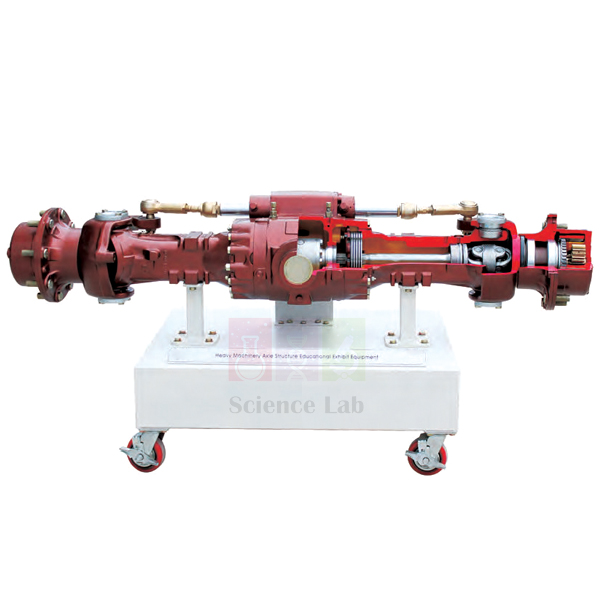
Heavy Duty Vehicles Differential Gear Model
The Heavy Duty Vehicles Differential Gear Model opens up a large heavy machinery differential so that trainees can see parts that stay hidden on a working axle, including the planetary gear on the wheel. Each component is painted a different colour, and the assembly of about 150 kg stands on a steel frame with 5-inch lockable wheels.
Heavy duty differential model specifications
| Parameter | Detail |
|---|---|
| Composition | Large heavy machinery differential gear |
| Visibility | Parts not visible on an actual unit are opened up; the planetary gear can be seen directly on the wheel |
| Colour coding | Each component coloured differently for teaching |
| Stand | Steel frame with 5-inch lockable wheels |
| Weight | Approx. 150 kg |
| Size | Approx. 2,000 × 800 × 500 mm |
| Training focus | Component identification, operating state, inspection and troubleshooting |
| Product code | SLE/ATE/26 |
| Minimum order | 10 units |
| Dispatch | Usually within 7 to 10 working days |
| Manufacturer | ScienceLab (Jain Scientific Equipments Pvt Ltd), Ambala, India |
Heavy axle lessons on the differential model
Following the drive to the wheel. Starting at the input, trainees trace the drive through the differential and out along the axle to the planetary set on the wheel. At the wheel they name the member that is driven, the member that is held and the member that turns the hub, then explain why the reduction sits so close to the tyre.
Inspection walk-round. The instructor names a symptom, such as noise, uneven drive or one wheel end running hot. Trainees find the coloured components that could cause it, describe each one in its normal operating state, and set out the order in which a mechanic would inspect them.
From a small differential to a heavy axle. Begin with the hand-turned differential gear to show the basic principle, then move to this model to show how heavy machines add a wheel-end reduction. The cut model of planetary gear system lets students compare the sun, planet and ring layout used inside an automatic gearbox.
Farm and heavy machine comparison. Set the tractor differential gear model beside this one and compare where each machine takes its final reduction. An assessment can end with each trainee naming the parts against the colour code without notes.
Frequently Asked Questions About the Heavy Duty Vehicles Differential Gear Model
Which member of the wheel-end planetary set takes the drive?
In the usual heavy-duty layout, the axle shaft turns the sun gear in the centre. The ring gear is held to the axle housing, so the planet gears roll around inside it and carry the planet carrier with them, which turns the wheel hub. Holding the ring gear gives a speed reduction and a matching rise in torque.
Why do heavy machines add a reduction at the wheel as well as in the differential?
Torque is multiplied at the last stage, close to the tyre. The differential and axle shafts then carry less torque and can be lighter than they would need to be if all the reduction sat in the centre of the axle. The machine still gets the high wheel torque it needs for pulling and climbing.
What does a differential lock do, and when is it used?
An open differential gives each side the same torque, so a wheel on mud limits the drive available to the wheel with grip. A lock joins both sides so they turn together and the wheel with grip can take more torque. It is engaged at low speed on poor ground and released before turning on firm ground. No lock is listed for this model.
Why might one wheel end run hot on a heavy machine?
Common causes are low gear oil or the wrong grade, worn bearings, and a brake that does not fully release and drags. Check the oil level at the wheel end first with the machine on level ground. After a run, compare the two hubs for heat, then inspect the bearings and brake on the hotter side.
What does an oil leak at the wheel hub lead to?
A leaking seal lets gear oil out and dirt in, so the planet gears and bearings run short of oil and wear quickly. Oil that reaches the brakes also weakens braking. Replace a weeping seal early, clean the area and refill to the correct level with the grade given in the machine service manual.
How should the model be set up for a class?
Roll it on a level floor and lock the 5-inch wheels before anyone leans on the frame. At about 150 kg it needs two people to move it. Leave clear space along both long sides of its 2,000 mm length so the group can walk round and point out each coloured part.
Driveline, axle and heavy vehicle trainers
- Differential Gear
- Tractor Differential Gear Model
- Cut Model Of Planetary Gear System
- Vehicle Transmission 5 Speed Manual Gearbox
- Trailer Air Brake Training Equipment
- CRDI Diesel Engine Power Train System F/R Type
To request a quotation, send the product name, code and quantity through our contact page or add the item to your enquiry cart.
Last updated: 14 November 2026
