- Physics Lab Equipment
- Chemistry Lab Equipment
- Biology Lab Equipment
- Anatomical Lab Equipment
- Learning
- Educational Lab Equipment
- Magnets
- Agriculture
- Astronomy
- Earth Science
- Geography Lab Equipment
- Safety Lab Coat
- Laboratory
- Meteorological
- Electricity & Magnetism
- Heat
- School Lab Equipment
- Lab Glassware
- Science Lab Equipment
- Tvet Lab Equipment
- Robotics Kits Supplier and Manufacturer for Schools India
- Math Lab Equipment Manufacturers and Exporters in Ambala
- STEM Kits Manufacturers and Supplier India
- Engineering Lab Equipment
- Hospital Lab Equipment
- Water, Sanitation & Hygiene Supplies
- Cold Chain, Solar & Communication Equipment
- Nutrition
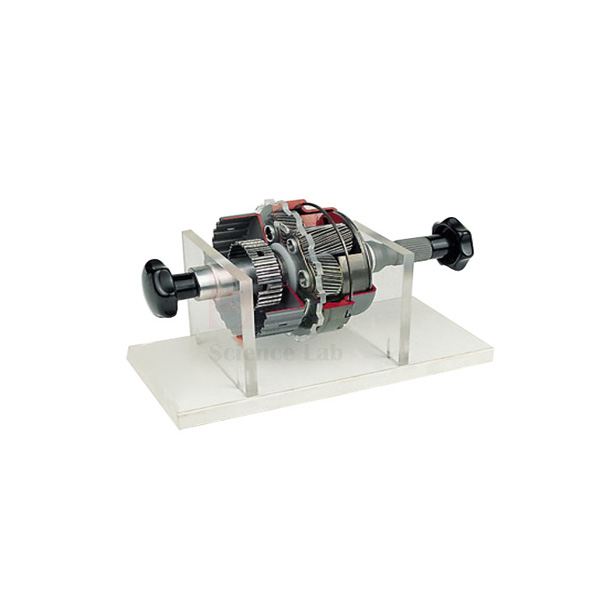
Cut Model Of Planetary Gear System
The Cut Model Of Planetary Gear System is a hand-turned cutaway of a planetary gear drive: a central sun gear, several planet gears on a carrier and an internally toothed ring gear. It is built from original components that keep full mechanical function, so students can make the sun, the carrier or the ring the driving, driven or fixed member and watch what the other two do.
Planetary gear cut model specifications
| Parameter | Detail |
|---|---|
| Gear type | Planetary gear drive |
| Members | Central sun gear; multiple planet gears on a planet carrier; internally toothed ring gear |
| Configurations | Sun gear, planet carrier and ring gear may each be driving, driven or fixed |
| Load sharing | Torque and power distributed among several planet gears |
| Construction | Cutaway of original components; active parts clearly visible; full mechanical functionality kept |
| Mounting and operation | Mounted on a base plate with carrying handles; turned by hand |
| Applications illustrated | Automotive construction and shipbuilding |
| Dimensions | Approx. 450 × 400 × 300 mm |
| Weight | Approx. 10 kg |
| Product code | SLE/MCE/62 |
| Minimum order | 10 units |
| Dispatch | Usually within 7 to 10 working days |
| Manufacturer | ScienceLab (Jain Scientific Equipments Pvt Ltd), Ambala, India |
Practicals on the planetary gear model
Speed ratio by counting turns. Hold the ring gear, put a chalk mark on the sun gear and on the carrier, and turn the sun through ten turns. Count the carrier turns, then count the teeth on each member and check the measured ratio against the tooth-count result. Repeat the count on the gear train model to compare a simple train with the epicyclic one.
The six-way combination chart. Students fix each member in turn and drive each of the other two. For every case they note the input, the output, the direction of rotation and whether the output runs faster or slower, then use the chart to solve a tabular-method problem from their theory of machines notes.
Internal meshing of the ring gear. Before the lesson, show how internal teeth engage on the internal gear pinion drive. Students then find the same kind of mesh between the planets and the ring on this model and see why both turn the same way.
From one set to a gearbox. Finish on the automatic transmission cut model, where students point out the sun, carrier and ring inside a complete transmission and name the member held in each gear.
Frequently Asked Questions About the Cut Model Of Planetary Gear System
How do I work out the ratio when the ring gear is held and the sun drives?
Add the ring gear teeth to the sun gear teeth and divide by the sun gear teeth. The answer is how many turns the sun makes for each turn of the carrier, which turns the same way as the sun. Students can confirm it on the model by counting turns.
What is the tabular method for epicyclic gear problems?
First imagine the carrier fixed and give the sun x turns, writing the turns of the planets and ring from the tooth ratios. Then add y turns to every member, as if the whole set turned locked with the carrier. Apply the known conditions, such as the ring being held, and solve for x and y.
Why must one member be held before the set gives a fixed ratio?
An epicyclic train has two degrees of freedom, so with only one input the output is not fixed. Holding the sun, the carrier or the ring removes one freedom and gives a definite ratio. On the model, turning one gear with nothing held just lets the parts spin freely.
Why do the ring, sun and planet tooth counts have to match?
The planets must fit between the sun and the ring on the same centre distance. With gears of the same tooth size, the ring needs as many teeth as the sun plus twice the planet teeth. For evenly spaced planets, the ring and sun teeth added together must also divide exactly by the number of planets.
What is gained by sharing the load among several planet gears?
Each planet carries only part of the torque, so every tooth is less heavily loaded and the whole set can be smaller than a single gear pair of the same capacity. Input and output share one axis, and the planet forces on the sun balance one another.
What are the drawbacks of a planetary gear set?
It has more parts than a simple gear pair, needs close manufacturing accuracy so that the planets share the load evenly, and relies on good lubrication of the planet bearings. Wear and tooth damage are harder to inspect because the gears sit inside the ring.
Gear models for theory of machines and drivetrain lessons
- Cut Model Of Automatic Transmission System
- Gear Train Model
- Internal Gear Pinion Drive
- Gear Trainer Demonstrator
- Geared Systems
- Differential Gear
To request a quotation, send the product name, code and quantity through our contact page or add the item to your enquiry cart.
Last updated: 14 November 2026