- Physics Lab Equipment
- Chemistry Lab Equipment
- Biology Lab Equipment
- Anatomical Lab Equipment
- Learning
- Educational Lab Equipment
- Magnets
- Agriculture
- Astronomy
- Earth Science
- Geography Lab Equipment
- Safety Lab Coat
- Laboratory
- Meteorological
- Electricity & Magnetism
- Heat
- School Lab Equipment
- Lab Glassware
- Science Lab Equipment
- Tvet Lab Equipment
- Robotics Kits Supplier and Manufacturer for Schools India
- Math Lab Equipment Manufacturers and Exporters in Ambala
- STEM Kits Manufacturers and Supplier India
- Engineering Lab Equipment
- Hospital Lab Equipment
- Water, Sanitation & Hygiene Supplies
- Cold Chain, Solar & Communication Equipment
- Nutrition
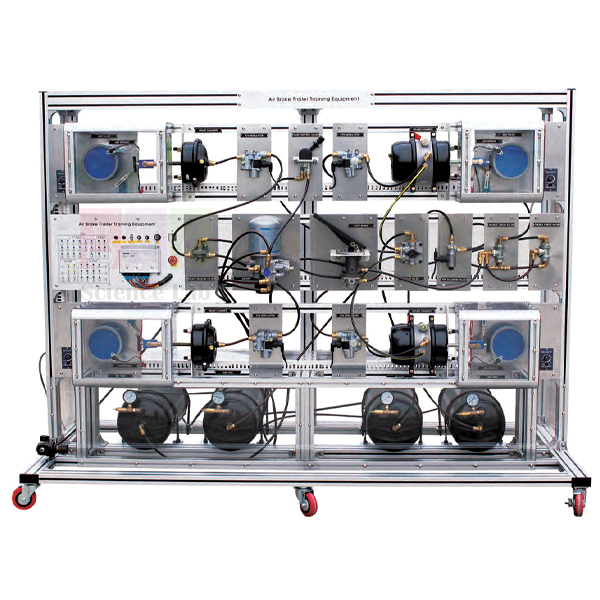
Trailer Air Brake Training Equipment
The Trailer Air Brake Training Equipment puts a heavy-truck air brake circuit with ABS on one profile stand, and its air tank and brake parts work as they do on a real vehicle. Four speed-controlled 120W motors turn the wheels, so trainees can test the ABS while the wheels rotate and take electrical readings at the check terminal.
Air brake and ABS trainer specifications
| Parameter | Detail |
|---|---|
| Type | Heavy-truck air brake system trainer with ABS; tests run with the installed air tank and all air brake parts |
| Wheel drive | 4 motors, single phase 220V, 120W each, speed control type; wheel rotation and speed controlled by motor |
| Composition | Air tank, pressure regulator, brake pedal, air pressure gauge, single chamber (2 nos), double chamber (2 nos), ECU, parking brake valve, check valve, ABS pulse ring, PCV modulator, quick release valve, air dryer, double check valve, etc. |
| Frame | Profile stand |
| Control panel | Check terminal, power lamp, fuse holder, key switch, power switch, emergency switch |
| Guarding | Rotating parts covered with acrylic covers; 4 transparent safety covers included |
| Training contents | Use of the foot brake and hand control valve; ABS waveform test; output voltage test; completing the brake air line test; ABS modulator resistance test |
| Weight | Approx. 250 kg |
| Size | Approx. 2,400 × 1,000 × 1,800 mm |
| Product code | SLE/ATE/10 |
| Minimum order | 10 units |
| Dispatch | Usually within 7 to 10 working days |
| Manufacturer | ScienceLab (Jain Scientific Equipments Pvt Ltd), Ambala, India |
Air brake and ABS exercises on the single-stand trainer
Tracing the air path. Before switching on, trainees follow the lines by hand from the air dryer and air tank, through the pressure regulator, check valve and quick release valve, to the two single and two double chambers. They label each part on a sketch of the circuit and mark the direction of air flow.
Pedal and parking brake. With the tank charged, press the brake pedal in small steps and read the air pressure gauge at each step while a partner watches the chambers move. Then work the parking brake valve, note which chambers respond and explain the difference between service and parking application.
ABS electrical checks. With the key switch off, measure the ABS modulator resistance at the check terminal using a standard digital multimeter. Then fit the acrylic covers, start the wheel motors and set a steady speed. Trainees read the output voltage and capture the ABS waveform on an oscilloscope dual trace.
Building on earlier lessons. Trainees who first met anti-lock braking on the ABS braking system training board simulator now see the same control ideas on full-size air brake parts. The working model of hydraulic braking system then shows how car brakes do the same job with fluid instead of air.
Frequently Asked Questions About the Trailer Air Brake Training Equipment
What does the quick release valve do in an air brake circuit?
It lets air out of the brake chambers close to the wheels instead of sending it all the way back to the brake valve. When the pedal is released, the brakes let go sooner, which cuts brake lag on long air lines. Trainees can find it by following the line from the pedal to the chambers.
Why is a check valve fitted between the air supply and the tank?
A check valve lets air pass one way only. If the supply side loses pressure, it stops the air already stored in the tank from flowing back out, so the brakes keep enough air for several applications. Trainees should be able to point to it and say which way the air flows through it.
What is the difference between a single and a double brake chamber?
A single chamber has one diaphragm and applies the service brake when air enters it. A double chamber, as used on most truck drive axles, adds a spring brake section: a strong spring applies the brake for parking or when air is lost, and air pressure holds that spring back while driving.
Why can a damaged pulse ring cause an ABS fault?
The ABS control unit reads wheel speed from the teeth of the pulse ring passing a sensor. A cracked or dirty ring, a missing tooth or extra gap from a loose wheel bearing gives a weak or broken signal. The control unit may then log a fault or misjudge wheel slip, so the ring and its gap are checked early.
Which instruments are needed for the ABS electrical tests?
A multimeter at the check terminal covers the output voltage test and the ABS modulator resistance test. The ABS waveform test needs an oscilloscope, because a single voltage or resistance reading cannot show a damaged tooth or an uneven signal the way a trace does.
What does the air dryer do, and does the air tank still need draining?
The air dryer takes water and oil out of the compressed air before it reaches the tank, so valves do not corrode, stick or freeze. It purges the moisture it has collected each time charging stops. Tanks should still be drained regularly, because some water can get past a worn or faulty dryer.
Brake trainers and test instruments for a heavy-vehicle workshop
- Trailer Type Air Brake System Training Equipment
- ABS Braking System Training Board Simulator
- Working Model Of Hydraulic Braking System
- Standard Digital Multimeter
- Oscilloscope Dual Trace
To request a quotation, send the product name, code and quantity through our contact page or add the item to your enquiry cart.
Last updated: 14 November 2026
