- Physics Lab Equipment
- Chemistry Lab Equipment
- Biology Lab Equipment
- Anatomical Lab Equipment
- Learning
- Educational Lab Equipment
- Magnets
- Agriculture
- Astronomy
- Earth Science
- Geography Lab Equipment
- Safety Lab Coat
- Laboratory
- Meteorological
- Electricity & Magnetism
- Heat
- School Lab Equipment
- Lab Glassware
- Science Lab Equipment
- Tvet Lab Equipment
- Robotics Kits Supplier and Manufacturer for Schools India
- Math Lab Equipment Manufacturers and Exporters in Ambala
- STEM Kits Manufacturers and Supplier India
- Engineering Lab Equipment
- Hospital Lab Equipment
- Water, Sanitation & Hygiene Supplies
- Cold Chain, Solar & Communication Equipment
- Nutrition
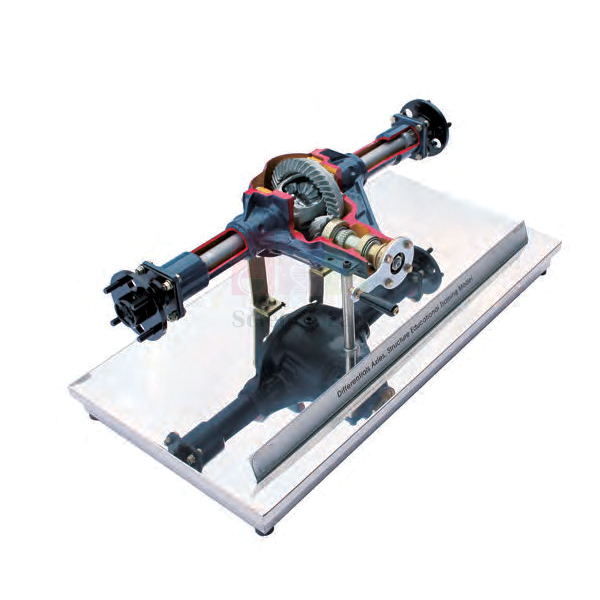
Differential Gear
The Differential Gear is a hand-turned cut-section trainer built around a real axle differential, so students can watch how the drive from the pinion is shared between the two axle shafts. The incised sections are painted in different colours, which lets each gear in the power path be picked out, named and followed as the assembly turns.
Differential gear trainer specifications
| Parameter | Detail |
|---|---|
| Composition | Differential gear from a real axle |
| Operation | Manual; gear movement observed by turning by hand |
| Construction | Teaching unit with incised (cut-away) sections |
| Colour coding | Incised sections painted in different colours |
| Weight | Approx. 40 kg |
| Size | Approx. 800 × 500 × 300 mm |
| Product code | SLE/ATE/25 |
| Minimum order | 10 units |
| Dispatch | Usually within 7 to 10 working days |
| Manufacturer | ScienceLab (Jain Scientific Equipments Pvt Ltd), Ambala, India |
Driveline practicals with the differential
Straight ahead and cornering. Chalk a mark on each axle shaft and turn the input with both sides free: the shafts turn together and the small gears stay still on their cross-shaft. Then hold one shaft and turn the input again. The other shaft now runs at twice the speed of the carrier, and students see the small gears spinning.
Final drive ratio by counting. Count the teeth on the pinion and on the crown wheel through the cut-away, or count the input turns for one turn of the carrier. Divide to find the final drive reduction and compare the two methods.
Tracing the power path. Using the colour coding, students label each part from the input pinion to the crown wheel, carrier, small gears, side gears and axle shafts. The heavy duty vehicles differential gear model and the tractor differential gear model then show the same idea at a larger scale.
A bevel epicyclic train. Set the trainer beside the planetary gear cut model and compare the two. The differential carrier works as the planet carrier, the small gears as planets and the two side gears as the other members of the set. Students then explain why holding one side gear makes the other speed up.
Frequently Asked Questions About the Differential Gear
Why does a driven axle need a differential?
On a bend, the outer wheel travels further than the inner wheel in the same time, so it must turn faster. With both wheels fixed to one shaft, a tyre would have to scrub, wearing it and upsetting the handling. The differential lets the wheels turn at different speeds while both stay driven.
What do the small gears inside the carrier do when going straight and when cornering?
Going straight, the carrier, small gears and side gears turn together as one unit and the small gears do not spin on their shaft. On a bend, the small gears rotate on their shaft, letting one side gear speed up while the other slows by the same amount.
What is the final drive ratio?
It is the reduction between the drive pinion and the crown wheel, found by dividing the crown wheel teeth by the pinion teeth. Because the pinion is much smaller, it lowers speed and multiplies torque, and it also turns the drive through a right angle towards the wheels.
Does an open differential share torque equally, and why can one wheel spin?
It sends equal torque to both sides, but that torque is limited by the wheel with less grip. If one wheel is on mud or ice, it spins freely and the other wheel gets just as little torque, so the vehicle may not move. Limited-slip and locking differentials are made to overcome this.
Which noises point to a worn differential?
A whine or hum that rises and falls with road speed suggests worn or badly set crown wheel and pinion teeth or bearings. A clunk when the throttle is applied or released points to too much backlash. Grinding or binding during slow, tight turns often comes from the small gears or side gears.
How can differential noise be told apart from wheel bearing noise?
Differential noise usually changes between accelerating and coasting, because the load on the gear teeth changes. Wheel bearing noise tends to change when the vehicle sways left or right on a bend, as weight shifts onto one bearing. A drive shaft joint often clicks on full-lock turns.
Axle, gearbox and transmission trainers
- Heavy Duty Vehicles Differential Gear Model
- Tractor Differential Gear Model
- Vehicle Transmission 5 Speed Manual Gearbox
- FF Auto Transmission Stand Type
- Cut Model Of Planetary Gear System
- Cut Model Of Automatic Transmission System
To request a quotation, send the product name, code and quantity through our contact page or add the item to your enquiry cart.
Last updated: 14 November 2026
