- Physics Lab Equipment
- Chemistry Lab Equipment
- Biology Lab Equipment
- Anatomical Lab Equipment
- Learning
- Educational Lab Equipment
- Magnets
- Agriculture
- Astronomy
- Earth Science
- Geography Lab Equipment
- Safety Lab Coat
- Laboratory
- Meteorological
- Electricity & Magnetism
- Heat
- School Lab Equipment
- Lab Glassware
- Science Lab Equipment
- Tvet Lab Equipment
- Robotics Kits Supplier and Manufacturer for Schools India
- Math Lab Equipment Manufacturers and Exporters in Ambala
- STEM Kits Manufacturers and Supplier India
- Engineering Lab Equipment
- Hospital Lab Equipment
- Water, Sanitation & Hygiene Supplies
- Cold Chain, Solar & Communication Equipment
- Nutrition
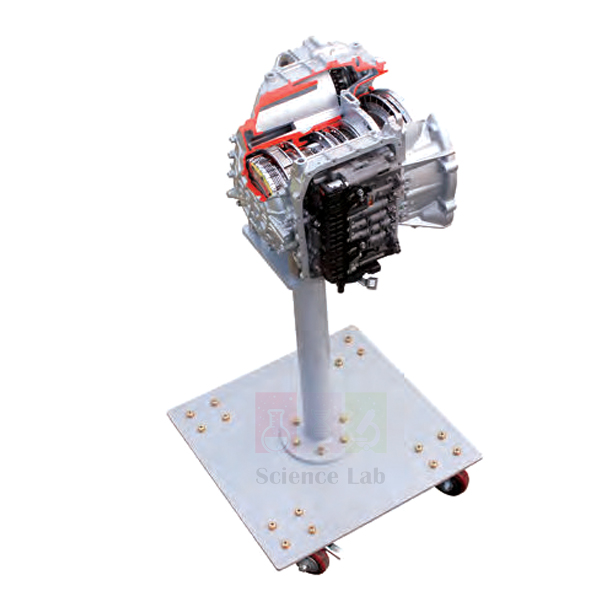
FF Auto Transmission 6 Steps
The FF Auto Transmission 6 Steps is a sectioned training stand carrying a front-wheel 6-step automatic transmission and its torque converter. The converter is incised, and each cut section is painted a different colour, so students can follow how engine power reaches the gearbox. The steel stand rolls on four castors with 4-inch urethane wheels and can be turned towards each group.
Six-step FF automatic transmission stand specifications
| Parameter | Detail |
|---|---|
| Composition | Front-wheel 6-step automatic transmission, torque converter |
| Torque converter | Incised sections, each painted a different colour for teaching clarity |
| Stand | Steel stand with 4 wheel castors; 4-inch urethane wheels |
| Finish | Vehicle paint used for painting and coating |
| Weight | Approx. 60 kg |
| Size | Approx. 600 × 600 × 1,100 mm |
| Product code | SLE/ATE/09 |
| Minimum order | 10 units |
| Dispatch | Usually within 7 to 10 working days |
| Manufacturer | ScienceLab (Jain Scientific Equipments Pvt Ltd), Ambala, India |
Transmission lessons on the six-step stand
Power path through the converter. Start at the engine side of the incised torque converter and follow the colour-coded sections to the transmission input. Students name each section and say whether it turns with the engine, turns with the gearbox input or is held still at low speed.
Four steps against six. Set this stand beside the FF auto transmission stand type, a 4-speed FF automatic. Students sketch engine speed against road speed for both boxes and show why six steps give a smaller drop in engine speed at each change.
Front-wheel-drive layout. An FF transaxle carries the final drive and differential inside its own case. Use the differential gear model to show what that part does, then discuss how the transaxle sits across the engine bay and drives the front wheels.
Manual against automatic. Finish with the manual gearbox trainer, where the driver selects each ratio, and list the jobs that the automatic does for the driver instead.
Frequently Asked Questions About the FF Auto Transmission 6 Steps
What sets a front-wheel-drive automatic transaxle apart from a rear-drive automatic?
A transaxle holds the gearbox, final drive and differential in one case. It usually sits across the engine bay beside the engine and drives the front wheels through two drive shafts. A rear-drive automatic sends power down a propeller shaft to a separate axle at the back.
What does a six-step automatic gain over a four-speed?
Closer steps between ratios keep the engine nearer its most efficient speed, and each change drops engine speed by less, so shifts feel smoother. A taller top ratio also lowers engine speed when cruising. The trade-off is a more complex gear train and control system.
What causes torque converter clutch shudder at light throttle?
At light load the lock-up clutch inside the converter is often allowed to slip slightly. Worn friction material, or fluid that is the wrong type or has lost its friction additives, makes it grab and release, felt as a vibration like driving over a rough road. Fresh fluid of the type the vehicle maker specifies is the usual first step.
Why must adaptive shift values be cleared after some transmission repairs?
The transmission control unit learns how quickly each clutch applies and adjusts pressure to keep shifts smooth as parts wear. After a valve body, clutch pack or control unit is replaced, the old learned values no longer fit. Shifts can stay harsh until the values are cleared with a scan tool and relearned on a set drive cycle.
Can a harsh downshift come from outside the transmission?
Yes. The controller uses engine data such as throttle angle and air flow to time and cushion each shift. A dirty throttle body or a slow air flow sensor gives wrong load information, so shifts feel harsh even with a healthy gearbox. Check the engine side before condemning the transmission.
How is direct drive produced in a planetary gear set?
Lock any two members of the set together, such as the sun gear and the carrier, and the whole set turns as one unit. Output speed then equals input speed. Clutches inside the automatic do this locking when the controller selects the direct ratio.
Automatic transmission and driveline trainers
- FF Auto Transmission Stand Type
- Cut Model Of Automatic Transmission System
- CRDI Diesel Engine Power Train System Automatic Transmission
- Differential Gear
- Cut Model Of Planetary Gear System
- Clutch Structure Trainer Hydraulic Manual
To request a quotation, send the product name, code and quantity through our contact page or add the item to your enquiry cart.
Last updated: 14 November 2026
