- Physics Lab Equipment
- Chemistry Lab Equipment
- Biology Lab Equipment
- Anatomical Lab Equipment
- Learning
- Educational Lab Equipment
- Magnets
- Agriculture
- Astronomy
- Earth Science
- Geography Lab Equipment
- Safety Lab Coat
- Laboratory
- Meteorological
- Electricity & Magnetism
- Heat
- School Lab Equipment
- Lab Glassware
- Science Lab Equipment
- Tvet Lab Equipment
- Robotics Kits Supplier and Manufacturer for Schools India
- Math Lab Equipment Manufacturers and Exporters in Ambala
- STEM Kits Manufacturers and Supplier India
- Engineering Lab Equipment
- Hospital Lab Equipment
- Water, Sanitation & Hygiene Supplies
- Cold Chain, Solar & Communication Equipment
- Nutrition
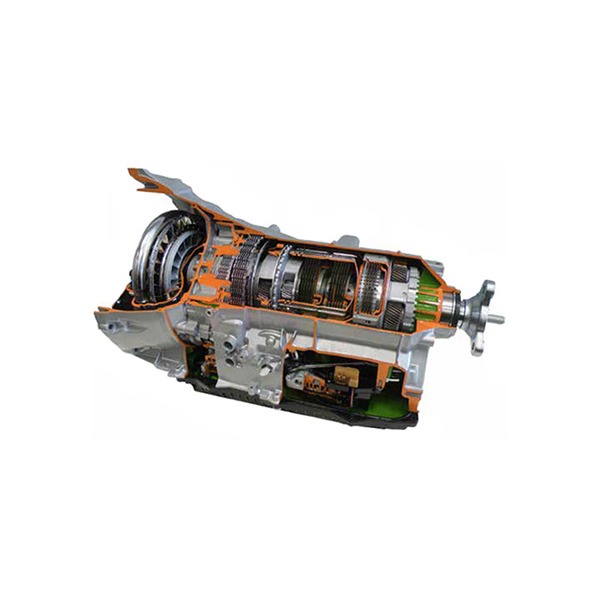
Cut Model Of Automatic Transmission System
Cut from a full-size car automatic transmission, a previously used unit, this teaching model opens up the hydraulic torque converter, planetary gear set, multiple-plate clutches, bands and control valves. A hand crank on the torque converter turns the mechanism, and the model's gear selector sets each of the five forward speeds and reverse, so the instructor can show what holds each gear.
Automatic transmission cut model specifications
| Parameter | Detail |
|---|---|
| Base unit | Full-size original automatic transmission of a car (previously used), sectioned for teaching |
| Transmission type | Hydraulic automatic |
| Parts shown | Hydraulic torque converter, planetary gear set, multiple-plate clutches, bands, control valves; hydraulic and lubricating oil paths |
| Gear change | Epicyclic, 5 forward speeds plus reverse, chosen with the model's gear selector |
| Sectioning | Cut to show the internal gear mechanism for forward and reverse speeds |
| Operation | Manual, by hand crank on the torque converter |
| Finish | Colour-coded parts in gloss-coated paint; many parts chromium plated and galvanized; hardware and gears electroplated |
| Mounting | Tubular frame stand with wheels |
| Size and weight | Approx. 750 × 550 × 700 mm; approx. 110 kg |
| Product code | SLE/MCE/61 |
| Minimum order | 10 units |
| Dispatch | Usually within 7 to 10 working days |
| Manufacturer | ScienceLab (Jain Scientific Equipments Pvt Ltd), Ambala, India |
Lessons with the automatic transmission model
Power flow in each gear. Set the model's gear selector to each of the five forward speeds and reverse in turn, and turn the hand crank slowly. For every position, students record which clutch or band is applied and which planetary member is driven, held or giving output, and build an element chart for the whole transmission.
A single gear set first. Start on the cut model of planetary gear system, where one sun, planet carrier and ring gear are easy to see. Students then find the same members inside the transmission model and see how several sets are combined.
Oil paths and valves. Follow the colour-coded hydraulic and lubricating oil paths from the control valves to the clutch pistons and band servos, and discuss how line pressure applies each element in turn.
Manual against automatic. Set the model beside the 5 speed manual gearbox and compare selection by synchro sleeves with clutch-and-band shifting in gears that stay in constant mesh.
Frequently Asked Questions About the Cut Model Of Automatic Transmission System
How does one planetary gear set give several ratios?
A planetary set has a sun gear, planet gears on a carrier and an outer ring gear. Holding one member, driving another and taking output from the third gives a reduction, an overdrive or reverse. Locking any two members together gives direct drive. Clutches and bands do the holding and driving.
How is reverse produced in an automatic transmission?
The planet carrier is held still while the sun gear is driven. The planets then act as idlers and turn the ring gear the opposite way at a reduced speed. On the cut model, the instructor sets the gear selector to reverse and shows the output turning backwards as the hand crank moves forward.
What does the torque converter do, and what is a lock-up clutch?
The engine drives an impeller that throws oil at a turbine connected to the gearbox, while a stator redirects the returning oil to multiply torque at low speed. Because a fluid drive always slips a little, many converters add a lock-up clutch that joins engine and gearbox directly at cruising speed.
Why might a transmission slip in low gears and reverse but not in higher gears?
Look for the element that only those gears share. A clutch or band applied in the low ranges and reverse may be worn, or its oil circuit may leak. Higher gears use different members, so they still work. The cut model lets students trace which element is common to the slipping gears.
Do the gears slide in and out of mesh to change ratio?
No. In a planetary transmission all the gears stay in constant mesh. A shift happens when one clutch or band releases and another applies, changing which member is held or driven. That is why an automatic can change gear without breaking the drive.
How is the cut model moved and set up for a class?
It sits on a tubular frame stand with wheels, measures about 750 × 550 × 700 mm and weighs about 110 kg. Roll it between classroom and workshop rather than lifting it, and turn the crank slowly when demonstrating a shift.
Drivetrain models and transmission trainers
- Cut Model Of Planetary Gear System
- FF Auto Transmission Stand Type
- FF Auto Transmission 6 Steps
- Vehicle Transmission 5 Speed Manual Gearbox
- Clutch Structure Trainer Hydraulics
- Differential Gear
To request a quotation, send the product name, code and quantity through our contact page or add the item to your enquiry cart.
Last updated: 15 November 2026