- Physics Lab Equipment
- Chemistry Lab Equipment
- Biology Lab Equipment
- Anatomical Lab Equipment
- Learning
- Educational Lab Equipment
- Magnets
- Agriculture
- Astronomy
- Earth Science
- Geography Lab Equipment
- Safety Lab Coat
- Laboratory
- Meteorological
- Electricity & Magnetism
- Heat
- School Lab Equipment
- Lab Glassware
- Science Lab Equipment
- Tvet Lab Equipment
- Robotics Kits Supplier and Manufacturer for Schools India
- Math Lab Equipment Manufacturers and Exporters in Ambala
- STEM Kits Manufacturers and Supplier India
- Engineering Lab Equipment
- Hospital Lab Equipment
- Water, Sanitation & Hygiene Supplies
- Cold Chain, Solar & Communication Equipment
- Nutrition
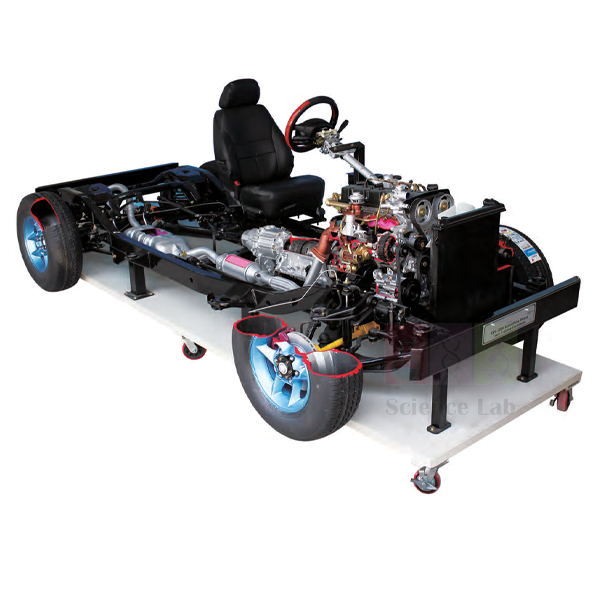
CRDI Diesel Engine Power Train System Automatic Transmission
The CRDI Diesel Engine Power Train System Automatic Transmission is a full-size sectioned diesel chassis showing how an F/R type automatic transmission fits into a vehicle power train. A 2,900cc class diesel F/R engine assembly is coupled to the automatic transmission, driveshaft and rear axle, with steering and brakes alongside. An AC 220V motor and controller move the driveline. The engine and transmission are production units on a stand built in Ambala.
Automatic diesel power train trainer specifications
| Parameter | Detail |
|---|---|
| Type | F/R type automatic transmission and power train system structure of a diesel engine vehicle |
| Engine | 2,900cc class diesel F/R engine assembly (production unit) |
| Transmission and driveline | Automatic transmission assembly (production unit), change lever, driveshaft, rear axle |
| Chassis systems | Brake system, steering system |
| Other equipment | 1 set of lighting, fuel tank, battery, intake/exhaust system |
| Drive and control | AC 220V motor operation, controller, safety breaker |
| Finish | Precise cutting to show internal structure; incised sections painted in different colours |
| Weight and size | Approx. 450 kg; approx. 3,000 × 2,000 × 1,300 mm |
| Training contents | Tyre replacement; brake lining and pad adjustment and replacement; shock absorber and spring replacement; fuel pump attachment, detachment and inspection; oil filter replacement; belt replacement and tension control |
| Product code | SLE/ATE/18 |
| Minimum order | 10 units |
| Dispatch | Usually within 7 to 10 working days |
| Manufacturer | ScienceLab (Jain Scientific Equipments Pvt Ltd), Ambala, India |
Driveline and service practicals on the automatic chassis
Lever position and power flow. With the motor driving the chassis through the controller, the instructor moves the change lever through its positions while students watch the driveshaft and axle. They record where drive stops, where it reverses and where it runs forward, then open a cut model of an automatic transmission to see which clutches and bands each position applies.
Brake pad and lining service. Isolate the drive at the safety breaker first. A group removes a wheel, measures pad and lining thickness with a metal vernier caliper, compares it with the service limit, then adjusts or replaces the parts and refits the wheel.
Fuel pump removal and inspection. Before the job, a CRDI pump and nozzle set on the bench shows trainees a common rail fuel pump and a sectioned injector nozzle. They then detach the fuel pump from the engine, inspect its mountings and connections, and refit it in the correct order.
Belt service. Students locate each drive belt on the engine, judge its tension, replace one belt and set the new one to the correct tension. The session closes with an oil filter change on the same engine.
Frequently Asked Questions About the CRDI Diesel Engine Power Train System Automatic Transmission
Why must the brake be pressed before the change lever leaves Park?
On a running vehicle, the engine is already turning the torque converter, so the car can creep the moment a drive range is selected. Holding the brake keeps it still, and most cars lock the lever until the pedal is pressed. Park only locks the transmission output and does not replace the parking brake.
What is kick-down on an automatic transmission?
Pressing the accelerator fully down makes the transmission drop one or more gears for extra pulling power, for example when overtaking. It happens even at speeds where the transmission would normally hold the higher gear. Easing off the pedal lets it change back up.
How does a torque converter increase torque?
The engine-driven impeller throws fluid at the turbine, which drives the transmission. A stator between them turns the returning fluid so it helps the impeller along. That multiplies torque while the turbine runs much slower than the impeller, and the converter behaves as a plain fluid coupling once their speeds come close.
How does an automatic transmission decide when to change gear?
In hydraulically controlled units, a governor makes a pressure that rises with road speed and works against throttle pressure on each shift valve. When governor pressure wins, the valve moves and the next gear is applied. Electronically controlled units do the same job with speed and throttle sensors and shift solenoids.
How often should automatic transmission fluid be checked, and with which fluid?
Follow the vehicle service schedule, and check sooner if shifts turn harsh or the fluid smells burnt. Many units are checked warm with the engine idling in Park. Use only the fluid grade the transmission maker specifies, because the friction behaviour of the clutches depends on it.
What moves the driveline on the trainer, and how is it isolated?
An AC 220V motor drives the power train through a controller, so the engine, automatic transmission, driveshaft and rear axle move as on a real vehicle. A safety breaker cuts the drive. Switch it off before anyone works on wheels, brakes, belts or the fuel pump.
Automatic transmission and diesel driveline trainers
- CRDI Diesel Engine Power Train System F/R Type
- Cut Model Of Automatic Transmission System
- FF Auto Transmission Stand Type
- FF Auto Transmission 6 Steps
- Cut Model Of Planetary Gear System
- Differential Gear
To request a quotation, send the product name, code and quantity through our contact page or add the item to your enquiry cart.
Last updated: 20 November 2026
