- Physics Lab Equipment
- Chemistry Lab Equipment
- Biology Lab Equipment
- Anatomical Lab Equipment
- Learning
- Educational Lab Equipment
- Magnets
- Agriculture
- Astronomy
- Earth Science
- Geography Lab Equipment
- Safety Lab Coat
- Laboratory
- Meteorological
- Electricity & Magnetism
- Heat
- School Lab Equipment
- Lab Glassware
- Science Lab Equipment
- Tvet Lab Equipment
- Robotics Kits Supplier and Manufacturer for Schools India
- Math Lab Equipment Manufacturers and Exporters in Ambala
- STEM Kits Manufacturers and Supplier India
- Engineering Lab Equipment
- Hospital Lab Equipment
- Water, Sanitation & Hygiene Supplies
- Cold Chain, Solar & Communication Equipment
- Nutrition
The Glassware Burettes range covers graduated borosilicate glass burettes for titration, from Class A and micro burettes to Class B, Schellbach-stripe and special-stopcock types, with a burette brush and a single burette clamp. School chemistry labs, college analytical practicals and quality-control benches use them for acid-base, redox and complexometric titrations. The burettes and the clamp are made by ScienceLab in Ambala. The burette brush is also manufactured by ScienceLab, Ambala.
Burettes by class, stopcock and scale
| Group | What it covers | Example products |
|---|---|---|
| Class A burettes | Class A burettes with a PTFE key and blue graduations, and micro burettes in 5 ml and 10 ml with a tapered tip and funnel top. | Burettes, Micro Burettes, Class-A |
| Class B burettes | Class B burettes for teaching titrations, one with a glass stopcock key and one with a PTFE key. | Burette, Class-B, with Glass Key, Burette, Class-B, with PTFE Key Stopcock |
| Special stopcocks | A PTFE key that comes off the body for cleaning, and a Rotaflow-type PTFE needle valve that opens gradually for drop-by-drop delivery. | Burettes Detachable Stopcock, Burettes with PTFE Needle Valve Stopcock |
| Schellbach-stripe burettes | Burettes whose stripe pinches to a point at the meniscus, with a PTFE key, a detachable key or a glass key. | Burettes with PTFE Key Stopcock Schellbach Stripe, Burettes with detachable Stopcocks Schellbach Stripe, Burettes with Schellbach Stripe |
| Brush and clamp | A long nylon brush on a flexible wire handle for the barrel, and a die-cast clamp with spring-loaded rubber-grip jaws and a built-in boss head. | Burette Brush, Burette Clamp, Die Cast – Single Clamp |
Choosing and running burettes for titration classes
Match the burette to the level of work. Class B burettes, such as the PTFE-key Class B burette, suit school and undergraduate titrations and practical examinations. The Class A Burettes suit analytical and quality-control work, and the micro burettes serve micro-scale methods with small volumes. Busy student benches gain from a Schellbach stripe, while college labs that titrate to single drops near the end point often prefer the needle valve burette.
Set each burette up the same way on every bench. Fix the single burette clamp on the stand rod at a height that leaves the jet just inside the neck of the titration flask, then let its spring jaws close on the glass. Check that the burette hangs vertically. Fill it with the help of a small funnel and take the funnel out before titrating, so drops from its stem do not change the level.
At the end of the session, drain the burette and rinse it with tap water and then distilled water. Leave it upside down in the stand to drain. Store a glass key out of its barrel, or with a strip of paper between key and barrel, so the ground surfaces cannot stick.
Frequently Asked Questions About Glassware Burettes
What is the difference between the Class A and Class B burettes?
Class A burettes are made to a tighter volume tolerance, for analytical, quality-control and micro-scale work; here that means the PTFE-key Burettes and the Micro Burettes, Class-A. Class B burettes have a wider tolerance that still suits teaching titrations, and come with a glass key or a PTFE key. Choose Class A where results feed an analysis, and Class B for student benches.
When is a needle valve or a detachable stopcock worth choosing?
Choose the PTFE needle valve burette when a leak-free seal and fine control matter: the valve opens gradually, needs no grease and avoids plug seizure. Choose a detachable stopcock where titrations run daily, because the key comes off so the barrel, jet and key can be washed separately. A glass key needs a thin film of grease and can stick if alkali is left in it.
What should be checked when burettes arrive or come out of storage?
Check each burette before it goes to a bench. Look along the barrel and at the jet for chips or cracks, and turn the key to see that it moves smoothly. Fill the burette with water, close the stopcock and leave it standing for a few minutes to show any leak. Reassemble a detachable stopcock carefully and test it the same way.
What does the Schellbach stripe on a burette do?
It gives a sharper reading point. The stripe is usually a narrow coloured line on a white band down the back of the burette. Seen through a clear liquid, the meniscus makes the stripe appear to pinch to a point exactly at the liquid level. Read that point with your eye level with it to avoid parallax error, and record every reading the same way.
How should a burette be cleaned with the burette brush?
Rinse the burette with tap water, wet the Burette Brush in a mild laboratory detergent solution and work it down the barrel from the top with a gentle twist, then draw it back. Do not force the brush into the narrow jet. Finish with tap water and a final rinse of distilled water, and let the burette drain upside down.
What are concordant titres, and how many runs are needed?
Concordant titres are accurate titres that agree within the limit your syllabus sets, often a tenth of a millilitre. Do one rough run to find the approximate end point, then accurate runs, adding titrant drop by drop near the end, until at least two agree. Work out the mean from the concordant titres only, and leave the rough titre out.
Glassware and stands used with these burettes
- Lab Glassware: the Lab Glassware parent page, which leads to the burette, flask, bottle, beaker and funnel sub-ranges.
- Lab Glassware: a separate school glassware listing arranged by practical, for class-set orders of everyday items.
- Glassware Flasks: conical and iodine flasks that receive the titrant during a titration.
- Stand bases, Rods and Rings: a cast iron burette stand with white and black plates, and single and double hardwood stands.
- Measuring Cylinders: measuring cylinders for rough volumes, where a burette's fine scale is not needed.
To request a quotation or a catalogue for this range, send the product names, codes and quantities through our contact page or add the items to your enquiry cart.
Last updated: 20 November 2026
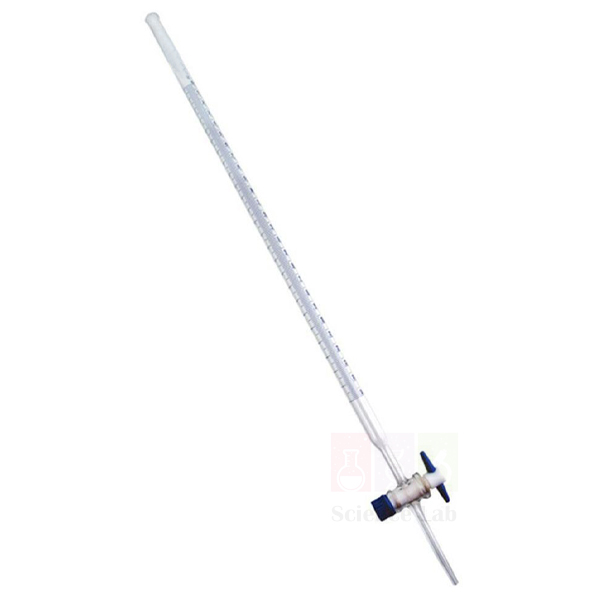
Burettes
Graduated glass tubes that deliver a measured, variable volume of titrant through a PTFE key stopcock. These Class A burettes are made of heavy-duty borosilicate glass, and their blue scale shows up well against most solutions when reading the meniscus. Four capacities cover small-volume work, routine student titrations and titrations with a large titre: 5, 10, 50 and 100 ml.
Burette specifications and capacities
| Parameter | Detail |
|---|---|
| Accuracy class | Class A |
| Material | Heavy-duty borosilicate glass |
| Stopcock | PTFE key |
| Graduations | Blue |
| Capacities | 5 ml, 10 ml, 50 ml, 100 ml |
| Heat resistance | Heat resistant |
| Chemical resistance | Chemical resistant |
| Application | Chemical laboratory |
| Product code | SLE/GBu/01 |
| Minimum order | 10 units |
| Dispatch | Usually within 7 to 10 working days |
| Manufacturer | ScienceLab (Jain Scientific Equipments Pvt Ltd), Ambala, India |
Setting up and running titrations with the burette
Preparing the burette. Clamp it vertically in a burette stand with clamp and bosshead. Rinse it with distilled water, then with a few millilitres of the titrant, running each rinse out through the tip and throwing it away. Fill through a small glass funnel and take the funnel out before reading, so drips from it cannot change the level.
Acid-base titration. Run titrant into a conical flask holding the pipetted alkali and a few drops of methyl orange. Do one rough run to find roughly where the end point lies. Then do careful runs, adding drop by drop as it approaches, and repeat until two titres agree closely.
Redox titration with permanganate. Fill the burette with potassium permanganate solution and titrate an acidified iron(II) or oxalate solution in the flask. The permanganate acts as its own indicator, and the end point is the first faint pink that stays. The solution is too dark to see the bottom of the meniscus, so read the top edge instead, at both readings.
Frequently Asked Questions About the Burettes
Why rinse the burette with the titrant before filling it?
Water left on the inner wall would dilute the titrant, so more of it would be needed to reach the end point and the titre would come out too high. A small rinse with the titrant itself coats the wall with solution of the right strength. Discard the rinse.
How do you get rid of the air bubble in the tip?
After filling, open the stopcock fully for a moment over a waste beaker so the rush of liquid sweeps the bubble out. Tap the tip gently if one clings. A bubble that escapes during the titration adds its volume to the reading and gives a false titre.
How should a burette be read?
Bring your eye level with the meniscus so you look straight at it, not from above or below. For clear solutions read the bottom of the curve against the blue scale. Holding a white card with a dark band just behind the meniscus makes the edge sharper.
Which burette capacity should a lab choose?
Match the size to the expected titre. The 50 ml size covers most student and routine titrations. Choose 5 ml or 10 ml when only small volumes of titrant are expected, and 100 ml when the titre is large.
Why a PTFE key rather than a glass stopcock?
A PTFE key turns smoothly without grease, so no grease can smear into the tip or contaminate the titrant. It does not seize in the barrel, even with alkaline solutions that can make glass keys stick. Loosen the key slightly when the burette is put away.
What are common mistakes students make with a burette?
Typical errors are a burette that is not vertical, forgetting the initial reading, reading from an angle, and running titrant in too fast near the end point. Others include closing the stopcock too late and subtracting the readings in the wrong order. Clamp it firmly and record every reading straight away.
Burette stands, clamps, brushes and other burettes
- Burette Stand with Clamp & Bosshead
- Burette Clamp, Die Cast – Single Clamp
- Burette Brush
- Micro Burettes, Class-A
- Burette, Class-B, with PTFE Key Stopcock
To request a quotation, send the product name, code and quantity through our contact page or add the item to your enquiry cart.
Last updated: 14 November 2026
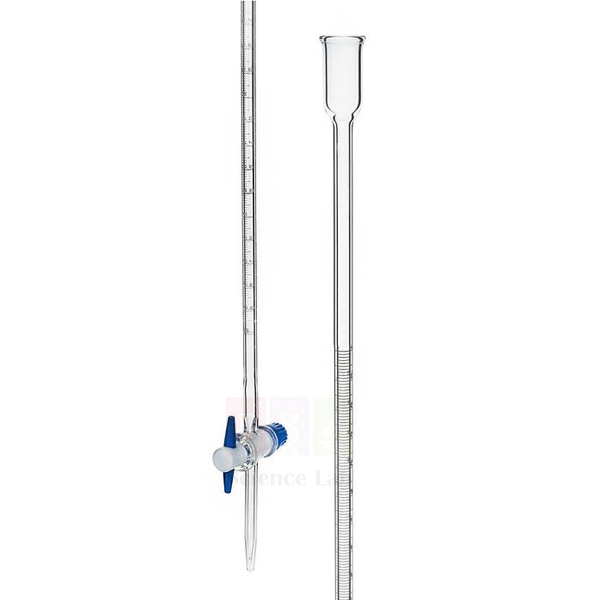
Micro Burettes, Class-A
Micro Burettes, Class-A (Product Code: SLE/GBu/02) are small-capacity burettes designed for precise analytical methods in micro chemistry, made in 5 ml and 10 ml sizes. Precision bore tubing assures accuracy between any two points along the body, the tapered tip gives a smooth, controlled flow, and a funnel top allows reagent to be poured in or drawn up from below through a rubber-stoppered tube. Manufactured by Jain Scientific Equipments Pvt Ltd (ScienceLab), Ambala, as part of its borosilicate laboratory glassware in India, they are a precise addition to a volumetric analysis kit in college, research and quality-control laboratories.
Specifications
| Parameter | Detail |
|---|---|
| Type | Micro burette |
| Accuracy class | Class A |
| Capacities | 5 ml, 10 ml |
| Material | Heavy-duty borosilicate glass |
| Bore | Precision bore tubing, for accuracy between any two points throughout the body |
| Tip | Tapered, for smooth flow |
| Filling | Funnel top — fill by pouring, or by suction from below through a rubber-stoppered tube |
| Stopcock | PTFE key |
| Graduations | Blue |
| Heat and chemical resistance | Heat resistant, chemical resistant |
| Application | Chemical laboratory, micro chemistry |
Typical Use
Micro-scale titrations use a fraction of the reagent and sample needed for a conventional titration, which matters when a standard solution is costly, hazardous or available only in small amounts, or when the sample itself is limited. Analysts use micro burettes for small-volume determinations in research and quality control, and teachers use them to run microscale chemistry practicals that cut chemical consumption and waste. Because the bore is uniform, a reading taken between any two graduations can be relied on, not only readings from the zero mark.
For volatile or unpleasant reagents, filling from below through a rubber-stoppered tube keeps the liquid enclosed; for routine solutions, simply pour into the funnel top. Secure the burette in a burette clamp so it hangs truly vertical, fill slowly to avoid trapping air, and check that the tapered tip is free of bubbles before the first reading. With such small volumes, a single drop is a significant fraction of the titre, so approach the end point slowly and read the meniscus at eye level.
Manufacturer
ScienceLab is the trading name of Jain Scientific Equipments Private Limited, a manufacturer of laboratory glassware and apparatus in Ambala, Haryana. Tender and procurement teams that need supplier identifiers can quote GSTIN 06AAECJ8618A1ZT and LEI 3358004HRD1JIVXKYX49. The company supplies institutions in India and international markets; read more on the company profile.
Related Glassware Burettes
Equipment that completes a micro-titration set-up:
- Burettes — Class A burettes with PTFE key in larger capacities for conventional titrations.
- Titration Kit, Student, Microscience — a student kit for classes working at microscale.
- Burette Stand — supports the burette above the titration vessel.
- Rubber stoppers with holes of different diameters — for the rubber-stoppered tube used to fill from below.
- Burette Brush — for cleaning the narrow bore after use.
Browse all models in the Glassware Burettes category.
Frequently Asked Questions
Which sizes are available?
5 ml and 10 ml.
How is the burette filled?
Either pour reagent into the funnel top, or draw it up by suction from below through a rubber-stoppered tube.
How does it differ from the standard Class A Burettes?
Both are Class A with PTFE keys and blue graduations. The micro burette adds precision bore tubing, a funnel top and a tapered tip, and is intended specifically for micro chemistry.
What is the graduation interval?
The interval is not given in this listing. Please contact us for the graduation detail of each size.
Can a calibration certificate be provided?
Discuss any calibration-certificate requirement with us at the enquiry stage, before an order is placed.
Does the PTFE key need grease?
No. PTFE runs smoothly without grease, which also avoids grease contaminating small-volume samples.
What should an institutional quotation request include?
The number of 5 ml and 10 ml burettes, any stands or clamps required, and the delivery location in India or abroad.
Request a Quote
To price Micro Burettes, Class-A, contact us through the contact page or add them to the enquiry cart with the rest of your titration equipment.
Last updated: 24 September 2026
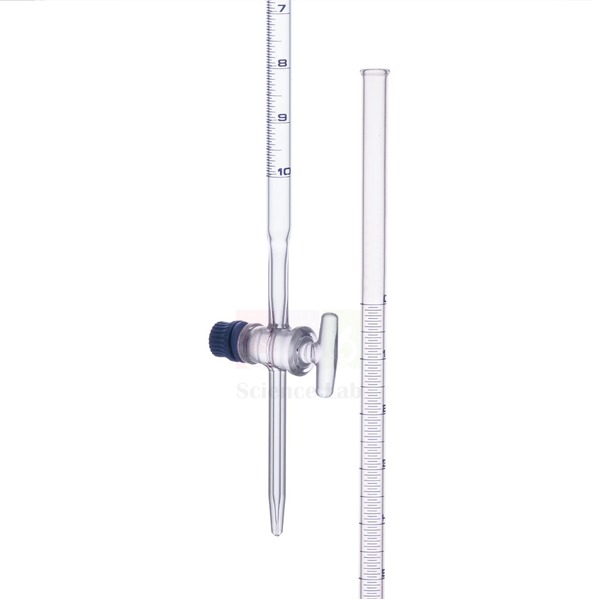
Burette, Class-B, with Glass Key
The Burette, Class-B, with Glass Key (Product Code: SLE/GBu/03) is a heavy-duty borosilicate glass burette fitted with a glass stopcock key and marked with blue graduations, intended for routine titrations in teaching and general-purpose chemical laboratories. It is produced in 10, 25, 50 and 100 ml capacities by Jain Scientific Equipments Pvt Ltd (ScienceLab), Ambala, and is a practical choice when stocking chemistry lab equipment for schools in India where Class B accuracy meets the requirement.
Specifications
| Parameter | Detail |
|---|---|
| Accuracy class | Class B |
| Material | Heavy-duty borosilicate glass |
| Stopcock | Glass key |
| Graduations | Blue |
| Capacities | 10 ml, 25 ml, 50 ml, 100 ml |
| Heat resistance | Heat resistant |
| Chemical resistance | Chemical resistant |
| Application | Chemical laboratory |
Typical Use
Secondary-school and undergraduate practicals — standardising an acid, finding the concentration of an alkali or estimating iron with permanganate — are well served by a Class B burette, whose tolerance is wider than Class A but entirely adequate for teaching. The 25 ml and 50 ml sizes are the usual choices for student benches, the 10 ml size suits small titres, and the 100 ml size is useful where a large volume of titrant is delivered. When equipping a school laboratory setup in India, many institutions use Class B burettes for student practicals and keep Class A burettes for staff and project work.
A glass key needs a thin film of stopcock grease to turn smoothly and seal; apply it sparingly to the key, away from the bore hole, so grease does not block the tip. Do not leave alkaline solutions standing in the burette, as they can cause a glass key to seize; drain and rinse promptly after use. For storage, remove the key or slip a strip of paper between key and barrel so that the two cannot stick together.
Manufacturer
Jain Scientific Equipments Private Limited, known to customers as ScienceLab, manufactures this burette in Ambala, Haryana. The company provides chemistry glassware and teaching apparatus to schools, colleges and laboratories throughout India and international markets. Company details are on the profile page.
Related Glassware Burettes
Alternatives and accessories for titration work with this burette:
- Burette, Class-B, with PTFE Key Stopcock — the same class with a grease-free PTFE key.
- Burettes — Class A burettes with PTFE key for work that needs a tighter tolerance.
- Burette Stand, Hard Wood, Double — a double stand for two burettes side by side.
- Conical Flask, Borosilicate Glass, Graduated — a titration vessel to swirl beneath the burette tip.
- Burette Brush — for cleaning the bore between practicals.
Compare all models in our Glassware Burettes category.
Frequently Asked Questions
Which capacities can I order?
10 ml, 25 ml, 50 ml and 100 ml.
What is the difference between Class B and Class A?
Class B burettes have a wider permitted tolerance than Class A. They suit teaching and routine work; for precise analysis, choose a Class A burette.
Does the glass key need grease?
Yes, a thin film of stopcock grease keeps it turning smoothly and prevents leaks. If you prefer a grease-free stopcock, see the Class B burette with PTFE key.
Can I use it for sodium hydroxide titrations?
Yes, but drain and rinse the burette promptly afterwards; alkali left in contact with a glass key can make it stick.
Can I order a replacement key?
Glass keys are normally matched to their own barrel, so please contact us with the size before ordering a spare.
Is a calibration certificate offered?
If your institution needs calibration documentation, raise it with us during the enquiry so we can advise what can be arranged.
How do I request a quotation for a class set?
Give the quantity in each capacity, any stands or flasks needed and the delivery location. We supply institutions in India and international markets.
Request a Quote
For a quotation on the Burette, Class-B, with Glass Key, use our contact page or add it to the enquiry cart with the rest of your titration list.
Last updated: 24 September 2026
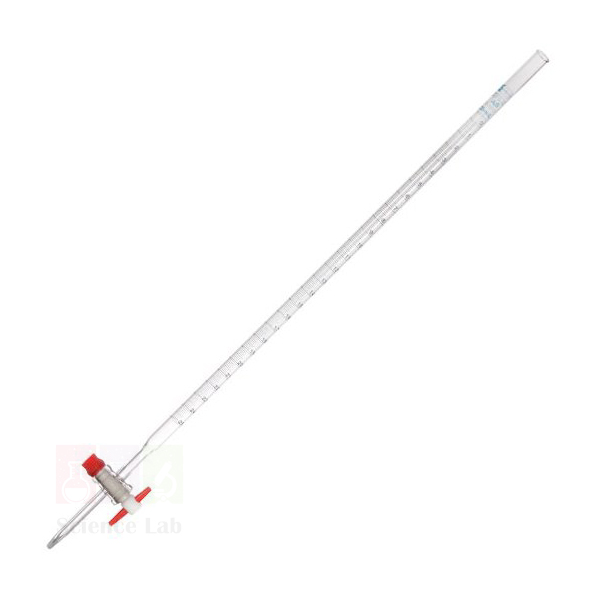
Burette, Class-B, with PTFE Key Stopcock
Burette, Class-B, with PTFE Key Stopcock (Product Code: SLE/GBu/04) is a graduated burette for delivering measured volumes of titrant, drawn in heavy-duty borosilicate glass and fitted with a PTFE key stopcock. It is intended for routine volumetric work in school, college and teaching laboratories, where Class B accuracy suits student titrations and practical examinations. The burette is made by Jain Scientific Equipments Pvt Ltd (ScienceLab), Ambala, as part of its borosilicate laboratory glassware in India and international markets.
Specifications
| Parameter | Detail |
|---|---|
| Type | Burette, Class B |
| Material | High-quality, heavy-duty borosilicate glass |
| Stopcock | PTFE key |
| Capacities | 5 ml, 10 ml, 25 ml, 50 ml, 100 ml |
| Scale | Graduated |
| Properties | Heat resistant; chemical resistant |
| Application | Chemical laboratory work such as titration |
Typical Use
In an acid–base titration the burette is clamped upright on a stand, rinsed with a little of the titrant, filled above the zero line and then run into a conical flask until the indicator changes colour. The volume used is simply the final reading minus the initial reading, both taken at eye level against the bottom of the meniscus. Before the first reading, open the stopcock briefly to push any trapped air out of the jet, as a bubble there is a common cause of error in student results.
A PTFE key is normally used without stopcock grease, so there is no lubricant to smear the bore or find its way into the solution — a practical advantage for chemistry lab equipment in schools in India, where the same burettes pass through many hands each week. The 25 ml and 50 ml sizes cover most school titrations, while the 5 ml and 10 ml sizes help when reagents are costly or only small volumes are available.
Manufacturer
This Class B burette is manufactured by Jain Scientific Equipments Private Limited, the company that trades as ScienceLab from Ambala, Haryana, India. The firm produces glassware and teaching apparatus for chemistry, physics and biology laboratories and supplies them to institutions and distributors. You can read about its background and product groups on the company profile page.
Related Laboratory Equipment
Items usually set up alongside this burette for a titration:
- Burette Clamp, Die Cast – Single Clamp — grips the burette upright on a stand rod
- Burette Stand — a steady support for the burette during the run
- Conical Flask — the receiving flask that can be swirled without splashing
- Burette Brush — a long brush for cleaning the bore after use
- Burette, Class-B, with Glass Key — the same class with a glass key, for labs that prefer it
See every burette type and accessory in our Glassware Burettes category.
Frequently Asked Questions
Which capacities can I order?
Five sizes are listed: 5 ml, 10 ml, 25 ml, 50 ml and 100 ml. Mention the size and number required for each in your enquiry.
What does Class B mean for this burette?
Class B is the general-purpose accuracy grade, with a wider permitted tolerance than Class A, which makes it well matched to teaching and routine work. For the tolerance figure of a particular size, please contact us.
Does the PTFE key need greasing?
Normally not. Keep the key and barrel clean, rinse after use and avoid over-tightening the retaining fitting so the key turns smoothly.
Can the burette be dried in a hot oven?
The borosilicate glass is heat resistant, but graduated volumetric glassware is usually left to drain and air-dry rather than being heated strongly, to protect the accuracy of the scale.
Is a calibration certificate available?
Please discuss your calibration documentation requirements with us through the contact page before ordering.
What should an institutional quotation request include?
List the capacities, quantity per size, delivery address and any packing or labelling needs; this lets us quote accurately for a school or college laboratory order.
Do you supply in bulk and for export?
Yes. Burettes are supplied in quantity to schools, colleges and distributors across India and international markets.
Request a Quote
For pricing and availability, send your requirement through our contact page, or add this burette to the enquiry cart together with the other glassware you need.
Last updated: 24 September 2026
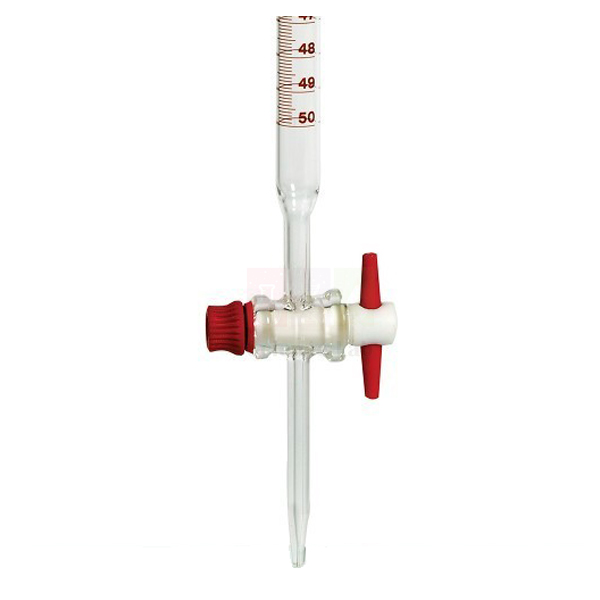
Burettes Detachable Stopcock
Burettes Detachable Stopcock (Product Code: SLE/GBu/05) are graduated borosilicate glass burettes whose PTFE key stopcock can be taken off the body, so the barrel, jet and key can be washed and dried separately. They suit teaching laboratories, college chemistry departments and quality-control benches that run titrations daily and want glassware that is easy to strip down and look after. The burettes are produced by Jain Scientific Equipments Pvt Ltd (ScienceLab), Ambala, for buyers of school chemistry lab equipment in India and abroad.
Specifications
| Parameter | Detail |
|---|---|
| Type | Burette with detachable stopcock |
| Stopcock key | PTFE |
| Body material | High-quality, heavy-duty borosilicate glass |
| Capacities | 5 ml, 10 ml, 25 ml, 50 ml, 100 ml |
| Scale | Graduated |
| Resistance | Heat resistant and chemical resistant |
| Used in | Chemical laboratories |
Typical Use
These burettes are used for volumetric analysis in the usual way — mounted vertically, filled with standard solution and read before and after delivery — but their real benefit shows at the end of the session. Coloured or reactive titrants can leave deposits in the stopcock bore, and with a fixed stopcock that area is hard to reach. Detaching the stopcock lets a technician clean the barrel with a brush, soak the key and jet separately, and let every part drain fully before storage.
When reassembling, seat the key squarely, fill the burette with water and leave it closed for a short time to confirm there is no drip at the jet before issuing it to students. Storing the stopcock loosened or removed during long breaks also helps prevent the key from sticking.
Manufacturer
ScienceLab is the brand name of Jain Scientific Equipments Private Limited, a company based in Ambala, Haryana, that makes laboratory glassware and teaching apparatus. The company is incorporated under CIN U29309HR2020PTC087597 and manufactures at its licensed factory at 449, HSIIDC Industrial Area, Saha, Ambala (Factory Licence AMB-ONLINE-CHD-J-414). More about the business is on our company profile.
Related Laboratory Equipment
Useful companions for a titration bench built around this burette:
- Burettes with detachable Stopcocks Schellbach Stripe — the same detachable design with a striped scale for easier reading
- Burettes with PTFE Needle Valve Stopcock — an alternative when finer drop-by-drop control is wanted
- Burette Stand, Hard Wood, Double — holds two burettes side by side, for example titrant and blank
- Burette Brush — reaches the full length of the barrel once the stopcock is removed
- Methyl Red (Indicator) — an indicator used in acid–base titrations
Compare other stopcock styles in the Glassware Burettes range.
Frequently Asked Questions
Why choose a detachable stopcock?
It can be removed from the burette, so the stopcock and bore are easier to clean, inspect and dry than on a fixed design.
What is the stopcock key made of?
PTFE. The body of the burette is heavy-duty borosilicate glass.
How do I check for leaks after refitting the stopcock?
Fill with water, close the key, clamp the burette upright and watch the jet for a few minutes. If it drips, reseat the key and test again before use.
Can I buy spare stopcocks separately?
Spare parts are not listed on this page. Please contact us with the burette size and we will advise.
Which sizes are made?
5 ml, 10 ml, 25 ml, 50 ml and 100 ml capacities are available, all graduated.
What about warranty and breakage in transit?
Please ask about warranty and transit-breakage terms when you request a quotation, so they are agreed in writing for your order.
Do you handle large and overseas orders?
Yes, we supply schools, colleges and distributors across India and international markets.
Request a Quote
Tell us the capacities and quantities you need through the contact form, or collect several items in the enquiry cart and send one combined request.
Last updated: 24 September 2026
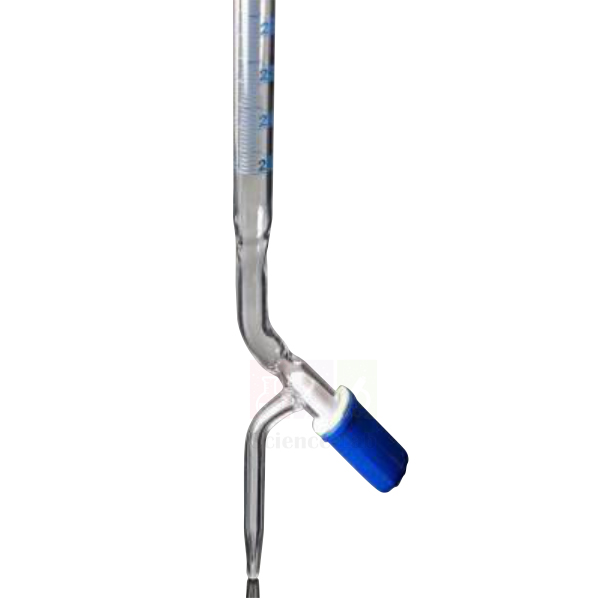
Burettes with PTFE Needle Valve Stopcock
Burettes with PTFE Needle Valve Stopcock (Product Code: SLE/GBu/06) combine a graduated borosilicate glass body with a Rotaflow-type PTFE needle valve in place of a conventional key. The valve gives a leakproof seal and finer control of flow, needs no lubrication and avoids the plug seizure that can affect ground stopcocks. They are chosen by college, university and analytical laboratories that want precise, drop-by-drop delivery near the end point, and are made by Jain Scientific Equipments Pvt Ltd (ScienceLab), Ambala, as part of its borosilicate laboratory glassware in India and for overseas buyers.
Specifications
| Parameter | Detail |
|---|---|
| Body | Borosilicate glass |
| Stopcock | Rotaflow-type PTFE needle valve |
| Valve benefits | Leakproof seal, finer flow control, no lubrication needed, no plug seizure |
| Capacities | 5 ml, 10 ml, 25 ml, 50 ml, 100 ml |
| Scale | Graduated |
| Properties | Heat resistant, chemical resistant |
| Application | Chemical laboratory titrations |
Typical Use
A needle valve opens progressively as it is turned, rather than in a single quarter-turn, so the operator can run titrant quickly at first and then slow it to single drops or even part-drops as the colour change approaches. That makes this burette well suited to titrations with gradual or subtle end points, to repeat determinations where readings must agree closely, and to teaching students careful end-point technique.
Open and close the valve with light finger pressure only; the seal comes from the PTFE needle seating in the glass, and forcing it closed does not improve the seal. Because no grease is used, the burette is simple to rinse and there is no lubricant to contaminate sensitive solutions. For stable readings, clamp it on a burette stand — a standard piece of chemistry lab equipment in India — with the jet just inside the neck of the receiving flask.
Manufacturer
These needle valve burettes come from Jain Scientific Equipments Private Limited, which markets its laboratory products under the ScienceLab name. The company works from Ambala in Haryana, India, and serves teaching and analytical laboratories at home and abroad. Visit the company profile for an overview of the organisation.
Related Laboratory Equipment
Pair this burette with the following for a complete titration set-up:
- Burette Stand with Clamp & Bosshead — stand, clamp and boss head for mounting the burette
- Flask, Conical, Wide Neck — a receiving flask with room for the jet and a wash-down
- Wash Bottle LDPE with Narrow Mouth — for rinsing a hanging part-drop into the flask
- Burette, Class-B, with PTFE Key Stopcock — a quarter-turn key alternative for routine class work
Other burette designs are listed under Glassware Burettes.
Frequently Asked Questions
How does a needle valve differ from a key stopcock?
A key opens with a quarter-turn, while a needle valve opens gradually as it is rotated, giving much finer control of flow near the end point.
Does the valve need stopcock grease?
No. The PTFE needle valve eliminates the need for lubrication, so there is no grease to wipe away or contaminate the titrant.
Will the valve stick if the burette is stored for a while?
The PTFE needle design is intended to avoid plug seizure. Rinse and drain the burette before storage and leave the valve lightly closed.
What accuracy class is this burette?
An accuracy class is not stated in our listing for this model. Please contact us if your method specifies one.
Which capacities can be supplied?
5 ml, 10 ml, 25 ml, 50 ml and 100 ml.
Is a calibration certificate provided?
Discuss calibration paperwork with us before you order, through the contact page.
Can laboratories order these in quantity?
Yes, we supply institutions and distributors in India and international markets; include sizes and quantities in your enquiry.
Request a Quote
Send the sizes and quantities you need via our contact page, or add this item to the enquiry cart to request a quotation with other glassware.
Last updated: 24 September 2026
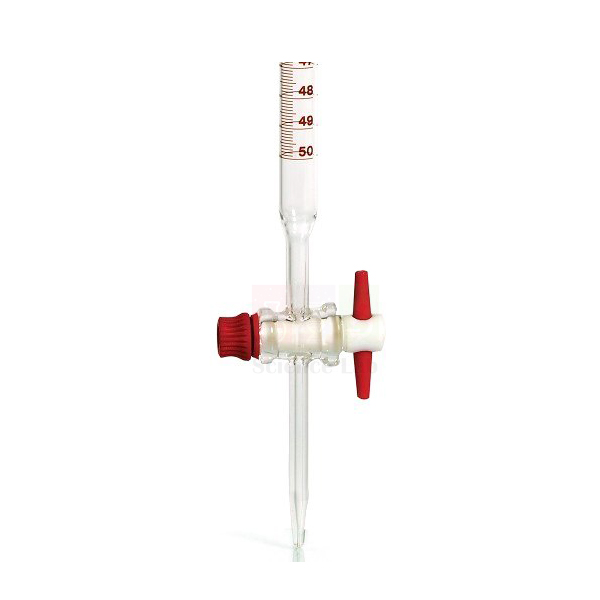
Burettes with PTFE Key Stopcock Schellbach Stripe
Burettes with PTFE Key Stopcock Schellbach Stripe (Product Code: SLE/GBu/07) pair a Schellbach-striped scale, which makes the meniscus easier to read, with a PTFE key stopcock that turns smoothly without grease. Made from high-quality, heavy-duty borosilicate glass and graduated along the tube, they are a good fit for practical examinations and busy student benches where quick, consistent readings matter. Jain Scientific Equipments Pvt Ltd (ScienceLab), Ambala, manufactures them alongside its wider borosilicate glassware in India and for international markets.
Specifications
| Parameter | Detail |
|---|---|
| Reading aid | Schellbach stripe |
| Stopcock | PTFE key |
| Glass | High-quality, heavy-duty borosilicate |
| Capacities | 5 ml, 10 ml, 25 ml, 50 ml, 100 ml |
| Graduation | Graduated scale |
| Resistance | Heat and chemicals |
| Field of use | Chemical laboratory |
Typical Use
A Schellbach stripe is typically a narrow coloured line on a white band running down the back of the burette. Seen through a clear liquid, the meniscus bends the stripe so that it appears to pinch to a point exactly at the liquid level, which gives a sharper reference than judging the curve of the meniscus alone. Students make fewer parallax errors, and a teacher checking readings across a room of benches can verify them quickly.
The burette is used in the familiar sequence of rinse, fill, clear the jet, take an initial reading and titrate to the end point, and it is a natural choice when assembling a chemistry titration kit for school acid–base practicals. Read the level where the stripe narrows to a point, and keep the burette vertical on its stand so the stripe stays directly behind the scale.
Manufacturer
Jain Scientific Equipments Private Limited operates under the ScienceLab brand from Ambala, Haryana, making glassware and apparatus for school, college and research laboratories. Buyers who want to know more about the company before ordering can see our company profile.
Related Laboratory Equipment
Other items used with this burette at the titration bench:
- Burette Clamp, Die Cast – Single Clamp — keeps the burette vertical so the stripe reads true
- Retort Stand — the stand rod and base to carry the clamp
- Conical Flask — the receiving vessel for the titration
- Burettes with Schellbach Stripe — the striped version with a glass key stopcock
- Burettes with detachable Stopcocks Schellbach Stripe — striped scale with a removable stopcock
The complete line-up is in our Glassware Burettes category.
Frequently Asked Questions
What does the Schellbach stripe do?
It gives a sharp visual marker at the meniscus, so the liquid level can be read more consistently and with less parallax error.
Is the stopcock glass or PTFE?
This model has a PTFE key. If you prefer a glass key with a Schellbach stripe, see Burettes with Schellbach Stripe in the list above.
Does the stripe help with dark or coloured solutions?
The effect is clearest with colourless liquids. With strongly coloured titrants the meniscus may need to be read at its top edge instead; follow the method your syllabus specifies.
What sizes are offered?
5 ml, 10 ml, 25 ml, 50 ml and 100 ml graduated burettes.
Can I get a calibration certificate?
Please raise any calibration documentation needs with us via the contact page so we can advise before you order.
How should the burette be cleaned?
Rinse with water straight after use, brush the barrel if residues remain, rinse with distilled water and let it drain upside down with the stopcock open.
Do you supply schools in bulk and export orders?
Yes, to institutions and distributors throughout India and international markets.
Request a Quote
Request pricing through our contact page, or place this burette in the enquiry cart with the rest of your laboratory list.
Last updated: 24 September 2026
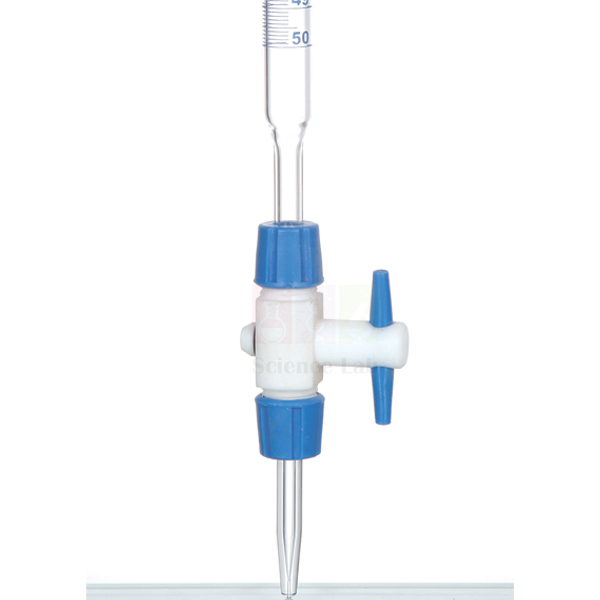
Burettes with detachable Stopcocks Schellbach Stripe
Burettes with detachable Stopcocks Schellbach Stripe (Product Code: SLE/GBu/08) bring together two practical features in one graduated burette: a Schellbach stripe for accurate meniscus reading and a PTFE key stopcock that can be removed for cleaning. The body is high-quality, heavy-duty borosilicate glass. This combination suits shared teaching laboratories where readings need to be reliable and the glassware must also be easy for technicians to service. It is made by Jain Scientific Equipments Pvt Ltd (ScienceLab), Ambala, a laboratory glassware manufacturer serving India and international markets.
Specifications
| Parameter | Detail |
|---|---|
| Scale feature | Schellbach stripe for accurate meniscus reading |
| Stopcock | Detachable, with PTFE key |
| Construction | High-quality, heavy-duty borosilicate glass |
| Sizes | 5 ml, 10 ml, 25 ml, 50 ml, 100 ml |
| Marking | Graduated |
| Heat and chemical resistance | Yes, both |
| Intended for | Chemical laboratory use |
Typical Use
During a practical, the stripe helps every student read the level the same way: the stripe appears to narrow to a point at the meniscus, and that point is taken as the reading. After the class, the stopcock is detached so the barrel can be brushed through end to end and the key rinsed on its own, which keeps the bore free of dried reagent and the stripe clearly visible for the next group.
When planning a school laboratory setup in India or elsewhere, departments often standardise on one burette pattern for all benches. This model is a sensible choice where both reading consistency and ease of maintenance are priorities. Check each reassembled burette with water for leaks before use, and store it with the stopcock removed or loosened.
Manufacturer
The manufacturer is Jain Scientific Equipments Private Limited, better known by its trading name ScienceLab. From Ambala in Haryana, the company supplies glassware, instruments and teaching aids to laboratories in India and abroad. Learn more on our company profile.
Related Laboratory Equipment
Commonly ordered with this burette:
- Burettes Detachable Stopcock — the same removable stopcock without the striped scale
- Burettes with PTFE Key Stopcock Schellbach Stripe — striped scale with a PTFE key stopcock
- Burette Stand, Hard Wood, Double — supports two burettes at one bench position
- Burette Brush — cleans the barrel once the stopcock is off
- Glass Beaker — for holding titrant while filling and for collecting rinsings
Browse all options in Glassware Burettes.
Frequently Asked Questions
What is different about this burette compared with a standard one?
It has both a Schellbach stripe for easier, more accurate meniscus reading and a stopcock that can be detached for cleaning.
What material is the stopcock key?
PTFE, fitted to a heavy-duty borosilicate glass burette.
How do I read the level with the stripe?
Keep your eye level with the liquid and read the graduation where the stripe appears to narrow to a point.
Which capacities are available?
5 ml, 10 ml, 25 ml, 50 ml and 100 ml.
Are replacement stopcocks available?
They are not listed separately here. Please contact us with the size and quantity you need.
Can you provide calibration documents?
Please discuss calibration documentation with us through the contact page before placing an order.
Is supply available for tenders and distributors?
Yes, we quote for institutional orders and distributor stock in India and international markets.
Request a Quote
Share your size-wise quantities through the contact page, or add this item to the enquiry cart to include it in a combined quotation.
Last updated: 24 September 2026

Burettes with Schellbach Stripe
Burettes with Schellbach Stripe (Product Code: SLE/GBu/09) are graduated, heavy-duty borosilicate glass burettes fitted with a traditional glass key stopcock and a Schellbach stripe for accurate meniscus reading. With glass for both the body and the key, they appeal to laboratories that prefer a conventional all-glass burette while still wanting the clearer reading the stripe provides. They are manufactured by Jain Scientific Equipments Pvt Ltd (ScienceLab), Ambala, among its borosilicate laboratory glassware in India and for international markets.
Specifications
| Parameter | Detail |
|---|---|
| Reading feature | Schellbach stripe for accurate meniscus reading |
| Stopcock | Glass key |
| Material | High-quality, heavy-duty borosilicate glass |
| Capacity options | 5 ml, 10 ml, 25 ml, 50 ml, 100 ml |
| Scale | Graduated |
| Properties | Heat resistant; chemical resistant |
| Used in | Chemical laboratories |
Typical Use
This burette is used for standard volumetric titrations — neutralisation, precipitation and redox methods — in school and college chemistry. Used with an acid base indicator kit, it lets students follow the colour change while the stripe gives a crisp reference point at the meniscus for each reading. Fill it with the help of a small funnel, then remove the funnel before titrating so drops from its stem do not alter the level.
A glass key needs a little care. Apply only a very thin film of stopcock grease to the key, keeping it clear of the bore, and wipe off any excess. After use, rinse the burette and, before storage, remove the key or place a thin strip of paper between key and barrel so the ground surfaces cannot stick together.
Manufacturer
ScienceLab burettes are made by Jain Scientific Equipments Private Limited, headquartered in Ambala, Haryana, India. Trading as ScienceLab, the company produces a broad catalogue of laboratory glassware and apparatus for education and research. Full company information is on the company profile page.
Related Laboratory Equipment
Items that complete a titration station with this burette:
- Burette Stand — holds the burette steady and vertical
- Glass Funnel — for filling the burette without spills
- Burette Brush — for cleaning the inside of the tube
- Burettes with PTFE Key Stopcock Schellbach Stripe — the striped design with a grease-free PTFE key
- Burette, Class-B, with Glass Key — a glass key burette without the stripe
For more choices, visit Glassware Burettes.
Frequently Asked Questions
Is the stopcock on this burette glass or PTFE?
It has a glass key stopcock. A PTFE key version with a Schellbach stripe is also listed in the related items above.
Does a glass key need grease?
Yes, a very thin film of stopcock grease keeps a glass key turning smoothly and sealing well. Keep grease out of the bore and jet.
How can I stop the key from seizing?
Clean and dry the key and barrel after use, and store the burette with the key removed or separated by a strip of paper.
Which sizes are available?
5 ml, 10 ml, 25 ml, 50 ml and 100 ml, each graduated with the Schellbach stripe.
Is a calibration certificate included?
Please check calibration documentation with us via the contact page before you place an order.
What details should a college include in its enquiry?
The capacity and number of each size, delivery location, and any requirement for spare keys, so we can respond with a complete quotation.
Can you supply overseas buyers?
Yes, we supply institutions and distributors in India and international markets.
Request a Quote
Ask for pricing through our contact page, or use the enquiry cart to list this burette with other items for one quotation.
Last updated: 24 September 2026
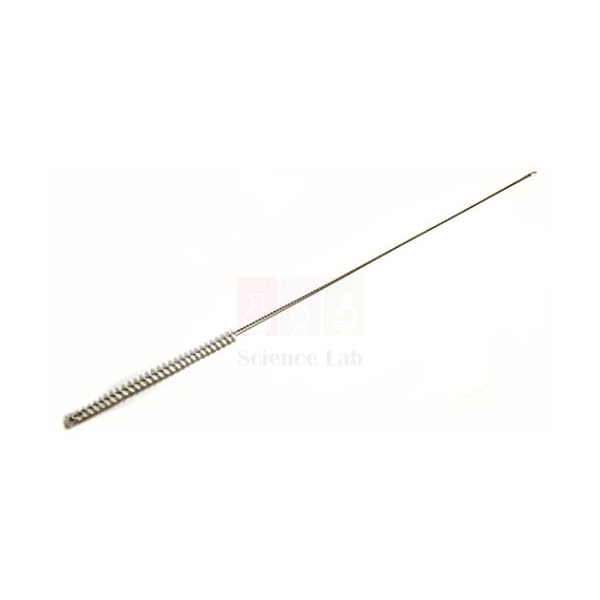
Burette Brush
Burette Brush (Product Code: SLE/GBu/10) is a long cleaning brush for the narrow barrel of a burette, measuring 24" overall with an 8.5" section of white nylon bristles and a 0.50" brush diameter. Its double thick gauge, wire-wound handle is heavy-duty yet flexible, so it can be pushed down a full-length burette tube. Laboratory technicians and students use it to clear reagent films and residues after titrations. It is manufactured by Jain Scientific Equipments Pvt Ltd (ScienceLab), Ambala, a lab consumables supplier in India and international markets.
Specifications
| Parameter | Detail |
|---|---|
| Overall length | 24" |
| Bristle section | 8.5", nylon bristles |
| Brush diameter | 0.50" |
| Bristle colour | White |
| Handle | Double thick gauge wire-wound, heavy-duty flexible metal |
| Purpose | Cleaning burettes and similar long, narrow glassware |
Typical Use
After a titration session, rinse the burette with tap water, wet the brush in a mild laboratory detergent solution and work it down the barrel from the top with a gentle twisting motion, then draw it back. The long handle reaches the lower graduations without the hand entering the tube, and the flexible wire lets the brush follow the tube rather than jamming. Finish with tap water and a final rinse of distilled water, and let the burette drain inverted.
Do not force the brush into the narrow jet below the stopcock; clean that part by flushing instead. Keep the twisted wire tip away from hard contact with the glass, rinse the brush after each use and hang it to dry. When bristles begin to splay or wear, replace the brush — a routine item for any chemistry consumables supplier in India to stock alongside other glassware cleaning tools.
Manufacturer
This brush is manufactured by Jain Scientific Equipments Private Limited, which trades as ScienceLab from Ambala, Haryana, India, and supports laboratories with glassware, apparatus and cleaning accessories. For vendor registration forms, the company's GSTIN is 06AAECJ8618A1ZT and its LEI is 3358004HRD1JIVXKYX49. Read more on our company profile.
Related Laboratory Equipment
Other cleaning tools and the glassware this brush is used on:
- Brush Burette — another burette brush option in our chemistry range
- Brush Test Tube — a shorter brush for test tubes
- Beaker Brush — for wide-mouth vessels such as beakers
- Wash Bottle LDPE with Narrow Mouth — for the final distilled-water rinse
- Burette, Class-B, with PTFE Key Stopcock — a burette this brush is used to clean
See burettes and accessories in Glassware Burettes.
Frequently Asked Questions
How long is the brush?
It is 24" long overall, with an 8.5" nylon bristle section.
Will it fit my burettes?
The brush diameter is 0.50". Compare this with the internal bore of your burettes; if you are unsure, contact us with the burette details.
Is the handle rigid or flexible?
Flexible. It is a double thick gauge, wire-wound handle made of heavy-duty flexible metal.
What are the bristles made of?
White nylon.
How many brushes come in a pack?
Pack quantity is not stated in our listing. Please mention the number you need and we will confirm packing in the quotation.
Can you supply brushes for a whole department or for export?
Yes, we supply schools, colleges and distributors in India and international markets.
Request a Quote
Send your quantity through our contact page, or add the brush to the enquiry cart with the burettes and glassware on your list.
Last updated: 20 November 2026

Burette Clamp, Die Cast – Single Clamp
Burette Clamp, Die Cast – Single Clamp (Product Code: SLE/GBu/12) is a die-cast retort clamp with a built-in boss head and a single burette clamp, used to hold one burette upright on a stand rod during titration. Spring-loaded jaws with rubber grips close on the burette quickly and hold it steadily, and the metal surfaces have a high-quality finish. It is supplied as a pack of 10 and manufactured by Jain Scientific Equipments Pvt Ltd (ScienceLab), Ambala, as part of the chemistry lab equipment it makes in India for schools, colleges and overseas buyers.
Specifications
| Parameter | Detail |
|---|---|
| Construction | Die-cast retort clamp |
| Type | Single (holds one burette) |
| Boss head | Built in |
| Jaws | Spring loaded, with rubber grips, for quick and stable clamping |
| Finish | High-quality finish to metal surfaces |
| Supplied as | Pack of 10 |
Typical Use
Slide the built-in boss head onto the rod of a retort stand and tighten it at a height that leaves the burette jet just inside the neck of the titration flask. Press the spring-loaded jaws open, place the burette between them and release; the rubber grips close around the glass so it stays upright without over-tightening. Because the boss head is part of the casting, there is no separate boss to lose, and the burette can be taken out and replaced in seconds when students refill or change solutions.
Check by eye that the burette hangs vertically before taking readings, and wipe the rubber grips clean if reagent is spilled on them. Supplied in packs of 10, the clamp is convenient for school lab equipment bulk supply, letting a department equip a full row of titration benches with matching fittings.
Manufacturer
The clamp is manufactured by Jain Scientific Equipments Private Limited, trading as ScienceLab, in Ambala, Haryana, India. The company was incorporated under CIN U29309HR2020PTC087597 and carries out production at its licensed factory in the HSIIDC Industrial Area at Saha, Ambala (Factory Licence AMB-ONLINE-CHD-J-414). For more on the company, see the company profile.
Related Laboratory Equipment
What you need to put this clamp to work:
- Retort Stand — the rod and base the clamp's boss head attaches to
- A-Shape Retort Stand Base — a stable base option for the stand rod
- Burette Clamp, Die Cast – Double Clamp — the twin version for two burettes on one rod
- Burette, Class-B, with PTFE Key Stopcock — a general-purpose burette to hold in the clamp
- Burettes with PTFE Needle Valve Stopcock — for finer flow control at the end point
More burettes and fittings are in the Glassware Burettes category.
Frequently Asked Questions
How many clamps are in one pack?
Each pack contains 10 clamps.
Do I need to buy a separate boss head?
No. The boss head is built into the die-cast body, so the clamp fixes straight onto a stand rod.
Can it hold two burettes?
No, this is the single type for one burette. For two burettes on one rod, choose the Burette Clamp, Die Cast – Double Clamp.
Will it fit the stand rods we already have?
The rod size range is not stated in our listing. Please contact us with your rod diameter and we will confirm.
Will the jaws mark or crack the glass?
The spring-loaded jaws are fitted with rubber grips, which cushion the burette while holding it firmly.
Is warranty cover offered?
Please ask about warranty terms when requesting your quotation so they are confirmed for your order.
Can you supply several packs for schools or distributors?
Yes, we manufacture multiple packs to institutions and distributors in India and international markets.
Request a Quote
Tell us how many packs you need through our contact page, or add this clamp to the enquiry cart with stands and burettes for a single quotation.
Last updated: 20 November 2026