- Physics Lab Equipment
- Chemistry Lab Equipment
- Biology Lab Equipment
- Anatomical Lab Equipment
- Learning
- Educational Lab Equipment
- Magnets
- Agriculture
- Astronomy
- Earth Science
- Geography Lab Equipment
- Safety Lab Coat
- Laboratory
- Meteorological
- Electricity & Magnetism
- Heat
- School Lab Equipment
- Lab Glassware
- Science Lab Equipment
- Tvet Lab Equipment
- Robotics Kits Supplier and Manufacturer for Schools India
- Math Lab Equipment Manufacturers and Exporters in Ambala
- STEM Kits Manufacturers and Supplier India
- Engineering Lab Equipment
- Hospital Lab Equipment
- Water, Sanitation & Hygiene Supplies
- Cold Chain, Solar & Communication Equipment
- Nutrition
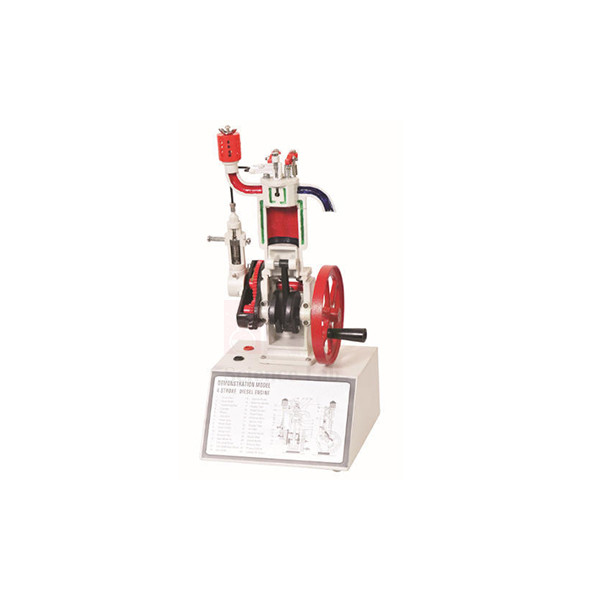
Section Model Of Four-Stroke Diesel Engine
The Section Model Of Four-Stroke Diesel Engine shows how a 100 cc indirect-injection diesel works, with its injection pump, injector, pre-chamber and glow plug opened up for view. Coloured internal surfaces mark air, fuel and gas mixture, and exhaust gas, and a 3-volt bulb lights at the firing point as the crankshaft is turned.
Diesel engine section model specifications
| Parameter | Detail |
|---|---|
| Engine type | Four-stroke diesel, indirect injection, sectioned for training |
| Displacement | 100 cc |
| Injection system | Injection pump, injector, pre-chamber, preheating glow plug |
| Fuel system details | Cam-operated jerk pump; manually operated air inlet diaphragm injection nozzle and starting valve |
| Valve train | Camshaft in the crankcase, overhead valves |
| Other parts shown | Rpm regulator, oil pump, air filter, silencer, tank, cooling system, distribution circuit |
| Firing indication | 3-volt bulb glows at the correct point in the cycle through an electrical contact system in the model |
| Colour coding | Internal surfaces coloured for air, fuel and gas mixture, and exhaust gas; parts, lubricating circuits, fuel and cooling systems in different colours |
| Dimensions and weight | 500 × 500 × 650 mm; 25 kg (approx.) |
| Product code | SLE/MCE/67 |
| Minimum order | 10 units |
| Dispatch | Usually within 7 to 10 working days |
| Manufacturer | ScienceLab (Jain Scientific Equipments Pvt Ltd), Ambala, India |
Diesel lessons on the section model
Finding the firing point. Turn the crankshaft slowly through the compression stroke and stop the moment the 3-volt bulb lights. Students mark the crank position, note that the piston is close to the top of its stroke, and explain why fuel must arrive just before that point to burn at the right time.
Tracing the fuel path. Starting at the tank, the class follows the fuel through the cam-operated jerk pump and the injector into the pre-chamber, then finds the glow plug used for cold starts and the starting valve. The diesel fuel injection system inline pump shows a full-size in-line pump element, and the diesel fuel injection system VE pump shows the distributor type.
Valves and lubrication. Students follow the drive from the camshaft in the crankcase to the overhead valves and say when each valve opens and closes. They then trace the lubricating circuit from the oil pump by its colour and name the parts it feeds.
Air and exhaust path. Using the coloured internal surfaces, students follow air from the air filter through the inlet valve into the cylinder, and exhaust gas out through the exhaust valve to the silencer. They then locate the cooling system and name the parts it keeps from overheating.
Frequently Asked Questions About the Section Model Of Four-Stroke Diesel Engine
Why does an indirect-injection diesel need a glow plug?
The small pre-chamber has a lot of wall area for its volume, so in a cold engine the compressed air loses heat to the metal before the fuel arrives. The glow plug heats the pre-chamber so that the first injections ignite. Once the engine is warm, the chamber walls stay hot enough and the plug is no longer needed.
How does indirect injection differ from direct injection?
In indirect injection, fuel is sprayed into a pre-chamber joined to the cylinder by a narrow passage. Burning starts there and a jet of gas carries it into the cylinder, which gives smoother, quieter running with simple injectors. Direct injection sprays straight into the cylinder, uses less fuel and starts more easily when cold, but needs higher injection pressure.
Why is only air drawn into a diesel cylinder?
Compression heats the air enough to ignite diesel fuel. If fuel came in with the air, it would ignite too early during the compression stroke. Fuel is injected only near the end of compression, so power is set by how much fuel is injected rather than by throttling the air.
How does a cam-operated jerk pump work?
A cam lifts the pump plunger. Once the plunger closes the fuel inlet, the trapped fuel is squeezed until it forces open the delivery valve and travels to the injector in a sharp spurt, which gives the pump its name. Injection ends when the plunger uncovers a spill port, and moving that point changes the quantity delivered.
What does the rpm regulator do?
A diesel has no throttle on the air, so without control it could stall at idle or run too fast with no load. The rpm regulator, or governor, moves the fuel control of the injection pump to hold the speed that has been set. Its stop position cuts the fuel to shut the engine down.
Why does air in the fuel line stop a diesel?
Air compresses where fuel does not, so a bubble in the pump or pipe takes up the plunger stroke and the injector never reaches its opening pressure. The engine misfires or will not start. Bleed the system at the filter and the pump until fuel without bubbles flows, then crank again.
Diesel engines, fuel injection and engine models
- Diesel Fuel Injection System Inline Pump
- Diesel Fuel Injection System VE pump
- 4 Stroke Diesel Engine
- Cut Section Model Of Four Stroke Petrol Engine
- Diesel Engine Fault Diagnosis Training Equipment Auto Fault
- Wankel Engine Model
To request a quotation, send the product name, code and quantity through our contact page or add the item to your enquiry cart.
Last updated: 15 November 2026
